
TL;DR
This paper introduces Kim-independence in NSOP$_{1}$ theories, generalizing non-forking independence, and demonstrates its key properties, characterizing NSOP$_{1}$ theories and connecting to known independence notions in specific algebraic structures.
Contribution
It defines Kim-independence for NSOP$_{1}$ theories and proves it satisfies essential properties, providing a new framework for understanding independence in these theories.
Findings
Kim-independence satisfies Kim's lemma, local character, symmetry, and an independence theorem.
These properties characterize NSOP$_{1}$ theories.
Kim-independence aligns with known notions in Frobenius fields and vector spaces with a generic bilinear form.
Abstract
We study NSOP theories. We define Kim-independence, which generalizes non-forking independence in simple theories and corresponds to non-forking at a generic scale. We show that Kim-independence satisfies a version of Kim's lemma, local character, symmetry, and an independence theorem and that, moreover, these properties individually characterize NSOP theories. We describe Kim-independence in several concrete theories and observe that it corresponds to previously studied notions of independence in Frobenius fields and vector spaces with a generic bilinear form.
Click any figure to enlarge with its caption.
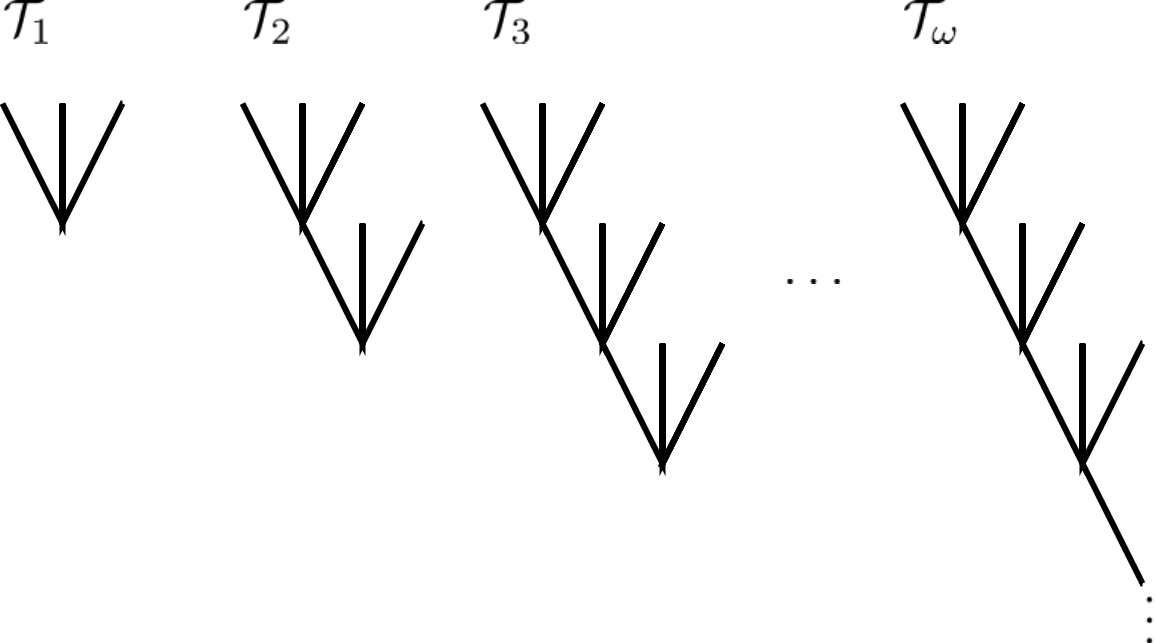 Figure 1
 Figure 2
Peer Reviews
No public reviews on file for this paper yet. If you reviewed it on a platform where reviews are public (OpenReview, ICLR, NeurIPS, ICML), you can paste yours below so the community can read it here.
Videos
No videos yet. Explain this paper in a talk, walkthrough, or lecture? Add one.
On Kim-Independence
Itay Kaplan and Nicholas Ramsey
Abstract.
We study NSOP1 theories. We define Kim-independence, which generalizes non-forking independence in simple theories and corresponds to non-forking at a generic scale. We show that Kim-independence satisfies a version of Kim’s lemma, local character, symmetry, and an independence theorem and that, moreover, these properties individually characterize NSOP1 theories. We describe Kim-independence in several concrete theories and observe that it corresponds to previously studied notions of independence in Frobenius fields and vector spaces with a generic bilinear form.
The first author would like to thank the Israel Science Foundation for partial support of this research (Grant no. 1533/14).
Contents
- 1 Introduction
- 2 Syntax
- 3 Kim-dividing
- 4 Local character
- 5 Symmetry
- 6 The Independence Theorem
- 7 Forking and Witnesses
- 8 Characterizing NSOP1 and Simple Theories
- 9 Examples
1. Introduction
The class of simple theories was one of the first classes of unstable theories to receive extensive study. The starting point is Classification Theory, where, in the course of studying stable theories, Shelah isolates local character as a key property of non-forking independence and observes a dichotomy in the way local character can fail, a theorem we now recognize as saying that a non-simple theory must have the tree property of the first or second kind [She90, Theorem III.7.11]. Shortly after the publication of the first edition of [She90], Shelah defined the class of simple theories and characterized them in terms of a certain chain condition of the Boolean algebra of non-weakly dividing formulas, which in turn led to consistency results on their saturation spectra [She80]. The aim of that work was to obtain an ‘outside’ set-theoretic definition of the class to support the claim that simplicity marked a dividing line. In separate developments, questions concerning concrete examples created the need for new methods to treat unstable structures. Hrushovski and Pillay used local stability and -rank in the study of the definability of groups in pseudo-finite and PAC fields in [HP94], and these methods were situated in the broader context of PAC structures studied by Hrushovski [Hru91], where an independence theorem was proved. Moreover, Lachlan’s far-reaching theory of smoothly approximated structures furnished examples of tame unstable theories. After Kantor, Liebeck, and Macpherson [KLM89] classified the primitive smoothly approximable structures, Cherlin and Hrushovski [CH03] used stability theoretic methods concerning independence and amalgamation to describe how these primitive pieces fit together to form a quasi-finite structure.
Kim’s thesis and subsequent work by Kim and Pillay showed how to regard these developments as instances of a common theory, with non-forking independence at its center [Kim98], [KP97]. Kim proved that in a simple theory, forking and dividing coincide, non-forking independence is symmetric and transitive, and Kim and Pillay proved that the independence theorem holds over models. Moreover, Kim showed that symmetry and transitivity of non-forking both individually characterize the simple theories, and Kim and Pillay showed that any independence relation satisfying the basic properties of non-forking independence must actually coincide with non-forking independence, giving both a striking characterization of the simple theories and a powerful method for showing that a particular theory is simple, namely by observing that it has an independence relation of the right kind.
Here, we study the class of NSOP1 theories. These are the theories which do not have the property SOP1, which form a class of theories that properly contain the simple theories and which are contained inside the class of theories without the tree property of the first kind. SOP1 was defined by Džamonja and Shelah in their study of the -order [DS04] and later studied by Shelah and Usvyatsov in [SU08]. The NSOP1 theories were characterized as the theories satisfying a weak independence theorem for invariant types by Chernikov and the second-named author in [CR16]. This characterization provided a point of contact between the combinatorics of model-theoretic tree properties and the study of definability in particular algebraic examples. Chatzidakis [Cha99], [Cha02] studied independence in -free PAC fields and, more generally, Frobenius fields and showed that the independence theorem holds for these structures even though they are not simple. Similarly, Granger showed in his thesis that the model companion of the theory of infinite-dimensional vector spaces with a bilinear form is not simple but nonetheless comes equipped with a good notion of independence. The amalgamation criterion of [CR16] established that these structures have NSOP1 theory by appealing to the existence of these independence relations, but what was missing was a theory of independence in NSOP1 theories more generally. The purpose of this paper is to establish exactly such a theory.
One central tool in the study of forking in simple theories is Kim’s lemma: in a simple theory, a formula divides over a set if and only if it divides with respect to some Morley sequence over if and only if it divides for all Morley sequences over . In [CK12], this was shown to hold over models in NTP2 theories, provided that the Morley sequence is a strict invariant Morley sequence. In the setting of NSOP1 theories, we find a new phenomenon: forking which is never witnessed by a generic sequence. In fact, we show that any NSOP1 theory with a universal witness to dividing must be simple (Proposition 8.7 below) and that forking need not equal dividing in an NSOP1 theory. Nonetheless, we find that, by restricting attention to the forking that is witnessed by a generic sequence, one can recover many of the properties of forking in simple theories. We show moreover that this kind of simplicity at a generic scale is characteristic of NSOP1 theories.
There is considerable freedom in the choice of notion of generic sequence. One suggestion which inspired our work is due to Kim, who proposed in his 2009 talk on NTP1 theories [Kim09] that one might develop an independence theory for NTP1 theories or a subclass therein by considering only formulas which divide with respect to every non-forking Morley sequence. Compared to invariance or finite satisfiability, forking is a relatively weak notion of independence and this notion proved unwieldy at the beginning stages of developing the theory presented here. However, Hrushovski’s study of -dividing [Hru12] and Malliaris and Shelah’s characterization of NTP1 theories in terms of higher formulas [MS15] provided evidence that one might be able to build a theory around an investigation of formulas that divide with respect to a Morley sequence in a global invariant or finitely satisfiable type. Building off this work, we introduce the notion of Kim-dividing – a formula Kim-divides over a set if it divides with respect to a Morley sequence in a global -invariant type – and the associated notion of independence, Kim-independence. Our first observation is that a theory is NSOP1 if and only if Kim-dividing satisfies a version of Kim’s lemma over models, where a formula divides with respect to a Morley sequence in some global invariant type extending the type of the parameters if and only if it divides with respect to every Morley sequence in an appropriate invariant type.
From Kim’s lemma for Kim-dividing, many familiar properties of non-forking independence follow: Kim-forking equals Kim-dividing, Kim-independence satisfies extension and a version of the chain condition, etc. In subsequent sections, we investigate additional properties of Kim-independence in NSOP1 theories and prove that, in many cases, these properties are characteristic of NSOP1. In Section 4 we observe a form of local character for Kim-independence in the context of NSOP1 theories. In Section 5, we show additionally that Kim-independence is symmetric over models. The argument there centers upon the notion of a tree Morley sequence which is defined in terms of indiscernible trees. We show that tree Morley sequences always witness Kim-dividing and prove a version of the chain condition for them. In Section 6, we prove the independence theorem. In Section 7, we prove that in an NSOP1 theory a formula Kim-divides over a model if and only if it divides with respect to every non-forking Morley sequence in the parameters and this too characterizes NSOP1 theories. This means that Kim-independence could have been defined from the outset in essentially the way Kim proposed, but curiously, proving anything about this notion without making use of invariant types seems quite difficult. In Section 8, we state our main theorem: Kim’s lemma for Kim-dividing, symmetry over models, and the independence theorem both hold in NSOP1 theories and individually characterize NSOP1 theories. We also show that the simple theories can be characterized in several new ways in terms of Kim-independence. In particular, we show that Kim-independence coincides with non-forking over models if and only if the theory is simple, which means that our theorems imply the corresponding facts for non-forking independence in a simple theory.
We conclude the paper with Section 9 where we describe Kim-independence explicitly in several concrete examples. We show it may be described in purely algebraic terms in the case of Frobenius fields, where Kim-independence turns out to coincide with weak independence, as defined by Chatzidakis. We also show that in Granger’s two-sorted theory of a vector space over an algebraically closed field with a generic bilinear form, Kim-independence is closely related to Granger’s -independence and may be given a simple algebraic description. These results suggest the naturality and robustness of Kim-dividing, but also serve to explain the simplicity-like phenomena observed in these concrete examples on the basis of a general theory. We additionally describe a combinatorial example of a NSOP1 theory, based on a variant of introduced by Džamonja and Shelah, which furnishes counter-examples to some a priori possible strengthenings of the results we prove. In particular, we give the first example of a simple non-cosimple type, answering a question of Chernikov [Che14], and the first example of an NSOP3 theory in which every complete type has a global non-forking extension but forking does not equal dividing, answering a question of Conant [Con14].
2. Syntax
In this section we will define SOP1 and prove its equivalence with a syntactic property of a different form. This will allow us to relate SOP1 to dividing. We will often work with arrays and trees. Suppose is an array. Write for the th row of the array and for the sequence of rows with index less than , i.e. . Suppose is a tree, is a collection of tuples indexed by . We write for the tree partial order and for the lexicographic order on . For a node , write for the sequence , and likewise for . We use the notation and similarly. If the tree is contained in or , we write to denote the element of the tree of length consisting of all zeros. Throughout the paper, denotes a complete theory and is a monster model of .
Definition 2.1**.**
[DS04, Definition 2.2] The formula has SOP1 if there is a collection of tuples so that
- •
For all , is consistent.
- •
For all , if , then is inconsistent.
We say is SOP1 if some formula has SOP1 modulo . is NSOP1 otherwise.
The following lemma is close to [CR16, Lemma 5.2], but with a key strengthening which will allow us to relax the -inconstency in the definition of SOP1 to a version with -inconsistency.
Lemma 2.2**.**
Suppose is an array where for all and and are formulas over . Write for and suppose
- (1)
For all , . 2. (2)
* is consistent.* 3. (3)
* is inconsistent.*
then has SOP1.
Proof.
By adding constants, we may assume . By Ramsey and compactness, we may assume is a -indiscernible sequence. By compactness again, we may extend the array to an array whose rows are indexed by the integers . We will construct, for each , a tree so that
- (1)
If , then is consistent. 2. (2)
If and then is inconsistent. 3. (3)
If , .
To define , we put . Now suppose we are given satisfying the requirements. There is an automorphism taking to fixing . Define by and, for all , , . Clearly all branches have the same type over as . Write for all . Now note that in both and conditions (1) and (2) are preserved and that is inconsistent with for any since is consistent if and only if is consistent, for . Likewise, instantiating along any branch through this tree yields something consistent: any branch in or has the same type over as and is consistent. We conclude by compactness. ∎
Lemma 2.3**.**
Suppose is a formula, is a natural number, and is an infinite sequence with satisfying:
- (1)
For all , . 2. (2)
* is consistent.* 3. (3)
* is -inconsistent.*
Then has SOP1.
Proof.
By compactness and Ramsey, it suffices to prove this when – so suppose is an indiscernible sequence with , is consistent, and is -inconsistent.
For integers , define a partial type by
[TABLE]
Let . Note that if is consistent then is consistent for any integer by indiscernibility of the sequence . Let be maximal so that is consistent. Note that is consistent, as it is the empty partial type and we have
[TABLE]
which is inconsistent, so . So now we know is consistent and is inconsistent. By indiscernibility and compactness, we may fix some integer so that
[TABLE]
is inconsistent. Now choose finite so that
[TABLE]
is inconsistent. Let indicate the tuple of variables and let be the formula . Let be defined as follows:
[TABLE]
Now choose so that – this is possible as . Then we put . Let .
To conclude, we have to establish the following:
Claim: The array and the formulas , satisfy the following:
- (1)
. 2. (2)
is consistent. 3. (3)
If then is inconsistent.
Proof of claim: (1) follows from the fact that and both and are enumerated in . Note that is consistent so, by indiscernibility,
[TABLE]
is consistent, which establishes (2). Finally, if , then implies
[TABLE]
By indiscernibility of and the fact that , this set is consistent if and only if
[TABLE]
is consistent. As this latter set is inconsistent, this shows (3), which proves the claim. The lemma now follows by Lemma 2.2. ∎
Finally, we note that the criterion for SOP1 from Lemma 2.3 is an equivalence. This was implicit in [CR16], at least in its -inconsistent version, but we think that the property described by Lemma 2.3 is, in most cases, the more fruitful way of thinking about SOP1 and therefore worth making explicit.
Proposition 2.4**.**
The following are equivalent, for a complete theory :
- (1)
* has SOP1.* 2. (2)
There is a formula and an array so that:
- (a)
* for all .* 2. (b)
* is consistent.* 3. (c)
* is -inconsistent.* 3. (3)
There is a formula and an array so that:
- (a)
* for all .* 2. (b)
* is consistent.* 3. (c)
* is -inconsistent for some .*
Proof.
(3)(1) is Lemma 2.3.
(1)(2). This follows from the proof of [CR16, Proposition 5.6].
(2)(3) is obvious. ∎
Remark 2.5*.*
Though the configurations described in (2) and (3) are not obviously preserved by expansion, SOP1 as defined in Definition 2.1 clearly is. It follows, then, that one can take to be indiscernible with respect to some Skolemization in the language of and, moreover, obtain for all (in fact, this is what the proof of [CR16, Proposition 5.6] directly shows).
3. Kim-dividing
3.1. Averages and Invariant Types
Definition 3.1**.**
A global type is called -invariant if implies if and only if . A global type is invariant if there is some small set such that is -invariant. If and are -invariant global types, then the type is defined to be for any and . We define by induction: and . When is a model, write a\mathop{\mathchoice{\kern 5.71527pt\hbox to0.0pt{\hss\mid\hss}\lower 3.87495pt\hbox to0.0pt{\hss\smile\hss}\kern 5.71527pt\displaystyle{}}{\kern 5.71527pt\hbox to0.0pt{\hss\mid\hss}\lower 3.87495pt\hbox to0.0pt{\hss\smile\hss}\kern 5.71527pt\textstyle{}}{\kern 5.71527pt\hbox to0.0pt{\hss\mid\hss}\lower 3.87495pt\hbox to0.0pt{\hss\smile\hss}\kern 5.71527pt\scriptstyle{}}{\kern 5.71527pt\hbox to0.0pt{\hss\mid\hss}\lower 3.87495pt\hbox to0.0pt{\hss\smile\hss}\kern 5.71527pt\scriptscriptstyle{}}}^{i}_{M}b to mean extends to a global -invariant type.
Fact 3.2**.**
[Sim15, Chapter 2] Given a global -invariant type and positive integer , is a well-defined -invariant global type. If is an -saturated model and satisfies whenever and , then extends uniquely to a global -invariant type.
Definition 3.3**.**
Suppose is an -invariant global type and is a linearly ordered set. By a *Morley sequence in * over of order type , we mean a sequence such that for each , where . Given a linear order , we will write for the -invariant global type so that if then for all .
The above definition of generalizes the finite tensor product – given any global -invariant type and linearly ordered set , one may easily show that exists and is -invariant, by Fact 3.2 and compactness.
Definition 3.4**.**
Let be a collection of tuples, a set, and an ultrafilter over . We define the *average type of * *over * to be the type defined by
[TABLE]
Fact 3.5**.**
[She90, Lemma 4.1] Let be a collection of tuples and an ultrafilter on .
- (1)
For every set , is a complete type over . 2. (2)
The global type is -invariant. 3. (3)
For any model , if , there is some ultrafilter on so that .
One important consequence of Fact 3.5 for us is that every type over a model extends to a global -invariant type: given , one chooses an ultrafilter so that . Then is a global type extending which is -invariant. In the arguments below, it will often be convenient to produce global invariant types through a particular choice of ultrafilter.
Fact 3.6**.**
[CK12, Remark 2.16] Write a\mathop{\mathchoice{\kern 5.71527pt\hbox to0.0pt{\hss\mid\hss}\lower 3.87495pt\hbox to0.0pt{\hss\smile\hss}\kern 5.71527pt\displaystyle{}}{\kern 5.71527pt\hbox to0.0pt{\hss\mid\hss}\lower 3.87495pt\hbox to0.0pt{\hss\smile\hss}\kern 5.71527pt\textstyle{}}{\kern 5.71527pt\hbox to0.0pt{\hss\mid\hss}\lower 3.87495pt\hbox to0.0pt{\hss\smile\hss}\kern 5.71527pt\scriptstyle{}}{\kern 5.71527pt\hbox to0.0pt{\hss\mid\hss}\lower 3.87495pt\hbox to0.0pt{\hss\smile\hss}\kern 5.71527pt\scriptscriptstyle{}}}^{u}_{A}b to mean that is finitely satisfiable in – the is for “ultrafilter” as this is equivalent to asserting for some ultrafilter on . The relation \mathop{\mathchoice{\kern 5.71527pt\hbox to0.0pt{\hss\mid\hss}\lower 3.87495pt\hbox to0.0pt{\hss\smile\hss}\kern 5.71527pt\displaystyle{}}{\kern 5.71527pt\hbox to0.0pt{\hss\mid\hss}\lower 3.87495pt\hbox to0.0pt{\hss\smile\hss}\kern 5.71527pt\textstyle{}}{\kern 5.71527pt\hbox to0.0pt{\hss\mid\hss}\lower 3.87495pt\hbox to0.0pt{\hss\smile\hss}\kern 5.71527pt\scriptstyle{}}{\kern 5.71527pt\hbox to0.0pt{\hss\mid\hss}\lower 3.87495pt\hbox to0.0pt{\hss\smile\hss}\kern 5.71527pt\scriptscriptstyle{}}}^{u} satisfies both left and right extension over models:
- (1)
(Left extension) If is a model and a\mathop{\mathchoice{\kern 5.71527pt\hbox to0.0pt{\hss\mid\hss}\lower 3.87495pt\hbox to0.0pt{\hss\smile\hss}\kern 5.71527pt\displaystyle{}}{\kern 5.71527pt\hbox to0.0pt{\hss\mid\hss}\lower 3.87495pt\hbox to0.0pt{\hss\smile\hss}\kern 5.71527pt\textstyle{}}{\kern 5.71527pt\hbox to0.0pt{\hss\mid\hss}\lower 3.87495pt\hbox to0.0pt{\hss\smile\hss}\kern 5.71527pt\scriptstyle{}}{\kern 5.71527pt\hbox to0.0pt{\hss\mid\hss}\lower 3.87495pt\hbox to0.0pt{\hss\smile\hss}\kern 5.71527pt\scriptscriptstyle{}}}^{u}_{M}b then for all , there is some so that ad\mathop{\mathchoice{\kern 5.71527pt\hbox to0.0pt{\hss\mid\hss}\lower 3.87495pt\hbox to0.0pt{\hss\smile\hss}\kern 5.71527pt\displaystyle{}}{\kern 5.71527pt\hbox to0.0pt{\hss\mid\hss}\lower 3.87495pt\hbox to0.0pt{\hss\smile\hss}\kern 5.71527pt\textstyle{}}{\kern 5.71527pt\hbox to0.0pt{\hss\mid\hss}\lower 3.87495pt\hbox to0.0pt{\hss\smile\hss}\kern 5.71527pt\scriptstyle{}}{\kern 5.71527pt\hbox to0.0pt{\hss\mid\hss}\lower 3.87495pt\hbox to0.0pt{\hss\smile\hss}\kern 5.71527pt\scriptscriptstyle{}}}^{u}_{M}b^{\prime}. 2. (2)
(Right extension) If is a model and a\mathop{\mathchoice{\kern 5.71527pt\hbox to0.0pt{\hss\mid\hss}\lower 3.87495pt\hbox to0.0pt{\hss\smile\hss}\kern 5.71527pt\displaystyle{}}{\kern 5.71527pt\hbox to0.0pt{\hss\mid\hss}\lower 3.87495pt\hbox to0.0pt{\hss\smile\hss}\kern 5.71527pt\textstyle{}}{\kern 5.71527pt\hbox to0.0pt{\hss\mid\hss}\lower 3.87495pt\hbox to0.0pt{\hss\smile\hss}\kern 5.71527pt\scriptstyle{}}{\kern 5.71527pt\hbox to0.0pt{\hss\mid\hss}\lower 3.87495pt\hbox to0.0pt{\hss\smile\hss}\kern 5.71527pt\scriptscriptstyle{}}}^{u}_{M}b then for all , there is some so that a^{\prime}\mathop{\mathchoice{\kern 5.71527pt\hbox to0.0pt{\hss\mid\hss}\lower 3.87495pt\hbox to0.0pt{\hss\smile\hss}\kern 5.71527pt\displaystyle{}}{\kern 5.71527pt\hbox to0.0pt{\hss\mid\hss}\lower 3.87495pt\hbox to0.0pt{\hss\smile\hss}\kern 5.71527pt\textstyle{}}{\kern 5.71527pt\hbox to0.0pt{\hss\mid\hss}\lower 3.87495pt\hbox to0.0pt{\hss\smile\hss}\kern 5.71527pt\scriptstyle{}}{\kern 5.71527pt\hbox to0.0pt{\hss\mid\hss}\lower 3.87495pt\hbox to0.0pt{\hss\smile\hss}\kern 5.71527pt\scriptscriptstyle{}}}^{u}_{M}bc.
Definition 3.7**.**
Suppose and is an -indiscernible sequence. A global -invariant type is called an indiscernible type if whenenver , is -indiscernible.
Definition 3.8**.**
A collection of sequences where is called a mutually indiscernible array over a set of parameters if, for each , the sequence is an indiscernible sequence over .
The following two lemmas are essentially [Adl14, Lemma 8]. We include a proof for completeness.
Lemma 3.9**.**
If is an -indiscernible sequence, there is an indiscernible global -invariant type .
Proof.
Let be an -saturated elementary extension of of size and let be an arbitrary global -invariant type extending . Let . By Ramsey and compactness, we may extract from an -indiscernible sequence . Clearly extends . It is also -invariant: if not, there are in , an increasing -tuple from , and a formula so that
[TABLE]
Then there is an increasing -tuple so that
[TABLE]
since the sequence is extracted from . This contradicts the fact that realizes an -invariant type over . By Fact 3.2, the type determines a unique -invariant extension to . Call it . Then is an indiscernible type. ∎
Lemma 3.10**.**
Suppose , is an -indiscernible sequence, and is a global -invariant indiscernible type. Let with , where . Then is a mutually indiscernible array over .
Proof.
We prove by induction on that is mututally indiscernible over . For , there’s nothing to prove. Suppose it’s been shown for and consider . As is an indiscernible type, is -indiscernible. For , we know, by induction, that is -indiscernible. As , this entails is indiscernible over , which completes the induction. ∎
3.2. Kim-dividing
In this subsection, we define Kim-dividing and Kim-forking, the fundamental notions explored in this paper. To start, we will need the definition of -dividing, introduced by Hrushovski in [Hru12, Section 2.1]:
Definition 3.11**.**
Suppose is an -invariant global type. The formula -divides over if for some (equivalently, any) Morley sequence in over , is inconsistent.
We note that we will consistently use the letters to refer to types, to refer to numbers. In this way, no confusion between -dividing and the more familiar -dividing will arise.
The related notion of a higher formula was introduced by Malliaris and Shelah in [MS15] on the way to a new characterization of NTP1 theories:
Definition 3.12**.**
[MS15, Definition 8.6] A higher formula is a triple where is a formula, is a set of parameters, and is an ultrafilter on so that, if and then is consistent.
We can rephrase the above definition as: is a higher formula if, setting , does not -divide over .
Definition 3.13**.**
We say that a formula Kim-divides over if there is some -invariant global type so that -divides. The formula Kim-forks over if and each Kim-divides over . A type Kim-forks if it implies a formula which does. If does not Kim-fork over , we write a\mathop{\mathchoice{\kern 5.71527pt\hbox to0.0pt{\hss\mid\hss}\lower 3.87495pt\hbox to0.0pt{\hss\smile\hss}\kern 5.71527pt\displaystyle{}}{\kern 5.71527pt\hbox to0.0pt{\hss\mid\hss}\lower 3.87495pt\hbox to0.0pt{\hss\smile\hss}\kern 5.71527pt\textstyle{}}{\kern 5.71527pt\hbox to0.0pt{\hss\mid\hss}\lower 3.87495pt\hbox to0.0pt{\hss\smile\hss}\kern 5.71527pt\scriptstyle{}}{\kern 5.71527pt\hbox to0.0pt{\hss\mid\hss}\lower 3.87495pt\hbox to0.0pt{\hss\smile\hss}\kern 5.71527pt\scriptscriptstyle{}}}^{K}_{A}b.
We call this notion Kim-dividing to make explicit the fact that this definition was inspired by a suggestion of Kim in his 2009 BIRS talk [Kim09], where he proposed an independence relation based on instances of dividing that are witnessed by every appropriate Morley sequence. A rough connection between Kim’s notion and ours is provided by Theorem 3.16 below, which shows that, in an NSOP1 theory, dividing with respect some invariant Morley sequence is equivalent to dividing with respect to all. An even tighter connection is established by Theorem 7.7, which shows that we can drop the assumption that the Morley sequences are generated by an invariant type. (We note that for technical reasons our notion is still different from Kim’s – the proposal of [Kim09] forces a kind of base monotonicity and we do not).
In general, we only know that a type over has a global -invariant extension when is a model. Thus, when working with Kim-independence below, we will restrict ourselves almost entirely to the case where the base is a model.
The next two propositions explain how the notions of higher formula and -dividing interact with SOP1.
Proposition 3.14**.**
Suppose has SOP1. Then there is a model , a formula , and ultrafilters on with
[TABLE]
so that is higher but is not higher.
Proof.
Fix a Skolemization of . As has SOP1, there is, by Proposition 2.4, a formula and an array such that
- (1)
is an indiscernible sequence (with respect to the Skolemized language) 2. (2)
. 3. (3)
is consistent. 4. (4)
If , then is inconsistent.
Put . For , let be any non-principal ultrafilter on , concentrating on and set for . Note that by (2). By (3), does not -divide, hence is higher. However, by (4), is -inconsistent hence -divides, so is not higher. ∎
Proposition 3.15**.**
Suppose is a set of parameters and is a formula which -divides over for some global -invariant type . If there is some global -invariant such that does not -divide, then has SOP1.
Proof.
As -divides over , there is so that instances of instantiated on a Morley sequence of are -inconsistent.
Let . We have to check that the sequence satisfies the following properties:
- (1)
is consistent 2. (2)
is -inconsistent 3. (3)
for all .
Note that so (1) follows from our assumption that does not -divide. Likewise, so (2) follows from the fact that -divides. Finally, for any , we have realizes a global -invariant type over . Hence (3) follows from the fact that . ∎
Theorem 3.16**.**
The following are equivalent for the complete theory :
- (1)
* is NSOP1* 2. (2)
Ultrafilter independence of higher formulas: for every model , and ultrafilters and on with , is higher if and only if is higher. 3. (3)
Kim’s lemma for Kim-dividing: For every model and , if -divides for some global -invariant , then -divides for every global -invariant .
Proof.
(1)(3) is the contrapositive of Proposition 3.15.
(2)(1) is the contrapositive of Proposition 3.14.
(3)(2): Immediate, since every type finitely satisfiable in is -invariant. ∎
Remark 3.17*.*
Note that the proof gives a bit more: if is NSOP1, (2) is true over arbitrary sets and (3) is true over an arbitrary set as well, though this may be vacuous if does not extend to a global -invariant type.
3.3. The basic properties of Kim-independence
Theorem 3.16, a kind of Kim’s lemma for Kim-dividing, already gives a powerful tool for proving that in NSOP1 theories Kim-independence enjoys many of the properties known to hold for non-forking independence in simple theories.
We will frequently use the following easy observation. The proof is exactly as in the case of dividing. See, e.g., [GIL02, Lemma 1.5] or [She80, Lemma 1.4].
Lemma 3.18**.**
(Basic Characterization of Kim-dividing) Suppose is an arbitrary complete theory. The following are equivalent:
- (1)
* does not Kim-divide over .* 2. (2)
For any global -invariant and with , there is such that is -indiscernible. 3. (3)
For any global -invariant and with , there is such that is -indiscernible.
Note that in an NSOP1 theory, by Kim’s Lemma for Kim-dividing, we could have replaced (2) by: there is a global -invariant and with , so that for some is -indiscernible (and similarly for (3)), provided extends to a global -invariant type.
The following proposition is proved by the same argument one uses to prove forking = dividing via Kim’s lemma, as in [GIL02, Theorem 2.5] or [CK12, Corollary 3.16].
Proposition 3.19**.**
(Kim-forking = Kim-dividing) Suppose is NSOP1. If , if Kim-forks over then Kim-divides over .
Proof.
Suppose where each Kim-divides over . Fix an ultrafilter on so that . Let be a Morley sequence in . Then is an -invariant Morley sequence. We must show is inconsistent. Suppose not – let . We have so for each , there is so that . By the pigeonhole principle, there is so that is infinite. Then is an -invariant Morley sequence in . As is NSOP1, Kim-dividing over is witnessed by any -invariant Morley sequence so is inconsistent. But , a contradiction. ∎
Proposition 3.20**.**
(Extension over Models) Suppose is a model, and a\mathop{\mathchoice{\kern 5.71527pt\hbox to0.0pt{\hss\mid\hss}\lower 3.87495pt\hbox to0.0pt{\hss\smile\hss}\kern 5.71527pt\displaystyle{}}{\kern 5.71527pt\hbox to0.0pt{\hss\mid\hss}\lower 3.87495pt\hbox to0.0pt{\hss\smile\hss}\kern 5.71527pt\textstyle{}}{\kern 5.71527pt\hbox to0.0pt{\hss\mid\hss}\lower 3.87495pt\hbox to0.0pt{\hss\smile\hss}\kern 5.71527pt\scriptstyle{}}{\kern 5.71527pt\hbox to0.0pt{\hss\mid\hss}\lower 3.87495pt\hbox to0.0pt{\hss\smile\hss}\kern 5.71527pt\scriptscriptstyle{}}}^{K}_{M}b. Then for any , there is so that a^{\prime}\mathop{\mathchoice{\kern 5.71527pt\hbox to0.0pt{\hss\mid\hss}\lower 3.87495pt\hbox to0.0pt{\hss\smile\hss}\kern 5.71527pt\displaystyle{}}{\kern 5.71527pt\hbox to0.0pt{\hss\mid\hss}\lower 3.87495pt\hbox to0.0pt{\hss\smile\hss}\kern 5.71527pt\textstyle{}}{\kern 5.71527pt\hbox to0.0pt{\hss\mid\hss}\lower 3.87495pt\hbox to0.0pt{\hss\smile\hss}\kern 5.71527pt\scriptstyle{}}{\kern 5.71527pt\hbox to0.0pt{\hss\mid\hss}\lower 3.87495pt\hbox to0.0pt{\hss\smile\hss}\kern 5.71527pt\scriptscriptstyle{}}}^{K}_{M}bc.
Proof.
This is exactly as in the usual proof that forking satisfies extension. Let . We claim that the following set of formulas is consistent:
[TABLE]
If this set of formulas is not consistent, then by compactness,
[TABLE]
where each Kim-divides over . It follows that Kim-forks over , a contradiction. So this set is consistent and we may choose a realization . Then a^{\prime}\mathop{\mathchoice{\kern 5.71527pt\hbox to0.0pt{\hss\mid\hss}\lower 3.87495pt\hbox to0.0pt{\hss\smile\hss}\kern 5.71527pt\displaystyle{}}{\kern 5.71527pt\hbox to0.0pt{\hss\mid\hss}\lower 3.87495pt\hbox to0.0pt{\hss\smile\hss}\kern 5.71527pt\textstyle{}}{\kern 5.71527pt\hbox to0.0pt{\hss\mid\hss}\lower 3.87495pt\hbox to0.0pt{\hss\smile\hss}\kern 5.71527pt\scriptstyle{}}{\kern 5.71527pt\hbox to0.0pt{\hss\mid\hss}\lower 3.87495pt\hbox to0.0pt{\hss\smile\hss}\kern 5.71527pt\scriptscriptstyle{}}}^{K}_{M}bc and . ∎
Proposition 3.21**.**
(Chain Condition for Invariant Morley Sequences) Suppose is NSOP1 and . If a\mathop{\mathchoice{\kern 5.71527pt\hbox to0.0pt{\hss\mid\hss}\lower 3.87495pt\hbox to0.0pt{\hss\smile\hss}\kern 5.71527pt\displaystyle{}}{\kern 5.71527pt\hbox to0.0pt{\hss\mid\hss}\lower 3.87495pt\hbox to0.0pt{\hss\smile\hss}\kern 5.71527pt\textstyle{}}{\kern 5.71527pt\hbox to0.0pt{\hss\mid\hss}\lower 3.87495pt\hbox to0.0pt{\hss\smile\hss}\kern 5.71527pt\scriptstyle{}}{\kern 5.71527pt\hbox to0.0pt{\hss\mid\hss}\lower 3.87495pt\hbox to0.0pt{\hss\smile\hss}\kern 5.71527pt\scriptscriptstyle{}}}^{K}_{M}b and is a global -invariant type, then for any with , there is so that a^{\prime}\mathop{\mathchoice{\kern 5.71527pt\hbox to0.0pt{\hss\mid\hss}\lower 3.87495pt\hbox to0.0pt{\hss\smile\hss}\kern 5.71527pt\displaystyle{}}{\kern 5.71527pt\hbox to0.0pt{\hss\mid\hss}\lower 3.87495pt\hbox to0.0pt{\hss\smile\hss}\kern 5.71527pt\textstyle{}}{\kern 5.71527pt\hbox to0.0pt{\hss\mid\hss}\lower 3.87495pt\hbox to0.0pt{\hss\smile\hss}\kern 5.71527pt\scriptstyle{}}{\kern 5.71527pt\hbox to0.0pt{\hss\mid\hss}\lower 3.87495pt\hbox to0.0pt{\hss\smile\hss}\kern 5.71527pt\scriptscriptstyle{}}}_{M}I and is -indiscernible.
Proof.
By the basic characterization of Kim-dividing, Lemma 3.18, given a\mathop{\mathchoice{\kern 5.71527pt\hbox to0.0pt{\hss\mid\hss}\lower 3.87495pt\hbox to0.0pt{\hss\smile\hss}\kern 5.71527pt\displaystyle{}}{\kern 5.71527pt\hbox to0.0pt{\hss\mid\hss}\lower 3.87495pt\hbox to0.0pt{\hss\smile\hss}\kern 5.71527pt\textstyle{}}{\kern 5.71527pt\hbox to0.0pt{\hss\mid\hss}\lower 3.87495pt\hbox to0.0pt{\hss\smile\hss}\kern 5.71527pt\scriptstyle{}}{\kern 5.71527pt\hbox to0.0pt{\hss\mid\hss}\lower 3.87495pt\hbox to0.0pt{\hss\smile\hss}\kern 5.71527pt\scriptscriptstyle{}}}^{K}_{M}b, a global -invariant type, and with , there is so that is -indiscernible. To prove the proposition it suffices to show a^{\prime}\mathop{\mathchoice{\kern 5.71527pt\hbox to0.0pt{\hss\mid\hss}\lower 3.87495pt\hbox to0.0pt{\hss\smile\hss}\kern 5.71527pt\displaystyle{}}{\kern 5.71527pt\hbox to0.0pt{\hss\mid\hss}\lower 3.87495pt\hbox to0.0pt{\hss\smile\hss}\kern 5.71527pt\textstyle{}}{\kern 5.71527pt\hbox to0.0pt{\hss\mid\hss}\lower 3.87495pt\hbox to0.0pt{\hss\smile\hss}\kern 5.71527pt\scriptstyle{}}{\kern 5.71527pt\hbox to0.0pt{\hss\mid\hss}\lower 3.87495pt\hbox to0.0pt{\hss\smile\hss}\kern 5.71527pt\scriptscriptstyle{}}}^{K}_{M}b_{<n} for all . Given , let . Then and, by indiscernibility,
[TABLE]
As is NSOP1, this shows a^{\prime}\mathop{\mathchoice{\kern 5.71527pt\hbox to0.0pt{\hss\mid\hss}\lower 3.87495pt\hbox to0.0pt{\hss\smile\hss}\kern 5.71527pt\displaystyle{}}{\kern 5.71527pt\hbox to0.0pt{\hss\mid\hss}\lower 3.87495pt\hbox to0.0pt{\hss\smile\hss}\kern 5.71527pt\textstyle{}}{\kern 5.71527pt\hbox to0.0pt{\hss\mid\hss}\lower 3.87495pt\hbox to0.0pt{\hss\smile\hss}\kern 5.71527pt\scriptstyle{}}{\kern 5.71527pt\hbox to0.0pt{\hss\mid\hss}\lower 3.87495pt\hbox to0.0pt{\hss\smile\hss}\kern 5.71527pt\scriptscriptstyle{}}}^{K}_{M}b_{<n}. ∎
Section 5 will be dedicated to the proof that \mathop{\mathchoice{\kern 5.71527pt\hbox to0.0pt{\hss\mid\hss}\lower 3.87495pt\hbox to0.0pt{\hss\smile\hss}\kern 5.71527pt\displaystyle{}}{\kern 5.71527pt\hbox to0.0pt{\hss\mid\hss}\lower 3.87495pt\hbox to0.0pt{\hss\smile\hss}\kern 5.71527pt\textstyle{}}{\kern 5.71527pt\hbox to0.0pt{\hss\mid\hss}\lower 3.87495pt\hbox to0.0pt{\hss\smile\hss}\kern 5.71527pt\scriptstyle{}}{\kern 5.71527pt\hbox to0.0pt{\hss\mid\hss}\lower 3.87495pt\hbox to0.0pt{\hss\smile\hss}\kern 5.71527pt\scriptscriptstyle{}}}^{K} is symmetric in NSOP1 theories. The argument will require more tools, but at this stage we can already observe the converse: even a weak form of symmetry for \mathop{\mathchoice{\kern 5.71527pt\hbox to0.0pt{\hss\mid\hss}\lower 3.87495pt\hbox to0.0pt{\hss\smile\hss}\kern 5.71527pt\displaystyle{}}{\kern 5.71527pt\hbox to0.0pt{\hss\mid\hss}\lower 3.87495pt\hbox to0.0pt{\hss\smile\hss}\kern 5.71527pt\textstyle{}}{\kern 5.71527pt\hbox to0.0pt{\hss\mid\hss}\lower 3.87495pt\hbox to0.0pt{\hss\smile\hss}\kern 5.71527pt\scriptstyle{}}{\kern 5.71527pt\hbox to0.0pt{\hss\mid\hss}\lower 3.87495pt\hbox to0.0pt{\hss\smile\hss}\kern 5.71527pt\scriptscriptstyle{}}}^{K} will imply that a theory is NSOP1.
Proposition 3.22**.**
The following are equivalent for a complete theory :
- (1)
* is NSOP1.* 2. (2)
Weak symmetry: if , then b\mathop{\mathchoice{\kern 5.71527pt\hbox to0.0pt{\hss\mid\hss}\lower 3.87495pt\hbox to0.0pt{\hss\smile\hss}\kern 5.71527pt\displaystyle{}}{\kern 5.71527pt\hbox to0.0pt{\hss\mid\hss}\lower 3.87495pt\hbox to0.0pt{\hss\smile\hss}\kern 5.71527pt\textstyle{}}{\kern 5.71527pt\hbox to0.0pt{\hss\mid\hss}\lower 3.87495pt\hbox to0.0pt{\hss\smile\hss}\kern 5.71527pt\scriptstyle{}}{\kern 5.71527pt\hbox to0.0pt{\hss\mid\hss}\lower 3.87495pt\hbox to0.0pt{\hss\smile\hss}\kern 5.71527pt\scriptscriptstyle{}}}^{i}_{M}a\implies a\mathop{\mathchoice{\kern 5.71527pt\hbox to0.0pt{\hss\mid\hss}\lower 3.87495pt\hbox to0.0pt{\hss\smile\hss}\kern 5.71527pt\displaystyle{}}{\kern 5.71527pt\hbox to0.0pt{\hss\mid\hss}\lower 3.87495pt\hbox to0.0pt{\hss\smile\hss}\kern 5.71527pt\textstyle{}}{\kern 5.71527pt\hbox to0.0pt{\hss\mid\hss}\lower 3.87495pt\hbox to0.0pt{\hss\smile\hss}\kern 5.71527pt\scriptstyle{}}{\kern 5.71527pt\hbox to0.0pt{\hss\mid\hss}\lower 3.87495pt\hbox to0.0pt{\hss\smile\hss}\kern 5.71527pt\scriptscriptstyle{}}}^{K}_{M}b.
Proof.
(1)(2). Suppose is NSOP1. As b\mathop{\mathchoice{\kern 5.71527pt\hbox to0.0pt{\hss\mid\hss}\lower 3.87495pt\hbox to0.0pt{\hss\smile\hss}\kern 5.71527pt\displaystyle{}}{\kern 5.71527pt\hbox to0.0pt{\hss\mid\hss}\lower 3.87495pt\hbox to0.0pt{\hss\smile\hss}\kern 5.71527pt\textstyle{}}{\kern 5.71527pt\hbox to0.0pt{\hss\mid\hss}\lower 3.87495pt\hbox to0.0pt{\hss\smile\hss}\kern 5.71527pt\scriptstyle{}}{\kern 5.71527pt\hbox to0.0pt{\hss\mid\hss}\lower 3.87495pt\hbox to0.0pt{\hss\smile\hss}\kern 5.71527pt\scriptscriptstyle{}}}^{i}_{M}a, there is a global -invariant type . We can find a Morley sequence in with . Then is -indiscernible, so no formula in divides with respect to the sequence . But by Kim’s lemma for Kim-dividing, this implies a\mathop{\mathchoice{\kern 5.71527pt\hbox to0.0pt{\hss\mid\hss}\lower 3.87495pt\hbox to0.0pt{\hss\smile\hss}\kern 5.71527pt\displaystyle{}}{\kern 5.71527pt\hbox to0.0pt{\hss\mid\hss}\lower 3.87495pt\hbox to0.0pt{\hss\smile\hss}\kern 5.71527pt\textstyle{}}{\kern 5.71527pt\hbox to0.0pt{\hss\mid\hss}\lower 3.87495pt\hbox to0.0pt{\hss\smile\hss}\kern 5.71527pt\scriptstyle{}}{\kern 5.71527pt\hbox to0.0pt{\hss\mid\hss}\lower 3.87495pt\hbox to0.0pt{\hss\smile\hss}\kern 5.71527pt\scriptscriptstyle{}}}^{K}_{M}b.
(2)(1). Suppose has SOP1. Then by [CR16, Theorem 5.1], there is a model , with b_{i}\mathop{\mathchoice{\kern 5.71527pt\hbox to0.0pt{\hss\mid\hss}\lower 3.87495pt\hbox to0.0pt{\hss\smile\hss}\kern 5.71527pt\displaystyle{}}{\kern 5.71527pt\hbox to0.0pt{\hss\mid\hss}\lower 3.87495pt\hbox to0.0pt{\hss\smile\hss}\kern 5.71527pt\textstyle{}}{\kern 5.71527pt\hbox to0.0pt{\hss\mid\hss}\lower 3.87495pt\hbox to0.0pt{\hss\smile\hss}\kern 5.71527pt\scriptstyle{}}{\kern 5.71527pt\hbox to0.0pt{\hss\mid\hss}\lower 3.87495pt\hbox to0.0pt{\hss\smile\hss}\kern 5.71527pt\scriptscriptstyle{}}}^{i}_{M}a_{i} and b_{1}\mathop{\mathchoice{\kern 5.71527pt\hbox to0.0pt{\hss\mid\hss}\lower 3.87495pt\hbox to0.0pt{\hss\smile\hss}\kern 5.71527pt\displaystyle{}}{\kern 5.71527pt\hbox to0.0pt{\hss\mid\hss}\lower 3.87495pt\hbox to0.0pt{\hss\smile\hss}\kern 5.71527pt\textstyle{}}{\kern 5.71527pt\hbox to0.0pt{\hss\mid\hss}\lower 3.87495pt\hbox to0.0pt{\hss\smile\hss}\kern 5.71527pt\scriptstyle{}}{\kern 5.71527pt\hbox to0.0pt{\hss\mid\hss}\lower 3.87495pt\hbox to0.0pt{\hss\smile\hss}\kern 5.71527pt\scriptscriptstyle{}}}^{i}_{M}b_{0}, but, setting , we have is inconsistent. As and b_{1}\mathop{\mathchoice{\kern 5.71527pt\hbox to0.0pt{\hss\mid\hss}\lower 3.87495pt\hbox to0.0pt{\hss\smile\hss}\kern 5.71527pt\displaystyle{}}{\kern 5.71527pt\hbox to0.0pt{\hss\mid\hss}\lower 3.87495pt\hbox to0.0pt{\hss\smile\hss}\kern 5.71527pt\textstyle{}}{\kern 5.71527pt\hbox to0.0pt{\hss\mid\hss}\lower 3.87495pt\hbox to0.0pt{\hss\smile\hss}\kern 5.71527pt\scriptstyle{}}{\kern 5.71527pt\hbox to0.0pt{\hss\mid\hss}\lower 3.87495pt\hbox to0.0pt{\hss\smile\hss}\kern 5.71527pt\scriptscriptstyle{}}}^{i}_{M}b_{0}, starts a Morley sequence in some -invariant type, . As is inconsistent, we have a_{0}\mathop{\mathchoice{\kern 5.71527pt\hbox to0.0pt{\hss\mathchar 12854\relax\kern 8.00134pt\hss}\hbox to0.0pt{\hss\mid\hss}\lower 3.87495pt\hbox to0.0pt{\hss\smile\hss}\kern 5.71527pt\displaystyle{}}{\kern 5.71527pt\hbox to0.0pt{\hss\mathchar 12854\relax\kern 8.00134pt\hss}\hbox to0.0pt{\hss\mid\hss}\lower 3.87495pt\hbox to0.0pt{\hss\smile\hss}\kern 5.71527pt\textstyle{}}{\kern 5.71527pt\hbox to0.0pt{\hss\mathchar 12854\relax\kern 8.00134pt\hss}\hbox to0.0pt{\hss\mid\hss}\lower 3.87495pt\hbox to0.0pt{\hss\smile\hss}\kern 5.71527pt\scriptstyle{}}{\kern 5.71527pt\hbox to0.0pt{\hss\mathchar 12854\relax\kern 8.00134pt\hss}\hbox to0.0pt{\hss\mid\hss}\lower 3.87495pt\hbox to0.0pt{\hss\smile\hss}\kern 5.71527pt\scriptscriptstyle{}}}^{K}_{M}b_{0}. Since b_{0}\mathop{\mathchoice{\kern 5.71527pt\hbox to0.0pt{\hss\mid\hss}\lower 3.87495pt\hbox to0.0pt{\hss\smile\hss}\kern 5.71527pt\displaystyle{}}{\kern 5.71527pt\hbox to0.0pt{\hss\mid\hss}\lower 3.87495pt\hbox to0.0pt{\hss\smile\hss}\kern 5.71527pt\textstyle{}}{\kern 5.71527pt\hbox to0.0pt{\hss\mid\hss}\lower 3.87495pt\hbox to0.0pt{\hss\smile\hss}\kern 5.71527pt\scriptstyle{}}{\kern 5.71527pt\hbox to0.0pt{\hss\mid\hss}\lower 3.87495pt\hbox to0.0pt{\hss\smile\hss}\kern 5.71527pt\scriptscriptstyle{}}}^{i}_{M}a_{0}, weak symmetry fails. ∎
4. Local character
In this section, we prove local character for \mathop{\mathchoice{\kern 5.71527pt\hbox to0.0pt{\hss\mid\hss}\lower 3.87495pt\hbox to0.0pt{\hss\smile\hss}\kern 5.71527pt\displaystyle{}}{\kern 5.71527pt\hbox to0.0pt{\hss\mid\hss}\lower 3.87495pt\hbox to0.0pt{\hss\smile\hss}\kern 5.71527pt\textstyle{}}{\kern 5.71527pt\hbox to0.0pt{\hss\mid\hss}\lower 3.87495pt\hbox to0.0pt{\hss\smile\hss}\kern 5.71527pt\scriptstyle{}}{\kern 5.71527pt\hbox to0.0pt{\hss\mid\hss}\lower 3.87495pt\hbox to0.0pt{\hss\smile\hss}\kern 5.71527pt\scriptscriptstyle{}}}^{K} in NSOP1 theories: for every NSOP1 theory, there is a cardinal so that, given a model and a type , there is an elementary submodel of size such that does not Kim-fork over . We give a simple and soft argument showing first that can be taken to be the first measurable cardinal above . Then, in a more difficult argument, we show that can be taken to be . The argument involving large cardinals is, of course, implied by the stronger result, but we thought that the conceptual simplicity of the first argument might be helpful in understanding the second. Lastly, we show that for any regular , we can construct a model which satisfies local character—this clarifies the situation for cardinals between and .
In order to prove our first theorem, we will use the following facts about measurable cardinals:
Fact 4.1**.**
[Kan03, Theorem 7.17] Suppose that is a measurable cardinal and that is a normal (non-principal) ultrafilter on . Suppose that is a sequence of finite tuples in , then for some set , is an indiscernible sequence.
Fact 4.2**.**
[KLS16, Fact 2.9] If is a continuous increasing union of sets where , is some set of cardinality , and , are as in Fact 4.1 with tuples from , then for some set , is fully indiscernible over (with respect to and ), which means that for every and in , we have , and is indiscernible over .
Theorem 4.3**.**
Suppose that is NSOP1 and that is measurable. Suppose that . Then for every there is a model with such that does not Kim-fork over .
Proof.
Suppose not. Construct by induction on a sequence such that:
- •
is an increasing continuous sequence of models.
- •
For , is a formula in .
- •
and .
- •
witnesses Kim-dividing of over .
- •
For , is some model containing of size .
We can construct such a sequence by our assumption.
Note that all clubs are in (see the proof of Fact 4.2 in [KLS16, Fact 2.9]).
By Fodor’s lemma for normal ultrafilters [Kan03, Exercise 5.10], applied to the function such that , there is some (consisting of limit ordinals) such that for all , is constant. For convenience assume that .
By Fact 4.2, there is some in such that is fully indiscernible with respect to .
Let in be such that for all if then there is such that (as is unbounded, the set of all such that for all there is such an is a club, so in ).
Let . Then is an indiscernible sequence such that b_{i}\mathop{\mathchoice{\kern 5.71527pt\hbox to0.0pt{\hss\mid\hss}\lower 3.87495pt\hbox to0.0pt{\hss\smile\hss}\kern 5.71527pt\displaystyle{}}{\kern 5.71527pt\hbox to0.0pt{\hss\mid\hss}\lower 3.87495pt\hbox to0.0pt{\hss\smile\hss}\kern 5.71527pt\textstyle{}}{\kern 5.71527pt\hbox to0.0pt{\hss\mid\hss}\lower 3.87495pt\hbox to0.0pt{\hss\smile\hss}\kern 5.71527pt\scriptstyle{}}{\kern 5.71527pt\hbox to0.0pt{\hss\mid\hss}\lower 3.87495pt\hbox to0.0pt{\hss\smile\hss}\kern 5.71527pt\scriptscriptstyle{}}}_{M_{\alpha_{0}}}^{u}b_{>i} for all . To see this, suppose that holds where . Then for some (as is limit). So by definition of , there is some in . But then is indiscernible over by choice of , so holds as well. But by construction.
We get a contradiction, since is in but also inconsistent since Kim-divides over . ∎
Lemma 4.4**.**
Suppose that is some model and that is a global type finitely satisfiable in which extends . Given any set , there is some of size such that and is a type of a Morley sequence generated by some global type finitely satisfiable in .
In particular, if Kim-divides over then Kim-divides over .
Proof.
Let be a global type extending , finitely satisfiable in .
Let be any model containing of size , and let . Let be such that for every and every formula over , if then is satisfiable in and let be any model containing of size . Continue like this, and finally, let . Then is still a Morley sequence sequence over in a -finitely satisfiable type (note that it is indiscernible). ∎
Theorem 4.5**.**
Suppose is NSOP1. Then for any and , there is so that does not Kim-fork over and .
Proof.
Let — is a regular cardinal, greater than , and implies (these are the only properties of we will use).
Suppose not. Then there is some witnessing this. Clearly . For every we can find , , , and such that:
- •
, , is increasing continuous, , is a formula such that Kim-divides over and is in .
Let be . Then is a stationary set.
For every , fix some global coheir over extending . Given a partition of a stationary subset of into parts, one of these has to be a stationary set. Hence, we may assume that for every , and is -Kim-dividing for some fixed , witnessed by any Morley sequence in . Define the regressive function by (this set is non-empty by continuity of the sequence). By Fodor’s lemma, we may assume that is constant on , and further restricting it, we may even assume that is fixed for every . This allows us to assume for simplicity that .
By Lemma 4.4, for every there is some of size such that Kim-divides over , and moreover, such that is a type of a Morley sequence of some global coheir over .
As for every , for each such there is some such that . Hence by Fodor’s lemma, there is some and a stationary such that for every , . Then we can find some model , a global coheir over and a stationary such that for every , (note that the number of possible ’s is ) and (the number of -types over is as ).
Let and .
By Lemma 4.4, for every there is some of size such that Kim-divides over , and moreover, such that is a type of a Morley sequence of some global coheir over . Thus, as above, we can find some stationary , and such that for every , and . Let and .
Continuing like this we find and increasing sequence of ordinals in , an increasing sequence of models , for and global coheirs (over ) such that:
- •
contains , is -Kim-dividing over for every , is a global coheir over such that for all , extends (in particular, for all ) and .
Denote . Note that is a subset of , hence consistent.
Claim: Suppose and for each , . Then
- (1)
for all 2. (2)
is -inconsistent.
Proof of claim: By induction on , we prove that if , then . For there is nothing to prove. Suppose the claim is true for and we are given and with for all . Then clearly . For , by induction , hence . As f_{0}\mathop{\mathchoice{\kern 5.71527pt\hbox to0.0pt{\hss\mid\hss}\lower 3.87495pt\hbox to0.0pt{\hss\smile\hss}\kern 5.71527pt\displaystyle{}}{\kern 5.71527pt\hbox to0.0pt{\hss\mid\hss}\lower 3.87495pt\hbox to0.0pt{\hss\smile\hss}\kern 5.71527pt\textstyle{}}{\kern 5.71527pt\hbox to0.0pt{\hss\mid\hss}\lower 3.87495pt\hbox to0.0pt{\hss\smile\hss}\kern 5.71527pt\scriptstyle{}}{\kern 5.71527pt\hbox to0.0pt{\hss\mid\hss}\lower 3.87495pt\hbox to0.0pt{\hss\smile\hss}\kern 5.71527pt\scriptscriptstyle{}}}_{M_{i_{0}}^{*}}^{u}\overline{e}f_{>0}, we get that . This shows (1). To see (2), note that , hence is -inconsistent, by our assumption that -Kim-divides with respect to Morley sequences in . ∎
By compactness, we can find an array so that is consistent, is -inconsistent, and for all . By Lemma 2.3, we obtain SOP1, a contradiction. ∎
Corollary 4.6**.**
Suppose that is a complete theory. The following are equivalent.
- (1)
For some uncountable cardinal , there is no sequence such that is an increasing continuous sequence of models of of size , is a formula over , , such that Kim-forks over and is consistent. 2. (2)
* is NSOP1.*
Proof.
(2) implies (1) by the proof of Theorem 4.5 (with ).
(1) implies (2). This is a variation on the proof of Proposition 3.14. Suppose has SOP1 as witnessed by some formula . Let be a Skolemized expansion of . Then also has SOP1 as witnessed by . Thus by Proposition 2.4, we can find a formula and an array such that for all , is consistent and is 2-inconsistent (all in ). By Ramsey and compactness we may assume that is indiscernible (with respect to ). Extend this sequence to one of length .
For , let (in ). Then for every limit ordinal , Kim-divides over as the sequence is indiscernible and for all , \overline{c}_{j}\mathop{\mathchoice{\kern 5.71527pt\hbox to0.0pt{\hss\mid\hss}\lower 3.87495pt\hbox to0.0pt{\hss\smile\hss}\kern 5.71527pt\displaystyle{}}{\kern 5.71527pt\hbox to0.0pt{\hss\mid\hss}\lower 3.87495pt\hbox to0.0pt{\hss\smile\hss}\kern 5.71527pt\textstyle{}}{\kern 5.71527pt\hbox to0.0pt{\hss\mid\hss}\lower 3.87495pt\hbox to0.0pt{\hss\smile\hss}\kern 5.71527pt\scriptstyle{}}{\kern 5.71527pt\hbox to0.0pt{\hss\mid\hss}\lower 3.87495pt\hbox to0.0pt{\hss\smile\hss}\kern 5.71527pt\scriptscriptstyle{}}}_{N_{\delta}}^{u}\overline{c}_{>j}. As , it follows that , and hence also Kim-divides. As is uncountable, , so contradicts (1). ∎
Question 4.7**.**
Suppose is NSOP1. Must it be the case that if , and , there is so that does not Kim-fork over and ?
Theorem 4.8**.**
Suppose that is NSOP1. Then for every regular cardinal there is a model of size such that for all there is with such that does not Kim-fork over .
Proof.
Let be an indiscernible sequence with respect to — a Skolemized expansion of . Let . Let . For let
[TABLE]
Suppose for contradiction that for every , Kim-forks over .
This means that for every there is a formula witnessing Kim-dividing over , where is a Skolem term, , , and both are increasing tuples.
Let be the set of limits such that for all , . Then is a club of . Define by . By Fodor’s lemma there is a stationary set on which is constant . Reducing to an unbounded subset of , we may assume that for every , , and (all the come from which has size ). By choice of , for all \alpha<$$\beta from , (i.e., every coordinate of is greater than every coordinate of ). Hence is an indiscernible sequence over such that t\left(b_{\alpha},b^{\prime}\right)\mathop{\mathchoice{\kern 5.71527pt\hbox to0.0pt{\hss\mid\hss}\lower 3.87495pt\hbox to0.0pt{\hss\smile\hss}\kern 5.71527pt\displaystyle{}}{\kern 5.71527pt\hbox to0.0pt{\hss\mid\hss}\lower 3.87495pt\hbox to0.0pt{\hss\smile\hss}\kern 5.71527pt\textstyle{}}{\kern 5.71527pt\hbox to0.0pt{\hss\mid\hss}\lower 3.87495pt\hbox to0.0pt{\hss\smile\hss}\kern 5.71527pt\scriptstyle{}}{\kern 5.71527pt\hbox to0.0pt{\hss\mid\hss}\lower 3.87495pt\hbox to0.0pt{\hss\smile\hss}\kern 5.71527pt\scriptscriptstyle{}}}_{N_{\alpha_{0}}}^{u}t\left(b_{>\alpha},b^{\prime}\right) for every by the construction of , and hence, as Kim-divides over , in inconsistent, but it is contained in . ∎
Remark 4.9*.*
Note that this theorem is most interesting for the case , as this is not covered by Theorem 4.5.
5. Symmetry
5.1. Generalized indiscernibles and a class of trees
For an ordinal , let the language be . We may view a tree with levels as an -structure by interpreting as the tree partial order, as the binary meet function, as the lexicographic order, and interpreted to define level . For the rest of the paper, a tree will be understood to be an -structure for some appropriate . We will sometimes suppress the and refer instead to , where the number of predicates is understood from context. We define a class of trees as follows.
Definition 5.1**.**
Suppose is an ordinal. We define to be the set of functions so that
- •
is an end-segment of of the form for equal to [math] or a successor ordinal. If is a successor, we allow , i.e. .
- •
.
- •
finite support: the set is finite.
We interpret as an -structure by defining
- •
if and only if . Write if and .
- •
where , if non-empty (note that will not be a limit, by finite support). Define to be the empty function if this set is empty (note that this cannot occur if is a limit).
- •
if and only if or, with and
- •
For all , .
It is easy to check that for all , . For infinite, however, will be ill-founded (as a partial order). In particular, names the level at the top of the tree, names the level immediately below , and so on. We remark that condition (1) in the definition of was stated incorrectly in the first version of this paper via the weaker requirement that is an end-segment, non-empty if is limit. The inductive constructions involving the typically assume that consists of the empty function (the root) and countably many copies of given by . But if is a limit, this becomes false if we allow functions with domain since the empty function is not an element of and therefore the function is not of the form for some . This is rectified by omitting functions whose domain is an end-segment of the form for limit.
As many arguments in this paper will involve inductive constructions of trees of tuples indexed by , it will be useful to fix notation as follows:
Definition 5.2**.**
Suppose is an ordinal.
- (1)
(Restriction) If , the restriction of *to the set of levels * is given by
[TABLE] 2. (2)
(Concatenation) If , , and , let denote the function . We define to be . We write for . 3. (3)
(Canonical inclusions) If , we define the map by . 4. (4)
(The all [math]’s path) If , then denotes the function with and for all .
The function includes into by adding zeros to the bottom of every node in . Clearly if , then . If is a limit, then is the direct limit of the for along these maps. Visually, to get from , one takes countably many copies of and adds a single root at the bottom. Lastly, note that the function will only be an element of if .
Definition 5.3**.**
Suppose is an -structure, where is some language.
- (1)
We say is a set of -indexed indiscernibles if whenever
, are tuples from with
[TABLE]
then we have
[TABLE] 2. (2)
In the case that for some , we say that an -indexed indiscernible is s-indiscernible. As the only -structures we will consider will be trees, we will often refer to -indexed indiscernibles in this case as s-indiscernible trees. 3. (3)
We say that -indexed indiscernibles have the modeling property if, given any from , there is an -indexed indiscernible in locally based on – i.e., given any finite set of formulas from and a finite tuple from , there is a tuple from so that
[TABLE]
and also
[TABLE]
Fact 5.4**.**
[KKS14, Theorem 4.3] Let denote be the -structure with all symbols being given their intended interpretations and each naming the elements of the tree at level . Then -indexed indiscernibles have the modeling property.
Remark 5.5*.*
Note that the tree is not the same tree as , which is ill-founded.
Corollary 5.6**.**
For any , -indexed indiscernibles have the modeling property.
Proof.
By Fact 5.4 and compactness. ∎
Definition 5.7**.**
Suppose is a tree of tuples, and is a set of parameters.
- (1)
We say is spread out over C if for all with for some , there is a global -invariant type so that is a Morley sequence over in . 2. (2)
Suppose is a tree which is spread out and -indiscernible over and for all with ,
[TABLE]
then we say is a Morley tree over . 3. (3)
A tree Morley sequence over is a -indiscernible sequence of the form for some Morley tree over .
Remark 5.8*.*
With regards to condition (1), if is a limit ordinal, then describes a function which is not an element of (as the least element of its domain is not [math] or a successor). In this case, we will abuse notation, writing for the tuple enumerating . Additionally,if is -indiscernible over , then, in order to be spread out over , it suffices to have global -invariant types as in (1) for all identically zero—i.e. those nodes in the tree of the form for some . Note that the condition in (2) forces to be -indiscernible—in fact, (1) and (2) together can be shown to be equivalent to demanding that the tree is indiscernible with respect to the language , where is interpreted as the pre-order which compares the lengths of nodes in the tree. Finally, in (3) we speak of , the sequence indexed by the all-zeroes path in the tree, simply because this is a convenient choice of a path. In an -indiscernible tree over , any two paths will have the same type over . Hence, (3) may be stated more succinctly as: a tree Morley sequence over is a path in some Morley tree over .
Lemma 5.9**.**
Suppose is a tree Morley sequence over .
- (1)
If for all , where the ’s are all initial subtuples of of the same length, then is a tree Morley sequence over . 2. (2)
Given , suppose . Then is a tree Morley sequence over .
Proof.
(1) is immediate from the definition: -indiscernibility, spread-outness, and being a Morley tree over are all preserved under taking subtuples.
(2) Suppose is a Morley tree over with . Define a function so that if with , then and
[TABLE]
for all . Define by
[TABLE]
It is easy to check that this is also an -indiscernible tree over (more formally, this construction corresponds to the -fold elongation of the tree as defined in [CR16] so is -indiscernible over by [CR16, Proposition 2.1(1)] there). It is also easy to check that is spread out over . Finally, the tree is also a Morley tree over : given , let . Then if and , then so so . It follows that is a tree Morley sequence over . We have
[TABLE]
so by reversing the order of the tuple, we deduce that is a tree Morley sequence over . ∎
From the existence of a sufficiently large tree which is spread out and -indiscernible over , one can obtain a Morley tree which is based on it. The proof is via a standard Erdős-Rado argument. We follow the argument of [GIL02, Theorem 1.13].
Lemma 5.10**.**
Suppose is a tree of tuples, spread out and -indiscernible over . If is sufficiently large, then there is a Morley tree so that for all , there is so that
[TABLE]
Proof.
Let and set . Given a tree -indiscernible and spread out over , let
[TABLE]
By induction on , we will find a sequence of types so that
[TABLE]
is consistent. Construct by induction on cofinal subsets and subsets so that
- (1)
. 2. (2)
when is the th element of . 3. (3)
If , then . 4. (4)
.
For , we let and for all . Suppose and have been constructed. Write where the enumerate in increasing order. Then for all ,
[TABLE]
For a moment, fix . Define a coloring on by
[TABLE]
This is a coloring with at most many colors so by Erdős-Rado there is a homogeneous subset with . Let denote its constant value. By the pigeonhole principle, as the set of possible values is and has size , there must be some subset of cardinality so that implies . Let for some/all . Put . Then , , and clearly satisfy the requirements.
By compactness, this shows that is consistent. Let be a realization—now to show is a Morley tree over , we must show that is -indiscernible and spread out over . To see that it is spread out over , fix any with . Setting , there is , so that . If has domain , and is identically zero elsewhere, is a Morley sequence over in an -invariant type. It follows that is also a Morley sequence in an -invariant type, which establishes spread-outness of the tree. Checking that the tree is -indiscernible over is entirely similar. ∎
5.2. The symmetry characterization of NSOP1
In this subsection, we prove a version of Kim’s lemma for tree Morley sequences and use it to prove that Kim-independence is symmetric over models in an NSOP1 theory. Lemma 5.11 is the key step, showing that tree Morley sequences exist under certain assumptions. The method of proof is an inductive construction of a spread out -indiscernible tree, from which a Morley tree (and hence a tree Morley sequence) can then be extracted. This basic proof-strategy will be repeated several times throughout the paper.
Lemma 5.11**.**
Suppose is NSOP1, , and a\mathop{\mathchoice{\kern 5.71527pt\hbox to0.0pt{\hss\mid\hss}\lower 3.87495pt\hbox to0.0pt{\hss\smile\hss}\kern 5.71527pt\displaystyle{}}{\kern 5.71527pt\hbox to0.0pt{\hss\mid\hss}\lower 3.87495pt\hbox to0.0pt{\hss\smile\hss}\kern 5.71527pt\textstyle{}}{\kern 5.71527pt\hbox to0.0pt{\hss\mid\hss}\lower 3.87495pt\hbox to0.0pt{\hss\smile\hss}\kern 5.71527pt\scriptstyle{}}{\kern 5.71527pt\hbox to0.0pt{\hss\mid\hss}\lower 3.87495pt\hbox to0.0pt{\hss\smile\hss}\kern 5.71527pt\scriptscriptstyle{}}}^{K}_{M}b. For any ordinal , there is a spread out -indiscernible tree over , so that if and , then .
Proof.
We will argue by induction on . For the case , fix , a global -invariant type. Let . As a\mathop{\mathchoice{\kern 5.71527pt\hbox to0.0pt{\hss\mid\hss}\lower 3.87495pt\hbox to0.0pt{\hss\smile\hss}\kern 5.71527pt\displaystyle{}}{\kern 5.71527pt\hbox to0.0pt{\hss\mid\hss}\lower 3.87495pt\hbox to0.0pt{\hss\smile\hss}\kern 5.71527pt\textstyle{}}{\kern 5.71527pt\hbox to0.0pt{\hss\mid\hss}\lower 3.87495pt\hbox to0.0pt{\hss\smile\hss}\kern 5.71527pt\scriptstyle{}}{\kern 5.71527pt\hbox to0.0pt{\hss\mid\hss}\lower 3.87495pt\hbox to0.0pt{\hss\smile\hss}\kern 5.71527pt\scriptscriptstyle{}}}^{K}_{M}b, we may assume this sequence is -indiscernible. Put and . It is now easy to check that is a spread out -indiscernible tree satisfying the requirements.
Suppose for we have constructed for such that, if and then . First assume is a successor. By spread-outness, we know that is an -invariant Morley sequence which is, by -indiscernibility over , -indiscernible. Therefore, c^{\alpha}_{\emptyset}\mathop{\mathchoice{\kern 5.71527pt\hbox to0.0pt{\hss\mid\hss}\lower 3.87495pt\hbox to0.0pt{\hss\smile\hss}\kern 5.71527pt\displaystyle{}}{\kern 5.71527pt\hbox to0.0pt{\hss\mid\hss}\lower 3.87495pt\hbox to0.0pt{\hss\smile\hss}\kern 5.71527pt\textstyle{}}{\kern 5.71527pt\hbox to0.0pt{\hss\mid\hss}\lower 3.87495pt\hbox to0.0pt{\hss\smile\hss}\kern 5.71527pt\scriptstyle{}}{\kern 5.71527pt\hbox to0.0pt{\hss\mid\hss}\lower 3.87495pt\hbox to0.0pt{\hss\smile\hss}\kern 5.71527pt\scriptscriptstyle{}}}^{K}_{M}(c^{\alpha}_{\unrhd\langle i\rangle})_{i<\omega}. By extension (Proposition 3.20), we may find some so that
[TABLE]
Choose a global -invariant type . Let with for all . By the chain condition (Lemma 3.21), we can find so that c^{\prime\prime}\mathop{\mathchoice{\kern 5.71527pt\hbox to0.0pt{\hss\mid\hss}\lower 3.87495pt\hbox to0.0pt{\hss\smile\hss}\kern 5.71527pt\displaystyle{}}{\kern 5.71527pt\hbox to0.0pt{\hss\mid\hss}\lower 3.87495pt\hbox to0.0pt{\hss\smile\hss}\kern 5.71527pt\textstyle{}}{\kern 5.71527pt\hbox to0.0pt{\hss\mid\hss}\lower 3.87495pt\hbox to0.0pt{\hss\smile\hss}\kern 5.71527pt\scriptstyle{}}{\kern 5.71527pt\hbox to0.0pt{\hss\mid\hss}\lower 3.87495pt\hbox to0.0pt{\hss\smile\hss}\kern 5.71527pt\scriptscriptstyle{}}}^{K}_{M}(c^{\alpha}_{\eta,i})_{\eta\in\mathcal{T}_{\alpha},i<\omega} and is -indiscernible. Define a new tree by setting and for all . Then let be a tree -indiscernible over locally based on . By an automorphism, we may assume for all . This satisfies our requirements.
Next, assume is a limit. Let . By induction, if , then c^{\alpha}_{\zeta_{\beta}}\mathop{\mathchoice{\kern 5.71527pt\hbox to0.0pt{\hss\mid\hss}\lower 3.87495pt\hbox to0.0pt{\hss\smile\hss}\kern 5.71527pt\displaystyle{}}{\kern 5.71527pt\hbox to0.0pt{\hss\mid\hss}\lower 3.87495pt\hbox to0.0pt{\hss\smile\hss}\kern 5.71527pt\textstyle{}}{\kern 5.71527pt\hbox to0.0pt{\hss\mid\hss}\lower 3.87495pt\hbox to0.0pt{\hss\smile\hss}\kern 5.71527pt\scriptstyle{}}{\kern 5.71527pt\hbox to0.0pt{\hss\mid\hss}\lower 3.87495pt\hbox to0.0pt{\hss\smile\hss}\kern 5.71527pt\scriptscriptstyle{}}}^{K}_{M}c^{\alpha}_{\vartriangleright\zeta_{\beta}} and realizes for all with and . As is limit, every element satisfies for sufficiently large so, by compactness, we can find c_{*}\mathop{\mathchoice{\kern 5.71527pt\hbox to0.0pt{\hss\mid\hss}\lower 3.87495pt\hbox to0.0pt{\hss\smile\hss}\kern 5.71527pt\displaystyle{}}{\kern 5.71527pt\hbox to0.0pt{\hss\mid\hss}\lower 3.87495pt\hbox to0.0pt{\hss\smile\hss}\kern 5.71527pt\textstyle{}}{\kern 5.71527pt\hbox to0.0pt{\hss\mid\hss}\lower 3.87495pt\hbox to0.0pt{\hss\smile\hss}\kern 5.71527pt\scriptstyle{}}{\kern 5.71527pt\hbox to0.0pt{\hss\mid\hss}\lower 3.87495pt\hbox to0.0pt{\hss\smile\hss}\kern 5.71527pt\scriptscriptstyle{}}}^{K}_{M}(c^{\alpha}_{\eta})_{\eta\in\mathcal{T}_{\alpha}} such that realizes for all . Let be an -invariant Morley sequence over with for all . Once more applying the chain condition (Lemma 3.21), we may assume is -indiscernible. As before, we define a tree by setting and for all and . Then we define to be a tree -indiscernible over locally based on , and by an automorphism, we may assume for all .
Finally, suppose for limit we have constructed for such that, if and then . If , then for some , there is so that . Then put . This defines for all an -indiscernible tree satisfying our requirements. ∎
Lemma 5.12**.**
Suppose is NSOP1, , and a\mathop{\mathchoice{\kern 5.71527pt\hbox to0.0pt{\hss\mid\hss}\lower 3.87495pt\hbox to0.0pt{\hss\smile\hss}\kern 5.71527pt\displaystyle{}}{\kern 5.71527pt\hbox to0.0pt{\hss\mid\hss}\lower 3.87495pt\hbox to0.0pt{\hss\smile\hss}\kern 5.71527pt\textstyle{}}{\kern 5.71527pt\hbox to0.0pt{\hss\mid\hss}\lower 3.87495pt\hbox to0.0pt{\hss\smile\hss}\kern 5.71527pt\scriptstyle{}}{\kern 5.71527pt\hbox to0.0pt{\hss\mid\hss}\lower 3.87495pt\hbox to0.0pt{\hss\smile\hss}\kern 5.71527pt\scriptscriptstyle{}}}^{K}_{M}b. Then there is a tree Morley sequence which is -indiscernible with .
Proof.
By Lemma 5.11, for arbitrarily large cardinals , there is a tree which is spread out and -indiscernible over so that if and then . Note that is isomorphic to . So we may enumerate as . Note that for all , and for all . By Lemma 5.10, there is a Morley tree over so that for all there is so that .
Let . We claim is consistent. Given , let . Find so that . If , then for we have . Then because for all , we have . This shows is consistent and hence is consistent. The claim follows by compactness.
Let . Extract from an -indiscernible sequence . As , we know is a tree Morley sequence. By an automorphism, we may assume and . ∎
Proposition 5.13**.**
Suppose is NSOP1 and . Suppose is a tree Morley sequence over . Then is inconsistent if and only if Kim-divides over .
Proof.
Suppose is a tree Morley sequence over . Let be a Morley tree over with . Let be the function with and
[TABLE]
Consider the sequence . Because is a Morley tree over , is an -indiscernible sequence. Moreover, by -indiscernibility, . By indiscernibility, for all , we have . By NSOP1, it follows that is consistent if and only if is consistent: if exactly one of them is consistent, then we have SOP1 by Proposition 2.4.
Because is a spread out tree over , a_{\eta_{i}}\mathop{\mathchoice{\kern 5.71527pt\hbox to0.0pt{\hss\mid\hss}\lower 3.87495pt\hbox to0.0pt{\hss\smile\hss}\kern 5.71527pt\displaystyle{}}{\kern 5.71527pt\hbox to0.0pt{\hss\mid\hss}\lower 3.87495pt\hbox to0.0pt{\hss\smile\hss}\kern 5.71527pt\textstyle{}}{\kern 5.71527pt\hbox to0.0pt{\hss\mid\hss}\lower 3.87495pt\hbox to0.0pt{\hss\smile\hss}\kern 5.71527pt\scriptstyle{}}{\kern 5.71527pt\hbox to0.0pt{\hss\mid\hss}\lower 3.87495pt\hbox to0.0pt{\hss\smile\hss}\kern 5.71527pt\scriptscriptstyle{}}}^{i}_{M}a_{\eta_{<i}} for all . Using the fact that is an -indiscernible sequence and the compactness of the space of -invariant types, we have is a Morley sequence in some global -invariant type extending , so Kim-divides over if and only if is inconsistent. ∎
Corollary 5.14**.**
(Kim’s lemma for tree Morley sequences) Suppose is NSOP1 and . The following are equivalent:
- (1)
* Kim-divides over .* 2. (2)
For some tree Morley sequence over with , is inconsistent. 3. (3)
For every tree Morley sequence over with , is inconsistent.
Corollary 5.15**.**
(Chain condition for tree Morley sequences) Suppose is NSOP1 and . If a\mathop{\mathchoice{\kern 5.71527pt\hbox to0.0pt{\hss\mid\hss}\lower 3.87495pt\hbox to0.0pt{\hss\smile\hss}\kern 5.71527pt\displaystyle{}}{\kern 5.71527pt\hbox to0.0pt{\hss\mid\hss}\lower 3.87495pt\hbox to0.0pt{\hss\smile\hss}\kern 5.71527pt\textstyle{}}{\kern 5.71527pt\hbox to0.0pt{\hss\mid\hss}\lower 3.87495pt\hbox to0.0pt{\hss\smile\hss}\kern 5.71527pt\scriptstyle{}}{\kern 5.71527pt\hbox to0.0pt{\hss\mid\hss}\lower 3.87495pt\hbox to0.0pt{\hss\smile\hss}\kern 5.71527pt\scriptscriptstyle{}}}^{K}_{M}b and is a tree Morley sequence over with , then there is so that a^{\prime}\mathop{\mathchoice{\kern 5.71527pt\hbox to0.0pt{\hss\mid\hss}\lower 3.87495pt\hbox to0.0pt{\hss\smile\hss}\kern 5.71527pt\displaystyle{}}{\kern 5.71527pt\hbox to0.0pt{\hss\mid\hss}\lower 3.87495pt\hbox to0.0pt{\hss\smile\hss}\kern 5.71527pt\textstyle{}}{\kern 5.71527pt\hbox to0.0pt{\hss\mid\hss}\lower 3.87495pt\hbox to0.0pt{\hss\smile\hss}\kern 5.71527pt\scriptstyle{}}{\kern 5.71527pt\hbox to0.0pt{\hss\mid\hss}\lower 3.87495pt\hbox to0.0pt{\hss\smile\hss}\kern 5.71527pt\scriptscriptstyle{}}}^{K}_{M}I and is -indiscernible.
Proof.
The proof is identical to Proposition 3.21 above, since, by Lemma 5.9, is a tree Morley sequence over . ∎
Theorem 5.16**.**
(Symmetry) Suppose is a complete theory. The following are equivalent:
- (1)
* is NSOP1.* 2. (2)
\mathop{\mathchoice{\kern 5.71527pt\hbox to0.0pt{\hss\mid\hss}\lower 3.87495pt\hbox to0.0pt{\hss\smile\hss}\kern 5.71527pt\displaystyle{}}{\kern 5.71527pt\hbox to0.0pt{\hss\mid\hss}\lower 3.87495pt\hbox to0.0pt{\hss\smile\hss}\kern 5.71527pt\textstyle{}}{\kern 5.71527pt\hbox to0.0pt{\hss\mid\hss}\lower 3.87495pt\hbox to0.0pt{\hss\smile\hss}\kern 5.71527pt\scriptstyle{}}{\kern 5.71527pt\hbox to0.0pt{\hss\mid\hss}\lower 3.87495pt\hbox to0.0pt{\hss\smile\hss}\kern 5.71527pt\scriptscriptstyle{}}}^{K}* is symmetric over models: for any and tuples from , a\mathop{\mathchoice{\kern 5.71527pt\hbox to0.0pt{\hss\mid\hss}\lower 3.87495pt\hbox to0.0pt{\hss\smile\hss}\kern 5.71527pt\displaystyle{}}{\kern 5.71527pt\hbox to0.0pt{\hss\mid\hss}\lower 3.87495pt\hbox to0.0pt{\hss\smile\hss}\kern 5.71527pt\textstyle{}}{\kern 5.71527pt\hbox to0.0pt{\hss\mid\hss}\lower 3.87495pt\hbox to0.0pt{\hss\smile\hss}\kern 5.71527pt\scriptstyle{}}{\kern 5.71527pt\hbox to0.0pt{\hss\mid\hss}\lower 3.87495pt\hbox to0.0pt{\hss\smile\hss}\kern 5.71527pt\scriptscriptstyle{}}}^{K}_{M}b\iff b\mathop{\mathchoice{\kern 5.71527pt\hbox to0.0pt{\hss\mid\hss}\lower 3.87495pt\hbox to0.0pt{\hss\smile\hss}\kern 5.71527pt\displaystyle{}}{\kern 5.71527pt\hbox to0.0pt{\hss\mid\hss}\lower 3.87495pt\hbox to0.0pt{\hss\smile\hss}\kern 5.71527pt\textstyle{}}{\kern 5.71527pt\hbox to0.0pt{\hss\mid\hss}\lower 3.87495pt\hbox to0.0pt{\hss\smile\hss}\kern 5.71527pt\scriptstyle{}}{\kern 5.71527pt\hbox to0.0pt{\hss\mid\hss}\lower 3.87495pt\hbox to0.0pt{\hss\smile\hss}\kern 5.71527pt\scriptscriptstyle{}}}^{K}_{M}a.* 3. (3)
\mathop{\mathchoice{\kern 5.71527pt\hbox to0.0pt{\hss\mid\hss}\lower 3.87495pt\hbox to0.0pt{\hss\smile\hss}\kern 5.71527pt\displaystyle{}}{\kern 5.71527pt\hbox to0.0pt{\hss\mid\hss}\lower 3.87495pt\hbox to0.0pt{\hss\smile\hss}\kern 5.71527pt\textstyle{}}{\kern 5.71527pt\hbox to0.0pt{\hss\mid\hss}\lower 3.87495pt\hbox to0.0pt{\hss\smile\hss}\kern 5.71527pt\scriptstyle{}}{\kern 5.71527pt\hbox to0.0pt{\hss\mid\hss}\lower 3.87495pt\hbox to0.0pt{\hss\smile\hss}\kern 5.71527pt\scriptscriptstyle{}}}^{K}* enjoys the following weak symmetry property: for any and tuples from , a\mathop{\mathchoice{\kern 5.71527pt\hbox to0.0pt{\hss\mid\hss}\lower 3.87495pt\hbox to0.0pt{\hss\smile\hss}\kern 5.71527pt\displaystyle{}}{\kern 5.71527pt\hbox to0.0pt{\hss\mid\hss}\lower 3.87495pt\hbox to0.0pt{\hss\smile\hss}\kern 5.71527pt\textstyle{}}{\kern 5.71527pt\hbox to0.0pt{\hss\mid\hss}\lower 3.87495pt\hbox to0.0pt{\hss\smile\hss}\kern 5.71527pt\scriptstyle{}}{\kern 5.71527pt\hbox to0.0pt{\hss\mid\hss}\lower 3.87495pt\hbox to0.0pt{\hss\smile\hss}\kern 5.71527pt\scriptscriptstyle{}}}^{i}_{M}b implies b\mathop{\mathchoice{\kern 5.71527pt\hbox to0.0pt{\hss\mid\hss}\lower 3.87495pt\hbox to0.0pt{\hss\smile\hss}\kern 5.71527pt\displaystyle{}}{\kern 5.71527pt\hbox to0.0pt{\hss\mid\hss}\lower 3.87495pt\hbox to0.0pt{\hss\smile\hss}\kern 5.71527pt\textstyle{}}{\kern 5.71527pt\hbox to0.0pt{\hss\mid\hss}\lower 3.87495pt\hbox to0.0pt{\hss\smile\hss}\kern 5.71527pt\scriptstyle{}}{\kern 5.71527pt\hbox to0.0pt{\hss\mid\hss}\lower 3.87495pt\hbox to0.0pt{\hss\smile\hss}\kern 5.71527pt\scriptscriptstyle{}}}^{K}_{M}a.*
Proof.
(1)(3) is Proposition 3.22 and (2)(3) is immediate from the fact that a\mathop{\mathchoice{\kern 5.71527pt\hbox to0.0pt{\hss\mid\hss}\lower 3.87495pt\hbox to0.0pt{\hss\smile\hss}\kern 5.71527pt\displaystyle{}}{\kern 5.71527pt\hbox to0.0pt{\hss\mid\hss}\lower 3.87495pt\hbox to0.0pt{\hss\smile\hss}\kern 5.71527pt\textstyle{}}{\kern 5.71527pt\hbox to0.0pt{\hss\mid\hss}\lower 3.87495pt\hbox to0.0pt{\hss\smile\hss}\kern 5.71527pt\scriptstyle{}}{\kern 5.71527pt\hbox to0.0pt{\hss\mid\hss}\lower 3.87495pt\hbox to0.0pt{\hss\smile\hss}\kern 5.71527pt\scriptscriptstyle{}}}^{i}_{M}b implies a\mathop{\mathchoice{\kern 5.71527pt\hbox to0.0pt{\hss\mid\hss}\lower 3.87495pt\hbox to0.0pt{\hss\smile\hss}\kern 5.71527pt\displaystyle{}}{\kern 5.71527pt\hbox to0.0pt{\hss\mid\hss}\lower 3.87495pt\hbox to0.0pt{\hss\smile\hss}\kern 5.71527pt\textstyle{}}{\kern 5.71527pt\hbox to0.0pt{\hss\mid\hss}\lower 3.87495pt\hbox to0.0pt{\hss\smile\hss}\kern 5.71527pt\scriptstyle{}}{\kern 5.71527pt\hbox to0.0pt{\hss\mid\hss}\lower 3.87495pt\hbox to0.0pt{\hss\smile\hss}\kern 5.71527pt\scriptscriptstyle{}}}^{K}_{M}b.
(1)(2). Suppose is NSOP1. Assume towards contradiction that a\mathop{\mathchoice{\kern 5.71527pt\hbox to0.0pt{\hss\mid\hss}\lower 3.87495pt\hbox to0.0pt{\hss\smile\hss}\kern 5.71527pt\displaystyle{}}{\kern 5.71527pt\hbox to0.0pt{\hss\mid\hss}\lower 3.87495pt\hbox to0.0pt{\hss\smile\hss}\kern 5.71527pt\textstyle{}}{\kern 5.71527pt\hbox to0.0pt{\hss\mid\hss}\lower 3.87495pt\hbox to0.0pt{\hss\smile\hss}\kern 5.71527pt\scriptstyle{}}{\kern 5.71527pt\hbox to0.0pt{\hss\mid\hss}\lower 3.87495pt\hbox to0.0pt{\hss\smile\hss}\kern 5.71527pt\scriptscriptstyle{}}}^{K}_{M}b and b\mathop{\mathchoice{\kern 5.71527pt\hbox to0.0pt{\hss\mathchar 12854\relax\kern 8.00134pt\hss}\hbox to0.0pt{\hss\mid\hss}\lower 3.87495pt\hbox to0.0pt{\hss\smile\hss}\kern 5.71527pt\displaystyle{}}{\kern 5.71527pt\hbox to0.0pt{\hss\mathchar 12854\relax\kern 8.00134pt\hss}\hbox to0.0pt{\hss\mid\hss}\lower 3.87495pt\hbox to0.0pt{\hss\smile\hss}\kern 5.71527pt\textstyle{}}{\kern 5.71527pt\hbox to0.0pt{\hss\mathchar 12854\relax\kern 8.00134pt\hss}\hbox to0.0pt{\hss\mid\hss}\lower 3.87495pt\hbox to0.0pt{\hss\smile\hss}\kern 5.71527pt\scriptstyle{}}{\kern 5.71527pt\hbox to0.0pt{\hss\mathchar 12854\relax\kern 8.00134pt\hss}\hbox to0.0pt{\hss\mid\hss}\lower 3.87495pt\hbox to0.0pt{\hss\smile\hss}\kern 5.71527pt\scriptscriptstyle{}}}^{K}_{M}a. By Lemma 5.12, there is a tree Morley sequence over with which is -indiscernible. Since b\mathop{\mathchoice{\kern 5.71527pt\hbox to0.0pt{\hss\mathchar 12854\relax\kern 8.00134pt\hss}\hbox to0.0pt{\hss\mid\hss}\lower 3.87495pt\hbox to0.0pt{\hss\smile\hss}\kern 5.71527pt\displaystyle{}}{\kern 5.71527pt\hbox to0.0pt{\hss\mathchar 12854\relax\kern 8.00134pt\hss}\hbox to0.0pt{\hss\mid\hss}\lower 3.87495pt\hbox to0.0pt{\hss\smile\hss}\kern 5.71527pt\textstyle{}}{\kern 5.71527pt\hbox to0.0pt{\hss\mathchar 12854\relax\kern 8.00134pt\hss}\hbox to0.0pt{\hss\mid\hss}\lower 3.87495pt\hbox to0.0pt{\hss\smile\hss}\kern 5.71527pt\scriptstyle{}}{\kern 5.71527pt\hbox to0.0pt{\hss\mathchar 12854\relax\kern 8.00134pt\hss}\hbox to0.0pt{\hss\mid\hss}\lower 3.87495pt\hbox to0.0pt{\hss\smile\hss}\kern 5.71527pt\scriptscriptstyle{}}}^{K}_{M}a, there is some which Kim-divides over . By Corollary 5.14, is inconsistent. But for all by indiscernibility, a contradiction. ∎
Corollary 5.17**.**
Assume the complete theory is NSOP1 and . Then
[TABLE]
Proof.
By symmetry, it is enough to prove \text{acl}(a)\mathop{\mathchoice{\kern 5.71527pt\hbox to0.0pt{\hss\mid\hss}\lower 3.87495pt\hbox to0.0pt{\hss\smile\hss}\kern 5.71527pt\displaystyle{}}{\kern 5.71527pt\hbox to0.0pt{\hss\mid\hss}\lower 3.87495pt\hbox to0.0pt{\hss\smile\hss}\kern 5.71527pt\textstyle{}}{\kern 5.71527pt\hbox to0.0pt{\hss\mid\hss}\lower 3.87495pt\hbox to0.0pt{\hss\smile\hss}\kern 5.71527pt\scriptstyle{}}{\kern 5.71527pt\hbox to0.0pt{\hss\mid\hss}\lower 3.87495pt\hbox to0.0pt{\hss\smile\hss}\kern 5.71527pt\scriptscriptstyle{}}}^{K}_{M}b, assuming a\mathop{\mathchoice{\kern 5.71527pt\hbox to0.0pt{\hss\mid\hss}\lower 3.87495pt\hbox to0.0pt{\hss\smile\hss}\kern 5.71527pt\displaystyle{}}{\kern 5.71527pt\hbox to0.0pt{\hss\mid\hss}\lower 3.87495pt\hbox to0.0pt{\hss\smile\hss}\kern 5.71527pt\textstyle{}}{\kern 5.71527pt\hbox to0.0pt{\hss\mid\hss}\lower 3.87495pt\hbox to0.0pt{\hss\smile\hss}\kern 5.71527pt\scriptstyle{}}{\kern 5.71527pt\hbox to0.0pt{\hss\mid\hss}\lower 3.87495pt\hbox to0.0pt{\hss\smile\hss}\kern 5.71527pt\scriptscriptstyle{}}}^{K}_{M}b. If a\mathop{\mathchoice{\kern 5.71527pt\hbox to0.0pt{\hss\mid\hss}\lower 3.87495pt\hbox to0.0pt{\hss\smile\hss}\kern 5.71527pt\displaystyle{}}{\kern 5.71527pt\hbox to0.0pt{\hss\mid\hss}\lower 3.87495pt\hbox to0.0pt{\hss\smile\hss}\kern 5.71527pt\textstyle{}}{\kern 5.71527pt\hbox to0.0pt{\hss\mid\hss}\lower 3.87495pt\hbox to0.0pt{\hss\smile\hss}\kern 5.71527pt\scriptstyle{}}{\kern 5.71527pt\hbox to0.0pt{\hss\mid\hss}\lower 3.87495pt\hbox to0.0pt{\hss\smile\hss}\kern 5.71527pt\scriptscriptstyle{}}}^{K}_{M}b, there is a Morley sequence in an -invariant type with which is -indiscernible. Then it is automatically -indiscernible so \text{acl}(a)\mathop{\mathchoice{\kern 5.71527pt\hbox to0.0pt{\hss\mid\hss}\lower 3.87495pt\hbox to0.0pt{\hss\smile\hss}\kern 5.71527pt\displaystyle{}}{\kern 5.71527pt\hbox to0.0pt{\hss\mid\hss}\lower 3.87495pt\hbox to0.0pt{\hss\smile\hss}\kern 5.71527pt\textstyle{}}{\kern 5.71527pt\hbox to0.0pt{\hss\mid\hss}\lower 3.87495pt\hbox to0.0pt{\hss\smile\hss}\kern 5.71527pt\scriptstyle{}}{\kern 5.71527pt\hbox to0.0pt{\hss\mid\hss}\lower 3.87495pt\hbox to0.0pt{\hss\smile\hss}\kern 5.71527pt\scriptscriptstyle{}}}^{K}_{M}b. ∎
6. The Independence Theorem
The full independence theorem will be deduced from a weak independence theorem, which has an easy proof:
Proposition 6.1**.**
Assume is NSOP1. Then \mathop{\mathchoice{\kern 5.71527pt\hbox to0.0pt{\hss\mid\hss}\lower 3.87495pt\hbox to0.0pt{\hss\smile\hss}\kern 5.71527pt\displaystyle{}}{\kern 5.71527pt\hbox to0.0pt{\hss\mid\hss}\lower 3.87495pt\hbox to0.0pt{\hss\smile\hss}\kern 5.71527pt\textstyle{}}{\kern 5.71527pt\hbox to0.0pt{\hss\mid\hss}\lower 3.87495pt\hbox to0.0pt{\hss\smile\hss}\kern 5.71527pt\scriptstyle{}}{\kern 5.71527pt\hbox to0.0pt{\hss\mid\hss}\lower 3.87495pt\hbox to0.0pt{\hss\smile\hss}\kern 5.71527pt\scriptscriptstyle{}}}^{K} satisfies the following weak independence theorem over models: if , , a\mathop{\mathchoice{\kern 5.71527pt\hbox to0.0pt{\hss\mid\hss}\lower 3.87495pt\hbox to0.0pt{\hss\smile\hss}\kern 5.71527pt\displaystyle{}}{\kern 5.71527pt\hbox to0.0pt{\hss\mid\hss}\lower 3.87495pt\hbox to0.0pt{\hss\smile\hss}\kern 5.71527pt\textstyle{}}{\kern 5.71527pt\hbox to0.0pt{\hss\mid\hss}\lower 3.87495pt\hbox to0.0pt{\hss\smile\hss}\kern 5.71527pt\scriptstyle{}}{\kern 5.71527pt\hbox to0.0pt{\hss\mid\hss}\lower 3.87495pt\hbox to0.0pt{\hss\smile\hss}\kern 5.71527pt\scriptscriptstyle{}}}^{K}_{M}b, a^{\prime}\mathop{\mathchoice{\kern 5.71527pt\hbox to0.0pt{\hss\mid\hss}\lower 3.87495pt\hbox to0.0pt{\hss\smile\hss}\kern 5.71527pt\displaystyle{}}{\kern 5.71527pt\hbox to0.0pt{\hss\mid\hss}\lower 3.87495pt\hbox to0.0pt{\hss\smile\hss}\kern 5.71527pt\textstyle{}}{\kern 5.71527pt\hbox to0.0pt{\hss\mid\hss}\lower 3.87495pt\hbox to0.0pt{\hss\smile\hss}\kern 5.71527pt\scriptstyle{}}{\kern 5.71527pt\hbox to0.0pt{\hss\mid\hss}\lower 3.87495pt\hbox to0.0pt{\hss\smile\hss}\kern 5.71527pt\scriptscriptstyle{}}}^{K}_{M}c and b\mathop{\mathchoice{\kern 5.71527pt\hbox to0.0pt{\hss\mid\hss}\lower 3.87495pt\hbox to0.0pt{\hss\smile\hss}\kern 5.71527pt\displaystyle{}}{\kern 5.71527pt\hbox to0.0pt{\hss\mid\hss}\lower 3.87495pt\hbox to0.0pt{\hss\smile\hss}\kern 5.71527pt\textstyle{}}{\kern 5.71527pt\hbox to0.0pt{\hss\mid\hss}\lower 3.87495pt\hbox to0.0pt{\hss\smile\hss}\kern 5.71527pt\scriptstyle{}}{\kern 5.71527pt\hbox to0.0pt{\hss\mid\hss}\lower 3.87495pt\hbox to0.0pt{\hss\smile\hss}\kern 5.71527pt\scriptscriptstyle{}}}^{u}_{M}c, then there is with , and a^{\prime\prime}\mathop{\mathchoice{\kern 5.71527pt\hbox to0.0pt{\hss\mid\hss}\lower 3.87495pt\hbox to0.0pt{\hss\smile\hss}\kern 5.71527pt\displaystyle{}}{\kern 5.71527pt\hbox to0.0pt{\hss\mid\hss}\lower 3.87495pt\hbox to0.0pt{\hss\smile\hss}\kern 5.71527pt\textstyle{}}{\kern 5.71527pt\hbox to0.0pt{\hss\mid\hss}\lower 3.87495pt\hbox to0.0pt{\hss\smile\hss}\kern 5.71527pt\scriptstyle{}}{\kern 5.71527pt\hbox to0.0pt{\hss\mid\hss}\lower 3.87495pt\hbox to0.0pt{\hss\smile\hss}\kern 5.71527pt\scriptscriptstyle{}}}^{K}_{M}bc.
Proof.
Suppose is NSOP1 and fix and tuples so that , a\mathop{\mathchoice{\kern 5.71527pt\hbox to0.0pt{\hss\mid\hss}\lower 3.87495pt\hbox to0.0pt{\hss\smile\hss}\kern 5.71527pt\displaystyle{}}{\kern 5.71527pt\hbox to0.0pt{\hss\mid\hss}\lower 3.87495pt\hbox to0.0pt{\hss\smile\hss}\kern 5.71527pt\textstyle{}}{\kern 5.71527pt\hbox to0.0pt{\hss\mid\hss}\lower 3.87495pt\hbox to0.0pt{\hss\smile\hss}\kern 5.71527pt\scriptstyle{}}{\kern 5.71527pt\hbox to0.0pt{\hss\mid\hss}\lower 3.87495pt\hbox to0.0pt{\hss\smile\hss}\kern 5.71527pt\scriptscriptstyle{}}}^{K}_{M}b, a^{\prime}\mathop{\mathchoice{\kern 5.71527pt\hbox to0.0pt{\hss\mid\hss}\lower 3.87495pt\hbox to0.0pt{\hss\smile\hss}\kern 5.71527pt\displaystyle{}}{\kern 5.71527pt\hbox to0.0pt{\hss\mid\hss}\lower 3.87495pt\hbox to0.0pt{\hss\smile\hss}\kern 5.71527pt\textstyle{}}{\kern 5.71527pt\hbox to0.0pt{\hss\mid\hss}\lower 3.87495pt\hbox to0.0pt{\hss\smile\hss}\kern 5.71527pt\scriptstyle{}}{\kern 5.71527pt\hbox to0.0pt{\hss\mid\hss}\lower 3.87495pt\hbox to0.0pt{\hss\smile\hss}\kern 5.71527pt\scriptscriptstyle{}}}^{K}_{M}c and b\mathop{\mathchoice{\kern 5.71527pt\hbox to0.0pt{\hss\mid\hss}\lower 3.87495pt\hbox to0.0pt{\hss\smile\hss}\kern 5.71527pt\displaystyle{}}{\kern 5.71527pt\hbox to0.0pt{\hss\mid\hss}\lower 3.87495pt\hbox to0.0pt{\hss\smile\hss}\kern 5.71527pt\textstyle{}}{\kern 5.71527pt\hbox to0.0pt{\hss\mid\hss}\lower 3.87495pt\hbox to0.0pt{\hss\smile\hss}\kern 5.71527pt\scriptstyle{}}{\kern 5.71527pt\hbox to0.0pt{\hss\mid\hss}\lower 3.87495pt\hbox to0.0pt{\hss\smile\hss}\kern 5.71527pt\scriptscriptstyle{}}}^{u}_{M}c.
Claim: There is so that and a\mathop{\mathchoice{\kern 5.71527pt\hbox to0.0pt{\hss\mid\hss}\lower 3.87495pt\hbox to0.0pt{\hss\smile\hss}\kern 5.71527pt\displaystyle{}}{\kern 5.71527pt\hbox to0.0pt{\hss\mid\hss}\lower 3.87495pt\hbox to0.0pt{\hss\smile\hss}\kern 5.71527pt\textstyle{}}{\kern 5.71527pt\hbox to0.0pt{\hss\mid\hss}\lower 3.87495pt\hbox to0.0pt{\hss\smile\hss}\kern 5.71527pt\scriptstyle{}}{\kern 5.71527pt\hbox to0.0pt{\hss\mid\hss}\lower 3.87495pt\hbox to0.0pt{\hss\smile\hss}\kern 5.71527pt\scriptscriptstyle{}}}^{K}_{M}bc^{\prime}.
Proof of claim: By symmetry, it suffices to find with and bc^{\prime}\mathop{\mathchoice{\kern 5.71527pt\hbox to0.0pt{\hss\mid\hss}\lower 3.87495pt\hbox to0.0pt{\hss\smile\hss}\kern 5.71527pt\displaystyle{}}{\kern 5.71527pt\hbox to0.0pt{\hss\mid\hss}\lower 3.87495pt\hbox to0.0pt{\hss\smile\hss}\kern 5.71527pt\textstyle{}}{\kern 5.71527pt\hbox to0.0pt{\hss\mid\hss}\lower 3.87495pt\hbox to0.0pt{\hss\smile\hss}\kern 5.71527pt\scriptstyle{}}{\kern 5.71527pt\hbox to0.0pt{\hss\mid\hss}\lower 3.87495pt\hbox to0.0pt{\hss\smile\hss}\kern 5.71527pt\scriptscriptstyle{}}}^{K}_{M}a. Let . By invariance, we know does not Kim-fork over . We have to show
[TABLE]
is consistent. If not, then by compactness and Kim-forking = Kim-dividing, we must have
[TABLE]
for some where Kim-divides over . By symmetry, b\mathop{\mathchoice{\kern 5.71527pt\hbox to0.0pt{\hss\mid\hss}\lower 3.87495pt\hbox to0.0pt{\hss\smile\hss}\kern 5.71527pt\displaystyle{}}{\kern 5.71527pt\hbox to0.0pt{\hss\mid\hss}\lower 3.87495pt\hbox to0.0pt{\hss\smile\hss}\kern 5.71527pt\textstyle{}}{\kern 5.71527pt\hbox to0.0pt{\hss\mid\hss}\lower 3.87495pt\hbox to0.0pt{\hss\smile\hss}\kern 5.71527pt\scriptstyle{}}{\kern 5.71527pt\hbox to0.0pt{\hss\mid\hss}\lower 3.87495pt\hbox to0.0pt{\hss\smile\hss}\kern 5.71527pt\scriptscriptstyle{}}}^{K}_{M}a, so there is some -invariant Morley sequence with which is moreover -indiscernible. Then we have
[TABLE]
As does not Kim-fork over , we know is consistent. But, by Kim’s lemma for Kim-dividing, we know is inconsistent and a fortiori is inconsistent, a contradiction. So the given partial type is consistent. Let realize it. Then and c^{\prime}b\mathop{\mathchoice{\kern 5.71527pt\hbox to0.0pt{\hss\mid\hss}\lower 3.87495pt\hbox to0.0pt{\hss\smile\hss}\kern 5.71527pt\displaystyle{}}{\kern 5.71527pt\hbox to0.0pt{\hss\mid\hss}\lower 3.87495pt\hbox to0.0pt{\hss\smile\hss}\kern 5.71527pt\textstyle{}}{\kern 5.71527pt\hbox to0.0pt{\hss\mid\hss}\lower 3.87495pt\hbox to0.0pt{\hss\smile\hss}\kern 5.71527pt\scriptstyle{}}{\kern 5.71527pt\hbox to0.0pt{\hss\mid\hss}\lower 3.87495pt\hbox to0.0pt{\hss\smile\hss}\kern 5.71527pt\scriptscriptstyle{}}}^{K}_{M}a, which proves the claim. ∎
As b\mathop{\mathchoice{\kern 5.71527pt\hbox to0.0pt{\hss\mid\hss}\lower 3.87495pt\hbox to0.0pt{\hss\smile\hss}\kern 5.71527pt\displaystyle{}}{\kern 5.71527pt\hbox to0.0pt{\hss\mid\hss}\lower 3.87495pt\hbox to0.0pt{\hss\smile\hss}\kern 5.71527pt\textstyle{}}{\kern 5.71527pt\hbox to0.0pt{\hss\mid\hss}\lower 3.87495pt\hbox to0.0pt{\hss\smile\hss}\kern 5.71527pt\scriptstyle{}}{\kern 5.71527pt\hbox to0.0pt{\hss\mid\hss}\lower 3.87495pt\hbox to0.0pt{\hss\smile\hss}\kern 5.71527pt\scriptscriptstyle{}}}^{u}_{M}c, by left extension, there is with bc^{\prime}\mathop{\mathchoice{\kern 5.71527pt\hbox to0.0pt{\hss\mid\hss}\lower 3.87495pt\hbox to0.0pt{\hss\smile\hss}\kern 5.71527pt\displaystyle{}}{\kern 5.71527pt\hbox to0.0pt{\hss\mid\hss}\lower 3.87495pt\hbox to0.0pt{\hss\smile\hss}\kern 5.71527pt\textstyle{}}{\kern 5.71527pt\hbox to0.0pt{\hss\mid\hss}\lower 3.87495pt\hbox to0.0pt{\hss\smile\hss}\kern 5.71527pt\scriptstyle{}}{\kern 5.71527pt\hbox to0.0pt{\hss\mid\hss}\lower 3.87495pt\hbox to0.0pt{\hss\smile\hss}\kern 5.71527pt\scriptscriptstyle{}}}^{u}_{M}c^{\prime\prime}. Then by right extension and automorphism, we can choose some so that and bc^{\prime}\mathop{\mathchoice{\kern 5.71527pt\hbox to0.0pt{\hss\mid\hss}\lower 3.87495pt\hbox to0.0pt{\hss\smile\hss}\kern 5.71527pt\displaystyle{}}{\kern 5.71527pt\hbox to0.0pt{\hss\mid\hss}\lower 3.87495pt\hbox to0.0pt{\hss\smile\hss}\kern 5.71527pt\textstyle{}}{\kern 5.71527pt\hbox to0.0pt{\hss\mid\hss}\lower 3.87495pt\hbox to0.0pt{\hss\smile\hss}\kern 5.71527pt\scriptstyle{}}{\kern 5.71527pt\hbox to0.0pt{\hss\mid\hss}\lower 3.87495pt\hbox to0.0pt{\hss\smile\hss}\kern 5.71527pt\scriptscriptstyle{}}}^{u}_{M}b^{\prime\prime}c^{\prime\prime}. As bc^{\prime}\mathop{\mathchoice{\kern 5.71527pt\hbox to0.0pt{\hss\mid\hss}\lower 3.87495pt\hbox to0.0pt{\hss\smile\hss}\kern 5.71527pt\displaystyle{}}{\kern 5.71527pt\hbox to0.0pt{\hss\mid\hss}\lower 3.87495pt\hbox to0.0pt{\hss\smile\hss}\kern 5.71527pt\textstyle{}}{\kern 5.71527pt\hbox to0.0pt{\hss\mid\hss}\lower 3.87495pt\hbox to0.0pt{\hss\smile\hss}\kern 5.71527pt\scriptstyle{}}{\kern 5.71527pt\hbox to0.0pt{\hss\mid\hss}\lower 3.87495pt\hbox to0.0pt{\hss\smile\hss}\kern 5.71527pt\scriptscriptstyle{}}}^{u}_{M}b^{\prime\prime}c^{\prime\prime} and , it follows that starts a Morley sequence in some global -finitely satisfiable (hence -invariant) type. As a\mathop{\mathchoice{\kern 5.71527pt\hbox to0.0pt{\hss\mid\hss}\lower 3.87495pt\hbox to0.0pt{\hss\smile\hss}\kern 5.71527pt\displaystyle{}}{\kern 5.71527pt\hbox to0.0pt{\hss\mid\hss}\lower 3.87495pt\hbox to0.0pt{\hss\smile\hss}\kern 5.71527pt\textstyle{}}{\kern 5.71527pt\hbox to0.0pt{\hss\mid\hss}\lower 3.87495pt\hbox to0.0pt{\hss\smile\hss}\kern 5.71527pt\scriptstyle{}}{\kern 5.71527pt\hbox to0.0pt{\hss\mid\hss}\lower 3.87495pt\hbox to0.0pt{\hss\smile\hss}\kern 5.71527pt\scriptscriptstyle{}}}^{K}_{M}bc^{\prime}, we may, by the chain condition (Proposition 3.21) find some so that is -indiscernible and a_{*}\mathop{\mathchoice{\kern 5.71527pt\hbox to0.0pt{\hss\mid\hss}\lower 3.87495pt\hbox to0.0pt{\hss\smile\hss}\kern 5.71527pt\displaystyle{}}{\kern 5.71527pt\hbox to0.0pt{\hss\mid\hss}\lower 3.87495pt\hbox to0.0pt{\hss\smile\hss}\kern 5.71527pt\textstyle{}}{\kern 5.71527pt\hbox to0.0pt{\hss\mid\hss}\lower 3.87495pt\hbox to0.0pt{\hss\smile\hss}\kern 5.71527pt\scriptstyle{}}{\kern 5.71527pt\hbox to0.0pt{\hss\mid\hss}\lower 3.87495pt\hbox to0.0pt{\hss\smile\hss}\kern 5.71527pt\scriptscriptstyle{}}}^{K}_{M}I. Then, we obtain , , and a_{*}\mathop{\mathchoice{\kern 5.71527pt\hbox to0.0pt{\hss\mid\hss}\lower 3.87495pt\hbox to0.0pt{\hss\smile\hss}\kern 5.71527pt\displaystyle{}}{\kern 5.71527pt\hbox to0.0pt{\hss\mid\hss}\lower 3.87495pt\hbox to0.0pt{\hss\smile\hss}\kern 5.71527pt\textstyle{}}{\kern 5.71527pt\hbox to0.0pt{\hss\mid\hss}\lower 3.87495pt\hbox to0.0pt{\hss\smile\hss}\kern 5.71527pt\scriptstyle{}}{\kern 5.71527pt\hbox to0.0pt{\hss\mid\hss}\lower 3.87495pt\hbox to0.0pt{\hss\smile\hss}\kern 5.71527pt\scriptscriptstyle{}}}^{K}_{M}bc^{\prime\prime}. By construction, so there is with . Then \sigma(a_{*})\mathop{\mathchoice{\kern 5.71527pt\hbox to0.0pt{\hss\mid\hss}\lower 3.87495pt\hbox to0.0pt{\hss\smile\hss}\kern 5.71527pt\displaystyle{}}{\kern 5.71527pt\hbox to0.0pt{\hss\mid\hss}\lower 3.87495pt\hbox to0.0pt{\hss\smile\hss}\kern 5.71527pt\textstyle{}}{\kern 5.71527pt\hbox to0.0pt{\hss\mid\hss}\lower 3.87495pt\hbox to0.0pt{\hss\smile\hss}\kern 5.71527pt\scriptstyle{}}{\kern 5.71527pt\hbox to0.0pt{\hss\mid\hss}\lower 3.87495pt\hbox to0.0pt{\hss\smile\hss}\kern 5.71527pt\scriptscriptstyle{}}}^{K}_{M}bc, , and , which shows that the weak independence theorem over models holds for . ∎
Lemma 6.2**.**
Suppose is NSOP1, , and a\mathop{\mathchoice{\kern 5.71527pt\hbox to0.0pt{\hss\mid\hss}\lower 3.87495pt\hbox to0.0pt{\hss\smile\hss}\kern 5.71527pt\displaystyle{}}{\kern 5.71527pt\hbox to0.0pt{\hss\mid\hss}\lower 3.87495pt\hbox to0.0pt{\hss\smile\hss}\kern 5.71527pt\textstyle{}}{\kern 5.71527pt\hbox to0.0pt{\hss\mid\hss}\lower 3.87495pt\hbox to0.0pt{\hss\smile\hss}\kern 5.71527pt\scriptstyle{}}{\kern 5.71527pt\hbox to0.0pt{\hss\mid\hss}\lower 3.87495pt\hbox to0.0pt{\hss\smile\hss}\kern 5.71527pt\scriptscriptstyle{}}}^{K}_{M}b. Fix an ordinal and any , a global -invariant type. If is a tree, spread out over , so that, for all , , then, writing for , we have
[TABLE]
is consistent and non-Kim-forking over .
Proof.
The proof is by induction on . For , there is nothing to show. For limit, it follows by induction, using that is the direct limit of the for along the maps . Now suppose given as in the statement. We know that is a tree spread out over so that, for all , . Note that . By induction, then,
[TABLE]
is consistent and non-Kim-forking over . By spread outness over , is a Morley sequence in some global -invariant type. By the chain condition,
[TABLE]
is consistent and non-Kim-forking over . As , it follows by Proposition 6.1 that
[TABLE]
is consistent and non-Kim-forking over . Unwinding definitions, this says
[TABLE]
is consistent and non-Kim-forking over , completing the proof. ∎
Remark 6.3*.*
In the above proof, the hypothesis that is used to apply the weak independence theorem (Proposition 6.1). Once one has proved the full independence theorem (Theorem 6.5), the same proof gives is consistent and non-Kim-forking over , just under the hypothesis that is indiscernible and spread out over , since b_{\nu}\mathop{\mathchoice{\kern 5.71527pt\hbox to0.0pt{\hss\mid\hss}\lower 3.87495pt\hbox to0.0pt{\hss\smile\hss}\kern 5.71527pt\displaystyle{}}{\kern 5.71527pt\hbox to0.0pt{\hss\mid\hss}\lower 3.87495pt\hbox to0.0pt{\hss\smile\hss}\kern 5.71527pt\textstyle{}}{\kern 5.71527pt\hbox to0.0pt{\hss\mid\hss}\lower 3.87495pt\hbox to0.0pt{\hss\smile\hss}\kern 5.71527pt\scriptstyle{}}{\kern 5.71527pt\hbox to0.0pt{\hss\mid\hss}\lower 3.87495pt\hbox to0.0pt{\hss\smile\hss}\kern 5.71527pt\scriptscriptstyle{}}}^{K}_{M}b_{\vartriangleright\nu} in any tree -indiscernible and spread out over .
Lemma 6.4**.**
(Zig-zag Lemma) Suppose the complete theory is NSOP1, and b\mathop{\mathchoice{\kern 5.71527pt\hbox to0.0pt{\hss\mid\hss}\lower 3.87495pt\hbox to0.0pt{\hss\smile\hss}\kern 5.71527pt\displaystyle{}}{\kern 5.71527pt\hbox to0.0pt{\hss\mid\hss}\lower 3.87495pt\hbox to0.0pt{\hss\smile\hss}\kern 5.71527pt\textstyle{}}{\kern 5.71527pt\hbox to0.0pt{\hss\mid\hss}\lower 3.87495pt\hbox to0.0pt{\hss\smile\hss}\kern 5.71527pt\scriptstyle{}}{\kern 5.71527pt\hbox to0.0pt{\hss\mid\hss}\lower 3.87495pt\hbox to0.0pt{\hss\smile\hss}\kern 5.71527pt\scriptscriptstyle{}}}^{K}_{M}b^{\prime}. Then for any global -invariant type , there is a tree Morley sequence over starting with so that
- (1)
If , then . 2. (2)
If , then .
Proof.
Fix and let . By recursion on , we will construct trees so that, for all
- (1)
If , then
[TABLE] 2. (2)
If , then
[TABLE] 3. (3)
is spread out and -indiscernible over 4. (4)
If then for all .
To start, define . This defines .
Now suppose given . Let be an -invariant Morley sequence with . Pick so that
[TABLE]
Then, by Lemma 6.2, we may choose so that
[TABLE]
Define a tree by
[TABLE]
Finally, let be a tree -indiscernible over locally based on this tree. By an automorphism, we may assume that for all . This satisfies the requirements.
Finally, arriving to stage for limit, we simply define by stipulating for all . By the coherence condition (4), this is well-defined, and satisfies the requirements. We conclude by extracting a Morley tree, by Lemma 5.10. ∎
Theorem 6.5**.**
Suppose is a complete theory. The following are equivalent:
- (1)
* is NSOP1.* 2. (2)
\mathop{\mathchoice{\kern 5.71527pt\hbox to0.0pt{\hss\mid\hss}\lower 3.87495pt\hbox to0.0pt{\hss\smile\hss}\kern 5.71527pt\displaystyle{}}{\kern 5.71527pt\hbox to0.0pt{\hss\mid\hss}\lower 3.87495pt\hbox to0.0pt{\hss\smile\hss}\kern 5.71527pt\textstyle{}}{\kern 5.71527pt\hbox to0.0pt{\hss\mid\hss}\lower 3.87495pt\hbox to0.0pt{\hss\smile\hss}\kern 5.71527pt\scriptstyle{}}{\kern 5.71527pt\hbox to0.0pt{\hss\mid\hss}\lower 3.87495pt\hbox to0.0pt{\hss\smile\hss}\kern 5.71527pt\scriptscriptstyle{}}}^{K}* satisfies the independence theorem over models: if , , a\mathop{\mathchoice{\kern 5.71527pt\hbox to0.0pt{\hss\mid\hss}\lower 3.87495pt\hbox to0.0pt{\hss\smile\hss}\kern 5.71527pt\displaystyle{}}{\kern 5.71527pt\hbox to0.0pt{\hss\mid\hss}\lower 3.87495pt\hbox to0.0pt{\hss\smile\hss}\kern 5.71527pt\textstyle{}}{\kern 5.71527pt\hbox to0.0pt{\hss\mid\hss}\lower 3.87495pt\hbox to0.0pt{\hss\smile\hss}\kern 5.71527pt\scriptstyle{}}{\kern 5.71527pt\hbox to0.0pt{\hss\mid\hss}\lower 3.87495pt\hbox to0.0pt{\hss\smile\hss}\kern 5.71527pt\scriptscriptstyle{}}}^{K}_{M}b, a^{\prime}\mathop{\mathchoice{\kern 5.71527pt\hbox to0.0pt{\hss\mid\hss}\lower 3.87495pt\hbox to0.0pt{\hss\smile\hss}\kern 5.71527pt\displaystyle{}}{\kern 5.71527pt\hbox to0.0pt{\hss\mid\hss}\lower 3.87495pt\hbox to0.0pt{\hss\smile\hss}\kern 5.71527pt\textstyle{}}{\kern 5.71527pt\hbox to0.0pt{\hss\mid\hss}\lower 3.87495pt\hbox to0.0pt{\hss\smile\hss}\kern 5.71527pt\scriptstyle{}}{\kern 5.71527pt\hbox to0.0pt{\hss\mid\hss}\lower 3.87495pt\hbox to0.0pt{\hss\smile\hss}\kern 5.71527pt\scriptscriptstyle{}}}^{K}_{M}c, and b\mathop{\mathchoice{\kern 5.71527pt\hbox to0.0pt{\hss\mid\hss}\lower 3.87495pt\hbox to0.0pt{\hss\smile\hss}\kern 5.71527pt\displaystyle{}}{\kern 5.71527pt\hbox to0.0pt{\hss\mid\hss}\lower 3.87495pt\hbox to0.0pt{\hss\smile\hss}\kern 5.71527pt\textstyle{}}{\kern 5.71527pt\hbox to0.0pt{\hss\mid\hss}\lower 3.87495pt\hbox to0.0pt{\hss\smile\hss}\kern 5.71527pt\scriptstyle{}}{\kern 5.71527pt\hbox to0.0pt{\hss\mid\hss}\lower 3.87495pt\hbox to0.0pt{\hss\smile\hss}\kern 5.71527pt\scriptscriptstyle{}}}^{K}_{M}c, then there is with , and a^{\prime\prime}\mathop{\mathchoice{\kern 5.71527pt\hbox to0.0pt{\hss\mid\hss}\lower 3.87495pt\hbox to0.0pt{\hss\smile\hss}\kern 5.71527pt\displaystyle{}}{\kern 5.71527pt\hbox to0.0pt{\hss\mid\hss}\lower 3.87495pt\hbox to0.0pt{\hss\smile\hss}\kern 5.71527pt\textstyle{}}{\kern 5.71527pt\hbox to0.0pt{\hss\mid\hss}\lower 3.87495pt\hbox to0.0pt{\hss\smile\hss}\kern 5.71527pt\scriptstyle{}}{\kern 5.71527pt\hbox to0.0pt{\hss\mid\hss}\lower 3.87495pt\hbox to0.0pt{\hss\smile\hss}\kern 5.71527pt\scriptscriptstyle{}}}^{K}_{M}bc.*
Proof.
(2)(1) follows from [CR16, Theorem 5.1], using that \mathop{\mathchoice{\kern 5.71527pt\hbox to0.0pt{\hss\mid\hss}\lower 3.87495pt\hbox to0.0pt{\hss\smile\hss}\kern 5.71527pt\displaystyle{}}{\kern 5.71527pt\hbox to0.0pt{\hss\mid\hss}\lower 3.87495pt\hbox to0.0pt{\hss\smile\hss}\kern 5.71527pt\textstyle{}}{\kern 5.71527pt\hbox to0.0pt{\hss\mid\hss}\lower 3.87495pt\hbox to0.0pt{\hss\smile\hss}\kern 5.71527pt\scriptstyle{}}{\kern 5.71527pt\hbox to0.0pt{\hss\mid\hss}\lower 3.87495pt\hbox to0.0pt{\hss\smile\hss}\kern 5.71527pt\scriptscriptstyle{}}}^{i} implies \mathop{\mathchoice{\kern 5.71527pt\hbox to0.0pt{\hss\mid\hss}\lower 3.87495pt\hbox to0.0pt{\hss\smile\hss}\kern 5.71527pt\displaystyle{}}{\kern 5.71527pt\hbox to0.0pt{\hss\mid\hss}\lower 3.87495pt\hbox to0.0pt{\hss\smile\hss}\kern 5.71527pt\textstyle{}}{\kern 5.71527pt\hbox to0.0pt{\hss\mid\hss}\lower 3.87495pt\hbox to0.0pt{\hss\smile\hss}\kern 5.71527pt\scriptstyle{}}{\kern 5.71527pt\hbox to0.0pt{\hss\mid\hss}\lower 3.87495pt\hbox to0.0pt{\hss\smile\hss}\kern 5.71527pt\scriptscriptstyle{}}}^{K}.
(1)(2): Assume is NSOP1. Suppose , , and a\mathop{\mathchoice{\kern 5.71527pt\hbox to0.0pt{\hss\mid\hss}\lower 3.87495pt\hbox to0.0pt{\hss\smile\hss}\kern 5.71527pt\displaystyle{}}{\kern 5.71527pt\hbox to0.0pt{\hss\mid\hss}\lower 3.87495pt\hbox to0.0pt{\hss\smile\hss}\kern 5.71527pt\textstyle{}}{\kern 5.71527pt\hbox to0.0pt{\hss\mid\hss}\lower 3.87495pt\hbox to0.0pt{\hss\smile\hss}\kern 5.71527pt\scriptstyle{}}{\kern 5.71527pt\hbox to0.0pt{\hss\mid\hss}\lower 3.87495pt\hbox to0.0pt{\hss\smile\hss}\kern 5.71527pt\scriptscriptstyle{}}}^{K}_{M}b, a^{\prime}\mathop{\mathchoice{\kern 5.71527pt\hbox to0.0pt{\hss\mid\hss}\lower 3.87495pt\hbox to0.0pt{\hss\smile\hss}\kern 5.71527pt\displaystyle{}}{\kern 5.71527pt\hbox to0.0pt{\hss\mid\hss}\lower 3.87495pt\hbox to0.0pt{\hss\smile\hss}\kern 5.71527pt\textstyle{}}{\kern 5.71527pt\hbox to0.0pt{\hss\mid\hss}\lower 3.87495pt\hbox to0.0pt{\hss\smile\hss}\kern 5.71527pt\scriptstyle{}}{\kern 5.71527pt\hbox to0.0pt{\hss\mid\hss}\lower 3.87495pt\hbox to0.0pt{\hss\smile\hss}\kern 5.71527pt\scriptscriptstyle{}}}^{K}_{M}c and b\mathop{\mathchoice{\kern 5.71527pt\hbox to0.0pt{\hss\mid\hss}\lower 3.87495pt\hbox to0.0pt{\hss\smile\hss}\kern 5.71527pt\displaystyle{}}{\kern 5.71527pt\hbox to0.0pt{\hss\mid\hss}\lower 3.87495pt\hbox to0.0pt{\hss\smile\hss}\kern 5.71527pt\textstyle{}}{\kern 5.71527pt\hbox to0.0pt{\hss\mid\hss}\lower 3.87495pt\hbox to0.0pt{\hss\smile\hss}\kern 5.71527pt\scriptstyle{}}{\kern 5.71527pt\hbox to0.0pt{\hss\mid\hss}\lower 3.87495pt\hbox to0.0pt{\hss\smile\hss}\kern 5.71527pt\scriptscriptstyle{}}}^{K}_{M}c. We must show there is with , and a^{\prime\prime}\mathop{\mathchoice{\kern 5.71527pt\hbox to0.0pt{\hss\mid\hss}\lower 3.87495pt\hbox to0.0pt{\hss\smile\hss}\kern 5.71527pt\displaystyle{}}{\kern 5.71527pt\hbox to0.0pt{\hss\mid\hss}\lower 3.87495pt\hbox to0.0pt{\hss\smile\hss}\kern 5.71527pt\textstyle{}}{\kern 5.71527pt\hbox to0.0pt{\hss\mid\hss}\lower 3.87495pt\hbox to0.0pt{\hss\smile\hss}\kern 5.71527pt\scriptstyle{}}{\kern 5.71527pt\hbox to0.0pt{\hss\mid\hss}\lower 3.87495pt\hbox to0.0pt{\hss\smile\hss}\kern 5.71527pt\scriptscriptstyle{}}}^{K}_{M}bc. Let and . Suppose towards contradiction that Kim-forks over . Let be a global type finitely satisfiable in . In particular, is -invariant so, by Lemma 6.4, there is a tree Morley sequence over , so that
- (a)
If , then . 2. (b)
If , then .
Then both and are tree Morley sequences over by Lemma 5.9. By (a), we know Kim-forks over so
[TABLE]
is inconsistent. However, because b_{0}\mathop{\mathchoice{\kern 5.71527pt\hbox to0.0pt{\hss\mid\hss}\lower 3.87495pt\hbox to0.0pt{\hss\smile\hss}\kern 5.71527pt\displaystyle{}}{\kern 5.71527pt\hbox to0.0pt{\hss\mid\hss}\lower 3.87495pt\hbox to0.0pt{\hss\smile\hss}\kern 5.71527pt\textstyle{}}{\kern 5.71527pt\hbox to0.0pt{\hss\mid\hss}\lower 3.87495pt\hbox to0.0pt{\hss\smile\hss}\kern 5.71527pt\scriptstyle{}}{\kern 5.71527pt\hbox to0.0pt{\hss\mid\hss}\lower 3.87495pt\hbox to0.0pt{\hss\smile\hss}\kern 5.71527pt\scriptscriptstyle{}}}^{u}_{M}c_{-1} by (2), Proposition 6.1 gives that does not Kim-fork over . Therefore
[TABLE]
is consistent. And this is a contradiction, as these two partial types are the same. This completes the proof. ∎
Corollary 6.6**.**
Suppose is NSOP1, , and b\mathop{\mathchoice{\kern 5.71527pt\hbox to0.0pt{\hss\mid\hss}\lower 3.87495pt\hbox to0.0pt{\hss\smile\hss}\kern 5.71527pt\displaystyle{}}{\kern 5.71527pt\hbox to0.0pt{\hss\mid\hss}\lower 3.87495pt\hbox to0.0pt{\hss\smile\hss}\kern 5.71527pt\textstyle{}}{\kern 5.71527pt\hbox to0.0pt{\hss\mid\hss}\lower 3.87495pt\hbox to0.0pt{\hss\smile\hss}\kern 5.71527pt\scriptstyle{}}{\kern 5.71527pt\hbox to0.0pt{\hss\mid\hss}\lower 3.87495pt\hbox to0.0pt{\hss\smile\hss}\kern 5.71527pt\scriptscriptstyle{}}}^{K}_{M}b^{\prime}. Then there is a tree Morley sequence over , with and .
Proof.
Let . By induction on ordinals , we will build trees spread out and -indiscernible over so that
- (1)
then . 2. (2)
If , then .
To start, let be an -invariant Morley sequence—as b\mathop{\mathchoice{\kern 5.71527pt\hbox to0.0pt{\hss\mid\hss}\lower 3.87495pt\hbox to0.0pt{\hss\smile\hss}\kern 5.71527pt\displaystyle{}}{\kern 5.71527pt\hbox to0.0pt{\hss\mid\hss}\lower 3.87495pt\hbox to0.0pt{\hss\smile\hss}\kern 5.71527pt\textstyle{}}{\kern 5.71527pt\hbox to0.0pt{\hss\mid\hss}\lower 3.87495pt\hbox to0.0pt{\hss\smile\hss}\kern 5.71527pt\scriptstyle{}}{\kern 5.71527pt\hbox to0.0pt{\hss\mid\hss}\lower 3.87495pt\hbox to0.0pt{\hss\smile\hss}\kern 5.71527pt\scriptscriptstyle{}}}^{K}_{M}b^{\prime}, we may assume this sequence is -indiscernible. Define by and . Then is spread out and -indiscernible over and clearly satisfies (1).
Now suppose given . Let be an -invariant Morley sequence with . Choose b^{\prime\prime}\mathop{\mathchoice{\kern 5.71527pt\hbox to0.0pt{\hss\mid\hss}\lower 3.87495pt\hbox to0.0pt{\hss\smile\hss}\kern 5.71527pt\displaystyle{}}{\kern 5.71527pt\hbox to0.0pt{\hss\mid\hss}\lower 3.87495pt\hbox to0.0pt{\hss\smile\hss}\kern 5.71527pt\textstyle{}}{\kern 5.71527pt\hbox to0.0pt{\hss\mid\hss}\lower 3.87495pt\hbox to0.0pt{\hss\smile\hss}\kern 5.71527pt\scriptstyle{}}{\kern 5.71527pt\hbox to0.0pt{\hss\mid\hss}\lower 3.87495pt\hbox to0.0pt{\hss\smile\hss}\kern 5.71527pt\scriptscriptstyle{}}}^{K}_{M}(b^{\alpha}_{\eta})_{\eta\in\mathcal{T}_{\alpha}} with
[TABLE]
(this is possible by Remark 6.3). By the chain condition, we may assume the sequence is -indiscernible and that b^{\prime\prime}\mathop{\mathchoice{\kern 5.71527pt\hbox to0.0pt{\hss\mid\hss}\lower 3.87495pt\hbox to0.0pt{\hss\smile\hss}\kern 5.71527pt\displaystyle{}}{\kern 5.71527pt\hbox to0.0pt{\hss\mid\hss}\lower 3.87495pt\hbox to0.0pt{\hss\smile\hss}\kern 5.71527pt\textstyle{}}{\kern 5.71527pt\hbox to0.0pt{\hss\mid\hss}\lower 3.87495pt\hbox to0.0pt{\hss\smile\hss}\kern 5.71527pt\scriptstyle{}}{\kern 5.71527pt\hbox to0.0pt{\hss\mid\hss}\lower 3.87495pt\hbox to0.0pt{\hss\smile\hss}\kern 5.71527pt\scriptscriptstyle{}}}^{K}_{M}(b^{\alpha}_{\eta,i})_{\eta\in\mathcal{T}_{\alpha},i<\omega}. Define a tree by and . Then let be a tree which is -indiscernible over and locally based on . By an automorphism, we may assume that for all . This satisfies the requirements.
Finally, if is a limit and we are given for all , define as follows: if , choose any and so that . Then define . By the coherence condition, this is well-defined and clearly satisfies the requirements.
To conclude, let be big enough for Erdős-Rado and consider given by the above construction. Apply Lemma 5.10 to find , a Morley tree over , based on this tree. By an automorphism, we may assume and . The sequence is the desired tree Morley sequence. ∎
7. Forking and Witnesses
7.1. Basic properties of forking
Definition 7.1**.**
- (1)
The formula divides over if there is an -indiscernible sequence with so that is inconsistent. A type divides over if it implies some formula that divides over . Write a\mathop{\mathchoice{\kern 5.71527pt\hbox to0.0pt{\hss\mid\hss}\lower 3.87495pt\hbox to0.0pt{\hss\smile\hss}\kern 5.71527pt\displaystyle{}}{\kern 5.71527pt\hbox to0.0pt{\hss\mid\hss}\lower 3.87495pt\hbox to0.0pt{\hss\smile\hss}\kern 5.71527pt\textstyle{}}{\kern 5.71527pt\hbox to0.0pt{\hss\mid\hss}\lower 3.87495pt\hbox to0.0pt{\hss\smile\hss}\kern 5.71527pt\scriptstyle{}}{\kern 5.71527pt\hbox to0.0pt{\hss\mid\hss}\lower 3.87495pt\hbox to0.0pt{\hss\smile\hss}\kern 5.71527pt\scriptscriptstyle{}}}^{d}_{A}B to mean that does not divide over . 2. (2)
The formula forks over if implies a finite disjunction where each divides over . A type forks over if it implies a formula which forks over . We write a\mathop{\mathchoice{\kern 5.71527pt\hbox to0.0pt{\hss\mid\hss}\lower 3.87495pt\hbox to0.0pt{\hss\smile\hss}\kern 5.71527pt\displaystyle{}}{\kern 5.71527pt\hbox to0.0pt{\hss\mid\hss}\lower 3.87495pt\hbox to0.0pt{\hss\smile\hss}\kern 5.71527pt\textstyle{}}{\kern 5.71527pt\hbox to0.0pt{\hss\mid\hss}\lower 3.87495pt\hbox to0.0pt{\hss\smile\hss}\kern 5.71527pt\scriptstyle{}}{\kern 5.71527pt\hbox to0.0pt{\hss\mid\hss}\lower 3.87495pt\hbox to0.0pt{\hss\smile\hss}\kern 5.71527pt\scriptscriptstyle{}}}^{f}_{A}B to mean that does not fork over .
The following facts about forking and dividing are easy and well-known – see, e.g., [GIL02] [Adl05].
Fact 7.2**.**
The following are true with respect to an arbitrary theory:
- (1)
a\mathop{\mathchoice{\kern 5.71527pt\hbox to0.0pt{\hss\mid\hss}\lower 3.87495pt\hbox to0.0pt{\hss\smile\hss}\kern 5.71527pt\displaystyle{}}{\kern 5.71527pt\hbox to0.0pt{\hss\mid\hss}\lower 3.87495pt\hbox to0.0pt{\hss\smile\hss}\kern 5.71527pt\textstyle{}}{\kern 5.71527pt\hbox to0.0pt{\hss\mid\hss}\lower 3.87495pt\hbox to0.0pt{\hss\smile\hss}\kern 5.71527pt\scriptstyle{}}{\kern 5.71527pt\hbox to0.0pt{\hss\mid\hss}\lower 3.87495pt\hbox to0.0pt{\hss\smile\hss}\kern 5.71527pt\scriptscriptstyle{}}}^{d}_{A}b if and only if, given any -indiscernible sequence with , there is so that is -indiscernible. 2. (2)
\mathop{\mathchoice{\kern 5.71527pt\hbox to0.0pt{\hss\mid\hss}\lower 3.87495pt\hbox to0.0pt{\hss\smile\hss}\kern 5.71527pt\displaystyle{}}{\kern 5.71527pt\hbox to0.0pt{\hss\mid\hss}\lower 3.87495pt\hbox to0.0pt{\hss\smile\hss}\kern 5.71527pt\textstyle{}}{\kern 5.71527pt\hbox to0.0pt{\hss\mid\hss}\lower 3.87495pt\hbox to0.0pt{\hss\smile\hss}\kern 5.71527pt\scriptstyle{}}{\kern 5.71527pt\hbox to0.0pt{\hss\mid\hss}\lower 3.87495pt\hbox to0.0pt{\hss\smile\hss}\kern 5.71527pt\scriptscriptstyle{}}}^{f} is an invariant ternary relation on small subsets satisfying:
- (a)
(Extension) If a\mathop{\mathchoice{\kern 5.71527pt\hbox to0.0pt{\hss\mid\hss}\lower 3.87495pt\hbox to0.0pt{\hss\smile\hss}\kern 5.71527pt\displaystyle{}}{\kern 5.71527pt\hbox to0.0pt{\hss\mid\hss}\lower 3.87495pt\hbox to0.0pt{\hss\smile\hss}\kern 5.71527pt\textstyle{}}{\kern 5.71527pt\hbox to0.0pt{\hss\mid\hss}\lower 3.87495pt\hbox to0.0pt{\hss\smile\hss}\kern 5.71527pt\scriptstyle{}}{\kern 5.71527pt\hbox to0.0pt{\hss\mid\hss}\lower 3.87495pt\hbox to0.0pt{\hss\smile\hss}\kern 5.71527pt\scriptscriptstyle{}}}^{f}_{A}b, then, for all , there is so that a^{\prime}\mathop{\mathchoice{\kern 5.71527pt\hbox to0.0pt{\hss\mid\hss}\lower 3.87495pt\hbox to0.0pt{\hss\smile\hss}\kern 5.71527pt\displaystyle{}}{\kern 5.71527pt\hbox to0.0pt{\hss\mid\hss}\lower 3.87495pt\hbox to0.0pt{\hss\smile\hss}\kern 5.71527pt\textstyle{}}{\kern 5.71527pt\hbox to0.0pt{\hss\mid\hss}\lower 3.87495pt\hbox to0.0pt{\hss\smile\hss}\kern 5.71527pt\scriptstyle{}}{\kern 5.71527pt\hbox to0.0pt{\hss\mid\hss}\lower 3.87495pt\hbox to0.0pt{\hss\smile\hss}\kern 5.71527pt\scriptscriptstyle{}}}^{f}_{A}bc. 2. (b)
(Base Monotonicity) If a\mathop{\mathchoice{\kern 5.71527pt\hbox to0.0pt{\hss\mid\hss}\lower 3.87495pt\hbox to0.0pt{\hss\smile\hss}\kern 5.71527pt\displaystyle{}}{\kern 5.71527pt\hbox to0.0pt{\hss\mid\hss}\lower 3.87495pt\hbox to0.0pt{\hss\smile\hss}\kern 5.71527pt\textstyle{}}{\kern 5.71527pt\hbox to0.0pt{\hss\mid\hss}\lower 3.87495pt\hbox to0.0pt{\hss\smile\hss}\kern 5.71527pt\scriptstyle{}}{\kern 5.71527pt\hbox to0.0pt{\hss\mid\hss}\lower 3.87495pt\hbox to0.0pt{\hss\smile\hss}\kern 5.71527pt\scriptscriptstyle{}}}^{f}_{A}bc then a\mathop{\mathchoice{\kern 5.71527pt\hbox to0.0pt{\hss\mid\hss}\lower 3.87495pt\hbox to0.0pt{\hss\smile\hss}\kern 5.71527pt\displaystyle{}}{\kern 5.71527pt\hbox to0.0pt{\hss\mid\hss}\lower 3.87495pt\hbox to0.0pt{\hss\smile\hss}\kern 5.71527pt\textstyle{}}{\kern 5.71527pt\hbox to0.0pt{\hss\mid\hss}\lower 3.87495pt\hbox to0.0pt{\hss\smile\hss}\kern 5.71527pt\scriptstyle{}}{\kern 5.71527pt\hbox to0.0pt{\hss\mid\hss}\lower 3.87495pt\hbox to0.0pt{\hss\smile\hss}\kern 5.71527pt\scriptscriptstyle{}}}^{f}_{Ab}c. 3. (c)
(Left Transitivity) If a\mathop{\mathchoice{\kern 5.71527pt\hbox to0.0pt{\hss\mid\hss}\lower 3.87495pt\hbox to0.0pt{\hss\smile\hss}\kern 5.71527pt\displaystyle{}}{\kern 5.71527pt\hbox to0.0pt{\hss\mid\hss}\lower 3.87495pt\hbox to0.0pt{\hss\smile\hss}\kern 5.71527pt\textstyle{}}{\kern 5.71527pt\hbox to0.0pt{\hss\mid\hss}\lower 3.87495pt\hbox to0.0pt{\hss\smile\hss}\kern 5.71527pt\scriptstyle{}}{\kern 5.71527pt\hbox to0.0pt{\hss\mid\hss}\lower 3.87495pt\hbox to0.0pt{\hss\smile\hss}\kern 5.71527pt\scriptscriptstyle{}}}^{f}_{Ab}c and b\mathop{\mathchoice{\kern 5.71527pt\hbox to0.0pt{\hss\mid\hss}\lower 3.87495pt\hbox to0.0pt{\hss\smile\hss}\kern 5.71527pt\displaystyle{}}{\kern 5.71527pt\hbox to0.0pt{\hss\mid\hss}\lower 3.87495pt\hbox to0.0pt{\hss\smile\hss}\kern 5.71527pt\textstyle{}}{\kern 5.71527pt\hbox to0.0pt{\hss\mid\hss}\lower 3.87495pt\hbox to0.0pt{\hss\smile\hss}\kern 5.71527pt\scriptstyle{}}{\kern 5.71527pt\hbox to0.0pt{\hss\mid\hss}\lower 3.87495pt\hbox to0.0pt{\hss\smile\hss}\kern 5.71527pt\scriptscriptstyle{}}}^{f}_{A}c then ab\mathop{\mathchoice{\kern 5.71527pt\hbox to0.0pt{\hss\mid\hss}\lower 3.87495pt\hbox to0.0pt{\hss\smile\hss}\kern 5.71527pt\displaystyle{}}{\kern 5.71527pt\hbox to0.0pt{\hss\mid\hss}\lower 3.87495pt\hbox to0.0pt{\hss\smile\hss}\kern 5.71527pt\textstyle{}}{\kern 5.71527pt\hbox to0.0pt{\hss\mid\hss}\lower 3.87495pt\hbox to0.0pt{\hss\smile\hss}\kern 5.71527pt\scriptstyle{}}{\kern 5.71527pt\hbox to0.0pt{\hss\mid\hss}\lower 3.87495pt\hbox to0.0pt{\hss\smile\hss}\kern 5.71527pt\scriptscriptstyle{}}}^{f}_{A}c. 3. (3)
For any model ,
[TABLE]
Remark 7.3*.*
\mathop{\mathchoice{\kern 5.71527pt\hbox to0.0pt{\hss\mid\hss}\lower 3.87495pt\hbox to0.0pt{\hss\smile\hss}\kern 5.71527pt\displaystyle{}}{\kern 5.71527pt\hbox to0.0pt{\hss\mid\hss}\lower 3.87495pt\hbox to0.0pt{\hss\smile\hss}\kern 5.71527pt\textstyle{}}{\kern 5.71527pt\hbox to0.0pt{\hss\mid\hss}\lower 3.87495pt\hbox to0.0pt{\hss\smile\hss}\kern 5.71527pt\scriptstyle{}}{\kern 5.71527pt\hbox to0.0pt{\hss\mid\hss}\lower 3.87495pt\hbox to0.0pt{\hss\smile\hss}\kern 5.71527pt\scriptscriptstyle{}}}^{d} may fail to satisfy (2)(a) in an arbitrary theory, but always satisfies (2)(b) and (2)(c).
As a warm-up to the theorem in the next subsection, we note that these properties easily give a weak form of transitivity for \mathop{\mathchoice{\kern 5.71527pt\hbox to0.0pt{\hss\mid\hss}\lower 3.87495pt\hbox to0.0pt{\hss\smile\hss}\kern 5.71527pt\displaystyle{}}{\kern 5.71527pt\hbox to0.0pt{\hss\mid\hss}\lower 3.87495pt\hbox to0.0pt{\hss\smile\hss}\kern 5.71527pt\textstyle{}}{\kern 5.71527pt\hbox to0.0pt{\hss\mid\hss}\lower 3.87495pt\hbox to0.0pt{\hss\smile\hss}\kern 5.71527pt\scriptstyle{}}{\kern 5.71527pt\hbox to0.0pt{\hss\mid\hss}\lower 3.87495pt\hbox to0.0pt{\hss\smile\hss}\kern 5.71527pt\scriptscriptstyle{}}}^{K}:
Lemma 7.4**.**
Suppose a\mathop{\mathchoice{\kern 5.71527pt\hbox to0.0pt{\hss\mid\hss}\lower 3.87495pt\hbox to0.0pt{\hss\smile\hss}\kern 5.71527pt\displaystyle{}}{\kern 5.71527pt\hbox to0.0pt{\hss\mid\hss}\lower 3.87495pt\hbox to0.0pt{\hss\smile\hss}\kern 5.71527pt\textstyle{}}{\kern 5.71527pt\hbox to0.0pt{\hss\mid\hss}\lower 3.87495pt\hbox to0.0pt{\hss\smile\hss}\kern 5.71527pt\scriptstyle{}}{\kern 5.71527pt\hbox to0.0pt{\hss\mid\hss}\lower 3.87495pt\hbox to0.0pt{\hss\smile\hss}\kern 5.71527pt\scriptscriptstyle{}}}^{d}_{M}bc and b\mathop{\mathchoice{\kern 5.71527pt\hbox to0.0pt{\hss\mid\hss}\lower 3.87495pt\hbox to0.0pt{\hss\smile\hss}\kern 5.71527pt\displaystyle{}}{\kern 5.71527pt\hbox to0.0pt{\hss\mid\hss}\lower 3.87495pt\hbox to0.0pt{\hss\smile\hss}\kern 5.71527pt\textstyle{}}{\kern 5.71527pt\hbox to0.0pt{\hss\mid\hss}\lower 3.87495pt\hbox to0.0pt{\hss\smile\hss}\kern 5.71527pt\scriptstyle{}}{\kern 5.71527pt\hbox to0.0pt{\hss\mid\hss}\lower 3.87495pt\hbox to0.0pt{\hss\smile\hss}\kern 5.71527pt\scriptscriptstyle{}}}^{K}_{M}c. Then ab\mathop{\mathchoice{\kern 5.71527pt\hbox to0.0pt{\hss\mid\hss}\lower 3.87495pt\hbox to0.0pt{\hss\smile\hss}\kern 5.71527pt\displaystyle{}}{\kern 5.71527pt\hbox to0.0pt{\hss\mid\hss}\lower 3.87495pt\hbox to0.0pt{\hss\smile\hss}\kern 5.71527pt\textstyle{}}{\kern 5.71527pt\hbox to0.0pt{\hss\mid\hss}\lower 3.87495pt\hbox to0.0pt{\hss\smile\hss}\kern 5.71527pt\scriptstyle{}}{\kern 5.71527pt\hbox to0.0pt{\hss\mid\hss}\lower 3.87495pt\hbox to0.0pt{\hss\smile\hss}\kern 5.71527pt\scriptscriptstyle{}}}^{K}_{M}c.
Proof.
Assume a\mathop{\mathchoice{\kern 5.71527pt\hbox to0.0pt{\hss\mid\hss}\lower 3.87495pt\hbox to0.0pt{\hss\smile\hss}\kern 5.71527pt\displaystyle{}}{\kern 5.71527pt\hbox to0.0pt{\hss\mid\hss}\lower 3.87495pt\hbox to0.0pt{\hss\smile\hss}\kern 5.71527pt\textstyle{}}{\kern 5.71527pt\hbox to0.0pt{\hss\mid\hss}\lower 3.87495pt\hbox to0.0pt{\hss\smile\hss}\kern 5.71527pt\scriptstyle{}}{\kern 5.71527pt\hbox to0.0pt{\hss\mid\hss}\lower 3.87495pt\hbox to0.0pt{\hss\smile\hss}\kern 5.71527pt\scriptscriptstyle{}}}^{d}_{M}bc and b\mathop{\mathchoice{\kern 5.71527pt\hbox to0.0pt{\hss\mid\hss}\lower 3.87495pt\hbox to0.0pt{\hss\smile\hss}\kern 5.71527pt\displaystyle{}}{\kern 5.71527pt\hbox to0.0pt{\hss\mid\hss}\lower 3.87495pt\hbox to0.0pt{\hss\smile\hss}\kern 5.71527pt\textstyle{}}{\kern 5.71527pt\hbox to0.0pt{\hss\mid\hss}\lower 3.87495pt\hbox to0.0pt{\hss\smile\hss}\kern 5.71527pt\scriptstyle{}}{\kern 5.71527pt\hbox to0.0pt{\hss\mid\hss}\lower 3.87495pt\hbox to0.0pt{\hss\smile\hss}\kern 5.71527pt\scriptscriptstyle{}}}^{K}_{M}c. As b\mathop{\mathchoice{\kern 5.71527pt\hbox to0.0pt{\hss\mid\hss}\lower 3.87495pt\hbox to0.0pt{\hss\smile\hss}\kern 5.71527pt\displaystyle{}}{\kern 5.71527pt\hbox to0.0pt{\hss\mid\hss}\lower 3.87495pt\hbox to0.0pt{\hss\smile\hss}\kern 5.71527pt\textstyle{}}{\kern 5.71527pt\hbox to0.0pt{\hss\mid\hss}\lower 3.87495pt\hbox to0.0pt{\hss\smile\hss}\kern 5.71527pt\scriptstyle{}}{\kern 5.71527pt\hbox to0.0pt{\hss\mid\hss}\lower 3.87495pt\hbox to0.0pt{\hss\smile\hss}\kern 5.71527pt\scriptscriptstyle{}}}^{K}_{M}c, for any -invariant Morley sequence with , there is with which is, moreover, -indiscernible. By base monotonicity of \mathop{\mathchoice{\kern 5.71527pt\hbox to0.0pt{\hss\mid\hss}\lower 3.87495pt\hbox to0.0pt{\hss\smile\hss}\kern 5.71527pt\displaystyle{}}{\kern 5.71527pt\hbox to0.0pt{\hss\mid\hss}\lower 3.87495pt\hbox to0.0pt{\hss\smile\hss}\kern 5.71527pt\textstyle{}}{\kern 5.71527pt\hbox to0.0pt{\hss\mid\hss}\lower 3.87495pt\hbox to0.0pt{\hss\smile\hss}\kern 5.71527pt\scriptstyle{}}{\kern 5.71527pt\hbox to0.0pt{\hss\mid\hss}\lower 3.87495pt\hbox to0.0pt{\hss\smile\hss}\kern 5.71527pt\scriptscriptstyle{}}}^{d}, a\mathop{\mathchoice{\kern 5.71527pt\hbox to0.0pt{\hss\mid\hss}\lower 3.87495pt\hbox to0.0pt{\hss\smile\hss}\kern 5.71527pt\displaystyle{}}{\kern 5.71527pt\hbox to0.0pt{\hss\mid\hss}\lower 3.87495pt\hbox to0.0pt{\hss\smile\hss}\kern 5.71527pt\textstyle{}}{\kern 5.71527pt\hbox to0.0pt{\hss\mid\hss}\lower 3.87495pt\hbox to0.0pt{\hss\smile\hss}\kern 5.71527pt\scriptstyle{}}{\kern 5.71527pt\hbox to0.0pt{\hss\mid\hss}\lower 3.87495pt\hbox to0.0pt{\hss\smile\hss}\kern 5.71527pt\scriptscriptstyle{}}}^{d}_{Mb}c so there is an -indiscernible sequence with . Thus is an -invariant Morley sequence with which is -indiscernible. By an automorphism, we obtain so that is -indiscernible. As was an arbitrary -invariant Morley sequence over , it follows that ab\mathop{\mathchoice{\kern 5.71527pt\hbox to0.0pt{\hss\mid\hss}\lower 3.87495pt\hbox to0.0pt{\hss\smile\hss}\kern 5.71527pt\displaystyle{}}{\kern 5.71527pt\hbox to0.0pt{\hss\mid\hss}\lower 3.87495pt\hbox to0.0pt{\hss\smile\hss}\kern 5.71527pt\textstyle{}}{\kern 5.71527pt\hbox to0.0pt{\hss\mid\hss}\lower 3.87495pt\hbox to0.0pt{\hss\smile\hss}\kern 5.71527pt\scriptstyle{}}{\kern 5.71527pt\hbox to0.0pt{\hss\mid\hss}\lower 3.87495pt\hbox to0.0pt{\hss\smile\hss}\kern 5.71527pt\scriptscriptstyle{}}}^{K}_{M}c. ∎
7.2. Morley Sequences
Definition 7.5**.**
Suppose . An \mathop{\mathchoice{\kern 5.71527pt\hbox to0.0pt{\hss\mid\hss}\lower 3.87495pt\hbox to0.0pt{\hss\smile\hss}\kern 5.71527pt\displaystyle{}}{\kern 5.71527pt\hbox to0.0pt{\hss\mid\hss}\lower 3.87495pt\hbox to0.0pt{\hss\smile\hss}\kern 5.71527pt\textstyle{}}{\kern 5.71527pt\hbox to0.0pt{\hss\mid\hss}\lower 3.87495pt\hbox to0.0pt{\hss\smile\hss}\kern 5.71527pt\scriptstyle{}}{\kern 5.71527pt\hbox to0.0pt{\hss\mid\hss}\lower 3.87495pt\hbox to0.0pt{\hss\smile\hss}\kern 5.71527pt\scriptscriptstyle{}}}^{K}-Morley sequence over is an -indiscernible sequence satisfying b_{i}\mathop{\mathchoice{\kern 5.71527pt\hbox to0.0pt{\hss\mid\hss}\lower 3.87495pt\hbox to0.0pt{\hss\smile\hss}\kern 5.71527pt\displaystyle{}}{\kern 5.71527pt\hbox to0.0pt{\hss\mid\hss}\lower 3.87495pt\hbox to0.0pt{\hss\smile\hss}\kern 5.71527pt\textstyle{}}{\kern 5.71527pt\hbox to0.0pt{\hss\mid\hss}\lower 3.87495pt\hbox to0.0pt{\hss\smile\hss}\kern 5.71527pt\scriptstyle{}}{\kern 5.71527pt\hbox to0.0pt{\hss\mid\hss}\lower 3.87495pt\hbox to0.0pt{\hss\smile\hss}\kern 5.71527pt\scriptscriptstyle{}}}^{K}_{M}b_{<i}. Likewise, an \mathop{\mathchoice{\kern 5.71527pt\hbox to0.0pt{\hss\mid\hss}\lower 3.87495pt\hbox to0.0pt{\hss\smile\hss}\kern 5.71527pt\displaystyle{}}{\kern 5.71527pt\hbox to0.0pt{\hss\mid\hss}\lower 3.87495pt\hbox to0.0pt{\hss\smile\hss}\kern 5.71527pt\textstyle{}}{\kern 5.71527pt\hbox to0.0pt{\hss\mid\hss}\lower 3.87495pt\hbox to0.0pt{\hss\smile\hss}\kern 5.71527pt\scriptstyle{}}{\kern 5.71527pt\hbox to0.0pt{\hss\mid\hss}\lower 3.87495pt\hbox to0.0pt{\hss\smile\hss}\kern 5.71527pt\scriptscriptstyle{}}}^{f}-Morley sequence over is an -indiscernible sequence satisfying b_{i}\mathop{\mathchoice{\kern 5.71527pt\hbox to0.0pt{\hss\mid\hss}\lower 3.87495pt\hbox to0.0pt{\hss\smile\hss}\kern 5.71527pt\displaystyle{}}{\kern 5.71527pt\hbox to0.0pt{\hss\mid\hss}\lower 3.87495pt\hbox to0.0pt{\hss\smile\hss}\kern 5.71527pt\textstyle{}}{\kern 5.71527pt\hbox to0.0pt{\hss\mid\hss}\lower 3.87495pt\hbox to0.0pt{\hss\smile\hss}\kern 5.71527pt\scriptstyle{}}{\kern 5.71527pt\hbox to0.0pt{\hss\mid\hss}\lower 3.87495pt\hbox to0.0pt{\hss\smile\hss}\kern 5.71527pt\scriptscriptstyle{}}}^{f}_{M}b_{<i}.
Lemma 7.6**.**
Suppose the complete theory is NSOP1, , and does not Kim-divide over . Then for any \mathop{\mathchoice{\kern 5.71527pt\hbox to0.0pt{\hss\mid\hss}\lower 3.87495pt\hbox to0.0pt{\hss\smile\hss}\kern 5.71527pt\displaystyle{}}{\kern 5.71527pt\hbox to0.0pt{\hss\mid\hss}\lower 3.87495pt\hbox to0.0pt{\hss\smile\hss}\kern 5.71527pt\textstyle{}}{\kern 5.71527pt\hbox to0.0pt{\hss\mid\hss}\lower 3.87495pt\hbox to0.0pt{\hss\smile\hss}\kern 5.71527pt\scriptstyle{}}{\kern 5.71527pt\hbox to0.0pt{\hss\mid\hss}\lower 3.87495pt\hbox to0.0pt{\hss\smile\hss}\kern 5.71527pt\scriptscriptstyle{}}}^{K}-Morley sequence over with , is non-Kim-forking over . In particular, this set of formulas is consistent.
Proof.
By induction on , we will show that is non-Kim-forking over . The case of follows by hypothesis. Now suppose is non-Kim-forking over . Fix with . Let with a\mathop{\mathchoice{\kern 5.71527pt\hbox to0.0pt{\hss\mid\hss}\lower 3.87495pt\hbox to0.0pt{\hss\smile\hss}\kern 5.71527pt\displaystyle{}}{\kern 5.71527pt\hbox to0.0pt{\hss\mid\hss}\lower 3.87495pt\hbox to0.0pt{\hss\smile\hss}\kern 5.71527pt\textstyle{}}{\kern 5.71527pt\hbox to0.0pt{\hss\mid\hss}\lower 3.87495pt\hbox to0.0pt{\hss\smile\hss}\kern 5.71527pt\scriptstyle{}}{\kern 5.71527pt\hbox to0.0pt{\hss\mid\hss}\lower 3.87495pt\hbox to0.0pt{\hss\smile\hss}\kern 5.71527pt\scriptscriptstyle{}}}^{K}_{M}b_{\leq n}. Then and . We know b_{n+1}\mathop{\mathchoice{\kern 5.71527pt\hbox to0.0pt{\hss\mid\hss}\lower 3.87495pt\hbox to0.0pt{\hss\smile\hss}\kern 5.71527pt\displaystyle{}}{\kern 5.71527pt\hbox to0.0pt{\hss\mid\hss}\lower 3.87495pt\hbox to0.0pt{\hss\smile\hss}\kern 5.71527pt\textstyle{}}{\kern 5.71527pt\hbox to0.0pt{\hss\mid\hss}\lower 3.87495pt\hbox to0.0pt{\hss\smile\hss}\kern 5.71527pt\scriptstyle{}}{\kern 5.71527pt\hbox to0.0pt{\hss\mid\hss}\lower 3.87495pt\hbox to0.0pt{\hss\smile\hss}\kern 5.71527pt\scriptscriptstyle{}}}^{K}_{M}b_{\leq n} so by the independence theorem, there is with and so that a^{\prime}\mathop{\mathchoice{\kern 5.71527pt\hbox to0.0pt{\hss\mid\hss}\lower 3.87495pt\hbox to0.0pt{\hss\smile\hss}\kern 5.71527pt\displaystyle{}}{\kern 5.71527pt\hbox to0.0pt{\hss\mid\hss}\lower 3.87495pt\hbox to0.0pt{\hss\smile\hss}\kern 5.71527pt\textstyle{}}{\kern 5.71527pt\hbox to0.0pt{\hss\mid\hss}\lower 3.87495pt\hbox to0.0pt{\hss\smile\hss}\kern 5.71527pt\scriptstyle{}}{\kern 5.71527pt\hbox to0.0pt{\hss\mid\hss}\lower 3.87495pt\hbox to0.0pt{\hss\smile\hss}\kern 5.71527pt\scriptscriptstyle{}}}^{K}_{M}b_{\leq n+1}. As , this completes the induction. The lemma, then, follows by compactness. ∎
Theorem 7.7**.**
Suppose the complete theory is NSOP1 and . The following are equivalent:
- (1)
* Kim-divides over .* 2. (2)
For some \mathop{\mathchoice{\kern 5.71527pt\hbox to0.0pt{\hss\mid\hss}\lower 3.87495pt\hbox to0.0pt{\hss\smile\hss}\kern 5.71527pt\displaystyle{}}{\kern 5.71527pt\hbox to0.0pt{\hss\mid\hss}\lower 3.87495pt\hbox to0.0pt{\hss\smile\hss}\kern 5.71527pt\textstyle{}}{\kern 5.71527pt\hbox to0.0pt{\hss\mid\hss}\lower 3.87495pt\hbox to0.0pt{\hss\smile\hss}\kern 5.71527pt\scriptstyle{}}{\kern 5.71527pt\hbox to0.0pt{\hss\mid\hss}\lower 3.87495pt\hbox to0.0pt{\hss\smile\hss}\kern 5.71527pt\scriptscriptstyle{}}}^{f}-Morley sequence over with , is inconsistent. 3. (3)
For every \mathop{\mathchoice{\kern 5.71527pt\hbox to0.0pt{\hss\mid\hss}\lower 3.87495pt\hbox to0.0pt{\hss\smile\hss}\kern 5.71527pt\displaystyle{}}{\kern 5.71527pt\hbox to0.0pt{\hss\mid\hss}\lower 3.87495pt\hbox to0.0pt{\hss\smile\hss}\kern 5.71527pt\textstyle{}}{\kern 5.71527pt\hbox to0.0pt{\hss\mid\hss}\lower 3.87495pt\hbox to0.0pt{\hss\smile\hss}\kern 5.71527pt\scriptstyle{}}{\kern 5.71527pt\hbox to0.0pt{\hss\mid\hss}\lower 3.87495pt\hbox to0.0pt{\hss\smile\hss}\kern 5.71527pt\scriptscriptstyle{}}}^{f}-Morley sequence over with , is inconsistent.
Proof.
(3)(2) is immediate, as a Morley sequence in a global -invariant type is, in particular, an \mathop{\mathchoice{\kern 5.71527pt\hbox to0.0pt{\hss\mid\hss}\lower 3.87495pt\hbox to0.0pt{\hss\smile\hss}\kern 5.71527pt\displaystyle{}}{\kern 5.71527pt\hbox to0.0pt{\hss\mid\hss}\lower 3.87495pt\hbox to0.0pt{\hss\smile\hss}\kern 5.71527pt\textstyle{}}{\kern 5.71527pt\hbox to0.0pt{\hss\mid\hss}\lower 3.87495pt\hbox to0.0pt{\hss\smile\hss}\kern 5.71527pt\scriptstyle{}}{\kern 5.71527pt\hbox to0.0pt{\hss\mid\hss}\lower 3.87495pt\hbox to0.0pt{\hss\smile\hss}\kern 5.71527pt\scriptscriptstyle{}}}^{f}-Morley sequence and such sequences always exist.
(2)(1) follows from Lemma 7.6, as an \mathop{\mathchoice{\kern 5.71527pt\hbox to0.0pt{\hss\mid\hss}\lower 3.87495pt\hbox to0.0pt{\hss\smile\hss}\kern 5.71527pt\displaystyle{}}{\kern 5.71527pt\hbox to0.0pt{\hss\mid\hss}\lower 3.87495pt\hbox to0.0pt{\hss\smile\hss}\kern 5.71527pt\textstyle{}}{\kern 5.71527pt\hbox to0.0pt{\hss\mid\hss}\lower 3.87495pt\hbox to0.0pt{\hss\smile\hss}\kern 5.71527pt\scriptstyle{}}{\kern 5.71527pt\hbox to0.0pt{\hss\mid\hss}\lower 3.87495pt\hbox to0.0pt{\hss\smile\hss}\kern 5.71527pt\scriptscriptstyle{}}}^{f}-Morley sequence is an \mathop{\mathchoice{\kern 5.71527pt\hbox to0.0pt{\hss\mid\hss}\lower 3.87495pt\hbox to0.0pt{\hss\smile\hss}\kern 5.71527pt\displaystyle{}}{\kern 5.71527pt\hbox to0.0pt{\hss\mid\hss}\lower 3.87495pt\hbox to0.0pt{\hss\smile\hss}\kern 5.71527pt\textstyle{}}{\kern 5.71527pt\hbox to0.0pt{\hss\mid\hss}\lower 3.87495pt\hbox to0.0pt{\hss\smile\hss}\kern 5.71527pt\scriptstyle{}}{\kern 5.71527pt\hbox to0.0pt{\hss\mid\hss}\lower 3.87495pt\hbox to0.0pt{\hss\smile\hss}\kern 5.71527pt\scriptscriptstyle{}}}^{K}-Morley sequence.
Now we show (1)(3). Suppose not—assume that is a formula which Kim-divides over , but there is some \mathop{\mathchoice{\kern 5.71527pt\hbox to0.0pt{\hss\mid\hss}\lower 3.87495pt\hbox to0.0pt{\hss\smile\hss}\kern 5.71527pt\displaystyle{}}{\kern 5.71527pt\hbox to0.0pt{\hss\mid\hss}\lower 3.87495pt\hbox to0.0pt{\hss\smile\hss}\kern 5.71527pt\textstyle{}}{\kern 5.71527pt\hbox to0.0pt{\hss\mid\hss}\lower 3.87495pt\hbox to0.0pt{\hss\smile\hss}\kern 5.71527pt\scriptstyle{}}{\kern 5.71527pt\hbox to0.0pt{\hss\mid\hss}\lower 3.87495pt\hbox to0.0pt{\hss\smile\hss}\kern 5.71527pt\scriptscriptstyle{}}}^{f}-Morley sequence over with so that is consistent. By induction on , we will construct a sequence and an elementary chain so that
- (1)
For all , . 2. (2)
For all , . 3. (3)
For all , b^{\prime}_{n}\mathop{\mathchoice{\kern 5.71527pt\hbox to0.0pt{\hss\mid\hss}\lower 3.87495pt\hbox to0.0pt{\hss\smile\hss}\kern 5.71527pt\displaystyle{}}{\kern 5.71527pt\hbox to0.0pt{\hss\mid\hss}\lower 3.87495pt\hbox to0.0pt{\hss\smile\hss}\kern 5.71527pt\textstyle{}}{\kern 5.71527pt\hbox to0.0pt{\hss\mid\hss}\lower 3.87495pt\hbox to0.0pt{\hss\smile\hss}\kern 5.71527pt\scriptstyle{}}{\kern 5.71527pt\hbox to0.0pt{\hss\mid\hss}\lower 3.87495pt\hbox to0.0pt{\hss\smile\hss}\kern 5.71527pt\scriptscriptstyle{}}}^{f}_{M}N_{n}. 4. (4)
For all , .
For the case, set and . Now suppose we are given and . Let be an arbitrary (small) elementary extension of which contains . By invariance and extension of \mathop{\mathchoice{\kern 5.71527pt\hbox to0.0pt{\hss\mid\hss}\lower 3.87495pt\hbox to0.0pt{\hss\smile\hss}\kern 5.71527pt\displaystyle{}}{\kern 5.71527pt\hbox to0.0pt{\hss\mid\hss}\lower 3.87495pt\hbox to0.0pt{\hss\smile\hss}\kern 5.71527pt\textstyle{}}{\kern 5.71527pt\hbox to0.0pt{\hss\mid\hss}\lower 3.87495pt\hbox to0.0pt{\hss\smile\hss}\kern 5.71527pt\scriptstyle{}}{\kern 5.71527pt\hbox to0.0pt{\hss\mid\hss}\lower 3.87495pt\hbox to0.0pt{\hss\smile\hss}\kern 5.71527pt\scriptscriptstyle{}}}^{f}, we may choose some so that and b^{\prime}_{n+1}\mathop{\mathchoice{\kern 5.71527pt\hbox to0.0pt{\hss\mid\hss}\lower 3.87495pt\hbox to0.0pt{\hss\smile\hss}\kern 5.71527pt\displaystyle{}}{\kern 5.71527pt\hbox to0.0pt{\hss\mid\hss}\lower 3.87495pt\hbox to0.0pt{\hss\smile\hss}\kern 5.71527pt\textstyle{}}{\kern 5.71527pt\hbox to0.0pt{\hss\mid\hss}\lower 3.87495pt\hbox to0.0pt{\hss\smile\hss}\kern 5.71527pt\scriptstyle{}}{\kern 5.71527pt\hbox to0.0pt{\hss\mid\hss}\lower 3.87495pt\hbox to0.0pt{\hss\smile\hss}\kern 5.71527pt\scriptscriptstyle{}}}^{f}_{M}N_{n+1}. This completes the recursion.
Set .
Claim 1: For all , (b^{\prime}_{i})_{i\geq n}\mathop{\mathchoice{\kern 5.71527pt\hbox to0.0pt{\hss\mid\hss}\lower 3.87495pt\hbox to0.0pt{\hss\smile\hss}\kern 5.71527pt\displaystyle{}}{\kern 5.71527pt\hbox to0.0pt{\hss\mid\hss}\lower 3.87495pt\hbox to0.0pt{\hss\smile\hss}\kern 5.71527pt\textstyle{}}{\kern 5.71527pt\hbox to0.0pt{\hss\mid\hss}\lower 3.87495pt\hbox to0.0pt{\hss\smile\hss}\kern 5.71527pt\scriptstyle{}}{\kern 5.71527pt\hbox to0.0pt{\hss\mid\hss}\lower 3.87495pt\hbox to0.0pt{\hss\smile\hss}\kern 5.71527pt\scriptscriptstyle{}}}^{f}_{M}N_{n}.
Proof of claim: Fix . We will argue by induction on that b^{\prime}_{n}\ldots b^{\prime}_{n+k}\mathop{\mathchoice{\kern 5.71527pt\hbox to0.0pt{\hss\mid\hss}\lower 3.87495pt\hbox to0.0pt{\hss\smile\hss}\kern 5.71527pt\displaystyle{}}{\kern 5.71527pt\hbox to0.0pt{\hss\mid\hss}\lower 3.87495pt\hbox to0.0pt{\hss\smile\hss}\kern 5.71527pt\textstyle{}}{\kern 5.71527pt\hbox to0.0pt{\hss\mid\hss}\lower 3.87495pt\hbox to0.0pt{\hss\smile\hss}\kern 5.71527pt\scriptstyle{}}{\kern 5.71527pt\hbox to0.0pt{\hss\mid\hss}\lower 3.87495pt\hbox to0.0pt{\hss\smile\hss}\kern 5.71527pt\scriptscriptstyle{}}}^{f}_{M}N_{n}. For , this is by construction. Assume it has been proven for . Note that b^{\prime}_{n+k+1}\mathop{\mathchoice{\kern 5.71527pt\hbox to0.0pt{\hss\mid\hss}\lower 3.87495pt\hbox to0.0pt{\hss\smile\hss}\kern 5.71527pt\displaystyle{}}{\kern 5.71527pt\hbox to0.0pt{\hss\mid\hss}\lower 3.87495pt\hbox to0.0pt{\hss\smile\hss}\kern 5.71527pt\textstyle{}}{\kern 5.71527pt\hbox to0.0pt{\hss\mid\hss}\lower 3.87495pt\hbox to0.0pt{\hss\smile\hss}\kern 5.71527pt\scriptstyle{}}{\kern 5.71527pt\hbox to0.0pt{\hss\mid\hss}\lower 3.87495pt\hbox to0.0pt{\hss\smile\hss}\kern 5.71527pt\scriptscriptstyle{}}}^{f}_{M}N_{n+k+1}. Now and are contained in so, in particular, we have b^{\prime}_{n+k+1}\mathop{\mathchoice{\kern 5.71527pt\hbox to0.0pt{\hss\mid\hss}\lower 3.87495pt\hbox to0.0pt{\hss\smile\hss}\kern 5.71527pt\displaystyle{}}{\kern 5.71527pt\hbox to0.0pt{\hss\mid\hss}\lower 3.87495pt\hbox to0.0pt{\hss\smile\hss}\kern 5.71527pt\textstyle{}}{\kern 5.71527pt\hbox to0.0pt{\hss\mid\hss}\lower 3.87495pt\hbox to0.0pt{\hss\smile\hss}\kern 5.71527pt\scriptstyle{}}{\kern 5.71527pt\hbox to0.0pt{\hss\mid\hss}\lower 3.87495pt\hbox to0.0pt{\hss\smile\hss}\kern 5.71527pt\scriptscriptstyle{}}}^{f}_{M}N_{n}b^{\prime}_{0}\ldots b^{\prime}_{n+k}. By base monotonicity, we have
[TABLE]
This, together with the induction hypothesis, implies
[TABLE]
by left-transitivity. The claim follows by finite character. ∎
Let be any non-principal ultrafilter on and be a sequence chosen so that , i.e. a Morley sequence over in the global -invariant type .
Claim 2: (c_{i})_{i<\omega}\mathop{\mathchoice{\kern 5.71527pt\hbox to0.0pt{\hss\mid\hss}\lower 3.87495pt\hbox to0.0pt{\hss\smile\hss}\kern 5.71527pt\displaystyle{}}{\kern 5.71527pt\hbox to0.0pt{\hss\mid\hss}\lower 3.87495pt\hbox to0.0pt{\hss\smile\hss}\kern 5.71527pt\textstyle{}}{\kern 5.71527pt\hbox to0.0pt{\hss\mid\hss}\lower 3.87495pt\hbox to0.0pt{\hss\smile\hss}\kern 5.71527pt\scriptstyle{}}{\kern 5.71527pt\hbox to0.0pt{\hss\mid\hss}\lower 3.87495pt\hbox to0.0pt{\hss\smile\hss}\kern 5.71527pt\scriptscriptstyle{}}}^{f}_{M}N.
Proof of claim: Suppose not. Then by finite character, there is so that (c_{i})_{i<l}\mathop{\mathchoice{\kern 5.71527pt\hbox to0.0pt{\hss\mathchar 12854\relax\kern 8.00134pt\hss}\hbox to0.0pt{\hss\mid\hss}\lower 3.87495pt\hbox to0.0pt{\hss\smile\hss}\kern 5.71527pt\displaystyle{}}{\kern 5.71527pt\hbox to0.0pt{\hss\mathchar 12854\relax\kern 8.00134pt\hss}\hbox to0.0pt{\hss\mid\hss}\lower 3.87495pt\hbox to0.0pt{\hss\smile\hss}\kern 5.71527pt\textstyle{}}{\kern 5.71527pt\hbox to0.0pt{\hss\mathchar 12854\relax\kern 8.00134pt\hss}\hbox to0.0pt{\hss\mid\hss}\lower 3.87495pt\hbox to0.0pt{\hss\smile\hss}\kern 5.71527pt\scriptstyle{}}{\kern 5.71527pt\hbox to0.0pt{\hss\mathchar 12854\relax\kern 8.00134pt\hss}\hbox to0.0pt{\hss\mid\hss}\lower 3.87495pt\hbox to0.0pt{\hss\smile\hss}\kern 5.71527pt\scriptscriptstyle{}}}^{f}_{M}N so we choose some which forks over . Choose so that . By definition of average type, we may find so that . Then (b^{\prime}_{i})_{i\geq n}\mathop{\mathchoice{\kern 5.71527pt\hbox to0.0pt{\hss\mathchar 12854\relax\kern 8.00134pt\hss}\hbox to0.0pt{\hss\mid\hss}\lower 3.87495pt\hbox to0.0pt{\hss\smile\hss}\kern 5.71527pt\displaystyle{}}{\kern 5.71527pt\hbox to0.0pt{\hss\mathchar 12854\relax\kern 8.00134pt\hss}\hbox to0.0pt{\hss\mid\hss}\lower 3.87495pt\hbox to0.0pt{\hss\smile\hss}\kern 5.71527pt\textstyle{}}{\kern 5.71527pt\hbox to0.0pt{\hss\mathchar 12854\relax\kern 8.00134pt\hss}\hbox to0.0pt{\hss\mid\hss}\lower 3.87495pt\hbox to0.0pt{\hss\smile\hss}\kern 5.71527pt\scriptstyle{}}{\kern 5.71527pt\hbox to0.0pt{\hss\mathchar 12854\relax\kern 8.00134pt\hss}\hbox to0.0pt{\hss\mid\hss}\lower 3.87495pt\hbox to0.0pt{\hss\smile\hss}\kern 5.71527pt\scriptscriptstyle{}}}^{f}_{M}N_{n}, contradicting Claim 1. ∎
Let be a global -invariant and indiscernible type, as in Definition 3.7. Let be a Morley sequence over in with for all . By Lemma 3.10, is a mutually-indiscernible array over . By Claim 2, we know \overline{c}_{0}\mathop{\mathchoice{\kern 5.71527pt\hbox to0.0pt{\hss\mid\hss}\lower 3.87495pt\hbox to0.0pt{\hss\smile\hss}\kern 5.71527pt\displaystyle{}}{\kern 5.71527pt\hbox to0.0pt{\hss\mid\hss}\lower 3.87495pt\hbox to0.0pt{\hss\smile\hss}\kern 5.71527pt\textstyle{}}{\kern 5.71527pt\hbox to0.0pt{\hss\mid\hss}\lower 3.87495pt\hbox to0.0pt{\hss\smile\hss}\kern 5.71527pt\scriptstyle{}}{\kern 5.71527pt\hbox to0.0pt{\hss\mid\hss}\lower 3.87495pt\hbox to0.0pt{\hss\smile\hss}\kern 5.71527pt\scriptscriptstyle{}}}^{f}_{M}N hence \overline{c}_{0}\mathop{\mathchoice{\kern 5.71527pt\hbox to0.0pt{\hss\mid\hss}\lower 3.87495pt\hbox to0.0pt{\hss\smile\hss}\kern 5.71527pt\displaystyle{}}{\kern 5.71527pt\hbox to0.0pt{\hss\mid\hss}\lower 3.87495pt\hbox to0.0pt{\hss\smile\hss}\kern 5.71527pt\textstyle{}}{\kern 5.71527pt\hbox to0.0pt{\hss\mid\hss}\lower 3.87495pt\hbox to0.0pt{\hss\smile\hss}\kern 5.71527pt\scriptstyle{}}{\kern 5.71527pt\hbox to0.0pt{\hss\mid\hss}\lower 3.87495pt\hbox to0.0pt{\hss\smile\hss}\kern 5.71527pt\scriptscriptstyle{}}}^{K}_{M}N, so we may assume the sequence is -indiscernible by symmetry. We know that is consistent so is consistent, and therefore is consistent. The sequence is also an -invariant Morley sequence so does not Kim-divide over . But as , is an -invariant Morley sequence over , and Kim-divides over , we know that is inconsistent.
Let be a mutually indiscernible array over , locally based on (exists by [Che14, Lemma 1.2]), with an -indiscernible sequence. By Lemma 3.10, we have . Also, because was taken to be -indiscernible and was an -invariant Morley sequence, we know each is an -invariant Morley sequence, and therefore each is an -invariant Morley sequence. By choice of the array, is consistent for all , so does not Kim-divide over . Also, we have is inconsistent. Thus, to derive a contradiction, it suffices by Lemma 7.6 to establish the following:
Claim 3: is an \mathop{\mathchoice{\kern 5.71527pt\hbox to0.0pt{\hss\mid\hss}\lower 3.87495pt\hbox to0.0pt{\hss\smile\hss}\kern 5.71527pt\displaystyle{}}{\kern 5.71527pt\hbox to0.0pt{\hss\mid\hss}\lower 3.87495pt\hbox to0.0pt{\hss\smile\hss}\kern 5.71527pt\textstyle{}}{\kern 5.71527pt\hbox to0.0pt{\hss\mid\hss}\lower 3.87495pt\hbox to0.0pt{\hss\smile\hss}\kern 5.71527pt\scriptstyle{}}{\kern 5.71527pt\hbox to0.0pt{\hss\mid\hss}\lower 3.87495pt\hbox to0.0pt{\hss\smile\hss}\kern 5.71527pt\scriptscriptstyle{}}}^{K}-Morley sequence over .
Proof of claim: As the forms a mutually indiscernible array over , we know that for each , is an -indiscernible sequence. But it is also an -invariant Morley sequence so \overline{d}_{<i}\mathop{\mathchoice{\kern 5.71527pt\hbox to0.0pt{\hss\mid\hss}\lower 3.87495pt\hbox to0.0pt{\hss\smile\hss}\kern 5.71527pt\displaystyle{}}{\kern 5.71527pt\hbox to0.0pt{\hss\mid\hss}\lower 3.87495pt\hbox to0.0pt{\hss\smile\hss}\kern 5.71527pt\textstyle{}}{\kern 5.71527pt\hbox to0.0pt{\hss\mid\hss}\lower 3.87495pt\hbox to0.0pt{\hss\smile\hss}\kern 5.71527pt\scriptstyle{}}{\kern 5.71527pt\hbox to0.0pt{\hss\mid\hss}\lower 3.87495pt\hbox to0.0pt{\hss\smile\hss}\kern 5.71527pt\scriptscriptstyle{}}}^{K}_{N}d_{i,0}. By symmetry, this yields in particular that d_{i,0}\mathop{\mathchoice{\kern 5.71527pt\hbox to0.0pt{\hss\mid\hss}\lower 3.87495pt\hbox to0.0pt{\hss\smile\hss}\kern 5.71527pt\displaystyle{}}{\kern 5.71527pt\hbox to0.0pt{\hss\mid\hss}\lower 3.87495pt\hbox to0.0pt{\hss\smile\hss}\kern 5.71527pt\textstyle{}}{\kern 5.71527pt\hbox to0.0pt{\hss\mid\hss}\lower 3.87495pt\hbox to0.0pt{\hss\smile\hss}\kern 5.71527pt\scriptstyle{}}{\kern 5.71527pt\hbox to0.0pt{\hss\mid\hss}\lower 3.87495pt\hbox to0.0pt{\hss\smile\hss}\kern 5.71527pt\scriptscriptstyle{}}}^{K}_{N}d_{0,0}\ldots d_{i-1,0}. This proves the claim and completes the proof. ∎
7.3. Witnesses
Definition 7.8**.**
Suppose is a model and is an -indiscernible sequence.
- (1)
Say is a witness for Kim-dividing over if, whenever Kim-divides over , is inconsistent. 2. (2)
Say is a strong witness to Kim-dividing over if, for all , the sequence is a witness to Kim-dividing over .
Corollary 5.14 and Lemma 5.9 show that tree Morley sequences are strong witnesses for Kim-dividing. The following proposition shows the converse, giving a characterization of strong witnesses as exactly the tree Morley sequences.
Proposition 7.9**.**
Suppose is NSOP1 and . Then is a strong witness for Kim-dividing over if and only if is a tree Morley sequence over .
Proof.
If is a tree Morley sequence, then is also a tree Morley sequence over by Lemma 5.9. It follows that is a strong witness to Kim-dividing by Corollary 5.14.
For the other direction, suppose is a strong witness to Kim-dividing over . Given an arbitrary cardinal , we may, by compactness, stretch the sequence to which is still a strong witness to Kim-dividing over . By recursion on , we will construct trees so that
- (1)
For all , and also for successor. 2. (2)
is -indiscernible. 3. (3)
is spread out over and -indiscernible over . 4. (4)
If , then for all .
For the case , put . This satisfies the demands. Suppose has been defined for all . As is also a strong witness to Kim-dividing over and is -indiscernible, we have
[TABLE]
Let be a Morley sequence in an -invariant type with for all . By symmetry, I_{>\alpha}\mathop{\mathchoice{\kern 5.71527pt\hbox to0.0pt{\hss\mid\hss}\lower 3.87495pt\hbox to0.0pt{\hss\smile\hss}\kern 5.71527pt\displaystyle{}}{\kern 5.71527pt\hbox to0.0pt{\hss\mid\hss}\lower 3.87495pt\hbox to0.0pt{\hss\smile\hss}\kern 5.71527pt\textstyle{}}{\kern 5.71527pt\hbox to0.0pt{\hss\mid\hss}\lower 3.87495pt\hbox to0.0pt{\hss\smile\hss}\kern 5.71527pt\scriptstyle{}}{\kern 5.71527pt\hbox to0.0pt{\hss\mid\hss}\lower 3.87495pt\hbox to0.0pt{\hss\smile\hss}\kern 5.71527pt\scriptscriptstyle{}}}^{K}_{M}(a^{\alpha}_{\eta})_{\eta\in\mathcal{T}_{\alpha}} so we may assume is -indiscernible. Let be an -indiscernible sequence locally based on . Note that is -indiscernible as well and for all .
Define the tree by and for all and . Let be an a tree -indiscernible over locally based on . The sequence is -indiscernible and, by the construction of , we have also . Let be an automorphism with and define the tree by setting for all . Note in particular, this definition gives for all . The tree we just constructed satisfies the demands, completing the successor step.
Now suppose given for all , where is a limit. Define by setting for all and . Condition (3) guarantees that this is well-defined.
Taking to be sufficiently large, we may extract a Morley tree from the tree we just constructed by Lemma 5.10 – in particular, we may obtain a Morley tree so that . This shows that is a tree Morley sequence over . ∎
Corollary 7.10**.**
Suppose is NSOP1 and . An \mathop{\mathchoice{\kern 5.71527pt\hbox to0.0pt{\hss\mid\hss}\lower 3.87495pt\hbox to0.0pt{\hss\smile\hss}\kern 5.71527pt\displaystyle{}}{\kern 5.71527pt\hbox to0.0pt{\hss\mid\hss}\lower 3.87495pt\hbox to0.0pt{\hss\smile\hss}\kern 5.71527pt\textstyle{}}{\kern 5.71527pt\hbox to0.0pt{\hss\mid\hss}\lower 3.87495pt\hbox to0.0pt{\hss\smile\hss}\kern 5.71527pt\scriptstyle{}}{\kern 5.71527pt\hbox to0.0pt{\hss\mid\hss}\lower 3.87495pt\hbox to0.0pt{\hss\smile\hss}\kern 5.71527pt\scriptscriptstyle{}}}^{f}-Morley sequence over is a tree Morley sequence.
Proof.
Suppose is an \mathop{\mathchoice{\kern 5.71527pt\hbox to0.0pt{\hss\mid\hss}\lower 3.87495pt\hbox to0.0pt{\hss\smile\hss}\kern 5.71527pt\displaystyle{}}{\kern 5.71527pt\hbox to0.0pt{\hss\mid\hss}\lower 3.87495pt\hbox to0.0pt{\hss\smile\hss}\kern 5.71527pt\textstyle{}}{\kern 5.71527pt\hbox to0.0pt{\hss\mid\hss}\lower 3.87495pt\hbox to0.0pt{\hss\smile\hss}\kern 5.71527pt\scriptstyle{}}{\kern 5.71527pt\hbox to0.0pt{\hss\mid\hss}\lower 3.87495pt\hbox to0.0pt{\hss\smile\hss}\kern 5.71527pt\scriptscriptstyle{}}}^{f}-Morley sequence over . Arguing as in Claim 1 of the proof of Theorem 7.7, for all , a_{>n}\mathop{\mathchoice{\kern 5.71527pt\hbox to0.0pt{\hss\mid\hss}\lower 3.87495pt\hbox to0.0pt{\hss\smile\hss}\kern 5.71527pt\displaystyle{}}{\kern 5.71527pt\hbox to0.0pt{\hss\mid\hss}\lower 3.87495pt\hbox to0.0pt{\hss\smile\hss}\kern 5.71527pt\textstyle{}}{\kern 5.71527pt\hbox to0.0pt{\hss\mid\hss}\lower 3.87495pt\hbox to0.0pt{\hss\smile\hss}\kern 5.71527pt\scriptstyle{}}{\kern 5.71527pt\hbox to0.0pt{\hss\mid\hss}\lower 3.87495pt\hbox to0.0pt{\hss\smile\hss}\kern 5.71527pt\scriptscriptstyle{}}}^{f}_{M}a_{\leq n}. Therefore,
is an \mathop{\mathchoice{\kern 5.71527pt\hbox to0.0pt{\hss\mid\hss}\lower 3.87495pt\hbox to0.0pt{\hss\smile\hss}\kern 5.71527pt\displaystyle{}}{\kern 5.71527pt\hbox to0.0pt{\hss\mid\hss}\lower 3.87495pt\hbox to0.0pt{\hss\smile\hss}\kern 5.71527pt\textstyle{}}{\kern 5.71527pt\hbox to0.0pt{\hss\mid\hss}\lower 3.87495pt\hbox to0.0pt{\hss\smile\hss}\kern 5.71527pt\scriptstyle{}}{\kern 5.71527pt\hbox to0.0pt{\hss\mid\hss}\lower 3.87495pt\hbox to0.0pt{\hss\smile\hss}\kern 5.71527pt\scriptscriptstyle{}}}^{f}-Morley sequence over , hence a witness to Kim-dividing over by Theorem 7.7. This shows is a strong witness to Kim-dividing over . By Proposition 7.9, is a tree Morley sequence over . ∎
In any theory, if is an \mathop{\mathchoice{\kern 5.71527pt\hbox to0.0pt{\hss\mid\hss}\lower 3.87495pt\hbox to0.0pt{\hss\smile\hss}\kern 5.71527pt\displaystyle{}}{\kern 5.71527pt\hbox to0.0pt{\hss\mid\hss}\lower 3.87495pt\hbox to0.0pt{\hss\smile\hss}\kern 5.71527pt\textstyle{}}{\kern 5.71527pt\hbox to0.0pt{\hss\mid\hss}\lower 3.87495pt\hbox to0.0pt{\hss\smile\hss}\kern 5.71527pt\scriptstyle{}}{\kern 5.71527pt\hbox to0.0pt{\hss\mid\hss}\lower 3.87495pt\hbox to0.0pt{\hss\smile\hss}\kern 5.71527pt\scriptscriptstyle{}}}^{f}-Morley sequence over , then, as the proof of Corollary 7.10 shows, that a_{>n}\mathop{\mathchoice{\kern 5.71527pt\hbox to0.0pt{\hss\mid\hss}\lower 3.87495pt\hbox to0.0pt{\hss\smile\hss}\kern 5.71527pt\displaystyle{}}{\kern 5.71527pt\hbox to0.0pt{\hss\mid\hss}\lower 3.87495pt\hbox to0.0pt{\hss\smile\hss}\kern 5.71527pt\textstyle{}}{\kern 5.71527pt\hbox to0.0pt{\hss\mid\hss}\lower 3.87495pt\hbox to0.0pt{\hss\smile\hss}\kern 5.71527pt\scriptstyle{}}{\kern 5.71527pt\hbox to0.0pt{\hss\mid\hss}\lower 3.87495pt\hbox to0.0pt{\hss\smile\hss}\kern 5.71527pt\scriptscriptstyle{}}}^{f}_{A}a_{\leq n} for all . As base monotonicity and left-transitivity do not necessarily hold for \mathop{\mathchoice{\kern 5.71527pt\hbox to0.0pt{\hss\mid\hss}\lower 3.87495pt\hbox to0.0pt{\hss\smile\hss}\kern 5.71527pt\displaystyle{}}{\kern 5.71527pt\hbox to0.0pt{\hss\mid\hss}\lower 3.87495pt\hbox to0.0pt{\hss\smile\hss}\kern 5.71527pt\textstyle{}}{\kern 5.71527pt\hbox to0.0pt{\hss\mid\hss}\lower 3.87495pt\hbox to0.0pt{\hss\smile\hss}\kern 5.71527pt\scriptstyle{}}{\kern 5.71527pt\hbox to0.0pt{\hss\mid\hss}\lower 3.87495pt\hbox to0.0pt{\hss\smile\hss}\kern 5.71527pt\scriptscriptstyle{}}}^{K}, we give a Morley sequence with this stronger behavior a name:
Definition 7.11**.**
Say the -indiscernible sequence is a total \mathop{\mathchoice{\kern 5.71527pt\hbox to0.0pt{\hss\mid\hss}\lower 3.87495pt\hbox to0.0pt{\hss\smile\hss}\kern 5.71527pt\displaystyle{}}{\kern 5.71527pt\hbox to0.0pt{\hss\mid\hss}\lower 3.87495pt\hbox to0.0pt{\hss\smile\hss}\kern 5.71527pt\textstyle{}}{\kern 5.71527pt\hbox to0.0pt{\hss\mid\hss}\lower 3.87495pt\hbox to0.0pt{\hss\smile\hss}\kern 5.71527pt\scriptstyle{}}{\kern 5.71527pt\hbox to0.0pt{\hss\mid\hss}\lower 3.87495pt\hbox to0.0pt{\hss\smile\hss}\kern 5.71527pt\scriptscriptstyle{}}}^{K}-Morley sequence if a_{>n}\mathop{\mathchoice{\kern 5.71527pt\hbox to0.0pt{\hss\mid\hss}\lower 3.87495pt\hbox to0.0pt{\hss\smile\hss}\kern 5.71527pt\displaystyle{}}{\kern 5.71527pt\hbox to0.0pt{\hss\mid\hss}\lower 3.87495pt\hbox to0.0pt{\hss\smile\hss}\kern 5.71527pt\textstyle{}}{\kern 5.71527pt\hbox to0.0pt{\hss\mid\hss}\lower 3.87495pt\hbox to0.0pt{\hss\smile\hss}\kern 5.71527pt\scriptstyle{}}{\kern 5.71527pt\hbox to0.0pt{\hss\mid\hss}\lower 3.87495pt\hbox to0.0pt{\hss\smile\hss}\kern 5.71527pt\scriptscriptstyle{}}}^{K}_{M}a_{\leq n} for all .
Question 7.12**.**
Suppose is NSOP1, , and is a total \mathop{\mathchoice{\kern 5.71527pt\hbox to0.0pt{\hss\mid\hss}\lower 3.87495pt\hbox to0.0pt{\hss\smile\hss}\kern 5.71527pt\displaystyle{}}{\kern 5.71527pt\hbox to0.0pt{\hss\mid\hss}\lower 3.87495pt\hbox to0.0pt{\hss\smile\hss}\kern 5.71527pt\textstyle{}}{\kern 5.71527pt\hbox to0.0pt{\hss\mid\hss}\lower 3.87495pt\hbox to0.0pt{\hss\smile\hss}\kern 5.71527pt\scriptstyle{}}{\kern 5.71527pt\hbox to0.0pt{\hss\mid\hss}\lower 3.87495pt\hbox to0.0pt{\hss\smile\hss}\kern 5.71527pt\scriptscriptstyle{}}}^{K}-Morley sequence over . Is a tree Morley sequence over ?
8. Characterizing NSOP1 and Simple Theories
8.1. The Main Theorem
Before continuing with the rest of the paper, we pause to take stock of what has been shown:
Theorem 8.1**.**
The following are equivalent for the complete theory :
- (1)
* is NSOP1* 2. (2)
Ultrafilter independence of higher formulas: for every model , and ultrafilters and on with , is higher if and only if is higher 3. (3)
Kim’s lemma for Kim-dividing: For every model and , if -divides for some global -invariant , then -divides for every global -invariant . 4. (4)
Local character: for some infinite cardinal , there cannot be a sequence such that is an increasing continuous sequence of models of , is a formula over , , such that Kim-forks over and is consistent. 5. (5)
Symmetry over models: for every , then a\mathop{\mathchoice{\kern 5.71527pt\hbox to0.0pt{\hss\mid\hss}\lower 3.87495pt\hbox to0.0pt{\hss\smile\hss}\kern 5.71527pt\displaystyle{}}{\kern 5.71527pt\hbox to0.0pt{\hss\mid\hss}\lower 3.87495pt\hbox to0.0pt{\hss\smile\hss}\kern 5.71527pt\textstyle{}}{\kern 5.71527pt\hbox to0.0pt{\hss\mid\hss}\lower 3.87495pt\hbox to0.0pt{\hss\smile\hss}\kern 5.71527pt\scriptstyle{}}{\kern 5.71527pt\hbox to0.0pt{\hss\mid\hss}\lower 3.87495pt\hbox to0.0pt{\hss\smile\hss}\kern 5.71527pt\scriptscriptstyle{}}}^{K}_{M}b if and only if b\mathop{\mathchoice{\kern 5.71527pt\hbox to0.0pt{\hss\mid\hss}\lower 3.87495pt\hbox to0.0pt{\hss\smile\hss}\kern 5.71527pt\displaystyle{}}{\kern 5.71527pt\hbox to0.0pt{\hss\mid\hss}\lower 3.87495pt\hbox to0.0pt{\hss\smile\hss}\kern 5.71527pt\textstyle{}}{\kern 5.71527pt\hbox to0.0pt{\hss\mid\hss}\lower 3.87495pt\hbox to0.0pt{\hss\smile\hss}\kern 5.71527pt\scriptstyle{}}{\kern 5.71527pt\hbox to0.0pt{\hss\mid\hss}\lower 3.87495pt\hbox to0.0pt{\hss\smile\hss}\kern 5.71527pt\scriptscriptstyle{}}}^{K}_{M}a. 6. (6)
Independence theorem over models: if , , a\mathop{\mathchoice{\kern 5.71527pt\hbox to0.0pt{\hss\mid\hss}\lower 3.87495pt\hbox to0.0pt{\hss\smile\hss}\kern 5.71527pt\displaystyle{}}{\kern 5.71527pt\hbox to0.0pt{\hss\mid\hss}\lower 3.87495pt\hbox to0.0pt{\hss\smile\hss}\kern 5.71527pt\textstyle{}}{\kern 5.71527pt\hbox to0.0pt{\hss\mid\hss}\lower 3.87495pt\hbox to0.0pt{\hss\smile\hss}\kern 5.71527pt\scriptstyle{}}{\kern 5.71527pt\hbox to0.0pt{\hss\mid\hss}\lower 3.87495pt\hbox to0.0pt{\hss\smile\hss}\kern 5.71527pt\scriptscriptstyle{}}}^{K}_{M}b, a^{\prime}\mathop{\mathchoice{\kern 5.71527pt\hbox to0.0pt{\hss\mid\hss}\lower 3.87495pt\hbox to0.0pt{\hss\smile\hss}\kern 5.71527pt\displaystyle{}}{\kern 5.71527pt\hbox to0.0pt{\hss\mid\hss}\lower 3.87495pt\hbox to0.0pt{\hss\smile\hss}\kern 5.71527pt\textstyle{}}{\kern 5.71527pt\hbox to0.0pt{\hss\mid\hss}\lower 3.87495pt\hbox to0.0pt{\hss\smile\hss}\kern 5.71527pt\scriptstyle{}}{\kern 5.71527pt\hbox to0.0pt{\hss\mid\hss}\lower 3.87495pt\hbox to0.0pt{\hss\smile\hss}\kern 5.71527pt\scriptscriptstyle{}}}^{K}_{M}c, and b\mathop{\mathchoice{\kern 5.71527pt\hbox to0.0pt{\hss\mid\hss}\lower 3.87495pt\hbox to0.0pt{\hss\smile\hss}\kern 5.71527pt\displaystyle{}}{\kern 5.71527pt\hbox to0.0pt{\hss\mid\hss}\lower 3.87495pt\hbox to0.0pt{\hss\smile\hss}\kern 5.71527pt\textstyle{}}{\kern 5.71527pt\hbox to0.0pt{\hss\mid\hss}\lower 3.87495pt\hbox to0.0pt{\hss\smile\hss}\kern 5.71527pt\scriptstyle{}}{\kern 5.71527pt\hbox to0.0pt{\hss\mid\hss}\lower 3.87495pt\hbox to0.0pt{\hss\smile\hss}\kern 5.71527pt\scriptscriptstyle{}}}^{K}_{M}c, then there is with , and a^{\prime\prime}\mathop{\mathchoice{\kern 5.71527pt\hbox to0.0pt{\hss\mid\hss}\lower 3.87495pt\hbox to0.0pt{\hss\smile\hss}\kern 5.71527pt\displaystyle{}}{\kern 5.71527pt\hbox to0.0pt{\hss\mid\hss}\lower 3.87495pt\hbox to0.0pt{\hss\smile\hss}\kern 5.71527pt\textstyle{}}{\kern 5.71527pt\hbox to0.0pt{\hss\mid\hss}\lower 3.87495pt\hbox to0.0pt{\hss\smile\hss}\kern 5.71527pt\scriptstyle{}}{\kern 5.71527pt\hbox to0.0pt{\hss\mid\hss}\lower 3.87495pt\hbox to0.0pt{\hss\smile\hss}\kern 5.71527pt\scriptscriptstyle{}}}^{K}_{M}bc.
Proof.
(1)(2)(3) is Theorem 3.16.
(1)(4) is Corollary 4.6.
(1)(5) is Theorem 5.16.
(1)(6) is Theorem 6.5. ∎
8.2. Simplicity within the class of NSOP1 theories
Definition 8.2**.**
[Che14, Section 6] Suppose is a partial type over the set .
- (1)
We say is a simple type if there is no , and so that is -inconsistent for all and is consistent for all . Equivalently, is simple if, whenever , , and , then does not divide over for some , (for the definition of dividing, see Definition 7.1 above). 2. (2)
We say is a co-simple type if there is no formula for which there exists and so that is -inconsistent for all and is consistent for all and moreover for all .
Proposition 8.3**.**
Assume is NSOP1 and let be a partial type over .
- (1)
Assume that for any and any model , divides over if and only if Kim-divides over . Then is a simple type. 2. (2)
Assume that if , then for any and for any , a\mathop{\mathchoice{\kern 5.71527pt\hbox to0.0pt{\hss\mid\hss}\lower 3.87495pt\hbox to0.0pt{\hss\smile\hss}\kern 5.71527pt\displaystyle{}}{\kern 5.71527pt\hbox to0.0pt{\hss\mid\hss}\lower 3.87495pt\hbox to0.0pt{\hss\smile\hss}\kern 5.71527pt\textstyle{}}{\kern 5.71527pt\hbox to0.0pt{\hss\mid\hss}\lower 3.87495pt\hbox to0.0pt{\hss\smile\hss}\kern 5.71527pt\scriptstyle{}}{\kern 5.71527pt\hbox to0.0pt{\hss\mid\hss}\lower 3.87495pt\hbox to0.0pt{\hss\smile\hss}\kern 5.71527pt\scriptscriptstyle{}}}^{f}_{M}b if and only if a\mathop{\mathchoice{\kern 5.71527pt\hbox to0.0pt{\hss\mid\hss}\lower 3.87495pt\hbox to0.0pt{\hss\smile\hss}\kern 5.71527pt\displaystyle{}}{\kern 5.71527pt\hbox to0.0pt{\hss\mid\hss}\lower 3.87495pt\hbox to0.0pt{\hss\smile\hss}\kern 5.71527pt\textstyle{}}{\kern 5.71527pt\hbox to0.0pt{\hss\mid\hss}\lower 3.87495pt\hbox to0.0pt{\hss\smile\hss}\kern 5.71527pt\scriptstyle{}}{\kern 5.71527pt\hbox to0.0pt{\hss\mid\hss}\lower 3.87495pt\hbox to0.0pt{\hss\smile\hss}\kern 5.71527pt\scriptscriptstyle{}}}^{K}_{M}b. Then is a co-simple type.
Proof.
Fix a Skolemization of . Throughout the proof, indiscernibility will be with respect to the language of the Skolemization. (1) Suppose is not simple. Then by compactness, there is a formula over and a tree -indiscernible over so that for some
- •
For all , is consistent
- •
For all , is -inconsistent.
Moreover we may assume is an -indiscernible sequence. Let . By Ramsey, compactness, and automorphism, we may assume is -indiscernible. Let . Then -indiscernibility implies is indiscernible over and is -inconsistent by our assumption. As , we have b\mathop{\mathchoice{\kern 5.71527pt\hbox to0.0pt{\hss\mathchar 12854\relax\kern 8.00134pt\hss}\hbox to0.0pt{\hss\mid\hss}\lower 3.87495pt\hbox to0.0pt{\hss\smile\hss}\kern 5.71527pt\displaystyle{}}{\kern 5.71527pt\hbox to0.0pt{\hss\mathchar 12854\relax\kern 8.00134pt\hss}\hbox to0.0pt{\hss\mid\hss}\lower 3.87495pt\hbox to0.0pt{\hss\smile\hss}\kern 5.71527pt\textstyle{}}{\kern 5.71527pt\hbox to0.0pt{\hss\mathchar 12854\relax\kern 8.00134pt\hss}\hbox to0.0pt{\hss\mid\hss}\lower 3.87495pt\hbox to0.0pt{\hss\smile\hss}\kern 5.71527pt\scriptstyle{}}{\kern 5.71527pt\hbox to0.0pt{\hss\mathchar 12854\relax\kern 8.00134pt\hss}\hbox to0.0pt{\hss\mid\hss}\lower 3.87495pt\hbox to0.0pt{\hss\smile\hss}\kern 5.71527pt\scriptscriptstyle{}}}^{d}_{AC}a_{0^{\omega}\frown\langle 0\rangle}. But by indiscernibility, a_{0^{\omega}\frown\langle 0\rangle}\mathop{\mathchoice{\kern 5.71527pt\hbox to0.0pt{\hss\mid\hss}\lower 3.87495pt\hbox to0.0pt{\hss\smile\hss}\kern 5.71527pt\displaystyle{}}{\kern 5.71527pt\hbox to0.0pt{\hss\mid\hss}\lower 3.87495pt\hbox to0.0pt{\hss\smile\hss}\kern 5.71527pt\textstyle{}}{\kern 5.71527pt\hbox to0.0pt{\hss\mid\hss}\lower 3.87495pt\hbox to0.0pt{\hss\smile\hss}\kern 5.71527pt\scriptstyle{}}{\kern 5.71527pt\hbox to0.0pt{\hss\mid\hss}\lower 3.87495pt\hbox to0.0pt{\hss\smile\hss}\kern 5.71527pt\scriptscriptstyle{}}}^{u}_{AC}b so in particular a_{0^{\omega}\frown\langle 0\rangle}\mathop{\mathchoice{\kern 5.71527pt\hbox to0.0pt{\hss\mid\hss}\lower 3.87495pt\hbox to0.0pt{\hss\smile\hss}\kern 5.71527pt\displaystyle{}}{\kern 5.71527pt\hbox to0.0pt{\hss\mid\hss}\lower 3.87495pt\hbox to0.0pt{\hss\smile\hss}\kern 5.71527pt\textstyle{}}{\kern 5.71527pt\hbox to0.0pt{\hss\mid\hss}\lower 3.87495pt\hbox to0.0pt{\hss\smile\hss}\kern 5.71527pt\scriptstyle{}}{\kern 5.71527pt\hbox to0.0pt{\hss\mid\hss}\lower 3.87495pt\hbox to0.0pt{\hss\smile\hss}\kern 5.71527pt\scriptscriptstyle{}}}^{K}_{M}b and b\mathop{\mathchoice{\kern 5.71527pt\hbox to0.0pt{\hss\mid\hss}\lower 3.87495pt\hbox to0.0pt{\hss\smile\hss}\kern 5.71527pt\displaystyle{}}{\kern 5.71527pt\hbox to0.0pt{\hss\mid\hss}\lower 3.87495pt\hbox to0.0pt{\hss\smile\hss}\kern 5.71527pt\textstyle{}}{\kern 5.71527pt\hbox to0.0pt{\hss\mid\hss}\lower 3.87495pt\hbox to0.0pt{\hss\smile\hss}\kern 5.71527pt\scriptstyle{}}{\kern 5.71527pt\hbox to0.0pt{\hss\mid\hss}\lower 3.87495pt\hbox to0.0pt{\hss\smile\hss}\kern 5.71527pt\scriptscriptstyle{}}}^{K}_{M}a_{0^{\omega}\frown\langle 0\rangle}, where , by symmetry.
(2) We argue similarly. Suppose is a collection of realizations of , forming a tree -indiscernible over , with respect to which witnesses that is not co-simple. Let . By Ramsey, compactness, and automorphism, we may assume is a -indiscernible sequence. Setting , we have a\mathop{\mathchoice{\kern 5.71527pt\hbox to0.0pt{\hss\mathchar 12854\relax\kern 8.00134pt\hss}\hbox to0.0pt{\hss\mid\hss}\lower 3.87495pt\hbox to0.0pt{\hss\smile\hss}\kern 5.71527pt\displaystyle{}}{\kern 5.71527pt\hbox to0.0pt{\hss\mathchar 12854\relax\kern 8.00134pt\hss}\hbox to0.0pt{\hss\mid\hss}\lower 3.87495pt\hbox to0.0pt{\hss\smile\hss}\kern 5.71527pt\textstyle{}}{\kern 5.71527pt\hbox to0.0pt{\hss\mathchar 12854\relax\kern 8.00134pt\hss}\hbox to0.0pt{\hss\mid\hss}\lower 3.87495pt\hbox to0.0pt{\hss\smile\hss}\kern 5.71527pt\scriptstyle{}}{\kern 5.71527pt\hbox to0.0pt{\hss\mathchar 12854\relax\kern 8.00134pt\hss}\hbox to0.0pt{\hss\mid\hss}\lower 3.87495pt\hbox to0.0pt{\hss\smile\hss}\kern 5.71527pt\scriptscriptstyle{}}}^{d}_{M}b_{0^{\omega}\frown\langle 0\rangle} but b_{0^{\omega}\frown\langle 0\rangle}\mathop{\mathchoice{\kern 5.71527pt\hbox to0.0pt{\hss\mid\hss}\lower 3.87495pt\hbox to0.0pt{\hss\smile\hss}\kern 5.71527pt\displaystyle{}}{\kern 5.71527pt\hbox to0.0pt{\hss\mid\hss}\lower 3.87495pt\hbox to0.0pt{\hss\smile\hss}\kern 5.71527pt\textstyle{}}{\kern 5.71527pt\hbox to0.0pt{\hss\mid\hss}\lower 3.87495pt\hbox to0.0pt{\hss\smile\hss}\kern 5.71527pt\scriptstyle{}}{\kern 5.71527pt\hbox to0.0pt{\hss\mid\hss}\lower 3.87495pt\hbox to0.0pt{\hss\smile\hss}\kern 5.71527pt\scriptscriptstyle{}}}^{u}_{M}a so a\mathop{\mathchoice{\kern 5.71527pt\hbox to0.0pt{\hss\mid\hss}\lower 3.87495pt\hbox to0.0pt{\hss\smile\hss}\kern 5.71527pt\displaystyle{}}{\kern 5.71527pt\hbox to0.0pt{\hss\mid\hss}\lower 3.87495pt\hbox to0.0pt{\hss\smile\hss}\kern 5.71527pt\textstyle{}}{\kern 5.71527pt\hbox to0.0pt{\hss\mid\hss}\lower 3.87495pt\hbox to0.0pt{\hss\smile\hss}\kern 5.71527pt\scriptstyle{}}{\kern 5.71527pt\hbox to0.0pt{\hss\mid\hss}\lower 3.87495pt\hbox to0.0pt{\hss\smile\hss}\kern 5.71527pt\scriptscriptstyle{}}}^{K}_{M}b_{0^{\omega}\frown\langle 0\rangle}. ∎
In a similar vein, we have:
Proposition 8.4**.**
The complete theory is simple if and only if is NSOP1 and \mathop{\mathchoice{\kern 5.71527pt\hbox to0.0pt{\hss\mid\hss}\lower 3.87495pt\hbox to0.0pt{\hss\smile\hss}\kern 5.71527pt\displaystyle{}}{\kern 5.71527pt\hbox to0.0pt{\hss\mid\hss}\lower 3.87495pt\hbox to0.0pt{\hss\smile\hss}\kern 5.71527pt\textstyle{}}{\kern 5.71527pt\hbox to0.0pt{\hss\mid\hss}\lower 3.87495pt\hbox to0.0pt{\hss\smile\hss}\kern 5.71527pt\scriptstyle{}}{\kern 5.71527pt\hbox to0.0pt{\hss\mid\hss}\lower 3.87495pt\hbox to0.0pt{\hss\smile\hss}\kern 5.71527pt\scriptscriptstyle{}}}^{f}=\mathop{\mathchoice{\kern 5.71527pt\hbox to0.0pt{\hss\mid\hss}\lower 3.87495pt\hbox to0.0pt{\hss\smile\hss}\kern 5.71527pt\displaystyle{}}{\kern 5.71527pt\hbox to0.0pt{\hss\mid\hss}\lower 3.87495pt\hbox to0.0pt{\hss\smile\hss}\kern 5.71527pt\textstyle{}}{\kern 5.71527pt\hbox to0.0pt{\hss\mid\hss}\lower 3.87495pt\hbox to0.0pt{\hss\smile\hss}\kern 5.71527pt\scriptstyle{}}{\kern 5.71527pt\hbox to0.0pt{\hss\mid\hss}\lower 3.87495pt\hbox to0.0pt{\hss\smile\hss}\kern 5.71527pt\scriptscriptstyle{}}}^{K} over models.
Proof.
If is simple, then \mathop{\mathchoice{\kern 5.71527pt\hbox to0.0pt{\hss\mid\hss}\lower 3.87495pt\hbox to0.0pt{\hss\smile\hss}\kern 5.71527pt\displaystyle{}}{\kern 5.71527pt\hbox to0.0pt{\hss\mid\hss}\lower 3.87495pt\hbox to0.0pt{\hss\smile\hss}\kern 5.71527pt\textstyle{}}{\kern 5.71527pt\hbox to0.0pt{\hss\mid\hss}\lower 3.87495pt\hbox to0.0pt{\hss\smile\hss}\kern 5.71527pt\scriptstyle{}}{\kern 5.71527pt\hbox to0.0pt{\hss\mid\hss}\lower 3.87495pt\hbox to0.0pt{\hss\smile\hss}\kern 5.71527pt\scriptscriptstyle{}}}^{f}=\mathop{\mathchoice{\kern 5.71527pt\hbox to0.0pt{\hss\mid\hss}\lower 3.87495pt\hbox to0.0pt{\hss\smile\hss}\kern 5.71527pt\displaystyle{}}{\kern 5.71527pt\hbox to0.0pt{\hss\mid\hss}\lower 3.87495pt\hbox to0.0pt{\hss\smile\hss}\kern 5.71527pt\textstyle{}}{\kern 5.71527pt\hbox to0.0pt{\hss\mid\hss}\lower 3.87495pt\hbox to0.0pt{\hss\smile\hss}\kern 5.71527pt\scriptstyle{}}{\kern 5.71527pt\hbox to0.0pt{\hss\mid\hss}\lower 3.87495pt\hbox to0.0pt{\hss\smile\hss}\kern 5.71527pt\scriptscriptstyle{}}}^{K} over models by Kim’s lemma for simple theories [Kim98, Proposition 2.1], as a Morley sequence in a global invariant type is, in particular, a Morley sequence in the sense of non-forking. On the other hand, by [Kim01, Theorem 2.4] forking is symmetric if and only if is simple and, by [Che14, Lemma 6.16], we even have that if forking is symmetric over models then is simple. If is NSOP1, then \mathop{\mathchoice{\kern 5.71527pt\hbox to0.0pt{\hss\mid\hss}\lower 3.87495pt\hbox to0.0pt{\hss\smile\hss}\kern 5.71527pt\displaystyle{}}{\kern 5.71527pt\hbox to0.0pt{\hss\mid\hss}\lower 3.87495pt\hbox to0.0pt{\hss\smile\hss}\kern 5.71527pt\textstyle{}}{\kern 5.71527pt\hbox to0.0pt{\hss\mid\hss}\lower 3.87495pt\hbox to0.0pt{\hss\smile\hss}\kern 5.71527pt\scriptstyle{}}{\kern 5.71527pt\hbox to0.0pt{\hss\mid\hss}\lower 3.87495pt\hbox to0.0pt{\hss\smile\hss}\kern 5.71527pt\scriptscriptstyle{}}}^{K} is symmetric so \mathop{\mathchoice{\kern 5.71527pt\hbox to0.0pt{\hss\mid\hss}\lower 3.87495pt\hbox to0.0pt{\hss\smile\hss}\kern 5.71527pt\displaystyle{}}{\kern 5.71527pt\hbox to0.0pt{\hss\mid\hss}\lower 3.87495pt\hbox to0.0pt{\hss\smile\hss}\kern 5.71527pt\textstyle{}}{\kern 5.71527pt\hbox to0.0pt{\hss\mid\hss}\lower 3.87495pt\hbox to0.0pt{\hss\smile\hss}\kern 5.71527pt\scriptstyle{}}{\kern 5.71527pt\hbox to0.0pt{\hss\mid\hss}\lower 3.87495pt\hbox to0.0pt{\hss\smile\hss}\kern 5.71527pt\scriptscriptstyle{}}}^{K}=\mathop{\mathchoice{\kern 5.71527pt\hbox to0.0pt{\hss\mid\hss}\lower 3.87495pt\hbox to0.0pt{\hss\smile\hss}\kern 5.71527pt\displaystyle{}}{\kern 5.71527pt\hbox to0.0pt{\hss\mid\hss}\lower 3.87495pt\hbox to0.0pt{\hss\smile\hss}\kern 5.71527pt\textstyle{}}{\kern 5.71527pt\hbox to0.0pt{\hss\mid\hss}\lower 3.87495pt\hbox to0.0pt{\hss\smile\hss}\kern 5.71527pt\scriptstyle{}}{\kern 5.71527pt\hbox to0.0pt{\hss\mid\hss}\lower 3.87495pt\hbox to0.0pt{\hss\smile\hss}\kern 5.71527pt\scriptscriptstyle{}}}^{f} implies is simple. ∎
We also can give an interesting new proof of the following well-known fact:
Corollary 8.5**.**
The complete theory is simple if and only if is NSOP1 and NTP2.
Proof.
In an NTP2 theory, if divides over a model , there is a Morley sequence sequence over in some global -finitely satisfiable type witnessing this [CK12, Lemma 3.14]. So \mathop{\mathchoice{\kern 5.71527pt\hbox to0.0pt{\hss\mid\hss}\lower 3.87495pt\hbox to0.0pt{\hss\smile\hss}\kern 5.71527pt\displaystyle{}}{\kern 5.71527pt\hbox to0.0pt{\hss\mid\hss}\lower 3.87495pt\hbox to0.0pt{\hss\smile\hss}\kern 5.71527pt\textstyle{}}{\kern 5.71527pt\hbox to0.0pt{\hss\mid\hss}\lower 3.87495pt\hbox to0.0pt{\hss\smile\hss}\kern 5.71527pt\scriptstyle{}}{\kern 5.71527pt\hbox to0.0pt{\hss\mid\hss}\lower 3.87495pt\hbox to0.0pt{\hss\smile\hss}\kern 5.71527pt\scriptscriptstyle{}}}^{d}=\mathop{\mathchoice{\kern 5.71527pt\hbox to0.0pt{\hss\mid\hss}\lower 3.87495pt\hbox to0.0pt{\hss\smile\hss}\kern 5.71527pt\displaystyle{}}{\kern 5.71527pt\hbox to0.0pt{\hss\mid\hss}\lower 3.87495pt\hbox to0.0pt{\hss\smile\hss}\kern 5.71527pt\textstyle{}}{\kern 5.71527pt\hbox to0.0pt{\hss\mid\hss}\lower 3.87495pt\hbox to0.0pt{\hss\smile\hss}\kern 5.71527pt\scriptstyle{}}{\kern 5.71527pt\hbox to0.0pt{\hss\mid\hss}\lower 3.87495pt\hbox to0.0pt{\hss\smile\hss}\kern 5.71527pt\scriptscriptstyle{}}}^{K}, which implies is simple. ∎
Definition 8.6**.**
[YC14, Definition 2.5] We say is a universal Morley sequence in if
- •
is indiscernible with
- •
If and divides over then is inconsistent.
Proposition 8.7**.**
Suppose is NSOP1. Then is simple if and only if, for any and , there is a universal Morley sequence in .
Proof.
If is simple, then in any type , there is a \mathop{\mathchoice{\kern 5.71527pt\hbox to0.0pt{\hss\mid\hss}\lower 3.87495pt\hbox to0.0pt{\hss\smile\hss}\kern 5.71527pt\displaystyle{}}{\kern 5.71527pt\hbox to0.0pt{\hss\mid\hss}\lower 3.87495pt\hbox to0.0pt{\hss\smile\hss}\kern 5.71527pt\textstyle{}}{\kern 5.71527pt\hbox to0.0pt{\hss\mid\hss}\lower 3.87495pt\hbox to0.0pt{\hss\smile\hss}\kern 5.71527pt\scriptstyle{}}{\kern 5.71527pt\hbox to0.0pt{\hss\mid\hss}\lower 3.87495pt\hbox to0.0pt{\hss\smile\hss}\kern 5.71527pt\scriptscriptstyle{}}}^{f}-Morley sequence in . By Kim’s lemma for simple theories [Kim98, Proposition 2.1], this is a universal Morley sequence in .
If is not simple, then there is some formula which divides over but does not Kim-divide over , by Proposition 8.4. Suppose there is a universal Morley sequence in —by compactness we can take it to be indexed by . Then given , we have is -indiscernible so b_{<i}\mathop{\mathchoice{\kern 5.71527pt\hbox to0.0pt{\hss\mid\hss}\lower 3.87495pt\hbox to0.0pt{\hss\smile\hss}\kern 5.71527pt\displaystyle{}}{\kern 5.71527pt\hbox to0.0pt{\hss\mid\hss}\lower 3.87495pt\hbox to0.0pt{\hss\smile\hss}\kern 5.71527pt\textstyle{}}{\kern 5.71527pt\hbox to0.0pt{\hss\mid\hss}\lower 3.87495pt\hbox to0.0pt{\hss\smile\hss}\kern 5.71527pt\scriptstyle{}}{\kern 5.71527pt\hbox to0.0pt{\hss\mid\hss}\lower 3.87495pt\hbox to0.0pt{\hss\smile\hss}\kern 5.71527pt\scriptscriptstyle{}}}^{d}_{M}b_{i} so b_{i}\mathop{\mathchoice{\kern 5.71527pt\hbox to0.0pt{\hss\mid\hss}\lower 3.87495pt\hbox to0.0pt{\hss\smile\hss}\kern 5.71527pt\displaystyle{}}{\kern 5.71527pt\hbox to0.0pt{\hss\mid\hss}\lower 3.87495pt\hbox to0.0pt{\hss\smile\hss}\kern 5.71527pt\textstyle{}}{\kern 5.71527pt\hbox to0.0pt{\hss\mid\hss}\lower 3.87495pt\hbox to0.0pt{\hss\smile\hss}\kern 5.71527pt\scriptstyle{}}{\kern 5.71527pt\hbox to0.0pt{\hss\mid\hss}\lower 3.87495pt\hbox to0.0pt{\hss\smile\hss}\kern 5.71527pt\scriptscriptstyle{}}}^{K}_{M}b_{<i} by symmetry. So is an \mathop{\mathchoice{\kern 5.71527pt\hbox to0.0pt{\hss\mid\hss}\lower 3.87495pt\hbox to0.0pt{\hss\smile\hss}\kern 5.71527pt\displaystyle{}}{\kern 5.71527pt\hbox to0.0pt{\hss\mid\hss}\lower 3.87495pt\hbox to0.0pt{\hss\smile\hss}\kern 5.71527pt\textstyle{}}{\kern 5.71527pt\hbox to0.0pt{\hss\mid\hss}\lower 3.87495pt\hbox to0.0pt{\hss\smile\hss}\kern 5.71527pt\scriptstyle{}}{\kern 5.71527pt\hbox to0.0pt{\hss\mid\hss}\lower 3.87495pt\hbox to0.0pt{\hss\smile\hss}\kern 5.71527pt\scriptscriptstyle{}}}^{K}-Morley sequence. By Lemma 7.6, is consistent. But divides over and is a universal Morley sequence so is inconsistent. This is a contradiction. ∎
If a\mathop{\mathchoice{\kern 5.71527pt\hbox to0.0pt{\hss\mid\hss}\lower 3.87495pt\hbox to0.0pt{\hss\smile\hss}\kern 5.71527pt\displaystyle{}}{\kern 5.71527pt\hbox to0.0pt{\hss\mid\hss}\lower 3.87495pt\hbox to0.0pt{\hss\smile\hss}\kern 5.71527pt\textstyle{}}{\kern 5.71527pt\hbox to0.0pt{\hss\mid\hss}\lower 3.87495pt\hbox to0.0pt{\hss\smile\hss}\kern 5.71527pt\scriptstyle{}}{\kern 5.71527pt\hbox to0.0pt{\hss\mid\hss}\lower 3.87495pt\hbox to0.0pt{\hss\smile\hss}\kern 5.71527pt\scriptscriptstyle{}}}^{K}_{M}bb^{\prime}, it does not always make sense to ask if a\mathop{\mathchoice{\kern 5.71527pt\hbox to0.0pt{\hss\mid\hss}\lower 3.87495pt\hbox to0.0pt{\hss\smile\hss}\kern 5.71527pt\displaystyle{}}{\kern 5.71527pt\hbox to0.0pt{\hss\mid\hss}\lower 3.87495pt\hbox to0.0pt{\hss\smile\hss}\kern 5.71527pt\textstyle{}}{\kern 5.71527pt\hbox to0.0pt{\hss\mid\hss}\lower 3.87495pt\hbox to0.0pt{\hss\smile\hss}\kern 5.71527pt\scriptstyle{}}{\kern 5.71527pt\hbox to0.0pt{\hss\mid\hss}\lower 3.87495pt\hbox to0.0pt{\hss\smile\hss}\kern 5.71527pt\scriptscriptstyle{}}}^{K}_{Mb}b^{\prime}, since it is not always the case that extends to a global -invariant type. This can occur, however, whenever is a model, for instance. Say \mathop{\mathchoice{\kern 5.71527pt\hbox to0.0pt{\hss\mid\hss}\lower 3.87495pt\hbox to0.0pt{\hss\smile\hss}\kern 5.71527pt\displaystyle{}}{\kern 5.71527pt\hbox to0.0pt{\hss\mid\hss}\lower 3.87495pt\hbox to0.0pt{\hss\smile\hss}\kern 5.71527pt\textstyle{}}{\kern 5.71527pt\hbox to0.0pt{\hss\mid\hss}\lower 3.87495pt\hbox to0.0pt{\hss\smile\hss}\kern 5.71527pt\scriptstyle{}}{\kern 5.71527pt\hbox to0.0pt{\hss\mid\hss}\lower 3.87495pt\hbox to0.0pt{\hss\smile\hss}\kern 5.71527pt\scriptscriptstyle{}}}^{K} satisfies base monotonicity over models if, whenever a\mathop{\mathchoice{\kern 5.71527pt\hbox to0.0pt{\hss\mid\hss}\lower 3.87495pt\hbox to0.0pt{\hss\smile\hss}\kern 5.71527pt\displaystyle{}}{\kern 5.71527pt\hbox to0.0pt{\hss\mid\hss}\lower 3.87495pt\hbox to0.0pt{\hss\smile\hss}\kern 5.71527pt\textstyle{}}{\kern 5.71527pt\hbox to0.0pt{\hss\mid\hss}\lower 3.87495pt\hbox to0.0pt{\hss\smile\hss}\kern 5.71527pt\scriptstyle{}}{\kern 5.71527pt\hbox to0.0pt{\hss\mid\hss}\lower 3.87495pt\hbox to0.0pt{\hss\smile\hss}\kern 5.71527pt\scriptscriptstyle{}}}^{K}_{M}Nb where , then a\mathop{\mathchoice{\kern 5.71527pt\hbox to0.0pt{\hss\mid\hss}\lower 3.87495pt\hbox to0.0pt{\hss\smile\hss}\kern 5.71527pt\displaystyle{}}{\kern 5.71527pt\hbox to0.0pt{\hss\mid\hss}\lower 3.87495pt\hbox to0.0pt{\hss\smile\hss}\kern 5.71527pt\textstyle{}}{\kern 5.71527pt\hbox to0.0pt{\hss\mid\hss}\lower 3.87495pt\hbox to0.0pt{\hss\smile\hss}\kern 5.71527pt\scriptstyle{}}{\kern 5.71527pt\hbox to0.0pt{\hss\mid\hss}\lower 3.87495pt\hbox to0.0pt{\hss\smile\hss}\kern 5.71527pt\scriptscriptstyle{}}}^{K}_{N}b.
Proposition 8.8**.**
The NSOP1 theory is simple if and only if \mathop{\mathchoice{\kern 5.71527pt\hbox to0.0pt{\hss\mid\hss}\lower 3.87495pt\hbox to0.0pt{\hss\smile\hss}\kern 5.71527pt\displaystyle{}}{\kern 5.71527pt\hbox to0.0pt{\hss\mid\hss}\lower 3.87495pt\hbox to0.0pt{\hss\smile\hss}\kern 5.71527pt\textstyle{}}{\kern 5.71527pt\hbox to0.0pt{\hss\mid\hss}\lower 3.87495pt\hbox to0.0pt{\hss\smile\hss}\kern 5.71527pt\scriptstyle{}}{\kern 5.71527pt\hbox to0.0pt{\hss\mid\hss}\lower 3.87495pt\hbox to0.0pt{\hss\smile\hss}\kern 5.71527pt\scriptscriptstyle{}}}^{K} satisfies base monotonicity over models.
Proof.
It is simple, this follows from Proposition 8.4, using Fact 7.2(2b). On the other hand, suppose \mathop{\mathchoice{\kern 5.71527pt\hbox to0.0pt{\hss\mid\hss}\lower 3.87495pt\hbox to0.0pt{\hss\smile\hss}\kern 5.71527pt\displaystyle{}}{\kern 5.71527pt\hbox to0.0pt{\hss\mid\hss}\lower 3.87495pt\hbox to0.0pt{\hss\smile\hss}\kern 5.71527pt\textstyle{}}{\kern 5.71527pt\hbox to0.0pt{\hss\mid\hss}\lower 3.87495pt\hbox to0.0pt{\hss\smile\hss}\kern 5.71527pt\scriptstyle{}}{\kern 5.71527pt\hbox to0.0pt{\hss\mid\hss}\lower 3.87495pt\hbox to0.0pt{\hss\smile\hss}\kern 5.71527pt\scriptscriptstyle{}}}^{K} satisfies base monotonicity over models. We will show that \mathop{\mathchoice{\kern 5.71527pt\hbox to0.0pt{\hss\mid\hss}\lower 3.87495pt\hbox to0.0pt{\hss\smile\hss}\kern 5.71527pt\displaystyle{}}{\kern 5.71527pt\hbox to0.0pt{\hss\mid\hss}\lower 3.87495pt\hbox to0.0pt{\hss\smile\hss}\kern 5.71527pt\textstyle{}}{\kern 5.71527pt\hbox to0.0pt{\hss\mid\hss}\lower 3.87495pt\hbox to0.0pt{\hss\smile\hss}\kern 5.71527pt\scriptstyle{}}{\kern 5.71527pt\hbox to0.0pt{\hss\mid\hss}\lower 3.87495pt\hbox to0.0pt{\hss\smile\hss}\kern 5.71527pt\scriptscriptstyle{}}}^{K}=\mathop{\mathchoice{\kern 5.71527pt\hbox to0.0pt{\hss\mid\hss}\lower 3.87495pt\hbox to0.0pt{\hss\smile\hss}\kern 5.71527pt\displaystyle{}}{\kern 5.71527pt\hbox to0.0pt{\hss\mid\hss}\lower 3.87495pt\hbox to0.0pt{\hss\smile\hss}\kern 5.71527pt\textstyle{}}{\kern 5.71527pt\hbox to0.0pt{\hss\mid\hss}\lower 3.87495pt\hbox to0.0pt{\hss\smile\hss}\kern 5.71527pt\scriptstyle{}}{\kern 5.71527pt\hbox to0.0pt{\hss\mid\hss}\lower 3.87495pt\hbox to0.0pt{\hss\smile\hss}\kern 5.71527pt\scriptscriptstyle{}}}^{d} over models. It follows then that is simple, by Proposition 8.4. So suppose towards contradiction that a\mathop{\mathchoice{\kern 5.71527pt\hbox to0.0pt{\hss\mid\hss}\lower 3.87495pt\hbox to0.0pt{\hss\smile\hss}\kern 5.71527pt\displaystyle{}}{\kern 5.71527pt\hbox to0.0pt{\hss\mid\hss}\lower 3.87495pt\hbox to0.0pt{\hss\smile\hss}\kern 5.71527pt\textstyle{}}{\kern 5.71527pt\hbox to0.0pt{\hss\mid\hss}\lower 3.87495pt\hbox to0.0pt{\hss\smile\hss}\kern 5.71527pt\scriptstyle{}}{\kern 5.71527pt\hbox to0.0pt{\hss\mid\hss}\lower 3.87495pt\hbox to0.0pt{\hss\smile\hss}\kern 5.71527pt\scriptscriptstyle{}}}^{K}_{M}b but a\mathop{\mathchoice{\kern 5.71527pt\hbox to0.0pt{\hss\mathchar 12854\relax\kern 8.00134pt\hss}\hbox to0.0pt{\hss\mid\hss}\lower 3.87495pt\hbox to0.0pt{\hss\smile\hss}\kern 5.71527pt\displaystyle{}}{\kern 5.71527pt\hbox to0.0pt{\hss\mathchar 12854\relax\kern 8.00134pt\hss}\hbox to0.0pt{\hss\mid\hss}\lower 3.87495pt\hbox to0.0pt{\hss\smile\hss}\kern 5.71527pt\textstyle{}}{\kern 5.71527pt\hbox to0.0pt{\hss\mathchar 12854\relax\kern 8.00134pt\hss}\hbox to0.0pt{\hss\mid\hss}\lower 3.87495pt\hbox to0.0pt{\hss\smile\hss}\kern 5.71527pt\scriptstyle{}}{\kern 5.71527pt\hbox to0.0pt{\hss\mathchar 12854\relax\kern 8.00134pt\hss}\hbox to0.0pt{\hss\mid\hss}\lower 3.87495pt\hbox to0.0pt{\hss\smile\hss}\kern 5.71527pt\scriptscriptstyle{}}}^{d}_{M}b, witnessed by and an -indiscernible sequence with and inconsistent. Fix a Skolemization of . By Ramsey and automorphism, we may assume is -indiscernible over . As a\mathop{\mathchoice{\kern 5.71527pt\hbox to0.0pt{\hss\mid\hss}\lower 3.87495pt\hbox to0.0pt{\hss\smile\hss}\kern 5.71527pt\displaystyle{}}{\kern 5.71527pt\hbox to0.0pt{\hss\mid\hss}\lower 3.87495pt\hbox to0.0pt{\hss\smile\hss}\kern 5.71527pt\textstyle{}}{\kern 5.71527pt\hbox to0.0pt{\hss\mid\hss}\lower 3.87495pt\hbox to0.0pt{\hss\smile\hss}\kern 5.71527pt\scriptstyle{}}{\kern 5.71527pt\hbox to0.0pt{\hss\mid\hss}\lower 3.87495pt\hbox to0.0pt{\hss\smile\hss}\kern 5.71527pt\scriptscriptstyle{}}}^{K}_{M}b, we may, by extension, assume a\mathop{\mathchoice{\kern 5.71527pt\hbox to0.0pt{\hss\mid\hss}\lower 3.87495pt\hbox to0.0pt{\hss\smile\hss}\kern 5.71527pt\displaystyle{}}{\kern 5.71527pt\hbox to0.0pt{\hss\mid\hss}\lower 3.87495pt\hbox to0.0pt{\hss\smile\hss}\kern 5.71527pt\textstyle{}}{\kern 5.71527pt\hbox to0.0pt{\hss\mid\hss}\lower 3.87495pt\hbox to0.0pt{\hss\smile\hss}\kern 5.71527pt\scriptstyle{}}{\kern 5.71527pt\hbox to0.0pt{\hss\mid\hss}\lower 3.87495pt\hbox to0.0pt{\hss\smile\hss}\kern 5.71527pt\scriptscriptstyle{}}}^{K}_{M}\text{Sk}(MI). Let . By base monotonicity over models, we have a\mathop{\mathchoice{\kern 5.71527pt\hbox to0.0pt{\hss\mid\hss}\lower 3.87495pt\hbox to0.0pt{\hss\smile\hss}\kern 5.71527pt\displaystyle{}}{\kern 5.71527pt\hbox to0.0pt{\hss\mid\hss}\lower 3.87495pt\hbox to0.0pt{\hss\smile\hss}\kern 5.71527pt\textstyle{}}{\kern 5.71527pt\hbox to0.0pt{\hss\mid\hss}\lower 3.87495pt\hbox to0.0pt{\hss\smile\hss}\kern 5.71527pt\scriptstyle{}}{\kern 5.71527pt\hbox to0.0pt{\hss\mid\hss}\lower 3.87495pt\hbox to0.0pt{\hss\smile\hss}\kern 5.71527pt\scriptscriptstyle{}}}^{K}_{N}b. But stretching to , we have that is a -invariant Morley sequence (in the reverse order) in and is inconsistent. So a\mathop{\mathchoice{\kern 5.71527pt\hbox to0.0pt{\hss\mathchar 12854\relax\kern 8.00134pt\hss}\hbox to0.0pt{\hss\mid\hss}\lower 3.87495pt\hbox to0.0pt{\hss\smile\hss}\kern 5.71527pt\displaystyle{}}{\kern 5.71527pt\hbox to0.0pt{\hss\mathchar 12854\relax\kern 8.00134pt\hss}\hbox to0.0pt{\hss\mid\hss}\lower 3.87495pt\hbox to0.0pt{\hss\smile\hss}\kern 5.71527pt\textstyle{}}{\kern 5.71527pt\hbox to0.0pt{\hss\mathchar 12854\relax\kern 8.00134pt\hss}\hbox to0.0pt{\hss\mid\hss}\lower 3.87495pt\hbox to0.0pt{\hss\smile\hss}\kern 5.71527pt\scriptstyle{}}{\kern 5.71527pt\hbox to0.0pt{\hss\mathchar 12854\relax\kern 8.00134pt\hss}\hbox to0.0pt{\hss\mid\hss}\lower 3.87495pt\hbox to0.0pt{\hss\smile\hss}\kern 5.71527pt\scriptscriptstyle{}}}^{K}_{N}b, a contradiction. ∎
9. Examples
9.1. A Kim-Pillay-style characterization of \mathop{\mathchoice{\kern 5.71527pt\hbox to0.0pt{\hss\mid\hss}\lower 3.87495pt\hbox to0.0pt{\hss\smile\hss}\kern 5.71527pt\displaystyle{}}{\kern 5.71527pt\hbox to0.0pt{\hss\mid\hss}\lower 3.87495pt\hbox to0.0pt{\hss\smile\hss}\kern 5.71527pt\textstyle{}}{\kern 5.71527pt\hbox to0.0pt{\hss\mid\hss}\lower 3.87495pt\hbox to0.0pt{\hss\smile\hss}\kern 5.71527pt\scriptstyle{}}{\kern 5.71527pt\hbox to0.0pt{\hss\mid\hss}\lower 3.87495pt\hbox to0.0pt{\hss\smile\hss}\kern 5.71527pt\scriptscriptstyle{}}}^{K}
We are interested in explicitly describing \mathop{\mathchoice{\kern 5.71527pt\hbox to0.0pt{\hss\mid\hss}\lower 3.87495pt\hbox to0.0pt{\hss\smile\hss}\kern 5.71527pt\displaystyle{}}{\kern 5.71527pt\hbox to0.0pt{\hss\mid\hss}\lower 3.87495pt\hbox to0.0pt{\hss\smile\hss}\kern 5.71527pt\textstyle{}}{\kern 5.71527pt\hbox to0.0pt{\hss\mid\hss}\lower 3.87495pt\hbox to0.0pt{\hss\smile\hss}\kern 5.71527pt\scriptstyle{}}{\kern 5.71527pt\hbox to0.0pt{\hss\mid\hss}\lower 3.87495pt\hbox to0.0pt{\hss\smile\hss}\kern 5.71527pt\scriptscriptstyle{}}}^{K} in concrete examples. As in simple theories, this is most easily acheived by establishing the existence of an independence relation with certain properties and then deducing that, therefore, the relation coincides with \mathop{\mathchoice{\kern 5.71527pt\hbox to0.0pt{\hss\mid\hss}\lower 3.87495pt\hbox to0.0pt{\hss\smile\hss}\kern 5.71527pt\displaystyle{}}{\kern 5.71527pt\hbox to0.0pt{\hss\mid\hss}\lower 3.87495pt\hbox to0.0pt{\hss\smile\hss}\kern 5.71527pt\textstyle{}}{\kern 5.71527pt\hbox to0.0pt{\hss\mid\hss}\lower 3.87495pt\hbox to0.0pt{\hss\smile\hss}\kern 5.71527pt\scriptstyle{}}{\kern 5.71527pt\hbox to0.0pt{\hss\mid\hss}\lower 3.87495pt\hbox to0.0pt{\hss\smile\hss}\kern 5.71527pt\scriptscriptstyle{}}}^{K}. The following theorem explains how this works. The content of the theorem is essentially the same as [CR16, Proposition 5.8], where a Kim-Pillay style criterion for NSOP1 theories was observed, but we point out how this gives information about Kim-independence.
Theorem 9.1**.**
Assume there is an -invariant ternary relation \mathop{\mathchoice{\kern 5.71527pt\hbox to0.0pt{\hss\mid\hss}\lower 3.87495pt\hbox to0.0pt{\hss\smile\hss}\kern 5.71527pt\displaystyle{}}{\kern 5.71527pt\hbox to0.0pt{\hss\mid\hss}\lower 3.87495pt\hbox to0.0pt{\hss\smile\hss}\kern 5.71527pt\textstyle{}}{\kern 5.71527pt\hbox to0.0pt{\hss\mid\hss}\lower 3.87495pt\hbox to0.0pt{\hss\smile\hss}\kern 5.71527pt\scriptstyle{}}{\kern 5.71527pt\hbox to0.0pt{\hss\mid\hss}\lower 3.87495pt\hbox to0.0pt{\hss\smile\hss}\kern 5.71527pt\scriptscriptstyle{}}} on small subsets of the monster which satisfies the following properties, for an arbitrary and arbitrary tuples from .
- (1)
Strong finite character: if a\mathop{\mathchoice{\kern 5.71527pt\hbox to0.0pt{\hss\mathchar 12854\relax\kern 8.00134pt\hss}\hbox to0.0pt{\hss\mid\hss}\lower 3.87495pt\hbox to0.0pt{\hss\smile\hss}\kern 5.71527pt\displaystyle{}}{\kern 5.71527pt\hbox to0.0pt{\hss\mathchar 12854\relax\kern 8.00134pt\hss}\hbox to0.0pt{\hss\mid\hss}\lower 3.87495pt\hbox to0.0pt{\hss\smile\hss}\kern 5.71527pt\textstyle{}}{\kern 5.71527pt\hbox to0.0pt{\hss\mathchar 12854\relax\kern 8.00134pt\hss}\hbox to0.0pt{\hss\mid\hss}\lower 3.87495pt\hbox to0.0pt{\hss\smile\hss}\kern 5.71527pt\scriptstyle{}}{\kern 5.71527pt\hbox to0.0pt{\hss\mathchar 12854\relax\kern 8.00134pt\hss}\hbox to0.0pt{\hss\mid\hss}\lower 3.87495pt\hbox to0.0pt{\hss\smile\hss}\kern 5.71527pt\scriptscriptstyle{}}}_{M}b, then there is a formula such that for any , a^{\prime}\mathop{\mathchoice{\kern 5.71527pt\hbox to0.0pt{\hss\mathchar 12854\relax\kern 8.00134pt\hss}\hbox to0.0pt{\hss\mid\hss}\lower 3.87495pt\hbox to0.0pt{\hss\smile\hss}\kern 5.71527pt\displaystyle{}}{\kern 5.71527pt\hbox to0.0pt{\hss\mathchar 12854\relax\kern 8.00134pt\hss}\hbox to0.0pt{\hss\mid\hss}\lower 3.87495pt\hbox to0.0pt{\hss\smile\hss}\kern 5.71527pt\textstyle{}}{\kern 5.71527pt\hbox to0.0pt{\hss\mathchar 12854\relax\kern 8.00134pt\hss}\hbox to0.0pt{\hss\mid\hss}\lower 3.87495pt\hbox to0.0pt{\hss\smile\hss}\kern 5.71527pt\scriptstyle{}}{\kern 5.71527pt\hbox to0.0pt{\hss\mathchar 12854\relax\kern 8.00134pt\hss}\hbox to0.0pt{\hss\mid\hss}\lower 3.87495pt\hbox to0.0pt{\hss\smile\hss}\kern 5.71527pt\scriptscriptstyle{}}}_{M}b. 2. (2)
Existence over models: implies a\mathop{\mathchoice{\kern 5.71527pt\hbox to0.0pt{\hss\mid\hss}\lower 3.87495pt\hbox to0.0pt{\hss\smile\hss}\kern 5.71527pt\displaystyle{}}{\kern 5.71527pt\hbox to0.0pt{\hss\mid\hss}\lower 3.87495pt\hbox to0.0pt{\hss\smile\hss}\kern 5.71527pt\textstyle{}}{\kern 5.71527pt\hbox to0.0pt{\hss\mid\hss}\lower 3.87495pt\hbox to0.0pt{\hss\smile\hss}\kern 5.71527pt\scriptstyle{}}{\kern 5.71527pt\hbox to0.0pt{\hss\mid\hss}\lower 3.87495pt\hbox to0.0pt{\hss\smile\hss}\kern 5.71527pt\scriptscriptstyle{}}}_{M}M for any . 3. (3)
Monotonicity: aa^{\prime}\mathop{\mathchoice{\kern 5.71527pt\hbox to0.0pt{\hss\mid\hss}\lower 3.87495pt\hbox to0.0pt{\hss\smile\hss}\kern 5.71527pt\displaystyle{}}{\kern 5.71527pt\hbox to0.0pt{\hss\mid\hss}\lower 3.87495pt\hbox to0.0pt{\hss\smile\hss}\kern 5.71527pt\textstyle{}}{\kern 5.71527pt\hbox to0.0pt{\hss\mid\hss}\lower 3.87495pt\hbox to0.0pt{\hss\smile\hss}\kern 5.71527pt\scriptstyle{}}{\kern 5.71527pt\hbox to0.0pt{\hss\mid\hss}\lower 3.87495pt\hbox to0.0pt{\hss\smile\hss}\kern 5.71527pt\scriptscriptstyle{}}}_{M}bb^{\prime} a\mathop{\mathchoice{\kern 5.71527pt\hbox to0.0pt{\hss\mid\hss}\lower 3.87495pt\hbox to0.0pt{\hss\smile\hss}\kern 5.71527pt\displaystyle{}}{\kern 5.71527pt\hbox to0.0pt{\hss\mid\hss}\lower 3.87495pt\hbox to0.0pt{\hss\smile\hss}\kern 5.71527pt\textstyle{}}{\kern 5.71527pt\hbox to0.0pt{\hss\mid\hss}\lower 3.87495pt\hbox to0.0pt{\hss\smile\hss}\kern 5.71527pt\scriptstyle{}}{\kern 5.71527pt\hbox to0.0pt{\hss\mid\hss}\lower 3.87495pt\hbox to0.0pt{\hss\smile\hss}\kern 5.71527pt\scriptscriptstyle{}}}_{M}b. 4. (4)
Symmetry: a\mathop{\mathchoice{\kern 5.71527pt\hbox to0.0pt{\hss\mid\hss}\lower 3.87495pt\hbox to0.0pt{\hss\smile\hss}\kern 5.71527pt\displaystyle{}}{\kern 5.71527pt\hbox to0.0pt{\hss\mid\hss}\lower 3.87495pt\hbox to0.0pt{\hss\smile\hss}\kern 5.71527pt\textstyle{}}{\kern 5.71527pt\hbox to0.0pt{\hss\mid\hss}\lower 3.87495pt\hbox to0.0pt{\hss\smile\hss}\kern 5.71527pt\scriptstyle{}}{\kern 5.71527pt\hbox to0.0pt{\hss\mid\hss}\lower 3.87495pt\hbox to0.0pt{\hss\smile\hss}\kern 5.71527pt\scriptscriptstyle{}}}_{M}b\iff b\mathop{\mathchoice{\kern 5.71527pt\hbox to0.0pt{\hss\mid\hss}\lower 3.87495pt\hbox to0.0pt{\hss\smile\hss}\kern 5.71527pt\displaystyle{}}{\kern 5.71527pt\hbox to0.0pt{\hss\mid\hss}\lower 3.87495pt\hbox to0.0pt{\hss\smile\hss}\kern 5.71527pt\textstyle{}}{\kern 5.71527pt\hbox to0.0pt{\hss\mid\hss}\lower 3.87495pt\hbox to0.0pt{\hss\smile\hss}\kern 5.71527pt\scriptstyle{}}{\kern 5.71527pt\hbox to0.0pt{\hss\mid\hss}\lower 3.87495pt\hbox to0.0pt{\hss\smile\hss}\kern 5.71527pt\scriptscriptstyle{}}}_{M}a. 5. (5)
The independence theorem: a\mathop{\mathchoice{\kern 5.71527pt\hbox to0.0pt{\hss\mid\hss}\lower 3.87495pt\hbox to0.0pt{\hss\smile\hss}\kern 5.71527pt\displaystyle{}}{\kern 5.71527pt\hbox to0.0pt{\hss\mid\hss}\lower 3.87495pt\hbox to0.0pt{\hss\smile\hss}\kern 5.71527pt\textstyle{}}{\kern 5.71527pt\hbox to0.0pt{\hss\mid\hss}\lower 3.87495pt\hbox to0.0pt{\hss\smile\hss}\kern 5.71527pt\scriptstyle{}}{\kern 5.71527pt\hbox to0.0pt{\hss\mid\hss}\lower 3.87495pt\hbox to0.0pt{\hss\smile\hss}\kern 5.71527pt\scriptscriptstyle{}}}_{M}b, a^{\prime}\mathop{\mathchoice{\kern 5.71527pt\hbox to0.0pt{\hss\mid\hss}\lower 3.87495pt\hbox to0.0pt{\hss\smile\hss}\kern 5.71527pt\displaystyle{}}{\kern 5.71527pt\hbox to0.0pt{\hss\mid\hss}\lower 3.87495pt\hbox to0.0pt{\hss\smile\hss}\kern 5.71527pt\textstyle{}}{\kern 5.71527pt\hbox to0.0pt{\hss\mid\hss}\lower 3.87495pt\hbox to0.0pt{\hss\smile\hss}\kern 5.71527pt\scriptstyle{}}{\kern 5.71527pt\hbox to0.0pt{\hss\mid\hss}\lower 3.87495pt\hbox to0.0pt{\hss\smile\hss}\kern 5.71527pt\scriptscriptstyle{}}}_{M}c, b\mathop{\mathchoice{\kern 5.71527pt\hbox to0.0pt{\hss\mid\hss}\lower 3.87495pt\hbox to0.0pt{\hss\smile\hss}\kern 5.71527pt\displaystyle{}}{\kern 5.71527pt\hbox to0.0pt{\hss\mid\hss}\lower 3.87495pt\hbox to0.0pt{\hss\smile\hss}\kern 5.71527pt\textstyle{}}{\kern 5.71527pt\hbox to0.0pt{\hss\mid\hss}\lower 3.87495pt\hbox to0.0pt{\hss\smile\hss}\kern 5.71527pt\scriptstyle{}}{\kern 5.71527pt\hbox to0.0pt{\hss\mid\hss}\lower 3.87495pt\hbox to0.0pt{\hss\smile\hss}\kern 5.71527pt\scriptscriptstyle{}}}_{M}c and implies there is with , and a^{\prime\prime}\mathop{\mathchoice{\kern 5.71527pt\hbox to0.0pt{\hss\mid\hss}\lower 3.87495pt\hbox to0.0pt{\hss\smile\hss}\kern 5.71527pt\displaystyle{}}{\kern 5.71527pt\hbox to0.0pt{\hss\mid\hss}\lower 3.87495pt\hbox to0.0pt{\hss\smile\hss}\kern 5.71527pt\textstyle{}}{\kern 5.71527pt\hbox to0.0pt{\hss\mid\hss}\lower 3.87495pt\hbox to0.0pt{\hss\smile\hss}\kern 5.71527pt\scriptstyle{}}{\kern 5.71527pt\hbox to0.0pt{\hss\mid\hss}\lower 3.87495pt\hbox to0.0pt{\hss\smile\hss}\kern 5.71527pt\scriptscriptstyle{}}}_{M}bc.
Then is NSOP1 and \mathop{\mathchoice{\kern 5.71527pt\hbox to0.0pt{\hss\mid\hss}\lower 3.87495pt\hbox to0.0pt{\hss\smile\hss}\kern 5.71527pt\displaystyle{}}{\kern 5.71527pt\hbox to0.0pt{\hss\mid\hss}\lower 3.87495pt\hbox to0.0pt{\hss\smile\hss}\kern 5.71527pt\textstyle{}}{\kern 5.71527pt\hbox to0.0pt{\hss\mid\hss}\lower 3.87495pt\hbox to0.0pt{\hss\smile\hss}\kern 5.71527pt\scriptstyle{}}{\kern 5.71527pt\hbox to0.0pt{\hss\mid\hss}\lower 3.87495pt\hbox to0.0pt{\hss\smile\hss}\kern 5.71527pt\scriptscriptstyle{}}} strengthens \mathop{\mathchoice{\kern 5.71527pt\hbox to0.0pt{\hss\mid\hss}\lower 3.87495pt\hbox to0.0pt{\hss\smile\hss}\kern 5.71527pt\displaystyle{}}{\kern 5.71527pt\hbox to0.0pt{\hss\mid\hss}\lower 3.87495pt\hbox to0.0pt{\hss\smile\hss}\kern 5.71527pt\textstyle{}}{\kern 5.71527pt\hbox to0.0pt{\hss\mid\hss}\lower 3.87495pt\hbox to0.0pt{\hss\smile\hss}\kern 5.71527pt\scriptstyle{}}{\kern 5.71527pt\hbox to0.0pt{\hss\mid\hss}\lower 3.87495pt\hbox to0.0pt{\hss\smile\hss}\kern 5.71527pt\scriptscriptstyle{}}}^{K}—i.e. if , a\mathop{\mathchoice{\kern 5.71527pt\hbox to0.0pt{\hss\mid\hss}\lower 3.87495pt\hbox to0.0pt{\hss\smile\hss}\kern 5.71527pt\displaystyle{}}{\kern 5.71527pt\hbox to0.0pt{\hss\mid\hss}\lower 3.87495pt\hbox to0.0pt{\hss\smile\hss}\kern 5.71527pt\textstyle{}}{\kern 5.71527pt\hbox to0.0pt{\hss\mid\hss}\lower 3.87495pt\hbox to0.0pt{\hss\smile\hss}\kern 5.71527pt\scriptstyle{}}{\kern 5.71527pt\hbox to0.0pt{\hss\mid\hss}\lower 3.87495pt\hbox to0.0pt{\hss\smile\hss}\kern 5.71527pt\scriptscriptstyle{}}}_{M}b then a\mathop{\mathchoice{\kern 5.71527pt\hbox to0.0pt{\hss\mid\hss}\lower 3.87495pt\hbox to0.0pt{\hss\smile\hss}\kern 5.71527pt\displaystyle{}}{\kern 5.71527pt\hbox to0.0pt{\hss\mid\hss}\lower 3.87495pt\hbox to0.0pt{\hss\smile\hss}\kern 5.71527pt\textstyle{}}{\kern 5.71527pt\hbox to0.0pt{\hss\mid\hss}\lower 3.87495pt\hbox to0.0pt{\hss\smile\hss}\kern 5.71527pt\scriptstyle{}}{\kern 5.71527pt\hbox to0.0pt{\hss\mid\hss}\lower 3.87495pt\hbox to0.0pt{\hss\smile\hss}\kern 5.71527pt\scriptscriptstyle{}}}^{K}_{M}b. If, moreover, \mathop{\mathchoice{\kern 5.71527pt\hbox to0.0pt{\hss\mid\hss}\lower 3.87495pt\hbox to0.0pt{\hss\smile\hss}\kern 5.71527pt\displaystyle{}}{\kern 5.71527pt\hbox to0.0pt{\hss\mid\hss}\lower 3.87495pt\hbox to0.0pt{\hss\smile\hss}\kern 5.71527pt\textstyle{}}{\kern 5.71527pt\hbox to0.0pt{\hss\mid\hss}\lower 3.87495pt\hbox to0.0pt{\hss\smile\hss}\kern 5.71527pt\scriptstyle{}}{\kern 5.71527pt\hbox to0.0pt{\hss\mid\hss}\lower 3.87495pt\hbox to0.0pt{\hss\smile\hss}\kern 5.71527pt\scriptscriptstyle{}}} satisfies
- (6)
Witnessing: if a\mathop{\mathchoice{\kern 5.71527pt\hbox to0.0pt{\hss\mathchar 12854\relax\kern 8.00134pt\hss}\hbox to0.0pt{\hss\mid\hss}\lower 3.87495pt\hbox to0.0pt{\hss\smile\hss}\kern 5.71527pt\displaystyle{}}{\kern 5.71527pt\hbox to0.0pt{\hss\mathchar 12854\relax\kern 8.00134pt\hss}\hbox to0.0pt{\hss\mid\hss}\lower 3.87495pt\hbox to0.0pt{\hss\smile\hss}\kern 5.71527pt\textstyle{}}{\kern 5.71527pt\hbox to0.0pt{\hss\mathchar 12854\relax\kern 8.00134pt\hss}\hbox to0.0pt{\hss\mid\hss}\lower 3.87495pt\hbox to0.0pt{\hss\smile\hss}\kern 5.71527pt\scriptstyle{}}{\kern 5.71527pt\hbox to0.0pt{\hss\mathchar 12854\relax\kern 8.00134pt\hss}\hbox to0.0pt{\hss\mid\hss}\lower 3.87495pt\hbox to0.0pt{\hss\smile\hss}\kern 5.71527pt\scriptscriptstyle{}}}_{M}b witnessed by and is a Morley sequence over in a global -invariant type extending , then is inconsistent.
then \mathop{\mathchoice{\kern 5.71527pt\hbox to0.0pt{\hss\mid\hss}\lower 3.87495pt\hbox to0.0pt{\hss\smile\hss}\kern 5.71527pt\displaystyle{}}{\kern 5.71527pt\hbox to0.0pt{\hss\mid\hss}\lower 3.87495pt\hbox to0.0pt{\hss\smile\hss}\kern 5.71527pt\textstyle{}}{\kern 5.71527pt\hbox to0.0pt{\hss\mid\hss}\lower 3.87495pt\hbox to0.0pt{\hss\smile\hss}\kern 5.71527pt\scriptstyle{}}{\kern 5.71527pt\hbox to0.0pt{\hss\mid\hss}\lower 3.87495pt\hbox to0.0pt{\hss\smile\hss}\kern 5.71527pt\scriptscriptstyle{}}}=\mathop{\mathchoice{\kern 5.71527pt\hbox to0.0pt{\hss\mid\hss}\lower 3.87495pt\hbox to0.0pt{\hss\smile\hss}\kern 5.71527pt\displaystyle{}}{\kern 5.71527pt\hbox to0.0pt{\hss\mid\hss}\lower 3.87495pt\hbox to0.0pt{\hss\smile\hss}\kern 5.71527pt\textstyle{}}{\kern 5.71527pt\hbox to0.0pt{\hss\mid\hss}\lower 3.87495pt\hbox to0.0pt{\hss\smile\hss}\kern 5.71527pt\scriptstyle{}}{\kern 5.71527pt\hbox to0.0pt{\hss\mid\hss}\lower 3.87495pt\hbox to0.0pt{\hss\smile\hss}\kern 5.71527pt\scriptscriptstyle{}}}^{K} over models, i.e. if , a\mathop{\mathchoice{\kern 5.71527pt\hbox to0.0pt{\hss\mid\hss}\lower 3.87495pt\hbox to0.0pt{\hss\smile\hss}\kern 5.71527pt\displaystyle{}}{\kern 5.71527pt\hbox to0.0pt{\hss\mid\hss}\lower 3.87495pt\hbox to0.0pt{\hss\smile\hss}\kern 5.71527pt\textstyle{}}{\kern 5.71527pt\hbox to0.0pt{\hss\mid\hss}\lower 3.87495pt\hbox to0.0pt{\hss\smile\hss}\kern 5.71527pt\scriptstyle{}}{\kern 5.71527pt\hbox to0.0pt{\hss\mid\hss}\lower 3.87495pt\hbox to0.0pt{\hss\smile\hss}\kern 5.71527pt\scriptscriptstyle{}}}_{M}b if and only if a\mathop{\mathchoice{\kern 5.71527pt\hbox to0.0pt{\hss\mid\hss}\lower 3.87495pt\hbox to0.0pt{\hss\smile\hss}\kern 5.71527pt\displaystyle{}}{\kern 5.71527pt\hbox to0.0pt{\hss\mid\hss}\lower 3.87495pt\hbox to0.0pt{\hss\smile\hss}\kern 5.71527pt\textstyle{}}{\kern 5.71527pt\hbox to0.0pt{\hss\mid\hss}\lower 3.87495pt\hbox to0.0pt{\hss\smile\hss}\kern 5.71527pt\scriptstyle{}}{\kern 5.71527pt\hbox to0.0pt{\hss\mid\hss}\lower 3.87495pt\hbox to0.0pt{\hss\smile\hss}\kern 5.71527pt\scriptscriptstyle{}}}^{K}_{M}b.
Proof.
It was shown in [CR16, Proposition 5.8] that if there is such a relation \mathop{\mathchoice{\kern 5.71527pt\hbox to0.0pt{\hss\mid\hss}\lower 3.87495pt\hbox to0.0pt{\hss\smile\hss}\kern 5.71527pt\displaystyle{}}{\kern 5.71527pt\hbox to0.0pt{\hss\mid\hss}\lower 3.87495pt\hbox to0.0pt{\hss\smile\hss}\kern 5.71527pt\textstyle{}}{\kern 5.71527pt\hbox to0.0pt{\hss\mid\hss}\lower 3.87495pt\hbox to0.0pt{\hss\smile\hss}\kern 5.71527pt\scriptstyle{}}{\kern 5.71527pt\hbox to0.0pt{\hss\mid\hss}\lower 3.87495pt\hbox to0.0pt{\hss\smile\hss}\kern 5.71527pt\scriptscriptstyle{}}}, then is NSOP1. The proof there shows that if \mathop{\mathchoice{\kern 5.71527pt\hbox to0.0pt{\hss\mid\hss}\lower 3.87495pt\hbox to0.0pt{\hss\smile\hss}\kern 5.71527pt\displaystyle{}}{\kern 5.71527pt\hbox to0.0pt{\hss\mid\hss}\lower 3.87495pt\hbox to0.0pt{\hss\smile\hss}\kern 5.71527pt\textstyle{}}{\kern 5.71527pt\hbox to0.0pt{\hss\mid\hss}\lower 3.87495pt\hbox to0.0pt{\hss\smile\hss}\kern 5.71527pt\scriptstyle{}}{\kern 5.71527pt\hbox to0.0pt{\hss\mid\hss}\lower 3.87495pt\hbox to0.0pt{\hss\smile\hss}\kern 5.71527pt\scriptscriptstyle{}}} satisfies axioms (1)-(4), then a\mathop{\mathchoice{\kern 5.71527pt\hbox to0.0pt{\hss\mid\hss}\lower 3.87495pt\hbox to0.0pt{\hss\smile\hss}\kern 5.71527pt\displaystyle{}}{\kern 5.71527pt\hbox to0.0pt{\hss\mid\hss}\lower 3.87495pt\hbox to0.0pt{\hss\smile\hss}\kern 5.71527pt\textstyle{}}{\kern 5.71527pt\hbox to0.0pt{\hss\mid\hss}\lower 3.87495pt\hbox to0.0pt{\hss\smile\hss}\kern 5.71527pt\scriptstyle{}}{\kern 5.71527pt\hbox to0.0pt{\hss\mid\hss}\lower 3.87495pt\hbox to0.0pt{\hss\smile\hss}\kern 5.71527pt\scriptscriptstyle{}}}^{u}_{M}b implies a\mathop{\mathchoice{\kern 5.71527pt\hbox to0.0pt{\hss\mid\hss}\lower 3.87495pt\hbox to0.0pt{\hss\smile\hss}\kern 5.71527pt\displaystyle{}}{\kern 5.71527pt\hbox to0.0pt{\hss\mid\hss}\lower 3.87495pt\hbox to0.0pt{\hss\smile\hss}\kern 5.71527pt\textstyle{}}{\kern 5.71527pt\hbox to0.0pt{\hss\mid\hss}\lower 3.87495pt\hbox to0.0pt{\hss\smile\hss}\kern 5.71527pt\scriptstyle{}}{\kern 5.71527pt\hbox to0.0pt{\hss\mid\hss}\lower 3.87495pt\hbox to0.0pt{\hss\smile\hss}\kern 5.71527pt\scriptscriptstyle{}}}_{M}b. Now suppose a\mathop{\mathchoice{\kern 5.71527pt\hbox to0.0pt{\hss\mid\hss}\lower 3.87495pt\hbox to0.0pt{\hss\smile\hss}\kern 5.71527pt\displaystyle{}}{\kern 5.71527pt\hbox to0.0pt{\hss\mid\hss}\lower 3.87495pt\hbox to0.0pt{\hss\smile\hss}\kern 5.71527pt\textstyle{}}{\kern 5.71527pt\hbox to0.0pt{\hss\mid\hss}\lower 3.87495pt\hbox to0.0pt{\hss\smile\hss}\kern 5.71527pt\scriptstyle{}}{\kern 5.71527pt\hbox to0.0pt{\hss\mid\hss}\lower 3.87495pt\hbox to0.0pt{\hss\smile\hss}\kern 5.71527pt\scriptscriptstyle{}}}_{M}b. Let and let be a global coheir of . By the independence theorem for \mathop{\mathchoice{\kern 5.71527pt\hbox to0.0pt{\hss\mid\hss}\lower 3.87495pt\hbox to0.0pt{\hss\smile\hss}\kern 5.71527pt\displaystyle{}}{\kern 5.71527pt\hbox to0.0pt{\hss\mid\hss}\lower 3.87495pt\hbox to0.0pt{\hss\smile\hss}\kern 5.71527pt\textstyle{}}{\kern 5.71527pt\hbox to0.0pt{\hss\mid\hss}\lower 3.87495pt\hbox to0.0pt{\hss\smile\hss}\kern 5.71527pt\scriptstyle{}}{\kern 5.71527pt\hbox to0.0pt{\hss\mid\hss}\lower 3.87495pt\hbox to0.0pt{\hss\smile\hss}\kern 5.71527pt\scriptscriptstyle{}}}, if is a Morley sequence over in with , then is consistent. But then a\mathop{\mathchoice{\kern 5.71527pt\hbox to0.0pt{\hss\mid\hss}\lower 3.87495pt\hbox to0.0pt{\hss\smile\hss}\kern 5.71527pt\displaystyle{}}{\kern 5.71527pt\hbox to0.0pt{\hss\mid\hss}\lower 3.87495pt\hbox to0.0pt{\hss\smile\hss}\kern 5.71527pt\textstyle{}}{\kern 5.71527pt\hbox to0.0pt{\hss\mid\hss}\lower 3.87495pt\hbox to0.0pt{\hss\smile\hss}\kern 5.71527pt\scriptstyle{}}{\kern 5.71527pt\hbox to0.0pt{\hss\mid\hss}\lower 3.87495pt\hbox to0.0pt{\hss\smile\hss}\kern 5.71527pt\scriptscriptstyle{}}}^{K}_{M}b. The “moreover” clause follows by definition of \mathop{\mathchoice{\kern 5.71527pt\hbox to0.0pt{\hss\mid\hss}\lower 3.87495pt\hbox to0.0pt{\hss\smile\hss}\kern 5.71527pt\displaystyle{}}{\kern 5.71527pt\hbox to0.0pt{\hss\mid\hss}\lower 3.87495pt\hbox to0.0pt{\hss\smile\hss}\kern 5.71527pt\textstyle{}}{\kern 5.71527pt\hbox to0.0pt{\hss\mid\hss}\lower 3.87495pt\hbox to0.0pt{\hss\smile\hss}\kern 5.71527pt\scriptstyle{}}{\kern 5.71527pt\hbox to0.0pt{\hss\mid\hss}\lower 3.87495pt\hbox to0.0pt{\hss\smile\hss}\kern 5.71527pt\scriptscriptstyle{}}}^{K}. ∎
Remark 9.2*.*
The condition (6) can be weakened to quantifying only over global coheirs of , or asserting the existence of one such coheir – this is sometimes slightly easier in practice.
Remark 9.3*.*
Axioms (1)-(5) do not, by themselves, suffice to characterize \mathop{\mathchoice{\kern 5.71527pt\hbox to0.0pt{\hss\mid\hss}\lower 3.87495pt\hbox to0.0pt{\hss\smile\hss}\kern 5.71527pt\displaystyle{}}{\kern 5.71527pt\hbox to0.0pt{\hss\mid\hss}\lower 3.87495pt\hbox to0.0pt{\hss\smile\hss}\kern 5.71527pt\textstyle{}}{\kern 5.71527pt\hbox to0.0pt{\hss\mid\hss}\lower 3.87495pt\hbox to0.0pt{\hss\smile\hss}\kern 5.71527pt\scriptstyle{}}{\kern 5.71527pt\hbox to0.0pt{\hss\mid\hss}\lower 3.87495pt\hbox to0.0pt{\hss\smile\hss}\kern 5.71527pt\scriptscriptstyle{}}}^{K}. See Remark 9.39 below.
9.2. Combinatorial examples
In this section, we study some combinatorial examples of NSOP1 theories which are not simple. They are structures which encode a generic family of selector functions for an equivalence relation. The theories defined below provide a different presentation of a theory defined by Džamonja and Shelah in [DS04] (where it was called – though this name is now typically reserved for a different theory) and later studied by Malliaris in [Mal12] (where it was called ). We give a family of theories as ranges over positive integers, but we will only be interested in the case of . Among non-simple NSOP1 theories, the theory is probably the easiest to understand, and we show that already witnesses many of the new phenomena in our context: with respect to this theory, we give explicit examples of formulas which divide but do not Kim-divide, formulas which fork and do not divide over models, and types which contain no universal Morley sequences.
We use to answer a question of Chernikov from [Che14] concerning simple and co-simple types and a question of Conant from [Con14] concerning forking and dividing. A type is simple if no instance of the tree property is consistent with the type and a type is co-simple if the tree property cannot witnessed using parameters which realize the type (see Definition 8.2 above for the precise definition). For stability, no such distinction arises, but Chernikov was able to show that, in general, there are co-simple types which are not simple. In fact, examples can be found in the triangle-free random graph. It was asked if there can exist simple types which are not co-simple and he showed that there can be no such types in an NTP2 theory. In [Con14], Conant gave a detailed analysis of forking and dividing in the Henson graphs and showed that forking does not equal dividing for formulas, though every complete type has a global non-forking extension. As the Henson graphs all have the property SOP3, Conant asked if there could be an NSOP3 example of this behavior. We show the answer to both questions is yes already within the class of NSOP1 theories.
Lastly, we use to give a counter-example to transitivity for \mathop{\mathchoice{\kern 5.71527pt\hbox to0.0pt{\hss\mid\hss}\lower 3.87495pt\hbox to0.0pt{\hss\smile\hss}\kern 5.71527pt\displaystyle{}}{\kern 5.71527pt\hbox to0.0pt{\hss\mid\hss}\lower 3.87495pt\hbox to0.0pt{\hss\smile\hss}\kern 5.71527pt\textstyle{}}{\kern 5.71527pt\hbox to0.0pt{\hss\mid\hss}\lower 3.87495pt\hbox to0.0pt{\hss\smile\hss}\kern 5.71527pt\scriptstyle{}}{\kern 5.71527pt\hbox to0.0pt{\hss\mid\hss}\lower 3.87495pt\hbox to0.0pt{\hss\smile\hss}\kern 5.71527pt\scriptscriptstyle{}}}^{K}. Because Kim-dividing does not behave well with respect to changing the base, the normal formulation of transitivity does not necessarily make sense. Nonetheless, there is a natural way to formulate a version which does make sense. Suppose is NSOP1, and both a\mathop{\mathchoice{\kern 5.71527pt\hbox to0.0pt{\hss\mid\hss}\lower 3.87495pt\hbox to0.0pt{\hss\smile\hss}\kern 5.71527pt\displaystyle{}}{\kern 5.71527pt\hbox to0.0pt{\hss\mid\hss}\lower 3.87495pt\hbox to0.0pt{\hss\smile\hss}\kern 5.71527pt\textstyle{}}{\kern 5.71527pt\hbox to0.0pt{\hss\mid\hss}\lower 3.87495pt\hbox to0.0pt{\hss\smile\hss}\kern 5.71527pt\scriptstyle{}}{\kern 5.71527pt\hbox to0.0pt{\hss\mid\hss}\lower 3.87495pt\hbox to0.0pt{\hss\smile\hss}\kern 5.71527pt\scriptscriptstyle{}}}^{K}_{M}bc and b\mathop{\mathchoice{\kern 5.71527pt\hbox to0.0pt{\hss\mid\hss}\lower 3.87495pt\hbox to0.0pt{\hss\smile\hss}\kern 5.71527pt\displaystyle{}}{\kern 5.71527pt\hbox to0.0pt{\hss\mid\hss}\lower 3.87495pt\hbox to0.0pt{\hss\smile\hss}\kern 5.71527pt\textstyle{}}{\kern 5.71527pt\hbox to0.0pt{\hss\mid\hss}\lower 3.87495pt\hbox to0.0pt{\hss\smile\hss}\kern 5.71527pt\scriptstyle{}}{\kern 5.71527pt\hbox to0.0pt{\hss\mid\hss}\lower 3.87495pt\hbox to0.0pt{\hss\smile\hss}\kern 5.71527pt\scriptscriptstyle{}}}^{K}_{M}c. Must it also be the case, then, that ab\mathop{\mathchoice{\kern 5.71527pt\hbox to0.0pt{\hss\mid\hss}\lower 3.87495pt\hbox to0.0pt{\hss\smile\hss}\kern 5.71527pt\displaystyle{}}{\kern 5.71527pt\hbox to0.0pt{\hss\mid\hss}\lower 3.87495pt\hbox to0.0pt{\hss\smile\hss}\kern 5.71527pt\textstyle{}}{\kern 5.71527pt\hbox to0.0pt{\hss\mid\hss}\lower 3.87495pt\hbox to0.0pt{\hss\smile\hss}\kern 5.71527pt\scriptstyle{}}{\kern 5.71527pt\hbox to0.0pt{\hss\mid\hss}\lower 3.87495pt\hbox to0.0pt{\hss\smile\hss}\kern 5.71527pt\scriptscriptstyle{}}}^{K}_{M}c? We show the answer is no.
For the remainder of this subsection, if is a structure in some language and , write for the substructure of generated by . We write just when is the monster model.
For a natural number , let where are sorts, is a binary relation symbol, and eval is an -ary function. The theory will say
- •
and are sorts— and disjoint and the universe is their union.
- •
is an equivalence relation on .
- •
is a function so that for all , is a function from to which is a selector function for – more formally, for all , we have and if and then we have
[TABLE]
The letter is for ‘function’ and is for ‘object’—we think of a tuple as naming the function . Let be the class of finite models of .
Recall that a Fraïssé class is said to have the strong amalgamation property (SAP) if, whenever , and and are embeddings, then there is a structure and embeddings , so that and, moreover, (and hence also ).
Lemma 9.4**.**
The class is a Fraïssé class with SAP. Moreover, it is uniformly locally finite.
Proof.
HP is clear as the axioms of are universal. The argument for JEP is identical to that for SAP, so we show SAP. Suppose where and . It suffices to define a -structure with domain , extending both and . Interpret and by and . Let be the equivalence relation generated by . It follows that if , and , then there is some so that and and, moreover, extends both and as equivalence relations.
We are left with interpreting . Let enumerate a collection of representatives for the -classes in . Then let and enumerate representatives for the - and -classes of elements not represented by an element of , respectively. Then every element of is equivalent to a unique element of
[TABLE]
Suppose . If , define if and otherwise. Likewise, if and , put if and otherwise. If , put . This defines eval on . More generally, if and , define for the unique equivalent to . This is well-defined as and agree on and the defined in this way is clearly in .
Finally, note that a structure in generated by elements is obtained by applying functions of the form to elements in , so has cardinality . This shows is uniformly locally finite. ∎
It follows that there is a complete -categorical theory extending whose models have age [Hod93, Chapter 7]. By the uniform local finiteness of , has quantifier-elimination so is the model completion of . Let be a monster model.
Definition 9.5**.**
Define a ternary relation \mathop{\mathchoice{\kern 5.71527pt\hbox to0.0pt{\hss\mid\hss}\lower 3.87495pt\hbox to0.0pt{\hss\smile\hss}\kern 5.71527pt\displaystyle{}}{\kern 5.71527pt\hbox to0.0pt{\hss\mid\hss}\lower 3.87495pt\hbox to0.0pt{\hss\smile\hss}\kern 5.71527pt\textstyle{}}{\kern 5.71527pt\hbox to0.0pt{\hss\mid\hss}\lower 3.87495pt\hbox to0.0pt{\hss\smile\hss}\kern 5.71527pt\scriptstyle{}}{\kern 5.71527pt\hbox to0.0pt{\hss\mid\hss}\lower 3.87495pt\hbox to0.0pt{\hss\smile\hss}\kern 5.71527pt\scriptscriptstyle{}}}^{*} on small subsets of by: a\mathop{\mathchoice{\kern 5.71527pt\hbox to0.0pt{\hss\mid\hss}\lower 3.87495pt\hbox to0.0pt{\hss\smile\hss}\kern 5.71527pt\displaystyle{}}{\kern 5.71527pt\hbox to0.0pt{\hss\mid\hss}\lower 3.87495pt\hbox to0.0pt{\hss\smile\hss}\kern 5.71527pt\textstyle{}}{\kern 5.71527pt\hbox to0.0pt{\hss\mid\hss}\lower 3.87495pt\hbox to0.0pt{\hss\smile\hss}\kern 5.71527pt\scriptstyle{}}{\kern 5.71527pt\hbox to0.0pt{\hss\mid\hss}\lower 3.87495pt\hbox to0.0pt{\hss\smile\hss}\kern 5.71527pt\scriptscriptstyle{}}}^{*}_{C}b if and only if
- (1)
. 2. (2)
.
where denotes the collection of -classes represented by an element of .
Lemma 9.6**.**
The relation \mathop{\mathchoice{\kern 5.71527pt\hbox to0.0pt{\hss\mid\hss}\lower 3.87495pt\hbox to0.0pt{\hss\smile\hss}\kern 5.71527pt\displaystyle{}}{\kern 5.71527pt\hbox to0.0pt{\hss\mid\hss}\lower 3.87495pt\hbox to0.0pt{\hss\smile\hss}\kern 5.71527pt\textstyle{}}{\kern 5.71527pt\hbox to0.0pt{\hss\mid\hss}\lower 3.87495pt\hbox to0.0pt{\hss\smile\hss}\kern 5.71527pt\scriptstyle{}}{\kern 5.71527pt\hbox to0.0pt{\hss\mid\hss}\lower 3.87495pt\hbox to0.0pt{\hss\smile\hss}\kern 5.71527pt\scriptscriptstyle{}}}^{*} satisfies the independence theorem over structures: if (not necessarily ), , a\mathop{\mathchoice{\kern 5.71527pt\hbox to0.0pt{\hss\mid\hss}\lower 3.87495pt\hbox to0.0pt{\hss\smile\hss}\kern 5.71527pt\displaystyle{}}{\kern 5.71527pt\hbox to0.0pt{\hss\mid\hss}\lower 3.87495pt\hbox to0.0pt{\hss\smile\hss}\kern 5.71527pt\textstyle{}}{\kern 5.71527pt\hbox to0.0pt{\hss\mid\hss}\lower 3.87495pt\hbox to0.0pt{\hss\smile\hss}\kern 5.71527pt\scriptstyle{}}{\kern 5.71527pt\hbox to0.0pt{\hss\mid\hss}\lower 3.87495pt\hbox to0.0pt{\hss\smile\hss}\kern 5.71527pt\scriptscriptstyle{}}}^{*}_{M}B, a^{\prime}\mathop{\mathchoice{\kern 5.71527pt\hbox to0.0pt{\hss\mid\hss}\lower 3.87495pt\hbox to0.0pt{\hss\smile\hss}\kern 5.71527pt\displaystyle{}}{\kern 5.71527pt\hbox to0.0pt{\hss\mid\hss}\lower 3.87495pt\hbox to0.0pt{\hss\smile\hss}\kern 5.71527pt\textstyle{}}{\kern 5.71527pt\hbox to0.0pt{\hss\mid\hss}\lower 3.87495pt\hbox to0.0pt{\hss\smile\hss}\kern 5.71527pt\scriptstyle{}}{\kern 5.71527pt\hbox to0.0pt{\hss\mid\hss}\lower 3.87495pt\hbox to0.0pt{\hss\smile\hss}\kern 5.71527pt\scriptscriptstyle{}}}^{*}_{M}C and B\mathop{\mathchoice{\kern 5.71527pt\hbox to0.0pt{\hss\mid\hss}\lower 3.87495pt\hbox to0.0pt{\hss\smile\hss}\kern 5.71527pt\displaystyle{}}{\kern 5.71527pt\hbox to0.0pt{\hss\mid\hss}\lower 3.87495pt\hbox to0.0pt{\hss\smile\hss}\kern 5.71527pt\textstyle{}}{\kern 5.71527pt\hbox to0.0pt{\hss\mid\hss}\lower 3.87495pt\hbox to0.0pt{\hss\smile\hss}\kern 5.71527pt\scriptstyle{}}{\kern 5.71527pt\hbox to0.0pt{\hss\mid\hss}\lower 3.87495pt\hbox to0.0pt{\hss\smile\hss}\kern 5.71527pt\scriptscriptstyle{}}}^{*}_{M}C then there is with , , and a^{\prime\prime}\mathop{\mathchoice{\kern 5.71527pt\hbox to0.0pt{\hss\mid\hss}\lower 3.87495pt\hbox to0.0pt{\hss\smile\hss}\kern 5.71527pt\displaystyle{}}{\kern 5.71527pt\hbox to0.0pt{\hss\mid\hss}\lower 3.87495pt\hbox to0.0pt{\hss\smile\hss}\kern 5.71527pt\textstyle{}}{\kern 5.71527pt\hbox to0.0pt{\hss\mid\hss}\lower 3.87495pt\hbox to0.0pt{\hss\smile\hss}\kern 5.71527pt\scriptstyle{}}{\kern 5.71527pt\hbox to0.0pt{\hss\mid\hss}\lower 3.87495pt\hbox to0.0pt{\hss\smile\hss}\kern 5.71527pt\scriptscriptstyle{}}}^{*}_{M}BC.
Proof.
We may assume is a substructure of , and that and are definably closed. Write with and and likewise
. Fix an automorphism with . Let and denote a collection of new formal elements with for all . Let, then, be defined by
[TABLE]
We will construct by hand an -structure extending with domain in which , and a^{*}\mathop{\mathchoice{\kern 5.71527pt\hbox to0.0pt{\hss\mid\hss}\lower 3.87495pt\hbox to0.0pt{\hss\smile\hss}\kern 5.71527pt\displaystyle{}}{\kern 5.71527pt\hbox to0.0pt{\hss\mid\hss}\lower 3.87495pt\hbox to0.0pt{\hss\smile\hss}\kern 5.71527pt\textstyle{}}{\kern 5.71527pt\hbox to0.0pt{\hss\mid\hss}\lower 3.87495pt\hbox to0.0pt{\hss\smile\hss}\kern 5.71527pt\scriptstyle{}}{\kern 5.71527pt\hbox to0.0pt{\hss\mid\hss}\lower 3.87495pt\hbox to0.0pt{\hss\smile\hss}\kern 5.71527pt\scriptscriptstyle{}}}^{*}_{M}BC.
There is a bijection given by for all and for all . Likewise, we have a bijection given by for all and for all . The union of the images of these functions is the domain of the structure to be constructed and their intersection is . Consider and as -structures by pushing forward the structure on and along and , respectively. Note that .
We are left to show that we can define an -structure on extending that of , , and in such a way as to obtain a model of . To begin, interpret the predicates by and . Let be defined to be the equivalence relation generated by , , and . The interpretation of the predicates is well-defined since if is an element of then is in the predicate if and only if is as well, and, moreover, it is easy to check that our assumptions on entail that no pair of inequivalent elements in , , or become equivalent in .
All that is left is to define the function extending . We first claim that is a function. The intersection of the domains of the first two functions is (in a Cartesian power of) . If are in this intersection, we must show
[TABLE]
Choose and with for . Then since on , we have
[TABLE]
Since and are defined by pushing forward the structure on and along and , respectively, this shows that defines a function. Now the intersection of with is and, by construction, all 3 functions agree on this set. So the union defines a function.
Choose a complete set of -class representatives so that if represents an -class that meets then . If is -equivalent to some and is in the domain of , define to be the value that this function takes on . On the other hand, if or is not -equivalent to any element on which has already been defined, put for the unique which is -equivalent to . This now defines on all of and, by construction, is a selector function for for all . This completes the construction of and we have shown is a model of . By model-completeness and saturation, embeds into over . If we can show a_{*}\mathop{\mathchoice{\kern 5.71527pt\hbox to0.0pt{\hss\mid\hss}\lower 3.87495pt\hbox to0.0pt{\hss\smile\hss}\kern 5.71527pt\displaystyle{}}{\kern 5.71527pt\hbox to0.0pt{\hss\mid\hss}\lower 3.87495pt\hbox to0.0pt{\hss\smile\hss}\kern 5.71527pt\textstyle{}}{\kern 5.71527pt\hbox to0.0pt{\hss\mid\hss}\lower 3.87495pt\hbox to0.0pt{\hss\smile\hss}\kern 5.71527pt\scriptstyle{}}{\kern 5.71527pt\hbox to0.0pt{\hss\mid\hss}\lower 3.87495pt\hbox to0.0pt{\hss\smile\hss}\kern 5.71527pt\scriptscriptstyle{}}}^{*}_{M}BC in , then this will be true for the image of in .
We have already argued that and are substructures of —it follows that every -class represented by an element of can only be equivalent to an element of or if it is equivalent to an element of . Moreover, our construction has guaranteed that and, by similar reasoning, . This implies , so a_{*}\mathop{\mathchoice{\kern 5.71527pt\hbox to0.0pt{\hss\mid\hss}\lower 3.87495pt\hbox to0.0pt{\hss\smile\hss}\kern 5.71527pt\displaystyle{}}{\kern 5.71527pt\hbox to0.0pt{\hss\mid\hss}\lower 3.87495pt\hbox to0.0pt{\hss\smile\hss}\kern 5.71527pt\textstyle{}}{\kern 5.71527pt\hbox to0.0pt{\hss\mid\hss}\lower 3.87495pt\hbox to0.0pt{\hss\smile\hss}\kern 5.71527pt\scriptstyle{}}{\kern 5.71527pt\hbox to0.0pt{\hss\mid\hss}\lower 3.87495pt\hbox to0.0pt{\hss\smile\hss}\kern 5.71527pt\scriptscriptstyle{}}}^{*}_{M}BC. ∎
Proposition 9.7**.**
The theory is NSOP1 and, moreover, if , then a\mathop{\mathchoice{\kern 5.71527pt\hbox to0.0pt{\hss\mid\hss}\lower 3.87495pt\hbox to0.0pt{\hss\smile\hss}\kern 5.71527pt\displaystyle{}}{\kern 5.71527pt\hbox to0.0pt{\hss\mid\hss}\lower 3.87495pt\hbox to0.0pt{\hss\smile\hss}\kern 5.71527pt\textstyle{}}{\kern 5.71527pt\hbox to0.0pt{\hss\mid\hss}\lower 3.87495pt\hbox to0.0pt{\hss\smile\hss}\kern 5.71527pt\scriptstyle{}}{\kern 5.71527pt\hbox to0.0pt{\hss\mid\hss}\lower 3.87495pt\hbox to0.0pt{\hss\smile\hss}\kern 5.71527pt\scriptscriptstyle{}}}^{*}_{M}b if and only if a\mathop{\mathchoice{\kern 5.71527pt\hbox to0.0pt{\hss\mid\hss}\lower 3.87495pt\hbox to0.0pt{\hss\smile\hss}\kern 5.71527pt\displaystyle{}}{\kern 5.71527pt\hbox to0.0pt{\hss\mid\hss}\lower 3.87495pt\hbox to0.0pt{\hss\smile\hss}\kern 5.71527pt\textstyle{}}{\kern 5.71527pt\hbox to0.0pt{\hss\mid\hss}\lower 3.87495pt\hbox to0.0pt{\hss\smile\hss}\kern 5.71527pt\scriptstyle{}}{\kern 5.71527pt\hbox to0.0pt{\hss\mid\hss}\lower 3.87495pt\hbox to0.0pt{\hss\smile\hss}\kern 5.71527pt\scriptscriptstyle{}}}^{K}_{M}b.
Proof.
In Lemma 9.6, we showed \mathop{\mathchoice{\kern 5.71527pt\hbox to0.0pt{\hss\mid\hss}\lower 3.87495pt\hbox to0.0pt{\hss\smile\hss}\kern 5.71527pt\displaystyle{}}{\kern 5.71527pt\hbox to0.0pt{\hss\mid\hss}\lower 3.87495pt\hbox to0.0pt{\hss\smile\hss}\kern 5.71527pt\textstyle{}}{\kern 5.71527pt\hbox to0.0pt{\hss\mid\hss}\lower 3.87495pt\hbox to0.0pt{\hss\smile\hss}\kern 5.71527pt\scriptstyle{}}{\kern 5.71527pt\hbox to0.0pt{\hss\mid\hss}\lower 3.87495pt\hbox to0.0pt{\hss\smile\hss}\kern 5.71527pt\scriptscriptstyle{}}}^{*} satisfies the independence theorem over a model, and the other conditions (1)-(4) in Theorem 9.1 are clear for \mathop{\mathchoice{\kern 5.71527pt\hbox to0.0pt{\hss\mid\hss}\lower 3.87495pt\hbox to0.0pt{\hss\smile\hss}\kern 5.71527pt\displaystyle{}}{\kern 5.71527pt\hbox to0.0pt{\hss\mid\hss}\lower 3.87495pt\hbox to0.0pt{\hss\smile\hss}\kern 5.71527pt\textstyle{}}{\kern 5.71527pt\hbox to0.0pt{\hss\mid\hss}\lower 3.87495pt\hbox to0.0pt{\hss\smile\hss}\kern 5.71527pt\scriptstyle{}}{\kern 5.71527pt\hbox to0.0pt{\hss\mid\hss}\lower 3.87495pt\hbox to0.0pt{\hss\smile\hss}\kern 5.71527pt\scriptscriptstyle{}}}^{*}. To show (6), notice that if A\mathop{\mathchoice{\kern 5.71527pt\hbox to0.0pt{\hss\mathchar 12854\relax\kern 8.00134pt\hss}\hbox to0.0pt{\hss\mid\hss}\lower 3.87495pt\hbox to0.0pt{\hss\smile\hss}\kern 5.71527pt\displaystyle{}}{\kern 5.71527pt\hbox to0.0pt{\hss\mathchar 12854\relax\kern 8.00134pt\hss}\hbox to0.0pt{\hss\mid\hss}\lower 3.87495pt\hbox to0.0pt{\hss\smile\hss}\kern 5.71527pt\textstyle{}}{\kern 5.71527pt\hbox to0.0pt{\hss\mathchar 12854\relax\kern 8.00134pt\hss}\hbox to0.0pt{\hss\mid\hss}\lower 3.87495pt\hbox to0.0pt{\hss\smile\hss}\kern 5.71527pt\scriptstyle{}}{\kern 5.71527pt\hbox to0.0pt{\hss\mathchar 12854\relax\kern 8.00134pt\hss}\hbox to0.0pt{\hss\mid\hss}\lower 3.87495pt\hbox to0.0pt{\hss\smile\hss}\kern 5.71527pt\scriptscriptstyle{}}}^{*}_{M}B with definably closed and containing , then either there is some and so that and the -class of does not meet or for some . Suppose is a Morley sequence in some global -invariant . If the class of does not meet , then for by -invariance so is -inconsistent. Likewise, if is not in , then for so are -inconsistent. It follows that \mathop{\mathchoice{\kern 5.71527pt\hbox to0.0pt{\hss\mid\hss}\lower 3.87495pt\hbox to0.0pt{\hss\smile\hss}\kern 5.71527pt\displaystyle{}}{\kern 5.71527pt\hbox to0.0pt{\hss\mid\hss}\lower 3.87495pt\hbox to0.0pt{\hss\smile\hss}\kern 5.71527pt\textstyle{}}{\kern 5.71527pt\hbox to0.0pt{\hss\mid\hss}\lower 3.87495pt\hbox to0.0pt{\hss\smile\hss}\kern 5.71527pt\scriptstyle{}}{\kern 5.71527pt\hbox to0.0pt{\hss\mid\hss}\lower 3.87495pt\hbox to0.0pt{\hss\smile\hss}\kern 5.71527pt\scriptscriptstyle{}}}^{*}=\mathop{\mathchoice{\kern 5.71527pt\hbox to0.0pt{\hss\mid\hss}\lower 3.87495pt\hbox to0.0pt{\hss\smile\hss}\kern 5.71527pt\displaystyle{}}{\kern 5.71527pt\hbox to0.0pt{\hss\mid\hss}\lower 3.87495pt\hbox to0.0pt{\hss\smile\hss}\kern 5.71527pt\textstyle{}}{\kern 5.71527pt\hbox to0.0pt{\hss\mid\hss}\lower 3.87495pt\hbox to0.0pt{\hss\smile\hss}\kern 5.71527pt\scriptstyle{}}{\kern 5.71527pt\hbox to0.0pt{\hss\mid\hss}\lower 3.87495pt\hbox to0.0pt{\hss\smile\hss}\kern 5.71527pt\scriptscriptstyle{}}}^{K} over models. ∎
We note that \mathop{\mathchoice{\kern 5.71527pt\hbox to0.0pt{\hss\mid\hss}\lower 3.87495pt\hbox to0.0pt{\hss\smile\hss}\kern 5.71527pt\displaystyle{}}{\kern 5.71527pt\hbox to0.0pt{\hss\mid\hss}\lower 3.87495pt\hbox to0.0pt{\hss\smile\hss}\kern 5.71527pt\textstyle{}}{\kern 5.71527pt\hbox to0.0pt{\hss\mid\hss}\lower 3.87495pt\hbox to0.0pt{\hss\smile\hss}\kern 5.71527pt\scriptstyle{}}{\kern 5.71527pt\hbox to0.0pt{\hss\mid\hss}\lower 3.87495pt\hbox to0.0pt{\hss\smile\hss}\kern 5.71527pt\scriptscriptstyle{}}}^{K} satisfies (a form of) local character in :
Proposition 9.8**.**
For any model and , there is a countable so that does not Kim-fork over .
Proof.
We use the characterization of \mathop{\mathchoice{\kern 5.71527pt\hbox to0.0pt{\hss\mid\hss}\lower 3.87495pt\hbox to0.0pt{\hss\smile\hss}\kern 5.71527pt\displaystyle{}}{\kern 5.71527pt\hbox to0.0pt{\hss\mid\hss}\lower 3.87495pt\hbox to0.0pt{\hss\smile\hss}\kern 5.71527pt\textstyle{}}{\kern 5.71527pt\hbox to0.0pt{\hss\mid\hss}\lower 3.87495pt\hbox to0.0pt{\hss\smile\hss}\kern 5.71527pt\scriptstyle{}}{\kern 5.71527pt\hbox to0.0pt{\hss\mid\hss}\lower 3.87495pt\hbox to0.0pt{\hss\smile\hss}\kern 5.71527pt\scriptscriptstyle{}}}^{K} from Proposition 9.7. Let and choose to be an arbitrary elementary submodel. By induction, construct an elementary chain of countable elementary submodels of so that and every equivalence class in is represented by an element of . Since is countable, is countable, there is no problem in choosing , by downward Löwenheim-Skolem. Let . We claim a\mathop{\mathchoice{\kern 5.71527pt\hbox to0.0pt{\hss\mid\hss}\lower 3.87495pt\hbox to0.0pt{\hss\smile\hss}\kern 5.71527pt\displaystyle{}}{\kern 5.71527pt\hbox to0.0pt{\hss\mid\hss}\lower 3.87495pt\hbox to0.0pt{\hss\smile\hss}\kern 5.71527pt\textstyle{}}{\kern 5.71527pt\hbox to0.0pt{\hss\mid\hss}\lower 3.87495pt\hbox to0.0pt{\hss\smile\hss}\kern 5.71527pt\scriptstyle{}}{\kern 5.71527pt\hbox to0.0pt{\hss\mid\hss}\lower 3.87495pt\hbox to0.0pt{\hss\smile\hss}\kern 5.71527pt\scriptscriptstyle{}}}^{K}_{M}N. Given , there is so that hence . This shows . Arguing similiarly, we have . This shows a\mathop{\mathchoice{\kern 5.71527pt\hbox to0.0pt{\hss\mid\hss}\lower 3.87495pt\hbox to0.0pt{\hss\smile\hss}\kern 5.71527pt\displaystyle{}}{\kern 5.71527pt\hbox to0.0pt{\hss\mid\hss}\lower 3.87495pt\hbox to0.0pt{\hss\smile\hss}\kern 5.71527pt\textstyle{}}{\kern 5.71527pt\hbox to0.0pt{\hss\mid\hss}\lower 3.87495pt\hbox to0.0pt{\hss\smile\hss}\kern 5.71527pt\scriptstyle{}}{\kern 5.71527pt\hbox to0.0pt{\hss\mid\hss}\lower 3.87495pt\hbox to0.0pt{\hss\smile\hss}\kern 5.71527pt\scriptscriptstyle{}}}^{K}_{M}N. ∎
Lemma 9.9**.**
Modulo , the formula axiomatizes a complete type over which is not co-simple.
Proof.
That implies a complete type is clear from quantifier-elimination. In , choose an array of distinct elements so that, for all , given , and . Let be the formula . It is now easy to check
- •
For all functions , is consistent
- •
For all , is -inconsistent,
so witnesses TP2 with respect to parameters realizing . This shows is not co-simple. ∎
Lemma 9.10**.**
Suppose . Then .
Proof.
The equality of and follows from SAP for [Hod93, Theorem 7.1.8]. The axioms of imply that every term of is equivalent to one of the form or , so . ∎
We will see that \mathop{\mathchoice{\kern 5.71527pt\hbox to0.0pt{\hss\mid\hss}\lower 3.87495pt\hbox to0.0pt{\hss\smile\hss}\kern 5.71527pt\displaystyle{}}{\kern 5.71527pt\hbox to0.0pt{\hss\mid\hss}\lower 3.87495pt\hbox to0.0pt{\hss\smile\hss}\kern 5.71527pt\textstyle{}}{\kern 5.71527pt\hbox to0.0pt{\hss\mid\hss}\lower 3.87495pt\hbox to0.0pt{\hss\smile\hss}\kern 5.71527pt\scriptstyle{}}{\kern 5.71527pt\hbox to0.0pt{\hss\mid\hss}\lower 3.87495pt\hbox to0.0pt{\hss\smile\hss}\kern 5.71527pt\scriptscriptstyle{}}}^{*} characterizes dividing when elements on the left-hand side come from . The following lemma is the key ingredient in proving this:
Lemma 9.11**.**
Suppose and for some and , where . Given a sequence of substructures of isomorphic to over where for , . Then if a\mathop{\mathchoice{\kern 5.71527pt\hbox to0.0pt{\hss\mid\hss}\lower 3.87495pt\hbox to0.0pt{\hss\smile\hss}\kern 5.71527pt\displaystyle{}}{\kern 5.71527pt\hbox to0.0pt{\hss\mid\hss}\lower 3.87495pt\hbox to0.0pt{\hss\smile\hss}\kern 5.71527pt\textstyle{}}{\kern 5.71527pt\hbox to0.0pt{\hss\mid\hss}\lower 3.87495pt\hbox to0.0pt{\hss\smile\hss}\kern 5.71527pt\scriptstyle{}}{\kern 5.71527pt\hbox to0.0pt{\hss\mid\hss}\lower 3.87495pt\hbox to0.0pt{\hss\smile\hss}\kern 5.71527pt\scriptscriptstyle{}}}^{*}_{C}B, then there is a structure and some so that
- (1)
. 2. (2)
* for all .*
Proof.
Suppose , and are given as in statement, satisfying (1). If , the lemma is clear so assume it is not, and therefore by our assumption that for all . Moreover, we may assume . Note that the underlying set of is . Let .
Case 1: for some . In this case, the underlying set of is . Let be the extension of with underlying set with relations interpreted so that and the function eval defined to extend and so that for all . It is easy to check that this satisfies (2).
Case 2: for all . By our assumption that satisfies (1), it follows that for all and hence the underlying set of is the disjoint union of and . Let . We will define an -structure extending with underlying set . Interpret the sorts and . Define the equivalence relation so that and forms one -class.
Fix for all a -isomorphism (assume ). Note that . Interpret to extend and so that, if and ,
[TABLE]
This defines and, by construction, the map extending and sending induces an isomorphism for all . This completes the proof. ∎
Corollary 9.12**.**
Suppose is a substructure of . If and , then a\mathop{\mathchoice{\kern 5.71527pt\hbox to0.0pt{\hss\mid\hss}\lower 3.87495pt\hbox to0.0pt{\hss\smile\hss}\kern 5.71527pt\displaystyle{}}{\kern 5.71527pt\hbox to0.0pt{\hss\mid\hss}\lower 3.87495pt\hbox to0.0pt{\hss\smile\hss}\kern 5.71527pt\textstyle{}}{\kern 5.71527pt\hbox to0.0pt{\hss\mid\hss}\lower 3.87495pt\hbox to0.0pt{\hss\smile\hss}\kern 5.71527pt\scriptstyle{}}{\kern 5.71527pt\hbox to0.0pt{\hss\mid\hss}\lower 3.87495pt\hbox to0.0pt{\hss\smile\hss}\kern 5.71527pt\scriptscriptstyle{}}}^{d}_{F}B if and only if a\mathop{\mathchoice{\kern 5.71527pt\hbox to0.0pt{\hss\mid\hss}\lower 3.87495pt\hbox to0.0pt{\hss\smile\hss}\kern 5.71527pt\displaystyle{}}{\kern 5.71527pt\hbox to0.0pt{\hss\mid\hss}\lower 3.87495pt\hbox to0.0pt{\hss\smile\hss}\kern 5.71527pt\textstyle{}}{\kern 5.71527pt\hbox to0.0pt{\hss\mid\hss}\lower 3.87495pt\hbox to0.0pt{\hss\smile\hss}\kern 5.71527pt\scriptstyle{}}{\kern 5.71527pt\hbox to0.0pt{\hss\mid\hss}\lower 3.87495pt\hbox to0.0pt{\hss\smile\hss}\kern 5.71527pt\scriptscriptstyle{}}}^{*}_{F}B.
Proof.
If a\mathop{\mathchoice{\kern 5.71527pt\hbox to0.0pt{\hss\mathchar 12854\relax\kern 8.00134pt\hss}\hbox to0.0pt{\hss\mid\hss}\lower 3.87495pt\hbox to0.0pt{\hss\smile\hss}\kern 5.71527pt\displaystyle{}}{\kern 5.71527pt\hbox to0.0pt{\hss\mathchar 12854\relax\kern 8.00134pt\hss}\hbox to0.0pt{\hss\mid\hss}\lower 3.87495pt\hbox to0.0pt{\hss\smile\hss}\kern 5.71527pt\textstyle{}}{\kern 5.71527pt\hbox to0.0pt{\hss\mathchar 12854\relax\kern 8.00134pt\hss}\hbox to0.0pt{\hss\mid\hss}\lower 3.87495pt\hbox to0.0pt{\hss\smile\hss}\kern 5.71527pt\scriptstyle{}}{\kern 5.71527pt\hbox to0.0pt{\hss\mathchar 12854\relax\kern 8.00134pt\hss}\hbox to0.0pt{\hss\mid\hss}\lower 3.87495pt\hbox to0.0pt{\hss\smile\hss}\kern 5.71527pt\scriptscriptstyle{}}}^{*}_{F}B then clearly a\mathop{\mathchoice{\kern 5.71527pt\hbox to0.0pt{\hss\mathchar 12854\relax\kern 8.00134pt\hss}\hbox to0.0pt{\hss\mid\hss}\lower 3.87495pt\hbox to0.0pt{\hss\smile\hss}\kern 5.71527pt\displaystyle{}}{\kern 5.71527pt\hbox to0.0pt{\hss\mathchar 12854\relax\kern 8.00134pt\hss}\hbox to0.0pt{\hss\mid\hss}\lower 3.87495pt\hbox to0.0pt{\hss\smile\hss}\kern 5.71527pt\textstyle{}}{\kern 5.71527pt\hbox to0.0pt{\hss\mathchar 12854\relax\kern 8.00134pt\hss}\hbox to0.0pt{\hss\mid\hss}\lower 3.87495pt\hbox to0.0pt{\hss\smile\hss}\kern 5.71527pt\scriptstyle{}}{\kern 5.71527pt\hbox to0.0pt{\hss\mathchar 12854\relax\kern 8.00134pt\hss}\hbox to0.0pt{\hss\mid\hss}\lower 3.87495pt\hbox to0.0pt{\hss\smile\hss}\kern 5.71527pt\scriptscriptstyle{}}}^{d}_{F}B, so we prove the other direction. Suppose a\mathop{\mathchoice{\kern 5.71527pt\hbox to0.0pt{\hss\mid\hss}\lower 3.87495pt\hbox to0.0pt{\hss\smile\hss}\kern 5.71527pt\displaystyle{}}{\kern 5.71527pt\hbox to0.0pt{\hss\mid\hss}\lower 3.87495pt\hbox to0.0pt{\hss\smile\hss}\kern 5.71527pt\textstyle{}}{\kern 5.71527pt\hbox to0.0pt{\hss\mid\hss}\lower 3.87495pt\hbox to0.0pt{\hss\smile\hss}\kern 5.71527pt\scriptstyle{}}{\kern 5.71527pt\hbox to0.0pt{\hss\mid\hss}\lower 3.87495pt\hbox to0.0pt{\hss\smile\hss}\kern 5.71527pt\scriptscriptstyle{}}}^{*}_{F}B and a\mathop{\mathchoice{\kern 5.71527pt\hbox to0.0pt{\hss\mathchar 12854\relax\kern 8.00134pt\hss}\hbox to0.0pt{\hss\mid\hss}\lower 3.87495pt\hbox to0.0pt{\hss\smile\hss}\kern 5.71527pt\displaystyle{}}{\kern 5.71527pt\hbox to0.0pt{\hss\mathchar 12854\relax\kern 8.00134pt\hss}\hbox to0.0pt{\hss\mid\hss}\lower 3.87495pt\hbox to0.0pt{\hss\smile\hss}\kern 5.71527pt\textstyle{}}{\kern 5.71527pt\hbox to0.0pt{\hss\mathchar 12854\relax\kern 8.00134pt\hss}\hbox to0.0pt{\hss\mid\hss}\lower 3.87495pt\hbox to0.0pt{\hss\smile\hss}\kern 5.71527pt\scriptstyle{}}{\kern 5.71527pt\hbox to0.0pt{\hss\mathchar 12854\relax\kern 8.00134pt\hss}\hbox to0.0pt{\hss\mid\hss}\lower 3.87495pt\hbox to0.0pt{\hss\smile\hss}\kern 5.71527pt\scriptscriptstyle{}}}^{d}_{F}B and we will get a contradiction. Suppose witnesses dividing, so with and , and there is an -indiscernible sequence with so that is -inconsistent for some . As a\mathop{\mathchoice{\kern 5.71527pt\hbox to0.0pt{\hss\mid\hss}\lower 3.87495pt\hbox to0.0pt{\hss\smile\hss}\kern 5.71527pt\displaystyle{}}{\kern 5.71527pt\hbox to0.0pt{\hss\mid\hss}\lower 3.87495pt\hbox to0.0pt{\hss\smile\hss}\kern 5.71527pt\textstyle{}}{\kern 5.71527pt\hbox to0.0pt{\hss\mid\hss}\lower 3.87495pt\hbox to0.0pt{\hss\smile\hss}\kern 5.71527pt\scriptstyle{}}{\kern 5.71527pt\hbox to0.0pt{\hss\mid\hss}\lower 3.87495pt\hbox to0.0pt{\hss\smile\hss}\kern 5.71527pt\scriptscriptstyle{}}}^{*}_{F}B we may, by growing the tuple , assume that every equivalence class represented both by and is represented by an element of . Let , for some/all (by -indiscernibility, this is well-defined and contains ) and . As a\mathop{\mathchoice{\kern 5.71527pt\hbox to0.0pt{\hss\mid\hss}\lower 3.87495pt\hbox to0.0pt{\hss\smile\hss}\kern 5.71527pt\displaystyle{}}{\kern 5.71527pt\hbox to0.0pt{\hss\mid\hss}\lower 3.87495pt\hbox to0.0pt{\hss\smile\hss}\kern 5.71527pt\textstyle{}}{\kern 5.71527pt\hbox to0.0pt{\hss\mid\hss}\lower 3.87495pt\hbox to0.0pt{\hss\smile\hss}\kern 5.71527pt\scriptstyle{}}{\kern 5.71527pt\hbox to0.0pt{\hss\mid\hss}\lower 3.87495pt\hbox to0.0pt{\hss\smile\hss}\kern 5.71527pt\scriptscriptstyle{}}}^{*}_{C}B, the structures , , and satisfy (1) of Lemma 9.11, and therefore there is and some so that and for all . By embedding into over we see that, in , is consistent by quantifier-elimination. This is a contradiction. ∎
Corollary 9.13**.**
The theory is NSOP1 and the formula axiomatizes a complete type which is simple and not cosimple.
Proof.
Lemma 9.9 shows that axiomatizes a complete type which is not cosimple. To show is simple, we have to show that \mathop{\mathchoice{\kern 5.71527pt\hbox to0.0pt{\hss\mid\hss}\lower 3.87495pt\hbox to0.0pt{\hss\smile\hss}\kern 5.71527pt\displaystyle{}}{\kern 5.71527pt\hbox to0.0pt{\hss\mid\hss}\lower 3.87495pt\hbox to0.0pt{\hss\smile\hss}\kern 5.71527pt\textstyle{}}{\kern 5.71527pt\hbox to0.0pt{\hss\mid\hss}\lower 3.87495pt\hbox to0.0pt{\hss\smile\hss}\kern 5.71527pt\scriptstyle{}}{\kern 5.71527pt\hbox to0.0pt{\hss\mid\hss}\lower 3.87495pt\hbox to0.0pt{\hss\smile\hss}\kern 5.71527pt\scriptscriptstyle{}}}^{d} satisfies local character on . So fix any with and any small set . We may suppose . Notice that . If then a\mathop{\mathchoice{\kern 5.71527pt\hbox to0.0pt{\hss\mid\hss}\lower 3.87495pt\hbox to0.0pt{\hss\smile\hss}\kern 5.71527pt\displaystyle{}}{\kern 5.71527pt\hbox to0.0pt{\hss\mid\hss}\lower 3.87495pt\hbox to0.0pt{\hss\smile\hss}\kern 5.71527pt\textstyle{}}{\kern 5.71527pt\hbox to0.0pt{\hss\mid\hss}\lower 3.87495pt\hbox to0.0pt{\hss\smile\hss}\kern 5.71527pt\scriptstyle{}}{\kern 5.71527pt\hbox to0.0pt{\hss\mid\hss}\lower 3.87495pt\hbox to0.0pt{\hss\smile\hss}\kern 5.71527pt\scriptscriptstyle{}}}^{*}_{a}B. If but for some then a\mathop{\mathchoice{\kern 5.71527pt\hbox to0.0pt{\hss\mid\hss}\lower 3.87495pt\hbox to0.0pt{\hss\smile\hss}\kern 5.71527pt\displaystyle{}}{\kern 5.71527pt\hbox to0.0pt{\hss\mid\hss}\lower 3.87495pt\hbox to0.0pt{\hss\smile\hss}\kern 5.71527pt\textstyle{}}{\kern 5.71527pt\hbox to0.0pt{\hss\mid\hss}\lower 3.87495pt\hbox to0.0pt{\hss\smile\hss}\kern 5.71527pt\scriptstyle{}}{\kern 5.71527pt\hbox to0.0pt{\hss\mid\hss}\lower 3.87495pt\hbox to0.0pt{\hss\smile\hss}\kern 5.71527pt\scriptscriptstyle{}}}^{*}_{b}B. Finally, if not -equivalent to any element of then a\mathop{\mathchoice{\kern 5.71527pt\hbox to0.0pt{\hss\mid\hss}\lower 3.87495pt\hbox to0.0pt{\hss\smile\hss}\kern 5.71527pt\displaystyle{}}{\kern 5.71527pt\hbox to0.0pt{\hss\mid\hss}\lower 3.87495pt\hbox to0.0pt{\hss\smile\hss}\kern 5.71527pt\textstyle{}}{\kern 5.71527pt\hbox to0.0pt{\hss\mid\hss}\lower 3.87495pt\hbox to0.0pt{\hss\smile\hss}\kern 5.71527pt\scriptstyle{}}{\kern 5.71527pt\hbox to0.0pt{\hss\mid\hss}\lower 3.87495pt\hbox to0.0pt{\hss\smile\hss}\kern 5.71527pt\scriptscriptstyle{}}}^{*}_{\emptyset}B. Corollary 9.12 showed a\mathop{\mathchoice{\kern 5.71527pt\hbox to0.0pt{\hss\mid\hss}\lower 3.87495pt\hbox to0.0pt{\hss\smile\hss}\kern 5.71527pt\displaystyle{}}{\kern 5.71527pt\hbox to0.0pt{\hss\mid\hss}\lower 3.87495pt\hbox to0.0pt{\hss\smile\hss}\kern 5.71527pt\textstyle{}}{\kern 5.71527pt\hbox to0.0pt{\hss\mid\hss}\lower 3.87495pt\hbox to0.0pt{\hss\smile\hss}\kern 5.71527pt\scriptstyle{}}{\kern 5.71527pt\hbox to0.0pt{\hss\mid\hss}\lower 3.87495pt\hbox to0.0pt{\hss\smile\hss}\kern 5.71527pt\scriptscriptstyle{}}}^{*}_{C}B if and only if a\mathop{\mathchoice{\kern 5.71527pt\hbox to0.0pt{\hss\mid\hss}\lower 3.87495pt\hbox to0.0pt{\hss\smile\hss}\kern 5.71527pt\displaystyle{}}{\kern 5.71527pt\hbox to0.0pt{\hss\mid\hss}\lower 3.87495pt\hbox to0.0pt{\hss\smile\hss}\kern 5.71527pt\textstyle{}}{\kern 5.71527pt\hbox to0.0pt{\hss\mid\hss}\lower 3.87495pt\hbox to0.0pt{\hss\smile\hss}\kern 5.71527pt\scriptstyle{}}{\kern 5.71527pt\hbox to0.0pt{\hss\mid\hss}\lower 3.87495pt\hbox to0.0pt{\hss\smile\hss}\kern 5.71527pt\scriptscriptstyle{}}}^{d}_{C}B for any with , so \mathop{\mathchoice{\kern 5.71527pt\hbox to0.0pt{\hss\mid\hss}\lower 3.87495pt\hbox to0.0pt{\hss\smile\hss}\kern 5.71527pt\displaystyle{}}{\kern 5.71527pt\hbox to0.0pt{\hss\mid\hss}\lower 3.87495pt\hbox to0.0pt{\hss\smile\hss}\kern 5.71527pt\textstyle{}}{\kern 5.71527pt\hbox to0.0pt{\hss\mid\hss}\lower 3.87495pt\hbox to0.0pt{\hss\smile\hss}\kern 5.71527pt\scriptstyle{}}{\kern 5.71527pt\hbox to0.0pt{\hss\mid\hss}\lower 3.87495pt\hbox to0.0pt{\hss\smile\hss}\kern 5.71527pt\scriptscriptstyle{}}}^{d} satisfies local character on . Therefore is simple. ∎
Remark 9.14*.*
This answers Problem 6.10 of [Che14].
Remark 9.15*.*
Given a model , one can consider the complete type over axiomatized by saying
- •
- •
for all
- •
for all
In a similar fashion, one can check that this is simple, non-co-simple so, in particular, nothing is gained by working over a model. In fact, in this situation, we get another proof of the corollary, using Proposition 8.3, as we have shown that if , then a\mathop{\mathchoice{\kern 5.71527pt\hbox to0.0pt{\hss\mid\hss}\lower 3.87495pt\hbox to0.0pt{\hss\smile\hss}\kern 5.71527pt\displaystyle{}}{\kern 5.71527pt\hbox to0.0pt{\hss\mid\hss}\lower 3.87495pt\hbox to0.0pt{\hss\smile\hss}\kern 5.71527pt\textstyle{}}{\kern 5.71527pt\hbox to0.0pt{\hss\mid\hss}\lower 3.87495pt\hbox to0.0pt{\hss\smile\hss}\kern 5.71527pt\scriptstyle{}}{\kern 5.71527pt\hbox to0.0pt{\hss\mid\hss}\lower 3.87495pt\hbox to0.0pt{\hss\smile\hss}\kern 5.71527pt\scriptscriptstyle{}}}^{d}_{M}b if and only if a\mathop{\mathchoice{\kern 5.71527pt\hbox to0.0pt{\hss\mid\hss}\lower 3.87495pt\hbox to0.0pt{\hss\smile\hss}\kern 5.71527pt\displaystyle{}}{\kern 5.71527pt\hbox to0.0pt{\hss\mid\hss}\lower 3.87495pt\hbox to0.0pt{\hss\smile\hss}\kern 5.71527pt\textstyle{}}{\kern 5.71527pt\hbox to0.0pt{\hss\mid\hss}\lower 3.87495pt\hbox to0.0pt{\hss\smile\hss}\kern 5.71527pt\scriptstyle{}}{\kern 5.71527pt\hbox to0.0pt{\hss\mid\hss}\lower 3.87495pt\hbox to0.0pt{\hss\smile\hss}\kern 5.71527pt\scriptscriptstyle{}}}^{K}_{M}b so is simple.
Proposition 8.7 above shows that in any non-simple NSOP1 theory, there are types over models with no universal Morley sequences in them. The following gives an explicit example:
Proposition 9.16**.**
Given , there is a type with no universal Morley sequence.
Proof.
Pick not in and let . Towards contradiction, suppose is a universal Morley sequence in .
Case 1: for all .
The formula divides over : choose any -indiscernible sequence with and – then is inconsistent. But is consistent, a contradiction.
Case 2: for . The formula divides over – choose any -indiscernible sequence with for all and . Then is inconsistent (as for any , the function takes on only one value on elements of any equivalence class). But is consistent, a contradiction. ∎
Proposition 9.17**.**
In , forking does not equal dividing, even over models.
Proof.
Fix . Let be the formula . Given any not in , we claim the formula forks but does not divide over . The proof of Proposition 9.16 shows that both and divide over so forks over . Given any -indiscernible sequence starting with , either all ’s lie in a single equivalence class, in which case is consistent, or they all lie in different classes, in which case is consistent. Either way, is consistent, so does not divide over . ∎
Recall that a formula quasi-divides over if there are finitely many with so that is inconsistent. Note that in the proof of Proposition 9.17, the formula quasi-divides over : take to be 4 elements realizing so that , and . Then is inconsistent. We ask if this must always be the case:
Question 9.18**.**
Suppose is NSOP1, and the formula forks over . Does necessarily quasi-divide over ?
In a similar vein, the following problem was suggested by Artem Chernikov:
Question 9.19**.**
If is NSOP1, , and then must it be the case that forks over if and only if divides over ?
We note that graph-theoretic examples of theories for which forking and dividing are different, but coincide for complete types have been studied by Conant [Con14].
Lemma 9.20**.**
Any be a tuple in , a tuple in , and . Then extends to a global -invariant type.
Proof.
Write , . We may assume that no equalities occur between the elements of and of , or between and . We define a -invariant global type as follows. The type contains all formulas of together with the following axiom scheme:
[TABLE]
It is clear that this type is consistent and -invariant. We claim it implies a complete type over : note that because , every term is equivalent to or . Because is equivalent to , every atomic formula is equivalent to an equality of terms or of the form . Equalities of the form are implied or negated by , so the truth value of every atomic formula in the variables with parameters in is determined by the above. ∎
Corollary 9.21**.**
The theory is an NSOP1 theory for which forking does not equal dividing, yet every type has a global non-forking extension.
Remark 9.22*.*
This answers Question 7.1(1) of [Con14], which asked if forking = dividing in every NSOP3 theory in which every type has a global non-forking extension, as every NSOP1 theory is NSOP3 [DS04, Claim 2.3].
Finally, the following proposition gives a counter-example to the form of transitivity mentioned at the beginning of the subsection.
Proposition 9.23**.**
For any model , there are , and so that f\mathop{\mathchoice{\kern 5.71527pt\hbox to0.0pt{\hss\mid\hss}\lower 3.87495pt\hbox to0.0pt{\hss\smile\hss}\kern 5.71527pt\displaystyle{}}{\kern 5.71527pt\hbox to0.0pt{\hss\mid\hss}\lower 3.87495pt\hbox to0.0pt{\hss\smile\hss}\kern 5.71527pt\textstyle{}}{\kern 5.71527pt\hbox to0.0pt{\hss\mid\hss}\lower 3.87495pt\hbox to0.0pt{\hss\smile\hss}\kern 5.71527pt\scriptstyle{}}{\kern 5.71527pt\hbox to0.0pt{\hss\mid\hss}\lower 3.87495pt\hbox to0.0pt{\hss\smile\hss}\kern 5.71527pt\scriptscriptstyle{}}}^{K}_{M}gc, g\mathop{\mathchoice{\kern 5.71527pt\hbox to0.0pt{\hss\mid\hss}\lower 3.87495pt\hbox to0.0pt{\hss\smile\hss}\kern 5.71527pt\displaystyle{}}{\kern 5.71527pt\hbox to0.0pt{\hss\mid\hss}\lower 3.87495pt\hbox to0.0pt{\hss\smile\hss}\kern 5.71527pt\textstyle{}}{\kern 5.71527pt\hbox to0.0pt{\hss\mid\hss}\lower 3.87495pt\hbox to0.0pt{\hss\smile\hss}\kern 5.71527pt\scriptstyle{}}{\kern 5.71527pt\hbox to0.0pt{\hss\mid\hss}\lower 3.87495pt\hbox to0.0pt{\hss\smile\hss}\kern 5.71527pt\scriptscriptstyle{}}}^{K}_{M}c, and fg\mathop{\mathchoice{\kern 5.71527pt\hbox to0.0pt{\hss\mathchar 12854\relax\kern 8.00134pt\hss}\hbox to0.0pt{\hss\mid\hss}\lower 3.87495pt\hbox to0.0pt{\hss\smile\hss}\kern 5.71527pt\displaystyle{}}{\kern 5.71527pt\hbox to0.0pt{\hss\mathchar 12854\relax\kern 8.00134pt\hss}\hbox to0.0pt{\hss\mid\hss}\lower 3.87495pt\hbox to0.0pt{\hss\smile\hss}\kern 5.71527pt\textstyle{}}{\kern 5.71527pt\hbox to0.0pt{\hss\mathchar 12854\relax\kern 8.00134pt\hss}\hbox to0.0pt{\hss\mid\hss}\lower 3.87495pt\hbox to0.0pt{\hss\smile\hss}\kern 5.71527pt\scriptstyle{}}{\kern 5.71527pt\hbox to0.0pt{\hss\mathchar 12854\relax\kern 8.00134pt\hss}\hbox to0.0pt{\hss\mid\hss}\lower 3.87495pt\hbox to0.0pt{\hss\smile\hss}\kern 5.71527pt\scriptscriptstyle{}}}^{K}_{M}c.
Proof.
Given , choose any in an -class represented by an element of —let enumerate a set of representatives for the remaining -classes of . Then choose distinct elements so that
- (1)
. 2. (2)
and
[TABLE]
for all . 3. (3)
and
[TABLE]
for all .
Then we have
[TABLE]
It follows that and are contained in so f\mathop{\mathchoice{\kern 5.71527pt\hbox to0.0pt{\hss\mid\hss}\lower 3.87495pt\hbox to0.0pt{\hss\smile\hss}\kern 5.71527pt\displaystyle{}}{\kern 5.71527pt\hbox to0.0pt{\hss\mid\hss}\lower 3.87495pt\hbox to0.0pt{\hss\smile\hss}\kern 5.71527pt\textstyle{}}{\kern 5.71527pt\hbox to0.0pt{\hss\mid\hss}\lower 3.87495pt\hbox to0.0pt{\hss\smile\hss}\kern 5.71527pt\scriptstyle{}}{\kern 5.71527pt\hbox to0.0pt{\hss\mid\hss}\lower 3.87495pt\hbox to0.0pt{\hss\smile\hss}\kern 5.71527pt\scriptscriptstyle{}}}^{*}_{M}gc and g\mathop{\mathchoice{\kern 5.71527pt\hbox to0.0pt{\hss\mid\hss}\lower 3.87495pt\hbox to0.0pt{\hss\smile\hss}\kern 5.71527pt\displaystyle{}}{\kern 5.71527pt\hbox to0.0pt{\hss\mid\hss}\lower 3.87495pt\hbox to0.0pt{\hss\smile\hss}\kern 5.71527pt\textstyle{}}{\kern 5.71527pt\hbox to0.0pt{\hss\mid\hss}\lower 3.87495pt\hbox to0.0pt{\hss\smile\hss}\kern 5.71527pt\scriptstyle{}}{\kern 5.71527pt\hbox to0.0pt{\hss\mid\hss}\lower 3.87495pt\hbox to0.0pt{\hss\smile\hss}\kern 5.71527pt\scriptscriptstyle{}}}^{*}_{M}c. However, , showing fg\mathop{\mathchoice{\kern 5.71527pt\hbox to0.0pt{\hss\mathchar 12854\relax\kern 8.00134pt\hss}\hbox to0.0pt{\hss\mid\hss}\lower 3.87495pt\hbox to0.0pt{\hss\smile\hss}\kern 5.71527pt\displaystyle{}}{\kern 5.71527pt\hbox to0.0pt{\hss\mathchar 12854\relax\kern 8.00134pt\hss}\hbox to0.0pt{\hss\mid\hss}\lower 3.87495pt\hbox to0.0pt{\hss\smile\hss}\kern 5.71527pt\textstyle{}}{\kern 5.71527pt\hbox to0.0pt{\hss\mathchar 12854\relax\kern 8.00134pt\hss}\hbox to0.0pt{\hss\mid\hss}\lower 3.87495pt\hbox to0.0pt{\hss\smile\hss}\kern 5.71527pt\scriptstyle{}}{\kern 5.71527pt\hbox to0.0pt{\hss\mathchar 12854\relax\kern 8.00134pt\hss}\hbox to0.0pt{\hss\mid\hss}\lower 3.87495pt\hbox to0.0pt{\hss\smile\hss}\kern 5.71527pt\scriptscriptstyle{}}}^{*}_{M}c. As Proposition 9.7 showed \mathop{\mathchoice{\kern 5.71527pt\hbox to0.0pt{\hss\mid\hss}\lower 3.87495pt\hbox to0.0pt{\hss\smile\hss}\kern 5.71527pt\displaystyle{}}{\kern 5.71527pt\hbox to0.0pt{\hss\mid\hss}\lower 3.87495pt\hbox to0.0pt{\hss\smile\hss}\kern 5.71527pt\textstyle{}}{\kern 5.71527pt\hbox to0.0pt{\hss\mid\hss}\lower 3.87495pt\hbox to0.0pt{\hss\smile\hss}\kern 5.71527pt\scriptstyle{}}{\kern 5.71527pt\hbox to0.0pt{\hss\mid\hss}\lower 3.87495pt\hbox to0.0pt{\hss\smile\hss}\kern 5.71527pt\scriptscriptstyle{}}}^{K}=\mathop{\mathchoice{\kern 5.71527pt\hbox to0.0pt{\hss\mid\hss}\lower 3.87495pt\hbox to0.0pt{\hss\smile\hss}\kern 5.71527pt\displaystyle{}}{\kern 5.71527pt\hbox to0.0pt{\hss\mid\hss}\lower 3.87495pt\hbox to0.0pt{\hss\smile\hss}\kern 5.71527pt\textstyle{}}{\kern 5.71527pt\hbox to0.0pt{\hss\mid\hss}\lower 3.87495pt\hbox to0.0pt{\hss\smile\hss}\kern 5.71527pt\scriptstyle{}}{\kern 5.71527pt\hbox to0.0pt{\hss\mid\hss}\lower 3.87495pt\hbox to0.0pt{\hss\smile\hss}\kern 5.71527pt\scriptscriptstyle{}}}^{*}, we are done. ∎
9.3. Frobenius Fields
In this section, we study a class of NSOP1 fields. If is a field, we write and for the algebraic and separable closures of , respectively.
Definition 9.24**.**
Suppose is a field.
- (1)
We say is pseudo-algebraically closed (PAC) if every absolutely irreducible variety over has an -rational point. 2. (2)
We say is a Frobenius field if is PAC and its absolute Galois group has the embedding property (also known as the Iwasawa property), that is, if and are continuous epimorphisms and is a finite quotient of , then there is a continuous epimorphism so that as in the following diagram:
[TABLE]
The free profinite group on countably many generators has the embedding property so the -free PAC fields are Frobenius fields. However, there are many others—see, e.g., [FJ08, 24.6].
Definition 9.25**.**
Suppose is a profinite group. Let be the collection of open normal subgroups of . We define
[TABLE]
Let the language with a sort for each , two binary relation symbols , , and a ternary relation . We regard as an -structure in the following way:
- •
The coset is in sort if and only if .
- •
if and only if
- •
and .
- •
and .
Note that we do not require that the sorts be disjoint (see [Cha98, Section 1] for a discussion on the syntax of this structure).
Interpretability of in is proved in [Cha02, Proposition 5.5]. The “moreover” clause is clear from the proof.
Fact 9.26**.**
Both and are interpretable in where is any algebraically closed field containing . Call the interpretation . Moreover, if is a subfield so that is a regular extension of , then the restriction of to produces an interpretation of , contained in in a natural way.
Lemma 9.27**.**
Let be a large sufficiently saturated and homogeneous field (i.e. a monster model of its theory) and a small elementary substructure. Suppose , are subsets of with .
- (1)
If in , then . 2. (2)
If is an -indiscernible sequence with , then is -indiscernible. 3. (3)
If A\mathop{\mathchoice{\kern 5.71527pt\hbox to0.0pt{\hss\mid\hss}\lower 3.87495pt\hbox to0.0pt{\hss\smile\hss}\kern 5.71527pt\displaystyle{}}{\kern 5.71527pt\hbox to0.0pt{\hss\mid\hss}\lower 3.87495pt\hbox to0.0pt{\hss\smile\hss}\kern 5.71527pt\textstyle{}}{\kern 5.71527pt\hbox to0.0pt{\hss\mid\hss}\lower 3.87495pt\hbox to0.0pt{\hss\smile\hss}\kern 5.71527pt\scriptstyle{}}{\kern 5.71527pt\hbox to0.0pt{\hss\mid\hss}\lower 3.87495pt\hbox to0.0pt{\hss\smile\hss}\kern 5.71527pt\scriptscriptstyle{}}}^{u}_{M}B in , then \mathcal{S}(\mathcal{G}(A))\mathop{\mathchoice{\kern 5.71527pt\hbox to0.0pt{\hss\mid\hss}\lower 3.87495pt\hbox to0.0pt{\hss\smile\hss}\kern 5.71527pt\displaystyle{}}{\kern 5.71527pt\hbox to0.0pt{\hss\mid\hss}\lower 3.87495pt\hbox to0.0pt{\hss\smile\hss}\kern 5.71527pt\textstyle{}}{\kern 5.71527pt\hbox to0.0pt{\hss\mid\hss}\lower 3.87495pt\hbox to0.0pt{\hss\smile\hss}\kern 5.71527pt\scriptstyle{}}{\kern 5.71527pt\hbox to0.0pt{\hss\mid\hss}\lower 3.87495pt\hbox to0.0pt{\hss\smile\hss}\kern 5.71527pt\scriptscriptstyle{}}}^{u}_{\mathcal{S}(\mathcal{G}(B))}\mathcal{S}(\mathcal{G}(B)) in .
Proof.
(1) If in , then there is an automorphism with . The map has an extension to which is, then, an automorphism of the pair taking to and fixing pointwise. It follows in the pair . Since and , we know is a regular extension of and of (see, e.g., [Cha99, Section 1.17]). By Fact 9.26, we have .
(2) If is an -indiscernible sequence with , given and , we know so . Then by (1) , which implies is -indiscernible.
(3) In any theory, if is an interpretation of the structure in the structure , and A\mathop{\mathchoice{\kern 5.71527pt\hbox to0.0pt{\hss\mid\hss}\lower 3.87495pt\hbox to0.0pt{\hss\smile\hss}\kern 5.71527pt\displaystyle{}}{\kern 5.71527pt\hbox to0.0pt{\hss\mid\hss}\lower 3.87495pt\hbox to0.0pt{\hss\smile\hss}\kern 5.71527pt\textstyle{}}{\kern 5.71527pt\hbox to0.0pt{\hss\mid\hss}\lower 3.87495pt\hbox to0.0pt{\hss\smile\hss}\kern 5.71527pt\scriptstyle{}}{\kern 5.71527pt\hbox to0.0pt{\hss\mid\hss}\lower 3.87495pt\hbox to0.0pt{\hss\smile\hss}\kern 5.71527pt\scriptscriptstyle{}}}^{u}_{C}B in , then \pi(A)\mathop{\mathchoice{\kern 5.71527pt\hbox to0.0pt{\hss\mid\hss}\lower 3.87495pt\hbox to0.0pt{\hss\smile\hss}\kern 5.71527pt\displaystyle{}}{\kern 5.71527pt\hbox to0.0pt{\hss\mid\hss}\lower 3.87495pt\hbox to0.0pt{\hss\smile\hss}\kern 5.71527pt\textstyle{}}{\kern 5.71527pt\hbox to0.0pt{\hss\mid\hss}\lower 3.87495pt\hbox to0.0pt{\hss\smile\hss}\kern 5.71527pt\scriptstyle{}}{\kern 5.71527pt\hbox to0.0pt{\hss\mid\hss}\lower 3.87495pt\hbox to0.0pt{\hss\smile\hss}\kern 5.71527pt\scriptscriptstyle{}}}^{u}_{\pi(C)}\pi(B). It follows that if A\mathop{\mathchoice{\kern 5.71527pt\hbox to0.0pt{\hss\mid\hss}\lower 3.87495pt\hbox to0.0pt{\hss\smile\hss}\kern 5.71527pt\displaystyle{}}{\kern 5.71527pt\hbox to0.0pt{\hss\mid\hss}\lower 3.87495pt\hbox to0.0pt{\hss\smile\hss}\kern 5.71527pt\textstyle{}}{\kern 5.71527pt\hbox to0.0pt{\hss\mid\hss}\lower 3.87495pt\hbox to0.0pt{\hss\smile\hss}\kern 5.71527pt\scriptstyle{}}{\kern 5.71527pt\hbox to0.0pt{\hss\mid\hss}\lower 3.87495pt\hbox to0.0pt{\hss\smile\hss}\kern 5.71527pt\scriptscriptstyle{}}}^{u}_{M}B in , then \mathcal{S}(\mathcal{G}(A))\mathop{\mathchoice{\kern 5.71527pt\hbox to0.0pt{\hss\mid\hss}\lower 3.87495pt\hbox to0.0pt{\hss\smile\hss}\kern 5.71527pt\displaystyle{}}{\kern 5.71527pt\hbox to0.0pt{\hss\mid\hss}\lower 3.87495pt\hbox to0.0pt{\hss\smile\hss}\kern 5.71527pt\textstyle{}}{\kern 5.71527pt\hbox to0.0pt{\hss\mid\hss}\lower 3.87495pt\hbox to0.0pt{\hss\smile\hss}\kern 5.71527pt\scriptstyle{}}{\kern 5.71527pt\hbox to0.0pt{\hss\mid\hss}\lower 3.87495pt\hbox to0.0pt{\hss\smile\hss}\kern 5.71527pt\scriptscriptstyle{}}}^{u}_{\mathcal{S}(\mathcal{G}(M))}\mathcal{S}(\mathcal{G}(\mathcal{B})) by Fact 9.26. ∎
Proposition 9.28**.**
Suppose is an arbitrary field and, in an elementary extension of , a\mathop{\mathchoice{\kern 5.71527pt\hbox to0.0pt{\hss\mid\hss}\lower 3.87495pt\hbox to0.0pt{\hss\smile\hss}\kern 5.71527pt\displaystyle{}}{\kern 5.71527pt\hbox to0.0pt{\hss\mid\hss}\lower 3.87495pt\hbox to0.0pt{\hss\smile\hss}\kern 5.71527pt\textstyle{}}{\kern 5.71527pt\hbox to0.0pt{\hss\mid\hss}\lower 3.87495pt\hbox to0.0pt{\hss\smile\hss}\kern 5.71527pt\scriptstyle{}}{\kern 5.71527pt\hbox to0.0pt{\hss\mid\hss}\lower 3.87495pt\hbox to0.0pt{\hss\smile\hss}\kern 5.71527pt\scriptscriptstyle{}}}^{K}_{F}b. Then the fields and satisfy the following conditions:
- (1)
* and are linearly disjoint over * 2. (2)
* is a separable extension of * 3. (3)
.
Proof.
In [Cha99, Theorem 3.5], Chatizdakis proves (1)-(3) for an arbitrary theory of fields under the assumption that a\mathop{\mathchoice{\kern 5.71527pt\hbox to0.0pt{\hss\mid\hss}\lower 3.87495pt\hbox to0.0pt{\hss\smile\hss}\kern 5.71527pt\displaystyle{}}{\kern 5.71527pt\hbox to0.0pt{\hss\mid\hss}\lower 3.87495pt\hbox to0.0pt{\hss\smile\hss}\kern 5.71527pt\textstyle{}}{\kern 5.71527pt\hbox to0.0pt{\hss\mid\hss}\lower 3.87495pt\hbox to0.0pt{\hss\smile\hss}\kern 5.71527pt\scriptstyle{}}{\kern 5.71527pt\hbox to0.0pt{\hss\mid\hss}\lower 3.87495pt\hbox to0.0pt{\hss\smile\hss}\kern 5.71527pt\scriptscriptstyle{}}}^{f}_{F}b. She deduces from a\mathop{\mathchoice{\kern 5.71527pt\hbox to0.0pt{\hss\mid\hss}\lower 3.87495pt\hbox to0.0pt{\hss\smile\hss}\kern 5.71527pt\displaystyle{}}{\kern 5.71527pt\hbox to0.0pt{\hss\mid\hss}\lower 3.87495pt\hbox to0.0pt{\hss\smile\hss}\kern 5.71527pt\textstyle{}}{\kern 5.71527pt\hbox to0.0pt{\hss\mid\hss}\lower 3.87495pt\hbox to0.0pt{\hss\smile\hss}\kern 5.71527pt\scriptstyle{}}{\kern 5.71527pt\hbox to0.0pt{\hss\mid\hss}\lower 3.87495pt\hbox to0.0pt{\hss\smile\hss}\kern 5.71527pt\scriptscriptstyle{}}}^{f}_{F}b that there is an -indiscernible coheir sequence , i.e. an -indiscernible sequence with B_{<i}\mathop{\mathchoice{\kern 5.71527pt\hbox to0.0pt{\hss\mid\hss}\lower 3.87495pt\hbox to0.0pt{\hss\smile\hss}\kern 5.71527pt\displaystyle{}}{\kern 5.71527pt\hbox to0.0pt{\hss\mid\hss}\lower 3.87495pt\hbox to0.0pt{\hss\smile\hss}\kern 5.71527pt\textstyle{}}{\kern 5.71527pt\hbox to0.0pt{\hss\mid\hss}\lower 3.87495pt\hbox to0.0pt{\hss\smile\hss}\kern 5.71527pt\scriptstyle{}}{\kern 5.71527pt\hbox to0.0pt{\hss\mid\hss}\lower 3.87495pt\hbox to0.0pt{\hss\smile\hss}\kern 5.71527pt\scriptscriptstyle{}}}^{u}_{F}B_{i} for all , so that for all (rather, she proves this with a heir sequence, but the argument is symmetric). She then proves that (1)-(3) follow from the existence of such a sequence. Note, however, that this follows merely from the assumption a\mathop{\mathchoice{\kern 5.71527pt\hbox to0.0pt{\hss\mid\hss}\lower 3.87495pt\hbox to0.0pt{\hss\smile\hss}\kern 5.71527pt\displaystyle{}}{\kern 5.71527pt\hbox to0.0pt{\hss\mid\hss}\lower 3.87495pt\hbox to0.0pt{\hss\smile\hss}\kern 5.71527pt\textstyle{}}{\kern 5.71527pt\hbox to0.0pt{\hss\mid\hss}\lower 3.87495pt\hbox to0.0pt{\hss\smile\hss}\kern 5.71527pt\scriptstyle{}}{\kern 5.71527pt\hbox to0.0pt{\hss\mid\hss}\lower 3.87495pt\hbox to0.0pt{\hss\smile\hss}\kern 5.71527pt\scriptscriptstyle{}}}^{K}_{F}b. ∎
Remark 9.29*.*
Note (1) and (2) are equivalent to saying A\mathop{\mathchoice{\kern 5.71527pt\hbox to0.0pt{\hss\mid\hss}\lower 3.87495pt\hbox to0.0pt{\hss\smile\hss}\kern 5.71527pt\displaystyle{}}{\kern 5.71527pt\hbox to0.0pt{\hss\mid\hss}\lower 3.87495pt\hbox to0.0pt{\hss\smile\hss}\kern 5.71527pt\textstyle{}}{\kern 5.71527pt\hbox to0.0pt{\hss\mid\hss}\lower 3.87495pt\hbox to0.0pt{\hss\smile\hss}\kern 5.71527pt\scriptstyle{}}{\kern 5.71527pt\hbox to0.0pt{\hss\mid\hss}\lower 3.87495pt\hbox to0.0pt{\hss\smile\hss}\kern 5.71527pt\scriptscriptstyle{}}}^{SCF}_{F}B [Cha99, Remark 3.3], where SCF denotes the complete (stable) theory of which is a model.
Lemma 9.30**.**
Suppose is a Frobenius field. If , contain and A\mathop{\mathchoice{\kern 5.71527pt\hbox to0.0pt{\hss\mid\hss}\lower 3.87495pt\hbox to0.0pt{\hss\smile\hss}\kern 5.71527pt\displaystyle{}}{\kern 5.71527pt\hbox to0.0pt{\hss\mid\hss}\lower 3.87495pt\hbox to0.0pt{\hss\smile\hss}\kern 5.71527pt\textstyle{}}{\kern 5.71527pt\hbox to0.0pt{\hss\mid\hss}\lower 3.87495pt\hbox to0.0pt{\hss\smile\hss}\kern 5.71527pt\scriptstyle{}}{\kern 5.71527pt\hbox to0.0pt{\hss\mid\hss}\lower 3.87495pt\hbox to0.0pt{\hss\smile\hss}\kern 5.71527pt\scriptscriptstyle{}}}^{K}_{F}B then \mathcal{S}(\mathcal{G}(A))\mathop{\mathchoice{\kern 5.71527pt\hbox to0.0pt{\hss\mid\hss}\lower 3.87495pt\hbox to0.0pt{\hss\smile\hss}\kern 5.71527pt\displaystyle{}}{\kern 5.71527pt\hbox to0.0pt{\hss\mid\hss}\lower 3.87495pt\hbox to0.0pt{\hss\smile\hss}\kern 5.71527pt\textstyle{}}{\kern 5.71527pt\hbox to0.0pt{\hss\mid\hss}\lower 3.87495pt\hbox to0.0pt{\hss\smile\hss}\kern 5.71527pt\scriptstyle{}}{\kern 5.71527pt\hbox to0.0pt{\hss\mid\hss}\lower 3.87495pt\hbox to0.0pt{\hss\smile\hss}\kern 5.71527pt\scriptscriptstyle{}}}^{f}_{\mathcal{S}(\mathcal{G}(F))}\mathcal{S}(\mathcal{G}(B)) in .
Proof.
Chatzidakis [Cha98] shows that the Galois group is -stable. Let be a Morley sequence in a global type finitely satisfiable in extending . As A\mathop{\mathchoice{\kern 5.71527pt\hbox to0.0pt{\hss\mid\hss}\lower 3.87495pt\hbox to0.0pt{\hss\smile\hss}\kern 5.71527pt\displaystyle{}}{\kern 5.71527pt\hbox to0.0pt{\hss\mid\hss}\lower 3.87495pt\hbox to0.0pt{\hss\smile\hss}\kern 5.71527pt\textstyle{}}{\kern 5.71527pt\hbox to0.0pt{\hss\mid\hss}\lower 3.87495pt\hbox to0.0pt{\hss\smile\hss}\kern 5.71527pt\scriptstyle{}}{\kern 5.71527pt\hbox to0.0pt{\hss\mid\hss}\lower 3.87495pt\hbox to0.0pt{\hss\smile\hss}\kern 5.71527pt\scriptscriptstyle{}}}^{K}_{F}B, we may assume is -indiscernible. Then is a Morley sequence in a global type finitely satisfiable in which is moreover -indiscernible. This implies \mathcal{S}(\mathcal{G}(A))\mathop{\mathchoice{\kern 5.71527pt\hbox to0.0pt{\hss\mid\hss}\lower 3.87495pt\hbox to0.0pt{\hss\smile\hss}\kern 5.71527pt\displaystyle{}}{\kern 5.71527pt\hbox to0.0pt{\hss\mid\hss}\lower 3.87495pt\hbox to0.0pt{\hss\smile\hss}\kern 5.71527pt\textstyle{}}{\kern 5.71527pt\hbox to0.0pt{\hss\mid\hss}\lower 3.87495pt\hbox to0.0pt{\hss\smile\hss}\kern 5.71527pt\scriptstyle{}}{\kern 5.71527pt\hbox to0.0pt{\hss\mid\hss}\lower 3.87495pt\hbox to0.0pt{\hss\smile\hss}\kern 5.71527pt\scriptscriptstyle{}}}^{K}_{\mathcal{S}(\mathcal{G}(F))}\mathcal{S}(\mathcal{G}(B)). As is simple, this implies \mathcal{S}(\mathcal{G}(A))\mathop{\mathchoice{\kern 5.71527pt\hbox to0.0pt{\hss\mid\hss}\lower 3.87495pt\hbox to0.0pt{\hss\smile\hss}\kern 5.71527pt\displaystyle{}}{\kern 5.71527pt\hbox to0.0pt{\hss\mid\hss}\lower 3.87495pt\hbox to0.0pt{\hss\smile\hss}\kern 5.71527pt\textstyle{}}{\kern 5.71527pt\hbox to0.0pt{\hss\mid\hss}\lower 3.87495pt\hbox to0.0pt{\hss\smile\hss}\kern 5.71527pt\scriptstyle{}}{\kern 5.71527pt\hbox to0.0pt{\hss\mid\hss}\lower 3.87495pt\hbox to0.0pt{\hss\smile\hss}\kern 5.71527pt\scriptscriptstyle{}}}^{f}_{\mathcal{S}(\mathcal{G}(F))}\mathcal{S}(\mathcal{G}(B)) by Kim’s lemma [Kim98, Proposition 2.1]. ∎
Fix a field and let SCF denote the complete theory of which is a model.
Definition 9.31**.**
Suppose , , and in the field . We say is weakly independent from over if
- (1)
A\mathop{\mathchoice{\kern 5.71527pt\hbox to0.0pt{\hss\mid\hss}\lower 3.87495pt\hbox to0.0pt{\hss\smile\hss}\kern 5.71527pt\displaystyle{}}{\kern 5.71527pt\hbox to0.0pt{\hss\mid\hss}\lower 3.87495pt\hbox to0.0pt{\hss\smile\hss}\kern 5.71527pt\textstyle{}}{\kern 5.71527pt\hbox to0.0pt{\hss\mid\hss}\lower 3.87495pt\hbox to0.0pt{\hss\smile\hss}\kern 5.71527pt\scriptstyle{}}{\kern 5.71527pt\hbox to0.0pt{\hss\mid\hss}\lower 3.87495pt\hbox to0.0pt{\hss\smile\hss}\kern 5.71527pt\scriptscriptstyle{}}}^{\text{SCF}}_{C}B 2. (2)
\mathcal{S}(\mathcal{G}(A))\mathop{\mathchoice{\kern 5.71527pt\hbox to0.0pt{\hss\mid\hss}\lower 3.87495pt\hbox to0.0pt{\hss\smile\hss}\kern 5.71527pt\displaystyle{}}{\kern 5.71527pt\hbox to0.0pt{\hss\mid\hss}\lower 3.87495pt\hbox to0.0pt{\hss\smile\hss}\kern 5.71527pt\textstyle{}}{\kern 5.71527pt\hbox to0.0pt{\hss\mid\hss}\lower 3.87495pt\hbox to0.0pt{\hss\smile\hss}\kern 5.71527pt\scriptstyle{}}{\kern 5.71527pt\hbox to0.0pt{\hss\mid\hss}\lower 3.87495pt\hbox to0.0pt{\hss\smile\hss}\kern 5.71527pt\scriptscriptstyle{}}}^{f}_{\mathcal{S}(\mathcal{G}(F))}\mathcal{S}(\mathcal{G}(B)), where \mathop{\mathchoice{\kern 5.71527pt\hbox to0.0pt{\hss\mid\hss}\lower 3.87495pt\hbox to0.0pt{\hss\smile\hss}\kern 5.71527pt\displaystyle{}}{\kern 5.71527pt\hbox to0.0pt{\hss\mid\hss}\lower 3.87495pt\hbox to0.0pt{\hss\smile\hss}\kern 5.71527pt\textstyle{}}{\kern 5.71527pt\hbox to0.0pt{\hss\mid\hss}\lower 3.87495pt\hbox to0.0pt{\hss\smile\hss}\kern 5.71527pt\scriptstyle{}}{\kern 5.71527pt\hbox to0.0pt{\hss\mid\hss}\lower 3.87495pt\hbox to0.0pt{\hss\smile\hss}\kern 5.71527pt\scriptscriptstyle{}}}^{f} denotes non-forking independence in
Extend this to arbitrary tuples by stipulating is weakly independent from over if and only if is weakly independent from over .
Theorem 9.32**.**
[Cha02, Theorem 6.1]** Let be a Frobenius field, sufficiently saturated, and a subfield of . Assume, moreover, that and if the degree of imperfection of is finite, that contains a -basis of . Assume that the tuples of satisfy:
- (1)
* and are weakly independent over , and are weakly independent over , * 2. (2)
* and are SCF-independent over .*
Then there is realizing such that and are weakly independent over .
Theorem 9.33**.**
Suppose is a Frobenius field and are tuples from an elementary extension of . Then a\mathop{\mathchoice{\kern 5.71527pt\hbox to0.0pt{\hss\mid\hss}\lower 3.87495pt\hbox to0.0pt{\hss\smile\hss}\kern 5.71527pt\displaystyle{}}{\kern 5.71527pt\hbox to0.0pt{\hss\mid\hss}\lower 3.87495pt\hbox to0.0pt{\hss\smile\hss}\kern 5.71527pt\textstyle{}}{\kern 5.71527pt\hbox to0.0pt{\hss\mid\hss}\lower 3.87495pt\hbox to0.0pt{\hss\smile\hss}\kern 5.71527pt\scriptstyle{}}{\kern 5.71527pt\hbox to0.0pt{\hss\mid\hss}\lower 3.87495pt\hbox to0.0pt{\hss\smile\hss}\kern 5.71527pt\scriptscriptstyle{}}}^{K}_{F}b if and only if and are weakly independent over .
Proof.
Given , and , set and . It suffices to show A\mathop{\mathchoice{\kern 5.71527pt\hbox to0.0pt{\hss\mid\hss}\lower 3.87495pt\hbox to0.0pt{\hss\smile\hss}\kern 5.71527pt\displaystyle{}}{\kern 5.71527pt\hbox to0.0pt{\hss\mid\hss}\lower 3.87495pt\hbox to0.0pt{\hss\smile\hss}\kern 5.71527pt\textstyle{}}{\kern 5.71527pt\hbox to0.0pt{\hss\mid\hss}\lower 3.87495pt\hbox to0.0pt{\hss\smile\hss}\kern 5.71527pt\scriptstyle{}}{\kern 5.71527pt\hbox to0.0pt{\hss\mid\hss}\lower 3.87495pt\hbox to0.0pt{\hss\smile\hss}\kern 5.71527pt\scriptscriptstyle{}}}^{K}_{F}B if and only if is weakly independent from over . If A\mathop{\mathchoice{\kern 5.71527pt\hbox to0.0pt{\hss\mid\hss}\lower 3.87495pt\hbox to0.0pt{\hss\smile\hss}\kern 5.71527pt\displaystyle{}}{\kern 5.71527pt\hbox to0.0pt{\hss\mid\hss}\lower 3.87495pt\hbox to0.0pt{\hss\smile\hss}\kern 5.71527pt\textstyle{}}{\kern 5.71527pt\hbox to0.0pt{\hss\mid\hss}\lower 3.87495pt\hbox to0.0pt{\hss\smile\hss}\kern 5.71527pt\scriptstyle{}}{\kern 5.71527pt\hbox to0.0pt{\hss\mid\hss}\lower 3.87495pt\hbox to0.0pt{\hss\smile\hss}\kern 5.71527pt\scriptscriptstyle{}}}^{K}_{F}B, then A\mathop{\mathchoice{\kern 5.71527pt\hbox to0.0pt{\hss\mid\hss}\lower 3.87495pt\hbox to0.0pt{\hss\smile\hss}\kern 5.71527pt\displaystyle{}}{\kern 5.71527pt\hbox to0.0pt{\hss\mid\hss}\lower 3.87495pt\hbox to0.0pt{\hss\smile\hss}\kern 5.71527pt\textstyle{}}{\kern 5.71527pt\hbox to0.0pt{\hss\mid\hss}\lower 3.87495pt\hbox to0.0pt{\hss\smile\hss}\kern 5.71527pt\scriptstyle{}}{\kern 5.71527pt\hbox to0.0pt{\hss\mid\hss}\lower 3.87495pt\hbox to0.0pt{\hss\smile\hss}\kern 5.71527pt\scriptscriptstyle{}}}^{SCF}_{F}B by Proposition 9.28 and \mathcal{S}(\mathcal{G}(A))\mathop{\mathchoice{\kern 5.71527pt\hbox to0.0pt{\hss\mid\hss}\lower 3.87495pt\hbox to0.0pt{\hss\smile\hss}\kern 5.71527pt\displaystyle{}}{\kern 5.71527pt\hbox to0.0pt{\hss\mid\hss}\lower 3.87495pt\hbox to0.0pt{\hss\smile\hss}\kern 5.71527pt\textstyle{}}{\kern 5.71527pt\hbox to0.0pt{\hss\mid\hss}\lower 3.87495pt\hbox to0.0pt{\hss\smile\hss}\kern 5.71527pt\scriptstyle{}}{\kern 5.71527pt\hbox to0.0pt{\hss\mid\hss}\lower 3.87495pt\hbox to0.0pt{\hss\smile\hss}\kern 5.71527pt\scriptscriptstyle{}}}^{f}_{\mathcal{S}(\mathcal{G}(F))}\mathcal{S}(\mathcal{G}(B)) by Proposition 9.28. Hence and are weakly independent over . For the other direction, suppose and are weakly independent over . Let be a Morley sequence in a global -invariant type with and set . We will show by induction that has a realization weakly independent from over . For , this is by the assumption that and are weakly independent over . If it has been shown for , then note that, because, B_{n+1}\mathop{\mathchoice{\kern 5.71527pt\hbox to0.0pt{\hss\mid\hss}\lower 3.87495pt\hbox to0.0pt{\hss\smile\hss}\kern 5.71527pt\displaystyle{}}{\kern 5.71527pt\hbox to0.0pt{\hss\mid\hss}\lower 3.87495pt\hbox to0.0pt{\hss\smile\hss}\kern 5.71527pt\textstyle{}}{\kern 5.71527pt\hbox to0.0pt{\hss\mid\hss}\lower 3.87495pt\hbox to0.0pt{\hss\smile\hss}\kern 5.71527pt\scriptstyle{}}{\kern 5.71527pt\hbox to0.0pt{\hss\mid\hss}\lower 3.87495pt\hbox to0.0pt{\hss\smile\hss}\kern 5.71527pt\scriptscriptstyle{}}}^{i}_{F}B_{0}\ldots B_{n}, we have, in particular, and are weakly independent over . By Theorem 9.32, has a realization weakly independent from . By compactness, we conclude is consistent. As was arbitrary, this shows A\mathop{\mathchoice{\kern 5.71527pt\hbox to0.0pt{\hss\mid\hss}\lower 3.87495pt\hbox to0.0pt{\hss\smile\hss}\kern 5.71527pt\displaystyle{}}{\kern 5.71527pt\hbox to0.0pt{\hss\mid\hss}\lower 3.87495pt\hbox to0.0pt{\hss\smile\hss}\kern 5.71527pt\textstyle{}}{\kern 5.71527pt\hbox to0.0pt{\hss\mid\hss}\lower 3.87495pt\hbox to0.0pt{\hss\smile\hss}\kern 5.71527pt\scriptstyle{}}{\kern 5.71527pt\hbox to0.0pt{\hss\mid\hss}\lower 3.87495pt\hbox to0.0pt{\hss\smile\hss}\kern 5.71527pt\scriptscriptstyle{}}}^{K}_{F}B. ∎
9.4. Vector spaces
The theories of a vector space over a field equipped with a symmetric or alternating bilinear form have model companions—they are the theories of an infinite dimensional vector space over an algebraically closed field equipped with a generic nondegenerate alternating or symmetric bilinear form. We use to refer to both the model companion where the form is symmetric and where it is alternating, as this choice makes no difference for our analysis below. The language is two-sorted: there is a sort for the vector space, with the language of abelian groups on it, a sort for the field, equipped with the ring language, a function for the action of scalar multiplication, and a function for the bilinear form. In this subsection, we write for a fixed monster model of .
Fact 9.34**.**
Given a set , write for the field points of and for the vector space points of . For a set of vectors, write for the -span of .
- (1)
eliminates quantifiers after expanding the vector space sort with an -ary predicate interpreted so that if and only if are linearly independent for all [Gra99, Theorem 9.2.3]. 2. (2)
For any set , the field points of contain the field generated by , , and for each , and every set such that there are with and . The vector space points of are the -span of . The field points of are the algebraic closure of and the vector space points of are the -span of [Gra99, Proposition 9.5.1].
Definition 9.35**.**
Write \mathop{\mathchoice{\kern 5.71527pt\hbox to0.0pt{\hss\mid\hss}\lower 3.87495pt\hbox to0.0pt{\hss\smile\hss}\kern 5.71527pt\displaystyle{}}{\kern 5.71527pt\hbox to0.0pt{\hss\mid\hss}\lower 3.87495pt\hbox to0.0pt{\hss\smile\hss}\kern 5.71527pt\textstyle{}}{\kern 5.71527pt\hbox to0.0pt{\hss\mid\hss}\lower 3.87495pt\hbox to0.0pt{\hss\smile\hss}\kern 5.71527pt\scriptstyle{}}{\kern 5.71527pt\hbox to0.0pt{\hss\mid\hss}\lower 3.87495pt\hbox to0.0pt{\hss\smile\hss}\kern 5.71527pt\scriptscriptstyle{}}}^{ACF} to denote algebraic independence, which coincides with non-forking independence in the theory ACF. Suppose and is a singleton. Let c\mathop{\mathchoice{\kern 5.71527pt\hbox to0.0pt{\hss\mid\hss}\lower 3.87495pt\hbox to0.0pt{\hss\smile\hss}\kern 5.71527pt\displaystyle{}}{\kern 5.71527pt\hbox to0.0pt{\hss\mid\hss}\lower 3.87495pt\hbox to0.0pt{\hss\smile\hss}\kern 5.71527pt\textstyle{}}{\kern 5.71527pt\hbox to0.0pt{\hss\mid\hss}\lower 3.87495pt\hbox to0.0pt{\hss\smile\hss}\kern 5.71527pt\scriptstyle{}}{\kern 5.71527pt\hbox to0.0pt{\hss\mid\hss}\lower 3.87495pt\hbox to0.0pt{\hss\smile\hss}\kern 5.71527pt\scriptscriptstyle{}}}^{\Gamma}_{A}B be the assertion that (\text{dcl}(cA))_{K}\mathop{\mathchoice{\kern 5.71527pt\hbox to0.0pt{\hss\mid\hss}\lower 3.87495pt\hbox to0.0pt{\hss\smile\hss}\kern 5.71527pt\displaystyle{}}{\kern 5.71527pt\hbox to0.0pt{\hss\mid\hss}\lower 3.87495pt\hbox to0.0pt{\hss\smile\hss}\kern 5.71527pt\textstyle{}}{\kern 5.71527pt\hbox to0.0pt{\hss\mid\hss}\lower 3.87495pt\hbox to0.0pt{\hss\smile\hss}\kern 5.71527pt\scriptstyle{}}{\kern 5.71527pt\hbox to0.0pt{\hss\mid\hss}\lower 3.87495pt\hbox to0.0pt{\hss\smile\hss}\kern 5.71527pt\scriptscriptstyle{}}}^{ACF}_{(\text{dcl}(A))_{K}}(\text{dcl}(B))_{K} and one of the following holds:
- (1)
2. (2)
3. (3)
and is -independent over ,
where ‘ is -independent over ’ means that whenever is a linearly independent set in then the set is algebraically independent over the compositum of and .
By induction, for define c\mathop{\mathchoice{\kern 5.71527pt\hbox to0.0pt{\hss\mid\hss}\lower 3.87495pt\hbox to0.0pt{\hss\smile\hss}\kern 5.71527pt\displaystyle{}}{\kern 5.71527pt\hbox to0.0pt{\hss\mid\hss}\lower 3.87495pt\hbox to0.0pt{\hss\smile\hss}\kern 5.71527pt\textstyle{}}{\kern 5.71527pt\hbox to0.0pt{\hss\mid\hss}\lower 3.87495pt\hbox to0.0pt{\hss\smile\hss}\kern 5.71527pt\scriptstyle{}}{\kern 5.71527pt\hbox to0.0pt{\hss\mid\hss}\lower 3.87495pt\hbox to0.0pt{\hss\smile\hss}\kern 5.71527pt\scriptscriptstyle{}}}_{A}^{\Gamma}B by
[TABLE]
Fact 9.36**.**
[Gra99, Theorem 12.2.2] [CR16, Lemma 6.1] The relation \mathop{\mathchoice{\kern 5.71527pt\hbox to0.0pt{\hss\mid\hss}\lower 3.87495pt\hbox to0.0pt{\hss\smile\hss}\kern 5.71527pt\displaystyle{}}{\kern 5.71527pt\hbox to0.0pt{\hss\mid\hss}\lower 3.87495pt\hbox to0.0pt{\hss\smile\hss}\kern 5.71527pt\textstyle{}}{\kern 5.71527pt\hbox to0.0pt{\hss\mid\hss}\lower 3.87495pt\hbox to0.0pt{\hss\smile\hss}\kern 5.71527pt\scriptstyle{}}{\kern 5.71527pt\hbox to0.0pt{\hss\mid\hss}\lower 3.87495pt\hbox to0.0pt{\hss\smile\hss}\kern 5.71527pt\scriptscriptstyle{}}}^{\Gamma} is automorphism invariant and symmetric. Moreover, it satisfies extension, strong finite character, and the independence theorem over a model. Consequently, is NSOP1.
Proposition 9.37**.**
Suppose . Then if , and , then A\mathop{\mathchoice{\kern 5.71527pt\hbox to0.0pt{\hss\mid\hss}\lower 3.87495pt\hbox to0.0pt{\hss\smile\hss}\kern 5.71527pt\displaystyle{}}{\kern 5.71527pt\hbox to0.0pt{\hss\mid\hss}\lower 3.87495pt\hbox to0.0pt{\hss\smile\hss}\kern 5.71527pt\textstyle{}}{\kern 5.71527pt\hbox to0.0pt{\hss\mid\hss}\lower 3.87495pt\hbox to0.0pt{\hss\smile\hss}\kern 5.71527pt\scriptstyle{}}{\kern 5.71527pt\hbox to0.0pt{\hss\mid\hss}\lower 3.87495pt\hbox to0.0pt{\hss\smile\hss}\kern 5.71527pt\scriptscriptstyle{}}}^{K}_{M}B if and only if .
Proof.
The right to left direction is trivial and holds in any theory. Suppose is a model, , , and . Let and let be an -invariant Morley sequence over with . Fix with for all . By restricting the sequence to a subtuple, we obtain an -invariant Morley sequence with . Let . Let . Let be a basis for . Let complete this set to a basis for and let complete it to a basis for , then let be the set of vectors completing to a basis for corresponding to the —i.e. . By our assumptions, is a set of linearly independent vectors in . Let be the -vector space with basis . To define the model , we are left with definining the form on —for this it suffices to define the form on a basis. First, interpret the form so that extends the structure on —i.e.
[TABLE]
[TABLE]
[TABLE]
And likewise, interpret the structure so that it extends the structure on —i.e.
[TABLE]
[TABLE]
Then finally, we interpret the form so that the structure generated by does not depend on : put and set
[TABLE]
This defines . By quantifier-elimination, there is an embedding over into . Let . By quantifier-elimination, we have for all . This shows does not Kim-divide over . ∎
Proposition 9.38**.**
Suppose . Then
- (1)
a\mathop{\mathchoice{\kern 5.71527pt\hbox to0.0pt{\hss\mid\hss}\lower 3.87495pt\hbox to0.0pt{\hss\smile\hss}\kern 5.71527pt\displaystyle{}}{\kern 5.71527pt\hbox to0.0pt{\hss\mid\hss}\lower 3.87495pt\hbox to0.0pt{\hss\smile\hss}\kern 5.71527pt\textstyle{}}{\kern 5.71527pt\hbox to0.0pt{\hss\mid\hss}\lower 3.87495pt\hbox to0.0pt{\hss\smile\hss}\kern 5.71527pt\scriptstyle{}}{\kern 5.71527pt\hbox to0.0pt{\hss\mid\hss}\lower 3.87495pt\hbox to0.0pt{\hss\smile\hss}\kern 5.71527pt\scriptscriptstyle{}}}^{\Gamma}_{M}b\implies a\mathop{\mathchoice{\kern 5.71527pt\hbox to0.0pt{\hss\mid\hss}\lower 3.87495pt\hbox to0.0pt{\hss\smile\hss}\kern 5.71527pt\displaystyle{}}{\kern 5.71527pt\hbox to0.0pt{\hss\mid\hss}\lower 3.87495pt\hbox to0.0pt{\hss\smile\hss}\kern 5.71527pt\textstyle{}}{\kern 5.71527pt\hbox to0.0pt{\hss\mid\hss}\lower 3.87495pt\hbox to0.0pt{\hss\smile\hss}\kern 5.71527pt\scriptstyle{}}{\kern 5.71527pt\hbox to0.0pt{\hss\mid\hss}\lower 3.87495pt\hbox to0.0pt{\hss\smile\hss}\kern 5.71527pt\scriptscriptstyle{}}}^{K}_{M}b. 2. (2)
There are and so that a\mathop{\mathchoice{\kern 5.71527pt\hbox to0.0pt{\hss\mid\hss}\lower 3.87495pt\hbox to0.0pt{\hss\smile\hss}\kern 5.71527pt\displaystyle{}}{\kern 5.71527pt\hbox to0.0pt{\hss\mid\hss}\lower 3.87495pt\hbox to0.0pt{\hss\smile\hss}\kern 5.71527pt\textstyle{}}{\kern 5.71527pt\hbox to0.0pt{\hss\mid\hss}\lower 3.87495pt\hbox to0.0pt{\hss\smile\hss}\kern 5.71527pt\scriptstyle{}}{\kern 5.71527pt\hbox to0.0pt{\hss\mid\hss}\lower 3.87495pt\hbox to0.0pt{\hss\smile\hss}\kern 5.71527pt\scriptscriptstyle{}}}^{K}_{M}b and a\mathop{\mathchoice{\kern 5.71527pt\hbox to0.0pt{\hss\mathchar 12854\relax\kern 8.00134pt\hss}\hbox to0.0pt{\hss\mid\hss}\lower 3.87495pt\hbox to0.0pt{\hss\smile\hss}\kern 5.71527pt\displaystyle{}}{\kern 5.71527pt\hbox to0.0pt{\hss\mathchar 12854\relax\kern 8.00134pt\hss}\hbox to0.0pt{\hss\mid\hss}\lower 3.87495pt\hbox to0.0pt{\hss\smile\hss}\kern 5.71527pt\textstyle{}}{\kern 5.71527pt\hbox to0.0pt{\hss\mathchar 12854\relax\kern 8.00134pt\hss}\hbox to0.0pt{\hss\mid\hss}\lower 3.87495pt\hbox to0.0pt{\hss\smile\hss}\kern 5.71527pt\scriptstyle{}}{\kern 5.71527pt\hbox to0.0pt{\hss\mathchar 12854\relax\kern 8.00134pt\hss}\hbox to0.0pt{\hss\mid\hss}\lower 3.87495pt\hbox to0.0pt{\hss\smile\hss}\kern 5.71527pt\scriptscriptstyle{}}}^{\Gamma}_{M}b.
Proof.
(1) Suppose a\mathop{\mathchoice{\kern 5.71527pt\hbox to0.0pt{\hss\mid\hss}\lower 3.87495pt\hbox to0.0pt{\hss\smile\hss}\kern 5.71527pt\displaystyle{}}{\kern 5.71527pt\hbox to0.0pt{\hss\mid\hss}\lower 3.87495pt\hbox to0.0pt{\hss\smile\hss}\kern 5.71527pt\textstyle{}}{\kern 5.71527pt\hbox to0.0pt{\hss\mid\hss}\lower 3.87495pt\hbox to0.0pt{\hss\smile\hss}\kern 5.71527pt\scriptstyle{}}{\kern 5.71527pt\hbox to0.0pt{\hss\mid\hss}\lower 3.87495pt\hbox to0.0pt{\hss\smile\hss}\kern 5.71527pt\scriptscriptstyle{}}}^{\Gamma}_{M}b. By transitivity of \mathop{\mathchoice{\kern 5.71527pt\hbox to0.0pt{\hss\mid\hss}\lower 3.87495pt\hbox to0.0pt{\hss\smile\hss}\kern 5.71527pt\displaystyle{}}{\kern 5.71527pt\hbox to0.0pt{\hss\mid\hss}\lower 3.87495pt\hbox to0.0pt{\hss\smile\hss}\kern 5.71527pt\textstyle{}}{\kern 5.71527pt\hbox to0.0pt{\hss\mid\hss}\lower 3.87495pt\hbox to0.0pt{\hss\smile\hss}\kern 5.71527pt\scriptstyle{}}{\kern 5.71527pt\hbox to0.0pt{\hss\mid\hss}\lower 3.87495pt\hbox to0.0pt{\hss\smile\hss}\kern 5.71527pt\scriptscriptstyle{}}}^{\text{ACF}}, (\text{dcl}(aM))_{K}\mathop{\mathchoice{\kern 5.71527pt\hbox to0.0pt{\hss\mid\hss}\lower 3.87495pt\hbox to0.0pt{\hss\smile\hss}\kern 5.71527pt\displaystyle{}}{\kern 5.71527pt\hbox to0.0pt{\hss\mid\hss}\lower 3.87495pt\hbox to0.0pt{\hss\smile\hss}\kern 5.71527pt\textstyle{}}{\kern 5.71527pt\hbox to0.0pt{\hss\mid\hss}\lower 3.87495pt\hbox to0.0pt{\hss\smile\hss}\kern 5.71527pt\scriptstyle{}}{\kern 5.71527pt\hbox to0.0pt{\hss\mid\hss}\lower 3.87495pt\hbox to0.0pt{\hss\smile\hss}\kern 5.71527pt\scriptscriptstyle{}}}^{\text{ACF}}_{M_{K}}(\text{dcl}(bM))_{K} so
[TABLE]
since the field points of the algebraic closure of any set are just the field-theoretic algebraic closure of . Similarly, transitivity of independence for vector spaces forces . This shows so a\mathop{\mathchoice{\kern 5.71527pt\hbox to0.0pt{\hss\mid\hss}\lower 3.87495pt\hbox to0.0pt{\hss\smile\hss}\kern 5.71527pt\displaystyle{}}{\kern 5.71527pt\hbox to0.0pt{\hss\mid\hss}\lower 3.87495pt\hbox to0.0pt{\hss\smile\hss}\kern 5.71527pt\textstyle{}}{\kern 5.71527pt\hbox to0.0pt{\hss\mid\hss}\lower 3.87495pt\hbox to0.0pt{\hss\smile\hss}\kern 5.71527pt\scriptstyle{}}{\kern 5.71527pt\hbox to0.0pt{\hss\mid\hss}\lower 3.87495pt\hbox to0.0pt{\hss\smile\hss}\kern 5.71527pt\scriptscriptstyle{}}}^{K}_{M}b, by Proposition 9.37.
(2) Given any , choose two vectors that are -linearly independent over . By model-completeness, we can find some vector so that , so a\mathop{\mathchoice{\kern 5.71527pt\hbox to0.0pt{\hss\mid\hss}\lower 3.87495pt\hbox to0.0pt{\hss\smile\hss}\kern 5.71527pt\displaystyle{}}{\kern 5.71527pt\hbox to0.0pt{\hss\mid\hss}\lower 3.87495pt\hbox to0.0pt{\hss\smile\hss}\kern 5.71527pt\textstyle{}}{\kern 5.71527pt\hbox to0.0pt{\hss\mid\hss}\lower 3.87495pt\hbox to0.0pt{\hss\smile\hss}\kern 5.71527pt\scriptstyle{}}{\kern 5.71527pt\hbox to0.0pt{\hss\mid\hss}\lower 3.87495pt\hbox to0.0pt{\hss\smile\hss}\kern 5.71527pt\scriptscriptstyle{}}}^{K}_{M}b_{1}b_{2}, and also . Then we clearly have algebraically dependent, as they are equal, hence a\mathop{\mathchoice{\kern 5.71527pt\hbox to0.0pt{\hss\mathchar 12854\relax\kern 8.00134pt\hss}\hbox to0.0pt{\hss\mid\hss}\lower 3.87495pt\hbox to0.0pt{\hss\smile\hss}\kern 5.71527pt\displaystyle{}}{\kern 5.71527pt\hbox to0.0pt{\hss\mathchar 12854\relax\kern 8.00134pt\hss}\hbox to0.0pt{\hss\mid\hss}\lower 3.87495pt\hbox to0.0pt{\hss\smile\hss}\kern 5.71527pt\textstyle{}}{\kern 5.71527pt\hbox to0.0pt{\hss\mathchar 12854\relax\kern 8.00134pt\hss}\hbox to0.0pt{\hss\mid\hss}\lower 3.87495pt\hbox to0.0pt{\hss\smile\hss}\kern 5.71527pt\scriptstyle{}}{\kern 5.71527pt\hbox to0.0pt{\hss\mathchar 12854\relax\kern 8.00134pt\hss}\hbox to0.0pt{\hss\mid\hss}\lower 3.87495pt\hbox to0.0pt{\hss\smile\hss}\kern 5.71527pt\scriptscriptstyle{}}}^{\Gamma}_{M}b_{1}b_{2}. ∎
Remark 9.39*.*
This observation implies that axioms (1)-(5) in Theorem 9.1 do not suffice to characterize \mathop{\mathchoice{\kern 5.71527pt\hbox to0.0pt{\hss\mid\hss}\lower 3.87495pt\hbox to0.0pt{\hss\smile\hss}\kern 5.71527pt\displaystyle{}}{\kern 5.71527pt\hbox to0.0pt{\hss\mid\hss}\lower 3.87495pt\hbox to0.0pt{\hss\smile\hss}\kern 5.71527pt\textstyle{}}{\kern 5.71527pt\hbox to0.0pt{\hss\mid\hss}\lower 3.87495pt\hbox to0.0pt{\hss\smile\hss}\kern 5.71527pt\scriptstyle{}}{\kern 5.71527pt\hbox to0.0pt{\hss\mid\hss}\lower 3.87495pt\hbox to0.0pt{\hss\smile\hss}\kern 5.71527pt\scriptscriptstyle{}}}^{K}, since \mathop{\mathchoice{\kern 5.71527pt\hbox to0.0pt{\hss\mid\hss}\lower 3.87495pt\hbox to0.0pt{\hss\smile\hss}\kern 5.71527pt\displaystyle{}}{\kern 5.71527pt\hbox to0.0pt{\hss\mid\hss}\lower 3.87495pt\hbox to0.0pt{\hss\smile\hss}\kern 5.71527pt\textstyle{}}{\kern 5.71527pt\hbox to0.0pt{\hss\mid\hss}\lower 3.87495pt\hbox to0.0pt{\hss\smile\hss}\kern 5.71527pt\scriptstyle{}}{\kern 5.71527pt\hbox to0.0pt{\hss\mid\hss}\lower 3.87495pt\hbox to0.0pt{\hss\smile\hss}\kern 5.71527pt\scriptscriptstyle{}}}^{\Gamma} satisfies these axioms and \mathop{\mathchoice{\kern 5.71527pt\hbox to0.0pt{\hss\mid\hss}\lower 3.87495pt\hbox to0.0pt{\hss\smile\hss}\kern 5.71527pt\displaystyle{}}{\kern 5.71527pt\hbox to0.0pt{\hss\mid\hss}\lower 3.87495pt\hbox to0.0pt{\hss\smile\hss}\kern 5.71527pt\textstyle{}}{\kern 5.71527pt\hbox to0.0pt{\hss\mid\hss}\lower 3.87495pt\hbox to0.0pt{\hss\smile\hss}\kern 5.71527pt\scriptstyle{}}{\kern 5.71527pt\hbox to0.0pt{\hss\mid\hss}\lower 3.87495pt\hbox to0.0pt{\hss\smile\hss}\kern 5.71527pt\scriptscriptstyle{}}}^{\Gamma}\neq\mathop{\mathchoice{\kern 5.71527pt\hbox to0.0pt{\hss\mid\hss}\lower 3.87495pt\hbox to0.0pt{\hss\smile\hss}\kern 5.71527pt\displaystyle{}}{\kern 5.71527pt\hbox to0.0pt{\hss\mid\hss}\lower 3.87495pt\hbox to0.0pt{\hss\smile\hss}\kern 5.71527pt\textstyle{}}{\kern 5.71527pt\hbox to0.0pt{\hss\mid\hss}\lower 3.87495pt\hbox to0.0pt{\hss\smile\hss}\kern 5.71527pt\scriptstyle{}}{\kern 5.71527pt\hbox to0.0pt{\hss\mid\hss}\lower 3.87495pt\hbox to0.0pt{\hss\smile\hss}\kern 5.71527pt\scriptscriptstyle{}}}^{K} by Proposition 9.38(2).
Acknowledgements
This work constitutes part of the dissertation of the second-named author. He would like to thank Thomas Scanlon and Leo Harrington for many useful conversations. Artem Chernikov also had a profound influence on this project and it is our pleasure to thank him. Finally, we would like to thank the anonymous referee writing such a thorough report in so little time.
The reference list from the paper itself. Each links out to its DOI / PubMed record.
- 1[Adl 05] Hans Adler. Explanation of independence. ar Xiv preprint math/0511616 , 2005.
- 2[Adl 14] Hans Adler. Kim’s lemma for ntp 2 theories: a simpler proof of a result by chernikov and kaplan. Rendiconti del seminario matematico , 72(3-4), 2014.
- 3[CH 03] Gregory L Cherlin and Ehud Hrushovski. Finite structures with few types . Number 152. Princeton University Press, 2003.
- 4[Cha 98] Zoé Chatzidakis. Model theory of profinite groups having the iwasawa property. Illinois Journal of Mathematics , 42(1):70–96, 1998.
- 5[Cha 99] Zoé Chatzidakis. Simplicity and independence for pseudo-algebraically closed fields. In Models and computability (Leeds, 1997) , volume 259 of London Math. Soc. Lecture Note Ser. , pages 41–61. Cambridge Univ. Press, Cambridge, 1999.
- 6[Cha 02] Zoé Chatzidakis. Properties of forking in ω 𝜔 \omega -free pseudo-algebraically closed fields. The Journal of Symbolic Logic , 67(03):957–996, 2002.
- 7[Che 14] Artem Chernikov. Theories without the tree property of the second kind. Ann. Pure Appl. Logic , 165(2):695–723, 2014.
- 8[CK 12] Artem Chernikov and Itay Kaplan. Forking and dividing in N T P 2 𝑁 𝑇 subscript 𝑃 2 NTP_{2} theories. The Journal of Symbolic Logic , 77(01):1–20, 2012.