Large single transverse spin asymmetry for forward neutrons in ultraperipheral polarized proton-nucleus collisions in explanation of measurements at RHIC-PHENIX
Gaku Mitsuka

TL;DR
This paper explains the large single transverse spin asymmetry for forward neutrons observed in polarized proton-nucleus collisions at RHIC by proposing a model involving ultraperipheral collisions and hadronic interactions, supported by Monte Carlo simulations.
Contribution
It introduces a novel explanation for the observed asymmetry using a combined ultraperipheral and hadronic interaction model, validated by detailed Monte Carlo simulations.
Findings
Simulated asymmetries agree with PHENIX measurements.
Ultraperipheral collisions significantly contribute to the asymmetry.
The combined model reproduces the experimental data.
Abstract
The PHENIX experiment at BNL-RHIC recently reported the single transverse spin asymmetry for forward neutrons measured in polarized proton-nucleus collisions at GeV; in proton-aluminum and proton-gold collisions are -0.015 and 0.18, respectively, which are clearly different from in proton-proton collisions. In this paper, we propose large for forward neutrons in ultraperipheral polarized proton-nucleus collisions as an explanation of the PHENIX measurements. The proposed model is demonstrated using two Monte Carlo simulations organized as follows. In the ultraperipheral collision simulation, we use the STARlight event generator for the simulation of the virtual photon flux and then use the MAID2007 unitary isobar model for the simulation of the neutron production in the interactions of a virtual photon with a polarized proton. In the…
Click any figure to enlarge with its caption.
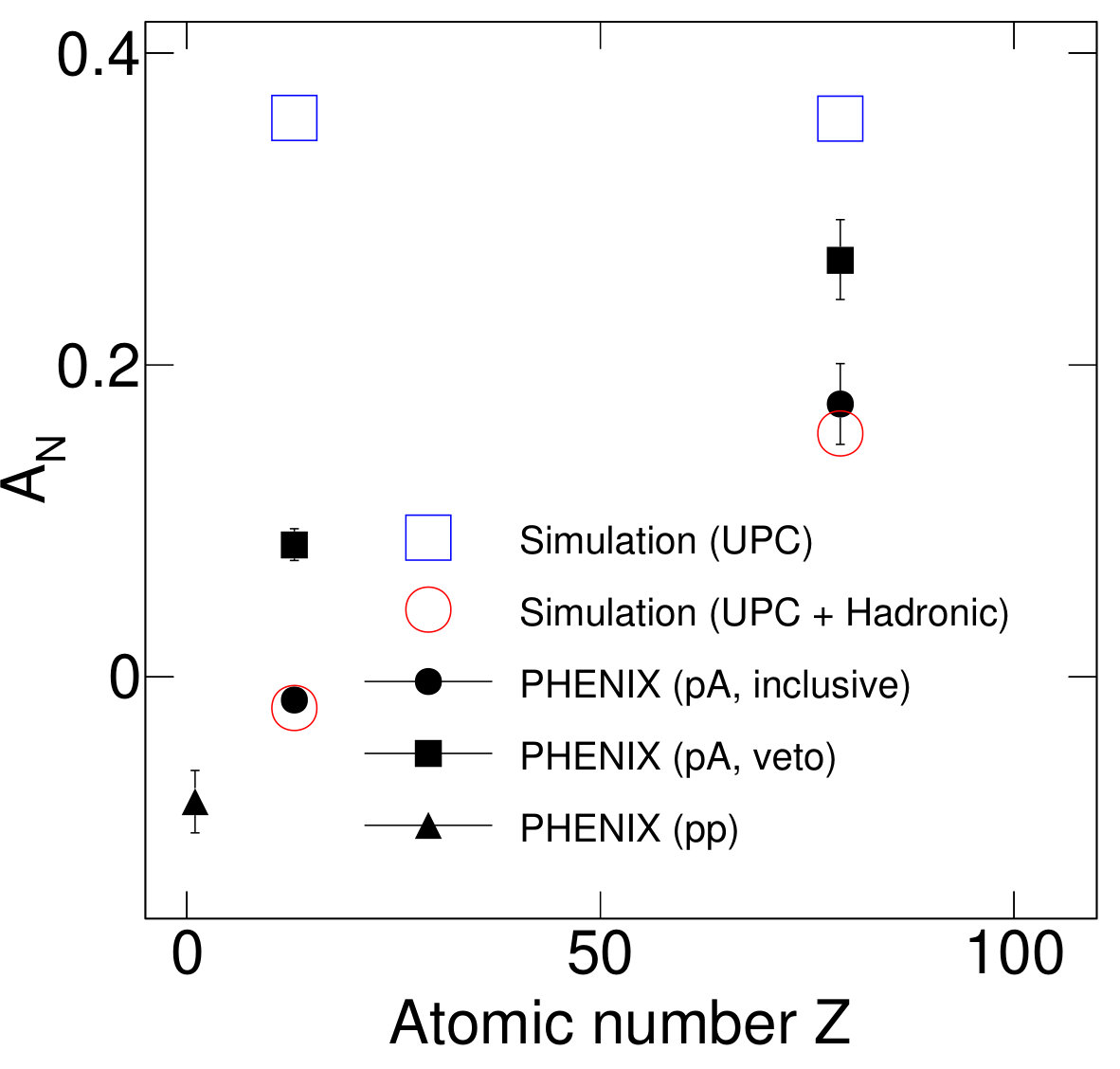 Figure 1
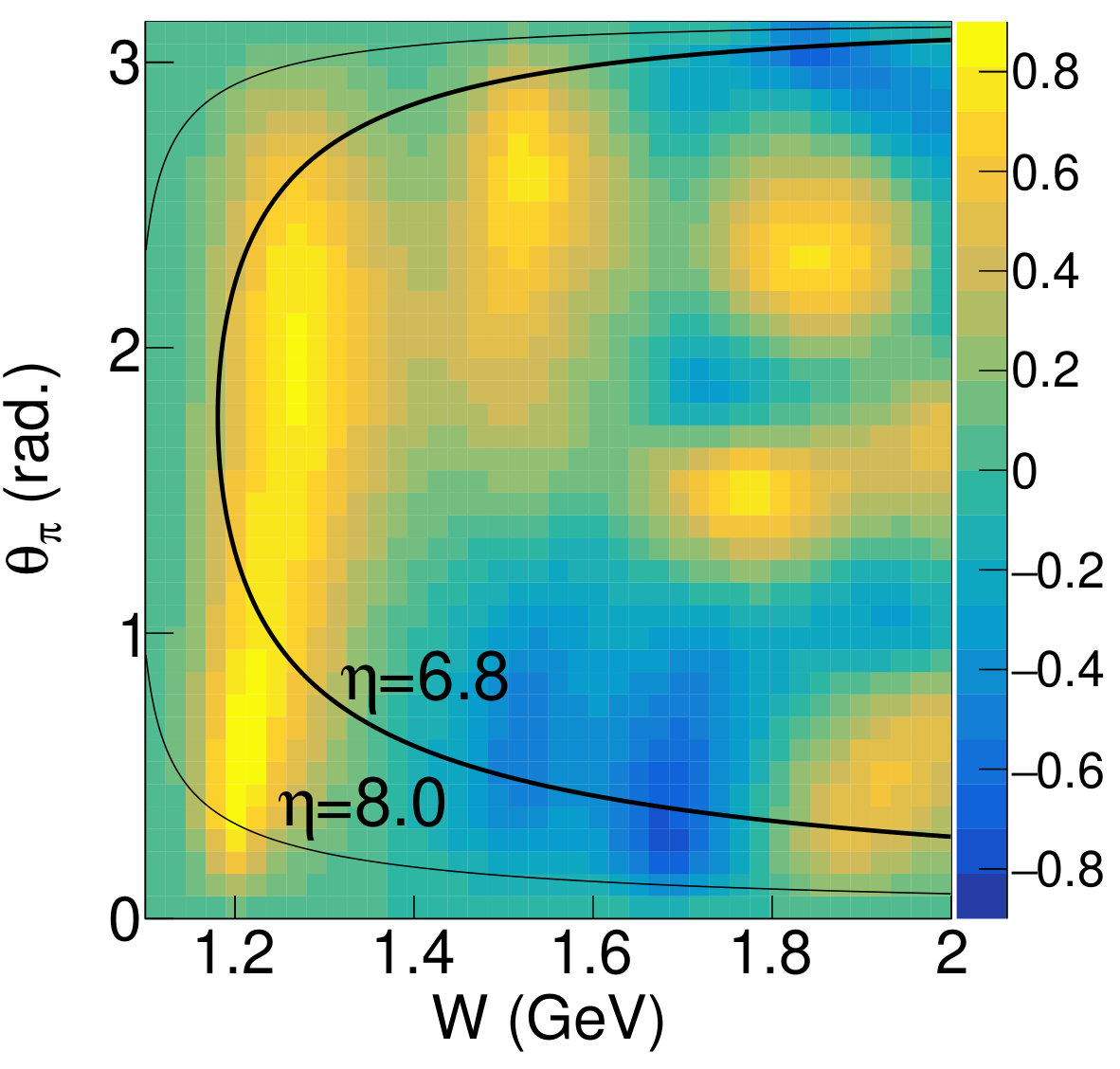 Figure 2
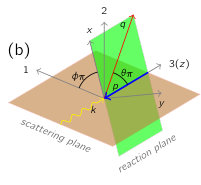 Figure 3
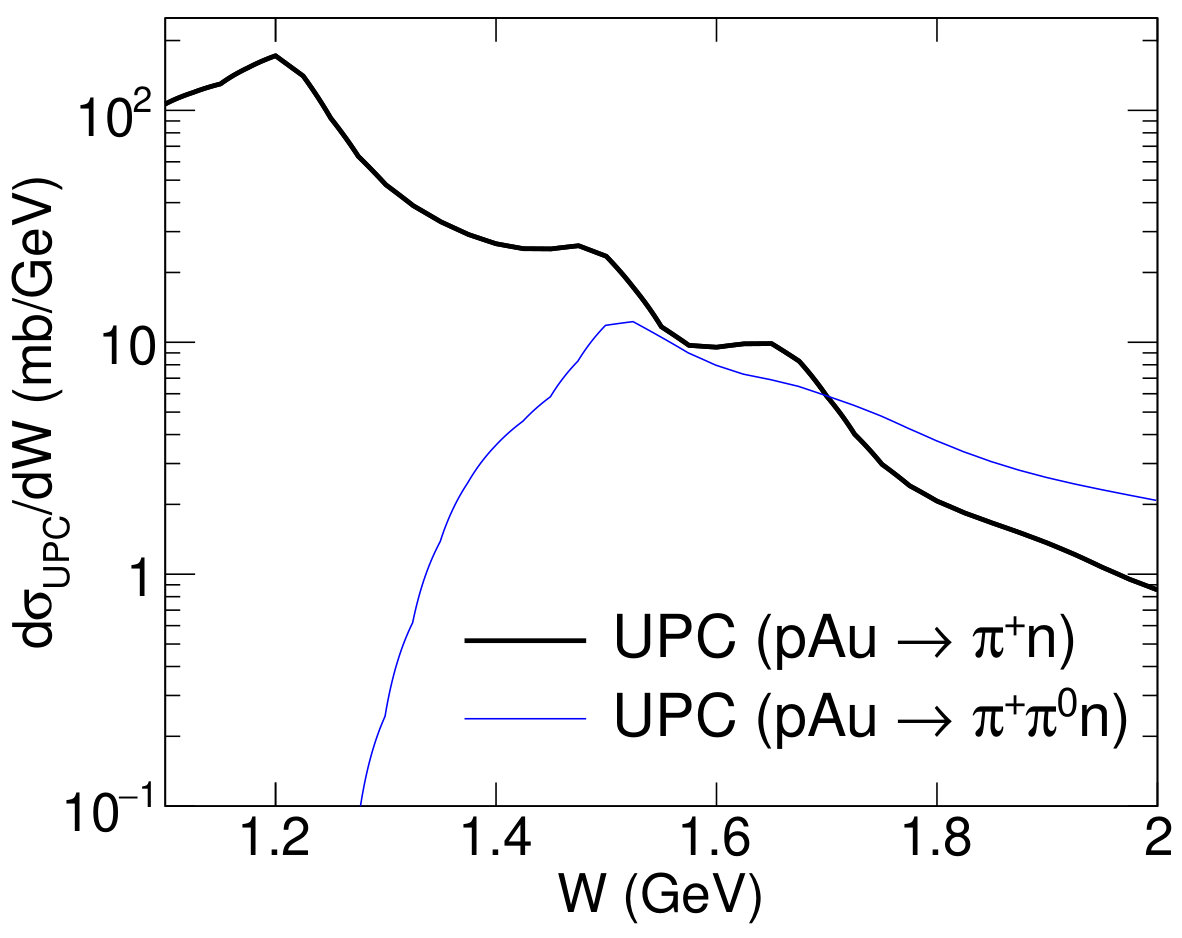 Figure 4
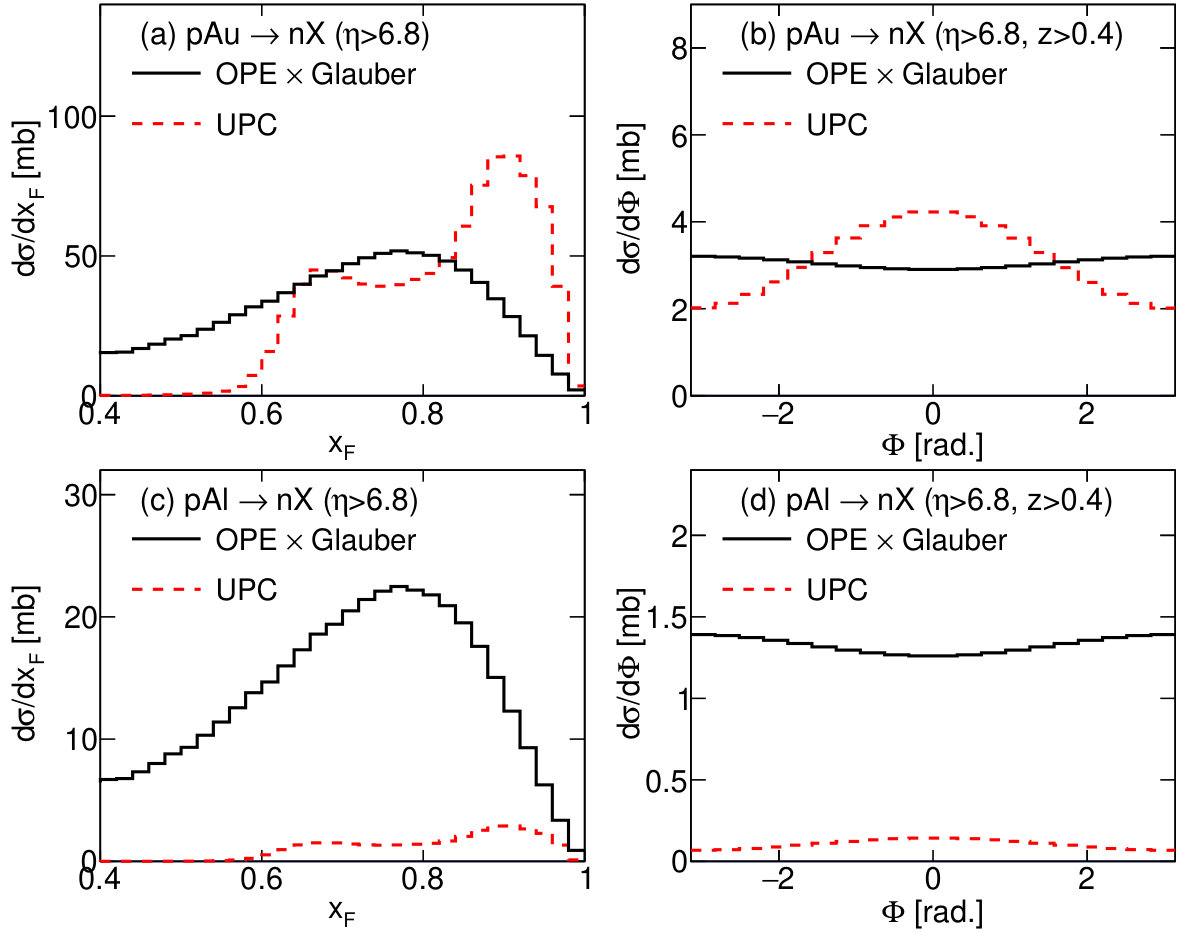 Figure 5
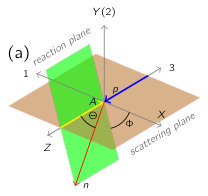 Figure 6
| UPCs | Hadronic interactions | ||
|---|---|---|---|
| () | () | ||
| ( and ) | |||
|---|---|---|---|
| – | – | ||
| (1) Energy range | ||
|---|---|---|
| (2) Two-pion production | ||
| (3) range | ||
Peer Reviews
No public reviews on file for this paper yet. If you reviewed it on a platform where reviews are public (OpenReview, ICLR, NeurIPS, ICML), you can paste yours below so the community can read it here.
Videos
No videos yet. Explain this paper in a talk, walkthrough, or lecture? Add one.
Recently measured large for forward neutrons in collisions at
GeV explained through simulations of ultraperipheral collisions and hadronic interactions
Gaku Mitsuka
RIKEN BNL Research Center, Brookhaven National Laboratory, Upton, New York 11973-5000, USA
Abstract
The PHENIX experiment at the Relativistic Heavy Ion Collider recently reported that transverse single spin asymmetry, , for forward neutrons in collisions at 200\text{,}\mathrm{GeV}$$. in and collisions were measured as -0.015 and 0.18, respectively. These values are clearly different from the measured in collisions. In this paper, we propose that a large for forward neutrons in ultraperipheral collisions may explain the PHENIX measurements. The proposed model is demonstrated using two Monte Carlo simulations. In the ultraperipheral collision simulation, we use the starlight event generator for the simulation of the virtual photon flux and then use the maid2007 unitary isobar model for the simulation of the neutron production in the interactions of a virtual photon with a polarized proton. In the hadronic interaction simulation, the differential cross sections for forward neutron production are predicted by a simple one-pion exchange model and the Glauber model. The simulated values for both the contribution of ultraperipheral collisions and the hadronic interactions are in good agreement with the PHENIX results.
pacs:
13.85.-t, 13.85.Tp, 24.85.+p
I Introduction
The PHENIX experiment at the Relativistic Heavy Ion Collider (RHIC) reported that the transverse single spin asymmetry, denoted , for forward neutrons measured in transversely polarized proton–nucleus () collisions at 200\text{,}\mathrm{GeV} is far different from that in polarized proton–proton ($p^{\uparrow}p$) collisions at $\sqrt{s}=$200\text{\,}\mathrm{GeV} PHENIXPrelim . That is, the measured for and collisions are and , respectively. On the other hand, is in collisions PHENIXNeutron . In these measurements, the neutrons produced in and collisions are detected by a zero-degree calorimeter RHICZDC in the polarized proton remnant side that is defined as the positive rapidity region.
As studied in Ref. Kopeliovich2 , the interference of pion (spin-flip) and -Reggeon (spin nonflip) exchanges successfully explains for forward neutrons in collisions at RHIC. We would expect that this mechanism can be extended to predict for collisions. The authors of Ref. Kopeliovich2 incorporate the pion–-Reggeon interference with strong nuclear absorptive corrections and a nuclear breakup Kopeliovich3 . However, the predicted in collisions remains negative and the magnitude of is too small to explain the PHENIX results.
In this paper, we propose an alternative mechanism: ultraperipheral proton–nucleus collisions (UPCs) Bertulani1 ; Bertulani2 . UPCs occur when the impact parameter is larger than the sum of the radii of each colliding particle, namely, , where and are the radius of the proton and nucleus, respectively. As we explored in Ref. Mitsuka , UPCs have a comparable cross section with the hadronic interactions in the very forward rapidity region. In ultraperipheral collisions, virtual photons () emitted from the relativistic nucleus interact with polarized protons. Thus the number of neutrons produced via the interaction depends on the azimuthal angle of the scattered neutrons relative to the proton polarization. This may finally contribute to the large for forward neutrons in collisions.
We first develop the Monte Carlo (MC) simulation framework for UPCs (Sec. II) and hadronic interactions (Sec. III). In Sec. IV, using these MC simulations we show that UPCs in collisions have sizable cross sections compared with hadronic interactions and the yield of forward neutrons in UPCs certainly depend on the scattering azimuthal angle relative to the proton polarization axis. Finally, in Sec. V, we compare the simulated with the PHENIX results. Conclusions are drawn in Sec. VI. Natural units are used throughout.
II Methodology of Ultraperipheral Collisions Monte Carlo simulations
The MC simulation for UPCs in this study comprises two steps. First, we simulate the virtual photon flux as a function of the photon energy and impact parameter by using starlight STARLIGHT ; STARLIGHTcode (Sec. II.2). Second, the simulation of the interaction and particle production is performed following the differential cross sections that are predicted by the maid2007 model MAID07 (Sec. II.3).
II.1 Formalism for ultraperipheral collisions
The differential cross section for single neutron production in UPCs is given by
[TABLE]
where is the number of the emitted photons, is the center-of-mass energy, with the neutron scattering polar angle and azimuthal angle in the center-of-mass frame, is the total cross section for a single photon interaction with a proton leading to single neutron production, and is the probability of having no hadronic interactions in collisions at given . We calculate and in Sec. II.2 and Sec. II.3, respectively.
A finite probability for having no hadronic interactions is introduced in order to account for a smooth cut off around the impact parameter STARLIGHT . and , where 5\text{,}\mathrm{fm} and $R_{\textrm{Au}}\sim$7\text{\,}\mathrm{fm}, are the radius of the proton and nucleus, respectively. The range of the impact parameter considered in the simulation extends from 4\text{,}\mathrm{fm} to $b_{\textrm{\rm max}}=${10}^{5}\text{\,}\mathrm{fm}. The value of is well below the sum of the effective radii of colliding particles, and rapidly approaches zero below these nuclear radii.
For comparisons with the simulation results of hadronic interactions in Sec. IV and the experimental results from PHENIX in Sec. V, we will numerically transform the differential cross section in Eq. (1) based on the center-of-mass frame to that in the detector reference frame. Both frames are defined in Fig. 1.
II.2 Simulation of the virtual photon flux
For simplicity (unless otherwise noted), the discussion in this subsection is based on the proton rest frame. The virtual photons flux emitted by the relativistic nucleus is simulated using starlight, which follows the Weizsäcker-Williams approximation Weizsacker ; Williams . The double differential photon flux due to the fast moving nucleus with velocity is written as
[TABLE]
where is the photon energy, is the atomic number ( and for Al and Au, respectively), is the fine structure constant, ( is the Lorentz factor), and and are the modified Bessel functions. In the case of a relativistic nucleus (), we safely disregard the contribution of the term in Eq. (2). The photon energy in the proton rest frame is properly transformed to the center-of-mass energy to allow substitution of Eq. (2) for Eq. (1).
II.3 Simulation of the interaction
The kinematics of the interaction is shown in Fig. 1(b) and is defined as
[TABLE]
where the variables in brackets indicate the four-momenta of each particle. We use the following notations for these four-momenta:
[TABLE]
where the center-of-mass energy is given by .
Figure 1(b) also introduces the polar angle and azimuthal angle of , with reference to a coordinate system with , 1, and 2 axes such that lies in the 1-3 plane. The proton is transversely polarized along the 2 axis. The frame is the scattering plane. The frame is defined such that the axis is directed into the direction; the axis is perpendicular to the – reaction plane; and the axis is given by .
Single neutron and pion production from the interaction are simulated following the differential cross sections predicted by the maid2007 model. The cross section of the interaction is formed as in Ref. Drechsel :
[TABLE]
where and are the response functions for pion photoproduction, and and are the proton polarization along and axes, respectively. In the third equation, and respectively are replaced with target asymmetry and . We assume and in this study. Note that we can numerically obtain in Eq. (1) from in Eq. (5) with the relation and .
The photon virtuality is limited by , thus 2\text{\times}{10}^{-3}\text{,}\mathrm{G}\mathrm{eV}^{2} in $p^{\uparrow}\textrm{Al}$ collisions and $Q^{2}<$6\text{\times}{10}^{-4}\text{\,}\mathrm{G}\mathrm{eV}^{2} in collisions. In the following simulations, we fix 0\text{,}\mathrm{G}\mathrm{eV}^{2}$$ as default and take into account effects of nonzero as a model uncertainty. The virtual photons are assumed to be fully unpolarized in this study.
Both baryon resonance and nonresonance contributions are taken into account for neutron and pion productions in maid2007. The model contains all four-star resonances with masses below and follows the Breit-Wigner forms for the resonance shape. Nonresonance background contribution contains the Born terms as detailed in Ref. MAID07 .
Due to the energy range guaranteed by maid2007, the minimum and maximum values in the UPC MC simulation are set as 1.1\text{,}\mathrm{GeV} and $W_{\textrm{max}}=$2.0\text{\,}\mathrm{GeV}, respectively. We will discuss cross section contribution from outside the above energy range in Sec. IV.1.
Figure 2 shows of the interaction as a function of . In the detector reference frame, the thick and thin curves correspond to the rapidity of produced neutrons of and 8.0, respectively. Because the neutrons produced along the negative axis, namely, , are more likely to have large positive rapidity in the detector reference frame, the thick and thin curves shift to the large region.
III Methodology of simulations in Hadronic interactions
Throughout this section, we use the detector reference frame defined in Fig. 1(a). We effectively obtain the differential cross section of forward neutron production in hadronic interactions as follows. First (Sec. III.1), we calculate the cross section of inclusive neutrons in collisions, , using a simple one-pion exchange model. Note that this calculation is performed for unpolarized protons. The one-pion exchange model has well described forward neutron production in collisions at the Intersecting Storage Rings ISR and RHIC PHENIXNeutron and in collisions at the Hadron-Electron Ring Accelerator (HERA) ZEUS1 .
Second (Sec. III.2), the cross section of the interaction, , can be calculated by and the Gribov-Glauber model Gribov ; Glauber . Here we avoid an implementation of multiple scattering of a projectile proton with a nucleus, and instead we multiply the cross section with the inelastic cross section ratio obtained from Ref. Guzey .
For the -dependence of the differential cross section, we multiply with in order to effectively take into account the single spin asymmetry (Sec. III.2).
III.1 Simulation of the interaction
The differential cross section for inclusive neutrons in collisions at the center-of-mass energy as a function of the longitudianl momentum fraction and the transverse momentum is formed in terms of the pion-exchange model Kopeliovich1 as
[TABLE]
where is the rapidity gap survival factor, is the pion trajectory with the slope and the pion mass , is the four-momentum transfer squared, is the effective vertex function, is the phase factor Kopeliovich1 , and is the total cross section of the interactions at the center-of-mass energy . The effective vertex function is parameterized as using the pion–nucleon coupling and the -slope parameter . In this study, we fix 1.0\text{,}{\mathrm{GeV}}^{-2} and $g^{2}_{\pi^{+}pn}/8\pi=13.75$ which are consistent with the results at HERA [ZEUS1 ](#bib.bib16); [H1 ](#bib.bib21), and follow the best compete fit results [PDG ](#bib.bib22) for $\sigma^{\textrm{\rm tot}}_{\pi^{+}p}(M_{X}^{2})$. Because the parameters $S^{2}$ and $R^{2}_{\pi}$ have been poorly determined to date, we use $S^{2}=0.2$ and $R^{2}_{\pi}=$0.3\text{\,}{\mathrm{GeV}}^{-2} that derive the best agreement with the forward neutron distribution measured at the PHENIX experiment PHENIXNeutron . These best-fit values are compatible with other experimental results ZEUS2 .
III.2 Single spin asymmetry in collisions
As introduced in the third paragraph of Sec. III, we avoid an implementation of multiple scattering of a projectile proton with a nucleus. On the other hand, we effectively obtain the cross sections by multiplying in Eq. (6) with the inelastic cross section ratio that is calculated in Ref. Guzey . Thus we obtain:
[TABLE]
The single spin asymmetry for forward neutrons in interactions originate in the interference of pion (spin-flip) and -Reggeon (spin nonflip) exchanges Kopeliovich2 that well reproduces the result from the PHENIX experiment: PHENIXNeutron . Preliminary results in Ref. Kopeliovich3 based on the same approach as Ref. Kopeliovich2 state that single spin asymmetry for forward neutrons in hadronic collisions is also described by the pion–-Reggeon interference followed by a nuclear breakup. Here, we do not implement the pion– interference in the simulation. Instead, we multiply the differential cross section in Eq. (7) by , where we take and from Ref. Kopeliovich3 .
Finally, we obtain using Eq. (7):
[TABLE]
IV Results
IV.1 Simulation results in collisions at 200\text{,}\mathrm{GeV}$$
IV.1.1 The total cross sections
First, we calculate the total cross section of the interaction at 200\text{,}\mathrm{GeV}$$ and compare it with UPCs and hadronic interactions. The total cross section for UPCs is calculated by integrating Eq. (1) over , , and :
[TABLE]
where we require a single neutron scattered at and . The rapidity limit corresponds to the acceptance of a zero-degree calorimeter at RHIC and the limit is introduced to remove the contribution of low-energy forward neutrons. These cuts are consistent with the RHIC measurements PHENIXNeutron . As addressed in Sec. II.1, we fix 4\text{,}\mathrm{fm}, $b_{\textrm{\rm max}}=${10}^{5}\text{\,}\mathrm{fm}, 1.1\text{,}\mathrm{GeV}, and $W_{\textrm{max}}=$2.0\text{\,}\mathrm{GeV}. We then obtain 19.6\text{,}\mathrm{mb}$$.
For the discussions in Sec. IV.1.2 and IV.1.4, here we show the differential UPC cross sections at 200\text{,}\mathrm{GeV}$$ as a function of in Fig. 3. The values are calculated by integrating Eq. (1) over and . For simplicity, no kinematical limit is applied to such integration. Thick black curve indicates the interaction and thin blue curve indicates the two-pion production .
The total cross section for hadronic interaction is calculated by integrating Eq. (8) over and :
[TABLE]
We obtain 19.2\text{,}\mathrm{mb}$$ by requiring a single neutron emitted into and . According to the comparison of these two cross sections, we find that UPCs lead to significant background contribution to the investigations of single spin asymmetry in terms of hadronic interactions. Table 1 summarizes the calculated cross sections.
IV.1.2 The differential cross sections as a function of
In Fig. 4(a), we show the differential cross sections as a function of , namely, , for UPCs (dashed [red] line) and hadronic interactions (solid [black] line). UPCs dominate in at and have a sharp peak around . This peak originates from the channel in UPCs. As found in the thick black curve in Fig. 3, a center-of-mass energy of 1.3\text{,}\mathrm{GeV}, a photon energy ranging from $0.17<\omega^{\textrm{rest}}_{\gamma^{\ast}}<$0.5\text{\,}\mathrm{GeV} in the proton rest frame, corresponds to the baryon-resonance region that has a larger UPC cross section compared to higher energy regions due to the both ample photon flux and large cross section. Thus, low momentum neutrons produced by a pronounced interaction at 1.3\text{,}\mathrm{GeV} and emitted into $\theta_{n}\sim\pi$ in the $\gamma^{\ast}p^{\uparrow}$ center-of-mass frame are boosted to nearly the same velocity of the projectile proton in the detector reference frame. These neutrons lead to the forward neutrons sharply distributed around $x_{\textrm{F}}=0.95$. Similarly, the neutrons emitted into $\theta_{n}\sim 0$ at $1.1<W<$1.3\text{\,}\mathrm{GeV} in the center-of-mass frame cause the second peak round .
IV.1.3 The differential cross sections as a function of
In Fig. 4(b), we compare the differential cross section as a function of , namely, between UPCs (dashed [red] line) and hadronic interactions (solid [black] line). We find that of UPCs has substantial positive asymmetry of about 0.36 compared with the negative asymmetry of hadronic interactions .
The UPC-induced asymmetry can be understood as follows. Replacing with and in Eq. (5), the -dependence of the differential UPC cross section is approximated as
[TABLE]
where is an average of over but the rapidity and limits, and , are applied. As we find in the distribution in Fig. 3, forward neutrons in UPCs are mainly produced by the decay at 1.3\text{,}\mathrm{GeV}, where $\langle T(\theta_{\pi})\rangle$ is $\sim 0.7$, as shown in Fig. [2](#S2.F2). Conversely, resonances at $1.4<W<$1.8\text{\,}\mathrm{GeV} have negative below . Therefore integrating over suffers from the both positive and negative and then we obtain at 2.0\text{,}\mathrm{GeV}$$. In accordance with an equivalence , we finally obtain .
IV.1.4 Model uncertainties
Finally, we discuss the following three uncertainties in the present UPC cross sections: (1) the contribution from outside 2.0\text{,}\mathrm{GeV}$$, (2) the contribution from the two-pion production process, and (3) the effects of nonzero .
(1) We first compare the UPC cross sections in the following three energy ranges: 1.1\text{,}\mathrm{GeV}, $1.1<W<$2.0\text{\,}\mathrm{GeV}, and 2.0\text{,}\mathrm{GeV}. For the calculation of UPC cross sections, we use the framework in Ref. [Mitsuka ](#bib.bib8) instead of the framework developed in this paper, because maid2007 provides the $\gamma^{\ast}p^{\uparrow}$ differential cross sections only at $1.1<W<$2.0\text{\,}\mathrm{GeV}. In the framework in Ref. Mitsuka , the proton polarization is not taken into account, however the cross sections integrated over polar and azimuthal angles are independent of the target polarization. Unlike the framework developed in this paper, the total cross section in Ref. Mitsuka is taken from the compilation of present experimental results PDG at 7\text{,}\mathrm{GeV} and from the best compete fit results [PDG ](#bib.bib22) at $W>$7\text{\,}\mathrm{GeV}. The UPC cross sections in each energy range are summarized in Table. 2. Note that the rapidity and limits, and , are applied to the these cross sections. According to Table 2, we find that the cross sections at 1.1\text{,}\mathrm{GeV} and $W>$2.0\text{\,}\mathrm{GeV} are and of the cross section at 2.0\text{,}\mathrm{GeV}$$, respectively.
(2) The contribution of the two-pion production appears above the threshold energy 1.25\text{,}\mathrm{GeV}. The UPC cross section in Table [2](#S4.T2) is calculated using the 2-pion maid model [MAID2pi ](#bib.bib24), where the $\eta$ and $x_{\textrm{F}}$ limits are not applied to neutrons. Comparing UPCs leading to two-pion production, $6.2\text{\,}\mathrm{mb}$ present in Table [2](#S4.T2), with those leading to single pion production, $41.7\text{\,}\mathrm{mb}$ present in Table [1](#S4.T1), the former amounts to $14\text{\,}\mathrm{\char 37\relax}$ to the latter cross section. According to the discussions in (1) and (2), we find that UPCs at $1.1<W<$2.0\text{\,}\mathrm{GeV} leading to single neutron and pion production dominantly contribute to the single spin asymmetry for neutrons.
(3) Effects of nonzero to single spin asymmetry in UPCs are tested by comparing the total cross sections and distributions between and . For the nonzero values, we use 6\text{\times}{10}^{-4}\text{,}\mathrm{G}\mathrm{eV}^{2} in $p^{\uparrow}\textrm{Au}$ collisions and $Q^{2}=$2\text{\times}{10}^{-3}\text{\,}\mathrm{G}\mathrm{eV}^{2} in collisions. In both collisions, the cross section for forward neutron production at is at most larger than those at . Because is proportional to and is a function of , the distribution is modified by depending on . Accordingly, , obtained from averaged over and , at 1\text{\times}{10}^{-3}\text{,}\mathrm{G}\mathrm{eV}^{2} is $\sim$10\text{\,}\mathrm{\char 37\relax} smaller than that at .
The model uncertainties discussed in this subsection are summarized in Table 3.
IV.2 Simulation results in collisions at 200\text{,}\mathrm{GeV}$$
Total cross sections for UPCs and hadronic interactions in collisions are summarized in Table 1. The UPC cross section is 0.7\text{,}\mathrm{mb} which is $\sim$8\text{\,}\mathrm{\char 37\relax} of 8.3\text{,}\mathrm{mb}$$, where UPCs in collisions are highly suppressed compared with those in collisions due to .
Figure 4(c) shows for UPCs (dashed [red] line) and hadronic interactions (solid [black] line). We find UPCs leading to subdominant contribution to the distribution at .
Finally, Fig. 4(d) compares between UPCs (dashed [red] line) and hadronic interactions (solid [black] line). Although the UPC cross section is about of the hadronic-interactions cross section, the large positive asymmetry of UPCs eventually compensates the small negative asymmetry of hadronic interactions.
V Discussions
We compare the simulation results with the observed values in and collisions at 200\text{,}\mathrm{GeV}$$. Figure 5 shows as a function of the atomic number in (for reference), and collisions.
Filled [black] circles indicate the values inclusively measured by the PHENIX zero-degree calorimeter PHENIXPrelim , where the neutron rapidity and ranges are limited by and , respectively. These values can be compared with open [red] circles indicating the sum of UPCs and hadronic interactions MC simulations, denoted . These are written as
[TABLE]
since
[TABLE]
For the MC simulation results (open [red] circles and open [blue] squares), the neutron rapidity and region limits, and , are also taken into account to be consistent with the PHENIX measurements. In collisions, we obtain which is consistent with the PHENIX result . In collisions, we have that can be understood by that UPCs, having large positive and a cross section , significantly contribute to the inclusive value that are evident in Fig. 4 and Table 1. Note that a model uncertainty in , estimated by taking account of nonzero discussed in Sec. IV.1.4, amounts .
Filled [black] squares in Fig. 5 are the values measured by the PHENIX zero-degree calorimeter requiring a veto on the beam-beam counters (BBCs) covering RHICBBC . Because a nucleus in UPCs coherently scatters with a proton and thus does not generate underlying particles, such a BBC veto effectively selects UPC-rich events. In collisions, the PHENIX data with the BBC veto has larger than the inclusive PHENIX data (filled [black] circle). This indicates that the fraction of UPCs in the PHENIX data is enhanced at a certain level by the BBC veto, although the actual fraction is not presently reported. Conversely in collisions, the PHENIX data with the BBC veto provides which is far smaller than in collisions. A possible inference for the difference is that the fraction of hadronic interaction is still sizable in the PHENIX data in collisions even though UPC-rich events are preferentially selected by the BBC veto. If pure UPC data is experimentally available, the values may approach in both and collisions. Note that is same between and collisions, since depends only on the interactions which are common between and collisions.
VI Conclusions
It is demonstrated that ultraperipheral collisions have large for forward neutrons using the MC simulation framework developed for this study. The present UPC simulation comprised the following two parts; first, the simulation of the virtual photon flux was performed by the starlight event generator and, second, the simulation of the interaction followed the differential cross sections predicted by maid2007 unitary isobar model. In the interaction, the target asymmetry was appropriately treated. According to the MC simulations, we found UPCs in collisions leading to . Concerning forward neutron production of hadronic interaction, the simulation model used an one-pion exchange model and the Glauber model. The single spin asymmetry was effectively taken in account by multiplying with where . Combining the differential cross sections of UPCs and hadronic interactions, we simulated the and distributions for inclusive forward neutrons. The values for inclusive neutrons at and were predicted as and in and collisions, respectively. These were consistent with the recently reported PHENIX results. The PHENIX data with the BBC veto in collisions had larger than the inclusive PHENIX data, but were smaller than . This indicated that requiring the BBC veto enhanced the fraction of UPCs in the PHENIX data at a certain level, although the actual fraction was presently unreported.
For future analyses, we plan to extend the present simulation framework to include the contribution of the two-pion production . This would provide a more accurate description of of forward neutrons. Another extension would be to investigate the possible interference between electromagnetic and hadronic interactions, which is known as Coulomb-nuclear interference.
Acknowledgments
The author appreciates fruitful discussions with Y. Akiba, Y. Goto and I. Nakagawa.
The reference list from the paper itself. Each links out to its DOI / PubMed record.
- 1(1) I. Nakagawa et al ., (PHENIX Collaboration), The First Transverse Single Spin Measurement in High Energy Polarized Proton-Nucleus Collision at the PHENIX experiment at RHIC, J. of Phys. Conf. Ser. 736 , 012017 (2016).
- 2(2) A. Adare et al ., (PHENIX Collaboration), Inclusive cross section and single transverse spin asymmetry for very forward neutron production in polarized p 𝑝 p + + p 𝑝 p collisions at s = 200 Ge V 𝑠 times 200 gigaelectronvolt \sqrt{s}=$200\text{\,}\mathrm{Ge V}$ , Phys. Rev. D 88 , 032006 (2013).
- 3(3) C. Adler et al ., The RHIC zero degree calorimeters, Nucl. Instrum. Meth. A 470 (2001) 488.
- 4(4) B. Z. Kopeliovich, I. K. Potashnikova, and Iván Schmidt, Single transverse spin asymmetry of forward neutrons, Phys. Rev. D 84 , 114012 (2011).
- 5(5) B. Z. Kopeliovich, I. K. Potashnikova, and Iván Schmidt, Leading Neutrons From Polarized Proton–Nucleus Collisions, ar Xiv:1611.07365.
- 6(6) C. A. Bertulani and G. Baur, Electromagnetic processes in relativistic heavy ion collisions, Phys. Rep. 163 (1988) 299.
- 7(7) C. A. Bertulani, S. R. Klein, and J. Nystrand, Physics of Ultra-Peripheral Nuclear Collisions, Ann. Rev. Nucl. Part. Sci. 55 (2005) 271.
- 8(8) G. Mitsuka, Forward hadron production in ultra-peripheral proton–heavy-ion collisions at the LHC and RHIC, Eur. Phys. J. C 75 , 614 (2015).