Clustering of Topological Charges in a Kagome Classical Spin Liquid
Tomonari Mizoguchi, Ludovic D. C. Jaubert, and Masafumi Udagawa

TL;DR
This paper investigates a novel classical spin liquid phase in a kagome lattice model, characterized by topological charge clustering and hexamer formation, with potential experimental signatures in neutron scattering.
Contribution
It introduces a new classical spin liquid phase arising from topological charge recombination in a kagome Ising model, with a developed worm algorithm for its study.
Findings
Discovery of a classical spin liquid with extensive residual entropy.
Identification of hexamer formations of topological charges.
Detection of a half-moon pattern in magnetic structure factor.
Abstract
Fractionalization is a ubiquitous phenomenon in topological states of matter. In this work, we study the collective behavior of fractionalized topological charges and their instabilities, through the -- Ising model on a kagome lattice, which can be mapped to a model of interacting topological charges under the constraint of Gauss' law. We find that the recombination of topological charges gives rise to a yet unexplored classical spin liquid. This spin liquid is characterized by an extensive residual entropy, as well as the formation of hexamers of same-sign topological charges. The emergence of hexamers is reflected to a half-moon signal in the magnetic structure factor, which provides us a signature of this new spin liquid in neutron-scattering experiments. To study this phase, a worm algorithm has been developed which does not require the usual divergence-free condition.
Click any figure to enlarge with its caption.
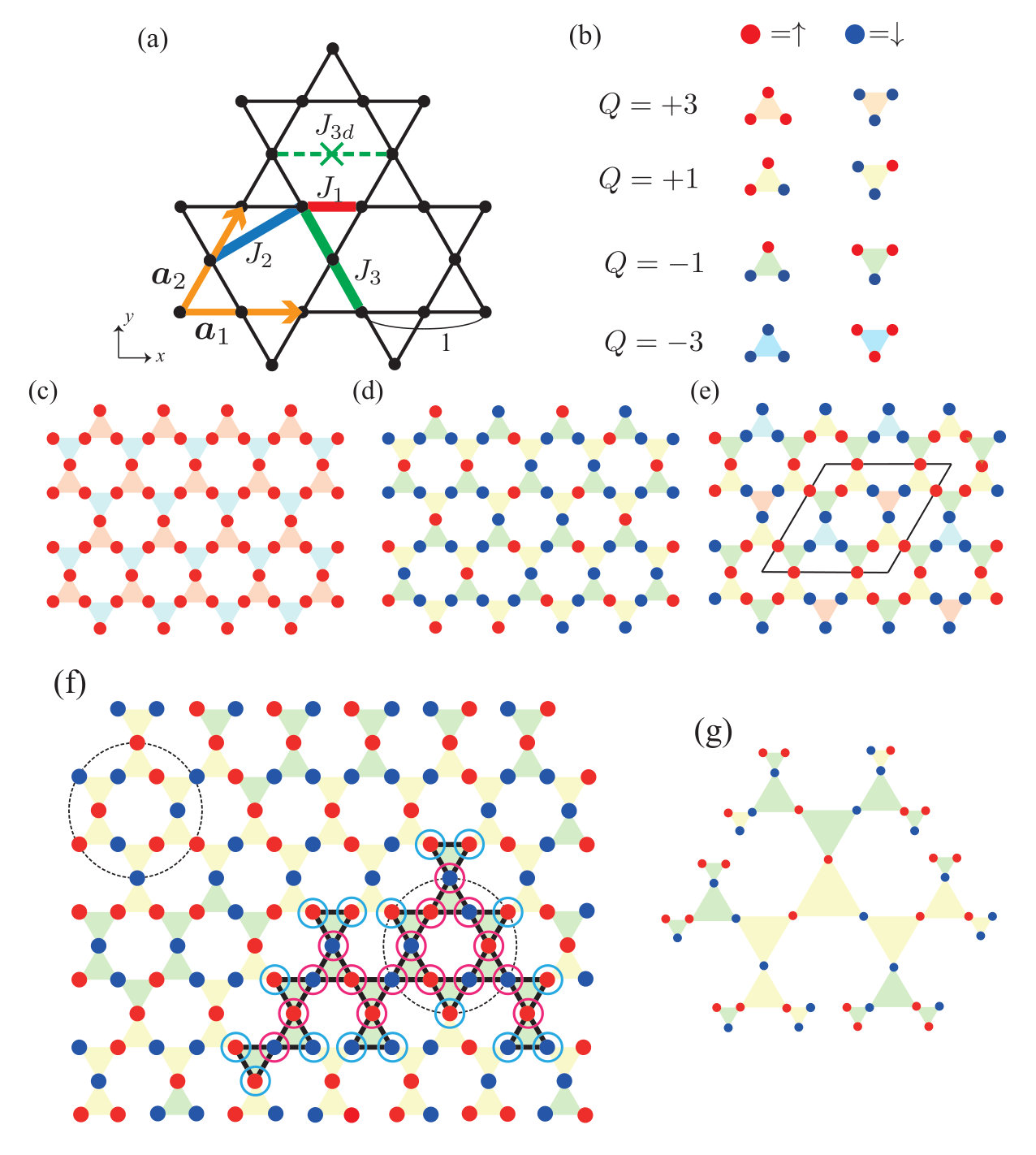 Figure 1
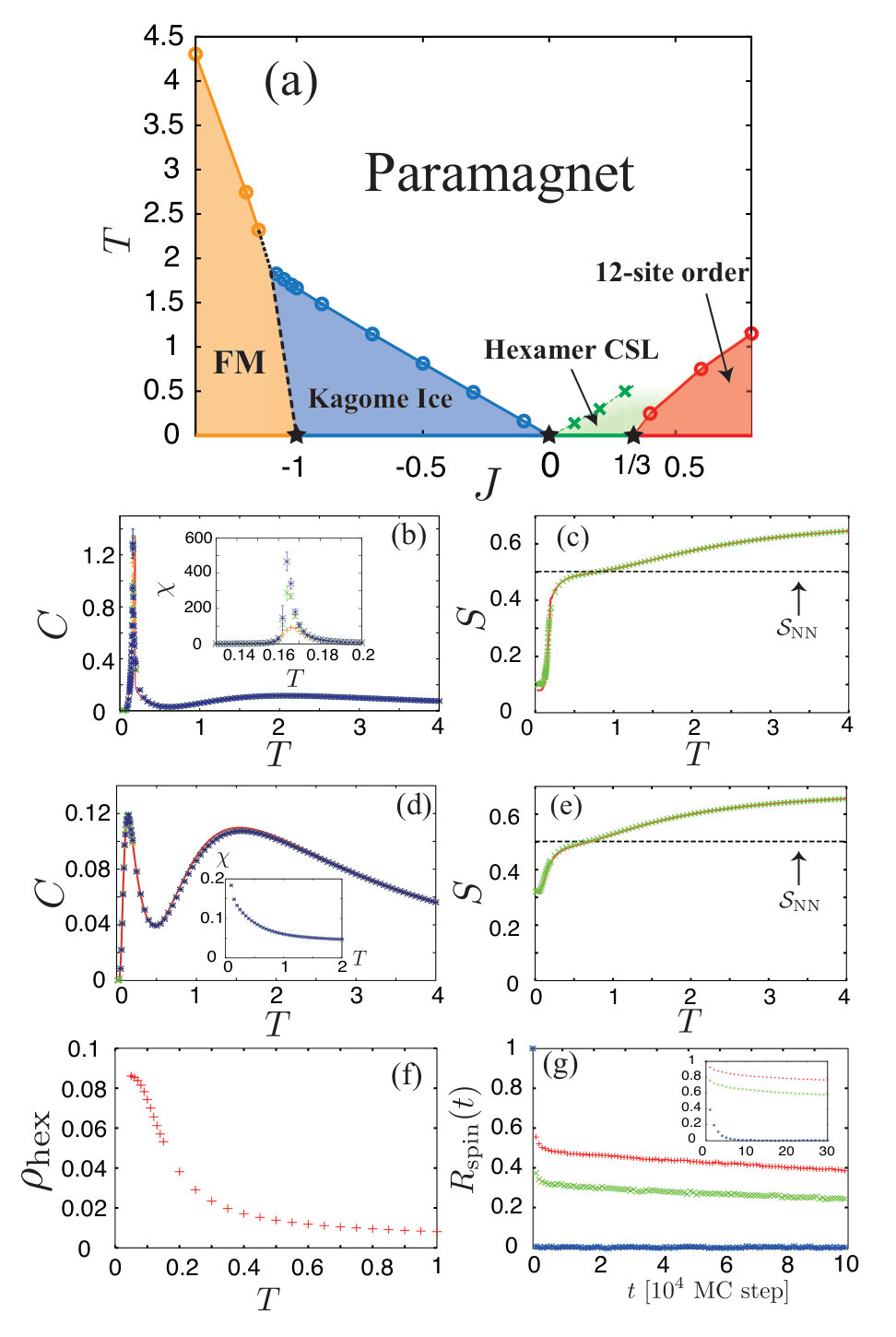 Figure 2
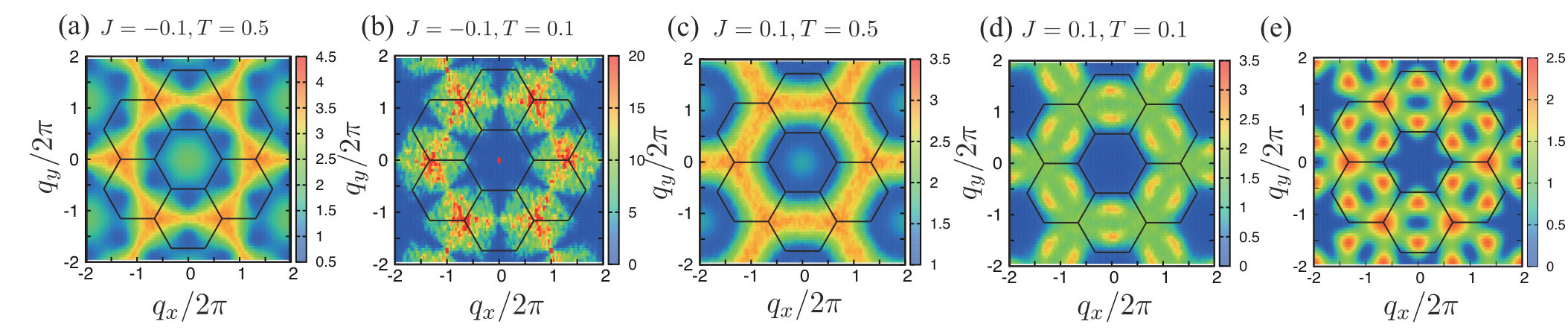 Figure 3
 Figure 4
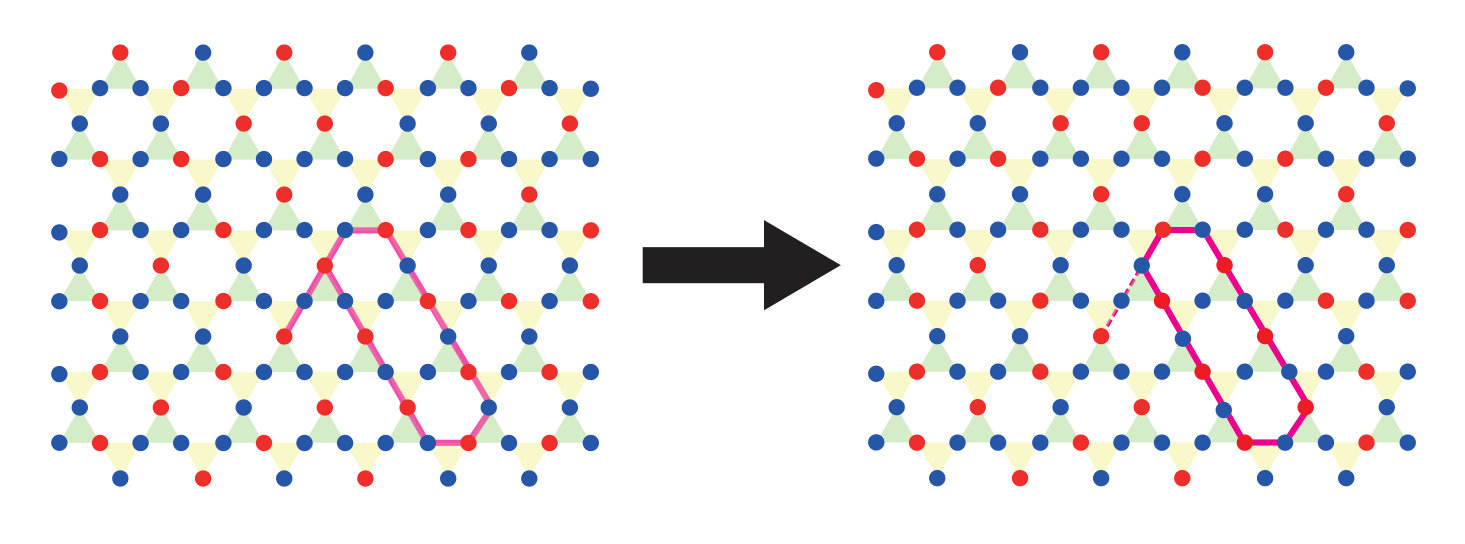 Figure 5
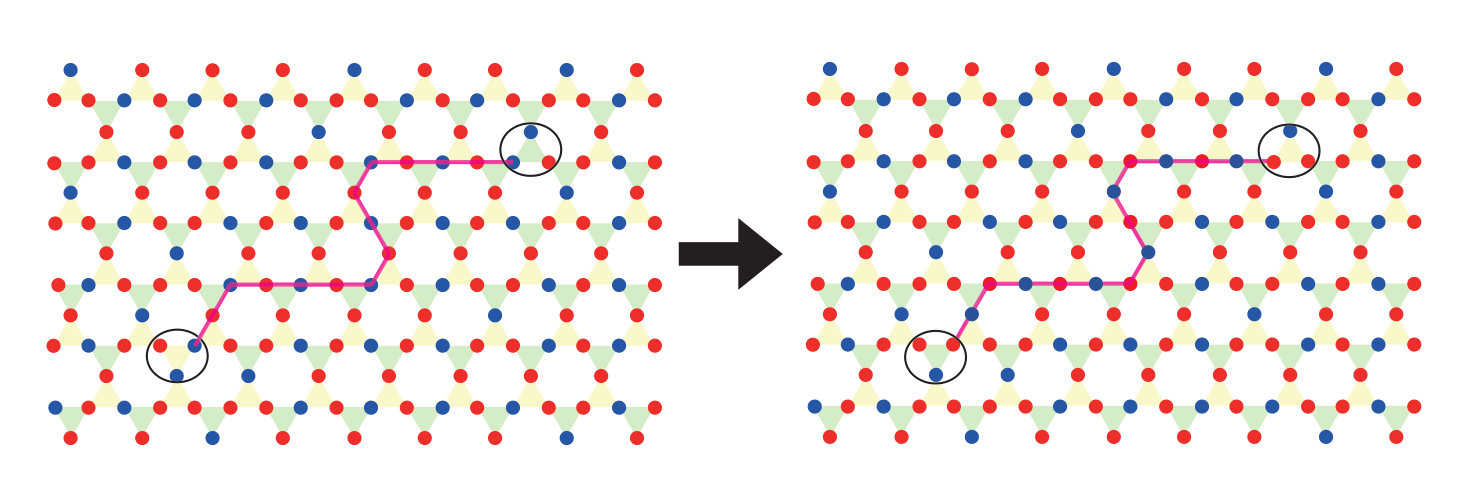 Figure 6
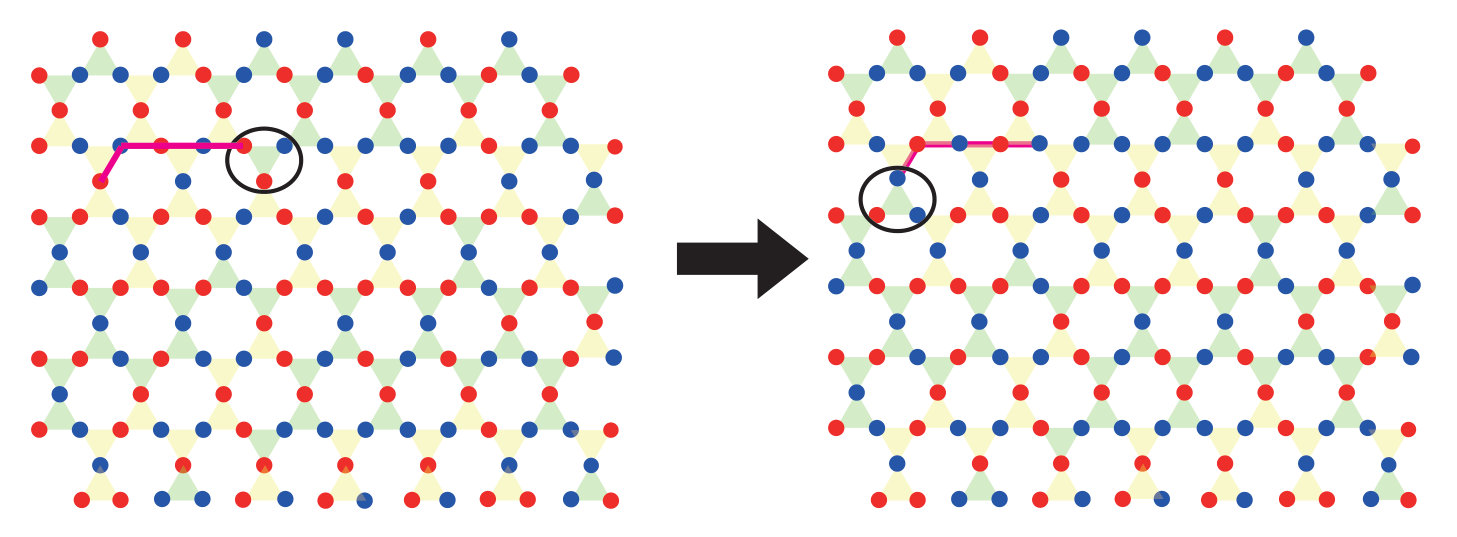 Figure 7
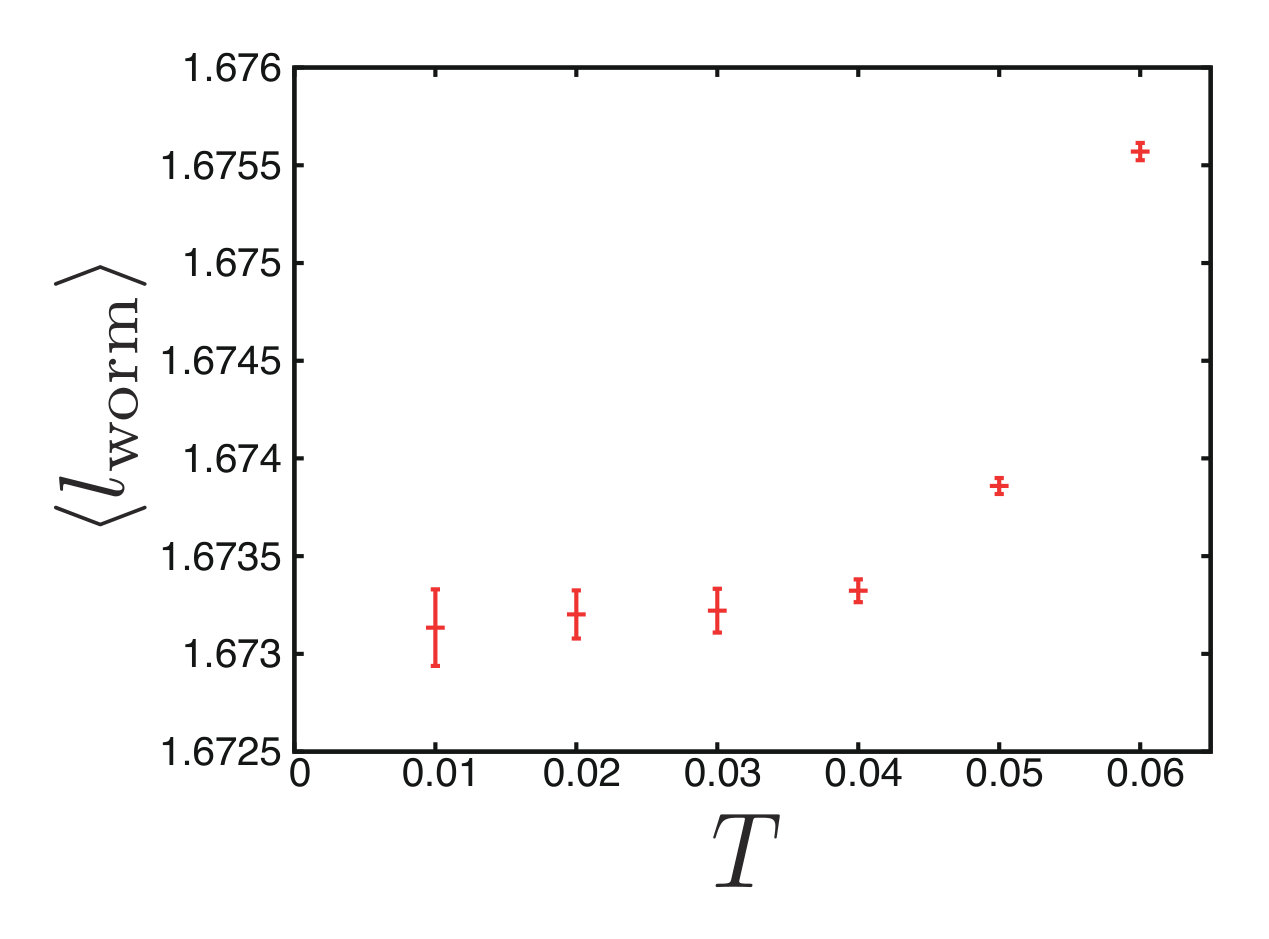 Figure 8
 Figure 9
 Figure 10
 Figure 11
Peer Reviews
No public reviews on file for this paper yet. If you reviewed it on a platform where reviews are public (OpenReview, ICLR, NeurIPS, ICML), you can paste yours below so the community can read it here.
Videos
No videos yet. Explain this paper in a talk, walkthrough, or lecture? Add one.
Present address: ]Department of Physics, Gakushuin University, Mejiro, Toshima-ku, Tokyo 171-8588, Japan
Clustering of Topological Charges in a Kagome Classical Spin Liquid
Tomonari Mizoguchi
Department of Physics, University of Tokyo, Hongo, Bunkyo-ku, Tokyo 113-0033, Japan
[
L. D. C. Jaubert
Okinawa Institute of Science and Technology Graduate University, Onna-son, Okinawa 904-0495, Japan
CNRS, Univ. Bordeaux, LOMA, UMR 5798, F-33400 Talence, France
Masafumi Udagawa
Department of Physics, Gakushuin University, Mejiro, Toshima-ku, Tokyo 171-8588, Japan
Abstract
Fractionalization is a ubiquitous phenomenon in topological states of matter. In this work, we study the collective behavior of fractionalized topological charges and their instabilities, through the -- Ising model on a kagome lattice. This model can be mapped onto a Hamiltonian of interacting topological charges under the constraint of Gauss’ law. We find that the recombination of topological charges gives rise to a yet unexplored classical spin liquid. This spin liquid is characterized by an extensive residual entropy, as well as the formation of hexamers of same-sign topological charges. The emergence of hexamers is reflected by a half-moon signal in the magnetic structure factor, which provides a signature of this new spin liquid in elastic neutron-scattering experiments. To study this phase, a worm algorithm has been developed which does not require the usual divergence-free condition.
PACS numbers
75.10.Kt
††preprint: APS/123-QED
Fractionalization is a hallmark of topological states of matter. In these systems, an excitation with a unit quantum number, such as a charge and a spin, is fractionalized into several constituents. These excitations can then condense into exotic topological phases kitaev2001 . The nature of fractionalized excitations have been studied through a number of systems, such as quasi-one-dimensional conducting polymers Heeger1988 , fractional quantum Hall systems Laughlin1983 ; Goldman1995 , and quantum spin liquids (QSLs) in one and higher dimensions balents2010 .
Among the systems showing fractionalization, QSLs are of special interest. QSL is a long-range-entangled quantum ground state without spontaneous symmetry breaking; the ground state is expressed as a superposition of a macroscopic number of product states. The realization of QSL has been intensively sought in frustrated magnets, and a number of candidate materials have been explored actively hiroi2001 ; shimizu2003 ; shores2005 ; okamoto2007 ; okamoto2009 ; singh2010 ; fak2012 ; takayama2015 .
Quantum spin ice gingras2014 ; savary2016 is one of the most promising systems in this context. Its classical counterpart, spin ice, is a classical spin liquid (CSL) with macroscopically degenerate ground states. CSL often serves as a constituting source of QSL, thanks to quantum fluctuations inducing a superposition between the degenerate ground states. This is why the parent CSL phase reflects several important properties of its descendant QSL state. In the case of quantum spin ice, a fractional excitation, called monopole, can be found in its classical counterpart, in which a flipped spin from the ground state is fractionalized into two half-unit charges castelnovo2008 ; jaubert2009 . CSL, due to its simplicity in comparison with QSL, enables us to study rather intractable aspects of fractional excitations.
In this work, we study the cooperative phenomena of fractionalized topological charges in the kagome CSL kano1953 ; azaria1987 ; wolf1988 ; takagi1993 of the -- Ising model. The nearest neighbor (NN) interactions () alone lead to a CSL phase, composed of the constrained configurations of topological charges, analogous to the fractional monopole excitations in spin ice. The further-neighbor interactions (, ) introduce a NN interaction between the topological charges. The resulting phase diagram supports a variety of (dis-)ordered phases, including what is, to the best of our knowledge, a yet unexplored CSL. This CSL is composed of coexisting hexamer clusters with an extensive residual entropy. Its anomalous spatial structure can be detected through a half-moon signal in magnetic structure factor.
Model.- We consider the kagome lattice composed of sites under periodic boundary conditions, and Ising spin variables, at each site, . Throughout this Letter, we set . We define the Hamiltonian as
[TABLE]
whose couplings are illustrated in Fig. 1(a). Here, we assume the NN coupling as antiferromagnetic (AFM), and set its value as a unit of energy, . We also introduce the second () and the third () neighbor terms. As opposed to a series of recent works on kagome Balents2002 ; Isakov2006 ; He2014 ; bieri2015 ; iqbal2015 , we shall not consider the term across hexagons, but rather the term between neighboring triangles which offers, as discussed below, an elegant representation in terms of topological charges. For general combinations of and , various magnetically ordered states have been studied wolf1988 ; takagi1993 . In the present work, we focus on the case of , where a charge representation is available ishizuka2013_2 . This model has offered a rich out-of-equilibrium physics on the three-dimensional pyrochlore lattice udagawa2016 ; rau2016 . To introduce this representation, we classify the triangles on the kagome lattice into “upward” () and “downward” (), according to their orientations. We then define a topological charge at each triangle as with for [see Fig. 1(b)], in a manner analogous to the monopole in spin ice castelnovo2008 . This definition naturally leads to the global charge neutrality condition: .
In terms of , the Hamiltonian can be rewritten as follows, up to a constant term ishizuka2013_2
[TABLE]
The first term represents the self-energy of a charge, summed over all triangles , while the second term is the interaction between neighboring pairs of charges on upward and downward triangles . Opposite charges attract for , while they repel for .
Phase diagram at .- At , the model is reduced to the Ising model with AFM NN interaction. Its residual entropy (per site) is kano1953 .
For finite , this degeneracy is lifted, and it becomes instructive to rewrite the Hamiltonian (2), as
[TABLE]
For , the energy is minimized by setting (i) for all the NN triangle pairs (i.e., staggered charge orderings), and (ii) () on all the triangles for ().
As a result, the ground state is a ferromagnet (FM) with triple-charge ordering for [Fig. 1(c)], and a single charge ordering for [Fig. 1(d)]. The latter phase shows macroscopic degeneracy with partial spin disorder i.e., a CSL ground state is realized. This CSL is known as kagome ice matsuhira2002 ; udagawa2002 ; isakov2004_2 ; aoki2004 and has been observed in artificial spin ice moller2009 ; chern2011 ; canals2016 ; sendetskyi2016 and itinerant systems ishizuka2013 .
On the other hand, the situation for is quite unusual, in that charges of the same sign attract each other, in contrast to the electrodynamics we are used to. Naively, this suggests a uniform charge order which would take the form of a large-scale charge segregation because of global charge neutrality, . However, charge configurations are constrained by the underlying spin structure. The constraint is best understood as a discrete analogue of Gauss’ law. The total charge of a given set of triangles equals the sum of fluxes piercing through the boundary ;
[TABLE]
where is a triangle of including site . The left-hand side of the equation is the discrete Gauss’ law, obtained from the fact that each site, , belongs to one upward and one downward triangle. Accordingly, the summation of vanishes for internal sites of , leaving only the boundary contribution . Since , the total charge inside is bounded by the number of boundary sites, . This prevents large regions of the same charge, and thus macroscopic charge segregation. Under the Gauss’ constraint, how can we minimize the ground-state energy by clustering charges of the same sign ?
To answer this question, let us first consider the limit of small (), where triple charges are excluded. We define a same-charge cluster as a maximal set of connected triangles bearing the same charge [Fig. 1(f)]. The energy of the th cluster, made of triangles, is
[TABLE]
where and are, respectively, the number of internal and boundary sites of the cluster [Fig. 1(f)], which satisfy . The term expresses the interaction between clusters, and the factor accounts for double counting. Any spin configuration can be decomposed as a paving of the lattice by same-charge clusters, where every cluster is surrounded by clusters of opposite charges. The total energy is thus, . The Gauss’ law (4) imposes the inequality, , which provides a lower bound to the total energy, . is the total number of triangles. This lower bound is reached when each and every cluster forms a closed ring, with potential sprouting branches [Fig. 1(f)]. For more details, see the Supplemental Material supplement . By construction, more than one closed ring in a same-charge cluster is impossible. This ground state is macroscopically degenerate and on average, each charge neighbors exactly two charges of the same sign.
This argument gives rigorous proof that the ground state is a degenerate set of spin configurations where the entire lattice is covered with same-charge clusters containing one and only one ring. As long as this constraint is satisfied, each configuration is realized with equal probability. In principle, rings have no upper-size limit. However, any large ring necessarily encircles other cluster(s), thereby limiting the number of configurations hosting large rings. Low-temperature classical Monte Carlo simulations confirm this scenario. We find that most of the clusters have hexamer rings, composed of six triangles. We call this novel degenerate ground state the hexamer CSL phase.
It is not possible to pave the entire system with hexamer rings, because this paving resides on a non-bipartite triangular lattice. It means that branches are necessary to accommodate the clusters on the lattice. Then, what is the density of hexamer rings defined per number of hexagons in the lattice, ? Monte Carlo simulations find [Fig. 2(f)], and thus an average number of triangles per cluster, . On average, there is an equal number of positive and negative hexamers, but small fluctuations exist.
When increasing , the hexamer CSL shows an instability to triple charge creation. By extending the discussion above, one can rigorously show supplement that the phase boundary is at , with a 12-site order for [Fig. 1(e)].
Thermodynamic quantities.- The hexamer CSL for gives characteristic features in thermodynamic quantities, especially when compared to the other disordered regime, kagome ice, for . To see this, we choose and , and perform a Monte Carlo simulation and Husimi-cactus calculations [Fig. 1(g)] to obtain the dependence of the specific heat (), entropy () and susceptibility () [Figs. 2(b)-2(e)]. The two methods match quantitatively well.
has two peaks both for and . The high-temperature broad peak, around , corresponds to the entropy release due to the vanishing triple charges. Below this peak, takes a value close to the residual entropy of the NN Ising model, .
At low temperatures, however, thermodynamic behaviors are quite different between these two regions. For , and diverge at due to the long-range charge order with ferrimagnetic spin ordering. While a previous study interpreted this transition to be of the three-state Potts universality class wolf1988 , recent state-of-the-art analyses in the presence of long-range dipolar interactions have shown it to be of the Ising universality class moller2009 ; chern2011 , as expected from the spontaneous symmetry breaking of the staggered charge order.
Meanwhile, for , the specific heat never diverges. The low-temperature peak is a crossover where the hexamer clusters develop their structure [Fig. 2(f)]. Indeed, and are almost size independent, indicating the absence of transitions. The population of hexamer clusters introduces a problem in equilibration, since the cluster is locally quite stable, and a standard single-spin-flip dynamics freezes. Even a loop algorithm barkema1998 ; moller2009 ; chern2011 effective for the kagome ice region is powerless here, since there is no underlying divergence-free field to support it. To overcome this difficulty, we developed a new type of worm algorithm supplement , which enables nonlocal charge transportation between different clusters, and efficiently equilibrates the system in this region [Fig. 2(g)].
This nonlocal dynamics enables us to explore the thermodynamic behavior below the second peak. In particular, we succeed in evaluating the dependence of entropy precisely, and find that it converges to an unfamiliar value of , near zero temperature. This residual entropy is well reproduced by applying a variant of Pauling’s argument pauling35 to a nine-spin cluster made of four connected triangles. As a Pauling constraint, we impose that each triangle neighbors with two, and only two, same-sign charges, giving the entropy supplement .
Magnetic structure factor.- The unusual spatial structure of the CSLs can be detected by analyzing their magnetic structure factors, .
The spatial structure of kagome ice region is characterized by the singularity of , called pinch point Youngblood81 ; isakov2004 . In fact, upon cooling, develops bow-tie structures in the centers of the second Brillouin zone, even above [Fig. 3(a)]. Below , where the kagome ice correlation is well developed, pinch-point singularities are observed [Fig. 3(b)], coexisting with the Bragg peaks of ferrimagnetic order canals2016 ; sendetskyi2016 ; brooks2014 ; petit2016 ; paddison2016 .
In contrast, at , develops a quite different pattern. First, the absence of Bragg peaks confirms the absence of long-range order at low temperature. Pinch points are missing, clearly indicating the hexamer CSL phase is not a Coulomb phase. Instead, one can see “half-moon” patterns surrounding the zone centers [Fig. 3(d)]. These patterns give the evidence for the hexamer rings. Actually, the contribution from isolated hexamers, , hosts a broader version of the half-moon patterns [Fig. 3(e)]. Similar patterns are observed on a fine-tuned point of the -- model on pyrochlores udagawa2016 ; rau2016 .
Discussion and Summary.- We have studied the collective behaviors of topological charges and their instabilities, through the -- Ising model on the kagome lattice. We found that the fractionalized topological charges are recombined into a novel CSL, as a result of a keen interplay between the topological constraint and interactions. This hexamer CSL is characterized by the hexamer clusters, whose configurational pattern leads to an unconventional value of residual entropy. This spatial pattern can be detected through the half-moon signal in the magnetic structure factor.
The hexamer CSL has a number of interesting features. Among them, the self-organization of multiscale structure is remarkable. While the starting Hamiltonian is homogeneous, each ground state configuration composed of the hexamer cluster coverings, shows quite inhomogeneous spatial structures. In the presence of quantum or stochastic dynamical processes, it is anticipated that this multiscale structure leads to rich dynamical spectra, possibly reminiscent of glassy systems. The hexamer CSL also offers a promising extended region () for the search of unconventional QSLs Balents2002 ; Isakov2006 ; He2014 ; bieri2015 ; iqbal2015 ; bauer14 ; essafi2016 ; buessen2016 and quantum order-by-disorder mechanisms Chernyshev14a ; gotze15a ; Chernyshev15 ; Oitmaa16a beyond the traditional Heisenberg antiferromagnet. Quantum mechanical perturbations will indeed, to a first approximation, lead to a superposition of degenerate configurations of the hexamer CSL.
It is tempting to speculate if the interaction between topological charges underlies hexagonal or small-cluster formation found in a broad range of frustrated magnets. For instance, cluster excitations of antiferromagnetic hexagonal loops, which are also referred to as “spin molecules”, were reported in the three-dimensional spinels Cr2O4 (Zn, Hg, Mg) lee2002 ; tomiyasu2008 ; tomiyasu2011 and ZnFe2O4 kamazawa2003 ; tomiyasu2011_2 by inelastic neutron scattering. Although the spins are not quite Ising in these materials because of a weak single-ion anisotropy, it would be fascinating for future work to clarify the relation between spin molecules and clustering of topological charges. Indeed, the charge representation is useful for a broad range of spin models on frustrated lattices. We hope the viewpoint of topological charges and their recombination will be useful for further explorations of novel states of matter in frustrated magnets, and especially their topological properties.
This work is supported by JSPS KAKENHI (No. 26400339, No. 24340076, No. 15H05852, and No. 15K13533), the Okinawa Institute of Science and Technology Graduate University, and MEXT-Supported Program for the Strategic Research Foundation at Private Universities. T. M. is supported by Advanced Leading Graduate Course for Photon Science (ALPS).
The reference list from the paper itself. Each links out to its DOI / PubMed record.
- 1(1) A. Y. Kitaev, Phys. Usp. 44 , 131 (2001).
- 2(2) A. J. Heeger, S. Kivelson, J. R. Schrieffer, and W. -P. Su, Rev. Mod. Phys. 60 , 781 (1988).
- 3(3) R. B. Laughlin, Phys. Rev. Lett. 50 , 1395 (1983).
- 4(4) V. J. Goldman and B. Su, Science 267 , 1010 (1995).
- 5(5) L. Balents, Nature (London) 464 , 199 (2010).
- 6(6) Z. Hiroi, M. Hanawa, N. Kobayashi, M. Nohara, H. Takagi, Y. Kato, and M. Takigawa, J. Phys. Soc. Jpn. 70 , 3377 (2001).
- 7(7) Y. Shimizu, K. Miyagawa, K. Kanoda, M. Maesato, and G. Saito, Phys. Rev. Lett. 91 , 107001 (2003).
- 8(8) M. P. Shores, E. A. Nytko, B. M. Bartlett, and D. G. Nocera, J. Am. Chem. Soc. 127 , 13462 (2005).