Magnetocaloric effect and scaling analysis in superspin glass Co/Au nanoparticles
P. Hrubovcak, A. Zelenakova, V. Zelenak, J. Kovac, V. Franco

TL;DR
This study investigates the magnetocaloric properties of Co/Au nanoparticles undergoing a transition from superparamagnetic to superspin glass state, revealing second-order transition characteristics and critical behavior deviations from classical models.
Contribution
It provides a detailed scaling analysis of the magnetocaloric effect in Co/Au nanoparticles, highlighting the second-order nature of the transition and unique critical exponents.
Findings
Magnetic entropy change peaks near the SPM to SSG transition temperature.
Scaling analysis confirms the second-order nature of the transition.
Critical exponents differ from mean field and Ising model predictions.
Abstract
Bimetallic Co/Au (core/shell) nanoparticle system exhibiting transition form superparamagnetic (SPM) to superspin glass state (SSG) at low temperatures has been investigated with respect to its magnetocaloric properties. Peaks of magnetic entropy change vs. temperature dependences () have been observed at a temperature in the vicinity of SPM to SSG transition. Despite of significant thermal hysteresis of magnetization at low applied fields a master curve has been constructed from the dependences employing scaling analysis. That confirms the investigated transition is of the second order type. Different values of critical exponents calculated from field dependence of relevant magnetocaloric response parameters in the proximity of critical temperature have been found for low and high applied fields. Moreover, the exponents exhibited significant disagreement…
Click any figure to enlarge with its caption.
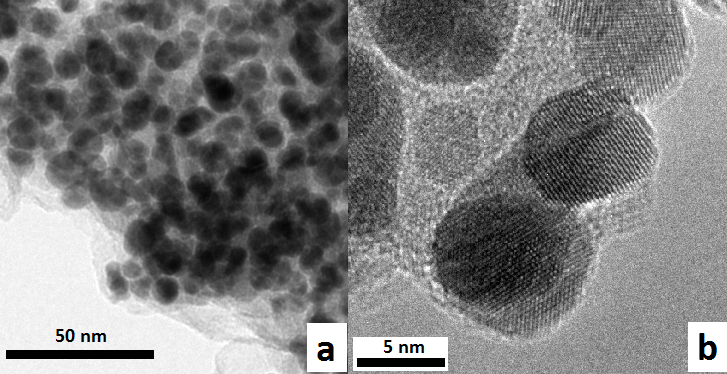 Figure 1
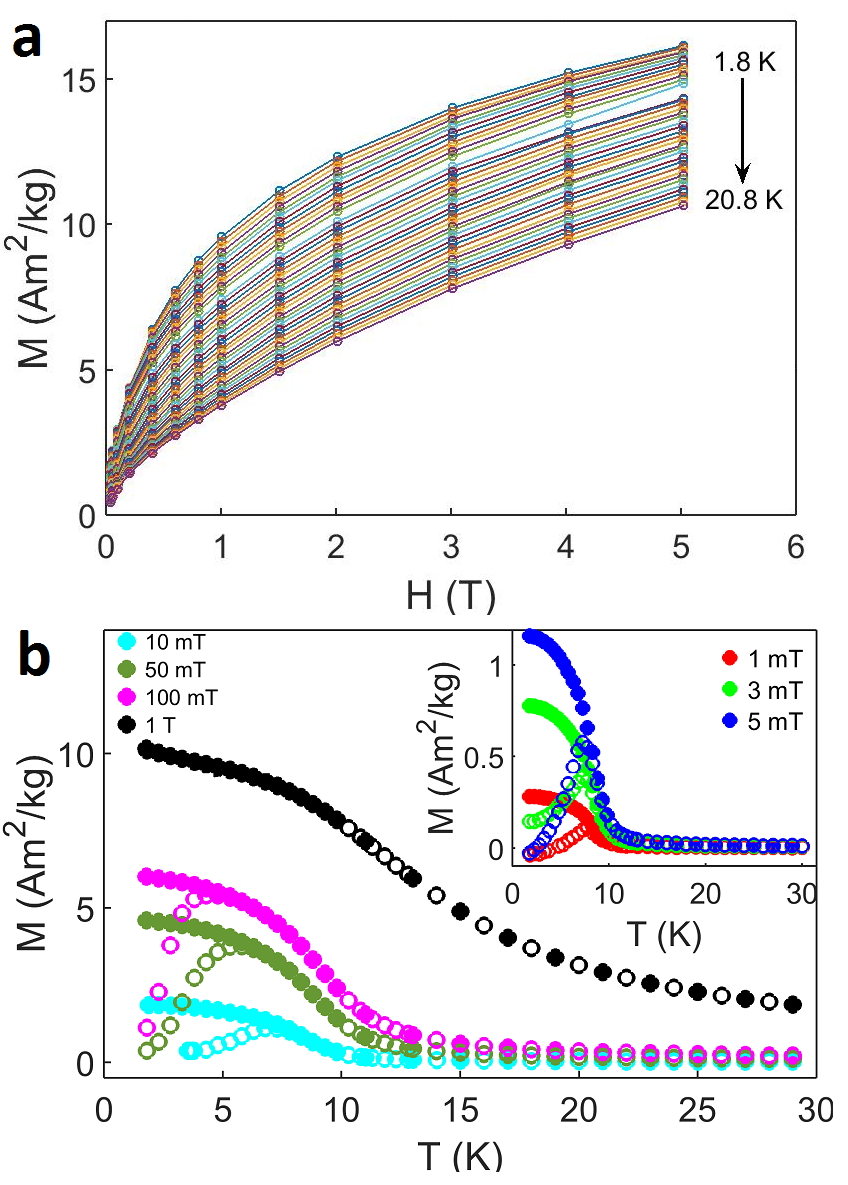 Figure 2
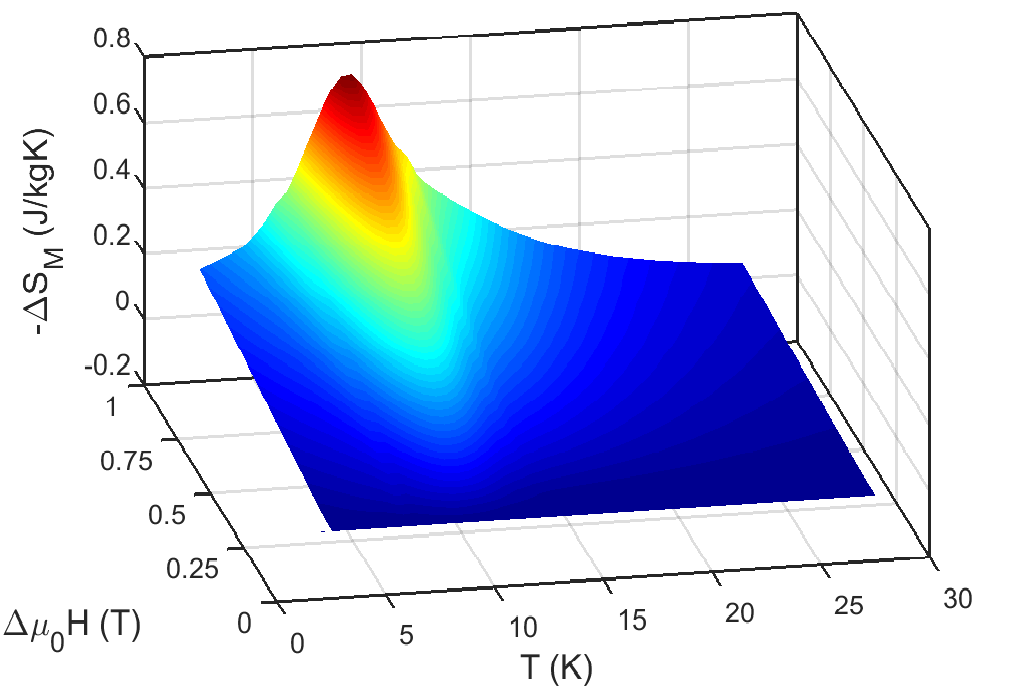 Figure 3
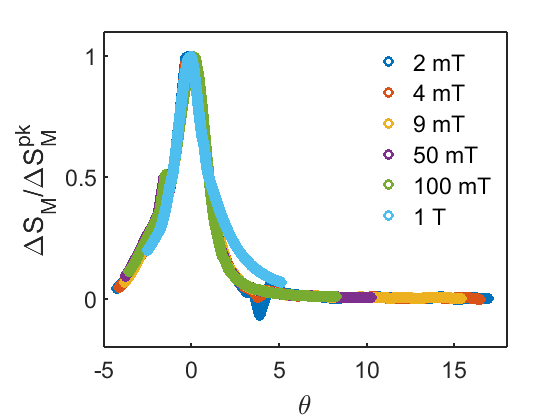 Figure 4
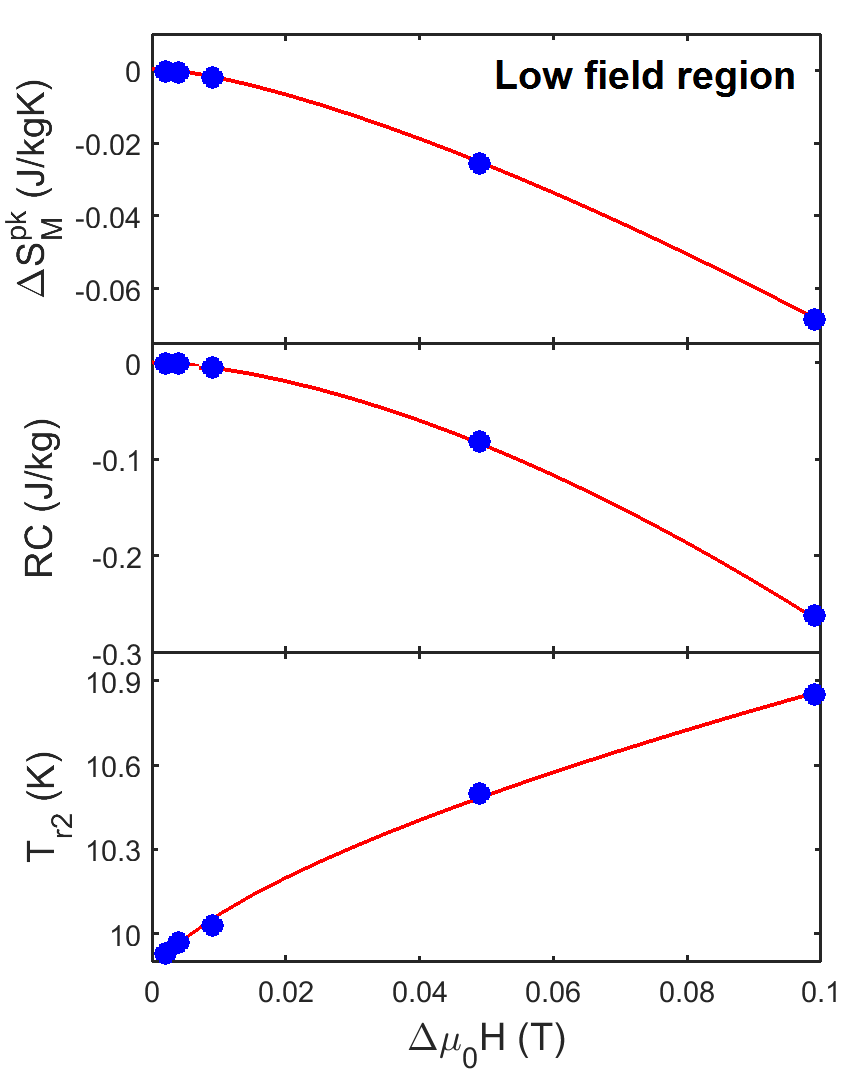 Figure 5
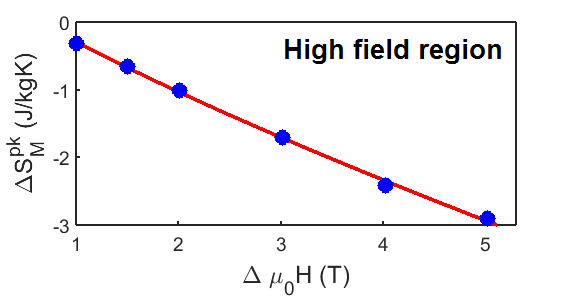 Figure 6
| (K) | (J/kgK) | (J/kg) | |
| Co/Au nanoparticles111This study. | 9 | 0.7 | 4.49 |
| Co nanoparticles222Polycrystalline nanoparticles (50 nm) with average crystalline size 4 nm Poddar et al. (2007). | 13 | 0.91 | - |
| Co/Ag nanoparticles333Nanoparticles with polycrystalline Co core of diameter 40 nm and Ag shell of thickness 28 nm Poddar et al. (2007). | 13 | 0.89 | - |
| La0.8Ca0.2MnO3444Nanoparticles prepared by sol-gel method. Average diameter is referenced in the brackets Shaobo et al. (2012); Hueso et al. (2002). (17 nm) | 90 | 0.1 | 20 |
| La0.8Ca0.2MnO3 (28 nm) | 210 | 1 | 75 |
| La0.8Ca0.2MnO3 (43 nm) | 236 | 4.2 | 40 |
| La2/3Ca1/3MnO3 (60 nm) | 260 | 0.5 | - |
| La2/3Ca1/3MnO3 (500 nm) | 260 | 5 | - |
| CoFeO4555Strongly interacting non-monodisperse nanoparticles of average diameter 5 nm Poddar et al. (2006). | 223 | 2.5 | - |
Peer Reviews
No public reviews on file for this paper yet. If you reviewed it on a platform where reviews are public (OpenReview, ICLR, NeurIPS, ICML), you can paste yours below so the community can read it here.
Videos
No videos yet. Explain this paper in a talk, walkthrough, or lecture? Add one.
Taxonomy
TopicsTheoretical and Computational Physics · Advanced Thermodynamics and Statistical Mechanics · Material Dynamics and Properties
Magnetocaloric effect and scaling analysis in superspin glass Co/Au nanoparticles
Pavol Hrubovčák
Adriana Zeleňáková
Department of Solid State Physics, P. J. Šafárik University, Park Angelinum 9, Košice, Slovakia
Vladimír Zeleňák
Department of Inorganic Chemistry, P. J. Šafárik University, Moyzesova 11, Košice, Slovakia
Jozef Kováč
Institute of Experimental Physics, Slovak Academy of Sciences, Watsonova 41, Košice, Slovakia
Victorino Franco
Department of Condensed Matter Physics, ICMSE-CSIC, Sevilla University, P.O. Box 1065, 41080 Sevilla, Spain
Abstract
Bimetallic Co/Au (core/shell) nanoparticle system exhibiting transition form superparamagnetic (SPM) to superspin glass state (SSG) at low temperatures has been investigated with respect to its magnetocaloric properties. Peaks of magnetic entropy change vs. temperature dependences () have been observed at a temperature in the vicinity of SPM to SSG transition. Despite of significant thermal hysteresis of magnetization at low applied fields a master curve has been constructed from the dependences employing scaling analysis. That confirms the investigated transition is of the second order type. Different values of critical exponents calculated from field dependence of relevant magnetocaloric response parameters in the proximity of critical temperature have been found for low and high applied fields. Moreover, the exponents exhibited significant disagreement with theoretical values characteristic of mean field theory as well as Ising models indicating distinct behavior of the SSG system at critical temperature.
PACS numbers
75.75.Fk, 89.75.Da, 64.60.Ht, 65.40.gd, 75.30.Sg
††preprint: APS/123-QED
I Introduction
Despite of intensive research on nanostructures driven mainly by the high application potential of these kind of materials in a variety of disciplines like medicine Mura et al. (2013); Tadić et al. (2012), technics Reiss and Hütten (2005) or industry Faraji et al. (2010); Tang and Lo (2013), only a few works devoted to examination of magnetic nanoparticles (NPs) with respect to their magnetocaloric properties have been reported so far McMichael et al. (1992); Shaobo et al. (2012); Poddar et al. (2007); Hueso et al. (2002). The magnetocaloric effect (MCE) refers to conversion of magnetic energy of a magnetic substance into thermal energy under applying or removing an external magnetic field Tishin and Spichkin (2003). Since the effect is known over a century, it has been the basis for several magnetic refrigeration techniques and a number of feasible refrigerant materials have already been designed Pecharsky and Gschneidner (1999). In the process of tailoring the qualities of potential refrigerants, magnetic nanoparticles have been found very pioneering. The main advantage of nanoparticles over the bulk materials stems in wider options for tuning the characteristics of the refrigerant material. Since the change of working temperature, refrigeration capacity or phase transition character in bulk materials can be induced almost exclusively by chemical composition, in the case of NPs size, shape, capping layer or dilution of nanoparticle system affect those features. Monte Carlo simulations carried out by Baldomir et al. Baldomir et al. (2007) suggest that for a given sample concentration of superparamagnetic NPs there exists a particle size that provides larger entropy increase, and reciprocally for a given particle volume there exists a sample concentration allowing to produce larger entropy change. Significantly different behavior was documented by Phan et al. Phan et al. (2009) in the bulk and nanostructured (50 nm and 35 nm) gadolinium iron garnets (Gd3Fe5O12). While the peak of magnetic entropy change () in bulk sample was found almost independent of the applied magnetic field, the ones corresponding to nanostructured samples tended to shift towards lower temperatures as the applied magnetic field was increased. Moreover, an increase in the magnitude of was documented with diminishing particle size. The authors ascribed this feature to surface spin disorder in nanostructured samples. Hueso et al. Hueso et al. (2002) studied MCE properties of La2/3Ca1/3MnO3 nanoparticles and found out that the first-order magnetic transition can be minimized and eventually evolves towards a second-order one as the grain size diminishes. Thus, we are able to change the nature of an intrinsic property of a material by changing the particle size. The investigation of numerous bulk systems exhibiting MCE by means of scaling analysis shown that in the case of the materials undergoing the second order phase transition (SOPT) an universal curve can be constructed from the magnetic entropy change vs. temperature dependences after proper rescaling Franco and Conde (2010); Franco et al. (2010a). Therefore, the collapse of curves can be regarded as the relevant indicator of SOPT in bulk crystalline and amorphous alloys Bonilla et al. (2010); Franco et al. (2007a, b, c). Franco et al. Franco et al. (2010b) extended this kind of analysis to monodispersed core/shell Co, Co/Ag and Ni/Ag nanoparticle systems. They utilized the field dependence of the magnetic entropy change peak for the surface spin freezing transition study and concluded that although the magnitude of the peak entropy change and position of the peak can be tuned by changing the composition and nature (metallic or organic) of the shell and surfactant layers, the characteristics of the spin freezing transition are not altered.
Apparently, there is a need for extended investigation of many interesting phenomena connected with magnetic NPs. Hence, we decided to prepare a monodisperse core/shell Co/Au nanoparticle system and study its magnetocaloric properties. As it was demonstrated elsewhere Hrubovčák et al. (2015), this system exhibits features of non-equilibrium dynamics induced by strong inter-particle interactions what leads to formation of superspin glass state. This work is the first attempt to apply scaling analysis of Franco and Conde (2010) developed for bulk materials on nanoparticle system exhibiting superspin glass state in order to examine the characteristics of the phase transition. Since complex study on MCE characteristics of similar system has not been reported yet, we put forward our results of magnetic entropy change, field dependence of relevant MCE parameters, scaling analysis and critical exponents obtained by processing the experimental data.
II EXPERIMENTAL
Examined Co/Au nanoparticles were synthesised employing the reverse micelle method. Utilized chemicals, process of preparation, particles’ structural analysis via X-ray diffraction and high resolution transmition electron microscopy along with histogram of particles’ size distribution can be found elsewhere Hrubovčák et al. (2015). Monodisperse core/shell nanoparticle system (denoted as Co/Au1 in ref. Hrubovčák et al. (2015)) exhibited average particle size 7 nm with average particle’s magnetic moment 86 corresponding to a cobalt core with diameter of 5 nm. The analysis of AC magnetic susceptibility data revealed the presence of non-equilibrium dynamics and freezing of the nanoparticles’ magnetic moments into the superspin glass state at K. The morphology of the investigated system is displayed in Fig. 1.
Magnetic properties of the system were examined by SQUID-based magnetometer (Quantum Design MPMS 5XL). The sample with 18 mg mass was encapsulated in a gelatine capsule and placed into a plastic holder. The signal of the empty capsule and holder was measured and substracted from experimental data. Isothermal magnetization curves were obtained using the following standard protocol which is commonly being used for data collection Caron et al. (2009); Franco . The sample was cooled down in zero magnetic field to 20.8 K and subsequently isothermal magnetization curves were recorded in a temperature range from 20.8 to 1.8 K with a step of 0.5 K in applied fields up to 5 T. Zero-field-cooling () and field-cooling () measurements were carried out in temperature range 1.8 - 30 K in applied fields up to 1 T. MCE was evaluated by means of magnetic entropy change vs. temperature dependences calculated from , and isothermal magnetization data for low and high applied fields, respectively.
III Results and discussion
III.1 DC magnetic measurements
Isothermal magnetization data recorded by means of standard protocol described in section II, Fig. 2 (a), indicate expected dependence of investigated Co/Au nanoparticle system magnetization on applied field magnitude. For each fixed temperature, the magnetization rises with increasing applied field, and for the corresponding applied field magnitude, it decreases with diminishing temperature. Fig. 2 (b) represents isofield magnetization data, where curves exhibit field dependent single maximum at peak temperature () which shifts towards lower temperatures with the applied field increment up to 100 mT. This feature is typical of superparamagnetic NPs and according to Tadić Tadić et al. (2009, 2007), the peak temperature, , can be attributed to experimental blocking temperature of the system at particular field. Decreasing the temperature below and curves start to bifurcate and significant thermal hysteresis becomes evident.The flat character of the curve with tendency to saturate as it approaches the lowest temperatures is one of the characteristic features of superspin glass systems with nonequilibrium dynamics, where strong interparticle interactions are dominant De Toro et al. (2014). On the other hand, no thermal hysteresis was observed for / curves obtained at T. These curves merge in the whole temperature span, suggesting that applied field was strong enough to overcome mutual interactions between particles and aligned the particles’ magnetic moments even at the lowest temperatures.
In order to examine magnetocaloric properties of the system via magnetic entropy change calculation, isothermal magnetization data obtained by means of standard protocol Caron et al. (2009); Franco are commonly being used in the majority of cases. However, it has been shown Caron et al. (2009); Carvalho et al. (2011); Tocado et al. (2009), that in the systems undergoing first order phase transition where thermal hysteresis is present, the application of Maxwell relation to the curves could possibly give unphysical magnetic entropy change spikes. This effect usually occur if i) the material is not properly prepared before each measurement (i.e. the memory of the sample is not properly erased) or ii) if the temperature interval between adjacent isotherms is lower than the extent of hysteresis. With the aim to suppress this feature, magnetization vs. temperature of the sample can be recorded at different constant magnetic fields and can be calculated from this data set avoiding artifacts Carvalho et al. (2011); Tocado et al. (2009). Since ZFC/FC protocol meets the demand, we employed and also data for determination in the region of applied fields up to 1 T, where thermal hysteresis in the studied Co/Au system was observed.
The relationship between the change in magnetization and entropy can be expressed by Maxwell relation Callen (1981) , which for an isothermal-isobaric process after numerical approximated integration yields Ma et al. (2007)
[TABLE]
where and are the magnetization values measured in magnetic field at temperatures and , respectively.
Fig. 3 presents magnetic entropy change vs. temperature dependences calculated from the experimental data. In accordance with Maxwell relation, the slope of curves determines the quantity and the sign of magnetic entropy change, while the peaks of the occurrence of inflection points of or data. These inflection points are present in all right shoulders () of curves and they are identical to the ones, because the irreversibility does not emerge down to vicinity of . However, in the case of left shoulders (), inflection points of follow the shift of towards lower temperatures with applied field increment and for the highest fields (100 mT, 1 T) do not even occur. Moreover, positive slope of below could reflect the presence of inverse MCE in Co/Au nanoparticle system. Such behavior has been observed and described by Gorsse et al. Gorsse et al. (2011) in Tb60Ni30Al10 amorphous alloy exhibiting spin glass behavior and its examination is beyond the scope of this study.
Since MCE refers to the reversible temperature change under the application or removal of an external magnetic field and data are not reversible under magnetic field cycling treatment, we utilized data for estimation, Fig. 3. As expected, processed data were found in significant agreement with results established from curves above (curves not shown), where the positions of corresponding peaks, K, along with their magnitudes were not or only slightly altered. At this point, it is worth to emphasize good correlation of peaks’ positions with freezing temperature of Co/Au nanoparticles’ superspins K established for the system from AC susceptibility measurements in our previous work Hrubovčák et al. (2015). In addition, evaluation of data obtained for high applied field region confirmed the presence of peak at K, thus at the very proximity of and close to .
Finally, we compared our results with the values reported by other authors for selected nanoparticle systems. The magnitudes of magnetic entropy change at corresponding critical temperatures in applied field of 1 T are listed in Table 1.
III.2 Scaling analysis
Numerous studies Pecharsky and Gschneidner (1999); Franco and Conde (2010); Franco et al. (2007c, 2010b) showed that the occurrence of peak () at peak temperature can indicate magnetic phase transition in a system and analysis of the peak features can provide us with information on the character of possible phase transition Franco et al. (2010a), presence of minor phases in material Franco et al. (2007a) or system critical behavior Franco and Conde (2010). In this study, we focused on the evaluation of peaks at the temperature and investigation of the characteristics of superparamagnetic to superspin glass state transition in the Co/Au nanoparticle system. With this objective we applied scaling analysis proposed and experimentally verified for the systems undergoing the second order phase transition (SOPT) in bulk materials Franco and Conde (2010).
According to Franco et al. Franco and Conde (2010) curves obtained for SOPT material can be rescaled onto a single curve which does not depend on field and in which the different temperature dependencies are unified. The first step in constructing process of such master curve stems in identifying reference temperature, , for each dependence. Reference temperature corresponds to a certain value of magnetic entropy change and it is identified as , where is arbitrary selected real number between 0 and 1. The value of was set for this study as it is the value commonly used for the purpose of scaling analysis Franco et al. (2007a, c, 2010b). Afterwards, curves are normalized with respect to their maximum and finally the temperature axis is rescaled according to equation Franco et al. (2007a)
[TABLE]
where and correspond to the reference temperatures below and above the , respectively.
Fig. 4 shows the collapse of data (presented in the Fig. 3) onto universal curve constructed for the maxima after employing scaling analysis according to Eq. 2. Analogous behavior has already been reported Franco et al. (2010b) in similar Co/Ag and Ni/Ag core/shell nanoparticle systems, where the surface spin freezing transition as typical order-disorder transition was found as an origin of this behavior. Due to the existence of master curve, superspin glass freezing occurring in our Co/Au system resembles the features of the second order phase transition in the vicinity of . The absence of thermal hysteresis in the ZFC/FC curves for fields above 1 T indicated a different nature of the transition, as can be observed in the absence of collapse of the rescaled 1 T curve onto the master curve for lower fields. In order to examine the phenomenon in more detail, further analysis of relevant magnetocaloric parameters dependence on the magnitude of applied magnetic field change has been carried out. As it was reported Franco and Conde (2010), field dependence of , and refrigeration capacity (RC) can be utilized for the calculation of critical exponents which control magnetic phase transition at the proximity of critical temperature. Refrigeration capacity is the measure of the energy that can be transferred between the hot and cold reservoirs and is defined as Pecharsky and Gschneidner (1999)
[TABLE]
where is the difference between minimum and maximum applied fields. Usually, it is calculated as full width at half maximum of the peak times the peak value and in the case of SOPT, RC should obey scaling law Franco and Conde (2010) RC, . Fig. 5 shows ) dependence up to = 100 mT of investigated Co/Au nanoparticle system and fit of experimental data yielded the value of from which was calculated. It is necessary to emphasize that we excluded the values of , and RC obtained for the field change of 1 T from corresponding data fits. This was due to the absence of thermal hysteresis in / curves at T, what indicates different behavior of the system in low and high applied magnetic fields. As we mentioned before, Franco et al. Franco et al. (2010b) studied similar systems of pure Co, Co/Ag and Ni/Ag core/shell nanoparticles where surface spin freezing process at low temperatures was revealed. They established from vs. dependence for field changes above 1 T and found out that this exponent did not vary with the change of core or shell material what points to the fact that the nature of the spin glass phase transition is not altered by material characteristics. Since our value differs from the one determined for surface spin freezing, we suppose that transition between superparamagnetic and superspin glass state Bedanta et al. (2015) at low applied fields is of distinct nature. Furthermore, the comparison of determined for our Co/Au system with the value of resulting from the mean-field theory Franco and Conde (2010) points to the fact that this theory is not suitable for the description of investigated SSG transition.
In the case of materials which do not follow a mean-field approach, the magnetic equation of state of such a material in the proximity of the transition temperature can be approximately described by the Arrott-Noakes equation of state Franco et al. (2007a); Arrott and Noakes (1967)
[TABLE]
where , are parameters of the equation, and are the crittical exponents. is the critical temperature represented by Curie temperature in standard SOPT. In our case, we attributed critical temperature to superspin glass freezing temperature K determined from magnetic AC susceptibility data analysis Hrubovčák et al. (2015). If we express field dependence as and consider the ralationship , Eq. (4) leads to relationship between the exponent at the Curie point and the critical exponents of the material Franco et al. (2006)
[TABLE]
Fit of experimental data of investigated Co/Au nanoparticle system presented in Fig. 5 released the value of and subsequently and were calculated. Obtained values are in high discordance with the values characteristic of the mean field theory or Ising models, Table 2. The only critical exponent find in line with mean-field approach was established from the dependence Franco and Conde (2010). Since no thermal hysteresis was observed in the Co/Au nanoparticle system for high applied fields (above 1 T), isothermal data were processed employing Eq. (1) for the evaluation of the systems’ magnetocaloric properties in high field region. Magnetic entropy change exhibited sharp peak at 7.5 K and its magnitude scaled with the applied field following power law , where the exponent was obtained by fitting the experimental data, Fig. 6. Apparently, magnetocaloric response of the system qualitatively differs depending on low or high applied field magnitude. Due to very sharp peak character, insufficient experimental data hampered further scaling analysis as well as critical exponents calculations. Nevertheless, our analysis of MCE revealed distinct behavior of Co/Au nanoparticle system in low and high applied field regions and confirmed that examined transition from SPM to SSG state in low field region is of the second order type.
IV Conclusion
Magnetocaloric effect has been observed in Co/Au nanoparticle system exhibiting transition from superparamagnetic to superspin glass state. Decreasing the temperature below sufficiently low value, strong inter-particle interactions become dominant inducing collective behavior of nanoparticles’ magnetic moments what results in the superspin frustration and non-equilibrium dynamics. Since magnetic characteristics of SSG state differ significantly from SPM state, abrupt change in magnetic entropy of the system was expected and experimentally confirmed. The values of J/kgK and corresponding refrigeration capacity RC J/kg have been established for applied field T. It has been shown that despite of evident thermal hysteresis of the system observed in low applied magnetic fields, universal curve can be constructed from data recorded in field-cooling protocol. This suggests that the transition between superparamagnetic and superspin glass state evidenced in the system is of the second order (SOPT). Further data analysis by means of scaling laws valid for for magnetic materials undergoing the second order phase transition revealed significant deviations of calculated critical exponents from the values typical of mean-field theory or Ising models what suggests that application of these approaches has limitations for examined transition description. Further, established exponents do not match with those reported for nanoparticle systems where freezing of surface spins into spin glass state proceeds. This indicates that there is a need of proposing new theory describing those processes in nanoparticle systems.
Acknowledgements.
This work was supported by the Slovak Research and Development Agency under the contracts APVV-14-0073, APVV-15-0520, APVV-15-0115, and VEGA (No. 1/0377/16, No. 1/0745/17) projects of Ministry of Education of the Slovak Republic and by the ERDF EU grant under No. ITMS 26220120035. The authors (A.Z and V.Z) would like to thank DESY/HASYLAB project under No. I-20110282 EC.
The reference list from the paper itself. Each links out to its DOI / PubMed record.
- 1Mura et al. (2013) S. Mura, j. Nicolas, and P. Couvreur, Nature Materials 12 , 991 (2013).
- 2Tadić et al. (2012) M. Tadić, V. Kusigerski, D. Markoviić, M. Panjan, L. Miloseviić, and V. Spasojeviić, Journal of Alloys and Compounds 525 , 28 (2012).
- 3Reiss and Hütten (2005) G. Reiss and A. Hütten, Nature Materials 4 , 725 (2005).
- 4Faraji et al. (2010) M. Faraji, Y. Yamini, and M. Rezaee, Journal of the Iranian Chemical Society 7 , 1 (2010).
- 5Tang and Lo (2013) S. Tang and I. M. Lo, Research Water 47 , 2613 (2013).
- 6Mc Michael et al. (1992) R. D. Mc Michael, R. D. Shull, L. H. Swartzendruber, L. J.and Bennett, and R. E. Watson, Journal of Applied Physics 111 (1992).
- 7Shaobo et al. (2012) X. Shaobo, L. Wenjian, and S. Yuping, Journal of Applied Physics 111 , 063922 (2012).
- 8Poddar et al. (2007) P. Poddar, S. Srinatha, J. Gass, B. Prasad, and H. Srikanth, Journal of Physical Chemistry C 111 , 14060 (2007).