Neutrino oscillation tomography of the Earth with KM3NeT-ORCA
Simon Bourret, Jo\~ao A. B. Coelho, V\'eronique Van Elewyck (for, the KM3NeT collaboration)

TL;DR
KM3NeT-ORCA aims to use atmospheric neutrino oscillations to perform Earth tomography, providing independent geophysical measurements of Earth's interior with high precision after a decade of data collection.
Contribution
This work demonstrates the potential of neutrino oscillation data from KM3NeT-ORCA to measure Earth's internal electron density with high accuracy, offering a novel geophysical technique.
Findings
Electron density in Earth's mantle measurable with 3-5% precision.
Outer core electron density measurable with 7-10% precision.
Potential to complement traditional geophysical methods.
Abstract
KM3NeT-ORCA is a water-Cherenkov neutrino detector designed for studying the oscillations of atmospheric neutrinos, with the primary objective of measuring the neutrino mass ordering. Atmospheric neutrinos crossing the Earth undergo matter effects, modifying the pattern of their flavour oscillations. The study of the angular and energy distribution of neutrino events in ORCA can therefore provide tomographic information on the Earth's interior with an independent technique, complementary to the standard geophysics methods. Preliminary estimations based on a full Monte Carlo simulation of the detector response show that after ten years of operation the electron density can be measured with a precision of 3-5% in the mantle and 7-10% in the outer core - depending on the mass ordering.
Click any figure to enlarge with its caption.
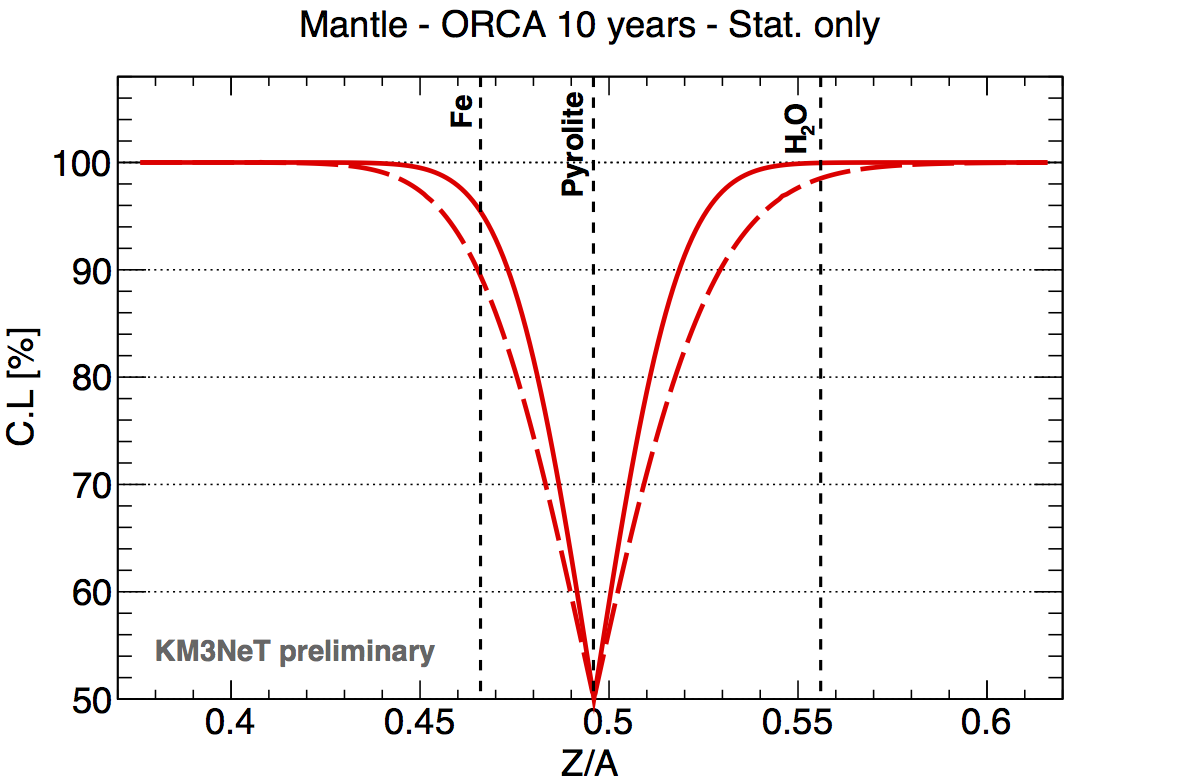 Figure 1
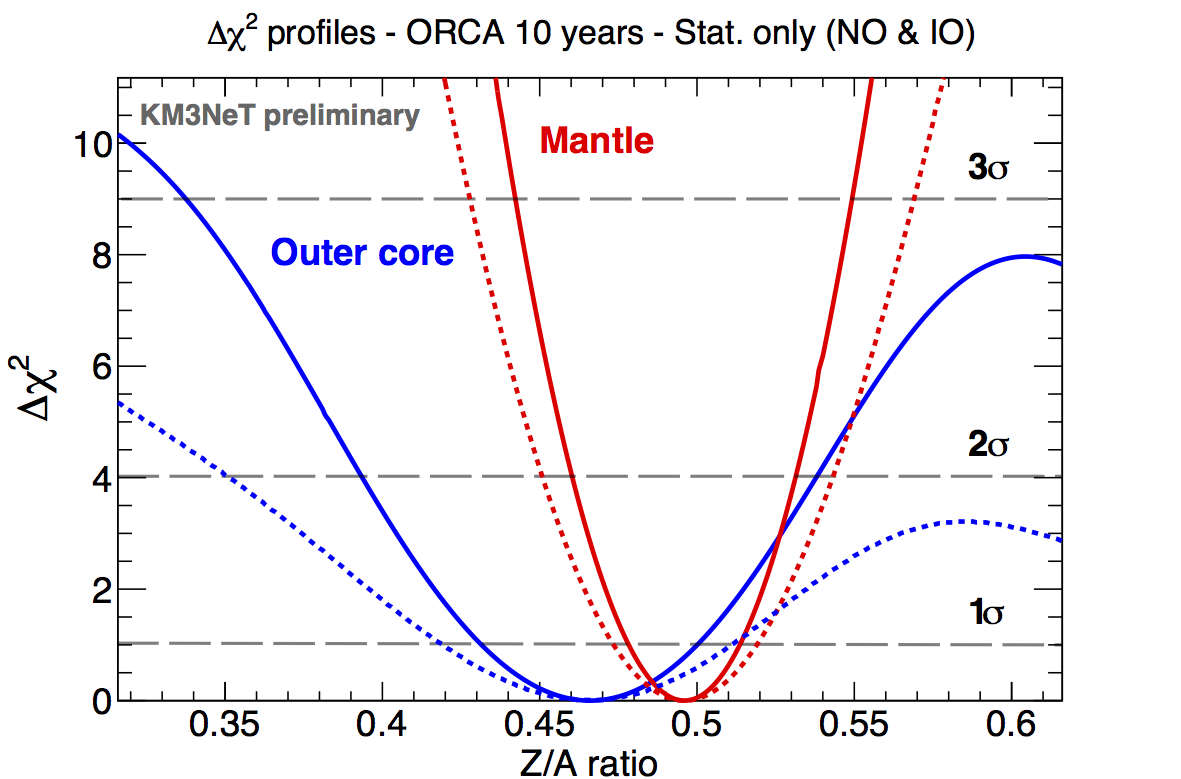 Figure 2
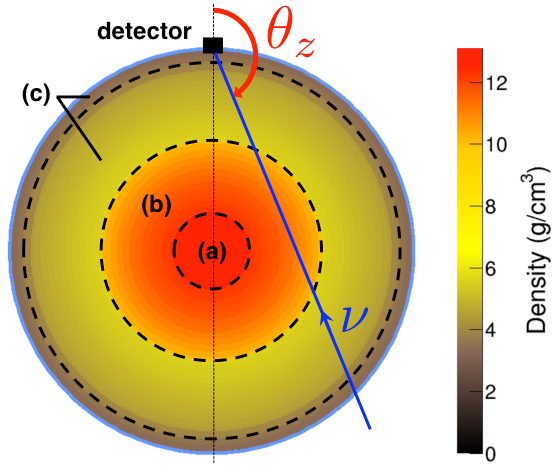 Figure 3
Peer Reviews
No public reviews on file for this paper yet. If you reviewed it on a platform where reviews are public (OpenReview, ICLR, NeurIPS, ICML), you can paste yours below so the community can read it here.
Videos
No videos yet. Explain this paper in a talk, walkthrough, or lecture? Add one.
Neutrino oscillation tomography of the Earth with KM3NeT-ORCA
Simon Bourret1
João A B Coelho1 and Véronique Van Elewyck1,2
on behalf of the KM3NeT collaboration
1 APC, Université Paris Diderot, CNRS/IN2P3, Sorbonne Paris Cité, F-75205 Paris, France
2 Institut Universitaire de France, 75005 Paris, France [email protected]
Abstract
KM3NeT-ORCA is a water-Cherenkov neutrino detector designed for studying the oscillations of atmospheric neutrinos, with the primary objective of measuring the neutrino mass ordering. Atmospheric neutrinos crossing the Earth undergo matter effects, modifying the pattern of their flavour oscillations. The study of the angular and energy distribution of neutrino events in ORCA can therefore provide tomographic information on the Earth’s interior with an independent technique, complementary to the standard geophysics methods. Preliminary estimations based on a full Monte Carlo simulation of the detector response show that after ten years of operation the electron density can be measured with a precision of 3-5% in the mantle and 7-10% in the outer core – depending on the mass ordering.
1 Introduction and motivations
ORCA (Oscillation Research with Cosmics in the Abyss) is the low-energy branch of KM3NeT, the next-generation neutrino Cherenkov detector currently being built in the Mediterranean Sea with the aim of measuring the neutrino mass ordering and searching for high-energy cosmic neutrino sources [1]. The ORCA detector will instrument 5.7 Mton of seawater in a dense configuration of 115 vertical strings with an horizontal spacing of 20 m, anchored on the seabed off the shore of Toulon (France). Each string supports 18 digital optical modules with a vertical spacing of 9 m. With this configuration, ORCA will focus on the study of atmospheric neutrino oscillations in the energy range .
Due to coherent forward scattering on electrons, the flavour oscillations of atmospheric neutrinos propagating through the Earth matter are modified with respect to vacuum oscillations: this is known as the MSW effect [2, 3]. An accurate measurement of this effect, based on the angular, energy and flavour distribution of neutrino interactions in ORCA, can provide tomographic information on the electron density in the Earth’s interior [4, 5]. This method is complementary to usual geophysical methods such as inversion of seismic data and geodetic measurements, which are used to infer the radial mass density profile. The ratio of electron to mass density scales with the average proton to nucleon ratio (hereafter denoted ), which depends on the chemical composition of the medium. Hence, combining both measurements may allow us to constrain compositional models of the inner Earth – e.g. in the outer core [4]. In this work we use a reference geophysical model of the radial mass density profile in the Earth and we estimate the sensitivity of ORCA to the ratio in the mantle and outer core.
2 Methodology
Neutrino event topologies in ORCA can be separated into two broad classes, for which dedicated reconstruction algorithms have been developed. Track-like events result from charged-current (CC) interactions of and which produce an outgoing . Cascade-like events correspond to all other interaction channels: charged-current interactions of and and neutral-current (NC) interactions, producing only hadronic and electromagnetic showers. Event classification, together with rejection of down-going atmospheric muons, are based on a Random Decision Forest algorithm. We refer to [1] for details regarding simulations, detector resolutions and classification performance.
The composition measurement is extracted from the energy and zenith angle (see Fig. 1) distributions of track-like and cascade-like events, in bins of reconstructed and . To compute the rate of interacting events in the detector, we use atmospheric flux tables from the HKKM2014 simulations [6], and neutrino-nucleon cross-sections weighted for water molecules from the GENIE Monte Carlo generator [7].
Using custom software, the evolution equation for neutrino propagation in matter is solved numerically for each step in order to obtain the probabilities of flavour transition. The mass ordering is assumed to be known at the time of the tomography measurement, and oscillation parameters are fixed to their global (ordering-dependent) best-fit values as of May 2016 [9].
The detector response and flavour identification are applied using binned 4-dimensional response matrices built from Monte Carlo simulated events, accounting for detection and reconstruction efficiencies, event classification performance and errors on reconstructed variables (including correlations). We consider 16 distinct channels: . The contamination of signal channels by atmospheric muons is of the order of a few percent and is not included due to limited Monte Carlo statistics.
3 Preliminary results and prospects
At this stage, the reported sensitivities account for statistical uncertainty only – the influence of systematic effects is currently under study. We use a binned log-likelihood ratio test statistic combining both signal channels:
[TABLE]
where denotes the expected number of events under a certain Earth model hypothesis (model experiment), and is the observed number of events under an assumption on the true Earth parameters (pseudo-data). In this simplified analysis the sensitivity can be evaluated from the average experiment or Asimov dataset, i.e. no pseudo-experiments are drawn.
Fig. 3 shows that ORCA will be more sensitive to the electron density in the mantle than in the core. Although the oscillations are enhanced for core-crossing neutrinos, the resonance energy () is closer to the detection threshold and fast oscillations cannot be well resolved in this region due to limited angular and energy resolutions. High-density values for the outer core cannot be excluded with strong significance, due to self-similarities of the oscillation probabilities as the electron density increases [5]. The composition of the mantle is usually approximated by a theoretical rock model called pyrolite (). We report the estimated confidence level for rejecting this hypothesis as a function of the alternative true in Fig. 3.
A confidence interval for the measurement of the factor for both layers can be derived from the 1-dimensional profiles – considering the two measurements independently. After 10 years of operation, we estimate that the proposed ORCA detector will be able to measure the electron density in the Earth mantle to an accuracy of (resp. ) at confidence level, assuming normal (resp. inverted) mass ordering. In the outer core, this accuracy is reduced to (resp. ). As shown in Fig. 3, a significant improvement is realised by combining track-like and cascade-like channels. Further studies will include improved reconstructions of the interaction inelasticity, which can help to distinguish neutrinos from antineutrinos on a statistical basis, as well as the impact of systematic effects and multi-layer simultaneous measurement.
Acknowledgements
The authors gratefully acknowledge financial support from the IdEx and LabEx UnivEarthS programs at Sorbonne Paris Cité (ANR-11-IDEX-0005-02, ANR-10-LABX-0023).
References
- [1]
KM3NeT Collaboration 2016 Journal of Physics G: Nuclear and Particle Physics 43 084001
- [2]
Mikheev S P and Smirnov A Yu 1985 Sov. J. Nucl. Phys. 42 913–917 [Yad. Fiz.42,1441(1985)]
- [3]
Wolfenstein L 1978 Phys. Rev. D 17 2369–2374
- [4]
Rott C, Taketa A and Bose D 2015 Scientific Reports 5 15225
- [5]
Winter W 2016 Nucl. Phys. B908 250–267
- [6]
Honda M, Sajjad Athar M, Kajita T, Kasahara K and Midorikawa S 2015 Phys. Rev. D92 023004
- [7]
Andreopoulos C et al. 2010 Nucl. Instrum. Meth. A614 87–104
- [8]
Dziewonski A M and Anderson D L 1981 Physics of the Earth and Planetary Interiors 25 297–356
- [9]
Gonzalez-Garcia M C, Maltoni M and Schwetz T 2014 Journal of High Energy Physics 2014 1–28
The reference list from the paper itself. Each links out to its DOI / PubMed record.
- 1[1] KM 3Ne T Collaboration 2016 Journal of Physics G: Nuclear and Particle Physics 43 084001
- 2[2] Mikheev S P and Smirnov A Yu 1985 Sov. J. Nucl. Phys. 42 913–917 [Yad. Fiz.42,1441(1985)]
- 3[3] Wolfenstein L 1978 Phys. Rev. D 17 2369–2374
- 4[4] Rott C, Taketa A and Bose D 2015 Scientific Reports 5 15225
- 5[5] Winter W 2016 Nucl. Phys. B 908 250–267
- 6[6] Honda M, Sajjad Athar M, Kajita T, Kasahara K and Midorikawa S 2015 Phys. Rev. D 92 023004
- 7[7] Andreopoulos C et al. 2010 Nucl. Instrum. Meth. A 614 87–104
- 8[8] Dziewonski A M and Anderson D L 1981 Physics of the Earth and Planetary Interiors 25 297–356