Physical properties of resonances as the building blocks of multichannel scattering amplitudes
Sa\v{s}a Ceci, Marin Vuk\v{s}i\'c, Branimir Zauner

TL;DR
This paper introduces a simple, physically motivated formula for multichannel resonant scattering that accurately predicts scattering amplitude features near resonances, including overlapping ones, without background fitting.
Contribution
It presents a novel, straightforward formula linking resonant properties to scattering amplitudes, enhancing understanding of resonance behavior without complex background modeling.
Findings
Accurately predicts residue phase from other resonant parameters.
Describes scattering amplitude shapes near resonances effectively.
Explains features of complex models by enforcing unitarity.
Abstract
We propose a simple formula for multichannel resonant scattering with parameters related to physical resonant properties. It can be used to predict residue phase from other resonant parameters and describe the shape of scattering amplitudes close to the resonance without any background contributions or fitting. It works well even for overlapping resonances. Imposing unitarity to the proposed formula enabled us to explain some puzzling features of much more advanced models.
Click any figure to enlarge with its caption.
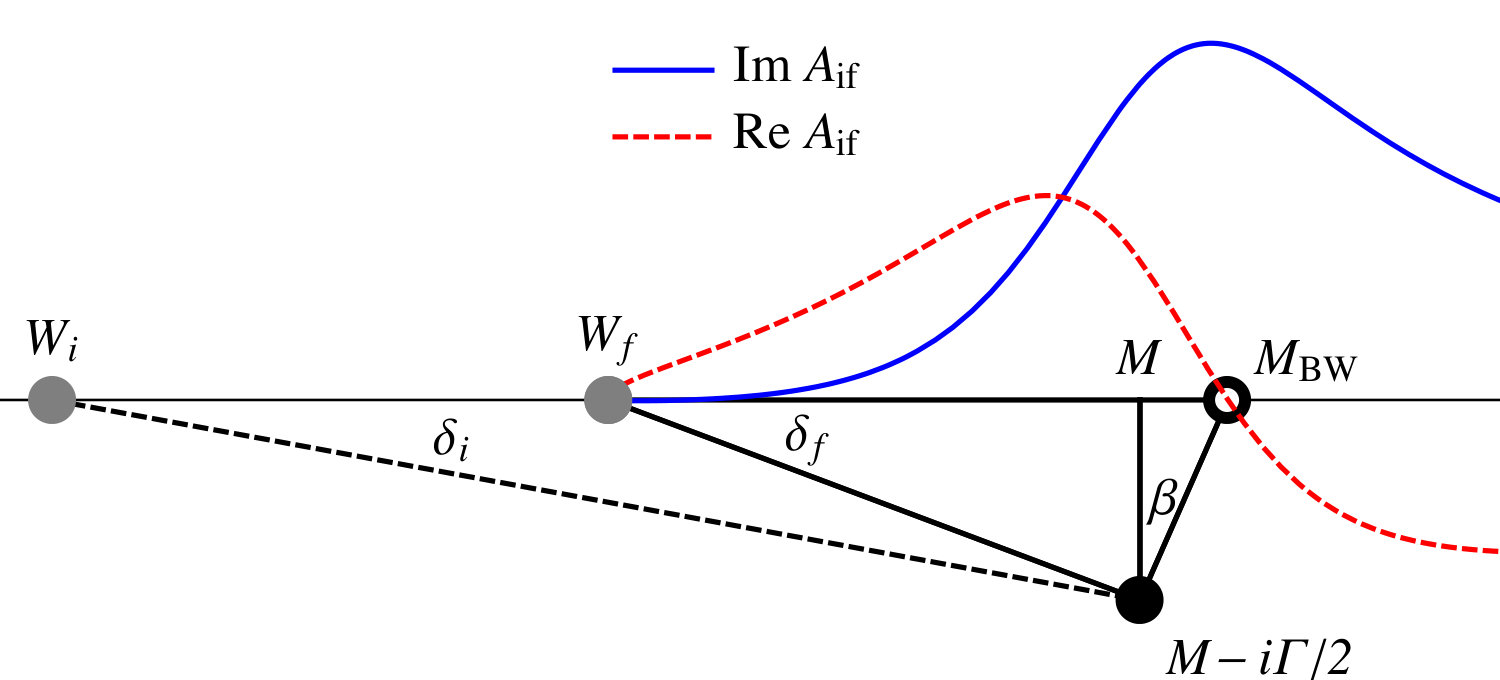 Figure 1
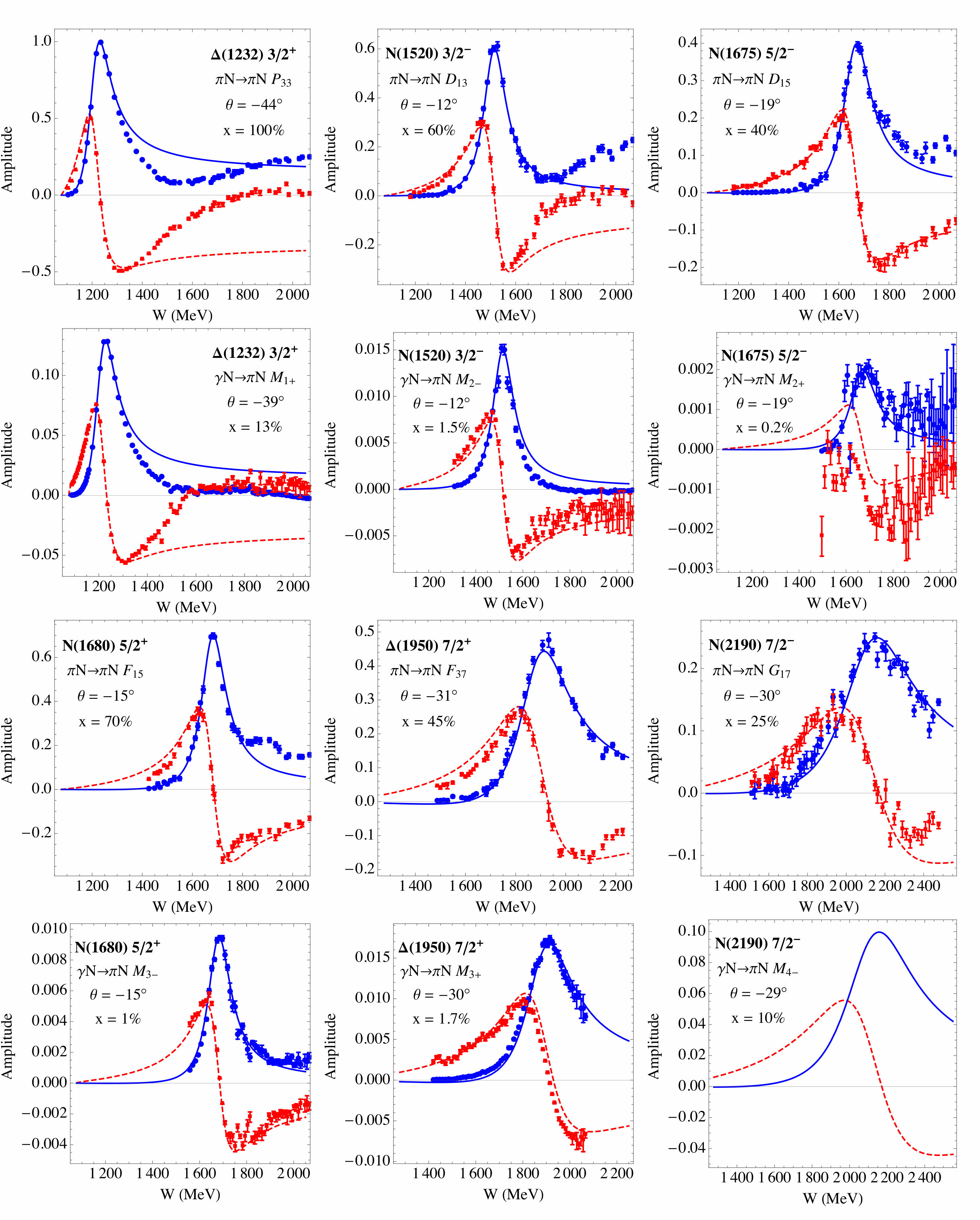 Figure 2
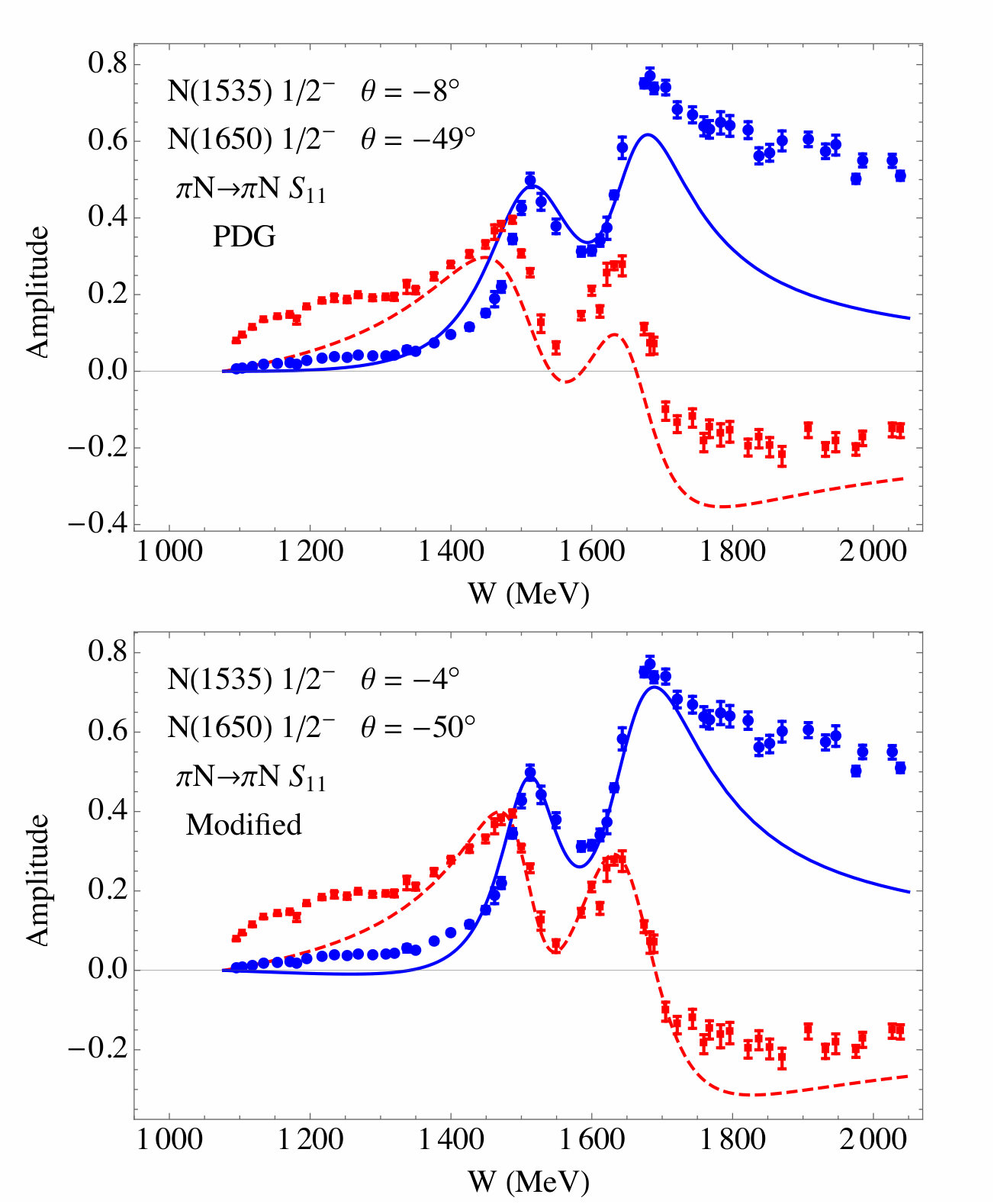 Figure 3
| /MeV | 12101 | 15105 | 16605 | 167510 | 188010 |
|---|---|---|---|---|---|
| /MeV | 1002 | 11010 | 13515 | 12015 | 24020 |
| /MeV | 12322 | 15155 | 16755 | 16855 | 193020 |
| /∘ | 2 | 7 | 10 | 9 | |
| /% | 1033 | 615 | 396 | 6910 | 435 |
| /∘ | 0 | 1 | 1 | 1 | 1 |
| /∘ | 2 | 7 | 6 | 10 | 9 |
| /∘ | 2 | 5 | 6 | 10 | 8 |
| /∘ | 0 | 1 | 1 | 1 | 1 |
| /∘ | 2 | 7 | 6 | 10 | 9 |
| /∘ | 2 | 3 | N/A | 3 | 3 |
| (%) | (MeV) | (MeV) | (MeV) | (∘) | (∘) | |
|---|---|---|---|---|---|---|
| 4510 | 151020 | 17080 | 153525 | 15 | ||
| Modified | 42 | 1510 | 110 | 1535 | 6 | |
| 6010 | 165515 | 13535 | 1655 | 20 | ||
| Modified | 76 | 1655 | 160 | 1680 | 3 |
Peer Reviews
No public reviews on file for this paper yet. If you reviewed it on a platform where reviews are public (OpenReview, ICLR, NeurIPS, ICML), you can paste yours below so the community can read it here.
Videos
No videos yet. Explain this paper in a talk, walkthrough, or lecture? Add one.
Taxonomy
TopicsElectromagnetic Scattering and Analysis
Physical properties of resonances as the building blocks
of multichannel scattering amplitudes
S. Ceci
Rudjer Bošković Institute, Bijenička 54, HR-10000 Zagreb, Croatia
M. Vukšić
University of Zagreb, Bijenička 34, HR-10000 Zagreb, Croatia
B. Zauner
Rudjer Bošković Institute, Bijenička 54, HR-10000 Zagreb, Croatia
Abstract
We propose a simple formula for multichannel resonant scattering with parameters related to physical resonant properties. It can be used to predict residue phase from other resonant parameters and describe the shape of scattering amplitudes close to the resonance without any background contributions or fitting. It works well even for overlapping resonances. Imposing unitarity to the proposed formula enabled us to explain some puzzling features of much more advanced models.
Resonance mass, Scattering amplitude poles, Breit-Wigner parameters
pacs:
11.55.Bq, 14.20.Gk, 11.80.Gw, 13.75.Gx
I Introduction
In 1936, Gregory Breit and Eugene Wigner wrote a paper on the capture of slow neutrons in nuclei BW . There they produced a famous equation for the resonant scattering, known now as the Breit-Wigner formula. It can be found in most textbooks on molecular physics AtkinsFriedman , nuclear physics NuclPh , and quantum field theory QFT . It is also present in The Review of Particle Physics PDG , a publication issued every two years by the Particle Data Group (PDG).
The formula is often expressed through scattering amplitude as a function of energy
[TABLE]
where is the resonant mass, the total decay width, and is the branching fraction.
For the elastic resonances, those decaying only to the same particles they are produced from, equals one and the formula is manifestly unitary. By unitary, we mean that the scattering matrix that is built up from the scattering amplitude as will be a unitary matrix.
The Breit-Wigner formula has been substantially modified since then to better represent the realistic scattering amplitudes with their angular-momentum-dependent threshold behaviors, various background contributions, and multiple, sometimes even strongly overlapping resonances. Representative and oft-quoted examples of such modifications are in the pion-pion GounarisSakurai ; Flatte and the pion-nucleon scattering Cutkosky ; ManleySaleski ; Batinic .
In addition to parameters , , and , these modifications produce another set of resonant properties. They are sometimes called the conventional resonant parameters, but are better known as the Breit-Wigner parameters: mass , width , and branching fraction . Parameters and are now known as the pole parameters, with the pole position equal to .
It is important to stress that the Breit-Wigner mass is not just some model parameter in a modified Breit-Wigner formula, as it is explained in detail, e.g., in section III. of Ref. Cutkosky . In fact, it is directly connected with the renormalized resonant mass of a propagator in quantum-field theory Sirlin ; Man95 ; Tornqvist ; Scherer ; Cec09 , which is defined as the real energy at which propagator’s denominator becomes purely imaginary.
The pole, on the other hand, might appear like it is just some mathematical feature of scattering matrix, but it is the defining characteristic of the resonance DalitzMoorhouse . In addition to the pole position, researchers extract the residue parameters as well. The residue magnitude is simply given by times . But there is also the residue phase . It has no counterpart in the textbook Breit-Wigner formula. Moreover, its physical meaning is much less clear than the meaning of other parameters. The mass is roughly related to the resonant energy, the decay width is inversely related to the resonance lifetime, and the branching fraction gives the probability of a resonance decaying to a particular set of lighter particles. So what is the physical meaning of the residue phase?
A step towards the possible answer was made in a broad, yet brief study on resonances Cec13 where a five-parameter semi-empirical Breit-Wigner-like formula was introduced. The relation between the elastic residue phase, elastic threshold, and the Breit-Wigner mass was later established and tested in a study on nucleon resonances Cec16 .
In this paper we propose a multichannel version of this formula with parameters directly related to either channel thresholds or physical resonant properties. We test it on prominent nucleon resonances by predicting the residue phase from other resonant parameters PDG ; Sva14 , show that the shape of the predicted amplitude agrees with the data SAID , analyze the robustness of the residue phase estimation on an overlapping resonance system Cec16 , and explain a puzzling feature of an advanced unitary model Batinic where the imaginary part of the amplitude matrix trace had peak positions at the Breit-Wigner masses Cec08 .
II Model
We begin with the scattering amplitude first suggested in Ref. Cec13
[TABLE]
where
[TABLE]
, , and are familiar pole parameters, while two new parameters are phases and . Note that if they are both zero, we will get exactly Eq. (1).
In Ref. Cec16 , the Breit-Wigner mass is defined as the real energy at which becomes 90∘, i.e.,
[TABLE]
The elastic phase is related to elastic threshold as
[TABLE]
The elastic residue phase is then .
To generalize Eq. (2) for inelastic processes we propose a simple modification
[TABLE]
where . The residue phase of this amplitude is given by
[TABLE]
To estimate , we need and s, which are determined from the geometry, as is shown in Fig. 1.
III Results
In Ref. Cec16 , residue phases of five prominent nucleon resonances seen in the elastic pion-nucleon scattering are predicted from other resonance parameters using elastic Eq. (2). Here we study the same five resonances to test Eq. (7). Unfortunately, unlike for the elastic scattering, in the inelastic case there are not enough results to make the world average. Therefore we use Švarc et al. Sva14 results for pion photo-production. The agreement between our predictions and experimental values of can be seen in Table 1, where resonance parameters , , and are the estimates made by PDG PDG , while and s are calculated from them using Eqs. (4) and (5) with 1077 MeV. Experimental s and s for elastic are estimated from PDG data PDG . Residue phases for are taken from Ref. Sva14 , to which we added a phase of calculated at the pole position due to different conventions ( and are c.m. momenta).
The agreement between predicted and experimental values is very good in almost all cases. To get a better idea about this agreement, we construct real and imaginary parts of the amplitude using Eq. (6) with parameters from Table 1 (no fitting, slightly adjusted) and compare them to the elastic and the photo-production single-energy data from SAID SAID in Fig. 2. For the photo production we use the magnetic multipoles multiplied with .
In Fig. 2 we included also N(2190) with averaged PDG parameter values: is 2100 MeV, is 439 MeV, and is 2171 MeV. This resonance is very broad and has a small branching fraction of only 25%. The predicted residue phase of is fully consistent with the of Cutkosky et al. Cutkosky , by Arndt et al. Arndt , and not too far from by Švarc et al. Sva14PDG . Interestingly, it has the opposite sign from Sokhoyan et al. Sok15 result of . Making a reasonable estimate or average of these results presents quite a challenge for PDG; their estimate is . That is another reason why plots might be better than tables.
The proposed model is built for isolated resonances and as such it is bound to fail in describing overlapping resonances. Still, in Ref. Cec16 it was shown that combining single resonance amplitudes and as produces a reasonable estimate for N(1535) and N(1650). In the upper part of Fig. 3 we show how the combined amplitude roughly resembles the data.
To test how much predictions would change if there was a better fit to the data, we adjust some resonant parameters in the lower part of Fig. 3. It turns out, not too much. The parameters we use are given in Table 2.
Before concluding, we would like to address a curious feature of a unitary and analytic coupled-channel multi-resonant analysis Batinic . In Ref. Cec08 it was shown that close to a resonance the trace of the multichannel matrix from Batinic looked like a simple elastic single-resonance amplitude, with the peak position of its imaginary part (and zero of the real) consistent with the Breit-Wigner mass. That is rather intriguing since the peak positions of the amplitude’s matrix elements in the presented model, or any other model have nothing to do with corresponding . But, we are looking at the trace of the matrix, not at mere matrix elements. Simply calculating the trace of Eq. (6) would not be too useful because the result is too general and we cannot learn much from it. That changes dramatically if we rewrite Eq. (6) as
[TABLE]
where real matrix absorbs everything else. When we impose the unitarity relation , we get the relation . Mathematically, this means that the trace of will be equal to its rank. The rank of a matrix is simply a number of its linearly independent rows (or columns). Consequently, the imaginary part of the trace of will be maximal (and the real part zero) when equals 90∘, which is exactly the definition of .
IV Conclusions
We proposed a simple formula for multichannel scattering amplitude with parameters related to physical resonant properties. It can be used to predict the residue phase from other resonant parameters and describe the shape of experimentally determined amplitudes without any background contributions or fitting. In particular, we explained why (1232) has elastic residue phase much lager (in magnitude) than most other prominent resonances: angle is large because this resonance is the closest one to threshold, angle is large because this resonance has large difference between and , and is the sum of the two. Moreover, we predicted that the residue phase in the pion photo-production will be smaller because threshold is further away and angle is smaller. The proposed formula seems to make sense even for overlapping resonances, and residue phase extraction appears to be robust in respect to small adjustments of the resonance parameters. Having said that, we would not recommend this formula for extraction of resonant properties since it is a local (near-resonance) approximation which works well only for prominent resonances. Yet, it seems to be very useful in predicting and explaining typical behavior of resonant amplitudes and physical properties of resonances. After all, imposing unitarity to the formula did enable us to understand puzzling features (peaks and zeros coinciding with Breit-Wigner masses) of a much more advanced unitary model.
V Acknowledgements
S.C. would like to thank Lothar Tiator and Hedim Osmanović for invaluable discussions, comments, and suggestions.
The reference list from the paper itself. Each links out to its DOI / PubMed record.
- 1(1) G. Breit and E. Wigner, Phys. Rev. 49 , 519 (1936).
- 2(2) P. Atkins and R. Friedman, Molecular quantum mechanics , pg. 495 (Oxford university press, 2005).
- 3(3) J. M. Blatt and V. F. Weisskopf, Theoretical Nuclear Physics , pg. 408 (Springer-Verlag, 1979).
- 4(4) M. Maggiore, A Modern Introduction to Quantum Field Theory , pg. 165 (Oxford University Press, 2005).
- 5(5) C. Patrignani et al. (Particle Data Group), Chin. Phys. C 40 , 100001 (2016).
- 6(6) G. S. Gounaris and J. J. Sakurai Phys. Rev. Lett. 21 , 244 (1968).
- 7(7) S. M. Flatté, Phys. Lett. B 63 , 224 (1976).
- 8(8) R. E. Cutkosky et al., Phys. Rev. D 20 , 2839 (1979).