Quark Wigner distributions and spin-spin correlations
D. Chakrabarti, T. Maji, C. Mondal, A. Mukherjee

TL;DR
This paper explores the internal spatial and spin structure of protons by calculating Wigner distributions for u and d quarks using a light-front quark-diquark model inspired by AdS/QCD, including spin correlations and GTMDs.
Contribution
It introduces a novel calculation of quark Wigner distributions within a light-front model incorporating scalar and axial vector diquarks, and analyzes their scale evolution and spin correlations.
Findings
Wigner distributions satisfy a Soffer-bound-type inequality.
GTMDs are evaluated and their scale evolution is shown.
Spin-spin correlations between quarks and protons are analyzed.
Abstract
We investigate the Wigner distributions for and quarks in a light-front quark-diquark model of a proton to unravel the spatial and spin structure. The light-front wave functions are modeled from the soft-wall AdS/QCD prediction. We consider the contributions from both the scalar and the axial vector diquarks. The Wigner distributions for unpolarized, longitudinally polarized, and transversely polarized protons are presented in the transverse momentum plane as well as in the transverse impact parameter plane. The Wigner distributions satisfy a Soffer-bound-type inequality. We also evaluate all the leading twist GTMDs and show their scale evolution. The spin-spin correlations between the quark and the proton are investigated
Click any figure to enlarge with its caption.
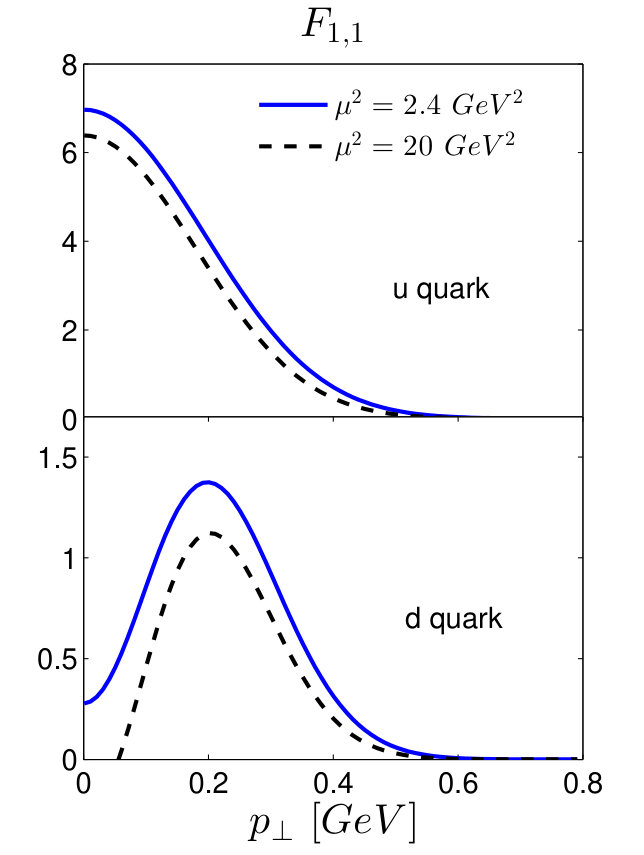 Figure 1
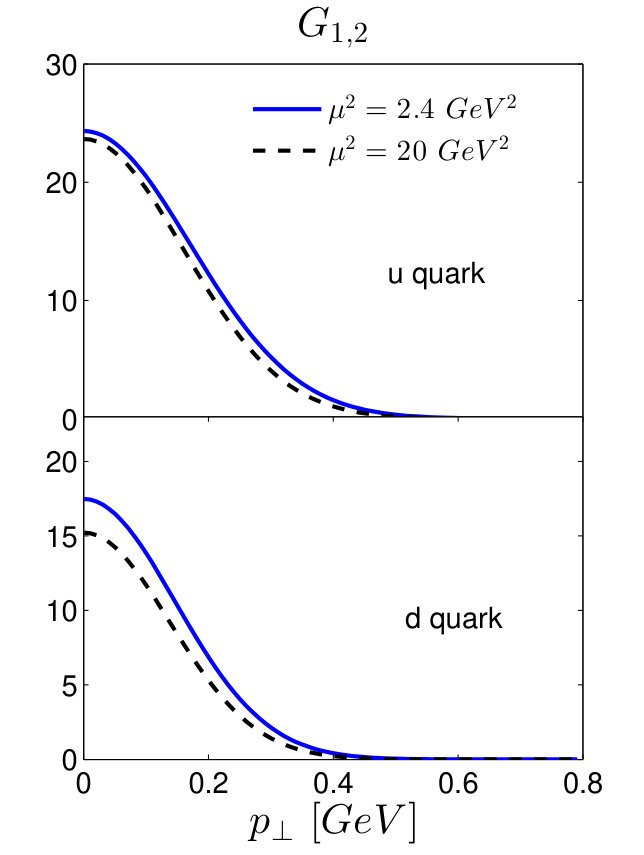 Figure 2
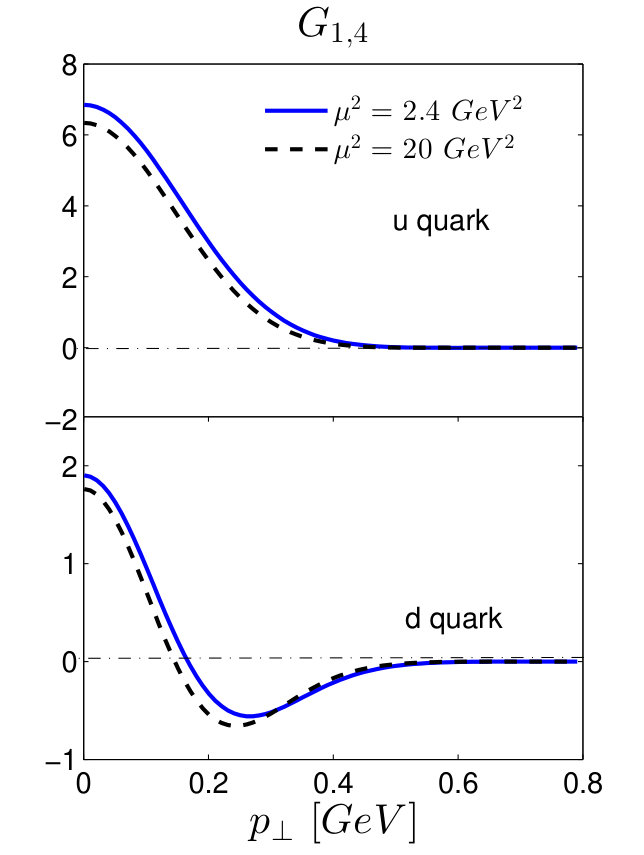 Figure 3
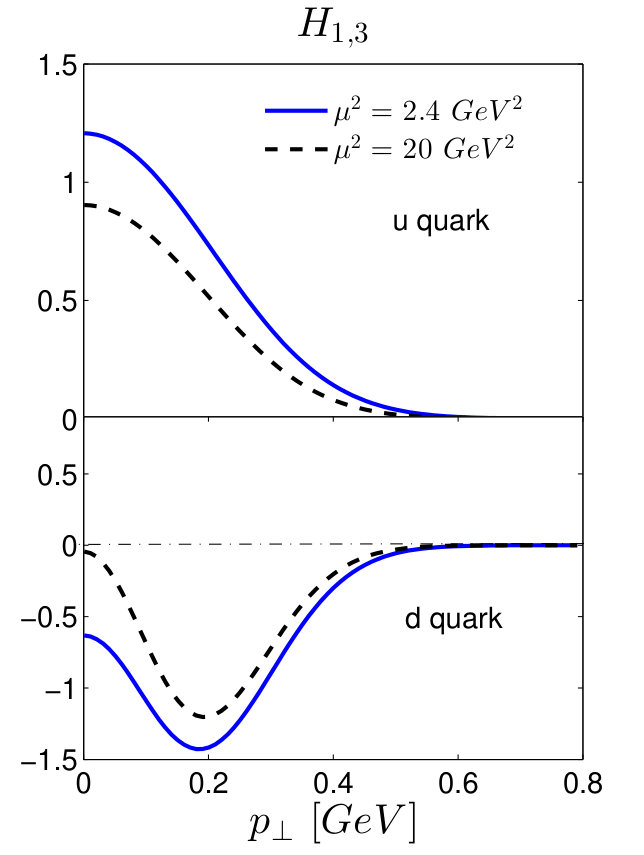 Figure 4
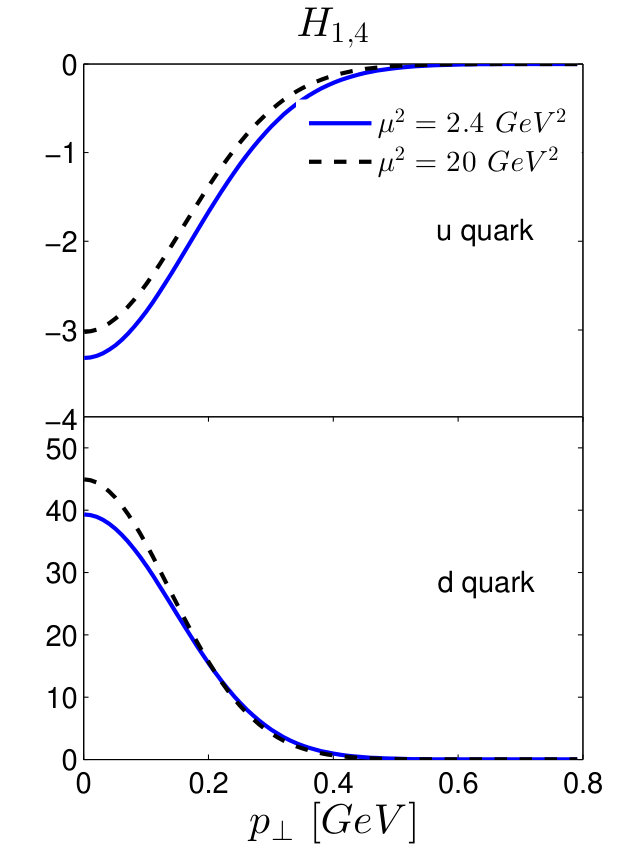 Figure 5
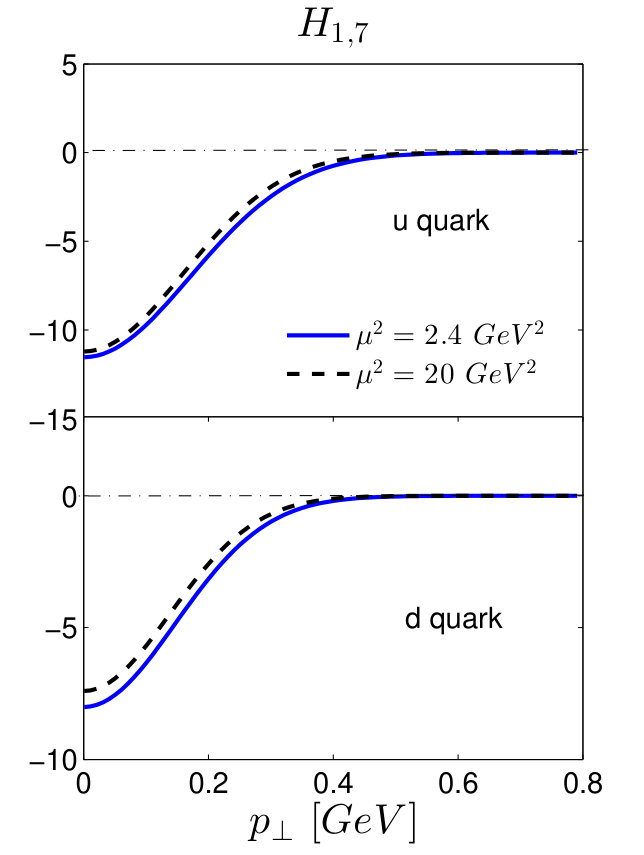 Figure 6
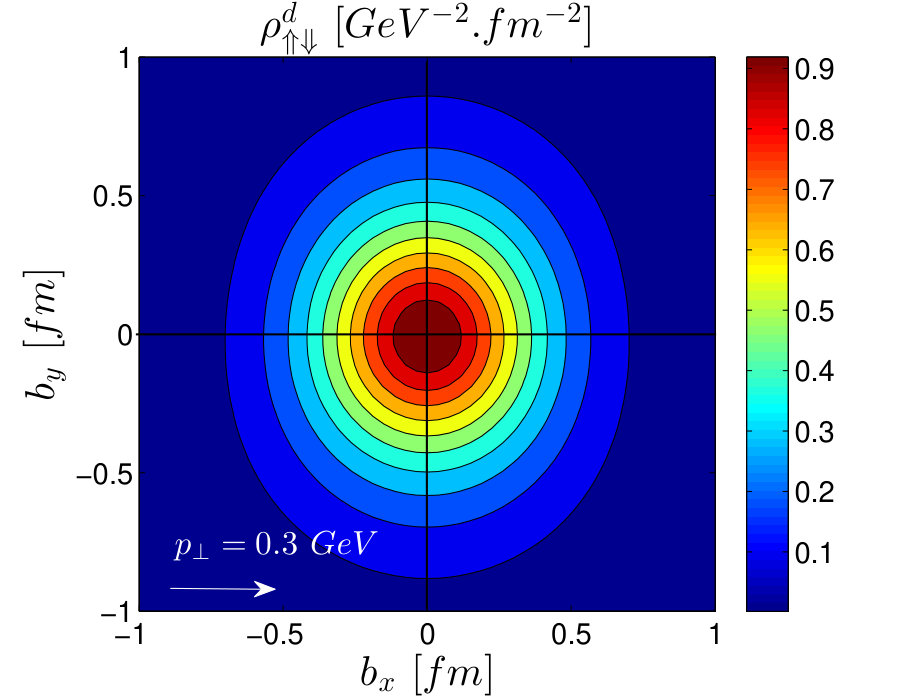 Figure 7
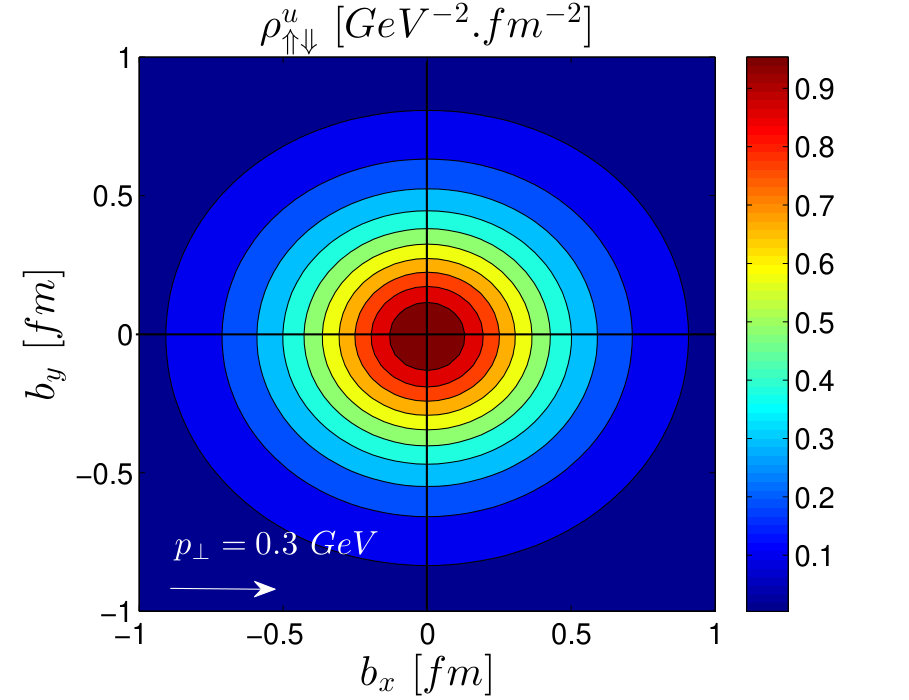 Figure 8
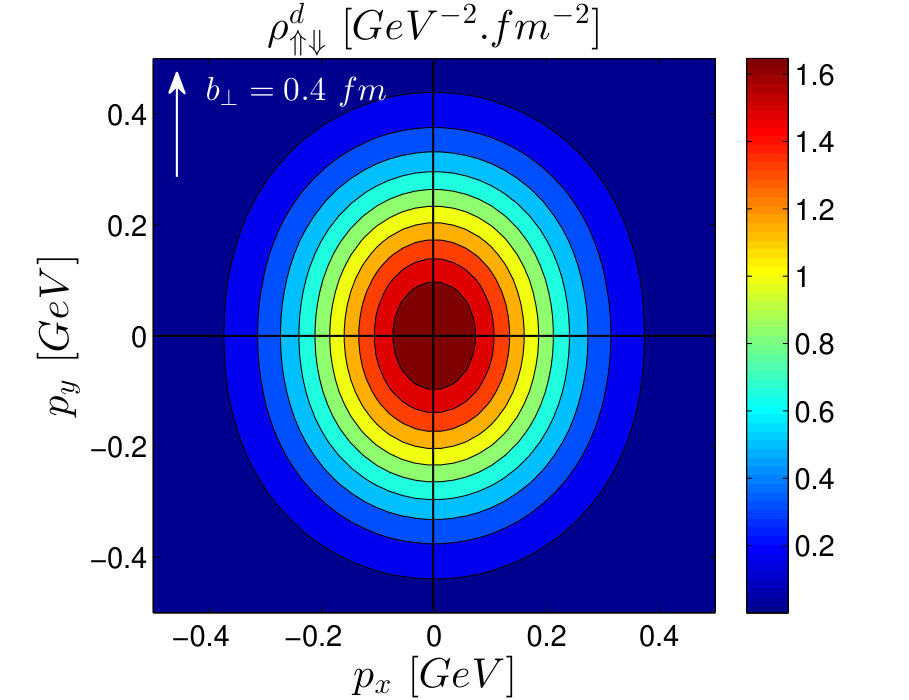 Figure 9
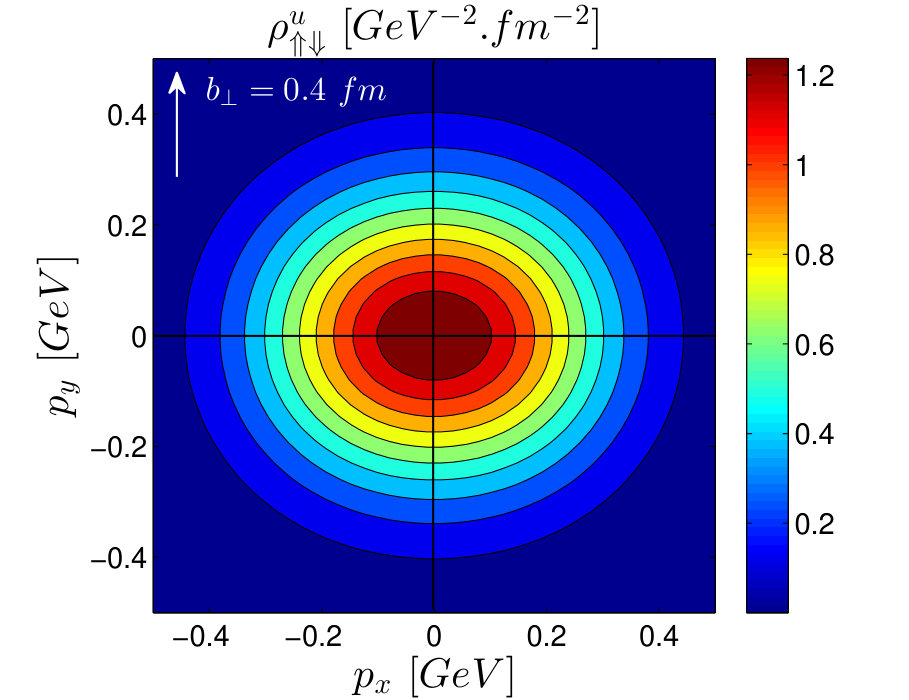 Figure 10
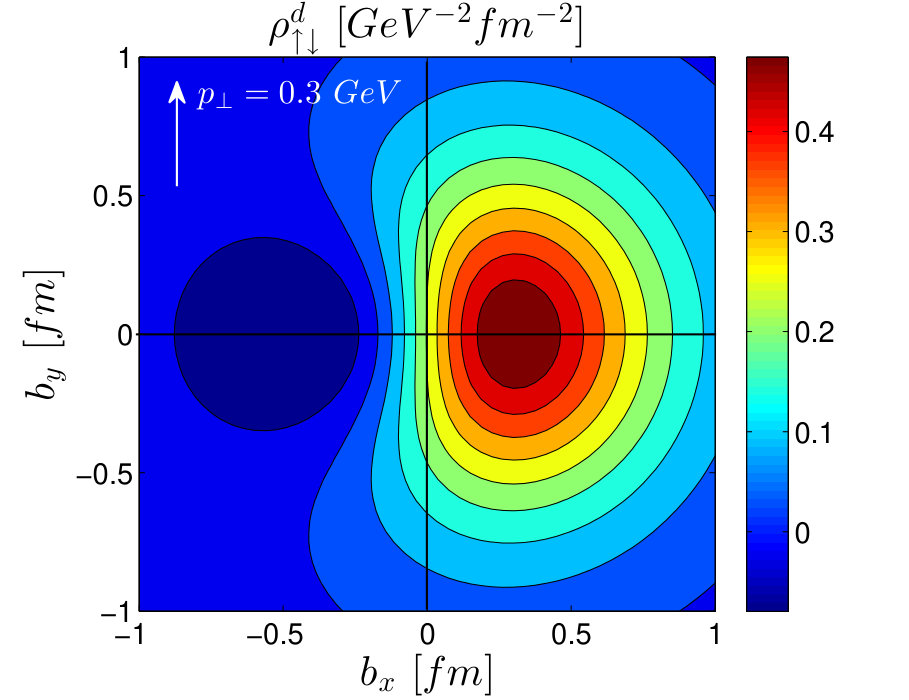 Figure 11
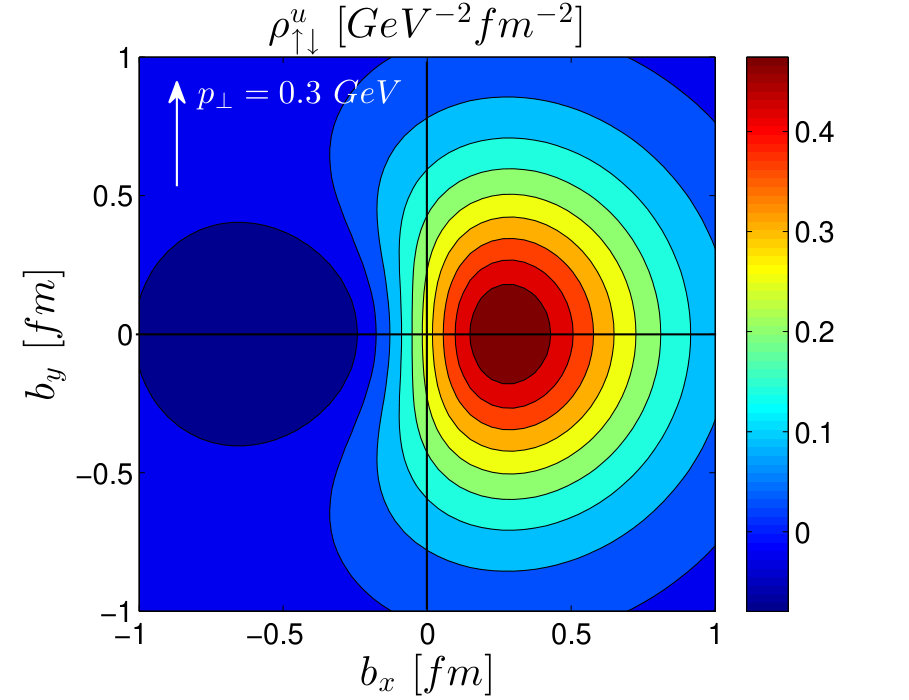 Figure 12
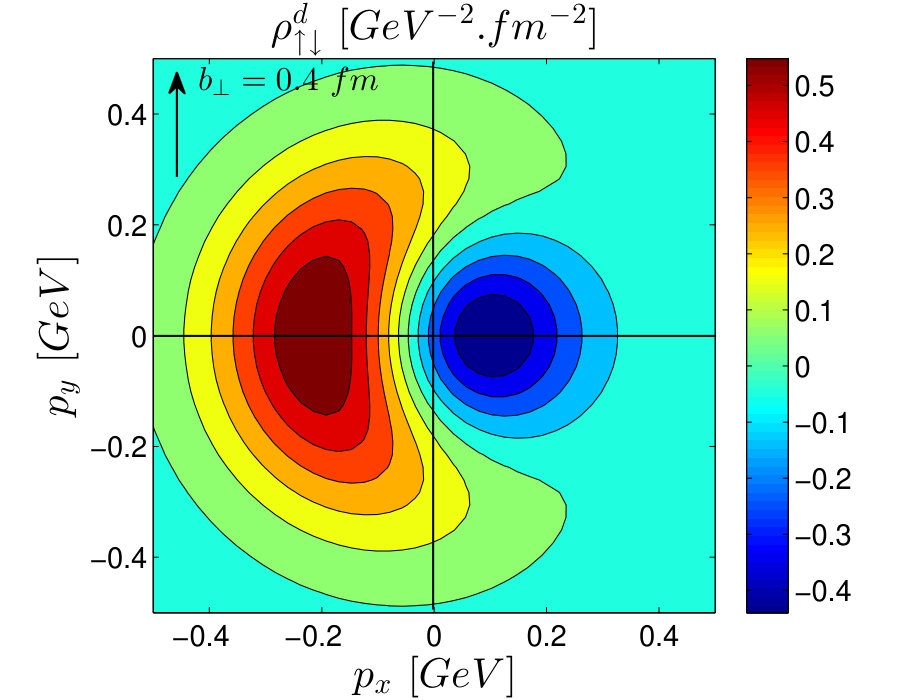 Figure 13
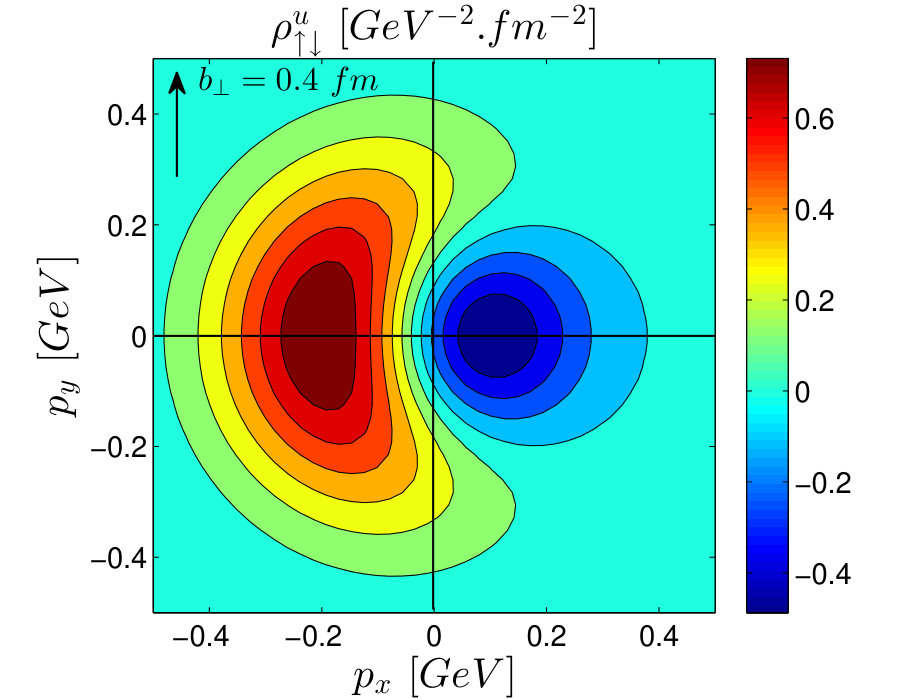 Figure 14
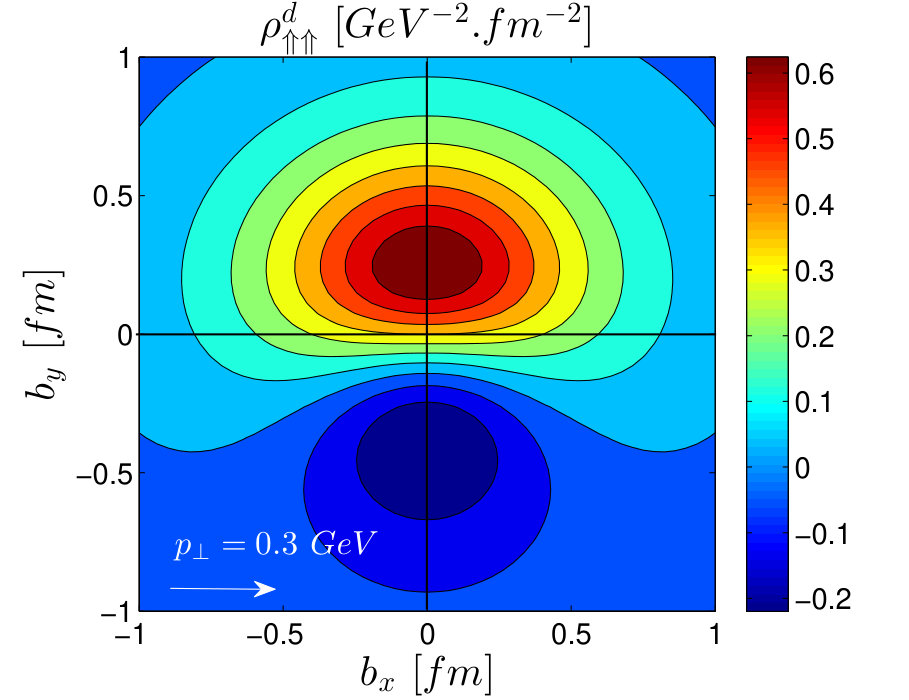 Figure 15
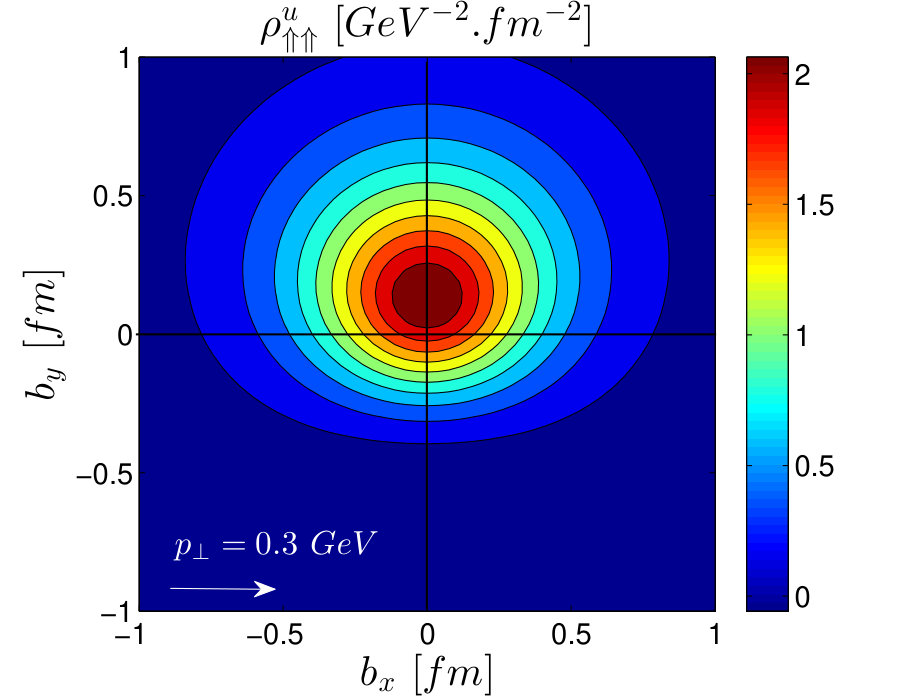 Figure 16
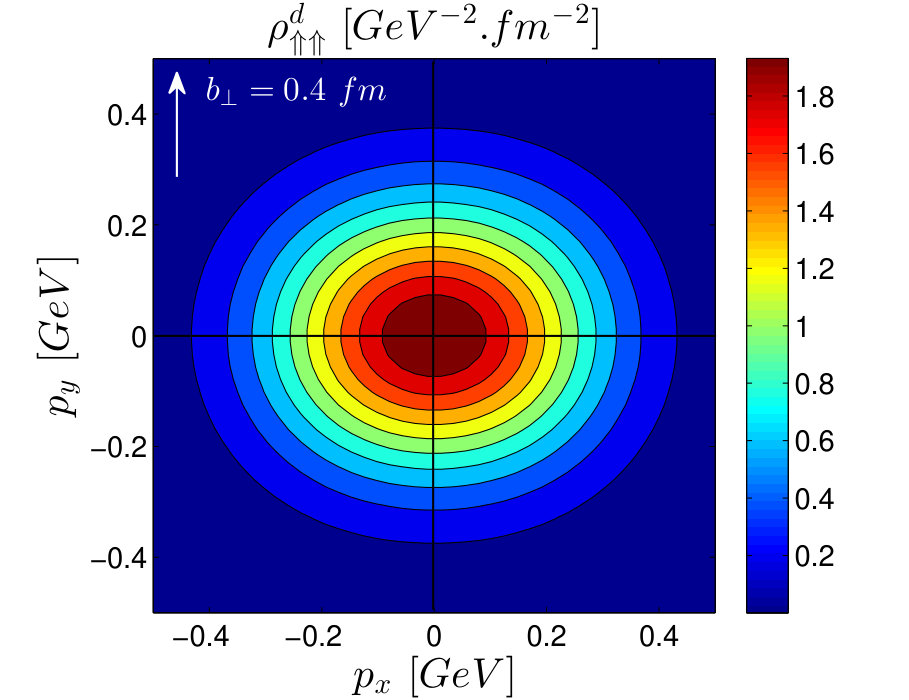 Figure 17
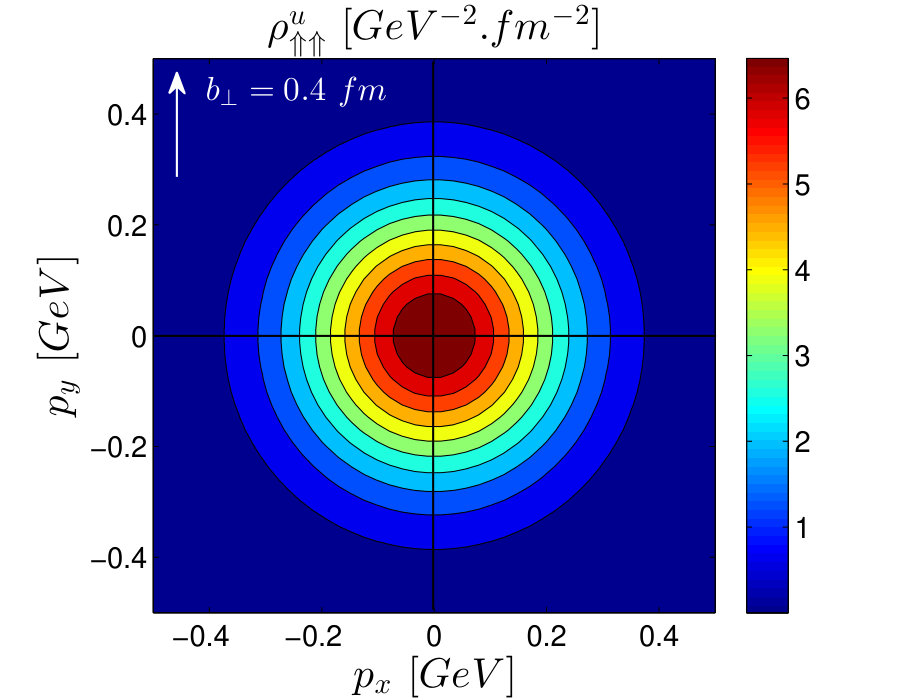 Figure 18
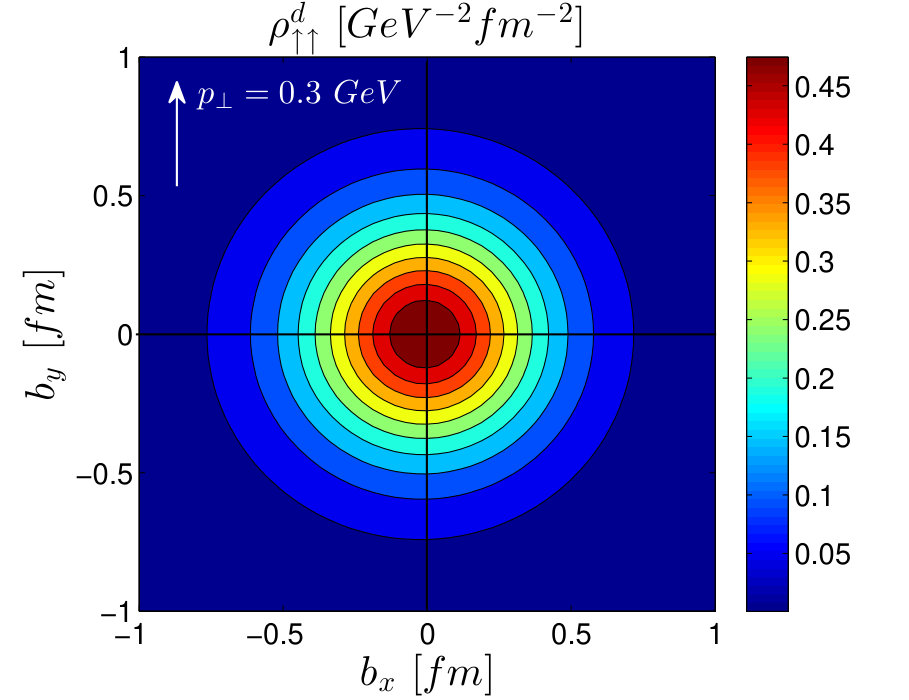 Figure 19
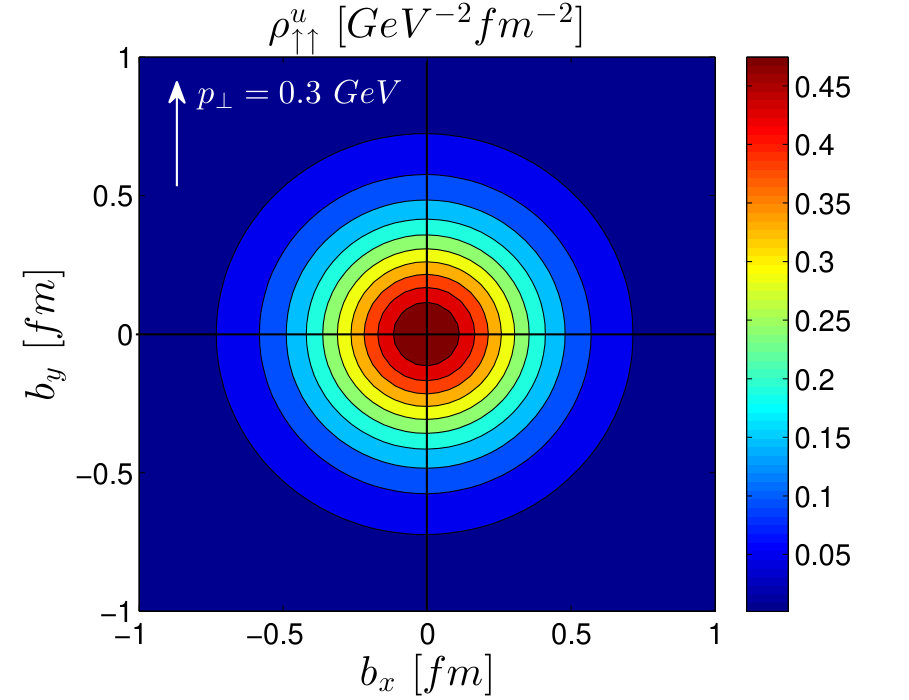 Figure 20
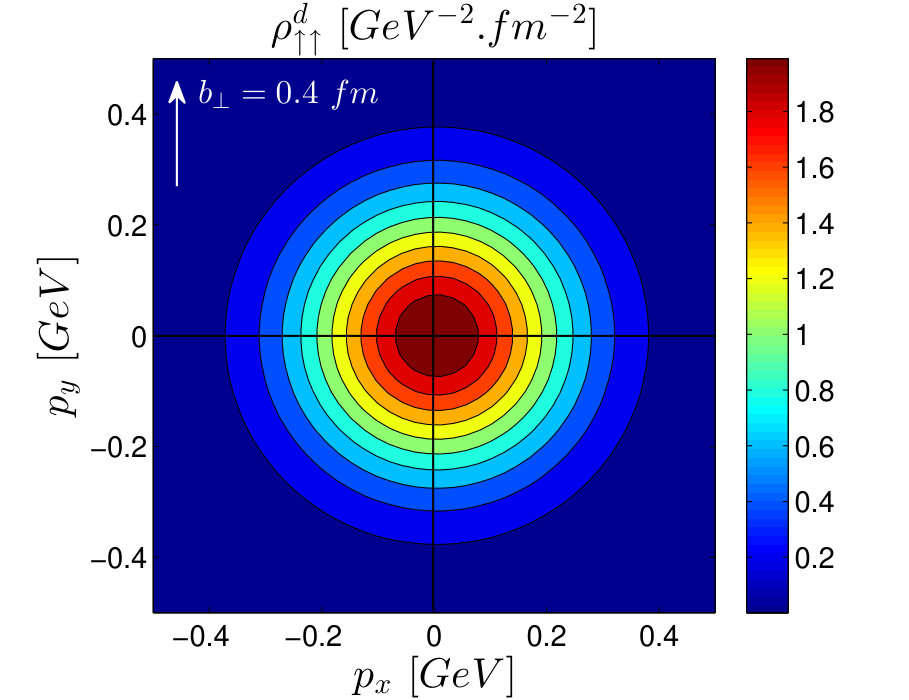 Figure 21
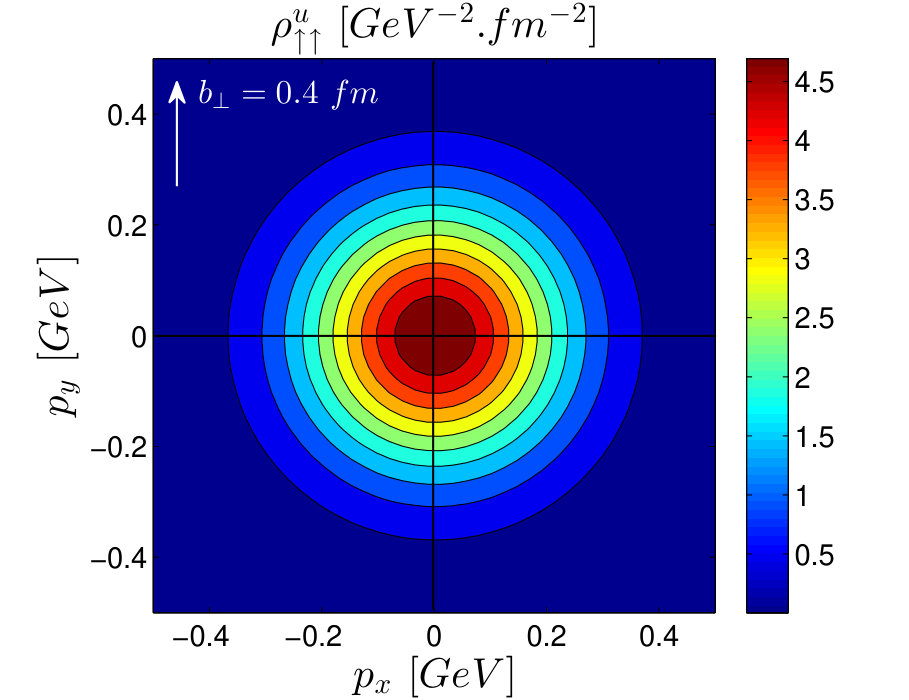 Figure 22
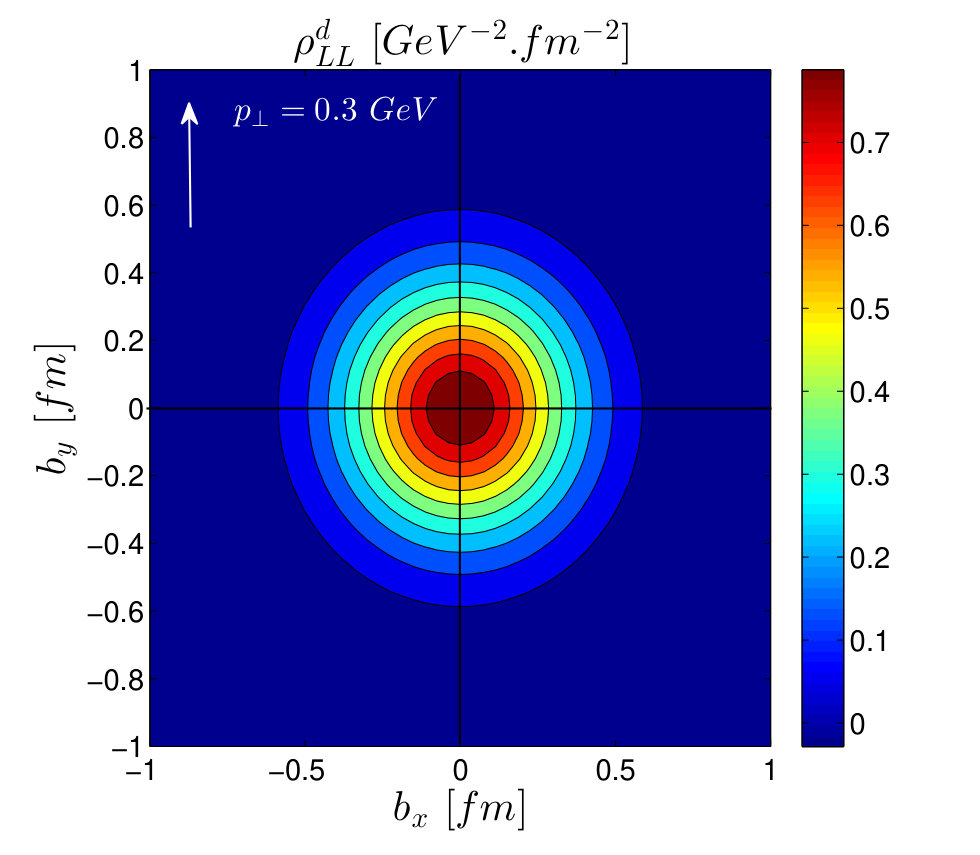 Figure 23
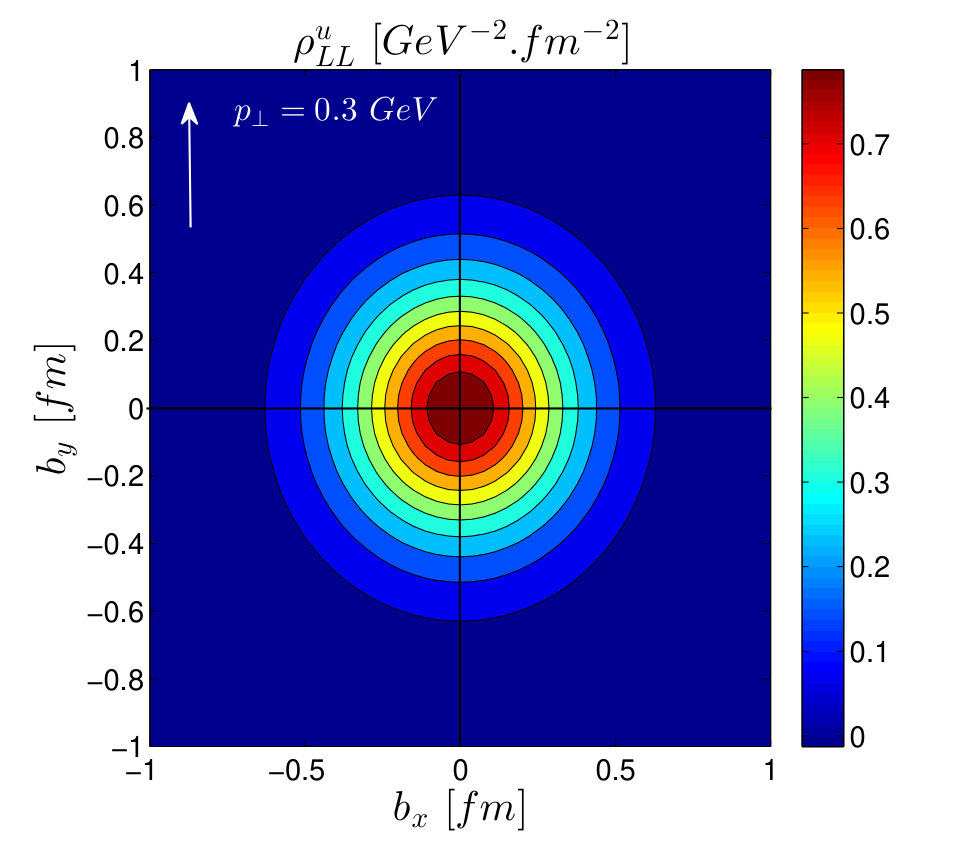 Figure 24
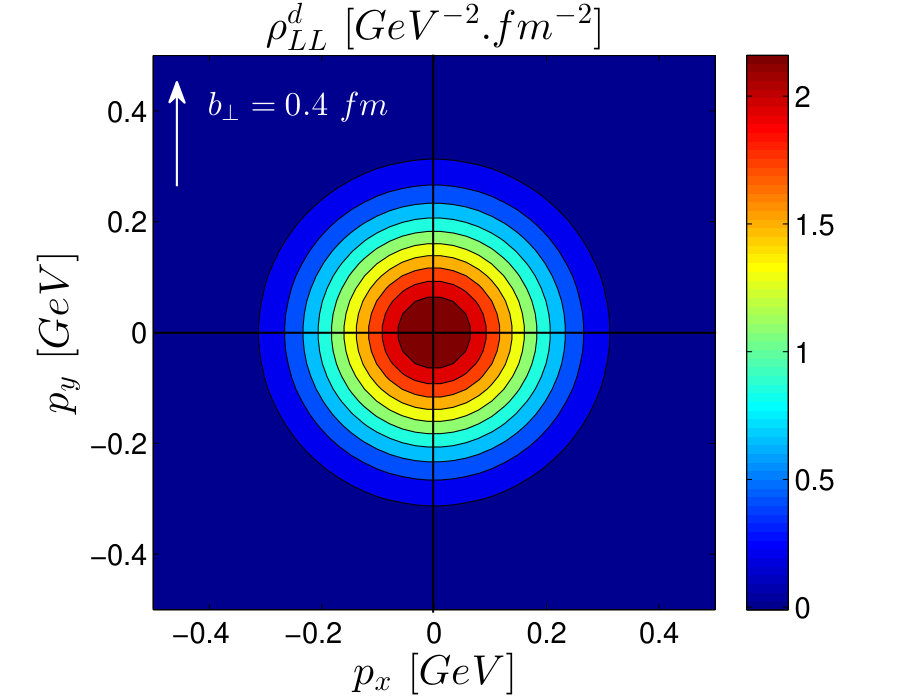 Figure 25
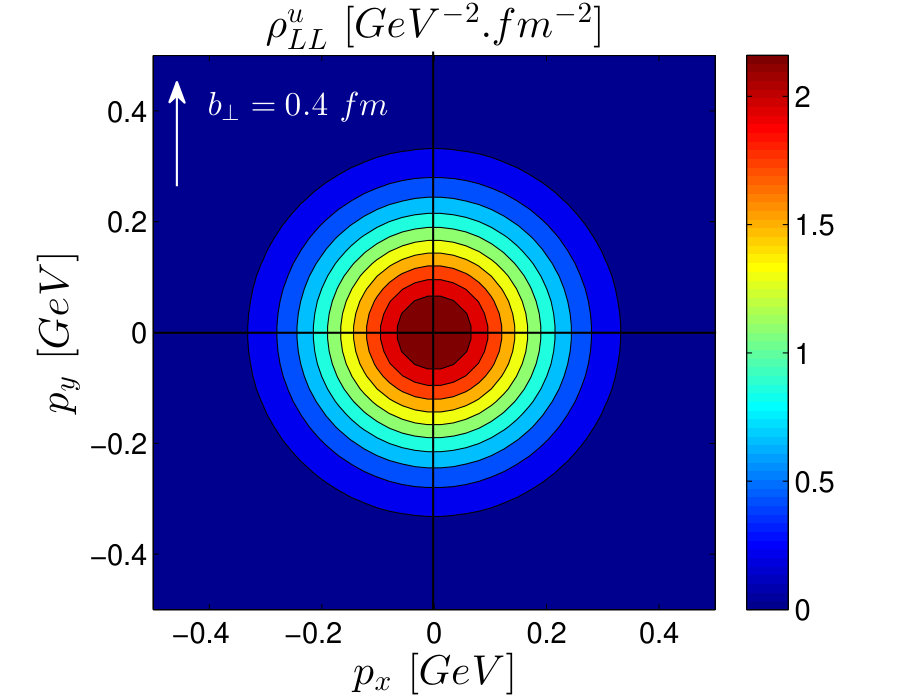 Figure 26
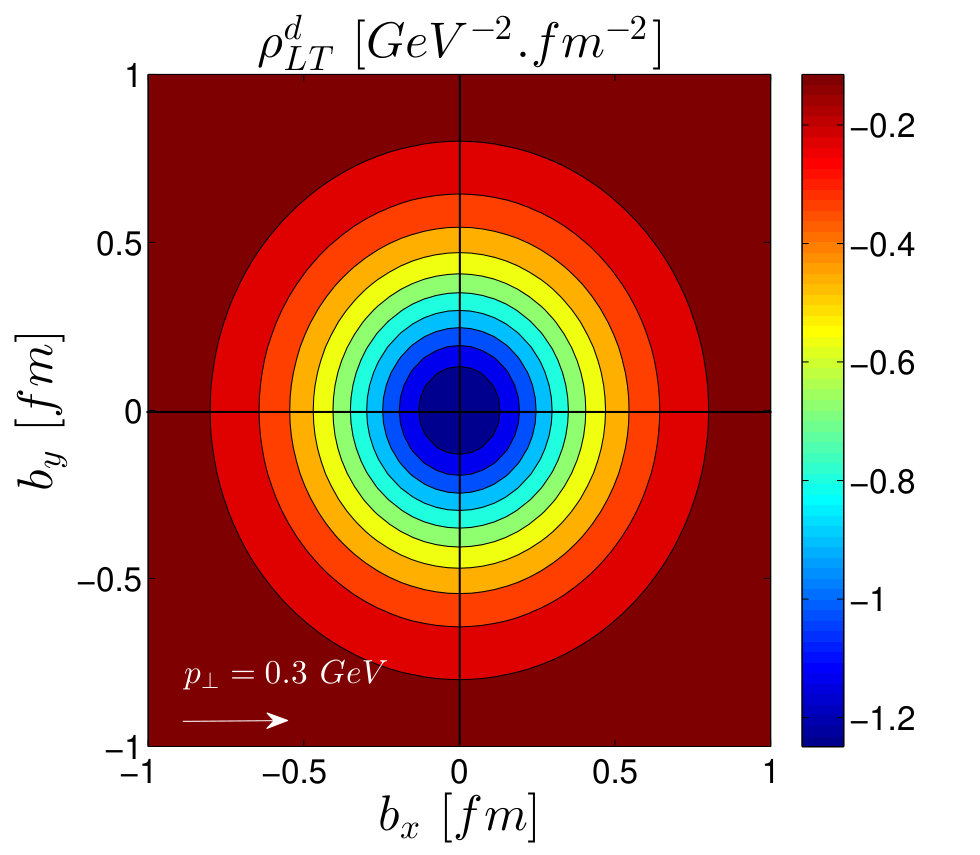 Figure 27
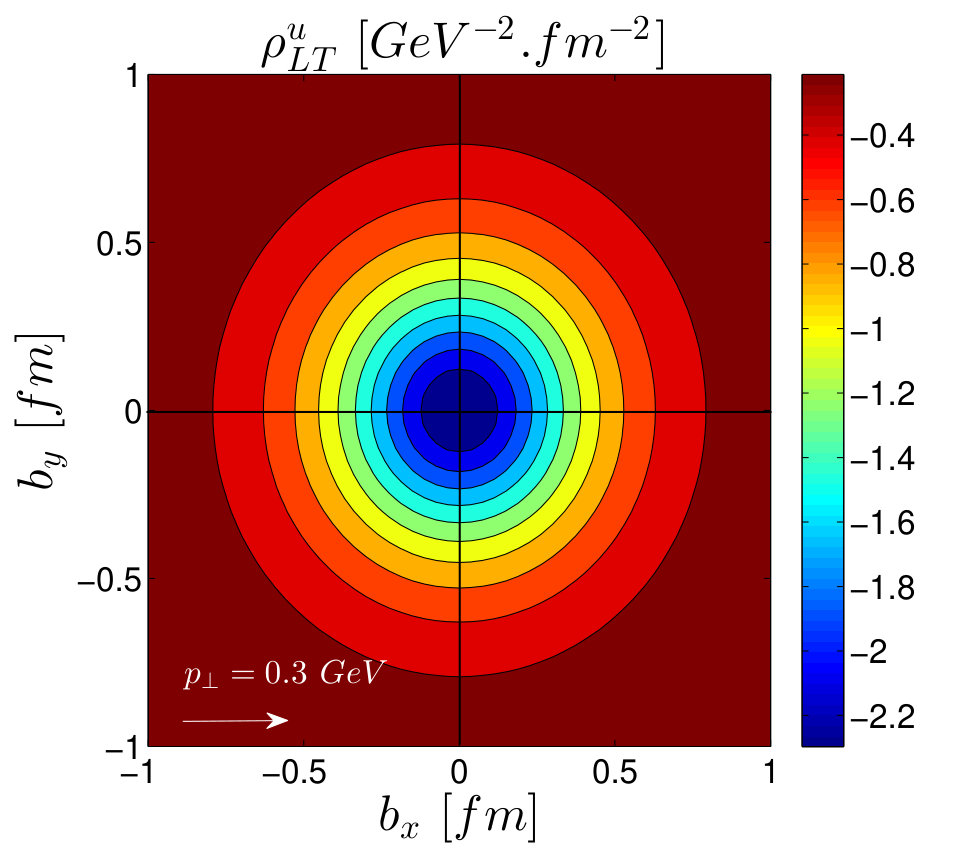 Figure 28
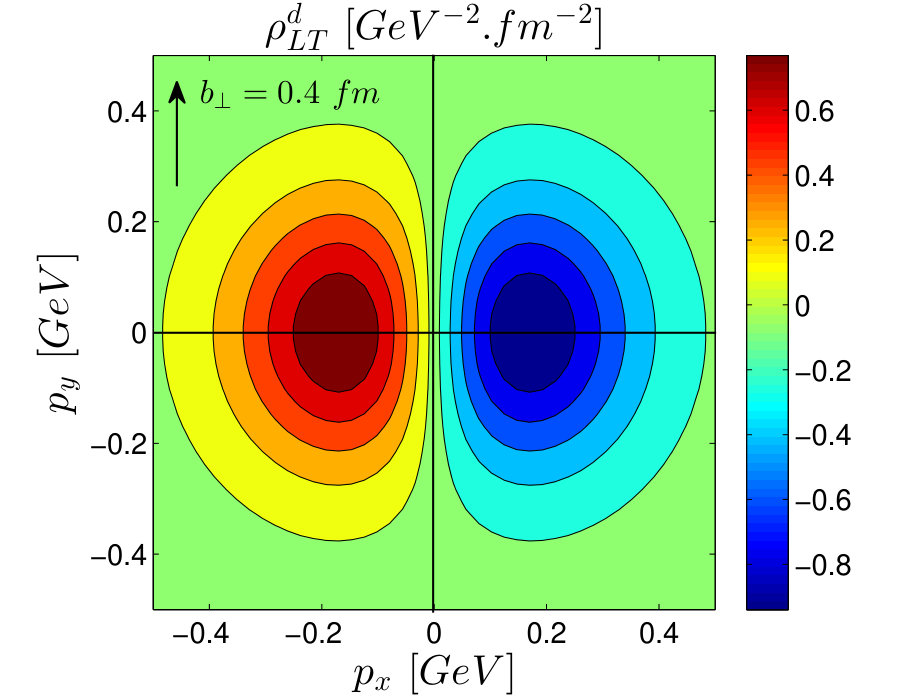 Figure 29
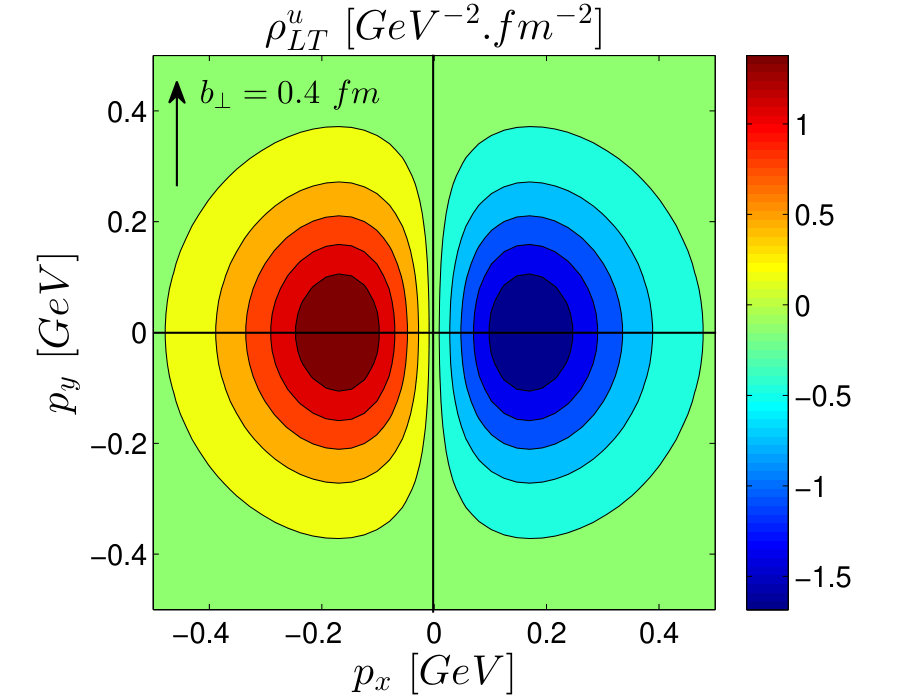 Figure 30
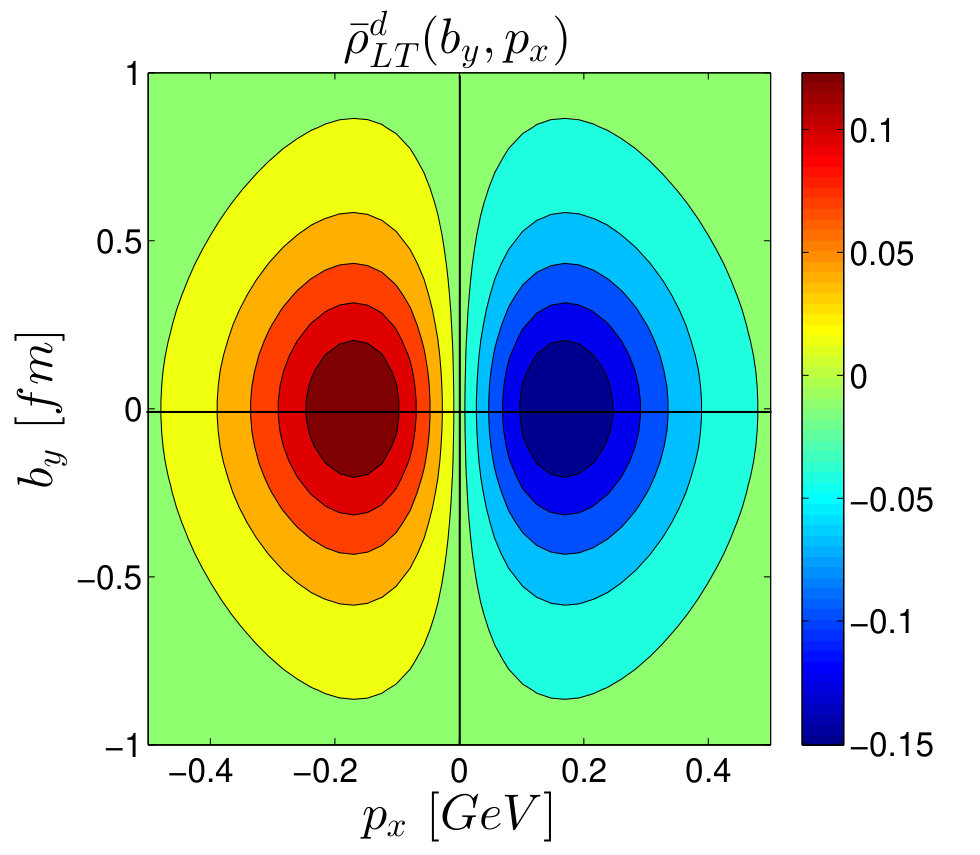 Figure 31
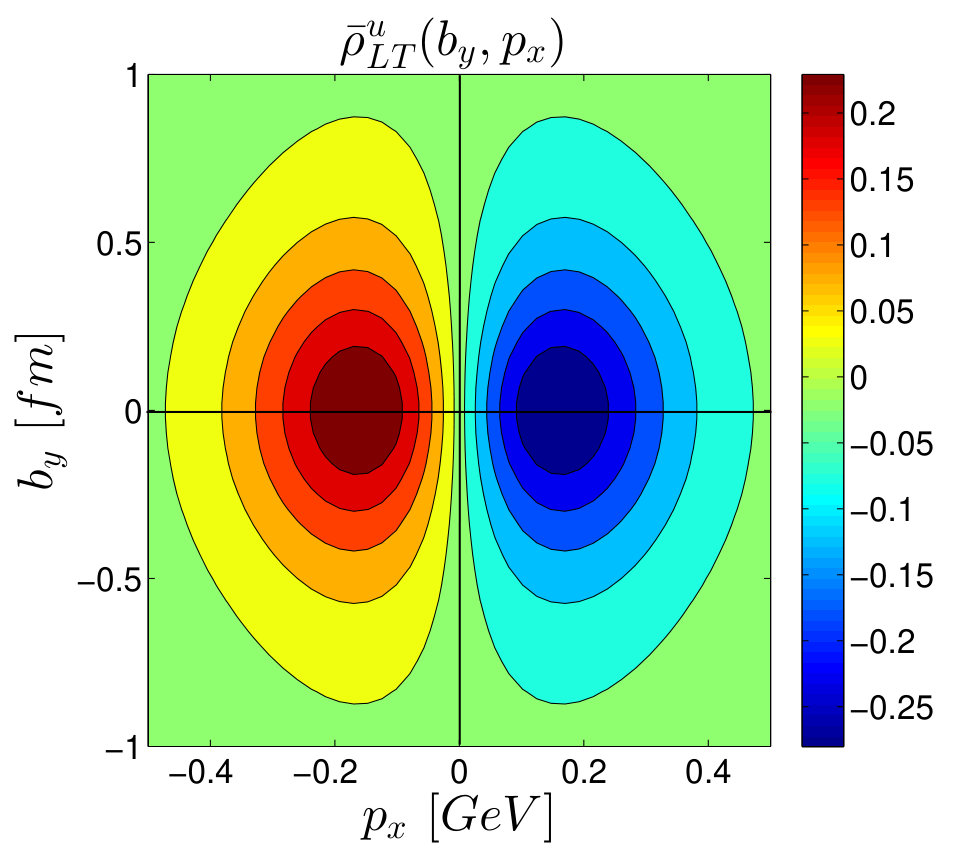 Figure 32
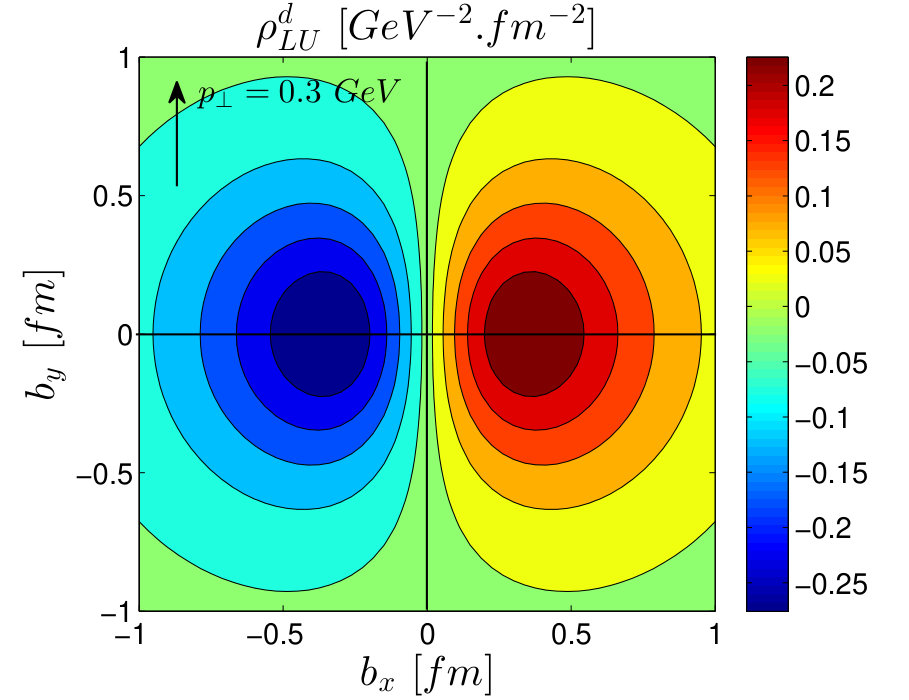 Figure 33
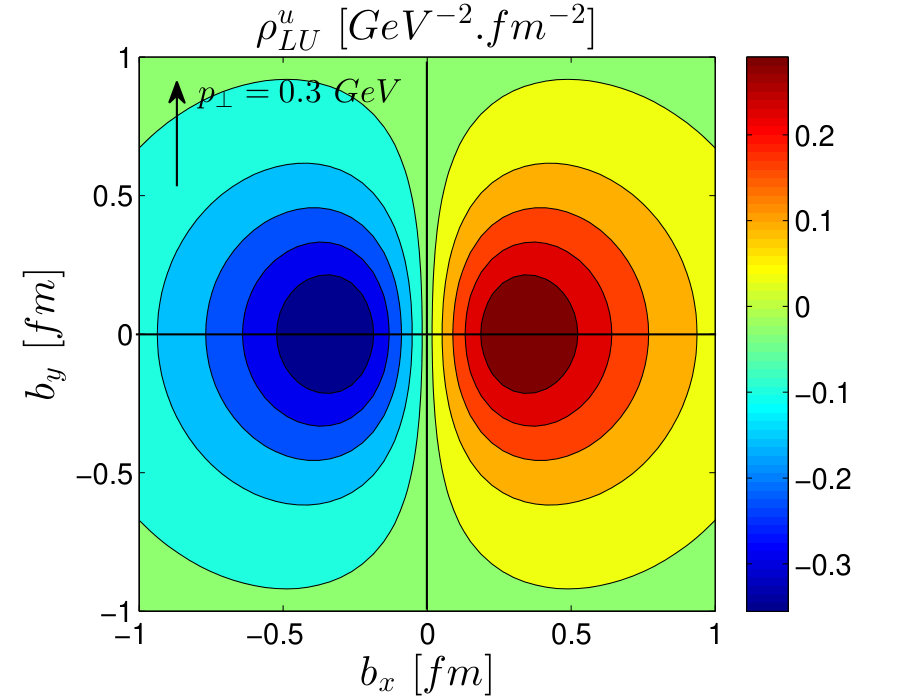 Figure 34
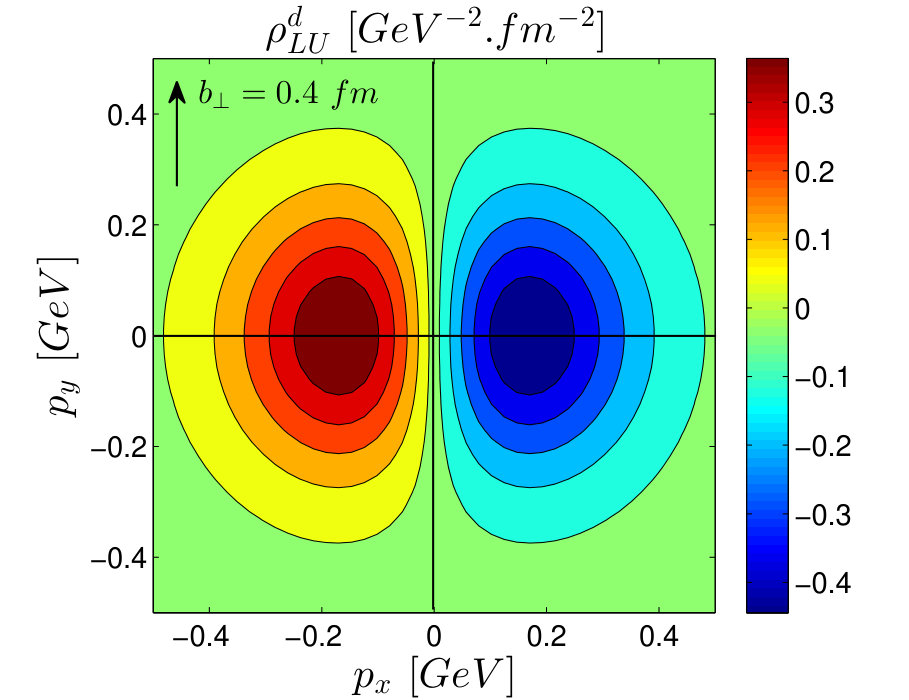 Figure 35
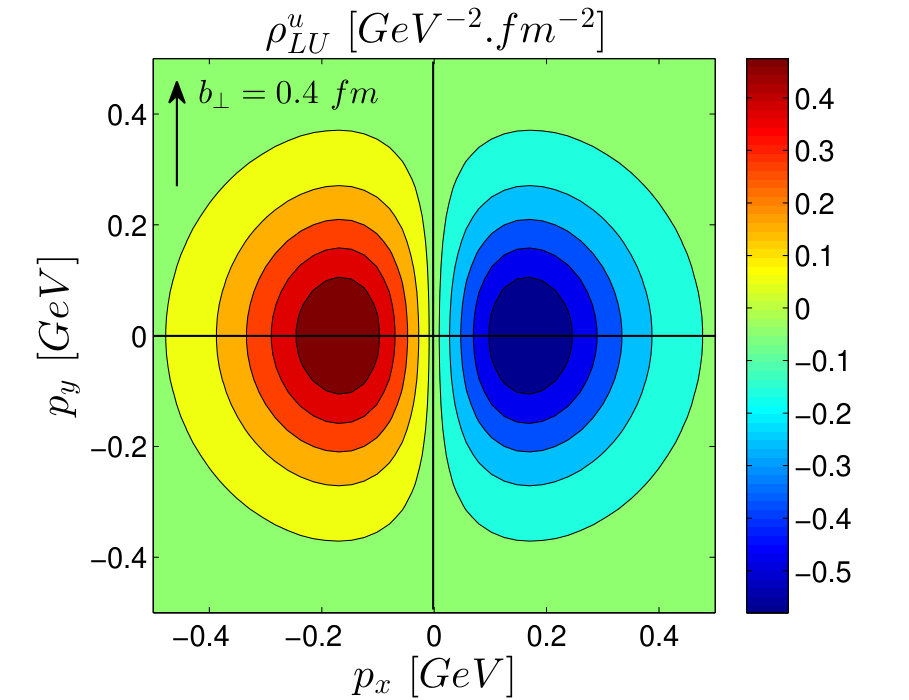 Figure 36
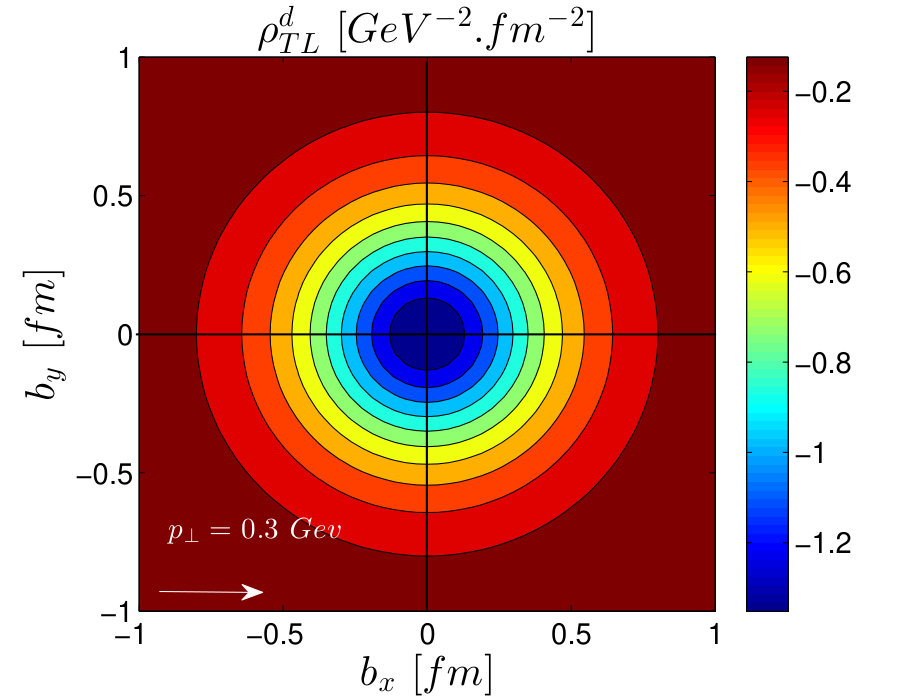 Figure 37
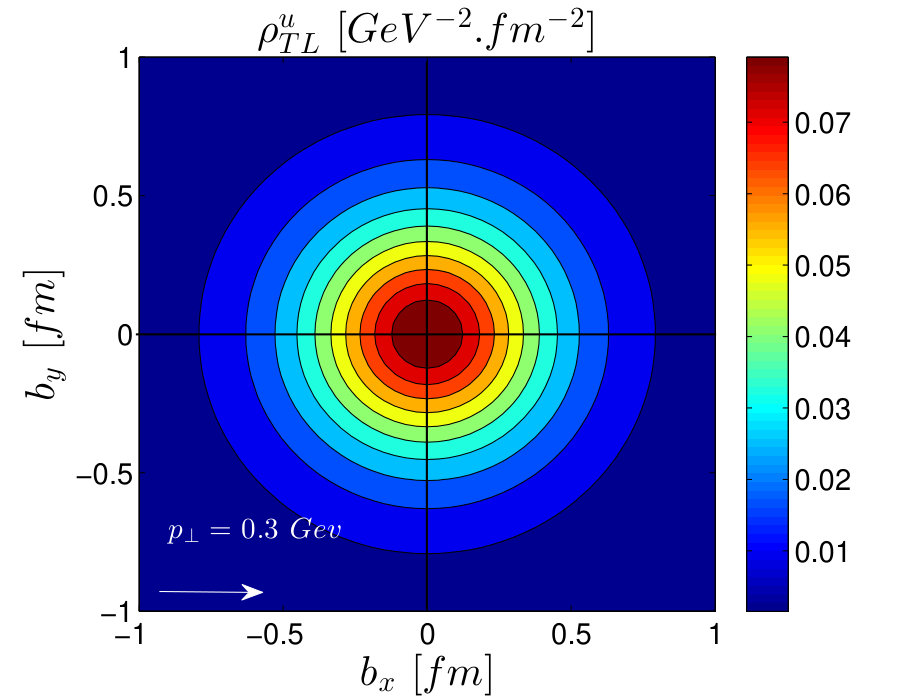 Figure 38
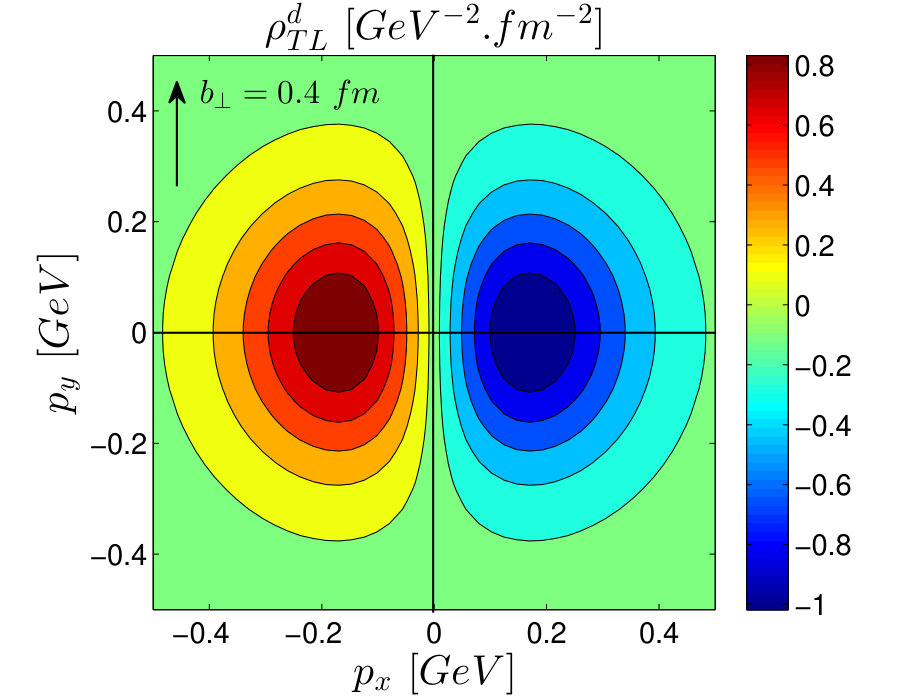 Figure 39
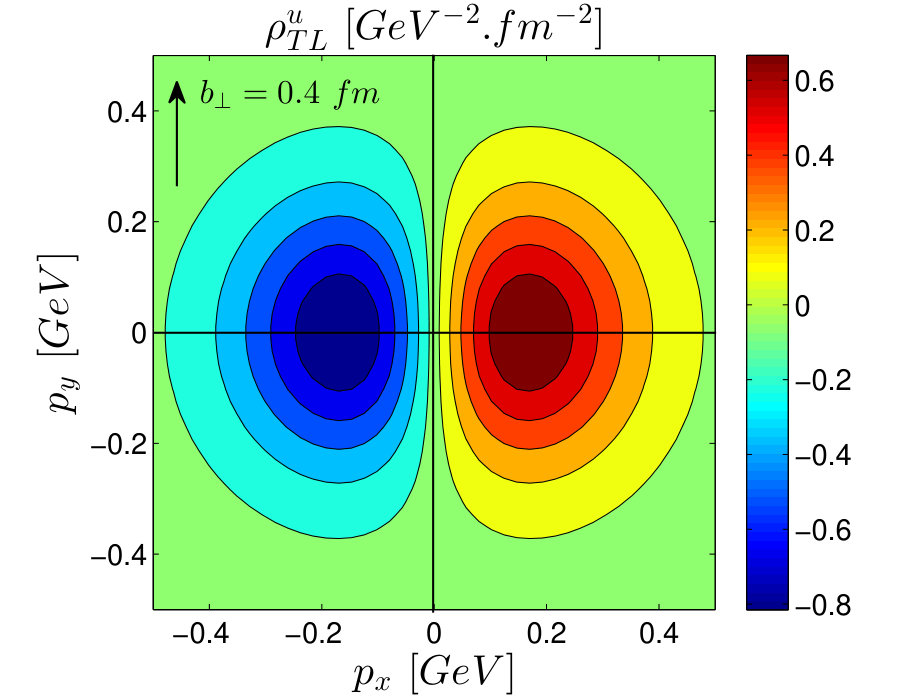 Figure 40
Peer Reviews
No public reviews on file for this paper yet. If you reviewed it on a platform where reviews are public (OpenReview, ICLR, NeurIPS, ICML), you can paste yours below so the community can read it here.
Videos
No videos yet. Explain this paper in a talk, walkthrough, or lecture? Add one.
Quark Wigner distributions and spin-spin correlations
D. Chakrabarti1
T. Maji1
C. Mondal1,2
A. Mukherjee3
1Department of Physics, Indian Institute of Technology Kanpur, Kanpur 208016, India
2Institute of Modern Physics, Chinese Academy of Sciences, Lanzhou 730000, China
3Department of Physics, Indian Institute of Technology Bombay, Mumbai 400076, India
Abstract
We investigate the Wigner distributions for and quarks in a light front quark-diquark model of a proton to unravel the spatial and spin structure. The light-front wave functions are modeled from the soft-wall AdS/QCD prediction. We consider the contributions from both the scalar and the axial vector diquarks. The Wigner distributions for unpolarized, longitudinally polarized and transversely polarized proton are presented in transverse momentum plane as well as in transverse impact parameter plane. The Wigner distributions satisfy a Soffer bound type inequality. We also evaluate all the leading twist GTMDs and show their scale evolution. The spin-spin correlations between the quark and the proton are investigated.
pacs:
13.40.Gp, 14.20.Dh, 13.60.Fz, 12.90.+b
I Introduction
The quark and gluon Wigner distribution introduced by Jixji1 ; xji2 have been studied extensively in recent times to understand the three dimensional structure of proton. The Wigner distributions encode spatial as well as partonic spin and orbital angular momentum structures. The Wigner distributions are six dimensional phase-space distributions and are not directly measurable. But after some phase-space reductions, they reduce to the generalized parton distributions(GPDs) and transverse momentum dependent distributions(TMDs). The Wigner distributions integrated over transverse momenta reduce to the GPDs at zero skewness and on integration over the transverse impact parameters with zero momentum transfer, they reduce to the TMDs. It is well known that GPDs and TMDs encode informations about the three dimensional partonic structure of hadrons. Recently, generalized transverse momentum dependent PDFs or GTMDs are introducedmeissner08 ; meissner09 ; Eche . Gluon GTMDs have been discussed in Lorce13 . GTMDs are related to the Wigner distributions and they again in certain kinematical limits reduce to GPDs and TMDs. The Wigner distributions after integrating over the light cone energy of the parton are interpreted as a Fourier transform of corresponding generalized transverse momentum dependent distributions (GTMDs) which are functions of the light cone three-momentum of the parton as well as the momentum transfer to the nucleon. The spin-spin and spin-orbital angular momentum(OAM) correlations between a nucleon and a quark inside the nucleon can be described from the phase space average of Wigner distributions. Angular momentum of a quark is extracted from Wigner distributions taking the phase space average. The Wigner distributions have been studied in different models e.g., in lightcone constituent quark modelLorce12 ; Lorce11 ; LCCQM1 ; LCCQM2 , in chiral soliton modelchi_QSM ; Lorce11 ; QSM , light front dressed quark modelMNO1 ; MNO2 ; AM , lightcone spectator modelliu_ma_WD , light-cone quark-scalar-diquark modelWD_SD .
In this work, we study the quark Wigner distributions in a light front quark-diquark modelMC for the proton where the diquark be both scalar or vector. We have studied the distributions for unpolarized as well as longitudinally and transversely polarized proton. The leading twist GTMDs are evaluated from the Wigner distributions. The we study the spin and OAM correlations between the quarks and proton. We find that the quark OAM tend to anti-align with the quark spin for and quark but to align with the proton spin.
The paper is organized as follows: We first introduce the light-front quark-diquark model in Sect.II. The Wigner distributions and GTMDs are introduced in Sect.III and how the OAM spin can be extracted from Wigner distributions and GTMDs are discussed in Sect.IV. Then, the results in our model are discussed in Sect.V for unpolarized, longitudinally polarized and transversely polarized proton in subsections V.1, V.2 and V.3 respectively. The spin-spin and spin-OAM correlations are discussed in V.4. A very brief description of the scale evolution of GTMDs is given in Sect.VI. Some inequalities satisfied among the GTMDs and also among the Wigner distributions in our model are shown in Sect. VII. Finally, we conclude the paper with a summary and discussion in Sect.VIII.
II Light-front quark-diquark model for nucleon
In this modelMC , the proton state is written as superposition of the quark-diquark states allowed under spin-flavor symmetry. Thus the proton can be written as a sum of isoscalar-scalar diquark singlet state , isoscalar-vector diquark state and isovector-vector diquark stateJakob97 ; Bacc08 and the state is written as
[TABLE]
Where and represent the scalar and axial-vector diquark having isospin at their superscript.
We use the light-cone convention . We choose a frame where the transverse momentum of proton vanishes i,e. P\equiv\big{(}P^{+},\frac{M^{2}}{P^{+}},\textbf{0}_{\perp}\big{)}. In this symmetric frame, the momentum of struck quark and that of diquark . Here is the longitudinal momentum fraction carried by the struck quark. The two particle Fock-state expansion for with spin-0 diquark is given by
[TABLE]
and the LF wave functions with spin-0 diquark, for , are given byLepa80
[TABLE]
where is the two particle state having struck quark of helicity and a scalar diquark having helicity (spin-0 singlet diquark helicity is denoted by s to distinguish from triplet diquark). The state with spin-1 diquark is given as Ellis08
[TABLE]
Where represents a two-particle state with a quark of helicity and a axial-vector diquark of helicity . The LFWFs are, for
[TABLE]
and for
[TABLE]
having flavor index . The LFWFs are a modified form of the soft-wall AdS/QCD prediction
[TABLE]
The wave functions reduce to the AdS/QCD predictionBT1 ; BT2 for the parameters and . We use the AdS/QCD scale parameter as determined in CM1 and the quarks are assumed to be massless.
III Wigner distributions
In the same way as the impact-parameter-dependent parton distributions (IPDs) which are obtained by the two-dimensional Fourier transforms of the generalized parton distributions (GPDs), one can map out the Wigner distributions as the two-dimensional Fourier transforms of the so-called generalized transverse-momentum-dependent parton distributions (GTMDs). In light-front framework, one defines the 5-dimensional quark Wigner distributions as Lorce11 ; Lorce12
[TABLE]
The correlator relates the GTMDs meissner08 ; meissner09 and in the Drell-Yan-West frame () and fixed light-cone time is given by
[TABLE]
The denotes the twist-two Dirac -matrix, , or with or corresponding to unpolarized, longitudinal polarized or -direction transverse polarized quark respectively. The gauge link Wilson line, ensures the color gauge invariance of the Wigner operator. and represent the proton momenta of the initial (final) state of proton, respectively and the spin of proton state. We use the light-front coordinates , where and . The kinematical variables are defined as
[TABLE]
Depending on the various polarization configurations of the proton and the quark, there are 16 independent twist-2 quark Wigner distributions. In an unpolarized proton, the quark Wigner distributions for unpolarized, longitudinally polarized and transversely polarized quark are defined as Lorce11 ; liu2015
[TABLE]
For a longitudinally polarized proton and different polarizations of quark the distributions are given by
[TABLE]
Again the Wigner distributions for a transversely polarized proton with various quark polarization are identified as
[TABLE]
and the pretzelous Wigner distribution is defined as
[TABLE]
Here the first subscript denotes the proton polarization, and the second one represents the quark polarization. The Wigner distributions are directly connected to the generalized parton correlation functions meissner08 ; Lorce11 . At , integrating over momentum the Wigner distributions reduce to impact-parameter-dependent parton distributions (IPDs) which can be interpreted as quark densities in the transverse position space. Again the integration of the distributions give the transverse momentum dependent parton distributions (TMDs) which can be interpreted as quark densities in transverse momentum space. In the Drell-Yan-West frame, the Wigner distributions may have a quasiprobability interpretation Lorce11 but the interpretation is lost when one defines a six-dimensional Wigner distribution, by including a longitudinal momentum transfer (). One can also obtain the three dimensional quark densities by integrating over two mutually orthogonal components of transverse position and momentum, e,g. and ( and ), which are not constraint by Heisenberg uncertainty principle as Lorce11
[TABLE]
with and
[TABLE]
with . For unpolarized and longitudinally polarized proton the distributions and are same. The Wigner distribution of quarks with longitudinal polarization in a longitudinally polarised proton is defined for and as Lorce11
[TABLE]
which can be decomposed as
[TABLE]
corresponding to and (where and are corresponding to and for longitudinal polarizations respectively). Similarly Wigner distribution for a quark with transverse polarizations in a proton with transverse polarizations can be written as
[TABLE]
which can be decomposed as
[TABLE]
The distribution in the transverse planes are shown in Fig.12 and Fig.13 for and quarks respectively. The transverse Wigner distribution are shown in Fig.(14) and in Fig.(15) with (e,i. polarization along the x-axis). and provide information about the correlations between proton spin and quark spin in the longitudinal direction and in the transverse direction respectively. We also can define the Wigner distributions for longitudinally polarized quarks in an transversely polarized proton, and transversely polarized quarks in an longitudinally polarized proton as
[TABLE]
The Wigner correlator, Eq.(8)can be parametrized in terms of GTMDsmeissner09 as
(i) for unpolarized proton
[TABLE]
(ii) for longitudinally polarized proton
[TABLE]
(iii) for transversely polarized proton
[TABLE]
The pretzelous distribution is parametrized as
[TABLE]
Where the and (n=1,2,3…8) can be expressed as Fourier transform of GTMDs and respectively.
[TABLE]
There are altogether 16 GTMDs at the leading twist. At the GTMDs reduces to transverse momentum dependent distributions(TMDs) which are functions of longitudinal momentum fraction and transverse momentum carried by quark. There are altogether 8 TMDs at the leading twist.
IV Orbital angular momentum
The canonical orbital angular momentum(OAM) operator for quark is defined as
[TABLE]
The OAM density operator can be expressed in terms of Wigner operator as
[TABLE]
Thus in Light-front gauge the average canonical OAM for quark is written in terms of Wigner distribution as.
[TABLE]
Where, the distribution can be written from Eqs.(11,14) as:
[TABLE]
From Eq.(29) we see that
[TABLE]
which satisfies the angular momentum sum rule for unpolarized proton– the total angular momentum of constituents sum up to zero. From Eq.(32) and Eq.(39), the twist-2 canonical quark OAM in the light-front gauge is written in terms of GTMDs as
[TABLE]
The correlation between proton spin and quark OAM is understood from . If quark OAM is parallel to proton spin and indicates the quark OAM is anti-parallel to proton spin.
The spin-orbit correlation of a quark is given by the operator
[TABLE]
The correlation between quark spin and quark OAM can be expressed with Wigner distributions and equivalently in terms of GTMD as:
[TABLE]
Where implies the quark spin and OAM tend to be aligned and implies they are anti-aligned.
The spin contribution of the quark to the proton spin is definedLorce11 as
[TABLE]
where is the axial charge.
V Results
The quark Wigner distributions are evaluated in the light-front quark-diquark model constructed from the AdS/QCD correspondence. Using the two particle Fock states expression of proton for both the scalar and vector diquark respectively in Eq.(9), we can express the quark-quark correlator, in terms of LFWFs. For the scalar diquark the expansion of is given by
[TABLE]
For the vector diquark, the expressions read as
[TABLE]
with the Dirac structures and . Where the initial and final momentums of the struck quark are
[TABLE]
respectively. Using the light-front wavefunctions from Eqs.(3,5, and 6) in Eqs.(49-54) at the initial scale , we explicitly calculate all the quark-quark correlators which give the expressions of Wigner distributions in the following forms
[TABLE]
where the label represents the scalar and denotes the isoscalar-vector(V) diquark corresponding to quark and isovector-vector(VV) diquark corresponding to quark. Combining the contributions from scalar and vector parts, one can write the distributions for and as
[TABLE]
where implies the proton(quark) polarization. Now, integrating over the light-front momentum fraction , we display the behavior of the Wigner distributions in the remaining four dimensions i.e. in the transverse coordinate space with a definite transverse momentum and in the transverse momentum space with a definite coordinate.
The distribution functions are given by
[TABLE]
[TABLE]
with
[TABLE]
Note that there are no implicit sum over and , in the expression of and .
V.1 Unpolarized proton
We plot the first Mellin moment of unpolarized Wigner distribution, and mixing distributions, for and quark in Fig.1. The first Mellin moment of unpolarized Wigner distributions represent the transverse phase-space distribution of the unpolarized quark in an unpolarized proton. Fig.1(a) and Fig.1(d) show the distributions in transverse momentum plane for quark and quark respectively with fixed impact parameter along and whereas the variation of the distributions in the transverse impact parameter plane are shown in Fig.1(b) and Fig.1(e) with fixed transverse momentum along for . Fig.1(c) and Fig.1(f) represent the mixing distributions for quark and quark respectively.
The average quadrupole distortions and are defined asLorce11
[TABLE]
Since the wave functions in soft-wall AdS/QCD model are of Gaussian type, the average quadrupole distortion is found to be zero for . Similarly have zero quadrupole distortion. Therefore, the distributions in transverse momentum plane as well as transverse impact parameter plane are circularly symmetric but the distributions in mixed space are axially symmetric. Thus, there is no favored configuration between and in mixed space unlike the light-cone constituent quark model(LCCQM) Lorce12 or chiral quark soliton model(QSM) Lorce11 . Comparing the behaviors of the quark and the quark, one finds in this model that for both and quarks, the distributions have positive maxima at the center , in both planes and gradually decrease towards periphery. The peak of the distributions for quark are large compared to quark but the quark distributions are little concentrating in the center relative to the quark in both planes. The distributions have a similar spread behaviors in the mixed plane for and quarks.
In Fig.2, we plot unpolarized-longitudinal Wigner distribution which represents the transverse phase-space distribution of the longitudinally polarized quark in an unpolarized proton. The transverse Wigner distributions , in the transverse momentum plane with fixed impact parameter along , are presented in Fig.2(a) and Fig.2(d) for and quarks respectively. The Fig.2(b) and 2(e) show the same distributions in transverse impact parameter plane, for and quark with fixed . We find in this model that in both planes exhibit dipolar structures having same polarity for and quarks but the polarity in momentum space is opposite from coordinate space for each quark. in transverse momentum plane is more concentrating in the center relative to that in transverse coordinate plane. The mixing distribution in the transverse mixed plane are shown in Fig.2(c) and Fig.2(f) for and quark respectively which display the quadrupole structures with same polarity for both quarks. These distributions essentially reflect quark spin-orbit correlations. From Eq.(47), we calculate at and the values are and for and quarks. implies the quark OAM is anti parallel to the quark spin as observed in scalar diquark model WD_SD , whereas in light-cone constituent quark model Lorce11 are found to be positive for both and quarks.
The Wigner distribution and the mixing distribution are shown in fig.3. From Eq.(58) it is clear that this distribution vanishes if the quark transverse coordinate is parallel to the polarization. Here the plots are shown for , the quark is polarized along x-direction. The figs.3(a) and (d) represent the distribution in the transverse momentum plane, with , for and quarks respectively. This is circularly symmetric in transverse momentum space. The fig.3(b) and (e) show the distribution in transverse impact parameter plane with for and quarks respectively. We see a dipolar distribution in the impact parameter plane. The mixing distribution is shown in fig.3(c) and (f) for and quarks respectively. Since this distribution is symmetric in transverse momentum plane, it shows a dipolar behavior in the mixed plane(unlike shows a quadrupole distribution). Because of the dipolar symmetry in impact parameter plane, the other class of mixing distributions vanishes.
In certain kinematical limit(see Eq.(31)), reduces to the Boer-Mulders function which is one of the T-odd TMDs at leading twist. Here we consider the T-even leading twist TMDs only. The one gluon final sate interaction(FSI) is needed to calculate the T-odd TMDs. So, here we have no contribution from this distribution at the TMD limit. At the impact parameter distribution limit the distribution is related to GPD together with some other distributionsmeissner09 .
V.2 Longitudinally polarized proton
In Fig. 4, we show the longitudinal-unpolarized Wigner distributions and mixing distributions which describe the unpolarized quark phase-space distributions in a longitudinal polarized proton. Fig.4(a) and Fig.4(d) display the variation of in transverse momentum plane for and quarks respectively with fixed along and and the variation of in transverse impact parameter plane are shown in Fig.4(b) and Fig.4(e) with fixed along , . In this model, The distributions are quite similar with in both transverse momentum as well as transverse impact parameter planes but the polarity of the dipolar structures of is opposite to the polarity of . Again, the quadrupole structures appear when we plot the distribution in the transverse mixed plane as shown in Fig.4(c) and Fig.4(f) for and quark respectively which are very similar to with opposite sign. These distributions essentially reflect the correlations between quark OAM and proton spin. In this model, the quark OAM for quark and for quark at . Therefore quark OAM is parallel to proton spin for both and quarks. Note that also in scalar diquark model with AdS/QCD wave functions the OAMs are found to be positive for both quarks. This result is model dependent and may be due to the particular form of the AdS/QCD wave functions.
The longitudinal-longitudinal Wigner distributions and mixing distributions are presented in Fig.5. These Wigner distributions describe the phase-space distributions of longitudinal polarized quark in a longitudinal polarized proton, and after integrating over transverse variables they correspond to the axial charge () which is positive for quark but negative for quark at large scales. The distributions in transverse momentum plane for and quark are plotted in Fig.5(a) and Fig.5(d) respectively whereas in transverse coordinate plane are shown in Fig.5(b) and Fig.5(e). In this model we find that in two planes the distributions are positive for quark in consistence with the sign of but for quark, the distributions are also positive whereas the axial charge is known to be negative. One should note that the axial charges are highly scale dependent and are measured only at high energies whereas the model here have a very low initial scale . So, we need to consider the scale evolution of the distributions before comparing with the measured data. For quark, the axial charge is known to be negative at larger scales. The scale evolutions of axial charges in this model are shown in MC . Where it is shown that the axial charge for quark becomes negative for . At the axial charges for the quarks are found to be and which are consistent with the measured data. The distributions are circularly symmetric for and quarks in both the planes and they are more concentrated in the center in plane relative to plane. The peaks of the distributions in plane are larger than that in plane. The mixing distributions for and quark are shown in Fig.5(c) and Fig.5(f) respectively. They are axially symmetric in mixed plane. show quite similar behavior of but with opposite sign and with much lower peak at the center.
The wigner distribution with a transversely polarized quark in a longitudinally polarized proton, , is shown in fig.6. The fig.6(a) and (d) represent the distribution in transverse momentum plane, with , for and quark respectively. We see a dipolar distribution as expected from the Eq.(61). The fig.6(b) and (e) show the distribution in transverse coordinate space with for and quarks respectively. The distribution is circularly symmetric with negative peak at the center of the coordinate space. The distribution vanishes if the quark transverse momentum is perpendicular to the polarization. This reflects there is a strong correlation between the quark transverse momentum and quark transverse polarization. The mixing distribution is shown in fig.6(c) and (f) for and quarks respectively. Because of the dipolar structure in transverse momentum plane, the other class of mixing distributions vanishes for the quark with a polarization along x-axis.
At the TMD limit, reduces to meissner09 , one of the eight T-even TMDs at leading twist. At the impact parameter distribution limit the distribution is related to the and GPD together with some other distributions.
V.3 Transversely polarised proton
The Wigner distribution in transverse plans and the mixing distribution are shown in fig.7. From Eq.(62) it is clear that this distribution vanishes if the quark transverse coordinate is parallel to the polarization. Here the plots are shown for i.e. the quark is polarized along x-direction. The figs.3(a) and (d) represent the distribution in the transverse momentum plane, with , for and quarks respectively. This is circularly symmetric in transverse momentum space. The fig.7(b) and (e) show the distribution in transverse coordinate space with for and quarks respectively. We see a dipolar distribution in the impact parameter plane. The mixing distribution is shown in fig.7(c) and (f) for and quarks respectively. Since this distribution is symmetric in transverse momentum plane, it shows a dipolar behavior in the mixed plane(unlike shows a quadruple distribution). Because of the dipolar structure in coordinate space, the other class of mixing distributions vanishes.
At the TMD limit, reduces to the Sivers function , one of the T-odd TMDs at leading twist. Since we consider T-even contributions only, the TMD limit of vanishes here. At the impact parameter distribution limit the distribution is related to the and GPDs together with some other distributions.
The wigner distribution with a longitudinally polarized quark in a transversely polarized proton, , is shown in fig.8. The fig.8(a) and (d) represent the distribution in transverse momentum plane, with , for and quark respectively. We see a dipolar distribution as expected from the Eq.(63). The fig.6(b) and (e) show the distribution in transverse coordinate space with for and quarks respectively. The distribution is circularly symmetric at the center of the coordinate space with positive peak for quark and negative peak for quark.
The distribution vanishes if the quark transverse momentum is perpendicular to the polarization. This reflects that there is a strong correlation between the quark transverse momentum and quark transverse polarization. The mixing distribution is shown in fig.8(c) and (f) for and quarks respectively. Because of the dipolar structure in transverse momentum plane, the other class of mixing distributions vanishes for the quark with a polarization along x-axis.
At the TMD limit, reduces to meissner09 , one of the T-even eight TMDs at leading twist. At the impact parameter distribution limit the distribution is related to and GPDs together with some other distributions.
The wigner distribution with a transversely polarized quark in a transversely polarized proton, , is shown in fig.9. The fig.9(a,c) represent the distribution in transverse momentum plane with for and quarks respectively. The distribution in transverse impact parameter plane is shown in fig.9(b,d) with . We observe that the peak of the distribution in both the plane are positive for quark and negative for quark. In fig.10, we plot the in mixed transverse plane for and quarks. The distributions are not symmetric in the mixed plane. This is due to the quadrupole contributions and appearing in the expressions for (Eq.73).
The pretzelous distribution, is shown in Fig.11. This distribution is found when the quark is transversely polarized along the perpendicular direction to the transversely polarized proton. We find quadruple distributions in transverse momentum plane as well as in transverse impact parameter plane. It is also observed that the polarity of quadruple distribution changes sign for quark in both the planes. Due to pure quadrupole contribution in (Eq.74) the pretzelous distribution is identically zero in the mixed plane.
V.4 Spin-spin correlations
The longitudinal Wigner distributions , with the polarization of proton and quark polarization ( Eq.(24)) are shown in Fig.12 and Fig.13 for and quarks respectively. One can observe that the distributions in transverse momentum plane as well as in transverse impact parameter plane look circularly symmetric for whereas for the distributions get distorted along or for both and quarks. Since the polarity of is opposite to and the magnitudes of the distributions are more or less same, thus in Eq.(24), the contributions from and get almost canceled for and the only dominating contributions coming from and which are circularly symmetric in both planes. Again for the contributions from and add up and causes the distortion. Note that the distortions from the circular symmetry in transverse momentum plane and in transverse impact parameter plane are in opposite direction to each other. Here we have shown the distributions for ; the other possible spin combinations in transverse momentum plane and in transverse impact parameter plane can be found from , and respectively, where . The mixed transverse densities are shown in Fig.12(c),(f) for quark and in Fig.13(c),13(f) for quark. exhibits the similar axially symmetric nature of with lower magnitude for . This is because of the other contribution, which is opposite to . For , although there are additional quadrupole contributions from and in , the contributions from and are very large compared to the quadrupole contributions and thus effectively show the similar behavior of with larger magnitude for both and quark.
We observe that the quark OAM tends to be aligned with proton spin and anti-aligned to the quark spin for both and quarks. The difference in correlation strength between quark OAM-proton spin correlation and quark OAM-spin correlation is very small(see Fig.2 and Fig.4). Therefore, if the quark spin is parallel to the proton spin, i,e. the contributions of and interfere destructively resulting the circular symmetry for and quarks, see Fig. 12(a,b) and 13(a,b). If the quark spin is anti-parallel to the proton spin, i,e. the contributions of and interfere constructively resulting a dipolar distribution for and quarks, see Fig 12(d,e) and 13(d,e).
From Eq.(26), we plot the transverse wigner distribution in Fig.14 for quark and Fig.15 for quark to understand the transverse spin-spin correlations. The Fig.14 represents the distribution of a quark with transverse polarization (along x-axis) in a proton with transverse polarization along x-axis. In the transverse momentum plane, we see an elliptical distribution for both the quarks(Fig.14(a,d) and 15(a,d)) because the distortions are circularly symmetric and is elliptically symmetric. In the transverse impact parameter plane we observed significant deviation comes from the dipolar nature of the distortions and . For , they interfere constructively and causes a large deviation as sheen in Fig.14(b),15(b). We also observed that the distributions change axis with the flip of transverse polarization of quarks.
VI GTMDs and their evolution
The generalized transverse momentum dependent distributions can be extracted from the different Wigner distributions as shown in Eqs.(29-38). The GTMDs reduce to the TMDs and GPDs at certain kinematical limits. The and contribute to the spin-OAM correlation as discussed in Sec.IV. and OAM in MIT bag model has been calculated in MIT . There are altogether 11 non zero GTMDs at the leading twist in this model. In this model, comparing Eq.(29-38) with Eq.(56-65), the explicit form of the GTMDs are
[TABLE]
[TABLE]
The normalization constants are
[TABLE]
where for quark.
The scale evolution of the GTMDs are modeled considering the evolution of the parameters that reproduces the correct scale evolution of the pdfsMC . Where the LFWFs are defined at the initial scale GeV and the hard scale evolution of the the distributions are modeled by making the parameters in the distribution scale dependent. The scale evolution of the parameters are determined by the DGLAP evolution of the PDFs:
[TABLE]
where the and are the parameters at . The parameter becomes unity at for both and quarks. The scale dependent parts and evolve as
[TABLE]
where the subscript in the right hand side of the above equation stands for corresponding to respectively. The detail of the scheme and the values are parameters are given in MC .
Our model predictions for the GTMDs and are shown in Fig.16 at the scale which is the average value of the HERMES experiment, and at which is the highest bin average value of the COMPASS experiment. At the TMD limit, the GTMDs and give the leading twist TMDs and respectively. We plot the GTMDs for and . We notice that the GTMD for d quark approaches towards negative at higher scales. This causes a negative axial charge for d quark as found experimentally. The scale evolution of GTMDs is considered in Eche and shown to be the same as for TMDs.
VII Inequalities
It is interesting to express the transverse GTMDs in terms of the unpolarized and longitudinal GTMDs at the leading twist. Some inequality relations for GTMDs with found in this model are
[TABLE]
Eq.(101) represents the Soffer boundsoffer for GTMDs. We observe that, at the TMD limit i,e. at , the above relations reduce to the relations discussed in MC_rel for light front quark-scalar-diquark model.
We can also find some inequalities for Wigner distributions given by
[TABLE]
The Eq.(109) can be regarded as a generalized soffer bound for the Wigner distributions. It will be interesting to check if other models also satisfy similar inequalities.
VIII Conclusions
We calculated the Wigner distributions of quarks in a nucleon using a diquark model. The light-front wave functions are modeled using ADS/QCD prediction. We took both scalar and vector diquarksMC . We have presented results of the Wigner distributions in transverse position and momentum space as well as mixed position and momentum space for unpolarized, longitudinally polarized and transversely polarized quark and proton and compared with other model predictions. We have noted a few inequalities among and in this model. It will be interesting to check if such inequalities are present in other models, particularly in models with gluonic degrees of freedom. The scale evolutions of the parton distribution functions are modeled by making the parameters scale dependent in accord with DGLAP equation. We have used the same evolution of the parameters in our calculation for the GTMDs. Relations of the Wigner distributions and GTMDs with the quark orbital angular momentum and spin-spin correlations are discussed.
We thank Oleg Teryaev for many useful discussions.
The reference list from the paper itself. Each links out to its DOI / PubMed record.
- 1(1) X. Ji, Phys. Rev. Lett. 91 , 062001 (2003);
- 2(2) A.V. Belitsky, X. Ji, and F. Yuan, Phys. Rev. D 69 , 074014 (2004).
- 3(3) S. Meissner, A. Metz, M. Schlegel and K. Goeke, JHEP 0808 , 038 (2008).
- 4(4) S. Meissner, A. Metz, and M. Schlegel, JHEP 0908 , 056 (2009).
- 5(5) M. G. Echevarria, A. Idilbi, K. Kanazawa, C. Lorc , A. Metz, B. Pasquini and M. Schlegel, Phys. Lett. B 759 , 336 (2016)
- 6(6) C. Lorc and B. Pasquini, JHEP 1309 , 138 (2013) doi:10.1007/JHEP 09(2013)138 [ar Xiv:1307.4497 [hep-ph]].
- 7(7) C. Lorce, B. Pasquini, X. Xiong and F. Yuan, Phys. Rev. D 85 , 114006 (2012).
- 8(8) C. Lorce and B. Pasquini, Phys. Rev. D 84 , 014015 (2011).