Universal edge fluctuations of discrete interlaced particle systems
Erik Duse, Anthony Metcalfe

TL;DR
This paper proves that the edge fluctuations of a broad class of discrete interlaced particle systems, including random tilings and eigenvalue minors, converge to the extended Airy kernel under weak asymptotic conditions.
Contribution
It establishes the universal edge fluctuation behavior for discrete Gelfand-Tsetlin patterns with minimal assumptions, connecting these to the extended Airy kernel.
Findings
Edge fluctuations converge to the extended Airy kernel.
Particles fluctuate with order $O(n^{-1/3})$ and $O(n^{-2/3})$ in tangent and normal directions.
Results apply broadly to models with weak asymptotic assumptions.
Abstract
We impose the uniform probability measure on the set of all discrete Gelfand-Tsetlin patterns of depth with the particles on row in deterministic positions. These systems equivalently describe a broad class of random tilings models, and are closely related to the eigenvalue minor processes of a broad class of random Hermitian matrices. They have a determinantal structure, with a known correlation kernel. We rescale the systems by , and examine the asymptotic behaviour, as , under weak asymptotic assumptions for the (rescaled) particles on row : The empirical distribution of these converges weakly to a probability measure with compact support, and they otherwise satisfy mild regulatory restrictions. We prove that the correlation kernel of particles in the neighbourhood of `typical edge points' convergences to the extended Airy kernel. To do this, we…
Click any figure to enlarge with its caption.
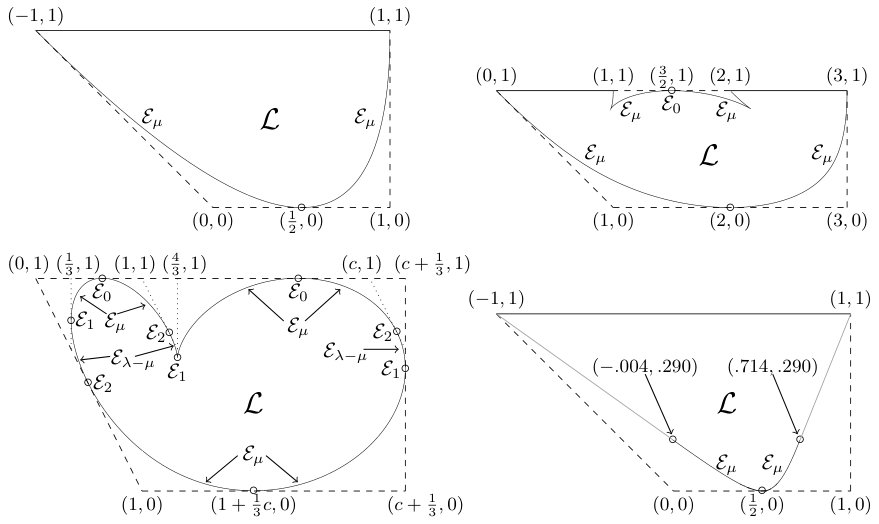 Figure 1
Peer Reviews
No public reviews on file for this paper yet. If you reviewed it on a platform where reviews are public (OpenReview, ICLR, NeurIPS, ICML), you can paste yours below so the community can read it here.
Videos
No videos yet. Explain this paper in a talk, walkthrough, or lecture? Add one.
Taxonomy
TopicsRandom Matrices and Applications · Advanced Combinatorial Mathematics · Stochastic processes and statistical mechanics