Magnetic Domain Walls as Hosts of Spin Superfluids and Generators of Skyrmions
Se Kwon Kim, Yaroslav Tserkovnyak

TL;DR
This paper demonstrates that magnetic domain walls can host spin superfluids with unique topological properties, enabling skyrmion generation, magnon manipulation, and spin transport control, supported by theoretical and numerical analysis.
Contribution
It introduces the concept of spin superfluidity within magnetic domain walls and explores its topological properties and potential for skyrmion and magnon control.
Findings
Domain walls can host spin superfluids with topological features.
Phase slips in the superfluid create and annihilate skyrmions, conserving skyrmion charge.
Emergent magnetic flux along the domain wall enables magnon manipulation.
Abstract
A domain wall in a magnet with easy-axis anisotropy is shown to harbor spin superfluid associated with its spontaneous breaking of the U(1) spin-rotational symmetry. The spin superfluid is shown to have several topological properties, which are absent in conventional superfluids. First, the associated phase slips create and destroy skyrmions to obey the conservation of the total skyrmion charge, which allows us to use a domain wall as a generator and detector of skyrmions. Secondly, the domain wall engenders the emergent magnetic flux for magnons along its length, which are proportional to the spin supercurrent flowing through it, and thereby provides a way to manipulate magnons. Thirdly, the spin supercurrent can be driven by the magnon current traveling across it owing to the spin transfer between the domain wall and magnons, leading to the magnonic manipulation of the spin…
Click any figure to enlarge with its caption.
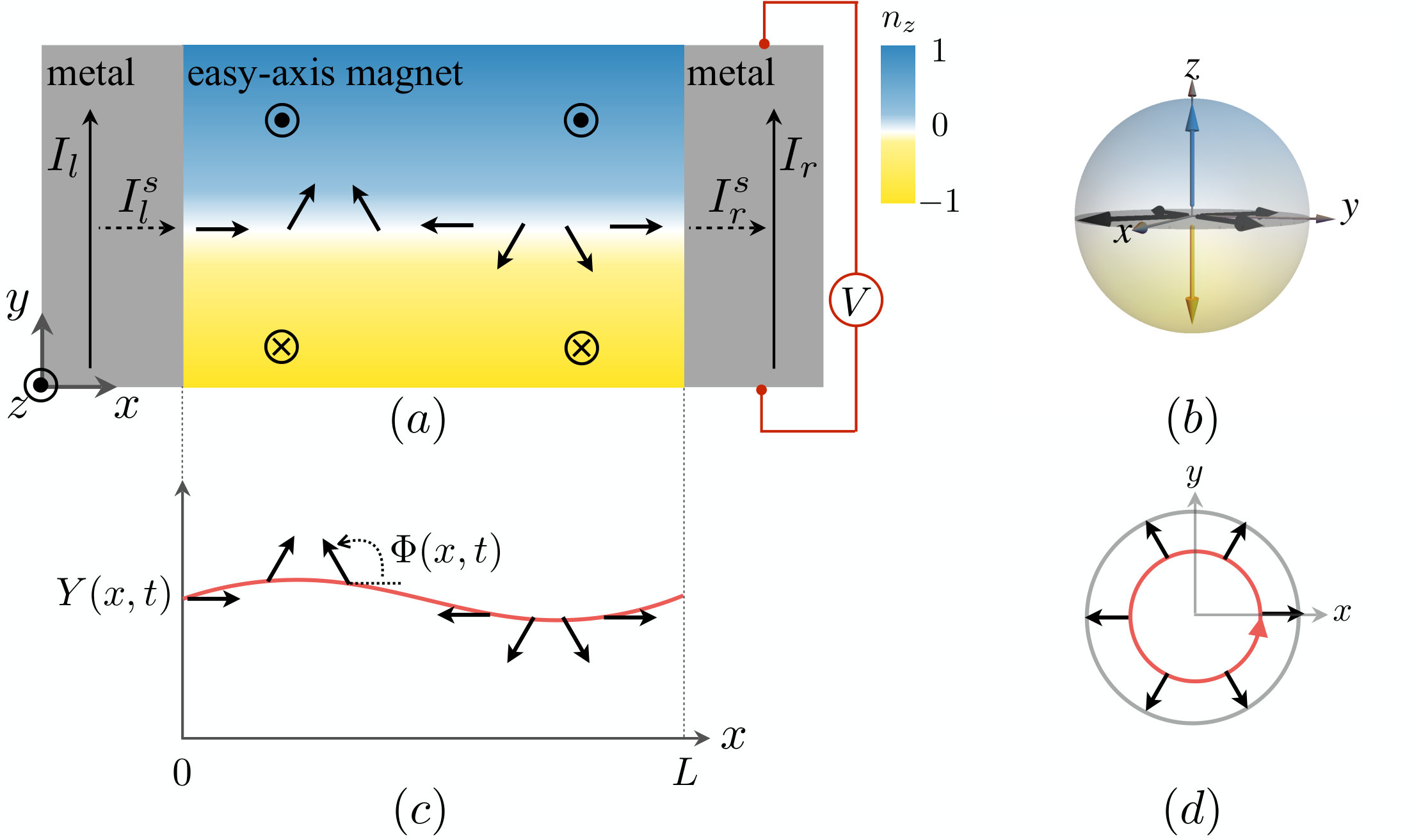 Figure 1
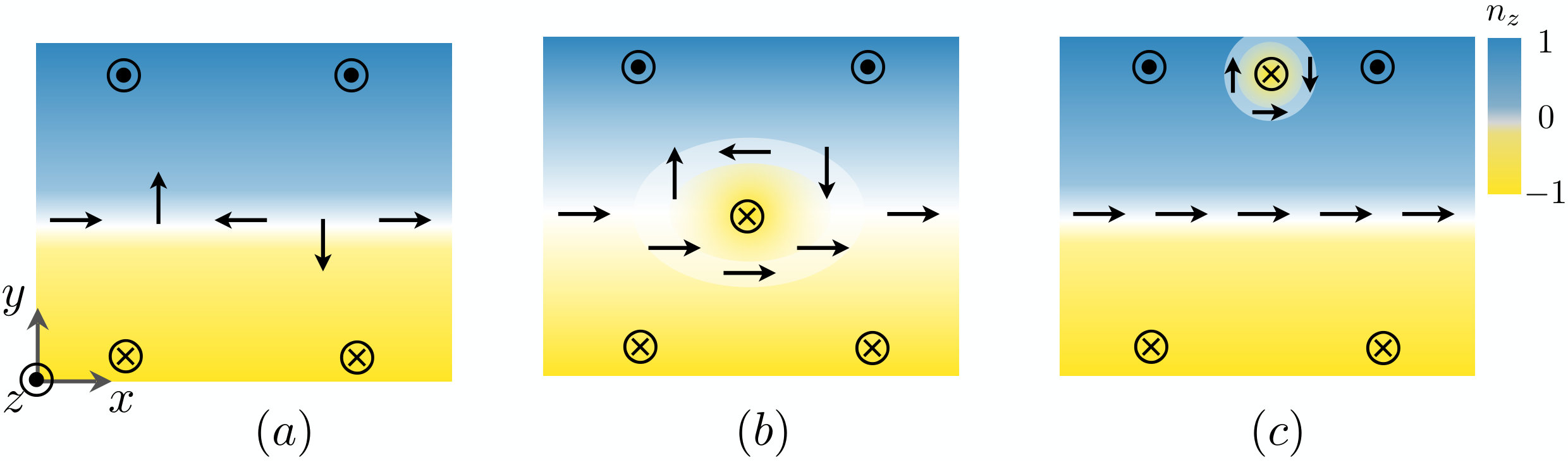 Figure 2
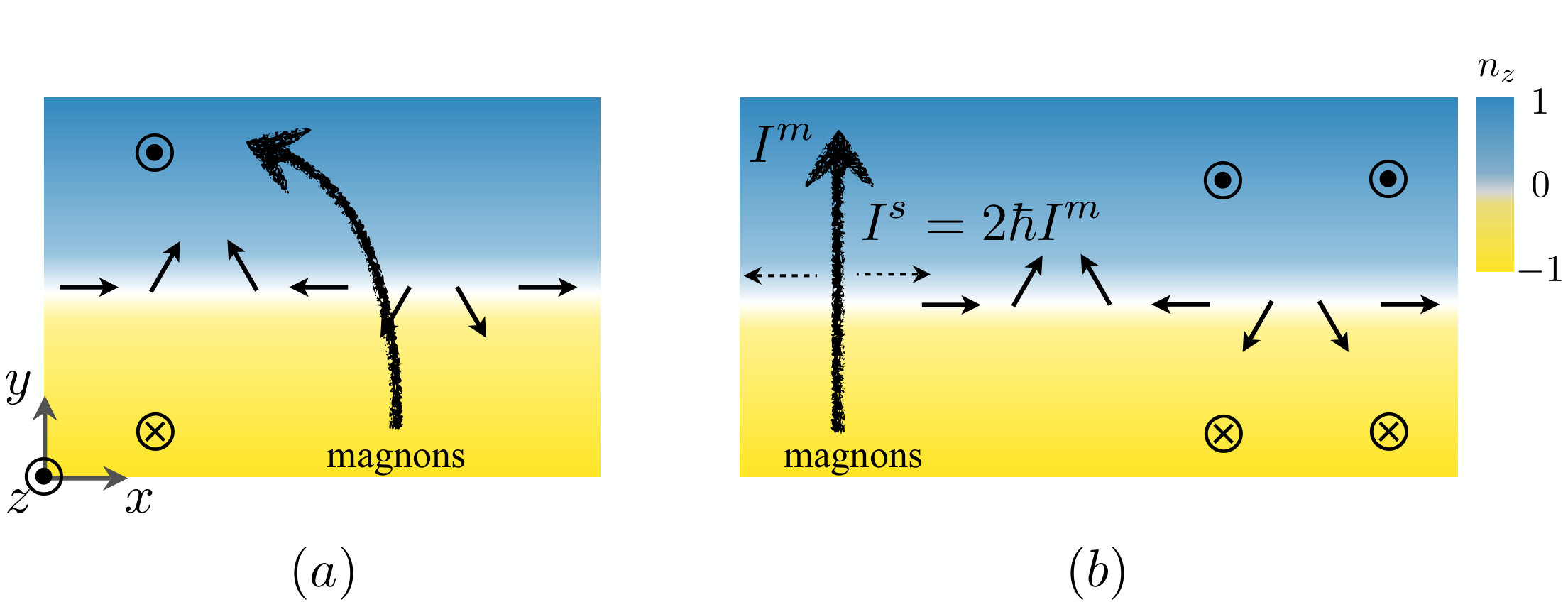 Figure 3
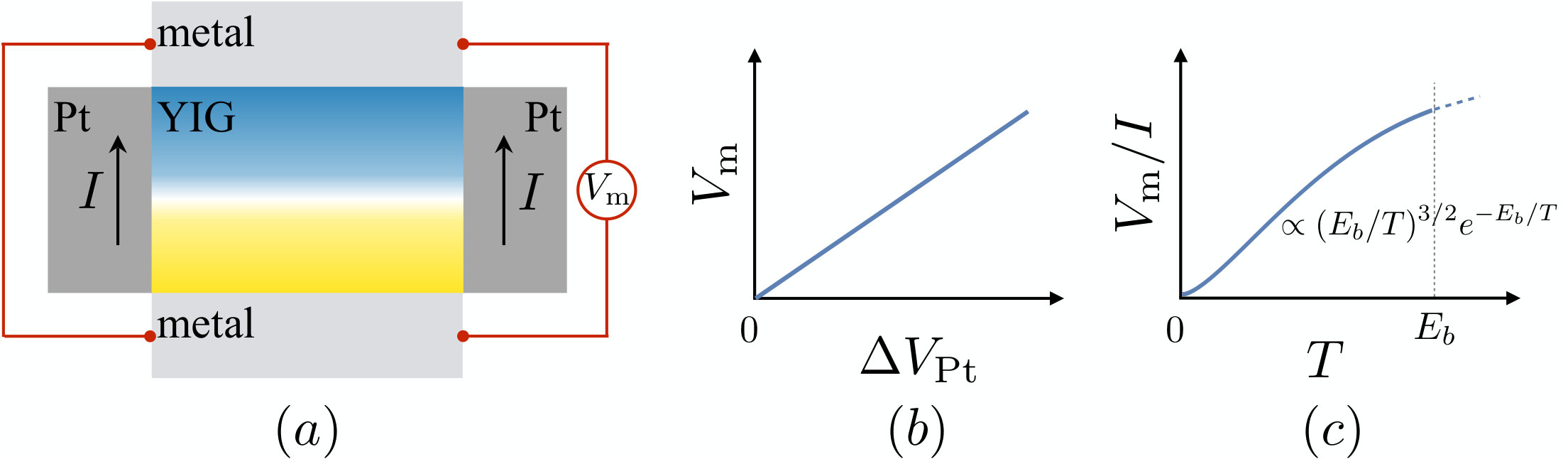 Figure 4
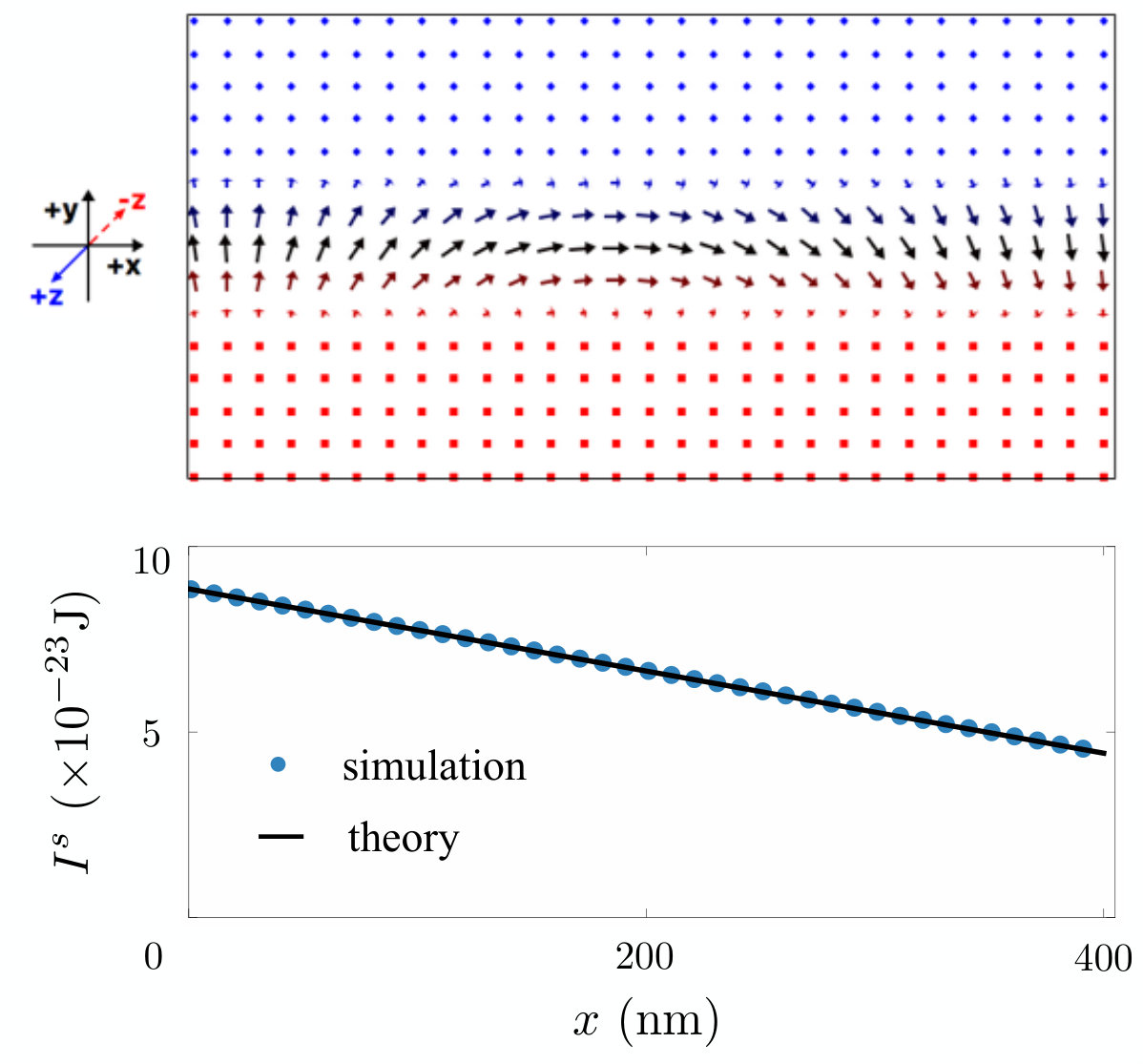 Figure 1
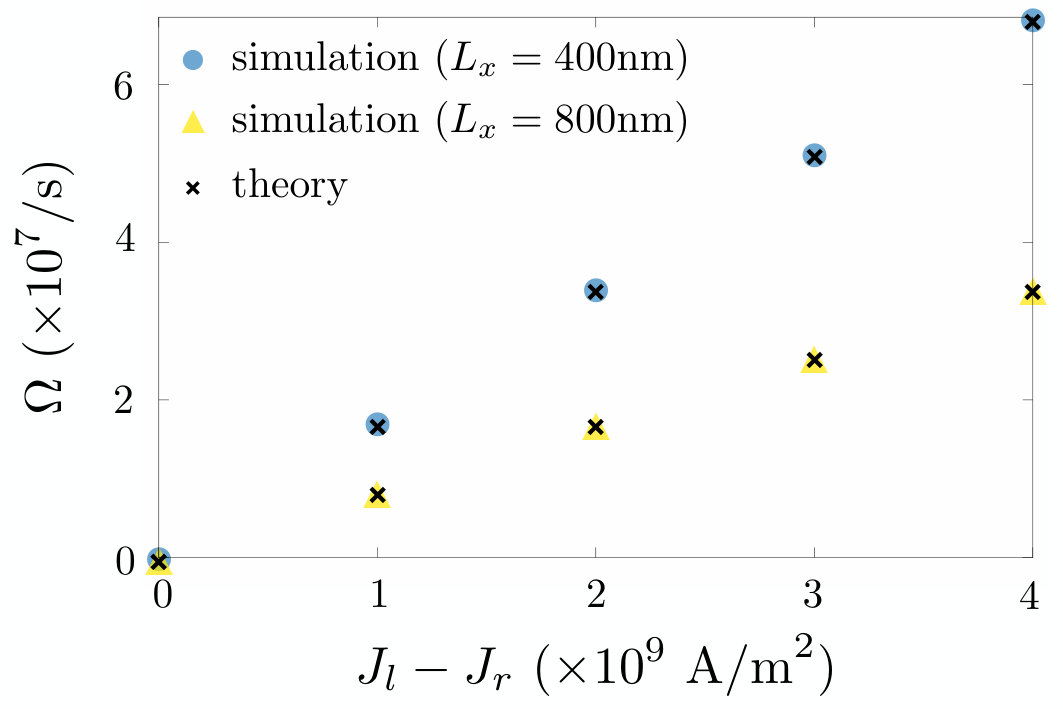 Figure 2
Peer Reviews
No public reviews on file for this paper yet. If you reviewed it on a platform where reviews are public (OpenReview, ICLR, NeurIPS, ICML), you can paste yours below so the community can read it here.
Videos
No videos yet. Explain this paper in a talk, walkthrough, or lecture? Add one.
Magnetic Domain Walls as Hosts of Spin Superfluids and Generators of Skyrmions
Se Kwon Kim
Yaroslav Tserkovnyak
Department of Physics and Astronomy, University of California, Los Angeles, California 90095, USA
Abstract
A domain wall in a magnet with easy-axis anisotropy is shown to harbor spin superfluid associated with its spontaneous breaking of the U(1) spin-rotational symmetry. The spin superfluid is shown to have several topological properties, which are absent in conventional superfluids. First, the associated phase slips create and destroy skyrmions to obey the conservation of the total skyrmion charge, which allows us to use a domain wall as a generator and detector of skyrmions. Secondly, the domain wall engenders the emergent magnetic flux for magnons along its length, which are proportional to the spin supercurrent flowing through it, and thereby provides a way to manipulate magnons. Thirdly, the spin supercurrent can be driven by the magnon current traveling across it owing to the spin transfer between the domain wall and magnons, leading to the magnonic manipulation of the spin superfluid. The theory for superfluid spin transport within the domain wall is confirmed by numerical simulations.
pacs:
75.78.-n, 75.60.Ch, 75.76.+j, 74.20.-z
Introduction.—Under normal conditions, particles in a fluid move against the friction force caused by, e.g., scattering with the vessel. In some extreme circumstances, certain fluids become superfluids that support particle flow with no resistance, which is exemplified by liquid 4He at temperatures below 2K Kapitza (1938); *AllenNature1938. Conventional superfluidity is characterized by the spontaneously broken U(1) symmetry associated with the phase of the macroscopic quantum wave function. A conserved quantity corresponding to the U(1) symmetry is the particle number, or equivalently mass, and it is this mass supercurrent that is carried by the gradient of the phase.
Analogously, materials with the U(1) spin-rotational symmetry can support superfluid spin transport if the symmetry is spontaneously broken by the ground states Sonin (2010); *KonigPRL2001; *ChenPRB2014-2; *ChenPRB2014-3; *ChenPRB2014; Takei and Tserkovnyak (2014); *TakeiPRL2015. Easy-plane magnets thus can realize spin superfluid by choosing an arbitrary direction in the easy plane and thereby breaking the U(1) symmetry in their ground states. The in-plane angle of the spin density is analogous to the phase of the wave function in mass superfluid, and, accordingly, the supercurrent of spin (projected onto the symmetry axis) is proportional to the gradient of the in-plane angle. On the other hand, easy-axis magnets, which have the U(1) spin-rotational symmetry like the easy-plane ones, do not break the symmetry spontaneously because spins order along the symmetry axis in their two ground states. Easy-axis magnets, therefore, do not support spin superfluidity as a metastable state. Instead, they support a domain wall (DW) *[][; andreferencestherein.]KosevichPR1990, which is a topological soliton smoothly connecting the two ground states. Since the two directions along the symmetry axis are the only directions that are invariant under spin rotations, a DW connecting those two states necessarily breaks the U(1) symmetry, which signals the possible existence of spin superfluidity in it.
Pursuing the idea, we study spin transport through a DW in a two-dimensional easy-axis magnet, the main results of which can be summarized as follows. First, we show that a DW indeed can serve as a conduit for spin superfluid. The spin supercurrent flowing through the DW is realized as a spiraling spin texture lying within the plane perpendicular to the easy axis. Secondly, we find the associated phase slips disturbing the spin supercurrent *[][; andreferencestherein.]HalperinIJMPB2010 are peculiar in that they accompany creation or destruction of skyrmions Skyrme (1961), swirling spin textures wrapping the unit sphere once, as a result of the conservation of the total skyrmion charge *[][; andreferencestherein.]Garst2016. See Fig. 1 for schematic illustrations. The DW thus can provide a good tool for generating and detecting skyrmions. Thirdly, we show that the DW harbors the emergent magnetic flux for magnons along its length Kovalev and Tserkovnyak (2012); *KongPRL2013; *IwasakiPRB2014; *SchuttePRB2014-2, whose density is proportional to the spin supercurrent flowing through it. By engineering a periodic array of DWs, we can therefore create an emergent magnetic superlattice for magnons, which can be useful for utilizing magnons in spintronics analogously to the electronic counterparts *[][; andreferencestherein.]NogaretJPCM2010. Lastly, magnons traveling across the DW can trigger the spin supercurrent by transferring their spin angular momentum to the DW, providing the magnonic control of the spin superfluid.
Spin superfluid in a DW.—Our model system is a quasi-two-dimensional ferromagnet with easy-axis anisotropy 111We focus on an easy-axis ferromagnet for concreteness here, but it is straightforward to show that the case of an easy-axis antiferromagnet is closely analogous.. For temperatures much below the Curie temperature, the low-energy dynamics of the magnet can be described by the direction of the local spin density, . The Hamiltonian is given by
[TABLE]
where the positive coefficients and parametrize the stiffness of the order parameter and the strength of easy-axis anisotropy, respectively. The system respects the time-reversal symmetry and the U(1) symmetry with respect to the global spin rotations about the axis. In the two ground states, spins order along the direction, , by breaking the time reversal symmetry, but not the U(1) symmetry. In a continuous field theory, the discrete degeneracy of the ground states entails a DW interpolating them *[][; andreferencestherein.]Kardar. The north and south poles on the unit sphere, which constitute the ground states, are the only points that are fixed under rotations about the axis. A DW connecting them, therefore, breaks the U(1) symmetry spontaneously, which can be exploited to realize spin superfluid Sonin (2010). See Fig. 1(a) for a schematic of the system with a DW carrying a spin supercurrent.
We consider a DW that is pinned around the straight line defined by . The pinning potential, which is omitted in Eq. (1), can be engineered by, e.g., locally decreasing the magnitude of easy-axis anisotropy Bauer et al. (2013); *FrankenAPL2013; *FrankenJPCM2012. Without loss of generality, we assume that the spins point at the north pole in the top and the south pole in the bottom, as . The vertical position of the DW is represented by , at which the spin is in the plane. The in-plane angle at the position is denoted by . The contribution from an infinitesimal segment of the DW to the total spin is given by ; thus represents the local spin density. Within the collective-coordinate approach Thiele (1973); *TretiakovPRL2008, the low-energy dynamics of the DW can be described by the two fields and with the Hamiltonian 222Supplemental Material contains the derivations for the dynamics of the one-dimensional DW Schryer and Walker (1974), the calculations of phase-slip-induced voltages, the discussions on simulation results, and three videos showing the magnetization evolutions.
[TABLE]
where represents the magnitude of the pinning potential, parametrizes the stiffness of the field , and ′ is the spatial derivative.
As we learn from quantum mechanics, the total spin projected onto the axis is the generator of the spin rotations about the same axis Landau and Lifshitz (1976), which yields the following Poisson bracket Goldstein et al. (2002): , where is the azimuthal angle of . Within the collective-coordinate approach for the DW dynamics, this translates into
[TABLE]
which shows that the two fields are canonically conjugate. The equations of motion for them can be obtained from the Hamiltonian and the Poisson bracket:
[TABLE]
The first equation is analogous to the Josephson relation in a one-dimensional mass superfluid between the phase of the wave function and the mass density ; the second equation is the coarse-grained continuity equation of the spin Halperin and Hohenberg (1969), in which the left-hand side is the time evolution of the spin density integrated over the axis and the right-hand side is the (negative) divergence of the spin current along the DW, . The analogy between the dynamics of the DW and that of a mass superfluid leads us to conclude that the DW supports superfluid spin transport flowing through it Sonin (2010). Unlike the ideal dissipationless situation that we have considered heretofore, generic spin systems are subject to dissipation caused by, e.g., spin-lattice coupling. It can be effectively captured by adding the Gilbert damping terms to the equations of motion Note (2):
[TABLE]
where is the Gilbert damping constant and parametrizes the DW width.
Spin can be injected into or ejected from the magnet by sandwiching it with two metals that exhibit spin Hall effects Sinova et al. (2015) as shown in Fig. 1(a). In the presence of charge currents and flowing in the direction in the left and right metals, respectively, matching the spin current across the interface and that of the bulk leads to the following boundary conditions:
[TABLE]
where is the length of the magnet. In the first equation, is the spin current injected from the left metal to the magnet, parametrized by the coefficient with the normal-metal width in the direction and the effective interfacial spin Hall angle Tserkovnyak and Bender (2014); is the spin pumping from the magnet into the metal, parametrized by the coefficient with the effective interfacial spin-mixing conductance Tserkovnyak and Bender (2014) and the thickness of the interface in the direction; the right-hand side is the spin current in the magnet evaluated at the left interface. The equations (5) for the dynamics of the DW in conjunction with the boundary conditions (6) are completely analogous to those for the dynamics of one-dimensional magnets with easy-plane anisotropy Sonin (2010). By adopting the known results for the latter system Takei and Tserkovnyak (2014), we obtain the solution for the steady state of our system, which precesses at the uniform frequency
[TABLE]
and carries the spin supercurrent
[TABLE]
with . These theoretical results for and are confirmed by micromagnetic simulations performed with the aid of the software OOMMF Donahue and Porter (1999). See Supplemental Material for the discussions on the simulation results Note (2).
The superfluid spin transport through a DW can be probed experimentally in the following way proposed in Refs. Takei and Tserkovnyak (2014). The uniform spin precession at the frequency induces the inverse spin Hall voltage in the metals, , where the upper (lower) sign corresponds to the left (right) metal and is the crossover length. For a numerical estimate, let us consider the non-local generation of the voltage in the right metal due to the charge current in the left metal. We take the following material parameters for PtYIGPt compounds: nm Jiang et al. (2013), nm3 Bhagat et al. (1973), , , and nm2 Kajiwara et al. (2010); *SandwegPRL2011; *HahnPRB2013, which yields the crossover length m Takei and Tserkovnyak (2014). When using nm for the platinum geometry and A/m2 for the charge-current density Kajiwara et al. (2010), we obtain V. Observation of the algebraic dependence of on can serve as evidence for the superfluid spin transport.
Phase slips creating skyrmions.—One-dimensional superfluids are susceptible to dissipation; thermal and quantum fluctuations engender finite resistance disturbing the supercurrent via phase slips Halperin et al. (2010), to which the spin supercurrent is not an exception Sonin (2010); Kim et al. (2016); *KimPRL2016. We will describe a topological aspect of the phase slips occurring to DW spin superfluid in the DW, which is absent in conventional superfluids. For the conceptual convenience of the discussion, we assume the periodic boundary conditions along the direction and the presence of one DW pinned at the straight line . Then the metastable state of the system can be classified by the integer U(1) winding number of the angle along the DW,
[TABLE]
The spin supercurrent sustained by the metastable state is proportional to the winding number, . Now, let us consider the spin texture expanded over the two-dimensional plane of the magnet. It covers the unit sphere integer number of times, which is referred to as the skyrmion charge Skyrme (1961); Belavin and Polyakov (1975):
[TABLE]
For the metastable states, the skyrmion charge is equal to the winding number, . For example, in Figs. 1(a) and (b), the spin texture departs from the north pole of the unit sphere in the top of the magnet, covers the equator once along the DW (i.e., ), and arrives at the south pole in the bottom. The spin texture covers the unit sphere exactly once, and thus it is classified by the skyrmion charge . This relation between the winding number and the skyrmion charge has been found by Kudryavtsev et al. (1998).
If spins do not fluctuate, the metastable state with the nonzero winding number would be maintained indefinitely. Magnets, however, generally experience thermal or quantum fluctuations, which can drive transitions between metastable states by changing the winding number via phase slips. Due to the equivalence between the winding number and the total skyrmion charge of the metastable states, a phase slip should create or destroy a skyrmion with the skyrmion charge identical to the change of the winding number. As an example, let us consider the scenario illustrated schematically in Fig. 2, during which a particle-like skyrmion is produced. The initial metastable state has the winding number and the skyrmion charge . Via the phase slip, the winding number becomes zero , and the associated loss of the skyrmion charge drifts away from the DW and leaves the magnet through the boundary.
Phase slips can be inferred by measuring the induced voltages in the proximate metals. See Fig. 3(a) for an experimental setup, in which two normal metals are attached to the PtYIGPt heterostructure along the length of the magnet and the charge current is flowing in two identical platinum. Phase slips unwind the spin texture with the average rate, which we denote by ; skyrmion charges are generated with the same frequency, . The created skyrmions are drifted away from the DW via the Brownian motion Schütte et al. (2014); *KimPRB2015; *BarkerPRL2016 and eventually annihilated at the top and bottom boundaries, giving rise to the electromotive voltage in the metals, , where is the electric charge of electrons and is the dimensionless phenomenological parameter characterizing the degree of the magnetic proximity effect Volovik (1987); *BarnesPRL2007; *TserkovnyakPRB2008; *TserkovnyakPRB2009. In addition, phase slips result in the spin precession at the left and right boundaries, which generates the inverse spin Hall voltage in the platinum, Kim et al. (2016); this is analogous to the phase-slip-induced voltage in one-dimensional superconducting wires Halperin et al. (2010). Two voltages, and , are linearly proportional to each other as shown in Fig. 3(b) with the ratio independent of the temperature and the applied charge current, which can be tested against experiments. Based on a dimensional analysis, rough numerical estimates for and due to thermally activated phase slips can be obtained Note (2) by adopting the results for one-dimensional superconductors Halperin et al. (2010); McCumber and Halperin (1970) and spin superfluids Kim et al. (2016). When using J/m2 Jiang et al. (2013), K, mm, and A/m2 for the charge-current density in addition to the other parameters used above, we obtain nV and nV with the phase-slip energy barrier K. The functional dependence of on the temperature is shown in Fig. 3(c).
Interaction with magnons.—In two-dimensional magnets, magnons are known to experience the emergent magnetic field proportional to the density of the skyrmion charge Kovalev and Tserkovnyak (2012), which can be harbored by the DW carrying a spin supercurrent. In the adiabatic limit, where a magnon keeps its spin antiparallel to the background spin texture, the emergent Lorentz force on it is given by
[TABLE]
where is the velocity of the magnon and
[TABLE]
is the strength of the emergent magnetic field, which is proportional to the integrand of the skyrmion charge Q (10). The emergent magnetic flux is localized at the DW, where a nontrivial spin texture exists. Let us consider a case shown in Fig. 4(a), where a magnon approaches the DW at the initial velocity . After traveling across the DW with the winding number , the magnon acquires a finite component in its velocity:
[TABLE]
to linear order in , where is the effective mass of magnons. The DW carrying a spin supercurrent therefore gives rise to a magnon Hall effect, the strength of which can be controlled by manipulating the spin supercurrent.
In return, magnons can affect the spin texture via the magnonic spin-transfer torque Hinzke and Nowak (2011); *YanPRL2011. Let us consider a magnon current flowing in the positive direction as shown in Fig. 4(b). In the adiabatic regime, a magnon changes spin from to while traveling across the DW. The spin-rotational symmetry of the system requires the conservation of spin angular momentum, and thus the DW should absorb per each magnon passing through it. Accordingly, the magnon current across the DW will inject the spin current into the DW, opening a possibility of magnonic manipulation of spin superfluid.
Discussion.—The origin of the spin superfluid in a DW, a boundary between two different domains, has an instructive interpretation in terms of the topological property of magnons bands. In each domain, magnons’ spin, which is antiparallel to the ground state, serve as a good quantum number because the U(1) spin-rotational symmetry is intact. In other words, the magnon band has a definite chirality, and it can be considered as a U(1)-symmetry-protected topological invariant of the band. Then, the spin superfluid between two domains with magnon bands of opposite chiralities has a natural interpretation as a gapless mode Kobayashi and Nitta (2014); Garcia-Sanchez et al. (2015) between the two topologically distinct phases, analogous to the edge states of topological insulators Hasan and Kane (2010); *QiRMP2011.
The U(1) spin-rotational symmetry is crucial for intact spin superfluidity, but it can be broken, e.g., by shape anisotropy or spin-orbit coupling, which will give rise to a critical barrier for the spin supercurrent to flow through the DW Sonin (2010). The barrier can be overcome by thermal fluctuations at finite temperatures, where thermally populated DWs can carry the spin current by mimicking superfluid spin transport Kim et al. (2015b).
The production of particle-like skyrmions by the phase slips has been considered here as an example, whereas the more common scenario would be the generation of lumps that are not proper to be considered as particles. According to the Hamiltonian (1), they can decrease their radius without any energy cost and disappear by collapsing into a single lattice point Cai et al. (2012). There are several ways to stabilize skyrmions in magnetic systems. For example, the interfacial Dzyaloshinskii-Moriya interaction Thiaville et al. (2012); *YuNL2016, which can be induced by proximate heavy metals, can stabilize skyrmions with a fixed radius.
Acknowledgements.
We are grateful to Fenner Harper, Rahul Roy, and Oleg Tchernyshyov for insightful discussions. We also thank the anonymous referees, whose comments and questions led to the significant improvement of the Letter. This work was supported by the Army Research Office under Contract No. W911NF-14-1-0016.
The reference list from the paper itself. Each links out to its DOI / PubMed record.
- 1Kapitza (1938) P. Kapitza, Nature 141 , 3558 (1938).
- 2Allen and Misener (1938) J. F. Allen and A. D. Misener, Nature 142 , 3597 (1938).
- 3Sonin (2010) E. B. Sonin, Adv. Phys. 59 , 181 (2010) . · doi ↗
- 4König et al. (2001) J. König, M. C. Bønsager, and A. H. Mac Donald, Phys. Rev. Lett. 87 , 187202 (2001) . · doi ↗
- 5Chen and Sigrist (2014) W. Chen and M. Sigrist, Phys. Rev. B 89 , 024511 (2014) . · doi ↗
- 6Chen et al. (2014 a) W. Chen, P. Horsch, and D. Manske, Phys. Rev. B 89 , 064427 (2014 a) . · doi ↗
- 7Chen et al. (2014 b) H. Chen, A. D. Kent, A. H. Mac Donald, and I. Sodemann, Phys. Rev. B 90 , 220401(R) (2014 b) . · doi ↗
- 8Takei and Tserkovnyak (2014) S. Takei and Y. Tserkovnyak, Phys. Rev. Lett. 112 , 227201 (2014) . · doi ↗