Nonrepetitive colourings of graphs excluding a fixed immersion or topological minor
Paul Wollan, David R. Wood

TL;DR
This paper proves that certain classes of graphs, specifically those excluding a fixed immersion or a particular planar graph as a topological minor, have bounded nonrepetitive chromatic number, expanding understanding of graph coloring constraints.
Contribution
It establishes the boundedness of nonrepetitive chromatic number for graphs excluding a fixed immersion or a specific planar graph as a topological minor, a new class with this property.
Findings
Graphs excluding a fixed immersion have bounded nonrepetitive chromatic number.
Graphs excluding a certain planar graph as a topological minor also have bounded nonrepetitive chromatic number.
This class of graphs is the largest known to have this property.
Abstract
We prove that graphs excluding a fixed immersion have bounded nonrepetitive chromatic number. More generally, we prove that if is a fixed planar graph that has a planar embedding with all the vertices with degree at least 4 on a single face, then graphs excluding as a topological minor have bounded nonrepetitive chromatic number. This is the largest class of graphs known to have bounded nonrepetitive chromatic number.
Click any figure to enlarge with its caption.
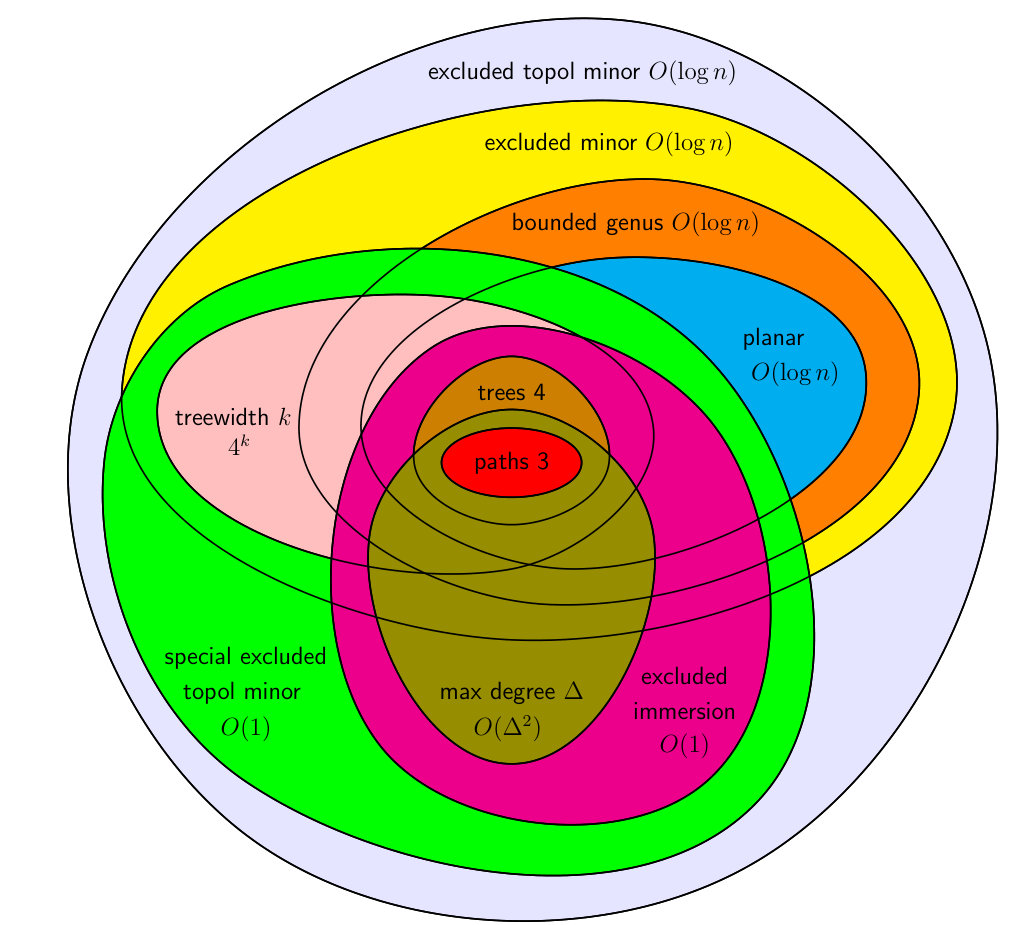 Figure 1
Peer Reviews
No public reviews on file for this paper yet. If you reviewed it on a platform where reviews are public (OpenReview, ICLR, NeurIPS, ICML), you can paste yours below so the community can read it here.
Videos
No videos yet. Explain this paper in a talk, walkthrough, or lecture? Add one.
**Nonrepetitive Colourings of Graphs Excluding
a Fixed Immersion or Topological Minor**
††14th March 2024
Paul Wollan 222Department of Computer Science, University of Rome, “La Sapienza”, Rome, Italy ([email protected]). Supported by the European Research Council under the European Union s Seventh Framework Programme (FP7/2007-2013)/ERC Grant Agreement no. 279558. David R. Wood 333School of Mathematical Sciences, Monash University, Melbourne, Australia ([email protected]).
Research supported by the Australian Research Council.
Abstract. We prove that graphs excluding a fixed immersion have bounded nonrepetitive chromatic number. More generally, we prove that if is a fixed planar graph that has a planar embedding with all the vertices with degree at least 4 on a single face, then graphs excluding as a topological minor have bounded nonrepetitive chromatic number. This is the largest class of graphs known to have bounded nonrepetitive chromatic number.
1 Introduction
A vertex colouring of a graph is nonrepetitive if there is no path for which the first half of the path is assigned the same sequence of colours as the second half. More precisely, a -colouring of a graph is a function that assigns one of colours to each vertex of . A path of even order in is repetitively coloured by if for . A colouring of is nonrepetitive if no path of of even order is repetitively coloured by . Observe that a nonrepetitive colouring is proper, in the sense that adjacent vertices are coloured differently. The nonrepetitive chromatic number is the minimum integer such that admits a nonrepetitive -colouring. We only consider simple graphs with no loops or parallel edges.
The seminal result in this area is by Thue [41], who in 1906 proved that every path is nonrepetitively 3-colourable. Thue expressed his result in terms of strings over an alphabet of three characters—Alon et al. [3] introduced the generalisation to graphs in 2002. Nonrepetitive graph colourings have since been widely studied [26, 27, 10, 30, 11, 31, 39, 2, 4, 7, 5, 9, 28, 8, 12, 37, 33, 21, 38, 6, 25, 3, 29, 32, 35]. The principle result of Alon et al. [3] was that graphs with maximum degree are nonrepetitively -colourable. Several subsequent papers improved the constant [26, 30, 16]. The best known bound is due to Dujmović et al. [16].
Theorem 1** ([16]).**
Every graph with maximum degree is nonrepetitively -colourable.
A number of other graph classes are known to have bounded nonrepetitive chromatic number. In particular, trees are nonrepetitively 4-colourable [8, 33], outerplanar graphs are nonrepetitively -colourable [33, 5], and graphs with bounded treewidth have bounded nonrepetitive chromatic number [33, 5]. (See Section 2 for the definition of treewidth.) The best known bound is due to Kündgen and Pelsmajer [33].
Theorem 2** ([33]).**
Every graph with treewidth is nonrepetitively -colourable.
The primary contribution of this paper is to provide a qualitative generalisations of Theorems 1 and 2 via the notion of graph immersions and excluded topological minors.
A graph contains a graph as an immersion if the vertices of can be mapped to distinct vertices of , and the edges of can be mapped to pairwise edge-disjoint paths in , such that each edge of is mapped to a path in whose endpoints are the images of and . The image in of each vertex in is called a branch vertex. Structural and colouring properties of graphs excluding a fixed immersion have been widely studied [24, 22, 42, 20, 18, 13, 34, 1, 36, 19, 14, 23, 40]. We prove that graphs excluding a fixed immersion have bounded nonrepetitive chromatic number.
Theorem 3**.**
For every graph with vertices, every graph that does not contain as an immersion is nonrepetitively -colourable.
Since a graph with maximum degree contains no star with leaves as an immersion, Theorem 3 implies that graphs with bounded degree have bounded nonrepetitive chromatic number (as in Theorem 1).
We strengthen Theorem 3 as follows (although without explicit bounds). A graph contains a graph as a strong immersion if contains as an immersion, such that for each edge of , no internal vertex of the path in corresponding to is a branch vertex.
Theorem 4**.**
For every fixed graph , there exists a constant , such that every graph that does not contain as a strong immersion is nonrepetitively -colourable.
Note that planar graphs with vertices are nonrepetitively -colourable [15], and the same is true for graphs excluding a fixed graph as a minor or topological minor [17]. It is unknown whether any of these classes have bounded nonrepetitive chromatic number. Our final result shows that excluding a special type of topological minor gives bounded nonrepetitive chromatic number.
Theorem 5**.**
Let be a fixed planar graph that has a planar embedding with all the vertices of with degree at least 4 on a single face. Then there exists a constant , such that every graph that does not contain as a topological minor is nonrepetitively -colourable.
Graphs with bounded treewidth exclude fixed walls as topological minors. Since walls are planar graphs with maximum degree 3, Theorem 5 implies that graphs of bounded treewidth have bounded nonrepetitive chromatic number (as in Theorem 2). Similarly, for every graph with vertices, the ‘fat star’ graph (which is the 1-subdivision of the -leaf star with edge multiplicity ) contains as a strong immersion. Since fat stars embed in the plane with all vertices of degree at least 4 on a single face, Theorem 5 implies that graphs excluding a fixed graph as a strong immersion have bounded nonrepetitive chromatic number (as in Theorem 4). In this sense, Theorem 5 generalises all of Theorems 1, 2, 3 and 4.
The results of this paper, in relation to the best known bounds on the nonrepetitive chromatic number, are summarised in Figure 1.
2 Tree Decompositions
For a graph and tree , a tree decomposition or -decomposition of consists of a collection of sets of vertices of , called bags, indexed by the nodes of , such that for each vertex the set induces a connected subtree of , and for each edge of there is a node such that . The width of a -decomposition is the maximum, taken over the nodes , of . The treewidth of a graph is the minimum width of a tree decomposition of . The adhesion of a tree decomposition is . The torso of each node is the graph obtained from by adding a clique on for each edge incident to . Dujmović et al. [17] generalised Theorem 2 as follows:
Lemma 6** ([17]).**
If a graph has a tree decomposition with adhesion such that every torso is nonrepetitively -colourable, then is nonrepetitively -colourable.
For integers a graph has -bounded degree if contains at most vertices with degree greater than .
Lemma 7**.**
Every graph with -bounded degree is nonrepetitively -colourable.
Proof.
Assign a distinct colour to each vertex of degree at least , and colour the remaining graph by Theorem 1. For each vertex of degree at least , no other vertex is assigned the same colour as . Thus is in no repetitively coloured path. The result then follows from Theorem 1. ∎
Dvořák [18] proved the following structure theorem for graphs excluding a strong immersion.
Theorem 8** ([18]).**
For every fixed graph , there exists a constant , such that every graph that does not contain as a strong immersion has a tree decomposition such that each torso is -bounded degree.
Lemmas 7, 6 and 8 imply Theorem 4.
3 Weak Immersions
The proof of Theorem 4 gives no explicit bound on the constant . In this section we prove an explicit bound on the nonrepetitive chromatic number of graphs excluding a weak immersion. Theorem 3 follows from Lemma 6 and the following structure theorem of independent interest.
Theorem 9**.**
For every graph with vertices, every graph that does not contain as a weak immersion has a tree decomposition with adhesion at most such that every torso has -bounded degree.
The starting point for the proof of Theorem 9 is the following structure theorem of Wollan [42]. For a tree and graph , a -partition of is a partition of indexed by the nodes of . Each set is called a bag. Note that a bag may be empty. For each edge of a tree , let and be the components of where is in and is in . For each edge , let and . Let be the set of edges in between and . The adhesion of a -partition is the maximum, taken over all edges of , of . For each node of , the torso of (with respect to a -partition) is the graph obtained from by identifying into a single vertex for each edge incident to (deleting resulting parallel edges and loops).
Theorem 10** ([42]).**
For every graph with vertices, for every graph that does not contain as a weak immersion, there is a -partition of with adhesion at most such that each torso has -bounded degree.
Proof of Theorem 9.
Let be a graph that does not contain as a weak immersion. Consider the -partition of from Theorem 10.
Let be obtained from by orienting each edge towards some root vertex. We now define a tree decomposition of . Initialise for each node . For each edge of , if and and is the least common ancestor of and in , then add to for each node on the path in , and add to for each node on the path in . Thus each vertex is in a sequence of bags that correspond to a directed path from to some ancestor of in . By construction, the endpoints of each edge are in a common bag. Thus is a tree decomposition of .
Consider a vertex for some edge of . Then has a neighbour in , and . Thus . That is, the tree decomposition has adhesion at most .
Let be the torso of each node with respect to the tree decomposition . That is, is obtained from by adding a clique on for each edge of . Our goal is to prove that has -bounded degree.
Consider a vertex of . Then is in at most one child bag of , as otherwise would belong to a set of bags that do not correspond to a directed path in . Since has adhesion at most , has at most neighbours in , where is the parent of and has at most neighbours in . Thus the degree of in is at most the degree of in plus . Call this property ().
First consider the case that . Let be the node of for which . Since , by construction, is an ancestor of . Let be the node immediately before on the path in . We now bound the number of neighbours of in . Say . If is in then let be the edge . Otherwise, is in and thus has a neighbour in since ; let be the edge . Observe that , and thus . Since for distinct , we have . By (), the degree of in is at most .
Now consider the case that . Suppose further that is not one of the at most vertices of degree greater than in the torso of with respect to the given -partition. Suppose that in , has neighbours in and neighbours not in (the identified vertices). So . Consider a neighbour of in with . Then for some child of . For at most children of , there is a neighbour of in . Furthermore, for each child of , has at most neighbours in since the -partition has adhesion at most . Thus has degree at most in . By (), has degree at most in .
Since , the torso has -bounded degree. ∎
4 Excluding a Topological Minor
Theorem 5 is an immediate corollary of Lemma 6 and the following structure theorem of Dvořák [18] that extends Theorem 8.
Theorem 11** ([18]).**
Let be a fixed planar graph that has a planar embedding with all the vertices of with degree at least 4 on a single face. Then there exists a constant , such that every graph that does not contain as a topological minor has a tree decomposition such that each torso has -bounded degree.
While Theorem 11 is not explcitly stated in [18], we now explain that it is in fact a special case of Theorem 3 in [18]. This result provides a structural description of graphs excluding a given topological minor in terms of the following definition. For a graph and surface , let be the minimum, over all possible embeddings of in , of the minimum number of faces such that every vertex of degree at least 4 is incident with one of these faces. By assumption, for our graph and for every surface , we have . In this case, Theorem 3 of Dvořák [18] says that for some integer , every graph that does not contain as a topological minor is a clique sum of -bounded degree graphs. It immediately follows that has the desired tree decomposition. See Corollary 1.4 in [34] for a closely related structure theorem.
The following natural open problem arises from this research: Do graphs excluding a fixed planar graph as a topological minor have bounded nonrepetitive chromatic number? And what is the structure of such graphs?
Acknowledgement
This research was initiated at the Workshop on New Trends in Graph Coloring held at the Banff International Research Station in October 2016. Thanks to the organisers. And thanks to Chun-Hung Liu and Zdeněk Dvořák for stimulating conversations.
The reference list from the paper itself. Each links out to its DOI / PubMed record.
- 1Abu-Khzam and Langston [2003] Faisal N. Abu-Khzam and Michael A. Langston . Graph coloring and the immersion order. In Computing and combinatorics , vol. 2697 of Lecture Notes in Comput. Sci. , pp. 394–403. Springer, 2003. doi: 10.1007/3-540-45071-8_40 . · doi ↗
- 2Alon and Grytczuk [2008] Noga Alon and Jarosław Grytczuk . Breaking the rhythm on graphs. Discrete Math. , 308:1375–1380, 2008. doi: 10.1016/j.disc.2007.07.063 . MR: 2392054 . · doi ↗
- 3Alon et al. [2002] Noga Alon, Jarosław Grytczuk, Mariusz Hałuszczak, and Oliver Riordan . Nonrepetitive colorings of graphs. Random Structures Algorithms , 21(3-4):336–346, 2002. doi: 10.1002/rsa.10057 . MR: 1945373 . · doi ↗
- 4Barát and Czap [2012] János Barát and Július Czap . Facial nonrepetitive vertex coloring of plane graphs. J. Graph Theory , 2012. doi: 10.1002/jgt.21695 . · doi ↗
- 5Barát and Varjú [2007] János Barát and Péter P. Varjú . On square-free vertex colorings of graphs. Studia Sci. Math. Hungar. , 44(3):411–422, 2007. doi: 10.1556/S Sc Math.2007.1029 . MR: 2361685 . · doi ↗
- 6Barát and Varjú [2008] János Barát and Péter P. Varjú . On square-free edge colorings of graphs. Ars Combin. , 87:377–383, 2008. MR: 2414029 .
- 7Barát and Wood [2008] János Barát and David R. Wood . Notes on nonrepetitive graph colouring. Electron. J. Combin. , 15:R 99, 2008. http://www.combinatorics.org/Volume_15/Abstracts/v 15i 1r 99.html . MR: 2426162 .
- 8Brešar et al. [2007] Boštjan Brešar, Jarosław Grytczuk, Sandi Klavžar, Stanisław Niwczyk, and Iztok Peterin . Nonrepetitive colorings of trees. Discrete Math. , 307(2):163–172, 2007. doi: 10.1016/j.disc.2006.06.017 . MR: 2285186 . · doi ↗