Noise induced transition in Josephson junction with second harmonic
Nivedita Bhadra

TL;DR
This paper investigates how multiplicative colored noise can induce stabilization in a Josephson junction with second harmonic, revealing a noise-induced transition and stabilization mechanism through analytical and numerical methods.
Contribution
It introduces a classical approach to analyze noise-induced stabilization in Josephson junctions with second harmonic, combining analytical effective potential analysis with numerical validation.
Findings
Noise can stabilize an unstable configuration in the junction.
Effective potential captures the stabilization effect.
Numerical results confirm analytical predictions.
Abstract
We show a noise-induced transition in Josephson junction with fundamental as well as second harmonic. A periodically modulated multiplicative colored noise can stabilize an unstable configuration in such a system. The stabilization of the unstable configuration has been captured in the effective potential of the system obtained by integrating out the high-frequency components of the noise. This is a classical approach to understand the stability of an unstable configuration due to the presence of such stochasticity in the system and our numerical analysis confirms the prediction from the analytical calculation.
Click any figure to enlarge with its caption.
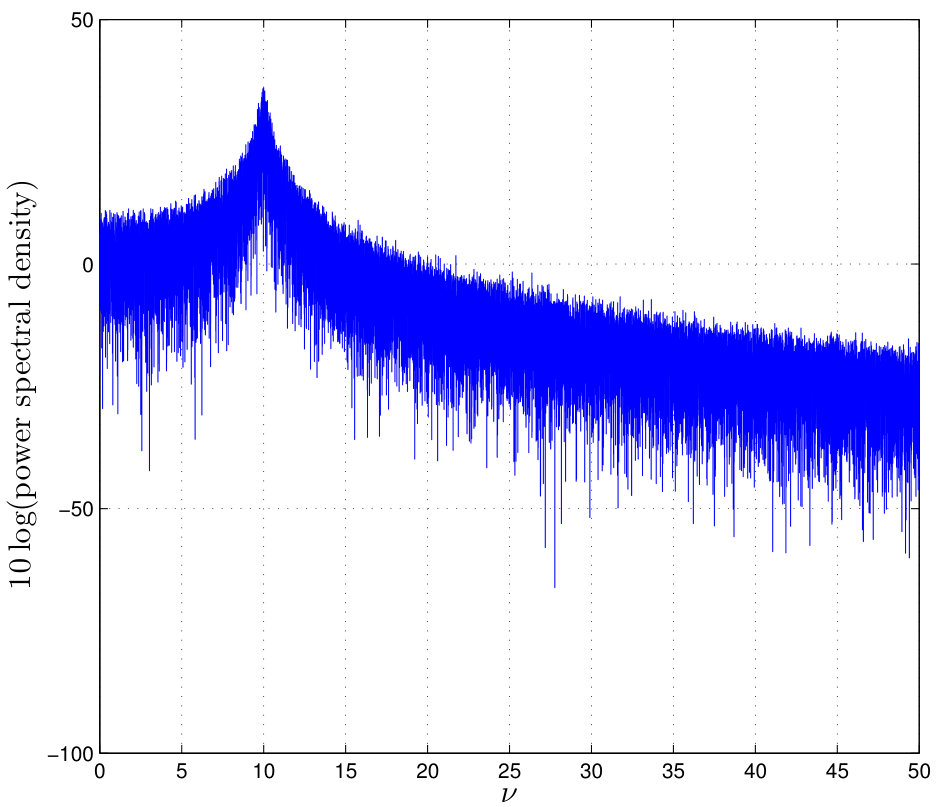 Figure 1
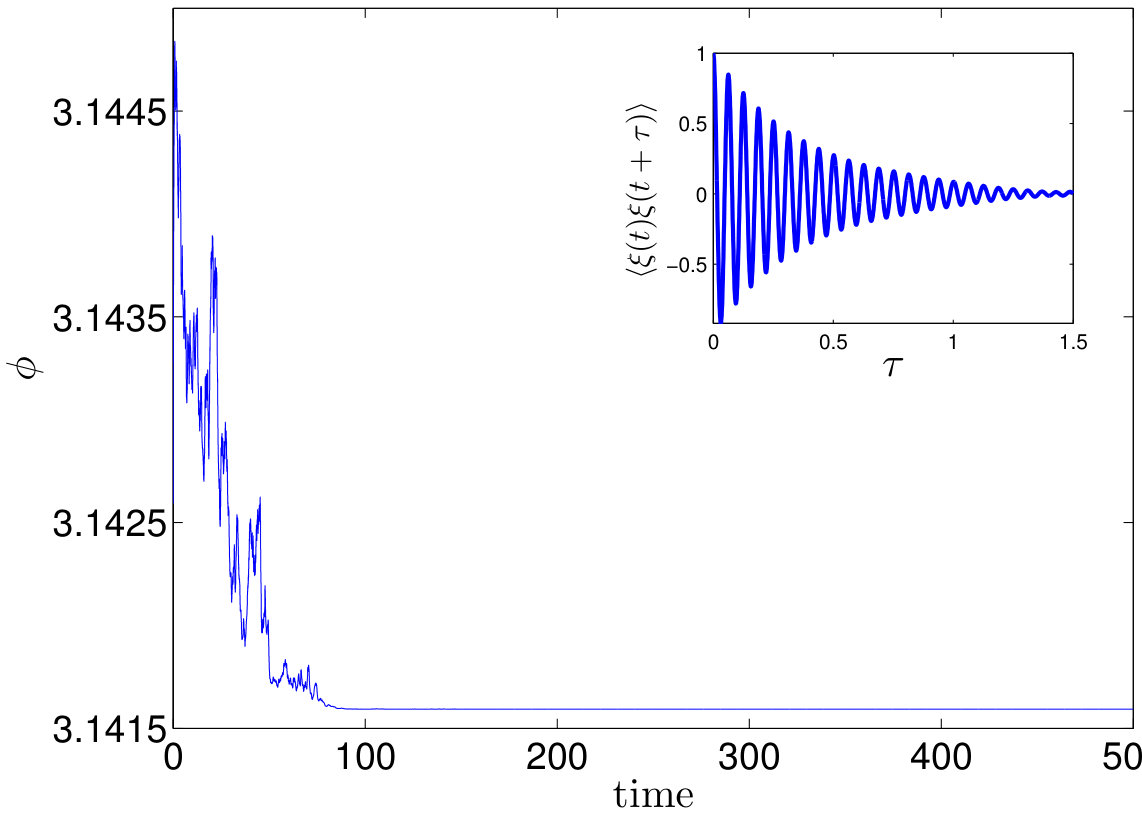 Figure 2
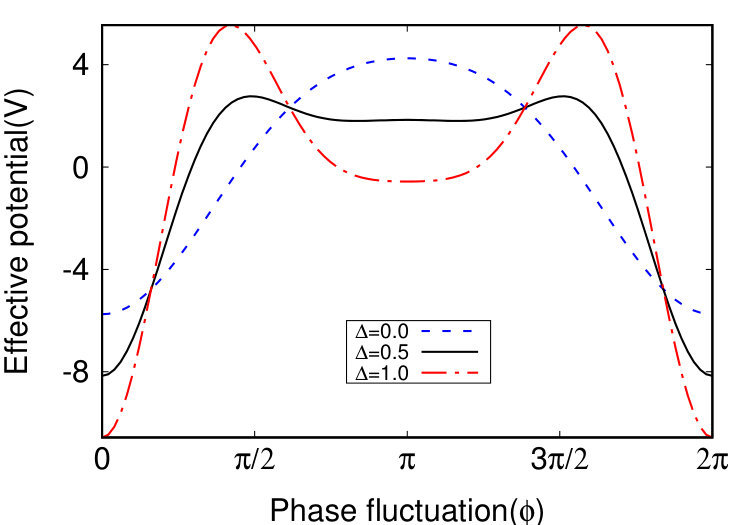 Figure 3
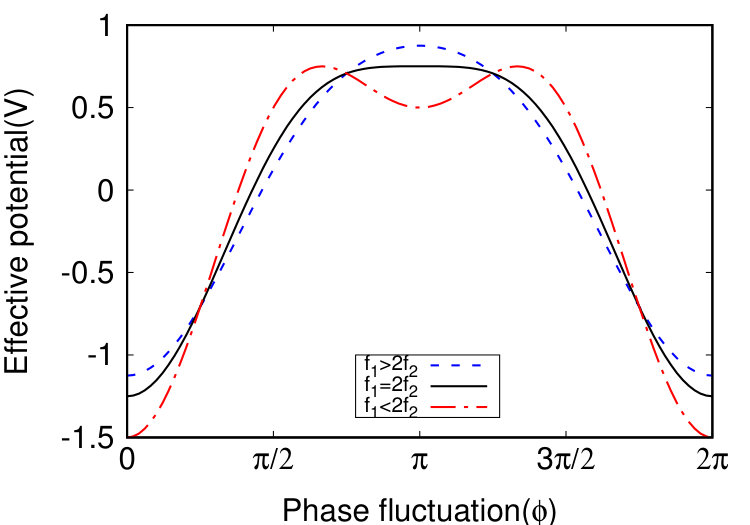 Figure 4
Peer Reviews
No public reviews on file for this paper yet. If you reviewed it on a platform where reviews are public (OpenReview, ICLR, NeurIPS, ICML), you can paste yours below so the community can read it here.
Videos
No videos yet. Explain this paper in a talk, walkthrough, or lecture? Add one.
11institutetext: Department of Physical Sciences, Indian Institute of Science Education and Research Kolkata, Mohanpur, Nadia, West Bengal 741246, India
Noise induced transition in Josephson junction with second harmonic
Nivedita Bhadra Present address: Department of Physical Sciences, Indian Institute of Science Education and Research Kolkata, Mohanpur, Nadia, West Bengal 741246, India11
(Received: date / Revised version: date)
Abstract
We show a noise induced transition in Josephson junction with fundamental as well as second harmonic. A periodically modulated multiplicative colored noise can stabilize an unstable configuration in such a system. The stabilization of the unstable configuration has been captured in the effective potential of the system obtained by integrating out the high frequency components of the noise. This is a classical approach to understand the stability of an unstable configuration due to the presence of such stochasticity in the system and our numerical analysis confirms the prediction from the analytical calculation.
pacs:
PACS-keydiscribing text of that key and PACS-keydiscribing text of that key
††offprints:
1 Introduction
Presence of noise can induce several interesting phenomena in a nonlinear system, e.g., stochastic resonanceGammaitoni1998 , dynamical stabilizationLanda1996 ; Simons2009 , noise induced orderMatsumoto1983 , noise induced chaosKautz1985 , broadly known as noise induced transitionVandenBroeck1994a ; HorsthemkeW.2006 .We have studied a noise induced transition in a nonlinear system, namely, Josephson junction(JJ) which consists of first as well as the second harmonic in its current phase relation(CPR).
In a Josephson junction, a supercurrent flows between two proximately coupled superconductors through a thin insulating layer due to Cooper pair tunneling. The value of the supercurrent is proportional to the sine of the difference of the phases of the superconductor order parameter. In conventional JJs at equilibrium, the phase difference is zero. In principle, current can be the summation of all harmonics. Generally the single harmonic is adequate for the description of the JJ properties and other higher harmonics are negligible. However, in recent years, there have been a lot of interesting studies on JJ with unconventional current phase relations(CPR)Goldobin2007 ; Richard2013 ; Ouassou2016 . The second harmonic in the current phase relation has become noticeable in these studies. Several mechanisms of generation of the second harmonic have also been discussed Goldobin2007 . For example, in JJs with a ferromagnetic interlayer i.e. S/F/S, where for some intervals of the exchange field and F-layer thickness, the ground state corresponds to the phase difference equal to , also known as “” junctions. Experimental studies showed a transition in S/F/S from the measurements of the temperature dependence of the critical current Ryazanov2001 . The CPR for JJs is sinusoidal only near the critical temperature , , being the amplitude of the first harmonic in CPR. At low temperatures, the higher harmonic terms become important and the relation becomes , where and are amplitudes of the first and the second harmonic of the Josephson current. At the transition, the first harmonic becomes zero and the second-harmonic term dominates Buzdin2005 ; Sellier2004a ; Robinson2006 ; Robinson2007 . These studies show the higher harmonics to be extremely sensitive to changes in barrier thickness, temperature etc. Recently, a robust second harmonic CPR has been established in a Josephson junction of two superconductors separated by a ferromagnetic layer Pal2014 . In this work we adopt a classical approach and propose a toy model for JJ with two harmonics, i.e. , where a stochastic modulation of the potential barrier is introduced and we have shown that the unstable configuration can be stabilized with this kind of external temporal modulation.
Several work has been done in the context of JJ with additive Gaussian and non-Gaussian noise. Ref. Mantegna1998 ; Dubkov2004 ; Spagnolo2004 shows how the presence of noise can enhance the stability of fluctuating metastable states. Both Gaussian and non-Gaussian noise sources can affect the escape time of the junctions and the mean lifetime of the metastable statesAugello2010 ; Valenti2014a . To the best of our knowledge the effect of multiplicative noise has not drawn much attention. Multiplicative periodic modulation has been discussed in the context of bosonic JJBoukobza2010 ; Sensarma2011 ; Mann2017 . In experiments the height of the potential can be modulated externally in Bosonic JJ. Optical lattice can be a simulator for realizing this kind of modulation experimentallyLignier2007 . Depth of the potential, amplitude and frequency of the drive can be varied over a wide range in such a set up. An off-resonant incoherent light source focused at the barrier between them is one of the possible noise source for such a systemKhodorkovsky2008 . The bosonic JJ can be described by a two mode Bosonic Hubbard HamiltonianParaoanu2001 ; Leggett2001 ; Gati2007 . In Khodorkovsky2008 theoretical study has been done considering stochastic modulation of the potential barrier in BHH with first harmonic. Ref.Boukobza2010 shows how the presence of a small amplitude high frequency multiplicative periodic drive leads to the dynamic stabilization of the configuration. Periodic modulation of small frequency can easily be implemented in optical set up by varying the intensity of the counter propagating lasers forming the optical latticeWitthaut2008 . Inspired by these works on bosonic JJ we investigated the effect of multiplicative noise or stochastic modulation in JJ with the first as well as the second harmonic. We are presenting a mathematical model and expect this would in future motivate experiments to introduce this kind of modulation in non bosonic JJ with both harmonic. We observe that the unstable state for this JJ model can be stabilized in presence of such stochastic modulation. Power spectrum of the modulating function has a peak at a high frequency. Due to the presence of this high frequency “separation of variable” method is applicable. This method was first adopted to understand the dynamic stabilization of the inverted position of a pendulum periodically driven at the point of suspensionButikov2001 . Later studies have shown dynamical stabilization of this kind in presence of noisy driveLanda1996 . The probability distribution shows that the presence of additive noise cannot induce stabilization of the position but multiplicative noise can induce such stabilizationSimons2009 . We have considered the presence of a multiplicative modulation of the potential which has the form of a periodically modulated multiplicative colored noise. The idea is to separate the “fast” and “slow” variable and integrating out the “fast” variable. An effective potential for the “slow” component can be obtained in this way. This elimination of rapid components produces higher harmonic terms in whose coefficient can be adjusted to generate new local minima at . We adopted this method of separation of variable to obtain the effective potential for the system. The stable phase for the system has been achieved from this effective potential.
2 Model
We consider a Josephson junction model with first as well as second harmonic in the current phase relation(CPR). The governing equation for the system is
[TABLE]
where , and are the junction resistance, the first and second harmonic of Josephson critical current and the bias current; and represent the phase difference and the capacitance between the two superconductors respectively. We would consider the case when the bias current is . Rewriting Eq.1 we obtain
[TABLE]
where and is the damping parameter of Josephson current. For algebraic simplicity, we consider the case . However, the general case can be considered in the same way (see Eq. 21). Hence, We can write Eq.2 in terms of Josephson potential as
[TABLE]
where
[TABLE]
The condition for stabilization of position is obtained by putting , i.e., . Our study is in the other regime, i.e., . It can be observed from the potential(Eq.4) that configuration for the system is unstable at . This work shows how this unstable configuration can be stabilized in presence of modulation of the potential barrier. The equation governing the stochastically modulated system is
[TABLE]
where is the noise whose power spectrum has a peak at a high frequency compared to the natural frequency of the system when is absent. This choice of ensures that the deviations of the variable , caused by the stochastic vibration, are small. Hence, a separation of “slow” and “fast” variable is possible. The noise is taken to be Gaussian distributed with zero mean, , and the temporal correlation goes as
[TABLE]
Henceforth, angular bracket will denote averaging over the time, where is the variance of the stochastic process, is the modulation frequency which is taken to be very high compared to the natural frequency of JJ with both harmonic and is the attenuation parameter. We have studied the problem under the limit . For the simplicity of calculation, we have not included any additive noise. However, we have shown in the numerical analysis that inclusion of small additive noise does not affect the results significantly.
3 Calculation of effective potential
In this section, we would calculate the effective potential for this system. This effective potential approach was for the first time implemented in the context of dynamic stabilization of a pivot driven pendulum. Dynamical stabilization of i.e., the inverted position of the system was theoretically explained on the basis of this effective potential. The idea is to obtain the effective potential by splitting the motion into “fast” and “slow” variable and averaging over the “fast” component. In such cases, new harmonics appear in the effective potential. Now the stable phases can be obtained by finding out the extrema of the effective potential. We adopt the same method for this system.
The variable governing the dynamics of this Josephson junction is the phase difference of the superconducting order parameters across the junction . We can separate it into “fast” and “slow” part . Writing , where , Eq.5 becomes
[TABLE]
by keeping terms up to . Eq.7 involves both the fluctuating part(fast) and the “smooth”(slow) part, each of which should have its own separate equation of motion. Retaining terms linear in or , and replacing by the noise averaged value for the fluctuation part, the equation of motion for the fluctuating part is given by
[TABLE]
and that of the “slow” part is
[TABLE]
The natural initial condition for is to set at the initial time which we may choose as . With this initial condition, Eq.(8) admits for all time, as expected.
Note that the cross-correlation, as is shown below, is , and it contributes to the average motion of the pendulum. We can consider as we are interested in the regime . We would solve Eq. 8 by Green function . The effect of noise can be cast into the form of a unit force. Eq. 8 can be written as
[TABLE]
where is unit force at . In terms of Green function Eq.11 becomes
[TABLE]
where satisfies the initial condition for with continuous at and . In this case, the solution takes the following form
[TABLE]
Substituting this solution in Eq.10, we find
[TABLE]
From now on we would opt out for the simplification of symbol. In terms of effective potential we can write
[TABLE]
where
[TABLE]
Now, to find the condition for stability of , we simply put the condition . It gives the condition as
[TABLE]
The stability condition at shows a divergence at .
Now we study the stable and unstable phases after expanding around . Expanding around we obtain the effective potential in the following form
[TABLE]
where . We ignore higher order terms since the highest order term considered here() is always positive for the range of values we are interested in .
Let us now consider a few special situations.
In the modulation i.e. and , the series(Eq.18) starts with the quartic term, with the coefficient of as negative . The coefficient of is positive (), providing stability to the system. Therefore, . Hence, is an unstable configuration for the system. 2. 2.
In presence of noise .i.e.,when, , and the condition is satisfied, the coefficient of is positive. In this case, , hence, is stable configuration for the system. 3. 3.
At , both terms vanish. Effective potential becomes
[TABLE]
Hence, it is an unstable configuration at .
When , the governing equation becomes
[TABLE]
The Green function solution is
[TABLE]
If , Eq.21 reduces to Eq.13. Details of the analytical expression for is not given. However, in the numerical analysis part we have included a small value of damping parameter .
4 Numerical results
The theoretical results we have obtained in the previous section are approximate. To observe the shape of the time evolution for phase fluctuation we have performed some numerical analysis.
According to our analytical calculation for the potential (Eq.4) of the system we have found that is an unstable configuration in the regime . Fig.1 shows effective potential in absence of any modulation of the potential .
The solid line shows the shape of the potential for . The plot shows a maximum for whereas, in the regime , it shows a minimum at . Gradually curvature of the potential changes from positive to negative undergoing a zero value indicating a transition at . In order to find the effect of modulation , we plot in Fig.2 the effective potential obtained from the analytical calculation(16). The plot shows is a maximum potential configuration in absence of i.e.,, whereas, for nonzero values of noise it gradually becomes a minimum at .
To observe the effect of colored noise on the time evolution of we have simulated Eq.20 by Euler algorithm. We have taken the parameter values as, . Time step was chosen to be . We have taken as sufficiently wide band noise. Fig.LABEL:fig:PSofcolorednoise shows the power spectral density of . The spectrum shows a sharp peak at the frequency . is generated by a forced oscillator with frequency which has a damping . The applied force is a delta correlated random force. The solution of this randomly forced damped oscillator is fed into the JJ equation(Eq.20). The variance is such that which satisfies the stability condition at . The initial condition for has been kept as we are interested in observing the motion of around . has been kept as . The potential shown in Fig.2 is also consistent with the nature of the trajectory for phase fluctuation in Fig.3. In absence of , the potential shows only one minimum at , whereas, in presence of another minimum appears at in the effective potential. All these plots shown are an average of 40 different realizations. In Fig.4 we show the timeseries of in presence of additive white noise. The equation governing such case would be
[TABLE]
where . This kind of additive white noise might be present due to thermal fluctuation(effect of environment) in such a system. The amplitude of the thermal noise we consider is . We have not studied the large thermal fluctuation regime. From Fig. 4 we observe that nature of the timeseries of does not change noticeably in this regime.
5 Conclusion
In this work, we have shown how the modulation having the correlation of a periodically modulated colored noise can stabilize unstable configuration in Josephson junction with the first and the second harmonic. There is a surge in interest in the study of JJ with dominant second harmonic term and its several ground states recently. We take a classical route to understand the state. Our study shows appearance of this state due to the presence of such multiplicative noisy modulation in the system. This kind of noise can be implemented in Bosonic JJ as discussed in Sec.1. The stable state has been detected by analyzing the effective potential we obtained.This approximate analysis shows how new harmonic appears in the effective potential. We also observe the stability of in the numerical analysis of the stochastic equation governing the system. In general for a JJ system with first harmonic, the phase fluctuation for ground state is . In presence of second harmonic, it depends on the amplitude of the harmonic of the potential barrier. In our current study, we have shown how the can be made a ground state in presence of a stochastic modulation. In JJ, the value of phase fluctuation, i.e. is actually a measure of Josephson current. Since the Josephson current is proportional to the sine argument of the phase fluctuation, being negative indicates inversion of the direction of the current. The condition to make the as a ground state depends on the parameter of the applied modulation of the potential.
6 Acknowledgements
The author would like to thank Siddhartha Lal and Anandamohan Ghosh for valuable discussions.
7 Authors contributions
Both the analytical calculations and the numerical analysis have been performed by N.B.
The reference list from the paper itself. Each links out to its DOI / PubMed record.
- 1(1) Luca Gammaitoni, Peter Hänggi, Peter Jung, and Fabio Marchesoni. Stochastic resonance. Rev. Mod. Phys. , 70:223–287, Jan 1998.
- 2(2) Polina S. Landa and Alexey A. Zaikin. Noise-induced phase transitions in a pendulum with a randomly vibrating suspension axis. Phys. Rev. E , 54:3535–3544, Oct 1996.
- 3(3) Yuval B. Simons and Baruch Meerson. Emergence of stability in a stochastically driven pendulum: Beyond the kapitsa pendulum. Phys. Rev. E , 80:042102, Oct 2009.
- 4(4) K. Matsumoto and I. Tsuda. Noise-induced order. Journal of Statistical Physics , 33(3):757–757, 1983.
- 5(5) R. L. Kautz. Chaos and thermal noise in the rf‐biased josephson junction. Journal of Applied Physics , 58(1):424–440, 1985.
- 6(6) C. Van den Broeck, J. M. R. Parrondo, and R. Toral. Noise-induced nonequilibrium phase transition. Phys. Rev. Lett. , 73:3395–3398, Dec 1994.
- 7(7) Lefever R. Horsthemke W. Noise-induced transitions . Springer Series in Synergetics. Springer, 2pr edition, 2006.
- 8(8) E Goldobin, D Koelle, R Kleiner, and A Buzdin. Josephson junctions with second harmonic in the current-phase relation: Properties of φ 𝜑 \varphi junctions. Physical Review B , 76(22):224523, 2007.