Self-consistent determination of the many-body state of ultracold bosonic atoms in a one-dimensional harmonic trap
Oleksandr V. Marchukov, Uwe R. Fischer

TL;DR
This paper investigates quantum phase fluctuations in one-dimensional ultracold bosonic gases at zero temperature using a self-consistent multiconfigurational approach, revealing a peak in phase fluctuations linked to correlation dips.
Contribution
It introduces a self-consistent method to analyze spatial phase fluctuations and their relation to correlations in 1D Bose gases with moderate interactions.
Findings
Phase fluctuations peak at specific positions, indicating correlation dips.
The method captures the shape of orbitals and occupation amplitudes self-consistently.
Results connect phase fluctuation behavior with interaction regimes.
Abstract
We study zero-temperature quantum fluctuations in harmonically trapped one-dimensional interacting Bose gases, using the self-consistent multiconfigurational time-dependent Hartree method. We define from the full single-particle density matrix by the spatial decay exponent of off-diagonal long-range order. In a regime of mesoscopic particle numbers and moderate contact couplings, we derive the spatial dependence of the amplitude of phase fluctuations, determined from the {\em self-consistently} derived shape of the field operator orbitals and Fock space orbital occupation amplitudes. It is shown that the phase fluctuations display a peak, which in turn corresponds to a dip of the first-order correlations in position space, akin to what has previously been obtained in the Tonks-Girardeau limit of very large interactions and low densities.
Click any figure to enlarge with its caption.
 Figure 10
 Figure 11
 Figure 1
 Figure 2
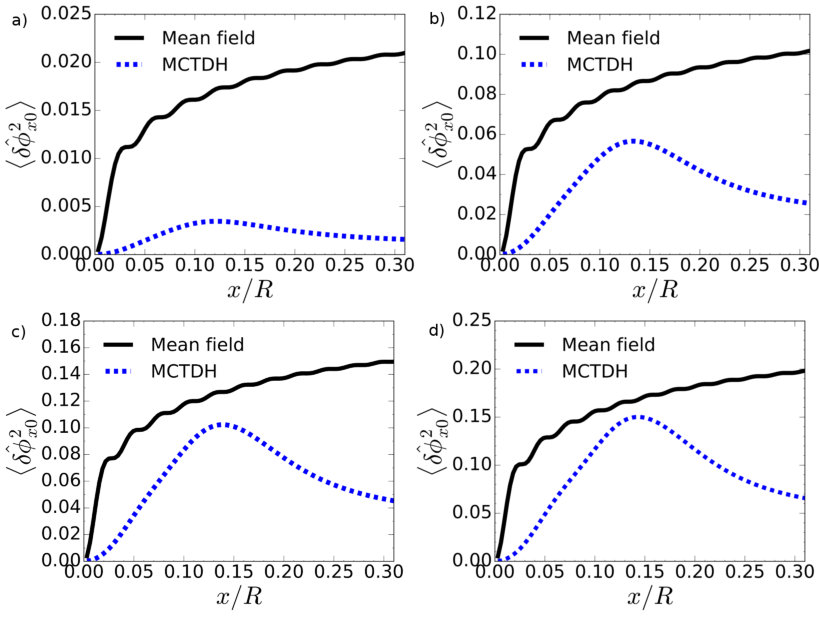 Figure 3
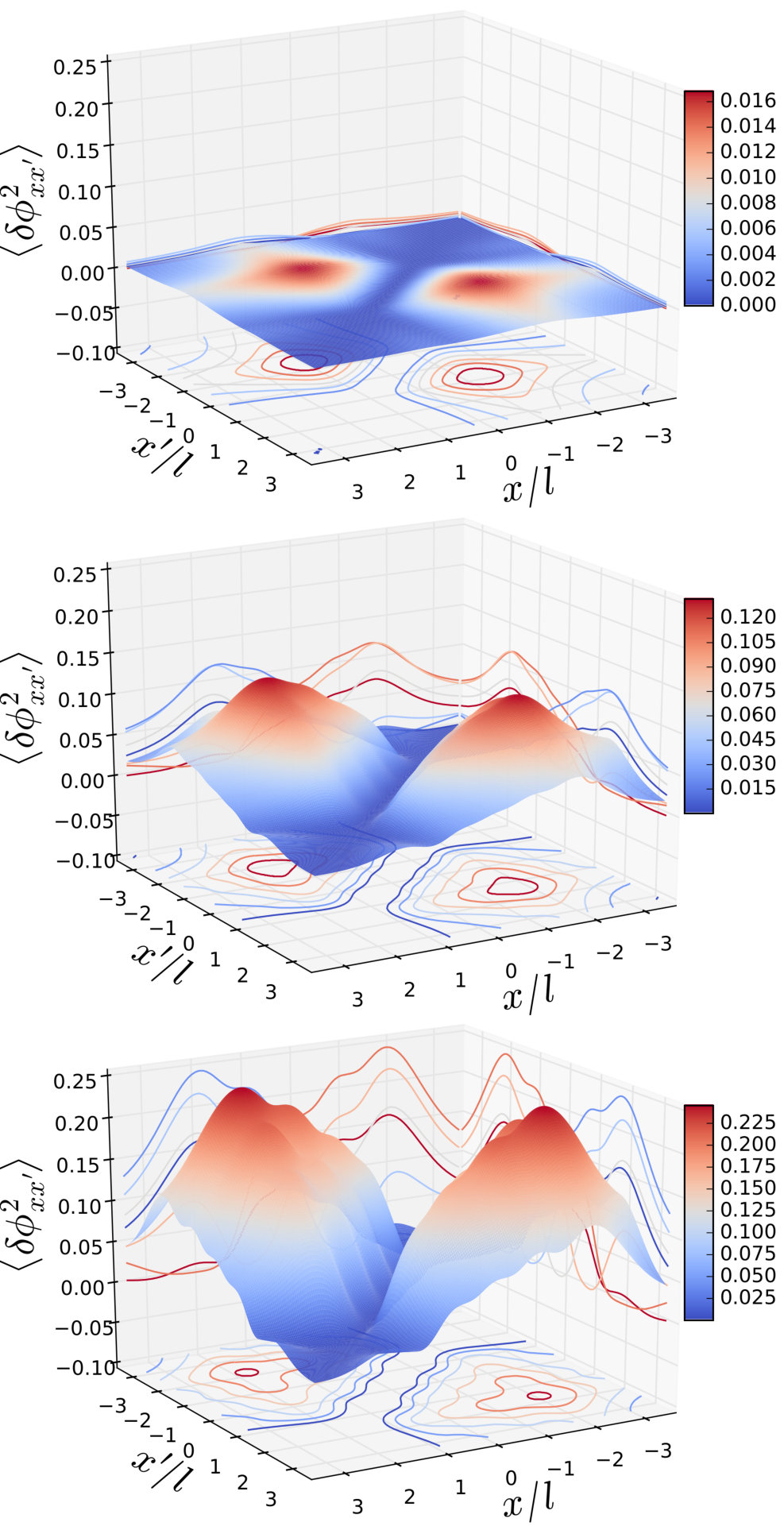 Figure 4
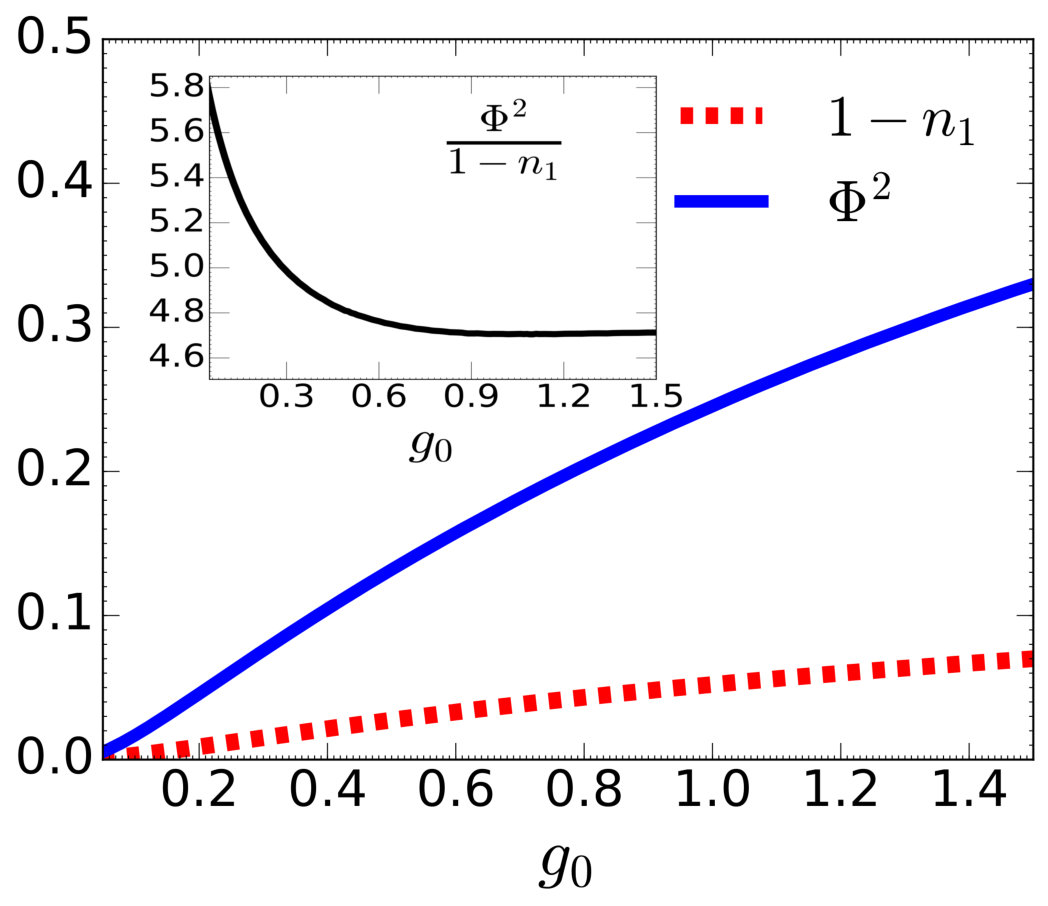 Figure 5
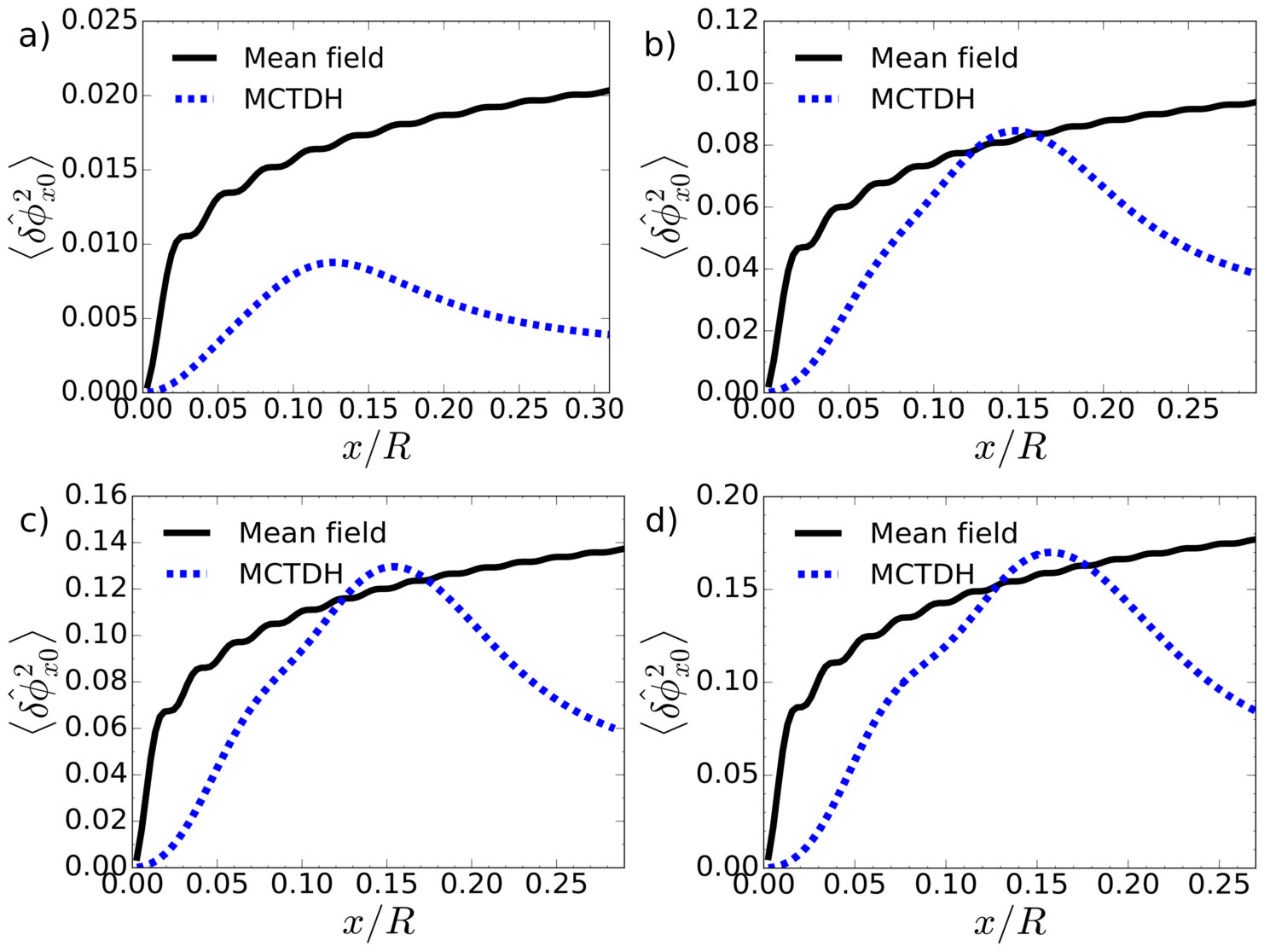 Figure 6
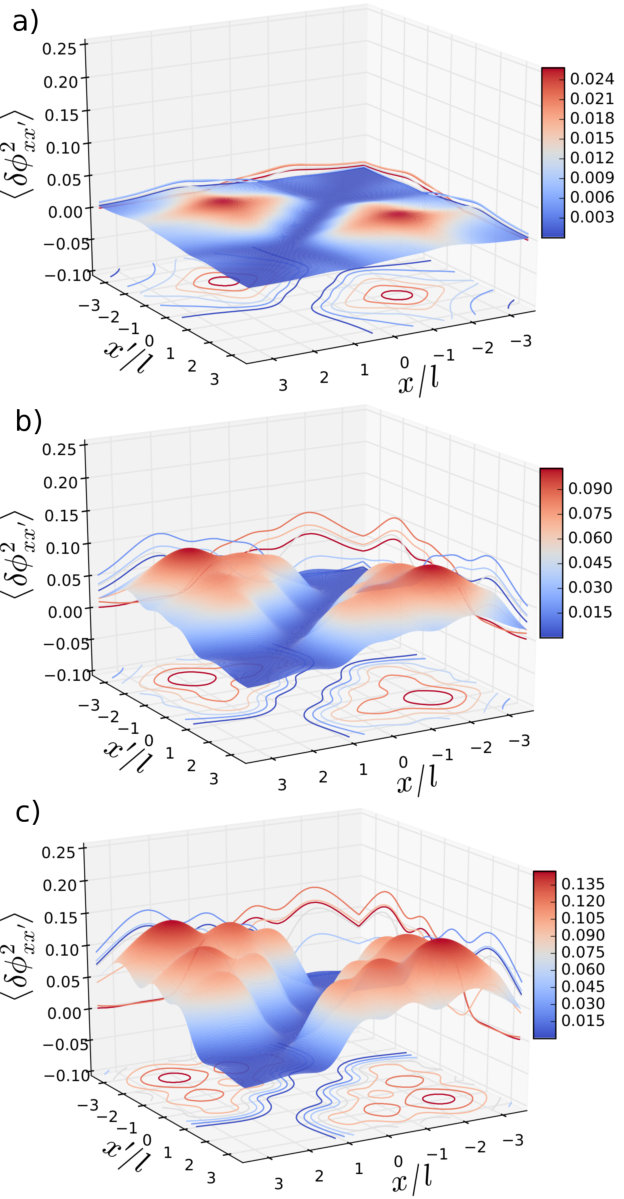 Figure 9
Peer Reviews
No public reviews on file for this paper yet. If you reviewed it on a platform where reviews are public (OpenReview, ICLR, NeurIPS, ICML), you can paste yours below so the community can read it here.
Videos
No videos yet. Explain this paper in a talk, walkthrough, or lecture? Add one.