Search for weak M1 transitions in $^{48}$Ca with inelastic proton scattering
M. Mathy (1), J. Birkhan (1), H. Matsubara (2,3), P. von Neumann-Cosel, (1), N. Pietralla (1), V.Yu. Ponomarev (1), A. Richter (1), and A. Tamii (2), ((1) Institut f\"ur Kernphysik, Technische Universit\"at Darmstadt, (2), Research Center for Nuclear Physics, Osaka University

TL;DR
This study searches for weak M1 transitions in $^{48}$Ca using high-resolution proton scattering and compares results with electron scattering to understand their contribution to the total M1 strength, revealing about 25% contribution from weak transitions.
Contribution
It provides the first detailed comparison of weak M1 transition strengths in $^{48}$Ca from proton and electron scattering experiments, confirming the significance of weak transitions and quenching factors.
Findings
29 peaks with M1 contributions identified in 7-13 MeV range
Total B(M1) strength of 1.19(6) μ_N^2 matches electron scattering results
Weak transitions contribute approximately 25% to the total B(M1) strength in $^{48}$Ca
Abstract
The spinflip M1 resonance in the doubly magic nucleus Ca, dominated by a single transition, serves as a reference case for the quenching of spin-isospin modes in nuclei. The aim of the present work is a search for weak M1 transitions in Ca with a high-resolution (p,p') experiment at 295 MeV and forward angles including 0 degree and a comparison to results from a similar study using backward-angle electron scattering at low momentum transfers in order to estimate their contribution to the total B(M1) strength. M1 cross sections of individual peaks in the spectra are deduced with a multipole decomposition analysis. The corresponding reduced B(M1) transition strengths are extracted following the approach outlined in J. Birkhan et al., Phys. Rev. C 93, 041302(R) (2016). In total, 29 peaks containing a M1 contribution are found in the excitation energy region 7 - 13 MeV. The…
Click any figure to enlarge with its caption.
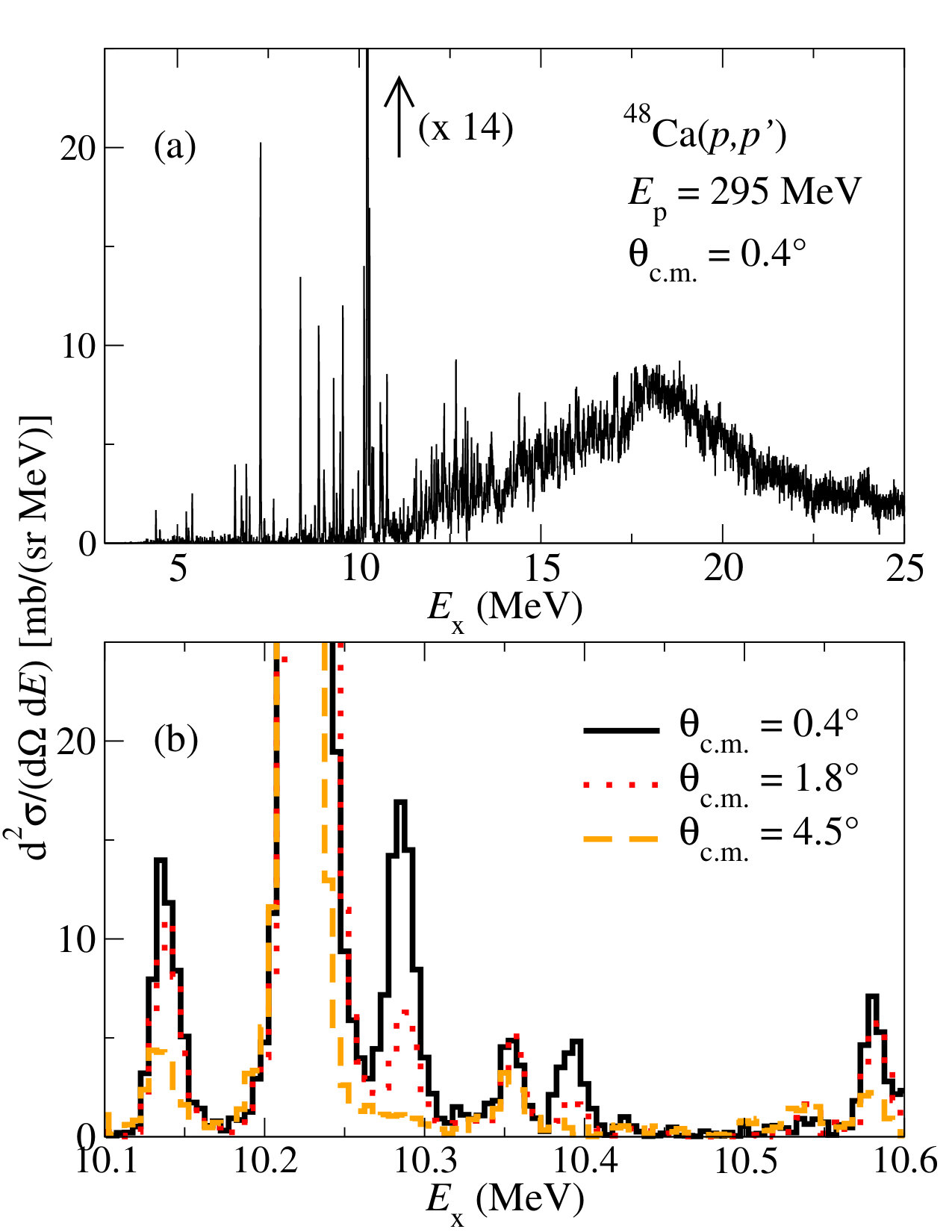 Figure 1
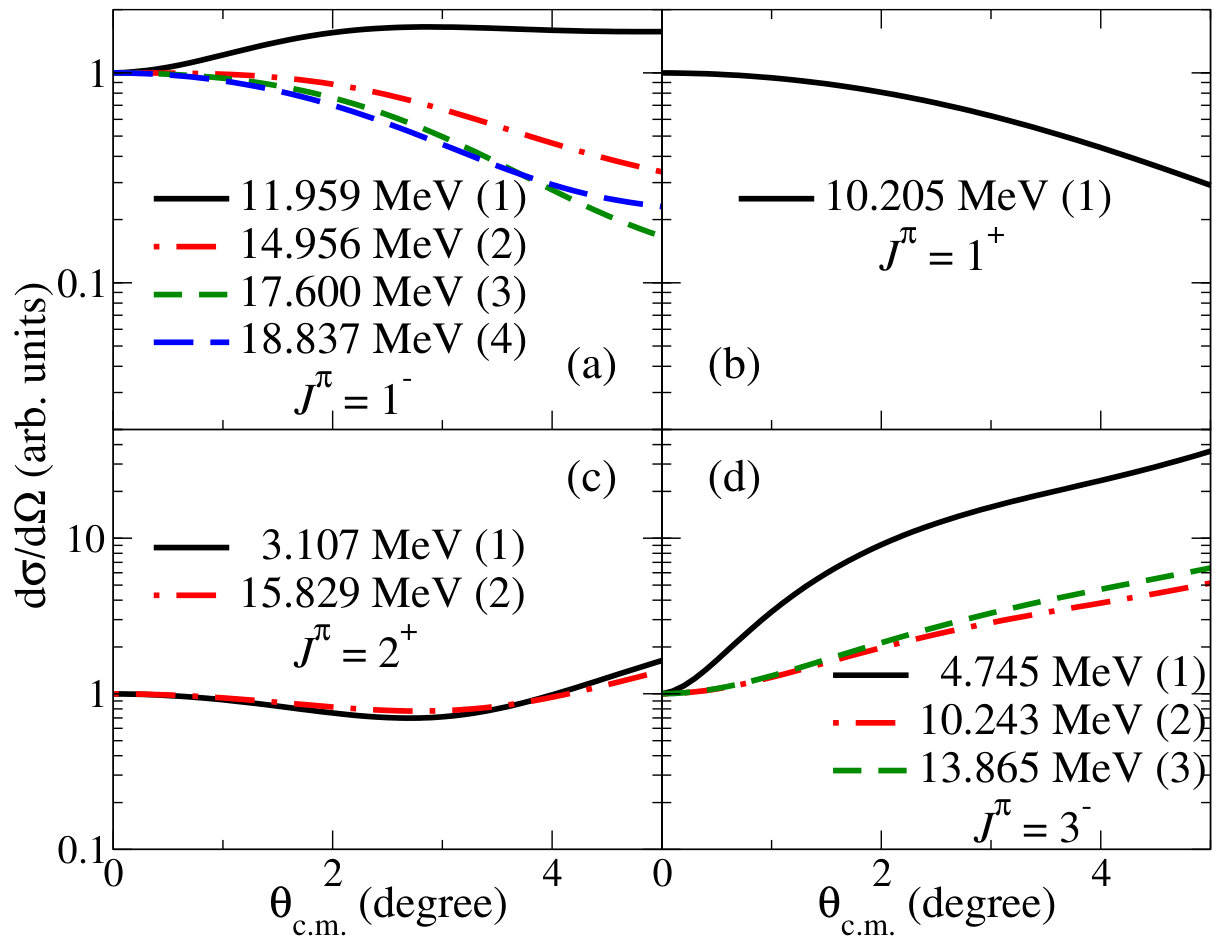 Figure 2
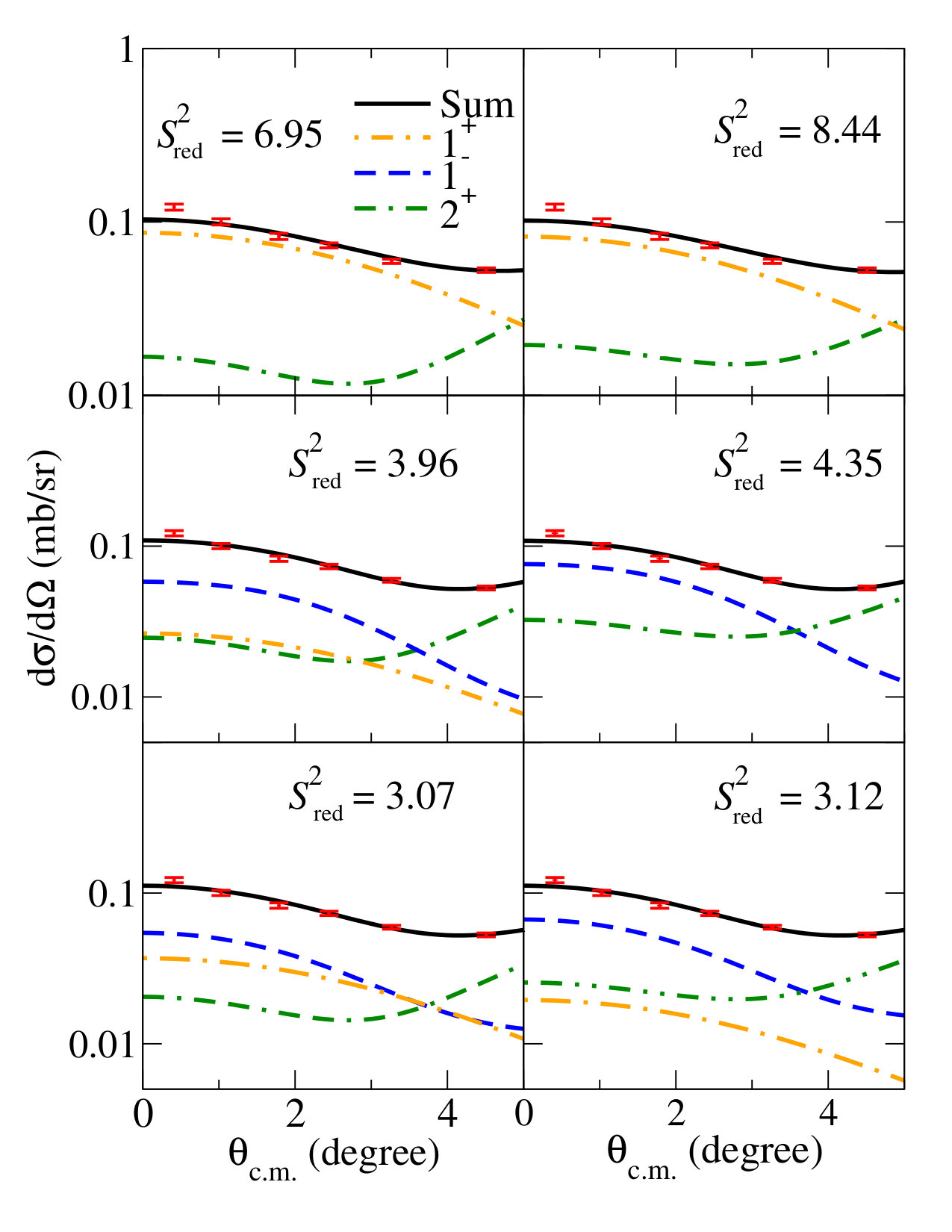 Figure 3
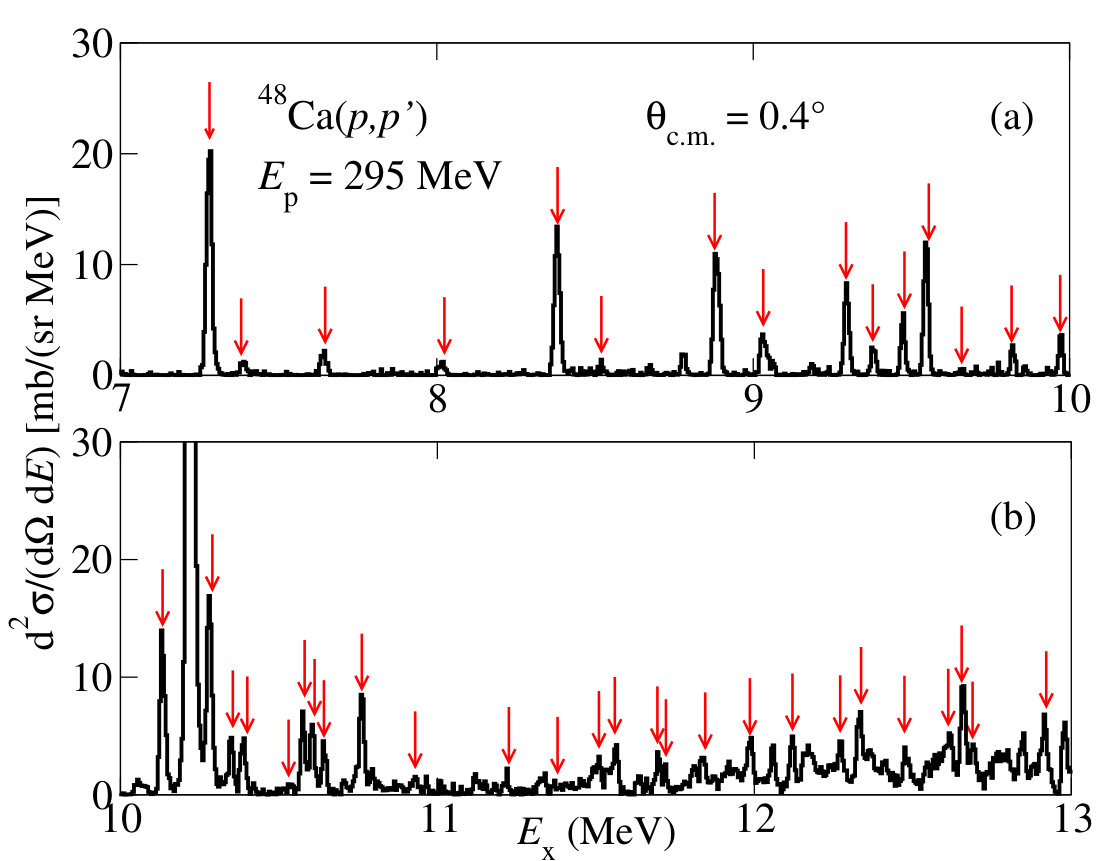 Figure 4
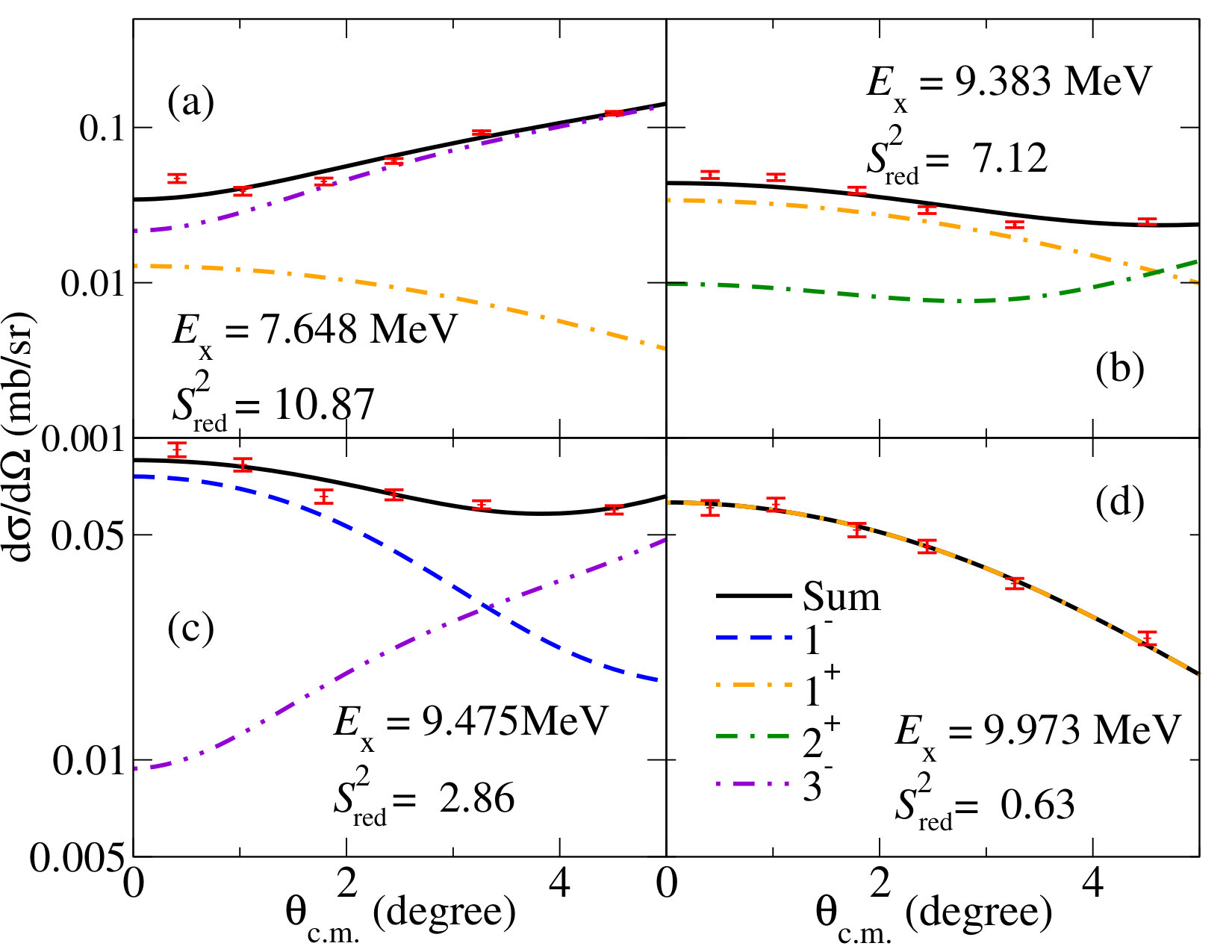 Figure 5
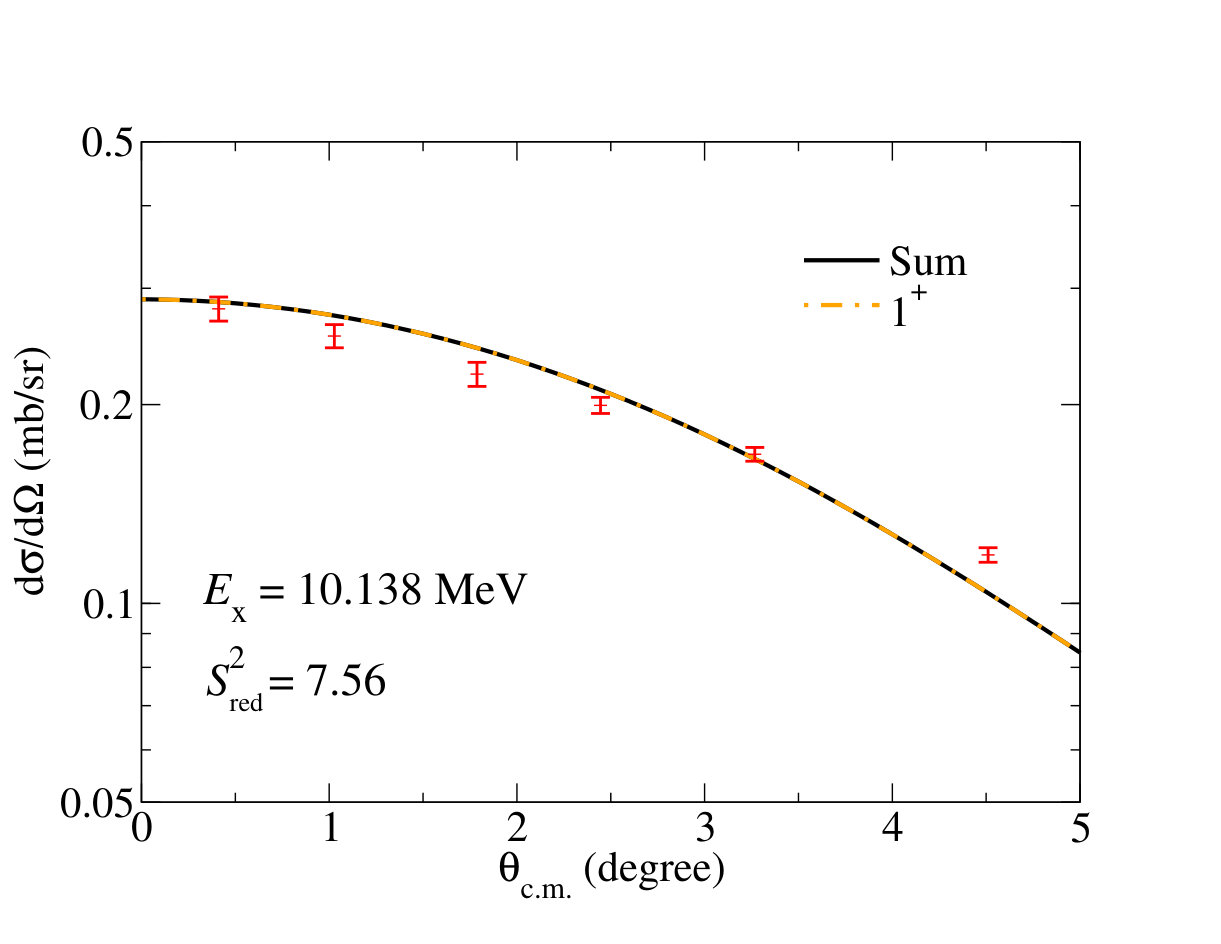 Figure 6
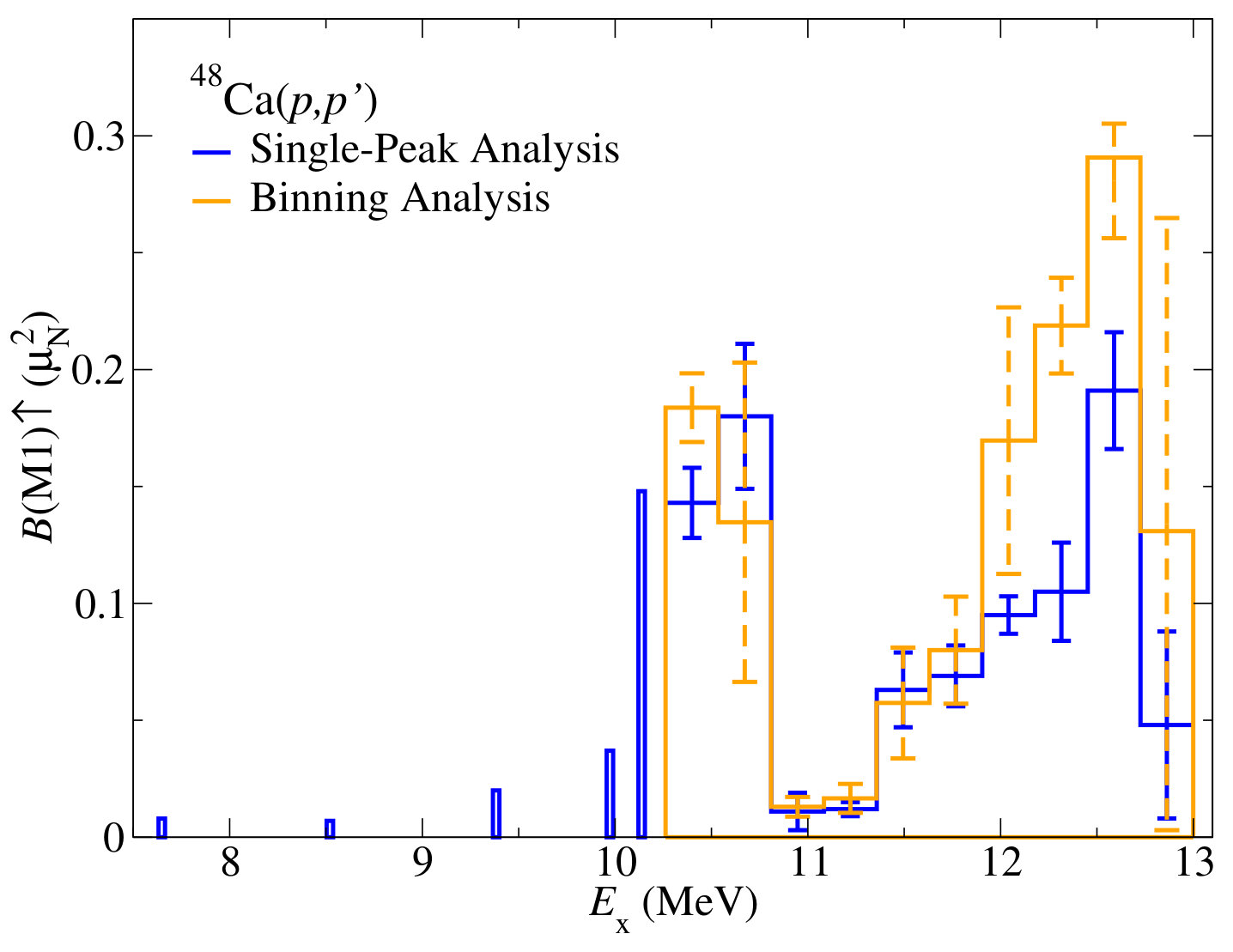 Figure 7
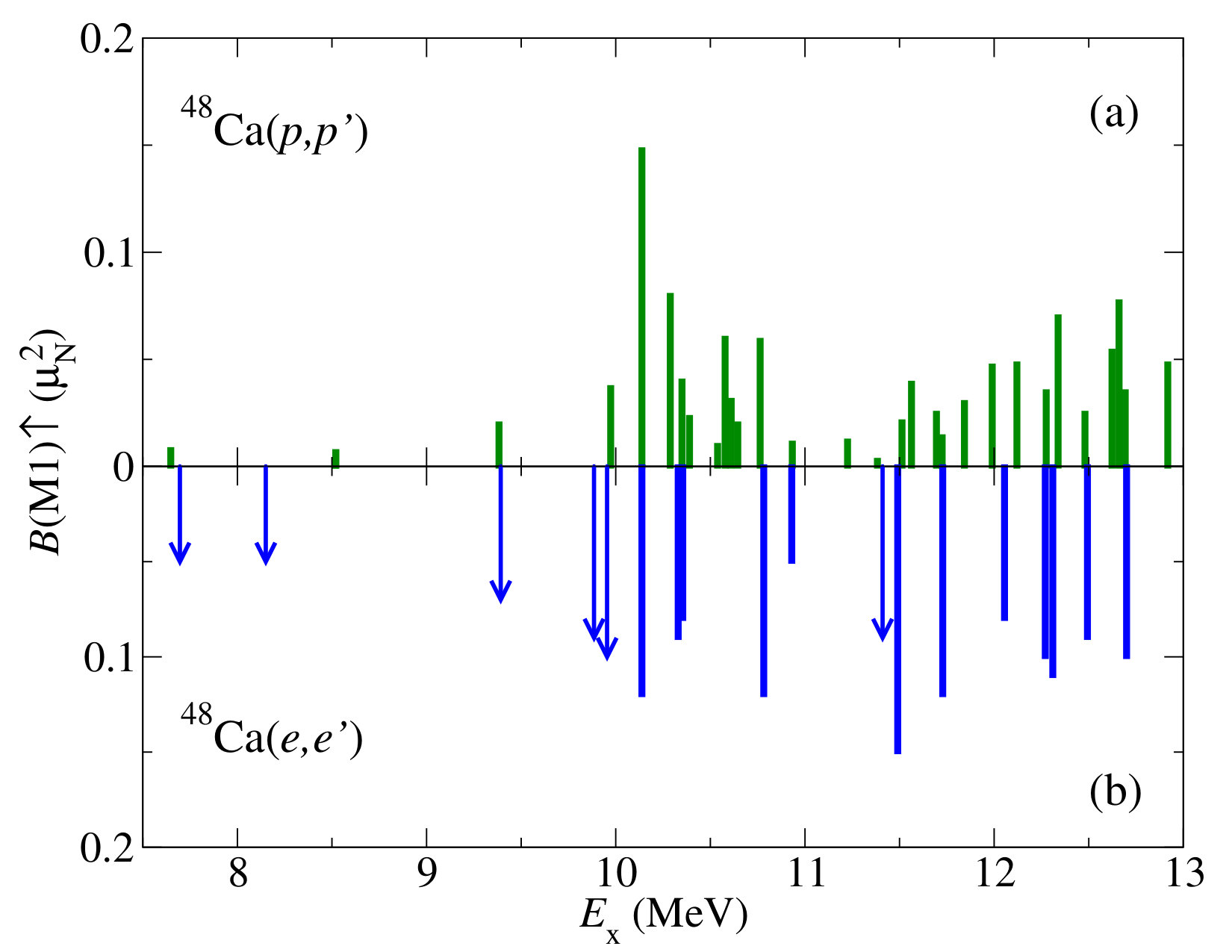 Figure 8
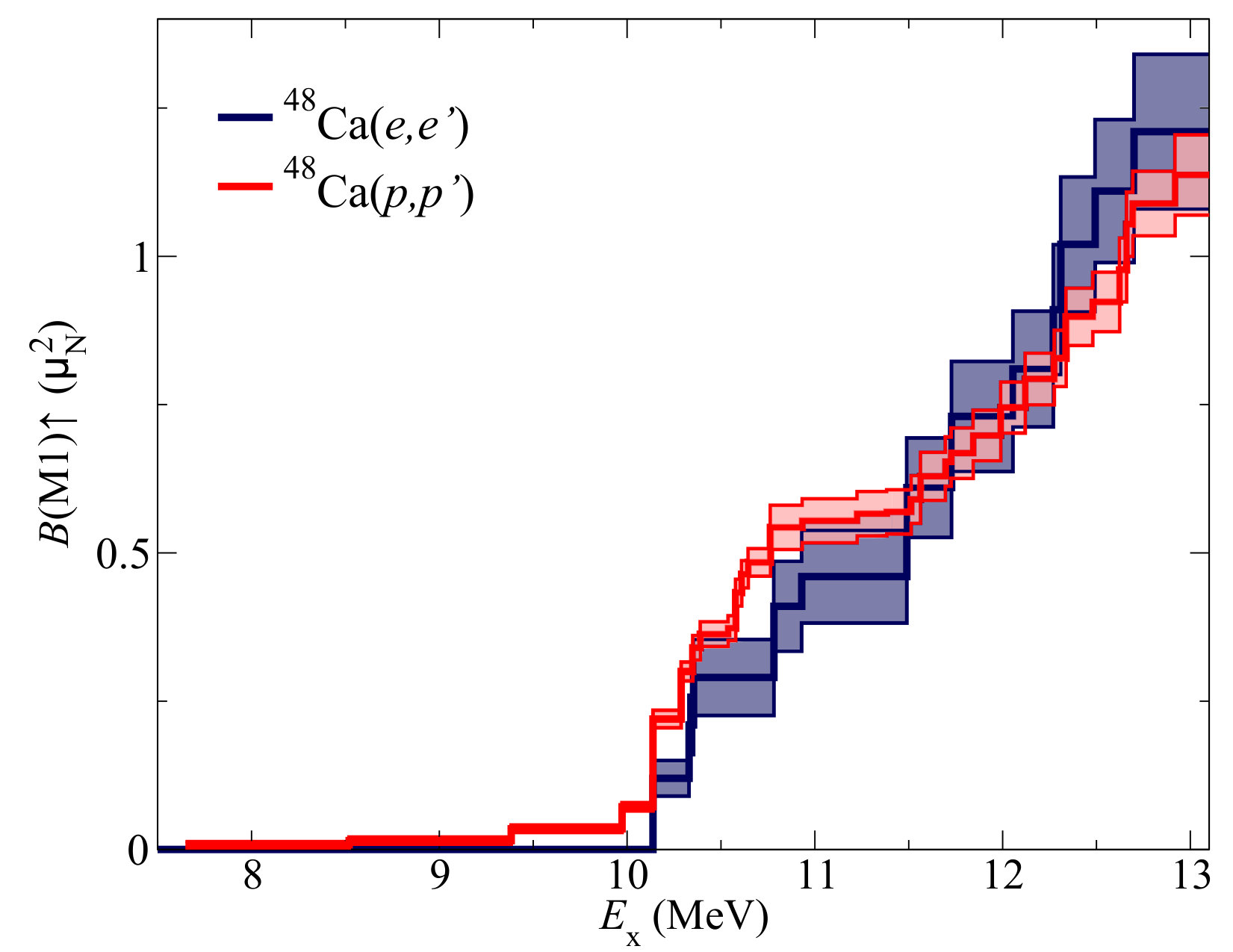 Figure 9
| Present | Ref. bur06 | MDA | |
| (MeV) | (MeV) | ||
| 7.285 | 7.296 | () | no fit |
| 7.299 | |||
| 7.385 | 7.371 | () | (+) |
| 7.648 | 7.652 | (+) | |
| 7.656 | |||
| 8.018 | 8.028 | () | |
| 8.385 | 8.385 | + | |
| 8.386 | |||
| 8.520 | 8.518 | + | |
| 8.522 | |||
| 8.893 | 8.883 | () | |
| 9.043 | 9.034 | + | |
| 9.049 | |||
| 9.298 | 9.292 | + | |
| 9.295 | |||
| 9.383 | 9.392 | + | |
| 9.475 | 9.473 | + | |
| 9.548 | 9.546 | + | |
| 9.550 | |||
| 9.653 | 9.638 | no fit | |
| 9.823 | 9.810 | no fit | |
| 9.973 | 9.954 | ||
| Present work | Ref. ste83 | ||||
|---|---|---|---|---|---|
| MeV | (mb/sr) | MeV | |||
| 7.648 | 0.015(9) | 0.008(5) | |||
| 7.696 | |||||
| 8.150 | |||||
| 8.520 | 0.012(5) | 0.007(3) | |||
| 9.383 | 0.035(1) | 0.020(2) | 9.392 | ||
| 9.885 | |||||
| 9.973 | 0.063(0) | 0.037(3) | 9.954 | ||
| 10.138 | 0.255(9) | 0.148(13) | 10.138 | 0.12(3) | 0.8(2) |
| 10.288 | 0.137(1) | 0.080(8) | |||
| 10.330 | 0.09(4) | ||||
| 10.350 | 0.069(22) | 0.040(13) | 10.354 | 0.08(4) | 2.0(1.2) |
| 10.390 | 0.040(1) | 0.023(2) | |||
| 10.538 | 0.017(4) | 0.010(3) | |||
| 10.578 | 0.103(12) | 0.060(8) | |||
| 10.610 | 0.053(6) | 0.031(4) | |||
| 10.645 | 0.034(6) | 0.020(4) | |||
| 10.763 | 0.102(48) | 0.059(29) | 10.782 | 0.12(4) | 2.0(1.2) |
| 10.933 | 0.018(13) | 0.011(8) | 10.930 | 0.05(2) | 4.7(3.9) |
| 11.225 | 0.020(5) | 0.012(3) | |||
| 11.383 | 0.005(3) | 0.003(2) | |||
| 11.410 | |||||
| 11.513 | 0.036(26) | 0.021(15) | 11.490 | 0.15(3) | 7.2(5.4) |
| 11.563 | 0.066(7) | 0.039(5) | |||
| 11.695 | 0.043(15) | 0.025(9) | |||
| 11.725 | 0.024(14) | 0.014(9) | 11.728 | 0.12(4) | 8.5(5.9) |
| 11.843 | 0.051(6) | 0.030(4) | |||
| 11.990 | 0.079(5) | 0.047(5) | |||
| 12.055 | 0.08(3) | ||||
| 12.120 | 0.082(8) | 0.048(6) | |||
| 12.275 | 0.059(32) | 0.035(19) | 12.270 | 0.10(5) | 2.8(2.1) |
| 12.338 | 0.117(13) | 0.070(9) | 12.310 | 0.11(3) | 1.4(0.4) |
| 12.480 | 0.043(22) | 0.025(13) | 12.493 | 0.09(4) | 3.5(2.4) |
| 12.623 | 0.090(32) | 0.054(20) | |||
| 12.660 | 0.129(1) | 0.077(6) | |||
| 12.693 | 0.059(7) | 0.035(5) | 12.700 | 0.10(5) | 2.8(1.5) |
| 12.918 | 0.080(66) | 0.048(40) | |||
Peer Reviews
No public reviews on file for this paper yet. If you reviewed it on a platform where reviews are public (OpenReview, ICLR, NeurIPS, ICML), you can paste yours below so the community can read it here.
Videos
No videos yet. Explain this paper in a talk, walkthrough, or lecture? Add one.
Search for weak transitions in 48Ca with inelastic proton scattering
M. Mathy
Institut für Kernphysik, Technische Universität Darmstadt, D-64289 Darmstadt, Germany
J. Birkhan
Institut für Kernphysik, Technische Universität Darmstadt, D-64289 Darmstadt, Germany
H. Matsubara
Research Center for Nuclear Physics, Osaka University, Ibaraki, Osaka 567-0047, Japan
Tokyo Women’s Medical University, 8-1 Kawada-cho, Shinjuku-ku, Tokyo 162-8666, Japan
P. von Neumann-Cosel
Institut für Kernphysik, Technische Universität Darmstadt, D-64289 Darmstadt, Germany
N. Pietralla
Institut für Kernphysik, Technische Universität Darmstadt, D-64289 Darmstadt, Germany
V. Yu. Ponomarev
Institut für Kernphysik, Technische Universität Darmstadt, D-64289 Darmstadt, Germany
A. Richter
Institut für Kernphysik, Technische Universität Darmstadt, D-64289 Darmstadt, Germany
A. Tamii
Research Center for Nuclear Physics, Osaka University, Ibaraki, Osaka 567-0047, Japan
Abstract
Background:
The quenching of spin-isospin modes in nuclei is an important field of research in nuclear structure. It has an impact on astrophysical reaction rates and on fundamental processes like neutrinoless double- decay. Gamow-Teller (GT) and spinflip strengths are quenched. Concerning the latter, the resonance in the doubly magic nucleus 48Ca, dominated by a single transition, serves as a reference case.
Purpose:
The aim of the present work is a search for weak transitions in 48Ca with a high-resolution experiment at 295 MeV and forward angles including and a comparison to results from a similar study using backward-angle electron scattering at low momentum transfers in order to estimate their contribution to the total strength in 48Ca.
Methods:
The spin- cross sections of individual peaks in the spectra are deduced with a multipole decomposition analysis (MDA) and converted to reduced spin- transition strengths using the unit cross section method. For a comparison with electron scattering results, corresponding reduced transition strengths are extracted following the approach outlined in J. Birkhan et al., Phys. Rev. C 93, 041302(R) (2016).
Results:
In total, 30 peaks containing a contribution are found in the excitation energy region MeV. The resulting strength distribution compares well to the electron scattering results considering different factors limiting the sensitivity in both experiments and the enhanced importance of mechanisms breaking the proportionality of nuclear cross sections and electromagnetic matrix elements for weak transitions as studied here. The total strength of 1.14(7) deduced assuming a non-quenched isoscalar part of the cross sections agrees with the result of 1.21(13) . A binwise analysis above 10 MeV provides an upper limit of 1.51(17) .
Conclusions:
The present results confirm the previous electron scattering work that weak transitions contribute about 25% to the total strength in 48Ca and the quenching factors of GT and spin- strength are then comparable in -shell nuclei. Thus, the role of meson-exchange currents (MECs) seems to be negligible in 48Ca, in contrast to -shell nuclei.
I Introduction
Spinflip magnetic dipole excitations constitute an elementary excitation mode of nuclei and thus serve as an important test of nuclear structure models hey10 . Knowledge of its properties is, e.g., important for modeling reaction cross sections in large-scale nucleosynthesis network calculations loe12 or neutral-current neutrino reactions in supernovae lan04 ; lan08 . Because the transitions mainly occur between spin-orbit partners they are also expected to show sensitivity to the evolution of single-particle properties leading to new shell closures in neutron-rich nuclei ots05 ; ots10 .
An investigation of the spinflip strength also contributes to a resolution of the long-standing problem of quenching of the spin-isopin response in nuclei ost92 . It represents the analog of the GT strength for (GT0) transitions, where denote the isospin of initial and final states, respectively. The same quenching mechanisms contribute to spinflip and GT transitions but the magnitude can be different. In light nuclei, meson-exchange currents (MEC) enhance the total over the GT0 strengths as demonstrated, e.g., for nuclei in the -shell ric90 ; lue96 ; vnc97 ; hof02 . In -shell nuclei, comparable quenching factors for GT mar96 and vnc98 transitions are needed in shell-model calculations to achieve agreement with the data.
Because of the particularly simple particle-hole structure of states, strength in the doubly magic nucleus 48Ca has been considered a reference case to study the quenching phenomenon hey10 ; tak88 . The strength is largely concentrated in a single transition to a state at 10.23 MeV. It was first observed in inelastic electron scattering ste80 ; ste83 with a reduced transition strength . Recently, a much larger value has been reported from a 48Ca measurement at the HIS facilitytom11 challenging our present understanding of quenching in microscopic models.
The states belonging to the spinflip resonance in even-even nuclei can also be excited in small-angle inelastic proton scattering at energies of a few hundred MeV because angular momentum transfer is favored in these kinematics and the spin-isospin part dominates over the isoscalar-spin and tensor parts of the proton-nucleus interaction lov81 . The isoscalar giant monopole resonance populated through the dominant isoscalar interaction part resides at higher excitation energies and contributes little in the energy region where spinflip transitions are expected. Indeed, in pioneering experiments bumps were observed in forward-angle scattering spectra and identified as spinflip resonance in heavy nuclei dja82 ; fre90 , but only recently high energy-resolution measurements at extreme forward angles including have become feasible tam09 ; nev11 .
At energies above 100 MeV, a single-step reaction mechanism dominates in scattering in analogy to the and reactions ich06 implying a proportionality between the measured cross sections and the transition matrix elements. This can be utilized to extract electromagnetic transition strengths from such experiments based on isospin symmetry between the spinflip mode and the GT mode excited in charge-exchange (CE) reactions bir16 . Using the data from Ref. pol12 very good agreement with the strength distribution in 208Pb extracted from electromagnetic probes las88 is obtained. Application to the case of 48Ca resulted in an transition strength compatible with the experiment and excluding the new value.
For a quantitative interpretation of quenching in microscopic models the full strength must be known experimentally. In scattering, 18 additional transitions in 48Ca were identified ste83 . Although individually weak ( ), they sum up to about 1.2 which corresponds to roughly 25% of the total observed strength. Most of these transitions were close to the detection limit of the experiment, and there is considerable uncertainty about possible unobserved strength below the detection limit set by the radiative background and the high level density in the spectra at excitation energies above 10 MeV. The data used in the present work are not hampered by a large background. We perform a multipole-decomposition analysis (MDA) pol12 ; kru15 of the 48Ca data to extract the spinflip cross sections, which can then be converted to transition strengths with the aid of the method described in Ref. bir16 . The result provides an independent constraint on the total strength in 48Ca.
The paper is organized as follows: Section II gives a brief summary of the experiment, the data analysis and resulting spectra available for the MDA. Section III.1 provides details of the MDA procedure, while Sec. III.2 presents the corresponding results. The method used to extract electromagnetic transition strengths from the spinflip cross sections is described in Sec. IV.1. The electromagnetic strength distribution and its comparison with the results is discussed in Secs. IV.2 and IV.3, respectively. Finally, conclusions are given in Sec. V.
II Experiment
II.1 Experimental details
The 48Ca reaction was studied at the Research Center for Nuclear Physics in Osaka, Japan. A proton beam with currents 4 - 10 nA was accelerated to an energy MeV. A self-supporting metallic 48Ca foil with an areal density of 1.87 mg/cm2 and an isotopic enrichment of 95.2 % served as target. Scattered protons were analyzed with the Grand Raiden magnetic spectrometer fuj99 placed under , , and . Using dispersion-matching techniques an energy resolution of 25 keV (full width at half maximum) was achieved. The experimental techniques of background suppression in scattering and the main steps for the raw-data analysis are described in Ref. tam09 . Further details of the subtraction procedure and the analysis of the 48Ca data can be found in Ref. bir15 .
II.2 Spectra
The large acceptance of the Grand Raiden spectrometer permits a software decomposition of the data into spectra for up to three different angular bins for each spectrometer setting. Thus, spectra of the double differential cross sections of the 48Ca reaction are available at , and . The target contained a non-negligible contribution from oxygen. It was subtracted from the spectra with the aid of 16O data measured in the same kinematics mat10 normalized to the well-known E2 transition in 16O at 6.917 MeV til93 .
Figure 1(a) shows the spectrum at as an example. The by-far most strongly excited state at 10.23 MeV is populated by a spinflip transition. Otherwise, at very forward angles relativistic Coulomb excitation of states dominates the cross sections pol12 ; kru15 ; tam11 ; has15 . The resonance-like structure with a maximum at about 18.5 MeV is identified bir17 as the isovector electric giant dipole resonance consistent with data from a 48Ca experiment str00 . Below 10 MeV the spectra are essentially free of instrumental background. The stronger transitions visible in this energy region have all been observed in experiments and identified to have dipole or quadrupole character har02 ; der14 .
An excerpt for the energy region MeV is presented in Fig. 1(b) with an overlay of spectra for different scattering angles. Most of the observed peaks exhibit decreasing cross sections with increasing scattering angles characteristic for or transitions (note, however, the different behavior of the peak at 10.54 MeV).
III Multipole-decomposition analysis
III.1 Method
In order to extract the cross-section part of the spectra due to transitions, a MDA has been performed. In the MDA, the experimental angular distribution of the cross sections of a particular transition or an energy bin in the spectra are fitted to a sum of theoretical angular distributions for different possible multipolarities calculated in distorted-wave Born approximation (DWBA)
[TABLE]
in which denotes the weighting factors for each multipolarity. MDA is routinely applied in investigations of electric and spinflip giant resonances with hadronic reactions, see Refs. ich06 ; har01 for examples.
Calculations were performed with the code NLopt (joh13, ) for all possible combinations but limited to one theoretical angular distribution for each multipolarity. The program tries to minimize the checksum
[TABLE]
weighted by the uncertainty of the experimental cross sections. Here, denotes the number of data points. An average over the values for a given multipolarity is determined via
[TABLE]
where the reduced checksum is introduced to compare results of multipole decompositions with a different number of allowed theoretical angular distributions.
Theoretical angular distributions of the cross sections for different multipolarities were computed with the program code DWBA07 ray07 using wave functions from the quasiparticle phonon model (QPM) sol92 and the effective Love-Franey proton-nucleus interaction lov81 . It has been shown that the QPM provides a very good description of nuclear structure in heavy nuclei near shell closures (see, e.g., Refs. pon99 ; rye02 ; sav08 ) including the momentum transfer dependence of form factors in electron scattering and angular distributions in proton scattering pol12 ; bur07 ; wal11 . For 48Ca, DWBA cross sections for the excitation of states with different spin and parity have been calculated in the one-phonon approximation. Taking the strongest excited states on the one-phonon level the angular dependence of the different modes is entirely governed by the transferred angular momentum.
Because of the small experimental momentum transfers only angular momenta are considered in the MDA. Figure 2 summarizes the QPM results for , , , and transitions populating , and states in 48Ca, respectively. The DWBA calculations include Coulomb scattering, and the interference with nuclear scattering important for transitions, where Coulomb excitation dominates, leads to a greater variety of possible angular distributions. In contrast, transitions are described by a ‘universal’ curve in the small- range of the data independent of the particular nucleus. This is also approximately true for excitations. In the forward angle range studied here, spin-dipole transitions exhibit an angular dependence very similar to some of the theoretical curves for transitions and therefore are not explicitly included in the fits.
As an example, Fig. 3 shows MDA results for different combinations of , , and theoretical angular distributions for the transition to a state at 12.275 MeV. The best values are obtained for dominant cross sections. However, smaller and contributions are also needed for optimum values (bottom row). The need for the latter stems from the slow fall-off of cross sections at the largest angles, which cannot be described by either or angular distributions. The contributions are almost negligible in the fits shown in the top row which use model angular distribution (1) from Fig. 2. Here, the component dominates but the overall fit is poorer. The cross section part at is determined from Eq. (3) weighting with the values.
III.2 Results
Two types of the MDA are discussed in the following, a single-peak analysis in the excitation energy range MeV and a binwise analysis for excitation energies MeV. The energy range was defined based on the following arguments: At lower the number of excited states is small because of the double shell closure of 48Ca and one can assume that the spectroscopic information is sufficiently complete bur06 . Shell-model calculations can provide a detailed description of the strength distribution and predict a compact resonance concentrated in the investigated energy range vnc98 .
Figure 4 presents an extended view of the spectrum shown in Fig. 1 for the energy region MeV. In total, 41 structures indicated by red arrows are considered in the single-peak analysis. These have been identified in all 6 spectra. (Note that results for the prominent transition at 10.23 MeV have been reported in Ref. bir16 and therefore are not considered here). Below 10 MeV, the spectrum is background-free and almost all peaks visible in the most-forward angle spectrum are included. One exception is the peak at 8.8 MeV which was only observed in the spectrum shown. In this energy region, available spectroscopic information bur06 is included as a guide of possible multipolarities. Above the neutron threshold ( MeV), the level density and level widths increase such that the transitions are not always fully resolved. Thus, combinations of all possible multipolarities are considered. Alternatively, a binwise analysis representing an upper limit of the possible cross sections is performed.
III.2.1 Single-peak analysis between 7 and 10 MeV
The state density in the energy range from 7 to 10 MeV is small and the peaks are well separated. However, the available spectroscopic information bur06 indicates that within the energy resolution of the experiment and the systematic uncertainties of the energy calibration many peaks may correspond to doublets, even neglecting the possible excitation of states with . Accordingly, the MDA is performed assuming a single multipolarity or a combination of two multipolarities. Furthermore, data from the 48Ca reaction har02 , which selectively excites dipole and to a lesser extent transitions, and the results ste83 are used as a guide for possible and transitions. The electric character of all dipole transitions observed in Ref. har02 has been shown in a subsequent experiment at HiS using polarized photons der14 .
To check the possible correspondence of excitation energies from the Nuclear data Sheets (NDS) bur06 with the 48Ca() results, the condition wei94
[TABLE]
is used. Here, stands for the quoted uncertainties. The absolute accuracy of excitation energies in the data is keV. A summary of the comparison and the most likely assignments is given in Table 1.
Examples of the MDA results are presented in Fig. 5 showing the fit with the smallest value for each case. The transition to the peak at 7.648 MeV exhibits an angular distribution increasing with scattering angle suggesting . The best description is obtained assuming . The most forward angles indicate the presence of dipole strength but because of the dominance of the higher- component the values do not distinguish between and . The angular distribution of the peak at 9.383 MeV is consistent with a character except for the largest angle, which requires inclusion of an part. The most forward angles confirm the assignment for the transition to the state at 9.475 MeV from the data but an additional component is needed for a reasonable fit at larger angles. Finally, an excellent fit is obtained assuming for the excitation of the state at 9.973 MeV.
In the following, the results for each peak are discussed briefly.
7.285 MeV. There is no combination of any two multipolarities which would provide a good fit to the data and hence no component is considered. The 48Ca experiments find a state a 7.299 MeV and Ref. bur06 quotes a state at 7.296 MeV with but the correspondence is uncertain considering the energy difference.
7.385 MeV. The multipole decomposition gives the best fit for a state or a mixture of and . There is no indication for an part from the fit. A pure ground-state transition from a state at 7.371 MeV was identified in the ) reaction van92 , thus . The comparison with the fit suggests , however, no transition around this energy was observed in the () data har02 .
7.648 MeV. Two states with and are known within the experimental energy uncertainty of the peak. The MDA favors fits of the combinations (, ) and (, ) with comparable values, the latter shown in the top left of Fig. 5. As mentioned above an E3 contribution is necessary to describe the rising of the angular distribution for larger angles. Assuming for the dipole part the averaged cross section at is 0.015(9) mb/sr.
8.018 MeV. The angular distribution is described best if the multipole decomposition contains an part. This agrees with the assignment of Ref. bur06 . However, a description of the data in terms of a pure transition is rather poor.
8.385 MeV. The 48Ca experiment found the excitation of a state at MeV, and a state at 8.386 MeV is quoted in Ref. bur06 . Indeed, the combination of and excitations provides one of the lowest values confirming these assignments.
8.520 MeV. The 48Ca data show population of a state at MeV but canot decide on the spin ( or 2). Excitation of a state at 8.522 MeV has been observed in many reactions bur06 . The combination of dipole-plus electric octupole gives the best fits in the MDA but no / distinction is possible. Assuming character for the dipole part a cross section of mb/sr at is extracted.
8.893 MeV. The measurements find a state at MeV consistent with results from other reactions bur06 . and combinations provide a superior fit to the assumption of a pure transition. However, both the corresponding or (deduced with the method described below) value should have led to a signal visible in the data. Thus, no possible component of the cross sections is considered.
9.043 MeV. The available spectroscopic information suggests a combined excitation of a state at 9.034 MeV and a state at 9.049 MeV. Indeed, an / combination leads to the best fit of the data.
9.298 MeV. Previous data suggest an excitation of close-lying and states bur06 . This is consistent with the MDA favoring an / combination although / gives a similar . In any case, there is no indication of a contribution.
9.383 MeV. There is an indication of a corresponding transition in the backward-angle data ste83 . A fit assuming a transition leads to but the fit is improved allowing for plus . The best fit () is obtained with an / combination. However, we exclude an contribution because no corresponding peak was seen in the data. When the partial cross section from the MDA is converted to a value normalizing to the theoretical value from the QPM for the corresponding angular distribution, one ends up with a transition strength well above the sensitivity limits of the experiments har02 ; der14 . This is not the case assuming a dominant transition. The corresponding cross section at amounts to mb/sr.
9.475 MeV. The excitation energy is consistent with observation of a transition at 9.473 MeV in the experiments suggesting a pure character. Again the data at larger angles require inclusion of a multipolarity (cf. bottom left of Fig. 5). Fits with a instead of an part lead to larger values.
9.548 MeV. The spectroscopic information suggests again simultaneous excitation of (9.546 MeV) and (9.550 MeV) states consistent with the MDA results.
9.653 MeV and 9.823 MeV. There is no prior information from other experiments bur06 which could be related to these small peaks. The MDA does not allow for unique assignments. Thus, no possible contributions are considered.
9.973 MeV. The transition to the state at 9.973 MeV shows clear character as demonstrated in the bottom right part of Fig. 5. An character is also excluded by the absence of a corresponding transition in the data. The 48Ca(e,e’) experiment finds the excitation of a state at 9.954 MeV ste83 . Despite about 20 keV difference of the centroid energies one may argue that both experiments may have seen the same state considering the systematic uncertainties of the respective energy calibrations. The cross section at is 0.064 mb/sr.
III.2.2 Single-peak analysis between 10 and 13 MeV
Above 10 MeV the increase of the level density makes an interpretation of the peaks as an excitation of a single state unlikely. Guided by the dominance of and cross sections in comparable data for heavier nuclei pol12 ; kru15 ; tam11 ; has15 , combinations of // and // transitions are considered. The fits are constrained to at most three theoretical angular distributions because of the limited number of data points. An example of the procedure is illustrated in Fig. 3 for excitation of the 12.275 MeV peak. A summary of the partial cross sections at deduced from the MDA is given in Table 2.
The excitation of the state at 10.138 MeV is an exception, where the data and the good correspondence with the electron scattering result suggests a pure transition. The corresponding experimental angular distribution and the fit are depicted in Fig. 6.
III.2.3 Binwise analysis between 10 and 13 MeV
Above the neutron threshold a small physical background, most likely due to quasifree reactions, is observed in the data. Together with the high level density this may lead to a situation where weak transitions can no longer be resolved. In order to estimate possible missing cross section parts, a binwise MDA of the total cross sections is performed. The background component was not modeled separately but it was assumed that the combination of different multipoles allowed in the MDA can mimic its angular dependence.
The prominent excitation of the state at 10.23 MeV is again excluded. The binwise analysis covers the energy range MeV divided into 10 bins.
IV strength distribution in
In this section the isovector spinflip- (IVSM1) transition strength distribution is extracted from the cross sections at . Using approximations explained below the corresponding electromagnetic strength distribution in 48Ca can be derived. Only a brief summary of the method is given here since it has been presented in Refs. bir15 ; bir16 including a discussion of the underlying approximations and estimates of the systematic uncertainty.
IV.1 Extraction of strength from the data
For incident energies high enough to ensure the dominance of one-step reactions one can relate the proton inelastic scattering cross sections at to the IVSM1 strength
[TABLE]
where is a nuclear-mass dependent factor (the so-called unit cross section), a kinematical factor correcting for non-zero momentum and energy transfer, and denotes the reduced IVSM1 transition strength. The kinematical correction factor is determined by DWBA calculations and the extrapolation of the cross section part at finite angles deduced with the MDA to is achieved with the aid of the theoretical angular distribution shown in Fig. 2.
The unit cross section is taken from a corresponding relation for analog Gamow-Teller (GT) strengths in charge-exchange reactions tad87 ; zeg07 . At the very small momentum transfers considered here, isospin symmetry fuj11 suggests . The systematics of for the reaction at incident energies comparable to the present experiment has been studied in Ref. sas09 . A simple mass-dependent parameterization is given there, which allows to extract for 48Ca. The resulting value is consistent with a recent analysis of its mass dependence in lighter nuclei mat15 extrapolated to mass number 48.
As discussed in Ref. bir16 , several effects can break the proportionality between cross section and matrix element in Eq. (5). While most of these are either small or taken into account in the MDA, a general problem are coherent contributions to the excitation of states invoked by the tensor part of the interaction. This problem has been investigated in Ref. zeg06 for GT transitions in the framework of a shell-model study. The lowest strengths found in the present work correspond to GT strengths of the order of 0.001. This implies systematic uncertainties for individual transitions of about 30%, maybe up to 50% for the weakest strengths. However, since the interference has random sign zeg06 ; fay97 the effect on the total strength will be smaller.
The corresponding electromagnetic transition strength
[TABLE]
contains spin and orbital contributions for the isoscalar (IS) and isovector (IV) parts. In the present work it is assumed that and strengths are approximately the same based on the following arguments. Orbital strength is connected to ground-state deformation hey10 and thus expected to be weak for the present case of a doubly magic nucleus. Because the isoscalar part is usually neglected. Then, an analog electromagnetic transition strength can be extracted from the data
[TABLE]
and compared to strengths from electromagnetic probes. Equation (7) has, e.g., been successfully applied in the comparison of strengths from electromagnetic and hadronic reactions in self-conjugate -shell nuclei ric90 ; lue96 ; vnc97 .
However, the strong transition in 48Ca has pure neutron character deh84 and it is assumed that this also holds for the weak transitions investigated here. This assumption is motivated by a picture where the strong transition at 10.23 MeV acts as a doorway bbb98 and the fragmentation of the strength distribution results from mixing with nearby complex (multi particle-multi hole) states. In such a scenario, the excitation probability is still determined by the amplitude of the doorway-state wave function.
In the particular case of a pure neutron transition, the term in the electromagnetic operator, Eq. (6), needs to be considered for the determination of the value because of the interference term. The IS contribution to the cross sections of the 10.23 MeV transition amounts to 5.2(2.5)% determined by a fit of theoretical angular distributions for IS and IV transitions bir16 . The result is adopted for the present analysis.
Extraction of the analog electromagnetic strength requires the inclusion of quenching implemented through effective factors in Eq. (6), where denotes the magnitude of quenching. For -shell nuclei was determined in Ref. vnc98 . A recent study indicates for the isoscalar spinflip strength in a series of -shell nuclei mat15 . All results in the next section are derived with these quenching factors. However, the isoscalar quenching factor may have a mass dependence. As an extreme, one may assume . Then all strengths in Table 2 and in the binwise analysis would be larger by a factor 1.21.
IV.2 Results
The strength distribution between 7 and 13 MeV deduced with the method explained in the previous subsection is displayed in Fig. 7. The strength in the single-peak analysis is concentrated in the energy regions MeV and MeV, while strengths below 10 MeV are weak. Table 2 summarizes the results. The total strength amounts to . A comparison with the binwise analysis shows agreement within error bars between 10 and 12 MeV but significantly larger strengths (up to a factor of two) of the latter at higher excitation energies. The total strength of the binwise analysis including the single-peak analysis results at lower excitation energies is .
IV.3 Comparison with the results
A comparison of the strength distribution deduced from the single-peak analysis with the results from the 48Ca experiment (ste83, ) is presented in Fig. 8 and Table 2. Leaving out transitions from Ref. ste83 , for which only upper limits are given, we find correspondence with all but two transitions identified in the data based on the criterion Eq. (4). Exceptions are the transitions to states at 10.330 MeV and 12.055 MeV in Ref. ste83 . The former fulfills Eq. (4) when assigned to the peak observed in proton scattering at 10.350 MeV. However, an assignment to the 10.354 MeV transition seen in electron scattering is considered more likley.
The strengths from electron scattering tend to be larger (see the ratio of electron-to-proton scattering strengths in Table 2) but are still consistent within error bars in many cases. This is particularly true if one relaxes condition (4) somewhat and, e.g., relates the strength of the transition seen at 12.700 MeV in electron scattering to the sum of the transitions at 12.660 and 12.693 MeV in proton scattering. Possible differences between the strengths may be related to the assumptions underlying the analysis of the data explained in Section IV.1. Some of these could also affect the average ratio of . For example, orbital contributions – although shown to be weak ric85 – could lead to a systematic enhancement of the strength by constructive interference with the spin part, since the dominant shell-model configurations are the same in all states. For the same reason one can also speculate about a systematic reduction of due to the interference of contributions discussed above. While the shell-model study of 26Mg showed a random sign of the mixing in an open-shell nucleus zeg06 , this may be different in a case, where the wave functions of all excited states are similar.
The present analysis finds 30 transitions compared to 18 seen in Ref. ste83 . This may be related to the different sensitivity thresholds in both experiments. For the data a statistical limit due to the radiative tail in the spectra and difficulties to distinguish and form factors for weak transitions dominate the uncertainties. The spectra are background-free up to the neutron threshold and the background due to quasifree scattering is small approaching 2 mb/(sr MeV) hau91 at higher excitation energies (cf. Fig. 4). Here, the limits come from the sensitivity of the MDA. In passing, we note that seven further potential M1 candidates in the data are quoted in Ref. ste84 . However, in the classification scheme introduced in Ref. sob85 these fall into lower probability categories.
Finally, we show a plot of the running sums of the strengths from both experiments (Fig. 9). They exhibit a similar slope and agree within error bars except for the region between 10.5 and 11.5 MeV, where the present analysis finds a number of weaker transitions not observed in Ref. ste83 . However, considering that the peaks seen in the spectra of both experiments are near the limits of experimental sensitivity and taking into account the effects which may modify their relative ratio discussed above, the agreement is good.
V Conclusions
We have presented a search for strength in 48Ca besides the prominent transition at 10.23 MeV using proton scattering data taken at 295 MeV and very forward angles including . The cross sections at due to excitation of the spinflip mode have been extracted with the aid of a MDA and converted into strength with the method outlined in Ref. bir16 . An analysis based on a MDA of individual peaks shows overall good agreement with a study using electron scattering ste83 . In detail there are some differences: The values from Ref. ste83 tend to be higher although they are still consistent within error bars in many cases, and about 50% more individual transitions are identified in the present data.
The variances between the results from both experiments can be attributed to the different limits of the experimental sensitivity and mechanisms breaking the assumptions made in Ref. bir16 for the extraction of electromagnetic transition strengths from the nuclear scattering cross sections, which are aggravated for weak transitions as studied here. In particular, contributions from coherent and wave function components of the states neglected in the one-phonon approximation of the QPM calculation can modify the angular distributions. Also, the mixing of spin and orbital contributions in the strength may play a role. It is hard to quantify the related systematic uncertainties because they require explicit models for the wave functions of the ground state and excited states. Based on shell-model analyses of these effects in -shell nuclei zeg06 ; fay97 we estimate that they may reach up to 50% for the weakest transitions studied.
The good correspondence of the total strengths deduced from both experiments suggests that there is little additional fragmented strength hidden in the data. Accordingly, the quenching factor for strength deduced in large-scale shell-model calculations lan04 ; vnc98 remains, which is comparable to that of GT decay in -shell nuclei mar96 .
Acknowledgements.
We are indebted to the RCNP accelerator team for providing excellent beams. This work was supported by the DFG under contract No. SFB 1245, JSPS KAKENHI Grant No. JP14740154, and MEXT KAKENHI Grant No. JP25105509.
The reference list from the paper itself. Each links out to its DOI / PubMed record.
- 1(1) K. Heyde, P. von Neumann-Cosel, and A. Richter, Rev. Mod. Phys. 82 , 2365 (2010).
- 2(2) H. P. Loens, K. Langanke, G. Martínez-Pinedo, and K. Sieja, Eur. Phys. J. A 48 , 34 (2012).
- 3(3) K. Langanke, G. Martínez-Pinedo, P. von Neumann-Cosel, and A. Richter, Phys. Rev. Lett. 93 , 202501 (2004).
- 4(4) K. Langanke, G. Martínez-Pinedo, B. Müller, H.-Th. Janka, A. Marek, W. R. Hix, A. Juodagalvis, and J. M. Sampaio, Phys. Rev. Lett. 100 , 011101 (2008).
- 5(5) T. Otsuka, T. Suzuki, R. Fujimoto, H. Grawe, and Y. Akaishi, Phys. Rev. Lett. 95 , 232502 (2005);
- 6(6) T. Otsuka, T. Suzuki, M. Honma, Y. Utsuno, N. Tsunoda, K. Tsukiyama, and M. Hjorth-Jensen, Phys. Rev. Lett. 104 , 012501 (2010).
- 7(7) F. Osterfeld, Rev. Mod. Phys. 64 , 491 (1992).
- 8(8) A. Richter, A. Weiss, O. Häusser, and B. A. Brown, Phys. Rev. Lett. 65 , 2519 (1990).