Reversible transitions in high-$T_c$ cuprates based point contacts
L.F. Rybalchenko, N.L. Bobrov, V.V. Fisun, I.K. Yanson, A.G.M. Jansen,, and P. Wyder

TL;DR
This study investigates electric field and current-induced switching transitions in high-$T_c$ cuprate superconductors using point contacts, revealing oxygen electromigration as the key mechanism, with effects persisting up to room temperature and high magnetic fields.
Contribution
It demonstrates that electric fields and currents can induce reversible resistance switching in high-$T_c$ cuprates via oxygen electromigration, a novel insight into their electronic behavior.
Findings
Switching transitions occur between different resistance states.
The effect persists up to room temperature.
Magnetic fields up to 10 T do not suppress the switching.
Abstract
The influence of electric felds and currents has been investigated in the high- superconductors and using a point-contact geometry with as the counterelectrode, which reveal switching transitions between states of a different resistance. The origin of this effect in point contacts is associated with electromigration of the oxygen, driven by the electric feld as well as by the currentinduced "electron wind". The switching effect preserves its basic features at elevated temperatures up to room temperature and in high magnetic felds up to 10 T.
Click any figure to enlarge with its caption.
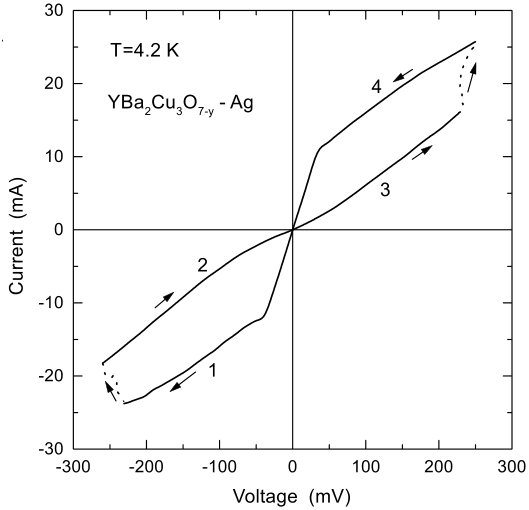 Figure 1
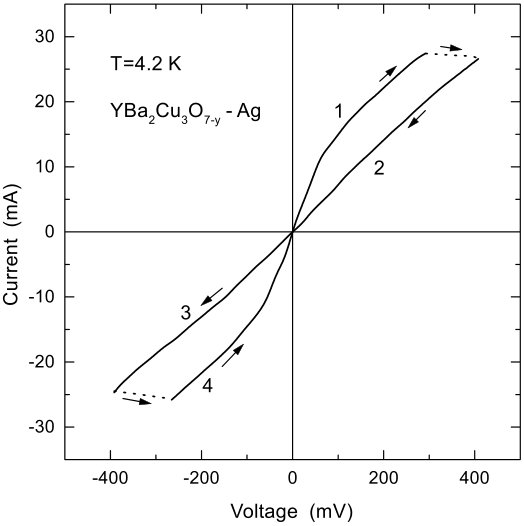 Figure 2
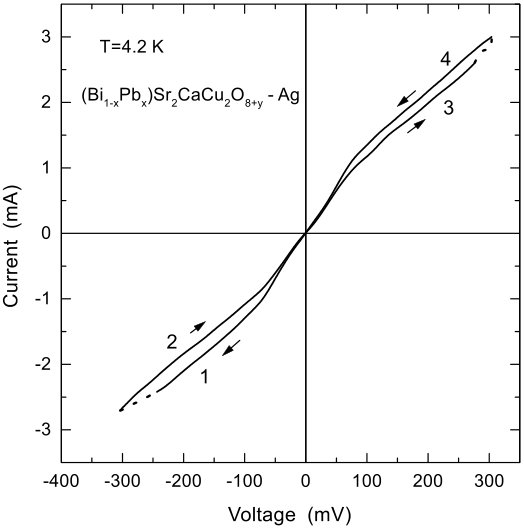 Figure 3
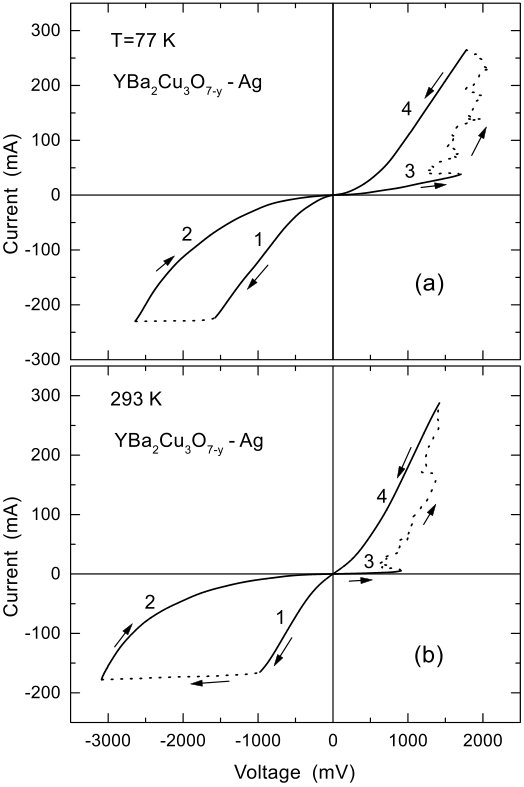 Figure 4
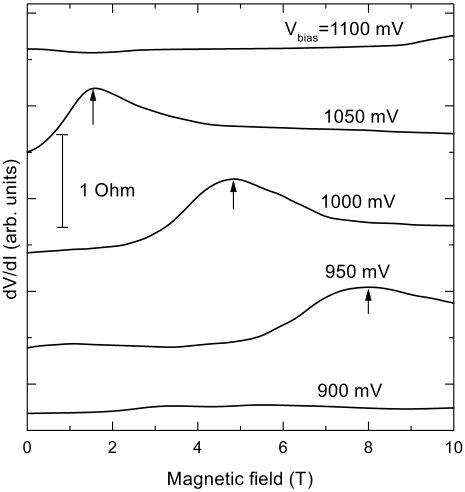 Figure 5
Peer Reviews
No public reviews on file for this paper yet. If you reviewed it on a platform where reviews are public (OpenReview, ICLR, NeurIPS, ICML), you can paste yours below so the community can read it here.
Videos
No videos yet. Explain this paper in a talk, walkthrough, or lecture? Add one.
Reversible transitions in high- cuprates based point contacts
L.F. Rybaltchenko**, N.L. Bobrov**, V.V. Fisun**, I.K. Yanson**, A.G.M. Jansen*, and P. Wyder
High Magnetic Field Laboratory, Max-Planck-Institut fr Festkrperforschung and Centre National de la Recherche Scientifique, B.P. 166, 38042 Grenoble Cedex 9, France*,
B. Verkin Institute for Low Temperature Physics and Engineering, 47 Lenin Avenue, 310164 Kharkov, Ukraine**
Email address: [email protected]
(Eur. Phys. J. B 10, 475-480 (1999))
Abstract
The influence of electric felds and currents has been investigated in the high- superconductors and using a point-contact geometry with as the counterelectrode, which reveal switching transitions between states of a different resistance. The origin of this effect in point contacts is associated with electromigration of the oxygen, driven by the electric feld as well as by the currentinduced ”electron wind”. The switching effect preserves its basic features at elevated temperatures up to room temperature and in high magnetic felds up to 10 T.
pacs:
74.72.-h; 74.80.Fp; 66.30.Qa
I Introduction
Compared with conventional superconductors, the electronic (and superconducting) properties of the cuprate superconductors can be much more affected by the application of a direct electric feld (see 1 , and Refs. therein). For ultrathin layers (12-100 Å) in a metalinsulator- superconductor junction with a gate electrode, it was found that the normal state resistance could change by as much as 20% in an applied polarization 2 . The mechanism for such a large electric feld effect in cuprate superconductors remains under discussion 3 ; 4 . One of the two proposed explanations is associated with the conventional Coulomb interaction of the external electric feld with the free charges resulting in a change of the carrier concentration in a thin film. The other explanation involves the oxygen rearrangement driven by the applied feld (oxygen electromigration) that changes the density of the charge carriers (holes) in the conduction band.
A significant influence on the cuprate superconductor properties, namely on the charge carrier concentration, can be also obtained in point contacts (PC) with metallic conductivity. A few years ago 5 , we have observed for the first time reversible changes of the resistance of point contacts based on single crystal (Re = Y or Ho) with a normal counterelectrode. The conductivity and superconducting parameters of the PC area could be varied very strongly by applying a voltage over the contact in the range of a few hundreds millivolts. Above a positive critical voltage (usually about 300 ) applied to the superconducting electrode, the superconductivity in the contact area could be suppressed completely, accompanied in some cases by a transition to the semiconducting state. The state of suppressed superconductivity in the PC area revealed a high stability. Even an exposure of a few hours at temperatures significantly higher than did not affect noticeably this normal state. A return to the original state (i.e., a restoration of the superconductivity in the PC area) took only place by applying across the contact the opposite voltage polarity of approximately the same value. We suggested that the observed switching phenomenon is associated with the oxygen migration in the PC area in an electric field. A theoretical confirmation of this explanation was found in papers of Chandrasekhar et al. 6 , where the authors have simulated the oxygen dynamics in the chains of 1-2-3 type cuprate superconductors and found a high oxygen mobility in an electric field.
In the present work we have further investigated the switching phenomena in point contacts with and samples under applied electric and magnetic fields. We have found for the first time that in the 1-2- 3 system it is possible to suppress superconductivity in the contact area for both electric field polarities. We assume that apart from a direct action of the electric field on the oxygen migration, also the current-induced ”electron wind” 7 plays a role in the observed phenomena. Because of the difference in charge between the oxygen ions and the hole type of charge carriers, these driving forces should act in opposite directions. The sample quality has an influence on the efficiency of the ”electron wind” force with respect to the electric field induced migration. For the Bi-compound of 2212 type, we observed for the first time a moderate switching effect of one polarity only, indicating for the presence of the direct field action on the oxygen ions. Reduced concentration and short mean-freepath of the holes are possible reasons of the inefficiency of the ”electron wind” in this compound.
Previous study of the magnetic field influence on the switching effect in single crystals of 1-2-3 type with optimal oxygen content has given ambiguous results 8 . Most of the contacts did not show any influence of the field on the switching effect, but for some ones a strong change in contact resistance was found. In the present work for polycrystalline samples with reduced oxygen content (oxygen index 6.75), we have found that the switching effect persists in high magnetic fields revealing only small variations of the point contact resistance under the applied field. A suggestion is made to connect these variations with the inhomogeneous crystalline structure of the given samples. At elevated temperatures (up to room temperature), the critical switching voltage for the oxygen deficient samples dropped by a factor of two. Such behavior supports the oxygen electromigration model of the effects studied.
II Experimental features
We have studied the switching effects in point contacts with the high- superconductors (with different oxygen content) and (fully oxidized). The contacts were created by gently touching a sharpened electrode to a fresh fracture of the superconducting electrode. The point-contact characteristics, curves and their first derivatives , were measured by the standard methods at slow sweep rates: each full voltage span takes about a few minutes. The temperatures could be varied over a wide range (1,5-300 ). In general, the magnetic fields up to 10 T were aligned approximately perpendicularly to the PC axis.
Typical PC resistances obtained on the samples under study varied from several to several tens of ohms. An estimation of the contact size d (diameter of the conducting constriction) according to the Maxwell formula 9 gives , if one takes the residual resistivity value for high quality samples of the 1-2-3 type. For the maximal voltage of 3 that could be applied across the contact without contact destruction, the maximal electric field applied to the contact area is about , i.e. much less than the corresponding values attained in experiments with a source-drain-gate arrangement on a thin film with electric field effects at (see, for example, 2 ). Even for such elevated fields in the experiments on thin film structures, the changes of the sample resistance did not exceed 20%. In our experiments the PC resistance variations could attain more than two orders of magnitude, in spite of the relative smallness of the electrical field applied.
III Switching characteristics
III.1 YBaCuO system
Figure 1 represents the typical switching effect observed in our experiments on point contacts based on single crystal (or ) samples.
The arrows show the voltage-sweep direction and the voltage sign corresponds to the polarity of the electrode. As one can see, at some negative voltage of the electrode, the low ohmic PC characteristic of the superconducting state (S) (branch 1) transforms to a high ohmic one (branch 2), corresponding to the normal state (N). The latter, in its turn, can be returned to the original state (transition from branch 3 to branch 4) at the opposite electrode polarity. The shown hysteretic characteristic could be repeated over and over again provided the amplitude of the periodic voltage was large enough, monitoring in such way the reversible transitions between the N-S and N-N types of point contacts. The switching transitions between the different PC states occurred at voltages close to a critical value , which for most of the single crystal samples was within the 250-350 range. For ceramic samples this value could be higher by a factor 2-3, and for oxygen deficient samples even by a factor 4-6. The value showed only a weak correlation with the value of the PC differential resistance , measured at ( is superconducting energy gap), which mirrors the resistance of a contact with superconducting properties in the normal state. For example, when increased by an order of the magnitude, dropped only by not more then about ten percent. We note that Figure 1 does not show the most extreme PC states, which could be attained in our experiments. In many contacts, the low voltage () resistance could change more than two orders of magnitude between the two states.
The switching time between different PC states depends on the voltage exceeding the critical value . For large voltage sweeps, for instance, of a several tens of millivolts above , the switching occurs faster than the time to record the data (). At voltages close to , the switching takes a time of about several tens of minutes 5 .
The superconductivity occurred to be suppressed entirely in the high resistance state of the contact presented in Figure 1 (branches 2, 3) because the low-voltage resistance is larger than the high-voltage resistance , i.e., excess currents due to Andreev reflection are absent. As the superconductivity is suppressed for at negative polarity of the electrode (left semi-plane of Fig. 1), we suggest that in given case the switching transitions are associated with the electric field induced migration of the negatively charged oxygen ions from the surface of the superconducting electrode into its bulk. Furthermore, the hysteretic behavior during the switching transitions excludes a possibility to explain the given phenomenon by a direct Coulomb influence on the free charge concentration.
In some cases, we could observe similar switching transitions at opposite polarities (Fig. 2). We call the latter the inverse effect, in order to distinguish from the usually observed direct effect. In our previous work 5 , we observed the inverse effect of a relatively small intensity only together with the direct one. After a full restoration of the superconductivity at for positive polarity, a subsequent voltage increase caused a partial suppression of the superconductivity (a transition to a higher ohmic branch of the PC characteristic). Correspondingly, during the voltage sweep in opposite direction, the sequence of transitions was reversed, firstly the partial suppression of the superconductivity was restored, then the full suppression occurred. In 5 we suggested that the given phenomenon is associated with overdoping of the PC area by the oxygen migration that could reduce the superconducting parameters 10 .
However, in the present work we have observed that in some contacts based on single crystals the inverse effect can be observed on its own and not on a background of the direct effect as in previous experiments. Moreover, the inverse effect shows a full suppression of the superconductivity in the point-contact area (see Fig. 2), and a transition to the semiconducting state in some cases. It is reasonable to suggest that we also deal with an oxygen migration in the case of the inverse switching effect. The driving force can be the current-induced ”electron wind”, which due to the hole type of current carriers moves the oxygen ions in an opposite direction compared to the electric-field induced migration. The efficiency of the ”electron-wind” process depends on the quasiparticle momentum gain in an applied electric field. When the mean-free-path of the charge carriers is small, the gained momentum can be insufficient for the oxygen displacement. That is probably the reason why the inverse effect is rarely observed in single crystal samples, and never was observed in ceramics and polycrystals where the mean-free-path is very short.
III.2 BiSrCaCuO system
In previous PC investigations of the system 11 , the switching effect has not been observed. Its observation could be masked by the interlayer Josephson effect, which results in many step-like structures in the characteristics. On the background of such a structure, it is difficult to recognize the features associated with the switching effects under discussion. Nevertheless, in some contacts based on polycrystal () with the step structure was suppressed, probably due to imperfections in the layer ordering that prevented the Josephson tunneling between layers. The partial substitution for by could be responsible for some crystalline disorder without essential reduction of the critical temperature.
In Figure 3 we present the case of a switching effect in . The polarity of the switching effect indicates that the oxygen motion in the contact area results from the direct action of the electrostatic field, but not from the current-induced ”electron wind”. The inverse effect was not observed which can be understood as a result of the structural disorder which limits the ”electron wind” effect. In contrast to the -cuprate system, for the Bi-system the suppression of the superconductivity near the contact center was relatively weak (see, for instance, the difference between branches 1 and 2 in Fig. 3). Accordingly, the change of the resistance at zero bias was also small. The small intensity of the switching effect may be explained by the absence of the chains in the -cuprates that hinders the oxygen migration.
IV Temperature influence
The observation of a strong switching effect even in oxygen deficient samples of low crystalline perfection 12 indicates the important role of the chains in the oxygen electromigration in cuprate superconductors. High intensity and stability of the switching effect in these samples allowed the study of its temperature dependence. In Figure 4 the switching characteristics in oxygen deficient are presented at 77 and at 293 . The complicated nature of the transition branch in the right semi-plane of Figure 4 indicates that the transition occurs with many elemental acts with slightly different , so that each of the acts is associated with the oxygen motion in some particular structural (or substructural) element (crystallite, block, cluster, etc.). Probably, the oxygen deficiency defines the strong structural non-uniformity of these samples. The transition branches at negative voltage in Figure 4 do not show these features due to the use of a current source for the recording of the curves.
The absence of any observation of the inverse switching effect in oxygen deficient samples is apparently a result of the structural imperfection preventing a proper momentum gain by the ”electron wind”. The 77 characteristics of oxygen deficient samples are not significantly different from those recorded at 4.2 , as well as the values of a critical voltage of transition between different states. However, at 293 the decreased essentially, approximately by a factor 1.5-2. Besides, at 293 the switching occurred to a higher resistance state (Fig. 4b) because at elevated temperatures the oxygen ions move more easily in an applied electric field. These temperature dependent data support the oxygen electromigration model of the switching effect.
From the data presented, one can conclude that a possible current-induced heating of the PC area does not affect essentially the switching phenomena studied. Even for strong temperature variations between 4.2 and 77 , the switching characteristics occurred to be similar. Earlier 12 , we have shown that these phenomena preserve practically the same behavior in the high and low ohmic contacts, in spite of a large difference of a electric power dissipated in the PC area. Moreover, the switching characteristics do not change by lowering the He bath temperature in the superfluid phase where the heat transfer from the PC area is significantly enhanced.
V Magnetic field influence
In previous experiments devoted to a study of the magnetic field influence on switching effects in point contacts based on high quality single crystals (or ) 8 , the obtained results were not unambiguous. The current-voltage characteristics of most of the contacts investigated remained practically unchanged in fields up to 5 T. In some contacts, a strong change of the PC characteristics under an applied magnetic field was observed. A suggestion was made that such contacts contained in the contact area twin boundaries which could be moved in a magnetic field. According to 13 , such boundaries may be nonsuperconducting. So, their displacement could influence the state in the PC area.
In the present investigations we studied the magnetic field action on the switching processes in oxygen deficient samples. In fields up to 10 T, the intensity of the switching effect remained practically without any essential change. The critical voltages of the transitions between different contact states showed only small variations of nonsystematic character (there were investigated several tens of contacts).
A clear field influence was detected in the magnetic field dependences of the differential resistance recorded at fixed relatively high voltage biases across the contact (Fig. 5). Broad maxima usually arised in dependences in a wide voltage range, starting from and up to (about 1.4 at 4.2 for given samples). With increasing, the maximum shifted to a smaller magnetic field range with subsequent disappearance. Sometimes we observed two maxima simulteneously, but mostly the succeeding maximum arised only when the preceding one disappeared. The magnetic field dependent contact resistance changes (10-15%) are much smaller than the resistance changes involved in the switching effect. The maxima are observed for both the high ohmic contact state and the low ohmic one.
Because given maxima arise at voltages close to , it is reasonable to suppose that the joint action of both electric and magnetic fields causes a small reversible displacement of oxygen ions over distances comparable with the lattice parameters. Only for a subsequent voltage increase to , the oxygen migration would become possible over significant distances in new metastable sites. Such an intermediate nonsteady state of the oxygen ions may result in a change of the contact resistance. The above mentioned mechanism in terms of moving twin boundaries can not probably be applied to explain the magnetic field influence on the contact resistance in our case of the strongly disordered oxygen deficient samples. Therefore, we suggest another explanation.
Recently, Ratner 14 has analysed electronic and magnetic properties of the copper-oxide superconductors with a different oxygen content. He arrived to a conclusion that in the dielectric phase of compounds with oxygen content close to the critical magnitude (i.e. near the dielectric-metal transition), extended ferromagnetic clusters can be formed in the subsystem. As one can infer from the erratic transitions between different contact states in Figure 4, the oxygen distribution over the volume of the samples investigated is not homogeneous. So, the occurrence of a ferromagnetic cluster in the PC area is quite possible. In such a situation, the paramagnetic ions incorporated into the cluster may be displaced by both electric and magnetic fields, influencing the position of neighbouring oxygen ions located in the metallic phase and, correspondingly, the PC resistance.
VI Summary
In conclusion, we have found that in point contacts based on samples with normal counterelectrode, it is possible to observe the switching from a superconducting to a normal branch of the current-voltage characteristics for both polarities of the applied voltage. The data obtained support the validity of the oxygen electromigration model for the explanation of electric field effects in the point-contact geometry. A migration of the oxygen ions in the point-contact area of the superconducting electrode may be caused by both the direct field action and the current-induced ”electron wind” which act in opposite directions. Depending on the local sample perfection, the predominance of one of these two mechanisms determines the observed polarity of the effect. The switching effect observed in point contacts has a relatively small intensity compared to the experiments on which could be associated to the absence of chains with mobile oxygen ions in this compound. The switching field effect keeps its basic features in high magnetic fields (up to 10 T) and at elevated temperatures (up to room temperature).
V.V.F. and I.K.Y. acknowledge the financial support by the European Community grant INTAS-94-3562.
The reference list from the paper itself. Each links out to its DOI / PubMed record.
- 1(1) T. Frey, J. Mannhart, J.G. Bednorz, E.J. Williams, Phys.Rev. B 51, 3257 (1995). · doi ↗
- 2(2) X.X. Xi, Q. Li, C. Doughty, C. Kwon, S. Bhattacharya, A.T. Findikoglu, T. Venkatesan, Appl. Phys. Lett. 59, 3470 (1991).
- 3(3) N. Chandrasekhar, O.T. Valls, A.M. Goldman, Phys. Rev.B 54, 10218 (1996). · doi ↗
- 4(4) T. Frey, J. Mannhart, J.G. Bednorz, E.J. Williams, Phys.Rev. B 54, 10221 (1996). · doi ↗
- 5(5) L.F. Rybaltchenko, V.V. Fisun, N.L. Bobrov, I.K. Yanson, A.V. Bondarenko, M.A. Obolenskii, Sov. J. Low Temp. Phys. 17, 106 (1991).
- 6(6) N. Chandrasekhar, O.T. Valls, A.M. Goldman, Phys. Rev. Lett. 71, 1079 (1993); Phys. Rev. B 49, 6220 (1994). · doi ↗
- 7(7) K.S. Ralls, D.C. Ralph, R.A. Buhrman, Phys. Rev. B 40,(1989) 11561. · doi ↗
- 8(8) I.K. Yanson, V.V. Fisun, L.F. Rybaltchenko, N.L. Bobrov, M.A. Obolenskii, A.V. Bondarenko, Sov. J. Low Temp. Phys. 18, 408 (1992).