Ultrafast X-ray Diffraction Thermometry Measures the Influence of Spin Excitations on the Heat Transport through nanolayers
A. Koc, M. Reinhardt, A. von Reppert, W. Leitenberger, K. Dumesnil, P., Gaal, F. Zamponi, and M. Bargheer

TL;DR
This study uses ultrafast X-ray diffraction to measure heat transport in a multilayer system, revealing how spin excitations influence energy flow at the nanoscale, especially in antiferromagnetic Dysprosium.
Contribution
It introduces an experimental analytic approach to separate spin and electron-lattice contributions to heat transport in complex multilayer nanostructures.
Findings
Spin excitations in Dy accelerate heat flow at low temperatures.
Heat transport is slowed down after passing through Dy, Y, and Nb layers.
Macroscopic heat equation models match experimental energy density but not strain.
Abstract
We investigate the heat transport through a rare earth multilayer system composed of Yttrium (Y), Dysprosium (Dy) and Niobium (Nb) by ultrafast X-ray diffraction. This is an example of a complex heat flow problem on the nanoscale, where several different quasi-particles carry the heat. The Bragg peak positions of each layer represent layer-specific thermometers that measure the energy flow through the sample after excitation of the Y top-layer with fs-laser pulses. In an experiment-based analytic solution to the nonequilibrium heat transport problem, we derive the individual contributions of the spins and the coupled electron-lattice system to the heat conduction. The full characterization of the spatiotemporal energy flow at different starting temperatures reveals that the spin excitations of antiferromagnetic Dy speed up the heat transport into the Dy layer at low temperatures,…
Click any figure to enlarge with its caption.
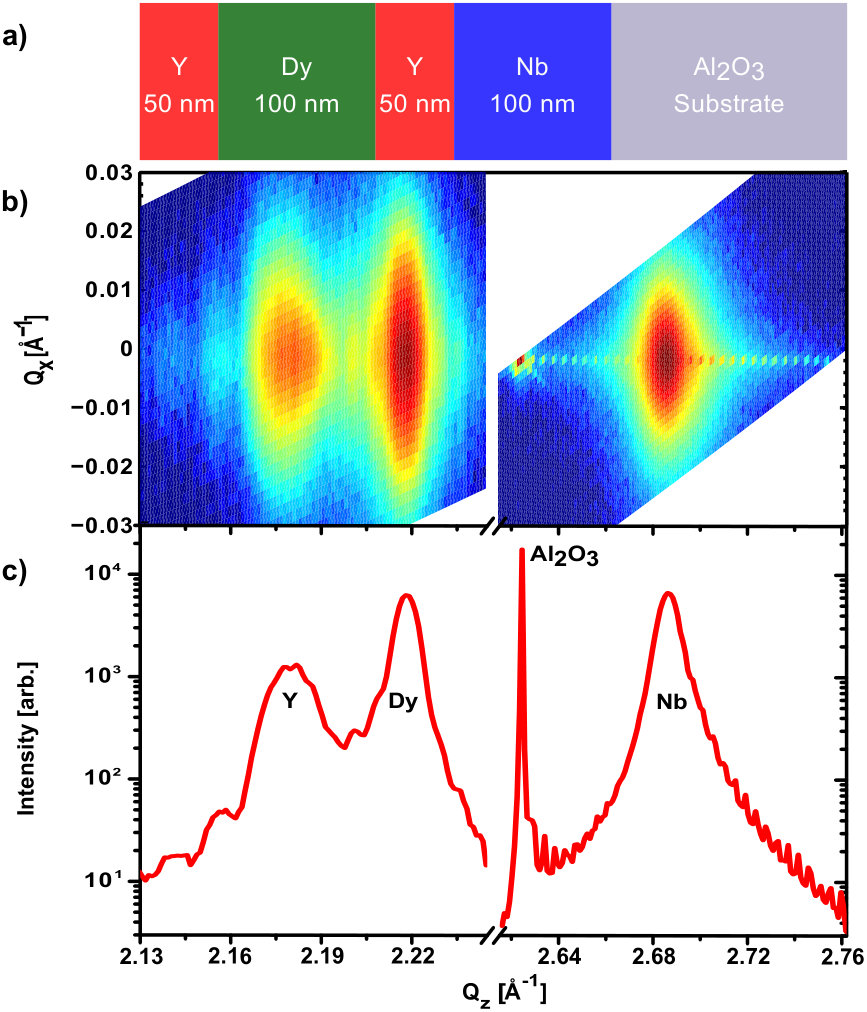 Figure 1
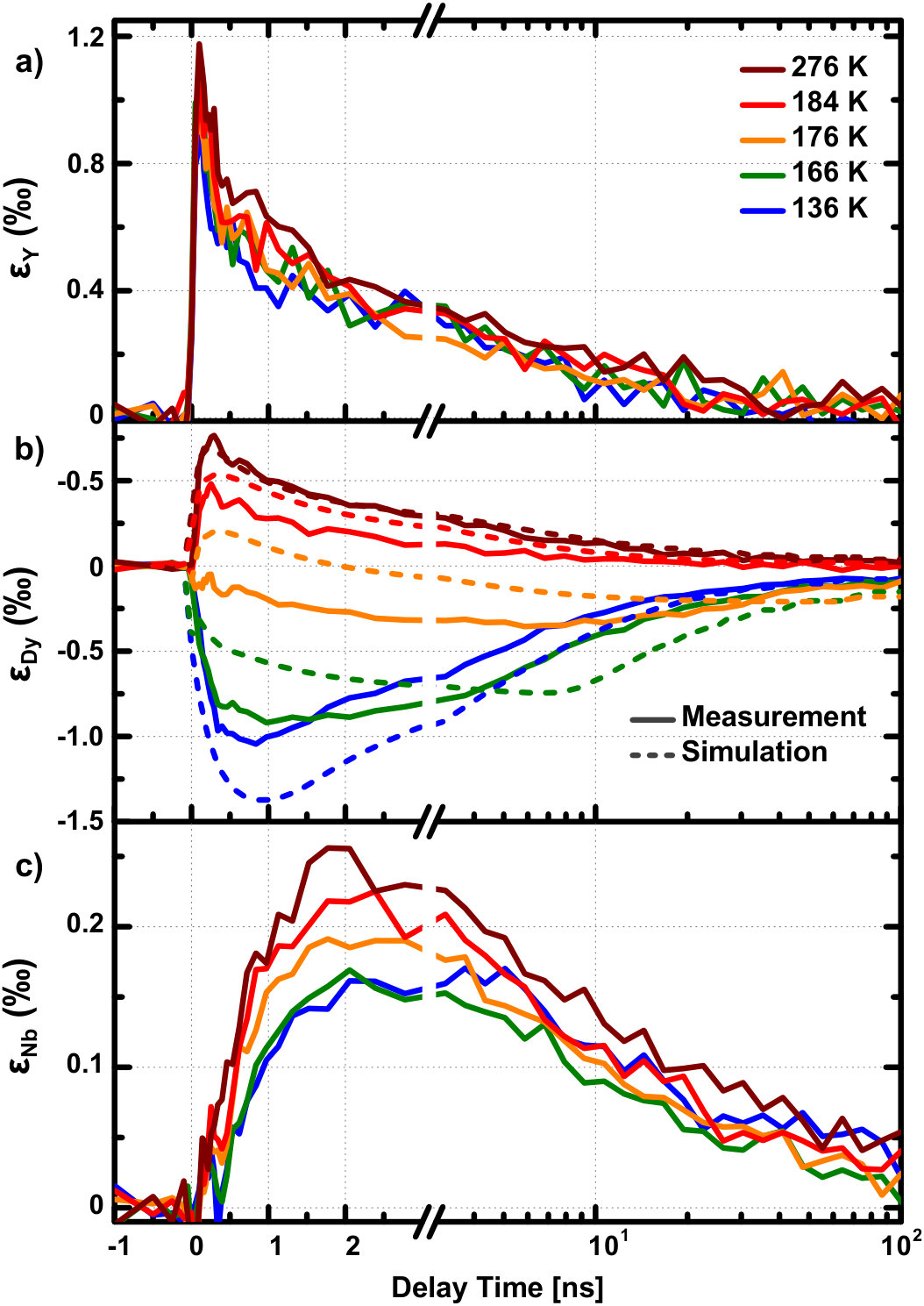 Figure 2
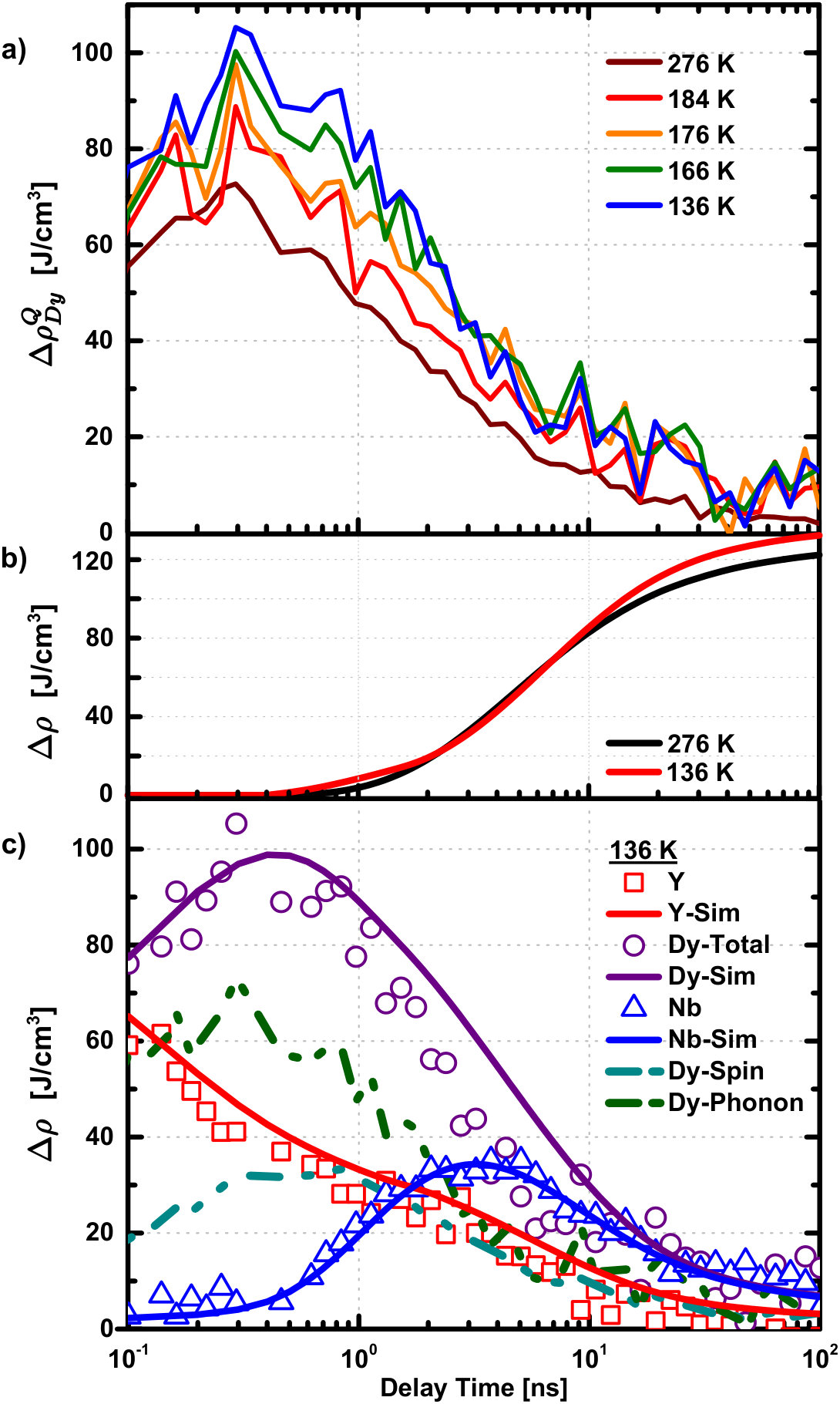 Figure 3
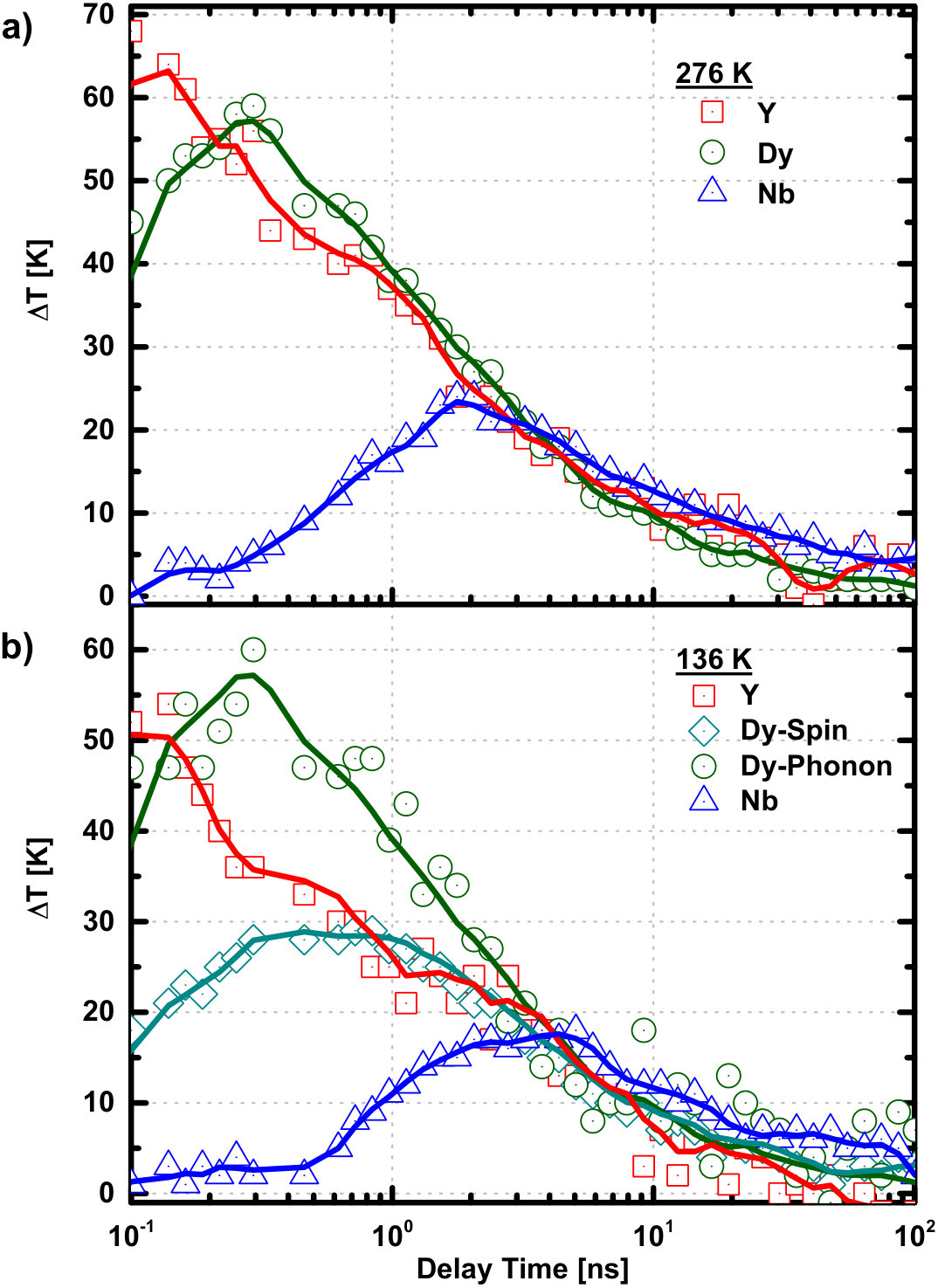 Figure 4
| system | (kJ/cm3) |
|---|---|
| Y | 69 |
| Dy spin | -20 |
| Dy phonon | 95 |
| Nb | 206 |
Peer Reviews
No public reviews on file for this paper yet. If you reviewed it on a platform where reviews are public (OpenReview, ICLR, NeurIPS, ICML), you can paste yours below so the community can read it here.
Videos
No videos yet. Explain this paper in a talk, walkthrough, or lecture? Add one.
Ultrafast X-ray Diffraction Thermometry Measures the Influence of Spin Excitations on the Heat Transport through nanolayers
A. Koc
M. Reinhardt
Helmholtz Zentrum Berlin, Albert-Einstein-Str. 15, 12489 Berlin, Germany
A. von Reppert
Institut für Physik & Astronomie, Universität Potsdam, Karl-Liebknecht-Str. 24-25, 14476 Potsdam, Germany
W. Leitenberger
Institut für Physik & Astronomie, Universität Potsdam, Karl-Liebknecht-Str. 24-25, 14476 Potsdam, Germany
K. Dumesnil
Institut Jean Lamour (UMR CNRS 7198), Université Lorraine, Boulevard des Aiguillettes B.P. 239, F-54500 Vandoeuvre les Nancy cédex, France
P. Gaal
Helmholtz Zentrum Berlin, Albert-Einstein-Str. 15, 12489 Berlin, Germany
Institut für Nanostruktur- und Festkörper Physik, Univesität Hamburg, Jungiusstr. 11,20355 Hamburg,Germany
F. Zamponi
Institut für Physik & Astronomie, Universität Potsdam, Karl-Liebknecht-Str. 24-25, 14476 Potsdam, Germany
M. Bargheer
[email protected] http://www.udkm.physik.uni-potsdam.de Institut für Physik & Astronomie, Universität Potsdam, Karl-Liebknecht-Str. 24-25, 14476 Potsdam, Germany
Helmholtz Zentrum Berlin, Albert-Einstein-Str. 15, 12489 Berlin, Germany
(March 18, 2024)
Abstract
We investigate the heat transport through a rare earth multilayer system composed of Yttrium (Y), Dysprosium (Dy) and Niobium (Nb) by ultrafast X-ray diffraction. This is an example of a complex heat flow problem on the nanoscale, where several different quasi-particles carry the heat. The Bragg peak positions of each layer represent layer-specific thermometers that measure the energy flow through the sample after excitation of the Y top-layer with fs-laser pulses. In an experiment-based analytic solution to the nonequilibrium heat transport problem, we derive the individual contributions of the spins and the coupled electron-lattice system to the heat conduction. The full characterization of the spatiotemporal energy flow at different starting temperatures reveals that the spin excitations of antiferromagnetic Dy speed up the heat transport into the Dy layer at low temperatures, whereas the heat transport through this layer and further into the Y and Nb layers underneath is slowed down. The experimental findings are compared to the solution of the heat equation using macroscopic temperature-dependent material parameters without separation of spin- and phonon contributions to the heat. We explain, why the simulated energy density matches our experiment-based derivation of the heat transport, although the simulated thermoelastic strain in this simulation is not even in qualitative agreement.
Heat transport at the nanoscale has become an important problem of contemporary physics.Cahill et al. (2003, 2014); Hoogeboom-Pot et al. (2015) The field is driven largely by the need to improve heat transport characteristics in integrated circuits operating at high clock rates.Balandin (2002) The design length scales approach the physical limits, where wave fundamental properties of phonon-heat conduction play an important role.Luckyanova et al. (2012); Xiong et al. (2016) Research on the functionality of interfaces in nano-electronics is prevalent, and the heat transport characteristics of interfaces depend strongly e.g. on the roughness of the interface, which is often hard to control in the fabrication process Cahill et al. (2003, 2014); Chen et al. (2004). In many insulators and semiconductors the heat capacity is dominated by phonons, whereas electrons only contribute significantly at high temperatures. The heat transport in metals in contrast is dominated by the conduction band electrons and the excitation of phonons typically reduces the heat transport, because they act as scatterers for electrons Ashcroft and Mermin (1976). In some magnetic materials with strong exchange interactions and large magnetic moments the spin-correlations can contribute more than half of the specific heat over large temperature ranges Pecharsky et al. (1996); Griffel et al. (1954); Gerstein et al. (1957). One classical example is the rare earth Dysprosium, which we are investigating in this article. Similar to phonon excitations, the magnetic excitations are known to reduce the heat conductivity when it is dominated by the electrons. Boys and Legvold (1968) On the other hand heat conduction by magnons may dominate in antiferromagnets.Hess et al. (2003) The transport of heat across interfaces in nanostructures with magnetic and nonmagnetic layers is far beyond what can be safely simulated on an ab-initio basis. The additional degree of freedom given by the quasiparticles of the magnetic excitations presents a very complex problem Beaurepaire et al. (1996). Additional to the basic understanding of heat transport at the nanoscale,Biele et al. (2015) fundamental studies of ultrafast magnetism regarding the possibility of all optical magnetic switching Stamm et al. (2007); Eschenlohr et al. (2013); Frietsch et al. (2015); Rettig et al. (2015) or the role of spin currents Li et al. (2016); Choi et al. will profit from a detailed knowledge about transient temperatures and temperature gradients in such systems. Ultrafast x-ray diffraction has only recently become a tool to measure the transient temperatures in multilayersNavirian et al. (2014) and to assign contributions from electrons and phonons to thermal transport.Xu et al. (2014)
In this paper we present the results of time-resolved ultrafast X-ray diffraction (UXRD) studies on a complex thin film heterostructure with the layering sequence Y/Dy/Y/Nb/Sapphire. We simultaneously measured the relative Bragg peak shifts of all layers as a direct measure of transient strain after optical excitation of the top Y layer. Using the Grüneisen coefficients derived from the thermal expansion, experimentally measured on the same structure, we extract the time dependent energy densities in each layer. When only electrons and phonons carry the heat, the transient temperatures can be direcly read from the measured strains . In the antiferromagnetic state of Dy, a large fraction of the energy resides in spin excitations and we show how to separate the phonon- and spin-contributions () via an analytic decomposition of the measured signal. The initial temperature is varied from K through the Néel temperature K of Dy up to K. We find that the additional presence of anti-ferromagnetic spin excitations in Dy below speeds up the energy flow from the excited Y layer into the Dy layer, where an additional channel for heat dissipation is present. At the same time, the heat transport through Dy is slowed down as the temperature gradient is decreased when the magnetic excitations scatter the electrons which are the main heat transporting quasi-particles. A full ab-initio simulation of this complex heat transport problem seems impossible, since the interface-resistances, depending on the perfection of the nanostructure and the coupling constants between electrons, phonons and spin-excitations are unknown. Still, heat transport simulations using bulk values for the thermal conductivities Ho et al. (1974); Dobrovinskaya et al. (2009) can be compared with our measured total energy densities, although the contributions of individual quasiparticles are neglected. We find the nonequilibrium of spins and phonons in the observable of the measured strain.
The sample shown in Fig. 1a) is grown epitaxially and consists of a 100 nm thick (0001)-oriented Dy layer encapsulated between two nm thick Y films with (0001)-orientation in order to prevent oxidation and to stabilize the helical spin order of Dy Dumesnil et al. (1995). A nm thick Nb buffer layer connects this metallic sandwich stucture to an substrate. The thickness values are derived from the Laue-oscillations around individual Bargg peaks. The penetration depth of nm for our excitation pulses at nm wavelength was determined by ellipsometry studies, showing that mainly the upper Y layer is excited.
Time-resolved X-ray diffraction measurements were performed at the XPP experimental station at the storage ring BESSY II Navirian et al. (2012). Reciprocal space mapping (RSM) is performed by recording the x-ray photons diffracted from the sample at various incidence angles around the Bragg reflections with a two-dimensional hybrid pixel detector (Pilatus 100k, Dectris Inc.) Reinhardt et al. (2016). The large extinction length of hard X-ray pulses at Å allows for simultaneous detection of diffraction signals from all layers of this structure that is opaque to optical light. As an example, Fig. 1b) displays the broad RSM Schick et al. (2013) of the thin films Y, Dy, and Nb as well as the sharp RSM of the Al2O3 substrate at K. Fig. 1c shows the diffracted intensity of the out-of-plane scattering vector obtained by integrating the RSM over the in-plane scattering vector components and . The signal broadening of the nanolayers in is due to the limited layer thickness, whereas the mosaic structure of the crystal is mainly observed as a broadening in the in-plane directions.
I Results
I.1 Time-resolved X-ray diffraction data
We present the transient response of each nanolayer after ultrafast laser heating with a laser fluence of 2 mJ/cm2. To extract this information from the data, we fitted each Bragg peak at any delay time with a Gaussian line profile in to determine the peak position. Transforming the average reciprocal lattice vector to lattice constants , we obtain the transient strain in each layer. In Fig. 2a) the transient strain of both Y layers as the average of the upper and bottom Y layer is shown for different base temperatures . At K the laser-heated Y layer shows a maximal expansion within the ps time-resolution limit given by the pulse duration of the X-rays at beamline. It relaxes via heat diffusion into the other thin film layers. At lower the same dynamics are observed, however the maximal strain value decreases with decreasing . The indirectly heated Dy layer (Fig. 2b) shows very different dynamics depending on the base temperature. At K the paramagnetic Dy layer expands and reaches the maximal expansion after about ps. In the AFM phase below the Dy layer contracts upon heating. This negative thermal expansion is a signature of spin-excitations in the antiferromagnetic spin order von Reppert et al. (2016). The transient strain in the Nb layer is depicted in Fig. 2c). A maximal expansion of the Nb layer at K is observed at about ns. At lower base temperatures the maximal expansion shifts to larger time-delays and the magnitude of the maximal expansion is reduced.
I.2 Data analysis in two-thermal-energies-model
We analyze the dynamics of the thin film system on timescales larger than the time required for propagating sound through the nanolayer system and smaller than the time for sound-propagation over the in-plane length scale given by the laser-excitation spot. Therefore we assume Hooke’s law to be valid, which relates the strain to the stress via an effective elastic constant Smith and Gjevre (1960); Rosen and Klimker (1970); Keith J. Carroll (1965) that takes into account the in-plane clamping of the film to the substrate. The macroscopic Grüneisen constant measures, how efficiently the energy density in a subsystem generates stress . We prefer to write an inverse parameter which we directly obtained from the bulk specific heat per volume from the literature Jennings et al. (1960); Pecharsky et al. (1996); von Reppert (2015) and the expansion coefficient determined from the temperature dependent XRD on the investigated thin film structure. The change of the integral heat
[TABLE]
in a volume of a system is proportional to the lattice strain . At temperatures above , the increase of the energy densities in Y, Dy and Nb can be directly found from eq.1. Essentially, the energy density of excited phonons in each material drives the lattice expansion, since the electrons carry a negligible fraction of the specific heat, when the electrons have relaxed to approximately the lattice temperature. Table 1 summarizes the constants of Nb, Y, as well as the spin and phonon systems of Dy. These beta values are essentially independent of temperature, as confirmed exemplarily by the constant linear slopes of the curves plotted in Fig. 2 of ref. von Reppert et al. (2016). To simplify the analysis we do not separately account for the electron and phonon contributions in each metal, since the specific heat of the electron system is always very small. Above the spin contribution to remains constant, but the specific heat of the spins above is very small.
In contrast, the specific heat of the spin system below is very large. In order to measure the individual conributions of phonons and spins to the energy density and expansion of Dy at temperatures below , we envoke the tow-thermal-energies model (TTEM) von Reppert et al. (2016) in Dy. This model assumes that the measured strain is a superposition of both thermoelastic strain and the magnetostrictive strain .
[TABLE]
Since the Grüneisenconstants and the coefficients are temperature independent, these strains are a robust and linear measure of the local energy densities.
[TABLE]
Below we have four heat carrying degrees of freedom in the system, namely the spin-excitations in Dy and the phonon-excitation in Dy, Nb and Y. In addition to the three measured transient lattice strains (Fig. 2), we need a fourth equation to find the solution to the heat transport problem. We conducted temperature dependent ellipsometry measurements proving that the absorbed energy density of the multilayer does not change considerably with temperature. Assuming that no substantial fraction of the initial heat is transported to the substrate, we can identify the total amount of energy deposited in the multilayer at any temperature with the value measured at K, where only phonons drive the Dy expansion. This is an excellent approximation for timescales below ns and a very good appoximation up ns, because the heat transport into the sapphire substrate is similar for all temperatures.
When we write
[TABLE]
we only overestimate at low temperatures by the rather small fraction of heat that is transported into the substrate more than it would be transported at K. For convenience, this error can be read from the difference of red and black lines in Fig. 3b). The energy densities in Dy derived for several different base temperatures are plotted in Fig. 3a). We find that with lower base temperature a larger and larger fraction of the energy is rapidly transferred from the excited Y layer into Dy.
We now solve eq. 4 to obtain equations for the contractive strain driven by spin order and the phonon driven expansive strain , which only depend on measured quantities:
[TABLE]
Here, is the experimentally determined energy density plotted in Fig. 3a). We can now use eq. 1 to derive the contributions to the time-dependent energy densities in Dy. The corresponding energy densities of the adjacent layers are determined directly from the measured quantities . The resulting energy densities in each material derived from the experiment are plotted in Fig. 3c) and compared to a simple calculation of the heat transport according to the heat equation. Schick et al. (2014) Assuming a small thermal interface resistance of 200 MW/m2K only between Nb and Sapphire, we find a very good simultaneous agreement of the experimentally derived total energy density in Dy and the simulations at K and K. In contrast, the simulated thermal expansion averaged over the film thickness (dashed lines in Fig. 2b) considerably deviate from the measured strain , because the spin- and phonon-system are not even locally in thermal equilibrium. Closer to the phase transition the deviations get stronger.
II Discussion
Heat transport is driven by temperature gradients. We therefore plot the transient temperature changes of the spins and phonons in Dy and in Fig. 4 as the experimental solution of the heat transport problem through the three layers as a function of time for two temperatures above and below . We use the specific heats of the individual subsystems to calculate the temperature rise from . The most striking result is, that within the time resolution of ps, we measure that the Y layer is heated by K at low and 68 K at high temperature, although ellipsometry proves that the same amount of energy was deposited by the light pulse. This suggests that the additional energy dissipation channel into spin excitations at low temperatures dramatically speeds up the heat transport across the Y/Dy interface.
Another robust feature seen in Fig. 4 is the delay of the temperature rise in the Nb layer, indicating a reduced heat transport through Dy. The temperature rise in the phonon system of Dy at both base temperatures is nearly the same, and therefore the heat arriving in the spin system effectively is additional to the phonon heat, explaining the observation in Fig. 3a) that the increase of the energy density in Dy is higher at low temperature. Note that the kinetics of the temperature rise in the spin- and phonon-systems of Dy are clearly different.
The fact that energy density in the spin system of Dy drives a lattice contraction counteracting the expansion initiated by phonon-heating explains the strong deviations of the observed lattice strain from the simulated strain (Fig. 2b) when spins and phonons are not in a thermal equilibrium. The good agreement on the level of comparing the heat transport can be understood, when we identify the electrons as the main heat transporting quasiparticles. This means that a temperature-gradient in the electron system promotes the transport. Immediately after the optical excitation, the energy is essentially stored in the electron system, with a very large temperature gradient according to the small heat capacity of electrons in Dy. Within the timescale of electron-phonon and electron-spin coupling the heat transport should therefore considerably speed up. This would then lead to an even better match of the simulations with the data in Fig. 3a). When the electron-, spin- and phonon temperatures have approached each other, the heat is essentially stored in spin excitations and phonons. Nonetheless it is the electron system which transports the energy, explaining why we simulate the heat transport essentially correct, even if the spin and phonon system have not equilibrated.
III Conclusion
We have exemplified an experimental procedure to measure the heat transport through multilayer systems with thicknesses in the nanometer-range in the non-trivial case, where a considerable fraction of the heat of one material (Dy) is dynamically stored in a strongly interacting spin system. At all temperatures, the heat transport is dominated by electron transport, although electrons only contribute negligibly to the heat capacity. Below the Néel temperature, the spin-system opens up an additional heat sink. While the heat transport into the phonon system is nearly unchanged, the spins extract additional energy from the adjacent laser heated Y layer and speed up the inital cooling. At the same time the spin-excitations slow down the electronic heat transport by electron-magnon scattering, which is evidenced by a delayed rise of the Nb temperature, through which the heat is finally dissipated.
Although the average heat, experimentally measured in each layer, is in rather good agreement with standard simulations using the heat equation, there are strong deviations of simulated strain from the measured values. This is because a large fraction of the energy is stored in spin excitations which promote the contraction of the film. In general, for multilayer-systems where only electrons and phonons carry the heat, the transient temperatures can be directly read from the measured strains, which may be very useful when simulations fail to predict real situations e.g. rough interfaces. For even more complex situations, where several quasiparticles contribute to the heat transport and thermoelastic strain, we have shown how to analytically decompose the measured signal and get the correct decomposition of spin- and phonon contributions to the strain and the heat. A direct experimental assessment of the heat flow is crucial for understanding the heat transport via various quasi-particles and across interfaces. We believe that such direct experimental crosschecks of theoretical predictions yield valuable information when it comes to optimizing heat transport for real applications.
IV Acknowledgement
The reference list from the paper itself. Each links out to its DOI / PubMed record.
- 1Cahill et al. (2003) David G. Cahill, Wayne K. Ford, Kenneth E. Goodson, Gerald D. Mahan, Arun Majumdar, Humphrey J. Maris, Roberto Merlin, and Simon R. Phillpot, “Nanoscale thermal transport,” Journal of Applied Physics 93 , 793–818 (2003) , http://dx.doi.org/10.1063/1.1524305 . · doi ↗
- 2Cahill et al. (2014) D. G. Cahill, P. V. Braun, G. Chen, D. R. Clarke, S. Fan, K. E. Goodson, P. Keblinski, W. P. King, G. D. Mahan, A. Majumdar, et al. , “Nanoscale thermal transport. ii. 2003-2012,” Applied Physics Reviews 1 , 011305 (2014).
- 3Hoogeboom-Pot et al. (2015) Kathleen M. Hoogeboom-Pot, Jorge N. Hernandez-Charpak, Xiaokun Gu, Travis D. Frazer, Erik H. Anderson, Weilun Chao, Roger W. Falcone, Ronggui Yang, Margaret M. Murnane, Henry C. Kapteyn, and Damiano Nardi, “A new regime of nanoscale thermal transport: Collective diffusion increases dissipation efficiency,” Proceedings of the National Academy of Sciences 112 , 4846–4851 (2015) , http://www.pnas.org/content/112/16/4846.full.pdf . · doi ↗
- 4Balandin (2002) A. A. Balandin, “Nanoscale thermal management,” IEEE Potentials 21 , 11–15 (2002) . · doi ↗
- 5Luckyanova et al. (2012) Maria N. Luckyanova, Jivtesh Garg, Keivan Esfarjani, Adam Jandl, Mayank T. Bulsara, Aaron J. Schmidt, Austin J. Minnich, Shuo Chen, Mildred S. Dresselhaus, Zhifeng Ren, Eugene A. Fitzgerald, and Gang Chen, “Coherent phonon heat conduction in superlattices,” Science 338 , 936–939 (2012) , http://science.sciencemag.org/content/338/6109/936.full.pdf . · doi ↗
- 6Xiong et al. (2016) Shiyun Xiong, Kimmo Sääskilahti, Yuriy A. Kosevich, Haoxue Han, Davide Donadio, and Sebastian Volz, “Blocking phonon transport by structural resonances in alloy-based nanophononic metamaterials leads to ultralow thermal conductivity,” Phys. Rev. Lett. 117 , 025503 (2016) . · doi ↗
- 7Chen et al. (2004) G. Chen, D. Borca-Tasciuc, and R. G. Yang, “Nanoscale Heat Transfer,” Encyclopedia of Nanoscience and Nanotechnology , 7 , 429–459 (2004) . · doi ↗
- 8Ashcroft and Mermin (1976) N.W. Ashcroft and N.D. Mermin, Solid State Physics (Saunders College, Philadelphia, 1976).