Lorentz invariance violation as an explanation of muon excess in Auger data
Gaurav Tomar

TL;DR
This paper proposes that Lorentz invariance violation in the photon sector can explain the excess of muons observed by the Auger experiment, by modifying the neutral pion decay process and increasing muon production.
Contribution
It introduces a novel LIV-based mechanism affecting pion decay, providing a potential explanation for muon excess in cosmic ray data.
Findings
LIV suppresses neutral pion decay width in the studied energy range.
Modified decay width leads to increased muon production matching observations.
Planck-suppressed LIV at order p^2/M_{Pl} is consistent with current bounds.
Abstract
The Auger collaboration has observed the number of muons which is higher than its prediction by existing hadronic interaction models. We explain this excess of muons by using Lorentz invariance violation (LIV) in photon sector. As an outcome of Lorentz invariance violation, the dispersion relation of photon gets modified, which we use for the calculation of decay width. In the Auger data of primary energy , we find that the neutral pion decay width is suppressed in comparison to its standard model (SM) counterpart. As a result, we get a large number of muons explaining the observed muon excess. We consider Planck suppressed LIV at order for studying the photon sector, which is in agreement with the current bounds, and not as tightly constrained as LIV at order .
Click any figure to enlarge with its caption.
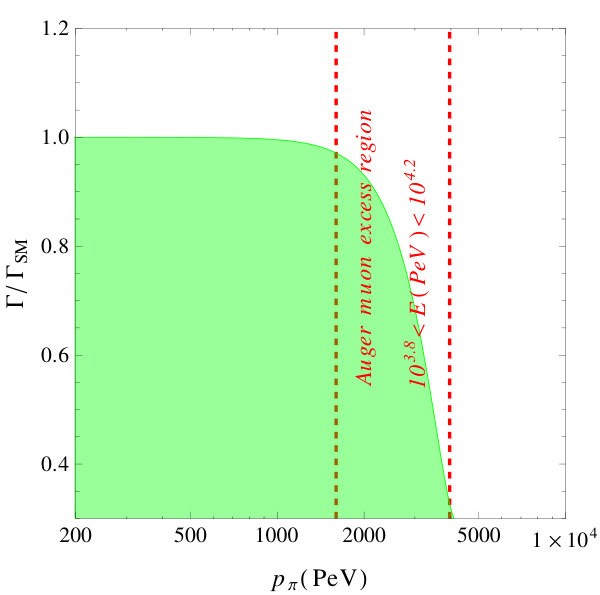 Figure 1
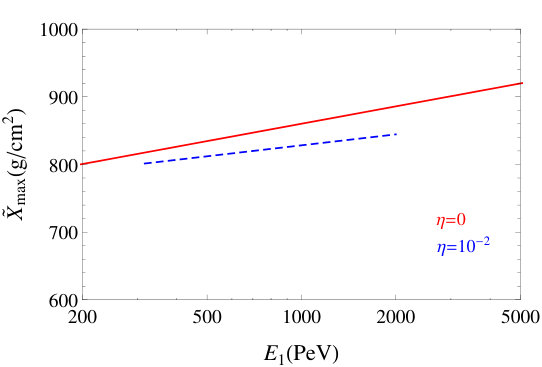 Figure 2
Peer Reviews
No public reviews on file for this paper yet. If you reviewed it on a platform where reviews are public (OpenReview, ICLR, NeurIPS, ICML), you can paste yours below so the community can read it here.
Videos
No videos yet. Explain this paper in a talk, walkthrough, or lecture? Add one.
††institutetext: Physical Research Laboratory, Ahmedabad 380009, India.
Lorentz invariance violation as an explanation of muon excess in Auger data
Gaurav Tomar
Abstract
The Auger collaboration has observed the number of muons which is higher than its prediction by existing hadronic interaction models. We explain this excess of muons by using Lorentz invariance violation (LIV) in photon sector. As an outcome of Lorentz invariance violation, the dispersion relation of photon gets modified, which we use for the calculation of decay width. In the Auger data of primary energy , we find that the neutral pion decay width is suppressed in comparison to its standard model (SM) counterpart. As a result, we get a large number of muons explaining the observed muon excess. We consider Planck suppressed LIV at order for studying the photon sector, which is in agreement with the current bounds, and not as tightly constrained as LIV at order .
Keywords:
Lorentz invariance violation, Auger muon excess, Pierre Auger Observatory
1 Introduction
Ultra high energy (UHE) cosmic rays with energy of GeV are the most energetic particles observed on the Earth. After their collisions with the Earth atmosphere, a huge cascade of secondary particles with low energy is created. As the collision energy is roughly ten times higher than the one at LHC, it can be a suitable window for new physics. These cascades of particles or showers are explored by large arrays like Yakutsk Extensive Air Shower Array and Pierre Auger Observatory (PAO). A new study from Auger collaboration Aab2015a ; Aab2016 suggests that the number of muons produced in UHE showers is higher in comparison to the one predicted by existing models Abu-Zayyad2000 ; Aab2014 ; Aab2015 . Basically, the hadronic component of showers with primary energy have - more muons than expected Aab2015a ; Aab2015b ; Aab2016 .
The explanation of the muon excess in PAO data is challenged by the distribution of the depth of shower maximum, , which should be independently fitted. To fit the data, the density of muon at 1 km from the shower core which is denoted as, , should increase. The properties of hadronic interactions which affect and are: cross-section, elasticity, multiplicity, primary mass, and energy fraction. The variation of and with them is shown in Allen2013 , where it is noted that changing energy fraction is the only viable option for increasing . Any other change in without affecting the longitudinal profile is not possible which is tightly constrained (see fig. 1 of ref. Allen2013 ). If hadronic shower carries energy fraction of the total primary cosmic ray energy , then it scales as,
[TABLE]
where is the fraction of energy transfered into electromagnetic particles per generation, and is the number of generations required for most pions to have energy below GeV. Below 100 GeV energy, most of the charged pions decay rather than interact, terminating the energy transfer to the electromagnetic component of the shower. While the charged pions interact instead of decay above GeV energy, persisting the hadronic shower. The best way to increase is to reduce either or . The estimated value of needed to reach pion energy below GeV is for primary energy GeV respectively Matthews2005 . But the required for getting the desired result also reduce which is tightly constrained. So the best option for increasing the muon density is to reduce ( energy fraction) 111In ref. Diaz2016 , the variation of as a function of photon energy is discussed in LIV framework. We will examine this point in Sec. 4..
There are many proposals for reducing energy fraction such as, chiral symmetry restoration, pion decay suppression, and pion production suppression Allen2013 ; Farrar2013 . The string percolation models Alvarez-Muniz2012 and strange fireball mechanism Anchordoqui2016 are other approaches used for the explanation of the observed muon excess. In this work, we focus on the decay suppression of which can occur from Lorentz invariance violation in photon sector. As the lifetime of is very small , it decays immediately into two photons after its production. We modify the photon dispersion relation in the spirit of Galaverni2008 ; Maccione2008 ; Galaverni2008a , and calculate the neutral pion decay width. At high energy, as a result of modified dispersion relation, photon becomes massive enough to suppress the decay into two photons. The possible Lorentz invariance violation is motivated from quantum gravity Mattingly2005 ; Liberati2013 ; Cognola2016 and in many studies Ellis2004 ; Horava:2009uw ; Mohanty2011 ; Mohanty2012 ; Girelli2012 ; Anchordoqui2014a ; Tomar2015 it has been shown that LIV becomes important at very high energy scale. There are stringent constraints on LIV in photon Galaverni2008 ; Maccione2008 ; Galaverni2008a ; Kostelecky2011 and fermion Gagnon2004 ; Scully2009 ; Bi2009 ; Maccione2009 . Specifically, LIV in photon sector is tightly constrained for Planck mass suppressed dim-5 operators and even dim-6 operators are constrained to a unprecedented level Galaverni2008 ; Maccione2008 ; Kostelecky2011 . For dim-6 operators, the bound on photon LIV parameter is, Galaverni2008 which comes from the stringent upper bound on photon flux above GeV Rubtsov2006 , and if photon is observed at GeV then Maccione2008 . We consider a dim-6 scenario (LIV at order ) in this work and find that for getting the desired muon excess, LIV parameter is , which seems to be in tension with the upper bound mentioned in Maccione2008 ; Galaverni2008a . But we want to emphasize that the upper limit quoted in Maccione2008 ; Galaverni2008a is based on the assumption of the observation of photon with GeV energy. In cosmic rays, photon with this much energy is a question of discussion Abbasi2016 ; Aab2016a , and the upper bound can be avoided at present. The rest of the paper is as follows: in Sec. 2, we discuss the modified dispersion relation. We give the neutral pion decay calculation in LIV framework in Sec. 3, and our discussion and conclusion in Sec. 4 and Sec. 5 respectively.
2 Dispersion relation
The Lorentz invariance violation modifies the dispersion relation of photon. As we mentioned before, LIV at order corresponds to a cubic dispersion relation which arises from dim-5 operator. The LIV at order is tightly constrained with the required suppression scale well above the Planck mass. In the following, we consider the underlying theory to be invariant by taking LIV at order . We denote the 4-momentum of the photon by and consider the following dispersion relation for photon,
[TABLE]
where is a LIV parameter and Planck mass GeV. This dispersion relation can be obtained from the Lagrangian given in Mattingly2008 . As scenario of eq. (2) arises from -odd contributions Jacobson2003 ; Myers2003 ; Jacobson2006 , it is tightly constrained Maccione2007 ; Galaverni2008 ; Kostelecky2011 . In the following, we assume that theory is -even by taking .
3 Neutral pion decay
We calculate the neutral pion decay width using modified dispersion relation of eq. (2) considering . We compute the amplitude for neutral pion decay process , which is dominated by chiral anomaly and reads Bernstein2013 ,
[TABLE]
where is the pion decay constant. We calculate the average amplitude square, which is,
[TABLE]
where . The decay width of is then given as,
[TABLE]
where is the fine structure constant and is the photon energy which is defined as . The momentum of photon is defined as, . From the argument of delta function in eq. (5), one reads,
[TABLE]
which after solving gives,
[TABLE]
We reduce the argument of function in terms of by taking,
[TABLE]
After these simplifications, we get the decay width of neutral pion,
[TABLE]
where . We perform the integration of eq. (9) in the allowed limits of , which are fixed by taking in eq. (7), and gives,
[TABLE]
[TABLE]
By solving these equations numerically, we get the allowed limits on the photon momentum. Using these limits, we solve eq. (9) to get the decay width of and then compare it with the SM result of pion decay in a moving frame, which is given as,
[TABLE]
In fig. (1), we have shown the deviation of decay width from its SM prediction (see eq. (12)). We find that as a result of phase space and suppression, the decay width of (electromagnetic energy transfered per generation, ) decreases with large pion momentum. As a result, increases (see eq. (1)), which can enhance the number of muons by in the desired energy range. We have shown the Auger muon excess region for the primary cosmic ray energy , which translate into neutral pion energy with GarciaCanal2009 .
Here it is important to mention that we also checked our calculation for scenario and found that is required to explain the Auger muon excess, which is three orders of magnitude higher than the current bounds Kostelecky2011 . So it is not possible to address the observed muon excess in Auger data for scenario.
4 Discussion
In the previous sections, we discussed how modified dispersion relation gives rise to a massive photon, which stops decay at energy denoted as . We mentioned that decay does not contribute into shower maximum depth , but as a result of LIV, it is possible that photon becomes massive enough to decay into pairs which can modify . We contemplate this idea in the spirit of Diaz2016 , and check our LIV scenario against that. The threshold energy for photon decay into pairs is,
[TABLE]
where is the mass of electron. We get after considering the condition . If the initial photon energy , then photon starts decaying into pair of . As a result, the shower maximum gets modified and can be written as Diaz2016 ,
[TABLE]
where is the critical energy at which ionization starts dominating over radiative processes, is the radiation length in the medium, and . In the standard scenario (), Letessier-Selvon2011 . In fig. (2), we have shown the behavior of modified as a function of initial photon energy by using MeV, Letessier-Selvon2011 , and . The standard Lorentz invariant scenario is also shown for comparison. By taking , eq. (13) gives PeV. It is clear from fig. (1) that neutral pion decay for stops at PeV, so there should not be any photon with energy . Analyzing fig. (2), we find that in the allowed region , the modified shower maximum depth varies between 10-40. The precise measurement of in future can be used to probe this model.
5 Conclusion
In this paper, we discuss the Lorentz invariance violation explaining the muon excess observed by Auger collaboration. The relative number of muons can be increased either by reducing the energy fraction in electromagnetic decay i.e. suppressing the neutral pion decay or reducing the . As the variation of is tightly constrained from the independent observation of , change in is the best option for increasing the number of muons. We reduce the energy fraction by suppressing the decay width. We consider the modified dispersion relation for photon by taking LIV at order from a -even dim-6 operator, and calculate the neutral pion decay width in this scenario. We find that, at high energies, Lorentz invariance violation starts playing an important role and suppress the decay width of , which depends on the value of LIV parameter . We find that by taking Plank mass square suppressed , it is possible to suppress the decay width of in the desired energy range. As a result of neutral pion decay width suppression, the energy fraction in electromagnetic shower reduces and it gives rise to the relative number of muons observed by Auger collaboration.
6 Acknowledgement
The author would like to thank Subhendra Mohanty, Namit Mahajan and Petr Satunin for helpful discussions. The author also thanks Ujjal Kumar Dey for reading the manuscript and anonymous referee for his/her constructive comments on the manuscript.
The reference list from the paper itself. Each links out to its DOI / PubMed record.
- 1(1) Pierre Auger Collaboration, A. Aab et al., The Pierre Auger Cosmic Ray Observatory , Nucl. Instrum. Meth. A 798 (2015) 172–213, [ ar Xiv:1502.01323 ].
- 2(2) Pierre Auger Collaboration, A. Aab et al., Testing Hadronic Interactions at Ultrahigh Energies with Air Showers Measured by the Pierre Auger Observatory , Phys. Rev. Lett. 117 (2016), no. 19 192001, [ ar Xiv:1610.08509 ].
- 3(3) MIA, Hi Res Collaboration, T. Abu-Zayyad et al., Evidence for Changing of Cosmic Ray Composition between 10**17-e V and 10**18-e V from Multicomponent Measurements , Phys. Rev. Lett. 84 (2000) 4276–4279, [ astro-ph/9911144 ].
- 4(4) Pierre Auger Collaboration, A. Aab et al., Depth of maximum of air-shower profiles at the Pierre Auger Observatory. II. Composition implications , Phys. Rev. D 90 (2014), no. 12 122006, [ ar Xiv:1409.5083 ].
- 5(5) Pierre Auger Collaboration, A. Aab et al., Muons in air showers at the Pierre Auger Observatory: Mean number in highly inclined events , Phys. Rev. D 91 (2015), no. 3 032003, [ ar Xiv:1408.1421 ]. [Erratum: Phys. Rev.D 91,no.5,059901(2015)].
- 6(6) Pierre Auger Collaboration, A. Aab et al., Muons in air showers at the Pierre Auger Observatory: Mean number in highly inclined events , Phys. Rev. D 91 (2015), no. 3 032003, [ ar Xiv:1408.1421 ]. [Erratum: Phys. Rev.D 91,no.5,059901(2015)].
- 7(7) J. Allen and G. Farrar, Testing models of new physics with UHE air shower observations , in Proceedings, 33rd International Cosmic Ray Conference (ICRC 2013): Rio de Janeiro, Brazil, July 2-9, 2013 , p. 1182, 2013. ar Xiv:1307.7131 .
- 8(8) J. Matthews, A Heitler model of extensive air showers , Astropart. Phys. 22 (2005) 387–397.