Transverse densities of octet baryons from chiral effective field theory
Jose Manuel Alarc\'on, Astrid N. Hiller Blin, C. Weiss

TL;DR
This paper calculates the transverse charge and current densities of octet baryons at large distances using a combined approach of chiral effective field theory and dispersion analysis, providing insights into their peripheral structure.
Contribution
It introduces a novel method combining chiral EFT and dispersion analysis to compute baryon densities at large distances with controlled uncertainties.
Findings
Densities are computed at distances > 1 fm.
Results align with empirical data and lattice QCD.
Method extends to include rho-meson mass region.
Abstract
Transverse densities describe the distribution of charge and current at fixed light-front time and provide a frame-independent spatial representation of hadrons as relativistic systems. We calculate the transverse densities of the octet baryons at peripheral distances b = O(M_pi^{-1}) in an approach combining chiral effective field theory (ChEFT) and dispersion analysis. The densities are represented as dispersive integrals of the imaginary parts of the baryon electromagnetic form factors in the timelike region (spectral functions). The spectral functions on the two-pion cut at t > 4 M_pi^2 are computed using relativistic ChEFT with octet and decuplet baryons in the EOMS renormalization scheme. The calculations are extended into the rho-meson mass region, using a dispersive method that incorporates the timelike pion form-factor data. The approach allows us to construct densities at…
Click any figure to enlarge with its caption.
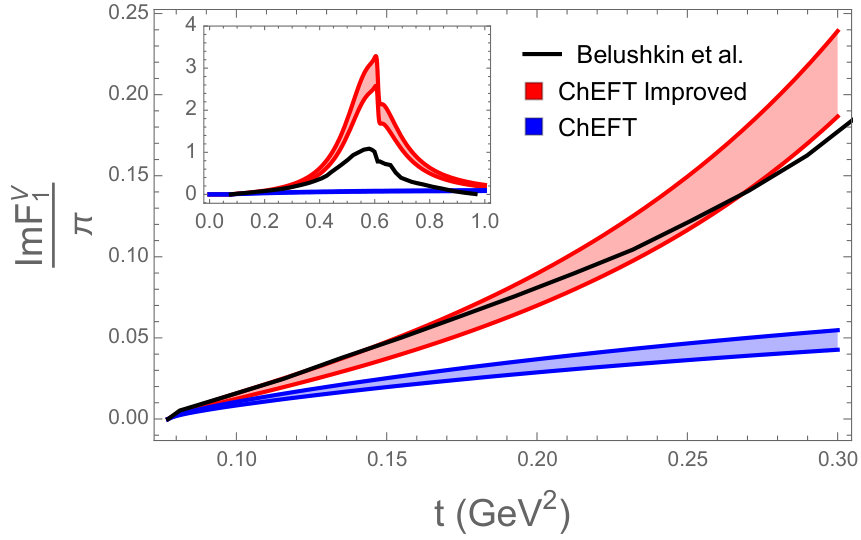 Figure 1
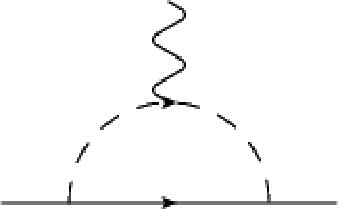 Figure 2
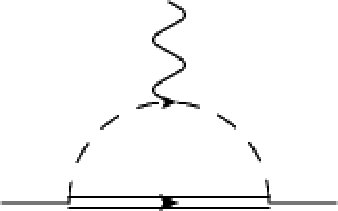 Figure 3
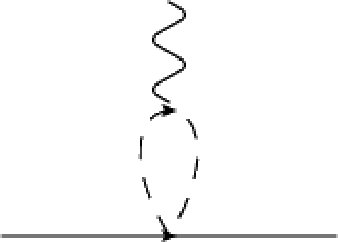 Figure 4
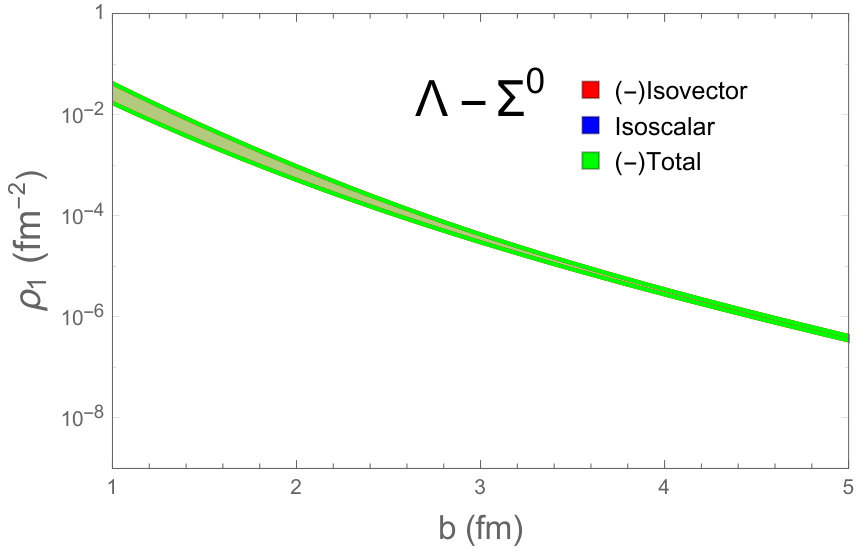 Figure 5
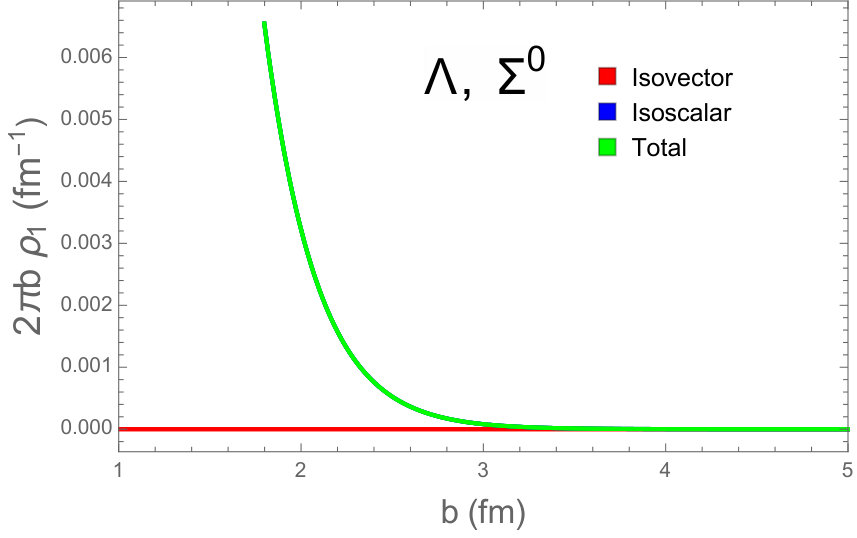 Figure 6
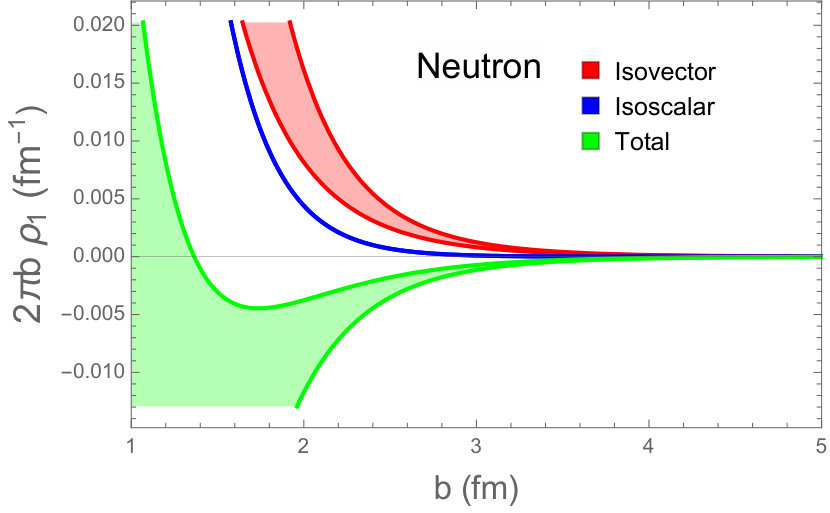 Figure 7
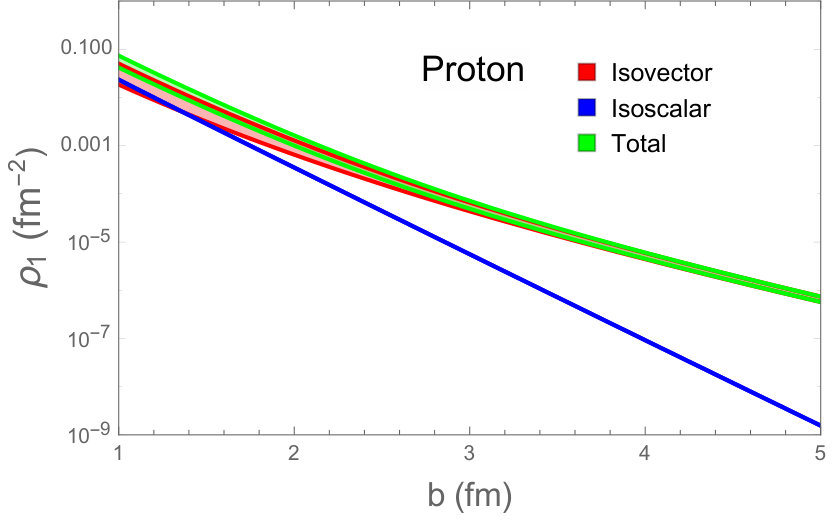 Figure 8
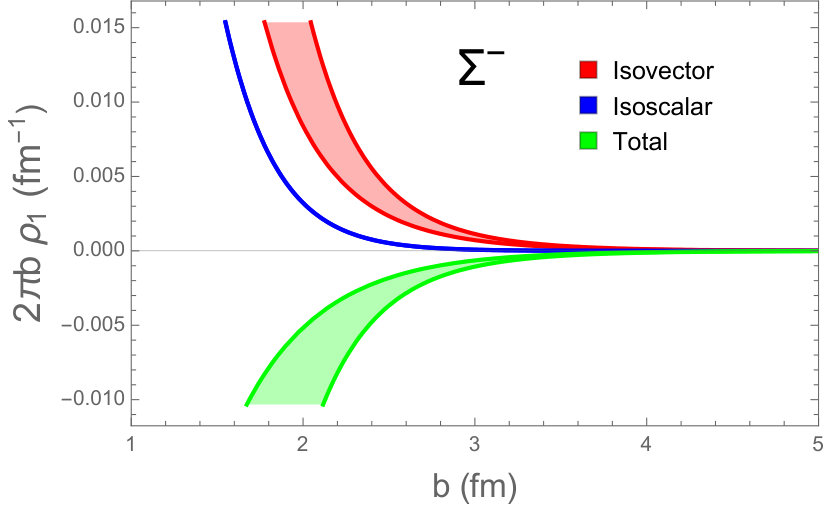 Figure 9
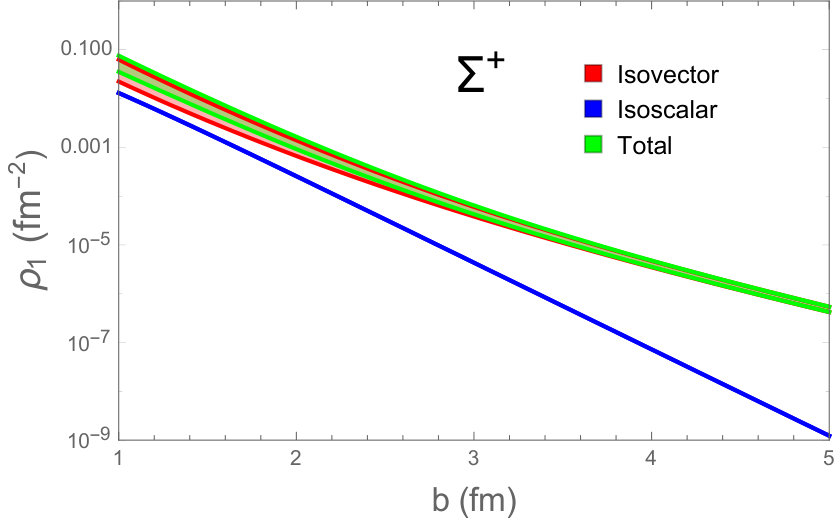 Figure 10
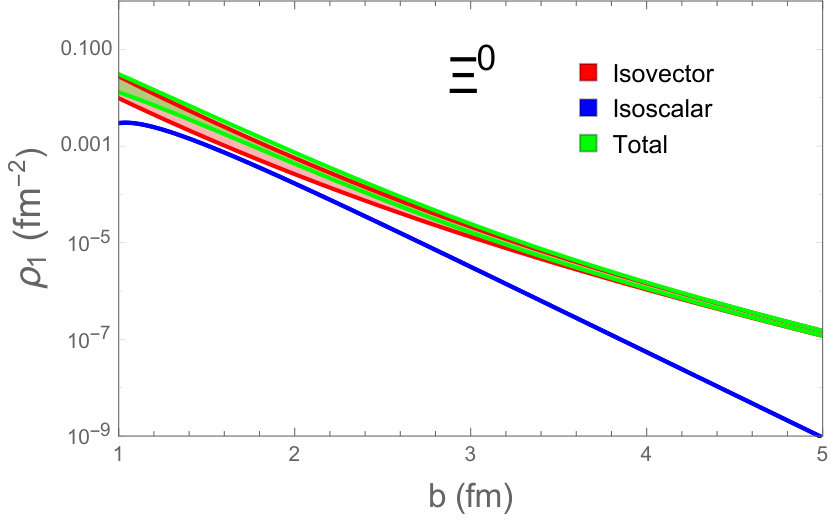 Figure 11
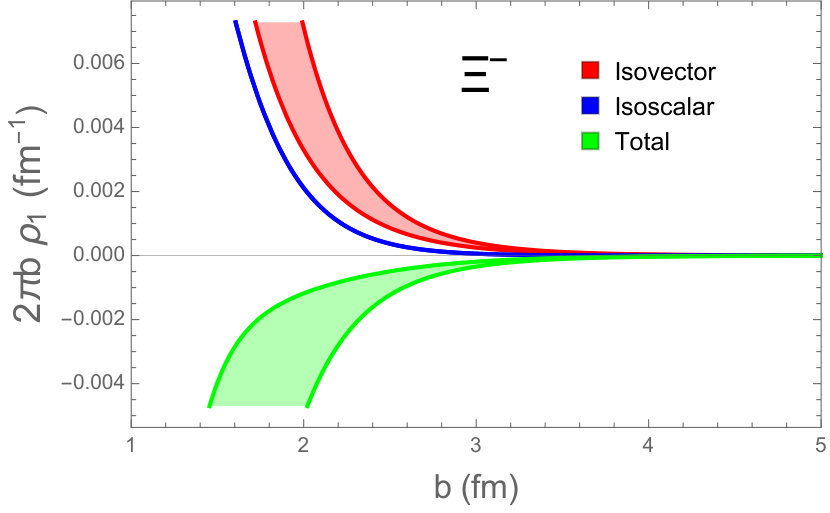 Figure 12
Peer Reviews
No public reviews on file for this paper yet. If you reviewed it on a platform where reviews are public (OpenReview, ICLR, NeurIPS, ICML), you can paste yours below so the community can read it here.
Videos
No videos yet. Explain this paper in a talk, walkthrough, or lecture? Add one.
∎
11institutetext: Jose Manuel Alarcón and Christian Weiss 22institutetext: Theory Center, Jefferson Lab, Newport News, VA 23606, USA
22email: [email protected], 22email: [email protected] 33institutetext: Astrid N. Hiller Blin 44institutetext: Departamento de Física Teórica and IFIC, Centro Mixto Universidad de Valencia-CSIC, Institutos de Investigación de Paterna, E-46071 Valencia, Spain
44email: [email protected]
Transverse densities of octet baryons from chiral effective field theory
Jose Manuel Alarcón
Astrid N. Hiller Blin
Christian Weiss
Abstract
Transverse densities describe the distribution of charge and current at fixed light-front time and provide a frame-independent spatial representation of hadrons as relativistic systems. We calculate the transverse densities of the octet baryons at peripheral distances in an approach combining chiral effective field theory (EFT) and dispersion analysis. The densities are represented as dispersive integrals of the imaginary parts of the baryon electromagnetic form factors in the timelike region (spectral functions). The spectral functions on the two-pion cut at are computed using relativistic EFT with octet and decuplet baryons in the EOMS renormalization scheme. The calculations are extended into the -meson mass region, using a dispersive method that incorporates the timelike pion form-factor data. The approach allows us to construct densities at distances fm with controlled uncertainties. Our results provide insight into the peripheral structure of nucleons and hyperons and can be compared with empirical densities and lattice-QCD calculations.
Keywords:
Electromagnetic form factors Chiral Lagrangians Hyperons Charge distribution
††journal: Few-Body Systems
1 Introduction
Light-front quantization offers a natural framework for formulating the spatial structure of relativistic systems and exploring its connection to the underlying dynamics; see [1] for a review. In this framework, hadronic current matrix elements (vector, axial) are represented in terms of transverse densities, which are two-dimensional Fourier transforms of the invariant form factors and describe the transverse spatial distribution of charge and current in the hadron at fixed light-front time [2; 3; 4; 5]. The transverse densities are frame independent (they are invariant under longitudinal boosts and transform kinematically under transverse boosts) and thus provide an objective spatial representation of the hadron as a relativistic system. In composite models of hadron structure they correspond to proper densities of the light-front wave functions of the system. In the context of QCD the transverse charge and current densities in hadrons can be related to the generalized parton distributions (GPDs) describing the distribution of quarks and antiquarks in longitudinal momentum and transverse position [3; 6]. The charge and magnetization densities in the nucleon have been extracted from the available electromagnetic form-factor data [7; 8] and provide interesting insight into the nucleon structure; see [5] for a review. It is worthwhile to explore how the transverse densities could be calculated using theoretical methods, and how the studies could be extended to other baryons.
The transverse densities at a given distance can be connected with the “exchange mechanisms” acting in the hadron form factors — virtual processes in which the current couples to the hadron through the exchange of a hadronic system in the -channel. This connection can be made rigorous in a dispersive representation of the transverse densities [9; 10]. At distances , the densities are governed by soft-pion exchange between the current and the hadron and can be calculated model-independently using chiral effective field theory (EFT). Detailed studies of the peripheral densities in the nucleon were performed in [10; 11; 12] using EFT with SU(2) flavor group, and a simple quantum-mechanical interpretation of the results was obtained (chiral light-front wave functions, orbital motion of a peripheral pion). At distances fm, the transverse densities are dominated by vector-meson exchange (isovector ; isoscalar ) and offer interesting insight into the duality between quark structure and meson exchange [14].
In these proceedings we report about a study of the peripheral densities of the SU(3) flavor-octet baryons combining methods of EFT and dispersion analysis. The densities are represented as a dispersive integral over the imaginary parts of the baryon electromagnetic form factors in the timelike region (spectral functions). The isovector spectral functions on the two-pion cut at are computed using relativistic EFT with octet and decuplet baryons in the EOMS renormalization scheme. The calculations are extended into the -meson mass region using a dispersive method that incorporates the timelike pion form-factor data. The methods allow us to construct the densities down to distances fm with controlled uncertainties. Details will be reported in a forthcoming publication [13].
2 Transverse densities and dispersive representation
The matrix element of the electromagnetic current between states of a flavor-octet baryon () with 4-momenta and is described by two invariant form factors, and (the Dirac and Pauli form factors; we follow the conventions of [10]). They are functions of the invariant momentum transfer , and can be measured and interpreted without specifying the form of relativistic dynamics or the reference frame. In the context of light-front quantization, one considers the current matrix element in a frame where the 4-momentum transfer has only transverse components , and represents the form factors as Fourier transforms of certain two-dimensional densities (here ),
[TABLE]
The interpretation of as spatial densities is discussed in [3; 5] and summarized in [10]. Their spatial integral reproduces the total charge and anomalous magnetic moment of the baryon. In a state where the baryon is localized in transverse space at the origin, describes the spin-independent current at light-front time and transverse position , while describes the spin-dependent part of the current in a transversely polarized nucleon.
The form factors are analytic functions of and satisfy unsubtracted dispersion relations
[TABLE]
The spectral functions are given by the imaginary parts of the form factors on the principal cut starting at . They describe processes in which the current at timelike converts to a hadronic state that couples to the system. Most of the relevant processes are in the unphysical region below the two-baryon threshold at , where the spectral function can only be computed theoretically. From Eqs. (1) and (2), one obtains a dispersive representation of the transverse densities [9]
[TABLE]
where are the modified Bessel functions. The integrals in Eqs. (3) and (4) converge exponentially at large , at , strongly suppressing contributions from high-mass hadronic states. Depending on the distance , the integrals sample the spectral functions in different regions of [14]. At fm, the integrals extend over the near-threshold region , where the spectral functions arise from soft two-pion exchange between the baryon and the current. At fm, the dominant contributions come from the vector-meson region of the spectral functions (). At even shorter distances, the integrals extend over the high-mass region GeV2, where the spectral functions involve multi-hadron states and are poorly known at present [15]. The dispersive representation Eqs. (3) and (4) thus establishes a quantitative connection between the transverse densities and the exchange mechanisms in the form factor.
3 Spectral functions from chiral EFT and dispersion theory
We compute the isovector spectral functions of the SU(3) octet-baryon form factors above the two-pion threshold using relativistic EFT. Decuplet baryons are included as dynamical degrees of freedom within the small-scale expansion (SSE) [16; 17] (the first form factor calculations in this approach were performed in [18]). The fields and Lagrangian are described in [19; 20; 21]. The renormalization of the divergent pieces is performed within the EOMS scheme, which permits consistent power counting [22]. The spectral functions arise from diagrams with a two-pion cut; the diagrams are shown in Fig. 1 (the imaginary parts are actually finite at this order and do not require renormalization). The low-energy constants at this order are given by the nucleon’s axial charge (or coupling) and the coupling, so that the spectral functions are EFT predictions free of unknown parameters. While not shown here, we have calculated the entire form factor from the full set of diagrams in order to verify gauge invariance, and reproduce the SU(2) results of [21].
The EFT expressions by themselves describe the baryon spectral functions only in the near-threshold region . In order to extend the description to higher , we use a dispersive technique following [23; 24; 25]; see also [26]. On general grounds, the isovector spectral function on the two-pion cut (neglecting the contributions from states) can be expressed as
[TABLE]
where is the -channel center-of-mass momentum, is the partial-wave amplitude, and is the pion form factor. The expression on the right-hand side of Eq. (5) is real because the complex functions and have the same phase on the two-pion cut (Watson theorem). It is convenient to rewrite Eq. (5) as
[TABLE]
This representation has two major advantages: (i) The function has no two-pion cut, because it is real at ; (ii) the squared modulus can be extracted directly from the exclusive annihilation cross section, without determining the phase of the complex function. We now use EFT to calculate the real function at , and multiply with the empirical containing the meson resonance. At one has , so that the EFT result for the ratio is the same as that for the amplitude itself, and the prescription simply amounts to multiplying the result for the spectral function by ,
[TABLE]
The prescription Eq. (7) results in a marked improvement of the EFT predictions for the spectral functions. The improved EFT results for the nucleon () reproduce the dispersion-theoretical spectral functions (obtained by analytic continuation of the phase shifts [27; 28; 29]) up to within errors, and have qualitatively the correct behavior even in the -meson mass region (see Fig. 2). We use this method to calculate the other octet-baryon spectral functions on the two-pion cut. A detailed discussion of the procedure and its applications will be presented in [13].
4 Peripheral transverse densities
Using the improved EFT results for the spectral functions, we calculate the peripheral isovector densities in the octet baryons. The restriction to distances fm ensures that the dispersion integrals Eqs. (3) and (4) extend only over the region of where our approximation to the spectral functions is justified. The uncertainties of the isovector densities are estimated by propagating the theoretical uncertainty of the spectral functions [13]. In order to estimate also the isoscalar densities, we parametrize the isoscalar spectral functions of the octet baryons in the mass region GeV2 by vector-meson poles (). The couplings are obtained from SU(3) symmetry, with certain assumptions regarding the ratio and the empirical couplings (we do not aim for a precise description of the isoscalar sector here, as the peripheral densities are dominated by the isovector component).
Results for the transverse charge densities are shown in Fig. 3. The densities decay exponentially at large , as dictated by the analytic properties of Eqs. (3) and (4). The comparison of the various components reveals several interesting features. At large distances fm, the densities are dominated by the isovector component, resulting from two-pion exchange near threshold. The isoscalar component generally becomes comparable to the isovector at distances below fm, due to the similar strength of the spectral functions in the vector-meson region ( vs. ). In the neutron, the isovector component dominates for fm, and causes the peripheral charge density to be negative. Studies of empirical neutron densities have shown that at fm the isoscalar takes over, and the neutron charge density becomes positive [4; 14]; at such distances the present theoretical calculation has large uncertainties and cannot predict the sign.
In the and charge densities, the isovector component is absent because of the isospin selection rules for the -channel process current : the transitions and are both forbidden. In contrast, in the transition density, the isoscalar component is absent and the density is pure isovector. The peripheral densities of the and thus provide a means to isolate the low-mass isovector and isoscalar exchanges in the form factors. The and densities are similar to the proton and neutron in that both isovector and isoscalar exchanges are present. The isovector component is relatively smaller in the states, due to the suppression of octet intermediate states in the pion loops for the form factor (they are of the same order as the decuplet intermediate states).
Similar features are exhibited by the magnetization densities of the octet baryons. Using the same techniques we can also calculate the flavor decomposition of the peripheral densities and study the contribution of individual quark flavors to the charge and magnetization [13].
5 Summary and outlook
We have presented a new approach to the calculation of the peripheral transverse densities using a combination of relativistic EFT and dispersion analysis. The dispersive improvement extends the EFT calculations of the isovector spectral functions into the vector-meson mass region and allows us to compute densities down to distances fm with controlled accuracy. The approach can be extended to the octet-baryon form factors of other operators (energy-momentum tensor, moments of GPDs). It can also be used to calculate the transverse densities of the decuplet baryons (especially the isobar), which are studied in Lattice QCD, as well as to the densities of the octet-decuplet transition form factors (especially ), which are measured in resonance electroproduction.
Our approach consistently includes the contributions from decuplet intermediate states in the loop diagrams. These contributions are numerically important in the transverse densities at distances 1–2 fm. They are also essential for ensuring the proper scaling behavior of the densities in the large– limit of QCD. This was demonstrated for the SU(2) EFT in [10; 30], and can be shown for the present SU(3) calculation as well.
Acknowledgements.
This material is based upon work supported by the U.S. Department of Energy, Office of Science, Office of Nuclear Physics under contract DE-AC05-06OR23177. This work was supported by the Spanish Ministerio de Economía y Competitividad (MINECO) and the European fund for regional development (FEDER) under contracts FIS2014-51948-C2-2-P and SEV-2014-0398.
The reference list from the paper itself. Each links out to its DOI / PubMed record.
- 1Brodsky et al [1998] Brodsky SJ, Pauli HC, Pinsky SS (1998) Quantum chromodynamics and other field theories on the light cone. Phys Rept 301:299–486, DOI 10.1016/S 0370-1573(97)00089-6, hep-ph/9705477
- 2Soper [1977] Soper DE (1977) The Parton Model and the Bethe-Salpeter Wave Function. Phys Rev D 15:1141, DOI 10.1103/Phys Rev D.15.1141
- 3Burkardt [2000] Burkardt M (2000) Impact parameter dependent parton distributions and off forward parton distributions for ζ → 0 → 𝜁 0 \zeta\rightarrow 0 . Phys Rev D 62:071,503, DOI 10.1103/Phys Rev D.62.071503, 10.1103/Phys Rev D.66.119903, [Erratum: Phys. Rev.D 66,119903(2002)], hep-ph/0005108
- 4[4] Miller GA (2007) Charge Density of the Neutron. Phys Rev Lett 99:112001 DOI doi:10.1103/Phys Rev Lett.99.112001 ar Xiv:0705.2409 [nucl-th]
- 5[5] Miller GA (2010) Transverse Charge Densities. Ann Rev Nucl Part Sci 60:1 DOI doi:10.1146/annurev.nucl.012809.104508 ar Xiv:1002.0355 [nucl-th]
- 6[6] Burkardt M (2003) Impact parameter space interpretation for generalized parton distributions. Int J Mod Phys A 18:173 DOI doi:10.1142/S 0217751 X 03012370 hep-ph/0207047
- 7Perdrisat et al [2007] Perdrisat CF, Punjabi V, Vanderhaeghen M (2007) Nucleon Electromagnetic Form Factors. Prog Part Nucl Phys 59:694–764, DOI 10.1016/j.ppnp.2007.05.001, hep-ph/0612014
- 8Punjabi et al [2015] Punjabi V, Perdrisat CF, Jones MK, Brash EJ, Carlson CE (2015) The Structure of the Nucleon: Elastic Electromagnetic Form Factors. Eur Phys J A 51:79, DOI 10.1140/epja/i 2015-15079-x, 1503.01452