Interaction of real and virtual $p\bar{p}$ pairs in $J/\psi\to p\bar{p}\gamma(\rho,\omega)$ decays
A. I. Milstein, S. G. Salnikov

TL;DR
This paper models the interaction between real and virtual proton-antiproton pairs in specific J/psi decays using an optical potential approach, successfully fitting experimental data and explaining near-threshold spectral features.
Contribution
It introduces a new NbarN optical potential model for the 1S0 state and applies it to describe invariant mass spectra in J/psi decays, aligning well with experimental observations.
Findings
Good fit to experimental pbarp invariant mass spectra
Successful description of near-threshold spectral peaks
Proposed NbarN interaction potential model
Abstract
The invariant mass spectra of the processes , , and close to the threshold are calculated by means of the optical potential. The potential model for interaction in the state is proposed. The parameters of the model are obtained by fitting the cross section of scattering together with the invariant mass spectra of the decays. Good agreement with the available experimental data is achieved. Using our potential and the Green's function approach we also describe the peak in the invariant mass spectrum in the decay in the energy region near the threshold.
Click any figure to enlarge with its caption.
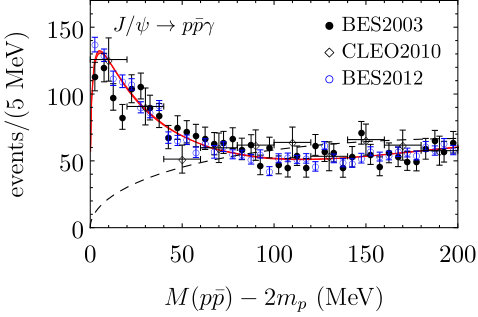 Figure 1
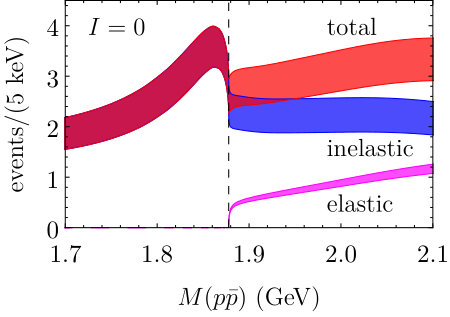 Figure 2
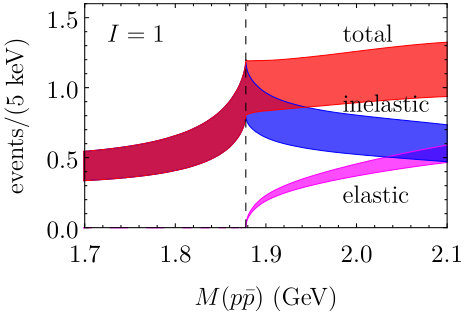 Figure 3
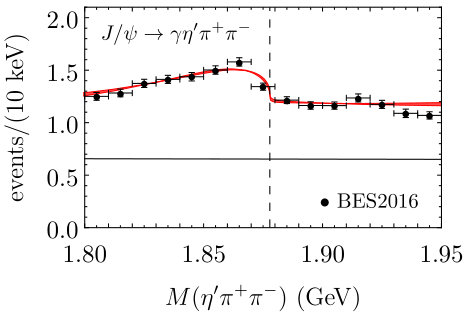 Figure 4
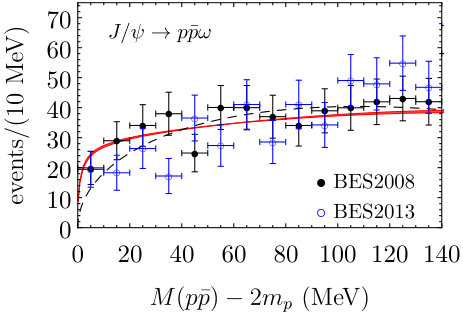 Figure 5
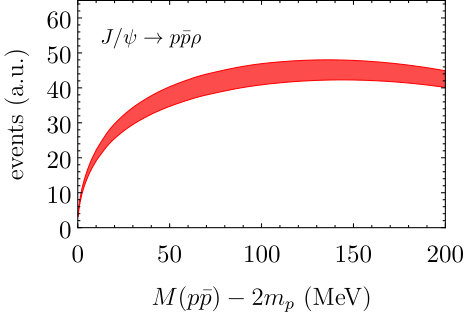 Figure 6
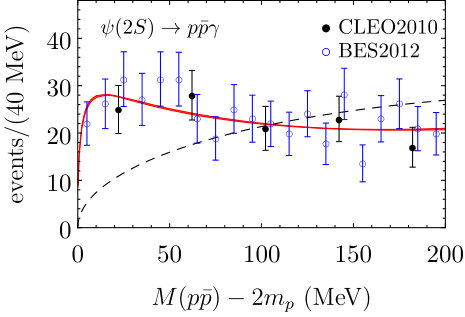 Figure 7
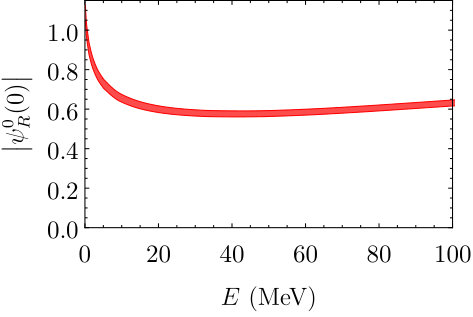 Figure 8
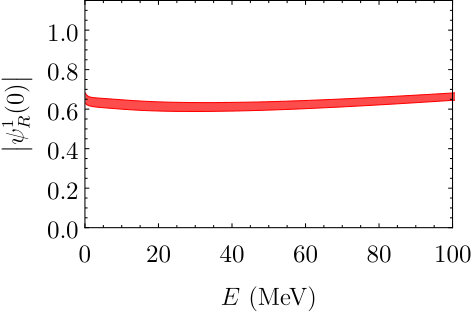 Figure 9
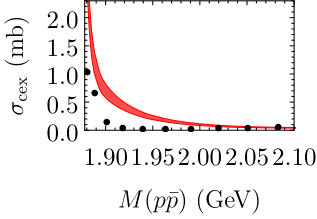 Figure 10
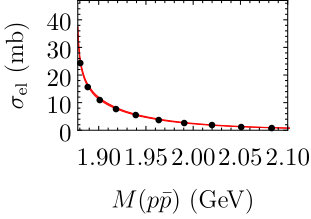 Figure 11
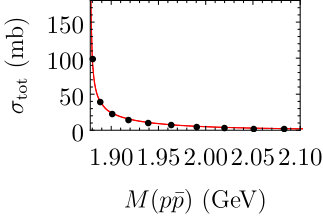 Figure 12
Peer Reviews
No public reviews on file for this paper yet. If you reviewed it on a platform where reviews are public (OpenReview, ICLR, NeurIPS, ICML), you can paste yours below so the community can read it here.
Videos
No videos yet. Explain this paper in a talk, walkthrough, or lecture? Add one.
Taxonomy
TopicsParticle physics theoretical and experimental studies · Quantum Chromodynamics and Particle Interactions · Black Holes and Theoretical Physics
Interaction of real and virtual pairs in
decays
A. I. Milstein
Budker Institute of Nuclear Physics, 630090, Novosibirsk, Russia
S. G. Salnikov
Budker Institute of Nuclear Physics, 630090, Novosibirsk, Russia
Novosibirsk State University, 630090, Novosibirsk, Russia
L.D. Landau Institute for Theoretical Physics, 142432, Chernogolovka, Russia
(March 16, 2024)
Abstract
The invariant mass spectra of the processes , , and close to the threshold are calculated by means of the optical potential. The potential model for interaction in the state is proposed. The parameters of the model are obtained by fitting the cross section of scattering together with the invariant mass spectra of the decays. Good agreement with the available experimental data is achieved. Using our potential and the Green’s function approach we also describe the peak in the invariant mass spectrum in the decay in the energy region near the threshold.
I Introduction
Investigation of the nucleon-antinucleon interaction in the low-energy region is an actual topic today. Unusual behavior of the cross sections of several processes has been discovered in recent years. For instance, the cross sections of the processes and reveal an enhancement near the threshold Aubert et al. (2006a); Lees et al. (2013); Achasov et al. (2014); Akhmetshin et al. (2016). The enhancement near the threshold is also observed in the decays Bai et al. (2003); Ablikim et al. (2009); Bai et al. (2001), Bai et al. (2003); Alexander et al. (2010); Ablikim et al. (2012, 2008, 2013). The sharp peak in the vicinity of threshold has been observed in the cross sections of several processes, i.e., Aubert et al. (2006b, 2007); Akhmetshin et al. (2013); Lukin et al. (2015); Obrazovsky and Serednyakov (2014) and Ablikim et al. (2016). These observations led to numerous speculations about a new resonance Bai et al. (2003), bound state Datta and O’Donnell (2003); Ding and Yan (2005); Yan et al. (2005), or even a glueball state Kochelev and Min (2006); Li (2006); He et al. (2007) with the mass about double proton mass. Another possibility, which we are studying, is the nucleon-antinucleon interaction in the final or intermediate states.
We describe the nucleon-antinucleon interaction by means of an optical potential model. Several optical nucleon-antinucleon potentials El-Bennich et al. (2009); Zhou and Timmermans (2012); Kang et al. (2014) are usually used to describe the interaction in the low-energy region. All these nucleon-antinucleon potentials have been proposed to fit the nucleon-antinucleon scattering data. These data include elastic, charge-exchange, and annihilation cross sections of scattering, as well as some single-spin observables. There were attempts to describe the processes of production in annihilation using these potential models. For instance, using the Paris Dmitriev and Milstein (2007) and Jülich Haidenbauer et al. (2014) models, it has been shown that the near-threshold enhancement of the cross sections of these processes can be explained by the final-state nucleon-antinucleon interaction. The strong dependence of the ratio of electromagnetic form factors of the proton on the energy in the timelike region near the threshold has been explained by the influence of the tensor part of the nucleon-antinucleon interaction.
In our recent paper Dmitriev et al. (2016a), to fit the parameters of the potential, we have suggested to include all available experimental data in addition to the nucleon-antinucleon scattering data. A simple potential model of interaction in the partial waves , coupled by the tensor forces, has been suggested. The parameters of this model has been obtained by fitting simultaneously the nucleon-antinucleon scattering data, the cross sections of and production in annihilation, and the ratio of electromagnetic form factors of the proton in the timelike region. This model has allowed us to calculate also the contribution of virtual intermediate state to the processes of meson production in annihilation and to describe the sharp dip in the cross section of production in the vicinity of the threshold Dmitriev et al. (2016a). Similar results have also been obtained in Ref. Haidenbauer et al. (2015) within the chiral model Kang et al. (2014) but without the tensor interaction taken into account.
The potential Dmitriev et al. (2016a) has also been used to explain the enhancement observed in the invariant mass spectra of the decays near the threshold Dmitriev et al. (2016b). Note that in these decays in the near-threshold region the most important contribution is also given by the partial waves . The spectra of these decays, as well as the decays , have also been studied in Refs. Kang et al. (2015); Liu and Kang (2016) using the chiral model Kang et al. (2014).
In the present paper we follow our idea and construct a simple optical potential model of the interaction in the partial wave. This partial wave should give the most important contribution to the final-state interaction in the decays in the energy region close to the threshold. We show that it is possible to describe the pronounced peak in the invariant mass spectrum of the decay using a simple model of the interaction. Moreover, in contrast to the results of Ref. Kang et al. (2015), our model doesn’t predict such peak in the spectrum of the decay which has not been observed yet.
We use our model to calculate the contribution of virtual pair to the decay rate in the energy region near the threshold. Our model describes a peak in the invariant mass spectrum. It has been pointed out in Ref. Ablikim et al. (2016) that a contribution of virtual state may be one of possible origins of the peak in the spectrum. However, in Ref. Ablikim et al. (2016) any models of the interaction have not been applied.
II Decay amplitude
Due to the -parity conservation law, possible states for a pair in the decays , , and are and . The -wave state dominates in the near-threshold region where the relative velocity of the nucleons is small. The pairs have different isospins for the final states containing a vector meson ( for the state, and for the state). In the case of final state, the pair is a mixture of two isospin states.
We derive the formulas for the decay rate of the process , where is one of the vector mesons or a photon. Below we use the notation: and are the momentum and the energy of the meson in the rest frame, is the proton momentum in the center-of-mass frame, is the invariant mass of the system. Then the following relations hold:
[TABLE]
where is the mass of the particle, and are the masses of a meson and a proton, respectively, . Since we consider the invariant mass region , the proton and antiproton are nonrelativistic in their center-of-mass frame, while is about .
In the center-of-mass frame, the radial wave function of the pair corresponding to the wave, , is a regular solution of the radial Schrödinger equation
[TABLE]
Here is the radial part of the Laplace operator, , is the optical potential for the partial wave with the isospin . The solution is determined by its asymptotic form at large distances
[TABLE]
where is some function of energy. The dimensionless amplitude of the decay with the corresponding isospin of the pair can be written as
[TABLE]
Here is an energy-independent dimensionless constant, and are the polarization vectors of the particle and , respectively,
[TABLE]
where is the unit vector collinear to the momentum of electrons in the beam. The sum over the polarizations of the vector mesons reads
[TABLE]
and the sum over the photon polarizations is
[TABLE]
where .
The decay rate of the process can be written in terms of the dimensionless amplitude (see, e.g., Sibirtsev et al. (2005)):
[TABLE]
where is the proton solid angle in the center-of-mass frame and is the solid angle of the particle in the rest frame.
Substituting the amplitude (3) in Eq. (7) and averaging over the spin states, we obtain the invariant mass and angular distribution for the decay rate
[TABLE]
where is the angle between and . The invariant mass distribution can be obtained by integrating Eq. (8) over the solid angles and :
[TABLE]
The wave function module squared is the so-called enhancement factor which equals to unity if the final-state interaction is turned off.
The optical potential can also be used to calculate the decay rates of the processes with a virtual pair in the intermediate state. In Ref. Dmitriev et al. (2016a) it is shown that the total cross section of production, which is a sum of the cross section of real pair production (the elastic cross section) and the cross section of the meson production via annihilation of a virtual pair (the inelastic cross section), can be written in terms of the Green’s function of the pair. According to Ref. Dmitriev et al. (2016a), in order to switch from the elastic cross section to the total one, we should replace by , where is the Green’s function of the Schrödinger equation (2). Therefore, the contribution of the intermediate state to the decay rate of the process (particles in the final state can be nucleons or mesons) has the form
[TABLE]
where is the invariant mass of the mesons, . The Green’s function is the solution of the equation
[TABLE]
and can be written in terms of regular, , and non-regular, , solutions of the Schrödinger equation (2):
[TABLE]
where is the Heaviside function, and the non-regular solution has the asymptotic form at large distances
[TABLE]
III Results and Discussion
In the present work we propose an optical potential for the partial wave, which can be represented as
[TABLE]
where are the Pauli matrices in the isospin space. Thus, the potentials , corresponding to channels in Eq. (2), read
[TABLE]
Similar to Ref. Dmitriev et al. (2016a), our potential is the sum of a long-range pion-exchange potential and a short-range potential well
[TABLE]
where is the pion-exchange potential, , , and are free parameters fixed by fitting the experimental data. The pion-exchange potential of the nucleon-antinucleon interaction for the total spin is given by the formula (see, e.g., Ericson and Weise (1988))
[TABLE]
where , is the pion mass.
The data used for fitting the parameters of the potential include the partial contributions of wave to the elastic, charge-exchange, and total cross sections of scattering, and the invariant mass spectra of the decays , , and . The partial cross sections of scattering are calculated from the Nijmegen partial wave -matrix (Table V of Ref. Zhou and Timmermans (2012)). The results of the fit are given in Table 1, and the dependence of on the nucleon energy is shown in Fig. 1. The accuracy of the fit can be seen from Fig. 2.
The number of free parameters in our model is . The total number of experimental data points for the invariant mass spectra of the decays , , and is . Thus, we have degrees of freedom. The minimum per degree of freedom is , which is good enough taking into account simplicity of our model. The errors in Table 1 correspond to the values of the parameters that give .
By means of this model and Eq. (9), we calculate the invariant mass spectra in the processes and (see Fig. 3). The isospin of the pair is and for meson and meson in the final state, respectively. Therefore, the decay rates for these processes are given by Eq. (9) with the corresponding constants and wave functions . Our model fits the experimental data for the decay quite well. There are no experimental data for the decay , therefore, the predictions for the invariant mass spectrum are especially important. The spectrum in the decay , calculated in Ref. Kang et al. (2015) with the use of the chiral model Kang et al. (2014), has a pronounced peak close to the threshold, while our model predicts a monotonically increasing spectrum without any peak.
The decay amplitude of the process is a sum of two isospin contributions. Therefore, the decay rate reads
[TABLE]
Our model describes with good accuracy the pronounced peak, seen fairly well in the experimental data for the decay (see Fig. 3). For the best fit, the ratio of the constants is . We have investigated in details the origin of this peak and found out that it arrises because of a significant compensation of two isospin amplitudes at energy above per nucleon, though each isospin amplitude has no peak. This leads to another interesting prediction. The decay rate of the process , given by the formula
[TABLE]
should be much larger than that for the process . For completeness, we also consider the decay (the corresponding ratio of the constants is ), see Fig. 3.
At , the state may also give a noticeable contribution to the decay rate. This is why we do not show the prediction for the decay rate in this region. Besides, the value is only approximate boundary of the region where the contribution of the state can be neglected. Of course, it is impossible to calculate this boundary because the exact decay mechanism is unknown. Only the experimental measurements of the angular distributions near the threshold can show the importance of higher partial waves contributions and give more accurate information about the region of applicability of our approach.
Making use of our potential model and Eq. (10), we obtain also the predictions for the decay rates of the processes with the interaction of virtual nucleon-antinucleon pairs in the intermediate state (see Fig. 4). A peak in the total and inelastic invariant mass spectra exists near the threshold, especially in the isoscalar channel. This behavior seems to be the consequence of the existence of a quasi-bound state near the threshold. Our analysis shows that such state does exist in the isoscalar channel, and its energy is . This is an unstable bound state in the classification of Ref. Badalyan et al. (1982) because its energy moves to when the imaginary part of the potential is turned off.
Let us discuss the exotic behavior of the decay rate of the process near the threshold observed in Ref. Ablikim et al. (2016). The -parity of the intermediate state, , should be equal to that of the final state, . Taking into account -parity conservation we obtain , thus the isospin of the pair is . Possible states with positive -parity are and , and the former one is expected to dominate in the near-threshold region. Therefore, we believe that the peak in the invariant mass spectrum could occur because of the interaction of virtual nucleons in the isoscalar intermediate state. The contribution of non- channels should be a smooth function in the vicinity of the threshold. Therefore, we approximate the invariant mass spectrum of the decay by the function , where , and are some fitting parameters. The comparison of the experimental data and our fitting formula in Fig. 5 demonstrates good agreement in the near-threshold region.
IV Conclusions
We have proposed a simple optical potential model of interaction in the state. With the help of this model we have calculated the effects of final-state interaction in several decays. Our model describes the invariant mass spectra of the decays , , and with good precision. We have also obtained the predictions for the invariant mass spectrum in the decay which has not been measured yet. Our prediction for this spectrum differs from the theoretical results obtained earlier. Therefore, the experimental study of the decay rate of this process would help to discriminate different models of the nucleon-antinucleon interaction.
We have used the Green’s function approach to calculate the contribution of the interaction of virtual pairs in the state to the cross sections of the processes. In particular we have calculated the contribution of the intermediate state to the invariant mass spectrum for the decay in the energy region near the threshold. Our results are in good agreement with the available experimental data and describe the peak in the invariant mass spectrum just below the threshold.
Acknowledgements.
We are thankful to V. F. Dmitriev for useful discussions. The work of S. G. Salnikov has been supported by the RScF grant 16-12-10151.
The reference list from the paper itself. Each links out to its DOI / PubMed record.
- 1Aubert et al. (2006 a) B. Aubert, et al., Phys. Rev. D 73 , 012005 (2006 a) . · doi ↗
- 2Lees et al. (2013) J. P. Lees, et al., Phys. Rev. D 87 , 092005 (2013) . · doi ↗
- 3Achasov et al. (2014) M. N. Achasov, et al., Phys. Rev. D 90 , 112007 (2014) . · doi ↗
- 4Akhmetshin et al. (2016) R. Akhmetshin, et al., Phys. Lett. B 759 , 634 (2016) . · doi ↗
- 5Bai et al. (2003) J. Bai, et al., Phys. Rev. Lett. 91 , 022001 (2003) . · doi ↗
- 6Ablikim et al. (2009) M. Ablikim, et al., Phys. Rev. D 80 , 052004 (2009) . · doi ↗
- 7Bai et al. (2001) J. Bai, et al., Phys. Lett. B 510 , 75 (2001) . · doi ↗
- 8Alexander et al. (2010) J. P. Alexander, et al., Phys. Rev. D 82 , 092002 (2010) . · doi ↗