On polynomially integrable domains in Euclidean spaces
Mark L. Agranovsky

TL;DR
This paper investigates whether odd-dimensional ellipsoids are uniquely characterized by the polynomial nature of their Radon transform in Euclidean spaces, exploring a partial verification of this property.
Contribution
It provides partial results and discussion on the uniqueness of odd-dimensional ellipsoids based on the polynomial property of their Radon transform.
Findings
Ellipsoids have algebraic Radon transforms.
In odd dimensions, the Radon transform of ellipsoids is polynomial in t.
The paper discusses whether these properties uniquely identify ellipsoids.
Abstract
Let be a bounded domain in with smooth boundary. Denote the Radon transform of the characteristic function of the domain i.e., the dimensional volume of the intersection with the hyperplane If the domain is an ellipsoid, then the function is algebraic and if, in addition, the dimension is odd, then is a polynomial with respect to Whether odd-dimensional ellipsoids are the only bounded smooth domains with such a property? The article is devoted to partial verification and discussion of this question.
Click any figure to enlarge with its caption.
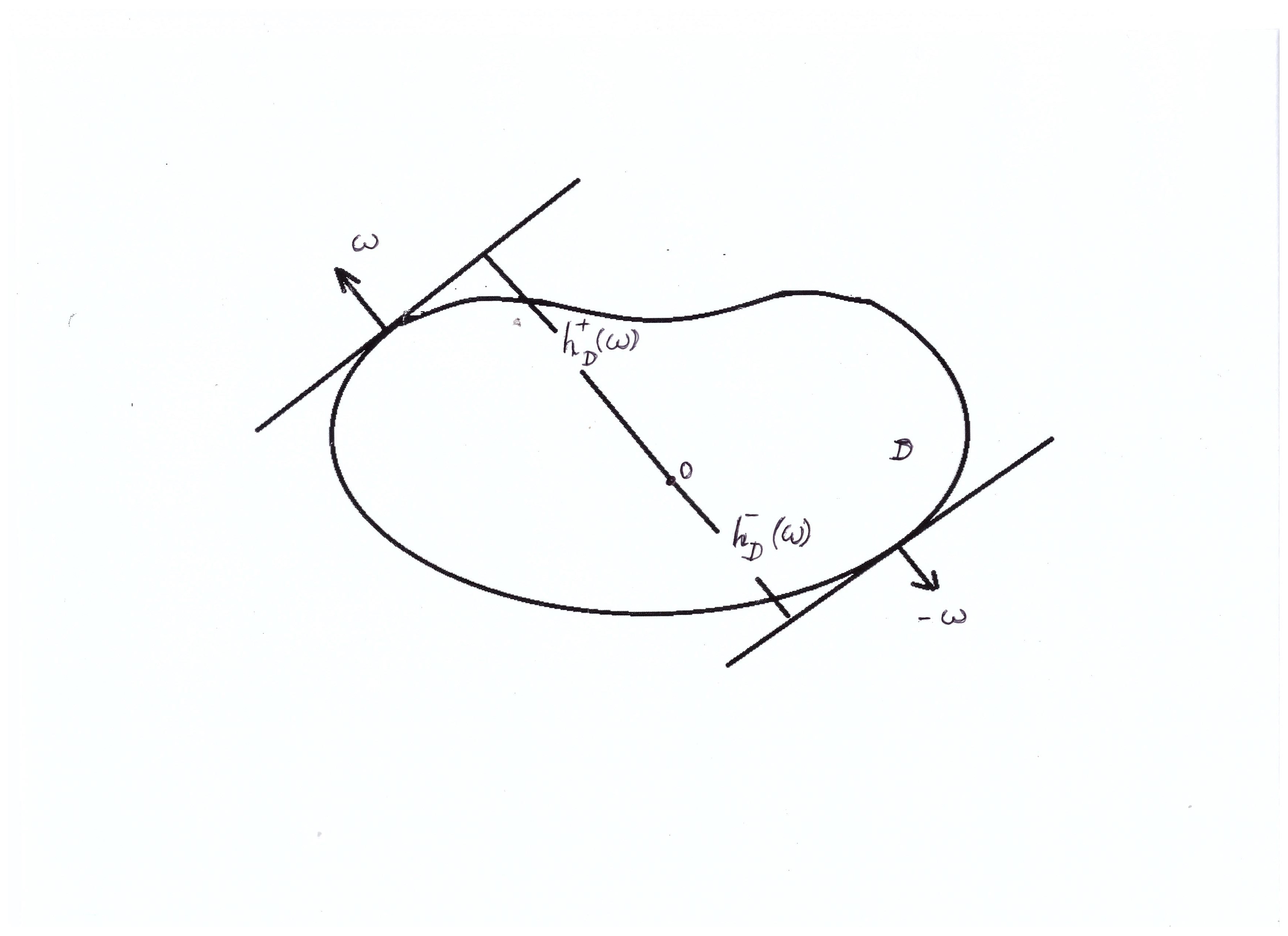 Figure 1
Peer Reviews
No public reviews on file for this paper yet. If you reviewed it on a platform where reviews are public (OpenReview, ICLR, NeurIPS, ICML), you can paste yours below so the community can read it here.
Videos
No videos yet. Explain this paper in a talk, walkthrough, or lecture? Add one.
On polynomially integrable domains in Euclidean spaces
Mark L. Agranovsky
Abstract
Let be a bounded domain in with smooth boundary. Denote the Radon transform of the characteristic function of the domain i.e., the dimensional volume of the intersection with the hyperplane If the domain is an ellipsoid, then the function is algebraic and if, in addition, the dimension is odd, then is a polynomial with respect to Whether odd-dimensional ellipsoids are the only bounded smooth domains with such a property? The article is devoted to partial verification and discussion of that question.
111MSC 2010: 44A12, 51M99; keywords: Radon transform, Fourier transform, cross-section, polynomial, ellipsoid.
1 Introduction
V. A. Vassiliev proved [1, 9] that if is a bounded domain in even-dimensional space with boundary, then the two-valued function, evaluated the dimensional volumes of the two complementary portions of which are cut-off by the section of by the hyperplane is not an algebraic function of the parameters of the hyperplane. That means that no functional equation where is a polynomial, is fulfilled. The result of [9] is a multidimensional generalization of a celebrated Newton’s Lemma XXVIII in Principia [8] for convex ovals in The smoothness condition is essential.
The main object of interest in this article is the section-volume function
[TABLE]
which is the derivative of
Contrary to the multi-valued cut-off-volume function its derivative is single-valued and can be algebraic in any dimension of the ambient space (the differentiation can ”improve” the algebraicity, just keep in mind the algebraic function which is the derivative of the non-algebraic function )
For example, if is the unit ball in then
[TABLE]
is algebraic in any dimension. If is odd then, even better, is a polynomial in Here and further, will denote a nonzero constant, which exact value is irrelevant.
Ellipsoids in odd-dimensional spaces also have the same property. For instance, if
[TABLE]
then
[TABLE]
where
[TABLE]
Definition 1
We will call a domain polynomially integrable if its section-volume function coincides with a polynomial in
[TABLE]
in the domain of all such that the hyperplane hits the domain
We assume that the leading coefficient is not identical zero and in this case we call the degree of the polynomially integrable domain
Note that in [9] the term ”algebraically integrable” refers to the cut-off volume function rather than to but polynomial integrability with respect to either function is the same.
It was conjectured in [9] that ellipsoids are the only smoothly bounded algebraically integrable domains in odd-dimensional Euclidean spaces. We are concerned with the similar question about the section-volume function and the condition is that this function is a polynomial in Although polynomials are definitely algebraic functions, we do not impose conditions on the dependence on Still, our conjecture is that the odd-dimensional ellipsoids are the only bounded polynomially integrable domains in odd-dimensional Euclidean spaces.
The present article contains some partial results and observations on the conjecture.
Namely, in Sections 1-4 we prove that there are no bounded polynomially integrable domains with smooth boundaries in Euclidean spaces of even dimensions (Theorem 2), while in odd dimensions the following is true: 2) polynomially integrable bounded domains with smooth boundaries are convex (Theorem 5), 3) there are no polynomially integrable bounded domains in with smooth boundaries, of degree strictly less than (Theorem 7), 4) polynomially integrable bounded domains in with smooth boundaries, of degree are only ellipsoids (Theorem 8, 4) polynomially integrable bounded domains in with smooth boundaries, having axial and central symmetry are only ellipsoids (Theorem 11). In Section 7 a relation of polynomial integrability and stationary phase expansions is discussed. Some open questions are formulated in Section 8.
2 Preliminaries
2.1 Support functions
For any bounded domain define the support functions
[TABLE]
where is a vector in the unit sphere and is the standard inner product in
The two support functions are related by
[TABLE]
The relation with translations is given by
[TABLE]
If then the is disjoint from the closed domain (and therefore ).
2.2 Radon transform
We will be using several standard facts about the Radon transform. They can be found in many books or articles on Radon transform, see e.g., [6],[7].
The Radon transform of a continuous compactly supported function in is defined as the integral
[TABLE]
of over the dimensional plane with the unit normal vector on the distance from the origin, against the dimensional volume element
There is a nice relation, called Projection-Slice Formula, between Fourier and Radon transforms:
[TABLE]
where is the dimensional Fourier transform and is the one-dimensional Fourier transform with respect to the variable The formula follows immediately by writing the integral as a double integral against and
The Radon transform can be inverted in different ways. The following formula is called back-projection inversion formula ([7], Thm 2.13) :
[TABLE]
where is sufficiently smooth compactly supported function.
There is a crucial difference between the inversion formulas in even and odd dimensions. If is even then the exponent is fractional and becomes an integral operator, so that the inversion formula is not local. However, when is odd then is integer and the operator in front of the integral is differential so that the formula is local.
Due to the relation
[TABLE]
the inversion formula can be rewritten in odd dimensions as:
[TABLE]
where is the Lebesgue measure on the unit sphere The Plancherel formula for the Radon transform in odd dimensions is:
[TABLE]
The following conditions characterize the range of Radon transform in class of Schwartz functions:
2. 2.
The moment extends from the unit sphere to as a polynomial of degree at most
The immediate corollary of property 1 is that if then
[TABLE]
i.e. is an even function on when is even and is an odd function when is odd.
In the sequel, the above facts will be used for the section-volume function which is just the Radon transform of the characteristic function of the domain
[TABLE]
All domains under consideration will be assumed bounded, with boundary, although some statements are true even under weaker smooth assumptions. As it is shown in [9],[1], smoothness plays an important role in that circle of questions.
3 There are no polynomially integrable domains in even dimensions
The condition of algebraic integrability in [9] involves both variables and while the polynomial integrability imposes a condition with respect to only, so that the statement formulated in the title on this section is not a straightforward corollary of the result in [9]. However, this statement easily follows from the asymptotic behavior of the section-volume function near the boundary points of
Theorem 2
There are no polynomially integrable domain with smooth boundary in with even
**Proof **Let be such a domain. We will show that can not behave polynomially when the section of by the hyperplanes shrink to an elliptical point on The elliptical point of the surface is a point at which the principal curvatures are all nonzero and of the same sign.
To find such a point, consider the maximally distant, from the origin, boundary point
[TABLE]
Using rotation and translation, we can move to [math] and make the tangent plane at 0 the coordinate plane
[TABLE]
so that the domain is in the upper half-plane Let the image of the point under those transformations Then is located on the axis and
[TABLE]
where is the ball of radius with center The boundary surface can be represented, in a neighborhood of as the graph
[TABLE]
Since the tangent plane at [math] is the first differential vanishes at the origin, Using rotations around the axis we can diagonalize the second differential and then the equation of near [math] becomes
[TABLE]
where
The coefficients are the principal curvatures of the surface and since all of them are not less than the curvature of the sphere
[TABLE]
Indeed, the equation of the sphere is
[TABLE]
and since we have
[TABLE]
and then the inequalities follow by the passage to the limit.
Let us turn further to the function The value is the dimensional volume of the section and the leading term of the asymptotic when is defined by the leading, quadratic, term in the decomposition of This leading term of is the volume of the ellipsoid
[TABLE]
which is Therefore,
[TABLE]
Thus, the function has zero at of order If this function is a polynomial then the order must be integer, which is not the case when is even. Thus, is not a polynomial in In fact, all we have used is that is an elliptical point of the convex hypersurface Since the points of sufficiently close to are elliptical as well, we conclude that, moreover, for an open set of directions the function is not a polynomial in This proves the theorem.
4 Polynomially integrable domains in are convex
Lemma 3
Suppose that the section-volume function coincides with a polynomial in
[TABLE]
when Then
[TABLE]
for any polynomial of and any
**Proof **Regarding the function as the Radon transform of the characteristic function of the domain we can write by the inversion formula (5):
[TABLE]
Since for the power series in in the left hand side equals 1 identically and hence each term with vanishes:
[TABLE]
Since is taken from an open set, the functions span the space of all homogeneous polynomials of degree at most Those polynomials, being restricted on the unit sphere, generate restrictions of all polynomials Lemma is proved.
Remark 4
The assertion of Lemma remains true also under the assumption that expands as an infinite power series in
[TABLE]
in a neighborhood of
Theorem 5
If a smoothly bounded domain in with odd, is polynomially integrable then it is convex.
**Proof **Let be such a domain and denote the convex hull of If then there is an open portion of the boundary which is disjoint from a neighborhood of Then one can construct a function which vanishes near and behaves in a prescribed way on In particular, one can construct a compactly supported function in with the following properties:
2. 2.
where is the external unit normal field on the boundary of
Denote the Radon transform of
[TABLE]
Formula 4 implies
[TABLE]
Using (7), write the Plancherel formula (6) for the pair of functions: and Although formula (6) works for Schwartz functions, we can extend the equality to our case approximating by smooth functions, if the differentiation in in the left hand side applies to the second, smooth, factor We obtain
[TABLE]
By the condition, the Radon transform of the characteristic function of coincides with the polynomial as long as the hyperplane hits The latter occurs, if and only if it hits In turn, that is equivalent to the inequality Thus, the integration in in the right hand side of (8) is performed on the segment
The left hand side of (8) can be rewritten, using (7) and Green’s formula, as:
[TABLE]
where is the first coordinate of .
Finally, (8) takes the form:
[TABLE]
Furthermore, the function vanishes in a neighborhood of the boundary Therefore, its integrals over hyperplanes with
[TABLE]
vanish as well for sufficiently small and
[TABLE]
Hence, all the derivatives of vanish at the end points of the integration interval and then integration by parts in yields:
[TABLE]
More explicitly:
[TABLE]
We have replaced here the integral on by integration on due to 9. Consider an arbitrary term in the right hand side:
[TABLE]
The function is the Radon transform of a smooth compactly supported function Therefore, according to the description of the range of Radon transform in Section 2, the moment condition 2) is fulfilled. This means that the function
[TABLE]
extends from the unit sphere as a polynomial of degree at most Therefore, the function extends as a polynomial of degree at most But then
[TABLE]
by Lemma 3.
Thus, we have proven that all and therefore which is a sum of is zero as well, But by the choice of the function This contradiction is obtained under assumption that is strictly smaller than its convex hull Therefore, the opposite, they coincide and thus is convex. Theorem is proved.
Remark 6
It can be seen from the proof that Theorem 5 is valid also in the case when decomposes into infinite power series in More precisely, if for every fixed the function extends, in a neighborhood of the segment as a power series.
5 Polynomially integrable domains in of degree are ellipsoids
In this section, we characterize odd-dimensional ellipsoids by the property of the functions being polynomials in of degree at most In fact, is also the lower bound for the degrees of those polynomials. Everywhere in this section the dimension is assumed being odd.
Theorem 7
If is a polynomially integrable domain in with smooth boundary then for almost all the degree of the polynomial is at least In particular, there are no polynomially integrable domains of degree less than
**Proof **For every point denote by the Gaussian curvature, i.e., the product if the principal curvatures of at the point The Gaussian curvature coincides with the Jacobian of the Gaussian (spherical) map
[TABLE]
which maps any to the external normal vector to at Respectively, the points of zero Gaussian curvature is exactly the set of critical points of the Gaussian map.
Pick any Denote Since by Theorem 5 the boundary is convex, all the principal curvatures at are nonnegative. Since the product and therefore
This implies that has zero at of order (see ([6, 1.7]) or the arguments of the proof of Theorem 2). Therefore
[TABLE]
where is a polynomial.
Repeating the argument for the point with the normal vector we conclude that the polynomial has also zero of order at the point Therefore
[TABLE]
and hence
[TABLE]
By the choice of , the estimate holds for all regular values By Sard ’s theorem the Lebesgue measure and hence the estimate for the degree is fulfilled for almost all This proves the theorem.
Theorem 8
Let be odd. Let be a bounded domain in with smooth boundary. Suppose that for almost all the function is a polynomial in , of degree at most Then is an ellipsoid.
**Proof **By our assumption and formula (10), for almost all thd following representation holds:
[TABLE]
where
The function is the Radon transform of the characteristic function of the domain
[TABLE]
Applying Projection-Slice Formula (3) we obtain:
[TABLE]
Consider the following functions on
[TABLE]
[TABLE]
The function expresses the half-width of the domain in the direction
Performing the following change of variable in the integral in the left hand side in (12):
[TABLE]
we obtain
[TABLE]
Performing the next change of variable we arrive at:
[TABLE]
where
[TABLE]
Lemma 9
The function is a (positive) constant. The function is either zero or a homogeneous polynomial of degree one. The function is a homogeneous quadratic polynomial.
**Proof **of Lemma
The straightforward differentiation of both sides of (12) with respect to at the point gives:
[TABLE]
where we have denoted
[TABLE]
On the other hand,
[TABLE]
Therefore, from (13) and the first equality in (14) we obtain
[TABLE]
By (13) and the second equality in (14) we have
[TABLE]
and hence is a linear form. In particular, it can be identically zero, if, for instance, the domain has a central symmetry.
Finally, (13), the third equality in (14) imply
[TABLE]
and then
[TABLE]
is a quadratic form, because is a linear form. The lemma is proved.
Let us proceed with the proof of Theorem 8. Applying a suitable orthogonal transformation we can assume that the quadratic form has a diagonal form:
[TABLE]
Also, according to Lemma 9 one has
[TABLE]
for some vector
Remember that
[TABLE]
Applying translation by vector and a dilatation of the domain and using property (2), we may assume that This means that and then Thus,
[TABLE]
But the function in the right hand side is exactly the support function of the ellipsoid
[TABLE]
and hence
[TABLE]
This completes the proof of Theorem 8.
The following result is a combination of Theorem 8 and Lemma 3:
Theorem 10
Let be a domain in with a smooth boundary, where is odd. Suppose that the section-volume function is a polynomial, and for each the coefficient coincides with the restriction to of a polynomial of degree at most Then is an ellipsoid.
**Proof **Lemma 3 and the condition imply that for Theorem 8 implies that is an ellipsoid.
6 Axially symmetric polynomially integrable domains in 3D are ellipsoids
In this section we confirm the conjecture about ellipsoids as the only polynomially integrable domains, however under the pretty strong condition of axial symmetry. To avoid additional technical difficulties, we consider the three-dimensional case.
The following theorem asserts that, in this case, to conclude that the domain is an ellipsoid, it suffices essentially to demand the polynomial integrability only in two directions:
Theorem 11
Let the be an axially and centrally symmetric domain in Suppose that the section-volume function is a polynomial in when is one of the two orthogonal directions and where is the symmetry axis and is any orthogonal direction. Assume also that and Then is an ellipsoid.
**Proof **We assume that the center of symmetry of is 0 and the symmetry axis the axis,
Due to the axial symmetry, the cross-section of by the plane is a two-dimensional disc of radius and therefore the volume of the corresponding cross-section is
[TABLE]
. By our assumption, is a polynomial
[TABLE]
The central symmetry implies that it is an even polynomial, i.e.
[TABLE]
and hence
[TABLE]
Since and , we conclude that the equation of the boundary of the domain is given by:
[TABLE]
where we have incorporated the constant into
Consider now the cross-section of the domain in the orthogonal direction This vector lies in plane and due to rotational symmetry can be taken Intersect by the hyperplane The equation of that section can be written as:
[TABLE]
Now introduce the family of domains in
[TABLE]
Every domain is non-empty, as Also, the domains are bounded because the condition implies that the left hand side of the inequality tends to when and hence is free of points from for any fixed and large enough.
Note that The parameter varies in a neighborhood of [math] and therefore for small and, correspondingly,
[TABLE]
for The function is real analytic in On the other hand,due to the central symmetry the function
[TABLE]
is a polynomial, in
Since
[TABLE]
for from an open set, we conclude that the volume function is a polynomial on the whole half-line
On the other hand, by the change of variables
[TABLE]
we obtain
[TABLE]
Since
[TABLE]
we conclude that
[TABLE]
Since is a polynomial, the exponent must be integer, which implies
Thus, the equation (15) of the domain is given by the second order equation
[TABLE]
and is an ellipsoid.
7 Finite stationary phase expansion point of view
Let be a convex polynomially integrable domain with the section-volume function
[TABLE]
The relation (3) between Fourier and Radon transforms yields
[TABLE]
On the other hand, by the Green’s formula
[TABLE]
where is the surface measure on and is the external unit normal vector to
The right hand side in (17 can be written, after performing differentiation in in the form
[TABLE]
where are polynomials with respect to Thus, we have
[TABLE]
The critical points of the function
[TABLE]
are the points and such that
[TABLE]
Equation (19) is the stationary phase expansion (cf. [10]) in the powers of of the oscillatory integral in the left hand side, over the manifold with the large parameter at the critical points of the phase function
In a general setting, the stationary phase expansion is an asymptotic series. In our particular case, however, there is only finite number of terms in the expansion, which is rather an exact equality.
The phenomenon of stationary phase expansions with finite number of terms was studied in [3],[5], [4]. The simplest example of such expansion delivers the unit ball in The Fourier transform of the characteristic function of the ball is
[TABLE]
The right hand side is the stationary phase expansion, at the critical points of the oscillatory integral on resulted from the Green’s formula for the integral over the ball in the left hand side. The phase function of this oscillatory integral is the height-function
It was shown in [5] that finite (single-term) stationary phase expansion appears for the phase functions - moment maps of Hamiltonian actions on symplectic manifolds. This result was generalized in [4] for the even-dimensional, not necessarily symplectic, manifolds acted on by with isolated fixed points. The situation studied in [4] leads to multi-term expansions.
It is an open problem to describe all the situations when the stationary phase expansions are finite (e.g., see the discussion in [4]). Balls and ellipsoids do deliver such examples, but apparently do not exhaust them. We saw that polynomially integrable domains and the phase functions (the height-function in the direction ) also provide finite stationary phase expansions (19).
However, in the case of polynomially integrable domains the situation is much more restrictive. Indeed, we have finite expansions, on the manifold but for the whole family height functions parametrized by the unit vector
In fact, this property fully characterizes polynomially integrable domains:
Proposition 12
Let be a convex domain in with smooth boundary. Then is polynomially integrable if and only if the Fourier transform has, for any direction a finite stationary phase expansion with respect to the large parameter
Proof
The part ”if” is already proved by formula (19). We have to show that if (19) is valid then is a polynomially integrable domain. By Projection-Slice Formula (3) the section-volume function is the inverse one-dimensional Fourier transform with respect to of
[TABLE]
The general terms in the right hand side are
[TABLE]
Consider one of them, say,
If
[TABLE]
then its th derivative in is
[TABLE]
Consequent integration in yields that is a piecewise polynomial, namely, it is a polynomial in on and is a polynomial in on
Likewise, the functions are polynomials on each half-line and Then the section-volume function is a polynomial on the segment as a sum of Thus, is polynomially integrable.
8 Open questions
We conclude with formulating open questions.
- •
Are ellipsoids the only domains with infinitely smooth boundaries in the Euclidean spaces of odd dimensions for which the section-volume function is a polynomial in ? The same question refers to the cut-off function (see [9]).
- •
Under which conditions for the behaviour of the above volume functions with respect to polynomially integrable domains are ellipsoids?
- •
What geometric properties of a domain can be derived from the finite stationary phase expansion for Fourier transform of its characteristic function?
- •
What is the role of the smoothness condition for the boundary? Are there polynomially integrable domains with a relaxed condition of smoothness, different from ellipsoids?
I am grateful to Mikhail Zaidenberg for drawing my attention to the subject of this article and stimulating initial discussions.
The reference list from the paper itself. Each links out to its DOI / PubMed record.
- 1[1] V.I. Arnold, V.A. Vassiliev, Newton’s Principia read 300 years later , Notices AMS, 36:9 (1989), 1148-1154.
- 2[2] V.I. Arnold, V.A. Vassiliev, Addendum to [3] , Notices AMS, 37:1, 144.
- 3[3] M.Atiyah, R. Bott, The moment map and equivariant cohomologies , Topology, 23, 1964, 1-28.
- 4[4] J. Bernard, Finite stationary phase expansions , Asian J. Math, v. 0, no.2, 2005, 187-198.
- 5[5] J.J. Duistermatt, G.J. Heckman, On the variation in the cohomology of the symplectic form of the reduced phase space , Invent. Math., 69, 1982 m 259-268.
- 6[6] I. M. Gel′fand, M. I. Graev, N. Ya. Vilenkin, Generalized Functions, Volume 5: Integral Geometry and Representation Theory ,Volume: 381; 1966; 449 pp.
- 7[7] S. Helgason, Groups and Geometric Analysis , Acad.Press, 1984.
- 8[8] I. Newton, Philosophiae Naturalis Principia Mathematica , London, 1687.