Lp almost conformal isometries of Sub-Semi-Riemannian metrics and solvability of a Ricci equation
Erwann Delay (LMA)

TL;DR
This paper investigates conditions under which two Sub-Semi-Riemannian metrics on a compact manifold are approximately conformally isometric in an Lp sense and explores the solvability of a Ricci-type equation without proximity assumptions.
Contribution
It establishes almost conformal isometries between Sub-Semi-Riemannian metrics and demonstrates Ricci equation solvability under broad conditions, extending previous results.
Findings
Metrics are almost conformally isometric in Lp sense under certain conditions
Ricci-type equation is solvable without closeness assumptions
Results apply to manifolds with parallel Ricci curvature
Abstract
Let M be a smooth compact manifold without boundary. We consider two smooth Sub-Semi-Riemannian metrics on M. Under suitable conditions, we show that they are almost conformally isometric in an Lp sense. Assume also that M carries a Riemannian metric with parallel Ricci curvature. Then an equation of Ricci type, is in some sense solvable, without assuming any closeness near a special metric.
Click any figure to enlarge with its caption.
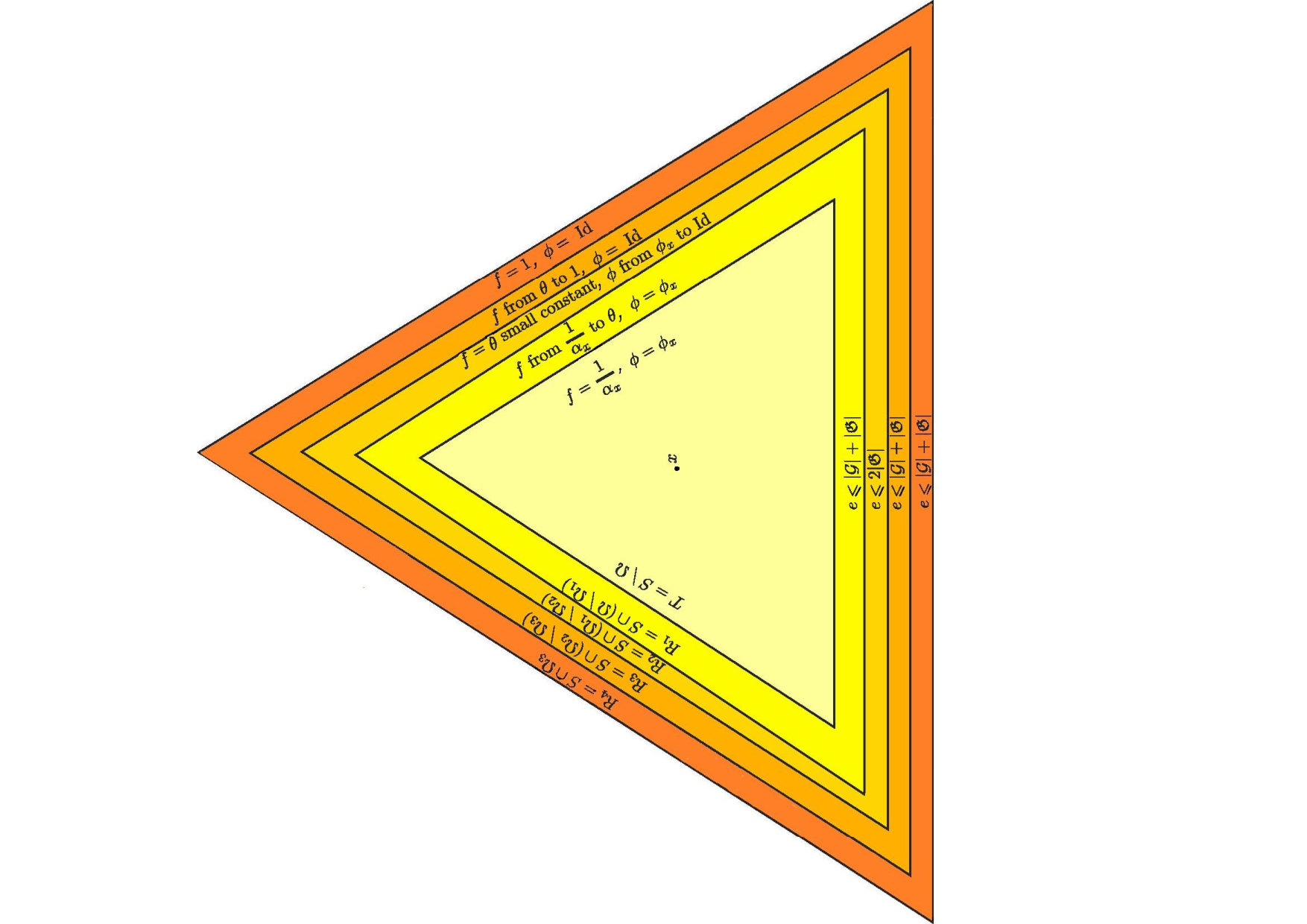 Figure 1
Peer Reviews
No public reviews on file for this paper yet. If you reviewed it on a platform where reviews are public (OpenReview, ICLR, NeurIPS, ICML), you can paste yours below so the community can read it here.
Videos
No videos yet. Explain this paper in a talk, walkthrough, or lecture? Add one.
Taxonomy
TopicsGeometric Analysis and Curvature Flows · Geometry and complex manifolds · Advanced Differential Geometry Research
almost conformal isometries of Sub-Semi-Riemannian metrics and Solvability of a Ricci equation
Erwann Delay
Erwann Delay, Avignon Université, Laboratoire de Mathématiques d’Avignon (EA 2151) F-84916 Avignon
[email protected] http://www.math.univ-avignon.fr
(Date: January 18, 2107)
Abstract.
Let be a smooth compact manifold without boundary. We consider two smooth Sub-Semi-Riemannian metrics on . Under suitable conditions, we show that they are almost conformally isometric in an sense. Assume also that carries a Riemannian metric with parallel Ricci curvature. Then an equation of Ricci type, is in some sense solvable, without assuming any closeness near a special metric.
Keywords : Sub-Semi-Riemannian metrics, Ricci curvature, Einstein metrics, Inverse problem, Quasilinear elliptic systems.
2010 MSC : 53C21, 53A45, 58J05, 35J62, 53C17, 53C50.
Contents
- 1 Introduction
- 2 closeness of some Sub-Semi-Riemannian metrics
- 3 Solvability of a Ricci type equation
1. Introduction
The goal of this note is to prove that the two principal results of D. DeTurck [11] given for positive definite symmetric bilinear form and for special Einstein metrics can be extended significantly in different ways.
Firstly, we can extend the positive definideness condition of the Riemannian metrics to Sub-Semi-Riemmannian metrics with the same rank and signature.
Secondly we are able to replace some particular Einstein metrics of non zero scalar curvature by any parallel Ricci metrics (ie. metrics with covariantly constant Ricci tensor).
Let be a smooth compact manifold without boundary. A Sub-Semi-Riemannian metric (SSR-metric for short) is a symmetric covariant 2-tensor field with constant signature and constant rank.
Let us now state the first result, interesting by itself, about almost conformal isometries.
Lemma 1.1**.**
Assume that and are two smooth SSR-metrics on with the same rank and signature. Let be a smooth Riemmannian metrics on , let and let . Then there exist a smooth diffemorphism and a smooth positive function such that is -close to zero in the norm relative to .
Before going to the application for a Ricci equation, let us introduce some notations. For a smooth riemannian manifold, we denote by its Ricci curvature. For a real constant , we consider the operator
[TABLE]
This operator is geometric in the sense that for any smooth diffeomorphism ,
[TABLE]
We would like to invert . We thus choose a symmetric 2-tensor field on , and look for Riemannian metric such that
[TABLE]
This is a geometrically natural and difficult quasilinear system to solve, already for perturbation methods. The prescribed Ricci curvature problem has a long history starting with the work of D. DeTurck [9],[11], [10], [13], [12], [1], [14], [2], [3], [6],[8], [7], [5], [4],…
Motivated by the explosion of studies around the Ricci flow, and recently, some discrete versions thereof (eg. ), a renewed interest arises for this kind of natural geometric equations. We invite the reader to look at the nice recent works of A. Pulemotov and Y. Rubinstein [16] and [17] for related results. Our contribution here is the following.
Theorem 1.2**.**
Assume that carries a Riemannian metric with parallel Ricci tensor. Let such that is non degenerate, and that is not in the spectrum of the Lichnerowicz Laplacian of .111Like D. Deturck [11], we may allow an eigenspace spanned by when Then for any with the same rank and signature as at each point of , there exist a smooth positive function and a Riemannian metrics in such that
[TABLE]
The proof goes by combining the Lemma 1.1 , the local inversion result of Proposition 3.1 for weak regular metric (where the conformal factor is not required) and a regularity argument. We have then solved the problem up to a positive function . Here we do not expect that can be taken equals to one in general, this will be the subject of future investigations.
Parallel Ricci metrics, are (locally) products of Einstein metrics (see eg. [18]). They exists on the simplest examples of manifolds who do not admit Einstein metrics, like , () or () where is a surface of genius . They are also static solutions of some geometric fourth order flows (eg. ). Finally they are particular cases of Riemannian manifolds with Harmonic curvature (or equivalently Codazzi Ricci tensor).
Our global result show once again that such metrics with covariantly constant Ricci tensor deserve a particular attention.
Acknowledgments : I am grateful to Philippe Delanoë for comments and improvements, and to Alexandra Barbieri and François Gautero for the picture of the simplex.
2. closeness of some Sub-Semi-Riemannian metrics
We follow the section 3 called ”approximation lemma” in [11] in order to verify that all the step there can be adapted for SSR-metrics as above. This will prove the Lemma 1.1.
We will keep almost the same notations as in [11], just replacing and there respectively by and here.
Let and be as in the introduction, we thus assume they have the same signature and the same rank. For the rest of the section we fix a Riemannian metric , an and . All the measures, volumes, and norms are understood with respect to .
At each point , the two SSR-metric and having the same rank and signature, there exists an orientation preserving automorphism of , such that
[TABLE]
For , the following construction can be performed using the -exponential map at . There exists an open set such that :
is contained in a coordinate neighborhood of where in this coordinate (centered at 0), up to a positive automorphism of , is equal to at :
[TABLE]
(ii) For any positive real , the linear change of coordinates
[TABLE]
satisfies on the estimate (the left hand side of which does not depend upon , and vanishes at the origin),
[TABLE]
We consider a triangulation of where each simplex lies in the interior of some with . Since the point belong to the interior of the simplex , shrinking if necessary, we are sure that send into (the norm of approaches zero when tends to zero).
Let , , , be some open neighbourhoods of the dimensional skeleton (composed with union of the boundary of all simplex) with the properties :
[TABLE]
and
[TABLE]
The rest of the proof in section 3 of [11] is based on triangular inequalities between norms of tensors and can be implemented here without any change. For a better understanding, though, we provide further details of the figure page 368 of [11], specifying the estimates that occur on the differents parts of the simplex, see figure 1. On the picture, we have denoted the error by :
[TABLE]
On the inner part of the simplex, is estimated by (2.1). The transition of the diffeomorphism , on the middle ring , from to the identity, still exist because our is an orientation preserving map with norm less than 1 as in [11].
Exemple 2.1**.**
The simplest non trivial example consists of a product of manifolds with the two SSR-metrics of the form
[TABLE]
where is a family of Riemannian metrics on , depending on the parameters and smooth in all of its arguments. Here, any of the three manifolds but one may be reduced to a point.
3. Solvability of a Ricci type equation
We revisit the section 2 of [11] called “perturbation lemma”.
We first need to introduce some operators. The divergence of a symmetric 2-tensor field and its adjoint acting on one form are
[TABLE]
The gravitationnal operator acting on symmetric 2-tensors is
[TABLE]
The Lichnerowicz Laplacian is 222Different sign convention with DeTurck
[TABLE]
It appears in the Linearization of the Ricci operator :
[TABLE]
The Hodge Laplacian acting on one forms is
[TABLE]
We also define the following Laplacian
[TABLE]
We denote by its finite dimensionnal kernel, composed of smooth one forms (by elliptic regularity).
We start with the equivalent of proposition 2.1 in [11].
Proposition 3.1**.**
Let be a smooth Riemannian manifold with parallel Ricci curvature. Let such that is non degenerate and that is not in the spectrum of the Lichnerowicz Laplacian. Let and . Then for any close to in , there exist a Riemannian metrics in such that
[TABLE]
In [11], the proof of the corresponding proposition is given by a succession of lemmas. We thus revisit them one after the other. Some care is needed because we have to replace Ric and there, respectively with Ein and here. Furthermore, in our context, the operator has no kernel whereas the kernel of is nonempty in [11], spanned by . We clearly have also for any Riemannian metrics , the Bianchi identity
[TABLE]
We start with a local study of the action of the diffeomorphim group on the covariant symetrics 2-tensors, near a non degenerate parallel one. The result obtained remains in the spirit of the local study near a Riemmanian metric by Berger, Ebin, or Palais (see eg. the lemma 2.3 of [11]). Here the metric tensor is replaced by a non degenerate parallel tensor field.
Lemma 3.2**.**
Let be a smooth, non degenerate and parallel symmetric two tensor field. Let be a smooth Banach submanifold of , whose tangent space at is a complementary of . Then for any close enough to in , there exist an diffeomorphism close to the identity such that .
Proof.
The tensor field being parallel, its Lie derivative in the direction of a vector field is
[TABLE]
Locally, the submanifold can be seen as the image of an immersion , with . We define to be the set of vector fields such that is -orthogonal 333closed complementary suffice to .
Let
[TABLE]
defined by
[TABLE]
where is the flow of the vector field at time 1. We have and the linearisation of in the first two variables is
[TABLE]
Now because
[TABLE]
and is non degenerate, then is an isomorphism. From the implicit function theorem, for close to , there exist and small such that . ∎
Let us recall the lemma 2.5 in [11] :444 It seems there is a misprint in the proof this lemma: The Ricci term for at the top of page 362 in [11] has a different sign.
Lemma 3.3**.**
For , we have
[TABLE]
The equivalent of the lemma 2.6 in [11] becomes (we do not have to quotient by because of no kernel for us, and so we do not need to adjust with a constant ).
Lemma 3.4**.**
Suppose , , and satisfies the hypotheses of theorem 1.2 let
[TABLE]
and define by555To avoid ambiguities, we may take any fixed closed complementary to in instead of the first factor of
[TABLE]
Then for some neigbborood of [math], is a Banach submanifold of whose tangent space at is a complementary space of .
Proof.
We have to show that the derivative of at is injective and its image has the closed subspace as complementary. A metric with parallel Ricci tensor is a local Einstein product so is smooth. We first show that the spaces and are “stable” (modulo two points of regularity) by but also by (when the metric is Ricci parallel). Indeed, recall that in that case [15]:
[TABLE]
and the adjoint version :
[TABLE]
We deduce that
[TABLE]
and
[TABLE]
thus the “stability” of by the two operators above.
When restricted on the kernel of , we trivially have
[TABLE]
but also, by linearising for instance,
[TABLE]
then the stability of .
We can also remark that with the formula above, if ,
[TABLE]
and
[TABLE]
For any function , it is well known that , so
[TABLE]
We obtain that
[TABLE]
If , we deduce
[TABLE]
Assume that is not an eigenvalue of , then is an isomorphism from to . The image of the splitting in Lemma 3.3 by produce:666Here also we have to replace the first factor by when a choice of was made in the first factor of .
[TABLE]
The two first factors are the same than the image by of the corresponding spaces in Lemma 3.3. Let us study the image of third one. For , we compute
[TABLE]
[TABLE]
We deduce for instance that
[TABLE]
Let us define
[TABLE]
We now prove that
[TABLE]
The fact that is the sum of the two factors is clear by (3.2). Let in the intersection of the two factors, so
[TABLE]
for some and . Because of the decomposition of , we deduce that thus , then and finally, by (3.1), so . We have obtained
[TABLE]
We claim that is injective. Indeed, let in the kernel of , then with in the first summand of . Thus so because of the decomposition (3.3), we obtain . Its implies and from equation (3.2), , so . ∎
From the Lemma 3.2 with and Lemma 3.4 we directly deduce :
Lemma 3.5**.**
If and , then there exist a metric and a diffeomorphism for which .
We will complete the proof of proposition 3.1, where now , but and still cames from Lemma 3.5 so is a priori not regular enough. If we inspect the pages 364-365 in [11] we can see that we just have to change by to obtain that is in fact in . We conclude that and has as its image by . At this level we also use that is non degenerate (see equation (2.8) there).
The Theorem 1.2 is now a direct consequence of the Lemma 1.1, the Proposition 3.1 with , and the regularity result of [12].
Exemple 3.6**.**
Recalling that the Ricci curvature of a product of Riemannian manifolds is the direct sum of the Ricci curvatures of each factors, we see that a product of Einstein manifolds clearly satisfies the assumption of the Theorem 1.2. The simplest example combining the 3 possibilities of Einstein constants is the following. Let us consider three compact Einstein manifolds , , with Ricci curvatures given by , , . Then endowed with
[TABLE]
has parallel Ricci curvature equal to
[TABLE]
In this example, the kernel of contains the parallel tensors
[TABLE]
for any constants . Here, we only have to choose in order to destroy this kernel and make non degenerate.
The reference list from the paper itself. Each links out to its DOI / PubMed record.
- 1[1] Alfred Baldes, Nonexistence of Riemannian metrics with prescribed Ricci tensor , Nonlinear problems in geometry (Mobile, Ala., 1985), Contemp. Math., vol. 51, Amer. Math. Soc., Providence, RI, 1986, pp. 1–8. MR 848927 (87k:53085)
- 2[2] Ph. Delanoë, Obstruction to prescribed positive Ricci curvature , Pacific J. Math. 148 (1991), no. 1, 11–15.
- 3[3] by same author, Local solvability of elliptic, and curvature, equations on compact manifolds , J. Reine Angew. Math. 558 (2003), 23–45. MR 1979181 (2004 e:53054)
- 4[4] E. Delay, Inversion d’opérateurs de courbure au voisinage de la métrique euclidiennne , bull. Soc. Math. France, à paraître, hal-00973138.
- 5[5] by same author, Sur l’inversion de l’opérateur de Ricci au voisinage d’une métrique Ricci parallèle , Annales de l’institut Fourier, à paraître, hal-00974707 v 2.
- 6[6] by same author, Etude locale d’opérateurs de courbure sur l’espace hyperbolique , J. Math. Pures Appli. 78 (1999), 389–430.
- 7[7] by same author, Study of some curvature operators in the neighbourhood of an asymptotically hyperbolic Einstein manifold , Advances in Math. 168 (2002), 213–224.
- 8[8] E. Delay and M. Herzlich, Ricci curvature in the neighbourhood of rank-one symmetric spaces , J. Geometric Analysis 11 (2001), no. 4, 573–588.