Measurement of charged-particle distributions sensitive to the underlying event in $\sqrt{s} = 13$ TeV proton-proton collisions with the ATLAS detector at the LHC
ATLAS Collaboration

TL;DR
This paper measures charged-particle distributions in 13 TeV proton-proton collisions to understand the underlying event activity, providing data to improve Monte Carlo models with high precision at LHC energies.
Contribution
It presents the first detailed measurement of underlying event-sensitive charged-particle distributions at 13 TeV, aiding the development of more accurate event generators.
Findings
Models describe data to 5% accuracy
Data uncertainties are less than 1%
Provides new insights into UE activity at 13 TeV
Abstract
We present charged-particle distributions sensitive to the underlying event, measured by the ATLAS detector in proton-proton collisions at a centre-of-mass energy of 13 TeV, in low-luminosity Large Hadron Collider fills corresponding to an integrated luminosity of 1.6 nb. The distributions were constructed using charged particles with absolute pseudorapidity less than 2.5 and with transverse momentum greater than 500 MeV, in events with at least one such charged particle with transverse momentum above 1 GeV. These distributions characterise the angular distribution of energy and particle flows with respect to the charged particle with highest transverse momentum, as a function of both that momentum and of charged-particle multiplicity. The results have been corrected for detector effects and are compared to the predictions of various Monte Carlo event generators, experimentally…
Click any figure to enlarge with its caption.
 Figure 1
 Figure 2
 Figure 3
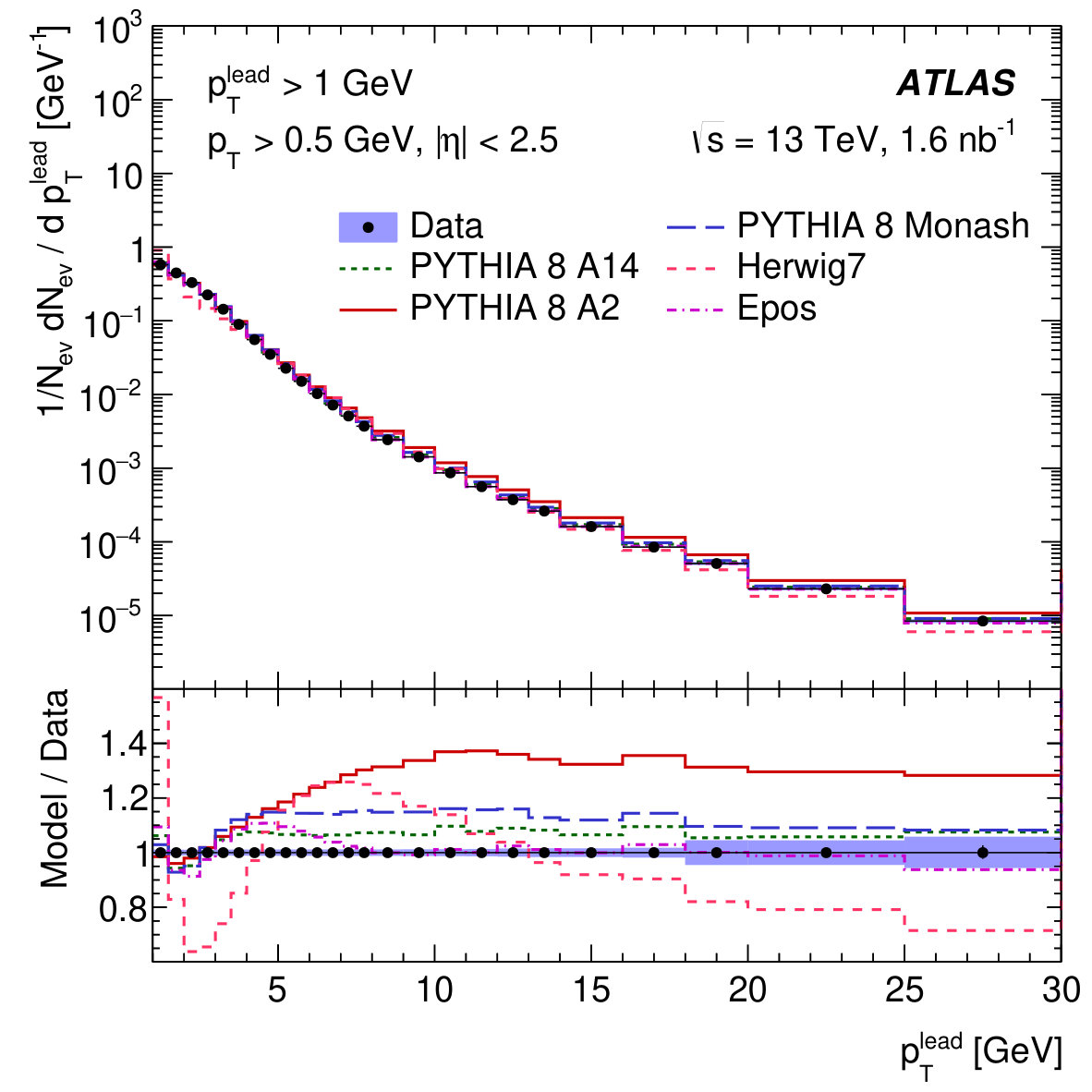 Figure 4
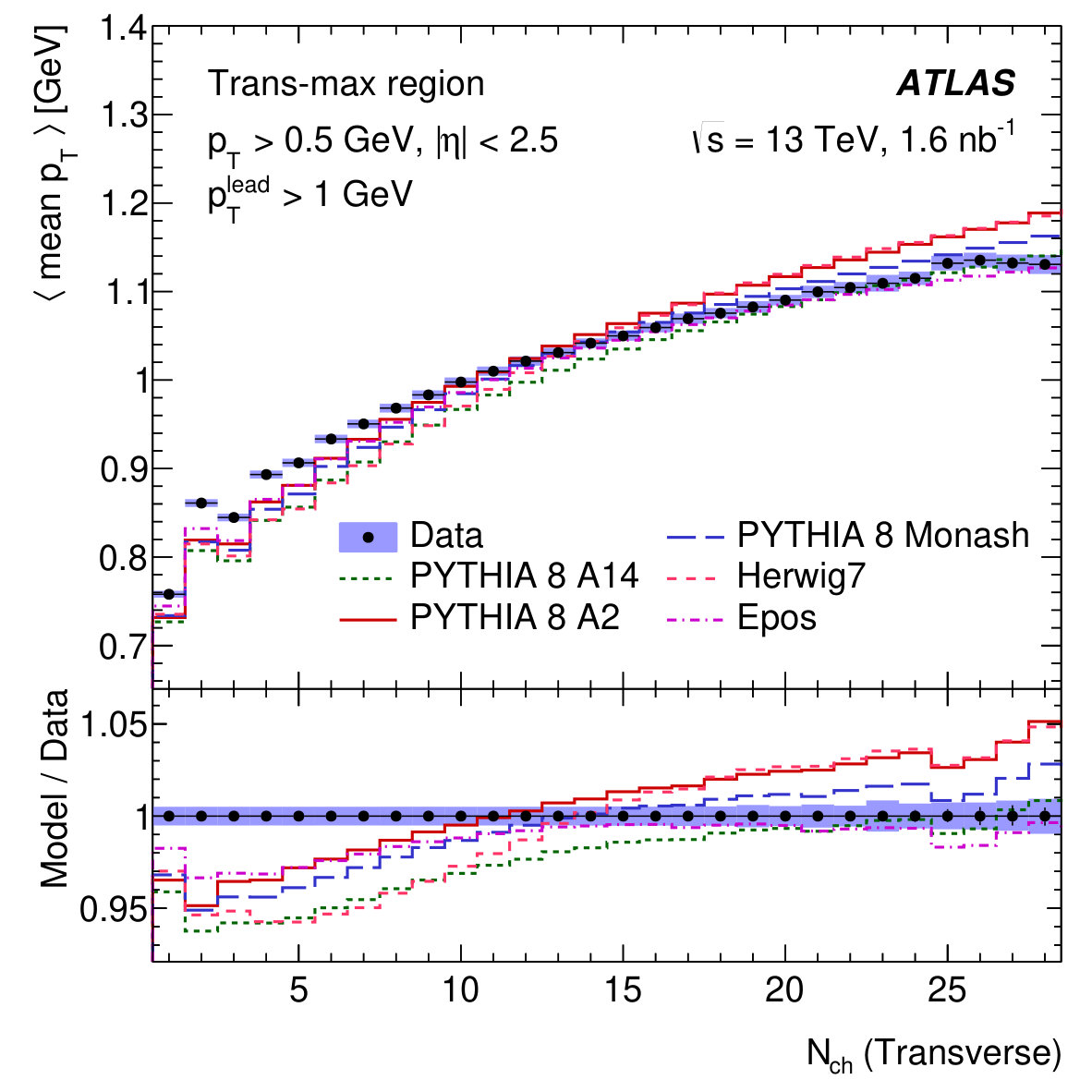 Figure 5
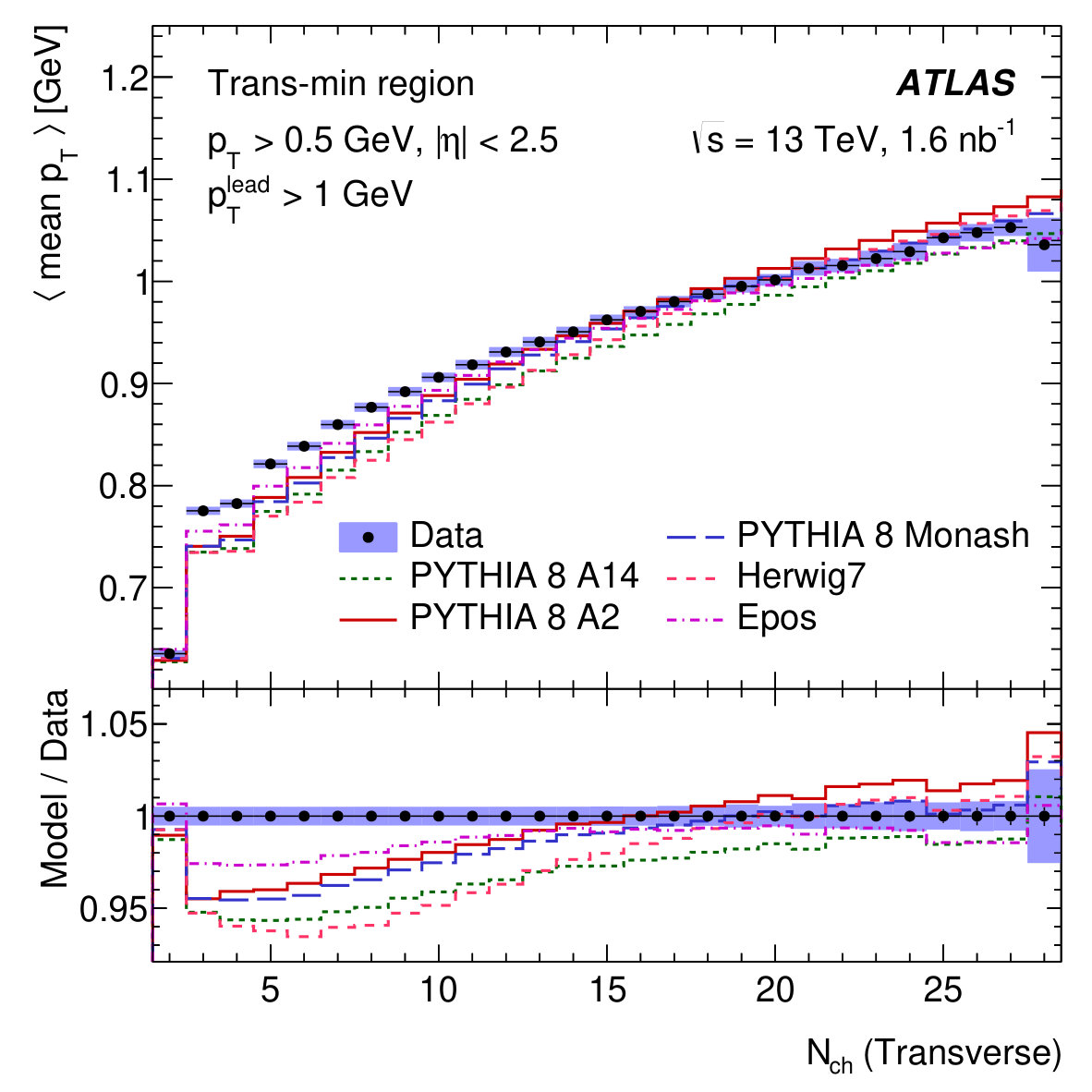 Figure 6
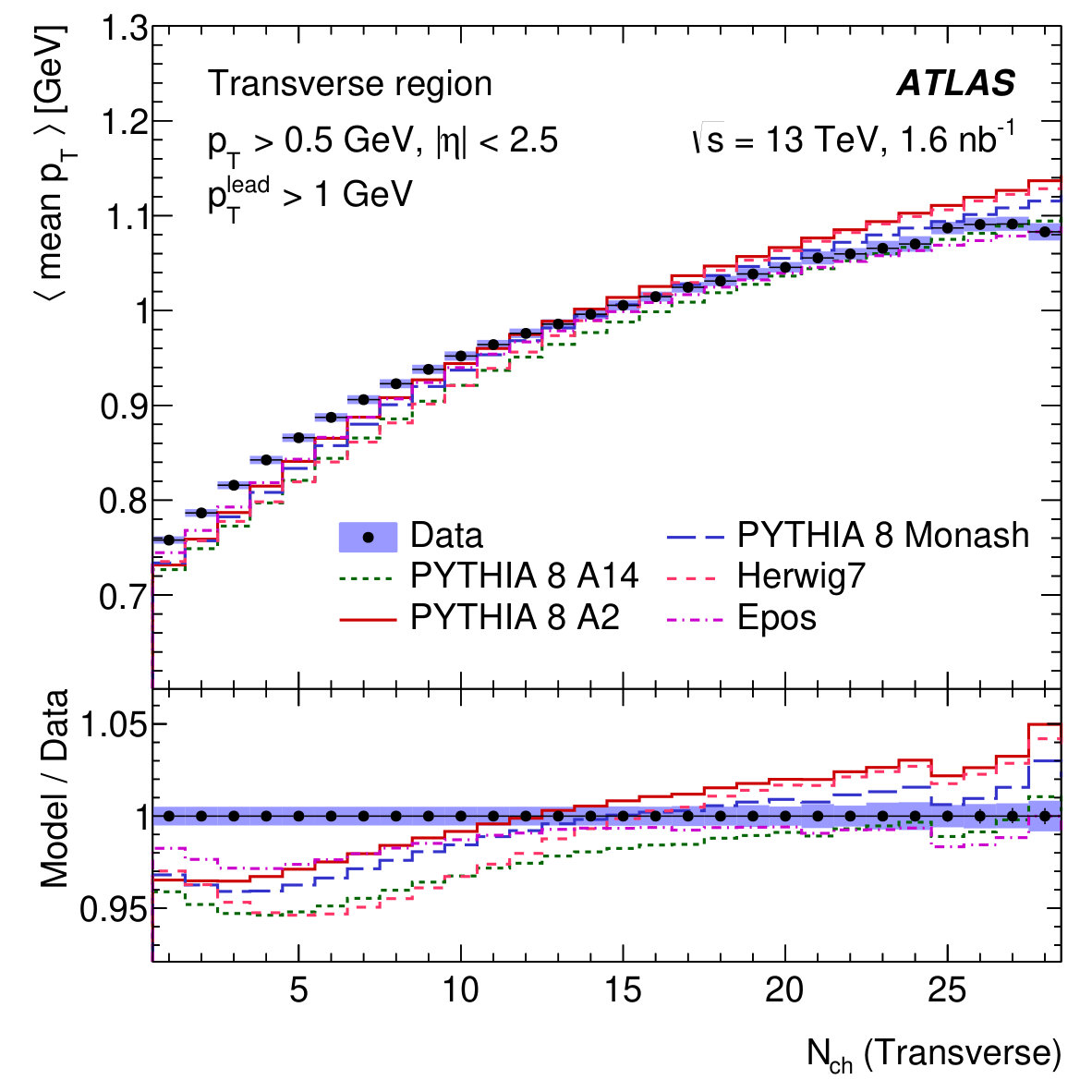 Figure 7
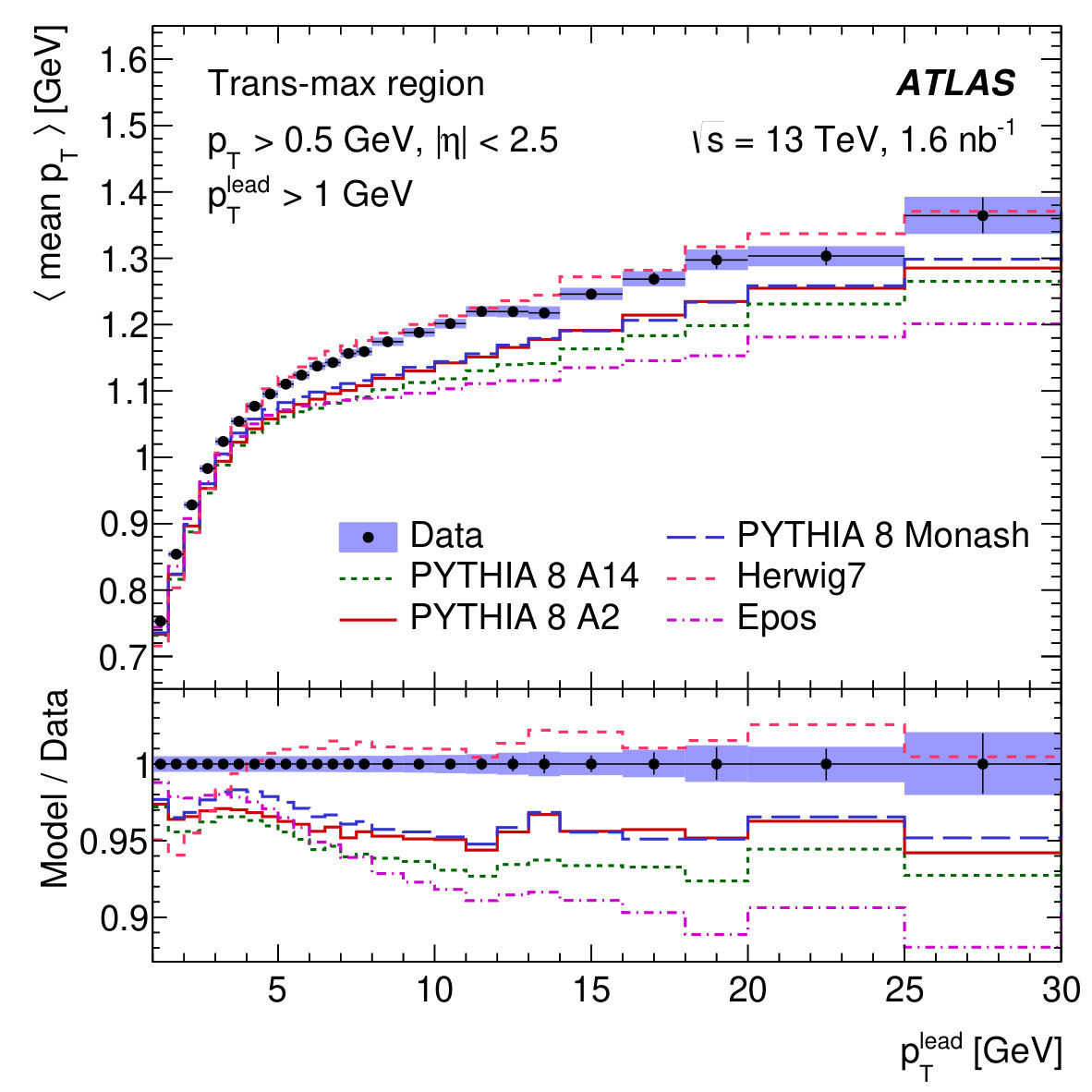 Figure 8
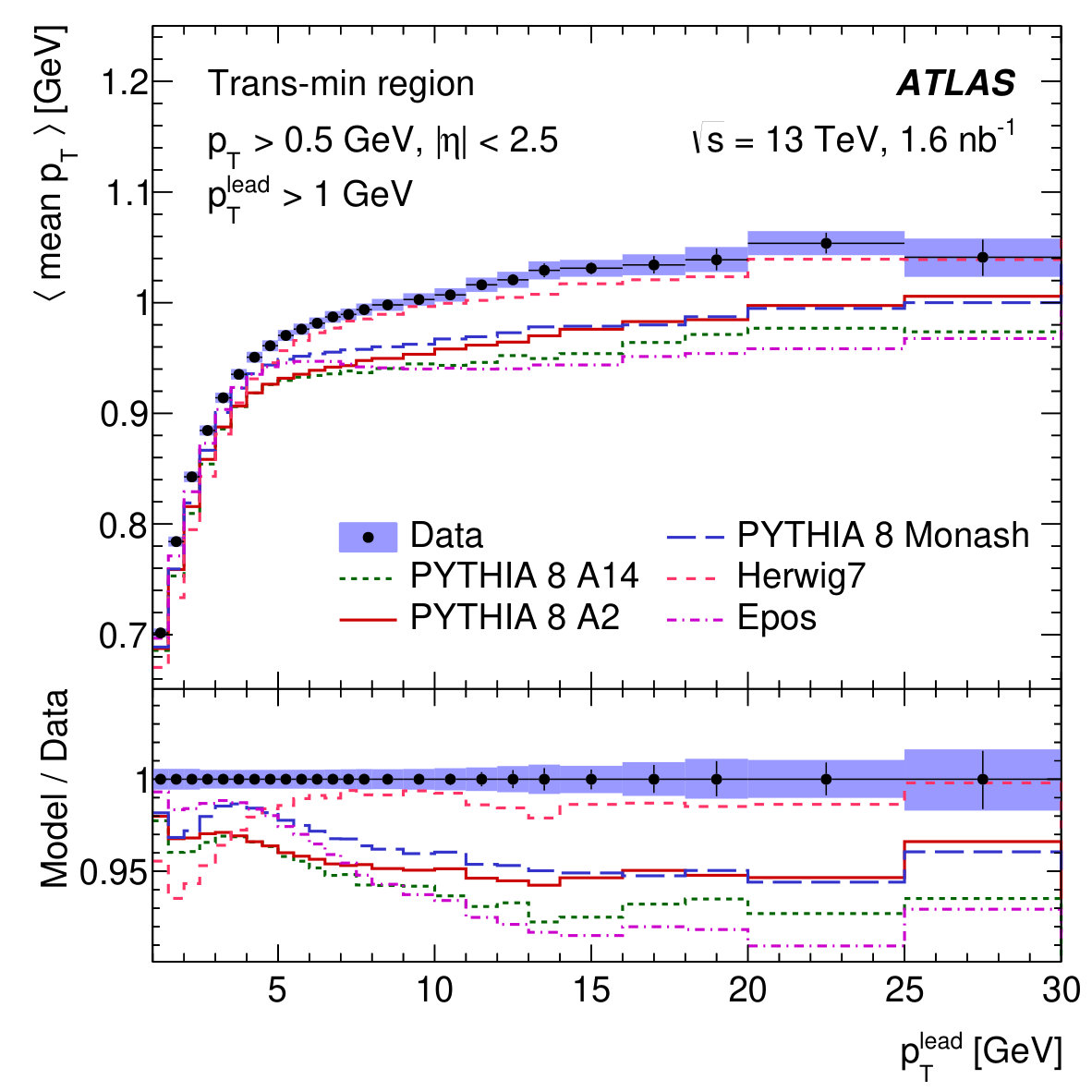 Figure 9
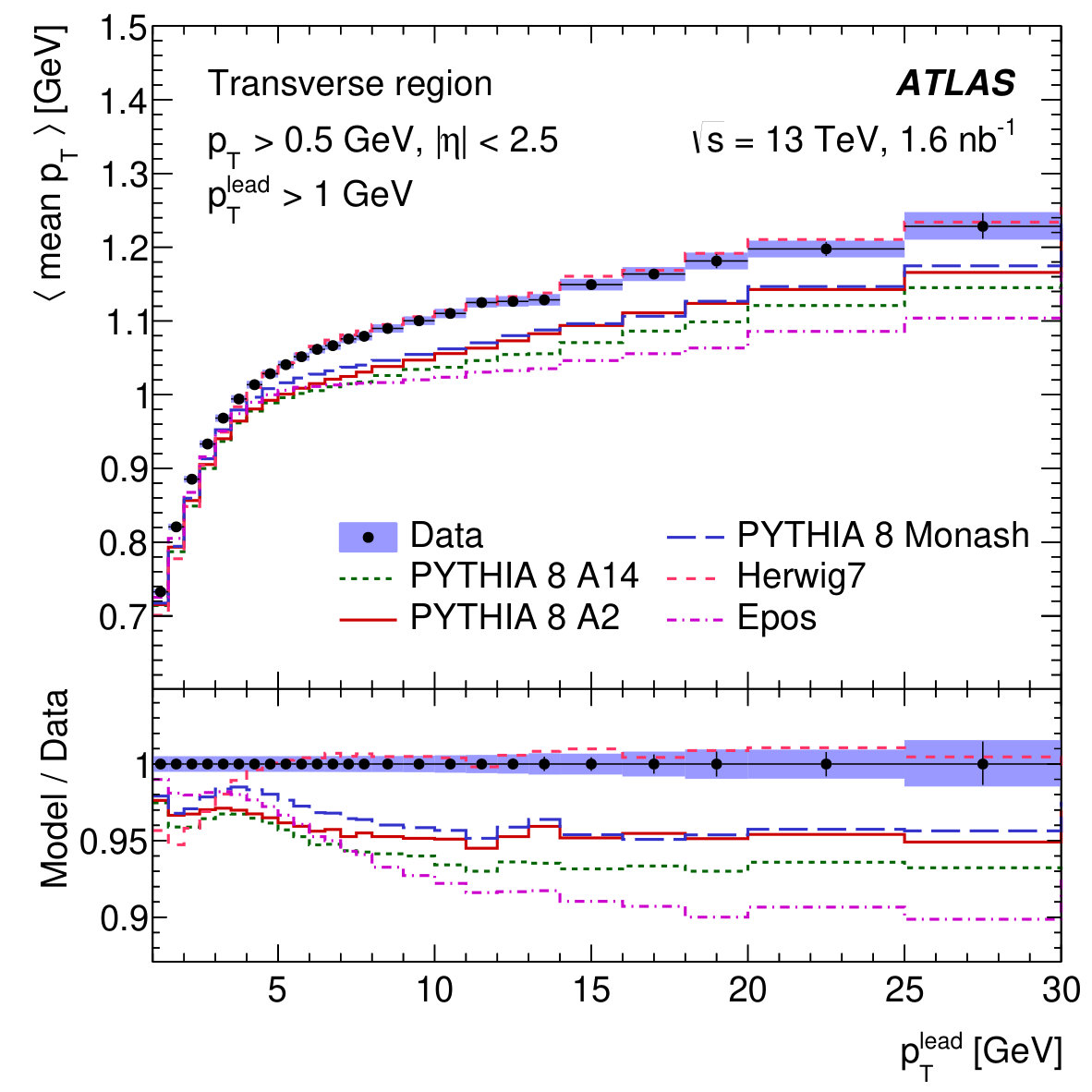 Figure 10
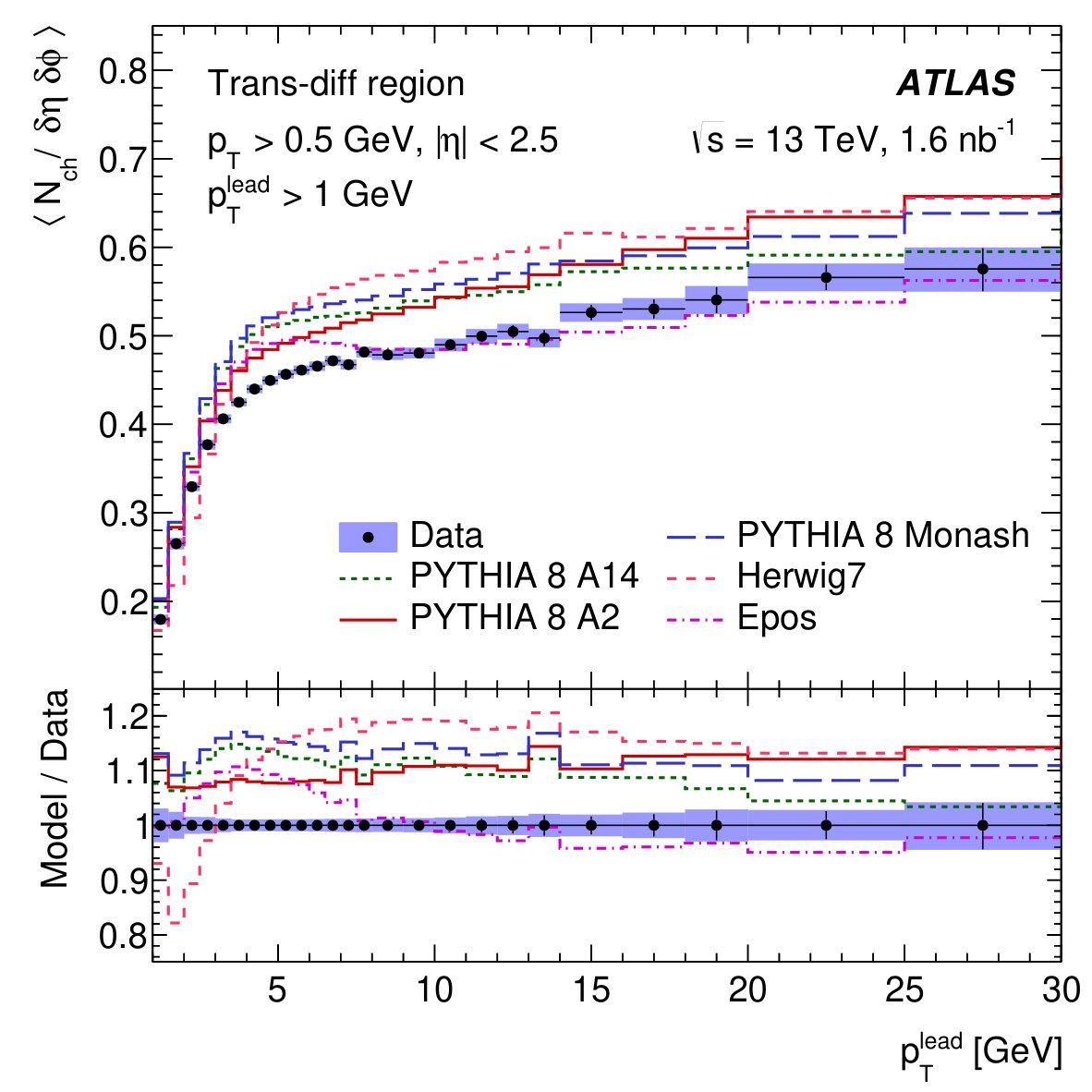 Figure 11
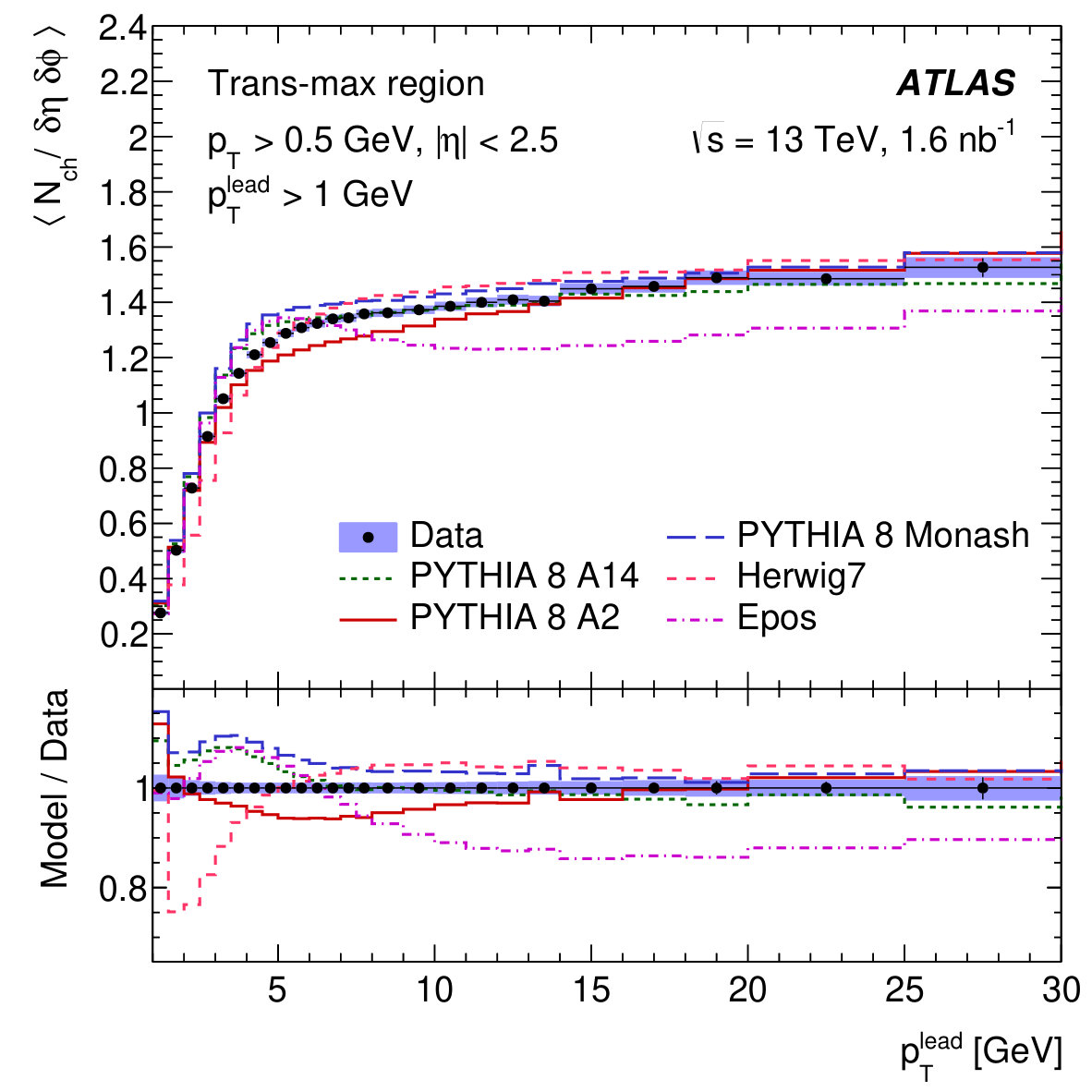 Figure 12
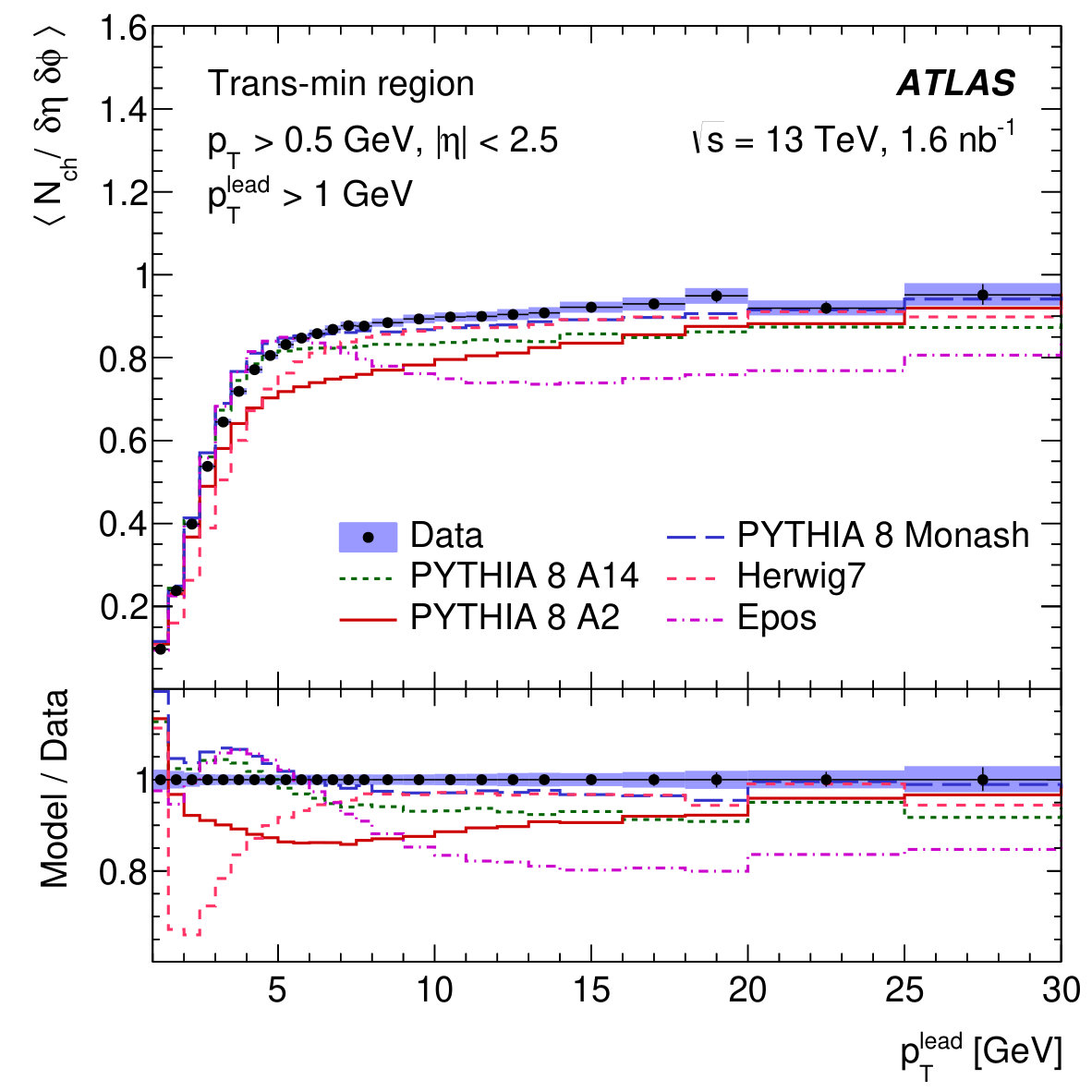 Figure 13
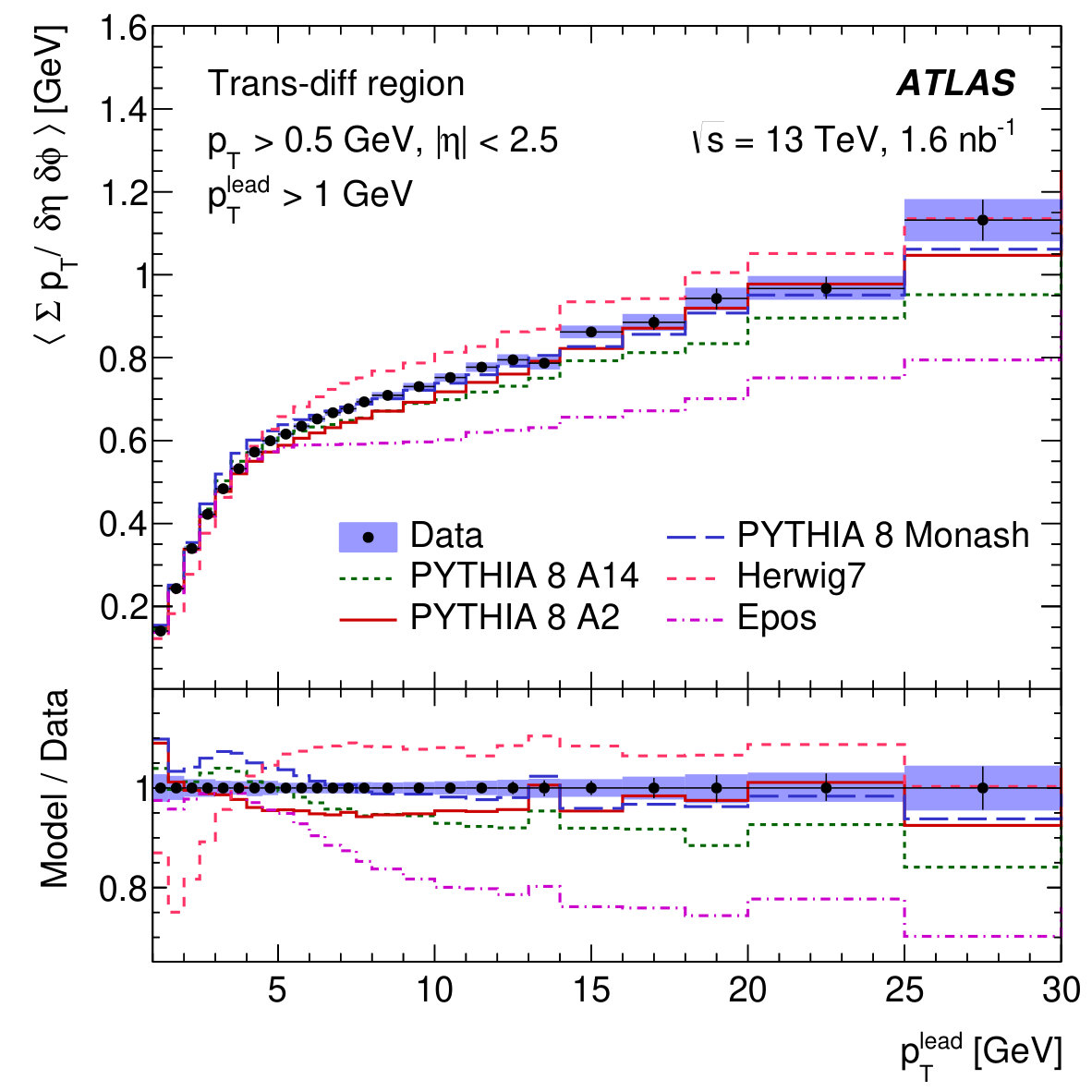 Figure 14
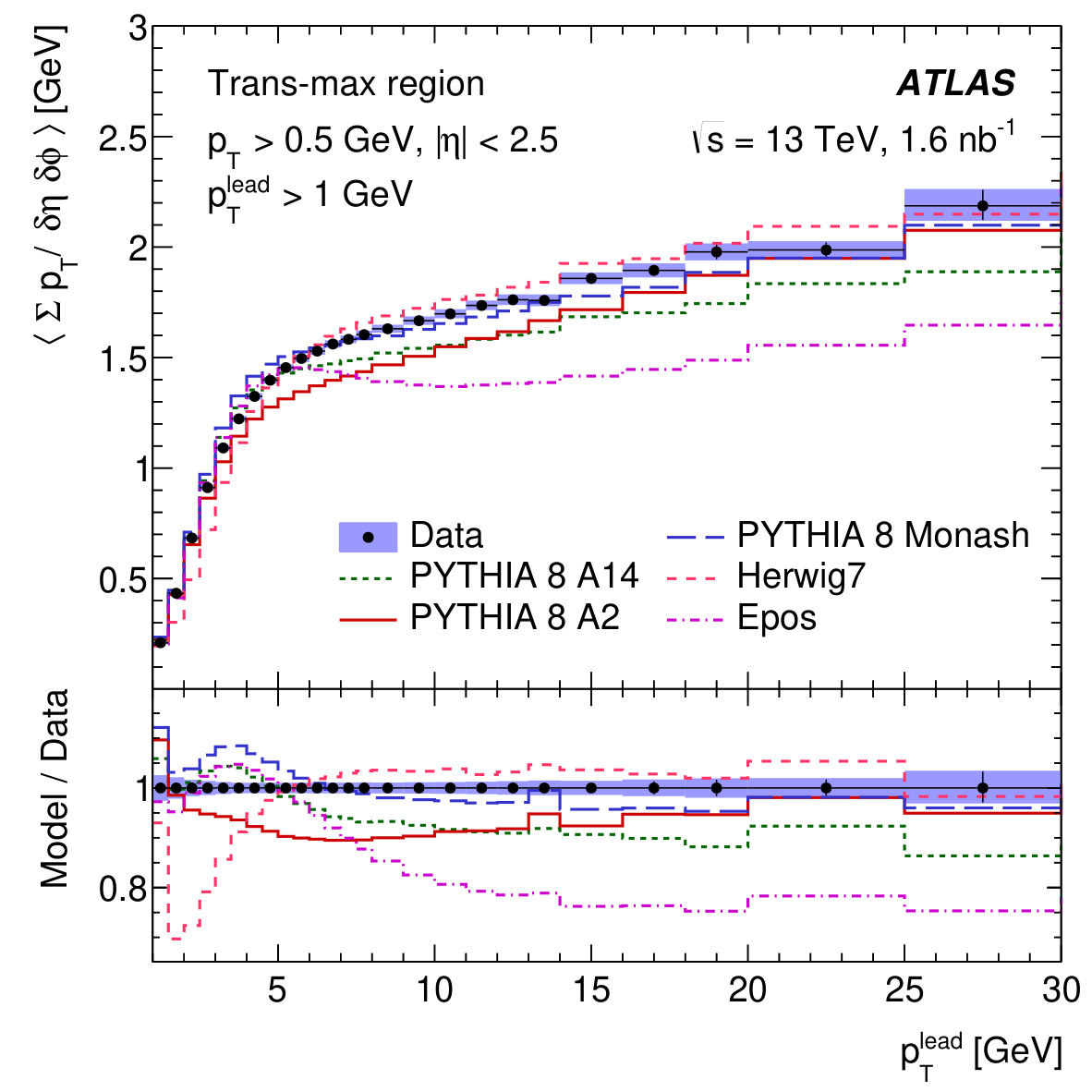 Figure 15
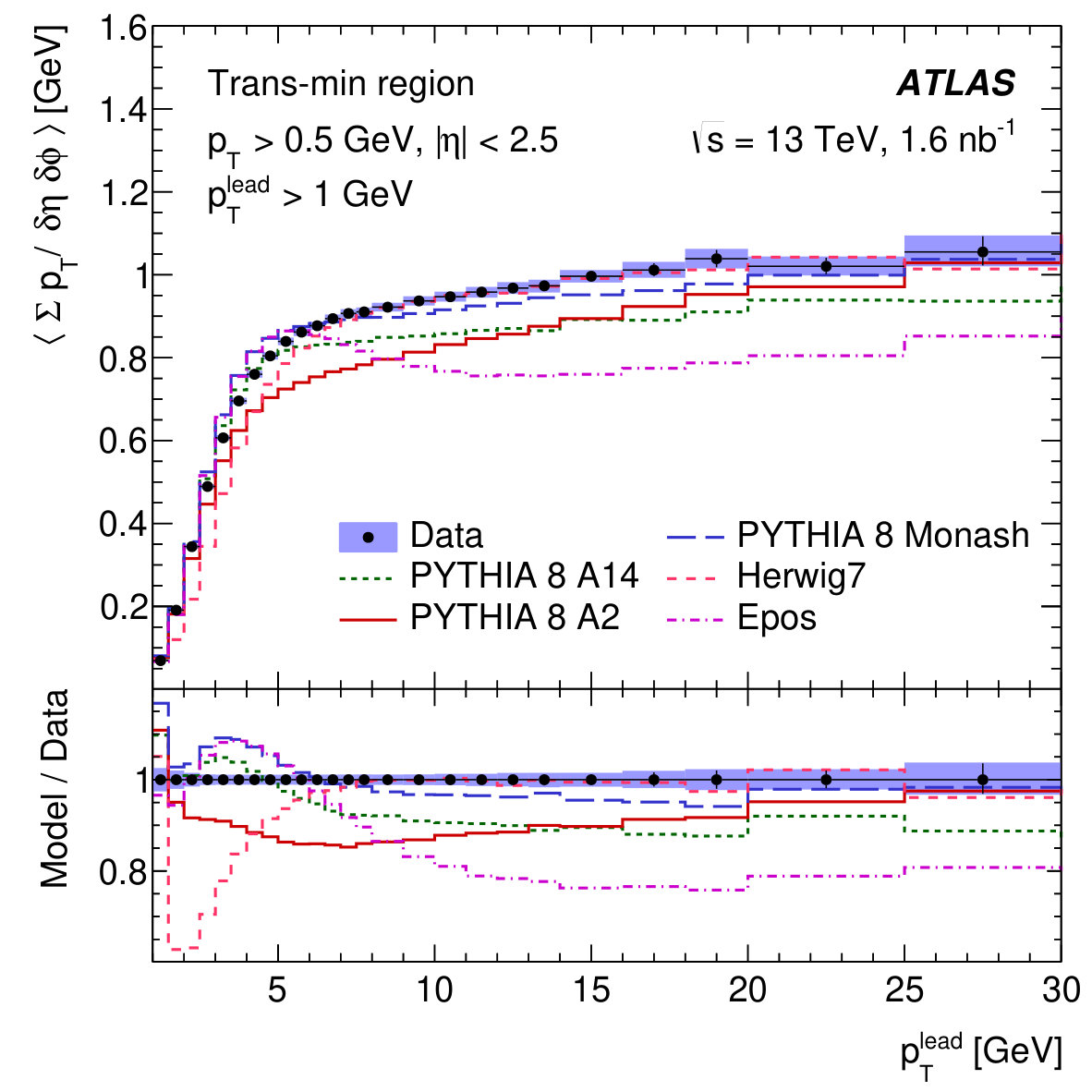 Figure 16
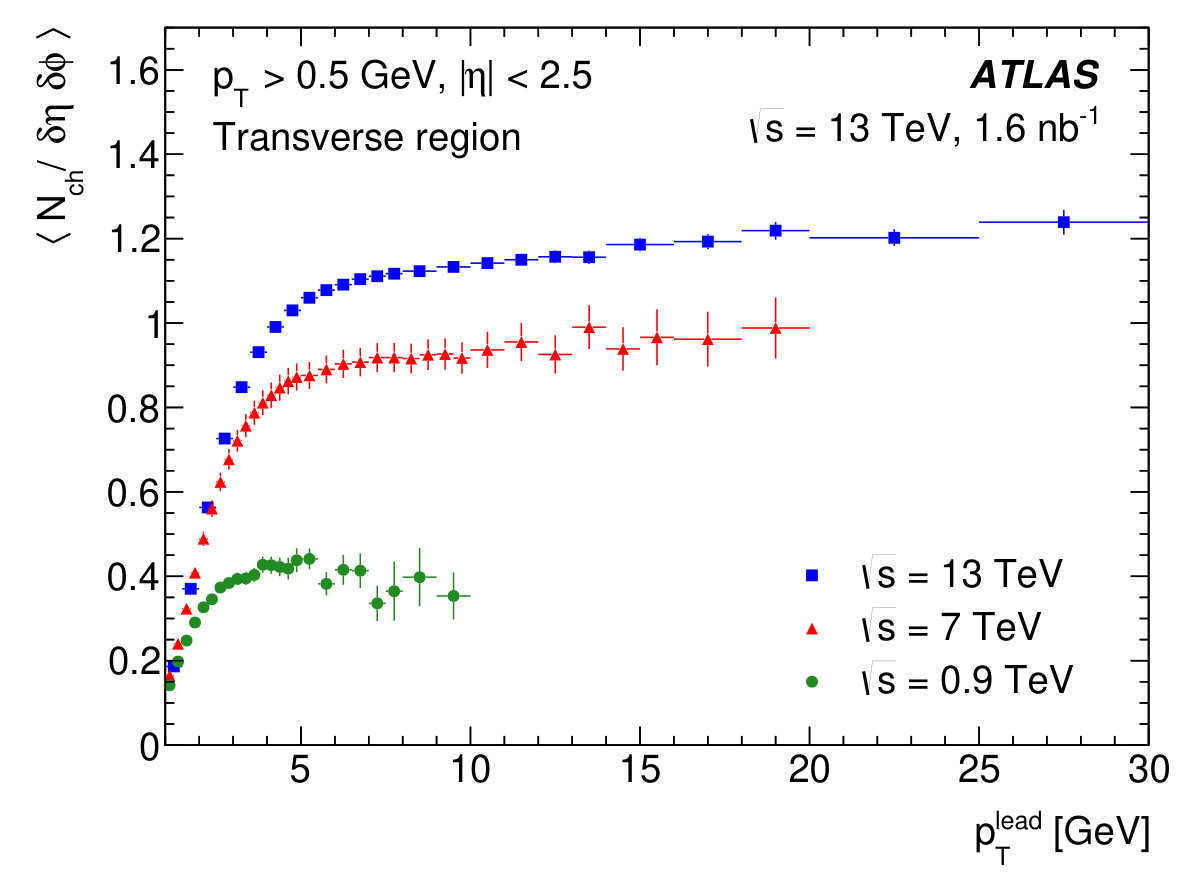 Figure 17
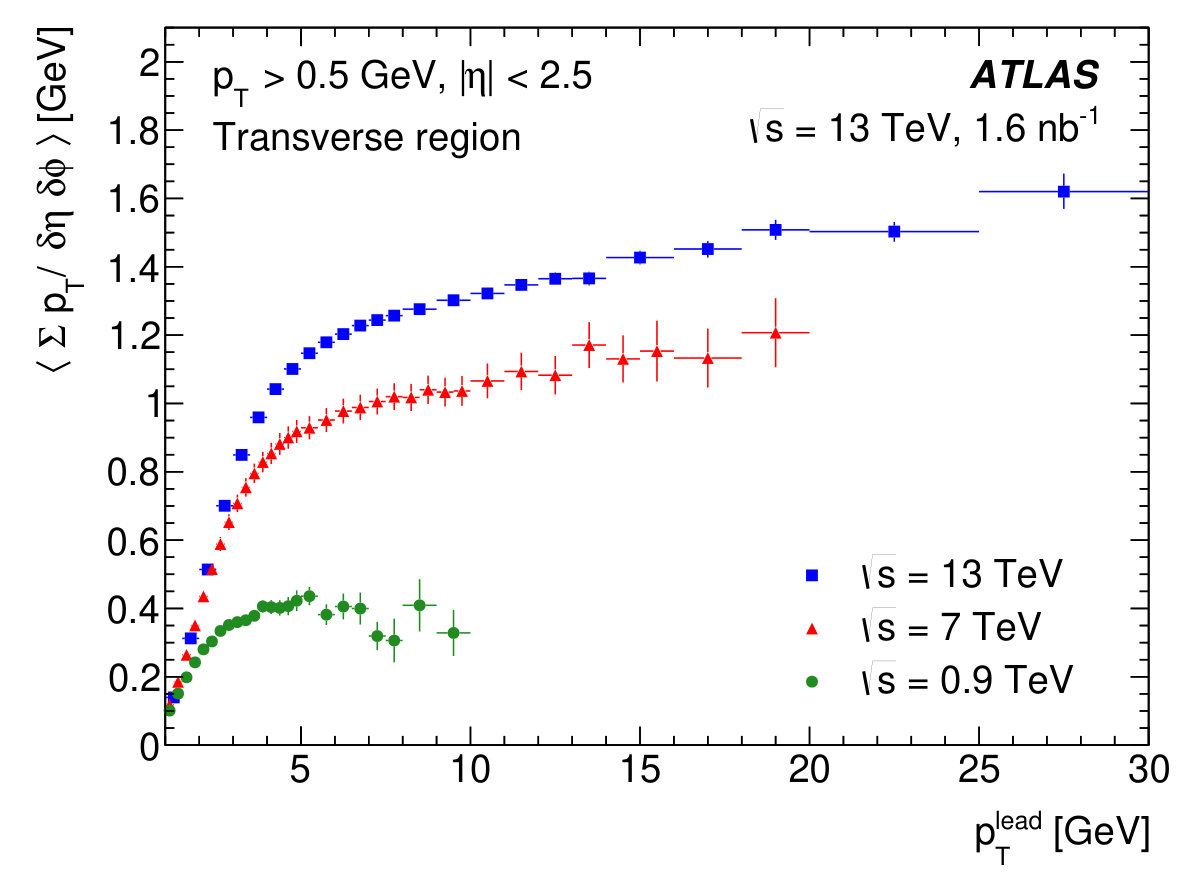 Figure 18
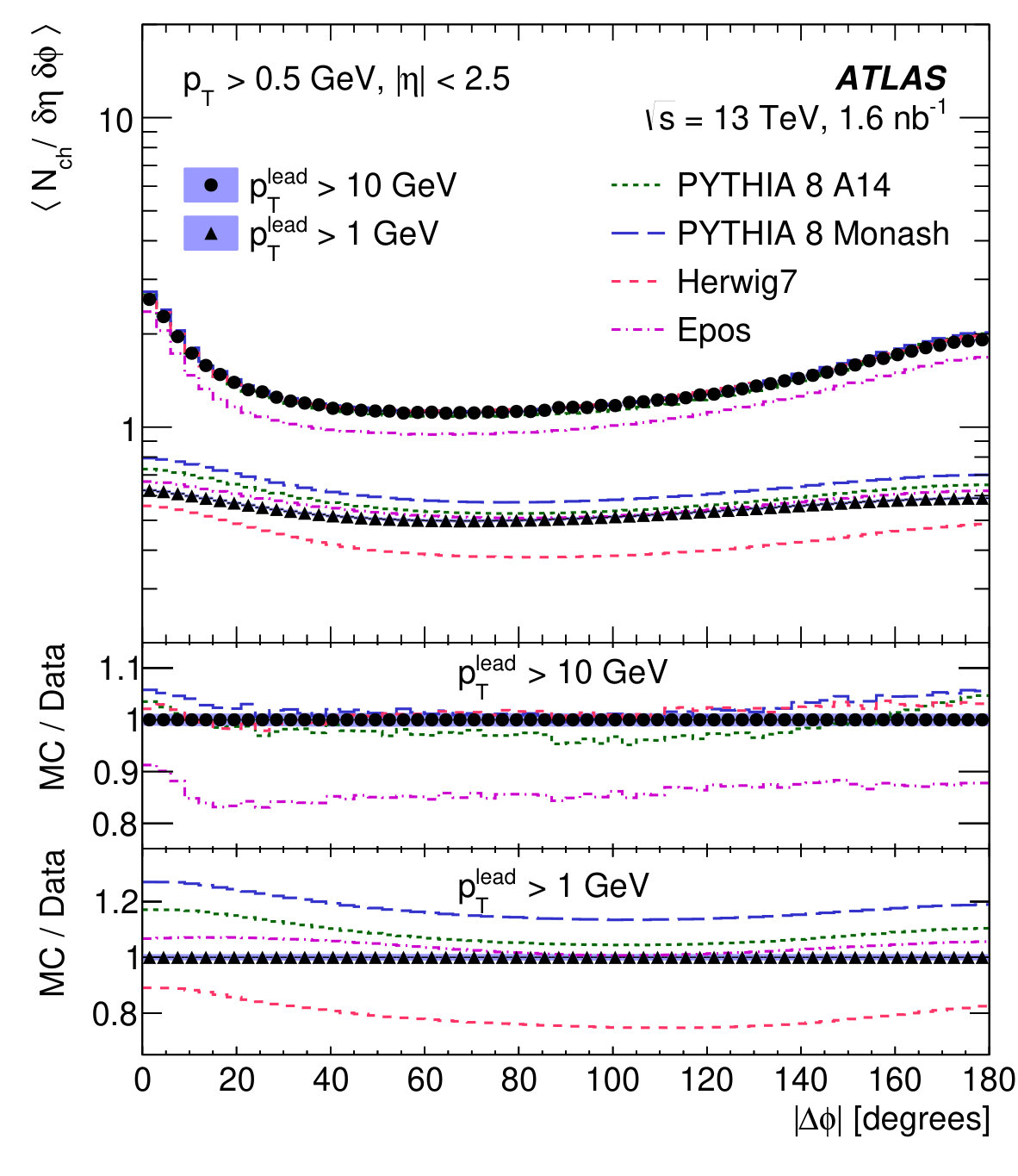 Figure 19
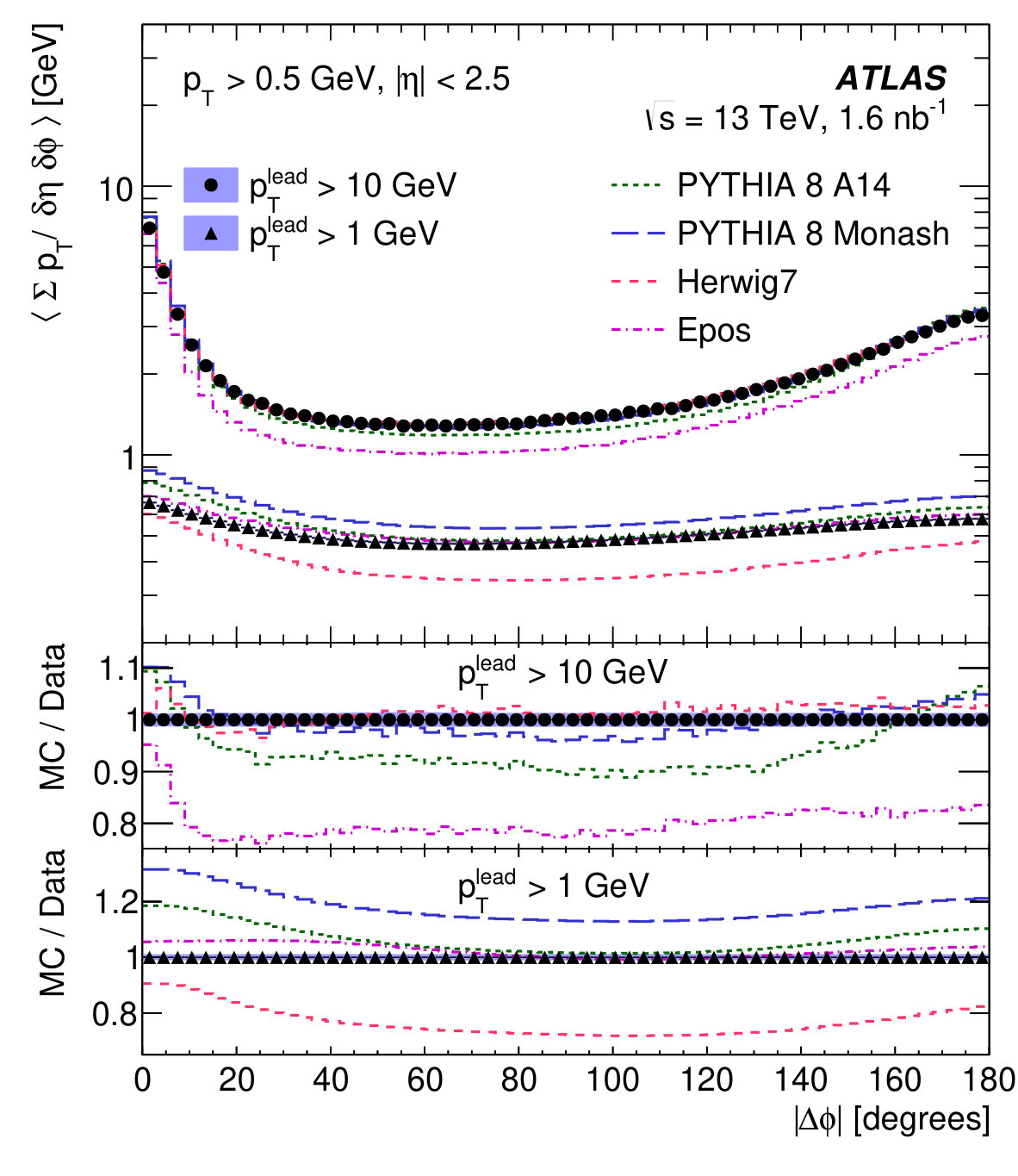 Figure 20
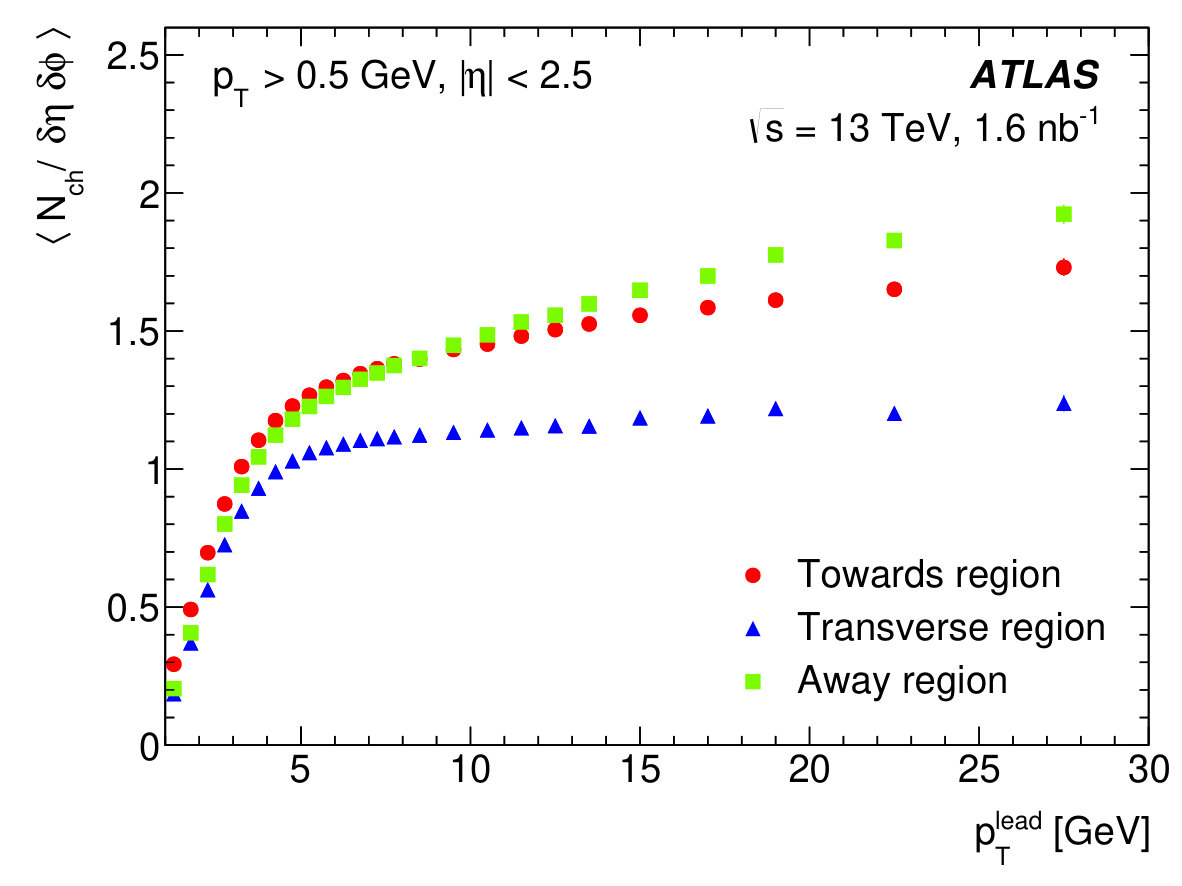 Figure 21
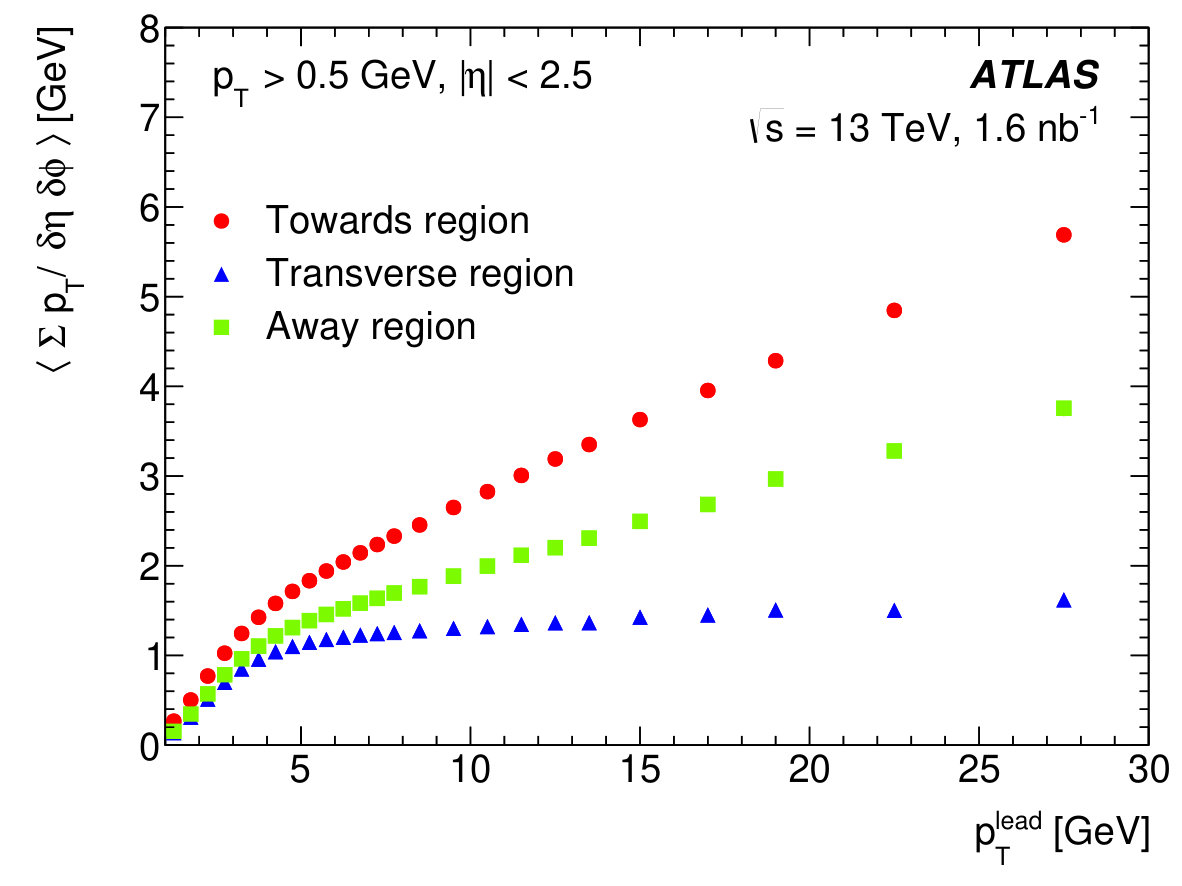 Figure 22
| Symbol | Description |
|---|---|
| Binned variables | |
| Transverse momentum of the leading charged particle | |
| Number of charged particles in the transverse region | |
| Absolute difference in particle azimuthal angle from the leading charged particle | |
| Averaged variables | |
| Mean number of charged particles per unit (in radians) | |
| Mean scalar sum of charged particles per unit (in radians) | |
| Mean per-event average of charged particles ( charged particle required) | |
| Generator | Version | Tune | Focus | From | |
|---|---|---|---|---|---|
| Pythia 8 | 8.185 | A2 | MSTW2008 LO | MB | ATLAS |
| Pythia 8 | 8.185 | A14 | NNPDF2.3 LO | UE | ATLAS |
| Pythia 8 | 8.186 | Monash | NNPDF2.3 LO | MB/UE | Authors |
| Herwig 7 | 7.0.1 | UE-MMHT | MMHT2014 LO | UE/DPS | Authors |
| Epos | 3.4 | LHC | — | MB | Authors |
| Range of values | ||||
| Observable | Material | Non-primaries | Non-closure | Parameterisation |
| or vs. | 0.9% | 0.6% | – | – |
| or vs. | – | – | – | – |
| vs. | – | – | — 0.5% (combined) — | |
| vs. | – | – | — 0.5% (combined) — | |
Peer Reviews
No public reviews on file for this paper yet. If you reviewed it on a platform where reviews are public (OpenReview, ICLR, NeurIPS, ICML), you can paste yours below so the community can read it here.
Videos
No videos yet. Explain this paper in a talk, walkthrough, or lecture? Add one.
\AtlasTitle
Measurement of charged-particle distributions sensitive to the underlying event in TeV proton–proton collisions with the ATLAS detector at the LHC \PreprintIdNumberCERN-EP-2016-28 \AtlasJournalJHEP \AtlasJournalRefJHEP 03 (2017) 157 \AtlasDOIdoi:10.1007/JHEP03(2017)157 \AtlasAbstract We present charged-particle distributions sensitive to the underlying event, measured by the ATLAS detector in proton–proton collisions at a centre-of-mass energy of 13 TeV, in low-luminosity Large Hadron Collider fills corresponding to an integrated luminosity of . The distributions were constructed using charged particles with absolute pseudorapidity less than 2.5 and with transverse momentum greater than 500 MeV, in events with at least one such charged particle with transverse momentum above 1 GeV. These distributions characterise the angular distribution of energy and particle flows with respect to the charged particle with highest transverse momentum, as a function of both that momentum and of charged-particle multiplicity. The results have been corrected for detector effects and are compared to the predictions of various Monte Carlo event generators, experimentally establishing the level of underlying-event activity at LHC Run 2 energies and providing inputs for the development of event generator modelling. The current models in use for UE modelling typically describe this data to 5% accuracy, compared with data uncertainties of less than 1%.
1 Introduction
To perform precise Standard Model measurements or to search for new physics phenomena at hadron colliders, it is important to have a good understanding not only of the primary short-distance hard scattering process, but also of the accompanying interactions of the rest of the proton–proton collision – collectively termed the underlying event (UE). As the UE is an intrinsic part of the same proton–proton collision as any “signal” partonic interaction, accurate description of its properties by Monte Carlo (MC) event generators is important for the LHC physics programme.
In modelling terms, the UE can receive contributions from initial- and final-state radiation (ISR, FSR), from the QCD evolution of colour connections between the hard scattering and the beam-proton remnants, and from additional hard scatters in the same – collision, termed multiple partonic interactions (MPI). As it is significantly influenced by physics not currently calculable from first principles, the measurement of the UE’s properties is crucial not only for better understanding of the mechanisms involved but also to provide input for empirical tuning of the free parameters of phenomenological UE models in MC event generators.
It is impossible to uniquely separate the UE from the hard scattering process on an event-by-event basis, but observables can be defined which are particularly sensitive to the properties of the UE. Measurements of such observables have been performed in collisions between 900\text{,}\mathrm{GeV} and $7\text{\,}\mathrm{TeV}$ in ATLAS [[1](#bib.bibx1), [2](#bib.bibx2), [3](#bib.bibx3), [4](#bib.bibx4), [5](#bib.bibx5)], ALICE [[6](#bib.bibx6)] and CMS [[7](#bib.bibx7), [8](#bib.bibx8), [9](#bib.bibx9)]. UE observables were also previously measured in $p\bar{p}$ collisions in dijet and Drell–Yan events at CDF, with centre-of-mass energies of $\sqrt{s}=$1.8\text{\,}\mathrm{TeV} [10, 11] and [12].
In this paper we report the measurement of UE observables with the ATLAS detector [13] at the LHC, using charged particles in of proton–proton collisions at a centre-of-mass energy of .
2 Underlying-event observables
The UE observables in this study are constructed from “primary” charged particles in the pseudorapidity range ,111ATLAS uses a right-handed coordinate system with its origin at the nominal interaction point (IP) in the centre of the detector and the -axis along the beam pipe. The -axis points from the IP to the centre of the LHC ring, and the -axis points upward. Cylindrical coordinates are used in the transverse plane, being the azimuthal angle around the beam pipe. The pseudorapidity is defined in terms of the polar angle as . whose transverse momentum () is required to be greater than . Primary charged particles are defined as those with a mean lifetime 300\text{,}\mathrm{ps}, which are either directly produced in $pp$ interactions or from subsequent decays of particles with a lifetime $\tau<$30\text{\,}\mathrm{ps}. This measurement follows the fiducial particle definition used in the ATLAS minimum-bias measurement [14] excluding particle species with in the range and their decay products. The charged particles falling in this range are strange baryons with a very low reconstruction probability, whose decays are inconsistently modelled in MC generators. Their exclusion from the fiducial acceptance definition hence avoids the need to apply large and poorly defined corrections to particle level for these species, making the measurement more accurate.
This measurement uses the established form of UE observables [1, 2, 3, 4, 5, 6, 7, 9, 10, 12], in which the azimuthal plane of the event is segmented into several distinct regions with differing sensitivities to the UE. As illustrated in Figure 1, the azimuthal angular difference with respect to the leading (highest-) charged particle, , is used to define the regions:
- •
, the “towards region”;
- •
, the “transverse region”; and
- •
, the “away region”.
As the scale of the hard scattering increases, the leading charged particle acts as a convenient indicator of the main flow of hard-process energy. The towards and away regions are dominated by particle production from the hard process and are hence relatively insensitive to the softer UE. In contrast, the transverse region is more sensitive to the UE, and observables defined inside it are the primary focus of UE measurements.
A further refinement is to distinguish on a per-event basis between the more and the less active sides of the transverse region [15, 16], defined in terms of their relative scalar sums of primary charged-particle and termed “trans-max” and “trans-min” respectively. The trans-min region is relatively insensitive to wide-angle emissions from the hard process, and the difference between trans-max and trans-min observables (termed the “trans-diff”) hence represents the effects of hard-process contamination. In this analysis, an event must have a non-zero primary charged-particle multiplicity in the trans-min region in order to be included in either the trans-min, -max, or -diff observables.
The variables measured in this analysis, constructed using charged particles with 0.5\text{,}\mathrm{GeV} and $|\eta|<2.5$, with a higher-$p_{\text{T}}$ requirement of $p_{\text{T}}^{\text{lead}}>$1\text{\,}\mathrm{GeV} placed on the leading charged particle, are described in Table 1. These variables are divided into two groups: first the “binned” per-event or per-particle quantities used to define the horizontal axes in the unfolded observables of Section 8; and secondly the “averaged” mean values of distributions of per-event quantities to be studied as functions of the binned variables – a construction known as a “profile”. The second-group variables are defined for each bin and (except for , in which the area factors cancel) are scaled by the corresponding areas to give densities comparable between all such measurements, including between various experiments and collider energies. The area factor is for the toward, transverse & away regions, whereas it is for the single-sided trans-min & trans-max regions, and for each of the equally sized bins in distributions plotted against . Due to the fiducial acceptance and the -independence of the region definitions, in all cases. The profile observables are implemented as profile histograms, presenting the mean values of the “averaged” variables as measured in each bin of another observable. These hence measure the degree of correlation between two event features, either between the UE and hard scattering, or between different UE aspects. The mean charged-particle momentum is constructed on an event-by-event basis and then averaged over all events to give .
The majority of underlying-event observables study the dependences of the averaged quantities on the transverse momentum of the leading object – here the leading charged particle. The development of this from low to high corresponds to the smooth transition from “minimum bias” interactions to the hard-scattering regime focused on by most LHC analyses, and the correlation distributions characterise how soft QCD effects co-evolve with the hard process through this transition. This analysis also studies the dependence of the observables on the azimuthal angle with respect to the leading particle and each region’s charged-particle multiplicity. For the observables studied as a function of relative azimuthal angle, the leading particle is excluded from the spectrum.
3 Monte Carlo modelling of the underlying event
As a physics process related to the bulk structure of protons and not calculable from first-principles perturbative QCD, the underlying event is modelled in Monte Carlo event generator programs by various phenomenological approaches. The scattering subprocess type which contributes most to UE observables is non-diffractive inelastic scattering. In event generator implementations, model-specific choices are made to regulate these processes’ QCD divergences at low scales. In this analysis the observable definitions restrict the effect of diffractive scattering, i.e. colour-singlet exchange, to play a minor role: the profile observables have been found to be completely insensitive to diffraction, while the and profiles exhibit a 2% effect at low and the whole of the vs. distribution is affected by diffraction at a 1–2% level.
This section reviews relevant features of the Pythia 8 [17, 18], Herwig 7 [19] and Epos [20, 21] MC event generator models, which are used in this study either for data correction or for comparison to the final corrected data distributions. A summary of the Monte Carlo generator configurations used is given in Table 2.
Pythia 8.18 / 8.21:
The Pythia generator family is very widely used at the LHC and elsewhere for event modelling, and Pythia 8 is its most recent release series. Its key features are leading-logarithmic initial- and final-state parton showers and a Lund string hadronisation model, in addition to particle decays and soft-QCD modelling. Hard-process calculations are performed either via an internal set of leading-order matrix elements, or by reading externally generated hard scattering events.
The Pythia 8 approach to soft-QCD modelling uses a parameterised total cross-section, which is split into elastic, diffractive, and non-diffractive (ND) inelastic scattering subprocesses. The first two of these again have parameterised cross-sections, and the hadronic ND inelastic cross-section is set by subtracting their contributions from the total.
The ND contribution is modelled using perturbative QCD matrix elements, dominated by -channel gluon exchange. As the partonic cross-section for this exceeds the hadronic ND cross-section at low , the existence of MPI is implied and may be used to regularise the cross-section growth. Pythia 8 uses an evolved form of the Sjöstrand–van Zijl MPI model [22] in which the eikonal formalism is applied to give a model with a Poisson distribution of multiple perturbative scatterings whose mean rate depends on the scale of the hard process (interpreted as the reciprocal of the impact parameter), the proton form factor, and the ratio of hadronic to partonic ND cross-sections. An ansatz is used to regularise cross-section growth at low , with a weak power-law evolution of the regularisation parameter with . The current form of the model also interleaves MPI emissions with parton shower evolution, allows several forms of matter overlap parameterisation, and interacts with a non-perturbative annealing procedure for reconfiguration of colour strings during hadronisation (the “colour reconnection” mechanism).
As MPI and hadronisation modelling are phenomenological and even the perturbative parton shower formalism has some configurational freedom, many parameter optimisations (“tunes”) of Pythia 8 have been performed. The following are considered in this study:
- •
ATLAS’s dedicated underlying-event tune is “A14” [23]. Its configuration is based on the NNPDF2.3 LO [24] parton density function (PDF), and was optimised for the description of several underlying event and jet radiation observables, including jet, Drell–Yan, and data, with an emphasis on high-scale events.
- •
An alternative tune, “Monash” [25], is used for comparison. Like A14, it was constructed using Drell–Yan and underlying-event data from ATLAS, but also data from CMS, from the SPS, and from the Tevatron in order to constrain energy scaling. It also uses the NNPDF 2.3 LO PDF, and has more of a general-purpose / low- emphasis than A14. This tune gives an excellent description of the ATLAS 7, 8 and minimum-bias spectra [26, 27, 14].
- •
The ATLAS minimum-bias tune “A2” [28] was used for deriving detector corrections. This is based on the MSTW2008 LO PDF [29], and was tuned using ATLAS minimum-bias data at for the MPI parameters, in addition to the older Pythia 8 tune “4C” values for fragmentation parameters. It provides a good description of minimum-bias and transverse energy flow data [30].
The Pythia 8 predictions shown in this paper use large MC samples from versions 8.185 and 8.186, but checks against the newer 8.2xx release series (specifically, version 8.210) found no distinguishable difference.
Herwig 7.0.1:
The Herwig family of MC generators has also been heavily used in many collider physics studies, and Herwig 7 is the most recent major series [31, 19]. Like Pythia, it is a fully exclusive hadron-level generator, containing leading-logarithmic parton showers, hadronisation and decays, an MPI mechanism, and capabilities for parton-shower matching to higher-order hard processes. It uses a cluster hadronisation scheme, and angular-ordered and dipole parton showers.
The soft-QCD modelling in Herwig 7 (and Herwig++ before it) uses an eikonal model similar to Pythia’s, but with some distinctions. The same treatment with Poisson-distributed simulation of many independent perturbative QCD scatters is then used, but with a simpler MPI parameterisation than in Pythia: the functional form of the proton electromagnetic form factor is used to parameterise the hadronic matter distribution rather than Pythia’s very flexible parameterisation, and a continuation of eikonal scattering down to very low values is applied in place of Pythia’s phenomenological regularisation of eikonal scattering below the cutoff. The Herwig soft eikonal scattering model uses distinct matter distributions for soft and hard MPI scattering, and introduces a -dependence of MPI parameters similar to that found in Pythia. The parameters of this model are highly constrained by fits to total cross-section and elastic scattering data [31, 32]. A colour-disruption mechanism is used in hadronisation, as a cluster-oriented analogy to the Pythia colour reconnection, to improve the quality of minimum-bias observable description.
The Herwig 7 default tune, H7-UE-MMHT with the MMHT2014 LO PDF [33], has been used. This tune, like its Herwig++ predecessors, is based on LHC and Tevatron underlying-event measurements, as well as double parton scattering data [34]. It provides a good description of all these observables for from Tevatron to LHC .
Epos 3.4:
An alternative approach is taken by Epos, a specialist soft-QCD/cosmic-ray air-shower MC generator based on an implementation of parton-based Gribov–Regge theory [20]. This is a QCD-inspired effective-field theory describing the hard and soft scattering simultaneously. It incorporates elements of collective flow modelling from nuclear and heavy-ion physics, using hydrodynamic flow modelling in high-density regions and a string-based hadronisation model elsewhere. As a result the Epos calculations do not make use of standard parton density functions. Using this version, equivalent to the so-called “LHC tune” of version 1.99 [21], Epos gives a very good description of ATLAS’s minimum-bias data, including the tails of distributions where UE physics should be involved, but as it lacks a dedicated hard scattering component it is unclear how accurate its description of UE correlations can be.
Detector-level simulation
The Pythia 8 A2 sample and an MC simulation of single particles distributed to populate the high- region were used to derive the detector corrections for these measurements. Smaller samples produced with the Epos generator were used to cross-check the validity of the correction procedure.
These events were processed through the ATLAS detector simulation framework [35], which is based on Geant 4 [36]. They were then reconstructed and analysed using the same processing chain as for data. In all Monte Carlo samples the distribution of the primary vertex position was reweighted to match the distribution in data.
4 The ATLAS detector
The ATLAS detector is described in detail in Ref. [13]. In this analysis, the trigger system and inner tracking detectors are of particular relevance.
The inner tracking detector is immersed in the axial magnetic field of a superconducting solenoid, and measures the trajectories of charged particles in the pseudorapidity range with full azimuthal coverage. It consists of a silicon pixel detector (pixel), a silicon microstrip detector (SCT) and a straw-tube transition radiation tracker (TRT), split into a barrel and two endcap components. The barrel consists of 4 pixel layers, 4 layers of SCT modules with back-to-back silicon strip sensors, and 73 layers of TRT straws; each endcap has 3 pixel layers, 9 SCT layers, and 160 TRT straw layers. The pixel, SCT and TRT have – position resolutions of , , and respectively, and the pixel (apart from the innermost barrel layer) and SCT have resolutions of and respectively in the -direction for the barrel modules and in the -direction for the endcaps.
The innermost pixel layer, the “insertable B-layer” (IBL), was added between LHC Runs 1 and 2, around a new narrower (radius of ) and thinner beam pipe [37]. It is composed of 14 lightweight staves arranged in a cylindrical geometry, each made of 12 silicon planar sensors in its central region and three-dimensional sensors at the ends. The IBL pixel dimensions are 250\text{,}\mathrm{\SIUnitSymbolMicro m} in the $\phi$ and $z$ directions (compared with $50\times$400\text{\,}\mathrm{\SIUnitSymbolMicro m} for other pixel layers). The smaller radius and the reduced pixel size result in improvements of both the transverse and longitudinal impact parameter resolutions. In addition, the services for the existing pixel detector were upgraded, significantly reducing the material in , in particular at the boundaries of the active tracking volume. A track from a charged particle traversing the barrel detector typically has 12 silicon measurement points (hits), of which 4 are pixel and 8 are SCT, and more than 30 TRT straw hits.
The ATLAS detector has a two-level trigger system: level 1 and the high-level trigger [38]. Events used in this analysis were required to satisfy level-1 triggers using the minimum-bias trigger scintillators (MBTS). These are mounted at each end of the detector in front of the liquid-argon endcap-calorimeter cryostats at 3.56\text{,}\mathrm{m}$$ and are segmented into two rings in pseudorapidity ( and ), with 8 azimuthal sectors in the inner ring and 4 in the outer. The MBTS scintillator was replaced for Run 2 due to radiation damage incurred in Run 1. The MBTS triggers fired if at least one MBTS hit from either side of the detector was recorded above threshold.
5 Event and object selection
This measurement uses data taken in a special configuration of the LHC, with low beam currents and reduced beam focusing, producing a low mean number of interactions per bunch-crossing, , between 0.003 and 0.03. This configuration and event selection were earlier used and documented in detail in the ATLAS minimum-bias analysis [14], and so only a summary is given here.
Trigger:
Events were selected from colliding proton bunches using a trigger which required one or more MBTS counters above threshold on either side of the detector. The efficiency of this trigger was measured to be 99% for low-multiplicity events and to rapidly rise to 100% for events with higher track multiplicities. The trigger requirement does not bias the and distributions of selected tracks in this analysis due to the > requirement.
Primary vertex:
Each event was required to contain a primary vertex reconstructed from at least two tracks with 100\text{,}\mathrm{MeV}$$ and selection requirements specific to vertexing [39]. The canonical primary vertex was identified as that with the highest of its associated tracks. To reduce contamination from events with more than one interaction in a bunch crossing (“pile-up”), events containing more than one primary vertex with four or more associated tracks were removed. The contributions from non-collision backgrounds and events where two interactions are reconstructed as a single vertex were studied in data and found to be negligible.
A total of 66 million data events passed the trigger and vertex selection requirements for this analysis.
Tracks:
Tracks were reconstructed starting from hits in the silicon detectors and then extrapolated to include information from the TRT. Each track required hits in both the pixel system and the SCT, including a requirement of a hit in the innermost expected pixel layer to reject secondary particles.
All tracks were reconstructed within the geometric acceptance of the inner detector, . In this analysis, all selected tracks were additionally required to have a transverse momentum above , and both the transverse impact parameter and the projected longitudinal impact parameter with respect to the primary vertex were required to be less than . For high- tracks, a further requirement was placed on the probability of the track fit, to suppress mismeasured tracks. The selected events were additionally required to contain at least one track with a transverse momentum above .
Backgrounds:
The contributions from non-collision background events, events with more than one interaction, and fake tracks (those formed by a random combination of hits or from a combination of hits from several particles) were found to be negligible. The contribution from secondary particles was estimated as in Ref. [14].
6 Correction to particle level
In order to compare the measured underlying-event distributions with model predictions in the particle-level fiducial phase space, the observables have been corrected for detector effects. These corrections include explicit accounting for inefficiencies due to the trigger selection, vertexing, and track reconstruction, by weighting the events and tracks by inverse efficiencies. A further correction has been applied to account for non-linear effects, particularly azimuthal re-orientation of the event which occurs should the leading charged particle not be reconstructed. In this situation the identification of the towards, transverse, and away regions can differ from that at particle level, leading to “wrong” track–region associations. Re-orientation mainly affects events with a low number of charged particles, and has been corrected using a dedicated method. The track-weight correction is described first, followed by the method to account for event re-orientation.
6.1 Event and track weighting
The weighting procedure for correcting measured distributions to particle level is affected by the primary vertex reconstruction efficiency, the tracking efficiency, the rate of non-primary particles, and the rate of charged strange baryons. Before defining the weights, we summarise these aspects of the vertexing and tracking performance:
Vertexing efficiency:
The vertex reconstruction efficiency, , was determined from data by taking the ratio of the number of selected events with a reconstructed vertex to the total number of events with the requirement of a primary vertex removed. The efficiency was close to 100% except for events in which exactly one 500\text{,}\mathrm{MeV} analysis track was found in the inner detector – for these the vertexing efficiency was found to be 90%. Since the leading-track $p_{\text{T}}>$1\text{\,}\mathrm{GeV} requirement in the analysis is correlated with higher track multiplicities, the effect of the vertex reconstruction on the analysis is small.
Tracking efficiency:
The efficiency to reconstruct primary charged particles was determined from simulation by matching MC-generator primary charged particles to tracks reconstructed from simulated inner-detector hits. For particles at the analysis transverse-momentum cutoff of 500\text{,}\mathrm{MeV}, the track reconstruction is $\sim\!85\%$ efficient for central pseudorapidity, and decreases to 65% for $|\eta|\sim 2.5$ at the edge of the inner tracking detector; these efficiencies are higher for tracks with higher $p_{\text{T}}$, for example 90% and 80% respectively for $p_{\text{T}}=$10\text{\,}\mathrm{GeV}.
Most of the loss in tracking efficiency is due to particle interactions with the detector material and support structures, and hence a good description of the detector material is needed. The ATLAS inner tracker upgrades for LHC Run 2 necessitated a new study of the detector material uncertainties, which are detailed in Ref. [14]. The track reconstruction efficiency for is corrected using a method that compares the efficiency to extend a track reconstructed in the pixel detector into the SCT in data and simulation.
Rate of non-primary tracks:
There are several sources of non-primary tracks: 1) tracks from hadronic interaction of particles with the detector material, 2) decay products from particles with strange quark content, mostly and decays, 3) photon conversions. The last of these is negligible for the tracks with 500\text{,}\mathrm{MeV} track selection, and a smaller effect for higher- tracks.
Fraction of charged strange baryons:
Charged strange baryons and their decay products have low reconstruction efficiency, unless they have large transverse momentum. With the fiducial primary particle definition used here, the fraction of tracks due to strange baryons with 10\text{,}\mathrm{GeV}$$ is 1%, while it is much smaller than 1% at lower . With our fiducial primary particle definition, tracks originating from charged strange baryons are classified as a background. An estimate of their contribution was made using the Epos generator, a choice motivated both by Epos providing the best current description of charged strange baryon rates as measured by the ALICE experiment [40], and by substantial variation of strange baryon modelling between different MC generators.
Weighting:
The effect of events lost due to the trigger and vertex requirements was corrected by an event-by-event weight,
[TABLE]
where is the trigger efficiency and is the multiplicity of “beam line” selected tracks, which have the same selection requirements as analysis tracks except that no vertexing requirement is applied and and hence there is no restriction on the longitudinal impact parameter.
To correct for inefficiencies in the track reconstruction, the distributions of the selected analysis tracks were corrected with track-by-track weights,
[TABLE]
where is the tracking efficiency, and , and are respectively the fractions of non-primary tracks, of out-of-kinematic-range tracks (i.e. tracks mis-reconstructed as within the fiducial and acceptances, but which actually originated from outside those ranges), and of weakly decaying charged strange baryons.
This track weight was used in the construction of the , , and distributions, and the mean in the event, determined using the weighted average .
For the distributions binned in charged multiplicity, this weight was not used to correct the binning variable, since this induces migrations subject to fluctuations not accounted for by track weighting. This correction was instead handled by the residual correction method described in the next section.
6.2 Re-orientation correction
The re-orientation correction was based on the HBOM method [41], in which the effect of the detector and reconstruction algorithms on an observable (i.e. a histogram bin value) is treated as an operator . The observed reconstruction-level value of an observable, , is hence related to its true value as , but one can continue to apply to the modified event, so that the th additional application gives . If the evolution of the observable’s value is a smoothly varying function under such iterations, an -order polynomial function can be fitted to for , and then extrapolated back to , i.e. . This procedure is carried out independently for each bin of each distribution. It is distinct from the unfolding approach used in Refs. [4] and [14], chosen because it is fully data-driven, i.e. does not rely on simulation performance or require reweighting of MC events to data.
In this analysis, encodes the effects of track reconstruction, i.e. each application of in principle smears the track kinematics and considers the possibility that some tracks would not have been reconstructed – directly inducing re-orientation should the leading track experience such a fate. These effects are described by the measured tracking resolutions and efficiencies, as functions of track and , but the efficiency was found to dominate and the resolution to be negligible, so reduces to random discarding of tracks according to their reconstruction efficiency. For the profile distributions, a weight proportional to the inverse of tracking efficiency (as above) was applied in each HBOM iteration step, , to make the effect on the observable less dramatic and more easily parameterisable.
To avoid correlations between observables with different values, each was calculated independently, using a distinct random seed and iterations of track discarding starting from the set of reconstructed () tracks. Second-order polynomials and a maximum of HBOM iterations were used as the nominal configuration, with variations being used to derive an extra systematic uncertainty, described in the following section.
7 Systematic uncertainties
Several categories of systematic uncertainties that may influence the distributions after corrections and unfolding were quantified, and their magnitudes are summarised in Table 3. The sources of uncertainty and the methods used to estimate them were the following:
Trigger and vertexing:
The systematic uncertainties were found to be negligible.
Track reconstruction:
The uncertainties in track reconstruction efficiency principally arise from imperfect knowledge of the material in the inner detector. The new insertable B-layer and changes to pixel detector services in the region add uncertainties not included in the inner-detector material assessments performed during Run 1: these have been evaluated by comparison of data to simulation, and by comparisons of simulations with different compositions of interacting particles. The result is an estimate of reconstruction efficiency uncertainty between 0.4% and 1.5% [14]. An additional systematic uncertainty arises from possible biases and degradation in the measurement: these effects were determined in Ref. [14] and estimated to affect the tail of the distribution by 4–5%.
Non-primary particles:
The systematic uncertainties were propagated by modification of track weights. The systematic uncertainty on the selected non-primary track fraction was estimated to be 24%, using variations of the fit range in the tail of the impact parameter distributions, and different MC generators and different shape assumptions for the extrapolation of the fraction from the side-bands to the signal region. The MC variation is responsible for the most significant contribution to this uncertainty. The systematic uncertainty due to the fraction of charged strange baryons was derived using the deviations of generator predictions from Epos [14].
Unfolding:
The systematic uncertainties associated with the HBOM unfolding have two distinct sources:
Non-closure: The HBOM correction procedure is in principle independent of the Monte Carlo generator modelling. However, the method shows deficiencies in some regions and distributions. The relative size of the observed non-closure (i.e. non-reproduction of a known input) derived using Pythia 8 A2 was therefore applied as a correction. The size of the correction is included as a systematic uncertainty, everywhere less than 2.5%. The measured transverse momentum distribution of the leading charged particle was found to be consistent with the result obtained using Bayes-inspired iterative unfolding [42] within the estimated bias.
Parameterisation: The statistical uncertainty of the HBOM method was derived for each bin using Monte Carlo sampling: for each iteration, samples were drawn from a Gaussian distribution corresponding to the point uncertainty, and 1000 independent replica HBOM fits were performed. The resulting uncertainty contribution is derived from the replicas’ central 68% confidence interval. An additional systematic uncertainty, estimating the stability of the fit method, was derived by using different numbers of HBOM iterations and polynomial degrees .
For the results presented in the following section, these independent sources of systematic uncertainty have been combined in quadrature to form single representative systematic uncertainty estimates.
8 Results
The unfolded distributions and their main features are discussed here, and in Figures 2, 3, 5 and 6 are compared to model predictions from Pythia 8 (the A14, A2 and Monash tunes), Herwig 7, and Epos. These model predictions were obtained using the analysis’ associated Rivet routine [43].
Leading charged-particle
Figure 2 shows the unit-normalised distribution of events with respect to the transverse momentum of the leading charged particle, . This is a steeply falling distribution, with a change of slope for 5\text{,}\mathrm{GeV}: a form which is broadly modelled by all generators. The Pythia 8 A14 and Monash tunes, as well as Epos, model the distribution within 15% out to $p_{\text{T}}^{\text{lead}}=$30\text{\,}\mathrm{GeV}, while the Pythia 8 A2 minimum-bias tune predicts too hard a spectrum in the high tail. Herwig 7 peaks strongly at the lowest and alternates between under- and over-shooting the data at higher scales, finally producing a softer tail than seen in data.
Angular distributions versus leading charged particle
Figure 3 shows the mean multiplicity and distributions as a function of azimuthal angle with respect to the leading particle for different requirements. Two event selections are shown here: the 1\text{,}\mathrm{GeV} cut common to all observables, and a harder $p_{\text{T}}^{\text{lead}}>$10\text{\,}\mathrm{GeV} requirement.
The difference between these two selections illustrates the transition from relatively isotropic minimum-bias scattering to the emergence of hard partonic scattering structure and hence a dominant axis of energy flow. This event structure with least activity perpendicular to the leading-object axis, i.e. away from , is seen for both selections and both observables but is much stronger for the event subset with the higher 10\text{,}\mathrm{GeV}$$ requirement: this demonstrates the evolution of event shape as a hard scattering component develops.
There is no clear “best” MC model for these observables. Epos performs best in the more inclusive 1\text{,}\mathrm{GeV} selection, followed by Pythia 8 A14; Herwig 7 significantly undershoots while Pythia 8 Monash is everywhere above the data. But in the hard-scattering $p_{\text{T}}^{\text{lead}}>$10\text{\,}\mathrm{GeV} event selection, Herwig 7 and Monash perform best, with a slight undershoot from Pythia 8 A14 and a large one from Epos. These orderings apply to both the and variables, although to different extents.
and densities in transverse/towards/away regions
Figure 4 shows the evolution of the mean charged-particle multiplicity and densities with the of the leading charged particle, from 1 to . For both observables, the towards, transverse, and away regions are shown overlaid for ease of comparison.
The primary feature is the general shape seen in all curves: starting close to zero at low , there is first a very rapid rise in activity in which the three regions are not strongly distinguished, then an abrupt transition at 5\text{,}\mathrm{GeV}$$ above which the three regions have quite distinct behaviours. The initial rapid rise to a roughly stable value of charged particle or per unit area is known as the “pedestal effect”. In modelling terms this reflects a reduction of the impact parameter with increasing , and hence the transition between the minimum-bias and hard-scattering regimes.
Secondly, the shape of the transverse region is different from the other two in both observables – it almost completely plateaus after 5\text{,}\mathrm{GeV}$$, while the towards and away regions continue to rise nearly linearly with . This characteristic feature of UE profile observables is the empirical demonstration of the azimuthal-region paradigm for UE analysis: the hard process dominates the towards and away regions, which continue to increase in activity as the hard-process scale grows, but the transverse region is relatively unaffected. This is consistent with the pedestal effect where the overlap between colliding protons is complete and hence any further growth is due to connections to, or contaminations from, the hard process rather than more MPI scattering.
An interesting feature is that for 7\text{,}\mathrm{GeV}$$ the away region actually becomes the one with highest charged-particle multiplicity, despite not containing the highest- charged particle. By the density measure, however, the towards region is unambiguously the most active region for all values.
and densities in trans-min/max/diff regions
Figure 5 focuses on the UE-dominated transverse region, and its per-event specialisations trans-min, -max, and -diff. Between these, the trans-min is the most sensitive to MPI effects, i.e. the pedestal, while the trans-max includes both MPI and hard-process contaminations: the trans-diff is hence the clearest measure of those contaminations. The comparisons to MC models are again made in these plots.
There is significant variation in performance between the models, with Pythia 8’s Monash tune and Herwig 7 giving the best description of data in the plateau region of trans-min, followed within 10% by the other Pythia 8 tunes. Epos, however, slightly overestimates in the “ramp” region to the pedestal effect plateau, and on the plateau it underestimates the pedestal height by around 20%. Herwig 7 and Pythia 8 A2 both mismodel the transition, with a severe undershoot for Herwig below of , and a milder but broader undershoot from A2 which extends up to 20\text{,}\mathrm{GeV}$$.
The predictions cluster together more tightly in the process-inclusive trans-max region, with all generators other than Epos providing a description of the density data within a few percent for 10\text{,}\mathrm{GeV}$$; Epos continues to undershoot the data significantly. Pythia 8 A14 also significantly undershoots the density data, by around 10% as compared to Epos’s 20%. Looking in trans-diff gives a clearer view of how non-MPI contributions to the UE are modelled, with mostly flat % overshoots from all models other than Epos in density, and a spread of performance in describing the density evolution. In the latter the best performance comes from the Pythia 8 Monash and A2 tunes, with Herwig 7 and Pythia 8 A14 both wrong by 5–10% but in opposite directions – Epos’s prediction is again separated from the ATLAS data by more than 20%.
There is no obvious best model for all observables, but the Pythia 8 Monash tune agrees well with the data in all observables other than trans-diff density, and Herwig 7 has comparable performance for hard-scattering events away from the “minimum-bias region” of 5\text{,}\mathrm{GeV}$$. The Pythia 8 A14 tune, used for much of the hard-process simulation in ATLAS, predicts activity 5% to 10% below the data, indicating that some re-tuning for event modelling may yield performance benefits. Epos is not able to model the level of underlying-event activity well in events with higher .
Mean transverse momentum in transverse & trans/min/max regions
The per-event mean transverse momentum of charged particles in the transverse azimuthal regions is of interest since it illustrates the balance in UE physics between the and multiplicity observables. This balance is affected in some MC models by colour-reconnection or -disruption mechanisms, which stochastically reconfigure the colour structures in the hadronising system into energetically favourable states and typically increase the per particle. Measurements of the correlations of mean with other event features are an important input to constrain such ad hoc models. Figure 6 shows, for the transverse and trans-min/max azimuthal regions, the correlations of the average per-event mean transverse momentum, , with the transverse region’s charged-particle multiplicity and the event’s .
The correlation with transverse charged-particle multiplicity is a correlation between two different “soft” properties. This distribution is modelled to within 5% for all by most of the generators and in all transverse region variants, but in all cases an underestimation of is visible until . The best modelling is from Epos, whose maximum undershoot is % at low but which follows the data closely in all region definitions for higher transverse multiplicities. The Monash tune is the best-performing Pythia 8 configuration, with a performance similar to that of Epos, while Pythia 8 A14 undershoots in the low-multiplicity events and Pythia 8 A2 overshoots at high-multiplicities – notably the regions not included in each tune’s construction. Herwig 7 shows the largest variations, from a % undershoot at low to a 5% overshoot at .
However, Herwig 7 performs better than all the other generators when considering the correlation between transverse region and . As seen in Figure 5, the transverse does not reach as flat a plateau as does with increasing , and hence the event-wise increases with . Herwig’s behaviour in this observable is within 1% of the data except in the “minimum bias” 5\text{,}\mathrm{GeV}$$ phase space (where the Herwig model is not expected to work), while all Pythia 8 tunes undershoot the data by between 5% and 10%, and Epos even more so.
9 Conclusions
We have presented several distributions sensitive to properties of the underlying event, measured by the ATLAS experiment at the LHC using of low-luminosity collision events. The measured observables are defined using charged tracks and have been corrected to the level of primary charged particles. Correction of the results for detector effects was performed via a combination of tracking and vertexing efficiency weighting and HBOM unfolding, with the latter accounting for re-orientation and similar indirect effects not accounted for by the reweighting. Systematic uncertainties are included for the effects of all data processing steps, including the unfolding.
The analysis observables follow the established strategy in which each event is azimuthally segmented into “towards”, “transverse”, and “away” regions with respect to the highest- (“leading”) charged particle, with a further per-event distinction into “min” and “max” sides within the transverse region. This construction produces a set of observables collectively sensitive to each of the components of the underlying event. The observables in this study characterise the correlations of a) each azimuthal region’s mean and mean charged-particle multiplicity densities with the transverse momentum, , of the event’s leading charged particle; and b) the per-event mean charged-particle with both and the transverse azimuthal region’s charged-particle multiplicity. The correlations with characterise the degree of connection between the underlying event and the hardest partonic scattering in the collision, while correlations with the transverse regions’ charged-particle multiplicities probe the particle production mechanisms between underlying-event components.
The presented measurement improves upon previous ATLAS measurements of the underlying event using leading-track alignment, both in the reach in and the precision achieved. Figure 7 shows the transverse region’s mean and densities in bins of as measured in leading-charged-particle UE studies at 7\text{,}\mathrm{TeV}$$, compared with the new data. An increase in UE activity of approximately 20% is observed when going from to collisions.
These results are a crucial input to physics studies in LHC collisions throughout the run, since the underlying event is present in all inelastic collision processes. Comparisons against predictions from several commonly used MC generator configurations indicate that for most observables the models describe the underlying-event data to better than 5% accuracy. But this level of variation is far greater than the experimental uncertainty of the measurements, and there is evidence of systematic mismodelling. The model defects are particularly acute in the transition from generic soft inelastic interactions – so-called “minimum bias” scattering – to secondary interactions in the presence of hard partonic scattering. Some improvement to MC tunes in light of these data will hence be of benefit to physics studies in LHC Run 2. The Epos MC generator, specialised for simulation of inclusive soft QCD processes, displays particularly discrepant features as the scale increases, casting doubt on its suitability for modelling LHC multiple interactions despite currently providing the best description of minimum-bias data.
This study hence provides important data from the new collider energy frontier for the tuning of MC generators in LHC Run 2, and further incentives for the development of a nucleon collision model capable of describing collider data in both hard and soft scatterings and at multiple centre-of-mass energies.
Acknowledgements
We thank CERN for the very successful operation of the LHC, as well as the support staff from our institutions without whom ATLAS could not be operated efficiently.
We acknowledge the support of ANPCyT, Argentina; YerPhI, Armenia; ARC, Australia; BMWFW and FWF, Austria; ANAS, Azerbaijan; SSTC, Belarus; CNPq and FAPESP, Brazil; NSERC, NRC and CFI, Canada; CERN; CONICYT, Chile; CAS, MOST and NSFC, China; COLCIENCIAS, Colombia; MSMT CR, MPO CR and VSC CR, Czech Republic; DNRF and DNSRC, Denmark; IN2P3-CNRS, CEA-DSM/IRFU, France; GNSF, Georgia; BMBF, HGF, and MPG, Germany; GSRT, Greece; RGC, Hong Kong SAR, China; ISF, I-CORE and Benoziyo Center, Israel; INFN, Italy; MEXT and JSPS, Japan; CNRST, Morocco; FOM and NWO, Netherlands; RCN, Norway; MNiSW and NCN, Poland; FCT, Portugal; MNE/IFA, Romania; MES of Russia and NRC KI, Russian Federation; JINR; MESTD, Serbia; MSSR, Slovakia; ARRS and MIZŠ, Slovenia; DST/NRF, South Africa; MINECO, Spain; SRC and Wallenberg Foundation, Sweden; SERI, SNSF and Cantons of Bern and Geneva, Switzerland; MOST, Taiwan; TAEK, Turkey; STFC, United Kingdom; DOE and NSF, United States of America. In addition, individual groups and members have received support from BCKDF, the Canada Council, CANARIE, CRC, Compute Canada, FQRNT, and the Ontario Innovation Trust, Canada; EPLANET, ERC, ERDF, FP7, Horizon 2020 and Marie Skłodowska-Curie Actions, European Union; Investissements d’Avenir Labex and Idex, ANR, Région Auvergne and Fondation Partager le Savoir, France; DFG and AvH Foundation, Germany; Herakleitos, Thales and Aristeia programmes co-financed by EU-ESF and the Greek NSRF; BSF, GIF and Minerva, Israel; BRF, Norway; CERCA Programme Generalitat de Catalunya, Generalitat Valenciana, Spain; the Royal Society and Leverhulme Trust, United Kingdom.
The crucial computing support from all WLCG partners is acknowledged gratefully, in particular from CERN, the ATLAS Tier-1 facilities at TRIUMF (Canada), NDGF (Denmark, Norway, Sweden), CC-IN2P3 (France), KIT/GridKA (Germany), INFN-CNAF (Italy), NL-T1 (Netherlands), PIC (Spain), ASGC (Taiwan), RAL (UK) and BNL (USA), the Tier-2 facilities worldwide and large non-WLCG resource providers. Major contributors of computing resources are listed in Ref. [44].
The reference list from the paper itself. Each links out to its DOI / PubMed record.
- 1[1] ATLAS Collaboration “Measurement of underlying event characteristics using charged particles in p p 𝑝 𝑝 pp collisions at s = 900 Ge V 𝑠 times 900 gigaelectronvolt \sqrt{s}=$900\text{\,}\mathrm{Ge V}$ and 7 Te V times 7 teraelectronvolt 7\text{\,}\mathrm{Te V} with the ATLAS detector” In Phys. Rev. D 83 , 2011, pp. 112001 DOI: 10.1103/Phys Rev D.83.112001 · doi ↗
- 2[2] ATLAS Collaboration “Measurements of underlying-event properties using neutral and charged particles in p p 𝑝 𝑝 pp collisions at 900 Ge V times 900 gigaelectronvolt 900\text{\,}\mathrm{Ge V} and 7 Te V times 7 teraelectronvolt 7\text{\,}\mathrm{Te V} with the ATLAS detector at the LHC” In Eur. Phys. J. C 71 , 2011, pp. 1636 DOI: 10.1140/epjc/s 10052-011-1636-z · doi ↗
- 3[3] ATLAS Collaboration “Underlying event characteristics and their dependence on jet size of charged-particle jet events in p p 𝑝 𝑝 pp collisions at s = 7 Te V 𝑠 times 7 teraelectronvolt \sqrt{s}=$7\text{\,}\mathrm{Te V}$ with the ATLAS detector” In Phys. Rev. D 86 , 2012, pp. 072004 DOI: 10.1103/Phys Rev D.86.072004 · doi ↗
- 4[4] ATLAS Collaboration “Measurement of the underlying event in jet events from 7 Te V times 7 teraelectronvolt 7\text{\,}\mathrm{Te V} proton–proton collisions with the ATLAS detector” In Eur. Phys. J. C 74.8 , 2014, pp. 2965 DOI: 10.1140/epjc/s 10052-014-2965-5 · doi ↗
- 5[5] ATLAS Collaboration “Measurement of distributions sensitive to the underlying event in inclusive Z 𝑍 Z -boson production in p p 𝑝 𝑝 pp collisions at s = 7 Te V 𝑠 times 7 teraelectronvolt \sqrt{s}=$7\text{\,}\mathrm{Te V}$ with the ATLAS detector” In Eur. Phys. J. C 74.12 , 2014, pp. 3195 DOI: 10.1140/epjc/s 10052-014-3195-6 · doi ↗
- 6[6] ALICE Collaboration, B. Abelev et al. “Underlying event measurements in p p 𝑝 𝑝 pp collisions at s = 0.9 𝑠 0.9 \sqrt{s}=$0.9$ and 7 Te V times 7 teraelectronvolt 7\text{\,}\mathrm{Te V} with the ALICE experiment at the LHC” In JHEP 07 , 2012, pp. 116 DOI: 10.1007/JHEP 07(2012)116 · doi ↗
- 7[7] CMS Collaboration “First measurement of the underlying event activity at the LHC with s = 0.9 Te V 𝑠 times 0.9 teraelectronvolt \sqrt{s}=$0.9\text{\,}\mathrm{Te V}$ ” In Eur. Phys. J. C 70 , 2010, pp. 555–572 DOI: 10.1140/epjc/s 10052-010-1453-9 · doi ↗
- 8[8] CMS Collaboration “Measurement of the underlying event activity using charged-particle jets in proton–proton collisions at s = 2.76 Te V 𝑠 times 2.76 teraelectronvolt \sqrt{s}=$2.76\text{\,}\mathrm{Te V}$ ” In JHEP 09 , 2015, pp. 137 DOI: 10.1007/JHEP 09(2015)137 · doi ↗