Controllability of a 2x2 parabolic system by one force with a space-dependent coupling term of order one
Michel Duprez

TL;DR
This paper investigates the controllability of a coupled 2x2 parabolic system with space-dependent coupling, establishing conditions for null and approximate controllability, and determining minimal control times using the moment method.
Contribution
It provides new controllability results for coupled parabolic systems with space-dependent coupling terms, including necessary and sufficient conditions and minimal control times.
Findings
Null controllability when control and coupling domains intersect.
Minimal time for null controllability when domains do not intersect.
Necessary and sufficient conditions for approximate controllability.
Abstract
This paper is devoted to the controllability of linear systems of two coupled parabolic equations when the coupling involves a space dependent first order term. This system is set on an bounded interval, and the first equation is controlled by a force supported in a subinterval of I or on the boundary. In the case where the intersection of the coupling and control domains is nonempty, we prove null controllability at any time. Otherwise, we provide a minimal time for null controllability. Finally we give a necessary and sufficient condition for the approximate controllability. The main technical tool for obtaining these results is the moment method
Click any figure to enlarge with its caption.
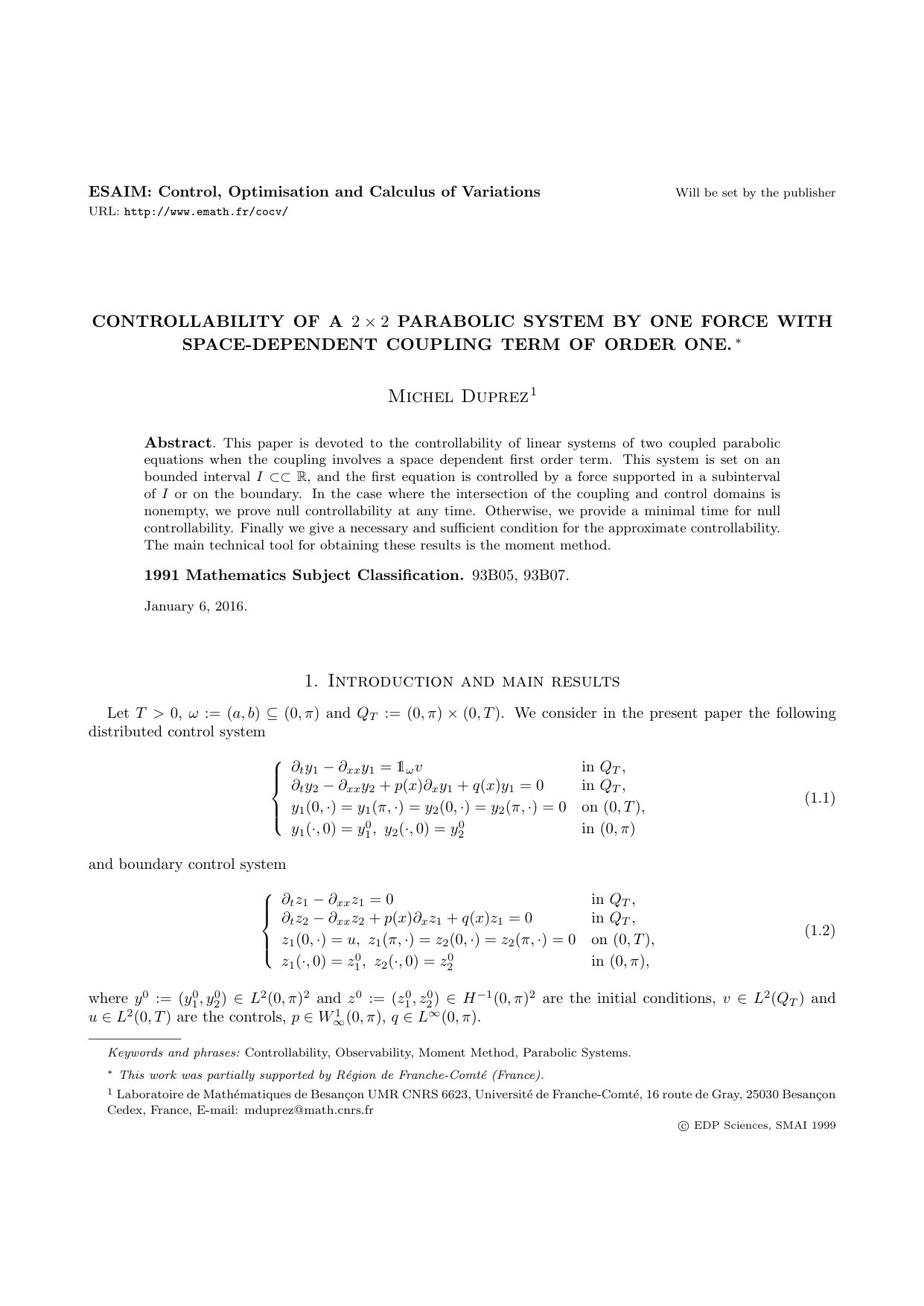 Figure 1
Peer Reviews
No public reviews on file for this paper yet. If you reviewed it on a platform where reviews are public (OpenReview, ICLR, NeurIPS, ICML), you can paste yours below so the community can read it here.
Videos
No videos yet. Explain this paper in a talk, walkthrough, or lecture? Add one.
Controllability of a parabolic system by one force with space-dependent coupling term of order one.
Michel Duprez
Laboratoire de Mathématiques de Besançon UMR CNRS 6623, Université de Franche-Comté, 16 route de Gray, 25030 Besançon Cedex, France, E-mail: [email protected]
(Date: January 6, 2016)
Abstract.
This paper is devoted to the controllability of linear systems of two coupled parabolic equations when the coupling involves a space dependent first order term. This system is set on an bounded interval , and the first equation is controlled by a force supported in a subinterval of or on the boundary. In the case where the intersection of the coupling and control domains is nonempty, we prove null controllability at any time. Otherwise, we provide a minimal time for null controllability. Finally we give a necessary and sufficient condition for the approximate controllability. The main technical tool for obtaining these results is the moment method.
Key words and phrases:
Controllability, Observability, Moment Method, Parabolic Systems.
1991 Mathematics Subject Classification:
93B05, 93B07
This work was partially supported by Région de Franche-Comté (France).
1. Introduction and main results
Let , and . We consider in the present paper the following distributed control system
[TABLE]
and boundary control system
[TABLE]
where and are the initial conditions, and are the controls, , .
It is known (see [20, p. 102] (resp. [16, Prop. 2.2])) that for given initial data (resp. ) and a control (resp. ) System (1.1) (resp. (1.2)) has a unique solution (resp. ) in
[TABLE]
which depends continuously on the initial data and the control, that is
[TABLE]
where does not depend on , , and .
Let us introduce the notion of null and approximate controllability for this kind of systems.
System (1.1) (resp. System (1.2)) is null controllable at time if for every initial condition (resp. ) there exists a control (resp. ) such that the solution to System (1.1) (resp. System (1.2)) satisfies
[TABLE] 2.
System (1.1) (resp. System (1.2)) is approximately controllable at time if for all and all (resp. ) there exists a control (resp. ) such that the solution to System (1.1) (resp. System (1.2)) satisfies
[TABLE]
We recall that null-controllability at some time T implies approximate controllability at the same time T for linear parabolic systems. This follows from the backward uniqueness result of [17, Th. 1.1] for first order perturbations and Propositions 2.5 and 2.6. Moreover the approximate controllability does not depend on the time of control since we consider autonomous systems. It is a consequence of the analyticity in time of the adjoint semigroup.
The main goal of this article is to provide a complete answer to the null and approximate controllability issues for System (1.1) and (1.2). For a survey and some applications in physics, chemistry or biology concerning the controllability of this kind of systems, we refer to [6]. In the last decade, many papers studied this problem, however most of them are related to some parabolic systems with zero order coupling terms. Without first order coupling terms, some Kalman coupling conditions are made explicit in [3, Th. 1.4], [4, Th. 1.1] and [16, Th. 1.1] for distributed null controllability of systems of more than two equations with constant matrices and in higher space dimension and in the case of time dependent matrices, some Silverman-Meadows coupling conditions are given in [3, Th. 1.2].
Concerning the null and approximate controllability of Systems (1.1) and (1.2) in the case and in , a partial answer is given in [1, 2, 13, 23] under the sign condition These results are obtained as a consequence of controllability results of a hyperbolic system using the transmutation method (see [21]). One can find a necessary and sufficient condition in [7] when . Finally, in [11], the authors gives a complete characterization of the approximate controllability and, in the recent work [8, 9], we can find a complete study of the null controllability.
When , the approximate controllability of systems (1.1) and (1.2) in any dimension is studied in [22]. The author gives a sufficient condition for the approximate controllability on the boundary and, in the case of analytic coupling coefficients and , a necessary and sufficient condition for the internal approximate controllability.
Let us now remind known results concerning null controllability for systems of the following more general form. Let be a bounded domain in () of class and an arbitrary nonempty subset of . We denote by the boundary of . Consider the system of two coupled linear parabolic equations
[TABLE]
where , and for all .
As a particular case of the result in section 4 of [18] (see also [5]), System (1.3) is null controllable whenever
[TABLE]
for a positive constant and a non-empty open subset of .
In [19, Th. 4], the author supposes that are constant and the first order coupling operator can be written as
[TABLE]
where satisfies in for a positive constant and is given by , for some . Moreover the operator has to satisfy
[TABLE]
Under these assumptions, the author proves the null controllability of System (1.3) at any time.
In [10, Th. 2.1], the authors prove that the same property holds true for System (1.3) if we assume that , for all , and the geometrical condition
[TABLE]
where represents the exterior normal unit vector to the boundary .
Lastly, for constant coefficients, it is proved in [14, Th. 1] that System (1.3) is null/approximately controllable at any time if and only if
[TABLE]
In [14, Th. 2], the authors give also a condition of null/approximate controllability in dimension one which can be written for system (1.1) as: , and
[TABLE]
for a subinterval of .
Now let us go back to Systems (1.1) and (1.2) for which we will provide a complete description of the null and approximate controllability. Our first and main result is the following {thrm} Let us suppose that , and
[TABLE]
Then System (1.1) is null controllable at any time .
Let us compare this result with the previously described results to highlight our main contribution:
- (1)
Even though System (1.1) is considered in one space dimension, we remark first that our coupling operator has a more general form than the one in (1.5) assumed in [19]. Moreover unlike [14], its coefficients are non-constant with respect to the space variable. 2. (2)
We do not have the geometrical restriction (1.6) assumed in [10]. More precisely we do not require the control support to be a neighbourhood of a part of the boundary. 3. (3)
As said before, in [22, Theorem 4.1], the author gives a necessary and sufficient condition for the approximate controllability of System (1.1) when and are analytic. We deduce that the condition of [22] is satisfied in dimension one as soon as or is not equal to zero.
For all , we denote by the normalized eigenvector of the Laplacian operator, with Dirichlet boundary condition, and consider the two following quantities
[TABLE]
for all . Combined with the criterion of Fattorini (see [15, Cor. 3.3] or Th. 5 in the present paper), Theorem 1 leads to the following characterization: {thrm} Let us suppose that and . System (1.1) is approximately controllable at any time if and only if
[TABLE]
[TABLE]
[TABLE]
This last result recovers the case studied in [11] for , where the authors also use the criterion of Fattorini.
{rmrk}
We will see in the proof of Theorems 1 and 1 that only the following regularity are needed for and
[TABLE]
for an open subinterval of . These hypotheses are used in Definition (1.8) of and and the change of unknown described in Section 3.2. For more general coupling terms, these control problems are open.
When the supports of the control and the coupling terms are disjoint in System (1.1), following the ideas in [9, Th. 1.3] where the authors studied the case , we obtain a minimal time of null controllability: {thrm} Let , . Suppose that Condition (1.10) holds and
[TABLE]
Let be given by
[TABLE]
One has
- (1)
If , then System (1.1) is null controllable at time . 2. (2)
If , then System (1.1) is not null controllable at time .
Concerning the boundary controllability, in [22, Th. 3.3], using the criterion of Fattorini, the author proves that System (1.2) is approximately controllable at time if and only if
[TABLE]
About null controllability of System (1.2), we can again generalize the results given in [9, Th. 1.1] to obtain a minimal time: {thrm} Let , and suppose that Condition (1.13) is satisfied. Let us define
[TABLE]
One has
- (1)
If , then System (1.2) is null controllable at time . 2. (2)
If , then System (1.2) is not null controllable at time .
{rmrk}
Using Riemann-Lebesgue Lemma, sequences and are convergent, more precisely
[TABLE]
Thus, if one of the two limits and (resp. the first limit) is not equal to zero, then the minimal time (resp. ) is equal to zero.
This article is organized as follows. In the second section, we present some preliminary results useful to reduce the null controllability issues to the moment problem. In the third and fourth sections, we study the null controllability issue of System (1.1) in the two cases when the intersection of the coupling and control supports is empty or not. Then we give the proof of Theorems 1 and 1 in Section 5 and 6, respectively. We finish with some comments and open problems in Section 7.
2. Preliminary results
Consider the differential operator
[TABLE]
where the matrix is given by
[TABLE]
the domain of and its adjoint is given by . In section 2.1, we will first establish some properties of the operator that will be useful for the moment method and, in section 2.2, we will recall some characterizations of the approximate and null controllability of system (1.1).
2.1. Biorthogonal basis
Let us first analyze the spectrum of the operators and . {prpstn} For all consider the two vectors
[TABLE]
where is defined for all by
[TABLE]
One has
- (1)
The spectrum of is given by . 2. (2)
For , the eigenvalue of is simple (algebraic multiplicity 1) if and only if . In this case, and are respectively an eigenfunction and a generalized eigenfunction of the operator associated with the eigenvalue , more precisely
[TABLE] 3. (3)
For , the eigenvalue of is double (algebraic multiplicity 2) if and only if . In this case, and are two eigenfunctions of the operator associated with the eigenvalue , that is for
[TABLE]
Proof.
The adjoint operator of is given by and . We can remark first that the resolvent of is compact. Thus the spectrum of reduces to its point spectrum. The eigenvalue problem associated with the operator is
[TABLE]
where and . For in and in , is an eigenvalue of and the vector is an associated eigenfunction. If now in , then is an eigenvalue and with . We remark that System (2.2) has a solution if and only if . If , is a second eigenfunction of linearly independent of , where, applying the Fredholm alternative, is the unique solution to the non-homogeneous Sturm-Liouville problem
[TABLE]
with . We recall that , since . Solving System (2.3) leads to the expression of given in Proposition 2.1. The expression of is given by the equality and the identity leads to . Thus, in the case , is a double eigenvalue of . Items 1 and 3 are now proved.
Let us now suppose that . The eigenvalue is simple, is an eigenfunction and a solution to , that is
[TABLE]
is a generalized eigenfunction of . We deduce that in and is solution to the Sturm-Liouville problem (2.3) with . We obtain the expression of given in Proposition 2.1. ∎
The function given in Proposition 2.1 will play an important role in this paper. Since , and are bounded, we have the following lemma {lmm} There exists a positive constant such that
[TABLE]
Since the eigenvalues of the operator are real, we deduce that and have the same spectrum and the associated eigenspaces have the same dimension. The eigenfunctions and the generalized eigenfunctions of can be found as previously. {prpstn} For all consider the two vectors
[TABLE]
where is defined for all by
[TABLE]
One has
- (1)
The spectrum of is given by . 2. (2)
For , the eigenvalue of is simple (algebraic multiplicity 1) if and only if . In this case, and are an eigenfunction and a generalized eigenfunction of the operator associated with the eigenvalue , more precisely
[TABLE] 3. (3)
For , the eigenvalue of is double (algebraic multiplicity 2) if and only if . In this case, and are two eigenfunctions of the operator associated with the eigenvalue , that is for
[TABLE]
Lemma 2.3 and Corollary 2.6 in [9] can be adapted easily to prove the following proposition.
{prpstn}
Consider the families
[TABLE]
Then
- (1)
The sequences and are biorthogonal Riesz bases of . 2. (2)
The sequence is a Schauder basis of and is its biorthogonal basis in .
We recall that and are biorthogonal in if for all and .
2.2. Duality
As it is well known, the controllability has a dual concept called observability (see for instance [6, Th. 2.1], [12, Th. 2.44, p. 56–57]). Consider the dual system associated with System (1.1)
[TABLE]
where . Let the matrix given by . The approximate controllability is equivalent to a unique continuation property:
{prpstn}
- (1)
System (1.1) is approximately controllable at time if and only if for all initial condition the solution to System (2.7) satisfies the unique continuation property
[TABLE] 2. (2)
System (1.2) is approximately controllable at time if and only if for all initial condition the solution to System (2.7) satisfies the unique continuation property
[TABLE]
The null controllability is characterized by an observability inequality:
{prpstn}
- (1)
System (1.1) is null controllable at time if and only if there exists a constant such that for all initial condition the solution to System (2.7) satisfies the observability inequality
[TABLE] 2. (2)
System (1.1) is null controllable at time if and only if there exists a constant such that for all initial condition the solution to System (2.7) satisfies the observability inequality
[TABLE]
3. Resolution of the moment problem
In this section, we first establish the moment problem related to the null controllability for System (1.1) and then we will solve it in section 3.2 (Theorem 1.1). The strategy involves finding an equivalent system (see Definition 3.2) to System (1.1), which has an associated quantity satisfying ”some good properties”.
3.1. Reduction to a moment problem
Let . For and , if we consider in the dual System (2.7), we get after an integration by parts
[TABLE]
Since is a Riesz basis of , System (1.1) is null controllable if and only if for all , there exists a control such that for all and the solution to System (1.1) satisfies the following equality
[TABLE]
where is the solution to the dual system (2.7) with the initial condition .
In the moment problem (3.1), we will look for a control of the form
[TABLE]
with and satisfying and .
The solutions and to the dual System (2.7) with the initial condition and are given for all by
[TABLE]
Plugging (3.2) and (3.3) in the moment problem (3.1), we get for all
[TABLE]
where , and are given for all and by
[TABLE]
and
[TABLE]
In [16, Prop. 4.1], the authors proved that the family admits a biorthogonal family in the space , i.e. a family satisfying
[TABLE]
Moreover for all there exists a constant such that
[TABLE]
We will look for and of the form
[TABLE]
and prove that the series converges. The moment problem (3.1) can be written as
[TABLE]
with for all
[TABLE]
[TABLE]
and
[TABLE]
3.2. Solving the moment problem
In this section, we will prove the null controllability of System (1.1) at any time when the supports of or intersects the control domain (Theorem 1.1). In [18], the authors obtain the null controllability of System (1.1) at any time under Condition (1.4), so we will not consider this case and we will always suppose that . This implies that there exists such that . By continuity of , we deduce that in for a positive constant and an open subinterval of .
{dfntn}
Let and . Consider the systems given for by
[TABLE]
We say that System is equivalent to System if System is null controllable at time if and only if System is null controllable at time .
Let us present the main technique used all along this section. Suppose that System (1.1) is null controllable at time . Let a control such that the solution to System (1.1) verifies in and a subinterval of . Consider a function satisfying
[TABLE]
with . Thus if we consider the change of unknown
[TABLE]
then is solution in to the system
[TABLE]
where the initial condition is , the control is and the coupling terms are given by and . Since is constant in , we have . Since is controlled, then also. The converse is clearly true: starting from the controlled System (3.15) the same process leads to the construction of a controlled solution of System (1.1). Thus through the change of unknown (3.14), following Definition 3.2, Systems (1.1) and (3.15) are equivalent.
The next main result of this section is Proposition 3.2 that will be introduced after some lemmas. The first of them is the following.
{lmm}
Let and with in an open subinterval of for a positive constant . There exists a subinterval and a function satisfying (3.13) such that System (1.1) is equivalent to System (3.15) with in . Moreover, for all , the interval can be chosen in order to obtain for all
[TABLE]
Consequently, taking the limit, we deduce that .
Proof.
Let be an interval strictly included in and satisfying
[TABLE]
for a positive constant . In the intervals and , we can take of class in order to have . Thus the function verifies (3.13) and, following the change of unknown described in (3.14), System (1.1) is equivalent to System (3.15) with in . The estimates in (3.16) are obtained taking the interval small enough, so will be close to . ∎
Let us first study System (1.1) in a particular case. {lmm}Consider and . Let us suppose that and in an open subinterval of . Then System (1.1) is equivalent to a system of the form (3.15) with coupling terms satisfying
[TABLE]
To prove this result we will need this lemma:
{lmm}
Let be a real sequence. Then there exists such that for all
[TABLE]
Proof of Lemma 3.2.
By contradiction let us suppose that for all there exists such that . Then
[TABLE]
The convergence of the series implies that the measure of the set in the right-hand side in (3.18) is finite and leads to the conclusion. ∎
Proof of Lemma 3.2.
Let an open subinterval of with and to be determined later, and satisfying
[TABLE]
where
[TABLE]
In particular, we have in . Let , and the solution to System (3.15). For System (3.15) the quantity defined in the introduction is given by
[TABLE]
with given by and and defined by
[TABLE]
Then, after a simple calculation, we obtain
[TABLE]
Let large enough such that . There exists an algebraic number of order two, i.e. a root of a polynomial of degree 2 with integer coefficients, satisfying
[TABLE]
since the set of such numbers is dense in . Let us take and . Thus ,
[TABLE]
Moreover
[TABLE]
with . Since is an algebraic number of order two, using diophantine approximations it can be proved that
[TABLE]
for a positive constant (see [9, Ine. (5.13)]). The expressions (3.21)-(3.23) give
[TABLE]
for all . Using Lemma 3.2, there exists satisfying
[TABLE]
Combining the last inequality with Estimate (3.24),
[TABLE]
∎
The next lemma is proved in [9, Lem. 5.1].
{lmm}
There exist functions , satisfying and such that for all
[TABLE]
where for the terms and are given by
[TABLE]
With the help of Lemma 3.2, we deduce the following proposition:
{prpstn}
Consider and . Let us suppose that in an open subinterval of for a positive constant . Then System (1.1) is equivalent to a system of the form (3.15) with coupling terms satisfying Condition (1.10), and
[TABLE]
where and are two positive constants independent on (the notion of equivalent systems is defined at the beginning of Section 3.2).
Proof.
Using Lemma 3.2, without loss of generality, we can suppose that and in a subinterval of for a positive constant . If in , Lemma 3.2 leads to
[TABLE]
which implies that Condition (1.10) is satisfied and the right-hand side of inequality (3.27) is negative for some appropriate constants and . Otherwise, let such that in or in for a positive constant . The rest of the proof is divided into three steps:
Step 1: If , we will prove in this step that System (1.1) is equivalent to a system with coupling terms satisfying . Assume that and consider defined in (3.19), with . We remark that . If we consider the change of unknown described in (3.14), then for all , using the definition of , we obtain
[TABLE]
where
[TABLE]
Using the definition of given in (3.20), we get
[TABLE]
We recall that . Thus, we obtain .
Step 2: We will show in this second step that System (1.1) is equivalent to a system with coupling terms such that . In view of Step 1, we can assume that . Using Lemma 3.2, up to the change of unknown (3.14) we can also suppose that in an open subinterval of . Moreover, by (3.16), the function and can be chosen in order to keep the quantity different of zero. Let such that in . Since and , there exists such that for a constant and all . Let us define the set
[TABLE]
and . Let satisfying
[TABLE]
where are to be determined. Again, if we consider the change of unknown (3.14), then for all , using the definition of , we obtain
[TABLE]
The goal is to choose the functions such that for a constant we have for all satisfying non-constant in . We will construct from until .
Let and consider a solution to
[TABLE]
This system is equivalent to
[TABLE]
We remark that we need that . Finding a function satisfying
[TABLE]
is equivalent to finding a function satisfying
[TABLE]
Let and define for all and all
[TABLE]
Using the fact that is non-constant in , without loss of generality, we can suppose that
[TABLE]
otherwise we adapt the interval at the beginning of Step 2. We deduce that the function of defined by
[TABLE]
is not equal to zero in . Since is a Riesz basis of , there exists such that
[TABLE]
Moreover, using the fact that , we have
[TABLE]
Thus
[TABLE]
Plugging and in (3.28), we obtain
[TABLE]
We have also for all
[TABLE]
We fix in order to have
[TABLE]
Let and let us assume that are already constructed. Consider the set
[TABLE]
If , then we take in . Otherwise, let and consider a solution to
[TABLE]
This system is equivalent to
[TABLE]
Let . Again, there exists such that the function given for all by
[TABLE]
is solution to this system. Then, we obtain
[TABLE]
The last quantity is different of zero for . Let us fix in order to have
[TABLE]
Thus, after constructing the functions , the obtained functions and are such that
[TABLE]
where is a positive constant which does not depend on .
Step 3: Finally, in this third step, we will prove that System (1.1) is equivalent to a system satisfying and Conditions (1.10) and (3.27). In view of Step 2, we can assume that
[TABLE]
where is a positive constant which does not depend on . If for all and a constant , then Condition (1.10) is satisfied and the right-hand side of inequality (3.27) is negative for some appropriate constants and . Let us now suppose that, for a , we have
[TABLE]
Again, using Lemma 3.2, up to the change of unknown (3.14) described at the beginning of the section we can also suppose that in a subinterval of . Moreover, using (3.16), this change of unknown can be chosen in order to keep the property: . Let such that and is constant in , otherwise we argue as in Step 2. Let satisfying
[TABLE]
Again, if we consider the change of unknown described in (3.14), then for all
[TABLE]
We will distinguish the cases and (see (1.8) for the definition of this quantity) for the new control domain .
- Case 1:
Assume that . Let be a solution to the system
[TABLE]
This system is equivalent to
[TABLE]
Taking into account that , in and in for a , one gets
[TABLE]
Let and be such that
[TABLE]
Then for all and a positive constant . Thus Condition (1.10) is satisfied and the right-hand side of inequality (3.27) is negative for some appropriate constants and . 2. Case 2:
Let us now assume that . Then Condition (1.10) is verified. We recall that, in the moment problem described in the last section, we have
[TABLE]
where , , and are given in (3.4). Since is constant in , the function of Proposition 2.1 reads for all
[TABLE]
We deduce that
[TABLE]
where and are given in Lemma 3.2. Using Lemma 3.2, we obtain . Thus, for small enough (3.27) is true for and, for all , the right-hand side of (3.27) is negative for be enough.
We conclude this proof remarking that, in each case, there exists and such that, for all , we have , which implies that . ∎
We recall that is given by (1.12). Before proving Theorem 1, we will establish the following proposition which is true even in the case where the coupling region and the control domain are disjoint.
{prpstn}
Assume that Conditions (1.10) and (3.27) hold and .
Then System (1.1) is null controllable at time .
Proof.
We will use the same strategy than [9]. Let . Using the definition of the minimal time in (1.12), there exists a positive integer for which
[TABLE]
The goal is to solve the moment problem described in Section 3.1. We recall that we look for a control of the form (3.2) and (3.8) with and defined in Lemma 3.2. We will solve the moment problem (3.9) depending on whether belongs to , or , where
[TABLE]
Case 1 : Consider the case with .
Let us take . The moment problem (3.9) becomes
[TABLE]
Since and using the estimate of and in Lemma 3.2, the last system has a unique solution
[TABLE]
Moreover, since the set of the considered in this case is finite, we get the inequality
[TABLE]
**Case 2: **Let such that and .
As in the previous case, we take and the moment problem (3.9) has a unique solution, given by (3.31). Thanks to the property of (see (2.5)) and Lemma 3.2, we get for the following estimates
[TABLE]
Thus, using the assumptions on , we obtain
[TABLE]
where is a constant which is independent on and .
**Case 3: **Consider now such that and .
This implies with (3.30) that
[TABLE]
The two last inequalities lead to
[TABLE]
Combined with inequality (3.27), taking large enough, we get
[TABLE]
with independent on . To solve the moment problem (3.9), we take here . Then the moment problem (3.9) reads . Since and using (3.35), the inverse of is given by
[TABLE]
We deduce that the solution to the moment problem (3.9) is
[TABLE]
The last expression together with (3.34) and (3.35) gives
[TABLE]
Case 4: Let us consider .
If , we can argue as in Case 1. Let us suppose that . In this case, , and inequality (3.30) reads . We take here and the solution of moment problem (3.9) is given by (3.31). We get
[TABLE]
Case 5: Let us now deal with the case .
We recall that , and inequality (3.30) reads
[TABLE]
The moment problem (3.9) is now with and given in (3.10) and (3.12), respectively. From (3.27), the matrix is invertible and
[TABLE]
Using inequalities (3.27) and (3.37), we obtain estimate (3.36).
Conclusion:
We have constructed a control of the form (3.2) and (3.8), which satisfies
[TABLE]
The last inequality, the estimate (3.7) of and the expression (3.8) of () lead to
[TABLE]
Thus, taking , we have the absolute convergence of the series defining and in . This ends the proof.
∎
Proof of Theorem 1.
Using Proposition 3.2, System (1.1) is equivalent to a system with coupling terms and satisfying Condition (1.10) and (3.27). Proposition 3.2 leads to the null controllability of System (1.1) when . We end the proof of Theorems 1 remarking that .
∎
4. Proof of Theorem 1
4.1. Positive null controllability result
Before studying the case where the intersection of the coupling and control domains is empty, we will first rewrite the function given in Proposition 2.1.
{lmm}
Let . Consider the function defined in Proposition 2.1. If we suppose that Condition (1.11) holds, then for all
[TABLE]
where
[TABLE]
Proof.
Since in , we get for all ,
[TABLE]
∎
Proof of Theorem 1.
We will follow the strategy of [9]. More precisely, we will prove Theorem 1.3 with the help of Proposition 3.2. Assume that Conditions (1.10) and (1.11) hold. Consider the functions and defined in Lemma 3.2 and the matrix given in (3.10). Let . We recall that
[TABLE]
where, for , and are defined in (3.4). Since , using the expression of given in Lemma 4.1, we obtain
[TABLE]
where for all
[TABLE]
We deduce that
[TABLE]
where are defined in (3.26). Since the integrals
[TABLE]
and the sequence are uniformly bounded with respect to and , we conclude with the help of Lemma 3.2.
We deduce that Condition (3.27) holds. Thus, using Proposition 3.2, System (1.1) is null controllable at time .
∎
4.2. Negative null controllability result
Let us now prove the negative part of Theorem 1.3 with the strategy used in [9]. Let . We will argue by contradiction: Assume that System (1.1) is null controllable at time . Using Proposition 2.2, there exists a constant such that for all , the solution to System (2.7) satisfies the observability inequality
[TABLE]
Using the Definition of (see (1.12)) there exists a strictly increasing sequence satisfying:
[TABLE]
Let us fix and with to be determined later and , the eigenfunction and generalized eigenfunction associated with given in Proposition 2.1. If we denote by the solution to the dual System (2.7) for initial data , then
[TABLE]
thus, using the orthogonality , we have
[TABLE]
The observability inequality (4.1) reads
[TABLE]
By choosing and , we get
[TABLE]
and the expression of given in Lemma 4.1 leads to
[TABLE]
Let . Equality (4.2) implies that there is such that for all
[TABLE]
We deduce that for , we get
[TABLE]
Thus, since goes to , estimates (4.4) and (4.5) are in contradiction with inequality (4.3) for large enough.
5. Proof of Theorem 1.2
We will proved Theorem 1 using the criterion of Fattorini, as in the pioneer work [22].
{thrm}
[see [15], Cor. 3.3] System (1.1) is approximatively controllable at time if and only if for any and for any we have
[TABLE]
Proof of Theorem 1.
**Necessary condition: ** Let us suppose that Conditions (1.9)-(1.10) do not hold i.e. there exists such that
[TABLE]
We remark that the function of Lemma 4.1 satisfy in , then
[TABLE]
We deduce that is an non-trivial eigenfunction associated with the eigenvalue of the operator satisfying
[TABLE]
Thus, using Theorem 5, System (1.1) is not approximately controllable at time .
**Sufficient condition: ** Let us suppose that Conditions (1.9)-(1.10) hold. If , then we conclude using Theorem 1. Let us now suppose that
[TABLE]
If , the set of the eigenvectors associated with the eigenvalue of is generated by (see Proposition 2.1). In this case, we remark that for all
[TABLE]
If , the eigenvectors associated with the eigenvalue of are linear combinations of and . Let and satisfying
[TABLE]
Using Lemma 4.1, it is equivalent to
[TABLE]
Since , we deduce that . Then . We conclude with the help of Theorem 5.
∎
6. Proof of Theorem 1
As in Section 3.1, System (1.2) is null controllable at time if and only if for all , and the solution to the dual System (2.7) for the initial data satisfies
[TABLE]
We recall that, for all , and are given for all by
[TABLE]
Proof of Theorem 1.
Again, we will follow the strategy used in [9]. Assume that and for all . We will look for the control under the form
[TABLE]
for all , where and are defined in Section 3.1. Plugging the expressions of , and in Equality (6.1), we obtain the moment problem
[TABLE]
Let . Using the definition of (see (1.14)), we have for all . Then, using the estimates (2.5) and (3.33), we get
[TABLE]
Thus for , the control defined in (6.2) is an element of .
Assume now that and for all . By contradiction let us suppose that there exists a constant such that for all the solution to the dual System (2.7) satisfies
[TABLE]
Let . Using the definition of , there exists a sequence such that
[TABLE]
Let with . We recall that
[TABLE]
Then, after calculation, we get
[TABLE]
and
[TABLE]
For and , taking into account inequality (6.4) and using the estimate (2.5), we obtain
[TABLE]
Thus for large enough we get a contradiction with observability inequality (6.3).
∎
7. Comments and open problems
When the control domain and the support of the coupling coefficients and is disjoint in the system
[TABLE]
(resp. system (1.2)), it is legitimate to ask if the minimal time (resp. ) given in Theorem 1.3 (resp. Theorem 1.4) can be different of zero and finite. For in , it is proved in [9, Lem. 7.1] that for any there exists a function such that the minimal time of null controllability associated with System (1.1) is given by . The authors give explicit functions and one can easily adapt them to the case in . In the other hand, the null controllability in the cases in Theorem 1 and in Theorem 1 are open problems.
In higher space dimension, even for this simplified system (7.1) (resp. system (1.2)), distributed and boundary controllability are also open problems. Considering the different results described in the introduction of the present paper, we can conjecture that the system of two coupled linear parabolic equations
[TABLE]
is null controllable at time if there exists an open nonempty subset of such that
[TABLE]
for a .
It seems that the main difficulty is to prove a Carleman estimate for the adjoint problem of system (7.2) under condition (7.3) when the coupling term is a differential operator (see for instance [10, 19] and also [14] for a different approach). In the one-dimensional case, we were not able to adapt the strategy developed in this paper in this general setting.
{acknowledgement}
The author thanks Assia Benabdallah, Manuel González-Burgos and Farid Ammar Khodja for their interesting comments and suggestions. He thanks as well the referees for his remarks that helped to improve the paper.
The reference list from the paper itself. Each links out to its DOI / PubMed record.
- 1[1] F. Alabau-Boussouira and M. Léautaud. Indirect controllability of locally coupled systems under geometric conditions. Comptes Rendus Mathematique , 349 (2011) 395–400.
- 2[2] F. Alabau-Boussouira and M. Léautaud. Indirect controllability of locally coupled wave-type systems and applications. J. Math. Pures Appl. 99 (2013) 544–576.
- 3[3] F. Ammar Khodja, A. Benabdallah, C. Dupaix, and M. González-Burgos. A generalization of the Kalman rank condition for time-dependent coupled linear parabolic systems. Differ. Equ. Appl. 1 (2009) 427–457.
- 4[4] F. Ammar-Khodja, A. Benabdallah, C. Dupaix, and M. González-Burgos. A Kalman rank condition for the localized distributed controllability of a class of linear parbolic systems. J. Evol. Equ. 9 (2009) 267–291.
- 5[5] F. Ammar Khodja, A. Benabdallah, C. Dupaix, and I. Kostin. Null-controllability of some systems of parabolic type by one control force. ESAIM Control Optim. Calc. Var. 11 (2005) 426–448.
- 6[6] F. Ammar-Khodja, A. Benabdallah, M. González-Burgos, and L. de Teresa. Recent results on the controllability of linear coupled parabolic problems: a survey. Math. Control Relat. Fields 1 (2011) 267–306.
- 7[7] F. Ammar Khodja, A. Benabdallah, M. González-Burgos, and L. de Teresa. Controllability of some system of parabolic equations. In Procedings of the II Encuentro RSME-SMM (2012).
- 8[8] F. Ammar Khodja, A. Benabdallah, M. González-Burgos, and L. de Teresa. Minimal time of controllability of two parabolic equations with disjoint control and coupling domains. C. R. Math. Acad. Sci. Paris 352 (2014) 391–396.