TL;DR
This paper introduces a novel non-iterative dense SLAM framework suitable for micro-robot systems, significantly reducing computational costs while maintaining high-resolution 3D mapping accuracy.
Contribution
It proposes the first non-iterative, online trainable data association method for visual SLAM using Fourier domain matching and decoupling techniques.
Findings
Faster runtime compared to state-of-the-art methods
Higher resolution 3D maps with comparable accuracy
Reduced computational complexity to O(n log n)
Abstract
The goal of this paper is to create a new framework for dense SLAM that is light enough for micro-robot systems based on depth camera and inertial sensor. Feature-based and direct methods are two mainstreams in visual SLAM. Both methods minimize photometric or reprojection error by iterative solutions, which are computationally expensive. To overcome this problem, we propose a non-iterative framework to reduce computational requirement. First, the attitude and heading reference system (AHRS) and axonometric projection are utilized to decouple the 6 Degree-of-Freedom (DoF) data, so that point clouds can be matched in independent spaces respectively. Second, based on single key-frame training, the matching process is carried out in frequency domain by Fourier transformation, which provides a closed-form non-iterative solution. In this manner, the time complexity is reduced to…
Click any figure to enlarge with its caption.
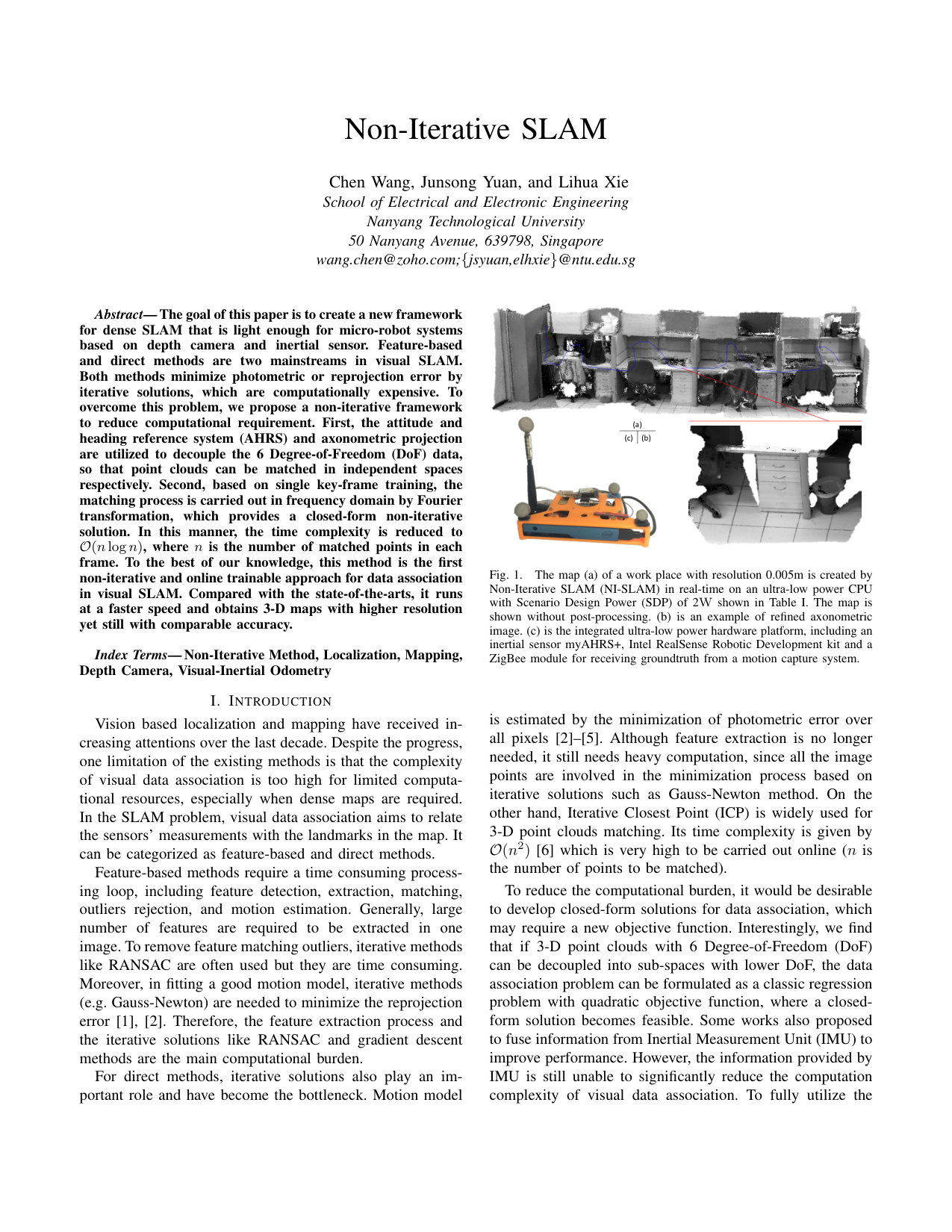 Figure 1
Peer Reviews
No public reviews on file for this paper yet. If you reviewed it on a platform where reviews are public (OpenReview, ICLR, NeurIPS, ICML), you can paste yours below so the community can read it here.
Code & Models
Videos
No videos yet. Explain this paper in a talk, walkthrough, or lecture? Add one.
See pages - of 104_Final_Paper_PDF
