Rejecting inadmissible rules in reduced normal forms in S4
Mojtaba Aghaei, Maryam Rostami Giv
Department of mathematics, Isfahan University of Technology, Isfahan, 84156-83111, Iran
[email protected]
[email protected]
Abstract.
Several methods for checking admissibility of rules in the modal logic S4 are presented in [1], [15]. These methods determine admissibility of rules in S4, but they don’t determine or give substitutions rejecting inadmissible rules. In this paper, we investigate some relations between one of the above methods, based on the reduced normal form rules, and sets of substitutions which reject them. We also generalize the method in [1], [15] for one rule to admissibility of a set of rules.
Keywords: sequent calculus, admissible rule, modal logic, S4, substitution, complexity.
2010 Mathematics Subject Classification: 03B47, 03D15.
1. Introduction
111This research was in part supported by a grant from IPM (NO)
Logical admissible rules were studied by Lorenzen [10], Harrop [7], Mints [11].The question wether algorithms exist for recognising admissibility of rules, posed by Friedman [10], is affirmatively solved by Rybakov [13], [14] for the modal logic S4, for a broad range of propositional modal logics, for example K4 and GL in [15], and by Roziere [12] for IPC using methods of proof theory.
Algorithms deciding admissibility for some transitive modal logics and IPC,
based on projective formulae and unification, are described in Ghilardi [3], [4],[5],[6].
They combine resolution and tableau approaches for finding projective approximations of a formula and rely on the existence of an algorithm for theorem proving. Lemhoff and Metcalfe [8] introduced a Gentzen-style system for analytic proof systems that derive admissible rules of non-classical logics.
A practically feasible realisation for S4 built on the algorithm for IPC in [5] is described
in [16]. These algorithms were specifically designed for finding general solutions for
matching and unification problems. In contrast, the original algorithm of [13] can
be used to find only some solution of such problems in S4. In [1] are presented some methods, specially a tableau method, for checking rule admissibility in S4. For more references for inadmissible rules in S4 see [2], [9], [13], [15].
In this paper, in section 2, we present deduction systems for S4 and some results in this system useful for producing substitutions rejecting some inadmissible rules. In section 3, using Kripke models based on S4-formulas in the normal form as their nodes, we provide necessary and sufficient conditions to the determine validity or admissibility of one or several rules (with the same substitution rejecting them) in the normal forms. A way to build the sets used in this conditions and the relations between them and validity or admissibility of rules is presented. In section 4, the relations between sets of substitutions rejecting sets of rules, and based on them an algorithm to decompose them to their components, are presented. We conclude this section by applying the algorithm on an example. The different ways to decompose the sets make different branches of trees for which examples are presented and show complexity of the problem of producing substitutions rejecting a set of rules.
2. Deduction systems for S4
To study substitutions rejecting admissibility of rules in S4, specially those reject admissibility of the rules p⋄p and p⋄p,p↔□p, we introduce deduction systems for S4 and some useful results in S4. A Hilbert system for S4 is obtained by adding to the language, axiom schemas and rules for classical logic, the modal □ and the schemas:
K:□(A→B)→(□A→□B)
T:□A→A
4:□A→□□A
and the necessitation rule, If ⊢A then ⊢□A.
⋄A is defined as ¬□¬A.
The Gentzen sequent system G1s for S4 is [17]:
Ax:A⊢A⊥L:⊥⊢
\leavevmode \leavevmode \leavevmode \leavevmode \leavevmode \leavevmode \leavevmode \leavevmode ∧L:A∧B,Γ⊢ΔA,B,Γ⊢Δ\leavevmode \leavevmode \leavevmode \leavevmode ∧R:Γ⊢A∧B,ΔΓ⊢A,Δ\leavevmode \leavevmode \leavevmode \leavevmode \leavevmode Γ⊢B,Δ
∨L:A∨B,Γ⊢ΔA,Γ⊢Δ\leavevmode \leavevmode \leavevmode \leavevmode \leavevmode \leavevmode \leavevmode B,Γ⊢Δ ∨R:Γ⊢A∨B,ΔΓ⊢A,B,Δ
→L:A→B,Γ⊢ΔΓ⊢A,Δ\leavevmode \leavevmode \leavevmode \leavevmode \leavevmode \leavevmode \leavevmode \leavevmode \leavevmode \leavevmode B,Γ⊢Δ→R:Γ⊢A→B,ΔA,Γ⊢B,Δ
¬L:¬A,Γ⊢ΔΓ⊢A,Δ¬R:Γ⊢¬A,ΔA,Γ⊢Δ
LW:A,Γ⊢ΔΓ⊢Δ RW:Γ⊢Δ,AΓ⊢Δ
Cut:Γ⊢ΔΓ⊢A,Δ\leavevmode \leavevmode \leavevmode \leavevmode \leavevmode \leavevmode \leavevmode \leavevmode \leavevmode \leavevmode A,Γ⊢Δ
□L:□A,\leavevmode Γ⊢ΔA,\leavevmode ,\leavevmode □A\leavevmode Γ⊢Δ\leavevmode \leavevmode \leavevmode \leavevmode \leavevmode □R:□Γ,\leavevmode Γ′⊢□A,\leavevmode ⋄Δ,\leavevmode Δ′□Γ⊢A,\leavevmode ⋄Δ
⋄L:⋄A,\leavevmode □Γ,\leavevmode Γ′⊢⋄Δ,\leavevmode Δ′A,\leavevmode □Γ⊢⋄Δ⋄R:\leavevmode \leavevmode \leavevmode \leavevmode \leavevmode \leavevmode Γ⊢⋄A,ΔΓ⊢A,\leavevmode ⋄A,\leavevmode Δ
In this paper, to produce substitutions rejecting admissibility of rules, we need formula A with ⊬A and ⊢⋄A, and/or ⊢A↔□A; See Table 1 and Table 2.
Lemma 2.1**.**
The following hold in S4:
(1)⊢□(A→B)→(⋄A→⋄B)**
(2)* If ⊢A→B then ⊢□A→□B*
(3)* If ⊢A→B then ⊢⋄A→⋄B*
(4)⊢□□A↔□A**
(5)⊢⋄⋄A↔⋄A**
(6)⊢□⋄□⋄A↔□⋄A**
(7)⊢⋄□⋄□A↔⋄□A.
(8)⊢□A→∘A* where ∘ is a sequence of the modals □ and ⋄.*
Lemma 2.2**.**
The following are provable in S4:
(1)⊢(□A→B)→⋄(A→B)**
(2)⊢⋄(A→⋄B)→(□A→⋄B)**
(3)⊢(⋄A→□B)↔□(⋄A→□B)**
(4)⊢(⋄A→□B)→□(A→□B)**
(5)⊢(A↔⋄A)∧(B↔□B)→((A→B)↔□(A→B))**
(6)⊢(A↔□A)∧(B↔□B)→((A∨B)↔□(A∨B))**
(7)⊢(□A∨□B)↔□(□A∨□B)**
(8)⊢(□A∨□B)→□(A∨□B)**
Proof.
(1) We prove ⊢□¬(A→B)→¬(□A→B)
1.□¬(A→B) assumption
2.¬(A→B)→A tautology
3.□(¬(A→B))→□A by 2,2.1(2)
4.□A1,3, MP
5.¬(A→B)→¬B tautology
6.□¬(A→B)→□¬B 5,2.1(2)
7.□¬B 1,6, MP
8.□¬B→¬B by axiom T
9.¬B by 9,10, MP
10.□A→(¬B→¬(□A→B)) tautology
11.¬(□A→B) 4,9,10, MP
(2) We prove ⊢¬(□A→⋄B)→□¬(A→⋄B)
1.¬(□A→⋄B) assumption
2.¬(□A→⋄B)→□A tautology
3.□A by 1,2,MP
4.¬(□A→⋄B)→¬⋄B tautology
5.¬⋄B by 1,4,MP
6.□¬B by 5
7.□□¬B by 6 and by axiom 4
8.□¬⋄B by 7
9.A→(¬⋄B→¬(A→⋄B)) tautology
10.□A→□(¬⋄B→¬(A→⋄B)) by 9,2.1(2)
11.□(¬⋄B→¬(A→⋄B)) by 10,3,MP
12.□¬⋄B→□¬(A→⋄B) by 11 and axiom K
13.□¬(A→⋄B) by 8,12,MP
(3) We get ⊢¬□(⋄A→□B)→¬(⋄A→□B)
1.¬□(⋄A→□B) assumption
2.⋄¬(⋄A→□B) by 1
3.¬(⋄A→□B)→⋄A tautology
4.⋄¬(⋄A→□B)→⋄⋄A by 3,2.1(3)
5.⋄⋄A by 2 and 4 and MP
6.⋄⋄A→⋄A by axiom 4
7.⋄A by 5 and 6 and MP
8.¬(⋄A→□B)→¬□B tautology
9.⋄¬(⋄A→□B)→⋄¬□B by 8,2.1(3)
10.⋄¬□B by 2 and 9 and MP
11.¬□□B by 10
12.¬□□B→¬□B by axiom 4
13.¬□B by 11 and 12 and MP
14.⋄A→(¬□B→¬(⋄A→□B)) tautology
15.¬(⋄A→□B) by 7,13,14
(4)
1.(A→⋄A)→((⋄A→□B)→(A→□B)) tautology
2.□(A→⋄A)→□((⋄A→□B)→(A→□B)) by 1,2.1(2)
3.A→⋄A by axiom 4
4.□(A→⋄A) by 3 and necessitation rule
5.□((⋄A→□B)→(A→□B)) by 2 and 4 and MP
6.□(⋄A→□B)→□(A→□B) by 5 and axiom K
7.(⋄A→□B)↔□(⋄A→□B) by part (3)
8.(⋄A→□B)→□(A→□B) by 6 and 7
∎
For formula A in S4, let the property (∗) be ⊬A and ⊢⋄A and the property (∗∗) be the property (∗) in addition ⊢A↔□A.
Let σ(p)=A. If A has the property (∗) then σ rejects the rule r=p⋄p and if A has the property (∗∗) then σ rejects the rule r=p⋄p,p↔□p.
Lemma 2.3**.**
Let A and B formulas in S4 with the property (∗∗) then A∨B has the property (∗∗).
Proof.
Let M1⊭A,M2⊭B and ⊢A∨B. Let M=(M1+M2)′ obtained by adding a new root [math] below M1 and M2. Then M,0⊨A∨B. Let M,0⊨A, since ⊢A↔□A then M,0⊨□A and then M1⊨A, contradiction: Then ⊬A∨B. By ⊢⋄A∨⋄B↔⋄(A∨B) we get ⊢⋄(A∨B), and ⊢A∨B↔□(A∨B) by Lemma 2.2(6).
∎
We can get formulas A with ⊢⋄A as follows. By Lemma 2.1(8), Lemma 2.2(1) and 2.2(4), and replacing p with □p or ⋄p and simplifying modals by Lemma 2.1, we get formulas A with ⊢⋄A as in Lemma 2.4. By some replacements we get ⊢A and we remove them from the list. Note that if ⊢⋄A then ⊢⋄(A∨B) and ⊢⋄(B→A) and if B is obtained from A by replacement then ⊢⋄B.
Lemma 2.4**.**
⊢⋄A* for the following formulas A in S4*
(1)(p→□p)* (7)⋄p→⋄□⋄p (13)□(⋄p→□⋄p)
(2)(p→□⋄p)* (8)⋄□p→□⋄□p (14)□(⋄p→⋄□⋄p)
(3)(p→⋄□p)* (9)⋄□⋄p→□⋄p (15)□(⋄□p→□⋄□p)
(4)(p→□⋄□p)* (10)□(p→□⋄p) (16)□(⋄□⋄p→□⋄p)
(5)(p→⋄□⋄p)* (11)□(p→⋄□⋄p) (17)□⋄(p→□⋄□p)
(6)⋄p→□⋄p* (12)□(□p→□⋄□p) (18)□⋄(⋄p→□⋄p)
Proof.
(1)−(5) by Lemma 2.1(8) and 2.2(1), (6) and (7) from (1)−(5), (8) from (6), (9) from (8) by replacement, (10)−(12) from (6)−(8) by Lemma 2.2(1), (13)−(14) from (10)−(12),\leavevmode (15) from(13),\leavevmode (16) form (15) and (18) from (17) by replacement, and (17) from (12) by Lemma 2.2(1).
∎
Remark 2.1**.**
By Lemma 2.2, except for (1)−(5) and (7) in Lemma 2.4, we get ⊢A↔□A. In the lemma note that (12) and then (17) and (18) are theorems in S4. The other parts of the lemma are not theorems. Consider S4-models M1 and M2. (1)−(7),(10),(11),(13),(14) are not valid in M1; (8),(9),(15),(16) are not valid in M2.
Example 2.1**.**
The proofs of ⊢⋄A in Lemma 2.4 in the sequent calculus are interesting. For example we prove some cases.
⊢⋄(p→□p)\leavevmode \leavevmode \leavevmode ⊢p→□p,⋄(p→□p)\leavevmode \leavevmode p⊢□p,⋄(p→□p)\leavevmode \leavevmode \leavevmode \leavevmode \leavevmode ⊢p,⋄(p→□p)\leavevmode \leavevmode \leavevmode \leavevmode ⊢p,p→□p\leavevmode \leavevmode \leavevmode p⊢p,□p\leavevmode \leavevmode p⊢pRW→R⋄R,RW□R→R⋄R**
⊢⋄□(p→□⋄p)\leavevmode \leavevmode ⊢□(p→□⋄p),⋄□(p→□⋄p)\leavevmode \leavevmode ⊢p→□⋄p,⋄□(p→□⋄p)\leavevmode \leavevmode p⊢□⋄p,⋄□(p→□⋄p)\leavevmode \leavevmode \leavevmode ⊢⋄p,⋄□(p→□⋄p)\leavevmode \leavevmode \leavevmode \leavevmode ⊢⋄p,□(p→□⋄p),⋄□(p→□⋄p)\leavevmode \leavevmode \leavevmode ⊢⋄p,p→□⋄p\leavevmode \leavevmode \leavevmode p⊢□⋄p,⋄p\leavevmode \leavevmode \leavevmode p⊢⋄p\leavevmode \leavevmode p⊢p⋄R,RWLW→R□R,RW⋄R□R→R□R⋄R**
⊢⋄□⋄(p→□⋄□p)⊢□⋄(p→□⋄□p),⋄□⋄(p→□⋄□p)⊢⋄(p→□⋄□p),⋄□⋄(p→□⋄□p)⊢(p→□⋄□p),⋄□⋄(p→□⋄□p)p⊢□⋄□p,⋄□⋄(p→□⋄□p)⊢⋄□p,⋄□⋄(p→□⋄□p)⊢⋄□p,□⋄(p→□⋄□p)⊢⋄□p,⋄(p→□⋄□p)⊢□p,⋄(p→□⋄□p)⊢p,⋄(p→□⋄□p)⊢p,p→□⋄□pp⊢p,□⋄□p\leavevmode \leavevmode \leavevmode p⊢p\leavevmode \leavevmode \leavevmode \leavevmode RW→R⋄R,RW□R⋄R□R⋄R,RW□R,LW→R⋄R,RW□R⋄R**
3. Kripke models and reduce normal forms
A Kripke frame is a pair (W,R) where W is a non-empty set of words and R is a relation on W, i.e. R⊆W×W. A Kripke model is a triple (W,R,V), where (W,R) is a frame and V is a valuation that assigns sets of worlds to propositional variables, i.e. V:P→P(W), where P is the set of propositional variables. V(p) is interpreted as the set of worlds where p is true. An S4-model is a Kripke model (W,R,V) in which R is reflexive and transitive.
M,w⊨ψ is defined as usual for an S4-formula ψ, an S4-model M and a w in M. ψ is valid in a model M, denoted M⊨ψ, if M,w⊨ψ for all worlds w in M.
A rule of inference is as the following: r=βα1,...,αn that α1,...,αn and β are S4-formulae. r is valid in an S4-model M, if from M⊨α1,...,M⊨αn follows M⊨β. The rule r is valid if it is valid in each S4-model M.
For a rule of inference r=βα1,...,αn, a logic λ and substitution σ we use λ⊢σr if from λ⊢σ(α1),...,λ⊢σ(αn) it follows that λ⊢σ(β). If λ⊬σr we say σ rejects r in λ. r is admissible in λ if λ⊢σr for every substitution σ.
Definition 3.1**.**
A Kripke model Kn is called n-characterizing for a modal logic λ (any normal modal logic, not necessarily an extension of the system K4) if the domain of the valuation V from Kn is the set P which consists of n different propositional variables, and if the following holds. For any formula α which is build up of variables from P
α∈λ⇔Kn⊨α**
We use Chλ(n) for n-characterizing Kripke models Kn.
Lemma 3.1**.**
*Let M=(M,V) be a λ-model.
(1)* If σ is a substitution and S(xi)=V(σ(xi)), then S is a definable valuation for which S(α)=V(σ(α)) for each λ formula α, that is (M,S),w⊨α iff (M,V),w⊨σ(α) for each w∈M.
(2)* If S is a definable valuation in M, that is for each variable xi there is a formula ϕi such that (M,S),w⊨xi iff (M,V),w⊨ϕi, and if σ(xi)=ϕi is a substitution then S(α)=V(σ(α)) for each λ-formula α, that is (M,S),w⊨α iff (M,V),w⊨σ(α) for each w∈M.
(3)* If σ is a substitution, S is a definable valuation for which S(α)=V(σ(α)) for each λ formula α, r:=βα1,...,αm is a rule and σ(r):=σ(β)σ(α1),...,σ(αm) then r is valid in (M,S) iff σ(r) is valid in (M,V).*
Proof.
(1) and (2) by easy induction on α and (3) by (1) and (2).
∎
Theorem 3.1**.**
*Let (Kn,Vn), n∈N, be a sequence of n-characterizing models for a modal logic λ. Inference rules r1:=β1α11,...,α1m1,...,rk:=βkαk1,...,αkmk are inadmissible in λ with the same substitution σ iff r1,...,rk are invalid in (Kn,S) for some n∈N and some definable valuation S of variables from r1,...,rk in Kn (that is, If S(αij)=Kn and S(βi)=Kn for i=1,...,k and j=1,...,mi).
Proof.
(⇐) If r1,...,rk are not admissible in λ with the same substitution σ then for i=1,...,k and j=1,...,mi, we get ⊢λσ(αij) and ⊬λσ(βi) then (Kn,Vn)⊨λσ(αij) and (Kn,Vn)⊭λσ(βi) for n the number of variables in σ(r1),...,σ(rk), thus σ(r1),...,σ(rk) is invalid in (Kn,Vn), so r1,...,rk are invalid in (Kn,S) with the definable valuation S(xi)=Vn(σ(xi)) for each variable xi free in r by Lemma 3.1.
(⇒) If r1,...,rk is invalid in (Kn,S) with the definable valuation S for each variable xi free in r1,...,rk then by Lemma 3.1, there is a substitution σ for each free variable xi in r1,...,rk such that S(xi)=Vn(σ(xi)) and σ(r1),...,σ(rk) are invalid in (Kn,Vn), that is, for i=1,...,k and j=1,...,mi we get (Kn,Vn)⊨λσ(αij) and (Kn,Vn)⊭λσ(βi), then ⊢λσ(αij) and ⊬λσ(βi), therefore r1,...,rk are not admissible in λ.
∎
Definition 3.2**.**
A rule r is said to be in reduced normal form if it has the form
(rnf)\leavevmode \leavevmode \leavevmode \leavevmode \leavevmode \leavevmode \leavevmode \leavevmode \leavevmode \leavevmode \leavevmode \leavevmode \leavevmode r=j∈J⋁ϕjj∈I⋁ϕj* or r=pij∈I⋁ϕj*
and each disjunct ϕj has the form
0≤i≤n⋀pit(i,j,0)∧0≤i≤n⋀⋄pit(i,j,1),
where (i) all ϕj are different (ii)\leavevmode p0,...,pn denote propositional variables, (iii) t is a Boolean function t:{0,...,n}×{1,...,s}×{0,1}→{0,1} and (iv) α0=¬α and α1=α for any formula α.
Remark 3.1**.**
For the rule r=⋁j∈Jϕj⋁i∈Iϕi in reduced normal form we can suppose J⊆I, because let r′=⋁j∈J−{k}ϕj⋁i∈Iϕi,k∈I−J, then r and r′ are rejected by the same substitutions. Let a substitution σ rejects r′, i.e., ⊢σ(⋁i∈Iϕi) and ⊬σ(⋁j∈J−{k}ϕj). For each i∈I,\leavevmode \leavevmode ϕi→¬ϕk and then ⋁i∈Iϕi→¬ϕk are tautologies, so ⊢¬σ(ϕk) and therefore ⊬σ(⋁j∈Jϕj). Then σ rejects r. The other side is obvious. For simplicity, we use r=JI
Using the renaming technique any modal rule can be transformed into an equivalent rule in reduced normal form [1], [15].
Theorem 3.2**.**
*Any rule r=βα can be transformed in exponential time to an equivalent rule in reduced normal form.
Proof.
see [1], [15].
∎
Let Θn={ϕ1,...,ϕs} be the
set of all disjuncts in n variables p1,...,pn. For every ϕj∈Θn,let
θ(ϕj)={pi\leavevmode ∣\leavevmode t(i,j,0)=1}θ⋄(ϕj)={pi\leavevmode ∣\leavevmode t(i,j,1)=1}.
For every subset of disjuncts W⊆Θn, let M(Θn,W)
denote the Kripke model in which
WM=W, RM={(ϕ1,ϕ2)\leavevmode ∣\leavevmode θ⋄(ϕ2)⊆θ⋄(ϕ1)}, (pi,ϕj)∈νm⇔pi∈θ(ϕj).
Example 3.1**.**
In Figure 2 and Figure 3 we show M(Θ2,Θ2) and M(Θ3,Θ3), in which i is used for ϕi for which Θ(ϕi) and Θ⋄(ϕi) are determined as they are showed in the figures. For example in Figure 2:
ϕ1:=p1∧p2∧⋄p1∧⋄p2*, ϕ6:=¬p1∧p2∧⋄p1∧¬⋄p2, ϕ16:=¬p1∧¬p2∧¬⋄p1∧¬⋄p2.
If Θ⋄(ϕi)⊆Θ(ϕi) we show the node i by ∙ and otherwise we show it by ∘ for which ⊢¬ϕi and then we can remove it from disjunctions in the rules. The right figures only show the nodes ∙.
*The first column in Table 1 and Table 2 show all the sets W, as in Theorem 3.5, for which if W⊆I, the rule r=p1I is inadmissible. The second column shows the simplified form of i∈W⋁ϕi, and the third shows the conditions on formulas A,B and C for them the substitution σ with σ(p1)=A,σ(p2)=B and σ(p3)=C rejects the rule r. We suppose in the tables ⊢⋄A except if ¬⋄p1 occurs in the simplified form. In the last three cases in Table 2, the substitution σ has not been found yet.
Theorem 3.3**.**
Let N=(N,R) and N⊨i∈I⋁ϕi and W={ϕi∈Θn∣∃x∈N\leavevmode \leavevmode N,x⊨ϕi}. Then
(1)* If N,x⊨ϕi then N,x⊨ϕ iff M(Θn,W),ϕi⊨ϕ for each formula ϕ.
(2)* W⊆{ϕi∈Θn∣i∈I,M(Θn,W),ϕi⊨ϕi}.
(3)* M(Θn,W)⊨i∈I′⋁ϕi iff W⊆{ϕi∈Θn∣i∈I′}.
(4)* N⊨i∈I′⋁ϕi iff W⊆{ϕi∈Θn∣i∈I′}.
(5)* If N⊭pi iff M(Θn,W)⊭pi for i=1,...,n.
(6)* If for each subset D of N there exists a∈N such that*
θ⋄(a)=θ(a)∪d∈D⋃θ⋄(d)**
then for each subset D of W there exists ϕj∈W such that
θ⋄(ϕj)=θ(ϕj)∪ϕ∈D⋃θ⋄(ϕ)**
*where Θ(a)={pi∣N,a⊨pi} and Θ⋄(a)={pi∣N,a⊨⋄pi}.
Proof.
First note that if N,x⊨ϕi and N,x⊨ϕj then ϕi=ϕj. Define f:N⟶ontoW with f(x)=ϕi iff N,x⊨ϕi. f is a homomorphism, because for x,y∈N if xRy, f(x)=ϕi,f(y)=ϕj and pk∈Θ⋄(f(y))=Θ⋄(ϕj), since N,y⊨ϕj then N,y⊨⋄pk, thus N,x⊨⋄pk and since N,x⊨ϕi, so pk∈Θ⋄(f(x))=Θ⋄(ϕi). Therefore Θ⋄(f(y))⊆Θ⋄(f(x)), then f(x)RMf(y).
(1) Since f is a surjective homomorphism then N,x⊨ϕ iff M(Θn,W),f(x)⊨ϕ iff M(Θn,W),ϕi⊨ϕ, if N,x⊨ϕi.
(2) By (1) for ϕ=ϕi∈W let N,x⊨ϕi then M(Θn,W),ϕi⊨ϕi. Again W⊆{ϕi∣i∈I}; Because, if j∈/I and ϕj∈W, let N,x⊨ϕj, since ϕj→¬ϕi for each i∈I and thus ϕj→¬i∈I⋁ϕi are tautologies then N,x⊨¬i∈I⋁ϕi, contradicting N⊨i∈I⋁ϕi.
(3)(⇒) Let ϕj∈Wand j∈I′. Since M(Θn,W),ϕj⊨ϕj and ⊨ϕj→¬ϕi for i=j and then ⊨ϕj→¬i∈I′⋁ϕi so M(Θn,W),ϕj⊨¬i∈I′⋁ϕi.
(⇐) By (2).
(4) By (1) and (3).
(5) Let N,w⊭pi and f(w)=ϕj then M(Θn,W),f(w)⊭pi therefore M(Θn,W),ϕj⊭pi.
(6) Let D⊆W. Since f is surjective, for each ϕi∈D pick and fix a representative di such that f(di)=ϕi and take D′={di∈N∣ϕi∈D}. Let a∈N,f(a)=ϕj and θ⋄(a)=θ(a)∪d∈D′⋃θ⋄(d)=θ(a)∪ϕi∈D⋃θ⋄(di), then by Θ(a)=Θ(f(a))=Θ(ϕj) and Θ⋄(a)=Θ⋄(f(a))=Θ⋄(ϕj) and Θ⋄(di)=Θ⋄(f(di))=θ⋄(ϕi)), we get Θ⋄(ϕj)=θ(ϕj)∪ϕi∈D⋃θ⋄(ϕi)).
∎
Theorem 3.4**.**
A rule r=j∈J⋁ϕji∈I⋁ϕi∨j∈J⋁ϕj is invalid for S4 models iff there is a set W⊆{ϕi∈Θn∣i∈I∪J} such that
(1)* M(Θn,W),ϕj⊨ϕj for all ϕj∈W.
(2)* M(Θn,W)⊨i∈I⋁ϕi∨j∈J⋁ϕj.
(3)* There is i∈I such that ϕi∈W and M(Θn,W),ϕi⊭j∈J⋁ϕj.
(4)* r is invalid in M(Θn,W).
Proof.
Let r is invalid in N(N,R) then N⊨i∈I⋁ϕi∨j∈J⋁ϕj and N⊭j∈J⋁ϕj. Let W={ϕi∈Θn∣∃w∈N\leavevmode \leavevmode N,w⊨ϕi}. By Theorem 3.3, we get (1) and (2).
(3) Since N⊭j∈J⋁ϕj, then W⊈{ϕi∈Θn∣i∈J} and since W⊆{ϕi∈Θn∣i∈I∪J} then there is an i∈I−J such that ϕi∈W. By ⊨ϕi→¬j∈J⋁ϕj and M(Θn,W),ϕi⊨ϕi we get M(Θn,W),ϕi⊨¬j∈J⋁ϕj, then M(Θn,W),ϕi⊭j∈J⋁ϕj.
(4) By (2) and (3).
∎
Theorem 3.5**.**
*A rule r=p1i∈I⋁ϕi is inadmissible for S4 iff there is a set W⊆{ϕi∣i∈I} such that
(1) There is ϕj∈W such that M(Θn,W),ϕj⊭p1.
(2)* M(Θn,W),ϕj⊨ϕj for all ϕj∈W.
(3)* For each subset D of W there exists ϕj∈W such that
θ⋄(ϕj)=θ(ϕj)∪ϕ∈D⋃θ⋄(ϕ).
*Note that in (3),D can be empty.
Proof.
(⇒) Let r be inadmissible for S4, then by Theorem 3.1 there is an n-characterizing S4 model ChS4(n) in which r is invalid and by its way of construction the above condition (3) holds for it. Let W={ϕi∈Θn∣∃w∈ChS4(n)\leavevmode \leavevmode \leavevmode \leavevmode ChS4(n),w⊨ϕi}. Then the conditions (1)−(3) hold for M(Θn,W) by Theorem 3.3.
(⇐) By (1) and (2), the rule r is invalid in M(Θn,W), and by the proof of Theorem 3.4.10 [1] there is an extension of M(Θn,W) to an n-characterizing S4 model ChS4(n) with effectively contractible definable valuation S of the variables p1,...,pn which coincides with the original valuation of M(Θn,W) and ChS4(n)⊨i∈I⋁ϕi. Since M(Θn,W)⊭p1 and ChS4(n) is an extension of M(Θn,W) then ChS4(n)⊭p1. Then ChS4(n)⊭r, therefore r is inadmissible by Theorem 3.1
∎
Theorem 3.6**.**
*A rule r=j∈J⋁ϕji∈I⋁ϕi∨j∈J⋁ϕj is inadmissible for S4 iff there is a set W⊆{ϕi∈Θn∣i∈I∪J} such that
(1) ϕi∈W for some i∈I.
(2)* M(Θn,W),ϕj⊨ϕj for all ϕj∈W.
(3)* For each subset (D) of M there exists ϕj∈W such that
θ⋄(ϕj)=θ(ϕj)∪ϕ∈D⋃θ⋄(ϕ).
Proof.
(⇒) Similar to the previous theorem.
(⇐) Similar to the previous theorem except ChS4(n)⊨i∈I⋁ϕi∨j∈J⋁ϕj and since M(Θn,W)⊭j∈J⋁ϕj and ChS4(n) is an extension of M(Θn,W) then ChS4(n)⊭j∈J⋁ϕj.
∎
Theorem 3.7**.**
*Rules r1=j∈J1⋁ϕji∈I1⋁ϕi∨j∈J1⋁ϕj,...,rm=j∈Jm⋁ϕji∈Im⋁ϕi∨j∈Jm⋁ϕj are invalid in the same S4 model iff there is a set W⊆{ϕi∈Θn∣i∈Ik∪Jk} for k=1,...,m such that
(1)* ϕi∈W for some i∈Ik for k=1,...,m.
(2)* M(Θn,W),ϕj⊨ϕj for all ϕj∈W.
then r1,...,rm are invalid M(Θn,W).*
Theorem 3.8**.**
*Rules r1=j∈J1⋁ϕji∈I1⋁ϕi∨j∈J1⋁ϕj,...,rm=j∈Jm⋁ϕji∈Im⋁ϕi∨j∈Jm⋁ϕj are inadmissible for S4 with the same substitution σ iff there is a set W⊆{ϕi∈Θn∣i∈Ik∪Jk} for k=1,...,m such that
(1)* ϕi∈W for some i∈Ik for k=1,...,m.
(2)* M(Θn,W),ϕj⊨ϕj for all ϕj∈W.
(3)* For each subset (D) of M there exists ϕj∈W such that
θ⋄(ϕj)=θ(ϕj)∪ϕ∈D⋃θ⋄(ϕ).
Proof.
(⇒) Let r1,...,rm are inadmissible with the same σ. r1,...,rm are invalid in an n-characterizing S4 model ChS4(n) by Theorem 3.1. Let W={ϕi∈Θn∣∃x∈ChS4(n)\leavevmode \leavevmode ChS4(n),x⊨ϕi}, then W⊆{ϕi∈Θn∣i∈Ik∪Jk} for k=1,...,m. Similar to the previous theorems, the conditions (1)−(3) hold for M(Θn,W).
(⇐) By (1) and (2), the rule rk′=j∈Jk⋁ϕji∈W⋁ϕi is invalid in M(Θn,W), and by the proof of Theorem 3.4.10 [1] there is an extension of M(Θn,W) to an n-characterizing S4 model ChS4(n) with effectively contractible definable valuation S of the variables p1,...,pn which coincides with the original valuation of M(Θn,W) and ChS4(n)⊨i∈W⋁ϕi then ChS4(n)⊨i∈Ik⋁ϕi∨j∈Jk⋁ϕj. Since M(Θn,W)⊭j∈Jk⋁ϕj and ChS4(n) is an extension of M(Θn,W) then ChS4(n)⊭j∈Jk⋁ϕj. Then ChS4(n)⊭r1,...,ChS4(n)⊭rm, therefore r1,...,rm are inadmissible by the same σ by Theorem 3.1.
∎
Theorem 3.9**.**
*Rules r1=j∈J1⋁ϕji∈I1⋁ϕi∨j∈J1⋁ϕj,...,rm=j∈Jm⋁ϕji∈Im⋁ϕi∨j∈Jm⋁ϕj are inadmissible for S4 with the same substitution σ iff there is a set W⊆{ϕi∈Θn∣i∈Ik∪Jk} for k=1,...,m such that r1′=j∈J1⋁ϕjϕi∈W⋁ϕi,...,rm′=j∈Jm⋁ϕjϕi∈W⋁ϕi are inadmissible for S4 with the same substitution σ.
Proof.
(⇐) is trivial.
(⇒) Let ϕj∈/{ϕi∈Θn∣i∈Il∪Jl} then for i∈Il∪Jl we get ⊢ϕi→¬ϕj then ⊢i∈Il∪Jl⋁σ(ϕi)→¬σ(ϕj) and since ⊢i∈Il∪Jl⋁σ(ϕi) so ⊢¬σ(ϕj). For k=1,...,m, since ⊢i∈Ik∪Jk⋁σ(ϕi) then ⊢i∈Ik∪Jk−{j}⋁σ(ϕi) therefore the rule j∈Jk⋁ϕji∈Ik∪Jk−{j}⋁σ(ϕi) is inadmissible for S4 with the substitution σ.
∎
In the previous theorems, in the sets W there must be appropriate formula ϕi to support conditions such as M(Θn,W),ϕj⊨ϕj for all ϕj∈W. In the end of this section we study the construction and properties of these sets.
Definition 3.3**.**
Supp1⊆P(Θn)* is the smallest set where*
(1)* If C1,...,Cm are clusters of Mn, that is, ∀x,y∈Ci\leavevmode \leavevmode \leavevmode Θ⋄(x)=Θ⋄(y)=Θ⋄(Ci) for each i=1,...,m, and Xi⊆Ci where x∈Xi⋃Θ(x)=Θ⋄(Ci) for each i=1,...,m, then i=1⋃mXi∈Supp1.
(2)* If Yi⊆W∈Supp1 and Xi⊆Ci where Ci is a cluster, ∀y∈Yi\leavevmode \leavevmode Θ⋄(y)⊆Θ⋄(Ci) and Θ⋄(Ci)=y∈Yi⋃Θ(y)∪x∈Xi⋃Θ(x) for i=1,...,n, then W∪i=1⋃nXi∈Supp1.
Supp2⊆Supp1* is defined as W∈Supp2 if in addition*
(3)* For each D⊆W there is z∈W such that Θ⋄(z)=Θ(z)∪x∈D⋃Θ⋄(x).*
Example 3.2**.**
Let W1={55}, W2={46}, W3={55,46}, W4={55}∪{13,14}
W5={30,31}∪{21,23}∪{13,14}, W6={21,55}, W7={21,30,55},
W8={8,21,30,55}*.
These sets are in Supp1 and W1,W2,W6,W8∈Supp2 but W3,W4,W5,W7∈/Supp2.
Remark 3.2**.**
*If n≤3, the condition (3) can be replaced with
(4) ∃x∈W where Θ(x)=Θ⋄(x).
(5) If x,y∈W then zRx and zRy for some z∈W with Θ⋄(z)⊆Θ(z)∪Θ⋄(x)∪Θ⋄(y) .
But for n≥4, let W={x1,x2,x3,y1,y2,y3,z} with Θ(xi)=Θ⋄(xi)={pi},\leavevmode i=1,2,3,\leavevmode Θ⋄(y1)={p1,p2,p4},\leavevmode Θ⋄(y2)={p1,p3,p4},\leavevmode Θ⋄(y3)={p2,p3,p4},\leavevmode Θ⋄(z)={p1,p2,p3,p4} and Θ(y1)=Θ(y2)=Θ(y3)={p4},Θ(z)=∅. Then W∈Supp1 and the conditions (4),(5) are true for W but (3) is false for D={x1,x2,x3}.
Theorem 3.10**.**
(1)* If x∈W∈Supp1 and W′={w∈W∣xRw} then W′∈Supp1.
(2)* If x∈W∈Supp1 and W′={w∈W∣xRw} and Θ⋄(x)=Θ(x) then W′∈Supp2.
(3)* If x∈W∈Supp1 and Θ⋄(x)=Θ⋄(y), then W∪{y}∈Supp1.
(4)* If W1,W2∈Supp1 then W1∪W2∈Supp1.
(5)* W∈Supp1 iff M(Θn,W),ϕj⊨ϕj for all ϕj∈W.
(6)* W∈Supp2 iff*
(i)* M(Θn,W),ϕj⊨ϕj for all ϕj∈W and*
(ii)* For each subset (D) of W there exists ϕj∈W such that*
θ⋄(ϕj)=θ(ϕj)∪ϕ∈D⋃θ⋄(ϕ).
(7)* r=JI,J is invalid iff there is W∈Supp1 such that W∩I=∅ and W⊆I∪J.
(8)* r=JI,J is inadmissible iff there is W∈Supp2 such that W∩I=∅ and W⊆I∪J.
(9)* If r=JI,J is valid then r=JI,J is admissible.
(10)* If r=JI,J is invalid then r′=x,Jx,I,J is inadmissible for some x with θ(x)=θ⋄(x).
(11)* If r1=J1I1,J1,...,rk=JkIk,Jk are invalid in the same S4-model iff there is W∈Supp1 such that W∩Ii=∅ and W⊆Ii∪Ji for i=1,...,k.
(12)* If r1=J1I1,J1,...,rk=JkIk,Jk are inadmissible with the same σ iff there is W∈Supp2 such that W∩Ii=∅ and W⊆Ii∪Ji for i=1,...,k.
(13)* If r1=J1I1,J1,...,rk=JkIk,Jk are invalid in the same S4-model then r1′=x,J1x,I1,J1,...,r′=x,J1x,I1,J1 are inadmissible with the same σ for some x with θ(x)=θ⋄(x).
Proof.
(1) (i) Let C1,...,Cm be clusters of Mn and Xi⊆Ci where x∈Xi⋃Θ(x)=Θ⋄(Ci) for each i=1,...,m, and x∈W=i=1⋃mXi. Let x∈Xi⊆Ci Then W′=∀y∈XjxRy⋃Xj∈Supp1.
(ii) Let Yi⊆W1∈Supp1 and Xi⊆Ci where Ci is a cluster, ∀y∈Yi\leavevmode \leavevmode Θ⋄(y)⊆Θ⋄(Ci) and Θ⋄(Ci)=y∈Yi⋃Θ(y)∪x∈Xi⋃Θ(x), for i=1,...,n, and x∈W=W1∪i=1⋃nXi. Then W′=W1′∪∀y∈XjxRy⋃Xj and by induction hypothesis W1′∈Supp1, and if x is in some Ci, then ∀y∈Yi\leavevmode \leavevmode xRy and Yi⊆W1′, so W′∈Supp1 by Definition 3.3(2).
(2) By (1),W′∈Supp1 and if D⊆W′ and y∈D then Θ⋄(y)⊆Θ⋄(x) then y∈D⋃Θ⋄(y)⊆Θ⋄(x)=Θ(x), therefore Θ⋄(x)=Θ(x)∪y∈D⋃Θ⋄(y).
(3) (i) Let C1,...,Cm be clusters of Mn and Xi⊆Ci where x∈Xi⋃Θ(x)=Θ⋄(Ci) for each i=1,...,m, and x∈W=i=1⋃mXi. Let x∈Xj⊆Cj and Θ⋄(x)=Θ⋄(y) Then Xj∪{y}⊆Cj and x∈Xj∪{y}⋃Θ(x)=Θ⋄(Cj). Then W∪{y}=j=i=1⋃mXi∪(Xj∪{y})∈Supp1.
(ii) Let Yi⊆W1∈Supp1 and Xi⊆Ci where Ci is a cluster, ∀y∈Yi\leavevmode \leavevmode Θ⋄(y)⊆Θ⋄(Ci) and Θ⋄(Ci)=y∈Yi⋃Θ(y)∪x∈Xi⋃Θ(x), for i=1,...,n, and x∈W=W1∪i=1⋃nXi. If x∈W1, then by induction hypothesis W1∪{y}∈Supp1, so W∪{y}=(W1∪{y})∪i=1⋃nXi by Definition 3.3(2). If x∈Xj, then Xj∪{y}⊆Cj and w∈Xj⋃Θ(w)⊆w∈Xj∪{y}⋃Θ(w)⊆Θ⋄(Cj) thus Θ⋄(Cj)=w∈Yj⋃Θ(w)∪w∈Xj∪{y}⋃Θ(w). Therefore W∪{y}=W1∪(Xj∪{y})∪j=i=1⋃nXi∈Supp1 by Definition 3.3(2).
(5) (⇐) By induction on W. Let W=i=1⋃nXi where ∅=Xi⊆Ci and Ci is a cluster for i=1,...,n. x∈Xi⋃Θ(x)⊆Θ⋄(Ci) is trivial. If pk∈Θ⋄(Ci) and φj∈Xi⊆Ci, since φj⊨φj and pk∈Θ⋄(φj)=Θ⋄(Ci) then φj⊨⋄pk. Let φjRφj′ and φj′⊨pk then pk∈Θ(φj′). If W′=∅ then φj′∈Xi thus pk∈x∈Xi⋃Θ(x), so x∈Xi⋃Θ(x)=Θ⋄(Ci) and therefore W∈Supp1 by Definition 2(1). If W′=∅ and Xi⊆W−W′ and Yi={φj′∈W′∣φj∈Xi}, then φj′∈Xi∪Yi and pk∈x∈Xi⋃Θ(x)∪y∈Yi⋃Θ(y), so x∈Xi⋃Θ(x)∪y∈Yi⋃Θ(y)=Θ⋄(Ci). Since the hypothesis M(Θn,W′),φj⊨φj is true for all φj∈W′, by induction hypothesis W′∈Supp1 and therefore W=W′∪Xi⊆W−W′⋃Xi∈Supp1 by Definition 3.3(2)
(⇒)is trivial.
(6) It is trivial by (5) and Definition 3.3(3).
(7) By the part (5) and Theorem 3.4.
(8) By the part (6) and Theorem 3.6.
(9) If r=JI,J is inadmissible then by the part (8), there is W∈Supp2 such that W∩I=∅ and W⊆I∪J. Since Supp2⊆Supp1 then W∈Supp1 so r is invalid by the part (7).
(10) If r=JI,J is invalid then by the part (7), there is W∈Supp1 such that W∩I=∅ and W⊆I∪J. Let z∈W∩I and W′={w∈W∣zRw} and θ(x)=θ⋄(x)=θ⋄(z). By the parts (2) and (3), W′∪{x}∈Supp2, (W′∪{x})∩I=∅ and (W′∪{x})⊆(I∪{x})∪J. Then by the part (8) r′=x,Jx,I,J is inadmissible.
(11)−(13) similar to (7)−(10) by Theorems 3.8 and 3.9.
∎
4. substitutions for rules in reduced normal forms
Suppose S:P(Θn)→P(Σ) with S(A)={σ\leavevmode ∣\leavevmode ⊬σr\leavevmode \leavevmode \leavevmode for\leavevmode each\leavevmode r\leavevmode in\leavevmode A}. The following theorem shows properties of S and the way of composing S(A) to its components in the form of S(W−{i1}W,...,W−{in}W) where W={i1,...,in} according to the parts (7) and (8) of the theorem. Some applications of the theorem is given by figures (4), (5) and (6) and example (4.1). The compositions are done using the actions a +J and −J in the parts (12) and (13), decreasing premisses and adding demands (9) and (11), and simplifications (4), (5) and (6). The method introduced in the theorem and the following examples justify the approach of the paper in considering substitutions rejecting a set of rules instead of a single rule as usual and generalizing the results in the previous sections.
Theorem 4.1**.**
*The above function S satisfies the following:
(1)* If A⊆B then S(B)⊆S(A).
(2)* S(A)∩S(B)=S(A∪B).
(3)* S(A)∪S(B)⊆S(A∩B).
(4)* S({J1W1,J2W2}∪A)=S({J2W2}∪A) if J1⊆J2,W2⊆W1.
(5)* If Ji⊆Ji′,Wi⊆Wi′ and WiWi′ and JiJi′ are admissible for i=1,...,m then S(J1W1,...,JmWm)=S(J1′W1′,...,Jm′Wm′) (special cases of (10) and (11)).
(6)* If W=i=1⋂mWi then S({J1W1,...,JmWm})=S({J1∩WW,...,Jm∩WW}) then S({J1W1,...,JmWm})=∅ if J1⊆W or … or Jm⊆W
(7)* If W={i1,...,in} and J1,...,Jm⊆W then S(W−{i1}W,...,W−{in}W)⊆S(J1W,...,JmW)
(8)* If W1={i1,...,in} and W2={j1,...,jm} and W1=W2 then
S(W1−{i1}W1,...,W1−{in}W1)∩S(W2−{j1}W2,...,W2−{jm}W2)=∅
(9)* If J1,...,JnW1W2⊆Θ(r) then
(i)* S({J1W2,...,JmW2})=S({J1W1,...,JmW1})⋃S({W1W2}).
(ii)* S({J1W1,...,JmW1})∩S({W1W2})=∅.
(iii)* S({J1W1,...,JmW1})⊆S({J1W2,...,JmW2}).
(10)* If JiWi⊆Wi′⊆Θ(r) for i=1,...,m then
(i)* S({J1W1′,...,JmWm′})=S({J1W1,...,JmWm})⨂S({W1W1′,...,WmWm′}):=α∈2m⋃Sα where
Sα=S({r1,...,rm})* and*
[TABLE]
*for i=1,...,m.
(ii)* S(α)∩S(β)=∅ if α=β.
(iii)* S({J1W1,...,JmWm})∩S({W1W1′,...,WmWm′})=∅.
(iv)* S({J1W1,...,JmWm})⊆S({J1W1′,...,JmWm′}).
(11)* If Ji⊆Ji′⊆Wi⊆Θn(r) for i=1,...,m then
(i)* S({J1W1,...,JmWm})=S({J1′W1,...,Jm′Wm})⨂S({J1J1′,...,JmJm′}):=α∈2m⋃Sα where Sα=S({r1,...,rm}) and*
[TABLE]
*for i=1,...,m.
(ii)* S(α)∩S(β)=∅ if α=β.
(iii)* S({J1′W1,...,Jm′Wm})∩S({J1J1′,...,JmJm′}).
(iv)* S({J1′W1,...,Jm′Wm})⊆S({J1W1,...,JmWm}).
(12)* If Ji⊊Wi⊆Θ(r) for i=1,...,m, and {J1W1,...,JmWm}−J={J1−JW1−J,...,Jm−JWm−J} then
(i)* S({J1W1,...,JmWm})=S({J1W1,...,JmWm}−J)∪i=1⋃m(S({J1W1,...,JmWm})∩S({Wi−JWi}))
=S({J1W1,...,JmWm}−J)∪i=1⋃mS({J1W1,...,JmWm,Wi−JWi})*.
(ii)* S({J1W1,...,JmWm}−J)∩S({J1W1,...,JmWm,Wi−JWi})=∅.
(iii)* S({J1W1,...,JmWm}−J)⊆S({J1W1,...,JmWm}).
(13)* If J⊆Wi⊆Θ(r) for i=1,...,m, and {J1W1,...,JmWm}+J={J1∪JW1,...,Jm∪JWm} then
(i)* S({J1W1,...,JmWm})=S({J1W1,...,JmWm}+J)⨂S({J1J1∪J,...,JmJm∪J}):=α∈2m⋃Sα where
Sα=S({r1,...,rm}) and*
[TABLE]
*for i=1,...,m.
(ii)* S(α)∩S(β)=∅ if α=β.
(iii)* S({J1W1,...,JmWm}+J)∩S({J1J1∪J,...,JmJm∪J})=∅.
(iv)* S({J1W1,...,JmWm}+J)⊆S({J1W1,...,JmWm}).
Theorem 4.2**.**
If Ji⊆Wi⊆Θn(r) for i=1,...,m, then S({J1W1,...,JmWm})=∅ iff
there is W∈Supp2 such that Ji⊊W⊆Wi, for i=1,...,m.
Proof.
By Theorem 3.10(12).
∎
Remark 4.1**.**
In the items (9)−(13) in the Theorem 4.1, by Theorem 4.2, we can replace ⊊ with ⊆ if for some W∈Supp2 we suppose W1W⊆W2 in (9), Wi⊊W⊆Wi′ for i=1,...,m in (10), Ji⊊W⊆Ji′ for i=1,...,m in (11), Ji⊊W⊆Wi for i=1,...,m in (12). JiW⊆Ji∪J for i=1,...,m in (13).
Remark 4.2**.**
Theorem 4.1 suggests a method to decompose S(A) to its components as in (7) and (8). If for some JW∈A, i∈W−J and W−J has another element, we use the part (13) for J={i} and denote this action by
=+i. If i∈W∩J for some JW∈A and the previous action can’t be done, we use (12) for J={i} and denote this action by =−i.
After each of these actions we use (4) and (5) and (6) to simplify or unify the premisses or demands and to remove unnecessary rules. We denote this action by =s. When the premisses are the same the action =−i is simplified to
S({J1W,...,JmW})=S({J1−{i}W−{i},...,Jm−{i}W−{i}})∪S({J1W,...,JmW,W−{i}W}).
If i∈J′ for each J′W∈A and i∈W−J then the action =+i is simplified to
S({JW}∪A)=S({J∪{i}W}∪A)∪S({JJ∪{i}}∪A).
By Theorem 4.2 in each step the empty or nonempty sets are determined.
Figure 4 shows the tree of applications of actions ±i for an example from Figure 2. Figure 5 shows the simplified forms of the rules in figure 4. Since the tree for 3 variables is very big, Figure 6 shows a branch of application ±i for an example from figure 3.
Example 4.1**.**
S(11,2,3,4,10,12)=+2S(1,21,2,3,4,10,12)∪S(11,2)
=−2S(11,3,4,10,12)∪S(1,21,2,3,4,10,12,1,3,4,10,121,2,3,4,10,12)∪S(11,2)
=+3S(1,31,3,4,10,12)∪S(11,3)∪S(1,2,31,2,3,4,10,12,1,3,4,10,121,2,3,4,10,12)∪S(1,21,2,3,1,3,4,10,121,2,3,4,10,12)∪S(11,2)
=sS(1,31,3,4,10,12)∪S(11,3)∪S(1,2,31,2,3,4,10,12,1,3,4,10,121,2,3,4,10,12)∪S(1,21,2,3,1,31,2,3)∪S(11,2)
=+4S(1,3,41,3,4,10,12)∪S(1,31,3,4)∪S(11,3)∪S(1,2,3,41,2,3,4,10,12,1,3,4,10,121,2,3,4,10,12)∪S(1,2,31,2,3,4,1,3,4,10,121,2,3,4,10,12)∪S(1,21,2,3,1,31,2,3)∪S(11,2)
=sS(1,3,41,3,4,10,12)∪S(1,31,3,4)∪S(11,3)∪S(1,2,3,41,2,3,4,10,12,1,3,4,10,121,2,3,4,10,12)∪S(1,2,31,2,3,4,1,3,41,2,3,4)∪S(1,21,2,3,1,31,2,3)∪S(11,2)**
=−3S(1,41,4,10,12)∪S(1,3,41,3,4,10,12,1,4,10,121,3,4,10,12)∪S(11,4)∪S(1,31,3,4,1,41,3,4)∪S(11,3)∪S(1,2,41,2,4,10,12,1,4,10,121,2,4,10,12)∪S(1,2,3,41,2,3,4,10,12,1,3,4,10,121,2,3,4,10,12,1,2,4,10,121,2,3,4,10,12)∪S(1,21,2,4,1,41,2,4)∪S(1,2,31,2,3,4,1,3,41,2,3,4,1,2,41,2,3,4)∪S(1,21,2,11,2)∪S(1,21,2,3,1,31,2,3,1,21,2,3)∪S(11,2)**
=sS(1,41,4,10,12)∪S(1,3,41,3,4,10,12,1,4,10,121,3,4,10,12)∪S(11,4)∪S(1,31,3,4,1,41,3,4)∪S(11,3)∪S(1,2,41,2,4,10,12,1,4,10,121,2,4,10,12)∪S(1,2,3,41,2,3,4,10,12,1,3,4,10,121,2,3,4,10,12,1,2,4,10,121,2,3,4,10,12)∪S(1,21,2,4,1,41,2,4)∪S(1,2,31,2,3,4,1,3,41,2,3,4,1,2,41,2,3,4)∪S(1,21,2,3,1,31,2,3)∪S(11,2)**
=−4S(11,10,12)∪S(1,41,4,10,12,1,10,121,4,10,12)∪S(1,31,3,10,12,1,10,121,3,10,12)∪S(1,3,41,3,4,10,12,1,4,10,121,3,4,10,12,1,3,10,121,3,4,10,12)∪S(11,4)∪S(1,31,3,11,3)∪S(1,31,3,4,1,41,3,4)∪S(11,3)∪S(1,21,2,10,12,1,10,121,2,10,12)∪S(1,2,41,2,4,10,12,1,4,10,121,2,4,10,12,1,2,10,121,2,4,10,12)∪S(1,2,31,2,3,10,12,1,3,10,121,2,3,10,12,1,2,10,121,2,3,10,12)∪S(1,2,3,41,2,3,4,10,12,1,3,4,10,121,2,3,4,10,12,1,2,4,10,121,2,3,4,10,12,1,2,3,10,121,2,3,4,10,12)∪S(1,21,2,11,2)∪S(1,21,2,4,1,41,2,4,1,21,2,4)∪S(1,2,31,2,3,1,31,2,3,1,21,2,3)∪S(1,2,31,2,3,4,1,3,41,2,3,4,1,2,41,2,3,4,1,2,31,2,3,4)∪S(1,21,2,3,1,31,2,3)∪S(11,2)
=sS(11,10,12)∪S(1,41,4,10,12,1,10,121,4,10,12)∪S(1,31,2,3,10,12,1,10,121,2,3,10,12)∪S(1,3,41,2,3,4,10,12,1,4,10,121,2,3,4,10,12,1,2,3,10,121,2,3,4,10,12)∪S(11,4)∪S(1,31,3,4,1,41,3,4)∪S(11,3)∪S(1,21,2,10,12,1,10,121,2,10,12)∪S(1,2,41,2,4,10,12,1,4,10,121,2,4,10,12,1,2,10,121,2,4,10,12)∪S(1,2,31,2,3,10,12,1,3,10,121,2,3,10,12,1,2,10,121,2,3,10,12)∪S(1,2,3,41,2,3,4,10,12,1,3,4,10,121,2,3,4,10,12,1,2,4,10,121,2,3,4,10,12,1,2,3,10,121,2,3,4,10,12)∪S(1,21,2,4,1,41,2,4)∪S(1,2,31,2,3,4,1,3,41,2,3,4,1,2,41,2,3,4)∪S(1,21,2,3,1,31,2,3)∪S(11,2)
=+10S(1,101,10,12)∪S(11,10)∪S(1,4,101,4,10,12,1,10,121,4,10,12)∪S(1,41,4,10,1,10,121,4,10,12)∪S(1,3,101,2,3,10,12,1,10,121,2,3,10,12)∪S(1,31,3,10,1,10,121,2,3,10,12)∪S(1,3,4,101,2,3,4,10,12,1,4,10,121,2,3,4,10,12,1,2,3,10,121,2,3,4,10,12)∪S(1,3,41,3,4,10,1,4,10,121,2,3,4,10,12,1,2,3,10,121,2,3,4,10,12)∪S(11,4)∪S(1,31,3,4,1,41,3,4)∪S(11,3)∪S(1,2,101,2,10,12,1,10,121,2,10,12)∪S(1,21,2,10,1,10,121,2,10,12)∪S(1,2,4,101,2,4,10,12,1,4,10,121,2,4,10,12,1,2,10,121,2,4,10,12)∪S(1,2,41,2,4,10,1,4,10,121,2,4,10,12,1,2,10,121,2,4,10,12)∪S(1,2,3,101,2,3,10,12,1,3,10,121,2,3,10,12,1,2,10,121,2,3,10,12)∪S(1,2,31,2,3,10,1,3,10,121,2,3,10,12,1,2,10,121,2,3,10,12)∪S(1,2,3,4,101,2,3,4,10,12,1,3,4,10,121,2,3,4,10,12,1,2,4,10,121,2,3,4,10,12,1,2,3,10,121,2,3,4,10,12)∪*
S(1,2,3,41,2,3,4,10,1,3,4,10,121,2,3,4,10,12,1,2,4,10,121,2,3,4,10,12,1,2,3,10,121,2,3,4,10,12)∪S(1,21,2,4,1,41,2,4)∪S(1,2,31,2,3,4,1,3,41,2,3,4,1,2,41,2,3,4)∪S(1,21,2,3)∪S(11,2)
=sS(1,101,10,12)∪S(11,10)∪S(1,4,101,4,10,12,1,10,121,4,10,12)∪S(1,41,4,10,1,101,4,10)∪S(1,3,101,2,3,10,12,1,10,121,2,3,10,12)∪S(1,31,3,10,1,101,3,10)∪S(1,3,4,101,2,3,4,10,12,1,4,10,121,2,3,4,10,12,1,2,3,10,121,2,3,4,10,12)∪S(1,3,41,3,4,10,1,4,101,3,4,10,1,3,101,3,4,10)∪S(11,4)∪S(1,31,3,4,1,41,3,4)∪S(11,3)∪S(1,2,101,2,10,12,1,10,121,2,10,12)∪S(1,21,2,10,1,101,2,10)∪S(1,2,4,101,2,4,10,12,1,4,10,121,2,4,10,12,1,2,10,121,2,4,10,12)∪S(1,2,41,2,4,10,1,4,101,2,4,10,1,2,101,2,4,10)∪S(1,2,3,101,2,3,10,12,1,3,10,121,2,3,10,12,1,2,10,121,2,3,10,12)∪S(1,2,31,2,3,10,1,3,101,2,3,10,1,2,101,2,3,10)∪S(1,2,3,4,101,2,3,4,10,12,1,3,4,10,121,2,3,4,10,12,1,2,4,10,121,2,3,4,10,12,1,2,3,10,121,2,3,4,10,12)∪S(1,2,3,41,2,3,4,10,1,3,4,101,2,3,4,10,1,2,4,101,2,3,4,10,1,2,3,101,2,3,4,10)∪S(1,21,2,4,1,41,2,4)∪S(1,2,31,2,3,4,1,3,41,2,3,4,1,2,41,2,3,4)∪S(1,21,2,3)∪S(11,2)
=−10S(11,12)∪S(1,101,10,12,1,121,10,12)∪S(11,10)∪S(1,41,4,12,1,121,4,12)∪S(1,4,101,4,10,12,1,10,121,4,10,12,1,4,121,4,10,12)∪S(1,41,4,10,1,101,4,10)∪S(1,31,2,3,12,1,121,2,3,12)∪S(1,3,101,2,3,10,12,1,10,121,2,3,10,12,1,2,3,121,2,3,10,12)∪S(1,31,3,10,1,101,3,10)∪S(1,3,41,2,3,4,12,1,4,121,2,3,4,12,1,2,3,121,2,3,4,12)∪S(1,3,4,101,2,3,4,10,12,1,4,10,121,2,3,4,10,12,1,2,3,10,121,2,3,4,10,12,1,2,3,4,121,2,3,4,10,12)∪S(1,3,41,3,4,10,1,4,101,3,4,10,1,3,101,3,4,10)∪S(11,4)∪S(1,31,3,4,1,41,3,4)∪S(11,3)∪S(1,21,2,12,1,121,2,12)∪S(1,2,101,2,10,12,1,10,121,2,10,12,1,2,121,2,10,12)∪S(1,21,2,10,1,101,2,10)∪S(1,2,41,2,4,12,1,4,121,2,4,12,1,2,121,2,4,12)∪S(1,2,4,101,2,4,10,12,1,4,10,121,2,4,10,12,1,2,10,121,2,4,10,12,1,2,4,121,2,4,10,12)∪S(1,2,41,2,4,10,1,4,101,2,4,10,1,2,101,2,4,10)∪S(1,2,31,2,3,12,1,3,121,2,3,12,1,2,121,2,3,12)∪S(1,2,3,101,2,3,10,12,1,3,10,121,2,3,10,12,1,2,10,121,2,3,10,12,1,2,3,121,2,3,10,12)∪S(1,2,31,2,3,10,1,3,101,2,3,10,1,2,101,2,3,10)∪S(1,2,3,41,2,3,4,12,1,3,4,121,2,3,4,12,1,2,4,121,2,3,4,12,1,2,3,121,2,3,4,12)∪S(1,2,3,4,101,2,3,4,10,12,1,3,4,10,121,2,3,4,10,12,1,2,4,10,121,2,3,4,10,12,1,2,3,10,121,2,3,4,10,12,1,2,3,4,121,2,3,4,10,12)∪S(1,2,3,41,2,3,4,10,1,3,4,101,2,3,4,10,1,2,4,101,2,3,4,10,1,2,3,101,2,3,4,10)∪S(1,21,2,4,1,41,2,4)∪S(1,2,31,2,3,4,1,3,41,2,3,4,1,2,41,2,3,4)∪S(1,21,2,3)∪S(11,2)
=sS(1,101,10,12)∪S(11,10)∪S(1,4,101,4,10,12,1,10,121,4,10,12)∪S(1,41,4,10,1,101,4,10)∪S(1,31,2,3)∪S(1,2,3,101,2,3,10,12,1,2,10,121,2,3,10,12)∪S(1,3,101,2,3,10,1,2,101,2,3,10,1,2,31,2,3,10)∪S(1,2,101,2,10,12,1,10,121,2,10,12)∪S(1,101,2,10,1,21,2,10)∪S(1,31,3,10,1,101,3,10)∪S(1,3,41,2,3,4,1,2,31,2,3,4)∪* S(1,2,3,4,101,2,3,4,10,12,1,2,4,10,121,2,3,4,10,12,1,2,3,10,121,2,3,4,10,12)∪S(1,3,4,101,2,3,4,10,1,2,4,101,2,3,4,10,1,2,3,101,2,3,4,10,1,2,3,41,2,3,4,10)∪S(1,2,4,101,2,4,10,12,1,4,10,121,2,4,10,12,1,2,10,121,2,4,10,12)∪S(1,4,101,2,4,10,1,2,101,2,4,10,1,2,41,2,4,10)∪S(1,3,41,3,4,10,1,4,101,3,4,10,1,3,101,3,4,10)∪S(11,4)∪S(1,31,3,4,1,41,3,4)∪S(11,3)∪S(1,2,101,2,10,12,1,10,121,2,10,12)∪S(1,21,2,10,1,101,2,10)∪S(1,2,4,101,2,4,10,12,1,4,10,121,2,4,10,12,1,2,10,121,2,4,10,12)∪S(1,2,41,2,4,10,1,4,101,2,4,10,1,2,101,2,4,10)∪S(1,2,3,101,2,3,10,12,1,3,10,121,2,3,10,12,1,2,10,121,2,3,10,12)∪S(1,2,31,2,3,10,1,3,101,2,3,10,1,2,101,2,3,10)∪S(1,2,3,4,101,2,3,4,10,12,1,3,4,10,121,2,3,4,10,12,1,2,4,10,121,2,3,4,10,12,1,2,3,10,121,2,3,4,10,12)∪S(1,2,3,41,2,3,4,10,1,3,4,101,2,3,4,10,1,2,4,101,2,3,4,10,1,2,3,101,2,3,4,10)∪S(1,21,2,4,1,41,2,4)∪S(1,2,31,2,3,4,1,3,41,2,3,4,1,2,41,2,3,4)∪S(1,21,2,3)∪S(11,2)
*In the last equation note 11,12,1,41,4,12,1,2,31,2,3,12,1,2,3,41,2,3,4,12 are admissible, otherwise by Theorem 3.6 and Figure (2) there is W⊆{1,3,4,12} such that 12∈W and M(Θ2,W),ϕ12⊨ϕ12 then M(Θ2,W),ϕ12⊨⋄p2 which is false. Then by Theorem 4.1, parts (4) and (5)
S(11,12)=∅
S(1,41,4,12,1,121,4,12)=S(1,41,4,12,11,4,12)=S(1,41,4,12)=∅
S(1,21,2,12,1,121,2,12)=S(1,21,2,12,11,2,12)=S(1,21,2,12)=∅
S(1,2,41,2,4,12,1,4,121,2,4,12,1,2,121,2,4,12)=S(1,2,41,2,4,12,1,41,2,4,12,1,21,2,4,12)=S(1,2,41,2,4,12)=∅
S(1,2,31,2,3,12,1,3,121,2,3,12,1,2,121,2,3,12)=S(1,2,31,2,3,12,1,31,2,3,12,1,21,2,3,12)=S(1,2,31,2,3,12)=∅**
S(1,2,3,41,2,3,4,12,1,3,4,121,2,3,4,12,1,2,4,121,2,3,4,12,1,2,3,121,2,3,4,12)=S(1,2,3,41,2,3,4,12,1,3,41,2,3,4,12,1,2,41,2,3,4,12,1,2,31,2,3,4,12)=S(1,2,3,41,2,3,4,12)=∅**
S(1,101,10,12,1,121,10,12)=S(1,101,10,12,11,10,12)=S(1,101,10,12),
S(1,4,101,4,10,12,1,10,121,4,10,12,1,4,121,4,10,12)=S(1,4,101,4,10,12,1,10,121,4,10,12,1,41,4,10,12)=S(1,4,101,4,10,12,1,10,121,4,10,12),**
S(1,31,2,3,12,1,121,2,3,12)=S(1,31,2,3,11,2,3)=S(1,31,2,3),**
S(1,3,101,2,3,10,12,1,10,121,2,3,10,12,1,2,3,121,2,3,10,12)=+2S(1,2,3,101,2,3,10,12,1,2,10,121,2,3,10,12,1,2,3,121,2,3,10,12)∪S(1,3,101,2,3,10,1,2,10,121,2,3,10,12,1,2,3,121,2,3,10,12)∪S(1,2,3,101,2,3,10,12,1,10,121,2,10,12,1,2,3,121,2,3,10,12)∪S(1,3,101,2,3,10,1,10,121,2,10,12,1,2,3,121,2,3,10,12)=S(1,2,3,101,2,3,10,12,1,2,10,121,2,3,10,12,1,2,31,2,3,10,12)∪S(1,3,101,2,3,10,1,2,101,2,3,10,1,2,31,2,3,10)∪S(1,2,101,2,10,12,1,10,121,2,10,12,1,21,2,10,12)∪S(1,101,2,10,1,101,2,10,1,21,2,10)=S(1,2,3,101,2,3,10,12,1,2,10,121,2,3,10,12)∪S(1,3,101,2,3,10,1,2,101,2,3,10,1,2,31,2,3,10)∪S(1,2,101,2,10,12,1,10,121,2,10,12)∪S(1,101,2,10,1,21,2,10)**
S(1,3,41,2,3,4,12,1,4,121,2,3,4,12,1,2,3,121,2,3,4,12)=S(1,3,41,2,3,4,1,41,2,3,4,1,2,31,2,3,4)=S(1,3,41,2,3,4,1,2,31,2,3,4),
S(1,2,101,2,10,12,1,10,121,2,10,12,1,2,121,2,10,12)=S(1,2,101,2,10,12,1,10,121,2,10,12,1,21,2,10,12)=S(1,2,101,2,10,12,1,10,121,2,10,12),
S(1,2,4,101,2,4,10,12,1,4,10,121,2,4,10,12,1,2,10,121,2,4,10,12,1,2,4,121,2,4,10,12)=S(1,2,4,101,2,4,10,12,1,4,10,121,2,4,10,12,1,2,10,121,2,4,10,12,1,2,41,2,4,10,12)=S(1,2,4,101,2,4,10,12,1,4,10,121,2,4,10,12,1,2,10,121,2,4,10,12),
S(1,2,3,101,2,3,10,12,1,3,10,121,2,3,10,12,1,2,10,121,2,3,10,12,1,2,3,121,2,3,10,12)=S(1,2,3,101,2,3,10,12,1,3,10,121,2,3,10,12,1,2,10,121,2,3,10,12,1,2,31,2,3,10,12)=S(1,2,3,101,2,3,10,12,1,3,10,121,2,3,10,12,1,2,10,121,2,3,10,12),
S(1,2,3,4,101,2,3,4,10,12,1,3,4,10,121,2,3,4,10,12,1,2,4,10,121,2,3,4,10,12,1,2,3,10,121,2,3,4,10,12,1,2,3,4,121,2,3,4,10,12)=S(1,2,3,4,101,2,3,4,10,12,1,3,4,10,121,2,3,4,10,12,1,2,4,10,121,2,3,4,10,12,1,2,3,10,121,2,3,4,10,12,1,2,3,41,2,3,4,10,12)=S(1,2,3,4,101,2,3,4,10,12,1,3,4,10,121,2,3,4,10,12,1,2,4,10,121,2,3,4,10,12,1,2,3,10,121,2,3,4,10,12),
S(1,3,4,101,2,3,4,10,12,1,4,10,121,2,3,4,10,12,1,2,3,10,121,2,3,4,10,12,1,2,3,4,121,2,3,4,10,12)=+2S(1,2,3,4,101,2,3,4,10,12,1,2,4,10,121,2,3,4,10,12,1,2,3,10,121,2,3,4,10,12,1,2,3,4,121,2,3,4,10,12)∪S(1,3,4,101,2,3,4,10,1,2,4,10,121,2,3,4,10,12,1,2,3,10,121,2,3,4,10,12,1,2,3,4,121,2,3,4,10,12)∪S(1,2,3,4,101,2,3,4,10,12,1,4,10,121,2,4,10,12,1,2,3,10,121,2,3,4,10,12,1,2,3,4,121,2,3,4,10,12)∪S(1,3,4,101,2,3,4,10,1,4,10,121,2,4,10,12,1,2,3,10,121,2,3,4,10,12,1,2,3,4,121,2,3,4,10,12)=S(1,2,3,4,101,2,3,4,10,12,1,2,4,10,121,2,3,4,10,12,1,2,3,10,121,2,3,4,10,12,1,2,3,41,2,3,4,10,12)∪S(1,3,4,101,2,3,4,10,1,2,4,101,2,3,4,10,1,2,3,101,2,3,4,10,1,2,3,41,2,3,4,10)∪S(1,2,4,101,2,4,10,12,1,4,10,121,2,4,10,12,1,2,10,121,2,4,10,12,1,2,41,2,4,10,12)∪S(1,4,101,2,4,10,1,4,101,2,4,10,1,2,101,2,4,10,1,2,41,2,4,10)=S(1,2,3,4,101,2,3,4,10,12,1,2,4,10,121,2,3,4,10,12,1,2,3,10,121,2,3,4,10,12)∪S(1,3,4,101,2,3,4,10,1,2,4,101,2,3,4,10,1,2,3,101,2,3,4,10,1,2,3,41,2,3,4,10)∪S(1,2,4,101,2,4,10,12,1,4,10,121,2,4,10,12,1,2,10,121,2,4,10,12)∪S(1,4,101,2,4,10,1,2,101,2,4,10,1,2,41,2,4,10).**
5. Conclusion and Discussion
In this paper, we investigated some relations between the method in [1], [15], based on the reduced normal form rules in Theorem 3.5, and sets of substitutions which reject them in section 4. We also generalized the method for one rule to inadmissibility of a set of rules. We did some case studies for the cases 2 and 3 variables. The case studies show complexity of the problem. The decomposition of sets of substitutions rejecting sets of rules to its components algorithmically is done in section 4 and calculating at least one member of each components is leaved. Partially the problem is solved for some cases in the paper.

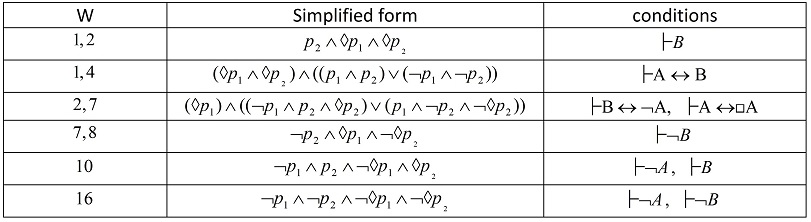 Figure 1
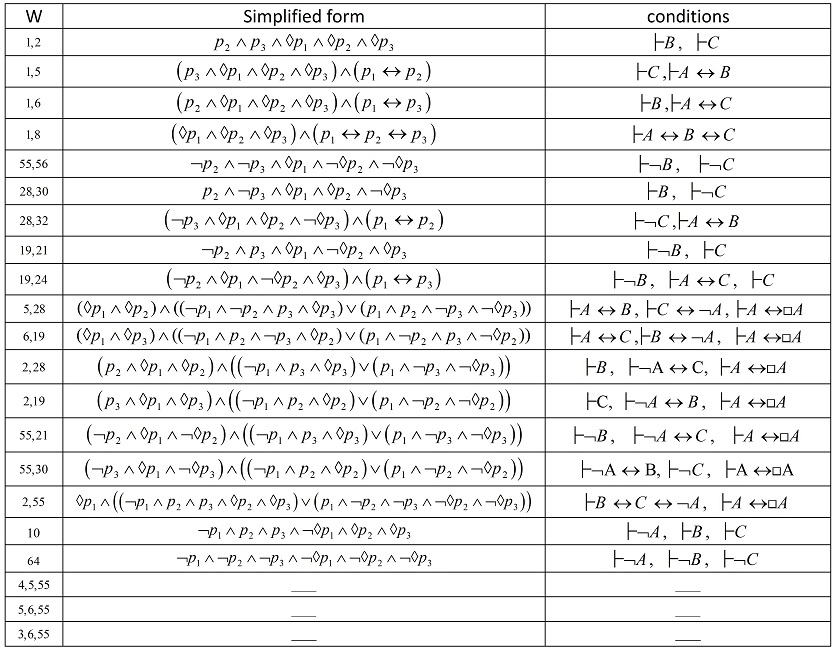 Figure 2
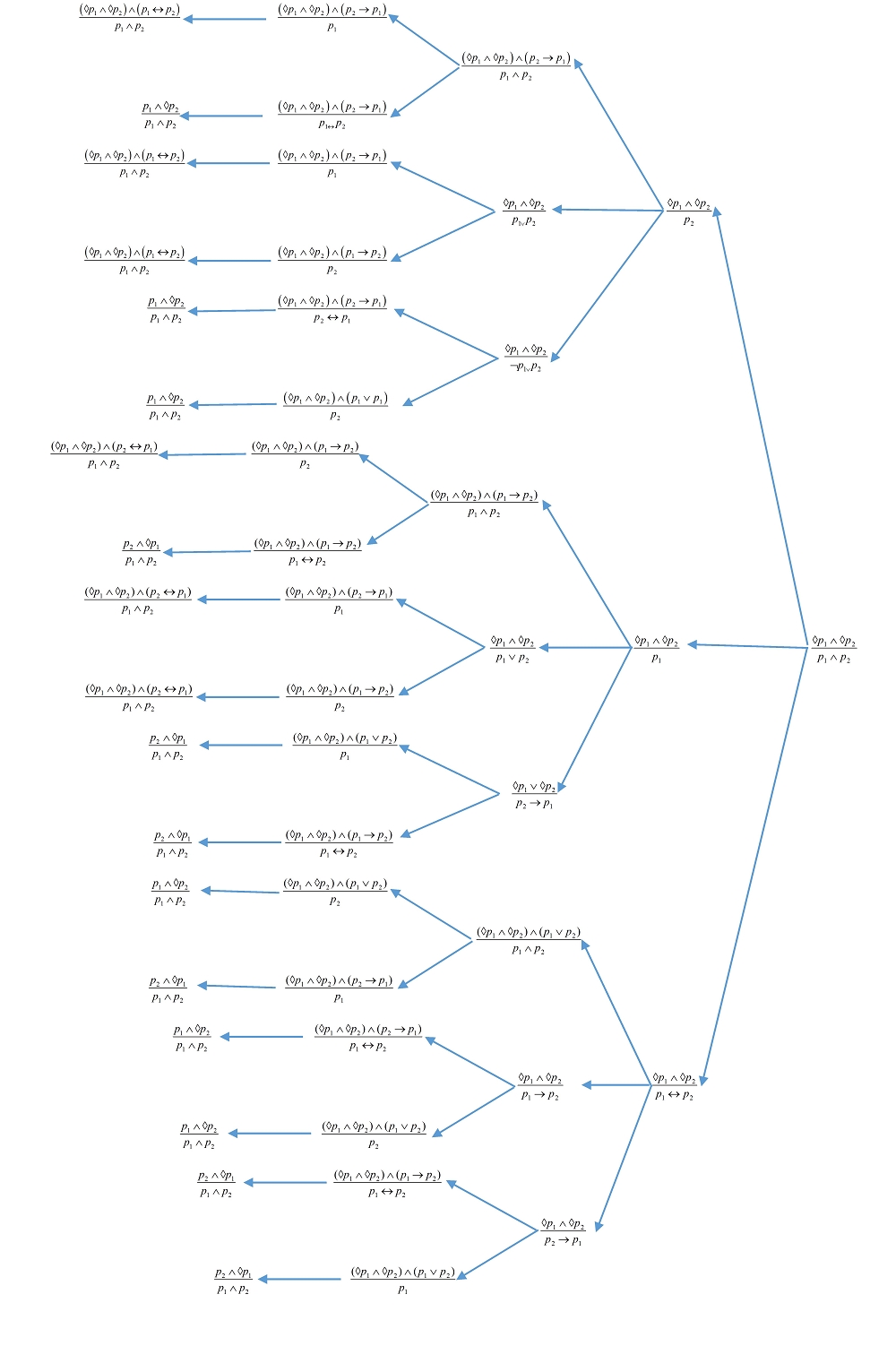 Figure 3
 Figure 4
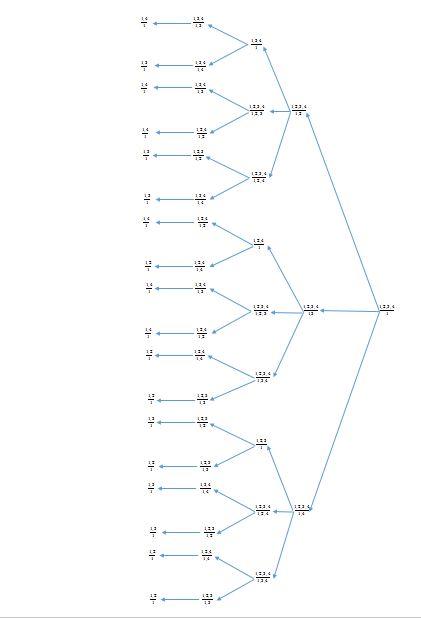 Figure 5
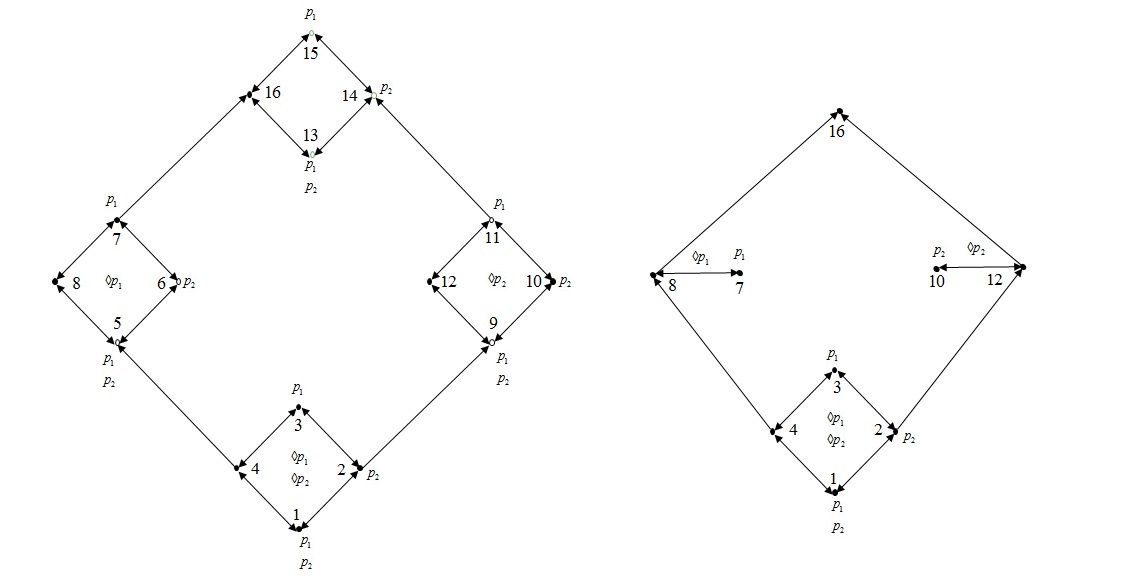 Figure 6
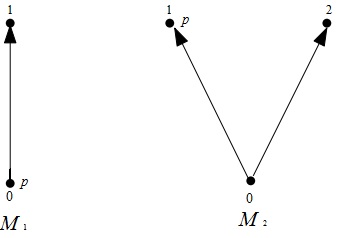 Figure 7
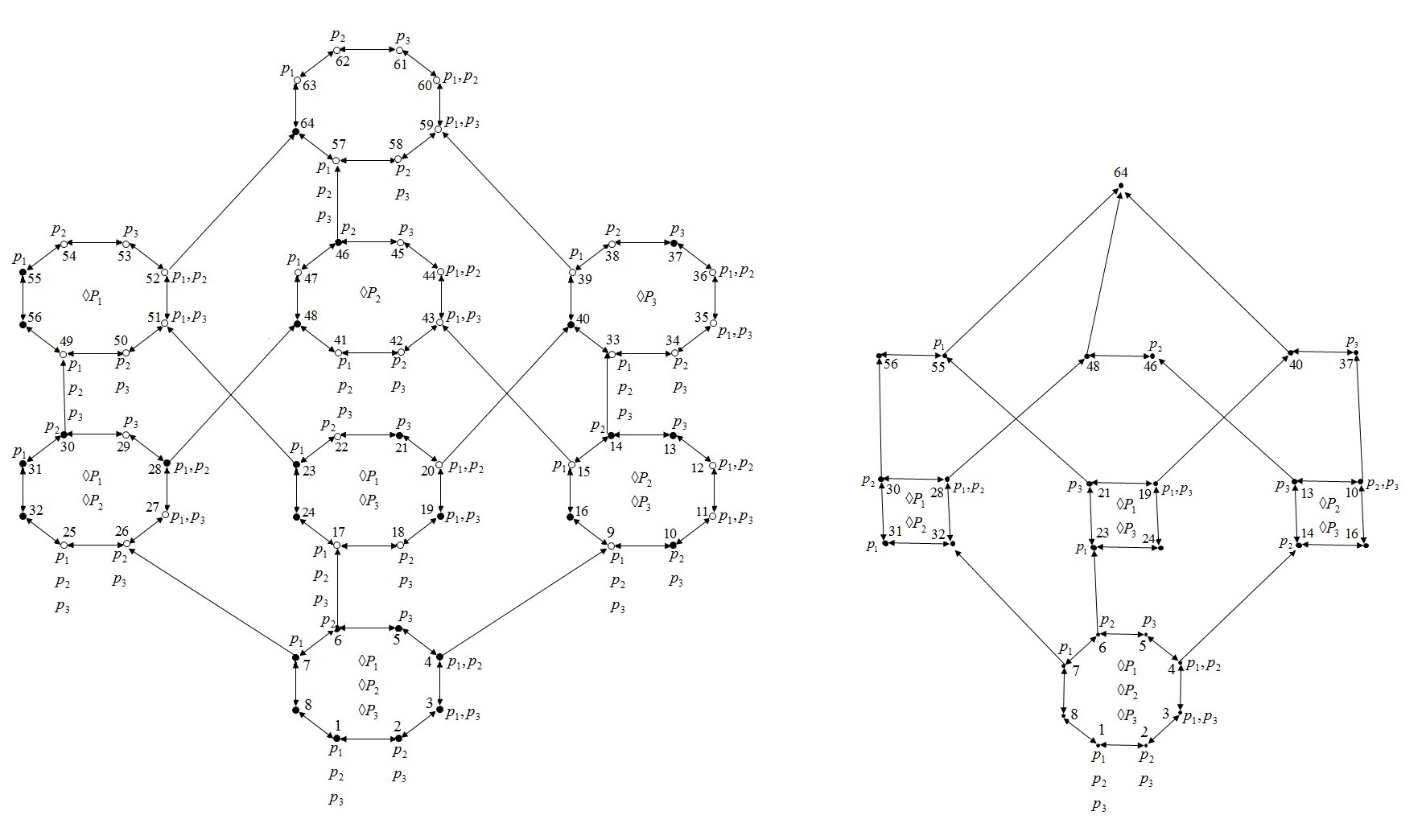 Figure 8
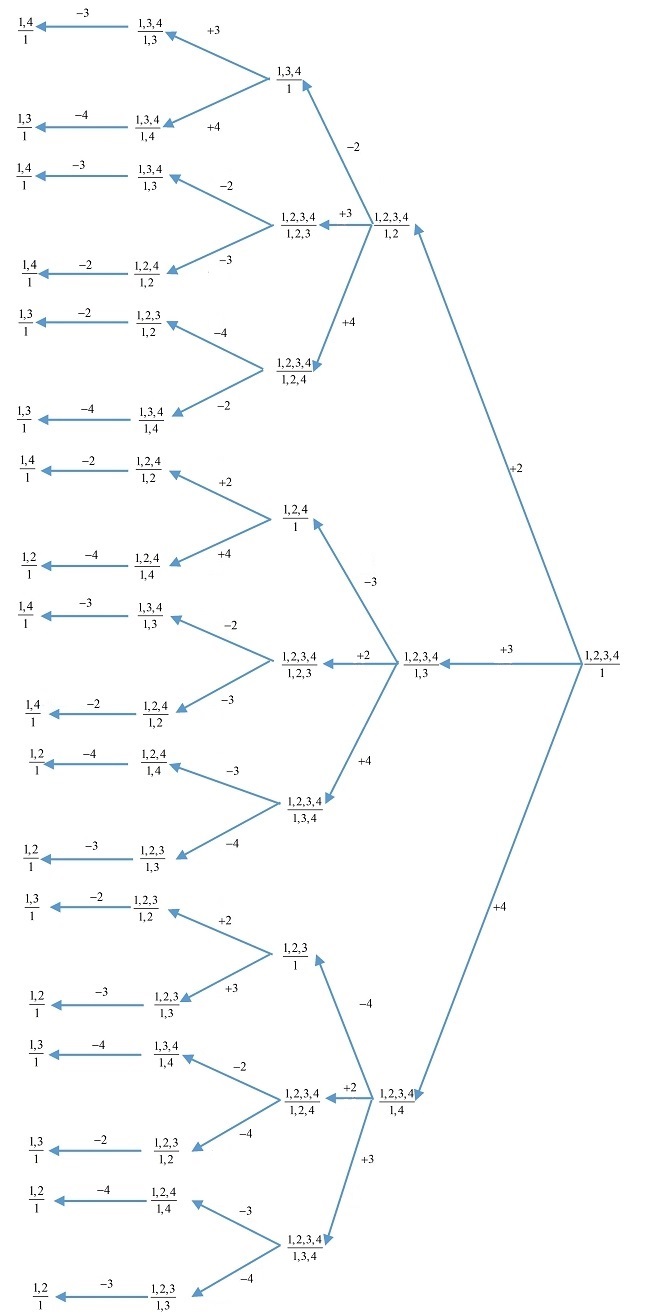 Figure 9