Interferometric visibility and coherence
Tanmoy Biswas, Mar\'ia Garc\'ia D\'iaz, Andreas Winter

TL;DR
This paper links quantum coherence to interference visibility in multi-path interferometers, providing a framework to derive coherence measures from observable interference patterns, including known and new measures.
Contribution
It introduces a general method to derive quantum coherence measures from interference visibility, connecting theoretical coherence quantification with experimental observables.
Findings
Recovered known coherence measures from visibility parameters
Derived new coherence measures based on interference visibility
Established a framework connecting interference patterns to quantum coherence
Abstract
Recently, the basic concept of quantum coherence (or superposition) has gained a lot of renewed attention, after Baumgratz et al. [PRL 113:140401 (2014)], following \AA{}berg [arXiv:quant-ph/0612146], have proposed a resource theoretic approach to quantify it. This has resulted in a large number of papers and preprints exploring various coherence monotones, and debating possible forms for the resource theory. Here we take the view that the operational foundation of coherence in a state, be it quantum or otherwise wave mechanical, lies in the observation of interference effects. Our approach here is to consider an idealised multi-path interferometer, with a suitable detector, in such a way that the visibility of the interference pattern provides a quantitative expression of the amount of coherence in a given probe state. We present a general framework of deriving coherence measures…
Click any figure to enlarge with its caption.
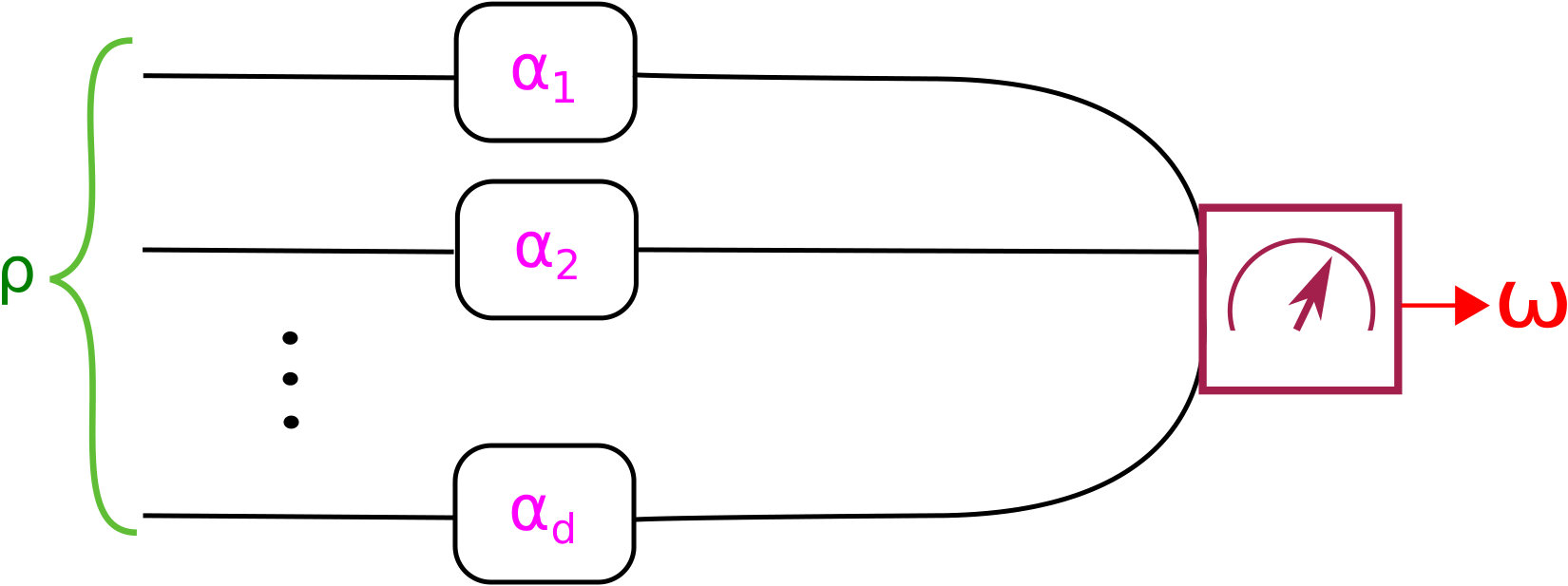 Figure 1
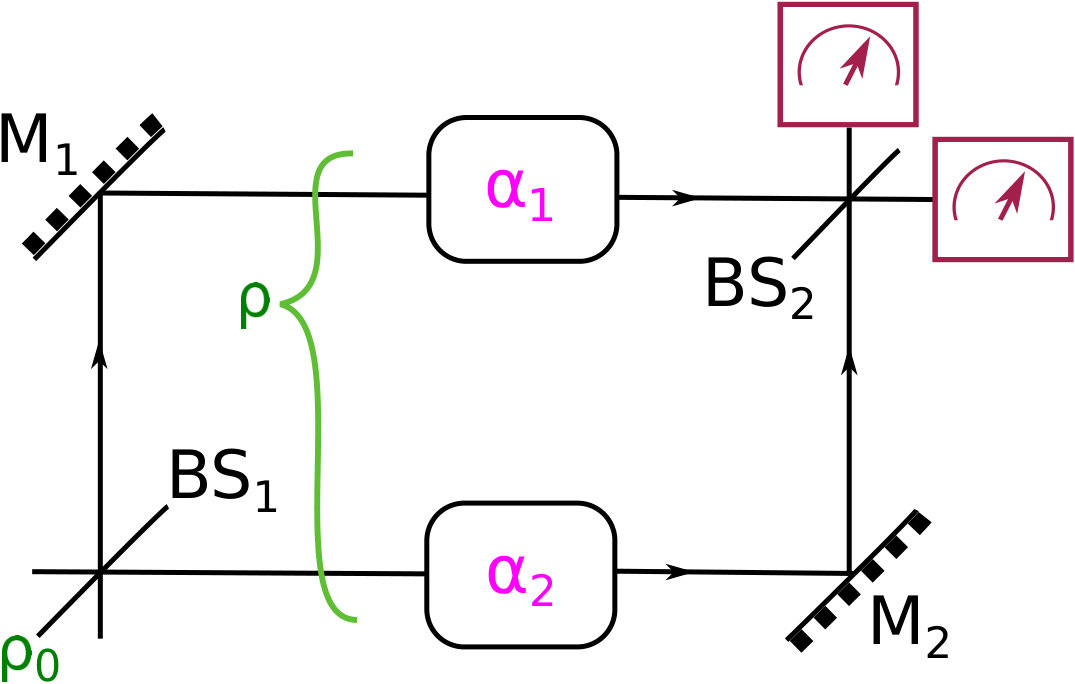 Figure 2
Peer Reviews
No public reviews on file for this paper yet. If you reviewed it on a platform where reviews are public (OpenReview, ICLR, NeurIPS, ICML), you can paste yours below so the community can read it here.
Videos
No videos yet. Explain this paper in a talk, walkthrough, or lecture? Add one.
Interferometric visibility and coherence
Tanmoy Biswas
Department of Physical Sciences, IISER Kolkata, Mohanpur 741246, West Bengal, India
María García Díaz
Departament de Física: Grup d’Informació Quàntica, Universitat Autònoma de Barcelona, ES-08193 Bellaterra (Barcelona), Spain
Andreas Winter
Departament de Física: Grup d’Informació Quàntica, Universitat Autònoma de Barcelona, ES-08193 Bellaterra (Barcelona), Spain
ICREA—Institució Catalana de Recerca i Estudis Avançats, Pg. Lluis Companys, 23, ES-08001 Barcelona, Spain
(20 June 2017)
Abstract
Recently, the basic concept of quantum coherence (or superposition) has gained a lot of renewed attention, after Baumgratz et al. [PRL 113:140401 (2014)], following Åberg [arXiv:quant-ph/0612146], have proposed a resource theoretic approach to quantify it. This has resulted in a large number of papers and preprints exploring various coherence monotones, and debating possible forms for the resource theory. Here we take the view that the operational foundation of coherence in a state, be it quantum or otherwise wave mechanical, lies in the observation of interference effects.
Our approach here is to consider an idealised multi-path interferometer, with a suitable detector, in such a way that the visibility of the interference pattern provides a quantitative expression of the amount of coherence in a given probe state. We present a general framework of deriving coherence measures from visibility, and demonstrate it by analysing several concrete visibility parameters, recovering some known coherence measures and obtaining some new ones.
Quantum coherence, interferometer, visibility
Introduction.—The physics of constructive and destructive interference of waves, along with the concept of coherence, has been well-understood since the 19th century. With the advent of quantum mechanics, these studies have assumed a fundamental quality as in quantum theory the superposition principle applies to everything, and the presence of quantum coherence is the basic hallmark of departure from classical physics. Recently, Baumgratz et al. BCP14 , following Åberg’s earlier work Aaberg2006 , have launched a flurry of new activity on coherence by attempting to cast it as a resource theory and introducing a number of tasks and monotones coherence-review ; MarvianSpekkens-review .
It has, however, remained largely unclear what this resource of “coherence” is about and how it relates to theories of asymmetry, among others MarvianSpekkens-review . To make contact with the operational foundations of coherence, we go back to its very definition, the observability of an interference pattern in a suitable experiment. Our present approach is to consider an idealised multi-path interferometer, which receives the state under consideration at the input. The experimenter is at liberty to put phase plates into each of the paths, and to construct a detector (a general beam splitter with detection of the output beams). The interference pattern, i.e. the response of the fixed detector as a function of the multiple phases, is the signature of coherence: the more it fluctuates, intuitively, the more coherent is the state. The degree of fluctuation, aka visibility, quantifies the strength of interference.
The idea in the present paper is that coherence is the potential of a state to yield visible fringes in a suitable experiment. Hence, we propose to optimise the visibility over all possible detectors, to obtain a measure of coherence of the original state. Indeed, we prove that under mild assumptions, every visibility parameter yields a coherence measure in this way, strongly monotonic under a certain class of incoherence-preserving operations. We illustrate our theory with concrete examples of visibility parameters.
Interferometers and visibility.—Consider a multi-path interferometer, in which a single particle can be in one of paths, denoting the spatial variable by orthogonal vectors , , spanning a -dimensional Hilbert space .
For the moment, we will ignore any internal degrees of freedom of the particle, and any other spatial degrees, so that the entire Hilbert space describing the system is , and a pure state inside the interferometer can be written as , and a general mixed state as
[TABLE]
An interferometric experiment (Fig. 1) has two distinct components. The first consists of local phase shifts that can be inserted into the paths, implementing a diagonal phase unitary
[TABLE]
so that the state becomes
[TABLE]
The second is a detector at the output, often simply fixed as the combination of a symmetric beam splitter with a path measurement, but for us a general POVM , with outcomes from a suitable space .
The experimenter, having chosen , will observe outcomes sampled from the Born distribution (the “interference pattern”):
[TABLE]
The signature of interference in such an experiment, where is given and fixed, is that the distribution can vary as a function of the phases . The degree of variability, intuitively, is the visibility of the interference pattern, calling for a visibility functional on conditional distributions .
While it is always dangerous to make a priori demands, we take it that such a functional has to capture the global property of not being constant. I.e., it should be [math] for constant and positive otherwise. It will also make sense to ask that it is invariant under permutations and shifts of the , reflecting the obvious symmetries of the experimental setup (see Fig. 1). We call a visibility functional satisfying these requirements regular. In the discussion of interferometers, specifically in the rich literature on the complementary between fringe visibility and which-path information WoottersZurek ; GreenbergerYasin ; Englert ; Jaeger-et-al , to cite only the principal ones, the topic of visibility has been addressed repeatedly, and from increasingly general perspectives. In particular, the realisation that for no unique visibility functional seems to exist, called for an axiomatic approach to put order into the many ad hoc parameters; cf. Duerr ; EKKC ; Prillwitz-et-al . We wish to highlight especially Coles’ paper Coles:coherent , which makes an eloquent case for an operational approach, where visibility (as well as which-path information) is expressed as a property of an observable probability distribution, and with which philosophy we feel very much in line.
In the simplest case of the well-known Mach-Zehnder interferometer (Fig. 2), i.e. , we observe interference fringes w.r.t. a relative phase shift: Consider the density matrix , the diagonal phase unitary , and a measurement with POVM elements , . Now, with , and writing , , the output probability is
[TABLE]
whose fluctuation is essentially characterised by the coefficient , and so most analyses conclude this to be the visibility.
Optimal visibility as measure of coherence.—If we want to treat the state as a resource, i.e. as a given, of which we are supposed to make the best, it makes sense to optimise the visibility over all possible measurements. This idea diverges somewhat from lab practice in interferometry and from many discussion of visibility vs. which-path information duality, where a fixed measurement is used, usually one mixing the paths uniformly (a - beam splitter in the Mach-Zehnder case, and more generally a transformation acting as a Fourier transform, followed by a channel detector) Englert ; EKKC ; BimonteMusto ; KszliZuk .
However, it is clear that the most beautiful coherent superposition in the state may be rendered invisible by an unsuitable choice of measurement For instance, consider the qutrit state under a measurement in the basis ; evidently, the three outcomes all have probability , irrespective of the phases in
[TABLE]
Intuitively, we expect the best choice to bring out the coherence in to be the projective measurement in the basis , for which the detection probabilities are . On the other hand, the standard choice of a symmetric beam splitter results in the Fourier basis , where , with detection probabilities
[TABLE]
which has the same oscillation pattern as , but smaller amplitude.
Thus we are motivated, given a visibility functional , to optimise the visibility over all measurements, to get the best out of . This leads to a number that now depends only on the state,
[TABLE]
The hypothesis that we will explore in the rest of the paper is that this number, for a large class of visibility functionals, is a good indicator of coherence in .
In an attempt to identify consistent quantifiers of coherent superposition, Baumgratz et al. BCP14 , following Åberg Aaberg2006 , have created a resource theory of coherence, with carefully chosen resource free state (diagonal density operators ) and free transformations (the so-called incoherent operations (IO)). A measure that is non-increasing under these operations is called a monotone. Mathematically, incoherent operations are completely positive and trace preserving linear maps, built from incoherent Kraus operators, where for all computational basis elements . If and are both incoherent, it is called strictly incoherent (SIO), and so is a map built from strictly incoherent Kraus operators. From this is it straightforward to see that a Kraus operator is incoherent if and only if it has the form with a function mapping basis states to basis states; it is strictly incoherent if and only if is one-to-one.
A functional is a monotone if under all IO (SIO) . It is called a strong monotone if for an incoherent Kraus decomposition, , . Well-known examples include the -measure of coherence BCP14 , and the relative entropy of coherence Aaberg2006 ; BCP14 ; WinterYang :
[TABLE]
with the relative entropy and the von Neumann entropy ; is the diagonal part of .
Our first result is a general link between visibility and coherence. We call a visibility functional weakly affine if for distributions , (assuming w.l.o.g. pairwise disjoint ), and for a probability distribution , we have , with the averaged distribution on .
Theorem 1
For any regular and weakly affine visibility functional , is a coherence measure that is strongly monotonic under SIO (strictly incoherent operations). If is convex in , then is convex in .
Proof.
Let a SIO with Kraus operators be given, acting on a state , so that defines the probability of the event and the post-measurement state. Observe that, because can be written as a diagonal matrix followed by a permutation ,
[TABLE]
with . This shows that the probability of seeing outcome is for all .
Now choose measurements for each , taking values in the disjoint sets , subject to the probability law given by
[TABLE]
Introducing the POVM with outcomes , we can now invoke weak affinity:
[TABLE]
because the measurement is eligible for but may be suboptimal. Since the measurements can be chosen to maximise the left hand side, we obtain
[TABLE]
For the convexity statement, let and choose any measurement on . Then,
[TABLE]
and because may be chosen to maximise the left hand side, we find as claimed. ∎
A couple of remarks are in order: First, there don’t seem to be easy conditions for to be a (strong) coherence monotone under IO, but of course that is something potentially checkable in individual cases. Secondly, one might wonder in case we merely want to detect coherence, whether there is a universal measurement such that if has coherences, then is positive. The answer is yes, namely any tomographically complete measurement, as long as has the property that it is non-zero on every non-constant .
Examples.—We now show that the above theory is not just an abstract construction, by considering several concrete visibility parameters, for which we can evaluate the associated coherence measures, or at least considerably simplify the optimisation.
A. Largest difference of intensity: The perhaps simplest and most intuitive parameter of visibility for two-outcome measurements is the difference between the largest and the smallest value of . To make it suitable for measurements with arbitrary outcome sets, we define
[TABLE]
Note that we do not normalise by the sum of the largest and smallest probability, as is customary in discussions of visibility in classical interferometry, where the basic observable quantities are intensities. There, this appears necessary to obtain a dimensionless visibility; here however, we have the probabilities that are already dimensionless and have an absolute meaning.
Clearly, is regular and weakly affine, so the corresponding coherence measure is a SIO monotone. In fact, it is easy to evaluate it, and the result is
[TABLE]
because we can always shift to by applying . In particular, the optimal measurement is a two-outcome POVM , and the value is the largest difference in response probability over POVM elements.
We can compare the result with the trace distance measure of coherence, , introduced in BCP14 :
Namely, on the one hand, for , we have , so by the triangle inequality
[TABLE]
which implies . On the other hand,
[TABLE]
In the qubit case, it holds that (see Appendix).
B. Estimating equidistributed phases: Inspired by the previous example, we are motivated to considering guessing problems of a more general kind, where we are trying to estimate the true setting of the phases among several alternatives, based on measurement outcomes. It turns out that a good candidate is the equidistributed set of phases , , and its shifts and permutations:
[TABLE]
where \vec{h}_{\pi}=\frac{2\pi}{d}\bigl{(}\pi(1),\pi(2),\ldots,\pi(d)\bigr{)} is a generating vector of uniformly accelerating phases (w.r.t. the permutation of coordinates). This quantity is the bias (excess over ) of the optimal strategy to guess the true value of that defines the phase settings. As defined, this visibility functional is regular and weakly affine, so the corresponding is a coherence monotone under SIO. As a matter of fact, it holds robustness
[TABLE]
for any and any permutation . Here, denotes the robustness of coherence, defined via
[TABLE]
which is known to be an IO monotone robustness . Interestingly, by maximising the operational visibility proposed in (Coles:coherent, , Eq. (20)), the same result is obtained Coles:unpub .
In the qubit case, it is well known that the robustness of coherence equals the -measure: robustness , and so is just half of that.
C. Largest sensitivity to phase changes: Looking back at example A, we notice that the points of largest and smallest value of the response probability to a POVM element may be quite far apart. In contrast, in many applications of interferometry it is a relatively small phase difference that we want to pick up LIGO , so we are interested in the largest magnitude of the derivative of :
[TABLE]
where ranges over all phases, and over all direction vectors that are suitably norm bounded. To extend to general measurements, we may include a maximisation over all two-outcome coarse grainings. We can easily see that is regular and weakly affine since is well-defined probability distribution over .
Now, as , its derivative at (w.l.o.g.) in direction is given by
[TABLE]
where is the diagonal Hamiltonian with eigenvalues , . Note that the derivative at any other point is the same, up to conjugating the measurement by . There are two natural limitations on : Geometrically, to obtain the largest gradient of , we should consider unit vectors , meaning ; or taking motivation from the Hamiltonian, we should bound its energy range, meaning . We denote these two scenarios by and , giving rise to two coherence measures . From Eq. (15), we directly get
[TABLE]
Inspecting this formula, we see that the optimisation is convex in , hence the maximum is attained on an extremal admissible Hamiltonian. For , these have the form , with and . For , the extremal have entries along the diagonal, and so
[TABLE]
where the maximisation over partitions , with , . In both cases, we obtain a strong SIO monotone, due to the evident weak affinity of . From Eq. (10) we see that , but equality does not seem to hold in general.
An alternate form of can be obtained by using Eq. (15), and going to the more convenient variable in the above equations. After a few manipulations, we arrive at
[TABLE]
where the maximisation is over the set of Hermitian matrices
[TABLE]
In this form it is formally a convex optimisation problem, because we may as well go to the convex hull of . However, its characterisation remains as a beautiful open problem. Indeed, it is easy to see that the elements of have zero diagonal and satisfy \|X\|_{p}=\bigl{(}\operatorname{Tr}|X|^{p}\bigr{)}^{1/p}\leq 1, but there may be other constraints.
Once again, the qubit case is very simple (see Appendix): and .
D. Largest Fisher information: Considering further the previous example, we realise that finding the largest derivative of the probability , while strongly motivated by the intuition rooted in intensities, does not necessarily identify the point of strongest statistical sensitivity, which is asking for the largest Fisher information, the natural measure for probability distributions. Looking again at directional estimation of a one-dimensional subfamily , , the Fisher information is given by the expected squared logarithmic derivative of the probability distribution:
[TABLE]
so we are considering the visibility functional
[TABLE]
where varies over the whole space of phases, and over a suitably bounded set of directions. Clearly, is regular and weakly affine.
The formula for the Fisher information, optimised over measurements (and , which w.l.o.g. is , by the same reasoning as in previous examples), for estimating in for a given diagonal Hamiltonian and is known BraunsteinCaves ; Paris:Fisher and given by
[TABLE]
Like in the previous example on sensitivity, there are two natural domains of diagonal Hamiltonians over which to optimise this: Either or , leading to two variants and of the coherence measure.
In either case, the optimal choice of is extremal subject to the convex constraint, because can easily be seen to be convex in . Namely, each term is convex, hence also its square, and the coefficient in front of it manifestly nonnegative. Thus, we obtain:
[TABLE]
where the first maximisation is over diagonal Hamiltonians with Hilbert-Schmidt norm ; the second over partitions , with , , so that .
For a qubit state , it can be verified (see Appendix) that , .
E. Largest differential Chernoff bound: We observe that the attainability of the Fisher information presupposes access to many copies of the state and independent measurements, in which setting the Fisher information gives the optimal scaling of the mean squared estimation error with the number of copies. If we allow general collective measurements and at the same time only want to distinguish pairs of nearby states optimally, we are led to the differential Chernoff bound Calsamiglia-et-al:Chernoff : While the Chernoff bound is defined as , for states and probability distributions alike Calsamiglia-et-al:Chernoff ; Chernoff , it is known that \frac{1}{{\rm d}t^{2}}{\rm d}^{2}\xi\bigl{(}P(\cdot|\vec{\alpha}_{0}),P(\cdot|\vec{\alpha}_{0}+{\rm d}t\vec{h})\bigr{)}=\mathrel{\mathop{\mathchar 58\relax}}{\rm d}_{\vec{h}}\xi^{2} defines the line element of a Riemannian metric on the parameter space. Thus we let
[TABLE]
As is regular and weakly affine, we will obtain a strong SIO monotone. Note that this would not work simply fixing a Hamiltonian, as shown in Girolami:wrong ; Luo:WY .
The differential Chernoff bound, optimised over measurements, for distinguishing for from in the many-copy regime, with a diagonal Hamiltonian and is again known Calsamiglia-et-al:Chernoff , and given by {\rm d}_{H}\xi^{2}=\frac{1}{{\rm d}t^{2}}{\rm d}^{2}\xi\bigl{(}\rho,e^{-itH}\rho e^{itH}\bigr{)}, which evaluates to
[TABLE]
the latter equalling the Wigner-Yanase skew information, skew-info .
Like in the previous two examples, there are two natural domains of diagonal Hamiltonians over which to optimise this: Either or , leading to two variants and of the coherence measure. Again, is convex in , thanks to convexity of each term , and . Consequently, the optimal is extremal under the convex norm constraint. For , this means that the maximum is attained on a difference of two diagonal projectors, . For , however, we can say something even better, using Lieb’s concavity theorem Lieb:WYD-concavity , which says that for semidefinite , the Wigner-Yanase skew information is convex in , by writing . In general, we split into positive and negative parts, and find after some straightforward algebra that
[TABLE]
which by Lieb’s theorem Lieb:WYD-concavity is jointly convex in and . Thus we find that the optimal and must be proportional to rank-one projectors, resulting in the expression claimed for .
[TABLE]
where the first maximisation is over distinct basis states and ; the second over disjoint subsets and of , with , .
For a qubit state , we find (see Appendix) that and .
F. Largest Shannon information: The previous examples should have prepared us for thinking of visibility as an expression of how much information about the output distribution reveals. So why not take this to the logical conclusion? Noting that is a channel from multi-phases to outputs , in the Shannon theoretic sense, we are motivated to define visibility as the Shannon capacity of :
[TABLE]
where is a probability measure on the , defining a joint distribution of channel inputs and outputs, and is the mutual information of two random variables Shannon . It can be checked that is regular and weakly affine. Operationally, is the largest communication rate that can be transmitted by a sender, who may encode information into the phase settings of asymptotically many interferometers, to a receiver who decodes the correct message with high probability based on the observations Shannon .
To obtain , we then only need to perform a maximisation of the Shannon capacity over all measurements:
[TABLE]
where the latter quantity is know as the accessible information. These optimisations are by no means easy, and are worked out only in some few cases. In any case, Theorem 1 shows that is a SIO monotone. This might provide some motivation to try to evaluate in certain special cases.
However, due to the Holevo bound Holevo:bound , and the Holevo-Schumacher-Westmoreland theorem HSW regarding the capacity of the cq-channel , we obtain the following:
[TABLE]
Namely, the Holevo bound Holevo:bound upper-bounds the accessible information,
[TABLE]
Here, the second term is always because the are unitarily rotated versions of , and the first term is maximised by the uniform distribution over all phases:
[TABLE]
with the well-known relative entropy of coherence Aaberg2006 ; BCP14 . Note that the latter is known to be a monotone under IO, and even under the still larger class of maximally incoherent operations (MIO) coherence-review .
Invoking the Holevo-Schumacher-Westmoreland theorem HSW regarding the capacity of the cq-channel , we get furthermore .
In the qubit case, the optimisation (29) seems to be unknown, but we believe that the maximum is attained on the binary ensemble , and the measurement in the eigenbasis of , which would yield . On the other hand, .
Discussion.—Using a simple model of multi-path interferometry and a broad approach to visibility of an experimental setup of phase modulation and detection, we showed that the concept of coherence of a state can be obtained by optimising the visibility over detection schemes. We illustrated our approach by analysing specific visibility functionals. The results are clearest in the two-level case, corresponding to Mach-Zehnder interferometers, where we find that the single off-diagonal density matrix element governs almost all visibility and coherence effects. In settings with more paths, as should be expected, there are different inequivalent ways of quantifying visibility and correspondingly many different, incomparable coherence measures.
Our discussion shows that it is possible to link coherence theory, a priori quite an abstract enterprise, to operational notions in the physics of interferometers. We hope that our present approach will be fruitful in the future to develop a firm physical foundation of the resource theory of coherence. As an example of this kind of impact, we highlight Theorem 1, which shows that visibility based coherence measures are naturally monotone under strictly incoherent operations (SIO), while it is an open question whether this holds also under the originally proposed incoherent operations (IO); this might be construed as favouring SIO over IO as the “correct” class of operations. See also Yadin et al. Yadin-etal , where it is shown that SIO are obtained precisely as the class of cptp maps that can be dilated in a specific incoherent way onto an extended system , where the “internal” or “spin” degrees of freedom of the particle are thought of as having no incoherence structure, so that in Åberg’s framework Aaberg2006 the incoherent subspaces are . Namely, a cptp map is strictly incoherent if and only if it can be decomposed into attaching an ancillary state of , followed by an incoherent unitary on the tensor product space, i.e. one mapping the subspaces into each other, followed by a destructive measurement of with outcomes .
Unlike other investigations that have tried to build a similar link between visibility and coherence, we start from visibility parameters as a feature of experimentally accessible data, rather than declaring known coherence measures as “visibility” Manab-etal ; Emili-etal . Because of this we think of our approach as operational, in contrast to the cited works whose approach could be characterised as axiomatic. In this respect, we believe that our present work goes some way towards answering the call for an operational justification of coherence as a visibility parameter (Coles:coherent, , Sec. VII). It is tempting to conjecture that all the coherence parameters derived from “reasonable” visibility functionals satisfy duality relations with suitable path-information measures such as in the mentioned works. Whether visibility as conceptualised by us is always dual to a path-information or some other parameter, is a question we have to leave open at this point. In any case, our analysis of some concrete examples of visibility functionals on interference fringes has bolstered this connection to coherence, resulting in coherence measures that can be related to, and in some cases identified with, previously considered measures.
We also think that the present treatment gives some insight into the relationship between coherence and the resource theory of asymmetry (or reference frames) for the group of time translations, cf. MarvianSpekkens-review . Namely, looking at Examples C, D, and E, each of the resulting coherence measures is obtained by maximising, over a bounded set of diagonal Hamiltonians, a function given in Eqs. (16), (21) and (25), respectively. It is known that for a fixed Hamiltonian , each of them is an monotone in the resource theory of time asymmetry corresponding to energy conservation, see for instance Girolami:wrong for the latter quantity. Hence, we are led to think of coherence theory as asymmetry theory with a Hamiltonian that has fixed eigenvectors but “undetermined” eigenvalues. This may go some way towards explaining the characteristic similarities and differences between (time) asymmetry and coherence.
In the analysis we encountered some interesting mathematical problems, too, among them the characterisation of the set of all commutators of norm-bounded diagonal and general Hermitian matrices. Furthermore, we would like to know whether, among the established coherence monotones, we can recover the -measure BCP14 , or the coherence of formation Aaberg2006 ; WinterYang directly via visibilities? In light of Refs. Manab-etal ; Emili-etal , the former would be especially interesting.
Finally, going beyond the single-particle interference of our above theory, the present study suggests multi-particle interference as a natural extension. This will not only provide a framework for the compositions of systems (cf. Åberg Aaberg2006 ), but also bring out the unique quantum features of interference, as opposed to the mere wave-mechanical ones in the single-particle case.
Ethics statement.—This work did not involve human embryos, nor any other human subjects, nor data collection on humans.
Data accessibility.—This work does not have experimental data.
Competing interests.—The authors have no competing interests.
Authors’ contributions.—All authors have contributed equally and crucially to the conception of the present paper, the execution of the scientific research, and its writing. All authors gave final approval for publication.
Acknowledgments and funding statement.—It is our pleasure to thank Emili Bagan, Manabendra Bera, John Calsamiglia and Chang-Shui Yu for discussions on interferometers and visibility, and Patrick Coles for illuminating remarks on an earlier version of the manuscript.
TB is supported by IISER Kolkata and acknowledges the hospitality of the Quantum Information Group (GIQ) at UAB during June-July 2016, when the present work was initiated. MGD is supported by a doctoral studies fellowship of the Fundación “la Caixa”. AW is or was supported by the European Commission (STREP “RAQUEL”) and the ERC (Advanced Grant “IRQUAT”). The authors acknowledge furthermore funding by the Spanish MINECO (grant FIS2013-40627-P), with the support of FEDER funds, and by the Generalitat de Catalunya CIRIT, project 2014-SGR-966.
A.—.
As only the relative phase matters, we see
[TABLE]
Its trace norm clearly is maximised at , showing , which for qubits is known to equal .
C.—.
For , the only nontrivial choice is and , directly resulting in C_{\nabla}^{(\infty)}=2\bigl{\|}|1\rangle\!\langle 1|\rho|2\rangle\!\langle 2|\bigr{\|}_{1}=2|\rho_{12}|.
For , we have to consider the Hamiltonian , yielding
[TABLE]
Its trace norm is maximised for the negative sign choice and at , and so
D.—.
The formula for the coherence measure reduces to
[TABLE]
where the maximisation is over such that . Note that and .
This calculation is conveniently done in the Bloch picture, writing , with a vector that we decompose as a product of its length and a unit vector (with components , and ). In this way the eigenprojectors of become . In the above maximisation, this allows us to identify and .
For , we already know that is optimal, so
[TABLE]
For , the maximisation reduces to that of , with and . The trace decomposes into four terms, however the three that contain a evaluate to [math], leaving , which yields (using the optimal choice ) .
E.—.
For , the only nontrivial choice is and , directly resulting in .
For , we have to consider the Hamiltonian , yielding
[TABLE]
Thus, , which is maximised at , hence .
The reference list from the paper itself. Each links out to its DOI / PubMed record.
- 1(1) .
- 2(2) J. Åberg, “Quantifying Superposition”, ar Xiv:quant-ph/0612146 (2006).
- 3(3) E. Bagan, J. A. Bergou, S. S. Cottrell and M. Hillery, “Relations between Coherence and Path Information”, Phys. Rev. Lett. 116 :160406 (2016).
- 4(4) T. Baumgratz, M. Cramer and M. B. Plenio, “Quantifying Coherence”, Phys. Rev. Lett. 113 :140401 (2014).
- 5(5) M. N. Bera, T. Qureshi, M. A. Siddiqui and A. K. Pati, “Duality of quantum coherence and path distinguishability”, Phys. Rev. A 92 :012118 (2015).
- 6(6) G. Bimonte and R. Musto, “On interferometric duality in multibeam experiments”, J. Phys. A: Math. Gen. 36 (35):11481-11502 (2003).
- 7(7) S. L. Braunstein and C. M. Caves, “Statistical Distance and the Geometry of Quantum States”, Phys. Rev. Lett. 72 (22):3439-3443 (1994).
- 8(8) J. Calsamiglia, R. Muñoz-Tapia, Ll. Masanes, A. Acín and E. Bagan, “Quantum Chernoff bound as a measure of distinguishability between density matrices: Application to qubit and Gaussian states”, Phys. Rev. A 77 :032311 (2008).