A spectral decomposition of orbital integrals for $PGL(2,F)$
David Kazhdan, Stephen DeBacker

TL;DR
This paper provides a spectral decomposition of orbital integrals for PGL(2,F), advancing understanding of harmonic analysis on p-adic groups and initiating steps towards generalization.
Contribution
It offers the first spectral decomposition of orbital integrals for PGL(2,F) and begins exploring similar decompositions for broader classes of groups.
Findings
Spectral decomposition of orbital integrals for PGL(2,F) achieved.
Methodology for spectral analysis of orbital integrals established.
Initial steps toward generalization to other groups outlined.
Abstract
Let be a local non-archimedian field, a semisimple -group, a Haar measure on and be the space of locally constant complex valued functions on with compact support. For any regular elliptic congugacy class we denote by the -invariant functional on given by This paper provides the spectral decomposition of functionals in the case and in the last section first steps of such an analysis for the general case.
Click any figure to enlarge with its caption.
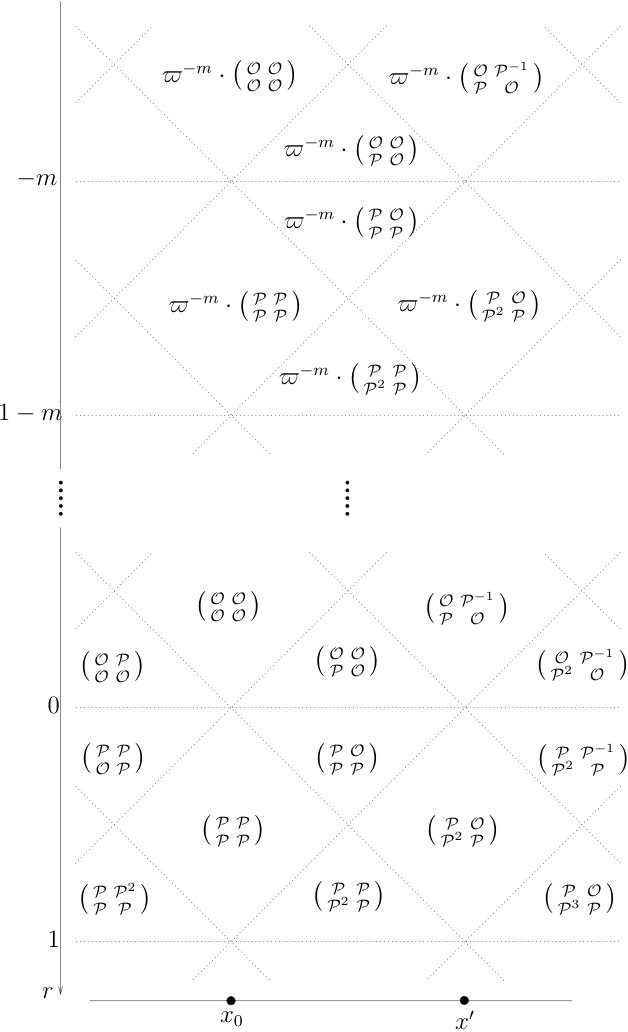 Figure 1
Peer Reviews
No public reviews on file for this paper yet. If you reviewed it on a platform where reviews are public (OpenReview, ICLR, NeurIPS, ICML), you can paste yours below so the community can read it here.
Videos
No videos yet. Explain this paper in a talk, walkthrough, or lecture? Add one.
Taxonomy
TopicsAdvanced Algebra and Geometry · Algebraic Geometry and Number Theory · Geometry and complex manifolds
A spectral decomposition of orbital integrals for (with an Appendix by S. Debacker)
David Kazhdan
Abstract.
Let be a local non-archimedian field, a semisimple -group, a Haar measure on and be the space of locally constant complex valued functions on with compact support. For any regular elliptic congugacy class we denote by the -invariant functional on given by
[TABLE]
This paper provides the spectral decomposition of functionals in the case and in the last section first steps of such an analysis for the general case.
Dedicated to A. Beilinson on the occasion of his 60th birthday.
Acknowledgments. Many thanks for J.Bernstein, S. Debacker and Y. Flicker who corrected a number of imprecisions in the original draft and S. Debacker for writing an Appendix.
I am partially supported by the ERC grant 669655-HAS.
1. Introduction
Let be a local non-Archimedean field, be the ring of integers of , the maximal ideal, the residue field, a generator of , , the valuation such that and , , the normalized absolute value. For any analytic -variety we denote by the space of locally constant complex-valued functions on with compact support and by the space of distributions on .
Let be a group of -points of a reductive group over be the center of , a Haar measure on and a Haar measure on . We denote by the space of compactly supported measures on invariant under shifts by some open subgroup. The map defines an isomorphisms between the spaces and .
We denote by the subsets of cuspidal, square-integrable and tempered representations. For any there exists a notion of the formal degree of which depends on a choice of a Haar measure . We chose this measure in such a way that the formal degree of the Steinberg representation is equal to and write instead of . (See Section for definitions in the case .
Given a regular elliptic conjugacy class we denote by the functional on the space given by where the invariant measure on corresponding to our choice of measures and .
Remark 1.1*.*
The functional does not depend on a choice of a Haar measure . In particular these functionals are canonically defined in the case when is semisimple.
We denote by the set of equivalent classes of smooth irreducible complex representations. For any we denote by the character of which the functional on given by where .
Conjecture 1.1**.**
For any regular elliptic conjugacy class there exists unique measure on the subset of tempered representations such that
[TABLE]
We say that the measure gives the spectral description of the functional . If is a regular ellipltic element we will write .
The main goal of this paper is to find the spectral description of the functionals in the case . When the residual characteristic of is odd such a description (based on the knowledge of formuals for characters ) was given in [SS84].
We discuss the general of case of a general reductive group in the last Section , but until Section we assume that .
Let be the subgroup of upper triangular matricies. Then where is the subgroup of diagonal and of unipotent matrices. We denote by the maximal compact subgroup of and by be the group of characters of For any we define in Section the notion of depth of .
We denote by the subset of non-trivial unipotent elements and by a -invariant measure on .
For any we denote by the representation of induced from the character of and define as the subset of irreducible representations of which appear as subquotients of . Then and we have a decomposition of in the disjoint union
[TABLE]
where is the subset of cuspidal representations. This decomposition induces a direct sum decomposition
[TABLE]
and the analogous direct sum decomposition of the space of distributions.
Let be the distributions on given by
[TABLE]
We denote by the components of and in the decomposition and for define
[TABLE]
and
[TABLE]
In Section we define the discriminant of a regular elliptic conjugacy class .
Theorem 1.2**.**
For any elliptic torus there exist functions on such that any regular elliptic conjugacy class we have an equality
[TABLE]
of distributions.
The Plancerel formula 8.1 and Claim 8.2 provide spectral descriptions of functionals and and there the spectral descriptions of .
2. The structure of groups and
For any we define by
[TABLE]
We denote by the Haar measure on with and by the Haar measure on with . Then .
We denote by the group of characters of , by the involution of given by and by the subgroup of characters such that . We can consider as a character of .
We denote by the subgroup of unramified characters and write . It is clear that .
We denote by the group of characters of and by the subgroup of characters such that . For any we denote by the subset of characters such that . For any we define
[TABLE]
It is clear that and that the group acts simply transitively on for all . So for all .
It is clear that the map
[TABLE]
defines a bijection for any . This isomorphism induces a structure of an algebraic variety on , for each . We denote by the algebra of regular functions on which is isomorphic to .
In the case when the involution acts on . We denote by the subring of invariant functions. It is clear that is isomorphic to .
Definition 2.1**.**
For any we denote by the minimal integer such that the restriction of to is trivial. Thus and where subgroups are defined in the beginning of this Section.
[TABLE]
be the natural projection, and the restriction of on . The map is surjective and the group acts simply transitively on fibers of .
Claim 2.1**.**
For any there exists unique -invariant measure supported on such that .
We denote by the map . It is clear that the map is -equivariant.‘
We often describe elements in terms of a preimage in under the map and matrix coefficients of . For any the ratio does not depend on a choice of a representative . We denote it by .
We denote by the image of and by the image of the group of diagonal matrices. We use the map
[TABLE]
to identify with and with , where . We denote by the matrix
[TABLE]
and by the image of in .
The following is well known.
Claim 2.2**.**
The subsets , , are disjoint, and .
We write .
We define and for any we denote by the image of the subgroup of matrices in with . So is an Iwahori subgroup of . We denote by the restriction of on .
We denote by the image of the subgroup of matrices of the form
[TABLE]
write , and denote by the projection . For any we denote by the same letter the character of given by .
We denote by the map
[TABLE]
and by the kernel of . If then is an open subgroup of .
For any character such that we denote by the map
[TABLE]
If , that is , we define a character of by .
Claim 2.3**.**
For any the map is a character of .
Definition 2.2**.**
For any regular elliptic conjugacy class we let be the biggest number such that intersects .
3. Basic structure of representations of
We say that a measure on is smooth if it is -invariant for some open subgroup . Let be the space of complex-valued compactly supported smooth measures on . For any open compact subgroup we denote by the normalized Haar measure on .
Convolution, denoted by , defines an algebra structure on . The algebra acts on by convolution from the right, , and also from the left.
The group acts on by conjugation. We denote by the space of coinvariants which is equal to the quotient .
We denote by the category of smooth complex representations of and by the set of equivalence classes of smooth irreducible representations of .
The group acts on and therefore on the spaces . It is clear that the subspace of constant functions invariant and we obtain the Steinberg representation of on the space . It is well known (see [GGP] ) the representation of is irreducible. For any we denote by the one-dimensional representation , and define .
For any , , we define
[TABLE]
For irreducible representations of the operator is of finite rank for any and we define the character on , as a generalized function (a functional on ) by
[TABLE]
By [JL70], there exist a locally -function on , (that we denote by ) such that
[TABLE]
We define a map from to functions on by
[TABLE]
It is clear that descends to a map from to functions on .
We say that an irreducible representation of is square-integrable if it is unitarizable (that is, there exists a nonzero -invariant Hermitian form on ), and for every the function on belongs to . We denote by the subset of square-integrable representations. Let be a Haar measure on .
The following Claim follows from [HC70].
Claim 3.1**.**
* For every there exists a number , called the of , such that*
[TABLE]
for any , where is a Haar measure on .
* There exists a unique choice of with .*
* For any irreducible square-integrable representation and any , the sequence of locally constant functions*
[TABLE]
on converges as a generalized function to the the character In other words, for any the sequence converges to .
For any smooth representation of we denote by the normalized Jacquet) functor which is a representation of acting on the space where is the span of . We define the action of on by , , of on . Here for represented by .
We say that is cuspidal if .
We denote by the subcategory of cuspidal representations and by the subset of equivalence classes of irreducible cuspidal representations. Since matrix coefficients of cuspidal representation of have compact support (see [JL70]) we have an inclusion .
4. Induced representations
For any we denote by the representation of unitarily induced from the character of . So is the space of locally constant complex valued functions on such that
[TABLE]
and acts on by left shifts: .
Since , the restriction to identifies the space with the space , , where is the space of locally constant functions on such that
[TABLE]
It is clear that in this realization the operator is a regular function on for any and so the function
[TABLE]
belongs to .
The following result is well known, see [JL70].
Proposition 4.1**.**
* For any we have .
A representation is reducible if and only if or where . In the second case has a one-dimensional subrepresentation , and the quotient is isomorphic to . In the first case has as a subrepresentation and the quotient is isomorphic to .
Let be such that are irreducible. Then the representations are isomorphic iff .
We have a disjoint union decomposition*
[TABLE]
* We have a disjoint union decomposition*
[TABLE]
* For any the character is given by a locally -function on supported on split elements such that*
[TABLE]
Definition 4.1**.**
For any , we denote by the representation of by left shifts on the space of locally constant compactly supported functions on such that
[TABLE]
We denote by the function supported on , , and such that
[TABLE]
We denote by , , the map
[TABLE]
where as before is the image in of
[TABLE]
We also have
Proposition 4.2**.**
If is a -invariant subspace such that for all then .
Proof.
As follows [Be92] it suffices to show that there is no nonzero morphism from to an irreducible representation of . But as follows from [BZ76] all morphisms from to an irreducible representation of are factorizable through a projection for some . ∎
Corollary 4.3**.**
If then the function generates as an -module.
Proof.
It is clear that is not equal to [math]. Moreover, it follows from Proposition 4.1 a),b) that it generates as an -module. But then Proposition 4.2 implies that generates as an -module. ∎
The following result follows from Corollary 4.3. We assume that and use the identification of the ring with as in the Introduction. Let
[TABLE]
be the algebra morphism defined by , .
Corollary 4.4**.**
* For any , and , the map preserves the subspace and so defines .
For any , the function on belongs to .
The maps*
[TABLE]
and
[TABLE]
are mutually inverse.
5. Structure of the representation when
In this section we fix a character such that (so ).
Definition 5.1**.**
We denote by the representation of on the space of locally constant functions on such that
[TABLE]
and by the subspace of functions with compact support.
Denote by the function supported on and equal to there, and define
[TABLE]
Let , be the -morphisms defined by
[TABLE]
where is the Haar measure on which is normalized by .
Lemma 5.1**.**
*
defines an isomorphism
* *
Proof.
Part a) is clear. It is also clear that the restriction of to is equal to and that . So to prove (b) it suffices to check that for any , we have
[TABLE]
where is the normalized Haar measure on and To see this, write as , , . Note that . The integral equals
[TABLE]
[TABLE]
since is supported on (so it vanishes unless )and we are integrating a nontrivial character the integral is 0.
The part follows from the parts since by Corollary 4.3‘ the function generates as an -module and ,as easy to check, the function generates as an -module. The part follows from .
∎
6. Algebras of endomorphisms
As before we fix (in this section) a character such that .
Lemma 6.1**.**
Let be the subalgebra of measures with
[TABLE]
where , are left and right shifts by . Then
* is the unit of .*
* Convolution on the right defines an isomorphism .*
Proof.
(1) is clear.
For (2), note that the map defines a morphism . One checks that the compositions and are the identity maps. So we can identify with .
∎
As follows from from Lemma 5.1 we identify the ring with and therefore (by Corollary 4.4 ) with the ring .
For any we denote by the function supported on with
[TABLE]
and write .
The following result follows from the commutativity of the algebra and Frobenius reciprocity.
Claim 6.2**.**
*Let be an irreducible quotient of . Then
The action of on preserves and therefore induces a homomorphism .
For any we have*
[TABLE]
Lemma 6.3**.**
* The map , , defines an isomorphism .
where we identify the space with , .*
* The set is a basis of the space .*
Proof.
The first part follows immediately from Lemma 5.1 and Proposition 6.2.
Let
[TABLE]
It follows from Lemma 5.1 and Claim 6.2 that and that this space is equal to , where was defined to be in the proof of Corollary 4.3. Since , it is sufficient to show that
[TABLE]
but this is immediate. Since the map is not a zero map we see that .
The part follows from . ∎
7. Categories of representations
Fix . Let be the set of equivalence classes of irreducible representations of which appear as subquotients of . It can be described as the set of equivalence classes of irreducible subquotients of the representations for . It follows from Proposition 4.1 that the set depends only on the image of in and that for distinct the sets and are disjoint.
We denote by the subcategory of representations the equivalence classes of whose irreducible subquotients belong to .
The following result is well known (see [BZ76] for parts and and [BDK86] for part ).
Proposition 7.1**.**
* We have a decomposition*
[TABLE]
This decomposition defines the direct sum decompositions
[TABLE]
and
[TABLE]
and
[TABLE]
* For any , , and , the function is supported on , and the map defines an isomorphism from to .
For any , , the function is supported on*
[TABLE]
and the map defines an isomorphism from to
[TABLE]
Lemma 7.2**.**
* For we have .*
* The map is an isomorphism.*
Proof.
Let be an irreducible representation such that for some . We want to show that .
Since we see that , where
[TABLE]
Since ,
By the Frobenius reciprocity we have
[TABLE]
. Therefore is a quotient of . So the lemma follows from Lemma 5.1 c) which asserts the equivalence of the representations and of .
follows now from [BDK86]. ∎
Corollary 7.3**.**
Let be a regular elliptic conjugacy class and be such that . Then for any where
[TABLE]
Proof.
Since it follows from Lemma 6.3 b) that the set is a basis of the space which (by Lemma 6.3 a) and Proposition 7.1 b)) is isomorphic to . So it suffices to check that for all . If then all elements of are split and so the support of is disjoint from . On the other hand if then by definition of . ∎
8. The Plancherel formula
Consider the distribution onn . The part of Proposition 7.1 implies the decomposition
[TABLE]
where
[TABLE]
The Plancherel fomula (see [AP]) describes the functionals and . Let and the Haar measure on such that . I will use notations of the section and in particular the identification of with .
Proposition 8.1**.**
* .*
* If then*
[TABLE]
* If then*
[TABLE]
where are explicit constants (see [AP]).
Let be the Haar measure on such that and the corresponding -invariant measure on . For any we write
[TABLE]
and denote by the functional on given by
[TABLE]
Let be the set of regular unipotent elements. Since acts transitively on and the stationary subgroup is unimodular (it actually is isomorphic to ), there exists a unique (up to a scalar) -invariant measure on .
The following claim is well known and is an easy exircise.
Claim 8.2**.**
* For any the integral*
[TABLE]
is absolutely convergent.
* One can choose a -invariant measure on in such a way that *
We define Let be the components of in the decomposition of Proposition 7.1
The following claim follows from Proposition 4.1 and Claim 8.2.
Lemma 8.3**.**
* for all cuspidal representations .*
* and for all .*
9. Proof of Theorem 1.2
The proof of Theorem 1.2 using results on orbital integrals for the group . We denote by the Hecke algebra for and for any define subalgebras as in [Ka]. We fix a Haar measure on identify with . For any we denote by the function supported on and equal to on and write .
The following result is immediate.
Claim 9.1**.**
* for any .*
Let be a maximal elliptic torus, the Lie algebra of . Define
[TABLE]
It is clear that is invariant under multiplications by and the projection induces a bijection . For any we have .
The folowing Claim follows from [Sh72] and [HC99].
Claim 9.2**.**
. For any maximal elliptic torus there exist functions on such that
[TABLE]
and for any there exists a neighborhood of [math] in such that we have
[TABLE]
where
[TABLE]
Define functions on by
[TABLE]
Then
* The functions are invariant under multiplication by .*
Therefore these functions define functions on which we also denote by and .
As follows from Appendix the results of [Ka] are applicable for all local fields . So we have the following statement.
Claim 9.3**.**
The equality holds for all if .
Corollary 9.4**.**
For any elliptic torus and any we have
[TABLE]
where .
Proof.
Apply the Corollary 9.3 to . ∎
Proposition 9.5**.**
For any we have
[TABLE]
where runs through the set of equivalent classes of irreducible cuspidal representations of .
Proof.
Since is spanned by matrix coefficients of irreducible cuspidal representations it is sufficient to chack the equality in the case when is a matrix coefficient of an irreducible cuspidal representation but in this case the equality follows from Proposition 3.1 . ∎
Theorem 9.6**.**
For any elliptic torus and any regular elliptic conjugacy class and any , we have
[TABLE]
Proof.
As follows from Proposition 9.1 the equality is true for . So as follows from Lemma 7.2 it is sufficient to check the equality in the case of .
If then does not intersect the support of . On the other hand it follows from Lemma 6.3 and the Plancherel formula (Proposition 8.1) that the right side of also vanishes in this case.
We see that for a proof of Theorem 9.1 it is sufficient to check the equation in the case .
Since and the equality follows from Claim 9.3 in the case when .
On the other hand iff , the equality follows from Corollary 7.2
∎
10. The case of general groups
Let be a split semisimple -group. I fix a Haar measure on and often write instead of . Using the Haar mesure one identifies the space of locally constant -valued compactly supported functions on with the space of locally constant -valued compactly supported measures on . The convolution defines an algebra structure on and we define
[TABLE]
For we denote by the image of in .
For any regular elliptic element we define a functional on by
[TABLE]
It is clear that does not depend on a choice a Haar measure and depends only on the conjugacy class of in . We write instead of .
Let be the set of regular elliptic conjugacy classes of .
There exists (see [K]) a measure on such that
[TABLE]
for any supported on the subset of regular elliptic elements.
Let be the subset of functions such that for any regular non-elliptic conjugacy class where is an invariant measure on .
We denote by the image of in . For any we define a function on by . As follows from Theorem in [K] for any the scalar product
[TABLE]
is well defined.
Let be the Bernstein center of . As follows from Theorem in [K] there exists a countable subset of characters and a decomposition
[TABLE]
of into a direct sum of finite dimensional subspaces such that acts by on .
As follows from [K] the subspaces are mutually orthogonal and the restrictions of the form on the subspaces are positive definite. For any we define a function on with values in complex-valued functions on by
[TABLE]
where is an orthonormal basis of . We can consider as a distribution on where
[TABLE]
For a regular elliptic conjugacy class we define a functional on by
[TABLE]
It is clear that for any almost all summands of the sum vanish.
If then it follows from [HC99] that can be described as the subspace of functions such that for all representations induced from an irreducible representations of a proper Levi subgroup of . Therefore (see Theorem in [K1]) one can express the functional in terms of traces of representations induced from an irreducible representations of a proper Levi subgroup of .
It would be interesting to find such an expression.
Appendix A On homogeneity for characters of
Stephen DeBacker
The following homogeneity result for , which is a refinement of the Harish-Chandra–Howe local character expansion [HC99, Ho74], is known to hold when the residue characteristic of is sufficiently large [D02, W93].
Let denote the Lie algebra of , let denote the set of nilpotent orbits in , and for let denote the function which represents the Fourier transform of the nilpotent orbital integral .
Theorem A.1**.**
Suppose is an irreducible smooth representation of of depth . If denotes the character of , then there exist complex constants , indexed by , such that
[TABLE]
for all regular semisimple .
In this appendix we (a) explain the notation that occurs in Theorem A.1 and its proof; (b) state a conjecture whose validity would imply Theorem A.1 for independent of the residue characteristic of ; and (c) prove this conjecture when .
Notation
Recall that denotes the ring of integers of , and denotes a uniformizer so that where is the prime ideal. We define for . We fix an additive character of that is trivial on and not trivial on .
We realize as the group of matrices with entries in having nonzero determinant. We let denote the subgroup consisting of diagonal matrices in .
We realize , the Lie algebra of , as the algebra of matrices with entries in the field with the usual bracket operation. The set of nilpotent matrices in is denoted by . The group acts on , and denotes the corresponding finite set of nilpotent orbits.
For , we define the standard filtration lattices of and the Iwahori filtration lattices . Note that for all integers , we have and . More concretely, for we have
[TABLE]
and
[TABLE]
Let denote the reduced Bruhat-Tits building of and the apartment corresponding to . Let be an alcove in . The group acts on , and the orbit of every point in intersects the closure of at least once. Moy and Prasad [MP94, MP96] associated to each and a lattice in and when a compact open subgroup of . For , we have and for . The Moy-Prasad lattices have the property that and for .
Since , it is enough to understand the Moy-Prasad lattices for in the closure of , and we do this for in Figure 1. Here the apartment is identified with the horizontal axis and the vertical axis measures . The chamber has end points and . The plane has been divided into polygonal regions by dotted lines and each polygonal region has been labeled by a lattice. If lies in the interior of one of these polygonal regions, then is the lattice so labeled. If lies on a dotted line, then is given by the label of the polygonal region directly above the point . Moy and Prasad define
[TABLE]
Note that . In Figure 1 we have unless lies on a dotted line, in which case is given by the label of the polygonal region directly below the point . Similar notation is used for the Moy-Prasad subgroups.
For we define
[TABLE]
We have and if and only if . From [AD02] we have
[TABLE]
Note that for all and .
For , the space of compactly supported, complex valued, locally constant functions on , we define , the Fourier transform of , by the formula
[TABLE]
for in . Here is a fixed Haar measure on .
If is a lattice in , let be the subspace of consisting of functions that are locally constant with respect to . If and are lattices in with , then denotes the subspace of consisting of functions supported in and locally constant with respect to . Set
[TABLE]
From [AD02] we have .
We denote by the space of invariant distributions on . For example, if , then , the corresponding orbital integral, lies in . If is a closed, -invariant subset of (for example, or ), then denotes the subspace of consisting of invariant distributions with support in . If is compactly generated and , then [HC99, Hu97] the distribution defined by for is represented by a locally integrable function, which is also denoted , on the set of regular semisimple elements in .
A conjecture
Fix an irreducible smooth representation of . The depth of , denoted by , is the smallest non-negative real number for which there exists so that has non-trivial fixed vectors with respect to . Choose such that ; such an must be of the form with .
For and , define
[TABLE]
Since , every invariant distribution supported on the set of nilpotent elements belongs to . Set
[TABLE]
Note that
For denote by the restriction of to the space of functions . It is shown in [D02, §§3.1–3.5] that Theorem A.1 follows from the following conjecture.
Conjecture A.2**.**
We have
[TABLE]
For , , and , define and for . If has valuation , then we have: (i) if and only if ; (ii) if and only if ; and (iii) if and only if . Thus, since , it is enough to verify Conjecture A.2 for .
A proof for
Thanks to the remarks at the end of the previous section, we only need to verify two statements:
[TABLE]
and
[TABLE]
We will prove Statement (A.3). A proof of Statement (A.2) may be carried out in a similar fashion (see also [D04]).
Descent and recovery
Fix . The goal of this section is to show that is completely determined by , where and are Iwahori filtration lattices.
Fix . We write with for some . Since is linear, without loss of generality we may assume that for some . We can write
[TABLE]
where denotes the characteristic function of the coset and all but finitely many of the complex constants are equal to zero. Again, since is linear, without loss of generality we may assume that .
Choose with the property that . By the definition of and Property A.1, we have if the support of does not intersect . That is, unless
[TABLE]
So, without loss of generality, we may assume with and .
Up to conjugacy, we have two choices for ; it is either or . In what follows, the reader is encouraged to consult Figure 1.
We first examine the case. In this case, we are looking at the coset where is the barycenter of , , and . Since is empty unless for , we may assume has this form. Since we are trying to show that is completely determined by , we may assume . Since is a -invariant distribution, after conjugating by we may assume that is
[TABLE]
with and . Let . We write
[TABLE]
Note that . Thus, we have expressed evaluated at in terms of evaluated at where has support closer to the origin with respect to the filtration than had with respect to the filtration.
We now examine the case. We may suppose that for some , so that and . Since is -invariant, after conjugating by we may assume that is
[TABLE]
with and . We then have
[TABLE]
Note that . Thus, we have expressed evaluated at in terms of evaluated at
[TABLE]
where has support closer to the origin with respect to the filtration than had with respect to the filtration.
To summarize, the point of descent and recovery is as follows. We begin with a simple function for some . From this function, we find a point and a function so that . After a finite number of steps, we will have shown that is completely determined by .
Counting
From [HC99] we know that the dimension of the complex vector space is equal to the number of nilpotent orbits. Since , we have
[TABLE]
From our work above we have
[TABLE]
Consequently, we need only show that . Since for any , we have that for the restriction of to is completely determined by
[TABLE]
The reference list from the paper itself. Each links out to its DOI / PubMed record.
- 1[AD 02] J. Adler and S. De Backer, Some applications of Bruhat-Tits theory to harmonic analysis on the Lie algebra of a reductive p 𝑝 p -adic group , Mich. Math. J., 50 (2002), no. 2, pp. 263–286.
- 2[AA] Aizenbud, Avraham; Avni, Nir; Representation growth and rational singularities of the moduli space of local systems , Invent. Math. 204 (2016), no. 1, 245–316.
- 3[AP] A. Aubert and R. Plymen Plancherel measure for G L ( n , F ) 𝐺 𝐿 𝑛 𝐹 GL(n,F) and G L ( m , D ) 𝐺 𝐿 𝑚 𝐷 GL(m,D) : explicit formulas and Bernstein decomposition , Journal of Number Theory 112 (2005), no. 1, 26–66.
- 4[BDK 86] J. Bernstein, P. Deligne, D. Kazhdan, Trace Paley-Wiener theorem for reductive p-adic groups . J. Analyse Math. 47 (1986), 180-192.
- 5[BZ 76] I. N. Bernstein, A. V. Zelevinski, Representations of the group G L ( n , F ) 𝐺 𝐿 𝑛 𝐹 GL(n,F) , where F 𝐹 F is a local non-Archimedean field . (Russian) Uspehi Mat. Nauk 31 (1976), no. 3 (189), 5-70.
- 6[Be 92] J. Bernstein, Representations of p 𝑝 p -adic groups . Lectures at Harvard University, Fall 1992. Notes by Karl E. Rumelhart.
- 7[C 72] W. Casselman, The Steinberg character as a true character . Harmonic analysis on homogeneous spaces. Proc. Sympos. Pure Math., Vol. XXVI, Williams Coll., Williamstown, Mass., (1972), 413–417. Amer. Math. Soc., Providence, R.I., 1973.
- 8[D 02] Homogeneity results for invariant distributions of a reductive p 𝑝 p -adic group , Ann. Sci. École Norm. Sup., 35 (2002), no. 3, pp. 391–422.