Single-Atom Scale Structural Selectivity in Te Nanowires Encapsulated inside Ultra-Narrow, Single-Walled Carbon Nanotubes
Paulo V. C. Medeiros, Samuel Marks, Jamie M. Wynn, Andrij Vasylenko,, Quentin M. Ramasse, David Quigley, Jeremy Sloan, Andrew J. Morris

TL;DR
This study investigates tellurium nanowires encapsulated in ultra-narrow carbon nanotubes, revealing their structural diversity, electronic transitions, and stability influenced by nanoconfinement, with implications for future nanodevice applications.
Contribution
It provides a comprehensive analysis combining advanced imaging and ab initio predictions of Te nanowires in ultra-narrow nanotubes, highlighting confinement effects on structure and electronic properties.
Findings
Te ENs exhibit various structures depending on nanotube diameter.
A Peierls distortion and metal-insulator transition are observed.
Nanoconfinement enhances stability of the nanowires.
Abstract
Extreme nanowires (ENs) represent the ultimate class of crystals: They are the smallest possible periodic materials. With atom-wide motifs repeated in one dimension (1D), they offer a privileged perspective into the Physics and Chemistry of low-dimensional systems. Single-walled carbon nanotubes (SWCNTs) provide ideal environments for the creation of such materials. Here we present a comprehensive study of Te ENs encapsulated inside ultra- narrow SWCNTs with diameters between 0.7 nm and 1.1 nm. We combine state-of-the-art imaging techniques and 1D-adapted ab initio structure prediction to treat both confinement and periodicity effects. The studied Te ENs adopt a variety of structures, exhibiting a true 1D realisation of a Peierls structural distortion and transition from metallic to insulating behaviour as a function of encapsulating diameter. We analyse the mechanical stability of the…
Click any figure to enlarge with its caption.
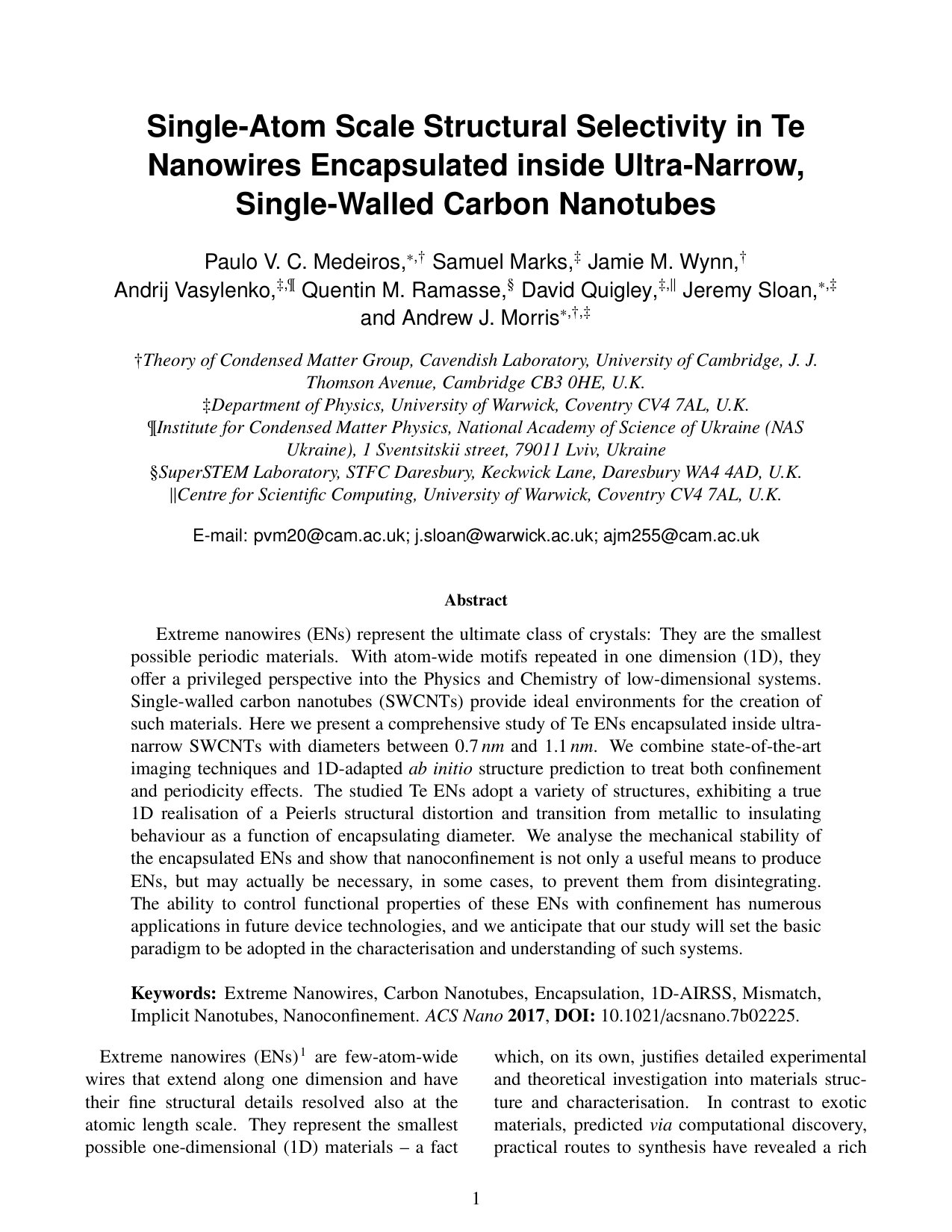 Figure 1
 Figure 2
Peer Reviews
No public reviews on file for this paper yet. If you reviewed it on a platform where reviews are public (OpenReview, ICLR, NeurIPS, ICML), you can paste yours below so the community can read it here.
Videos
No videos yet. Explain this paper in a talk, walkthrough, or lecture? Add one.
See pages 1-last of manuscript.pdf See pages 1-last of supporting_information.pdf