Casimir Energy in a Bounded Gross-Neveu model
F. Escalante, J.C. Rojas

TL;DR
This paper investigates the Casimir effect and dynamical mass generation in the massless Gross-Neveu model with finite boundaries, revealing boundary condition independence of the beta function and complex force behaviors.
Contribution
It provides a detailed analysis of the Casimir energy and beta function in a bounded Gross-Neveu model, highlighting boundary condition effects on physical parameters.
Findings
Beta function is independent of boundary conditions.
Casimir forces can be attractive or repulsive depending on parameters.
Massless Gross-Neveu model exhibits complex boundary-dependent behaviors.
Abstract
In this letter we study some relevant physical parameters of the massless Gross-Neveu model in a finite spatial dimension for different boundary conditions. It is considered the standard homogeneous Hartree Fock solution using zeta function regularization for the study the mass dynamically generated and its respective beta function. It is found that the beta function does not depend on the Boundary conditions. On the other hand, it was considered the Casimir effect of the resulting effective theory. There appears a complex picture where the sign of the generated forces depends on the parameters used in the study.
Click any figure to enlarge with its caption.
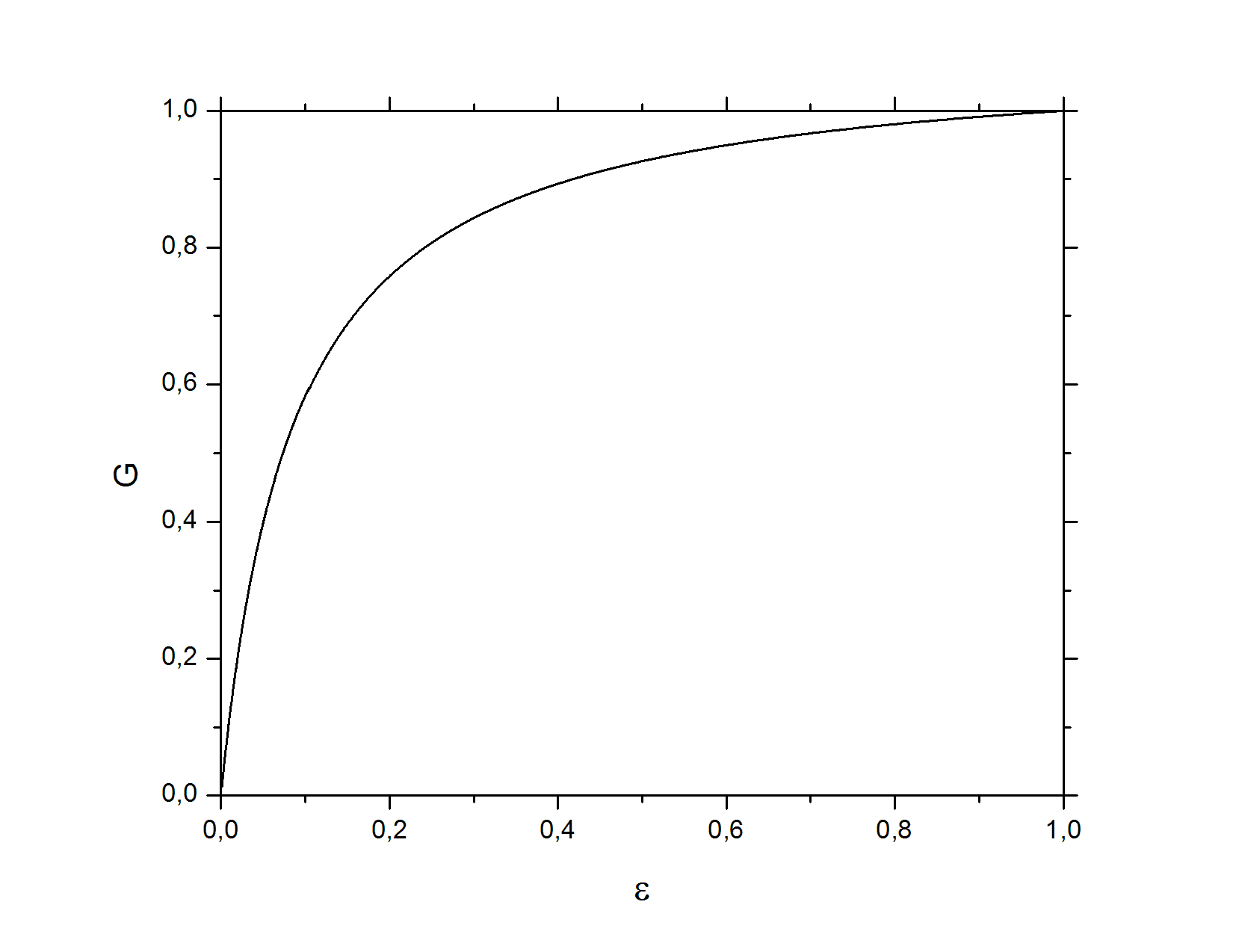 Figure 1
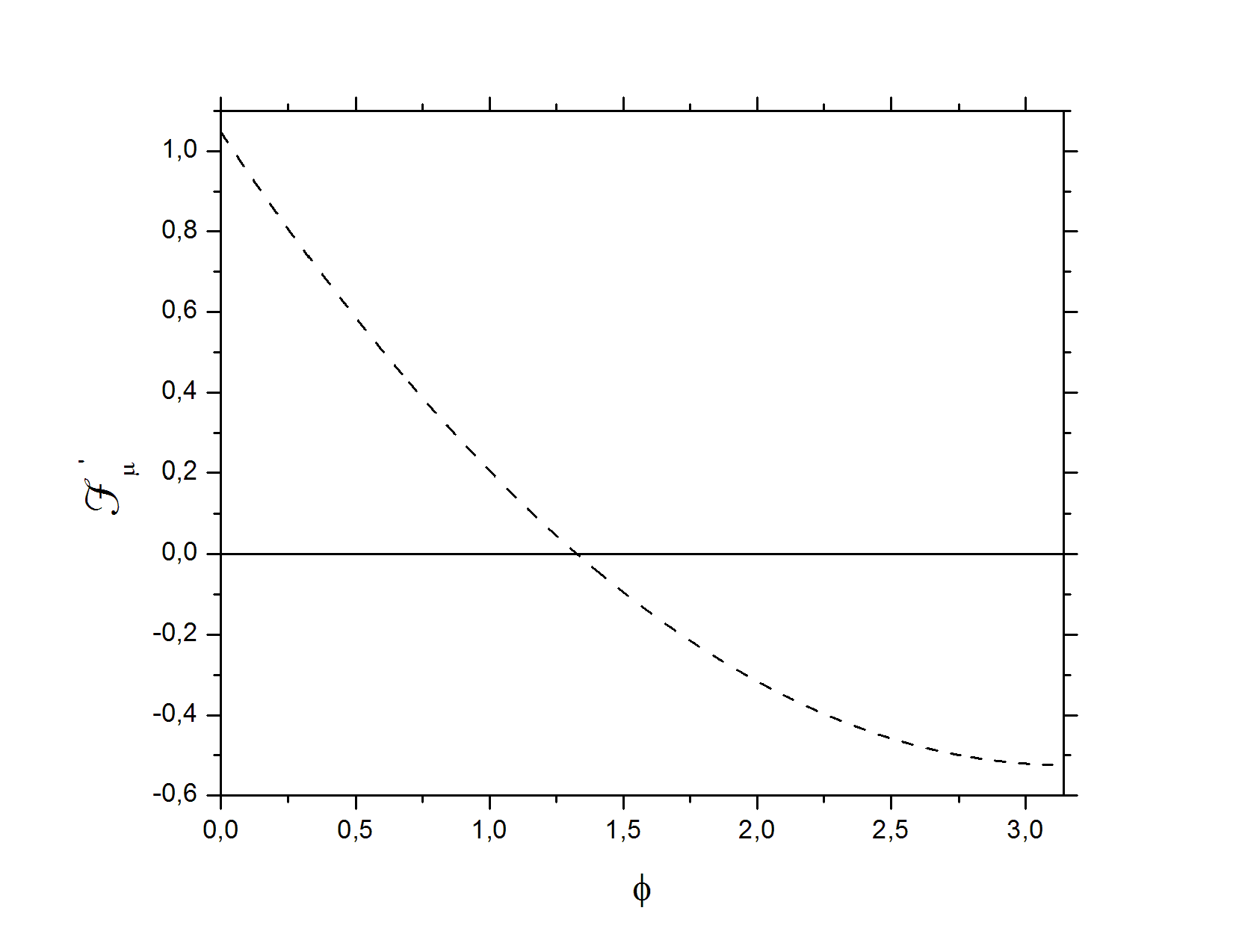 Figure 2
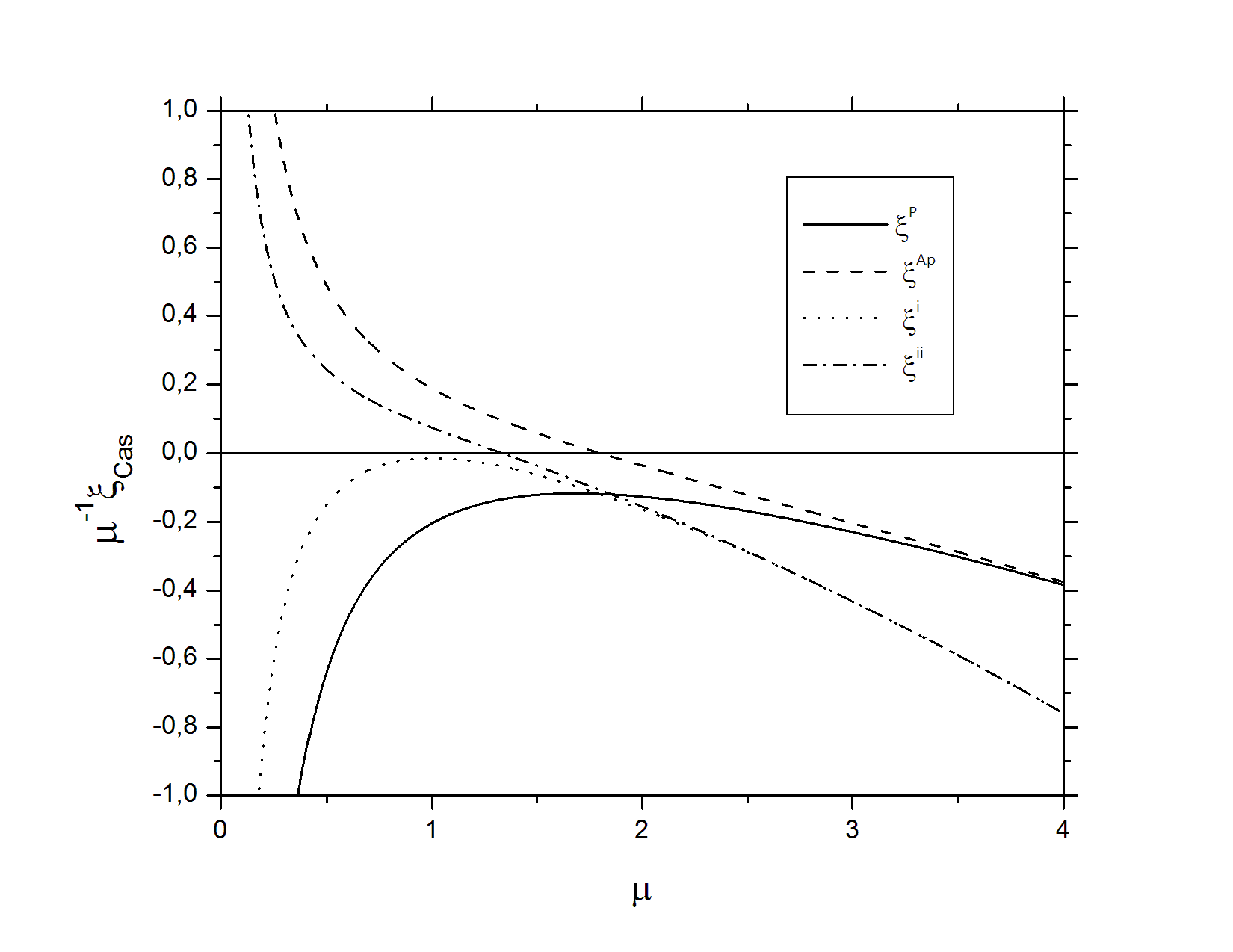 Figure 3
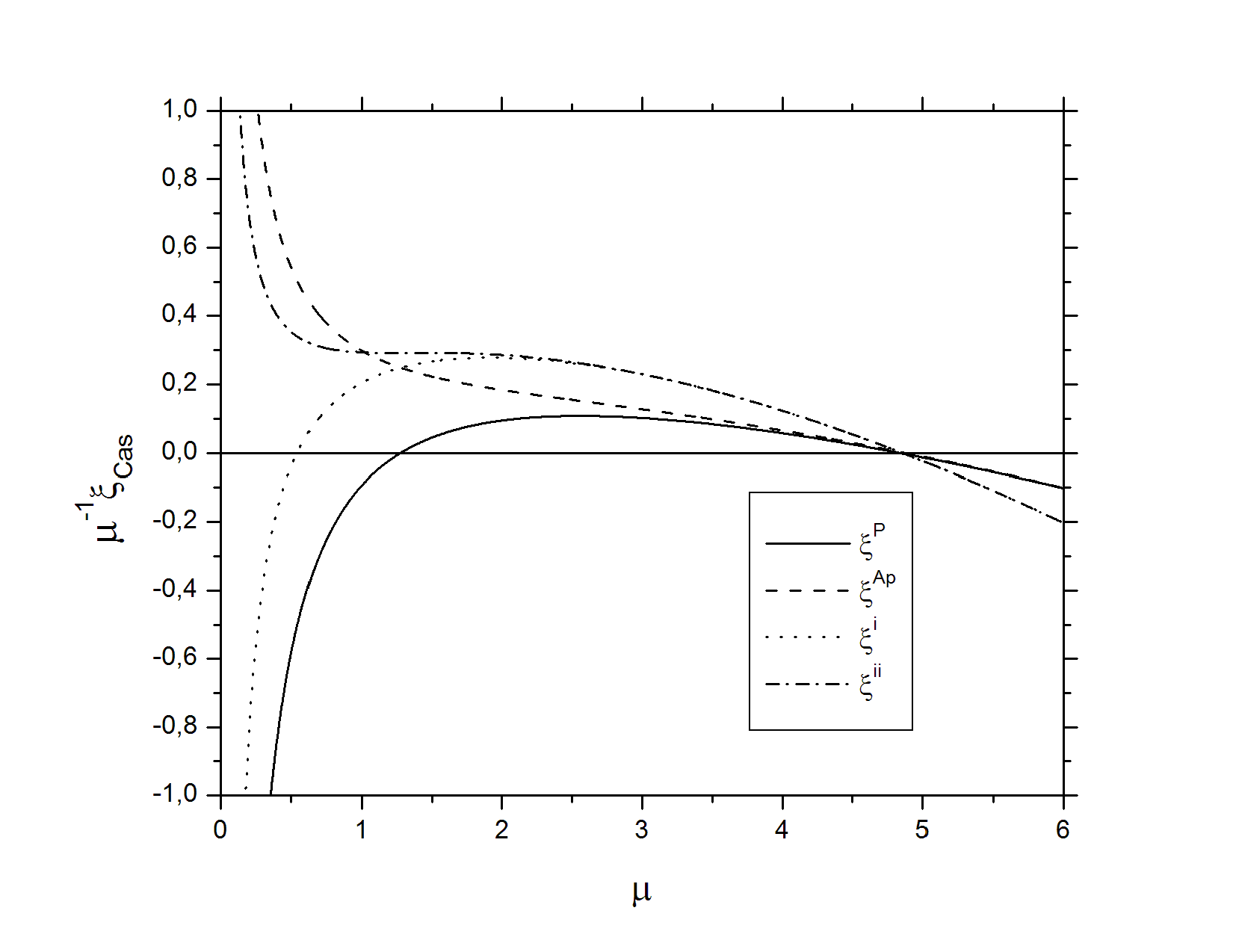 Figure 4
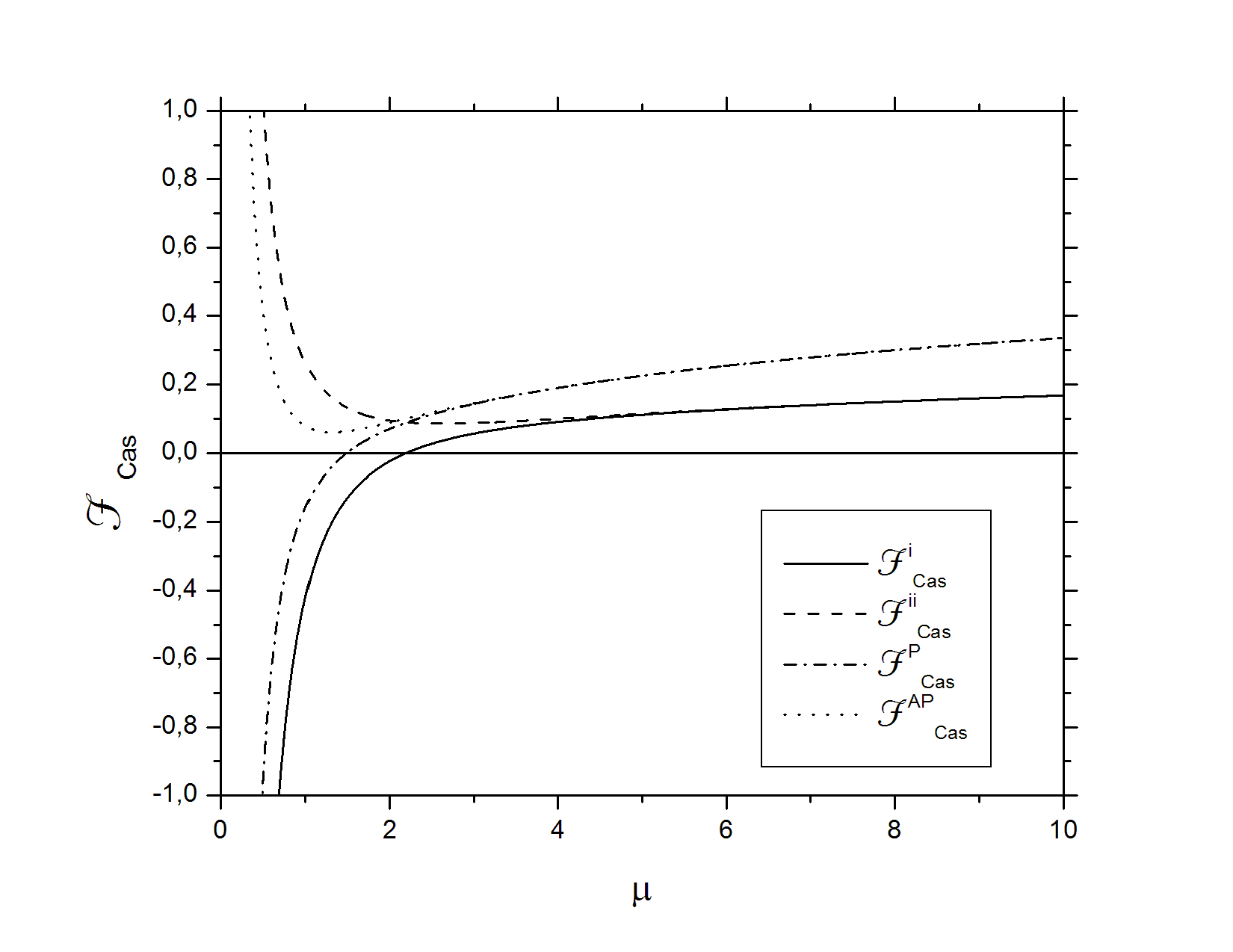 Figure 5
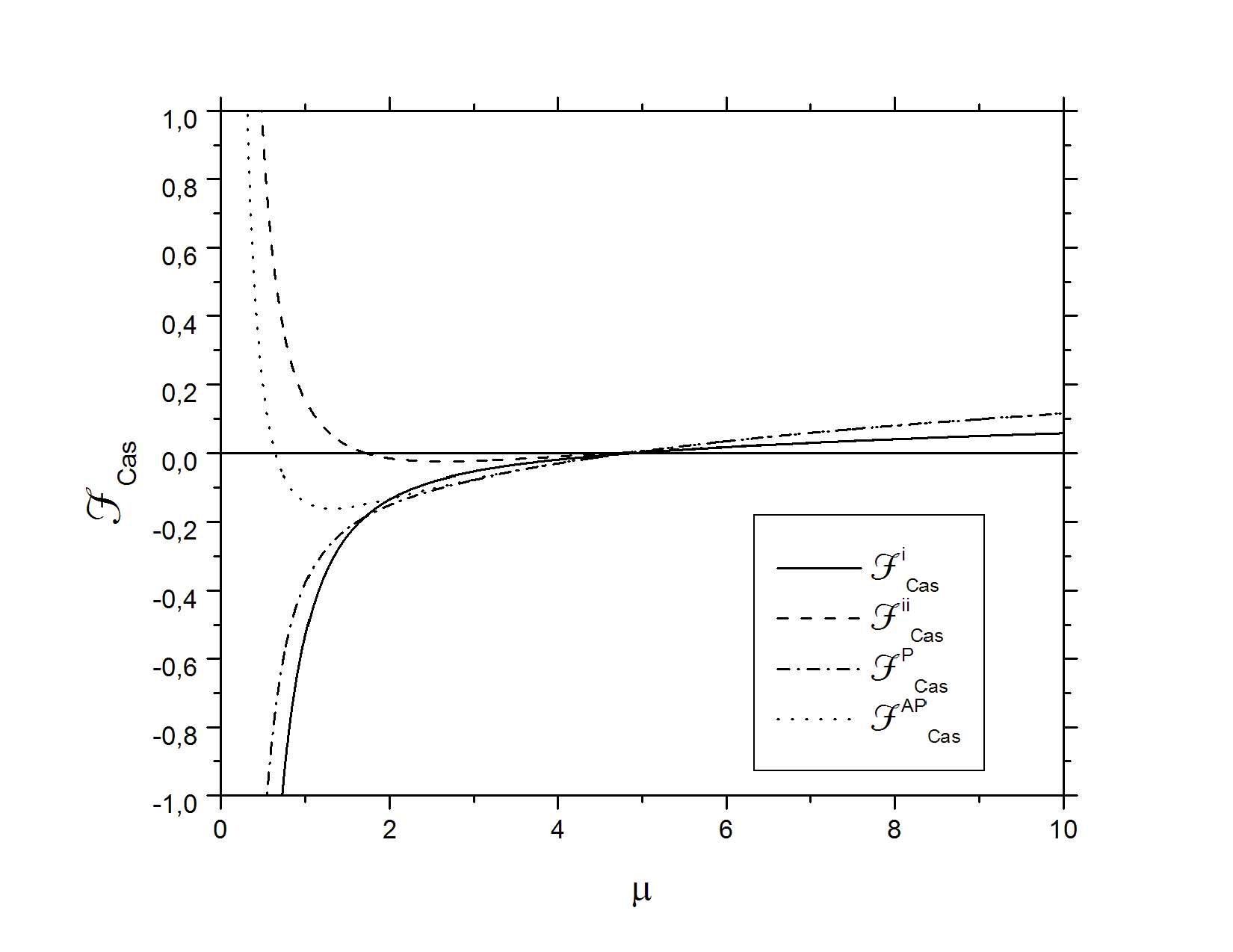 Figure 6
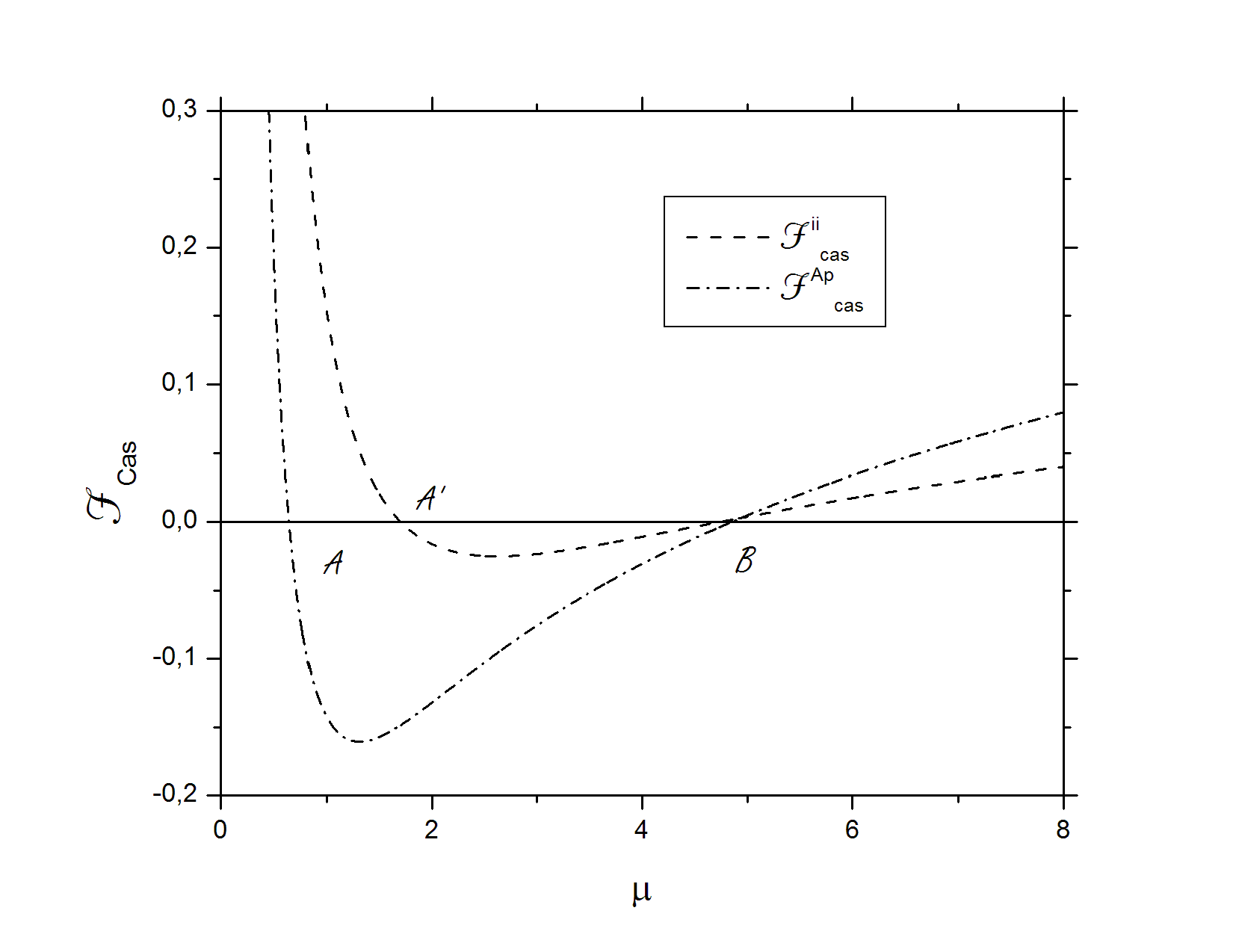 Figure 7
Peer Reviews
No public reviews on file for this paper yet. If you reviewed it on a platform where reviews are public (OpenReview, ICLR, NeurIPS, ICML), you can paste yours below so the community can read it here.
Videos
No videos yet. Explain this paper in a talk, walkthrough, or lecture? Add one.
Taxonomy
TopicsQuantum Electrodynamics and Casimir Effect · Quantum Mechanics and Applications · Noncommutative and Quantum Gravity Theories
Casimir Energy in a Bounded Gross-Neveu model
F. Escalante
Departamento de Física, Universidad Católica del Norte, Angamos 0610, Antofagasta, Chile
J.C. Rojas
Departamento de Física, Universidad Católica del Norte, Angamos 0610, Antofagasta, Chile
Abstract
In this letter we study some relevant physical parameters of the massless Gross-Neveu (GN) model in a finite spatial dimension for different boundary conditions. It is considered the standard homogeneous Hartree Fock solution using zeta function regularization for the study the mass dynamically generated and its respective beta function. It is found that the beta function does not depend on the boundary conditions. On the other hand, it was considered the Casimir effect of the resulting effective theory. There appears a complex picture where the sign of the generated forces depends on the parameters used in the study.
I Introduction
The Gross-Neveu (GN) model was born as a toy model of Quantum Chromodynamics (QCD) Gross:1974jv . Despite its simplicity, it keeps many interesting features, such as asymptotic freedom, dynamical mass generation and discrete chiral symmetry. Later, it was used in the study of baryons with explicit symmetry breaking by a mass term Thies:2005vq .
Curiously, this model has also application in condensed matter physics, where it describes the conductivity in certain polymers. In particular, it can be mentioned the case of trans-polyacetylene, which, in a simplified continuous model, is described by the symmetric GN model saxena , besides, the massive GN model has a condensed matter analogue; which are polymers with non-degenerate ground states brazovskii .
The original treatment of the GN model was under the assumption of the unbroken translational invariance, it means an standard treatment based on the large approximation, where the use of the Hartree Fock (HF) approximation is well founded, that leads a condensate independent of the space coordinates. Later, it was realized that there are crystal solutions of the model i.e. an spatial realization solution which have a rich interpretation in the realm of condensed matter physics Thies:2005wv .
In our study, we shall concentrate on the homogeneous solutions of the GN model for a finite space of fixed size . We are interested in the behaviour of physical parameters for different boundary conditions (BC’s).
The spatial BC’s considered are the periodic , anti periodic conditions. There are also considered the situation of no current transmission on the borders, there we consider two cases where such condition is fulfilled (see appendix C).
The HF approximation, implies the use of a large momentum cutoff. Since we shall deal with systems of spacial finite size, the momentum integrals must be replaced by summation on discrete modes, meaning that the natural regularization to be used is the zeta regularization technique Kirsten:2010zp .
In this work, we first ask about the ultraviolet dependence of the physical parameters on the BC’s, considering the GN model at zero bare mass () where temperature and chemical potential are not considered. We assume that the spatial length is a fixed parameter, so, if the physical mass is independent of the cutoff, it implies that the beta function does not depend on the BC’s. There appears an arbitrary mass scale and the functional dependency of the dynamical mass clearly depends on the BC’s.
A second step in our work is to study the Casimir energy and force due to the quantum fluctuation of the effective free system that arises from the HF approximation. We consider the non dimensional parameter , since the value of m is fixed by ultraviolet considerations, the variation of is equivalent to the variation of . We find that the value of energy and Force are sensitive to the BC’s. In particular, the signature of the energy clearly differs in the small size limit, but it is universally negative for infinite size limit. On the other hand, the force is also sensitive to the BC’s, implying situations where the forces are such that they compress or expand our space depending on the BC’s used. There is also a universal metastable point where the force becomes zero independently of the BC’s used. For the large limit the force becomes positive for any BC’s considered.
The Gross-Neveu model
The Gross-Neveu Lagrangian is given by
[TABLE]
Where runs from 1 to , it was introduce a finite mass in order to consider a general expression and we use the convention
[TABLE]
The Euler Lagrange equation from (1) is given by
[TABLE]
For the sake of simplicity, from now, we suppress the index . In the framework of Hartree-Fock relativistic approximation, it is assumed the expectation value and . We end up with the expression
[TABLE]
where and .
From (3) we obtain a free Dirac equation
[TABLE]
In order to obtain a stationary solution, we use the usual decomposition
[TABLE]
We obtain
[TABLE]
giving a system of coupled equations
[TABLE]
By making the redefinition of the fields
[TABLE]
we obtain a general solution
[TABLE]
where ande the constants and are not independent since they are determined by the boundary conditions.
II Hartree Fock for different boundary conditions
Following the standard procedure Schon:2000he , it is possible to compute the negative energy in an infinite space taking the value of as a parameter to be determined
[TABLE]
where and is a momentum cut off.
Since we have a finite spatial size, the wave number is discretized , implying , Where is a number which depends on boundary conditions. So, we have
[TABLE]
The summation term can be expressed as generalized zeta function regularization and its result is described in appendix A. Since the power in the summation is replaced by a term , it appears a mass scale . We have the following momentum decomposition for the BC to be considered (section (IV)):
[TABLE]
For the four considered BC, we obtained the following expressions for the energy density, where it was introduced the non dimensional variables and (see appendix B):
- •
Periodic BC
[TABLE]
- •
Anti periodic BC
[TABLE]
- •
Zero current BC
[TABLE]
In the following step, we minimize the energy densities with respect to . Then, we use (61) and obtain for each BC an expression for
[TABLE]
where goes to zero and must be considered as the ultraviolet cut-off.
If we Consider and constants, so the running of G should depends on the BC’s. But, fixing the value of a common for certain scale, implying different values of for each BC. If we take the limit , we observe an universal behaviour for G, independent of the BC’s
We observe from the general relation (61), that there is dependency of the constants and for each BC through the transcendental equation:
[TABLE]
being an arbitrary constant.
Considering the traditional point of view where the physical must be independent of the cutt-off we have a renormalization group equation
[TABLE]
For (17)-(19), it is computed the beta function
[TABLE]
we obtain
[TABLE]
meaning an universal behaviour of as it is shown if figure (1).
III Casimir Energy for global boundary conditions
Imposing BC’s of the form
[TABLE]
It is equivalent to study
[TABLE]
because of the linear relation (7).
In equations (8) and (9) we have solutions of the form
[TABLE]
where the values of depend on the imposed BC on the problem. We can define the matrix
[TABLE]
Assuming that it is invertible, i.e. , we can isolate the constants
[TABLE]
meaning that
[TABLE]
On the other side, the BC can be expressed in the following way
[TABLE]
so, evaluating (24) in and comparing with (25), we have
[TABLE]
Which is the condition for the eigenvalues of the problem.
We can include the periodic and anti periodic case by the parametrization
[TABLE]
[TABLE]
Eq. (26) leads to the condition
[TABLE]
Since , we have
[TABLE]
We define and a parameter which depends of the boundary conditions, so, the general expression for the Casimir energy is given by
[TABLE]
From appendix A, we have
[TABLE]
Ending with
[TABLE]
The Casimir Force
[TABLE]
We define , and , so
[TABLE]
IV Specific boundary conditions
Anti Periodic BC
We first, assume anti periodic BC for our spinor solution
[TABLE]
So, we have in (27), so
[TABLE]
Taking non-dimensional parameter , using (31) we have the Casimir energy
[TABLE]
and the Casimir force
[TABLE]
Periodic BC
Now we have the BC’s
[TABLE]
Proceeding as before, we obtain
[TABLE]
The Casimir energy is given by
[TABLE]
and the Casimir force
[TABLE]
Zero current BC
The confining condition is imposing the zero current condition at the borders
[TABLE]
And the eigenvalues are
[TABLE]
According to ec.(31) with , the Casimir energy and the Casimir force for this eigenvalues are given by
[TABLE]
[TABLE]
Limiting values
As can be seen from figures (3) and (3), the behaviour for small depends on the BC’s. In fact, the parameter determines the sign of the force as goes to zero. We are interested in the sign of the force for , where the force clearly goes to . Keeping the leading terms for :
[TABLE]
It is more clear to take the derivative to leading order
[TABLE]
where are Polylogarithm functions (see, for example lewin ). Since the positive derivative means a negative force and vice versa. The regime changes for the non physical value of , as it is shown in the figure (7), notice that does not depend on .
Another curious feature happen with and . When goes beyond a given value , the force becomes negative, having an equilibrium points and a metastable point , as it is clear from figure (7).
V Conclusions and discussion
The first part of this letter was aware of the ultraviolet behaviour of he GN model for different BC’s, in the framework of mean field theory assuming homogeneous solution and using zeta function regularization. We found that the beta function is independent of the type of boundary condition used, and that there appears a mass scale of arbitrary value. The generated dynamical mass should depend on the BC’s, if we have no prescription on the arbitrary mass scale.
Later, assuming, an homogeneous solution, we studied the Casimir energy and forces for different BC’s, if we concentrate on the behaviour of from figures (3) and (3), we notice the following features:
- a.
Anti periodic: for and for , for any positive value of . 2. b.
Periodic: has a maximum value for a certain value of , having limiting values of , for . The sign of the maximum value of , depends on the parameter . 3. c.
Confining i: The same qualitative behaviour of the periodic case. 4. d.
Confining ii: for and for , for any positive value of , in a similar fashion as the anti periodic case. 5. e.
We found that there is a common singular value of for , where becomes zero.
For the Casimir forces, from figures (5) and (5), we conclude that
- a.
Anti periodic BC: for and , for any value of . It also happen that for , can be negative in a finite range of . 2. b.
Periodic: for and for . 3. c.
Confining i: It has the same qualitative behaviour as the periodic case. 4. d.
Confining ii: It has the same qualitative behaviour as the anti periodic case.
It is shown in figure (5) that for , there is a common point where the Casimir force becomes zero for any boundary condition.
From the above considerations, we conclude that for BC’s periodic and confining i, there are two regimes of forces, being negative for “small” , representing an universe that has a shrinking tendency. On the other hand, when is “big”, our universe is an expanding one.
For the anti periodic and confining ii, there is a more complex situation, since its behaviour depends on the value of . For , the force is always positive, hence there is an expanding universe. For , there is mixed case as it is shown in figure (7), there are the points and the universal point . Between () and , the force becomes negative. It is also clear that is an unstable point and the points , are attracting points.
This study suggest that the natural further step is to consider a general relativity study where the spatial dynamics are affected by the quantum fluctuations of the Casimir energy and confirm if the BC’s determine the existence of shrinking or expanding low dimensional universes.
Appendix A Epstein zeta function
We use an extended version of the Epstein zeta function is Kirsten:2010zp
[TABLE]
We can express the summation term, using the properties of gamma function
[TABLE]
expression which is valid for . By means of the Jacobi inversion formulae Kirsten:2010zp , we have
[TABLE]
So, we have
[TABLE]
The above integrals are easily recognized gradshteyn and have the form
[TABLE]
Leading us to the general expression
[TABLE]
We are interested in the case , but there is a singularity in such point, so we isolate it by computing for the value , giving the expression
[TABLE]
In order to isolate the term, we use
[TABLE]
Finally, using the fact that the Epstein function can be expressed in a term where the singular point becomes isolated
[TABLE]
The limit of the finite part
[TABLE]
Appendix B Computation of energy density for general BC’s
As we see from section II, the density of energy
[TABLE]
is given by the BC’s imposed over
[TABLE]
We can use the zeta function regularization in order to obtain an expression for the energy density
[TABLE]
Introducing a parameter of mass and in both sides of the equation
[TABLE]
Recognizing the sum as the Epstein zeta function (see appendix A) and with , we have
[TABLE]
for the energy density is given by
[TABLE]
where .
Minimizing the energy density respect to
[TABLE]
and considering that , we can obtain an dimensionless expression
[TABLE]
therefore the parameter is given by
[TABLE]
Appendix C No current through the boundary
It is imposed the zero current condition at the boundaries
[TABLE]
In terms of components, we have
[TABLE]
if , then
[TABLE]
Since and are constants, we must impose that at the borders one of the fields must be zero, we can consider the following cases:
- i)
or ,
- ii)
or .
The conditions are
- i)
.
- ii)
, a transcendental equation that for behaves as .
**Acknowledgments
** F.E. and J.C.R. aknowledge the support of FONDECYT under grant No. 1150471 and J.C.R. aknowledges support of FONDECYT under grants No. 1150847 and No. 1130056.
The reference list from the paper itself. Each links out to its DOI / PubMed record.
- 1(1) D. J. Gross and A. Neveu, Phys. Rev. D 10 , 3235 (1974).
- 2(2) M. Thies and K. Urlichs, Phys. Rev. D 71 , 105008 (2005) [hep-th/0502210].
- 3(3) A. Saxena and A. R. Bischop, Phys. Rev. A 44 , R 2251 (1991).
- 4(4) S. A. Brazovskii and N. N. Kirova, JETP Lett. 33 , 4 (1981).
- 5(5) M. Thies and K. Urlichs, Phys. Rev. D 72 , 105008 (2005) doi:10.1103/Phys Rev D.72.105008 [hep-th/0505024].
- 6(6) K. Kirsten, MSRI Publ. 57 , 101 (2010) [ar Xiv:1005.2389 [hep-th]].
- 7(7) V. Schon and M. Thies, Phys. Rev. D 62 , 096002 (2000) doi:10.1103/Phys Rev D.62.096002 [hep-th/0003195].
- 8(8) I. S. Gradshteyn and I. M. Ryzhik, Table of integrals, series and products ,(7th Ed.) Academic Press, New York, 1980