A Finite-Volume discretization of viscoelastic Saint-Venant equations for FENE-P fluids
S\'ebastien Boyaval (MATHERIALS)

TL;DR
This paper extends a finite-volume discretization method for viscoelastic shallow flow equations to FENE-P fluids, demonstrating practical numerical stability and applicability despite some unresolved theoretical stability guarantees.
Contribution
It introduces an extension of the finite-volume scheme to FENE-P fluids, broadening the applicability of the method to more complex viscoelastic models.
Findings
Numerical simulations showed smooth solutions in practical parameter ranges.
The method preserves physical free-energy dissipation properties.
Stability conditions are not fully guaranteed theoretically but are observed numerically.
Abstract
Saint-Venant equations can be generalized to account for a viscoelastic rheology in shallow flows. A Finite-Volume discretization for the 1D Saint-Venant system generalized to Upper-Convected Maxwell (UCM) fluids was proposed in [Bouchut \& Boyaval, 2013], which preserved a physically-natural stability property (i.e. free-energy dissipation) of the full system. It invoked a relaxation scheme of Suliciu type for the numerical computation of approximate solution to Riemann problems. Here, the approach is extended to the 1D Saint-Venant system generalized to the finitely-extensible nonlinear elastic fluids of Peterlin (FENE-P). We are currently not able to ensure all stability conditions a priori, but numerical simulations went smoothly in a practically useful range of parameters.
Click any figure to enlarge with its caption.
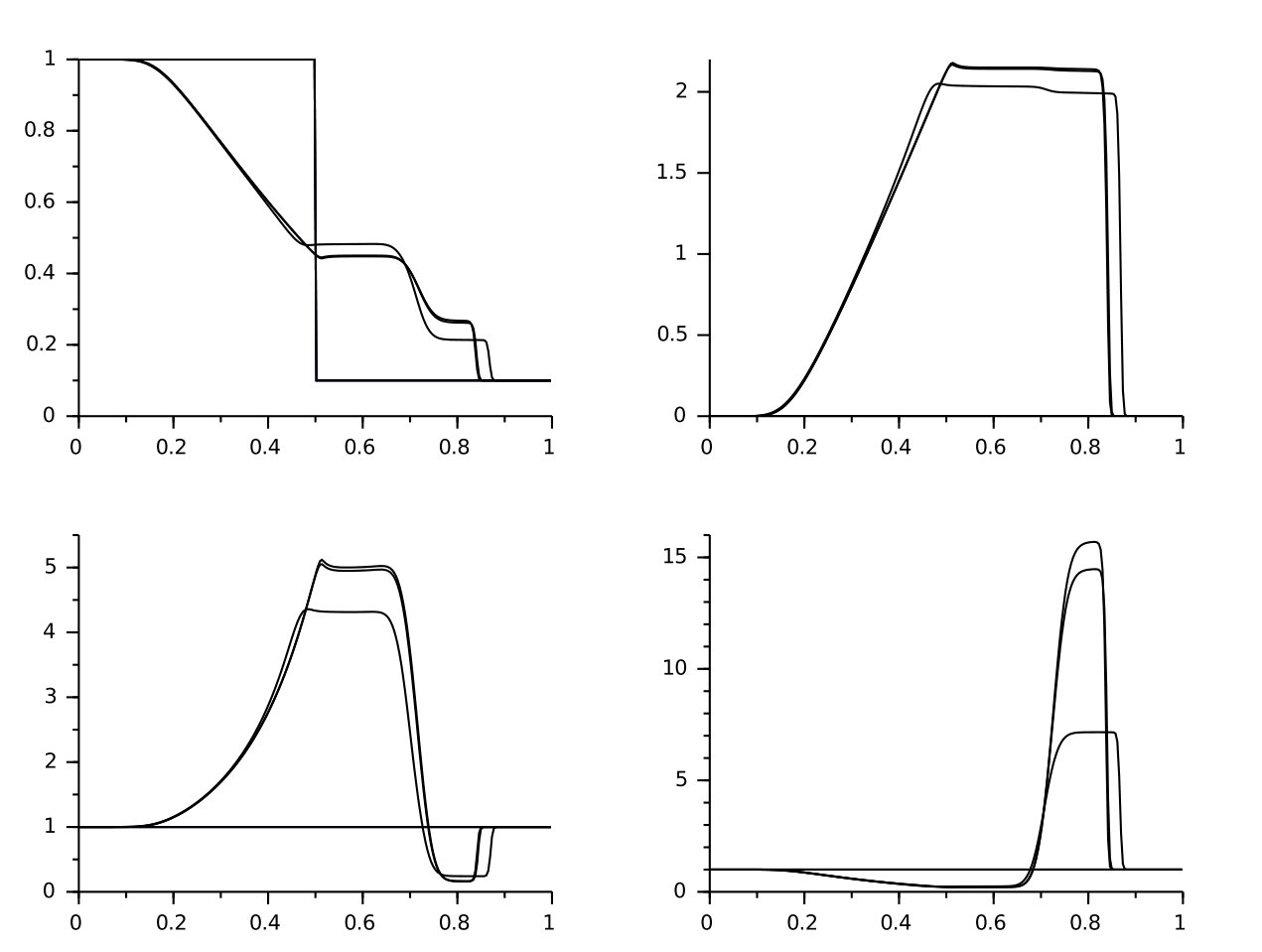 Figure 1
Peer Reviews
No public reviews on file for this paper yet. If you reviewed it on a platform where reviews are public (OpenReview, ICLR, NeurIPS, ICML), you can paste yours below so the community can read it here.
Videos
No videos yet. Explain this paper in a talk, walkthrough, or lecture? Add one.
Taxonomy
TopicsFluid Dynamics and Turbulent Flows · Rheology and Fluid Dynamics Studies · Lattice Boltzmann Simulation Studies
11institutetext: Sébastien Boyaval 22institutetext: Laboratoire d’hydraulique Saint-Venant (Ecole des Ponts ParisTech – EDF R& D – CEREMA) Université Paris-Est, EDF’lab 6 quai Watier 78401 Chatou Cedex France, & INRIA Paris MATHERIALS 22email: [email protected]
A Finite-Volume discretization
of viscoelastic Saint-Venant equations for FENE-P fluids
Sébastien Boyaval
Abstract
Saint-Venant equations can be generalized to account for a viscoelastic rheology in shallow flows. A Finite-Volume discretization for the 1D Saint-Venant system generalized to Upper-Convected Maxwell (UCM) fluids was proposed in [Bouchut & Boyaval, 2013], which preserved a physically-natural stability property (i.e. free-energy dissipation) of the full system. It invoked a relaxation scheme of Suliciu type for the numerical computation of approximate solution to Riemann problems. Here, the approach is extended to the 1D Saint-Venant system generalized to the finitely-extensible nonlinear elastic fluids of Peterlin (FENE-P). We are currently not able to ensure all stability conditions a priori, but numerical simulations went smoothly in a practically useful range of parameters.
Keywords:
Saint-Venant equations, FENE-P viscoelastic fluids, Finite-Volume, simple Riemann solver, Suliciu relaxation scheme
MSC (2010): 65M08, 65N08, 35Q30
1 Introduction
Saint-Venant equations standardly model shallow free-surface gravity flows and can be generalized to account for the viscoelastic rheology of non-Newtonian fluids bouchut-boyaval-2015 , Upper-Convected Maxwell (UCM) fluids in particular bouchut-boyaval-2013 . Here, we consider a generalized Saint-Venant (gSV) system for finitely-extensible nonlinear elastic fluids with Peterlin closure (FENE-P fluids) in Cartesian coordinates
[TABLE]
for 1D -translation invariant flow along under a uniform gravity field with
- •
mean flow depth (in case of a non-rugous flat bottom),
- •
mean flow velocity (for uniform cross sections), and
- •
a normal-stress difference given by conformation variables constrained by , a relaxation time and an elasticity modulus .
Note that (1-2-3-4) formally reduces to the standard viscous Saint-Venant system with viscosity when , and . Moreover we have used the quite general Gordon-Schowalter derivatives with slip parameter constrained by the hyperbolicity of the system (1-2-3-4). (This follows after an easy computation similar to 2016arXiv161108491B .)
In this work, we discuss a Finite-Volume method to solve (numerically) the Cauchy problem for the nonlinear hyperbolic 1D system (1-2-3-4). Standardly, we need to consider weak solutions (in fact, to (6-7-8-9), see below) plus admissibility constraints that are physically-meaningful dissipation rules formalizing the thermodynamics second principle close to an equilibrium dafermos-2000 . Here, we consider the inequality associated with the companion conservation law for the free-energy
[TABLE]
that is, on denoting the impulse by ,
[TABLE]
where the left-hand-side is obviously non-positive on the admissibility domain
[TABLE]
Note that we do not consider the vacuum state as admissible here, see 2016arXiv161108491B .
2 Finite-Volume discretization of FENE-P/Saint-Venant
Piecewise-constant approximate solutions to the Cauchy problem on for the gSV system can be defined by a Finite-Volume (FV) method. With a view to preserving and the dissipation (5) after discretization by a FV method, we choose as discretization variable. Indeed, the free-energy functional is convex on the convex domain (this follows after an easy computation from (bouchut-2004, , Lemma 1.3)) while it is not convex in the variable whatever smooth invertible functions are used for the reformulation of gSV
[TABLE]
with , (computations are similar to (bouchut-boyaval-2013, , Appendix)). In the sequel, we therefore discretize a quasilinear system with source
[TABLE]
which we recall is not ambiguous here (for those discontinuous solutions built using a Riemann solver, at least) thanks to the dissipation rule (5), see lefloch-2002 ; berthon-coquel-lefloch-2011 ; 2016arXiv161108491B .
2.1 Splitting-in-time
In cell , , with volume and center , we approximate solution to (10) on by
[TABLE]
on a time grid where will be chosen small enough compared with to ensure stability.
More precisly, having in mind the numerical approximation of a (well-posed) Cauchy problem for (10) on with initial condition , and therefore starting from approximations , , we shall define the cell values in two steps for each :
(i) an approximate solution to the homogeneous gSV system (i.e. without the source term ) on is first computed by an explicit three-point scheme
[TABLE]
(ii) an approximate solution to the full gSV system on is next computed as
[TABLE]
Then, the scheme is consistent with weak solutions of (1–2) equiv. (6–7)
[TABLE]
provided the two first flux components for the conservative part of the variable (actually solutions to conservation laws) are conservative , and consistent , as usual, and with the conservative interpretation (8–9) of (3–4) insofar as we next define and using a simple approximate Riemann solver harten-lax-vanleer-1983 for (6–7–8–9).
Moreover, with a view to preserving and a discrete version of (5)
[TABLE]
for a numerical free-energy flux function consistent with in (5), in the sequel, we shall discuss the relaxation technique introduced by Suliciu as simple Riemann solver in step (i), because it proved satisfying for other close systems bouchut-2003 ; bouchut-2004 ; bouchut-boyaval-2013 equipped with an “entropy” convex in the discretization variable like here. In the end, for the full scheme (13), a consistent free-energy dissipation
[TABLE]
then holds insofar , and the convexity of imply
[TABLE]
Proof
On noting , it suffices to show that
[TABLE]
imply (16). Now, this is obvious, on noting the convexity of in and
[TABLE]
since by design.
2.2 Suliciu relaxation of the Riemann problem without source
For all time ranges , , let us now define at each interface , , between cells and the numerical flux functions and
[TABLE]
invoking an approximate solution to the Riemann problem for (10) with initial condition at , and any .
In this work, we propose as approximate solution that given by Suliciu relaxation
[TABLE]
i.e. the projection (operator ) onto of the exact solution of the Riemann problem for the system with relaxed pressure
[TABLE]
and initial condition given by ()
[TABLE]
where are chosen so as to ensure stability, that is the dissipation rule (14) here (see below). Note that (19) is a hyperbolic system which fully decomposes into linearly degenerate eigenfields, so has an analytic expression (see formulas in bouchut-2004 ; bouchut-boyaval-2013 ). Note also: the Riemann solver is consistent under the CFL condition
[TABLE]
It remains to specify a choice of functions preserving and ensuring (14).
Although it is not clear whether our construction allows one to approximate solutions on any time ranges , since the series may be bounded uniformly for all space-grid choice ( may grow unboundedly as ), specifying such fully defines a computable scheme. In particular, (15) then implies that (12) at step (ii) always has at least one solution for any fixed at step (i). (This can be shown using Brouwer fixed-point theorem like in barrett-boyaval-2011 .)
Note however a difficulty here for FENE-P fluids with . Suliciu relaxation approach (19) was retained at step (i) because the solver often allows one to preserve invariant domains like and a dissipation rule (14) through well-chosen , see e.g. bouchut-2003 ; bouchut-2004 ; bouchut-boyaval-2013 . Indeed, on noting the exact Riemann solution to (19), to get (14) on choosing G(q_{l},q_{r})=u\Bigl{(}h\bigl{(}\frac{u^{2}}{2}+\hat{e}\bigr{)}+\pi\Bigr{)}|_{\mathcal{R}(0,q_{l},q_{r})}, it is enough that
[TABLE]
using if and if with .
One can easily propose satisfying the first condition in (22), i.e.
[TABLE]
as usual for Saint-Venant systems, plus the admissibility conditions ()
[TABLE]
for any satisfying (FENE-P fluids, see below). But the second condition is usually treated for monotone. Unfortunately, a lengthy (but easy) computation shows that the latter is not monotone here, so the standard method to choose a priori does not apply.
2.3 Choice of relaxation parameter
Let us treat the first part of (22) as usual and define , such that the functions ensure (23–24) and (25).
First, let us inspect (23–24) classically following (bouchut-klingenberg-waagan-2010, , section3.3). Denoting , so , it then holds with provided one chooses such that for , which yields thus (23–24) in particular.
On the other hand, let us now inspect (25), which rewrites with
[TABLE]
with , , positive such that (hence ) and . The upper-bound in (26) is satisfied with , on noting
[TABLE]
It remains to ensure the lower bound in (26). Obviously, so one only needs to inspect the case . Now, with , , if then holds
[TABLE]
In the end, we claim the following choices
[TABLE]
satisfy simultaneously (23–24) and (25) in a compatible way with , , , , , for . Moreover, note that we have chosen such that all subcharacteristic conditions (22) are satisfied in the limit, hence also the free-energy dissipation (15). Indeed, is monotone in the limit and one can then apply the standard method to choose bouchut-boyaval-2013 .
3 Numerical illustrations
We numerically approximate on the solution to a Riemann problem with
[TABLE]
as initial condition when , , , . In Fig. 1, we show the initial condition and the result at when for . Note the influence of the parameter on the stretch . On computing numerically the free-energy dissipation with the choice of relaxation parameter above, we have never observed the wrong sign, while the time-step did not go to zero.
The reference list from the paper itself. Each links out to its DOI / PubMed record.
- 1(1) Barrett, J.W., Boyaval, S.: Existence and approximation of a (regularized) Oldroyd-B model. M 3AS 21 (9), 1783–1837 (2011).
- 2(2) Berthon, C., Coquel, F., Le Floch, P.G.: Why many theories of shock waves are necessary: kinetic relations for non-conservative systems. Proceedings of the Royal Society of Edinburgh: Section A Mathematics 142 , 1–37 (2012)
- 3(3) Bouchut, F.: Entropy satisfying flux vector splittings and kinetic BGK models. Numerische Mathematik 94 , 623–672 (2003).
- 4(4) Bouchut, F.: Nonlinear stability of finite volume methods for hyperbolic conservation laws and well-balanced schemes for sources. Frontiers in Mathematics. Birkhäuser Verlag, Basel (2004)
- 5(5) Bouchut, F., Boyaval, S.: A new model for shallow viscoelastic fluids. M 3AS 23 (08), 1479–1526 (2013).
- 6(6) Bouchut, F., Boyaval, S.: Unified derivation of thin-layer reduced models for shallow free-surface gravity flows of viscous fluids. European Journal of Mechanics - B/Fluids 55, Part 1 , 116–131 (2016).
- 7(7) Bouchut, F., Klingenberg, C., Waagan, K.: A multiwave approximate Riemann solver for ideal MHD based on relaxation II: numerical implementation with 3 and 5 waves. Numer. Math. 115 (4), 647–679 (2010).
- 8(8) Boyaval, S.: Johnson-Segalman – Saint-Venant equations for viscoelastic shallow flows in the elastic limit. Ar Xiv e-prints (2016)