The Timing Noise of Magnetars
D. Cerri-Serim (1), M.M. Serim (1), D. Yucalan (1), S. Sahiner (1),, S.C. Inam (2), A. Baykal (1) ((1) METU, Ankara, Turkey (2) Baskent, University, Ankara, Turkey)

TL;DR
This paper analyzes the timing noise of magnetars and related sources, revealing a correlation between noise strength and spin-down rate, and applies Bayesian methods to study transient QPO features.
Contribution
It provides a comparative analysis of noise strength across magnetars and accreting sources, and introduces Bayesian analysis of transient QPOs in 4U 1907+09.
Findings
Noise strength scales with spin-down rate.
Higher spin-down rate causes increased torque noise.
Bayesian analysis of transient QPOs in 4U 1907+09.
Abstract
We represent noise strength analysis of Anomalous X-Ray Pulsars (AXPs) 4U 0142+61, 1RXS J170849.9-400910, 1E 1841-045, 1E 2259+586 and Soft Gamma Repeaters (SGRs) SGR J1833-0832, SWIFT J1822.3-1606 and SWIFT J1834.9-0846 together with the X-Ray binaries GX 1+4 and 4U 1907+09 for comparison with accreting sources. Using our timing solutions, we extracted residuals of pulse arrival times after removal of spin down trends and we calculated assoicated noise strength of each source. Our preliminary results indicate that the noise strength is scaling up with spin-down rate. This indicates that, increase in spin-down rate leads to more torque noise on the magnetars. In addition, we present our analysis with Bayesian statistics on the previously reported transient QPO feature of 4U 1907+09.
Click any figure to enlarge with its caption.
 Figure 1
 Figure 2
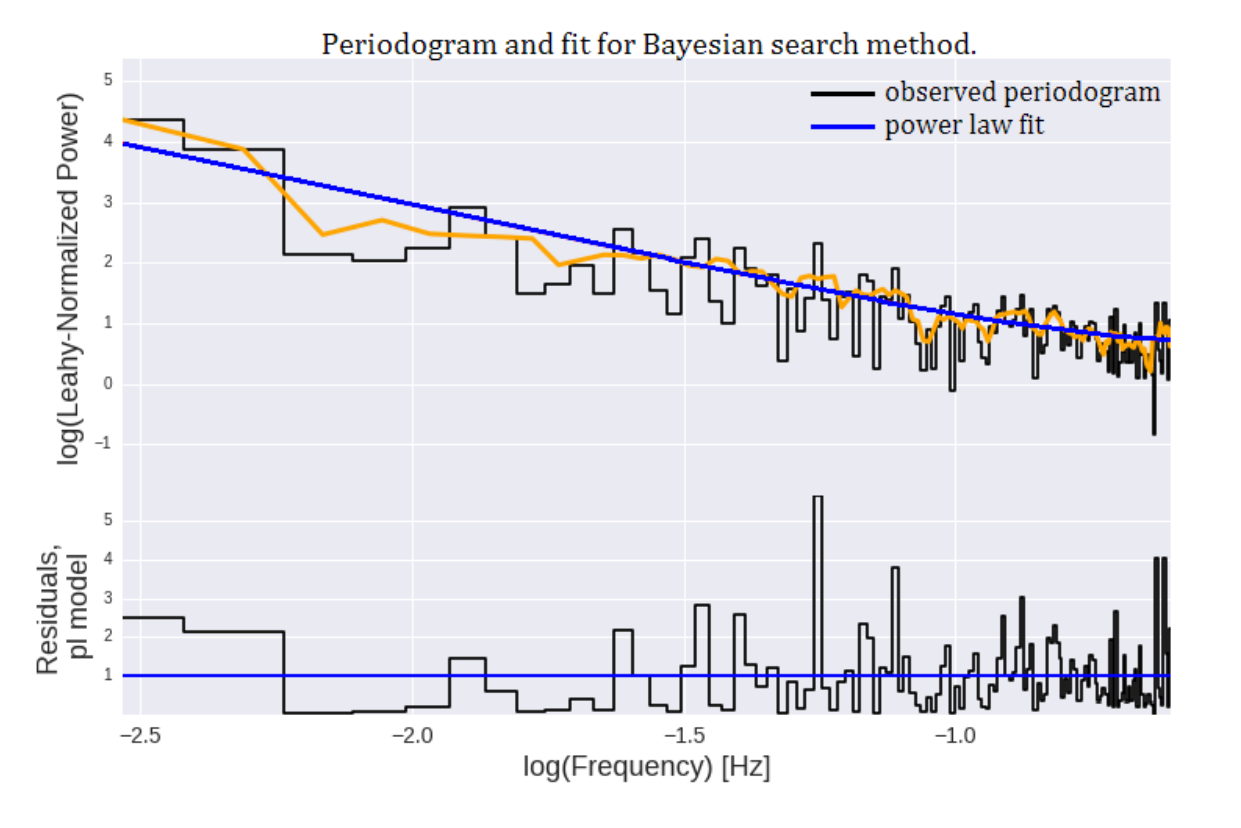 Figure 3
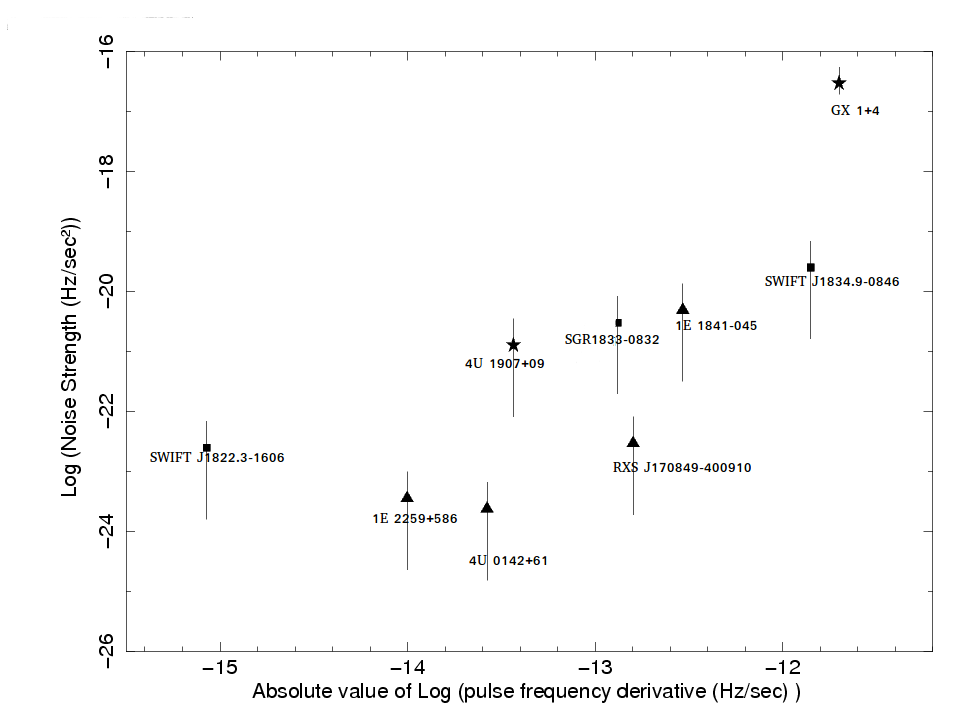 Figure 4
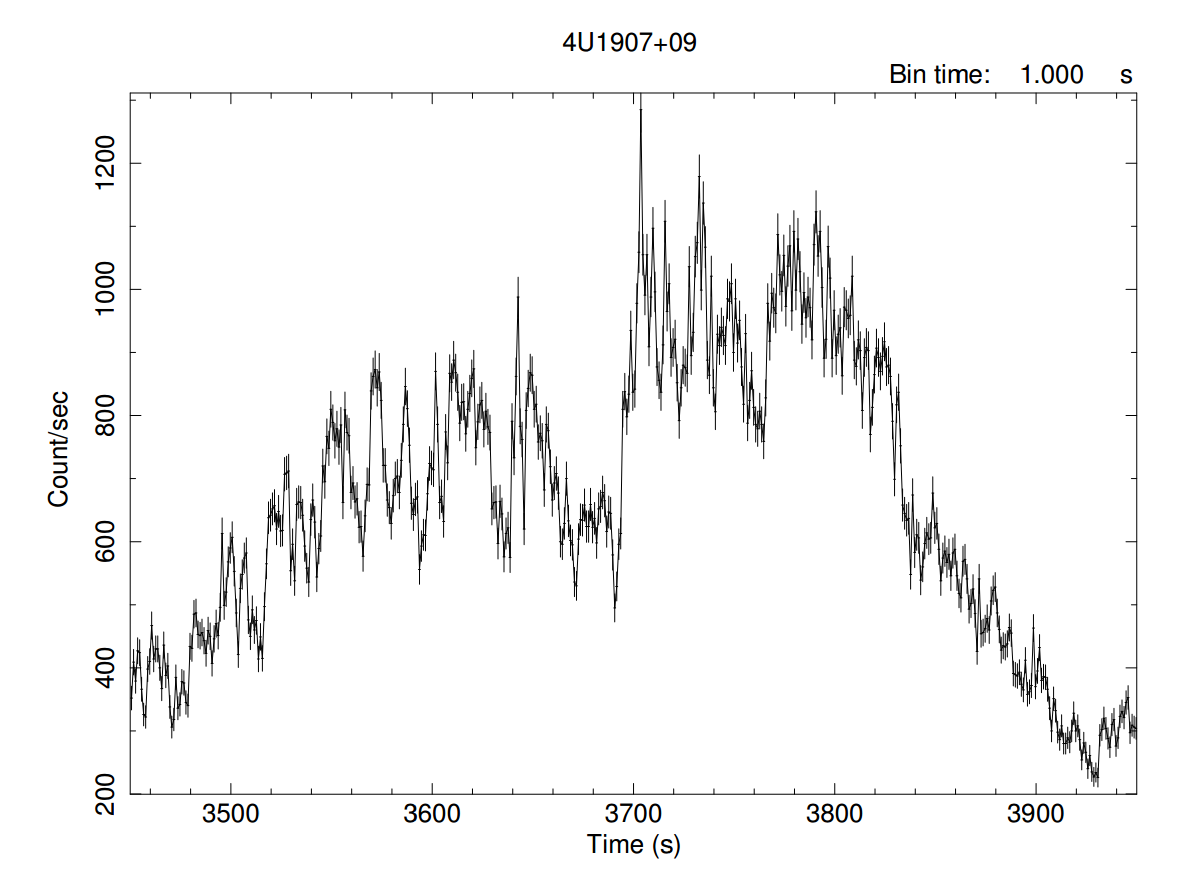 Figure 5
Peer Reviews
No public reviews on file for this paper yet. If you reviewed it on a platform where reviews are public (OpenReview, ICLR, NeurIPS, ICML), you can paste yours below so the community can read it here.
Videos
No videos yet. Explain this paper in a talk, walkthrough, or lecture? Add one.
Taxonomy
TopicsPulsars and Gravitational Waves Research · Gamma-ray bursts and supernovae · Astrophysical Phenomena and Observations
The Timing Noise of Magnetars
Middle East Technical University
M. M. Serim
Middle East Technical University
D. Yücalan
Middle East Technical University
Ş. Şahiner
Middle East Technical University
S. Ç. İnam
Başkent University
A. Baykal
Middle East Technical University
Abstract:
We represent noise strength analysis of Anomalous X-Ray Pulsars (AXPs) 4U 0142+61, 1RXS J170849.9-400910, 1E 1841-045, 1E 2259+586 and Soft Gamma Repeaters (SGRs) SGR J1833-0832, SWIFT J1822.3-1606 and SWIFT J1834.9-0846 together with the X-Ray binaries GX 1+4 and 4U 1907+09 for comparison with accreting sources. Using our timing solutions, we extracted residuals of pulse arrival times after removal of spin down trends and we calculated assoicated noise strength of each source. Our preliminary results indicate that the noise strength is scaling up with spin-down rate. This indicates that, increase in spin-down rate leads to more torque noise on the magnetars. In addition, we present our analysis with Bayesian statistics on the previously reported transient QPO feature of 4U 1907+09.
1 Introduction
Magnetars are isolated neutron stars with extreme magnetic fields (typically higher than ) (Kouveliotou et al. 1998; Vasisht & Gotthelf 1997) and their emission is thought to be originating from decay of this field (Duncan &Thompson 1992;Beloborodov 2009). They exhibit short X-ray bursts arising from crustal movements and magnetic activity (Thompson et al. 2002). Magnetars occasionally show glitches in their spin frequency followed by flux enchancements and structural changes in pulse profiles (Dib & Kaspi 2014; Rea & Esposito 2011). Timing studies on magnetars reveal that they posses high timing noise level compared with standard pulsars (Woods et al. 2002; Gavriil & Kaspi 2002). In this study, we present our timing noise strength measurements on 7 magnetars.
Pulsars in X-ray binary systems are powered by accretion of matter from their companion stars (Pringle & Rees 1972). Angular momentum content of accreted matter is a source of external torque for the pulsar and causes intrinsic variations in spin period. Investigating fluctuations in torque provides information about accreting matter and the internal structure of the pulsar (Lamb et al. 1978).
2 Analysis and Noise Strengths
We measured pulse frequencies via phase coherent timing solutions for each source. The constructed pulse frequency histories have approximately same time span. In order to investigate the torque fluctuations of these sources, we calculated associated noise strengths for the pulse frequency variations (see Cordes 1980;Deeter & Boynton 1982 for approach and also Baykal 1997 for applications). The expected mean square residual, after removal of mth degree polynomial over a time span T, is given by
[TABLE]
where indicates the expectation value for unit-strength noise process. The numerical evaluation of these values are presented in Deeter (1984). We removed spin down trends from the frequency measurements and calculated corresponding noise strength from the mean square residuals. In this work, we represent noise strength estimations of four AXPs (1E 2259+586, AXPs 4U 0412+61, 1RXS J170849.9-400910 and 1E 1841-045) and two X-ray binaries (GX 1+4:Serim et al. (2017); Bildsten et al. (1997) and 4U 1907+09: Şahiner et al. 2012) in addition to three SGRs (SWIFT J1822.3-1606, SGR J1833-0832 and SWIFT J1834-0846; Serim et al. 2012) . Noise strengths versus absolute value of pulse frequency derivatives are presented in Figure 1.
3 QPO of 4U 1907+09
4U 1907+09 is an X-ray pulsar with a spin period of 441.8 s. The secular spin down trend of the pulsar was interrupted by a torque reversal event in 2004 May (Fritz et al. 2006). After 2007 June, the pulsar returned to spin down with a rate close to its historical steady spin down rate (İnam et al. 2009, Şahiner et al. 2012). 4U 1907+09 is known to show abrupt variations in X-ray flux such as flares and dips on time scales of minutes to hours (In’t Zand et al. 1997). Quasi-periodic oscillations (QPO) of about 18 s had been reported during a 1 hr flare on 1996 February 23, which was interpreted as a transient accretion disc formation (In’t Zand et al. 1998).
We re-analysed the RXTE-PCA observation taken on February 23, 1996. We extracted the lightcurve of the observation and searched for QPO with the Bayesian search algorithm written in Python by Huppenkothen111The associated Python codes can be found in https://github.com/dhuppenkothen/BayesPSD.
The Bayesian search method found a QPO candidate around 17.9 s. The probability of detecting a false signal is p( ¿ 11.277) = , which corresponds to a 2.91 level of detection. We also constructed power density spectrum (PDS) of the same lightcurve, then fit the continuum with power law model and calculated the significance of qpo signal. In this method, detection level of the signal yielded 3.54.
4 Conclusion
In conclusion, we extract the timing residuals of 7 magnetars (3 SGRs and 4 AXPs) and 2 X-ray binaries using RXTE and Swift observations and calculated associated timing noise strengths.
- •
Our pulse timing noise analysis on 7 magnetars indicate that the spin-down rates of magnetars seem to show a correlation with their noise strengths. These noise strengths could be the result of micro-scale cracking of the crust due to the magnetic field stress on the crust. We will extend this work to other magnetars listed in McGill Magnetar Catalog (Olausen & Kaspi 2014).
- •
We re-analysed the transient QPO feature of 4U 1907+09. The Bayesian method does find a candidate for a QPO around 18s, however, lowers the level of detection to 2.91. The level of detection is less than that of the comparison analysis, which finds a candidate around the same period, with 3.54.
We acknowledge support from TÜBİTAK, the Scientific and Technological Research Council of Turkey through the research project MFAG 114F345 and Scientific Research Projects Coordination Unit (BAP) with the project BAP-01-05-2016-003.
The reference list from the paper itself. Each links out to its DOI / PubMed record.
- 1[1] Baykal, A., The torque and X-ray flux changes of OAO 1657-415 , AAP 318, 515 (1997)
- 2[2] Beloborodov, A. M., Untwisting Magnetospheres of Neutron Stars , Ap J 703, 1044 (2009)
- 3[3] Bildsten, L. et al., Observations of Accreting Pulsars , Ap JS 113, 367 (1997)
- 4[4] Cordes, J. M., Pulsar timing. II - Analysis of random walk timing noise - Application to the Crab pulsar , Ap J 237, 216 (1980)
- 5[5] Deeter, J. E. and Boynton, P. E., Techniques for the estimation of red power spectra. I - Context and methodology , Ap J 261, 337 (1982)
- 6[6] Deeter, J. E., Techniques for the estimation of red power spectra. II Evaluation of alternative methods , Ap J 281, 482 (1984)
- 7[7] Dib, R. and Kaspi, V. M., 16 yr of RXTE Monitoring of Five Anomalous X-Ray Pulsars , Ap J 784, 37 (2014)
- 8[8] Duncan, R. C. and Thompson, C., Formation of very strongly magnetized neutron stars - Implications for gamma-ray bursts , Ap JL 392, 9 (1992)