A Librational Model for the Propeller Bl\'eriot in the Saturnian Ring System
M. Seiler, M. Sei{\ss}, H. Hoffmann, F. Spahn

TL;DR
This paper develops a librational model for the propeller structure Blériot in Saturn's rings, combining N-body simulations and a harmonic oscillator approach to explain observed libration amplitudes and periods.
Contribution
The paper introduces a new model incorporating moonlet displacement and ring interactions to accurately reproduce Blériot's libration characteristics.
Findings
Simulations show gravitational interactions alone cannot explain libration amplitudes.
A harmonic oscillator model with external forcing matches observed libration period and amplitude.
External moon interactions amplify librations near resonance frequencies.
Abstract
The reconstruction of the orbital evolution of the propeller structure Bl\'eriot orbiting in Saturn's A ring from recurrent observations in Cassini ISS images yielded a considerable offset motion from the expected Keplerian orbit (Tiscareno et al., 2010). This offset motion can be composed by three sinusoidal harmonics with amplitudes and periods of 1845, 152, 58 km and 11.1, 3.7 and 2.2 years, respectively (Srem\v{c}evi\'c et al., 2014). In this paper we present results from N-Body simulations, where we integrated the orbital evolution of a moonlet, which is placed at the radial position of Bl\'eriot under the gravitational action of the Saturnian satellites. Our simulations yield, that especially the gravitational interactions with Prometheus, Pandora and Mimas is forcing the moonlet to librate with the right frequencies, but the libration-amplitudes are far too small to explain the…
Click any figure to enlarge with its caption.
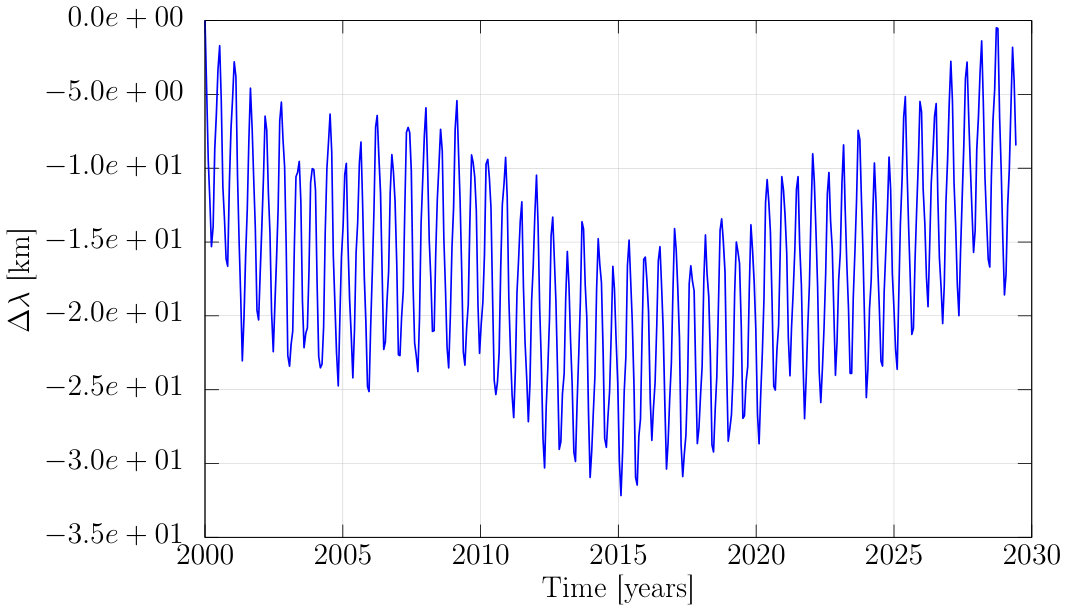 Figure 1
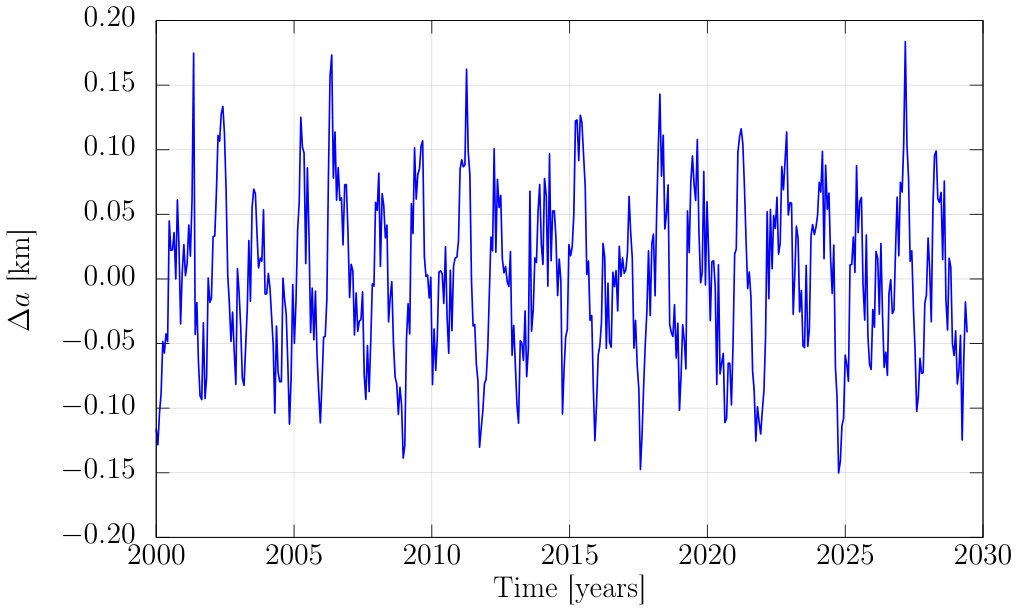 Figure 2
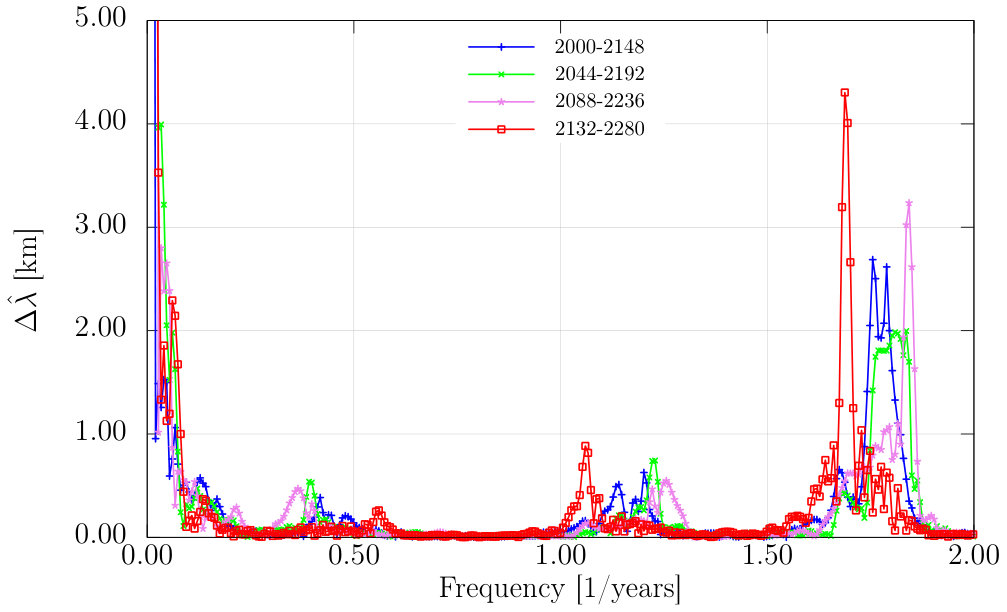 Figure 3
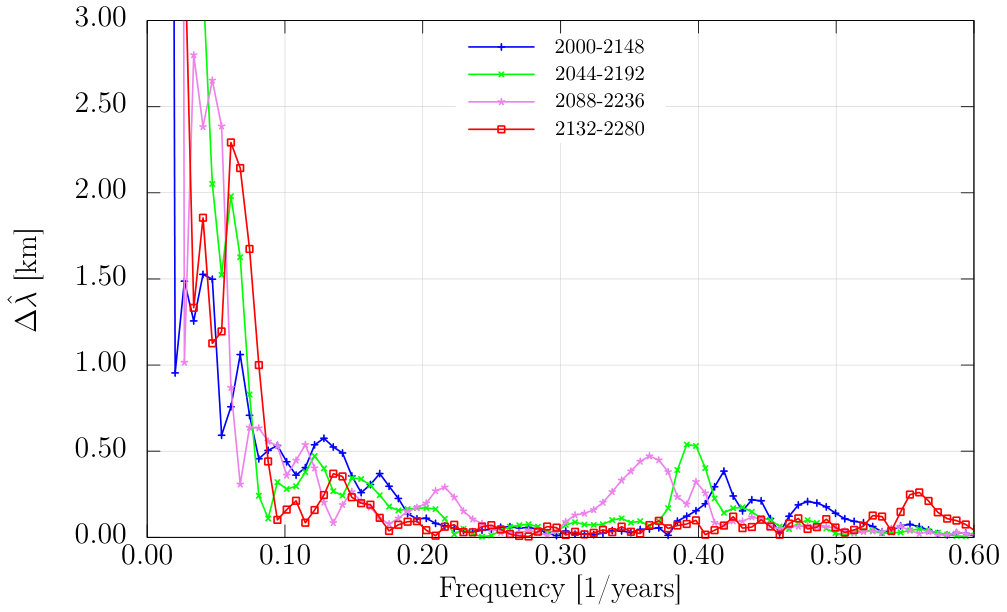 Figure 4
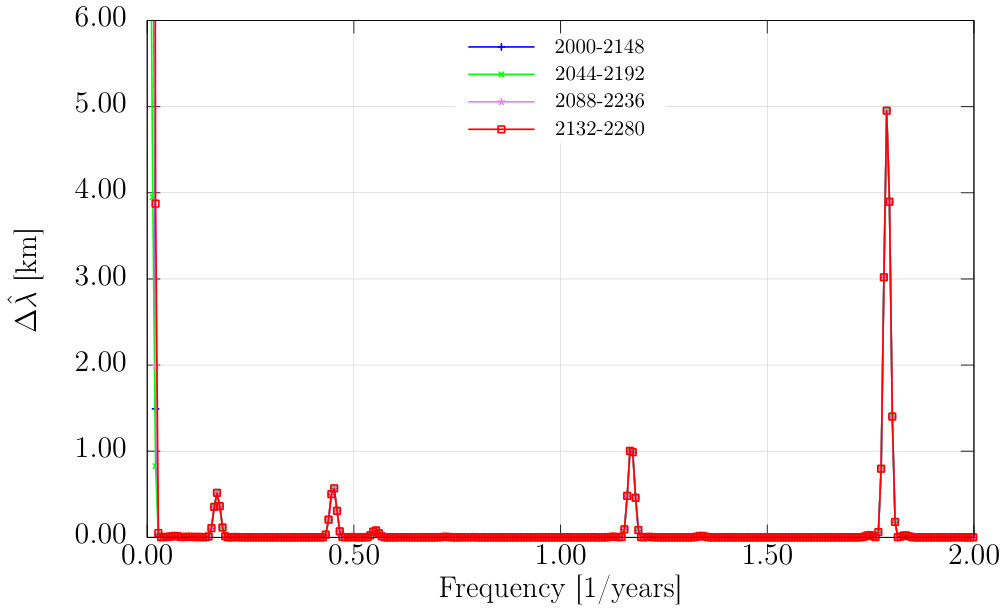 Figure 5
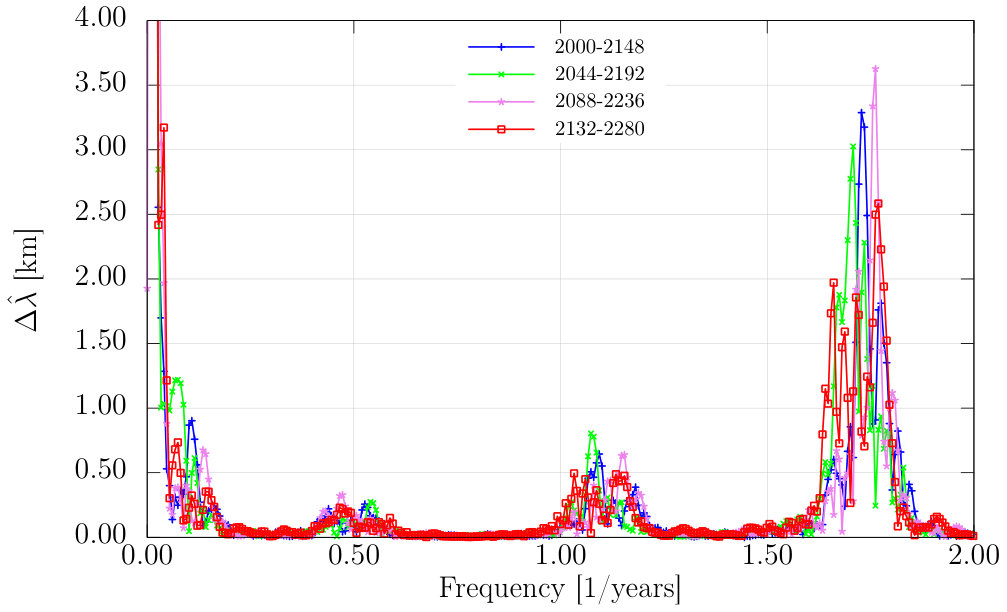 Figure 6
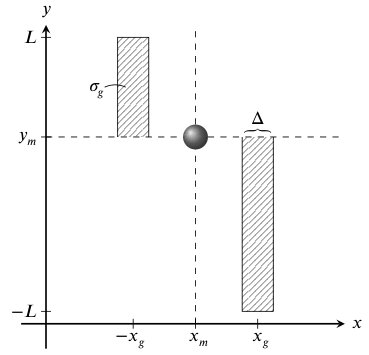 Figure 7
| [years-1] | [years] | [km] | [m s-1] | [m] | Resonance |
|---|---|---|---|---|---|
| 1.7 | 0.6 | 4.6 | 1.5 10-3 | 8 | 14:13 CER Pnd-Ble |
| 1.25 | 0.8 | 1.0 | 2.2 10-4 | 1.2 | 3:16:13 Mim-Pnd-Ble (2) |
| 0.4 | 2.5 | 0.15 | 4.3 10-5 | 0.5 | 3:16:13 Mim-Pnd-Ble (1) |
| 0.07 | 14.3 | 2.3 | 3 10-5 | 0.15 | 3:16:13 Mim-Pnd-Ble (3) |
Peer Reviews
No public reviews on file for this paper yet. If you reviewed it on a platform where reviews are public (OpenReview, ICLR, NeurIPS, ICML), you can paste yours below so the community can read it here.
Videos
No videos yet. Explain this paper in a talk, walkthrough, or lecture? Add one.
A Librational Model for the Propeller Blériot in the
Saturnian Ring System
M. Seiler *, M. Seiß, H. Hoffmann and F. Spahn
Theoretical Physics Group, Institute of Physics and Astronomy, University of Potsdam
Abstract
The reconstruction of the orbital evolution of the propeller structure Blériot orbiting in Saturn’s A ring from recurrent observations in Cassini ISS images yielded a considerable offset motion from the expected Keplerian orbit (Tiscareno et al., 2010). This offset motion can be composed by three sinusoidal harmonics with amplitudes and periods of 1845, 152, 58 km and 11.1, 3.7 and 2.2 years, respectively (Sremčević et al., 2014). In this paper we present results from N-Body simulations, where we integrated the orbital evolution of a moonlet, which is placed at the radial position of Blériot under the gravitational action of the Saturnian satellites. Our simulations yield, that especially the gravitational interactions with Prometheus, Pandora and Mimas is forcing the moonlet to librate with the right frequencies, but the libration-amplitudes are far too small to explain the observations. Thus, further mechanisms are needed to explain the amplitudes of the forced librations – e.g. moonlet-ring interactions. Here, we develop a model, where the moonlet is allowed to be slightly displaced with respect to its created gaps, resulting in a breaking point-symmetry and in a repulsive force. As a result, the evolution of the moonlet’s longitude can be described by a harmonic oscillator. In the presence of external forcings by the outer moons, the libration amplitude gets the more amplified, the more the forcing frequency gets close to the eigenfrequency of the disturbed propeller oscillator. Applying our model to Blériot, it is possible to reproduce a libration period of 13 years with an amplitude of about .
1 Introduction
One of the most puzzling discoveries of the spacecraft Cassini – orbiting around Saturn since its arrival in June 2004 – has been the observation of disk-embedded moons orbiting within Saturn’s main rings (Tiscareno et al., 2006; Spahn and Schmidt, 2006; Sremčević et al., 2007; Tiscareno et al., 2008). The typical density variations downstream the embedded moonlet’s orbit are created by the gravitational interaction of a small sub-kilometer-sized object (called moonlet) with the surrounding ring material and reminds of a two-bladed propeller giving the structure its name (Spahn and Sremčević, 2000; Sremčević et al., 2002). Meanwhile more than 150 propeller structures have been detected within the A and B ring. The largest propeller structure which is a few thousands km in azimuth is called Blériot and is caused by a moonlet with a diameter of around 800 meters. However, the moonlet is still too small to allow its direct observation by the Cameras aboard the spacecraft Cassini.
Nevertheless, the propeller structure permits the observation and orbital tracking of the largest moonlets. The reconstruction of the orbital evolution of Blériot revealed an offset motion with respect to a Keplerian motion of considerable amplitude (Tiscareno et al., 2010). Tiscareno et al. (2010) found, that one possibility to describe the longitudinal excess motion of Blériot is a harmonic function of 300 km and a period of 3.6 years.
It is still an ongoing debate, whether Blériot
- i)
is librating due to gravitational interactions with the other moons in the Saturnian system (resonances),
- ii)
is suffering from stochastical interactions with the surrounding ring material (Rein and Papaloizou, 2010; Tiscareno, 2013),
- iii)
is in a ’frog resonance’ (Pan and Chiang, 2010, 2012),
- iv)
or if it is even perturbed by the combined effects of all the above.
Considering hypothesis (ii), several attempts, have been started in order to explain this excess motion (Pan and Chiang, 2010, 2012; Tiscareno, 2013), where Rein and Papaloizou (2010) delivered an explanation considering a stochastic migration and Pan et al. (2012) showed in N-Body simulations, that such a mechanism could generate an maximal excess motion of 300 km over a time of 4 years.
Another mechanism (iii) has been introduced with a so-called ”frog resonance” model, where Pan and Chiang (2010) consider a resonance between the moonlet and its created gap edges, being modeled as two co-orbital point masses. This interaction is causing the moonlet to librate within its gap. However, the approximation of the gaps as coorbital point masses of almost half of the mass of the moonlet is a strong simplification, which does not reflect the true structure of a propeller.
Meanwhile newer orbital fits of the orbital evolution of Blériot have been performed, tracking and reconstructing the orbit from a larger set of ISS images over a larger time span. The most recent investigation by Sremčević et al. (2014) yielded, that Blériot’s orbital excess motion can be fitted astonishingly well by three harmonic functions with amplitudes and periods of 1845, 152 and 58 km and 11.1, 3.7 and 2.2 years, respectively, where the standard deviation of the remaining residual is about 17 km (see also Spahn et al., 2017).
The harmonic behavior of the excess motion might suggest that resonant interactions with the other Saturnian moons serve as a reason for the excess motion.
Such harmonic systematic deviations from the expected Keplerian orbit are a known phenomenon in the Saturnian system. Some of the outer moons are librating systematically, like the moon Enceladus which is in a 2:1 ILR with Dione and the moon Atlas, which is perturbed by the 54:53 CER and 54:53 ILR by Prometheus (Goldreich, 1965; Goldreich and Rappaport, 2003a, b; Spitale et al., 2006; Cooper et al., 2015).
Following these examples, we perform simulations where the moonlet is perturbed by the moons of Saturn to characterize the orbital motion of Blériot. It will turn out, that this approach can explain the observed frequencies, but not the large libration amplitudes. Thus, we propose a model of ring-moonlet interactions which is capable to explain the amplification of the perturbed excess motion to observable excursions. Favoring hypothesises (i) and (iv) outer gravitational near resonant excitations and ring-moonlet interactions are needed to explain the observations.
The paper is organized as follows: In section 2 we present the N-Body integrations and their results. In section 3 we introduce our model of the moonlet-gap interaction and give a connection to the azimuthal motion in section 3.1, and then apply our model to the moonlet Blériot. Finally, we will conclude and discuss our results in section 4.
2 Test Moonlet Integration
For the numerical integrations we consider the gravity of 15 Saturnian moons of masses and the oblate (up to ) Saturn of mass and radius determining the dynamics of the moonlet
[TABLE]
The considered moons are: Atlas, Daphnis, Dione, Enceladus, Epimetheus, Hyperion, Iapetus, Janus, Mimas, Pan, Pandora, Prometheus, Rhea, Tethys and Titan, where the initial values for the 15 moons were taken from the SPICE kernels sat375.bsp and sat378.bsp at the initial time 2000-001T12:00:00.000.
Next, we apply our N-Body integration routine to the propeller structure Blériot, which we model as a test particle, placed in the Saturnian equatorial plane ( deg) on a circular orbit () at the expected orbital position (initial semi-major axis and mean longitude , private communication Sremčević, 2013, extrapolation of results from ISS images for the initial time given above ).
The numerical deviation of the mean longitude and the semi-major axis of Blériot over a time span of 30 years are shown in the upper panels of Figure 1.
Analyzing the frequency spectrum (see in the lower panels) a clear librational behavior with different frequencies and amplitudes is visible in the residuals of the mean longitude and semi-major axis. The gravity of the acting 15 moons induce a mean eccentricity of and inclination of deg on the test moonlet.
2.1 The Dominating Moons
The amount of moons has been decreased systematically in order to identify the ones, which cause considerable resonant perturbations on Blériot. It turns out, that the satellites Pandora and Mimas are dominating the resonant behavior, resulting in four characteristic peaks in the Fourier spectrum of the mean longitude residual (see Figure 2, left panel).
The most dominating influence is clearly found in the 14:13 corotation-eccentricity resonance (short CER) of Pandora, which is forcing Blériot to librate with a period of 0.6 years with an amplitude of 5 km. A complete list of the important periods, amplitudes and resonances, causing the librations can be found in Table 1.
The presence of Mimas is resulting in a three-body resonance between Mimas, Pandora and Blériot. Mimas and Pandora are known to be in a 3:2 resonance, resulting in a libration period of 1.8 years. Additionally, Pandora is perturbing the orbital evolution of Blériot with its 14:13 resonance. Considering the resonant arguments (Murray and Dermott, 1999) of both resonances (3:2 and 14:13) one can construct related three-body resonances with libration periods of 0.6, 0.8, 2.5 and 14.3 years (compare with Figure 2 and Table 1) by subtracting the corresponding resonant arguments:
[TABLE]
Adding Prometheus, Titan and Tethys, all having influence on the orbital dynamics of Pandora and Mimas, leads to a non-stationary signal in the Fourier spectrum. This could be caused by the chaotic and strong interactions between Prometheus and Pandora resulting in wandering libration frequencies and changing amplitudes in the orbital dynamics of Blériot. Performing long-time simulations for the test moonlet considering a time span of up to 100 Saturnian years, the 42:40 IVR of Prometheus seems to become more and more important forcing the moonlet to librate with a period of about 4 years with a radial amplitude of 20 meters and an amplitude around 1 km in mean longitude. This signal is clearly visible in the Fourier spectrum and stationary in contrast to the other signals.
Although the libration periods of the test moonlet from our simulations agree fairly well with the observational data, the resulting amplitudes are far too small.
3 Moonlet-Propeller Interactions
Next, we will consider the gravitational interaction between the embedded moonlet with its created gap region. Imagine a non-symmetric propeller structure so that the moonlet gets accelerated by the ring gravity. We will show, that the evolution of the related longitudinal residual can be described by a harmonic oscillator. This harmonic oscillator feels a periodic external forcing caused by the gravity of the outer moons. The amplitudes of the external forced frequencies get the more magnified, the closer the forcing frequency matches the eigenfrequency of the harmonic oscillator (propeller-moonlet system).
Consider a moonlet located at () as illustrated in Figure 3. Interacting with the surrounding viscous ring material, the propeller moonlet gravitationally scatters ring particles to larger and smaller orbits creating two gaps in its vicinity in the ring material (regions of reduced surface mass density) and which are decorated by two density enhanced regions pairwise downstream of its orbit (Spahn and Wiebicke, 1989). Viscous diffusion of the ring material counteracts this gap-creation, smoothing out the structure with growing azimuthal distance downstream the moonlet (Spahn and Sremčević, 2000; Sremčević et al., 2002). For simplicity, we assume the gap shape to be a rectangular area with reduced density , illustrated by the shaded regions at and width in Figure 3. The diffusion process defines the length of the gaps, while the width of the propeller-blades is set by the moonlet’s mass or its Hill radius
[TABLE]
and Saturn’s mass is labeled by . We assume that both gaps are anchored at the position following the moonlet’s motion. Further, the ends at and are fixed, because the imprint of the moonlet motion will be averaged out along the azimuth due to the diffusion process and dragged along with the Kepler shear.
In the symmetric case () the torque on the moonlet due to the gravitational interaction with the gap is zero because of point symmetry. When the moonlet is leaving its mean position, the gravitational force of the ring material on the moonlet is
[TABLE]
where and are the surface mass density and the position vectors of the ring material and of the moonlet.
Splitting the integrals, subtracting the unperturbed background density and evaluating the integrals up to first order in and , the azimuthal force acting on the moonlet reads
[TABLE]
where . In the following we assume that the azimuthal excursions of the moonlet are negligibly small compared to the azimuthal extent of the propeller structure (). We also assume that the radial displacement of the moonlet is very small compared to the radial distance of the gaps to the moonlet ().
3.1 Relation to the Azimuthal Libration
The mean motion is given by the change in the mean longitude
[TABLE]
Thus, the change in azimuthal direction of the moonlet is given by the Gaussian perturbation equation
[TABLE]
neglecting higher orders in eccentricity, where we used the relation . Inserting from Eq. (8) results in
[TABLE]
with the libration frequency and the libration period. In this lowest order of the perturbation expansion we arrive at a harmonic oscillator. Here, the eigenfrequency contains the properties of the propeller feature as the lengths and , but also the drop in the surface mass density .
3.2 Application to Blériot
In order to estimate the eigenlibration period for the moonlet, we use values, which have been inspired by theoretical and observational data (Tiscareno et al., 2007; Spahn and Sremčević, 2000).
We can estimate the length of the gaps from the analytical model derived by Sremčević et al. (2002). The relative mass moved out of the gaps along the azimuth is
[TABLE]
which can be obtained from a direct numerical integration. Assuming for the rectangular simplification of the gaps, the gap length is and thus, for Blériot , where the scaling length can be calculated by
[TABLE]
with and denoting the viscosity, the Hill radius and the Kepler frequency. The value of fits to extrapolated values from observations of Tiscareno et al. (2007) and simulations of Daisaka et al. (2001).
Further, the width of the gap .
As a result, we estimate a eigenlibration period of that ring-moonlet harmonic oscillator:
[TABLE]
The Hill radius of the propeller moonlet has a strong influence on the gap length and thus on the libration period. With the libration period is .
If the propeller moonlet is placed in the Saturnian ring system with all the other moons, this harmonic oscillator will be forced with a zoo of frequencies due to the Saturnian moons. When a forcing frequency matches the eigenfrequency close enough, a large gain in the resulting amplitude is possible. For example, if the period of the resonant interaction and the eigenperiod of the oscillator differ by a third of a year, the amplitude is amplified by two orders of magnitude. The closer the forcing frequency is to the eigenfrequency, the larger the resulting amplitudes. Formally, to get to the observed amplitudes, which are about three orders of magnitude larger than the values from Table 1, the difference of the periods has to be smaller than years. The longest period from Table 1 falls well into the uncertainty interval of the estimated libration period , so that our model can indeed induce much larger libration amplitudes.
One should note, that our simple model is generally not fully consistent, because the libration amplitude is not much smaller than the used gap length . Thus, the condition to approximate the force for small amplitudes is easily violated. However, in reality the gap extents for more than several thousand km and is rather a decaying length of the gap if one for example assumes a exponential relaxation of the gap. A more complex model, would remove this inconsistency, but the oscillatory behavior due to the repulsive azimuthal force should persist. We will address such a comprehensive non-linear model in the future.
4 Conclusion and Discussion
In this paper we have presented results of N-Body simulations, which characterize the orbital evolution of the moonlet of the propeller Blériot, being perturbed by the gravitational interactions with 15 outer and inner moons of Saturn. We found, that the 14:13 CER of Pandora and the 3:16:13 three-body resonances of Mimas and Pandora are the dominating perturbations of Blériot’s orbit. Additionally, the chaotic interaction between Pandora and Prometheus has an effect on Blériot’s orbital evolution as well, resulting in changing libration frequencies over time.
Our simulations yielded, that the gravitational interactions with the other moons cause similar libration frequencies of Blériot as concluded from the Cassini ISS images, but the corresponding amplitudes are too small. Considering propeller-moonlet interactions with a new model, we have been able to find a mechanism to amplify certain modes in form of a harmonic oscillator which is periodically driven by an external forcing.
The Eigenfrequency of this oscillating system contains key-properties of the propeller structure. In the presence of an external forcing, this oscillating system amplifies the induced forced oscillations by the outer satellites up to several orders of magnitude. The closer the forcing frequency is to the eigenfrequency the stronger the amplification can be. Applying our moonlet-propeller-gap interaction model to Blériot, reasonable results have been obtained for the libration period, which fit the observations fairly well. Combining our model with the simulation results, we are able to reproduce the largest observed mode for the libration of Blériot. The smaller observed modes are not reproduced, but may evolve if one regards processes of non-linear mode coupling in our model, which we did not consider yet.
Even this first simplifying theoretical investigation demonstrates, that outer gravitational perturbations in combination with ring-moonlet interactions are necessary to address the propeller-moonlet migration problem.
In order to verify our results, we plan to incorporate our model into hydrodynamical simulations in the future. Additionally, we want to add higher order terms in the evaluation, i.e. nonlinear terms, in order to study mode coupling effects.
Besides the improvements on the propeller model, we also plan to apply our N-Body integrations to the other propeller structures located in the outer A ring.
The reference list from the paper itself. Each links out to its DOI / PubMed record.
- 1Cooper et al. (2015) Cooper, N. J., Renner, S., Murray, C. D., Evans, M. W., Jan. 2015. Saturn#700s Inner Satellites: Orbits, Masses, and the Chaotic Motion of Atlas from New Cassini Imaging Observations. Astronomical Journal 149, 27.
- 2Daisaka et al. (2001) Daisaka, H., Tanaka, H., Ida, S., Dec. 2001. Viscosity in a Dense Planetary Ring with Self-Gravitating Particles. Icarus 154, 296–312.
- 3Goldreich (1965) Goldreich, P., 1965. An explanation of the frequent occurrence of commensurable mean motions in the solar system. Monthly Notices Royal Astron. Soc. 130, 159.
- 4Goldreich and Rappaport (2003 a) Goldreich, P., Rappaport, N., Apr. 2003 a. Chaotic motions of prometheus and pandora. Icarus 162, 391–399.
- 5Goldreich and Rappaport (2003 b) Goldreich, P., Rappaport, N., Dec. 2003 b. Origin of chaos in the Prometheus-Pandora system. Icarus 166, 320–327.
- 6Murray and Dermott (1999) Murray, C. D., Dermott, S. F., 1999. Solar system dynamics.
- 7Pan and Chiang (2010) Pan, M., Chiang, E., Oct. 2010. The Propeller and the Frog. Astrophysical Journal Letters 722, L 178–L 182.
- 8Pan and Chiang (2012) Pan, M., Chiang, E., Jan. 2012. Care and Feeding of Frogs. Astronomical Journal 143, 9.