A New Proposal for Holographic BCFT
Rong-Xin Miao, Chong-Sun Chu, Wu-Zhong Guo

TL;DR
This paper introduces a new holographic dual for BCFTs that applies to general boundaries, reproduces expected anomalies, and reveals boundary-dependent entanglement entropy with phase transitions.
Contribution
It proposes a novel AdS/BCFT framework applicable to general boundaries, extending previous models and analyzing entanglement entropy and phase transitions.
Findings
Successfully reproduces boundary Weyl anomaly
Boundary central charges satisfy a c-like theorem holographically
Entanglement entropy depends on boundary conditions and exhibits phase transitions
Abstract
We propose a new holographic dual of conformal field theory defined on a manifold with boundaries, i.e. BCFT. Our proposal can apply to general boundaries and agrees with arXiv:1105.5165 for the special case of a disk and half plane. Using the new proposal of AdS/BCFT, we successfully obtain the expected boundary Weyl anomaly and the obtained boundary central charges satisfy naturally a c-like theorem holographically. We also investigate the holographic entanglement entropy of BCFT and find that the minimal surface must be normal to the bulk spacetime boundaries when they intersect. Interestingly,the entanglement entropy depends on the boundary conditions of BCFT and the distance to the boundary. The entanglement wedge has an interesting phase transition which is important for the self-consistency of AdS/BCFT.
Click any figure to enlarge with its caption.
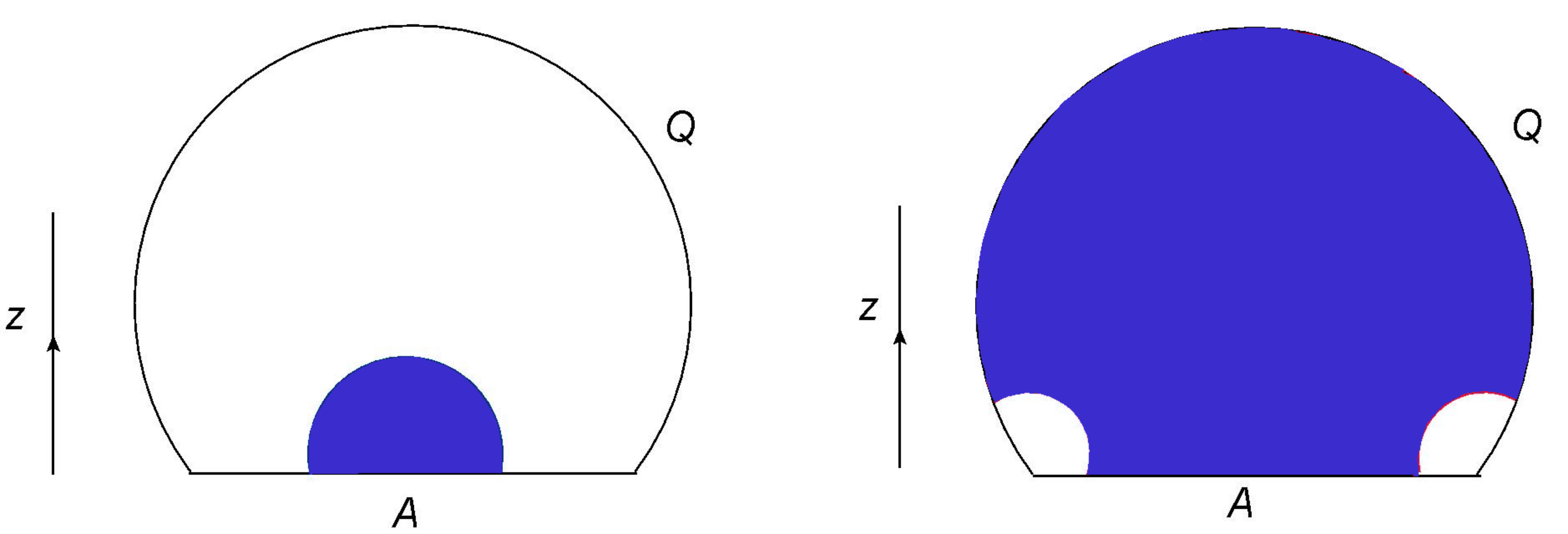 Figure 1
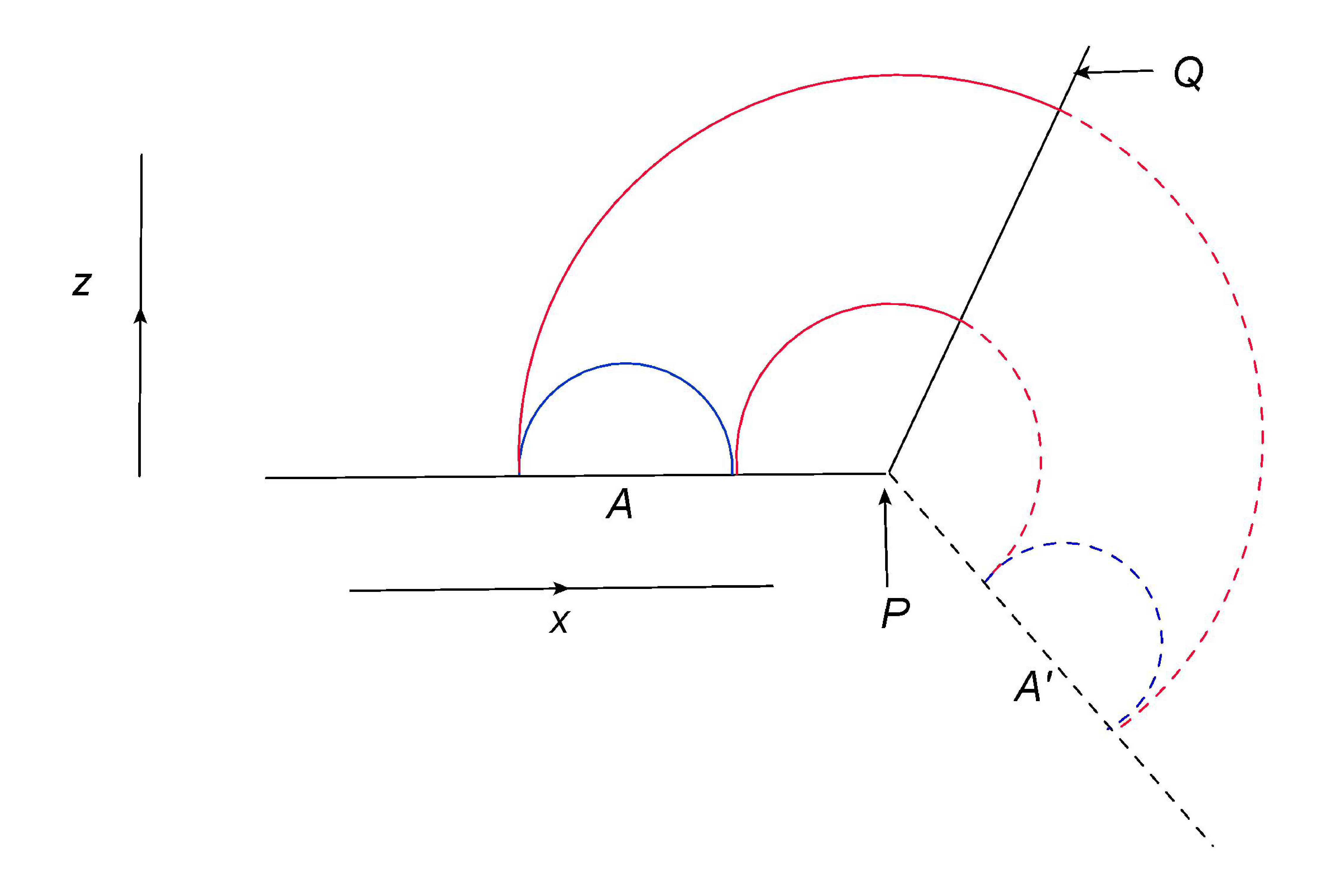 Figure 2
Peer Reviews
No public reviews on file for this paper yet. If you reviewed it on a platform where reviews are public (OpenReview, ICLR, NeurIPS, ICML), you can paste yours below so the community can read it here.
Videos
No videos yet. Explain this paper in a talk, walkthrough, or lecture? Add one.
NCTS-TH/1701
A New Proposal for Holographic BCFT
Rong-Xin Miao1
Chong-Sun Chu1,2
Wu-Zhong Guo2
1 Department of Physics, National Tsing-Hua University, Hsinchu 30013, Taiwan
2 National Center for Theoretical Sciences, National Tsing-Hua University, Hsinchu 30013, Taiwan
(January 16, 2017)
Abstract
We propose a new holographic dual of conformal field theory defined on a manifold with boundaries, i.e. BCFT. Our proposal can apply to general boundaries and agrees with arXiv: 1105.5165 for the special case of a disk and half plane. Using the new proposal of AdS/BCFT, we successfully obtain the expected boundary Weyl anomaly and the obtained boundary central charges satisfy naturally a c-like theorem holographically. We also investigate the holographic entanglement entropy of BCFT and find that the minimal surface must be normal to the bulk spacetime boundaries when they intersect. Interestingly, the entanglement entropy depends on the boundary conditions of BCFT and the distance to the boundary. The entanglement wedge has an interesting phase transition which is important for the self-consistency of AdS/BCFT.
I Introduction
BCFT (Boundary Conformal Field Theory) is a CFT defined on a manifold with a boundary , and with suitable boundary conditions imposed. It has important applications in string theory and condensed matter physics, e.g. boundary critical behaviorCardy:2004hm . The AdS/CFT correspondence Maldacena:1997re ; adscft is a concrete realization of holography. The duality has not only opened door to previously intractable problems in strongly coupled nonperturbative problems in quantum field theories (QFT), but has also offered many useful insights into the fundamental properties of quantum gravity. In this regard, it is interesting to extend the AdS/CFT correspondence to BCFT in order to get new handles to tackle some of the difficult problems in BCFT. The presence of boundary in the QFT will also offer new twists in the realization of the AdS/CFT correspondence, and should lead to a deeper understanding of the holographic principle.
Recently, Takayanagi Takayanagi:2011zk proposed to extend the dimensional manifold to a dimensional asymptotically AdS space so that , where is a dimensional manifold which satisfies . The gravitational action for holographic BCFT is Takayanagi:2011zk ; Nozaki:2012qd
[TABLE]
where is the supplementary angle between the boundaries and , and it is needed for a well-defined variational principle for the joint Hayward:1993my . We have taken . Note that here we have allowed in the action a constant term on . can be regarded as the holographic dual of boundary conditions of BCFT since it affects the boundary entropy (and also the boundary central charges, see (17,18) below) which are closely related to the boundary conditions (BC) Takayanagi:2011zk ; Nozaki:2012qd .
A central issue in the construction of the AdS/BCFT is the determination of the location of in the bulk. Imposing Dirichlet BC on and : , we get the variation of the on-shell action
[TABLE]
Interestingly, Takayanagi Takayanagi:2011zk proposed to impose Neumann BC on :
[TABLE]
to fix the position of . For more general boundary conditions which break boundary conformal invariance, Takayanagi:2011zk proposed to add matter fields on and replace eq.(3) by
[TABLE]
where we have included in the matter stress tensor . For geometrical shape of with high symmetry such as the case of a disk or half plane, (3) fixes the location of and produces many elegant results for BCFT Takayanagi:2011zk ; Nozaki:2012qd ; Fujita:2011fp . However since is of co-dimension one and its shape is determined by a single embedding function, (3) gives too many constraints and there is no solution in a given metric such as generally. On the other hand, of course, there should exist well-defined BCFT with general boundaries. As motivated in Takayanagi:2011zk ; Nozaki:2012qd , (3) and (4) are natural from the viewpoint of braneworld scenario. However from a practical point of view, it is not entirely satisfactory since one has a large freedom to choose the matter fields as long as they satisfy various energy conditions. As a result, it seems one can put the boundary at almost any position as one likes. Besides, it is unappealing that the holographic dual depends on the details of matters on . Finally, although eq.(4) could have solutions by tuning the matters, it is actually too strong since one can show that parallelpaper it always makes vanishing some of the central charges in the boundary Weyl anomaly. In this letter, we propose a new holographic dual of BCFT with determined by a new condition (8). This condition is consistent and provides a unified treatment to general shapes of . Besides, as we will show below, it yields the expected boundary contributions to Weyl anomaly.
II New Proposal for Holographic BCFT
Instead of imposing the Neumann BC (3), we propose to impose on the mixed BCs, and
[TABLE]
Here are projection operators satisfying and . Since we could impose at most one condition to fix the location of the co-dimension one surface , we require to be of the form . then implies . The mixed boundary condition (5) becomes
[TABLE]
where are to be determined. It is natural to require that eq. (6) to be linear in so that it is a second order differential equation for the embedding. In this paper we propose the choice . We will show below that there are problems with the other choices such as
[TABLE]
To sum up, we propose to use the traceless condition
[TABLE]
to determine the boundary . Here is the Brown-York stress tensor on . In general, it could also depend on the intrinsic curvatures which we will treat in the paper parallelpaper . A few remarks on (8) are in order. 1. It is worth noting that the junction condition for a thin shell with spacetime on both sides is also given by (4) Hayward:1993my . However, here is the boundary of spacetime and not a thin shell, so there is no need to consider the junction condition. 2. For the same reason, it is expected that has no back-reaction on the geometry just as the boundary . 3. Eq. (8) implies that is a constant mean curvature surface, which is also of great interests in both mathematics and physics just as the minimal surface. 4. (8) reduces to the proposal by Takayanagi:2011zk for a disk and half-plane. And it can reproduce all the results in Takayanagi:2011zk ; Nozaki:2012qd ; Fujita:2011fp . 5. Eq. (8) is a purely geometric equation and has solutions for arbitrary shapes of boundaries and arbitrary bulk metrics. 6. Very importantly, our proposal gives non-trivial boundary Weyl anomaly, which solves the difficulty met in Takayanagi:2011zk ; Nozaki:2012qd . In fact one can show that parallelpaper the proposal (4) is too restrictive and always yields in (9,10) parallelpaper .
Let us recall that in the presence of boundary, Weyl anomaly of CFT generally pick up a boundary contribution in addition to the usual bulk term , i.e. , where is a delta function with support on the boundary . Our proposal yields the expected boundary Weyl anomaly for 3d and 4d BCFT Herzog:2015ioa ; Fursaev:2015wpa ; Solodukhin:2015eca :
[TABLE]
where are boundary central charges, is the bulk central charge for 4d CFTs dual to Einstein gravity. and are the intrinsic curvature and the traceless part of the extrinsic curvature of , is the pull back of the Weyl tensor of to , and
[TABLE]
is the boundary terms of the Euler density in order to preserve the topological invariance. Since is not a minimal surface in our case, our results (17,18) are non-trivial generalizations of the Graham-Witten anomaly Graham:1999pm for the submanifold.
III Holographic Boundary Weyl Anomaly
Action method. Applying the method of Henningson:1998gx , one can derive the Weyl anomaly (including the boundary Weyl anomaly Nozaki:2012qd ) as the logarithmic divergent term of the gravitational action. For our purpose, we focus only on the boundary contributions to Weyl anomaly below.
Consider the asymptotically AdS metric in the Fefferman-Graham gauge
[TABLE]
where , is the metric of BCFT on , can be fixed by the PBH (Penrose-Brown-Henneaux) transformation Imbimbo:1999bj
[TABLE]
Note that the curvatures in our notation differ from those of Imbimbo:1999bj by a minus sign. Without loss of generality, we choose the Gauss normal coordinates for the metric :
[TABLE]
where is located at and are the coordinates along . The bulk boundary is given by . Expanding it in ,
[TABLE]
where the coefficients ’s and ’s are functions of . Substituting eqs.(12- 15) into the boundary condition eq.(8), we obtain that
[TABLE]
where we have re-parametrized the constant . It is worth noting that the other choices (7) of gives the same but different . In other words, the results (16) are independent of the choices of in the boundary condition (6) parallelpaper . In fact since , one obtains from (6) that as long as . This gives the first two terms in (16). As for the coefficient , according to Schwimmer:2008yh , the embedding function eq.(15) is highly constrained by the asymptotic symmetry of AdS, and it can be fixed by PBH transformations up to some conformal tensors. Adapting the method of Schwimmer:2008yh to the present case, one can indeed prove the universality of in the Gauss normal coordinates parallelpaper . In this way, we obtain , which agrees with the result obtained in Schwimmer:2008yh for the special case of .
Now we are ready to derive the boundary Weyl anomaly. For simplicity, we focus on the case of 3d BCFT and 4d BCFT. Substituting eqs.(12-16) into the action (1) and selecting the logarithmic divergent terms after the integral along and , we can obtain the boundary Weyl anomaly. We note that and do not contribute to the logarithmic divergent term in the action since they have at most singularities in powers of but there is no integration alone , thus there is no way for them to produce terms. We also note that only appears in the final results. The terms including and automatically cancel each other out. This is also the case for the holographic Weyl anomaly and universal terms of entanglement entropy for 4d and 6d CFTs Miao:2013nfa ; Miao:2015iba . After some calculations, we obtain the boundary Weyl anomaly for 3d and 4d BCFT as
[TABLE]
which takes the expected form (9), (10). It is remarkable that the coefficient of takes the correct value to preserve the topological invariance of . This is a non-trivial check of our results. Besides, the boundary charges in (9, 10) are expected to satisfy a c-like theorem Nozaki:2012qd ; Jensen:2015swa ; Huang:2016rol . As was shown in Takayanagi:2011zk ; Fujita:2011fp , null energy condition on implies decreases along RG flow. It is also true for us. As a result, eqs.(17, 18) indeed obey the c-theorem for boundary charges. This is also a support for our results. Most importantly, our confidence is based on the above universal derivations, i.e., we do not make any assumption about in the boundary condition (6).
We remark that based on the results of free CFTs Fursaev:2015wpa and the variational principle, it has been suggested that the coefficient of in (18) is universal for all 4d BCFTs Solodukhin:2015eca . Here we provide evidence, based on holography, against this suggestion: our results agree with the suggestion of Solodukhin:2015eca for the trivial case , while disagree generally. As argued in Huang:2016rol , the proposal of Solodukhin:2015eca is suspicious. It means that there could be no independent boundary central charge related to the Weyl invariant . However, in general, every Weyl invariant should correspond to an independent central charge, such as the case for 2d, 4d and 6d CFTs. Besides, we notice that the law obeyed by free CFTs usually does not apply to strongly coupled CFTs. See Dong:2016wcf ; Lee:2014zaa ; Hung:2014npa ; Chu:2016tps for examples.
In this subsection, we have proved that, by using the method of Henningson:1998gx , all the possible boundaries allowed by (6) produce the same boundary Weyl anomaly for 3d and 4d BCFT. Thus this method cannot distinguish the proposal (8) from the other choices (7).
Stress-tensor method. To resolve the above ambiguity, let us use the holographic stress tensor Balasubramanian:1999re to study the boundary Weyl anomaly as this method needs the information of which can distinguish different choices of boundary conditions (6). For simplicity, we focus on the case of 3d BCFT.
The first step of method Balasubramanian:1999re is to find a finite action by adding suitable covariant counterterms. We obtain
[TABLE]
where we have included on the usual counterterms in holographic renormalization Balasubramanian:1999re ; deHaro:2000vlm , is a constant Nozaki:2012qd and , the extrinsic curvature of , is the Gibbons-Hawking-York term for on . Notice that there is no freedom to add other counterterms, except for some finite terms which are irrelevant to Weyl anomaly. For example, we may add terms like and to . However, these terms are invariant under constant Weyl transformations. Thus they do not contribute to the boundary Weyl Anomaly. In conclusion, the renormalized action (19) is unique up to some irrelevant finite counterterms.
From the renormalized action, it is straightly to derive the Brown-York stress tensor on
[TABLE]
In the sprint of Nozaki:2012qd ; Balasubramanian:1999re ; deHaro:2000vlm , the boundary Weyl anomaly is given by
[TABLE]
where , and . Substituting eqs.(12-16) into (21), we get
[TABLE]
where is the trace of . This gives the correct boundary Weyl anomaly (17) if and only if
[TABLE]
which is just the solution to our proposed boundary condition (8). One can check that the other choices (7) give different and thus can be excluded. Following the same approach, we can also derive the boundary Weyl anomaly for 4d BCFT parallelpaper , which agrees with the correct result (18) iff and are given by the solutions to eq.(8). This is a very strong support to the boundary condition (8) we proposed.
IV Holographic Entanglement Entropy
Following Ryu:2006bv ; Lewkowycz:2013nqa , it is not difficult to derive the holographic entanglement entropy for BCFT, which is also given by the area of minimal surface
[TABLE]
where is a subsystem on , and denotes the minimal surface which ends on . What is new for BCFT is that the minimal surface could also end on the bulk boundary , when the subsystem is close to the boundary . See Fig.1 for example.
We could keep the endpoints of extreme surfaces freely on , and select the one with minimal area as . It follows that is orthogonal to the boundary when they intersect
[TABLE]
Here is the normal vector of and are the two independent normal vectors of . Another way to see this is that, otherwise there will arise problems in the holographic derivations of entanglement entropy by using the replica trick. In the replica method, one considers the -fold cover of and then extends it to the bulk as . It is important that is a smooth bulk solution. As a result, Einstein equation should be smooth on surface . Now the metric near is given by Lewkowycz:2013nqa
[TABLE]
where , is coordinate normal to the surface, is the Euclidean time, are coordinates along the surface, and are the two extrinsic curvature tensors. Going to complex coordinates , the component of Einstein equations
[TABLE]
is divergent unless the trace of extrinsic curvatures vanish . This gives the condition for a minimal surface Lewkowycz:2013nqa . Labeling the boundary by , we obtain the extrinsic curvature of as
[TABLE]
So the boundary condition (8) is smooth only if , which is exactly the orthogonal condition (25). As a summary, the holographic entanglement entropy for BCFT is given by RT formula (24) together with the orthogonal condition (25).
V Boundary Effects on Entanglement
Let us take a simple example to illustrate the boundary effects on entanglement entropy. Consider Poincare metric of , where is at . For simplicity, we focus on below. Solving eq.(8) for , we get . We choose as an interval with two endpoints at and . Due to the presence of boundary, there are now two kinds of minimal surfaces, one ends on and the other one does not. It depends on the distance that which one has smaller area. From eqs.(24,25), we obtain
[TABLE]
where is the critical distance and the parameter can be regarded as the holographic dual of the boundary condition of BCFT. It is remarkable that entanglement entropy (28) depends on the distance and boundary condition when it is close enough to the boundary. This behavior is expected from the viewpoint of BCFT since it has also been found that the correlation functions depend on the distance to the boundary McAvity:1993ue .
To extract the effects of boundary on the entanglement entropy, let us define the following quantity when does not intersect the boundary :
[TABLE]
The complementary situation where the entangling surface intersects the boundary is discussed in Takayanagi:2011zk . Here in (29) is the entanglement entropy when the boundary disappears or is at infinity. In the holographic language, it is given by the area of minimal surface that does not end on . Thus, is equal to or bigger than and is always non-negative. It is expected that boundary does not affect the divergent parts of entanglement entropy when , so all the divergence cancel in eq.(29). As a result, is not only non-negative but also finite. Physically, measures the decrease in the entanglement of the subsystem with the environment when a boundary is introduced. For the example discussed above, we find
[TABLE]
which is indeed both non-negative and finite. Note that depends both on the distance from the boundary and the boundary condition when , but becomes independent of them when . This represents some kind of phase transition. It is also intriguing to note that, in this simple example, is just one half of the mutual information between and its mirror image , so it must be non-negative and finite. See Fig1 for example.
VI Entanglement Wedge
According to Jafferis:2015del ; Dong:2016eik , a sub-region on the AdS boundary is dual to an entanglement wedge in the bulk where all the bulk operators within can be reconstructed by using only the operators of . The entanglement wedge is defined as the bulk domain of dependence of any achronal bulk surface between the minimal surface and the subsystem .
It is interesting to study the entanglement wedge in AdS/BCFT. For simplicity, let us focus on the static spacetime and constant time slice. A key observation is that entanglement wedge behaves a phase transition and becomes much larger than that within AdS/CFT, when is increasing and approaching to the boundary. See Fig.2 for example. This phase transition is important for the self-consistency of holographic BCFT. If there is no phase transition, then is always given by the first kind ( left hand side of Fig.2). When fills with the whole boundary and , there are still large space left outside the entanglement wedge, which means there are operators in the bulk cannot be reconstructed by all the operators on the boundary. Thanks to the phase transition, for large A is given by the second kind ( right hand side of Fig.2). As a result all the bulk operators can be reconstructed by using the boundary operators.
VII Conclusions and Discussions
In this letter, we propose a new holographic dual of BCFT, which can accommodate all possible shapes of the boundary in a unified prescription. The key idea is to impose the mixed boundary condition (8) so that there is only one constraint for the co-dimension one boundary . In general there could be more than one self-consistent boundary conditions for a theory Song:2016pwx , so the proposals of Takayanagi:2011zk and ours have no contradiction in principle. However, the proposal of Takayanagi:2011zk is too restrictive to include the general BCFT. The main advantage of our proposal is that we can deal with all shapes of the boundary easily. It is appealing that the bulk boundary is given by a constant mean curvature surface, which is a natural generalization of the minimal surface.
Applying the new AdS/BCFT, we obtain the expected boundary Weyl anomaly and the obtained boundary central charges satisfy naturally a c-like theorem holographically. As a by-product, we give a holographic disproof of the proposal Solodukhin:2015eca and clarify that the validity of the conjecture Herzog:2016kno based on Solodukhin:2015eca sensitively depends on the boundary conditions of non-free BCFT. Besides, we find the holographic entanglement entropy is given by the RT formula together with the condition that the minimal surface must be orthogonal to if they intersect. The presence of boundaries lead to many interesting effects, e.g. phase transition of the entanglement wedge. Of course, many things are left to be explored, for instance, the edge modes Donnelly:2014fua ; Huang:2014pfa , the shape dependence of entanglement Bueno:2015rda ; Mezei:2014zla , the applications to condensed matter and the relation between BCFT and quantum information Numasawa:2016emc . Finally, it is straightforward to generalize our work to Lovelock gravity, higher dimensions and general boundary conditions.
Acknowledgements
We would like to thank X. Dong, L.Y. Hung and F.L. Lin for useful discussions and comments. This work is supported in part by the National Center of Theoretical Science (NCTS) and the grant MOST 105-2811-M-007-021 of the Ministry of Science and Technology of Taiwan.
The reference list from the paper itself. Each links out to its DOI / PubMed record.
- 1(1) J. L. Cardy, hep-th/0411189.
- 2(2) J. M. Maldacena, Int. J. Theor. Phys. 38 , 1113 (1999) [Adv. Theor. Math. Phys. 2 , 231 (1998)] [hep-th/9711200].
- 3(3) E. Witten, Adv. Theor. Math. Phys. 2 (1998) 253 [hep-th/9802150]. S. S. Gubser, I. R. Klebanov and A. M. Polyakov, Phys. Lett. B 428 (1998) 105 doi:10.1016/S 0370-2693(98)00377-3 [hep-th/9802109].
- 4(4) T. Takayanagi, Phys. Rev. Lett. 107 (2011) 101602 [ar Xiv:1105.5165 [hep-th]].
- 5(5) M. Nozaki, T. Takayanagi and T. Ugajin, JHEP 1206 (2012) 066 [ar Xiv:1205.1573 [hep-th]].
- 6(6) G. Hayward, Phys. Rev. D 47 (1993) 3275.
- 7(7) M. Fujita, T. Takayanagi and E. Tonni, JHEP 1111 (2011) 043 [ar Xiv:1108.5152 [hep-th]].
- 8(8) Please see the companion paper for the proof of the universality of a 2 subscript 𝑎 2 a_{2} by using the PBH transformations and the details of holographic renormalization for 4d BCFT, where the boundary Weyl anomaly is derived.