About the efficient reduction of lambda terms
Andrea Asperti

TL;DR
This paper investigates the efficiency of sharing strategies in lambda calculus, aiming to clarify misconceptions about optimal sharing and its impact on computational performance.
Contribution
It provides a clearer understanding of what constitutes optimal sharing in lambda calculus and analyzes its actual efficiency.
Findings
Clarifies misconceptions about optimal sharing
Analyzes efficiency of sharing strategies
Provides insights into lambda calculus optimization
Abstract
There is still a lot of confusion about "optimal" sharing in the lambda calculus, and its actual efficiency. In this article, we shall try to clarify some of these issues.
Click any figure to enlarge with its caption.
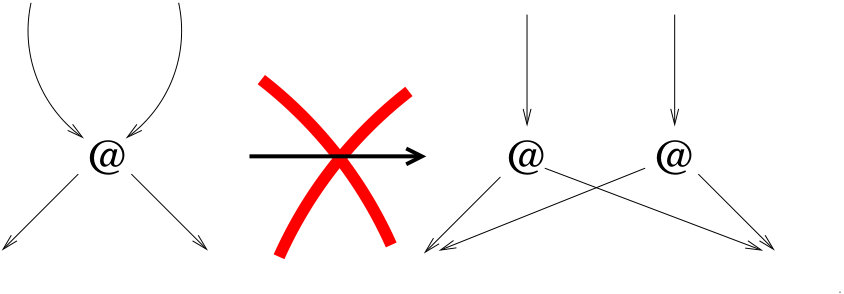 Figure 1
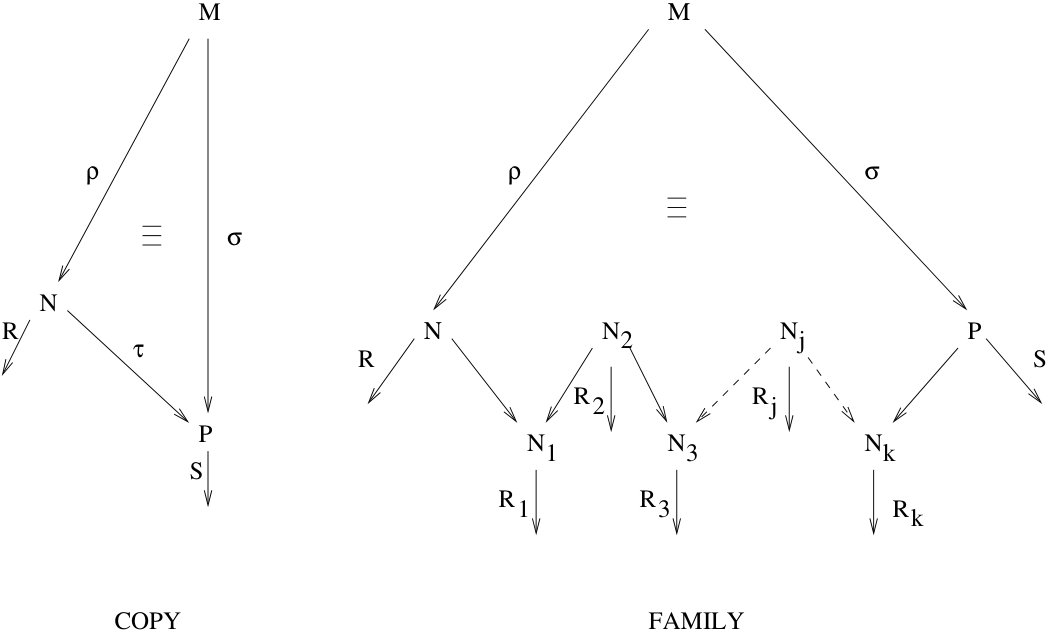 Figure 2
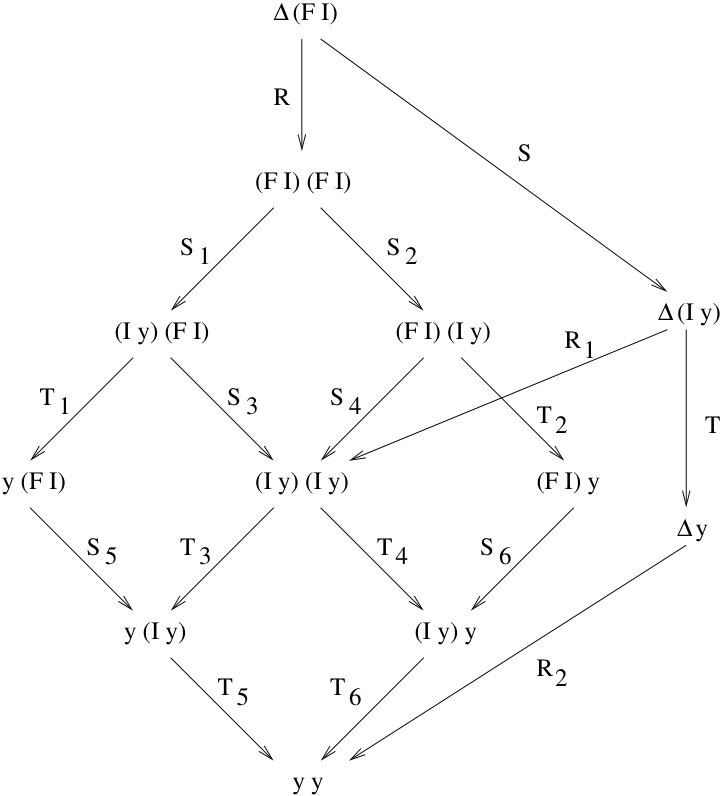 Figure 3
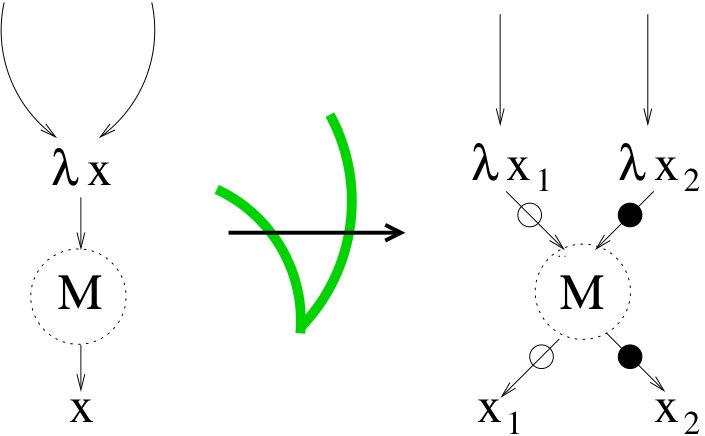 Figure 4
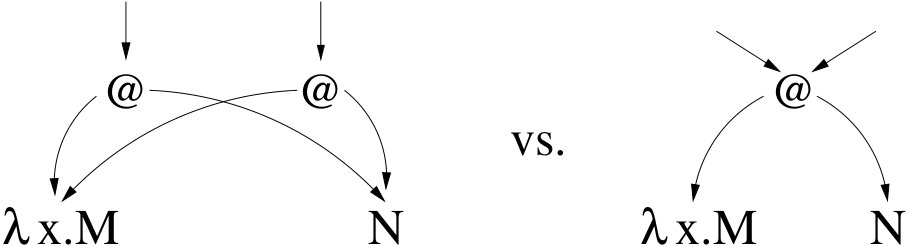 Figure 5
Peer Reviews
No public reviews on file for this paper yet. If you reviewed it on a platform where reviews are public (OpenReview, ICLR, NeurIPS, ICML), you can paste yours below so the community can read it here.
Videos
No videos yet. Explain this paper in a talk, walkthrough, or lecture? Add one.
About the efficient reduction of lambda terms
Andrea Asperti
DISI: Dipartimento di Informatica - Scienza e Ingegneria
Mura Anteo Zamboni 7
40127
Bologna
Italy
Abstract
There is still a lot of confusion about “optimal” sharing in the lambda calculus, and its actual efficiency. In this article, we shall try to clarify some of these issues.
category:
Theory of computation Lambda calculus
category:
Theory of computation Abstract machines
category:
Theory of computation Equational logic and rewriting
category:
Software and its engineering Functional languages
1 Introduction
In relation to rewriting techniques, sharing is the ability to avoid duplication of reduction work, due to duplication of subterms. The issue is relatively trivial at first order, but it becomes much more entangled as soon as we pass to a higher order framework, for which the lambda calculus provides a paradigmatic example.
Consider the well known beta rule
[TABLE]
If the argument gets duplicated and it contains a reducible expression, its reduction will be duplicated too.
It may seem that an eager strategy (possibly delayed “on demand”, as in the “call by need” strategy) could solve the job. Unfortunately, this is not the case.
Let us consider first the case of weak frameworks. In this case, functions are treated as values and reduction is never pursued under a -abstraction. So, if the argument is a lambda expression containing a redex , and is duplicated, the reduction of will be repeated in each instance. A typical situation is when the argument is obtained as a partial instantiation of some functional . To make things very simple, let us suppose (the Church integer) and let us instantiate it with the identity
[TABLE]
that is a weak normal form. If gets duplicated, the two internal applications of the identity will be duplicated too.
This may have very nasty effects. Consider the following weak reduction
[TABLE]
where we renamed variables for the sake of readability. We have just doubled the number of internal applications of the identity! If we start with applications of
[TABLE]
we end up with a term containing applications of the identity and all of them will need to be reduced when the term will be feed with an extra argument (e.g. an additional identity).
We warmly invite the readers to write and evaluate the term
[TABLE]
(where and are Church integers) in their favorite (weak) functional programming language, and observe the exponential explosion of the complexity when grows (no matter if the language is lazy or strict, or if it adopts combinators or closures). On the other side, innermost reduction of the previous term is just linear in .
So, is rightmost innermost reduction the correct solution? Of course, not. As a trivial example, consider the term
[TABLE]
Rightmost innermost reduction would start normalizing that is the Church integer for and has exponential dimension, hence the whole reduction would be exponential too.
What happens in (the innermost reduction of) example is that the term inside of example is replaced by a local variable, postponing the instantiation with the identity to a later stage. That is to say, that is not the duplication of redexes that matters, but the unnecessary, blind duplication of applications. For instance, with environment machine, any time we open a closure and the internal code contains an application, we are possibly duplicating reduction work.
But applications and lambda abstractions are just dual operators, so is the duplication of lambda abstractions dangerous too, from the point of view of sharing?
In principle, no, it is not. The point is that if the abstraction node is shared, there are already two (or more) different calls to the function, that will give rise to different redexes. The big challenge, however, is to duplicate the abstraction node without jointly duplicating the whole body of the function (that could contain applications). The really delicate part is to understand what happens at the level of variables, since they can now be bound by one or the other of the two abstractions, requiring some form of “unsharing” (see Figure 2).
The correct management of sharing and unsharing is not trivial. It was solved for the first time by Lamping [Lamping (1990)], and later revised and improved by many other people. One usually refer to this part of the algorithm as “bookkeeping” work, to distinguish it from duplication work and the actual firing of -redexes.
Let us also observe that, in the terminology of interaction nets [Lafont (1990)], the different behavior between the duplication of applications and lambda abstractions resides in the fact that in the latter case (Figure 2) duplication is requested at the principal port of the node, while in the case of the application (Figure 1), it is requested at an auxiliary port.
2 Reduction by families
Lévy developed the theory of optimality long before an implementation for it was available (in fact, the problem remained open for quite a long time). The precise definition of optimal sharing is not simple, and we shall postpone it for a moment. Two redexes that are sharable according to Lévy are said to belong to a same family, and optimal reduction is simulated on lambda terms by firing “in parallel” all redexes in a same family. Family reduction has very nice properties: the most interesting one is that it satisfies a one-step diamond property. As a consequence, as far as we reduce needed redexes, the length of a normalizing reduction (if it exists) does not depend on the strategy. This fact supported the conjecture that family reduction could provide an interesting measure of the “intrinsic complexity” of lambda terms, i.e. the cost required to compute the normal form of a lambda term independently from the reduction technique.
Before addressing this issue, let us consider a different, simple reduction technique: parallel -reduction in Takahashi’s sense [Takahashi (1995)], that allows us to fire in parallel (in a single step) all redexes in a given term. Clearly, this is a superoptimal reduction technique: all redexes in a Lévy’s family are parallel in Takahashi’s sense, but non all parallel redexes eventually belong to a same family (that is, not all of them are sharable).
The potential parallelism inherent in -terms can be very easily understood by restricting the attention to the simply typed case (the following argument was spelled out for the first time in the appendix to [Asperti and Lévy (2013)]).
Working with simple types, it is traditional to define a notion of degree of a redex in the following way (see e.g.[Girard et al. (1989)]).
Definition 2.1** (degree).**
The degree of a type is defined by:
- •
* if is atomic*
- •
**
*The degree of a redex is , where is the type of .
The degree of a term is the maximum among the degrees of all its redexes.*
A crucial property of the simply typed lambda calculus is that a redex of type may only create redexes of type or of type , hence with a degree strictly less than that of . As a consequence, each simply typed lambda term can be reduced to its normal form with a number of parallel reduction steps bound by its degree . On the other side, we can encode complex (arbitrarily large Kalmar-elementary) computations in -terms with low-degrees (see [Mayer (1974), Statman (1977)]). So, this two facts together prove that the amount of a parallelism in -terms is not elementary recursive.
Does this say anything bad about parallelism? No. On the contrary, there is a huge amount of parallelism in lambda terms (more than one could have expected), so it seems to be rather a good idea to try to exploit it. Of course, the speed up we may expect is never larger then the degree of parallelism, and if it is finite (or even elementary in the size of the term!) the execution of large elementary computations (with an exponential height larger than that of the available parallelism) will remain elementary.
Coming back to optimality, the important result proved in [Asperti and Mairson (2001)] was that most of these parallel redexes are actually sharable in Lévy’s sense, so that, again, you may reduce a simply typed lambda term in a number of family reductions that is approximately linear in its size (!!). Technically, this implies that (on a sequential machine) the cost of sharing a single redex cannot be bound by any elementary function, but this is merely due to the enormous amount of sharing that is inherent in lambda terms.
Stated in another way, we already concluded that parallel reduction does not look a bad idea. Then we discovered that most of the parallel redexes can be actually shared, that looks like an even better idea: why wasting parallelism by duplicating work if you can share it? However, the amount of sharing can be so - inconceivably - large that (in worse, pathological cases) cannot be handled in elementary time in the size of the term. That’s all.
The result in [Asperti and Mairson (2001)] tells you nothing about the efficiency of optimal reduction. The surprising result is that in lambda terms, due to higher order, we have much more sharing (in Lévy’s sense) than expectable. As a consequence:
- •
the computational cost per family may be huge
- •
the length of family reduction is not a good measure of the intrinsic complexity of terms
3 Efficiency, in theory
Intuitively, sharing graph reduction à la Lamping performs the minimum amount of duplication required by the computation. However, as we already explained, in addition to this duplication work, there is also an additional “bookkeeping” work required to enforce the correct matching between sharing and unsharing. This is usually implemented by means of different levels of sharing, and the introduction of suitable operators acting as brackets in the graph to delimit the scope of duplicators, dynamically changing their levels. This part of the algorithm is pretty complex, and its cost is not so clear yet. In particular, as proved in [Asperti and Chroboczek (1997)], if you are not careful in the management of brackets, they can easily accumulate, resulting in an exponential overhead. For instance, Gonthier’s implementations [Gonthier et al. (1992a), Gonthier et al. (1992b)] are just wrong, from this respect.
The accumulation problem described in [Asperti and Chroboczek (1997)], was not present in Lamping’s original algorithm [Lamping (1990)], neither in the Bologna Optimal Higher Order Machine (BOHM) [Asperti et al. (1996)], or in later implementations such as Lambdascope [van Oostrom and van de Looij (2010)]. It is conjectured that bookkeeping only adds a polynomial overhead to the reduction cost, but there is no proof of this fact.
To avoid to take bookkeeping into consideration, it was natural to look for frameworks where there is no need for it. A particularly interesting case was provided by elementary linear Logic [Girard (1998)], that is a logic with boxes but no dereliction, expressive enough to code all elementary functions. The sharing graph reduction of lambda terms typable in elementary linear logic can be done without the use of brackets, and hence without bookkeeping.
Rephrasing [Asperti and Mairson (2001)] in this context, [Asperti et al. (2004)] showed that the non elementary cost of optimal reduction is not due to bookkeeping (which one may suspect to add superfluous work), but to the (apparently unavoidable) duplication work. If you accept the fact that optimal reduction performs the minimal amount of duplication, you will have at least the same operations, and hence the same computational cost in any reduction technique.
The efficient nature of optimal reduction in absence of bookkeeping was confirmed by [Baillot et al. (2011)], who considered a class of -terms of known bounded complexity (polynomial and elementary time) and investigated the cost of their normalization via sharing graphs: the cost stays in the expected complexity class.
More recently, still working in a “bookkeeping free” framework, and making a direct syntactical comparison with a standard graph rewriting machine, [Guerrini et al. (2012)] showed that sharing graphs can only improve performances.
In conclusion, while there are several examples of classes of lambda terms where optimal reduction outperforms standard techniques, there is so far no known counterexample to its computational efficiency.
4 Efficiency, in practice
So, if optimal reduction is so good, and apart from the benighted ostracism of traditional schools, why functional programming languages are not yet implemented in this way?
First of all, we should make a distinction according to the intended use of the normalization algorithm. There are essentially two different settings where normalization of -terms plays a role: the first one is in higher order logical frameworks based on Martin-Löf type theory (e.g. for type-checking of dependent types, or when deploying reflection); the second setting is as core of real functional languages. We shall discuss them separately.
4.1 Higher order logical frameworks
The most important use of reduction in this context is to check convertibility of -terms: since the calculus is confluent and normalizing, two terms are convertible if and only if their normal forms are equal. However, this is just an extrema ratio: there is no evidence at all that the best way to check convertibility is via normalization, and in fact, up to our knowledge, no logical framework implements it in such a brute force way. In the vast majority of cases, two terms are convertible just because are equal (even if not normal), and it would be a major waste of time to normalize them. Even if they are not equal, they could just be few reduction steps afar (e.g. one could be obtained by the other by folding/unfolding a few definitions). In this case, the use of suitable convertibility heuristics, or a tighter control of constant unfolding could be substantially more beneficial than improving the efficiency of reduction.
In the case of optimality, the use of normalization for comparing terms poses a few additional problems, since there is the need to inspect the normal form111Note that no functional programming language gives you the ability to inspect higher order values, e.g. you cannot read back a closure: this is just an issue for convertibility.. This can be done in two ways: either by traveling in the resulting graph, computing paths in it, or via a readback procedure that reconstructs the -term out of the graph. At present, no precise bound at the complexity of these operations is known, but they do not look too complex. The delicate point is that, in this case, it does not make sense to compute complexity in terms of the size of the input, since a small sharing graph may result in a huge lambda term [Lawall and Mairson (1996)]. It is conjectured that, starting from a sharing graph in normal form, the complexity of the readback procedure is just linear in the size of the resulting term (that, for the sake of comparing term, is the best we may expect), but there is no proof of this fact.
Reduction is also a key ingredient of the reflection technique [Boutin (1997), Barendregt and Barendsen (2002)], whose basic idea is to check a property by running a suitable certified decision procedure. For instance, in order to compare two regular expressions, we can build the corresponding automata and execute a bisimulation algorithm over them. In this case, having an efficient way of evaluating lambda expressions may be important; however, for the most typical uses of reflection, and especially for small scale reflection [Gonthier and Mahboubi (2010)], optimal reduction looks a bit overkilling.
There is a final point that, at present, may advise against the adoption of optimal reduction in logical frameworks. Reduction is one of the most primitive operations in higher order logical frameworks, and a basic component of the type-checking/verification algorithm. So, it is part of the so called kernel of these systems: a component whose correctness must be trusted. To this aim, it has been argued that kernels should be small (in terms of lines of code), in order to improve confidence in their implementation222This conception is possibly a bit outdated. Instead of having a small kernel, it would be better to have a verified kernel, of course, no matter what its size could be.. While it is possible to implement abstract reduction machines for lambda terms in a few lines, sharing graphs eventually require a bit more code, and maybe it is not such a good idea to try to put this machinery in the kernel.
4.2 Functional programming
The first issue to face, when considering optimal reduction for the implementation of a real functional programming language, is to understand if the technique can be generalized to a larger and more flexible calculus (coding everything as pure lambda terms is, of course, not a feasible solution). Since sharing graphs can be expressed in terms of interaction nets, the natural idea is to generalize the logical operators from the application-lambda abstraction pair, to a generic setting of (higher order) interaction operators. This naturally leads to interaction system [Asperti and Laneve (1994)], that are the elegant synthesis between interaction nets and Klop’s higher order combinatory reduction systems [Klop (1980)]. Interaction nets are expressive enough to cover all inductive data structures, primitive fix-points and recursion, and also effective numerical computations where each integer is treated as a different constructor processed via primitive arithmetical operations. Interaction system can be implemented by means of sharing graphs with no additional burden with respect to lambda-calculus [Asperti and Laneve (1996)], demonstrating that sharing graphs just provide the abstract machinery for dealing with (optimal) sharing in a higher-order setting, independently from the rewriting rules.
The Bologna Optimal Higher-order Machines (BOHM) [Asperti et al. (1996)] provided a prototype implementation of the above ideas. BOHM was written in C, and aimed to efficiency, in order to compare with real implementations. Several benchmarks are given in [Asperti and Guerrini (1998)]. On pure lambda terms (see pag.296-230) BOHM outperformed both Caml Light and Haskell, while remaining competitive on typical symbolic computations. On more numerical computations Caml Light was sensibly faster (up to one order of magnitude), that was not surprising due to the underlying overhead of graph rewriting.
The main problem we faced when implementing sharing graphs was not related to performance but to memory consumption. This may look surprising since the point of optimality is precisely to be as parsimonious as possible in the duplication of data structures. However, the two things have very little in common. In general, there is a well known tension between time and space: you may improve time by sacrificing space, and conversely you may save space by spending more time. For instance, Savitch algorithm for graph reachability (implying PSPACE = NPSPACE) works in space where is the number of nodes of the graph, but its time complexity is ; this is to be compared with the best algorithms in time, that have time complexity (linear in the size of the graph) but require space. In many interesting cases, a data type can be more compactly encoded in terms of a procedure producing it333This is the case for all non random numbers according to Kolmogorov complexity.: a zipped file saves space at the cost of unzipping the information when required. As another example, all program transformations meant to improve performance such as inlining, unfolding or loop unrolling typically augment the dimension of the code.
To make an example relative to sharing graphs, consider a fixpoint definition
[TABLE]
where is some fixpoint operator. An invocation of will result in a lazy unfolding and partial evaluation of its body, as required by the computation. To avoid to repeat work, this unfolded form must be saved as a new, optimized version of :
[TABLE]
For instance, after invoking a recursive definition of a factorial function on the number , the new definition of the factorial will look like a sort of case switch for the first integers, followed by a recursive call to deal with the remaining cases. This may look as a desirable effect (a sort of naive form of memoization), but in many situations things are not so clear, possibly leading to a large consumption of memory space. Of course, you may renounce to share global definitions with their invocation instances, making local copies instead, but this clearly goes against the very idea of optimality.
Twenty years ago, this looked like a serious problem; since then, memory has become much cheaper and maybe, in the Big Data era we are entering, this is not a real issue any more.
5 super optimal strategies
To address the possibility to have super optimal reduction techniques for lambda terms we need to better understand the definition of optimal sharing according to Lévy. Let us start with an example. Consider the development for the term described in Figure 4, where , and . Firing , and we obtain the term ; the two redexes and inside looks sharable, although they have no ancestor in common: is a residual of , that in turn was created by , while has just been created by . In order to relate and , we need to consider a different reduction for , in this case the innermost reduction of leading to and observe that both and are residual (w.r.t. to ) of the same redex .
In general (see Figure 5),
we say that a redex with history is a copy of a redex with history , written , if and only if there is a derivation such that is permutation equivalent to () and is a residual of with respect to ().
The symmetric and transitive closure of the copy relation is called the family relation, and will be denoted with .
Two redexes are sharable according to Lévy if and only if they belong to a same family in the above sense.
It is important to observe that the family relation is not just defined over redexes, but it is relativized with respect to a reduction (the redex history) from some initial expression; as a consequence we will only be able to relate redexes originated from a same term , and the choice of initial term is relevant to determine sharing.
For instance, in the case of the example in Figure 4, if instead of start reducing from we start from then, according to Lévy, we loose the possibility to share and inside . Levy’s notion aims to preserve the sharing “inherent” in the initial -term, and not to recognize common subexpressions generated along the reduction (see [Grabmayer and Rochel (2014)] for an investigation of incremental sharing) . Two redexes can be shared when they have been created in essentially the same way, and not when they happen to look similar due to “syntactical coincidences”.
The critical situation is described in Figure 6.
This kind of configurations may be addressed, at some extent, by memoization techniques: if we cash the result of the first redex, and we meet the “same” configuration again, then we can reuse the previous result for the second computation. The delicate point is to understand what we mean by “same”: intensional equality may be too restrictive, and at the same time it may clutter the memoization table with too many terms; on the other side, as explained in Section 4.1 there is no obvious strategy to address convertibility: in particular, the obvious approach consisting in normalizing arguments may be in conflict with other optimality constraints (without considering the possibility of divergence).
So, while memoization is definitely not a panacea, it is true that in some situation can be more efficient than optimal sharing à la Lévy.
A context where memoization turns out to be particularly effective is on finite structures [Asperti (2015)]. The advantage of working in a finite setting is that instead of performing memoization “on demand”, we can work in parallel on all possible inputs, unfolding a function into a finite vector of cases (that is, essentially, its graph). Moreover, in this setting, types are strictly related to the dimension of data: this provides guidelines for the use of memoization, preventing to build huge hashing tables. The resulting calculus offers an efficient framework for the evaluation of finite terms in conjuction with a reasonably simple meta-theory, permitting a detailed and formal investigation of the complexity of reduction.
6 Do we need higher order?
The real question, however, is if we really need higher-order. As a matter of fact, functional programming makes a very modest use of it. Passing functions is used as a way to improve the parametricity of programs, and not as a computational device. Higher order order structures are hardly ever used as a datatype, and dynamically synthesizing functions is much less frequent than expected. The fact that functional languages survive without the need of optimal reduction techniques is merely due to this fact.
The danger inherent in higher order programming is well testified by a long series of studies relating complexity classes to hierarchies of terms with increasing type rank (see e.g. [Gurevich (1983), Goerdt (1992), Goerdt and Seidl (1990), Hillebrand and Kanellakis (1996), Asperti (2015)]). For instance, even working in a restricted finite setting, terms of system of rank are already polynomially complete, and their complexity can become rapidly unfeasible at higher ranks.
Even the recent result in [Accattoli and Dal Lago (2016)] can be understood in this sense. In order to simulate a (bounded) Turing machine you just need to encode the transition function between configurations, that is a linear function, and have the possibility to iterate it. On these trivial lambda terms even a silly strategy like leftmost outermost reduction turns out to be effective. Of course, this tells you nothing about the best way to evaluate lambda terms. If you really want to learn a lesson from this result is that, in order to encode Turing machines, you do not really need the full expressive power of lambda terms, and in particular you do not need higher-order (but to build sufficiently large “clocks”). This is not surprising: in fact, to efficiently compute a Turing machine, you just need a Turing machine.
{acks}
This short note was mostly motivated by a recent Haskell discussion thread debating why isn’t anyone talking about optimal lambda calculus implementations?444 https://www.reddit.com/r/haskell/comments/2zqtfk/why_isnt_anyone_talking_about_optimal_lambda/. Unfortunately, the thread was already archived when I noticed it and did not have the opportunity to post my contribution.
The reference list from the paper itself. Each links out to its DOI / PubMed record.
- 1[1]
- 2Accattoli and Dal Lago (2016) Beniamino Accattoli and Ugo Dal Lago. 2016. (Leftmost-Outermost) Beta Reduction is Invariant, Indeed. Logical Methods in Computer Science 12, 1 (2016). DOI: http://dx.doi.org/10.2168/LMCS-12(1:4)2016 · doi ↗
- 3Asperti (2015) Andrea Asperti. 2015. Computational Complexity Via Finite Types. ACM Trans. Comput. Log. 16, 3 (2015), 26. DOI: http://dx.doi.org/10.1145/2764906 · doi ↗
- 4Asperti and Chroboczek (1997) Andrea Asperti and Juliusz Chroboczek. 1997. Safe Operators: Brackets Closed Forever Optimizing Optimal lambda-Calculus Implementations - Optimizing Optimal lambda-Calculus Implementations. Appl. Algebra Eng. Commun. Comput. 8, 6 (1997), 437–468. DOI: http://dx.doi.org/10.1007/s 002000050083 · doi ↗
- 5Asperti et al . (2004) Andrea Asperti, Paolo Coppola, and Simone Martini. 2004. (Optimal) duplication is not elementary recursive. Inf. Comput. 193, 1 (2004), 21–56. DOI: http://dx.doi.org/10.1016/j.ic.2004.05.001 · doi ↗
- 6Asperti et al . (1996) Andrea Asperti, Cecilia Giovanetti, and Andrea Naletto. 1996. The Bologna Optimal Higher-Order Machine. J. Funct. Program. 6, 6 (1996), 763–810. DOI: http://dx.doi.org/10.1017/S 0956796800001994 · doi ↗
- 7Asperti and Guerrini (1998) Andrea Asperti and Stefano Guerrini. 1998. The Optimal Implementation of Functional Programming Languages . Cambridge Tracts in Theoretical Computer Science, Vol. 45. Cambridge University Press.
- 8Asperti and Laneve (1994) Andrea Asperti and Cosimo Laneve. 1994. Interaction Systems I: The Theory of Optimal Reductions. Mathematical Structures in Computer Science 4, 4 (1994), 457–504. DOI: http://dx.doi.org/10.1017/S 0960129500000566 · doi ↗