
TL;DR
This paper reviews recent theoretical advancements in modeling single top quark production within the Standard Model at hadron colliders, highlighting progress in understanding the underlying processes.
Contribution
It summarizes recent developments in the theoretical framework for single top production, providing an overview of current models and calculations.
Findings
Improved theoretical predictions for single top production cross sections
Enhanced understanding of single top production mechanisms
Progress in matching theory with experimental data
Abstract
I breafly discuss very recent progress in the theoretical description of Standard Model single top production at hadron colliders.
Click any figure to enlarge with its caption.
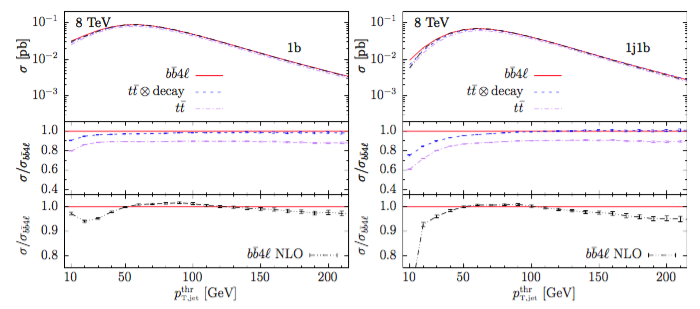 Figure 1
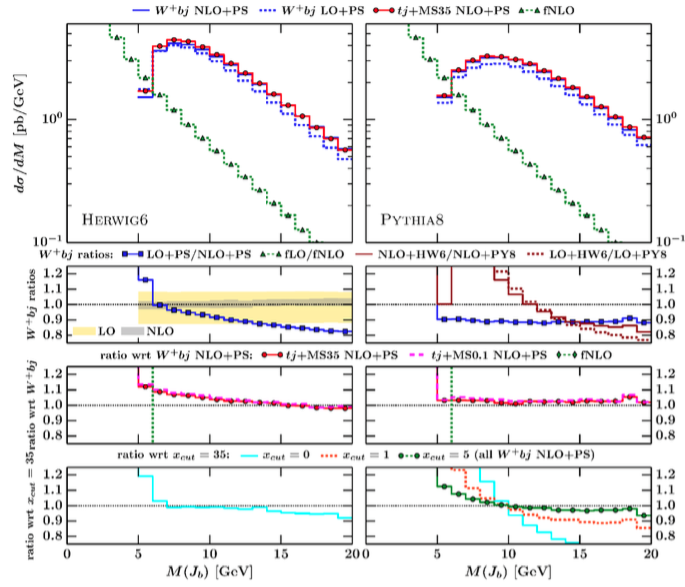 Figure 2
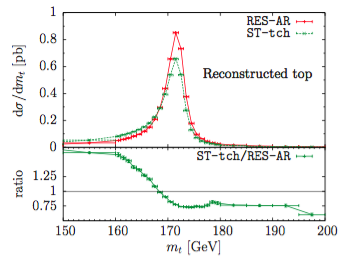 Figure 3
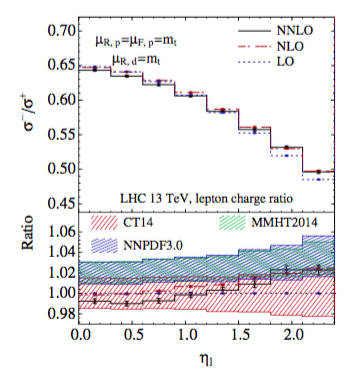 Figure 4
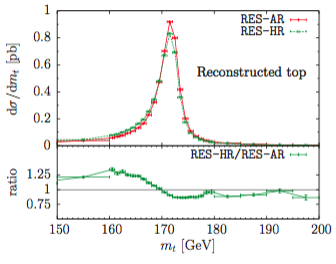 Figure 5
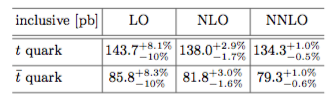 Figure 6
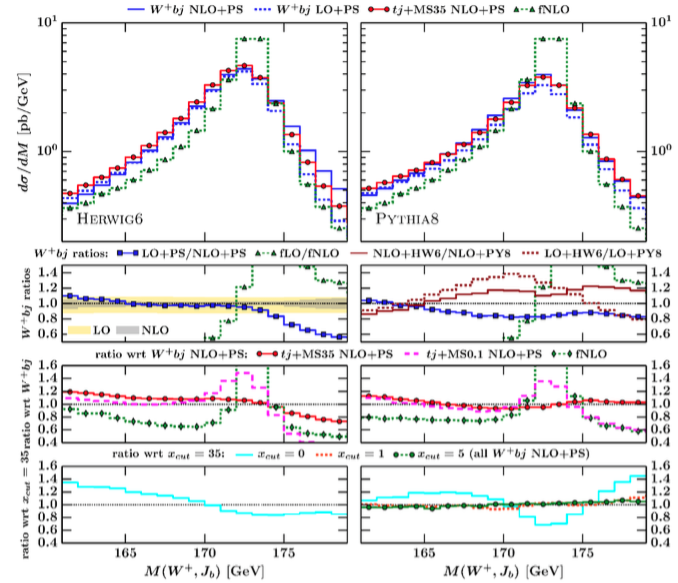 Figure 7
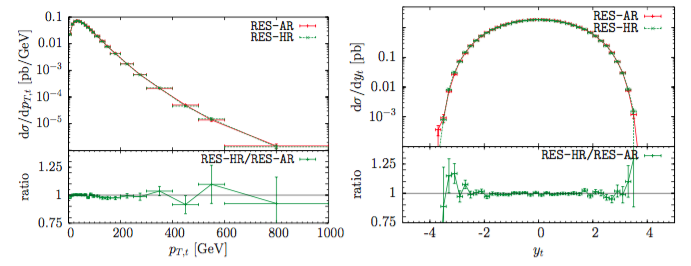 Figure 8
| inclusive [pb] | LO | NLO | NNLO |
|---|---|---|---|
| quark | |||
| quark |
Peer Reviews
No public reviews on file for this paper yet. If you reviewed it on a platform where reviews are public (OpenReview, ICLR, NeurIPS, ICML), you can paste yours below so the community can read it here.
Videos
No videos yet. Explain this paper in a talk, walkthrough, or lecture? Add one.
Taxonomy
TopicsParticle physics theoretical and experimental studies · High-Energy Particle Collisions Research · Distributed and Parallel Computing Systems
SNSN-323-63
Single top theory
Francesco Tramontano
*Departimento di Fisica “E. Pancini”,
Università di Napoli Federico II and INFN, sezione di Napoli,
via Cintia I-80126 Napoli, Italy*
I breafly discuss very recent progress in the theoretical description of Standard Model single top production at hadron colliders.
PRESENTED AT
International Workshop on Top Quark Physics
Olomouc, Czech Republic, September 19–23, 2016
1 Introduction
Many things have changed since the work of Willenbrock and Dicus in 1986 [1] that showed the relevance of single top physics at hadron colliders using tree level diagrams. In this presentation I’ll review the progress of the last year, since the end of TOP2015. Furthermore, I’ll just present a selection of results, I apologise, there has been indeed a lot of progress recently. The reader will note that “single top” production in hadron collisions is more and more an important tool that triggers progress in high energy physics. In the next three subsections I’ll report about new computations for t-channel, tW associated production and s-channel respectively.
2 t-channel
In ref. [2] the authors report about the computation of the Next-to-Next-to Leading Order (NNLO) QCD corrections to the t-channel single top production and decay. The computation has been performed using the structure function approach neglecting the color transfer among the two fermion lines, furthermore, the merging of the corrections for the production and decay of the top quark has been worked out in the narrow width approximation. From this differential computation one expects the highest precision on distributions that are inclusive or insensitive to the invariant mass of the reconstructed top, like the light jet transverse momentum and pseudo-rapidity. Furthermore, such computations might be relevant for pdf studies. Adopting the following definition for the NNLO cross section:
[TABLE]
the results for the total cross section at LHC at 13TeV obtained using CT14 pdf and using as central scale are reported in Table 1.
One can observe the nice features of the higher order corrections that give a small contribution and reduce the theoretical error. The impact of higher order corrections on the lepton charge ratio is shown in Figure 1.
Another important step forward has been done improving the matching of parton shower to matrix elements that involve a top-quark resonance. The problem of the matching of the Next to Leading Order (NLO) computation to a Parton Shower (PS) in presence of internal resonances is of prominent importance for the whole physics program at the LHC. Leading collaborations have started to address this problem studying t-channel single top production.
With the general subtraction schemes like Catani and Seymour or Frixione, Kunszt and Signer, only the ingoing and outgoing particle momenta are relevant and the counter events have the primary condition to adsorb the momenta of the extra radiated parton among the particles of the Born process, irrespective of the presence of internal resonances. This situation deteriorates the efficiency of the infrared cancellation. In a NLO+PS computation in presence of resonances there are even more severe problems. In the case of the POWHEG method for example, to work correctly, the ratio among the real emission and underlining Born matrix elements must become large only in the collinear limit, while, if there are resonances, the general mappings that are employed to attach the radiation can produce unphysical distortions in the Sudakov factor. Last, but not less important, PS has to be instructed about when preserve resonance mass during the shower to avoid arbitrary shifts of the resonance invariant mass resulting in an unphysical distortion of the top line shape.
Solutions to all the problems listed above have been proposed by two groups. The solution found in POWHEG in [3] is based on a division of the contributions to the cross section following all the possible resonance histories obtained introducing appropriate multiplicative factors for all the contributions. The other fundamental step is the introduction of resonance aware mappings, in such a way to minimise the mismatch among real and subtractions. A crucial aspect here is the delicate separation of the real contribution into resonance histories that preserve collinear factorisation and allow for subtractions computed in the resonance frame.
Similarly, the solution found in MG5_aMC@NLO [4] is based on the division of the contribution following the possible resonance histories performed combining input from the amplitude structure, the FKS singular region and information on the kinematical configuration. Then a remapping of the event kinematics is performed to match the resonance invariant mass, resorting on numerical methods to compute the new Jacobian factor so that there is no need of further analytic integrations.
The two collaborations have independently compared their different generators for the same process to understand the effects of the new treatment of the radiation. In POWHEG-BOX-RES the authors simulated pp collisions at 8TeV, using the MSTW2008NLO pdf set and assuming the following jet cuts: , adopting the kt-algorithm with R=0.5. The top quark distributions are given in Figure 2. They are obtained writing the Hardest Radiation (RES-HR ) of the event or both the hardest radiation from the production and the one from the decay (RES-AR). One observe good agreement among the two.
In Figure 3 there is the reconstructed top mass distributions. On the left the All Radiation generation (RES-AR) is compared to the one with hard radiation generated only in the production process and the top decay described by the PS. A shift of about 1GeV is found. On the right side the AR and HR generators are compared and a less pronounced difference is found for the top line shape.
With MG5_aMC@NLO the authors had the same setup plus a cut on the reconstructed top mass . In their analysis, the authors made a detailed study of the dependance of the predictions on the variation of the technical parameters that in turn is useful to understand the remaining associated uncertainties.
In Figure 4 and 5 the invariant mass of the the reconstructed top quark and the mass of the primary b-jet are shown respectively. One observe how the PS smears and flatten the sharp peak of fixed order prediction in the first and that the b-jet mass results much harder in NLO+PS wrt fixed order NLO. The reader can find many distributions and details in the original works.
3 tW associated production
As for the tW associated production, recently the POWHEG-BOX-VRES collaboration applied the new method for the treatment of the resonances histories to the computation of the plus four leptons production at the LHC, and so completing the description of pair production and decay at NLO+PS including all the non resonant and off shell contributions that produce the same final state [5]. This new generator is also an ideal generator for tW associated production where all the effects of the interference with the production are consistently included.
In Figure 6 are shown the cross sections for exactly 1-bjet above a threshold, inclusive in the left panel and exclusive in the right panel. One can note an increasingly important single top contribution at small jet threshold. A detailed study of Wt and HWt associated production at NLO+PS has also been presented in [6].
4 s-channel
Based on the results for the soft gluon resummation of Kidonakis [7, 8, 9] in ref. [10] Alekhin et al. implemented an approximated NNLO s-channel single top cross section. The authors then extracted the value of the top mass from single top cross sections and production fitting the best experimental determinations. Note that for the s-channel, Tevatron results are the ones with the highest precision. The exercise has been performed for three different pdf sets and shows that slightly more consistent values of the top mass are obtained with the ABM sets. Note however that the experimental cross sections determinations are correlated to the assumptions on the top mass value and that this correlation is not available for all the measurements and has not been taken into account in the work of ref. [10] ***We thank D. Hirschbühl and S. Moch for clarifications on this point..
5 conclusion
After at least thirty years of computations aiming to describe the production of a single top quark in hadronic collisions, a lot of progress has been done. Thanks to the relative simplicity of the hard process and the large amount of available data, the theoretical description of single top production at hadron colliders is an excellent laboratory to study new ideas on how to treat the radiation. At the same time in the near future, single top observables could be competitive on pdf studies and top mass determinations and so trigger further developments.
The reference list from the paper itself. Each links out to its DOI / PubMed record.
- 1[1] S. S. D. Willenbrock and D. A. Dicus, Phys. Rev. D 34 , 155, (1986).
- 2[2] E. L. Berger, J. Gao, C.-P. Yuan and H. X. Zhu, Phys. Rev. D 94 no.7, 071501, (2016)
- 3[3] T. Ježo and P. Nason, JHEP 1512 065, (2015)
- 4[4] R. Frederix, S. Frixione, A. S. Papanastasiou, S. Prestel and P. Torrielli, JHEP 1606 027, (2016)
- 5[5] T. Ježo, J. M. Lindert, P. Nason, C. Oleari and S. Pozzorini, Eur. Phys. J. C 76 no.12, 691, (2016)
- 6[6] F. Demartin, B. Maier, F. Maltoni, K. Mawatari and M. Zaro, ar Xiv:1607.05862 [hep-ph].
- 7[7] N. Kidonakis, Phys. Rev. D 74 , 114012, (2006).
- 8[8] N. Kidonakis, Phys. Rev. D 75 , 071501, (2007).