Comprehensive understanding of parity-time transitions in $\mathcal{PT}$ symmetric photonic crystals with an antiunitary group theory
Adam Mock

TL;DR
This paper develops a rigorous symmetry-based framework using antiunitary group theory to predict parity-time (PT) transition behaviors in photonic crystals, advancing understanding of PT symmetry phenomena.
Contribution
It introduces a general mathematical approach employing Heesh-Shubnikov group theory to classify PT transition types based solely on symmetry considerations.
Findings
Predicts thresholdless PT transitions using symmetry analysis
Classifies modes in PT-symmetric photonic lattices
Provides a framework applicable to various PT systems
Abstract
Electromagnetic materials possessing parity-time symmetry have received significant attention since it was discovered that the eigenmodes of these materials possess either real-frequency eigenvalues or the eigenfrequencies appear in complex-conjugate pairs. Interestingly, some eigenstates of these systems show thresholdless transitions to the complex-conjugate regime, some exhibit a transition as a function of the degree of non-Hermiticity and some show no transition at all. While previous work has provided some insight on the nature of transitions, this work lays out a general and rigorous mathematical framework that is able to predict, based on symmetry alone, whether an eigenmode will exhibit a thresholdless transition or no transition at all. Developed within the context of ferromagnetic solids,…
Click any figure to enlarge with its caption.
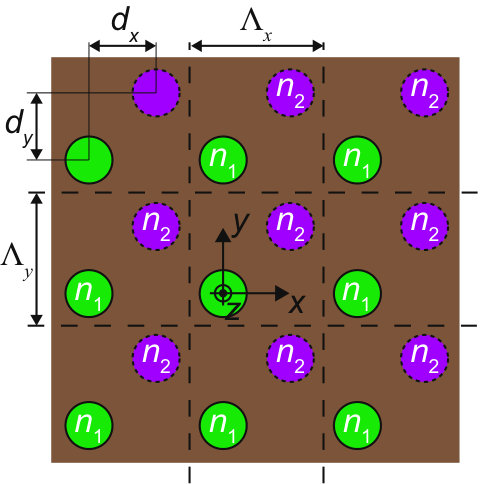 Figure 1
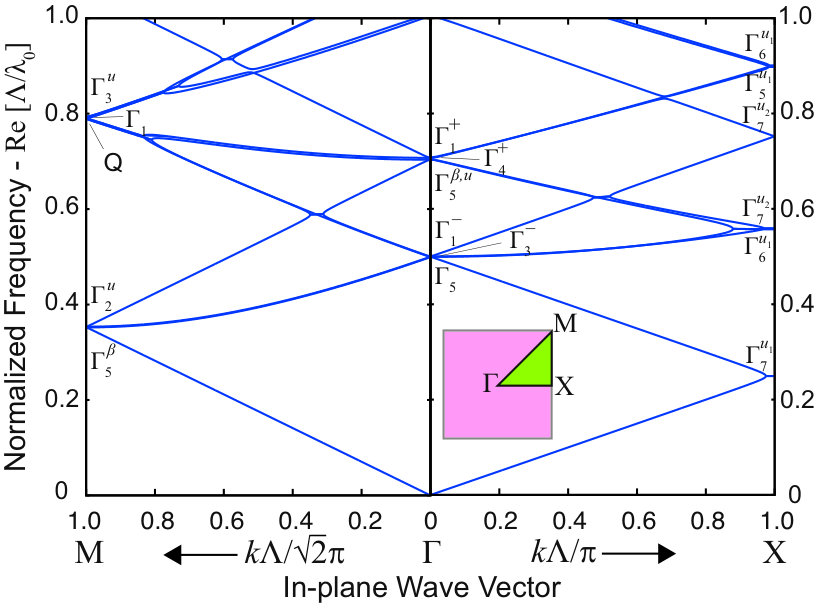 Figure 2
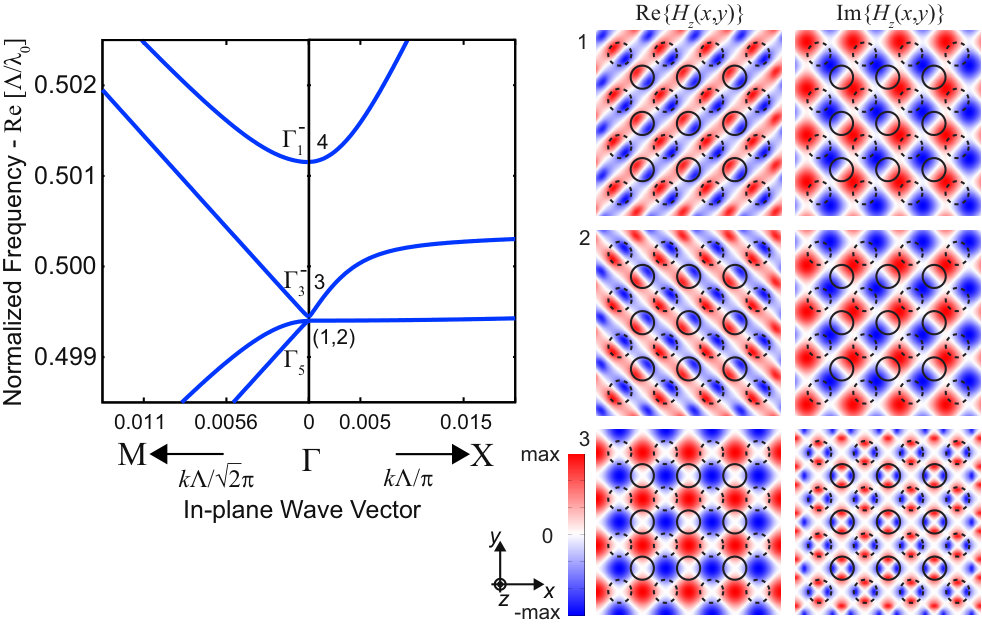 Figure 3
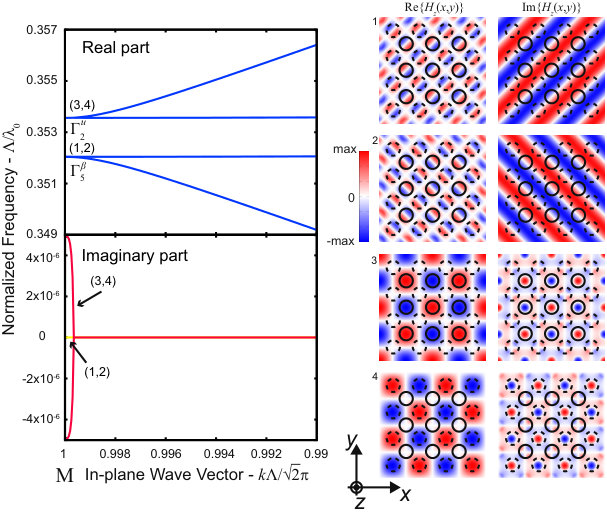 Figure 4
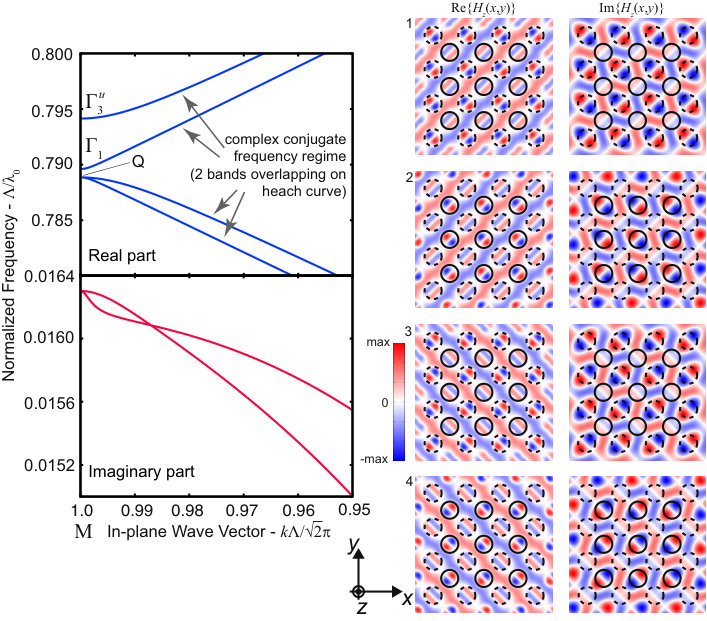 Figure 5
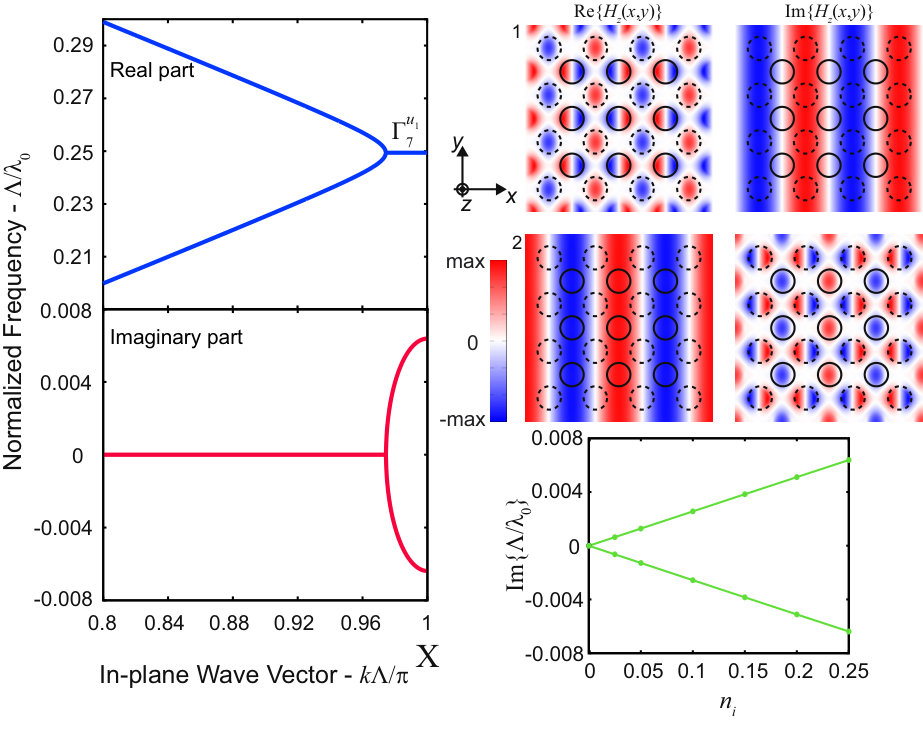 Figure 6
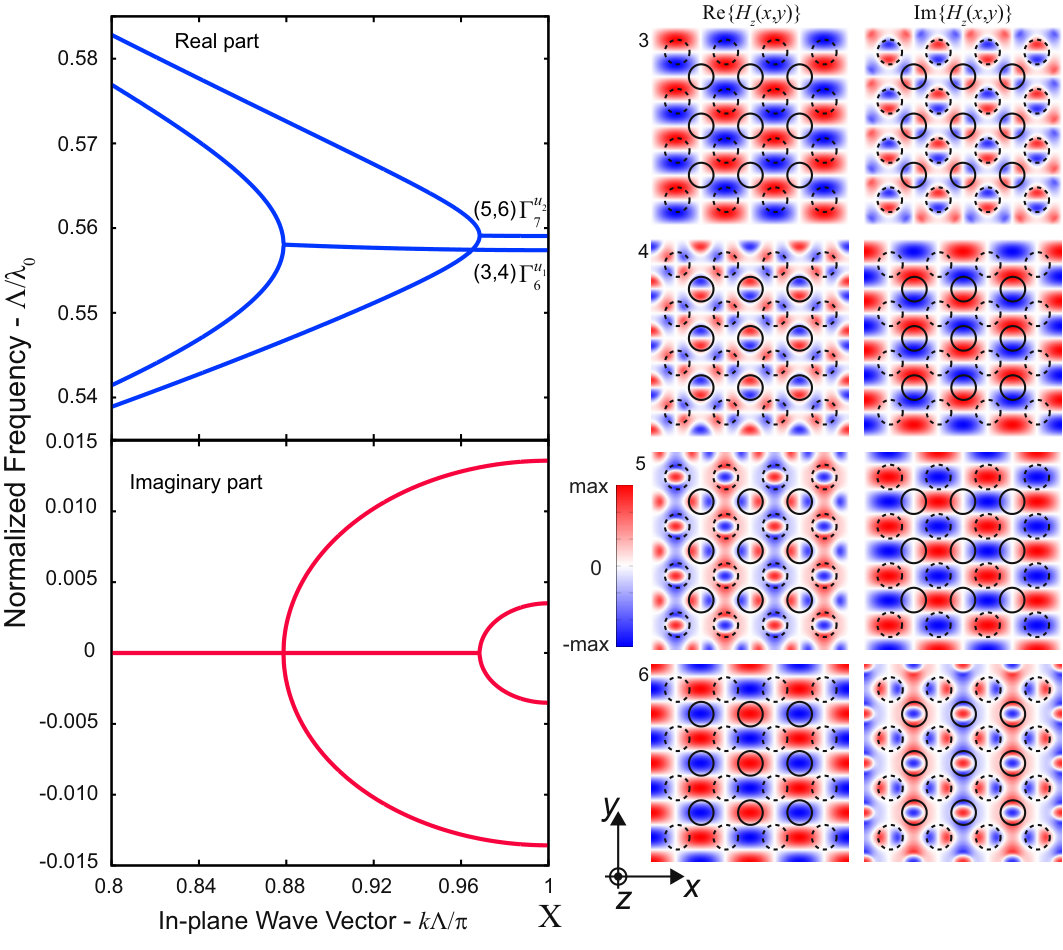 Figure 7
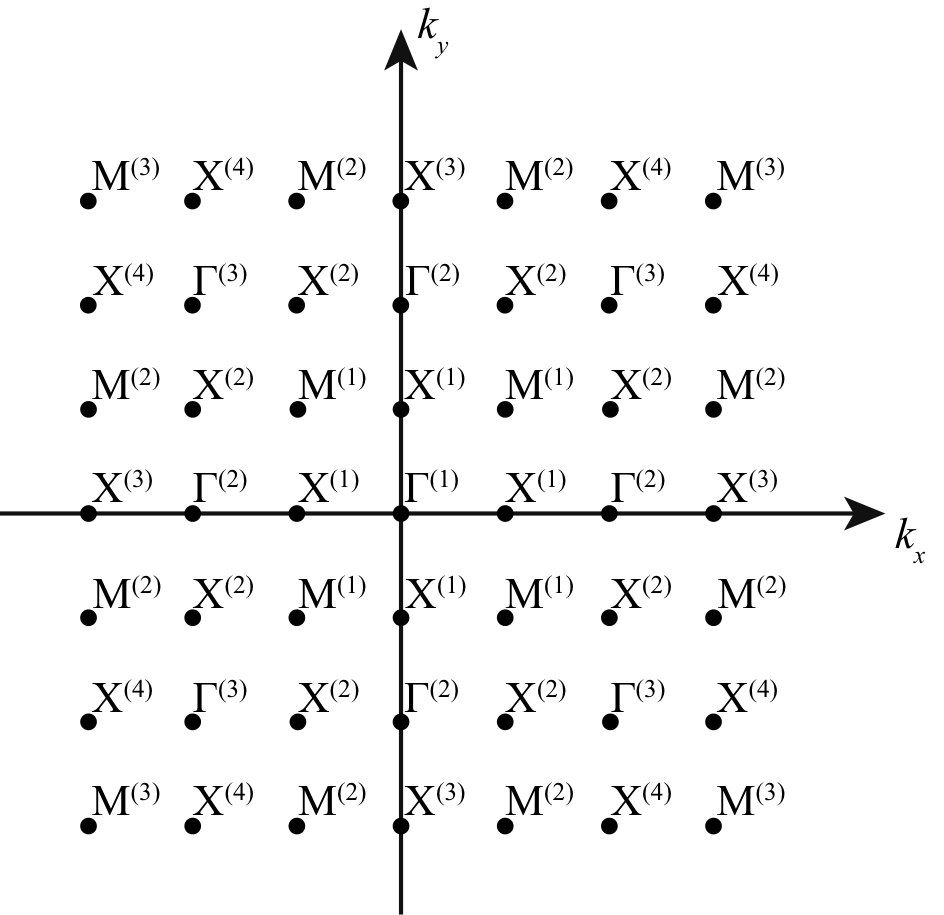 Figure 8
Peer Reviews
No public reviews on file for this paper yet. If you reviewed it on a platform where reviews are public (OpenReview, ICLR, NeurIPS, ICML), you can paste yours below so the community can read it here.
Videos
No videos yet. Explain this paper in a talk, walkthrough, or lecture? Add one.
Comprehensive understanding of parity-time transitions in symmetric photonic crystals with an antiunitary group theory
Adam Mock
School of Engineering and Technology, Central Michigan University, ET 100, Mount Pleasant, MI 48859, USA
and Science of Advanced Materials Program Central Michigan University, Mount Pleasant, MI 48859, USA
Abstract
Electromagnetic materials possessing parity-time symmetry have received significant attention since it was discovered that the eigenmodes of these materials possess either real-frequency eigenvalues or the eigenfrequencies appear in complex-conjugate pairs. Interestingly, some eigenstates of these systems show thresholdless transitions to the complex-conjugate regime, some exhibit a transition as a function of the degree of non-Hermiticity and some show no transition at all. While previous work has provided some insight on the nature of transitions, this work lays out a general and rigorous mathematical framework that is able to predict, based on symmetry alone, whether an eigenmode will exhibit a thresholdless transition or no transition at all. Developed within the context of ferromagnetic solids, Heesh-Shubnikov group theory is an extension of classical group theory that is applicable to antiunitary operators. This work illustrates the Heesh-Shubnikov approach by categorizing the modes of a two-dimensionally periodic photonic lattice that possesses symmetry.
Photonics, Semiconductor Physics, Quantum Physics
pacs:
I
I.1
I.1.1
II I. Introduction
Electromagnetic (EM) systems described by non-Hermitian wave equations but invariant under the combined operation of parity and time-inversion have been the subject of intense investigation in recent years El-Ganainy et al. (2007); Guo et al. (2009); Mostafazadeh (2009a, b); Rüter et al. (2010); Longhi (2010); Čtyroký et al. (2010); Benisty et al. (2011); Ge et al. (2012); Hodaei et al. (2014); Longhi and Feng (2014); Chang et al. (2014); Peng et al. (2014); Phang et al. (2015); Miao et al. (2016). Such systems have been shown to possess either real-frequency eigenvalues or paired complex-conjugate eigenvalues Bender and Boettcher (1998); Bender et al. (1999, 2002). In the latter case, the modes separate into gain or loss modes depending on the sign of the complex part of the frequency. And the spatial field distribution of the gain and loss modes show a preferential overlap with the amplifying and absorbing portions of the geometry, respectively. This work provides a theoretical foundation for understanding transitions in two-dimensionally periodic systems with symmetry. The modes in these systems exhibit a rich variety of behavior much of which lacks a rigorous mathematical basis Mock (2016a); Cerjan et al. (2016).
Preliminary studies of symmetric EM systems concerned two identical parallel waveguides, one of which provided gain and the other was absorbing El-Ganainy et al. (2007); Guo et al. (2009); Rüter et al. (2010). More complicated spatial arrangements were studied using optical fiber, fiber amplifiers and fiber splitters/combiners Makris et al. (2008); Regensburger et al. (2012, 2013). And fascinating recent work has exploited symmetry for laser mode control, optical isolation and vortex beam generation in ring resonator devices Hodaei et al. (2014); Feng et al. (2014); Longhi and Feng (2014); Chang et al. (2014); Peng et al. (2014); Phang et al. (2015). However, periodic systems (especially with periodicity in dimensions higher than one) with symmetry have only begun to be studied Musslimani et al. (2008); Makris et al. (2008); Zhou et al. (2010); Lin et al. (2011); Szameit et al. (2011); Regensburger et al. (2012); Feng et al. (2013); Regensburger et al. (2013); Zhu et al. (2014); Alaeian and Dionne (2014); Xie et al. (2014); Yannopapas (2014); Kulishov et al. (2014); Ge et al. (2015); Wang et al. (2015); Zhu (2015); Agarwal et al. (2015); Ge (2015); Ding et al. (2015); Turdeuev et al. (2015); Cerjan et al. (2016); Cerjan and Fan (2016); Mock (2016a). This work shows how a group theory approach originally developed to classify the irreducible representations of ferromagnetic solids can be used to predict transitions and degeneracies in the photonic band diagram.
Materials whose optical properties are periodically modulated in two dimensions (also known as two-dimensional photonic crystals) are critical in numerous areas of optics including integrated photonics, photonic metasurfaces, optical sensing, and studies of quantum electrodynamics and embedded eigenvalues. In each of these areas, understanding the nature of the electromagnetic modes is a critical first step. In relatively simple structures, modes can be characterized according to their parity about some axis of the system, and this information is typically sufficient to estimate critical design metrics such as coupling and radiation efficiencies. However, in two-dimensional (2D) photonic crystals (PCs), modes exhibit a richer variety of behavior Mock (2016a), and a more rigorous mode classification scheme is required. Group theory has been extremely useful in the classification of modes in 2D PCs Sakoda (2001); Srinivasan and Painter (2002). Additionally, group theory can predict mode degeneracies. However, application of “classical” group theory to symmetric systems is hampered by the fact that the time-inversion operation is antiunitary, and classical representation theory assumes all operations can be represented by unitary matrices (or matrices that are equivalent under unitary transformations). Fortunately, Heesh-Shubnikov group theory was developed to handle such situations with its associated corepresentations. Heesh-Shubnikov group theory was developed to analyze magnetic ordering in ferromagnetic materials in the middle decades of the twentieth century, and here we show that it continues to be instrumental in the understanding of symmetric photonics.
III II. Heesh-Shubnikov Group Theory
Formally, symmetry concerns electromagnetic systems whose refractive index obeys where the parity operator inverts one or more spatial coordinates. However, the interesting consequences of symmetry hold even when the parity operator is generalized to be any spatial symmetry operation while keeping the total amount of gain and loss balanced. In this paper, we concern ourselves with the geometry depicted in Fig. 1 with where is the lattice constant for a square lattice. With the origin centered on a gain rod, it is apparent that the structure is invariant under point symmetry operations in the point group. Further, the lattice is invariant under the combination of a spatial shift of and complex-conjugation (or ). In this sense the generalized invariance is where is the identity operator and the Seitz notation is used to represent the combined point symmetry operation () and spatial shift (). After the lattice has been shifted and complex conjugated, one can again apply the point symmetry operations in and the geometry will remain invariant. Ultimately, the lattice possesses two point group symmetry centers centered on the gain and loss rods. The full space group of the geometry is given by where represents the set of symmetry operations in the group [that is, let ] and .
The central question this paper addresses is whether thresholdless transitions can be predicted from symmetry. Group theory has been instrumental in understanding the qualitative features of both electronic and photonic band structures. Notably, it allows the determination of band degeneracies at both high and low symmetry points in reciprocal space from the irreducible representations of the groups. The presence of time-inversion introduces complex-conjugation into the symmetry operations considered here which makes the operators anti-unitary. Because the irreducible representations of “classical” groups (those without complex-conjugation) assume the symmetry operators are unitary, an alternative approach for constructing the irreducible representations is needed. While the Heesh-Shubnikov group theory was pioneered by their namesake, their exposition by Wigner played a significant role in their application to practical problems Heesh (1929); Shubnikov (1951); Shubnikov and Belov (1964); Wigner (1959); Cracknell (1975a, b). Heesh-Shubnikov groups are also referred to as a magnetic groups or black and white groups. In the context of periodic structures they apply to crystals whose lattice sites have a property that can take on one of two values.
The Heesh-Shubnikov group theory apparatus actually provides two critical pieces of information. In addition to providing the irreducible representations (more commonly referred to as “corepresentations”) of the anti-unitary operators, it also provides a categorization system that can be used to determine whether thresholdless transitions will occur. The categorization is based on a sum-rule test developed by Dimmock and Wheeler Frobenius and Schur (1906); Dimmock and Wheeler (1962). They discovered that corepresentations of fall into three categories Wigner (1959); El-Batanouny and Wooten (2008), and the categorization is determined by summing the classical characters of the elements resulting from squaring all symmetry elements that include the antiunitary operator :
[TABLE]
where is the character of the classical representation of , is the order of the unitary subgroup (to be explained below) and is the set of antiunitary operators (those containing ). In previous work, we discovered that Type (a) corepresentations correspond to a single representation of the unitary subgroup, and no new degeneracy is introduced. The eigenfrequencies of Type (a) modes remain real. Type (c) corepresentations contain two inequivalent representations of the unitary subgroup, and new degeneracy is introduced Wigner (1959); El-Batanouny and Wooten (2008); Mock (2016b). Modes with Type (c) corepresentations exhibit thresholdless symmetry transitions, so their eigenfrequencies come in complex-conjugate pairs even in the limit of inifinitesimal non-Hermiticity (that is, infinitesimal amounts of gain and loss). Type (b) corepresentations contain the same single representation of the unitary subgroup twice, and new degeneracy may appear.
Returning to the space group defined above, we note that the part forms a unitary subgroup of index 2, and the antiunitary elements form a coset of . Generally, symmetric geometries will have symmetry groups of the form where is a unitary subgroup, and is an antiunitary symmetry operator. Cracknell classifies Heesh-Shubnikov groups of this form as Type IV Cracknell (1975a, b).
Type (a) corepresentations maintain the dimensionality of the irreducible representations of the corresponding unitary subgroup . The dimensionalities of Type (b) and (c) corepresentations are twice that of the corresponding unitary subgroup. This is consistent with the observation that eigenstates with complex-conjugate eigenfrequencies associated with thresholdless transitions transform into each other under antiunitary symmetry operations, whereas those with real frequencies transform only into themselves.
In the following we illustrate these concepts at high-symmetry points in the photonic band structure shown in Fig. 2. Immediately one sees a variety of interesting behavior including thresholdless symmetry transitions at the high-symmetry X and M points. Furthermore, the structure also supports “classical” degeneracy or points where bands coalesce but do not yield a symmetry transition (eigenfrequencies remain real). This paper provides a general framework that explains where in the photonic band diagram transitions are expected to occur. Our analysis will use only the TE polarization to illustrate the concept. The approach applies to the TM polarization as well.
IV III. Results
Here we how the Heesh-Shubnikov group theory approach can predict the nature of transitions at the high symmetry points [], X [] and M []. In each case the points of interest will be band crossings occurring in the empty lattice (a lattice with infinitesimally small periodic perturbation) Ge and Stone (2014). What we find ultimately is that every empty lattice band crossing exhibits either a thresholdless transition or no transition at all. The group theory approach described here shows how symmetry can be used to distinguish and predict which points will or will not exhibit a transition.
IV.1 III.A Absence of transitions at the point []
Symmetry analysis in periodic structures is facilitated by identifying the group of or little group. In classical group theory, the little group consists of elements of the full space group which send a particular into where is a reciprocal lattice vector Sakoda (2001); Tinkham (1964). However, for Heesh-Shubnikov little groups (HSLG) that include antiunitary operators, such a group includes (i) unitary elements of the space group that send into (as before) and (ii) antiunitary elements of the space group that send into Cracknell (1975b).
Based on the Bloch form for modes of periodic systems, one can use a representation of the space group, , where Heine (1960); Mock et al. (2010). At (the point), the analysis is simplified since the space group representation for all and . In this case, the HSLG is the same as the full space group . More details on the specific symmetry operators are provided in Ref. smp .
Squaring each element in the group yields the elements . Summing the characters of these elements according to the Dimmock-Wheeler test yields for all of the classical representations of . Therefore, the modes of the symmetry lattice shown in Fig. 1 at are of Type (a), and no thresholdless transitions are expected there. The group contains four one-dimensional (1D) representations and one two-dimensional (2D) representation, so one anticipates non-degenerate and 2D degenerate modes at .
The components of the th Type (a) corepresentation for the unitary elements are given by where is the th classical representation of in . The components of the th Type (a) corepresentation for the antiunitary elements are given by where is an arbitrary but fixed antiunitary operator and is a matrix that satisfies Wigner (1959); El-Batanouny and Wooten (2008). A full corepresentation table which includes the labeling scheme in Fig. 2 and Fig. 3(a) is provided in Ref. smp .
Fig. 3(a) shows a detailed version of the photonic bandstructure shown in Fig. 2 at the point around the frequency . One sees a 2D degenerate set of modes (1,2) and non degenerate modes (3) and (4). However, all eigenfrequencies are real, and no transitions occur. Considering the field distributions depicted in Fig. 3(b), one sees that the 2D degenerate modes transform either into themselves or into each other under the various symmetry operations. The non-degenerate mode transforms into itself only (with corresponding character). Regardless of degeneracy, strictly real eigenfrequencies at is consistent with the equal energy overlap of the eigenmodes with the gain and loss rods. This is also consistent with the previous observation that the energy distribution of modes at has a spatial periodicity of Mock (2016a, b).
IV.2 III.B Thresholdless transitions at the X point []
The symmetry elements in the HSLG at include and . Because which is 1 for even and for odd, these two space group representations must be explicitly included in the group. This doubles the size of the HSLG, and the resulting unitary subgroup is isomorphic to . More details on the symmetry operators are provided in Ref. smp . Ultimately the HSLG at is . The group has eight 1D representations. Performing the Dimmock-Wheeler test yields four Type (a) and four Type (c) corepresentations. Enforcing the physical constraint that the character of switch sign for even and odd , leaves only the four Type (c) corepresentations. Therefore, we anticipate that thresholdless transitions are expected at every empty-lattice band crossing at . In this case only pairwise coupled modes with complex-conjugate frequencies are expected; no higher order degeneracy (or nondegeneracy) is anticipated. Figures 4 and 5 show detailed views of the lowest three bands at the X point. Indeed in each of these cases a transition is seen near . Moreover, the bottom right panel of Fig. 4 shows that the exceptional point approaches as indicating that the transition is thresholdless.
The components of the th Type (c) corepresentation for the unitary elements are given by Wigner (1959); El-Batanouny and Wooten (2008)
[TABLE]
where . The components of the th Type (c) correpresentation for the antiunitary elements are given by
[TABLE]
where these matrices operate on the loss/gain mode pair
[TABLE]
where () refers to loss (gain).
These equations show precisely how two-dimensional corepresentations representing the coupled complex-conjugate eigenfrequency pairs are constructed from nominally 1D irreducible representations of the unitary subgroup. Further, one sees that the corepresentations of the unitary operators are diagonal, so that they simply transform the modes making up the complex-conjugate pair into themselves. In contrast, the corepresentations of the antiunitary operators are antidiagonal which means the antiunitary operators transform these modes into each other. A critical aspect of the antiunitary operators is the shift by . Almost always, the gain mode and loss mode can be transformed into each other (with an appropriate constant multiplier) with this shift. This can be seen in the field profiles displayed in Figs. 4 and 5 where there is an additional factor of involved in the shift. The specific transformation matrices are provided in tables in Ref. smp .
IV.3 III.C Behavior at the M point []
Lastly, consider which is the M point. At the M point, the applicable point symmetry operations include all of those in . Because which is 1 for even and for odd, these two space group representations must be explicitly included in the group. This doubles the size of the HSLG, and the resulting 16-element unitary subgroup is isomorphic to . Altogether the HSLG at is . More details on the particular symmetry operations are provided in Ref. smp . The group contains four applicable 1D Type (c) representations that produce two-dimensional corepresentations associated with thresholdless transitions. It also contains one applicable 2D Type (a) representation, so one expects a doubly degenerate mode at M in the non-Hermitian system but with real eigenvalues. There are five other irreducible representations of but these are deemed not applicable because they do not change sign between elements with even and odd values of .
Figure 6 shows a detailed view of the band structure in Fig. 2 at the M point near the real frequency . Two sets of bands converge toward degeneracy. The bottom set belong to the Type (a) “classically” doubly degenerate corepresentation, and the imaginary part of their eigenfrequency remains zero all the way to . The top set belong to a Type (c) corepresentation, and they exhibit a transition at around . The spatial field distributions exhibit expected behavior. The classically degenerate modes transform either into themselves or into each other maintaining equal energy overlap with the gain and loss rods. The modes exhibiting a transition separate into gain and loss modes, and the antiunitary symmetry operators transform these two modes into each other.
IV.4 III.D Unexpected Behavior at the M point []
We show in Figure 7 another detailed view of the M point, this time near the real frequency . The empty lattice bandstructure possesses eight-fold degeneracy at this point. When the symmetric lattice is introduced, the eight-fold degeneracy is lifted. The view afforded by Fig. 7 depicts 4 bands all of which are in the complex-conjugate frequency regime, so each band consists of two overlapping bands with the same real frequency. The transition point can be seen in Fig. 2 and occurs around .
This point is highlighted because as these four bands approach the M point, the bottom two coalesce resulting in a doubly degenerate set of modes in the complex-conjugate frequency regime (point labeled Q). That is, the four modes have two sets of equal complex-conjugate frequencies. This is a surprising observation since the Heesh-Shubnikov analysis predicts either non-degenerate Type (c) representations (two coupled modes with complex-conjugate frequencies) or doubly degenerate Type (a) representations that remain in the real-frequency domain. The lowest frequency modes shown in Fig. 7 appear to exhibit properties of a doubly degenerate Type (c) representation even though one does not exist in the present analysis.
However, inspection of these bottom two coalescing bands indicates that they join only at the M point which is different from the other degeneracies whose overlapping occurs for a range of wavevectors and depends on the non-Hermiticity factor . Therefore, this phenomenon is likely not directly related to the prediction of thresholdless transitions via the Heesh-Shubnikov theory. Instead it results from the allowed symmetries at high-symmetry points determined by a reduction procedure Sakoda (2001). The procedure begins by identifying the number of equivalent high-symmetry points in reciprocal space that are invariant under symmetry operations. Fig. 8 displays a reciprocal lattice diagram with high symmetry points labeled. It is sufficient to work with the nominal unitary subgroup without the space group contribution, which here is just . For example there is only one point (at the origin), and it is invariant under all symmetry operations in . There are four points all of which are invariant under , two of which are invariant under and (each), and none of which are invariant under , , , and . The point of interest in the present discussion is M*(2), and there are eight equivalent points that are invariant under . M(2)* is not invariant under any other transformations in . The “character profile” of M*(2)* will then be where the ordered set represents the instances of the elements of in the order .
One then calculates the projection of the possible irreducible representations onto the character profile of M*(2)*. This is done using the formula
[TABLE]
where is the order of the group (), represents the character profile of the element discussed above, is the character of operation in the th irreducible representation of , and counts the instances of the th representation associated with M*(2)*. Performing this calculation for the 5 irreducible representations of results in one each of the four 1D representations and two instances of the lone 2D representation. Because the 1D representations pair up to form the 2D corepresntations in the complex-conjugate frequency regime, one expects two lone Type (c) corepresentations, and two 2D “classically degenerate” representations. And this behavior is exhibited in Fig. 7 where one sees the two Type (c) bands labeled and . The bottom two bands are also essentially Type (c) modes since they are in the complex-conjugate regime, but due to the reduction procedure, they also exhibit behavior associated with “classically” doubly degenerate modes exactly at the M point.
This observation raises an interesting question: if the reduction procedure requires that two 2D classically degenerate modes appear at M*(2), then shouldn’t these appear as pure 2D degenerate modes similar to modes (1,2) at M(1)? It appears that there are two competing effects at play: on the one hand, the reduction procedure provides information based purely on the lattice (square in this case); whereas, the formation of gain and loss modes occurs within the lattice sites. Apparently, the system favors the formation of gain/loss modes (Type (c) corepresentations) even though the lattice symmetry demands that two 2D classically degenerate modes appear. Ultimately, the phenomenon at M(2)* is the result of satisfying both constraints.
Based on observing the transformation properties of the fields in Fig. 7 we can write down the matrix representations of the operators associated with the degenerate set of complex-conjugate modes. The unitary operators transform according to
[TABLE]
where the fields are numbered according to the format in Fig. 7. This matrix consists of two identical matrices on the diagonal. These matrices are diagonal for and antidiagonal for . The antiunitary operators transform according to
[TABLE]
Similarly, this matrix consists of two identical matrices but now on the antidiagonal. These matrices are diagonal for and antidiagonal for . These operators correspond to the same elements of listed above but combined with (see Ref. smp for more details).
V IV. DISCUSSION AND CONCLUSIONS
In this work we have shown how Heesh-Shubnikov group theory can be used to predict thresholdless transitions in 2D periodic photonic lattices that posses symmetry. While the theoretical framework was developed decades ago, we have found it instrumental in understanding the complex and varied modal behavior of these modern materials. Notably, we focussed on high symmetry points in the reciprocal lattice and found that at the point, one expects all modes to remain in the real-frequency regime; at the X point, one expects all modes to be in the complex-conjugate frequency regime; and at the M point, one expects modes in the complex-conjugate frequency regime and doubly degenerate modes in the real-frequency regime. Interesting behavior was observed at the M point where modes possessed a combination of 2D degeneracy and complex-conjugate frequency formation.
This work lays a theoretical foundation for important future studies. Theoretically, a similar analysis applied to other lattice types as well as three-dimensional photonic crystals will likely uncover even more interesting behavior. From an engineering perspective, the real frequency states at the point shows that these materials could be designed to create photonic bandgap devices such as waveguides and cavities. The large density of states associated with the high-order degeneracy discovered at the M point could be useful for bandedge lasers. And the broad understanding of the band structure in general will prove critical for designing superprism-type devices and metasurfaces.
The reference list from the paper itself. Each links out to its DOI / PubMed record.
- 1El-Ganainy et al. (2007) R. El-Ganainy, K. G. Makris, D. N. Christodoulides, and Ziad H. Musslimani, “Theory of coupled optical 𝒫 𝒯 𝒫 𝒯 \mathcal{PT} -symmetric structures,” Optics Letters 32 , 2632–2634 (2007).
- 2Guo et al. (2009) A. Guo, G. J. Salamo, D. Duchesne, R. Morandotti, M. Volatier-Ravat, V. Aimez, G. A. Siviloglou, and D. N. Christodoulides, “Observation of 𝒫 𝒯 𝒫 𝒯 \mathcal{PT} -symmetry breaking in complex optical potentials,” Physical Review Letters 103 , 093902 (2009).
- 3Mostafazadeh (2009 a) Ali Mostafazadeh, “Spectral singularities of complex scattering potentials and infinite reflection and transmission coefficients at real energies,” Physical Review Letters 102 , 220402 (2009 a).
- 4Mostafazadeh (2009 b) Ali Mostafazadeh, “Resonance phenomenon related to spectral singularities, complex barrier potential, and resonating waveguides,” Physical Review A 80 , 032711 (2009 b).
- 5Rüter et al. (2010) Christian E. Rüter, Konstantinos G. Makris, Ramy El-Ganainy, Demetrios N. Christodoulides, Mordechai Segev, and Detlef Kip, “Observation of parity-time symmetry in optics,” Nature Physics 6 , 192–195 (2010).
- 6Longhi (2010) Stefano Longhi, “ 𝒫 𝒯 𝒫 𝒯 \mathcal{PT} -symmetric laser absorber,” Physical Review A 82 , 031801(R) (2010).
- 7Čtyroký et al. (2010) Jiří Čtyroký, Kuzmiak, Vladimír, and Sergey Eyderman, “Waveguide structures with antisymmetric gain/loss profile,” Optics Express 18 , 21585–21593 (2010).
- 8Benisty et al. (2011) Henri Benisty, Aloyse Degiron, Anatole Lupu, André De Lustrac, Sébastien Chénais, Sébastien Forget, Mondher Besbes, Grégory Barbillon, Surélien Bruyant, Blaize, Sylvain, and Gilles Lérondel, “Implementation of 𝒫 𝒯 𝒫 𝒯 \mathcal{PT} symmetric devices using plasmonics: principle and applications,” Optics Express 19 , 18004–18019 (2011).