
TL;DR
This paper proves that connected affine schemes in positive characteristic are K(pi, 1) spaces for the etale topology, using induction, ramification theory, and recent advances in higher ramification theory.
Contribution
It establishes the K(pi, 1) property for affine schemes in positive characteristic, including rigid analytic and mixed characteristic cases, with new ramification results.
Findings
Connected affine schemes are K(pi, 1) spaces in positive characteristic.
A key Bertini-type statement on wild ramification of l-adic local systems.
Extensions to rigid analytic and mixed characteristic settings.
Abstract
We prove that every connected affine scheme of positive characteristic is a K(pi, 1) space for the etale topology. The main ingredient is the special case of the affine space over a field k. This is dealt with by induction on n, using a key "Bertini-type"' statement regarding the wild ramification of l-adic local systems on affine spaces, which might be of independent interest. Its proof uses in an essential way recent advances in higher ramification theory due to T. Saito. We also give rigid analytic and mixed characteristic versions of the main result.
Click any figure to enlarge with its caption.
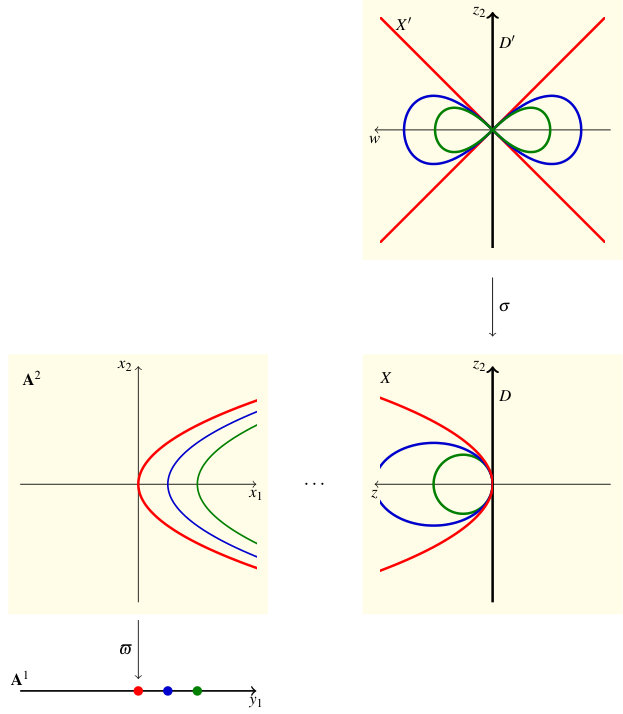 Figure 1
Peer Reviews
No public reviews on file for this paper yet. If you reviewed it on a platform where reviews are public (OpenReview, ICLR, NeurIPS, ICML), you can paste yours below so the community can read it here.
Videos
No videos yet. Explain this paper in a talk, walkthrough, or lecture? Add one.
Wild ramification and spaces
Piotr Achinger
Instytut Matematyczny PAN, ul. Śniadeckich 8, 00-656 Warszawa, Poland
Institut des Hautes Études Scientifiques
Le Bois-Marie 35, route de Chartres
91440 Bures-sur-Yvette, France
Abstract.
We prove that every connected affine scheme of positive characteristic is a space for the étale topology. The main ingredient is the special case of the affine space over a field . This is dealt with by induction on , using a key “Bertini-type” statement regarding the wild ramification of -adic local systems on affine spaces, which might be of independent interest. Its proof uses in an essential way recent advances in higher ramification theory due to T. Saito. We also give rigid analytic and mixed characteristic versions of the main result.
Key words and phrases:
schemes, étale fundamental group, étale homotopy, wild ramification, Swan conductor
2010 Mathematics Subject Classification:
Primary 14F35; Secondary 14F20, 14R10.
1. Introduction
The étale homotopy theory of schemes of positive characteristic is quite poorly understood. For example, already the étale fundamental group of the affine line over an algebraically closed field of characteristic is incredibly complicated [Ray94]. One of our main results is the realization that the étale homotopy theory of characteristic schemes is in a certain way controlled by the étale fundamental group.
The notion of a space for the étale topology plays a central role in this paper. In algebraic topology, a connected topological space (with a basepoint ) satisfying suitable technical assumptions is called a space if its higher homotopy groups () are zero. The homotopy type of such a space is completely determined by its fundamental group , and in particular the cohomology of any local system on agrees with the group cohomology of the corresponding representation of . Similarly, we call a connected scheme with a geometric point a scheme if for every locally constant étale sheaf of finite abelian groups on , the natural maps
[TABLE]
are isomorphisms (cf. Definition 4.1.1). If is noetherian and geometrically unibranch, this is equivalent to the vanishing of the higher étale homotopy groups for (cf. Proposition 4.1.4).
One of our main results is the following.
Theorem 1.1.1**.**
Every connected affine -scheme is a scheme.
This of course stands in stark contrast with the characteristic zero case. One might interpret this by saying that the étale fundamental group of a connected affine -scheme is so large that it ‘absorbs’ the higher homotopy groups. To go one step beyond the affine case, Theorem 1.1.1 implies that the étale homotopy type of a normal quasi-compact and separated -scheme can be described as the homotopy colimit of a finite diagram of classifying spaces of profinite groups.
1.2. Artin neighborhoods
To explain both our initial motivation and the idea of proof of Theorem 1.1.1, we will start by discussing Artin’s construction of neighborhoods on smooth complex algebraic varieties.
The notion of a scheme first appeared in algebraic geometry in Artin’s proof of the comparison theorem between singular and étale cohomology of a smooth scheme over , which states that
[TABLE]
for every locally constant étale sheaf of finite abelian groups on [Art73, Exp. XI].
Recall that an elementary fibration is a morphism of schemes for which there exists a commutative diagram
[TABLE]
where is an open immersion, the complementary closed immersion, is projective with geometrically connected fibers, smooth of dimension , and its restriction is finite étale surjective. Thus the geometric fibers of are smooth affine curves. Moreover, if is of finite type over , then the associated morphism is a locally trivial fibration. Artin showed that a smooth variety over an infinite field can be covered by Zariski open subsets for which there exists a chain of elementary fibrations
[TABLE]
We call a scheme admitting a chain as above an Artin neighborhood. Thus is an ‘iterated fibration in affine curves,’ and it follows that if has characteristic zero, an Artin neighborhood is a scheme. Moreover, if , then the associated analytic space is a space, and is an iterated extension of free groups. Consequently, in the natural commutative square
[TABLE]
the vertical and top arrows are isomorphisms, which implies (1.2.1) for an Artin neighborhood. The general case of (1.2.1) follows then easily by cohomological descent.
Our initial goal in this project was to generalize Artin’s theorem by showing that a smooth scheme over an infinite field of positive characteristic admits a covering by open subschemes; we dared not hope that something as striking as Theorem 1.1.1 can be true. To this end, a good understanding of the problem with extending Artin’s characteristic zero proof put us on the right track.
Namely, the reason why the argument that an Artin neighborhood is a scheme works only in characteristic zero is related to wild ramification. Suppose that is an elementary fibration, and we know that is a . To show that has to be a as well, it is easily seen that it is enough to prove that for a locally constant constructible sheaf on , the following condition is satisfied:
[TABLE]
This last assertion is true in characteristic zero e.g. by comparison with the complex case, where is topologically a locally trivial fibration, but in positive characteristic this can fail due to phenomena related to the wild ramification of the restriction of to the fibers of at the points of , as the following basic example shows.
Example 1.2.1*.*
Let be the projection to the second coordinate, where is algebraically closed of characteristic , the rank one sheaf of -vector spaces () on associated to the Artin–Schreier covering
[TABLE]
and a nontrivial character . Then the restriction of to is constant, while for , is not constant. Consequently, does not have the required compatibility with base change, and (1.2.2) does not hold.
1.3. The Bertini theorem for lcc sheaves
Our main technical result below states that one can make problems as in Example 1.2.1 go away by applying a non-linear automorphism of the affine space. Consequently, one can make the above inductive argument work for sheaves on if one is allowed to choose the fibration after being given the locally constant sheaf . For brevity, let us call a sheaf well-aligned with respect to a map if condition (1.2.2) holds.
Theorem 1.3.1** (Bertini theorem for lcc sheaves).**
Let be an infinite field of characteristic . Let be a prime and let be a locally constant constructible sheaf of -vector spaces on (). Let be the projection to the first coordinates. Then there exists an automorphism of such that is well-aligned with respect to (equivalently, is well-aligned with respect to ).
In fact, we prove that the assertion holds for a (not necessarily linear!) automorphism which is general in a suitable sense. This justifies the name ‘Bertini theorem.’ See Theorem 3.2.1 for a precise formulation.
We shall now explain how Theorem 1.3.1 implies Theorem 1.1.1. First, Theorem 1.3.1 enables us to prove by induction on that the affine space is a , along the lines sketched in §1.2. This turns out to be the key case of Theorem 1.1.1. To deduce the general case, one first treats affine étale schemes over as an intermediate step. To this end, one uses the following result.
Proposition** (5.2.1).**
Let be an affine scheme of finite type over admitting an étale map . Then there exists a finite étale map .
The proof of this assertion is suprisingly easy, and is based on Nagata’s proof of the Noether normalization lemma [Mum99, I §1]. A similar result has been obtained by Kedlaya [Ked02], and both were inspired by a trick used in [Kat01] in the one-dimensional case. The following example illustrates the general idea.
Example 1.3.2*.*
Let and let be the inclusion. Then is of course étale, but it is not finite because the points have empty preimages. To remedy this, we can send these points off to infinity by adding to functions with poles at the . This will make the map finite, but might destroy étaleness — unless we are in characteristic , in which case the added functions can be taken to be -th powers. Concretely, we might take
[TABLE]
One can apply a similar reasoning in a mixed characteristic situation and prove that an affinoid rigid space which is étale over a polydisc is also finite étale over a polydisc, cf. Proposition 6.6.1.
Combining Proposition 5.2.1 with the fact that is a , we see that if is an affine scheme of finite type over , admitting an étale map , then is a . Finally, using limit arguments and Gabber’s affine analog of the proper base change theorem [Gab94], we deduce Theorem 1.1.1.
1.4. Higher ramification theory and proof of the Bertini theorem
Theorem 1.3.1 is where higher ramification theory enters the picture. A key ingredient in the proof is the Deligne–Laumon theorem (cf. Corollary 2.2.2), which yields a condition for the higher direct images () being locally constant in terms of the Swan conductors at infinity of the restriction of to the fibers of . The ‘baby case’ is when is non-fierce at infinity (cf. Definition 3.1.1), in which case we can take to be a general linear automorphism (cf. Proposition 3.1.4). In the general case, we use the recent work of Takeshi Saito on the characteristic cycle associated to a locally constant -sheaf [Sai16, Sai17]. It turns out that we can take the automorphism to be quadratic.
As pointed out to us by Maxim Kontsevich, it makes sense to ask whether a variant of Theorem 1.3.1 holds for irregular connections on . Our method of proof, employing the characteristic cycle, seems to suggest that the answer should be positive. We plan to address this question in a future paper.
In the course of our work on Theorem 1.3.1, we started by solving its rank one case first. In this situation, the calculations are very explicit, and we include them in an appendix. One good feature of this proof is that, unlike our treatment of the general case, the arguments work over a finite field. It could be interesting to obtain a general proof of our Bertini theorem over finite fields.
1.5. Mixed characteristic and rigid analytic variants
If is a connected affine -scheme and a locally constant constructible -sheaf on , then the maps (1.1.1) are isomorphisms. This can be seen easily using the Artin–Schreier sequence, cf. Example 4.1.5. Scholze [Sch13, Theorem 4.9] observed that using perfectoid spaces, one can deduce that every mixed characteristic noetherian affinoid adic space is a space for -adic coefficients. Using a similar argument and Theorem 1.1.1, one can give the following strenghtening of Scholze’s result.
Theorem** (6.4.2).**
Every noetherian affinoid adic space over is a space.
This in turn allows us to give a mixed characteristic variant of Theorem 1.1.1.
Theorem** (6.5.1).**
Let be a noetherian -algebra such that is a henselian pair. Then and are schemes.
This has a natural application to Milnor fibers and Faltings’ topos, allowing us to remove the log smoothness hypothesis of the main result of [Ach15], cf. Corollary 6.5.3.
1.6. The naive étale topology
Let be a scheme. By the naive étale topology we mean the topology on the category of étale -schemes generated by Zariski coverings and finite étale surjective maps. The corresponding topos, which we denote by , is related to the étale topos by a natural map
[TABLE]
Theorem 1.1.1 implies that for -schemes we can compute étale cohomology of locally constant constructible sheaves using the naive étale topology.
Corollary 1.6.1**.**
Let be an -scheme and let be locally constant constructible sheaf on . Then the maps
[TABLE]
are isomorphisms.
(Presumably the same assertion holds for general constructible sheaves under suitable finiteness conditions on .)
Suppose that is a normal noetherian -scheme. Then the naive étale site of is locally connected, and applying the Verdier functor one can associate to it the ‘naive étale’ homotopy type . It follows that the natural map
[TABLE]
is a -isomorphism, and hence a weak equivalence.
By the results of Section 6, analogous results hold for rigid spaces in positive and mixed characteristic, in which case the naive étale topology is generated by admissible open coverings and finite étale covers of affinoids.
1.7. Implications in étale homotopy
Theorem 5.1.1 yields a “finite” description of the homotopy type of a smooth -dimensional variety in characteristic in terms of the single profinite group .
Corollary 1.7.1**.**
Let be a pointed connected quasi-projective scheme over , smooth of dimension . Then there exist affine open subsets containing and covering , and for every non-empty subset , a finite étale map
[TABLE]
with . Thus each is a , and induces an isomorphism of with an open subgroup . For , let be the homomorphism induced by the inclusion . Then the étale homotopy type of is the homotopy colimit of the diagram .
In principle, this tells us that a good understanding of the group would shed light on the étale homotopy types of smooth -schemes. Unfortunately, this group is too complicated for us to derive any concrete corollaries from the above presentation.
In any case, the results seem to suggest that a very strong form of Grothendieck’s anabelian conjectures could be true in positive characteristic. We allow ourselves to put forth some ambitious-looking questions in this direction in §7.6.
1.8. Examples and complements
We finish the paper with a few examples:
- •
Example 7.1, showing that in the presence of fierce ramification, linear projections are not enough in general in the context of Theorem 1.3.1.
- •
Example 7.2 of a smooth affine variety (the complement of a hyperplane arrangement) over such that is a for every while is not.
- •
Example 7.3 showing that and are not isomorphic as pro-finite groups for , even though they have the same finite quotients.
We also study some abstract properties of fundamental groups of affine schemes in §7.4, comment on the relationship between our work and the ‘ pro-’ neighborhoods of Friedlander and Gabber in §7.5, and state some open questions in the spirit of anabelian geometry in §7.6.
1.9. Outline
In Sections 2–3 and Appendix A, we deal with the proof of the Bertini theorem. We start with a review of relevant ramification theory in Section 2. Then we prove the easy case of the theorem when the sheaf is non-fiercely ramified at infinity in §3.1, and proceed to the general case in §3.2. Appendix A contains an alternative proof of the rank one case of Theorem 1.3.1.
In Sections 4–6, we deal with schemes and rigid analytic spaces. In Section 4, we review the notion of a scheme. Then in Section 5, we prove Theorem 1.1.1. The subsequent Section 6 treats the mixed characteristic and rigid geometry analogues of Theorem 1.1.1.
In the last Section 7, we provide relevant examples and further discussion as listed above.
1.10. Acknowledgements
I would like to thank Ahmed Abbes, Bhargav Bhatt, Ofer Gabber, Kiran Kedlaya, Laurent Lafforgue, Martin Olsson, Arthur Ogus, Fabrice Orgogozo, Takeshi Saito, Vasudevan Srinivas, and Karol Szumilo for helpful conversations. I am especially grateful to Takeshi Saito for his help with the proof of Theorem 1.3.1, and to Ofer Gabber for pointing out that Theorem 1.1.1 follows from its special case Corollary 5.2.3. We thank an anonymous referee for pointing out a mistake in an earlier version of the paper and for many valuable comments. We would also like to thank Maciej Borodzik for providing Figure 1. The author was supported by NCN OPUS grant number UMO-2015/17/B/ST1/02634.
Contents
- 1 Introduction
- 2 Review of wild ramification
- 3 Proof of the Bertini theorem
- 4 Review of schemes
- 5 Affine -schemes are
- 6 Mixed characteristic and rigid analytic variants
- 7 Examples and complements
- A The rank one case of the Bertini theorem
2. Review of wild ramification
Let be an algebraically closed field of characteristic .
2.1. The Swan conductor
Let be a smooth curve over , a point, a locally constant constructible -sheaf on . The Swan conductor is an integer measuring the wild ramification of at . It depends only on the restriction of to where is the fraction field of the henselization of . It appears in the Grothendieck–Ogg–Shafarevich formula [SGA77, Exp. X, formula 7.2]
[TABLE]
Here is a smooth geometrically integral curve with a smooth projective model , , and is a locally constant constructible -sheaf on . It is often more convenient to use the total dimension, defined as
[TABLE]
instead of the Swan conductor. For example, the version of the above formula without compact supports is
[TABLE]
Let where is a henselian discrete valuation field containing whose residue field is finitely generated over . Let be a prime and let be a locally constant constructible -sheaf on . Choose a separable closure of , and let . Then corresponds to the continuous -module .
Definition 2.1.1**.**
- (1)
We call non-fiercely ramified if there exists a finite separable Galois extension such that the pullback of to is constant and such that the residue field extension is separable. 2. (2)
Let be as in (1), and let be a generator of as an -algebra [Ser79, Chap. III, Prop. 12]. The ramification groups (cf. [Ser79, Chapter IV, §1]) are defined as
[TABLE]
They are independent of the choice of . The group is the inertia subgroup of , and is called the wild inertia subgroup. 3. (3)
Suppose that is non-fiercely ramified. Let be as in (1), let (so that acts on through its quotient ), and let () be the ramification groups. The Swan conductor of is defined as (cf. [Ser77, §19.3], [Lau81, §1.1])
[TABLE]
It is an integer, and is independent of the choice of . We also define the total dimension
[TABLE]
2.2. The Deligne–Laumon theorem
In the context of Theorem 1.3.1, the utility of the Swan conductor comes from the following result of Deligne and Laumon.
Theorem 2.2.1** ([Lau81, Théorème 2.1.1]).**
Let be a noetherian excellent scheme, and let be a separated morphism, smooth of relative dimension . Let be a closed subscheme which is finite and flat over . Let , let be a prime invertible on , and let be a locally constant constructible -sheaf on of constant rank . Consider the function defined as follows
[TABLE]
(here is any geometric point over , and the value of the function does not depend on the choice of ). Then
- (i)
The function is a constructible and lower-semicontinuous, 2. (ii)
If is locally constant on , then the triple is universally locally acyclic.
Corollary 2.2.2**.**
Let be a projective morphism with geometrically connected fibers, smooth of relative dimension , a section, a locally constant constructible -sheaf on . Suppose that the number is independent of the geometric point of . Then the sheaves and are locally constant with formation commuting with base change for all . In particular, we have for .
Proof.
We note first that for a locally constant constructible -sheaf on where is a henselian discrete valuation field with perfect residue field, we have . Indeed, it is clear from the fact that (using the notation of Definition 2.1.1) the are -groups for , and hence is semisimple as a -representation (by Maschke’s theorem), so and .
It follows that we can apply [Lau81, Corollaire 2.1.2] (together with [Lau81, Remarque 2.1.3]) to both and to see that and are locally constant for . By Poincaré–Verdier duality, the sheaves are then locally constant with formation commuting with base change. ∎
2.3. The characteristic cycle of a constructible sheaf
The recent work of Beilinson [Bei16] and Saito [Sai17] provides an analogue of the classical theory of the singular support and the characteristic cycle [KS94, Chapter IX] for constructible étale sheaves, fulfilling an expectation of Deligne. Let us review the relevant points briefly, following [Sai17].
Let be a smooth scheme over which is everywhere of dimension , let be a prime, and let be a constructible complex of -vector spaces on . In [Bei16], Beilinson defines the singular support inside the cotangent bundle . It is the smallest closed conical subset such that is micro-supported on (cf. Definition 2.3.1(4) below). He proves that all of its irreducible components have dimension .
T. Saito [Sai17] employed Deligne’s ideas to define the characteristic cycle . It is an integral combination of the irreducible components of . It is uniquely determined by the property of being compatible with étale base change and by the Milnor formula
[TABLE]
for the total dimension of the vanishing cycles of a morphism is to a smooth curve which is -transversal away from (cf. Definition 2.3.1(2)).
If is a curve, a dense open subset, and is a locally constant constructible -sheaf on , then
[TABLE]
(cf. [Sai17, Lemma 5.11.3]). Here denotes the zero section in and the fiber at .
Definition 2.3.1**.**
Let be a conical (i.e., stable under the -action) closed subset.
- (1)
A morphism from a smooth -scheme is called -transversal if for every ,
[TABLE]
In this case, we define
[TABLE] 2. (2)
A morphism to a smooth -scheme is called -transversal if for every ,
[TABLE] 3. (3)
A pair of morphisms , of smooth -schemes is called -transversal if is -transversal and is -transversal. 4. (4)
We say that a constructible complex of -sheaves on is micro-supported on if for every -transversal pair of morphisms , , is locally acyclic with respect to (cf. [Del77, Th.Finitude, Definition 2.12]).
In our proof of the Bertini theorem, we have to control the wild ramification of the restrictions to curves of a given sheaf . To this end, we need some compatibility of the characteristic cycle with pull-back.
Definition 2.3.2**.**
In the situation of Definition 2.3.1, suppose that every irreducible component of has dimension . A morphism from a smooth -scheme which is everywhere of dimension is called properly -transversal if it is -transversal and if every irreducible component of has dimension . In this situation, let be an integral combination of the irreducible components of . We define
[TABLE]
Here denotes pull-back along , and means the push-forward along in the sense of intersection theory.
Theorem 2.3.3** ([Sai17, Theorem 7.6]).**
Suppose that is properly -transversal. Then
[TABLE]
Corollary 2.3.4**.**
Let be a smooth -scheme, a divisor, a locally constant constructible -sheaf on . Then there exists a dense open subset with the following property: if and is a line such that the corresponding point lies in , and if are smooth locally closed curves with and , then
[TABLE]
Here we follow the convention that parametrizes lines in the tangent bundle (this is consistent with [Sai17]). Thus points are identified with pairs of a point and a tangent direction .
Proof.
We can assume that is everywhere of dimension , and that is of constant rank. Let be the inclusion. Since every irreducible component of has dimension , while has dimension , there exists a dense open subset such that for . Replace with and set
[TABLE]
Then is a dense open subset of .
Suppose that is a locally closed curve with and , as in the statement. We check that the inclusion is properly -transversal. The condition that is equivalent to the fact that
[TABLE]
This means that is -transversal. The additional condition on the dimensions of the irreducible components of is satisfied automatically.
Theorem 2.3.3 implies now that
[TABLE]
while
[TABLE]
By definition of , the coefficient of in depends only on the map . ∎
Remark 2.3.5*.*
In his slightly earlier paper [Sai16], predating Beilinson’s ideas, Saito defined the characteristic cycle of a locally constant constructible sheaf in a neighborhood of the generic point of the boundary divisor using a different method, and studied its behavior upon restrictions to curves. Our Corollary 2.3.4 can also be deduced from [Sai16, Corollary 3.9.2].
3. Proof of the Bertini theorem
In this section, remains to denote a fixed algebraically closed field of characteristic . The assertions of Proposition 3.1.4 and Theorem 3.2.1 remain valid over any infinite characteristic field.
3.1. The non-fierce case of the Bertini theorem
As a warm-up, we show that a variant of Theorem 1.3.1 holds for sheaves with non-fierce ramification at infinity. In contrast with the general case, it is possible to choose the automorphism to be a general linear automorphism.
Let be an integral smooth scheme over , an irreducible smooth divisor, its complement. Let be a locally constant constructible -sheaf on . Let denote the localization of at the generic point of for the étale topology. Then is the spectrum of the henselization of the fraction field of with respect to the discrete valuation given by .
Definition 3.1.1**.**
We call non-fiercely ramified along if the restriction of to is non-fiercely ramified in the sense of Definition 2.1.1(1), and if this is the case we write .
Proposition 3.1.2** (cf. [Lau83, §2.2]).**
In the above situation, suppose that is non-fiercely ramified along . Then there exists a dense open with the property that for any and any smooth locally closed curve with and transverse to at , we have .
Proof.
We include a direct proof (surely standard) because we were unable to find one in the literature (but see Remark 3.1.3 below). Let be a geometric point above . Setting puts us in the henselian situation described in §2. Let be as in Definition 2.1.1. Since the residue field of is separably closed, while is separable because of the non-fierceness assumption, we have . Thus is a totally ramified extension of . By [Ser79, I §6], there exists an Eisenstein polynomial such that , and the image of the variable is a uniformizer of under this isomorphism.
Both the non-fierceness assumption on and the assertion of the proposition are étale local in a neighborhood of . Spreading out the data described in the first paragraph to an étale neighborhood, we can assume that
- (1)
is affine, 2. (2)
is principal, its ideal generated by an element , 3. (3)
there exists a polynomial whose image in () is an Eisenstein polynomial, such that, setting , , then is normal and finite over , and is an étale torsor under a finite group over , 4. (4)
the pull-back of to is constant, 5. (5)
the polynomial has the form
[TABLE] 6. (6)
for all , there exists an integer and a unit such that
[TABLE]
Let be a smooth locally closed curve through a point and transverse to at that point. Transversality means that maps to a uniformizer of . Let . Since the image of in is Eisenstein (by condition (5) above), gives a uniformizer of at the unique point over . Moreover, condition (6) implies that
[TABLE]
We deduce that the -Galois extensions and induce the same ramification filtration on . This implies the required assertion. ∎
Remark 3.1.3*.*
The following argument employing the characteristic cycle was pointed out to us by an anonymous referee. Observe that by Theorem 2.3.3 the assertion of Proposition 3.1.2 holds under the weaker assumption that
[TABLE]
holds generically along . If is as in the above proof the normalization of in a finite étale Galois cover trivializing , then
[TABLE]
On the other hand, [Sai17, Lemma 4.2.6] implies that
[TABLE]
(cf. [Sai17, Definition 3.7] for the definition of ). Now if is non-fiercely ramified along , there exists as above such that is separable. Passing to a neighborhood of , we can assume that is étale, in which case the commutative diagram
[TABLE]
shows that for ,
[TABLE]
and hence
[TABLE]
Combining (3.1.2)–(3.1.4) we get (3.1.1).
Note that in the classical complex analytic setting (3.1.1) is always satisfied because the irreducible components of the singular support of a holonomic -module are Lagrangian subvarieties of , and hence are the closures in of conormal bundles of smooth locally closed subschemes .
Proposition 3.1.4**.**
The assertion of Theorem 1.3.1 holds for a general linear automorphism of if the sheaf is non-fiercely ramified along the hyperplane at infinity.
Proof.
By Proposition 3.1.2, there exists a dense open subset of the hyperplane at infinity with the property that for any line which meets at infinity the Swan conductor is independent of . Therefore if we take for a linear projection along a line which meets at infinity, then function will be constant. Hence the sheaves will be locally constant with formation commuting with base change by the Deligne–Laumon theorem (Corollary 2.2.2). ∎
Remark 3.1.5*.*
We expect that for a locally constant constructible -sheaf on , there exists an automorphism of the form
[TABLE]
such that is non-fierce at infinity.
3.2. The general case of the Bertini theorem
Before going into the proof, let us explain its main idea. In the non-fierce situation in the previous section, the Swan conductor of the restriction of a sheaf to a curve meeting the boundary divisor transversally at a single point was independent of for in a dense open .
In the general case, the theory of the characteristic cycle (Corollary 2.3.4) shows that the same assertion holds if the tangent space is a fixed element of a dense open subset of . This implies that for and a tangent direction such that , the number is independent of as long as .
It would therefore suffice to construct an -fibration whose fibers meet the hyperplane at infinity transversally with the same tangent direction. This is probably impossible, but we can produce such a fibration whose fibers are tangent to order two to the hyperplane at infinity and agree to sufficiently high order at that point. If , taking the normalization of their preimages in a cyclic covering of degree two ramified along the hyperplane at infinity makes them transverse to the boundary, with the same tangent direction (this is another idea due to T. Saito). This allows one to apply Corollary 2.3.4 to the cyclic covering.
Theorem 3.2.1**.**
Let be a field of characteristic . Let be a prime and let be a locally constant constructible sheaf of -vector spaces on (). Consider the map
[TABLE]
Let be the group of affine automorphisms of satisfying . Then there exists a dense open such that for all , is well-aligned with respect to .
(We note that this implies Theorem 1.3.1: since has an open subset isomorphic to an open subset of the affine space, is dense in as long as is infinite, and hence . Let
[TABLE]
Then , so if is well-aligned with respect to then is well-aligned with respect to where .)
Proof.
Let the coordinates on be . We put inside in the usual way, by adding an additional homogeneous coordinate . We will look at what happens ‘at infinity’ by considering the open subset
[TABLE]
It is isomorphic to , with coordinates , (). Let be the intersection of with the hyperplane at infinity and let .
Consider the cyclic cover of degree two of ramified along :
[TABLE]
and let
[TABLE]
We apply Corollary 2.3.4 to the tuple , obtaining the subset . We have with coordinates , and . The commutative diagram of exact sequences
[TABLE]
shows that there is a natural splitting
[TABLE]
using which we can regard as a subset of . We set
[TABLE]
Note that the group acts naturally on as the group of automorphisms fixing both and . Consequently, the action of preserves not only but also , on which it acts as the group of affine transformations fixing the coordinate . Furthermore, since as is fixed, the action of on lifts to an action on fixing . We claim that is the open orbit of the action of on . Writing , where is the affine space , the action of an element can be presented as
[TABLE]
for some , . Present an element of in the form where , then
[TABLE]
On the other hand, the class of lies in if and only if and . We can thus assume . For whose class lies in , take satisfying and set , , then as above sends to .
We define as the subscheme of all which map the point
[TABLE]
to a point in . (This particular choice will be explained shortly by the calculations of the fibers of .) Since is a dense open and lies in the open orbit , is a dense open subscheme of . Thus means that the point defined above lies in .
We analyze the fibers of (cf. Figure 1). The fiber over can be parametrized by
[TABLE]
This extends to a map as follows:
[TABLE]
We want to see what happens at infinity, so we look at :
[TABLE]
So , which corresponds to the point , which we denote henceforth by . Thus in the -coordinates, takes the form
[TABLE]
(defined for such that ).
Let be the closure of the image of in . Then , meets with multiplicity two at and is smooth at . Let be the normalization of , the unique point of above .
Case : The preimage of in has two branches at , each one smooth and transverse to (cf. top-right of Figure 1). This can be seen formally locally: look at
[TABLE]
where . So are two formal curve germs at , smooth and transverse to at . Moreover, they map isomorphically to the normalization of the germ of at — in other words, the diagram
[TABLE]
commutes.
Case : In this case, since , lifts (globally) along :
[TABLE]
In either case, the tangent vector of at is
[TABLE]
Shrinking to an étale neighborhood of , we can assume the existence of a locally closed curve through with germ at (more precisely, if , the étale cover comes from adjoining ). Then is étale at , so by the fact that the Swan conductor depends only on the complete local field at , we have
[TABLE]
The tangent direction of (which does not depend on ) lies in . The defining property of implies thus that is independent of . By the Deligne–Laumon theorem (Corollary 2.2.2), this implies that the sheaves are locally constant, with formation commuting with base change. ∎
4. Review of schemes
Following Abbes and Gros [AG16, §9], we will only consider schemes satisfying the following condition:
[TABLE]
By definition, a scheme is coherent if it is quasi-compact and quasi-separated. Note that if is a ring with finitely many idempotent elements, then satisfies (4.1.1), and that if is a finite étale morphism and satisfies (4.1.1), then so does .
Definition 4.1.1** (cf. [AG16, Definition 9.20]).**
A pointed connected scheme satisfying (4.1.1) is called a if for every locally constant constructible abelian sheaf on , the natural maps
[TABLE]
are isomorphisms for all . This notion is independent of the choice of the geometric base point . We call a scheme satisfying (4.1.1) a if its connected components are schemes.
Note that this is stronger than the notion used in op.cit., as we do not require that be of torsion order invertible on . The reference [AG16, §9] contains the most detailed discussion of this and related notions.
Proposition 4.1.2**.**
Let be a scheme satisfying (4.1.1).
- (a)
* is a if and only if for every locally constant constructible abelian sheaf on , and every class with , there exists a finite étale surjective map such that .* 2. (b)
Let be a finite étale surjective map. Then is a if and only if is. 3. (c)
* is a if and only if for every prime , every locally constant constructible -sheaf on , and every class with , there exists a finite étale surjective map such that .*
Proof.
Assertions (ab) are [Ach15, Proposition 3.2(ab)]. For (c), note that functoriality of the long cohomology exact sequence implies that if
[TABLE]
is a short exact sequence of locally constant constructible sheaves and and satisfy the assertion of (a) after pulling back along every finite étale , then so does . Since every locally constant constructible sheaf has a finite filtration whose quotients are -sheaves for various primes , and every finite étale over is a if is (by (b)), the ‘if’ part of (c) follows, and the ‘only if’ part is obvious. ∎
Lemma 4.1.3**.**
The maps are isomorphisms for . (In fact, this holds for and sheaves of sets, and for and sheaves of groups as well.) Therefore schemes of cohomological dimension (in particular, affine schemes of finite type of dimension over a separably closed field) are .
Proof.
For , cf. [AG16, Proposition 9.17]. The statement for follows from the torsor interpretation of (cf. [Ols09, Remark 5.2]): a class corresponds to an isomorphism class of an -torsor . The pullback has a section, and hence is a trivial -torsor, thus the corresponding class is zero. ∎
Proposition 4.1.4**.**
Let be a pointed connected noetherian scheme. Assume moreover that is geometrically unibranch ([Gro65, 6.15.1], e.g. normal). Then is a if and only if for , where is the étale homotopy group of Artin–Mazur [AM69].
Proof.
Consider the natural map of sites and the associated map where is the Verdier functor [AM69, §9]. On the one hand, is a if and only if is a -isomorphism (cf. [AM69, Theorem 4.3]). On the other hand, induces an isomorphism on and for , so for if and only if is a weak equivalence. Both source and target of being pro-finite (thanks to being geometrically unibranch, [AM69, Theorem 11.1]), we conclude by [AM69, Corollary 4.4]. ∎
Example 4.1.5*.*
Let be a prime. Then every connected affine -scheme is a for -torsion coefficients, that is, condition (c) of Proposition 4.1.2 holds for . Let be a locally constant constructible -sheaf on , and let (). We need to find a finite étale cover killing . First, we can assume that is constant, as there exists a finite étale cover such that the pullback of to is constant, with affine and connected. Second, we can reduce to the case . In this case, the Artin–Schreier sequence on
[TABLE]
together with Serre vanishing ( for ) shows that for . Thus if , we are done. If , then corresponds to an -torsor on , which again can be made trivial by a finite étale .
This example has been recently used by Scholze [Sch13, Theorem 4.9] to show that any Noetherian affinoid adic space over is a for -adic coefficients. We will follow Scholze’s argument to prove that such spaces are in fact for all coefficients in Section 6.
5. Affine -schemes are
5.1. The affine space is a
We start by showing that over a field of characteristic is a by induction on , using Theorem 1.3.1 in the induction step. Let us sketch the idea of the proof. By the characterization of Proposition 4.1.2(b), being a means being able to kill nonzero degree cohomology classes of locally constant constructible -sheaves ( an arbitrary prime) using finite étale covers. The case follows easily from Artin–Schreier theory, so suppose . If is such a sheaf, then Theorem 1.3.1 for implies that for a certain fibration , the higher direct image sheaves are locally constant, and hence one can kill their cohomology using finite étale covers of . We derive the corresponding statement for using the Leray spectral sequence of .
Theorem 5.1.1**.**
Let be a field. Then the affine space is a scheme.
Proof.
We prove this by induction on . We can assume that is an infinite field of characteristic . Let be a locally constant constructible abelian sheaf on . We want to show that for every class () there exists a finite étale surjective such that . This is automatic for (Lemma 4.1.3), so we can assume . Moreover, by Proposition 4.1.2(c), we can assume that is an -sheaf for a certain prime . The case is handled by Example 4.1.5, so we can assume .
By Theorem 1.3.1, there exists an -bundle such that the sheaves are locally constant for , with formation commuting with base change. Since the fibers are , we have for , so the Leray spectral sequence for has only two nonzero rows, yielding an exact sequence
[TABLE]
Let be the image of in . Since and is locally constant, the property of implies that there exists a finite étale surjective killing .
Replace with , with its pullback , and with their pullbacks , to . We again have an exact sequence as above, but now since maps to 0 in , it is the pullback of a class . Again, since is a and is locally constant, we conclude that there is a finite étale surjective killing , and then kills , as desired. ∎
5.2. Étale schemes over the affine space
Next, we deal with affine schemes endowed with an étale map to . To this end, we employ the following result.
Proposition 5.2.1**.**
Let be a field of characteristic . Let be an affine scheme of finite type over , and let be an étale map. Then there exists a finite étale map .
Proof.
This is a variant of Nagata’s proof of Noether normalization (cf. [Mum99, I §1]). Write , , where are the pull-backs of the coordinates on via . We shall prove a slightly stronger statement: given any such that and are algebraically independent over , there exist such that is finite over . This implies what we want to prove because , so is étale if and only if is.
The proof of this assertion is by induction on : if , is a closed immersion, and we take . For the induction step, pick positive integers and consider the elements
[TABLE]
Pick a nonzero , so that we have the relation
[TABLE]
By the usual argument, for , this will be a monic polynomial in with coefficients in . This means that if is the subring generated by , then is integral over . Since , the other are also integral over , hence is integral over . As is generated by elements, with among them, we can apply the induction assumption to , to find such that is finite over . Thus is finite over where , ∎
Remark 5.2.2*.*
A related result has been obtained by Kedlaya [Ked02]. As far as the author can tell, the trick of adding -th powers to make a given map finite while preserving étaleness goes back to Abhyankar [Abh57]. The author learned this technique from Katz’s lectures [Kat01]. We have previously used a variant of this fact in a mixed characteristic situation [Ach15, Proposition 5.4]. In §6.6, we will give a rigid analytic variant of Proposition 5.2.1.
Corollary 5.2.3**.**
Let be an affine scheme of finite type over , and let be an étale map. Then is a and for every geometric point of , is isomorphic to an open subgroup of .
Proof.
This follows directly from Proposition 5.2.1, Theorem 5.1.1, and Proposition 4.1.2(b). ∎
5.3. Henselian pairs and Gabber’s theorem
Recall [Ray70, Chapitre XI] that a henselian pair is a pair consisting of a ring and an ideal such that for every étale -algebra , the restriction map
[TABLE]
is a bijection. If is any pair, the henselization of is the initial map of pairs to a henselian pair. Henselization exists, and can be constructed as the inductive limit of pairs indexed by étale -algebras endowed with a map of -algebras , and (cf. [Gab94, §0]). Moreover .
Let be a henselian pair. We set , , the closed immersion. By [Gab94, §1], the restriction functors
[TABLE]
[TABLE]
are equivalences. For higher cohomology, we have the following.
Theorem 5.3.1** ([Gab94, Theorem 1]).**
In the above situation, for every torsion abelian sheaf on the restriction maps
[TABLE]
are isomorphisms for all .
Corollary 5.3.2**.**
In the above situation, is a if and only if is a .
Proof.
If is a finite étale -scheme and , then is a henselian pair, and hence the above statements hold for . Let be an lcc sheaf on , (). To show that (resp. ) is a means that for every such pair , there exists a finite étale surjective (resp. ) killing . By the above remarks, is thus a if and only if is. ∎
5.4. The general case
Finally, we deal with general connected affine -schemes.
Lemma 5.4.1**.**
Suppose that is a ring with no nontrivial idemponents which is the union of a filtered family of subrings such that is a . Then is a .
Proof.
Let be a locally constant constructible sheaf on , where . We need to find a finite étale surjective such that . There exists a sheaf on for some such that . Since the limit is filtered, we can restrict ourselves to for ; let . The natural map
[TABLE]
is an isomorphism, and hence there exists a such that is the image of a class . Since is a , there exists a finite étale surjective , but then the base change kills , as desired. ∎
Theorem** (1.1.1).**
Every connected affine scheme over is a scheme.
Proof.
Let be a connected affine scheme over . For a finite subset , let be the subring of generated by . Then is the union of all such rings . Therefore by Lemma 5.4.1 it suffices to treat the case when is generated over by a finite number of elements . These elements exhibit as a closed subscheme of , () defined by an ideal . Let be the henselization of along . By definition, is the inductive limit of étale -algebras endowed with a section over , i.e. a -algebra homomorphism . By Corollary 5.2.3, each is a . By Lemma 5.4.1, is a . But is a henselian pair and . Thus is a by Corollary 5.3.2. ∎
6. Mixed characteristic and rigid analytic variants
6.1. Review of rigid geometry
We recall the setup for rigid geometry in the sense of Raynaud, for which we follow [Abb10] (albeit we will only need the noetherian case, as opposed to the more general idyllic case treated in that book). An adic ring is a complete and separated topological ring admitting a finitely generated ideal such that the ideals are open and form a basis of neighborhoods of . Such an is called an ideal of definition. A formal scheme is called adic if it is locally of the form for an adic ring . An admissible blow-up is a morphism of finite type between adic formal schemes which is isomorphic to the blow-up of of a finitely generated open ideal. The category of coherent rigid spaces is the localization of the category of noetherian quasi-compact formal schemes and morphisms of finite type with respect to admissible blow-ups. If is an object of , we denote the associated object of by . We call the associated rigid space of . A formal model of a coherent rigid space is an object of together with an isomorphism . An affinoid rigid space is a coherent rigid space admitting a formal model of the form for a noetherian adic ring which locally admits a principal ideal of definition.
One has natural notions of finite and étale morphisms in , which allow one to define the rig-étale topos of a rigid space .
6.2. The Gabber–Fujiwara theorem
Let be a noetherian henselian pair, the -adic completion of . Our goal is to compare the cohomology of the affinoid rigid space to the cohomology of the scheme . The GAGA functor [Abb10, Chap. VII] produces a morphism of topoi
[TABLE]
inducing equivalences as in §5.3
[TABLE]
[TABLE]
Theorem 6.2.1** (Gabber–Fujiwara, [Fuj95, Corollary 6.6.3]).**
In the above situation, for every torsion abelian sheaf on the maps
[TABLE]
are isomorphisms for .
6.3. Affinoid rigid spaces in characteristic
With the Gabber–Fujiwara theorem in place, we can easily deduce from Theorem 1.1.1 its rigid analytic variant.
Definition 6.3.1**.**
We call a rigid space a space if for every locally constant constructible étale sheaf on , and every class for , there exists a finite étale surjective map such that .
Lemma 6.3.2**.**
Let be a noetherian henselian pair, the -adic completion of . Then is a rigid space if and only if is a scheme.
Proof.
This is analogous to the proof of Corollary 5.3.2. Let be a finite étale cover, the normalization of in , . Then is a noetherian henselian pair, and . Moreover, if , then is the finite étale cover corresponding to via the equivalence , and the square
[TABLE]
-commutes. Consequently, if is an abelian sheaf on , then the square
[TABLE]
commutes. By Theorem 6.2.1, the horizontal arrows are isomorphisms if is a torsion sheaf.
Let be a locally constant constructible sheaf on , . If (resp. ) is a then there exists a finite étale surjective (resp., ) such that (resp. ). The equivalence is thus clear in view of the preceding discussion. ∎
Theorem 6.3.3**.**
Let be an affinoid rigid space such that . Then is a space.
Proof.
Let be an ideal of definition, and let . Since locally admits a principal ideal of definition, the map is affine, and hence is an affine scheme. Thus is a scheme by Theorem 1.1.1. Lemma 6.3.2 implies that is a rigid analytic space. ∎
6.4. Affinoid rigid spaces in mixed characteristic
To deduce the mixed characteristic case, we use perfectoid spaces. Since they are by definition adic spaces, not rigid spaces, we have to consider adic spaces: we will simply call an adic space a if the condition of Definition 6.3.1 holds. If is a rigid space, the associated adic space, then the étale topoi and are equivalent (cf. [Hub96, Proposition 2.1.4]), and is a rigid space if and only if is a adic space. Our argument is analogous to [Sch13, Theorem 4.9].
Proposition 6.4.1**.**
Let be a perfectoid algebra over a perfectoid field . Then is a adic space.
Proof.
Suppose first that has characteristic . Without loss of generality, we can assume that is the completed perfection of . In this case, is a -algebra. By [Sch12, Lemma 6.13 (i)], is the completion of a filtered direct limit of -finite perfectoid affinoid -algebras . If we set , then every finite étale cover of comes by base change from a finite étale cover of . Thus if is a locally constant constructible sheaf on , we can assume that there exists an such that is the base change of a locally constant constructible sheaf on . For , let be the pullback of to . The natural map
[TABLE]
is an isomorphism ([Sch12, Corollary 7.18] combined with [Sch12, Corollary 7.19]). These remarks show that if all are , so is . Therefore it suffices to treat the case when is -finite.
By definition, being -finite means being the completed perfection of an affinoid algebra topologically of finite type over . For such algebras, is a by the noetherian case (Theorem 6.3.3). But induces an equivalence of the étale topoi ([Sch12, Corollary 7.19]), and hence is a .
Finally, we treat the case when has characteristic zero. Let be the tilt. Then by [Sch12, Theorem 7.12], the étale topoi of and are equivalent, and the same holds for all finite étale covers of and is a compatible way. Thus is a if and only if is. ∎
Theorem 6.4.2**.**
Let be (1) an affinoid noetherian adic space over or (2) for a noetherian -adic ring . Then is a space.
Proof.
By [Hub96, Proposition 2.1.4], (2) follows from (1). By the proof of [Sch13, Theorem 4.9], there exists a system of finite étale covers of and an affinoid perfectoid over such that
[TABLE]
Then is a by Proposition 6.4.1, and we conclude that is a by [Sch12, Corollary 7.18]. ∎
6.5. Application to -adic Milnor fibers
We can apply the Gabber–Fujiwara theorem once again, now in mixed characteristic, to go back to the henselian case.
Theorem 6.5.1**.**
Let be a noetherian -algebra such that is a henselian pair. Then is a scheme.
Proof.
By Lemma 6.3.2, is a if and only if the rigid space is a , where is the -adic completion of . The latter is a by Theorem 6.4.2. ∎
Fix a strictly henselian discrete valuation ring with residue field of characteristic and fraction field of characteristic zero. Let , , where is an algebraic closure of . For a scheme of finite type over and a geometric point of , the Milnor fiber of at is the scheme
[TABLE]
Corollary 6.5.2**.**
Let be a -scheme of finite type. Then for every geometric point of , the Milnor fiber is a scheme.
This allows us to strenghten the main result of [Ach15], removing the log smoothness hypothesis (but only in the case of ).
Corollary 6.5.3**.**
Let be a -scheme of finite type. Consider the Faltings’ topos of and the morphism of topoi
[TABLE]
Let be a locally constant constructible abelian sheaf on . Then for , and the natural maps
[TABLE]
are isomorphisms.
Proof.
Corollary 6.5.2 shows that condition (B) of [Ach15, §1.2] holds. This implies condition (D) of op.cit. which is exactly our assertion. ∎
6.6. Étale affinoids over the polydisc
Interestingly, we have a rigid analytic variant of Proposition 5.2.1 (cf. [Ach15, Proposition 5.10]).
Proposition 6.6.1**.**
Let be a complete discretely valued field whose residue field is of characteristic , an affinoid rigid analytic space of finite type over , the formal -polydisc over (the rigid-analytic generic fiber of ), an étale morphism. Then there exists a finite étale morphism .
Proof.
Let be the valuation ring of . Let be the Tate algebra corresponding to , let be the integral subring, and let be the pull-backs of the coordinates on via . Pick such that form a set of topological generators of over . This gives us a presentation
[TABLE]
where is a uniformizer. Let . Since is étale, we have , and hence is killed by a power of , say . By [Ach15, Proposition 5.4] applied to the reduction of modulo and , there exist elements which are polynomials in -th powers of elements of , such that the map given by is finite. Let be any lifts of to which are polynomials in -powers of elements of . Arguing as in [Ach15, Lemma 5.9], we see that the map given by is étale. It is also finite, because its reduction modulo is. ∎
7. Examples and complements
7.1. Linear projections do not suffice
Let be an algebraically closed field of characteristic , and let for some integer . Let and be coordinates on and let be the Artin–Schreier sheaf associated to a nontrivial character and the function . Let be a surjective linear map. The following lemma shows that is not locally constant. Consequently, the assertion of Proposition 3.1.4 is false for sheaves with fierce ramification at infinity.
Lemma 7.1.1**.**
.
Proof.
Say with not both zero. Suppose first that , then is a coordinate on every fiber of , and . If , then , and hence if , [math] if . If , then , so . It remains to consider the case . Then is a coordinate on every fiber and , so if , and , and if then and . In each case we have . ∎
Corollary 7.1.2**.**
In the above situation, is not locally constant for some .
Proof.
For , let . By the Grothendieck–Ogg–Shafarevich formula (2.1.1), we have
[TABLE]
Thus Lemma 7.1.1 implies that the function is not constant. On the other hand,
[TABLE]
and hence one of the sheaves is not locally constant. ∎
7.2. Complements of hyperplane arrangements
Theorem 1.1.1 implies that every complement of a hyperplane arrangement in is a . This is of course false over , and this contrast yields examples of interesting arithmetic behavior, the failure of the Lefschetz principle or the question of the existence of a finite étale cover killing a given étale cohomology class.
Remark 7.2.1*.*
The question whether certain complex complements of hyperplane arrangements are (in the topological sense) has been extensively studied, cf. e.g. [Bri73, Del72, Bes15] or [OT92, §5.1]. Of course, the fundamental group of the complement of a hyperplane arrangement loses its link to combinatorics (or representation theory) when one passes to positive characteristic.
Proposition 7.2.2**.**
Let . Then
- (1)
* and . In particular, is not a space, and its fundamental group is a good group in the sense of Serre [Ser63, §2.6].* 2. (2)
* is not a scheme. In particular is not a scheme for every field of characteristic zero.* 3. (3)
* is a scheme for every field of characteristic .*
Proof.
(1) These statements follow from A. Hattori’s work [Hat75] on the topology complements of generic hyperplane arrangements. See [OT92, Example 5.24] for a detailed discussion of this space, whose homotopy type is the same as that of the image of the boundary of the unit cube in under the quotient map . The inclusion induces an isomorphism on fundamental groups, and the surjection induces an injection on . (In [OT92, Example 5.24], the authors claim that this map is an isomorphism on , which seems to be incorrect.)
(2) For a subgroup of finite index, let us denote by the induced finite étale covering. Using the description of (1), can be identified with the image in of the union of the boundaries of all unit cubes in with vertices in . Let be the boundary of one of these cubes, then for every finite abelian group the composition
[TABLE]
is easily seen to be surjective. In the commutative diagram
[TABLE]
the slant arrow is surjective, and hence the left vertical arrow is nonzero. Consequently, the top right term is nonzero, which shows that is not a by the characterization of Proposition 4.1.2 and the fact that is the profinite completion of . The case of arbitrary characteristic zero fields follows from [Ach15, Proposition 3.2(c)]. (In fact, the term equals by [AM69, Proposition 6.3].)
(3) This is a direct consequence of Theorem 1.1.1. ∎
Remark 7.2.3*.*
An easier example of a scheme presenting such behavior is the ‘-sphere’
[TABLE]
After base change to a field containing , we can transform the equation to . Since is affine, is a for every field of odd characteristic. However, the map defined as
[TABLE]
makes into an -bundle over . Since is simply connected when is algebraically closed of characteristic zero, is simply connected as well. Moreover, the induced map
[TABLE]
is an isomorphism, and hence is not a .
7.3. Fundamental groups of affine spaces
Let be an algebraically closed field of characteristic . Recall that by the work of Raynaud on Abhyankar’s conjecture [Ray94], a finite group arises as a quotient of if and only if has no nontrivial quotient of order prime to . It follows that has the same property for all , and hence the profinite groups and have the same finite quotients. One can ask naively whether as profinite groups (we could deduce this from the previous statement if the groups were topologically finitely generated, cf. [FJ08, Proposition 15.4]). It is easy to see that such an isomorphism cannot be induced by an algebraic morphism .
Proposition 7.3.1**.**
If , then and are not isomorphic as profinite groups.
Proof.
Theorem 5.1.1 implies that the cohomological dimension of equals the largest for which there exists a locally constant constructible sheaf on with . Thus it suffices to show that the latter equals . This is easy and well-known, but we include a quick proof.
Let be any -sheaf on (for some ) with (for example, the Artin–Schreier sheaf where is an integer prime to and is a nontrivial character, cf. (2.1.2) and Proposition A.1.3). Let ( times). By the Künneth formula (cf. [Del77, Th. finitude, Corollaire 1.11]), . On the other hand, vanishes for for all constructible sheaves , by Artin’s theorem on the cohomological dimension of affine schemes [Art73, Exp. XIV, Corollaire 3.2]. ∎
7.4. Pro- completion and -Sylow subgroups
Let be a prime. In analogy with the notion of a good group [Ser63, §2.6], let us call a topological group -good, if for every continuous representation of the pro- completion on a finite dimensional -vector space , the natural maps
[TABLE]
are isomorphisms.
Proposition 7.4.1**.**
Let be connected noetherian pointed affine -scheme. Then the following hold.
- (1)
The group is a -good group, 2. (2)
The -completion is a free -group of rank equal to , 3. (3)
Every -Sylow subgroup of is a free -group. In particular, is -torsion free.
Proof.
(1) For brevity, let us call a finite étale surjective a -cover if it is Galois under the action of a finite -group. Let be a finite-dimensional -vector space and let be a representation whose image is a -group. Let be the associated sheaf on . Consider the commutative triangle
[TABLE]
Since the bottom map is an isomorphism by Theorem 1.1.1, the vertical arrow is an isomorphism if and only if the diagonal one is. To this end, let be the natural map of topoi
[TABLE]
Here denotes the topos of sheaves on the full subcategory of the étale site of consisting of -covers, with the induced topology. We must show that for . As usual, this is automatic for . By the definition of the higher direct images, this amounts to showing that for every -cover , and every class , there exists a -cover of and a map over such that . Since is trivialized by the -cover corresponding to the image of , we can assume is constant, and hence . In this case for because is affine, by Artin–Schreier theory.
(2) By [RZ10, Theorem 7.7.4], to prove that is free, it suffices to show that . This follows from (1) and the fact that for . The rank can be read off of .
(3) Let be a -Sylow subgroup. Let be a projective system of open subgroups such that , and let be the corresponding projective system of finite étale coverings of . Since the are also affine , we have
[TABLE]
Again, we conclude by [RZ10, Theorem 7.7.4]. ∎
7.5. Relation to pro-
Let be an infinite field of characteristic and let a prime. In [Fri73] (see also [Fri82, Theorem 7.11]), Friedlander has constructed coverings of smooth schemes over by connected open subsets which are ‘ pro-.’ This means that the pro- completion of the étale homotopy type of is weakly equivalent to the classifying space of the pro- completion . In simpler terms, for every locally constant constructible -sheaf on which is ‘-monodromic’ (i.e., the image of the associated -representation factors through ), the natural maps
[TABLE]
are isomorphisms. Being a does not imply being a pro- [MO15, Mise en garde 1.4.5]. A variant of this construction due to Gabber is used in [MO15] in order to prove computability of -cohomology of schemes of finite type over . Friedlander’s construction is a variation of Artin’s, and in particular the neighborhoods he obtains are Artin neighborhoods in the sense defined in the Introduction.
Since the opens constructed by Friedlander are affine, we deduce that a smooth scheme over can be covered by affine open subsets which are simultaneously and pro- (for a single fixed ). The two properties imply that for an -monodromic -sheaf on , we have a commutative triangle of isomorphisms
[TABLE]
This implies that is -good (cf. §7.4).
7.6. Anabelian geometry speculations
Anabelian geometry started with a series of conjectures formulated by Grothendieck in his letter to Faltings [Gro97] (cf. [Sza12, §5] for a more recent but not completely up to date survey). Its recurring theme is the question whether some class of connected schemes is ‘anabelian,’ that is, whether for , the morphism
[TABLE]
is bijective. It only makes sense to consider such classes in characteristic zero, for if is an -scheme, then the absolute Frobenius induces the identity on .
To fix this problem, we can introduce an auxiliary category , whose objects are schemes of positive characteristic, and whose morphisms are morphisms of schemes modulo the relation ( being the absolute Frobenius). More precisely, let be the full subcategory of the category of schemes consisting of schemes such that for some prime (depending on ). Then there is a functor
[TABLE]
such that
- (1)
for all objects , 2. (2)
whenever is a functor such that for all objects , then there exists a unique functor and an isomorphism .
The category and the functor are uniquely characterized by those properties, up to equivalence. In simple terms, the objects of are those of , the morphisms are the quotient of modulo the relation if for some , and composition is well-defined thanks to the relations .
By the universal property, the functor
[TABLE]
descends to , and hence so does the Artin–Mazur homotopy type functor .
Definition 7.6.1**.**
A class of objects of is anabelian if for , the morphism
[TABLE]
is a bijection.
We put here instead of because it behaves better in the absence of basepoints (cf. [SS16, §2.2]), and because the schemes we are interested in are anyway.
The following question seems very natural in the light of our results.
Question 7.6.2**.**
Let be the class of integral normal affine schemes with for some prime depending on , such that if , then
- (1)
the perfect ring is a field, 2. (2)
* is finitely generated over ,* 3. (3)
.
Is an anabelian class?
Note the contrast with Grothendieck’s conjectures, where the fields in question are finitely generated. In fact, it makes sense to ask the above question under the additional restriction that is an algebraically closed field.
It is not difficult to show, using the Artin–Schreier isomorphism , that the map (7.6.1) is always injective. In other words, if and are in the class , and are two morphisms inducing the same map , then . The details will appear elsewhere.
Surjectivity of (7.6.1) seems beyond reach at the present moment. A seemingly more tractable special case is the following:
Question 7.6.3**.**
Let be a perfect field of characteristic . Does determine ?
Appendix A The rank one case of the Bertini theorem
We present a second proof of Theorem 1.3.1 in the case when the sheaf has rank one. In this case, we are able to explicitly find the desired automorphism . Interestingly, we do not have to assume that is infinite.
A.1. Ramification of Artin–Schreier–Witt sheaves
For , let denote the group scheme of Witt vectors of length over , and let be the Frobenius homomorphism. As a variety, , and . We have a short exact (for the étale topology) sequence of -group schemes:
[TABLE]
yielding for any -scheme a boundary map
[TABLE]
If (e.g. if is affine), then induces an isomorphism
[TABLE]
Definition A.1.1**.**
If is a prime and is an injective character, we denote by the rank one -sheaf on associated to the -torsor given by (A.1.1) and the character .
If is a -scheme and is a map, we denote by the pull-back ; we call it the Artin–Schreier–Witt sheaf associated to and .
It is clear that if , then . Our first goal in this section is to study the ramification of along a divisor, in particular its Swan conductor.
To this end, suppose that as in Section 2. In this context, and in the perfect residue field case (), the Swan conductor of an Artin–Schreier–Witt sheaf over has been computed by Brylinski [Bry83] and Kato [Kat89]. To explain the result, we endow the groups and with increasing filtrations as follows:
[TABLE]
where is the valuation on .
Theorem A.1.2** ([Bry83, Corollary to Theorem 1]).**
Suppose that the residue field of is . Let , an injective character, defining the -sheaf on . Then
[TABLE]
where ranges over all such that .
The in the above theorem might be difficult to compute in concrete situations. The following proposition provides a simple condition for that minimum to be attained at .
Proposition A.1.3**.**
In the situation of Theorem A.1.2, suppose that
- (1)
the function has a unique maximum , 2. (2)
the number is negative and prime to .
Then .
Following Abbes and Saito [AS09, §10], we endow with the increasing filtration
[TABLE]
Here is the module of log differentials (cf. [AS09, §5.4]). The map
[TABLE]
is additive and compatible with the filtrations (the notation comes from the de Rham–Witt complex). Moreover, upon passing to the associated graded quotients (), factors uniquely through (A.1.2), that is, for every there exists a unique map making the following triangle commute
[TABLE]
Furthermore, is injective.
Lemma A.1.4**.**
Let and
[TABLE]
Then if and only if .
Proof.
This follows from the existence and injectivity of . ∎
Proof of Proposition A.1.3.
Let be as in Lemma A.1.4. Then , and Theorem A.1.2 states that . Moreover,
[TABLE]
with . Thus , so . ∎
A.2. Artin–Schreier–Witt sheaves on
Lemma A.2.1**.**
Let be a prime number and let be a non-empty finite subset of . Let be the order on such that if and only if in the lexicographical order. This is a linear order on ; let be the largest element of . There exist integers such that if we set then
- (1)
* is the unique maximum of on ,* 2. (2)
* is not divisible by .*
Proof.
Let be the diameter of for the -norm, so if , then . It is easy to see that , , will be injective as long as for all . Moreover, the condition that ensures that is non-decreasing. This implies that for every tuple of integers , we can find a tuple satisfying (1) and such that modulo . We deduce that we can make condition (2) fulfilled as well. ∎
Lemma A.2.2**.**
Let be polynomials without non-constant -power monomials, such that not all are constant. Then there exist such that if
[TABLE]
then
- (1)
* has a unique minimum , and* 2. (2)
* does not divide .*
Proof.
Apply Lemma A.2.1 to . By assumption, this union is disjoint. ∎
Lemma A.2.3**.**
Let , . Then there exists a such that if then the have no nonzero -th power monomials.
Proof.
The proof is by induction on . Elementary combinatorics shows that for , there exists a (unique up to adding an element of ) such that has no non-zero -th power monomials (note that we need separably closed to deal with the constant term). This solves the base case . For the induction step, we take with , and set
[TABLE]
Clearly mod . Moreover, has no -th power monomials. Set
[TABLE]
so that . By the induction assumption, there exists a such that the entries of have no -th power monomials. Finally, let
[TABLE]
Then
[TABLE]
and we see that the entries of have no -th power monomials, as desired. ∎
Proposition A.2.4**.**
The assertion of Theorem 1.3.1 holds if is a rank one -sheaf.
Proof.
As has no prime-to- quotients, while is cyclic, the representation corresponding to factors through an injective character for some . Thus there exists an such that . We can assume that not all of the are constant, otherwise is constant and there is nothing to prove. By Lemma A.2.3, we can moreover assume that the have no nonzero -th power monomials, as for any . By Lemma A.2.2, there exist such that if , then has a unique minimum , and does not divide . But by Proposition A.1.3 this means that is independent of , where ,
[TABLE]
and . ∎
Remark A.2.5*.*
We expect that the sheaf in the proof above is non-fierce at infinity.
Remark A.2.6*.*
Our calculations (especially Lemma A.2.1) resemble those of Barrientos [Bar16, §5] in a similar context of restricting rank one sheaves to curves.
The reference list from the paper itself. Each links out to its DOI / PubMed record.
- 1[Abb 10] Ahmed Abbes, Éléments de géométrie rigide. Volume I , Progress in Mathematics, vol. 286, Birkhäuser/Springer Basel AG, Basel, 2010, Construction et étude géométrique des espaces rigides. [Construction and geometric study of rigid spaces], With a preface by Michel Raynaud. MR 2815110
- 2[Abh 57] Shreeram Abhyankar, Coverings of algebraic curves , Amer. J. Math. 79 (1957), 825–856. MR 0094354
- 3[Ach 15] Piotr Achinger, K ( π , 1 ) 𝐾 𝜋 1 K(\pi,1) -neighborhoods and comparison theorems , Compos. Math. 151 (2015), no. 10, 1945–1964. MR 3414390
- 4[AG 16] Ahmed Abbes and Michel Gros, Covanishing topos and generalizations , The p 𝑝 p -adic Simpson correspondence, Ann. of Math. Stud., vol. 193, Princeton Univ. Press, Princeton, NJ, 2016, pp. 485–576. MR 3444783
- 5[AM 69] M. Artin and B. Mazur, Etale homotopy , Lecture Notes in Mathematics, No. 100, Springer-Verlag, Berlin-New York, 1969. MR 0245577
- 6[Art 73] Théorie des topos et cohomologie étale des schémas. Tome 3 , Lecture Notes in Mathematics, Vol. 305, Springer-Verlag, Berlin-New York, 1973, Séminaire de Géométrie Algébrique du Bois-Marie 1963–1964 (SGA 4), Dirigé par M. Artin, A. Grothendieck et J. L. Verdier. Avec la collaboration de P. Deligne et B. Saint-Donat. MR 0354654 (50 #7132)
- 7[AS 09] Ahmed Abbes and Takeshi Saito, Analyse micro-locale l 𝑙 l -adique en caractéristique p > 0 𝑝 0 p>0 : le cas d’un trait , Publ. Res. Inst. Math. Sci. 45 (2009), no. 1, 25–74. MR 2512777
- 8[Bar 16] Ivan Barrientos, Log ramification via curves in rank 1 , International Mathematics Research Notices (2016).