Partially metric association schemes with a multiplicity three
Edwin R. van Dam, Jack H. Koolen, Jongyook Park

TL;DR
This paper classifies symmetric partially metric association schemes with multiplicity three, linking them to well-known graphs and constructing new families of graphs with specific eigenvalue properties.
Contribution
It provides a complete classification of symmetric partially metric association schemes with multiplicity three and constructs new infinite families of graphs with specific spectral characteristics.
Findings
Classified symmetric partially metric association schemes with multiplicity three.
Connected to well-known graphs like Platonic solids and certain 2-arc-transitive covers.
Constructed infinite families of cubic arc-transitive 2-walk-regular graphs with eigenvalue multiplicity three.
Abstract
An association scheme is called partially metric if it has a connected relation whose distance-two relation is also a relation of the scheme. In this paper we determine the symmetric partially metric association schemes with a multiplicity three. Besides the association schemes related to regular complete -partite graphs, we obtain the association schemes related to the Platonic solids, the bipartite double scheme of the dodecahedron, and three association schemes that are related to well-known -arc-transitive covers of the cube: the M\"{o}bius-Kantor graph, the Nauru graph, and the Foster graph F048A. In order to obtain this result, we also determine the symmetric association schemes with a multiplicity three and a connected relation with valency three. Moreover, we construct an infinite family of cubic arc-transitive -walk-regular graphs with an eigenvalue with multiplicity…
Click any figure to enlarge with its caption.
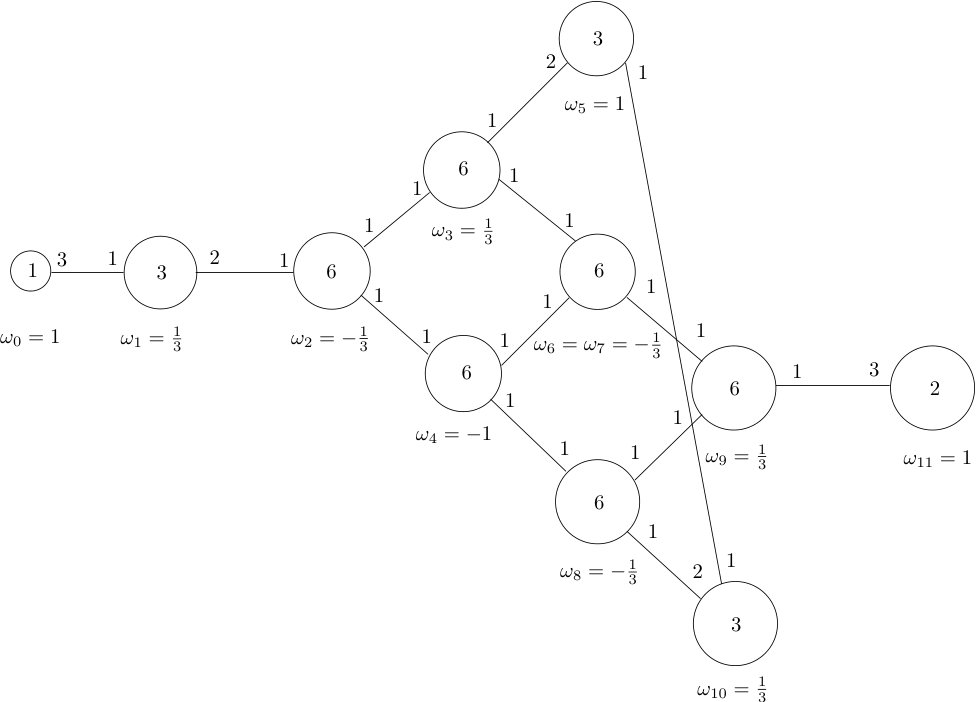 Figure 1
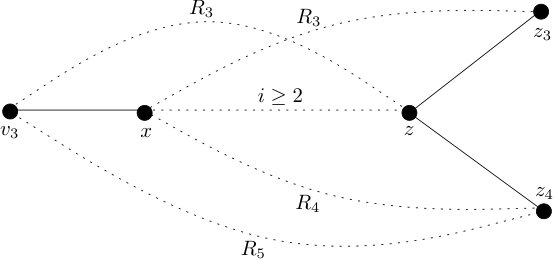 Figure 2
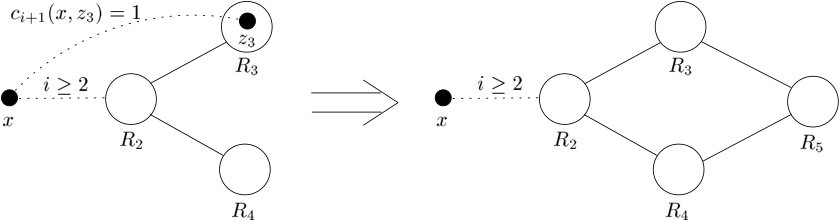 Figure 3
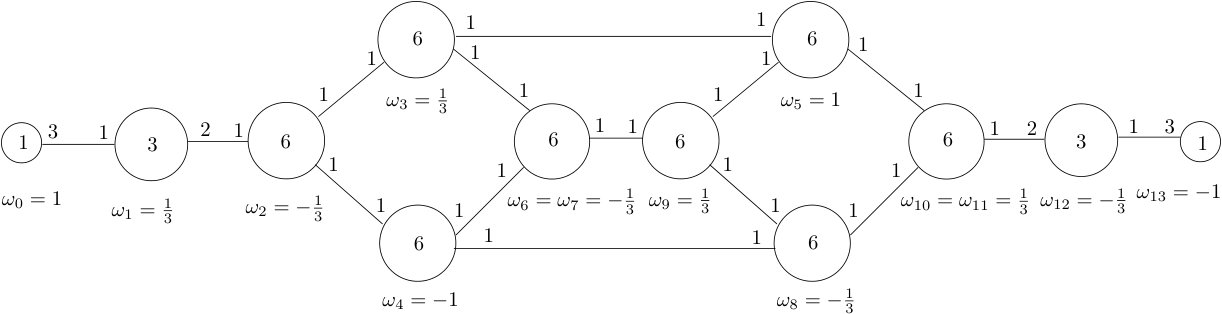 Figure 4
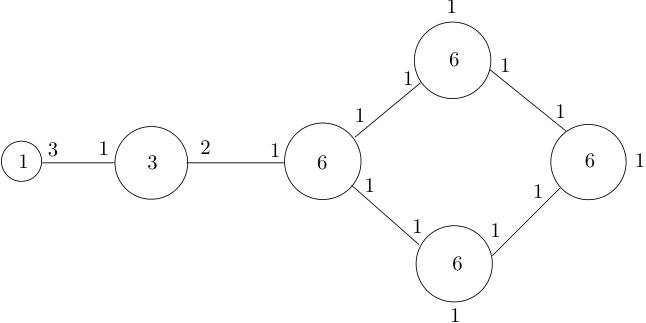 Figure 5
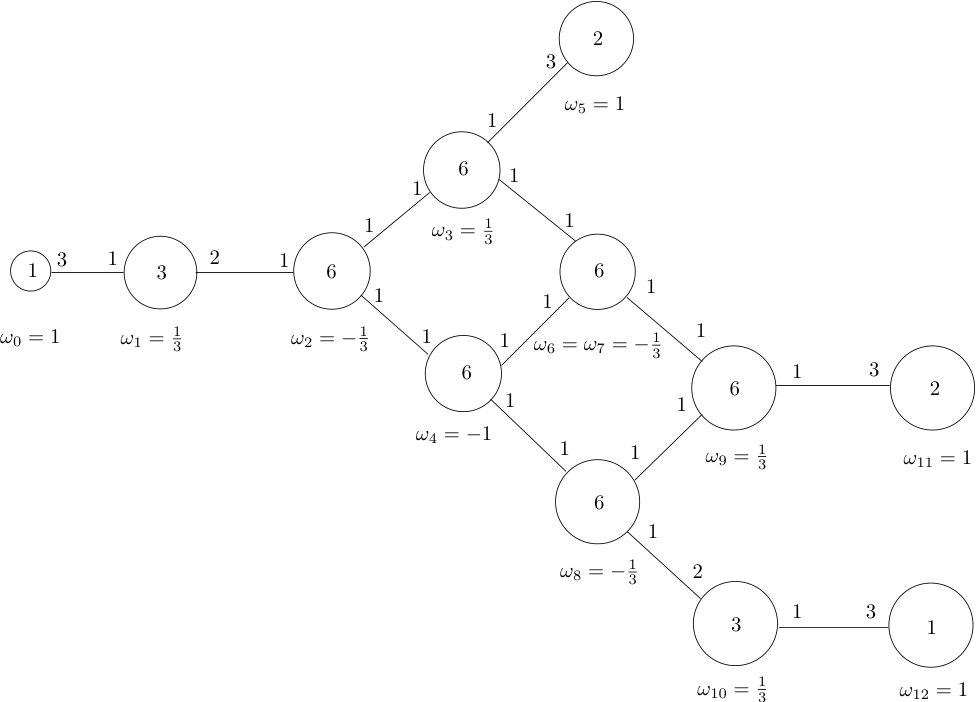 Figure 6
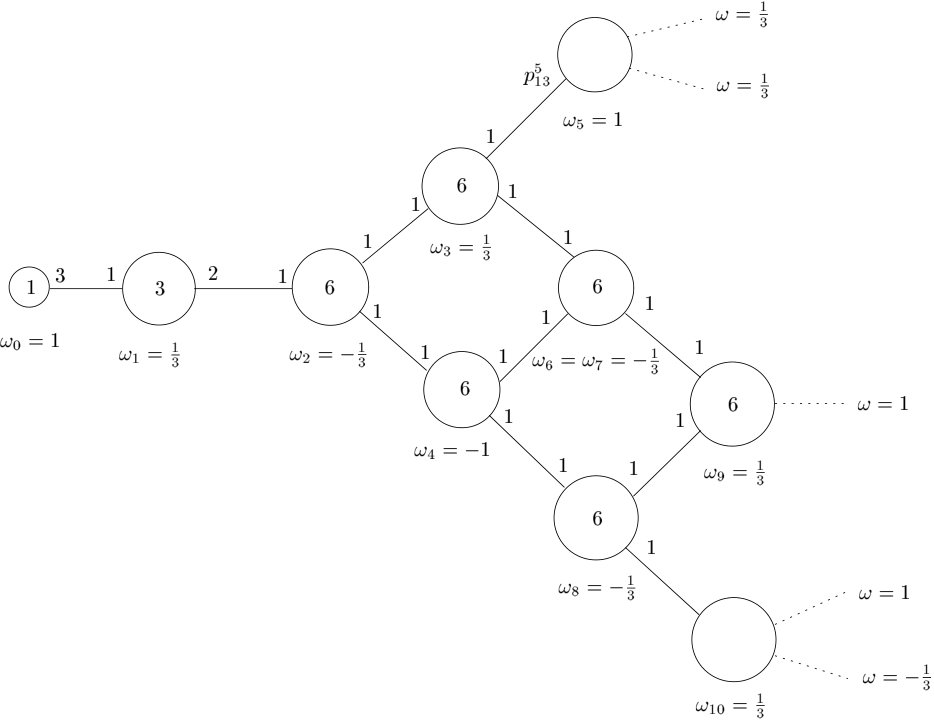 Figure 7
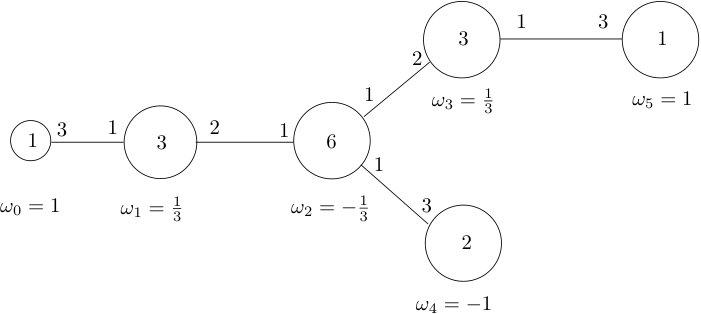 Figure 8
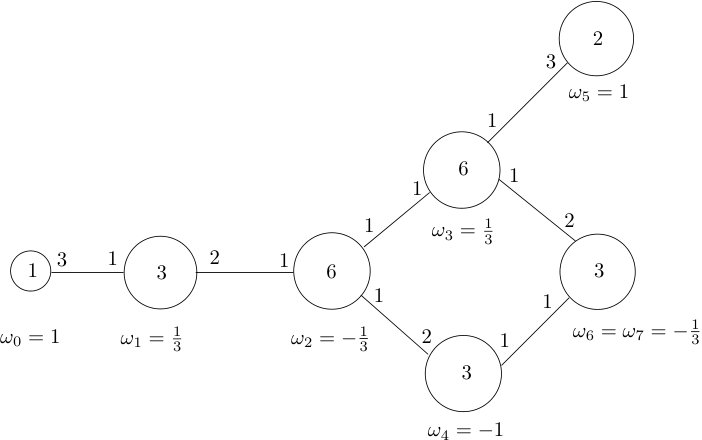 Figure 9
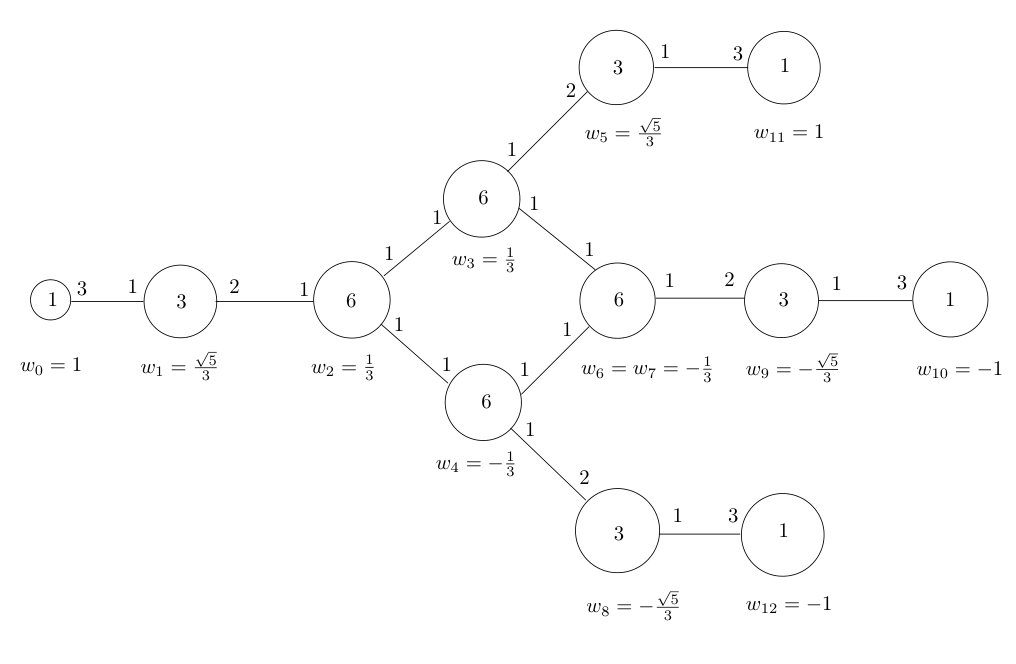 Figure 10
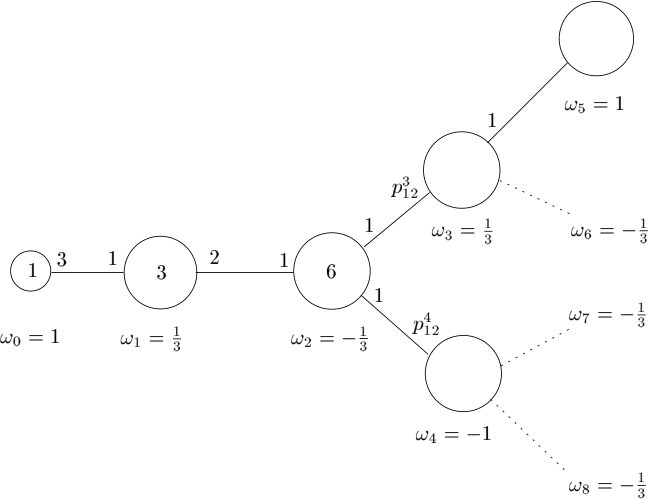 Figure 11
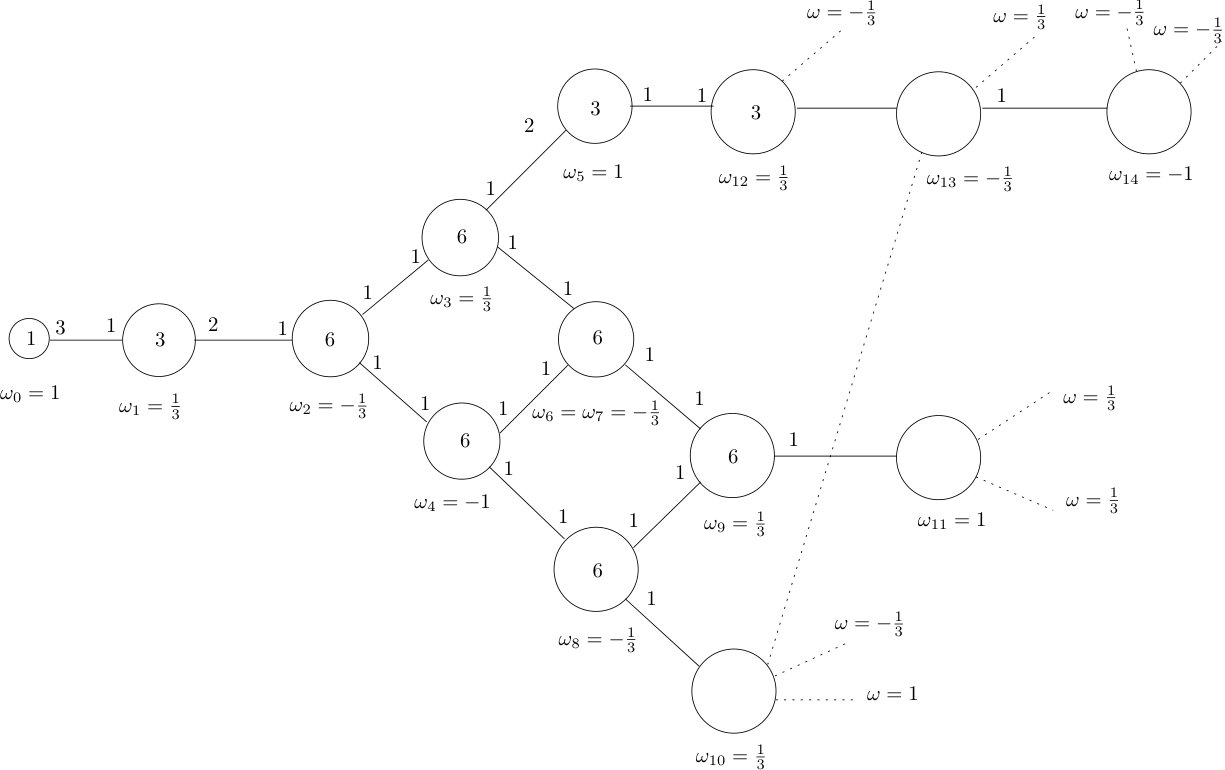 Figure 12
Peer Reviews
No public reviews on file for this paper yet. If you reviewed it on a platform where reviews are public (OpenReview, ICLR, NeurIPS, ICML), you can paste yours below so the community can read it here.
Videos
No videos yet. Explain this paper in a talk, walkthrough, or lecture? Add one.
Taxonomy
TopicsFinite Group Theory Research · Coding theory and cryptography · graph theory and CDMA systems
Partially metric association schemes with a multiplicity three
Edwin R. van Dam
Department of Econometrics and O.R., Tilburg University, the Netherlands
,
Jack H. Koolen
School of Mathematical Sciences, University of Science and Technology of China and Wu Wen-Tsun Key Laboratory of Mathematics, Chinese Academy of Sciences, Anhui, P.R. China
and
Jongyook Park
School of Computational Sciences, Korea Institute for Advanced Study, Seoul, Republic of Korea
Abstract.
An association scheme is called partially metric if it has a connected relation whose distance-two relation is also a relation of the scheme. In this paper we determine the symmetric partially metric association schemes with a multiplicity three. Besides the association schemes related to regular complete -partite graphs, we obtain the association schemes related to the Platonic solids, the bipartite double scheme of the dodecahedron, and three association schemes that are related to well-known -arc-transitive covers of the cube: the Möbius-Kantor graph, the Nauru graph, and the Foster graph F048A. In order to obtain this result, we also determine the symmetric association schemes with a multiplicity three and a connected relation with valency three. Moreover, we construct an infinite family of cubic arc-transitive -walk-regular graphs with an eigenvalue with multiplicity three that give rise to non-commutative association schemes with a symmetric relation of valency three and an eigenvalue with multiplicity three.
Key words and phrases:
association scheme, -walk-regular graph, small multiplicity, distance-regular graph, cover of the cube
2010 Mathematics Subject Classification:
05E30, 05C50
1. Introduction
Bannai and Bannai [3] showed that the association scheme of the complete graph on four vertices is the only primitive symmetric association scheme with a multiplicity equal to three. They also posed the problem of determining all such imprimitive symmetric association schemes. As many product constructions can give rise to such schemes with a multiplicity three, we suggest and solve a more restricted problem. Indeed, we will determine the symmetric partially metric association schemes with a multiplicity three, where an association scheme is called partially metric if it has a connected relation whose distance-two relation is also a relation of the scheme. Besides the association schemes related to regular complete -partite graphs, we obtain the association schemes related to the Platonic solids, the bipartite double scheme of the dodecahedron, and three association schemes that are related to well-known -arc-transitive covers of the cube: the Möbius-Kantor graph, the Nauru graph, and the Foster graph F048A. In order to obtain this classification, we also determine the symmetric association schemes with a multiplicity three and a connected relation with valency three and build on work by Cámara and the authors on -walk-regular graphs [6]. We furthermore construct an infinite family of cubic arc-transitive -walk-regular graphs with an eigenvalue with multiplicity three that give rise to non-commutative association schemes with a symmetric relation of valency three and an eigenvalue with multiplicity three. The latter indicates that the considered problem is completely different for non-symmetric association schemes and that it may be difficult to classify the cubic -walk-regular graphs with a multiplicity three.
Related work has been done by Yamazaki [23], who showed that if a symmetric association scheme has a connected relation with valency three, then this relation is bipartite or distance-regular. Hirasaka [17] classified the primitive commutative association schemes with a non-symmetric relation of valency three. Distance-regular graphs with a small multiplicity have also been classified; those with multiplicity three are the graphs of the five Platonic solids and the regular complete -partite graphs. For this and several other results on multiplicities of distance-regular graphs, we refer to [9, § 14]. See also the expository paper by Bannai [2] on among others the classification problem of association schemes.
This paper is organized as follows: after this introduction, we give definitions and our main tools in Section 2. In particular, we will use a generalization of Godsil’s multiplicity bound [13, Thm. 1.1] (Section 2.4), a generalization of the concept of a light tail introduced by Jurišić, Terwilliger, and Žitnik [18] (Section 2.7), and a lemma by Yamazaki [23] (Section 2.8). In Section 3, we describe the relevant association schemes and show uniqueness or non-existence of the schemes that occur in Section 4 in the proof of the classification result of association schemes with a valency three and a multiplicity three. In Section 5, we obtain the final classification result of partially metric association schemes with a multiplicity three. Finally, in Section 6, we construct an infinite family of cubic arc-transitive -walk-regular graphs with an eigenvalue with multiplicity three that give rise to non-commutative association schemes.
2. Definitions and tools
In this section we shall introduce notation, concepts, and useful tools that we shall use in the remainder of the paper.
2.1. Graphs
Let be a (simple and undirected) graph with vertex set . The distance between two vertices is the length of a shortest path connecting and . The maximum distance between two vertices in is the diameter . We use for the set of vertices at distance from and write, for the sake of simplicity, . The degree of is the number of vertices adjacent to it. A graph is regular with valency if the degree of each of its vertices is .
For a graph with diameter , the distance- graph of is the graph whose vertices are those of and whose edges are the pairs of vertices at mutual distance in . In particular, . The distance- matrix of is the matrix whose rows and columns are indexed by the vertices of and the -entry is whenever and [math] otherwise111Note that we do not use the notation for the distance- matrix in order to avoid confusion with the relation matrix of an association scheme; see Section 2.3. The adjacency matrix of equals and the eigenvalues of the graph are those of . The multiplicity of an eigenvalue of is denoted by . Let be the distinct eigenvalues of . Then the minimal graph idempotent for is defined by , i.e., this is the matrix representing the projection onto the eigenspace for . The spectral decomposition theorem leads immediately to
[TABLE]
for every integer .
2.2. Walk-regularity
A connected graph is -walk-regular if the number of walks of every given length between two vertices only depends on the distance between them, provided that (where it is implicitly assumed that the diameter of the graph is at least ). From (1), we obtain that a connected graph is -walk-regular if and only if for every minimal graph idempotent the -entry only depends on , provided that the latter is at most (see Dalfó, Fiol, and Garriga [8]). In other words, for a fixed minimal graph idempotent for , there exist constants , for , such that , where is the entrywise product.
Given a vertex in a graph and vertex at distance from , we consider the numbers , , and . A connected graph with diameter is distance-regular if these parameters do not depend on and , but only on , for . If this is the case then these numbers are denoted simply by , , and , for , and they are called the intersection numbers of . Also, if a connected graph is -walk-regular, then the intersection numbers of are well-defined for (see Dalfó et al. [7, Prop. 3.15]).
2.3. Association schemes
Let be a finite set, say with elements. An association scheme with rank on is a pair such that
- (i)
is a partition of , 2. (ii)
, 3. (iii)
for each , i.e., if then , 4. (iv)
there are numbers — the intersection numbers of — for , such that for every pair the number of with and equals .
In the literature, more general definitions of association schemes are available. We will use these also in Section 6. In particular, we will refer to them as non-symmetric association schemes when not all relations are symmetric (in this case (iii) is replaced by for some ). A non-symmetric association scheme can even be non-commutative in the sense that for some . Association schemes in this broader sense are generalizations of so-called “Schurian schemes” that arise naturally from the action of a finite transitive group on ; the orbitals (the orbits on ) of such a group action form the relations of a (possibly non-commutative or non-symmetric) association scheme.
From now on, we will however assume that association schemes are symmetric (as in the above definition), unless we specify explicitly that it is non-symmetric or non-commutative.
The elements of are called the relations of . For each , the relation can be interpreted as a graph with vertex set if we call two vertices and adjacent whenever . We call the scheme graph of , that is regular with valency . The corresponding adjacency matrix is called the relation matrix of , for , and we let be the relation matrix of . It is easy to see that the conditions (i)-(iv) are equivalent to conditions (i)’-(iv)’ on the relation matrices:
- (i)’
, where is the all-one matrix, 2. (ii)’
, where is the identity matrix, 3. (iii)’
for all , 4. (iv)’
.
The Bose-Mesner algebra of is the matrix algebra generated by . From (iv)’ we see that is a basis of and hence is -dimensional. Note that the Bose-Mesner algebra is closed under both ordinary multiplication and entrywise multiplication . From (iii)’ and (iv)’, it follows that the relation matrices commute, and hence all the matrices in are simultaneously diagonalizable. It follows that has a basis of minimal scheme idempotents , which we can order such that is the all-ones matrix . The rank of is denoted by and is called the multiplicity of , for .
Now the Bose-Mesner algebra has two bases and we can express each basis in terms of the other. Define constants and by
[TABLE]
Note that . From (2), we have
[TABLE]
hence the numbers are called the eigenvalues of . In this paper, we shall mainly focus on the eigenvalues of the scheme graph of . In this case we call the corresponding eigenvalue on and it is denoted by , i.e., . Note that these eigenvalues need not be distinct, for example in the Johnson scheme defined on the triples of a -set, the relation defined by “intersecting in point” has this property (because it is strongly regular in an association scheme with rank ).
Since the minimal scheme idempotents form a basis of , we have
[TABLE]
for certain real numbers () that are called Krein parameters. The Krein parameters are nonnegative and , where is whenever and [math] otherwise. From (2), we also have
[TABLE]
It follows that for all . For , let . We call these numbers the cosines corresponding to , and note that . From (3) and (5), it follows that if , then
[TABLE]
where (here and elsewhere) .
From a standard property of the entries of , see [5, Lemma 2.2.1.(iv)], we obtain that
[TABLE]
For more background on association schemes, see [4], [5, Ch. 2], and [19].
2.4. Partially metric association schemes and Godsil’s bound
An association scheme with rank is called -partially metric (with respect to the connected relation ) if — possibly after reordering of the relations — is a polynomial of degree in for , where is the relation matrix of (where implicitly it is assumed that ). This is equivalent to being the distance- graph of the scheme graph of for . Note that the distance- graph of a scheme graph is always a union of relations . The scheme is called metric if it is -partially metric; in this case is a distance-regular graph. For the sake of readability, we will assume in the remainder of the paper that for a partially -metric scheme, the relations are ordered according to distance, up to distance (as in the above definition), unless specified differently. We note that a -partially metric scheme is clearly also -partially metric for . Every association scheme with at least one connected relation is -partially metric; we therefore call an association scheme partially metric if it is at least -partially metric. To ensure that every metric association scheme is also partially metric, we also say that an association scheme with rank (where there is no distance- relation) is partially metric. We finally note that the concept of -partially metric can be extended to non-symmetric schemes with respect to a symmetric relation. Such -partially metric (possibly non-symmetric) schemes would arise naturally from -arc-transitive graphs, for example; see also Section 6.
If the association scheme is -partially metric, then the corresponding scheme graph of is called a -partially metric scheme graph. This scheme graph is -partially distance-regular in the sense of [7], and even stronger, it is -walk-regular. Thus, the intersection numbers of are well-defined for . In this case we have and for , and , and , where is the valency of . An illustrating example of a -partially metric scheme graph is given by the so-called flag graph of the -point biplane; see Figure 1 in [6] or [7] for the corresponding “relation-distribution diagram”. Such a diagram is similar as the distance-distribution diagram of a distance-regular graph. The relation-distribution diagram of an association scheme with respect to a scheme graph has a “bubble” for each relation , inside of which we depict , and we connect the bubble of by an edge to the bubble of if , and depict this intersection number on top of the edge; see for example Figure 3.
From (6), we now obtain that
[TABLE]
where are the cosines corresponding to a minimal scheme idempotent for corresponding eigenvalue . It follows in particular that if , then
[TABLE]
As an immediate consequence of [6, Thm. 4.3], we find the following generalization of Godsil’s bound [13, Thm. 1.1].
Theorem 2.1**.**
Let be a partially metric association scheme and assume that the corresponding scheme graph has valency . Let be a minimal scheme idempotent of with multiplicity for corresponding eigenvalue . If is not complete multipartite, then .
This result implies that if then . For , we only have the polygons and they have multiplicity for all minimal scheme idempotents except those for corresponding eigenvalue . If is complete multipartite, then . In this case, it follows that if , then multiplicity only occurs for the complete tripartite graphs, and multiplicity only occurs for eigenvalue of the complete bipartite graphs. Multiplicity occurs only for the complete -partite graphs and the complete tripartite cocktail party graph, also known as the octahedron.
2.5. Product schemes and the bipartite double
Let be an association scheme with rank and relation matrices for , and let be an association scheme with rank with relation matrices for . The direct product of and is the association scheme with relation matrices for and . It is easy to see that the minimal idempotents of this direct product scheme are also all possible Kronecker products of the minimal idempotents of and ; see also [1, Chapter 3]. Starting from an association scheme with a multiplicity three, one can construct other association schemes with a multiplicity three by taking the direct product of with any other scheme. Also other kinds of product constructions for association schemes are possible, giving rise to many association schemes with a multiplicity three, and suggesting that classifying all association schemes with a multiplicity three may be impossible. Likewise, multiplicity two may be too hard, although in this case our result in [6, Prop. 6.5] should be useful.
The bipartite double scheme of is the direct product of and the rank two association scheme on two vertices. In this way, every minimal idempotent of with multiplicity corresponds to two minimal idempotents of with multiplicity . For a connected graph with vertex set , the bipartite double of is the graph whose vertices are the symbols and where is adjacent to if and only of is adjacent to in . If is the scheme graph of a relation in , then the bipartite double of is a scheme graph in the bipartite double scheme .
If is -partially metric with corresponding scheme graph having odd-girth at least , then the bipartite double of is also -partially metric. This result follows from the arguments given in the proof of the analogous result for -walk-regular graphs in [6, Prop. 3.1].
2.6. Quotient schemes and covers
An association scheme is called imprimitive if a non-trivial union of some of the relations is an equivalence relation. In this case, there is a subscheme on each of the equivalence classes, and a quotient scheme on the set of equivalence classes. The original scheme is called a cover of the quotient scheme. The intersection numbers and Krein parameters of the subschemes and the quotient scheme follow from those of the original scheme. Like all direct product schemes, the bipartite double scheme is an example of an imprimitive association scheme; it is a double cover of . For details, we refer the reader to [4, § 2.9], [5, § 2.4], or [10].
A particular way to construct covers of graphs is by using voltage graphs. Let be a graph and let be a group. Let be the set of arcs of (for every edge , there are two opposite arcs: and ). A map such that for every edge is called a voltage assignment, and is called a voltage graph. The derived graph of this voltage graph is a cover of ; it has vertex set , and if is an edge in , then has edges for every . Every double cover is the derived graph of a voltage graph with group . In this case, the situation is simpler, and we can put voltages on the edges instead of the arcs. For example, the bipartite double can be obtained by putting voltage on every edge.
2.7. A light tail
Let be a partially metric association scheme and let be the relation matrix of . A minimal scheme idempotent for corresponding eigenvalue is called a light tail if the matrix is nonzero and for some real number . Thus, if , then the corresponding eigenvalue on is equal to , for all . Because is connected, this also implies that . We call the *associated matrix *for and the corresponding eigenvalue on . We call the light tail degenerate if and non-degenerate otherwise. This generalizes the concept of light tails in distance-regular graphs that was introduced by Jurišić, Terwilliger, and Žitnik [18]. Note that by (4), where is the rank of , which implies that . Because is positive semidefinite, it follows that if and only if . By Theorem 2.1 and the remarks thereafter this is equivalent to , where is the valency of . Let us now define , so that . Because is in the Bose-Mesner algebra of , there are such that for all . Similar as for minimal scheme idempotents, we call these numbers the cosines corresponding to , and we let for . Similar as (6), the following now holds for :
[TABLE]
In particular, this implies that and It moreover follows from the equation that
[TABLE]
where are the cosines corresponding to , for . Working out this equation for gives that
[TABLE]
Our generalization of light tails is motivated by the characterization of the case of equality in the following result on the multiplicities of minimal scheme idempotents. For distance-regular graphs, this bound was derived by Jurišić, Terwilliger, and Žitnik [18], and their proof can be followed almost completely.
Theorem 2.2**.**
Let be a partially metric association scheme with rank , and assume that the corresponding scheme graph has valency . Let be a minimal scheme idempotent with multiplicity for corresponding eigenvalue . Then
[TABLE]
with equality if and only if is a light tail.
Proof.
We give a sketch of the proof of the first part, as most details are the same as in the case of distance-regular graphs; see [18, Thm 3.2 and 4.1]. Let be such that . Then the bound (11) follows from applying Cauchy-Schwarz to
[TABLE]
The bound is tight if and only if and are linearly dependent, which is the case if and only if is the same for all such that , in other words, if and only if is a light tail. ∎
2.8. Yamazaki’s lemma
The following result was shown by Yamazaki [23] and is analogous to the result that a cubic -walk-regular graph is -walk-regular [6]. For convenience and because the terminology in [23] is different, we give a proof of this result.
Lemma 2.3**.**
(cf. [23, Lemma 2.4])* Let be an association scheme with rank . If there exists a connected relation with valency three, then is partially metric with respect to .*
Proof.
Let be the scheme graph of . Because the rank of the scheme is at least , is not the complete graph on vertices, and so . If is not a relation of the scheme, then it must be the union of two relations, and say, and then . Now let be a vertex of and let be the three neighbors of . Clearly these three are mutually at distance . Without loss of generality, we may assume that and because . But then should be contained in both and , which is a contradiction. Thus, is partially metric with respect to . ∎
The final lemma, which we shall call Yamazaki’s lemma, is also from [23]. Again, we give a proof for convenience and because of the different terminology in [23]. The result is depicted in Figure 1.
Lemma 2.4**.**
(cf. [23, Lemma 2.8])* Let be an association scheme with rank and a connected scheme graph of . Let be vertices such that and . Assume that there exist two distinct neighbors of and two distinct relations such that , , , and . Then there exists a relation such that , , and .*
Proof.
Because the association scheme is symmetric, there exist a neighbor of such that , , and . Let be the relation containing . See Figure 2 for a picture of this configuration. Then as , , and , and similarly as , , and .
In order to show that , it suffices to show that . From and , it is clear that . By symmetry and because is a union of relations of , there exists a unique vertex such that , and it follows that . But , hence . ∎
3. Uniqueness and non-existence of the relevant association schemes
In this section, we will discuss some of the relevant association schemes having a multiplicity three that occur in the proof of the classification result in Section 4.
3.1. The dodecahedron
The dodecahedron graph is a distance-regular graph with spectrum . Thus, both the corresponding metric association scheme and its bipartite double scheme have minimal scheme idempotents with a multiplicity three. Note however that the bipartite double graph does not have an eigenvalue with multiplicity three; its spectrum is . The relation-distribution diagram of the bipartite double scheme is given in Figure 3, where we also included the cosines for eigenvalue that we obtained in the proof of Theorem 4.3. We note that the bipartite double graph is also the scheme graph of a -partially metric fusion scheme of the bipartite double scheme. This scheme can be obtained by fusing three times a pair of relations (i.e., , and ; see Figure 3). However, also three pairs of idempotents are “fused”, in particular two pairs of idempotents with multiplicity three, leaving no multiplicity three in this fusion scheme.
Proposition 3.1**.**
The bipartite double of the association scheme of the dodecahedron graph is the unique association scheme with scheme graph having relation-distribution diagram as in Figure 3.
Proof.
Because has valency , the relation is clearly an equivalence relation. If we take the quotient scheme with respect to this equivalence relation, we obtain an association scheme for which the scheme graph obtained from is distance-regular with valency three and distance-distribution diagram as that of the dodecahedron; this follows from Figure 3. Because the dodecahedron and the corresponding association scheme is determined by its intersection numbers, this quotient scheme is indeed the metric association scheme of the dodecahedron. But then (the scheme graph) is a bipartite double cover of the dodecahedron, and hence it must be the bipartite double graph of the dodecahedron. Moreover, the association scheme is therefore the bipartite double scheme of the association scheme of the dodecahedron. ∎
3.2. The Möbius-Kantor graph
The Möbius-Kantor graph is the unique double cover of the cube without -cycles [5, p. 267]. It is isomorphic to the generalized Petersen graph and has spectrum . It is -arc-transitive and also known as the Foster graph F016A [22]. It generates an association scheme with scheme graph having relation-distribution diagram as in Figure 4, where also the cosines for eigenvalue are included; these cosines follow from the relation distribution diagram using (6).
Proposition 3.2**.**
The association scheme of the Möbius-Kantor graph is the unique association scheme with scheme graph having relation-distribution diagram as in Figure 4.
Proof.
Fix a vertex. Then it is easy to see that there is just one way (up to isomorphism) to build the graph with the given relation-distribution diagram from the perspective of the fixed vertex and using that the graph has no -cycles. The obtained graph is the Möbius-Kantor graph; clearly, the other relations of the association scheme follow from this. ∎
3.3. The Nauru graph
The Nauru graph is a triple cover of the cube. It is isomorphic to the generalized Petersen graph and has spectrum . It is -arc-transitive and also known as the Foster graph F024A [22]. It generates an association scheme with scheme graph having relation-distribution diagram as in Figure 5, where also the cosines for eigenvalue are included; again these cosines follow from the relation distribution diagram using (6).
Proposition 3.3**.**
The association scheme of the Nauru graph is the unique association scheme with scheme graph having relation-distribution diagram as in Figure 5.
Proof.
Fix a vertex . If one ignores the six edges between and , then up to isomorphism, one can build the graph with the given relation-distribution diagram (seen from the perspective of ) in a unique way (up to equivalence), using that there are no -cycles. It is easy to show that is an equivalence relation. Now fix one of the vertices . Then (again, up to equivalence) there is a unique way to determine the sets for all (i.e., there are two equivalent ways to determine and ; the rest is determined). Also observe (by considering the edges through ) that every edge is in precisely two -cycles that share no other edges. If we apply this to the edges between and , use the relation distribution with respect to (i.e., the sets ), and that there are no -cycles, then the remaining six edges of the scheme graph follow uniquely. In particular, observe that each edge between and is in one -cycle with vertices from and in one -cycle with vertices from , and the latter determines the edges between and . The obtained graph is the Nauru graph; and again, the other relations of the association scheme follow from this. ∎
3.4. The Foster graph F048A
The Foster graph F048A is a -cover of the cube, a -cover of the Möbius-Kantor graph, and a -cover of the Nauru graph. It is isomorphic to the generalized Petersen graph and has spectrum . It is -arc-transitive [22] and generates an association scheme with scheme graph having relation-distribution diagram as in Figure 6, where as before, the cosines for eigenvalue are included; once more these cosines follow from the relation distribution diagram using (6). In this association scheme, the eigenvalue [math] has two minimal scheme idempotents; these have multiplicities and .
Proposition 3.4**.**
The association scheme of the Foster graph F048A is the unique association scheme with scheme graph having relation-distribution diagram as in Figure 6.
Proof.
Let be the scheme graph of an association scheme , with relation-distribution diagram as in Figure 6. Because the valency of is , it follows that this association scheme has a quotient scheme, say, with a scheme graph having relation-distribution diagram as in Figure 5 (and let us number the relations of as in that figure). By Proposition 3.3, this quotient scheme must therefore be the association scheme of the Nauru graph. Thus, is a -cover of the Nauru graph, and it can be constructed from a voltage graph with group ; see Section 2.6. We will next show that there is essentially one way to do this. In order to do this, we will use the description of the Nauru graph as a generalized Petersen graph . This graph has vertices and with , where has neighbors , and , whereas has neighbors , and . Without loss of generality, we may put voltage [math] on the edges of a spanning tree of . The spanning tree we will use has edges for and for all .
Next, we will focus on relation of the quotient scheme. It splits into relations and in the cover scheme , where we note that is among the distance- relations, whereas is among the distance- relations. Because the three walks of length between two vertices and with should give rise to three walks of length between two vertices and with (for some ), it follows that these three walks should have the same voltage. Here the voltage of a walk is the sum of voltages over the edges in the walk. In particular, , with one of the walks between and having voltage [math] (being part of the spanning tree), which implies that also the other two walks should have voltage [math]. This implies that and have voltage [math]. Similarly, and have voltage [math].
Finally, we observe that because in the cover graph there are no -cycles, the voltage of a -cycle in the Nauru graph should be (where similar as before, the voltage of a cycle is the sum of voltages of its edges). This observation determines the voltages of all remaining edges, as one can easily see. In particular, note that every -cycle consists of consecutive adjacent vertices for some , from which it follows that the voltages of the edges , and must be . The obtained derived graph is the generalized Petersen graph , that is, the Foster graph F048A. Also here, the other relations of the association scheme follow from this. ∎
We note that this result is confirmed by considering the subscheme on one of the bipartite halves and the computational classification of association schemes with vertices by Hanaki and Miyamoto [15, 16], and by observing that such a subscheme determines the entire scheme because the girth of the scheme graph is .
3.5. A putative fission scheme for the Coxeter graph
The Coxeter graph is the unique distance-regular graph with intersection array [5, Thm. 12.3.1]. It is also known as the Foster graph F028A [22]. In the following, we will show that it is impossible to fission the distance- relation in the corresponding association scheme. The bipartite double of such a putative fission scheme occurs as one of the cases in the proof of Theorem 4.3.
Proposition 3.5**.**
There is no association scheme with scheme graph havingrelation-distribution diagram as in Figure 7 or Figure 8.
Proof.
It is easy to see that a scheme of Figure 7 must be a double cover of a scheme of Figure 8. If we fuse the relations at distance in the latter, we obtain a scheme of a distance-regular graph with intersection array . It is known that there is a unique such distance-regular graph, the Coxeter graph. Thus, the scheme graph is the Coxeter graph. Now fix a vertex in the Coxeter graph. The induced graph on the set of vertices at distance and is the disjoint union of two -cycles. It is easy to see that this makes it impossible to partition the vertices at distance into two sets of size with the intersection numbers as in Figure 8. Thus, no such association schemes exist. ∎
3.6. A putative -cover of the scheme of the Möbius-Kantor graph
Another case that appears in the proof of Theorem 4.3 is that of a putative -cover of the Möbius-Kantor graph, with relation-distribution diagram as in Figure 9. Here we will show that the related association scheme does not exist. From the intersection matrix , that is defined by , and which follows from the relation-distribution diagram, one can compute the eigenmatrix (see (2)) of the association scheme because in this case has no repeated eigenvalues. From this, all other intersection numbers, multiplicities, and Krein parameters can be computed; see for example [5, p. 46]. It turns out that some intersection numbers, such as , and several Krein parameters are negative. Moreover, some multiplicities are not integral. Our proof will avoid these computations though.
Proposition 3.6**.**
There is no association scheme with scheme graph havingrelation-distribution diagram as in Figure 9.
Proof.
From the relation-distribution diagram and (6), it follows easily that the only possible cosine sequence for eigenvalue [math] is . Alternatively, this is the only normalized eigenvector of for eigenvalue [math]. By (7), the corresponding multiplicity equals , which is not integral, so such an association scheme cannot exist. ∎
We note that this result is confirmed by considering the putative subscheme on one of the bipartite halves and the computational classification of association schemes with vertices by Hanaki and Miyamoto [15, 16].
4. Association schemes with a valency and multiplicity three
In this section we shall determine the association schemes having a connected relation with valency three and a minimal scheme idempotent with multiplicity three. In order to find this classification, we first need another lemma on a certain configuration of vertices and the corresponding cosines.
Lemma 4.1**.**
Let be a partially metric association scheme with a connected scheme graph with valency and . Let be a minimal scheme idempotent with multiplicity three and let be the corresponding eigenvalue of on . Let and be two adjacent vertices in , let be the other two neighbors of , and be the other two neighbors of . Fix another vertex , and let and be the respective cosines corresponding to . Then
[TABLE]
Proof.
Because and the multiplicity equals , it follows that . In order to calculate the cosines corresponding to , we will use the following well-known approach. Because has rank , it can be written as , where is an matrix with columns forming an orthonormal basis of the eigenspace of for its eigenvalue , with being the number of vertices of . For every vertex of we denote by the row of that corresponds to , normalized to length . Now the inner product is equal to .
Now, let be the orthogonal complement (in ) of the subspace spanned by and . The latter two vectors are linearly independent because and is adjacent to , and hence is -dimensional. From the equations and , it follows that is in . Similarly, is in . It is also easily shown that , and hence it follows that . By taking the inner product with , it thus follows that .
On the other hand, from (evaluated at ), we find that . By combining the two obtained equations we now find the required equation for and . ∎
By Lemma 2.3, an association scheme is partially metric if it has a connected relation with valency three. We will now show that if in addition it has a minimal scheme idempotent with multiplicity three, then the corresponding eigenvalue is or .
Proposition 4.2**.**
Let be an association scheme with rank and with a connected scheme graph with valency . Let be a minimal scheme idempotent with multiplicity three and let be the corresponding eigenvalue of on . Then . Moreover, if , then .
Proof.
Again, because and the multiplicity equals , it is clear that . By Lemma 2.3, is partially metric with respect to , the relation with scheme graph , and it follows that . Without loss of generality, we may assume that is bipartite. Indeed, if is not bipartite, then we can consider the bipartite double of which is the scheme graph of , which is also partially metric because the odd-girth of is at least (see Section 2.5), and which has minimal scheme idempotents with multiplicity three for corresponding eigenvalues and . So we assume that is bipartite.
We will now first show that or . In order to show this claim, let be a path of length in , i.e., , , and . Let be the cosines corresponding to . As is partially metric, and by (8).
Let and be the two neighbors of different from , with and for some relations . Note that , and are not necessarily distinct. However, by calculating the cosines and in terms of , we will show that and are distinct from if , which will prove that in this case . Indeed, by applying Lemma 4.1 to the adjacent vertices and their neighbors, we find that . Working this out in terms of gives (without loss of generality) that
[TABLE]
and
[TABLE]
Now it easily follows that if or , then , which shows the claim. Note also that , and hence , because .
Next, let us assume that . We next claim that also or . In order to prove this claim, we consider the neighbors of and . Note that and are at distance from as . Let and be the two neighbors of different from , and similarly let and be the two neighbors of different from . We assume that for some relations , for . Our aim is to show that for if . In order to do this, we again calculate the corresponding cosines in terms of , using Lemma 4.1. Indeed, this gives that . Together with (12) and (13), it follows (without loss of generality) that
[TABLE]
and
[TABLE]
Similarly, we obtain that
[TABLE]
and
[TABLE]
Again, it easily follows that for if , which indeed shows the claim that or .
We now first observe that is a light tail according to Theorem 2.2 because and , and hence we have equality in (11). Let be the associated matrix for for corresponding eigenvalue , i.e., , and let be the cosines corresponding to . Then by (10) and for by (9).
Assume now that . We continue with the above configuration of vertices. By Yamazaki’s lemma 2.4 we then know that or . We will first show that . Indeed, assume that has a neighbor such that . Besides and , has one more neighbor, say, with for some relation . From , we obtain that , which implies that
[TABLE]
From , we obtain that . By substituting and for into this equation, and then (12), (13), (14), and (15), we obtain that222We used Mathematica to work this out
[TABLE]
Thus, . However, because these eigenvalues are not integral, as algebraic conjugates they must both be eigenvalues of . But , and so it cannot be an eigenvalue. Hence, by contradiction, , and it follows that .
Finally, we consider the neighbors of . Similar as above, we now obtain that
[TABLE]
Thus, . ∎
We are now ready to classify the association schemes having a connected relation with valency three and a minimal scheme idempotent with multiplicity three.
Theorem 4.3**.**
Let be an association scheme with rank , a connected scheme graph with valency three, and a minimal scheme idempotent with multiplicity three. Then one of the following holds:
- (i)
* and is the tetrahedron (the complete graph on vertices)* 2. (ii)
* and is the cube,* 3. (iii)
* and is the Möbius-Kantor graph,* 4. (iv)
* and is the Nauru graph,* 5. (v)
* and is the Foster graph F048A,* 6. (vi)
* and is the dodecahedron,* 7. (vii)
* and is the bipartite double of the dodecahedron.*
Moreover, the association scheme is uniquely determined by . In all cases, except (vii), this is the association scheme that is generated333That is, the association scheme of minimal rank that has as a scheme graph by . In case (vii), the association scheme is the bipartite double scheme of the association scheme of case (vi).
Proof.
Let be the minimal scheme idempotent with multiplicity , for eigenvalue .
(1)The tetrahedron. If the rank of is , then is the complete graph on vertices, and we have case (i).
So from now on, we may assume that the rank is at least , and hence Proposition 4.2 applies, and . As in the proof of Proposition 4.2, it follows that is partially metric with respect to and . Likewise, by considering the bipartite double scheme, we may first restrict ourselves to determining the bipartite graphs and corresponding association schemes, but then we also have to check afterwards which association schemes could have as their bipartite double.
(2)The cube. So we assume that is bipartite. First, note that if , then must be the complete bipartite graph , but the corresponding scheme does not have an idempotent with multiplicity three. Secondly, if , then it is easily found that must be the cube. The corresponding rank scheme indeed has two minimal scheme idempotents with multiplicity three (for ). The only scheme having this scheme as its bipartite double is the scheme of the complete graph on vertices, and hence we obtain cases (i) and (ii).
For the remaining cases, we may assume that .
(3)Eigenvalue ; the dodecahedron. We first consider the case ; without loss of generality we assume that . For this case, we consider the configuration of vertices and the notation in the proof of Proposition 4.2. We thus find the following cosines: , , , , , and . It also follows that , , and similarly .
We claim now that Figure 3 shows the relation-distribution of . Indeed, the distribution up to distance is clear. In order to show the remainder of the distribution, we first observe that because , it follows that by Yamazaki’s lemma 2.4. Because and , it follows that . Let be the (remaining) relation , at distance , such that . Note that this is not the relation in the proof of Proposition 4.2. Then it follows from (6) (with ) that . Next, we will show that . Indeed, suppose that . Then by Yamazaki’s lemma 2.4, it follows that . However, by applying Lemma 4.1 to the adjacent vertices and and their neighbors, the cosines444By the cosine of a vertex we mean the cosine for the remaining two neighbors of are , which equal and , and one of these should be , which is a contradiction. These cosines also show that , and hence it follows indeed that . Similarly, we obtain that . We now have the distribution up to distance , and observe that . The latter implies that for all . Using this, the remainder of the distribution follows (as shown in Figure 3). By Proposition 3.1, we obtain the bipartite double scheme of the metric association scheme of the dodecahedron, and we have case (vii). Moreover, the only association scheme with this bipartite double is the scheme of the dodecahedron, which gives case (vi).
(4)Eigenvalue . Next, we consider the case ; again without loss of generality we assume that . Recall that we assumed that . We again consider the configuration of vertices as in the proof of Proposition 4.2, up to , and find that , and (from (12)-(14) and further). Thus, it is possible that , and are not distinct. We thus have the partial relation-distribution diagram as in Figure 10, where or .
(4.1)The Möbius-Kantor graph. Let us first consider the case that , i.e., . Then . We claim that in this case, we only have the Möbius-Kantor graph, with relation-distribution diagram as in Figure 4.
Indeed, if , then or should be equal to by Yamazaki’s lemma 2.4, but and , so we have a contradiction. If , then without loss of generality . Now , hence for all and at distance . In particular, it follows that . Because and , it follows that and . But now by (6), and again we have a contradiction. Thus, and hence . Now for all and at distance , which again implies that for all and at distance . In particular, we obtain that , and it then follows that with . We therefore indeed obtain the relation-distribution diagram of Figure 4. By Proposition 3.2, we obtain the association scheme of the Möbius-Kantor graph and we have case (iii). We also note that the obtained scheme is not the bipartite double of any scheme.
(4.2)The Nauru graph. Next, we consider the case that , hence , and . By Yamazaki’s lemma 2.4, we now obtain (without loss of generality) that , and hence that . Let us first consider the case that . Then , , which also implies that , , and . We now claim that in this case, we only have the Nauru graph, with relation-distribution diagram as in Figure 5.
To show this claim, we observe that it follows from Yamazaki’s lemma 2.4 that . If , then and there is a relation, say, among the “distance -relations”, such that . Then by (6). Because for all and at distance , it follows that for all and at distance , hence and . However, now by (6), which gives a contradiction. Thus, , and hence , and we indeed obtain the relation-distribution diagram as in Figure 5. By Proposition 3.3, we thus obtain the association scheme of the Nauru graph and we have case (iv). Again, we note that this scheme is not the bipartite double of any scheme.
(4.3)Girth . What remains is the case that both and . In this case it follows without loss of generality from Yamazaki’s lemma 2.4 that , so that the girth of is . We will now first show that the partial relation-distribution diagram is as in Figure 11. Indeed, in this case has at least one neighbor with cosine and at least one neighbor with cosine . By (6), the missing neighbor has cosine . Thus, , and because , it follows that , and . Thus, and the missing neighbor of is at distance from , say . In the above, we showed that . By applying Lemma 4.1 to the adjacent vertices and , and their neighbors, we find that the two remaining neighbors of have cosines . Thus, and . By Yamazaki’s lemma 2.4, it now follows that . By (6), should now also have a neighbor with cosine , so , hence and . The missing neighbor of must be at distance from , say . Thus, we find the partial relation-distribution diagram shown in Figure 11. Next, we will distinguish three cases according to the value of .
(4.3.1)A putative scheme related to the Coxeter graph. First, if , then . By Yamazaki’s lemma 2.4, it follows that and hence . Let be the missing neighbor of , with , say. Thus, , but it is clear that . By Lemma 4.1, the other two neighbors of (i.e., not ) have cosines , so and . By Yamazaki’s lemma 2.4, it follows that , and hence that . It now easily follows that we obtain the relation-distribution diagram of Figure 7. However, by Proposition 3.5 such a scheme, which is related to the Coxeter graph, does not exist.
(4.3.2)A putative -cover of the Möbius-Kantor graph. Secondly, if , then , and it follows that . Let be the missing neighbor of , with , say. Now . If moreover , then , , and , and it now easily follows that we obtain the relation-distribution diagram of Figure 9. However, by Proposition 3.6 such a scheme, whose scheme graph is a putative -cover of the Möbius-Kantor graph, does not exist. If however , then we claim that we obtain the partial relation-distribution diagram of Figure 12.
Now, let be the missing neighbor of , with , say. Thus, . Again, by Lemma 4.1, the other two neighbors of have cosines , so and . Now we easily obtain a relation with , which is among the distance- relations, and a relation with , among the distance- relations, as in Figure 12. Let be a path of length , with for . Because the girth of is , this is the unique path between and , and or . From the partial relation-distribution diagram it follows that has a neighbor such that . This implies that there are two paths of length from to , one of them being . Because , it also follows that . This implies that there must be a path , with for . This implies that , but this is impossible by Lemma 4.1. Thus, there is no association scheme with partial relation-distribution diagram of Figure 12.
(4.3.3)The Foster graph F048A. Thirdly, and finally, if , then . Again, let be the missing neighbor of , with , say, then . Let be a vertex at distance from such that . Because , it follows that (see the proof of Lemma 4.1), hence and . This implies that there are three disjoint paths of length between and , and hence and . Now is impossible by Yamazaki’s lemma 2.4, hence and we obtain the relation-distribution diagram of Figure 6. By Proposition 3.4, it follows that the association scheme is the one with scheme graph the Foster graph F048A, and we obtain case (v). Finally, we observe that this scheme is not the bipartite double of any scheme. ∎
5. Partially metric association schemes with a multiplicity three
Now we can finally give our main result, the classification of partially metric association schemes with a multiplicity three.
Theorem 5.1**.**
Let be a partially metric association scheme with rank and a multiplicity three, and let be the corresponding scheme graph. Then one of the following holds:
- (i)
* and is the tetrahedron (the complete graph on vertices),* 2. (ii)
* and is the cube,* 3. (iii)
* and is the Möbius-Kantor graph,* 4. (iv)
* and is the Nauru graph,* 5. (v)
* and is the Foster graph F048A,* 6. (vi)
* and is the dodecahedron,* 7. (vii)
* and is the bipartite double of the dodecahedron,* 8. (viii)
* and is the icosahedron,* 9. (ix)
* and is the octahedron,* 10. (x)
* and is a regular complete -partite graph.*
Moreover, the association scheme is uniquely determined by . In all cases, except (vii), this is the association scheme that is generated by . In case (vii), the association scheme is the bipartite double scheme of the association scheme of case (vi).
Proof.
If is complete multipartite, then has rank three, and we can easily see that is the octahedron () or a regular complete -partite graph, and we obtain cases (ix) and (x). Now, let us assume that is not complete multipartite, with valency .
Let be the adjacency matrix of and let be the minimal scheme idempotent with multiplicity three for corresponding eigenvalue . Because is not complete multipartite, Theorem 2.1 implies that . Note also that because is not complete.
If , then is a cycle, but then the corresponding scheme does not have a multiplicity three. Thus, . If , then we have one of the cases (i)-(vii) by Theorem 4.3. If , then by [6, Lemma 6.7].
We first assume that . Then is either or . If , then is locally a disjoint union of two edges and . Because is an eigenvalue of every local graph of by [6, Prop. 5.2], it follows that . Now equality holds in (11), and hence is a light tail. If is the corresponding eigenvalue on the associated matrix for the light tail , then it follows from (10) that . But this is impossible because every eigenvalue of must be an algebraic integer.
If , then is locally a quadrangle and hence it is the octahedron. The octahedron is a complete multipartite graph however, which we excluded in this part of the proof (still it occurs as case (ix), of course).
Finally, we assume that . Then because must be even. So is locally a pentagon and this shows that is the icosahedron (see [5, Prop. 1.1.4]), which is a distance-regular graph with spectrum . Theorem 2.1 implies that every minimal scheme idempotent of has multiplicity at least three for corresponding eigenvalue if . This implies that we cannot split the idempotent with multiplicity , which shows that the association scheme is also uniquely determined by in this final case (viii). ∎
We note that the bipartite double schemes of the (metric) association schemes of the icosahedron, the octahedron, and the regular complete -partite graphs also have a multiplicity three, but these are not partially metric. Analogous to the case of the dodecahedron, the bipartite double scheme of the icosahedron does have a fusion scheme that is partially metric, but this fusion scheme does not have a multiplicity three. The bipartite double graph of the icosahedron is the incidence graph of a group divisible design with the dual property, see [20]. Among the -walk-regular graphs with fixed valency, these have a relatively small number of vertices, see [21]. The bipartite double scheme of a regular complete -partite graph is a cover of the cube in the sense that it is imprimitive with the association scheme of the cube as a quotient scheme.
6. Non-commutative association schemes from covers of the cube
In this section, we present an infinite family of arc-transitive covers of the cube with an eigenvalue with multiplicity three. By a similar result as Lemma 2.3 (see [6, Prop. 3.6]), this provides an infinite family of -walk-regular graphs with a multiplicity three, as we already announced in [6, p. 2705]. Moreover, by considering the orbitals of the corresponding automorphism groups, we obtain an infinite family of non-commutative association schemes with a symmetric relation having a multiplicity three (note that we are careful not to call this a multiplicity of the scheme). This indicates that the restriction to symmetric association schemes in the earlier sections is not without good reason.
Feng, Kwak, and Wang [11], [12, Ex. 3.1] constructed covers of the cube from voltage graphs. We will describe (and generalize somewhat) these covers by their incidence matrix as follows. Let and be such that is a multiple of . Let be the permutation matrix corresponding to a cyclic permutation of order . Then we let
[TABLE]
Proposition 6.1**.**
Let and be such that is a multiple of . Then the bipartite graph with bipartite incidence matrix is arc-transitive and it has eigenvalues with multiplicity three.
Proof.
The arc-transitivity was essentially shown by Feng and Kwak [11] by using the concept of voltage graphs. The idea is that the arc-transitivity of the cube can be “lifted” to “transitivity of the nonzero blocks in the matrix ”, which can be combined with using the cyclic group within the blocks. Note that here it is important that both and have no common divisors with , that is, and also represent cyclic permutations of order .
For the multiplicity result, we note that it is not hard to show (see [14]) that has both eigenvalues with multiplicity three if and only if has eigenvalue with multiplicity three. We thus would like to know the nullity of the matrix
[TABLE]
Using elimination and decomposition, we found that
[TABLE]
where
[TABLE]
which indeed implies that . ∎
The cases and give rise to the cube and the Nauru graph, respectively. By Theorem 4.3, all other examples give rise to non-symmetric schemes, and hence to non-commutative schemes. Indeed, if the scheme were commutative and non-symmetric, then we could consider its symmetrized scheme. Thus, we may conclude that there exists an infinite family of non-commutative association schemes with a connected and symmetric cubic relation having an eigenvalue with multiplicity three.
Acknowledgements. The authors thank Marc Cámara for his contribution in the early start of this project and doing some supporting computations. Jack H. Koolen is partially supported by the National Natural Science Foundation of China (no. 11471009 and 11671376).
The reference list from the paper itself. Each links out to its DOI / PubMed record.
- 1[1] R.A. Bailey, Association Schemes: Designed Experiments, Algebra and Combinatorics . Cambridge Univ. Press, Cambridge, 2004.
- 2[2] E. Bannai, Combinatorics as pure mathematics – aims of algebraic combinatorics, Sugaku Expositions 26 (2013), 225–246.
- 3[3] E. Bannai, E. Bannai, On primitive symmetric association schemes with m 1 = 3 subscript 𝑚 1 3 m_{1}=3 . Contrib. Discrete Math. 1 (2006), 68–79.
- 4[4] E. Bannai, T. Ito, Algebraic Combinatorics I: Association Schemes , Benjamin-Cummings, Menlo Park, 1984.
- 5[5] A.E. Brouwer, A.M. Cohen, A. Neumaier, Distance-Regular Graphs , Springer-Verlag, Berlin, 1989.
- 6[6] M. Cámara, E.R. van Dam, J.H. Koolen, J. Park, Geometric aspects of 2 2 2 -walk-regular graphs, Linear Algebra Appl. 439 (2013), 2692–2710.
- 7[7] C. Dalfó, E.R. van Dam, M.A. Fiol, E. Garriga, B.L. Gorissen, On almost distance-regular graphs, J. Combin. Theory Ser. A 118:3 (2011), 1094–1113.
- 8[8] C. Dalfó, M.A. Fiol, E. Garriga. On k 𝑘 k -walk-regular graphs, Electron. J. Combin. 16 (2009), R 47.