Using red clump stars to correct the Gaia DR1 parallaxes
Guy R. Davies, Mikkel N. Lund, Andrea Miglio, Yvonne Elsworth, James, S. Kuszlewicz, Thomas S.H. North, Ben Rendle, William J. Chaplin, Tha\'ise S., Rodrigues, Tiago L. Campante, L\'eo Girardi, Steven J. Hale, Oliver Hall,, Caitlin D. Jones, Steven D. Kawaler, Ian Roxburgh

TL;DR
This paper uses red clump stars with asteroseismic data to identify and correct systematic errors in Gaia DR1 parallaxes, especially for stars with parallaxes less than about 1.6 mas.
Contribution
It introduces a new correction method for Gaia DR1 parallaxes based on red clump stars, improving distance estimates in the Kepler field.
Findings
Gaia DR1 parallaxes have a systematic error decreasing with distance.
The proposed correction aligns Gaia distances with asteroseismic and eclipsing binary measurements.
Discrepancies remain for the open cluster M67 red clump stars.
Abstract
Recent results have suggested that there is tension between the Gaia DR1 TGAS distances and the distances obtained using luminosities determined by eclipsing binaries or asteroseismology on red giant stars. We use the -band luminosities of red clump stars, identified and characterized by asteroseismology, to make independent distance estimates. Our results suggest that Gaia TGAS distances contain a systematic error that decreases with increasing distance. We propose a correction to mitigate this offset as a function of parallax that is valid for the Kepler field and values of parallax that are less than . For parallaxes greater than this we find agreement with previously published values. We note that the TGAS distances to the red clump stars of the open cluster M67 show a high level of disagreement that is difficult to correct for.
Click any figure to enlarge with its caption.
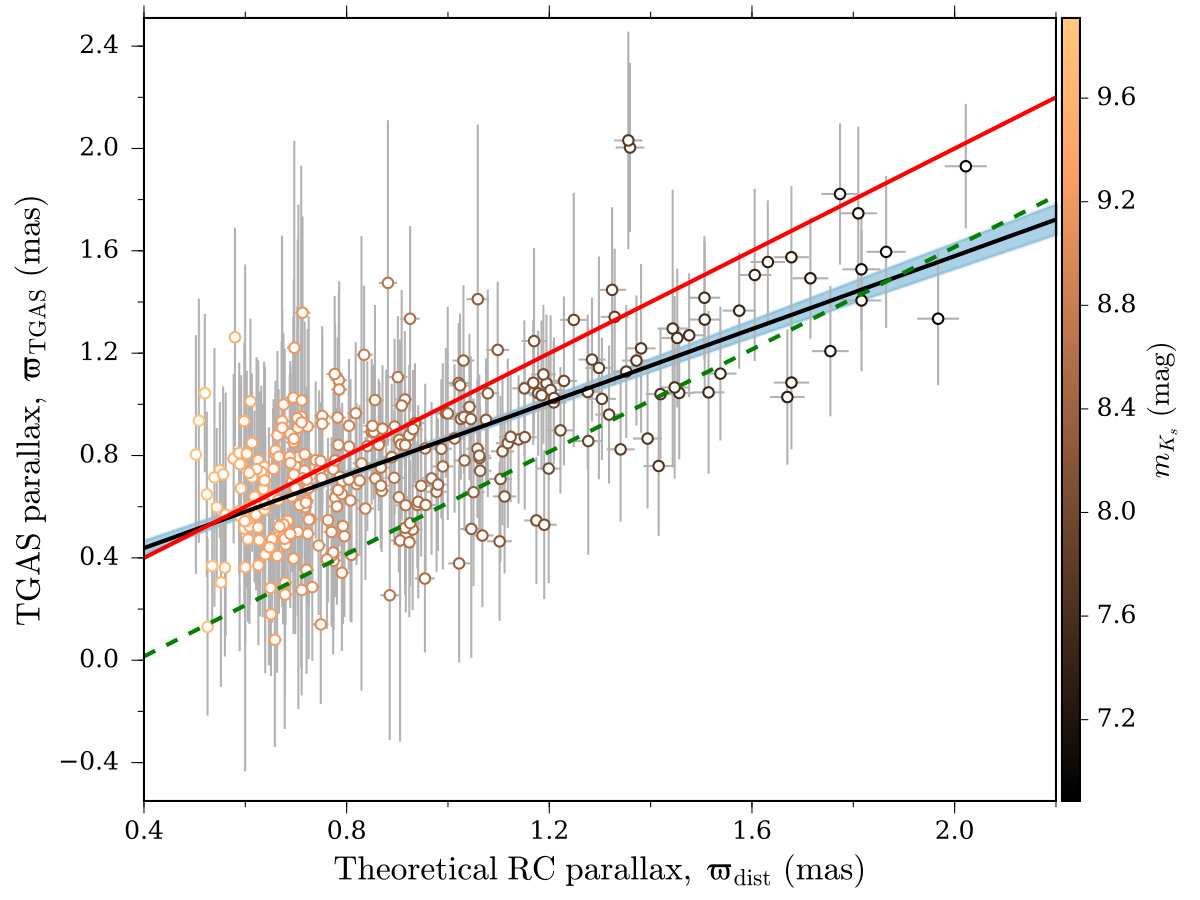 Figure 1
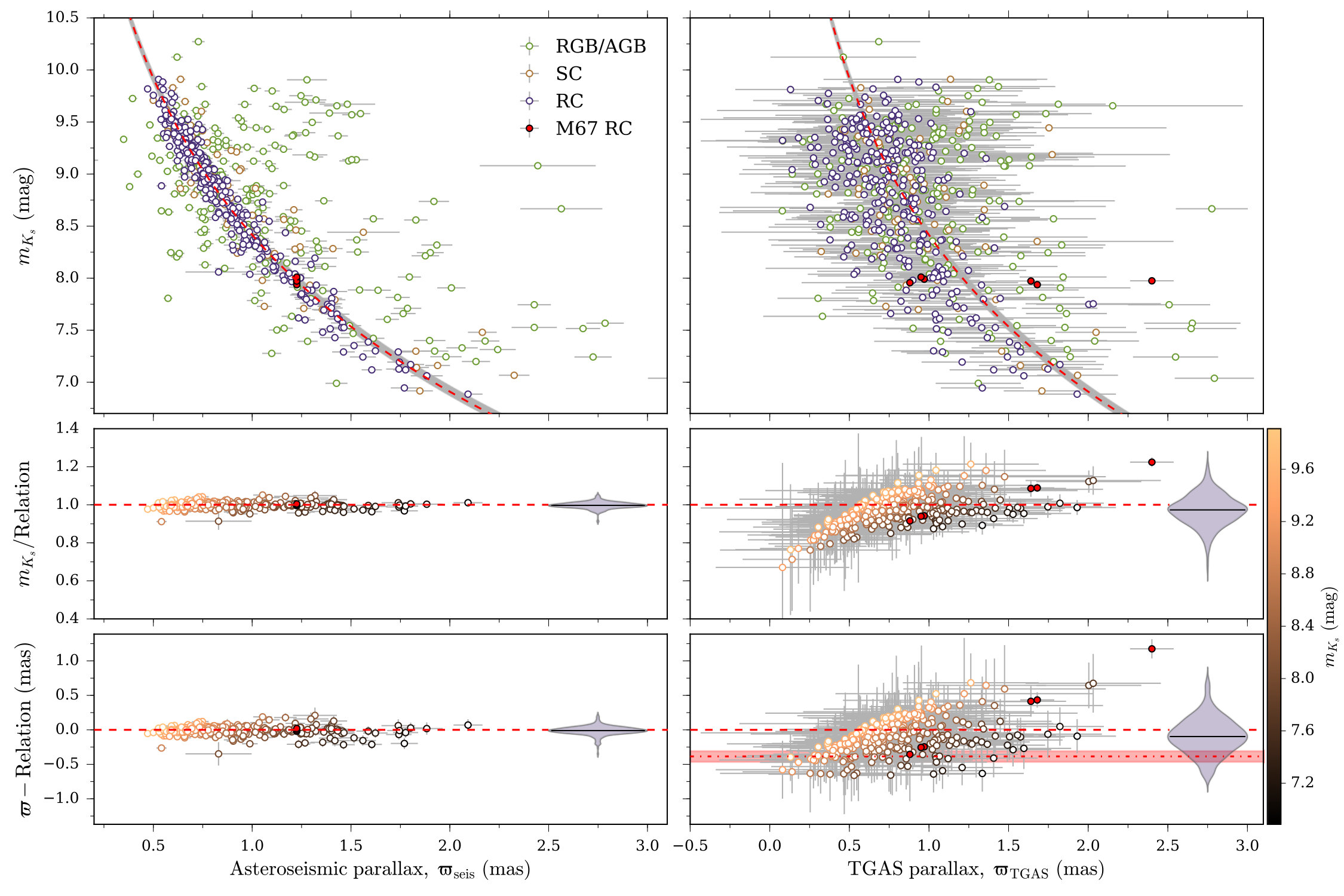 Figure 2
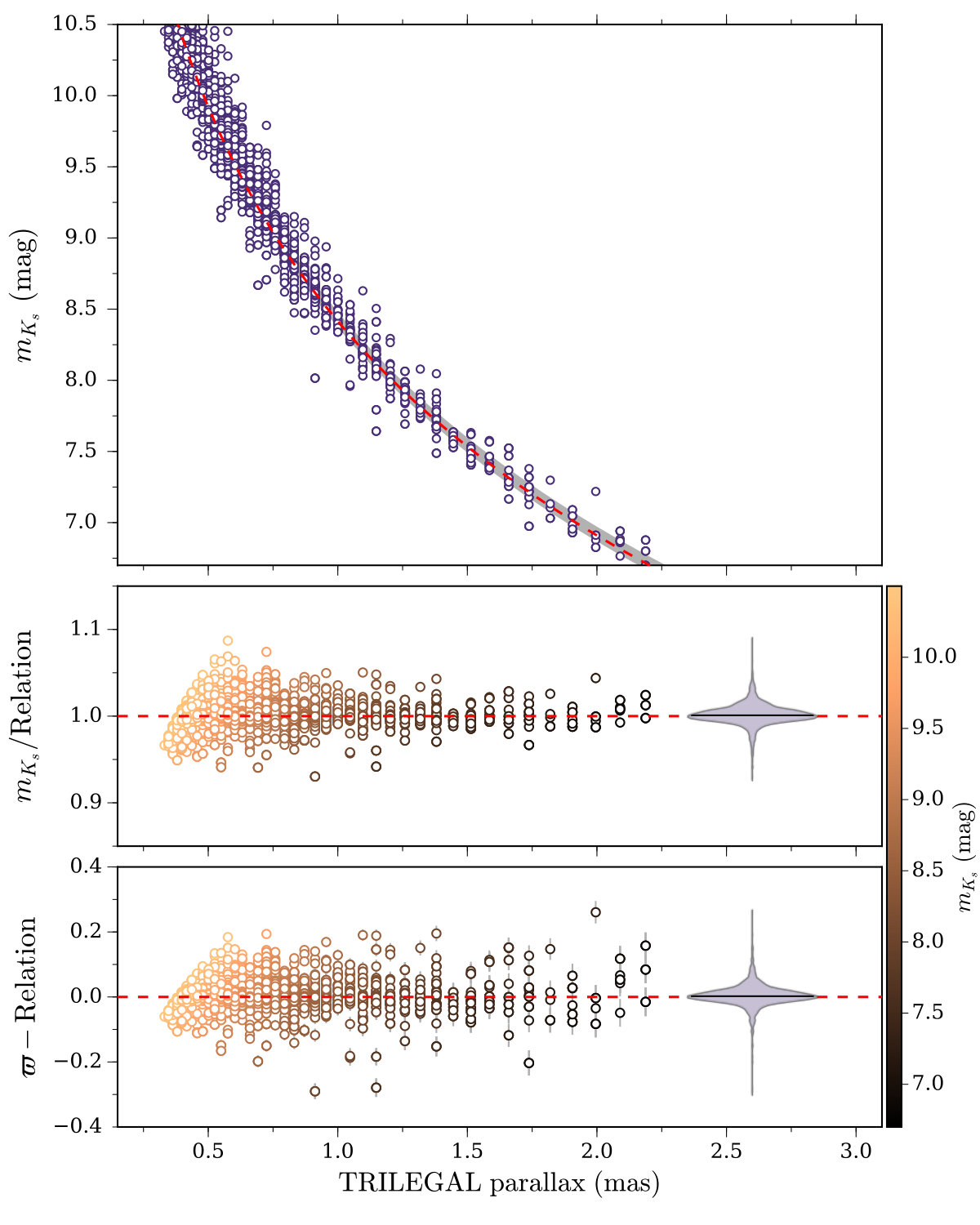 Figure 3
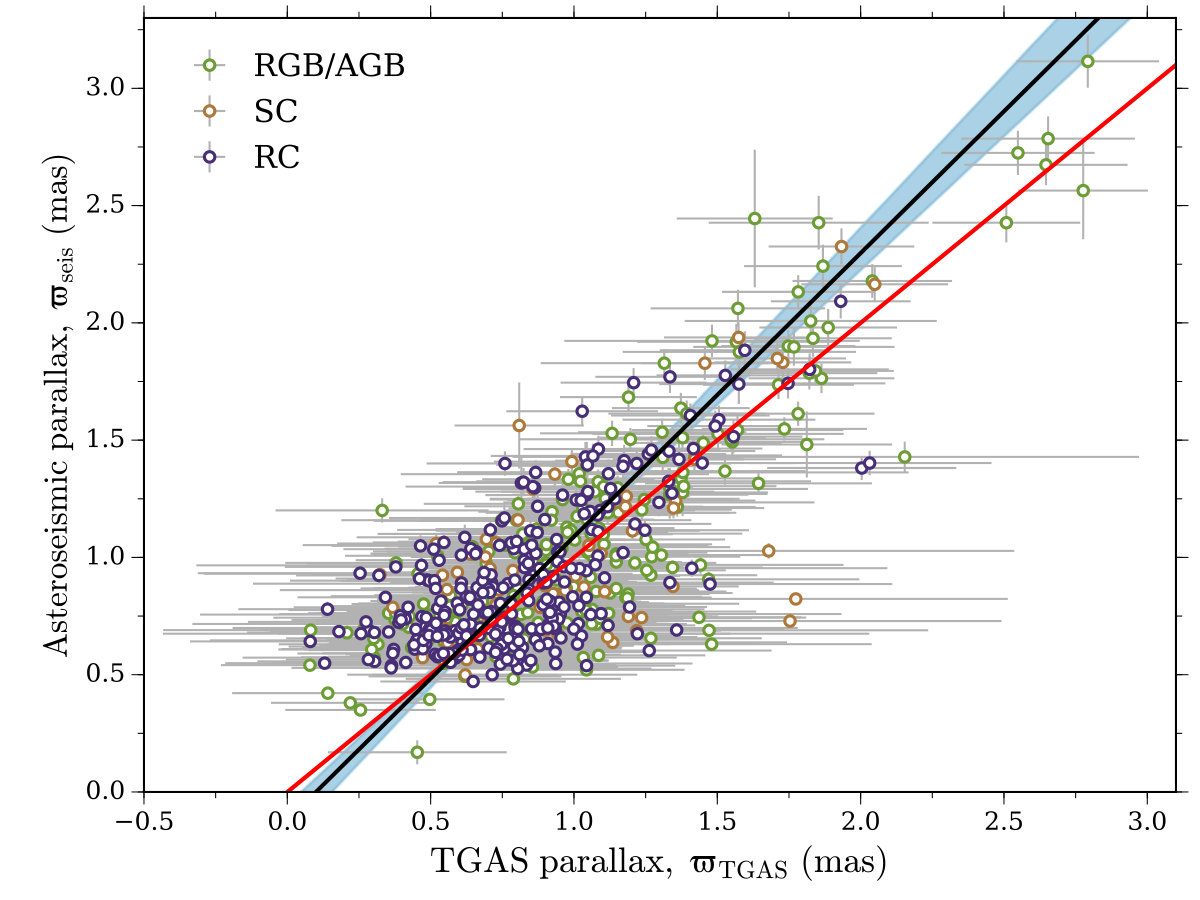 Figure 4
Peer Reviews
No public reviews on file for this paper yet. If you reviewed it on a platform where reviews are public (OpenReview, ICLR, NeurIPS, ICML), you can paste yours below so the community can read it here.
Videos
No videos yet. Explain this paper in a talk, walkthrough, or lecture? Add one.
11institutetext: School of Physics and Astronomy, University of Birmingham, Edgbaston, Birmingham, B15 2TT, UK 22institutetext: Stellar Astrophysics Centre, Department of Physics and Astronomy, Aarhus University, Ny Munkegade 120, DK-8000 Aarhus C, Denmark 33institutetext: Osservatorio Astronomico di Padova – INAF, Vicolo dell’Osservatorio 5, I-35122 Padova, Italy 44institutetext: Dipartimento di Fisica e Astronomia, Università di Padova, Vicolo dell’Osservatorio 2, I-35122 Padova, Italy 55institutetext: Department of Physics and Astronomy, Iowa State University, Ames, IA 50011, USA 66institutetext: Astronomy Unit, Queen Mary University of London, Mile End Road, London E1 4NS, UK
Using red clump stars to correct the Gaia DR1 parallaxes
Guy R. Davies Using red clump stars to correct the Gaia DR1 parallaxesUsing red clump stars to correct the Gaia DR1 parallaxesUsing red clump stars to correct the Gaia DR1 parallaxesUsing red clump stars to correct the Gaia DR1 parallaxes [email protected]
Mikkel N. Lund Using red clump stars to correct the Gaia DR1 parallaxesUsing red clump stars to correct the Gaia DR1 parallaxesUsing red clump stars to correct the Gaia DR1 parallaxesUsing red clump stars to correct the Gaia DR1 parallaxes
Andrea Miglio Using red clump stars to correct the Gaia DR1 parallaxesUsing red clump stars to correct the Gaia DR1 parallaxesUsing red clump stars to correct the Gaia DR1 parallaxesUsing red clump stars to correct the Gaia DR1 parallaxes
Yvonne Elsworth Using red clump stars to correct the Gaia DR1 parallaxesUsing red clump stars to correct the Gaia DR1 parallaxesUsing red clump stars to correct the Gaia DR1 parallaxesUsing red clump stars to correct the Gaia DR1 parallaxes
James S. Kuszlewicz Using red clump stars to correct the Gaia DR1 parallaxesUsing red clump stars to correct the Gaia DR1 parallaxesUsing red clump stars to correct the Gaia DR1 parallaxesUsing red clump stars to correct the Gaia DR1 parallaxes
Thomas S.H. North Using red clump stars to correct the Gaia DR1 parallaxesUsing red clump stars to correct the Gaia DR1 parallaxesUsing red clump stars to correct the Gaia DR1 parallaxesUsing red clump stars to correct the Gaia DR1 parallaxes
Ben Rendle Using red clump stars to correct the Gaia DR1 parallaxesUsing red clump stars to correct the Gaia DR1 parallaxesUsing red clump stars to correct the Gaia DR1 parallaxesUsing red clump stars to correct the Gaia DR1 parallaxes
William J. Chaplin Using red clump stars to correct the Gaia DR1 parallaxesUsing red clump stars to correct the Gaia DR1 parallaxesUsing red clump stars to correct the Gaia DR1 parallaxesUsing red clump stars to correct the Gaia DR1 parallaxes
Thaíse S. Rodrigues Using red clump stars to correct the Gaia DR1 parallaxesUsing red clump stars to correct the Gaia DR1 parallaxesUsing red clump stars to correct the Gaia DR1 parallaxesUsing red clump stars to correct the Gaia DR1 parallaxes
Tiago L. Campante Using red clump stars to correct the Gaia DR1 parallaxesUsing red clump stars to correct the Gaia DR1 parallaxesUsing red clump stars to correct the Gaia DR1 parallaxesUsing red clump stars to correct the Gaia DR1 parallaxes
Léo Girardi Using red clump stars to correct the Gaia DR1 parallaxesUsing red clump stars to correct the Gaia DR1 parallaxes
Steven J. Hale Using red clump stars to correct the Gaia DR1 parallaxesUsing red clump stars to correct the Gaia DR1 parallaxesUsing red clump stars to correct the Gaia DR1 parallaxesUsing red clump stars to correct the Gaia DR1 parallaxes
Oliver Hall Using red clump stars to correct the Gaia DR1 parallaxesUsing red clump stars to correct the Gaia DR1 parallaxesUsing red clump stars to correct the Gaia DR1 parallaxesUsing red clump stars to correct the Gaia DR1 parallaxes
Caitlin D. Jones Using red clump stars to correct the Gaia DR1 parallaxesUsing red clump stars to correct the Gaia DR1 parallaxesUsing red clump stars to correct the Gaia DR1 parallaxesUsing red clump stars to correct the Gaia DR1 parallaxes
Steven D. Kawaler Using red clump stars to correct the Gaia DR1 parallaxesUsing red clump stars to correct the Gaia DR1 parallaxes
Ian Roxburgh Using red clump stars to correct the Gaia DR1 parallaxesUsing red clump stars to correct the Gaia DR1 parallaxes
Mathew Schofield Using red clump stars to correct the Gaia DR1 parallaxesUsing red clump stars to correct the Gaia DR1 parallaxesUsing red clump stars to correct the Gaia DR1 parallaxesUsing red clump stars to correct the Gaia DR1 parallaxes
(Received 11. Nov. 2016 / Accepted 10. Jan. 2017)
Recent results have suggested that there is tension between the Gaia DR1 TGAS distances and the distances obtained using luminosities determined by eclipsing binaries or asteroseismology on red giant stars. We use the -band luminosities of red clump stars, identified and characterized by asteroseismology, to make independent distance estimates. Our results suggest that Gaia TGAS distances contain a systematic error that decreases with increasing distance. We propose a correction to mitigate this offset as a function of parallax that is valid for the Kepler field and values of parallax that are less than . For parallaxes greater than this we find agreement with previously published values. We note that the TGAS distances to the red clump stars of the open cluster M67 show a high level of disagreement that is difficult to correct for.
Key Words.:
Asteroseismology – Stars: fundamental parameters – Stars: oscillations (including pulsations) – Astronomical Databases – Parallaxes – Galaxy: structure
1 Introduction
The Gaia mission promises trigonometric parallaxes for stars with precisions of tens of micro arcseconds. The first data release (DR1) – the Tycho-Gaia Astrometric Solutions sample (Michalik et al. 2015; Gaia Collaboration et al. 2016) (hereafter TGAS) – is based on only 14 months of data and provides parallax estimates for some 2 million stars. Initial comparisons have suggested that the TGAS sample contains a systematic offset of around (Stassun & Torres 2016; Jao et al. 2016) , or that no correction is required (Lindegren et al. 2016; Sesar et al. 2016). Here we test the TGAS parallaxes using a sample of stars observed by the NASA Kepler mission that provide a useful probe of the far end of the distance scale in the Kepler field of view.
De Ridder et al. (2016) (hereafter DeR16) have recently shown that there is a tension between the astrometric distances of the TGAS sample and asteroseismically determined distances of red giants from Rodrigues et al. (2014) (hereafter R14). A linear fit of the asteroseismic parallaxes to the TGAS parallaxes returns a slope that is significantly different from unity, and an intercept that is significantly different from zero. We have replicated the DeR16 result in Figure 1 using an orthogonal distance regression (ODR, Boggs & Rogers (1990)), and find comparable results. It has been suggested by DeR16 that the above departures indicate that either the TGAS parallaxes are biased; or that asteroseismic parallaxes are compromised by incorrect interstellar extinction corrections and/or poorly known bulk metallicities, which would introduce systematics in the estimated stellar luminosities.
Here, we have tested the TGAS and asteroseismic distance scales independently by studying a subset of the stars from DeR16, specifically those stars that have been robustly identified by asteroseismology as red clump (designated RC and defined to include core helium-burning stars but exclude red giant branch (RGB), asymptotic giant branch (AGB), and secondary red clump (SC) stars). We also added a further six RC stars from the open cluster M67, which have asteroseismic detections (Stello et al. 2016) in data collected by the re-purposed Kepler Mission, K2.
We make use of an important property of the RC stellar population – specifically that RC stars have more or less the same luminosity (e.g., Cannon 1970; Paczyński & Stanek 1998) – to validate the estimated distances. As shown by Salaris & Girardi (2002) and Girardi (2016), the -band minimizes the intrinsic differences in the luminosites of RC stars due to differences in their metallicities. Residual changes due to variations in stellar masses, ages, and evolution along the He-burning phase remain at the level of mag. The main limitation in the use of RC stars as distance indicators stems from the difficulty in identifying them among the wider red giant population (with the exception of ensembles of stars located at similar distances, e.g. in clusters, the Galactic bulge, or nearby galaxies). This limitation has now been overcome thanks to asteroseismic constraints that can unambiguously discern RC from SC and RGB or AGB stars (Bedding et al. 2011). Hence RC stars can be used to test Gaia distances.
2 The asteroseismic constraints
Asteroseismology provides two key sets of constraints which may be used as independent ways of inferring distances:
Radii of red giant stars can be estimated from the average asteroseismic parameters that characterize their acoustic oscillation spectra: the so-called average large frequency separation, and the frequency corresponding to the maximum observed oscillation power. Red giants, which show these solar-like oscillations, may therefore be used as accurate distance indicators just as in the case of eclipsing binaries: the distance to each red giant may be estimated from the absolute luminosity, which is obtained from the asteroseismically determined radius (for example from asteroseismic scaling relations) and (e.g., Miglio et al. 2013).
Thanks to the frequencies of dipolar gravito-acoustic modes we can discern pristine RC stars among the zoo of red-giant stars (Bedding et al. 2011). We note that these inferences are independent of the constraints used to determine radii (and hence distances). Once RC stars are identified, their distances may be determined given their intrinsic luminosity.
RC stars in the solar neighborhood are expected to have similar intrinsic -band luminosities (to within mag), so we anticipate a RC coherent, extended feature in a diagram showing distance and apparent luminosity. This feature would show the expected distance dependence subject to some scatter or offset from the effects of reddening (photometric band dependent), stellar multiplicity, and the intrinsic scatter of RC luminosities.
We adopt a set of asteroseismic distances calculated using a model-independent method, i.e., using the asteroseismic scaling relations (e.g., Miglio et al. 2013); they are tabulated as the “distances from direct method” in the online data provided by R14. This method has no knowledge of the evolutionary state of the star and being model-independent does not force the estimated luminosities to some assumed RC value. This ensures that we have an independent estimate of luminosity for each star to use as a test of the assumption that the RC has a low scatter in luminosity.
We selected our RC sample using an asteroseismic classification (Elsworth et al. 2016) that exploits the diagnostic properties of dipole modes of mixed character, allowing one to discriminate between hydrogen-shell and helium core-burning red giant stars (Bedding et al. 2011). This classification has been shown to be robust in the identification of RC stars and is capable of separating out secondary clump stars and with the addition of temperature from Pinsonneault et al. (2014), the horizontal branch stars.
3 Results
Figure 2 shows the results of using a sample of RC stars as tests of the asteroseismic and astrometric distance scales. We calculate the theoretical dependence of the apparent -band magnitudes of the RC stars on distance (and hence parallax, i.e., , with in parsecs - in Figure 2 the dashed red line) using:
[TABLE]
where are apparent magnitudes obtained from the Two Micron All Sky Survey (2MASS; Cutri et al. 2003; Skrutskie et al. 2006); is the distance modulus; is the interstellar extinction in the band, determined from reddening values from the 3D dust map by Green et al. (2015) (derived from stars in the Pan-STARRS 1 survey) at the asteroseismic distance of a given star and we adopted an extinction-to-reddening ratio of (Fitzpatrick 1999). The maximum value of from the Green et al. (2015) map of our RC sample is , with a mean of . is the absolute band magnitude for the RC population (see Girardi 2016, and references therein); we adopted a median of the literature values presented in Girardi (2016), i.e., , where the uncertainty includes the RMS scatter between the different values. For the 6 RC stars added from the M67 cluster we de-reddened the magnitudes using (Taylor 2007), and for the asteroseismic distance we adopted the value given by Stello et al. (2016) of pc.
The agreement in the left-hand panels of Figure 2 of the asteroseismic parallax scale with the expected relation demonstrates that a sample of RC stars together with can be used to test the distance scale. There is in contrast a clear systematic error in the TGAS parallaxes versus distance, even given the large scatter.
For the M67 RC stars we see noticeable differences in parallaxes when compared with the expected values. We note that while it is possible to suggest a correction to the TGAS parallaxes (see section 4), it is difficult to see how a correction based solely on parallax or some measure of color could solve the problem presented by the M67 RC stars.
To check for the effects of extinction, binarity, and RC population heterogeneity on the results we have generated a synthetic population with the properties expected of the Kepler field (see Miglio et al. 2014). Figure 3 plots -band apparent magnitudes as a function of parallax for a TRILEGAL simulated population (Girardi et al. 2005) of single RC stars. The expected dependence is clear, as is the intrinsic spread in the RC luminosity (see Equation 3.1). The extinction in the band, , was determined from the values in TRILEGAL and (as per the real data) and (Cardelli et al. 1989).
As expected, for the small values of extinction expected here, band extinction has little effect on the inferred asteroseismic distances (when using the ). We have investigated the impact of a poorly estimated extinction by changing the true extinction by a factor of two. The results of this test show that even with this large systematic error in extinction, the impact on the estimated distances is of the order of only a few percent.
We have also used the synthetic population to estimate the impact of unresolved binaries on the apparent -band magnitudes. We find that only for a few systems (), with luminosity ratios close to unity, does the change in apparent magnitude significantly impact the asteroseismic distance estimate. It is worth noting that later releases of Gaia parallaxes are expected to achieve sufficiently high precision that the tests here could be used to identify unresolved binaries and constrain interstellar reddening.
4 Suggested correction
Using the sample of RC stars we propose a correction to the TGAS parallaxes. We find that the median offset between the TGAS parallaxes and the values predicted from Equation 3.1 is very close to (in the sense that TGAS overestimates the distance) which is less than either the correction for the Kepler field ecliptic latitude or the bulk offset of given by Stassun & Torres (2016). However, we see the bias decrease at smaller parallaxes, and at parallaxes larger than our correction is comparable to that of Stassun & Torres (2016).
Figure 4 shows the correction we propose that should be added to the TGAS parallaxes in the Kepler field as a function of the theorectical RC parallax i.e., the parallax that would be returned by an accurate estimate of the distance, :
[TABLE]
with parameters , , and a parameter correlation of . Uncertainties were estimated from the ODR. The correction may in practice be applied in an iterative manner. One begins by adopting to compute a correction using Equation 3.1, and hence a corrected parallax. This corrected parallax is then used as an input to Equation 3.1 to compute a new correction, and an iterated corrected parallax. The process is repeated until good convergence is found (typically this requires only one or two iterations).
This correction is calibrated with Kepler data and hence is strictly applicable to stars in the Kepler field. If, as suggested by Stassun & Torres (2016), any correction of TGAS parallaxes should be a function of ecliptic latitude, then the correction could be extended to all stars at similar latitudes. Care should be taken if this correction is to be applied at different latitudes.
5 Conclusions
In this letter we have used red clump (RC) stars as distance estimators to test the systematic error in the Gaia DR1 TGAS sample. We have reproduced the results of De Ridder et al. (2016) showing there is a disagreement between the TGAS distances and asteroseismic distances. By testing both results against the RC distance scale we have demonstrated that the asteroseismic distances are in better agreement with the RC than the TGAS distances. The TGAS sample showed a median offset of around (in the sense that TGAS overestimates the distance). We have also considered six RC stars with asteroseismic detections in the open cluster M67 but find discrepancies in the TGAS parallaxes that would be challenging to explain in terms of a color or spatially motivated systemic error.
We have proposed a correction to the TGAS parallaxes as a function of distance (as described by parallax). This correction is applicable to the Kepler field-of-view at distances , but could be used at similar ecliptic latitudes () following the findings of Stassun & Torres (2016). Care should be exercised when applying this correction to other latitudes should the TGAS bias be position dependent. The correction we find converges to the Stassun & Torres (2016) correction at parallaxes larger that but is noticeably smaller at greater distances.
Our results then bridge the gap between the previous works that favor a correction but are sensitive to nearby stars (Stassun & Torres 2016; Jao et al. 2016), and works that favor no correction but are sensitive to more distant stars (Lindegren et al. 2016; Sesar et al. 2016). We conclude that a correction to the TGAS sample is required but that this correction becomes negligible at distances greater than .
Acknowledgements.
We thank J. de Ridder, D. Huber, J. Heifetz and the anonymous referee for their help and useful comments. This publication is a direct result of a hack session organised in the Solar and Stellar Physics group at the University of Birmingham. This work has made use of data from the European Space Agency (ESA) mission Gaia (http://www.cosmos.esa.int/gaia), processed by the Gaia Data Processing and Analysis Consortium (DPAC, http://www.cosmos.esa.int/web/gaia/dpac/consortium). Funding for the DPAC has been provided by national institutions, in particular the institutions participating in the Gaia Multilateral Agreement. The authors acknowledge the support of the UK Science and Technology Facilities Council (STFC). MNL acknowledges the support of The Danish Council for Independent Research — Natural Science (Grant DFF-4181-00415). Funding for the Stellar Astrophysics Centre (SAC) is provided by The Danish National Research Foundation (Grant DNRF106). LG and TSR acknowledge support from PRIN INAF 2014 (CRA 1.05.01.94.05)
The reference list from the paper itself. Each links out to its DOI / PubMed record.
- 1Bedding et al. (2011) Bedding, T. R., Mosser, B., Huber, D., et al. 2011, Nature, 471, 608
- 2Boggs & Rogers (1990) Boggs, P. T. & Rogers, J. E. 1990, Contemporary Mathematics, 112, 183
- 3Cannon (1970) Cannon, R. D. 1970, MNRAS, 150, 111
- 4Cardelli et al. (1989) Cardelli, J. A., Clayton, G. C., & Mathis, J. S. 1989, Ap J, 345, 245
- 5Cutri et al. (2003) Cutri, R. M., Skrutskie, M. F., van Dyk, S., et al. 2003, Vizie R Online Data Catalog, 2246
- 6De Ridder et al. (2016) De Ridder, J., Molenberghs, G., Eyer, L., & Aerts, C. 2016, Ar Xiv e-prints [ ar Xiv:1609.08945 ]
- 7Elsworth et al. (2016) Elsworth, Y., Hekker, S., Basu, S., & Davies, G.-R. 2016, Submitted to MNRAS
- 8Fitzpatrick (1999) Fitzpatrick, E. L. 1999, PASP, 111, 63