Forming short-period Wolf-Rayet X-ray binaries and double black holes through stable mass transfer
Edward P.J. van den Heuvel (UvA), Simon F. Portegies Zwart (Leiden, Observatory), Selma E. de Mink (UvA)

TL;DR
This paper proposes a new evolutionary pathway for forming short-period Wolf-Rayet X-ray binaries and double black holes through stable mass transfer, emphasizing the role of black holes and specific mass ratios.
Contribution
It introduces a model where stable Roche-lobe overflow leads to WR X-ray binaries with black holes, distinct from neutron star systems, and predicts their evolution into double black holes.
Findings
WR X-ray binaries can only host black holes.
Stable mass transfer allows systems to survive spiral-in.
Estimated galactic double black hole formation rate is ~10^-5 per year.
Abstract
We show that black-hole High-Mass X-ray Binaries (HMXBs) with O- or B-type donor stars and relatively short orbital periods, of order one week to several months may survive spiral in, to then form Wolf-Rayet (WR) X-ray binaries with orbital periods of order a day to a few days; while in systems where the compact star is a neutron star, HMXBs with these orbital periods never survive spiral-in. We therefore predict that WR X-ray binaries can only harbor black holes. The reason why black-hole HMXBs with these orbital periods may survive spiral in is: the combination of a radiative envelope of the donor star, and a high mass of the compact star. In this case, when the donor begins to overflow its Roche lobe, the systems are able to spiral in slowly with stable Roche-lobe overflow, as is shown by the system SS433. In this case the transferred mass is ejected from the vicinity of the compact…
Click any figure to enlarge with its caption.
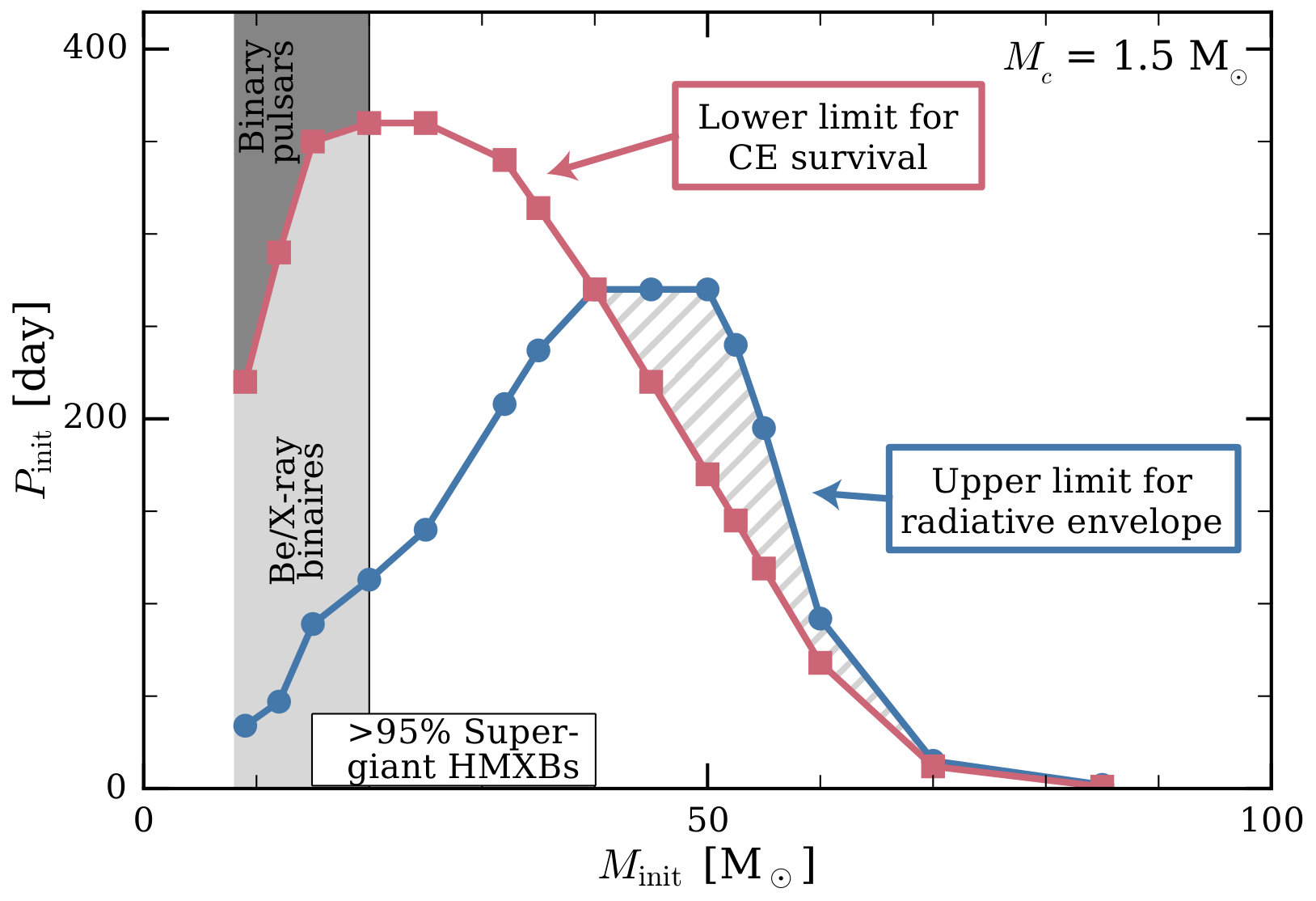 Figure 1
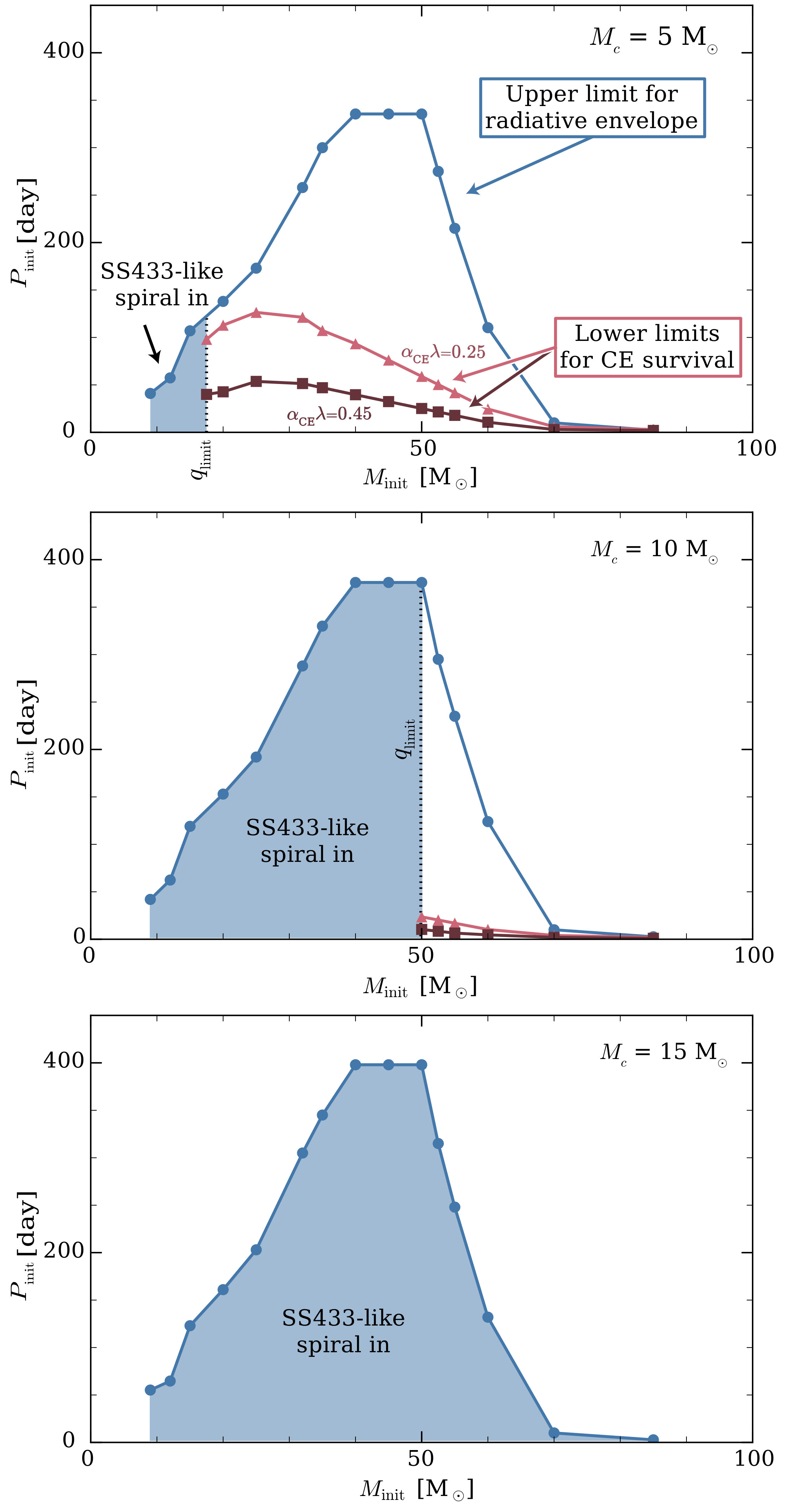 Figure 2
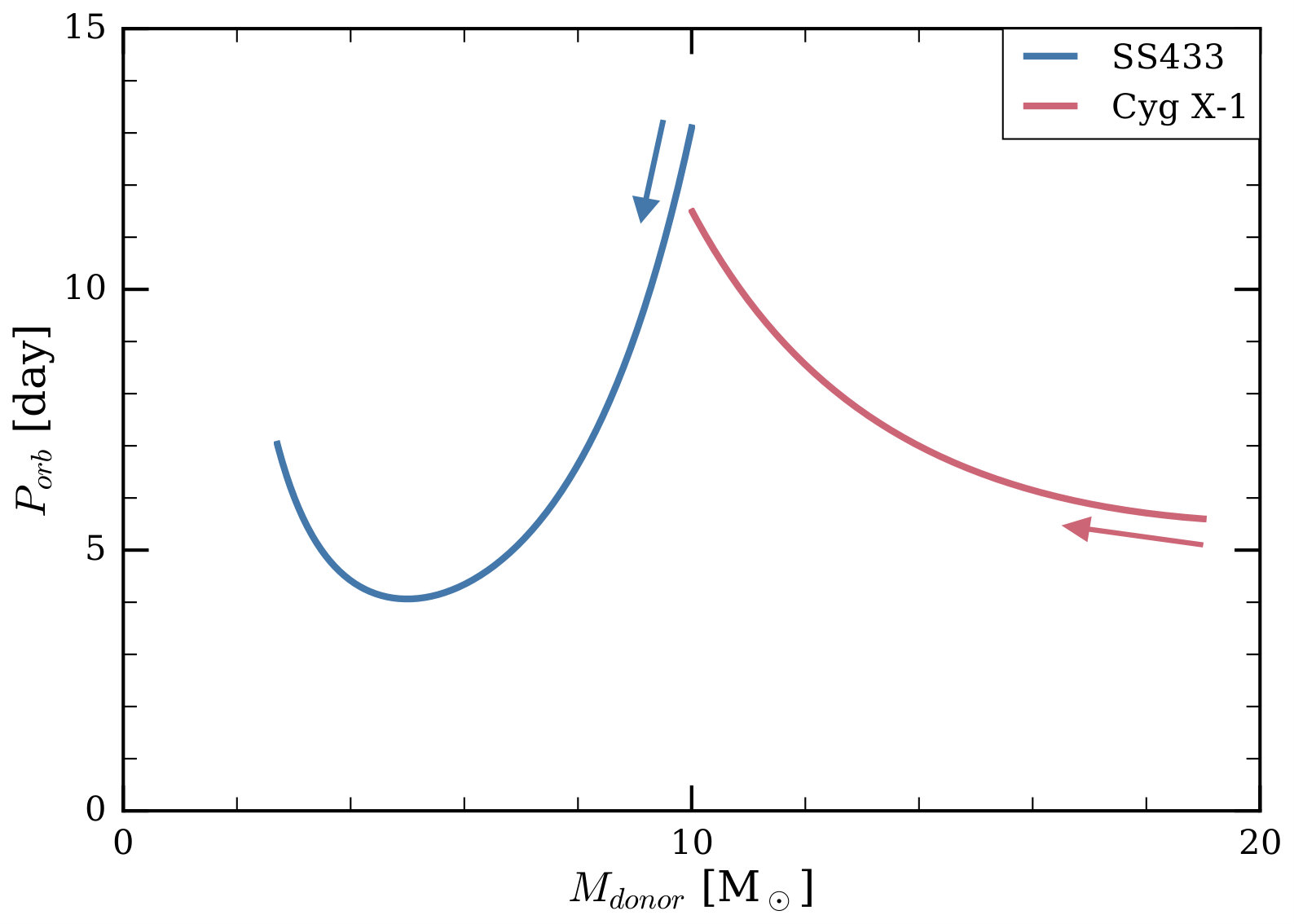 Figure 3
| Observed | HMXB at RLOF | WR X-ray binary | Double black hole | ||||||
|---|---|---|---|---|---|---|---|---|---|
| Name | Spectrum | Masses | Masses | Masses | Masses | ||||
| [day] | [ ] | [ ] | [ ] | [day] | [ ] | [day] | [Gyr] | ||
| WR 127 | WN3 + O9.5V | 9.555 | 17 + 36 | 9.6 + 33 | 9.6 + 13.6 | 1.54: | 9.6 + 7.0 | 1.71 | 6.91 |
| WR 21 | WN5 + O4-6 | 8.255 | 19 + 37 | 10.2 + 34 | 10.2 + 14.1 | 1.64: | 10.2 + 7.9 | 1.77 | 6.50 |
| WR 62a | WN5 + O5.5 | 9.145 | 22 + 40.5 | 10.8 + 37 | 10.8 + 16.1 | 1.45: | 10.8 + 8.8 | 1.61 | 4.40 |
| WR 42 | WC7 + O7V | 7.886 | 14 + 23 | 10.4 + 22 | 10.4 + 8.0 | 13.75 | 10.4 + 4.5 | 14.71 | – |
| WR 47 | WN6 + O5V | 6.2393 | 51 + 60 | 18.1 + 46 | 18.1 + 25.8 | 7.96 | 18.1 + 10.4 | 8.59 | – |
| WR 79 | WC7 + O5-8 | 8.89 | 11 + 29 | 9.0 + 27.4 | 9.0 + 10.1 | 2.44 | 9.0 + 5.4 | 2.64 | – |
| WR 11(CE) | WC8 + O7.5III | 78.53 | 9.0 + 30 | 7.8 + 28.5 | 7.8 + 10.5 | 0.90 | 7.8 +5.6 | 0.98 | 2.24 |
Peer Reviews
No public reviews on file for this paper yet. If you reviewed it on a platform where reviews are public (OpenReview, ICLR, NeurIPS, ICML), you can paste yours below so the community can read it here.
Videos
No videos yet. Explain this paper in a talk, walkthrough, or lecture? Add one.
Forming short-period Wolf-Rayet X-ray binaries and double black holes through stable mass transfer
E.P.J. van den Heuvel1,3 and S.F. Portegies Zwart2 and S.E. de Mink1,3
1Astronomical Institute ‘Anton Pannekoek’, University of Amsterdam, P.O. Box 94249, 1090 GE, Amsterdam, The Netherlands
2Leiden Observatory, Leiden University, PO Box 9513, 2300 RA, Leiden, The Netherlands
3Kavli Institute for Theoretical Physics, UCSB Kohn Hall, Santa Barbara, CA 93106-4030, USA
Abstract
We show that black-hole High-Mass X-ray Binaries (HMXBs) with O- or B-type donor stars and relatively short orbital periods, of order one week to several months may survive spiral in, to then form Wolf-Rayet (WR) X-ray binaries with orbital periods of order a day to a few days; while in systems where the compact star is a neutron star, HMXBs with these orbital periods never survive spiral-in. We therefore predict that WR X-ray binaries can only harbor black holes. The reason why black-hole HMXBs with these orbital periods may survive spiral in is: the combination of a radiative envelope of the donor star, and a high mass of the compact star. In this case, when the donor begins to overflow its Roche lobe, the systems are able to spiral in slowly with stable Roche-lobe overflow, as is shown by the system SS433. In this case the transferred mass is ejected from the vicinity of the compact star (so-called “isotropic re-emission” mass loss mode, or “SS433-like mass loss”), leading to gradual spiral-in. If the mass ratio of donor and black hole is \ {\raise-2.15277pt\hbox{\buildrel>\over{\sim}}}\ 3.5, these systems will go into CE evolution and are less likely to survive. If they survive, they produce WR X-ray binaries with orbital periods of a few hours to one day.
Several of the well-known WR+O binaries in our Galaxy and the Magellanic Clouds, with orbital periods in the range between a week and several months, are expected to evolve into close WR-Black-Hole binaries,which may later produce close double black holes. The galactic formation rate of double black holes resulting from such systems is still uncertain, as it depends on several poorly known factors in this evolutionary picture. It might possibly be as high as per year.
keywords:
stars: Wolf-Rayet stars, X-ray binaries, black holes, black-hole binaries
1 Introduction
Wolf-Rayet (WR) stars are hot and luminous evolved stars characterized by spectra with strong emission lines of He, C and/or N and O, produced by a dense high-velocity stellar wind. Their wind mass-loss rates are typically of order 10^{-5}$$\,{\rm M}_{\odot}\,{\rm yr}^{-1}. Except for the most luminous WN stars, WR stars do not contain hydrogen; they are helium stars, as was first pointed out by Paczyński (1967, for recent reviews of WR star properties see ). WR X-ray binaries are composed of a helium star and a compact star, which can be a neutron star or black hole. Their existence was predicted by Tutukov & Yungelson (1973) and van den Heuvel & De Loore (1973), as the outcome of the later evolution of High-Mass X-ray Binaries (HMXBs), when the evolved massive O- or B-type donor stars in these systems started to overflow their Roche lobes. (The classical definition of a HMXB is: an X-ray binary in which the mass-donor star is an O- or early B-type star, while in a WR X-ray binary the donor is a massive helium star; we follow here this nomenclature). Van den Heuvel and DeLoore pointed out that the outcome of this later evolution of a HMXB is expected to be a very close binary, consisting of a helium star (the helium core of the original HMXB donor star) and a compact star. They suggested that the peculiar 4.8 hour orbital period X-ray binary Cygnus X-3 is such a WR X-ray binary. This was confirmed 19 years later (van Kerkwijk et al., 1992): the companion of Cyg X-3 is a WR star of type WN5. When the 1973 prediction of the existence of WR X-ray binaries was made, it was thought that all HMXBs would produce such systems. Since the WR phase lasts some 400 000 years (Rosslowe & Crowther, 2015), which is longer than the duration of the HMXB-phase (e.g.van den Heuvel 1994), one would expect that WR X-ray binaries would be more abundant in the Galaxy than the over 200 known HMXBs. However, apart from Cyg X-3, no other WR X-ray system has been found in the Galaxy, and the problem of the ”missing WR X-ray binaries” (Vanbeveren, van Rensbergen, & De Loore, 1982; Lommen et al., 2005) has been with us for over 40 years. In recent years six more WR X-ray binaries have been discovered in other galaxies (Esposito et al., 2015); with the exception of one, all of these have short orbital periods, between 0.2 and 1.5 days; one system has a period of about 8 days. Two possible factors that may lead to the reduction of the predicted numbers of WR X-ray binaries in the Galaxy are:
- (1)
when the existence of WR X-ray binaries was predicted it was thought that all helium stars with masses \ {\raise-2.15277pt\hbox{\buildrel>\over{\sim}}}\ 3-4$$\,{\rm M}_{\odot} would be observable as WR stars. However, more recent estimates of masses of WR stars, either in binary systems or from their absolute luminosities have shown that, in order to show the typical WR spectral characteristics produced by a dense high-velocity stellar wind outflow, the helium stars must have a mass \ {\raise-2.15277pt\hbox{\buildrel>\over{\sim}}}\ 10(\pm 2)$$\,{\rm M}_{\odot} (Crowther, 2007; Sander et al., 2012). This implies that the hydrogen-rich progenitor of the WR star most probably must have had a mass \ {\raise-2.15277pt\hbox{\buildrel>\over{\sim}}}\ 30(\pm 5)\,\,{\rm M}_{\odot}, and in any case \ {\raise-2.15277pt\hbox{\buildrel>\over{\sim}}}\ 20\,{\rm M}_{\odot}.
Or: 2. (2)
Only very few HMXBs survive the spiral-in during the Roche-lobe overflow phase that follows the HMXB phase (we use here the expression ”spiral-in” for a drastic decrease of the orbital period by any kind of mechanism, not only by Common-Envelope (CE) evolution).
Here we will argue that the latter factor is the key reason for the scarcity of WR X-ray binaries, and that HMXBs in which the compact star is a neutron star hardly ever survive spiral-in. (Only very wide neutron-star systems with donor masses below about may survive, see section 3).
We show that, on the other hand, if the compact star is a black hole, with a mass \ {\raise-2.15277pt\hbox{\buildrel>\over{\sim}}}\ 5-10\,{\rm M}_{\odot}, the systems may survive spiral-in, and become close binaries consisting of a WR star and a black hole. For this reason, one expects in general that in WR X-ray binaries the compact star is a black hole.
Our ideas about which systems may survive spiral-in and produce WR X-ray binaries were triggered by the realization that the peculiar X-ray binary SS433 has avoided going into Common-Envelope (CE) evolution, and that the donor star in this system is transferring mass to the compact star by stable Roche-lobe overflow (King & Begelman, 1999; King et al., 2000). By analysing the properties of this system we realized that it is the high mass of the compact star in this system () in combination with the relatively low mass of its donor star () (Hillwig & Gies, 2008), which allowed it to avoid Common-Envelope (CE) evolution and enables it to gently spiral-in without ever coalescing with its donor. As we consider SS433 to be a ”keystone” for understanding the formation of the WR X-ray binaries, we give in section 2 a brief overview of its properties and evolutionary state. The avoidance of its going into CE-evolution is - as we will argue - a consequence of the donor star having a radiative envelope (King et al., 2000), in combination with the donor star and accretor having a mass ratio less than 3.5. In section 3 we then examine for which donor masses, mass ratios and orbital periods HMXBs will, when they start Roche-lobe overflow, avoid going into CE-evolution and may survive as WR X-ray binaries with short orbital periods. We also examine under which conditions they may still survive after having gone into CE-evolution. In this section some examples are given of how a number of well-known observed WR+O binaries with relatively short orbital periods are expected to evolve in the future, and are expected to produce WR X-ray Binaries and, as a final evolutionary state, close double black holes. In section 4 we attempt to estimate the birthrate of WR X-ray binaries in the Galaxy on the basis of our model, and find it to be still higher than observed and discuss possible ways to relieve this discrepancy. In section 5 we discuss the results and estimate the possible birthrate of double black holes based on our model.
2 SS433 - a keystone for understanding which HMXBs go into stable Roche-lobe overflow
2.1 The evolutionary state and future evolution of SS433
The SS433 system consists of a Roche-lobe filling A4-7I supergiant donor star with an estimated mass of and a luminosity of about 3800, plus a compact star with a mass of , in a 13.1-day period binary (Hillwig & Gies, 2008). The compact star is surrounded by an extended and luminous accretion disk, about an order of magnitude brighter than its A-supergiant companion. This disk ejects the famous precessing relativistic jets with a velocity of 0.265c, in which neutral hydrogen is ejected at a rate of some 10^{-6}$$\,{\rm M}_{\odot}\,{\rm yr}^{-1}, while in a strong disk wind with a velocity of about 1500 of order some 10^{-4}$$\,{\rm M}_{\odot}\,{\rm yr}^{-1} is ejected, as is seen in the form of the ‘stationary’ H line and broad absorption lines (Fabrika, 2004). The total mass loss from the disk is basically all the matter that the A-supergiant donor is transferring to the compact object by Roche-lobe overflow on its thermal timescale of years (see also Begelman et al., 2006).
The observed radiative accretion luminosity of the compact star with its disk does not exceed the Eddington luminosity L_{\rm Edd}\simeq 6\cdot 10^{38}$$\,{\rm erg}\,{\rm s}^{-1} of the compact star (which corresponds to a real accretion rate onto the compact star of order only a few times 10^{-8}$$\,{\rm M}_{\odot}\,{\rm yr}^{-1}), although when seen along the jets the UV luminosity might be as large as perhaps 10^{40}$$\,{\rm erg}\,{\rm s}^{-1} (Fabrika, 2004), which would correspond to an accretion rate of order 10^{-7}$$\,{\rm M}_{\odot}\,{\rm yr}^{-1}. This mass loss has been going on for thousands of years, as can be seen from the large radio nebula W50 that surrounds the system and has been produced by the precessing jets and the strong disk wind. Even though this mass transfer has been going on for thousands of years, the system has not entered in a Common-Envelope (CE) state.
The reason why SS433 has not gone into a CE phase is, as argued by King & Begelman (1999) and King et al. (2000), the fact that the A-supergiant star has a radiative envelope. If one takes away mass from a star with radiative envelope, this envelope responds by shrinking on a dynamical timescale, followed by a re-expansion on the thermal timescale of the envelope. As a result, this star can keep its radius close to that of its Roche lobe and will transfer matter to its companion on the thermal timescale of its envelope, without going into a CE phase. There is, however, an extra condition for keeping the Roche-lobe overflow stable, which was not mentioned in the above references, namely: the thermal timescale mass-transfer from a radiative donor envelope may itself become unstable, if the mass ratio of donor and companion star is larger than a value in the range 3 to 4 (e.g. Tout et al., 1997; Tauris et al., 2000; Hurley et al., 2000).
For the sake of argument we will assume here this limiting mass ratio to be 3.5. For mass ratios larger than about 3.5 the shrinking of the system due to the mass transfer goes so fast that the shrinking of the donor star cannot keep in pace with it, and the system will enter a CE phase. SS433 has indeed a mass ratio below 3.5 and therefore avoided going into a CE phase. Apart from systems with a donor with a radiative envelope and mass ratio larger than 3.5, also for systems in which the donor has a convective envelope, the formation of a Common Envelope is unavoidable. The reaction of a convective envelope to mass loss is expansion on a dynamical (pulsational) timescale, and thus the envelope becomes violently unstable, which leads to runaway mass transfer and the formation of a Common Envelope.
2.2 Why systems like SS433 are so rare: the fate of HMXBs
with a “standard” neutron star companion
One may wonder what is so special about SS433 and why we do not see more SS433-like systems. We propose that the answer is: the very unusual combination for a HMXB of a rather low donor mass (presently \sim 12.3$$\,{\rm M}_{\odot} and initially to \sim 15$$\,{\rm M}_{\odot}) plus a quite massive compact star (\sim 4.3$$\,{\rm M}_{\odot}). An 14 to 15 initial donor mass and an orbital period of days are typical for a Be/X-ray binary, the most common type of HMXB, containing a B-emission (Be) line star. There are some 200 Be/X-ray binaries known in our Galaxy and the Magellanic Clouds. Raguzova & Popov (2005) list 160 in our Galaxy and the two Magellanic Clouds and Reig (2011) lists 141 in our Galaxy plus the SMC alone. Since these papers appeared, Swift, INTEGRAL and other satellites have discovered several tens more, bringing the total presently known number to about 200. In all but one of the known Be/X-ray binaries, the compact stars are neutron stars which have a typical mass of about 1.4. Only one Be/X-ray binary is known to harbor probably a black hole companion, with a mass of 3.6 to 6.9 (Casares et al., 2014). If the companion of a 14 Be star is a 1.4 neutron star, the mass ratio is 10, and the formation of a Common Envelope is unavoidable, and the two stars will merge (unless the orbital period is longer than 1 to2 years, which is the case for only a small fraction of the Be/X-ray binaries, see section 3).
Only if the compact star has a mass \sim 4$$\,{\rm M}_{\odot} or larger, and the donor has a radiative envelope, the system will spiral in slowly and survive the SS433-like mass-transfer process. Therefore, out of the Be/X-ray binaries, only the one system with an (alleged) black hole companion will in the future evolve like SS433 and survive, all the others will have merged after transferring only a small amount of mass (or, the small fraction of systems with orbital periods longer than about 1 to 2 years, will have produced a very close Helium star plus neutron star system, after a short-lasting Common-Envelope phase). So, the birthrate of SS433-like systems is at most about 0.5 per cent of the birthrate of Be/X-ray binaries. (For a model for the formation and future evolution of the possible Be/black-hole binary, see Grudzinska et al., 2015).
The simple reason why SS433 can stably survive this type of spiral-in process for to perhaps years is because of its unique combination – for a Be/X-ray binary progenitor – of a quite massive compact star and a relatively moderate-mass donor star.
The \sim 4.3$$\,{\rm M}_{\odot} compact object in SS433 must be a low-mass black hole, because causality allows neutron stars to have masses not larger than about 3 (Nauenberg & Chapline, 1973; Kalogera & Baym, 1996).
3 Conditions for survival of Roche-lobe overflow in HMXBs as a function of donor mass, compact star mass and orbital period
3.1 Evolution of the orbit during SS433-like mass transfer
As shown by King et al. (2000) and Begelman et al. (2006), in the case of Roche-lobe overflow from donor stars with a radiative envelope, a further condition for avoiding the formation of a Common Envelope is that the spherization radius of the accreting compact object remains smaller than its Roche lobe, where is given by (Shakura & Sunyaev, 1973):
[TABLE]
where is the Schwarzschild radius of the compact object. In the case of SS433, is of order and R_{\rm s}\simeq 9$$\,{\rm km}, so R_{\rm sp}\sim 6\cdot 10^{5}$$\,{\rm km} \simeq 0.9$$\,{\rm R}_{\odot}, which is deep inside the Roche lobe of the compact star, and a CE will be avoided. In all HMXBs with orbital periods upward on one day the same will hold. So in all cases of HMXB systems with a donor with a radiative envelope and mass ratio less than about 3.5, one expects the system to go into normal Roche-lobe overflow evolution similar to that of SS433. The “SS433-mode” of mass transfer is what we have in the past called “isotropic re-emission”(e.g. Bhattacharya & van den Heuvel, 1991; Soberman et al., 1997; van den Heuvel, 1994; Tauris & van den Heuvel, 2006; Massevitch & Yungelson, 1975).
With the SS433-mode of mass transfer, followed by mass loss from the disk, which has the specific orbital angular momentum of the compact object, it is simple to calculate how the orbit of the system will change. In case that a fraction β of the transferred matter is ejected from the compact star and its disk with the specific orbital angular momentum of this star, and a fraction is accreted by this star, the orbital angular momentum loss leads to a change of the orbital radius a given by (e.g. see Tauris, 1996; Soberman et al., 1997; Tauris & van den Heuvel, 2006):
[TABLE]
where q is the mass ratio of donor and compact star, and subscript zero indicates the initial situation at the onset of Roche-lobe overflow.
For the case in which in which , as is in fact the case in SS433, as the accreted amount is to times the transferred amount, this equation in the limit of approaching unity simplifies to:
[TABLE]
Using Kepler’s third law the corresponding equation for the change of the orbital period is:
[TABLE]
In the case of SS433, assuming the initial mass of the A-supergiant donor to have been to , the mass of its helium core is about 3.5. This means that at the end of the Roche-lobe overflow phase , while at present . Inserting these values into equation (4), one finds that at the end of the Roche-lobe overflow the orbital period of the system will be days. So, SS433 will with these assumed component masses finish as a detached binary consisting of a 3.5 helium star and a 4.3 compact star. The entire process will take place on the thermal timescale of the envelope of the 10 A-supergiant which is between and years.
The helium star in the resulting system may during helium shell burning go through a second mass-transfer phase and finally explode as a supernova, likely leaving a neutron star. If the system remains bound in response to the natal kick of the neutron star, a close eccentric binary will result, consisting of the present \sim 4.3$$\,{\rm M}_{\odot} compact star plus a neutron star.
3.2 Upper limiting orbital period for having a radiative envelope
In order to determine the limiting orbital period for having a radiative envelope, we notice that for an effective temperature K (spectral type earlier than A7), stars have a deep radiative envelope (e.g. see Clayton, 1968). If the luminosity of a donor star of a given mass M is known, its radius can be found from the relation , where is the Stefan-Boltzmann constant. If the mass of the compact companion of the star is known, and we set the stellar radius equal to the radius of the Roche lobe of the donor, then the equation for the Roche lobe given by Eggleton (1983):
[TABLE]
allows one to calculate the orbital radius of the binary in which the donor fills its Roche lobe, as the mass ratio is known. Using Kepler’s third law, one also calculate the corresponding orbital period .
To calculate the maximum orbital periods up to which donor stars still have a radiative envelope, we used the luminosities of post-main-sequence evolutionary tracks, for solar metallicity, of rotating stars with masses up to 50 given by Ekström et al. (2012), and the limiting effective temperature of K. Post-main-sequence stars originating from stars more massive than about 50 have very strong stellar wind mass loss, or become Luminous Blue Variables, stars that experience strong eruptive mass loss episodes. Because of their strong mass loss they lose most of their hydrogen-rich envelope and always stay at effective temperatures above 8100K. Therefore these post-main sequence stars are expected to have radiative envelopes, so for them we used as maximum radius just their maximum post-main-sequence stellar radius. We made these calculations for compact companions with masses of 1.5, 5, 10 and 15. Figures 1 and 2 give these upper limiting orbital periods as a function of donor mass for initial donors with masses between 9 and 85. (In the mass range between 40 and 60 there are no tracks by Ekström et al. (2012) available. It is known from evolutionary calculations with similar assumed wind mass loss rates that for masses above 50 the stars at the end of hydrogen burning have lost most of their H-rich envelopes and their radii drop rapidly as a function of mass. We have, for the sake of argument, assumed that in the mass range between 40 and 50 the orbital periods at K are constant and after that they linearly decrease towards the orbital period of the 60 star).
The figures show that for donor masses up to about 50 these upper limiting orbital periods range from about 50 to 400 days, and beyond 50 they go down rapidly. Below these limiting curves, the donor stars in HMXBs will transfer mass to their compact companions according to the SS433-type of mass transfer, and the systems will not go into Common Envelope (CE) evolution, provided the mass ratio of donor and compact star is less than about 3.5. The regions where this SS433-like evolution will occur are indicated in the figure 2 by the blue-colored parts of the diagrams.(Notice that for calculating the curves of the limiting orbital periods, as well as the limiting donor masses for mass ratio 3.5, we used the real post-main-sequence masses of the stars, which are considerably reduced with respect to the intitial masses, due to stallar wind mass loss on the main sequence). To the right of these blue regions and below the radiative boundary periods, systems will go into Common Envelope evolution with a donor with radiative envelope. Above the radiative boundary periods they will go into Common Envelope evolution with a convective envelope (or if the period is too large they will not experience mass transfer at all).
The next question is: which systems with donor stars in this radiative-envelope regime, will survive as binaries after the onset of mass transfer by Roche-lobe overflow? It turns out that none of the systems with a 1.5 compact star (neutron star) will, as was already mentioned above. Because of their mass ratios of far above the mass ratio upper limit of 3.5, they go into CE evolution and for initial donor masses below 40 they all merge. This can be seen from the lower-limit curve for survival of CE evolution (the red curve) in figure 1. (The way this curve was calculated is explained in the next section). Although for donor masses larger than 40 according to the figure systems might survive CE-evolution (grey hashed region), such massive donors with NS companions may not be very likely, for stellar evolution reasons. In figure 1 we have indicated also the ranges of orbital periods and masses of the bulk of the known supergiant HMXBs with neutron star companions, and of the B-emission X-ray binaries with neutron star companions. One observes that the vast majority of the known supergiant HMXBs with neutron stars does not survive spiral-in.
It can be seen from this figure that among the known types of HMXBs only the B-emission X-ray binaries with a neutron star companion and orbital periods ranging from larger than 220 d with a 9 donor to larger than 370 d with a 20 donor (the red region of the diagram), will survive spiral in and can later form double neutron stars, after explosion of the helium star. This is a well-known result (e.g. see Taam, 1996; Portegies Zwart & Spreeuw, 1996; Dewi et al., 2005).
While none of the systems in the radiative-donor regime with a 1.5 neutron star survives the mass transfer, the systems with a 5, 10 and 15 compact companion star (black hole), in the blue-colored parts of figure 2, do survive SS433-like mass transfer and can produce helium-star binaries with relatively short orbital periods: WR/X-ray binaries.
It should be kept in mind that for the case with a 5, 10 and 15 compact star, the donors which we consider, overflow their Roche lobes after leaving the main sequence, which means that they evolve according to case B of close binary evolution (Kippenhahn & Weigert, 1990). The lower limit for the orbital period for this case is about one week.
An example of a system that will survive SS433-like evolution is Cygnus X-1, which has 5.6 day orbital period, a black hole and a donor, which according to its luminosity must have started out as a 30 star (Orosz et al., 2011). After SS433-like mass transfer the donor in Cygnus X-1 will leave a helium star of about 10, which might either leave a neutron star or a low-mass black hole, with an orbital period of about 9 days, depending on the direction and magnitude of the birth kick of the compact object. So Cyg X-1 will not terminate as a close system.
3.3 Lower limiting orbital periods for surviving CE evolution
Systems with orbital periods above the upper-limit line for radiative envelope in figures 1 and 2 will have convective envelopes and will, when their donor stars overflow their Roche lobes, go into CE evolution and spiral in, as described e.g. by Tutukov & Yungelson (1993), Portegies Zwart & Verbunt (1996), Lipunov et al. (1997) and later papers and recently by Belczynski et al. (2016) and Eldridge & Stanway (2016).
The same holds for systems with donors in the radiative region and mass ratios larger than about 3.5. We use here the formalism for the orbital change in the case of CE evolution as given by Webbink (1984) and de Kool (1990), which yields a ratio of the final and initial orbital radii and , respectively, given by:
[TABLE]
where is the mass of the helium core of the donor, is the mass of the hydrogen-rich envelope of the donor at the moment when Roche-lobe overflow begins, is the so-called “efficiency factor” of CE evolution which indicates the efficiency with which the release of orbital gravitational binding energy that occurs during spiral in of the compact star towards the core of the donor is converted into kinetic energy required to eject the common envelope, is a parameter that depends on the stellar mass density distribution and is the ratio of the Roche-lobe radius and the orbital radius at the onset of CE evolution.
The value of is typically of order 0.5. There are many factors that influence the precise value of the product , such as energy sources like recombination energy and accretion energy release (e.g. see the discussion in Tauris & van den Heuvel 2006; Portegies Zwart 2013, and in Ivanova et al. 2013; Kruckow et al. 2016). We assume here two values of the common envelope efficiency: and (e.g. Taam 1996), , and - while we know this an oversimplification - for our calculations we assume .
To calculate the outcome of CE evolution for stars in the mass range 10 to 85 we used the rotating evolutionary models for solar metallicity of Ekström et al. (2012). These models were calculated with stellar wind mass loss, such that at the end of core-hydrogen burning, when the stars leave the main sequence, their masses are lower than their initial values, and the mass of the helium core is known. Using for then these reduced post-main-sequence masses, and the corresponding values, one can calculate, for given values of and of the combination , what the values of the ratio will be.
Given the mass of the helium core one knows the radius of this helium star (for these we used the interpolation formula from Onno Pols given in Tauris & van den Heuvel 2006). Together with the mass of the compact star this radius gives the minimum final orbital radius for systems that survive CE-evolution, as the helium star is not allowed to be larger than its Roche-lobe radius in the final system. If would be smaller than this minimum value, the system does not survive and merges.
Using the above-given values of and , and the values of calculated according to the above given recipe for each initial donor mass and , one can then calculate the lower-limits to the initial orbital radii required for the systems to survive CE evolution. These values give one also the minimum initial orbital periods for surviving CE evolution, as a function of initial donor mass and .
In figure 1 the lower limiting period curve for survival of CE evolution for is indicated for systems with a neutron star companion with M_{\rm c}=1.5$$\,{\rm M}_{\odot}. For the case of M_{\rm c}=5$$\,{\rm M}_{\odot}, 10 and 15, the calculated lower limiting period curves for CE evolution with the above-given values of and 0.45 are given. (The latter value was derived from orbits of post-CE binaries by Portegies Zwart & Verbunt 1996). Systems above these curves in the parts of the panels in figure 2, to the right of the blue-colored regions are expected to survive CE-evolution as WR/X-ray binaries with short orbital periods.
3.4 Examples of the future evolution of some well-known WR+O spectroscopic binaries:
formation of close WR X-ray binaries and of double black holes
Table 1 shows as an example how we expect seven well-known observed massive WR+O spectroscopic binaries with well-determined masses and orbital periods to evolve in the future. The masses and orbital periods of these systems were taken from the catalogue of van der Hucht (2001), to which we refer for the original references for these systems. We have calculated the future evolution of these systems semi-empirically, as follows. We adopted the Conti-scenario (Conti, 1976) for the evolution of WR stars. According to this model, WR stars begin as WN stars and then evolve with strong wind mass loss into WC/WO stars, that finally undergo core collapse (Crowther, 2007). (For an alternative point of view, see Sander et al. (2012); McClelland & Eldridge (2016)).
To calculate the evolution of the observed WR+O binaries in Table 1, we made the following assumptions:
- •
On the basis of evolution calculations, such as by the Geneva group, we assumed, adopting the Conti scenario, the WR stars to spend 70% of their helium-burning lifetime as a WN star and 30% as a WC star.
- •
We assumed an observed WN star to be half-way its WN lifetime, that is: at 35% of its helium star lifetime. Similarly, we assumed observed WC stars to be at 85% of their helium star lifetime, so still to have 15% of this lifetime to go.
- •
We assumed their wind mass loss rates over their entire lifetime to correspond to the ones stars of their presently observed WR type. For these rates we used wind mass loss rates 1.4 times lower than assumed by Schaller et al. (1992), for the following reasons: Schaller et al. found for their adopted wind mass loss rates for solar metallicity that even stars up to 120 finished with a mass of only 8. It is evident that this cannot be correct, since the Population I X-ray binary Cygnus X-1 is a 14.8 black hole(Orosz et al. (2011),Ziolkowski (2012)). Assuming some 90 per cent of the final WC star (basically a CO core) to become the black hole ((e.g. Heger, 2012)), the final mass of the WR progenitor of Cyg X-1 must have been 16.4. The formation of a black hole with the mass of Cyg X-1 is possible only if the real wind mass loss rates at solar metallicity are about 1.4 times lower than the ones used by Schaller et al. In that case the progenitor of Cyg X-1 was a star of about 80 with solar metallicity.
- •
Also for the O-stars we used wind loss rates of 1.4 times lower than the ones used by Schaller et al. (1992).
- •
As total lifetime of the WR stars (massive helium stars) we used 400 000 yrs (Rosslowe & Crowther, 2015).
The results of these calculations are listed in Table 1. Columns 2, 3 and 4 list the observed parameters of the systems. Column 5 lists the masses of the components after the WR star has terminated its evolution and has become a black hole, and subsequently the companion has evolved for 3 million years to leave the main sequence and start Roche-lobe overflow. We calculated the masses in column 5 by taking into account the wind mass-loss of both stars, and by assuming that at the end of the life of the Wolf-Rayet star as a WC-type star, 90% of the mass of the WC star disappeared into the black hole (cf. Heger, 2012; Sukhbold et al., 2016), meaning that just only the gravitational binding energy of the helium star is lost. As there is no mass lost, we have assumed that the black holes did not receive a natal kick. (We realize that our implicit assumption in these calculations that stars with initial masses larger than about 25 always leave black holes, may not be fully realistic, since Sukhbold et al. (2016) (and also Ertl et al. and Muller in 2015, in papers referred to in this paper) find from their calculations that, quite arbitrarily, sometimes even very massive stars may still leave a neutron star as a remnant. Since the precise reasons why this happens is not fully understood, we have chosen not to take this into account here).
A possible indication that WR stars tend to leave black holes is that, so far, no WR stars have been detected as progenitors of Type Ib,c supernovae (Smartt, 2015).
We calculated how the orbits changed due to the wind mass loss and the core-collapse gravitational-mass loss, and assumed that after this the orbits tidally synchronized again. We then assumed the O-type companions of the BHs still to live another 3 million years as core-hydrogen burning stars, losing mass by stellar wind in this period. For the top six systems in the table, we subsequently calculated the spiral in of the resulting HMXB consisting of the O-star and the BH, using the SS433-type of spiral in. This resulted into the WR+BH systems with masses and orbital periods listed in columns (6) and (7), respectively. For the 7th system, the mass ratio of O-star and black hole is larger than 3.5 and we assumed this system to pass through CE-evolution.
One notices that several of the top-six WR X-ray binaries have orbital periods of order 1 to 2 days, and that their compact stars are black holes. After taking account of the wind mass loss of the WR stars in the WR X-ray systems during their further evolution and, again assuming that 90 per cent of the mass of the final WC star disappears into the black hole, one obtains masses and orbital periods of the double black hole binaries resulting from these systems listed in columns 8 and 9, respectively. (We assumed that the wind mass loss did not increase the orbital period of the WR X-ray binary, as the gravitational torque excerted by the black hole on the outflowing thick wind will cause loss of orbital angular momentum, which is expected to compensate the increase of orbital period due to the mass loss; if the latter torques would not occur, the final orbital periods will be about 1.8 times larger).
One observes from this table that some well-known WR+O spectroscopic binaries with orbital periods of order one week can produce close WR+BH X-ray binaries, and subsequently produce close double black hole binaries.
Since the first three systems in Table 1 have a mass ratio of donor and black hole before spiral-in mass transfer very close to the 3.5 limit, it is not completely sure whether the mass transfer from the radiative envelope will not become unstable. To mark this uncertainty, we have a put a colon after the post-spiral-in orbital periods in Table 1. For the 4th to 6th systems in Table 1 the mass ratio before spiral-in is below 3.5 and the transfer is expected to certainly be stable. The 4th and 5th systems, however, do not leave close WR X-ray binaries, and also not close double black holes. They leave WR X-ray binaries resembling the one observed system with an orbital period of about 8 days, mentioned in the Introduction. (In the VIIth catalogue of WR stars (van der Hucht, 2001) there are 3 more systems (WR30, 113 and 141) that will evolve similarly and leave wide WR X-ray binaries and wide double BHs).
In the case of the first three systems in Table 1: if their mass transfer becomes unstable, a Common Envelope will form and the outcome of the evolution must be calculated using equation 6. It turns out that with the above assumed value of , none of these three systems survives the CE-evolution, as in each case the Roche-lobe radius of the post-CE helium star is smaller than the radius of this star.
One sees that the orbital periods of WR XRBs produced by stable Roche lobe overflow are considerably larger than the one produced by CE evolution in the system of WR11.
4 The galactic formation rate of WR X-ray binaries
4.1 Predicted galactic numbers of WR X-ray binaries, compared to observations: still too few observed systems
Rosslowe & Crowther (2015) estimate the number of WR stars in the Galaxy to be . WR X-ray binaries have in our model come from WR plus O-type binaries similar to the systems in Table 1. In these systems the WR star and the O-star have comparable luminosities, meaning that they are double-lined spectroscopic binaries (abbreviated as SB2), which started out as O-type binaries with components with roughly similar masses. van der Hucht (2001) found 13 of the 61 WR stars within 3 kpc from the sun to be SB2s, so about 20 per cent, which would imply 240 SB2 WR-systems in the Galaxy. We particularly selected the 7 systems in Table 1, plus the 3 other systems mentioned in the foregoing section, for their masses and orbital periods such that they could potentially produce WR X-ray binaries. They therefore are not a representative sample of the SB2 WR+O binaries in van der Hucht’s VIIth catalogue of WR stars, in which there are in total 31 SB2 systems. Assuming these ten systems to be representative for one third of all WR SB2 systems in the Galaxy, then 80 such systems may be expected to evolve similarly to the ten systems mentioned in the last section, and produce similar WR/X-ray binaries. As in WR+O binaries and in WR X-ray binaries the WR stars are expected to live equally long, one would then expect, in a steady state of star formation, that there are also 80 WR X-ray binaries in the Galaxy. However, we know only one such system in the Galaxy: Cygnus X-3, which has an orbital period of 0.2 days. This system, at some 8-10 kpc distance, is in absolute terms one of the brightest X-ray sources in the Galaxy; although only our side of the Galaxy has been well-surveyed for X-ray sources, it is unlikely that there are more than 3 similar systems in the entire Galaxy. The large absolute X-ray luminosity of Cyg X-3 may be due to its short orbital period, which implies that the compact star is moving in the low-velocity part of its stellar wind. As the accretion rate scales with the minus 4th power of the wind velocity times the minus 2nd power of the orbital radius, in systems with orbital periods of one day or more, like in Table 1, the compact stars are in the high-velocity part of the wind, and are at some 3 times larger orbital radius, such that their X-ray luminosities will be at least some three orders of magnitude lower than that of Cyg X-3, i.e. below ergs/s. Since, however, we know none of such systems among the well-surveyed part of our Galaxy, up to some 6 kpc distance, which is one-fifth of the area of the galactic disk, the number in the entire galaxy is unlikely to be larger than about 5. So, the total number of observable WR X-ray binaries in the Galaxy is unlikely to be larger than 8, which is at most only 10 per cent of the above expected number. In the following section we discuss possible ways out of this conundrum.
4.2 Conceivable explanations for the large difference between expected and observed numbers of galactic black-hole WR X-ray binaries
To calculate the parameters of the WR X-ray binaries in Table 1 a number of assumptions about the evolution of the WR+O binary predecessors were made, as described in section 3.4. We now critically examine the effects of changing a number of the underlying assumptions.
- •
(i) The assumption that for the systems evolve with stable Roche-lobe overflow. If the real q-limit would be lower, e.g. , the six uppermost O + BH systems in Table 1 will all go into CE-evolution and will not survive. Also the three systems WR30, 113 and 141 mentioned in section 3.4 will not survive. Only the system WR 11 with its large orbital period will, going through CE-evolution, survive. This could reduce the expected number of WR X-ray binaries by a factor of 10. It would then imply that there are some 8 WR X systems in the Galaxy with orbital periods like that of the descendent of WR 11: about one day.
- •
(ii) The assumption that the BH formed from a WC star has 90 per cent of the final mass of this star. Nelemans et al. (1999) argue that only 0.65 of the final mass of a helium star ends up in the BH. We repeated the calculations of the evolution of the systems in Table 1 with this assumption. The first three systems in Table 1, as well as WR 79 will now go into CE evolution and coalesce, while WR 42 and 47 go through ”isotropic re-emission” and terminate with periods of about 4 days; WR 30, 113 and 141 evolve in a similar way and produce systems with still longer periods. The only system that in this case still survives as a short-period WR X-ray binary is WR11, which terminates with an orbital period of 2.13 hours if and 4.98 hours if .
- •
(iii) Our assumption that the core collapses of the massive stars always leave black holes. As mentioned in section 3.4, the results of the core-collapse calculations of massive stars by Sukhbold et al. (2016) show that, while sometimes even stars in the mass range 15 to 20 may leave a black hole, also in very massive stars the core collapse may in a number of cases still lead to the formation of a neutron star. If this is indeed the case, and would, for example, occur in half of the cases of the core collapses involved in the systems in Table 1, it would reduce the resulting number of WR X-ray binaries produced by these systems by a factor 2: if half of the systems produced a neutron star in the first core collapse in the system, these systems would merge on Roche-lobe overflow. And the produced number of double black holes would be reduced by a factor 4, as also in the second supernova half of the collapses would produce a neutron star.
5 Discussion - possible galactic formation rate of double black holes originating from WR X-ray binaries
From the discussion in the last section, it appears that lowering the fraction of the final WR-star mass that goes to form the black hole does not solve the problem of the lack of Galactic WR X-ray binaries. On the other hand, we found that a more promising way to explain the low observed incidence of WR X-ray binaries is: a lower q-limit than for stable mass transfer by Roche-lobe overflow. The latter limiting value was derived for binary systems with components less massive than 12 solar masses. It is therefore crucial to make more detailed binary evolution calculations for more massive black-hole HMXBs, in order to more precisely estimate this q-limit for massive systems (see also Pavlovskii et al. (2017)).
Also, it is important to calculate this limit for different values of the metallicity, as this type of evolution is expected to have been important also in the early universe. Further, we saw that if a sizeable fraction of the core-collapses of massive stars would still leave a neutron star instead of a black hole, this could further reduce the produced number of WR X-ray binaries by a factor two. This would then result in only 4 such system sin the Galaxy at any time.
Finally, assuming that the solution of the low incidence of WR X-ray binaries in the galaxy is indeed a lower q-limit than 3.5, and combining this with half of the massive star core collapses producing neutron stars, one can make an estimate of the galactic formation and merger rate of close double black holes resulting from WR X-ray binaries. As mentioned above, the produced double black hole systems then resemble the systems resulting from WR11, which have orbital periods of around one day. Such systems will merge on a timescale of order yr by the loss of gravitational radiation. As we expect half of the estimated 4 close WR X-ray binaries to form a close double black hole in 400 000 yr (the WR lifetime), the galactic merger rate of close double black holes produced by this process is per yr. The rate based on the system of Cygnus X-3 alone - assuming its WR star to be massive enough to leave a black hole- is of similar order, as its WR lifetime is again of order 400 000 years (see also Esposito et al. (2015) and references therein). Although the uncertainties on these estimated rates are expected to be at least an order of magnitude (each way), they nevertheless are interesting. The rates are an order of magnitude lower than the estimated galactic double-neutron-star merger rate (Kalogera et al., 2004).
Acknowledgments
We thank Thomas Tauris for very useful comments. This work was supported in part by the National Science Foundation under Grant No. NSF PHY11-25915. The CHARM is project P7/08 in the phase VII IA. It further was supported by the Netherlands Research Council NWO (grants #643.200.503, #639.073.803 and #614.061.608) by the Netherlands Research School for Astronomy (NOVA). SdM acknowledges support by a Marie Sklodowska-Curie Action (H2020 MSCA-IF-2014, project id 661502). Part of the numerical computations were carried out on the Little Green Machine at Leiden University (612.071.305 and 621.016.701).
The reference list from the paper itself. Each links out to its DOI / PubMed record.
- 1Begelman et al. (2006) Begelman, M. C., King, A. R., Pringle, J. E. 2006, MNRAS , 370, 399
- 2Belczynski et al. (2016) Belczynski, K., Holz, D. E., Bulik, T., O’Shaughnessy, R. 2016, Nat , 534, 512
- 3Bhattacharya & van den Heuvel (1991) Bhattacharya, D., van den Heuvel, E. P. J. 1991, Phys Rep , 203, 1
- 4Casares et al. (2014) Casares, J., Negueruela, I., Ribó, M., Ribas, I., Paredes, J. M., Herrero, A., Simón-Díaz, S. 2014, Nat , 505, 378
- 5Clayton (1968) Clayton, D. D. 1968, Principles of stellar evolution and nucleosynthesis
- 6Conti (1976) Conti, P. 1976, Mem Soc Roy Sciences Liège 6e Sér., Tome IX, p. 193
- 7Crowther (2007) Crowther, P. A. 2007, ARA&A , 45, 177
- 8de Kool (1990) de Kool, M. 1990, Ap J , 358, 189