Knotted surfaces in 4-manifolds by Knot surgery and Stabilization
Hee Jung Kim

TL;DR
This paper demonstrates that various knotted surfaces in 4-manifolds, constructed via knot surgery, become diffeomorphic after a single stabilization, revealing a unifying structure in their classification.
Contribution
It proves that all known examples of surface knots from knot surgery become diffeomorphic after one stabilization, extending understanding of surface equivalence in 4-manifolds.
Findings
Surfaces become diffeomorphic after stabilization with $S^2\tilde{\times}S^2$
Results apply to surfaces with fundamental groups preserved by knot surgery
Additional results for spin 4-manifolds with cyclic fundamental group
Abstract
Given a simply-connected closed 4-manifold and a smoothly embedded oriented surface , various constructions based on Fintushel-Stern knot surgery have produced new surfaces in that are pairwise homeomorphic to , but not diffeomorphic. We prove that for all known examples of surface knots constructed from knot surgery operations that preserve the fundamental group of the complement of surface knots, they become pairwise diffeomorphic after stabilizing by connected summing with one . When is spin, we show in addition that any surfaces obtained by a knot surgery whose complements have cyclic fundamental group become pairwise diffeomorphic after one stabilization by .
Click any figure to enlarge with its caption.
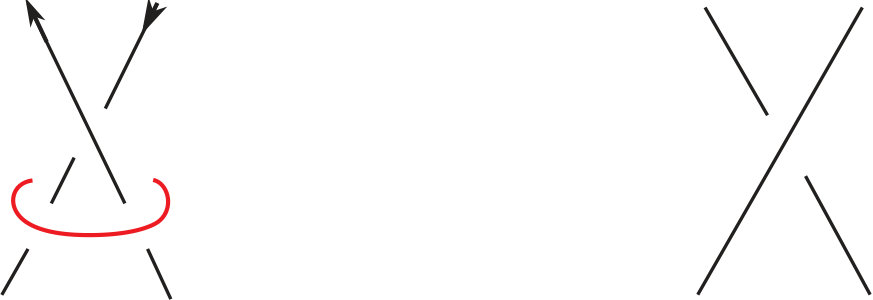 Figure 1
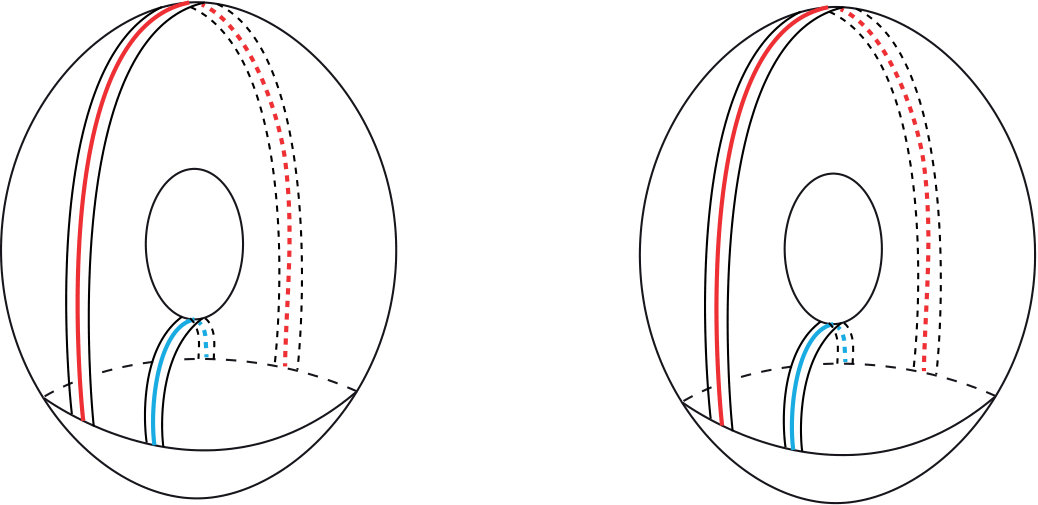 Figure 2
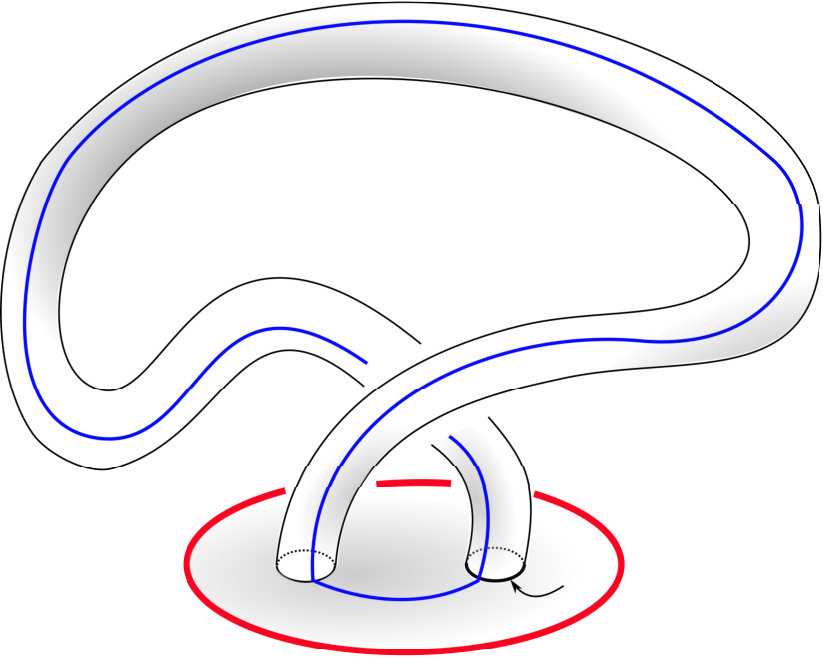 Figure 3
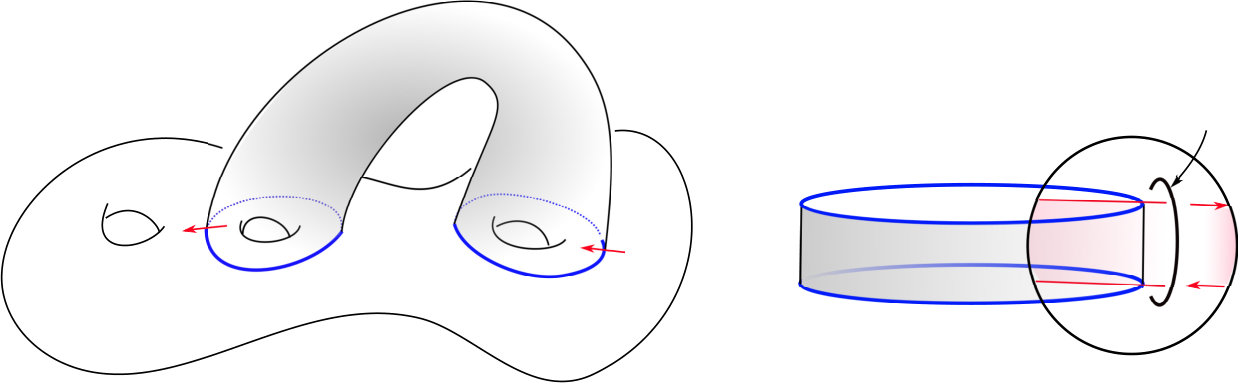 Figure 4
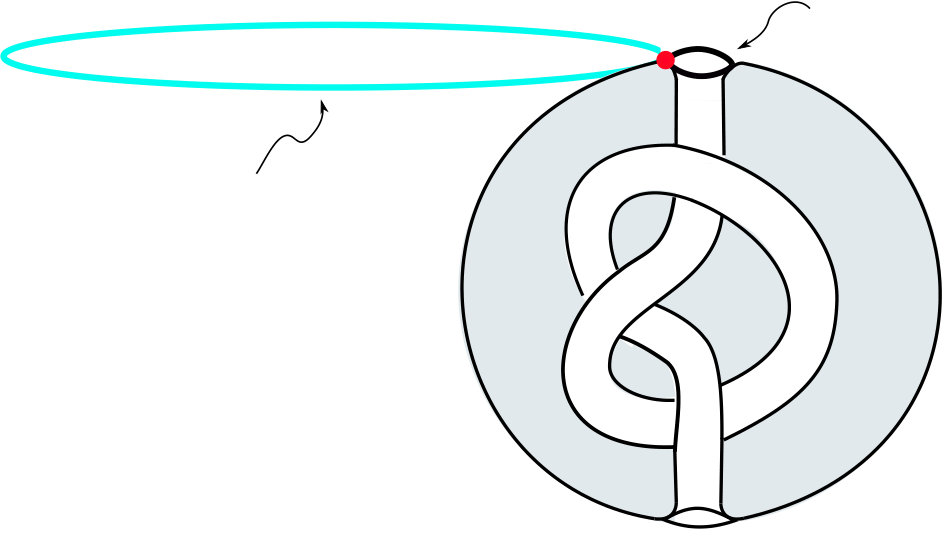 Figure 5
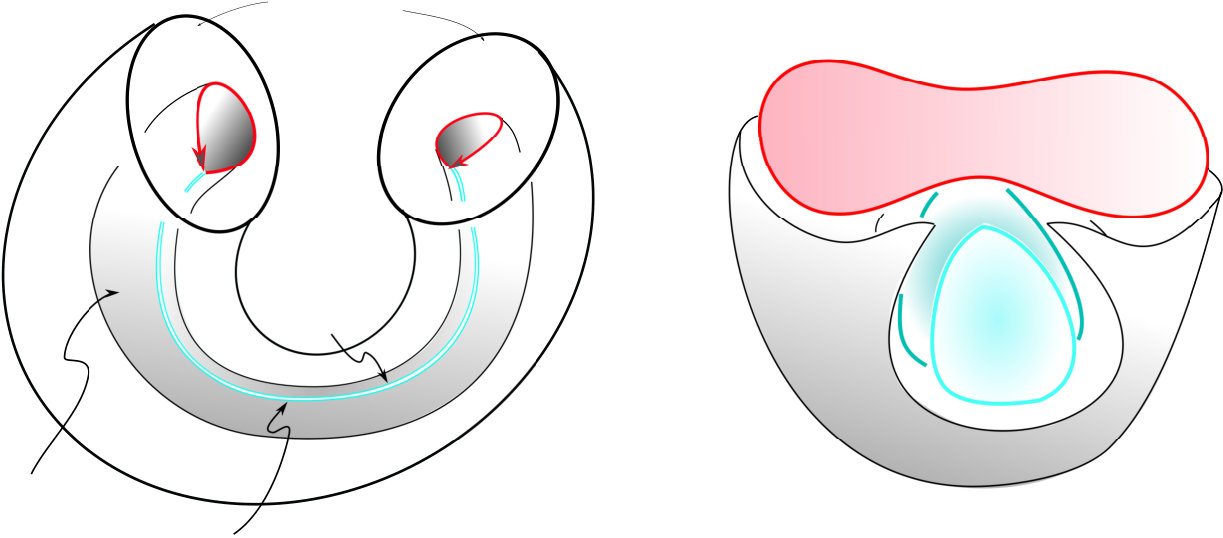 Figure 6
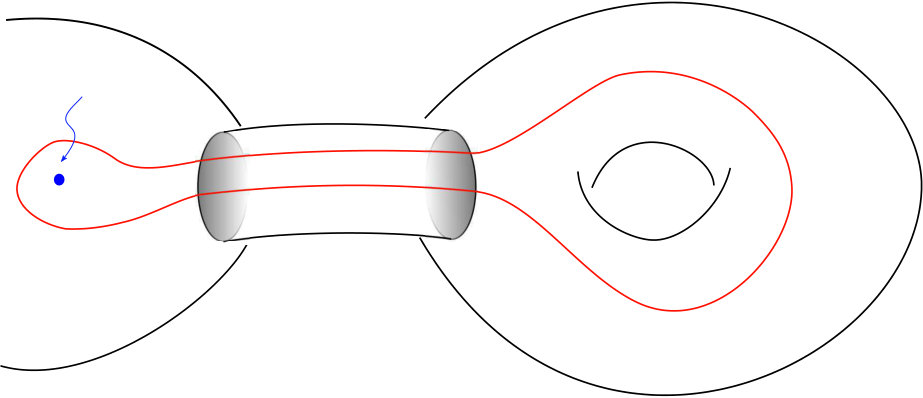 Figure 7
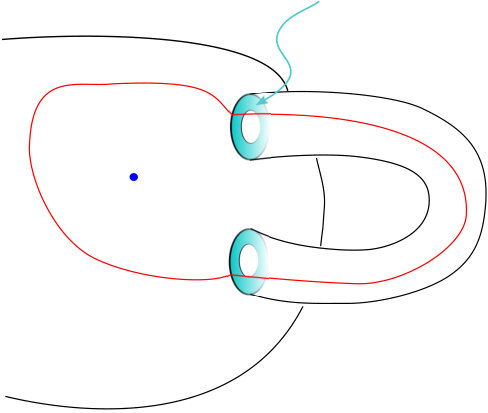 Figure 8
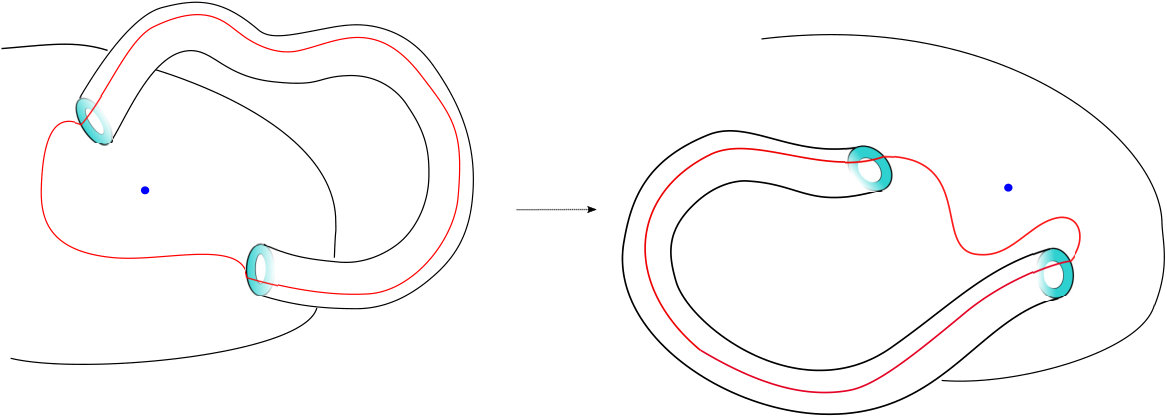 Figure 9
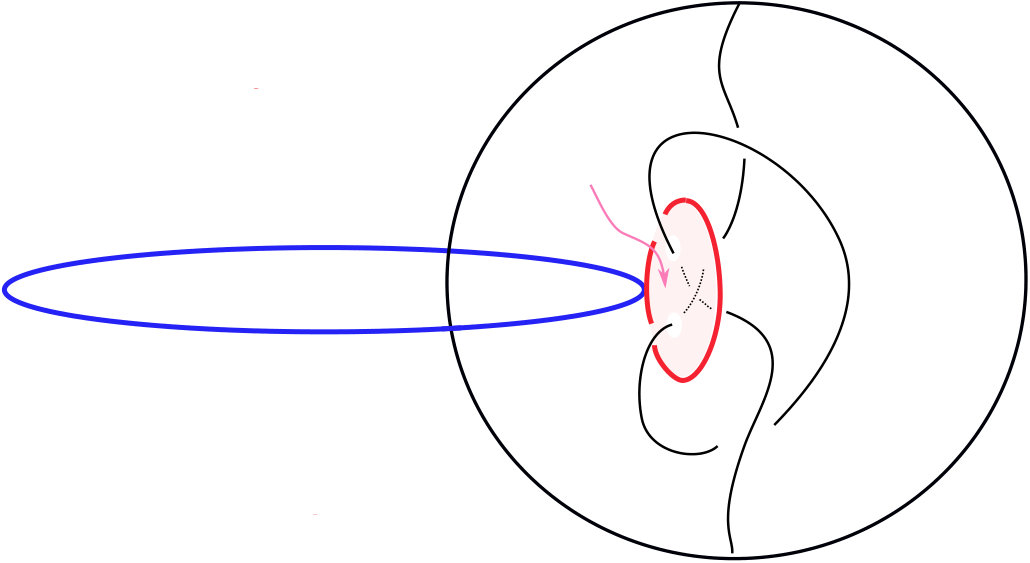 Figure 10
Peer Reviews
No public reviews on file for this paper yet. If you reviewed it on a platform where reviews are public (OpenReview, ICLR, NeurIPS, ICML), you can paste yours below so the community can read it here.
Videos
No videos yet. Explain this paper in a talk, walkthrough, or lecture? Add one.
Knotted surfaces in -manifolds by Knot surgery and Stabilization
Hee Jung Kim
Department of Mathematical Sciences
Seoul National University
Seoul 790-784, Korea
Abstract.
Given a simply-connected closed -manifold and a smoothly embedded oriented surface , various constructions based on Fintushel-Stern knot surgery have produced new surfaces in that are pairwise homeomorphic to , but not diffeomorphic. We prove that for all known examples of surface knots constructed from knot surgery operations that preserve the fundamental group of the complement of surface knots, they become pairwise diffeomorphic after stabilizing by connected summing with one . When is spin, we show in addition that any surfaces obtained by a knot surgery whose complements have cyclic fundamental group become pairwise diffeomorphic after one stabilization by .
Supported by NRF grant 2015R1D1A1A01059318 and BK21 PLUS SNU Mathematical Sciences Division.
Math. Subj. Class. 2010: 57M25 (primary), 57Q60 (secondary)
1. Introduction
Let be a smooth closed -manifold and be a smoothly embedded surface. An ‘exotic embedding’ of a surface in is a smooth embedding in that is pairwise homeomorphic to , but not diffeomorphic. The ‘stabilization’ of given pair is the process of connected summing with a standard manifold pair or , where denotes the non-trivial bundle over .
The recent work [3] of Auckly, Melvin, Ruberman, and the author has constructed the first examples of exotic -spheres in closed simply-connected -manifolds that become pairwise smoothly isotopic after ‘single’ stabilization by . In this context, one can ask if this stabilization phenomenon arises to exotic surfaces with higher genus.
While a great deal of exotic embeddings in -manifolds are known through various constructions [9, 8, 11, 18, 19, 20, 21], interestingly most examples of exotic embeddings for oriented surfaces in simply-connected -manifolds derive from the constructions based on ‘knot surgery’ of Fintushel-Stern [10]. Knot surgery using a knot in is the operation of removing a neighborhood of a torus and replacing it by a product of and the exterior of the knot . Fintushel and Stern provided an effective way to detect the change of diffeomorphism type for knot surgery, showing that the Alexander polynomial of is reflected in the Seiberg-Witten invariant for a knot surgered -manifold. This allows one to quickly construct and detect infinite families of exotic smooth structures on a large class of -manifolds. Likewise, knot surgery can be used to change a smooth structure of smoothly embedded surface in a -manifold. This approach relies on ‘ambient surgery’ whereby a given surface is surgered to a new surface , leaving the ambient manifold fixed. The rim surgery of Fintushel-Stern [11], author’s twist rim surgery [18], and Finashin’s annulus rim surgery [8] are examples of this technique, underlying most examples of smoothly knotted oriented surfaces in a simply-connected closed -manifold.
In the direction of the study of stabilization for exotic smooth structures, Auckly [2] for and Akbulut [1] for proved that a simply-connected -manifold and its knot surgered manifold become diffeomorphic after single stabilization by or , referred to as -stably equivalent with the terminology in [3]; see [5] for the alternative proof.
This paper investigates the analogous stabilization question for knotted surfaces produced by all of the known constructions based on knot surgery i.e. rim surgery, twist rim surgery, and annulus rim surgery.
The Wall’s stable -cobordism theorem [31] states that homotopy equivalent, simply-connected -manifolds become diffeomorphic after stabilization by some finite number of or . It also holds for embedded surfaces (up to diffeomorphism of pairs) with simply connected complements in a -manifold that represent the same homology class [25]. And, in fact, all known examples need only one stabilization to be diffeomorphic. So, the stabilization question for a knot surgered pair would be the following. In this paper, we will use the terminology ‘surface knot group’ for the fundamental group of surface complement in a -manifold.
Question 1.1**.**
Suppose that is simply connected and is an oriented smoothly embedded surface. Let be a pair obtained by a knot surgery from . If and have the same surface knot group in then are they -stably equivalent?
This paper answers this question affirmatively for all of the currently known constructions. The precise statements are given in Section 2 (Theorems A, B, C) after we discuss the known techniques for constructing exotic surfaces.
Rim surgery of Fintushel and Stern [11] constructed an infinite family of exotic smooth embedding for surfaces with simply-connected complements in a simply-connected -manifold. Finashin used annulus rim surgery [8] for knotting algebraic curves in , and produced surfaces that are smoothly not isotopic to algebraic curves for degree , but the topological classification of his examples was open. The later work [18] of the author introduced a method, called twist rim surgery, of knotting surfaces that produced exotic embeddings for surfaces with cyclic knot groups in a simply-connected -manifold. Applied to algebraic curves in , the twist rim surgery leads to the construction of infinitely many exotic smooth structures on algebraic curves of degree . For degrees and , the surfaces are spheres, and it is not easy to distinguish these by Seiberg-Witten invariants. The work of Ruberman and author [19] strengthened the criterion from [18] for topological equivalence of surfaces by showing that any surfaces produced by a knot surgery that preserve a cyclic knot group is topologically standard. As a consequence, we deduced that Finashin’s examples are topologically standard. Despite some results about the existence of symplectic, noncomplex surfaces as well as smooth surfaces without symplectic structures, the main classical source of examples for smooth embeddings codimension had been complex curves. A subsequent work [20] extended Gompf’s theorem about the fundamental group of symplectic manifolds to the relative case, showing that any finitely presented group can be realized as the fundamental group of complement of a symplectic surface in a simply-connected symplectic -manifold, whereas the fundamental groups of complement of complex curves are quite restricted. Those examples can be further smoothly knotted by twist rim surgery so that it has led to a large class of exotic embeddings. Another interesting aspect of twist rim surgery is that some iteration of the twist rim surgery gives a way of constructing new smooth surfaces with certain non-abelian finite surface knot group. One consequence is that it gave an infinite family of exotic surfaces in with knot group a dihedral group , for any odd .
In this paper, we prove that for all known examples of surface knots constructed from rim surgery, twisted rim surgery, and annulus rim surgery that preserve their surface knot groups, they become pairwise diffeomorphic after ‘single’ stabilization by .
Another result includes an interesting phenomenon in the relative version of stabilization i.e. connected sum with or . It is known that for a nonspin simply-connected -manifold , essentially due to Wall [30], is diffeomorphic to , but surprisingly it is not true for the relative case. Theorem D proves that for a degree -curve in , is not even pairwise homeomorphic to , even when is not spin i.e. even.
Finally, we show that if a knot surgery is cyclic, which is defined to be a surgery preserving a cyclic surface knot group [19], then the pairs are -stably equivalent by connected summing with in the case that is spin.
Remark 1.2**.**
Note that here we will not impose any extra assumptions on other than that is an oriented smoothly embedded surface in a simply-connected closed -manifold . Recall that the constructions of (twisted) rim surgery and annulus rim surgery can provide exotic embeddings of when is a surface of positive genus and has a non-trivial relative Seiberg-Witten invariant [10, 11, 12, 29] (or a relative Heegaard-Floer invariant as in the version of Mark [23]).
The main theorems are precisely stated in the next section where it carefully describes when surface knot groups are preserved for each knotting construction. And it includes the proof of Theorem D.
2. Main Theorems
Before we state our results, the notions of ‘equivalence’ of embeddings of surfaces in a should be clarified as in [3]:
Definition 2.1**.**
Two smoothly embedded surfaces in a smooth -manifold are equivalent if there is an orientation preserving pairwise diffeomorphism of to . Two smoothly embedded surfaces in a smooth -manifold are -stably equivalent if the natural embeddings (or ) are equivalent in (or ), but not in (or ) for any .
Note that our constructed exotic -spheres in [3] have simply-connected complements and they are -stably isotopic which is a stronger notion of equivalence of surfaces. It is still open to see the distinction between equivalence of surfaces up to diffeomorphism and smooth isotopy [27, 28], while this issue does not arise in the topological case [24, 26]. Here our stabilization by (or ) is taken in the ‘outside’ of embedded surfaces in , but there is another notion of stabilization for embedded surfaces, adding an unknotted handle to the surface. The work [6] of Baykur-Sunukjian showed that all constructions of exotic knotting of surfaces produce surfaces that become smoothly isotopic after adding a single handle in a standard way.
Let be a smooth -manifold containing a torus with a trivial normal bundle and let be a knot in with its closed complement . Fintushel-Stern’s knot surgery [10] is the process of removing a neighborhood of from and re-gluing via a diffeomorphism on the boundary to form . Denote by the boundary of the normal disk of , and let the meridian/longitude of be and respectively. Here the gluing map can be chosen by any diffeomorphism such that . When is a simply-connected closed -manifold, this operation doesn’t change the homeomorphism type, while it may change its diffeomorphism type.
Applied to a torus in the exterior of an embedded surface in a closed -manifold, the knot surgery can change embeddings of surfaces in -manifolds. We assume that is a smooth simply-connected closed -manifold, and is an oriented embedded surface in throughout the paper. Then the fundamental group is normally generated by a meridian of surface. For a surface carrying a non-trivial homology class in , the first homology group is always finite cyclic, of order that we will usually write as . The process of knotting an embedded surface in can be obtained by performing knot surgery on a torus in the exterior , and then gluing back in the neighborhood of the surface gives a new embedding of in with image . In the case of rim surgery, twist rim surgery, and annulus rim surgery, there is a canonical identification between and so that we can view as an embedding in ; see Section 3 for more details of these constructions. In general the resulting homeomorphism/diffeomorphism type of the new embedding depends on a choice of torus , knot , and gluing map . Our results show that the surfaces and are -stably equivalent under some circumstances as follows.
Rim surgery deals with surfaces with simply-connected complements in a simply-connected -manifold and doesn’t change the fundamental group, so the surface is in fact topologically isotopic to by the works in [24, 26]. The following theorem shows the stabilization result for these surfaces.
Theorem A**.**
Suppose that is a simply-connected closed -manifold and is an smoothly embedded oriented surface with . Let be a pair obtained by a rim surgery. Then is pairwise diffeomorphic to .
Remark 2.2**.**
It turns out that the general -stable isotopy principle holds for surfaces with simply-connected complements. The recent paper [4] of Auckly, Melvin, Ruberman, Schwartz, and the author has shown using Gabai’s result [15] that any two homologous surfaces of the same genus embedded in a -manifold with simply-connected complements are smoothly isotopic after single stabilization with if the surfaces are ordinary, and if they are characteristic.
Finashin’s annulus rim surgery [8] requires a suitable annulus in to produce a new surface via knotting along the annulus. This surgery in his paper is given by an explicit geometric description of the surgered surface, but in [19] a knot surgery description for this surgery is provided; see Section 3.3 for this description. It is shown in [8, 19] that annulus rim surgery preserves the surface knot group when , and it turns out that the surface is topologically isotopic to by the work in [19, Theorem 1.3].
Theorem B**.**
Suppose that is a simply-connected closed -manifold and is an smoothly embedded oriented surface with . Let be a pair obtained by an annulus rim surgery. Then is pairwise diffeomorphic to .
In order to explore this phenomenon for surface knots with arbitrary knot groups, we consider twist rim surgery [18, 19, 20], a variation of the Finstushel-Stern’s rim surgery with additional twists parallel to a meridian and a longitude of a knot . We write the meridian twist rim surgery as ‘-twist rim surgery’ when we wish to indicate the number of twists applied on the meridian of , and also denote by the new embedding produced from under the surgery. The way in which -twist rim surgery affects the fundamental group of a surface knot depends to some degree on the relation between and , where . For example, when , the twist rim surgery always preserves the fundamental group of a surface knot; the proof was given for -twist in [20, Proposition 2.3], but it works for -twist in the exactly same way. The -twist rim surgery allows us to construct exotic smooth embeddings for a symplectic surface with any finitely presented knot group in a symplectic -manifold (see [20, Theorem 3.1, 5.2] for more details). More generally, Proposition 2.4 in [20] shows when an -twist rim surgery preserves the fundamental group of surface knots as shown that for a surface with , if and the meridian has order in , then . This criterion is used to produce infinitely many exotic embeddings in with knot group a dihedral group for any odd [20, Theorem 5.1]. Note that when , the surface with is topologically isotopic to ; see [19, Theorem 1.3]. But for arbitrary surface knot groups, when the knot is chosen carefully, is equivalent to up to smooth -cobordism; see [20] for more details. In all cases that surface knot groups are preserved under twist rim surgery, we show that and are -stably equivalent:
Theorem C**.**
Suppose that the surface has , and let be any group . Then the following is true.
- (1)
* is pairwise diffeomorphic to .* 2. (2)
If and has order in then is pairwise diffeomorphic to .
Now, we give a simple proof to show an interesting phenomenon in this relative stabilization. Wall’s stabilization result [30] for a nonspin simply-connected -manifold shows that is diffeomorphic to , but interestingly it fails as follows:
Theorem D**.**
Let be a degree -curve in . Then the pair is ‘not’ pairwise homeomorphic to .
Proof.
If is odd then it is obvious since is spin. But, we will show that the pairs are still not homeomorphic in the case that is even so that is not spin. We claim that there is no odd class in . For any , the homology class can be written by in , where and denote the first and second generators of respectively. Then it gives that must be zero, so . This implies that there is no odd class in , but there is in . ∎
Remark 2.3**.**
It is worth pointing out that there is no odd class in even when is not spin. To understand this, first note that the nonzero element has as shown in the above proof, so it gives . In fact the handlebody picture of shows that there are [math]-framed -handles, and a -framed -handle which is -times linked with a -handle; see Exercises 6.2.12.(c) [17]. For even, there is a -homology class of the -framed -handle and over , the intersection form is given by . By the Wu formula, vanishes on , but has value on the -homology class .
Finally, we focus on the case that is a cyclic group , and investigate the stabilization problem of knot surgery. As the terminology in [19], if a knot surgery satisfies that is cyclic then the knot surgery is called a cyclic surgery. In [19, Theorem 1.2], Ruberman and the author showed that for any pair that is simply-connected and is an embedded surface with , if a knot surgery is cyclic then there is a pairwise homeomorphism . Thus, it is natural to ask the -stable equivalence for the cyclic knot surgery. We answer for this question in the case that is spin:
Theorem E**.**
Let be a simply-connected, closed, spin -manifold and be an embedded oriented surface with . Suppose that the knot surgery is cyclic. Then is pairwise diffeomorphic to after one stabilization with .
Remark 2.4**.**
In the contrast to the well-known stabilization theorems for simply-connected -manifolds, the relative stabilization for cyclic knot surgery doesn’t seem to give any general statement for a choice of or in the case of a nonspin -manifold . Our main argument for stabilization results will rely on proving the -stable equivalence of surface knots and for two knots and related by one crossing change. At each stage of crossing change that will make any knot to an unknot, one cannot assert that the pairs and become pairwise diffeomorphic after one stabilization with only or with only when is nonspin. This issue arises because may not be pairwise diffeomorphic to as seen in the proof of Theorem D.
3. Knot surgery constructions to change embeddings in -manifolds
Let be a simply-connected closed -manifold and be an embedded oriented surface.
3.1. Twist rim surgery
Let be a torus with (called a rim torus) that is the preimage in of a closed curve . Identify the neighborhood of the curve in with where in is . In this trivialization, let be a pushed-in copy of the meridian circle , so it is isotopic to a meridian of . Then the rim torus can be written as and we will identify a neighborhood of with . Let be a knot in with its closed exterior , and denotes a pair of meridian-longitude of . The -twists and -rolls of rim surgery on is defined by
[TABLE]
Here the gluing map is the diffeomorphism determined by
[TABLE]
with respect to a basis for and for , where are the pushoffs of , into and denotes a meridian of the rim torus.
Such a gluing corresponds to the spinning construction of the rim surgery of Fintushel-Stern i.e. , adding a combination of -fold twist spinning [32] and -fold roll spinning [13, 22]. It is useful to specify these twists by classical diffeomorphisms that give equivalent descriptions for the twisted rim surgery.
Consider self-diffeomorphisms denoted by and of that correspond to twists parallel to a meridian and a longitude of respectively. Let be a collar of in under a suitable trivialization with [math]-framing. Identify with and then the twist map is given by
[TABLE]
and otherwise, .
Similarly, a roll, , is obtained from by extending as the identity on the rest of .
Although a roll can also produce exotic embeddings, we will only deal with an -twist rim surgery in this paper since a meridian twist is sufficiently useful to construct all desired smoothly knotted surfaces. Most of the arguments for the stabilization result of the -twist rim surgery be easily modified to address the rolling as well.
Writing where is an unknotted ball pair, we regard as an automorphism of . Since the rim torus lies in a neighborhood of the curve , the twisted rim surgery performed in gives rise to the mapping torus of with monodromy given by the twist map . So the -twisted rim surgery on can be written as follows;
[TABLE]
In doing any rim surgery (twisted or otherwise) we assume that is a curve for which there is a framing of along such that the pushoff of into is null-homotopic in . But we don’t assume that is a non-separating curve on , which is necessary to distinguish the diffeomorphism type of from that of with Seiberg-Witten invariant. Note from [18, Lemma 2.2] that if bounds a disk in , the surface is the connected sum of with the -twist spun knot of Zeeman [32]. Our stabilization results include this example as well.
3.2. Twisted rim surgery and the surface knot group
As mentioned in Section 2, -twist rim surgery always preserves surface knot groups [20, Proposition 2.3], and also Proposition 2.4 in [20] shows when an -twist rim surgery preserves the fundamental group. Here we will revisit Proposition 2.4 with more elementary argument (compare the proof in [20]) since it explicitly provides the presentation of the fundamental group for later use.
Proposition 3.1** (Proposition 2.4 in [20]).**
Let be any group . Suppose that the surface has and the meridian has order in . If then is isomorphic to .
Proof.
In order to investigate a presentation of , we first consider the decomposition of induced from (3):
[TABLE]
Choosing a base point at the intersection of two components in this decomposition (4), we get the following diagram from the van Kampen theorem;
[TABLE]
In the diagram, each map is obviously induced by an inclusion and is generated by two elements and . So, the relations in a presentation of are given by which is trivial by the assumption that the pushoff of is null-homotopic in , and is a meridian of in . So, it leads the presentation for as follows:
[TABLE]
where , denote generators of in Figure 1. Associated with the relations, this presentation becomes the following:
[TABLE]
If and , it obviously gives .
∎
Remark 3.2**.**
Note that in the diagram, if the image of in is a cyclic subgroup generated by the meridian of , then the presentation (6) for readily leads to the group . The choice of the parameter in Proposition 3.1 makes this case. This property enables one to see that the stabilization result of Baykur-Sunukjian in [6] can be extended to knotted surfaces produced by the -twist rim surgery with the choice of in Proposition 3.1. They showed that for or any with in the case of , the -twist surgered surfaces become smoothly isotopic by adding one trivial handle. The same argument in [6, Section 3.2] can work for the examples in Proposition 3.1 by adding a -handle at a crossing of the knotted arc in to unknot it crossing by crossing, where it must be checked that the attached handle is trivial at each stage. It follows from the work of Boyle [7, Theorem 2, Section 2], showing that surfaces obtained by attaching two different -handles to a surface are equivalent in up to isotopy if and only if their ‘double cosets’ of the peripheral subgroup , the image of under the inclusion , should be same. Here the double coset induced by a -handle of the peripheral subgroup is defined by , where is a core of the -handle in the exterior of connecting a point to in and , are paths in starting from the base point of while ends at and ends at . So this makes an element in , and from his result [7, Theorem 2, Section 2] it can be shown that a -handle on is trivial if and only if its double coset ; see Corollary 3 [7, Section 3]. Note that this works for general -manifold as shown in [6, Lemma 3]. In our circumstance, the image of in is a cyclic subgroup generated by the meridian of so that every handle attached within is homotopic to a handle attached along some number of meridians to the surface . In other words, the core of every attached handle can be isotoped to lie in , and so such cores represent a trivial handle as shown in [7, Corollary 3, Section 3] or [6, Lemma 3].
3.3. Annulus rim surgery
Suppose that there is a smoothly embedded annulus , where denotes an interval ) in such that meets normally along so that are two curves and on . We assume that is connected. Choose a trivialization such that and , where denotes a disjoint union of two unknotted segments , a part of the boundary of a trivially embedded band in (See Figure 2). So, is identified with in .
Denote by a meridian of in and let be a torus in corresponding to . Knot surgery along this torus produces a new surface . The simplest gluing , given by , , and , provides the Finashin’s annulus rim surgery. This operation obviously yields a band by knotting the band along and let be the pair of arcs bounding . Here the framing of is chosen the same as the framing of . So the resulting manifold of the annulus rim surgery performed on becomes and we write a new pair as follows:
[TABLE]
This construction can be further modified by twists along a meridian and a longitude of , but we will stick to Finashin’s construction; see [19] for other modifications. Note that when , any (twisted or otherwise) annulus rim surgery preserves surface knot groups [8], [19, Proposition 3.3].
4. Basic Construction
In order to get our main theorems, for two knots and related by a single crossing change we will show the -stable equivalence on surface knots and produced by knot surgery. The complete proof for each knotting construction will be given in Section 5.1, 5.2, 5.3 but in this section we first present the key constructions and properties that will be used repeatedly in the proofs of our stabilization results.
Suppose that two knots , in differ by a single crossing change, so that the knot is obtained by performing a -Dehn surgery along a curve around an oppositely oriented crossing of as in Figure 3. Let , be two pairs obtained by a knot surgery along a torus and gluing map along the knots and respectively. Then we begin by showing that these pairs are related by a torus surgery:
Lemma 4.1**.**
A log transform of multiplicity performed on the pair produces .
Proof.
We first recall that the knot surgered pair is defined as follows:
[TABLE]
Here, we denote a torus in of this decomposition, where is a curve at a crossing of as in Figure 3. Identify a neighborhood with , where is a neighborhood of in , and we perform the -log transform parallel to the curve on in which is given by the identity in the direction times the -Dehn surgery along . Note that this construction realizes performing a torus surgery along in and gluing back this manifold in along their boundaries via . The resulting manifold is easily identified with because there is an obvious diffeomorphism from the log transform of along , denoted by , to which carries each element in a basis of to each element in of respectively.
∎
Remark 4.2**.**
When the knot surgery is an ambient surgery such as (twisted) rim surgery and annulus rim surgery, the above torus surgery on gives rise a new embedding in . And, because observed from the proof in Lemma 4.1, if a knot surgery does not change the surface knot group under some suitable circumstances then the new embedding also preserves its knot group.
4.1. Fiber sum and gluing map
A torus surgery of along can be described as a fiber sum of and : Let be a standardly embedded torus in , where is an unknot in . Then we write the torus surgered manifold in Lemma 4.1 as a fiber sum along tori and :
[TABLE]
In order to describe the gluing map carefully, identify a tubular neighborhood in with , where is a neighborhood of in . Let and denotes its pushoff into . Then forms a basis for where , are a meridian-longitude pair of with respect to the identification of . Similarly, under an identification in , let and , be a meridian-longitude pair of . So gives a basis for , where is a pushoff of into .
Described in the proof of Lemma 4.1, this construction realizes the product of a -Dehn surgery with , and note that the meridian (longitude ) of is the longitude (meridian) of the solid torus that is glued into . So the gluing map is determined as follows;
[TABLE]
In our present purpose, it is important to keep track of the gluing map in this fiber sum, from which we can determine the framing arising in our proof of the stabilization result.
4.2. Cobordism
In this section, we will construct a cobordism whose upper boundary is from . The proof of stable equivalence for surfaces and will come from the middle level of the constructed cobordism .
Given and , containing tori and respectively, we obtain by forming , and attaching a ‘doubly round -handle’ to the upper boundary. In particular, is attached to while is glued to ; the attaching map in the first case is the ‘identity’ with respect to some identification of , while the second torus is attached by a diffeomorphism that should realize the gluing map described in (10) when restricted to the boundary. From this description, it follows that in the upper boundary of W the meridian of is identified with the meridian of because the attaching map necessarily preserves the normal disk.
We also explicitly give a handle by handle description of for later work according to a standard handle structure of tori and and the gluing between them. As in Figure 4 (thicken by ), a standard handle decomposition of can be given by one [math]-handle , two -handles , , and one -handle , where and denote the -handles induced by the first and second factors of respectively. Similarly, has one [math]-handle , two -handles , generated by the first and second factors of , and one -handle . From the handles of these tori, will be built by adding one -dimensional -handle , two -handles denoted by , , and one -handle to .
To examine this attaching process closely which is basically same as the previous description, note that the handle structure of a neighborhood of a torus simply comes from each -dimensional -handle of the torus so that the corresponding -dimensional -handle is of the form . Then we define a -dimensional -handle by where denotes the interval , and the attaching process of a -handle is described as follows. The discs and are attached to each core of the -handles of and respectively, and the rest connects the boundaries of these cores in , where denotes a handlebody obtained by attaching all handles of index . Moreover, as described before, and are glued to each -dimensional -handle of and respectively. The boundary of the normal bundle of the torus restricted over the handle is glued to by the identity, and is glued to by the diffeomorphism so that it gives rise to the framing.
We will find out the resulting upper boundary at each stage of attaching handles while we’re building a cobordism from to the fiber sum . The level of after a -handle is obviously the connected sum , and for the rest handles we will give more careful arguments.
Since we’re interested in the equivalence of embeddings and in a same manifold , one may focus on ambient surgery so that . Then all constructions of (twisted) rim surgery and annulus rim surgery will share the following diagram which indicates the boundary at each stage of adding handles:
[TABLE]
Our main argument for -stable equivalence of and follows from the middle level of : Let be a handlebody obtained by attaching all handles of index in . Then from the diagram (11), is , which will be shown in Lemma 5.4, Theorem 5.6, and 5.7. After adding a -handle to , we would have a cobordism from to the fiber sum which is diffeomorphic to itself containing the surface by Lemma 4.1 and (9). Turning the -handle upside down so that it becomes to attach a -handle to the fiber sum gives a connected sum with or on . Disregarding the surface in the fiber sum, we first note that the level after attaching the -handle to is same as which is diffeomorphic to . But since we’re building a relative cobordism, it has to be argued that attaching the -handle gives rise to the pair on the boundary. This will be verified in Lemma 5.5, Theorem 5.6, and 5.7 so that it will prove the -stable equivalence of and .
When we discuss about the stabilization in Section 6 for the case that knot surgery is cyclic, that is a surgery preserving as a cyclic group, the cobordism will be considered to be from and it will be shown that the diagram (11) also works for this.
In the following subsections, we will investigate the level of at each step of adding handles, and give some assertions that will be used in the proof of the stabilization for each knotting construction. For the purpose in this article, the knot surgery is assumed to be cyclic or be an ambient surgery to produce a new surface in throughout the rest of paper, although some proofs may work for more general cases.
4.2.1. **Attaching a -handle **
Note that the homotopy class of attaching circle of -handle is represented by a curve in the outer boundary of as depicted in Figure 5. We claim that the resulting manifold on the boundary is .
Lemma 4.3**.**
The resulting upper boundary of attaching a -handle to is diffeomorphic to .
Proof.
We first draw as Figure 6, which is basically obtained by attaching a ‘round handle’ , where denotes a -handle of , to the outer boundary along . One can see that is isotoped in to as demonstrated in Figure 7 so that it yields a pairwise diffeomorphism . Since attaching a -handle along gives the effect on the boundary that surgers out the curve of the second summand in , so the result follows.
∎
4.2.2. Attaching a -handle and a dual handle of -handle
We now deal with the next -handle and the dual -handle of -handle in building . The level of our relative cobordism after adding those handles will have more subtle issues on the framing that will depend on each knotting construction, and so the details of the analysis for the boundary will be referred to the next following sections. But here we will first focus on the ambient manifold to study the boundary after adding the handles without concerning surfaces.
As seen in Lemma 4.3, the level of after adding a -handle is diffeomorphic to . Note that any knot surgery preserves the fundamental group of the ambient manifold, so is simply-connected and adding another -handle along the curve in gives rise a connected sum with a -bundle over on . The following lemma determines the framing.
Lemma 4.4**.**
Attaching a -handle to provides a connected sum with the twisted -bundle over so that is diffeomorphic to .
Proof.
Since is nullhomoptic in , it bounds a disk in that may be assumed to be embedded in closed -manifolds and intersect with the surface . As described in Section 4.2 about , the 2-handle is attached so that are glued to the cores of the 1-handles , in the tori , . And, we split the as so that is glued to the -dimensional -handle of each torus , and the normal corresponds to the normal bundle of the torus restricted over the handle. So the gluing map in (10), expressed with the meridian-longitude defined from the disk , gives rise to the framing of attaching this -handle which is same as the framing of the surgery along the curve on the boundary. It verifies that the framing relative to the disk is odd, and therefore the surgery gives the twisted -bundle over .
∎
Turning the cobordism upside down, denoted by , yields a dual -handle of the -handle which is attached to a collar . Again this attaching will give a -bundle over on as follows.
Lemma 4.5**.**
The level of after adding a dual -handle is diffeomorphic to .
Proof.
The -handle is attached in the same way of the proof of Lemma 4.4 as the parts of attaching sphere are glued to the -handles , of the tori , respectively. And the normal disk of is a cocore of whose boundary will be the attaching circle of its dual -handle glued in according to . So as given in (10) , the -handle is attached to a meridian circle to in . Since the fiber sum of with is diffeomorphic to , we need to see where the dual -handle is attached in . It follows from that the diffeomorphism is done by -Dehn twist along the curve in trivially multiplied by . Placing a meridian circle to in Figure 3, then blowing down to arrive at the right hand side of that figure: in the process, the meridian circle becomes a circle that links the crossing of in the same way that links the crossing of . Moreover, this picture verifies the fact that the framing on should be odd, since the dual -handle (corresponding to the meridian of ) will have framing [math], which becomes after blowing down. ∎
In the next following sections, we will verify the rest process in the digram (11) and prove the -stable equivalence of the surfaces , according to each knotting construction of surfaces.
5. -stable equivalence of knotted surfaces
5.1. Twist rim surgery
Let be any group , and suppose that the surface carries a nontrivial homology class with . Then our key theorem is stated as follows:
Theorem 5.1**.**
Suppose that two knots , in differ by a single crossing change. If is a pair produced by an -twist rim surgery such that either or the meridian has order in and , then is pairwise diffeomorphic to .
To prove Theorem 5.1, we now turn to the -handle and -handle in the diagram (11).
I. Attaching a -handle
Lemma 4.3 has shown that the upper boundary after adding a -handle is diffeomorphic to , and from Lemma 4.4 adding another -handle along the curve in gives for the ambient manifold. But since our stabilization is performed in the ‘outside’ of the surface , we first show that is nullhomotopic in :
Proposition 5.2**.**
Suppose that is a surface carrying . If either or the meridian has order in and , then the curve is nullhomotopic in .
Proof.
Since is a curve at an oppositely oriented crossing of a knot as in Figure 3, its homotopy class can be expressed as in terms of some element . It easily follows from the presentation (7) for in Proposition 3.1 that when either or and .
∎
Remark 5.3**.**
Proposition 5.2 asserts that we can find a disk such that , and in general it will be an immersed disk. But since the circle lies the interior of the -manifold , we simply pipe the self-intersection of off of its boundary to make it an embedded disk. It follows that there is an induced diffeomorphism from any surgered manifold of along to the connected sum of with a -bundle over i.e. or . Note that is obtained from by surgery on with the framing determined by the unique normal framing of , and is obtained with the other framing. To address the framing, we will explicitly find a disk and examine the framing of surgery relative to the disk. We will repeat this argument for the framing in Lemma 5.4, 5.5 and other constructions Theorem 5.6, 5.7, and Theorem E. Note that throughout this paper it may be assumed that the existing disk bounding the circle is an embedded disk by using the piping operation in the interior of the complement of surface . In fact, for our purpose this step is unnecessary in Lemma 5.4, 5.5, Theorem 5.6, 5.7 as we will see that the existence of immersed disk is sufficient, but it is not harmful to do it.
We first recall that twist rim surgery is performed along a rim torus in so that it produces the mapping torus ; see (3). So we view the torus used in a log transform in Lemma 4.1 is lying in the mapping torus ; see Figure 8, and so the curve is in .
Lemma 5.4**.**
The upper boundary of -handlebody in the cobordism is diffeomorphic to .
Proof.
Attaching a -handle gives a surgery along in . This curve obviously bounds an embedded disk in the component of the decomposition (3) for that intersects with at two points as in Figure 8. Using the disk , we denote by the surgery framing induced from attaching the -handle . Note that there is a framing determined by the unique normal framing of , but by Lemma 4.4, our framing on relative to this disk is the other one so that it doesn’t extend over . To investigate the framing on in , we shall find a disk bounding in the complement of , and compare with the framing on determined by the disk . This can be checked by computing since (mod ) .
To find the disk , we shall chase the homotopy class in the presentation for given in Proposition 3.1. Referring to the decomposition (4) for , we first claim that bounds a punctured torus in . The twist map along a meridian of gives a relation for all , which is same as under the assumption on in our theorem. And since the homotopy class is for some , it is same as , which obviously bounds a punctured torus in ; see the first picture in Figure 9.
Now consider a relation in where denotes a generator of in Figure 1, so a curve representing bounds a disk as in the first picture of Figure 9. And, is nullhomotopic in from the presentation (6) in Proposition 3.1, so it bounds a disk in . Adding this relation to the presentation of , we write , which bounds a disk in as depicted in the second picture of Figure 9.
It remains to compare the framings , . Note that the element is same as represented by a torus; see the second picture in Figure 9, which is trivial in , so does in . This shows vanishes on this class, from which our result follows. ∎
II. Attaching a dual handle of -handle
Turning upside down, the -handle provides adding a -handle to in our relative cobordism. As it turns out in Lemma 4.5, a key point is that the dual handle is attached to a curve at a crossing of and its framing, disregarding surface knot in , is shown to be twisted. But since we’re building a relative cobordism from the top, we will find a disk in bounding , and then examine the surgery framing relative to this disk . The idea is same as before, so it is basically to find a dual sphere of the attaching sphere of that doesn’t intersect with and determine its framing.
Lemma 5.5**.**
The upper boundary of is diffeomorphic to .
Proof.
Since is attached along a curve at a crossing of which is in as shown in Lemma 4.5, the curve bounds a disk in intersecting with at two points in the same way that does in Figure 8. And the surgery framing coming from adding the -handle on relative to does not extend over the full disk . Proposition 5.2 shows under our current assumption on that is nullhomotopic in , so this surgery gives or on . The hypothesis on in allows one to find a disk in with the exactly same argument in Lemma 5.4 and show that the framing on relative to is equivalent to the one relative to up to (mod ). ∎
Lemma 5.4 and 5.5 show that , so it completes the proof of Theorem 5.1.
5.2. Rim surgery
Finshel-Stern’s rim surgery is the case of -twist rim surgery. Let be an embedded surface in a simply-connected -manifold with . As discussed in Section 3.1, the rim surgery performed in a neighborhood of a curve produces i.e. in (3).
Theorem 5.6**.**
Suppose that two knots , in differ by a single crossing change. If and are surface knots obtained by rim surgery then is pairwise diffeomorphic to .
Proof.
Lemma 4.3 asserts that the level of after adding a -handle and a -handle is . At the stage of adding the next -handle along , the curve is nullhomotopic in because , so the surgery provided from the -handle gives a connected sum of or on the exterior of the surface. We now need to handle with the framing issue.
Since bounds a disk in intersecting at two points with as in Figure 8, this disk specifies the framing on the curve induced from the -handle , which doesn’t extend over by Lemma 4.4. To find a disk with in , note that is at a crossing of the knot , so it bounds an obvious punctured torus in consisting of two generators; a meridian of and some represented by a blue curve as in Figure 10. Since is trivial, the image of is trivial so that the curve bounds a disk in where denotes the rim torus given by a curve . Cutting along and filling with two oppositely oriented disks gives a disk bounding in .
If denotes the framing on relative to the disk , it readily follows that is equivalent to (mod ) by showing . This is because is represented by a torus in , which vanishes in , so does in . Thus, the level is diffeomorphic to .
Now turn upside down and note that as shown in Lemma 5.5, the dual -handle of the -handle is attached to the curve in which is again nullhomotopic in since , and so the dual -handle gives or on the exterior of in . Repeating the same argument in the above with in , one can show that the framing of the surgery induced by the -handle is twisted and so it proves our theorem.
∎
5.3. Annulus rim surgery
Our setting is given as in Section 3.3, and recall that the Finashin’s construction is a knot surgery along a torus in a neighborhood to produce with the gluing , , and . Furthermore, it is not hard to see that is preserved when by applying the Van Kampen theorem for the decomposition (8) of . In this computation, we see that the generators , of are trivial in , so the image of is a trivial subgroup of ; see [8], [19, Proposition 3.3] for more details. In this circumstance, the same argument in the rim surgery case works here.
Theorem 5.7**.**
Suppose that two knots , in differ by a single crossing change. If and are surface knots obtained by annulus rim surgery then is pairwise diffeomorphic to .
Proof.
We just begin with the -handle attached along in from Lemma 4.3. Since is a curve at a crossing of and the annulus rim surgery is performed on a neighborhood , the curve lies in the resulting manifold . And, it is nullhomotopic in since the image is trivial in as shown in [8], [19, Proposition 3.3]. So we sketch the exactly same argument in Theorem 5.6.
There exists an embedded disk bounding in that intersects with at ‘four points’, and the surgery framing relative to the disk , coming from the -handle , doesn’t extend over by Lemma 4.4. Since bounds a punctured torus in and the image is trivial in , the argument in Theorem 5.6 gives a way to find another disk in bounding . It readily follows that the framing on relative to is also twisted since the homology class is represented by a torus in . So vanishes on this class, from which we have .
Finally, turn upside down. By Lemma 4.5, the dual -handle of the -handle is attached along a curve in , which has a trivial in so that the attaching circle is nullhomotopic in . One simply proceeds the above argument to show that the boundary is diffeomorphic to , and hence our result follows.
∎
Remark 5.8**.**
A crucial point of our argument for the case of rim surgery and annulus rim surgery is that the image is trivial in . This allows us to exhibit a disk bounding easily as we first find a punctured torus with in and surger out one of two generators of using a disk bounding the circle. But the difference in twist rim surgery is that one cannot proceed this argument, and so we enlarge to the surgered manifold of a neighborhood of a curve on and use the fact that the image of in is a cyclic subgroup generated by the meridian of under our hypothesis in Proposition 5.2.
5.4. Stabilization for Rim surgery, Annulus rim surgery, and Twist rim surgery; Proofs of Theorem A, B, and C
Proof of Theorem A, B, and C.
Suppose that is a pair constructed from rim surgery, twisted rim surgery, and annulus rim surgery on , and assume that it preserves its surface knot group under the given hypothesis of Theorems A, B, C. For any knot in , there is a sequence of knots , ,…., , with the unknot , by crossing changes i.e. -Dehn surgery along disjoint -curves in . So, for each the pair is obtained by a ()-log transform along a torus in . And at each stage, the surface knot group is preserved for each knotting construction so that Theorem 5.1, 5.6, and 5.7 assert that is equivalent to in , and hence we deduce that is pairwise diffeomorphic to where is unknot.
In [19, Lemma 2.2], it is shown that for the unknot , any knot surgery on along a torus and a gluing with gives a diffeomorphism that is the identity on the boundary. Thus, so that this proves our main theorems. ∎
6. Stabilization for Cyclic knot surgery
Proof of Theorem E.
We shall follow the standard argument for the -stable equivalence shown in the previous knotting constructions, so the first step is to show that for any two knots and related by a single crossing change, the cyclic knot surgered pairs and become pairwise diffeomorphic after connected summing with .
We work with the cobordism constructed in Section 4.2, and the level of after adding a -handle and a -handle was shown in Lemma 4.3 to be diffeomorphic to . The rest argument about the -handle and -handle is the following.
Lemma 4.4 shows that attaching the -handle along a curve in gives rise to for the ambient manifold. This means that its framing on is determined by an embedded disk in that may intersect with and the framing does not extend over . To consider the framing in the complement of surface knot, we note that is also nullhomotopic in because the element is for some and is cyclic. So there is a disk spanning in that may assume to be embedded as discussed in Remark 5.3. The framing of surgery along relative to can be compared with the one relative to the disk by evaluating on the class , which is zero because is spin. Thus, the level is diffeomorphic to the pair .
Turning the -handle upside down, it was shown in Lemma 4.5 that its dual -handle gives a surgery along on , where the curve is at an oppositely oriented crossing of . Again since is cyclic, is nullhomotopic in so that the surgery from the dual -handle yields a connected sum of or on the boundary. In the middle level of between -handles and a -handle, we will have a pairwise diffeomorphism or . But it must be the pair because both ambient manifolds and are spin.
For the rest argument, the proof in Section 5.4 applies for the case of cyclic knot surgery with no extra effort.
∎
Acknowledgements
The author would like to thank the American Institute of Mathematics (AIM) for its support. The author is also grateful to Danny Ruberman for helpful comments and to the referee for correcting some errors in the first draft and wonderful suggestions.
The reference list from the paper itself. Each links out to its DOI / PubMed record.
- 1[1] Selman Akbulut, Variations on Fintushel-Stern knot surgery on 4 4 4 -manifolds , Proceedings of 8 t h superscript 8 𝑡 ℎ 8^{th} Gökova Geometry-Topology Conference, Gökova Geometry/Topology Conference (GGT), Gökova, 2002, pp. 1–12.
- 2[2] Dave Auckly, Families of four-dimensional manifolds that become mutually diffeoomorphic after one stabilization , Top. Appl. 127 (2003), 277–298.
- 3[3] Dave Auckly, Hee Jung Kim, Paul Melvin, and Daniel Ruberman, Isotopy of surfaces and diffeomorphisms after stabilization , J. London Math. Soc. 91 (2015), 439–463.
- 4[4] Dave Auckly, Hee Jung Kim, Paul Melvin, Daniel Ruberman, and Hannah Schwartz, Isotopy of surfaces in 4-manifolds after a single stabilization , ar Xiv:1708.03208.
- 5[5] R. İnanç Baykur and Nathan Sunukjian, Round handles, logarithmic transforms and smooth 4 4 4 -manifolds , J. Topol. 6 (2013), no. 1, 49–63.
- 6[6] by same author, Knotted surfaces in 4 4 4 -manifolds and stabilizations , J. Topol. 9 (2016), no. 1, 215–231.
- 7[7] J. Boyle, Classifying 1-handles attached to knotted surfaces , Trans. Amer. Math. Soc. 306 (1988), no. 2, 475–487.
- 8[8] Sergey Finashin, Knotting of algebraic curves in ℂ P 2 ℂ superscript P 2 \mathbb{C}\textup{P}^{2} , Topology. 41 (2002), no. 1, 47–55.