The chemical enrichment of long-GRB nurseries up to z=2
S. D. Vergani, J. Palmerio, R. Salvaterra, J. Japelj, F. Mannucci, D., A. Perley, P. D'Avanzo, T. Kr\"uhler, M. Puech, S. Boissier, S. Campana, S., Covino, L. K. Hunt, P. Petitjean, and G. Tagliaferri

TL;DR
This study examines the metallicity levels of host galaxies of long gamma-ray bursts up to redshift 2, revealing a mild metallicity threshold for LGRB formation that challenges some existing progenitor models.
Contribution
It provides new evidence for a metallicity threshold in LGRB host galaxies up to z=2, contrasting with the fundamental metallicity relation and standard progenitor models.
Findings
Most LGRB hosts have metallicities below log(O/H)~8.6.
LGRB hosts do not follow the fundamental metallicity relation.
A mild (~0.7 Zsun) metallicity threshold for LGRB formation is supported.
Abstract
We investigate the existence of a metallicity threshold for the production of long gamma-ray bursts (LGRBs). We used the host galaxies of the Swift/BAT6 sample of LGRBs. We considered the stellar mass, star formation rate (SFR), and metallicity determined from the host galaxy photometry and spectroscopy up to z = 2 and used them to compare the distribution of host galaxies to that of field galaxies in the mass-metallicity and fundamental metallicity relation plane. We find that although LGRBs also form in galaxies with relatively large stellar masses, the large majority of host galaxies have metallicities below log(O=H)~8.6. The extension to z = 2 results in a good sampling of stellar masses also above Log(Mstar/Msun)~9.5 and provides evidence that LGRB host galaxies do not follow the fundamental metallicity relation. As shown by the comparison with dedicated numerical simulations of…
Click any figure to enlarge with its caption.
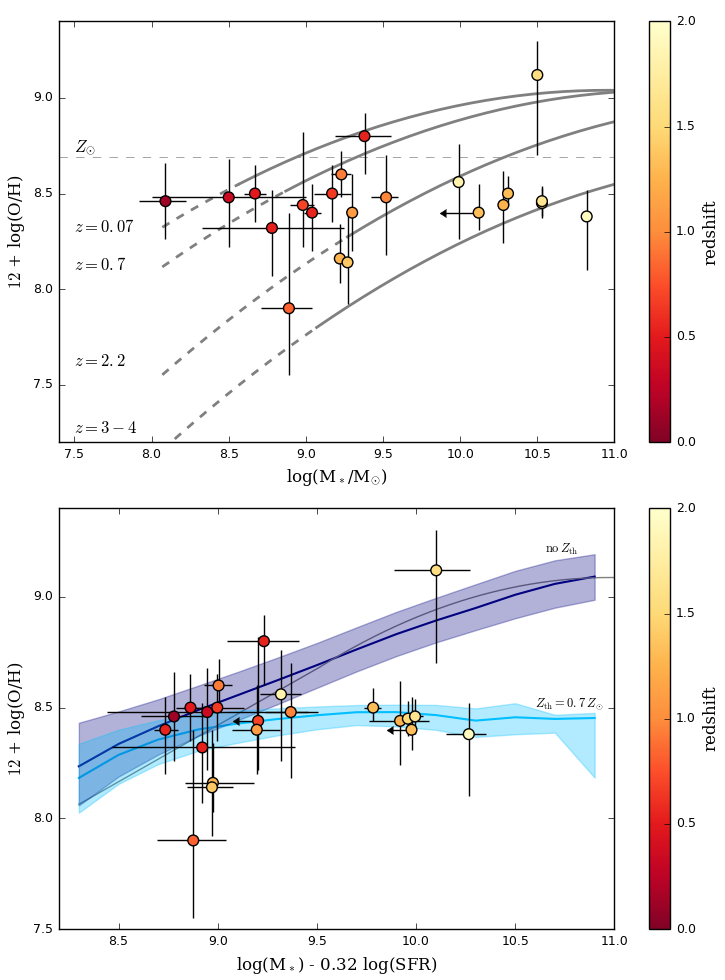 Figure 1
| Host galaxy | redshift | Log(MM⊙) | SFR | Metallicity |
|---|---|---|---|---|
| [M⊙ yr-1] | 12 + | |||
| GRB080413B | 1.1012 | 9.3 | 2.1 | 8.4 |
| GRB090926B | 1.2427 | 10.28 | 26 | 8.44 |
| GRB061007∗ | 1.2623 | 9.22 | 8.16 | |
| GRB061121∗ | 1.3160 | 10.31 | 44.2 | 8.5 |
| GRB071117∗ | 1.3293 | 8.4 | ||
| GRB100615A | 1.3979 | 9.27 | 8.6 | 8.14 |
| GRB070306 | 1.4965 | 10.53 | 101 | 8.45 |
| GRB060306 | 1.5597 | 10.5 | 17.6 | 9.12 |
| GRB080605 | 1.6408 | 10.53 | 47.0 | 8.46 |
| GRB080602 | 1.8204 | 9.99 | 125.0 | 8.56 |
| GRB060814 | 1.9223 | 10.82 | 54.0 | 8.38 |
| Host galaxy | |||||
|---|---|---|---|---|---|
| GRB 071117 |
| Host galaxy | [O ii]3726 | [O ii]3729 | [Ne iii]3869 | H | H | H | [O iii]4959 | [O iii]5007 | H | [N ii]6583 |
|---|---|---|---|---|---|---|---|---|---|---|
| GRB061007 | -(a) | 0.7 | 0.7 | 1.0 | 1.3 | 9.5 | 4.4 | 2.4 | ||
| GRB061121 | 8.3 | 18.4 | 2.5 | 0.7 | 4.2 | 7.9 | 7.9 | 26.6 | 40.0 | 4.5 |
| GRB071117 | 2.0 | 3.4 | 0.4 | 0.8 | -(b) | -(b) | 3.0 | 6.6 | 5.6 | 1.2 |
Peer Reviews
No public reviews on file for this paper yet. If you reviewed it on a platform where reviews are public (OpenReview, ICLR, NeurIPS, ICML), you can paste yours below so the community can read it here.
Videos
No videos yet. Explain this paper in a talk, walkthrough, or lecture? Add one.
11institutetext: GEPI, Observatoire de Paris, PSL Research University, CNRS, Univ. Paris Diderot, Sorbonne Paris Cité, Place Jules Janssen, F-92195 Meudon, France; 11email: [email protected] 22institutetext: Institut d’Astrophysique de Paris, Université Paris 6-CNRS, UMR7095, 98bis Boulevard Arago, F-75014 Paris, France 33institutetext: INAF - Osservatorio Astronomico di Brera, via E. Bianchi 46, I-23807 Merate, Italy 44institutetext: INAF - IASF Milano, via E. Bassini 15, I-20133, Milano, Italy 55institutetext: INAF - Osservatorio Astronomico di Trieste, via G. B. Tiepolo 11, I-34131 Trieste, Italy 66institutetext: INAF - Osservatorio Astrofisico di Arcetri, Largo E. Fermi 5, I-50125 Firenze, Italy 77institutetext: Dark Cosmology Centre, Niels Bohr Institute, University of Copenhagen, Juliane Maries Vej 30, DK-2100 Copenhagen, Denmark 88institutetext: Max-Planck-Institut für extraterrestrische Physik, Giessenbachstraße, D-85748 Garching, Germany 99institutetext: Aix Marseille Univ, CNRS, Laboratoire d’Astrophysique de Marseille, F-13388, Marseille, France
The chemical enrichment of long-GRB nurseries up to
S. D. Vergani 112233
J. Palmerio 22
R. Salvaterra 44
J. Japelj 55
F. Mannucci 66
D. A. Perley 77
P. D’Avanzo 33
T. Krühler 88
M. Puech 11
S. Boissier 99
S. Campana 33
S. Covino 33
L. K. Hunt 66
P. Petitjean 22
G. Tagliaferri 33
(Received ; accepted )
Abstract
*Aims. *We investigate the existence of a metallicity threshold for the production of long gamma-ray bursts (LGRBs).
*Methods. * We used the host galaxies of the Swift/BAT6 sample of LGRBs. We considered the stellar mass, star formation rate (SFR), and metallicity determined from the host galaxy photometry and spectroscopy up to and used them to compare the distribution of host galaxies to that of field galaxies in the mass-metallicity and fundamental metallicity relation plane.
*Results. *We find that although LGRBs also form in galaxies with relatively large stellar masses, the large majority of host galaxies have metallicities below . The extension to results in a good sampling of stellar masses also above Log(MM and provides evidence that LGRB host galaxies do not follow the fundamental metallicity relation. As shown by the comparison with dedicated numerical simulations of LGRB host galaxy population, these results are naturally explained by the existence of a mild () threshold for the LGRB formation. The present statistics does not allow us to discriminate between different shapes of the metallicity cutoff, but the relatively high metallicity threshold found in this work is somewhat in disagreement to most of the standard single-star models for LGRB progenitors.
Key Words.:
**Gamma-ray burst: general – Galaxies: abundances – Galaxies: star formation **
1 Introduction
It has been established that long gamma-ray bursts (LGRBs) are linked to the explosions of massive stars, both from the studies of their host galaxy formation sites (Fruchter et al., 2006; Svensson et al., 2010) as well as from detections of accompanying supernova emission (GRB-SN; see Cano et al. 2016 for a review). It is still not clear which conditions give rise to LGRBs or what is the relation between the progenitors of LGRBs and those of other explosions resulting from deaths of massive stars (e.g., Metzger et al., 2015).
The progenitors of nearby core-collapse supernovae can be directly identified as resolved stars in archived high-resolution images of their birth places (Smartt, 2015). However, LGRBs have a lower occurrence rate (e.g., Berger et al., 2003; Guetta & Della Valle, 2007) and are usually observable at cosmological distances, for which their birth places cannot be resolved. Our understanding of LGRB progenitors therefore depends on linking the predictions of different stellar evolution models with the observed properties of LGRB multiwavelength emission (e.g., Schulze et al., 2011; Cano et al., 2016) and their host galaxy environment (see Perley et al. 2016a for a review). In this work, we focus on the latter.
While metallicity is not the only factor that might affect the efficiency of the LGRB production (e.g., van den Heuvel & Portegies Zwart, 2013; Kelly et al., 2014; Perley et al., 2016b), it has been one of the most studied in the past as the metal content of the progenitor star is considered to play a major role in the formation of a LGRB explosion. Single-star evolution models predict that the metallicity of LGRB progenitors should be very low (e.g., Hirschi et al., 2005; Yoon & Langer, 2005; Woosley & Heger, 2006): in this way the progenitor star can expel the outer envelope (hydrogen and helium are not observed spectroscopically) without removing too much angular momentum from the rapidly rotating core. Higher metallicity values are allowed in the case of the models presented by Georgy et al. (2012), also depending on the different prescriptions between the coupling of surface and core angular momentum in the star. Alternatively, the LGRB progenitors could be close interacting binaries, in which case the metallicity is a less constraining factor (e.g., Fryer et al., 2007; van den Heuvel & Yoon, 2007). Strong observational constraints are clearly needed to understand which of the evolutionary channels could produce a LGRB.
Different observational works on LGRB host galaxies in the literature have indeed revealed that their metallicities are mostly subsolar (Modjaz et al., 2008; Levesque et al., 2010a; Graham & Fruchter, 2013; Vergani et al., 2015; Krühler et al., 2015; Perley et al., 2016b; Japelj et al., 2016). The evidence is corroborated by numerical simulations (e.g., Nuza et al., 2007; Campisi et al., 2011; Trenti et al., 2015). In particular, Campisi et al. (2011) studied LGRB host galaxies in the context of the mass metallicity (e.g. Tremonti et al., 2004) and fundamental metallicity (Mannucci et al., 2010, 2011) relations of field star-forming galaxies by combining a high-resolution N-body simulation with a semi-analytic model of galaxy formation. Campisi et al. (2011) find that a very low metallicity cut is not necessary to reproduce the observed relations. However, previous observational works present one or more of the following issues: (i) they are based on incomplete biased samples (e.g., Levesque et al. 2010a); (ii) they are based on stellar masses directly determined from observations, but on metallicities inferred from the mass-metallicity relation (e.g., Perley et al. 2016b); (iii) they use metallicities directly determined from the observations, but do not consider the stellar masses (e.g.: Krühler et al. 2015); and (iv) they are based on samples limited to small redshift ranges (e.g., ) as in Japelj et al. (2016).
In this paper we study the metallicity of the host galaxies of the complete Swift/BAT6 sample (Salvaterra et al., 2012) of LGRBs at , visible from the southern hemisphere. Combining the observed properties with simulations, we study their behavior in the stellar mass - metallicity relation (MZ) and fundamental metallicity relation (FMR). After the description of the sample and new data (Section 2), we present the results in Section 3 and discuss them in Section 4.
All errors are reported at 1 confidence unless stated otherwise. We use a standard cosmology (Planck Collaboration et al., 2014): , , and km s*-1* Mpc*-1*. The stellar masses and star formation rates (SFR) are determined using the Chabrier initial mass function (Chabrier, 2003).
2 The sample
Our sample is composed of the 27 host galaxies of the Swift/BAT6 complete sample of LGRBs at with declination Dec. As the spatial distribution of GRB is isotropic, this restriction does not introduce any bias in our results. The choice to select only the LGRBs that are well observable from the southern hemisphere was due to the availability of the X-shooter spectrograph (Vernet et al., 2011) at the ESO VLT (Very Large Telescope) facilities, which, thanks to its wide wavelength coverage, makes possible the detection of the emission lines necessary to determine the SFR and metallicity of the host galaxies at . In particular, metallicity is available for 81% of the sample (an estimate of the metallicity was not possible for five host galaxies only).
As the original Swift/BAT6 sample is selected essentially only on the basis of the LGRB prompt -ray flux, and no other selection criterion is applied when gathering the galaxy sample (except the southern hemisphere visibility), our sample does not suffer of any flux bias. Indeed, no correlation has been found between the prompt -ray emission and host galaxy properties (see e.g.: Levesque et al. 2010b; Japelj et al. 2016). Furthermore, dark bursts are correctly represented in the sample (see Melandri et al. 2012). The restriction to the southern hemisphere at maintains this condition, with 26% of LGRB of the sample being dark.
For the part of the sample at , Vergani et al. (2015) and Japelj et al. (2016) report the tables with the objects in the sample and their properties (including stellar masses, SFR and metallicity). The restriction to the Dec excludes GRB 080430 and GRB 080319B from the sample used in this work.
The properties (redshift, stellar mass, SFR, and metallicity) of the part of the sample are reported in Table 1. The stellar masses were taken from Perley et al. (2016b), with the exception of the host galaxies of GRB 071117 and GRB 080602, which are not part of the Perley et al. (2016b) sample, and for which we determined the stellar masses using Spitzer observations and the same prescription as Perley et al. (2016b). The host of GRB 071117 lies very close () to a red galaxy, and, therefore, the spatial resolution of the Spitzer observations allowed us to obtain only an upper limit on its infrared flux. We therefore also performed a spectral energy distribution fitting using the host galaxy photometry (see Table 2) following the same prescriptions as Vergani et al. (2015), and found log(MM⊙).
The SFR values were taken from Krühler et al. (2015) with the exception of the host galaxies of GRB 061007, GRB 061121 and GRB 071117, not included in that work. We obtained the VLT/X-shooter spectroscopy of these three host galaxies (ESO programs 095.D-0560 and 085.A-0795, PI: S.D. Vergani and H. Flores, respectively). We processed the spectra using version 2.6.0 of the X-shooter data reduction pipeline (Modigliani et al., 2010), following the procedures described in Japelj et al. (2015). The measured emission line fluxes are reported in Table 3. We determine the SFR from the H fluxes (corrected by the extinction determined through the Balmer ratio), with the same prescriptions as Krühler et al. (2015).
Following the same prescription as in Japelj et al. (2016), we determined the metallicity of the objects in the sample with the Maiolino et al. (2008) method on the strong emission line fluxes reported in the literature (Piranomonte et al., 2015; Krühler et al., 2015) or on those measured by us; in the relevant cases, the results are consistent within errors to those already reported in the literature.
3 The FMR and MZ relation
In Fig. 1 we plot the host galaxies of our sample in the MZ and FMR spaces. The dearth of high metallicity galaxies is evident as well as the fact that there are more massive galaxies at the higher redshifts () than at .
At low stellar masses (log(MM) there is some agreement with the MZ relation and FMR found for general star-forming galaxy populations (see also Japelj et al. 2016), whereas massive LGRB host galaxies are clearly shifted toward lower metallicities than predicted by the general relations.
While the MZ relation evolves in redshift, the FMR has the advantage that it is redshift independent in the redshift range considered here, hence strengthening the statistics of our results. For the general population of star-forming galaxies with log(Mlog(SFR), the FMR is valid up to , has been defined over SFR and stellar mass ranges encompassing those of the host galaxies in our sample, and has a smaller scatter (0.06 dex) than the MZ relation Mannucci et al. (2010, 2011).
To verify that our results are independent of the method used to determine the metallicity, we used the Kobulnicky & Kewley (2004) R23 method to determine the metallicities of the 21 host galaxies for which the relevant lines to use this metallicity indicator are available. The resulting MZ plot confirms the avoidance of super-solar metallicity and the shift of high stellar mass host galaxies toward lower metallicity than those found for general star-forming galaxy populations at similar stellar masses and redshifts.
We stress that the five galaxies in the sample for which we could not determine the metallicity (GRB 050318, GRB 050525, GRB 050802, GRB 060908, and GRB 091208B) are all faint galaxies, not hosting dark GRBs, and with stellar masses log(MM*⊙) (three of these galaxies have log(MM⊙*) ; see Vergani et al. 2015; Perley et al. 2016b). A super-solar metallicity for a large portion of these host galaxies is therefore extremely unlikely. For two of these galaxies (GRB 050525 and GRB 050802) SFR limits are available (Japelj et al. 2016; Palmerio et al. in preparation). Under the conservative hypothesis that they follow the FMR relation, we can derive limits on their metallicities from their SFR and stellar masses of , respectively.
We further investigate the implications of our observational results by comparing them with the expectations of a dedicated numerical simulation of the LGRB host galaxy population presented in Campisi et al. (2009, 2011), coupling high resolution numerical simulation of dark matter with the semi-analytical models of galaxy formation described in De Lucia & Blaizot (2007). Previous work (De Lucia et al., 2004) has shown that the simulated galaxy population provides a good match with the observed local galaxies properties and relations among stellar mass, gas mass and metallicity. Moreover, Campisi et al. (2011) shows that the simulations nicely reproduce the observed FMR of SDSS galaxies and its spread. Following Campisi et al. (2011) we compute the expected number of LGRBs hosted in each simulated galaxy, assumed to be proportional to the number of short-living massive stars (i.e., star particles less than yr in age), applying different metallicity thresholds () for the GRB progenitor, with probability equal to one below and zero otherwise. We construct the FMR of simulated hosts in the redshift range and we determined the best-fit value of by minimizing the against the BAT6 host data in the same redshift interval. The best-fit model (see Fig. 1) is obtained for (1 errors). This is consistent with indirect results inferred from the distribution of the LGRB host stellar masses at (Vergani et al., 2015) or of the infrared luminosities over a wider redshift range (Perley et al., 2016b).
4 Discussion and conclusions
In this paper we considered the properties of the host galaxies of the complete Swift/BAT6 sample of LGRBs (Salvaterra et al., 2012) that are visible from the southern hemisphere and at . We studied them with respect to the MZ and FMR relation of field star-forming galaxies. This is the first study considering at the same time the SFR, metallicity (both directly determined from the host galaxy spectroscopy), and stellar masses for a complete sample of LGRBs and on a large redshift range. Furthermore, we use LGRB host galaxy simulations to interpret our results.
Thanks to the sample extension to , we could double the sample size compared to Japelj et al. (2016) and show for the first time that LGRB host galaxies do not follow the FMR. We find that LGRBs up to tend to explode in a population of galaxies with subsolar metallicity (Z - Z*⊙*). Our results are well reproduced by LGRB host galaxy simulations with a metallicity threshold for the LGRB production of Z.
Although strong metallicity gradients ( dex) are unlikely (on the basis of low-redshift, spatially resolved LGRB host galaxies observations; Christensen et al. 2008; Levesque et al. 2011; Kruhler et al. in preparation), we cannot exclude that they are at play in the couple of galaxies showing evidences of super-solar metallicities (as, e.g., in the case of GRB 060306; see also Niino et al. 2015). The existence of some super-solar hosts may as well indicate, however, that the formation of LGRBs is also possible above the general threshold, although at much lower rate. Applying smoother cutoffs to the metallicity, instead of the step function used here, shifts toward lower values depending on the functional shape used. The present statistics does not allow us to discriminate between different cutoff shapes, therefore we do not go into further detail. We point out however that none of them succeed in reproducing the super-solar metallicity value. It should also be stressed that the GRB 060306 metallicity is very uncertain with pretty large error bars.
The relatively high metallicity threshold found in this work is much higher than required from standard collapsar models (but see Georgy et al. 2012). Binary stars are a possible solution as progenitors, although detailed models studying the role of metallicity on the fates of binary stars are missing. However, it is important to note that the metallicities determined using strong emission lines are not absolute values (see Kewley & Ellison 2008). In our case, they are relative to the Kewley & Dopita (2002) photoionization models on which the Maiolino et al. (2008) method is based. On the one hand, some works seem to indicate that those models may overestimate oxygen abundances by - dex compared to the metallicity derived using the so-called direct method (see e.g., Kennicutt et al. 2003; Yin et al. 2007). On the other hand, other works (see e.g., López-Sánchez et al. 2012; Nicholls et al. 2012) found that the oxygen abundances determined using temperatures derived from collisional-excited lines could be underestimated by - dex. In principle, the simulations should be independent of these models and therefore the curves derived in this work from simulations should not be affected by this issue.
The threshold should not be considered, therefore, as an absolute value. Nonetheless, to be in agreement with the metallicities (Z) needed in most LGRB single massive star progenitor models, all the metallicities presented here should be systematically overestimated, most of them by at least dex.
Acknowledgements.
This work is based in part on observations made with the Spitzer Space Telescope (programs 90062 and 11116), which is operated by the Jet Propulsion Laboratory, California Institute of Technology under a contract with NASA. SDV thanks M. Rodrigues, H. Flores and F. Hammer for useful discussions. JJ acknowledges financial contribution from the grant PRIN MIUR 2012 201278X4FL 002. TK acknowledges support from a Sofja Kovalevskaja Award to Patricia Schady. We thanks G. Cupani for sharing his expertise on X-shooter data reduction.
The reference list from the paper itself. Each links out to its DOI / PubMed record.
- 1Berger et al. (2003) Berger, E., Cowie, L. L., Kulkarni, S. R., et al. 2003, Ap J, 588, 99
- 2Campisi et al. (2009) Campisi, M. A., De Lucia, G., Li, L.-X., Mao, S., & Kang, X. 2009, MNRAS, 400, 1613
- 3Campisi et al. (2011) Campisi, M. A., Tapparello, C., Salvaterra, R., Mannucci, F., & Colpi, M. 2011, MNRAS, 417, 1013
- 4Cano et al. (2016) Cano, Z., Wang, S.-Q., Dai, Z.-G., & Wu, X.-F. 2016, Ar Xiv:1604.03549
- 5Chabrier (2003) Chabrier, G. 2003, PASP, 115, 763
- 6Christensen et al. (2008) Christensen, L., Vreeswijk, P. M., Sollerman, J., et al. 2008, A&A, 490, 45
- 7De Lucia & Blaizot (2007) De Lucia, G. & Blaizot, J. 2007, MNRAS, 375, 2
- 8De Lucia et al. (2004) De Lucia, G., Kauffmann, G., & White, S. D. M. 2004, MNRAS, 349, 1101