Statistical model analysis of $\alpha$-induced reaction cross sections of $^{64}$Zn at low energies
P. Mohr, Gy. Gy\"urky, Zs. F\"ul\"op

TL;DR
This study analyzes low-energy alpha-induced reaction cross sections on $^{64}$Zn using statistical models and recent experimental data, highlighting uncertainties and the need for improved alpha-nucleus potentials.
Contribution
It provides a comprehensive statistical analysis of $^{64}$Zn reactions at low energies, constraining reaction rates and identifying model improvements needed.
Findings
Best fit $ ext{chi}^2/F ext{~} 7.7$ per data point
Average deviation of about 30% between model and data
Reaction rate constrained within a factor of 2
Abstract
Background -nucleus potentials play an essential role for the calculation of -induced reaction cross sections at low energies in the statistical model. Uncertainties of these calculations are related to ambiguities in the adjustment of the potential parameters to experimental elastic scattering angular distributions (typically at higher energies) and to the energy dependence of the effective -nucleus potentials. Purpose The present work studies cross sections of -induced reactions for Zn at low energies and their dependence on the chosen input parameters of the statistical model calculations. The new experimental data from the recent Atomki experiments allow for a -based estimate of the uncertainties of calculated cross sections at very low energies. Method The recent data for the (,), (,), and (,)…
Click any figure to enlarge with its caption.
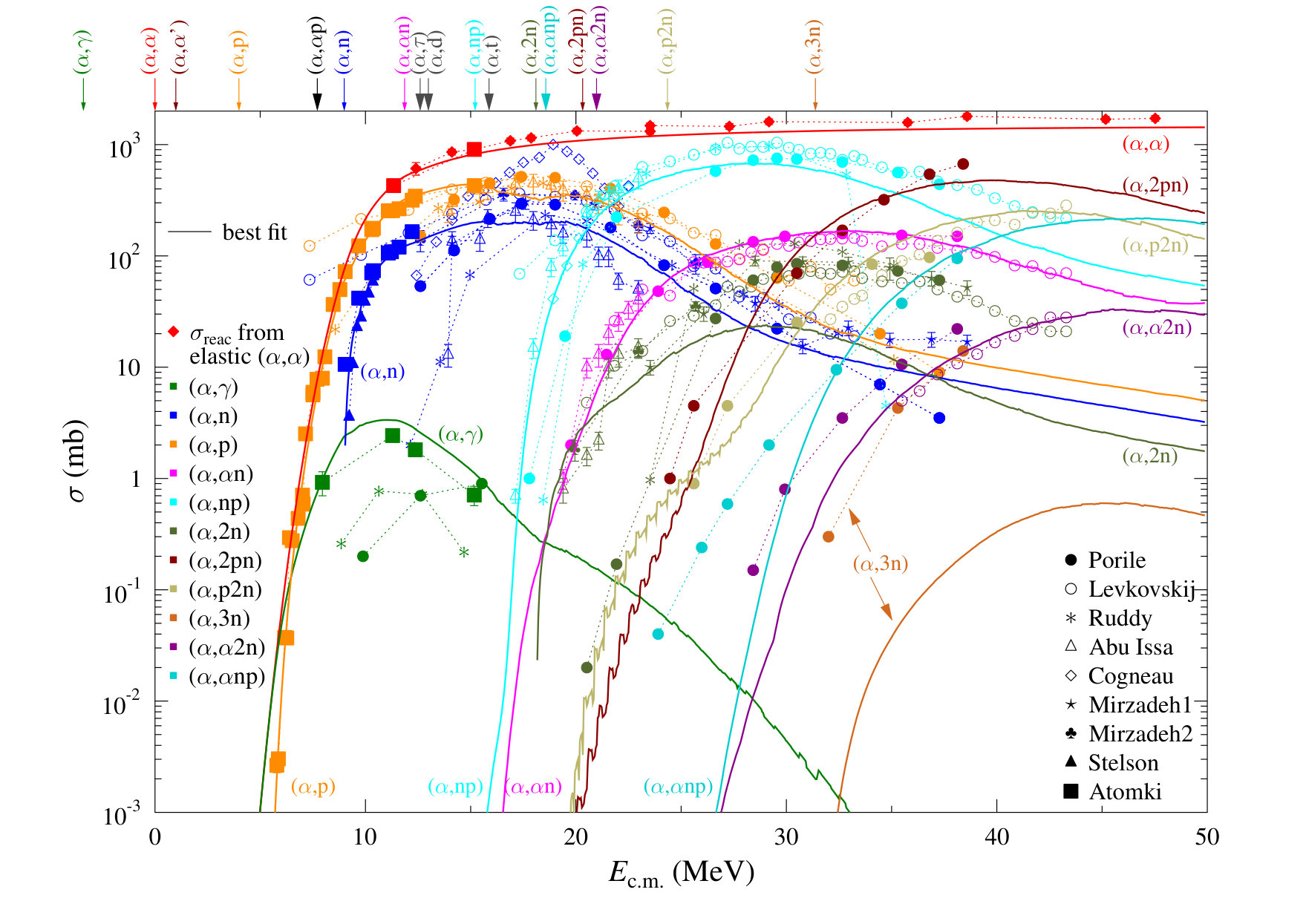 Figure 1
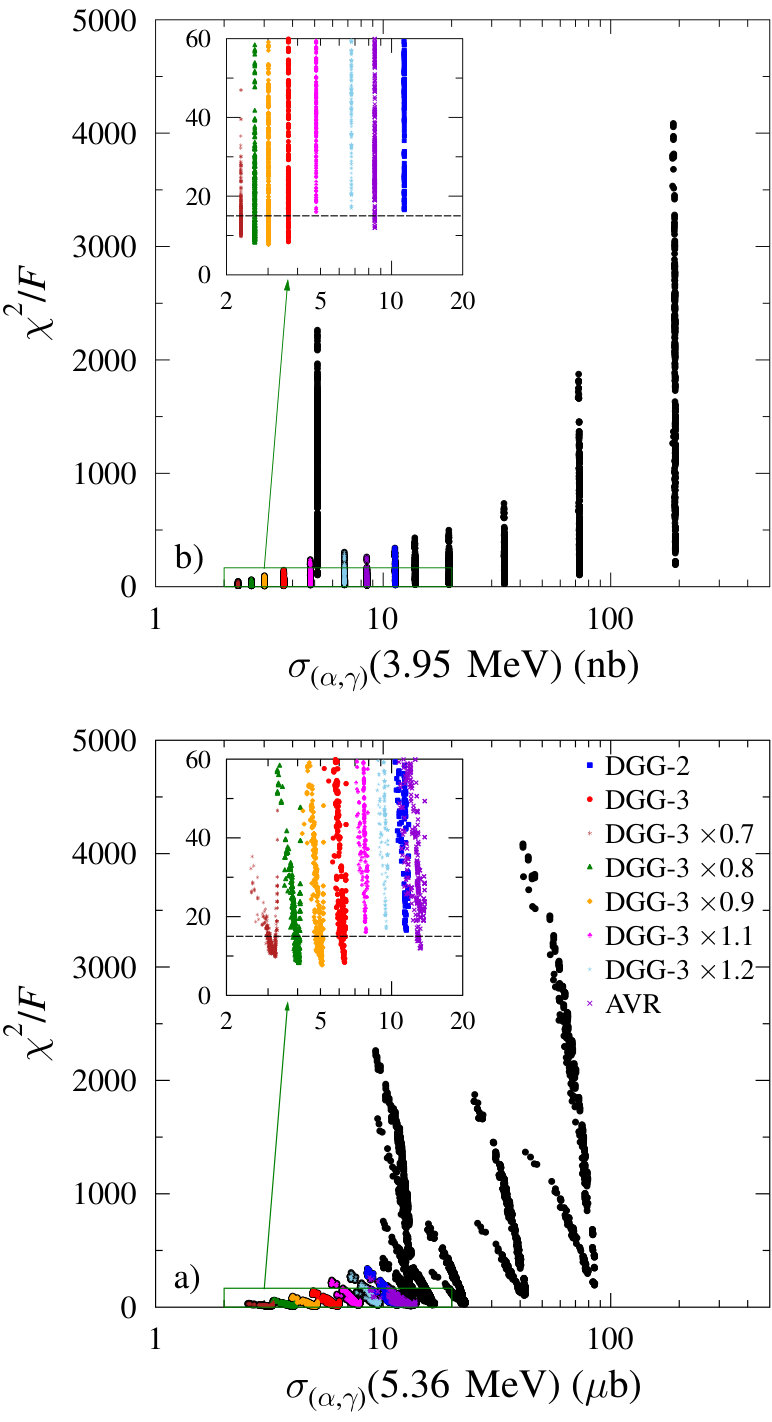 Figure 2
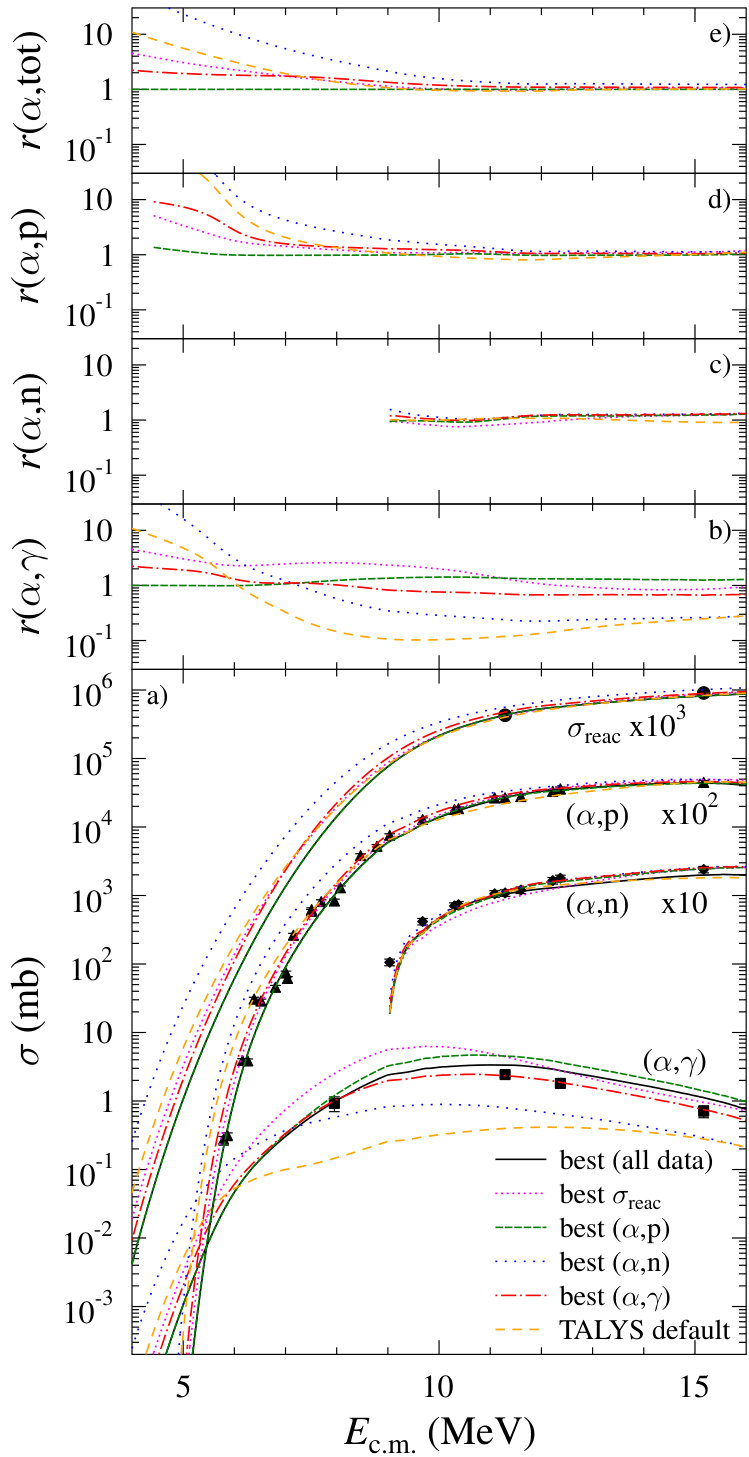 Figure 3
Peer Reviews
No public reviews on file for this paper yet. If you reviewed it on a platform where reviews are public (OpenReview, ICLR, NeurIPS, ICML), you can paste yours below so the community can read it here.
Videos
No videos yet. Explain this paper in a talk, walkthrough, or lecture? Add one.
Statistical model analysis of -induced reaction cross sections of
64Zn at low energies
P. Mohr
Institute for Nuclear Research (MTA Atomki), H-4001 Debrecen, Hungary
Diakonie-Klinikum, D-74523 Schwäbisch Hall, Germany
Gy. Gyürky
Institute for Nuclear Research (MTA Atomki), H-4001 Debrecen, Hungary
Zs. Fülöp
Institute for Nuclear Research (MTA Atomki), H-4001 Debrecen, Hungary
Abstract
Background
-nucleus potentials play an essential role for the calculation of -induced reaction cross sections at low energies in the statistical model. Uncertainties of these calculations are related to ambiguities in the adjustment of the potential parameters to experimental elastic scattering angular distributions (typically at higher energies) and to the energy dependence of the effective -nucleus potentials.
Purpose
The present work studies cross sections of -induced reactions for 64Zn at low energies and their dependence on the chosen input parameters of the statistical model calculations. The new experimental data from the recent Atomki experiments allow for a -based estimate of the uncertainties of calculated cross sections at very low energies.
Method
The recently measured data for the (,), (,), and (,) reactions on 64Zn are compared to calculations in the statistical model. A survey of the parameter space of the widely used computer code TALYS is given, and the properties of the obtained landscape are discussed.
Results
The best fit to the experimental data at low energies shows per data point which corresponds to an average deviation of about 30 % between the best fit and the experimental data. Several combinations of the various ingredients of the statistical model are able to reach a reasonably small , not exceeding the best-fit result by more than a factor of two.
Conclusions
The present experimental data for 64Zn in combination with the statistical model calculations allow to constrain the astrophysical reaction rate within about a factor of 2. However, the significant excess of of the best-fit from unity asks for further improvement of the statistical model calculations and in particular the -nucleus potential.
pacs:
24.10.Ht,24.60.Dr,25.55.-e
I Introduction
Statistical model calculations are widely used for the calculation of reaction cross sections of -induced reactions for intermediate mass and heavy target nuclei. It is found that the cross sections at low energies depend sensitively on the chosen -nucleus optical model potential. These low-energy cross sections play also an essential role under stellar conditions. In particular, (,) photodisintegration reactions in the so-called astrophysical p-process (or -process) are best determined by the study of the inverse (,) capture reactions Mohr07 . Under typical p-process conditions, temperatures of about billion Kelvin are reached (in short: ), and the corresponding Gamow window is located at a few MeV for intermediate mass nuclei like 64Zn (e.g. Woo78 ; Arn03 ; Rau06 ; Rap06 ; Tra14 ).
The lightest nucleus which is synthesized in the p-process, is 74Se Woo78 . These so-called p nuclei are typically characterized by very low natural abundances of the order of 1 % or even below. Although 64Zn is somewhat lighter than the lightest p nucleus, it has nevertheless been chosen for the present study because the cross sections of various -induced reactions can be determined for 64Zn by the simple and robust activation technique with high precision. The high natural abundance of 64Zn of almost 50 % allows to use targets with natural isotopic composition. However, there is also a drawback. For lighter nuclei like 64Zn the applicability of the statistical model may be limited at very low energies because of an insufficient level density in the 68Ge compound nucleus.
Our recent study of -induced reaction cross sections for the target nucleus 64Zn Orn16 ; Gyu12 was focused on total reaction cross sections and its determination from either elastic scattering angular distributions or from the sum over the cross sections of all open non-elastic channels (including inelastic scattering). It was found that there is excellent agreement at the lower energy of 12.1 MeV ( mb from elastic scattering vs. mb from the sum over non-elastic channels). At the higher energy of 16.1 MeV a significant contribution of compound-inelastic (,) scattering to higher-lying states in 64Zn was identified which is about % of \sigma_{\rm{reac}}$$=905\pm 18 mb from elastic scattering.
The present study extends our previous work Orn16 ; Gyu12 by a detailed study of the (,), (,n), (,p), and total reaction cross sections and their dependence on the underlying parameters of the statistical model (StM) calculations. For this purpose the full parameter space of the widely used TALYS TALYS code (version 1.8) was investigated. In particular, all available options for the -nucleus optical model potential (A-OMP), the nucleon OMP (N-OMP), the -ray strength function (GSF), and the level density (LD) were varied. Almost 7,000 combinations of input parameters are used to calculate a landscape. This landscape provides improved insight into the sensitivities of the different reaction channels on the underlying parameters. It is the scope of the present study to obtain an improved -based prediction of reaction cross sections at very low energies where experimental data are not available. As an example, an extrapolation to the astrophysically most relevant energies is made for the 64Zn(,)68Ge reaction with an estimate of the corresponding uncertainties.
The most important ingredient for the calculation of -induced reaction cross sections in the StM is the A-OMP. For heavy nuclei (above ) it has been found that different A-OMPs lead to dramatic variations of the predicted cross sections, exceeding one order of magnitude at astrophysically relevant energies (e.g., Som98 ; Sch16 ). Contrary, a quite reasonable description of the recent data for 64Zn was found for several A-OMPs Orn16 . However, as will be shown below from a -based assessment, this reasonable description for 64Zn is still far from a precise prediction of the experimental results.
The paper is organized as follows. In Sect. II a brief description of the statistical model and its ingredients is given. Available experimental data are summarized in Sect. III. Sect. IV presents the results and shows the obtained excitation functions for the total reaction cross section and the (,), (,n), and (,p) reaction channels under study. A discussion of the results and an extrapolation to lower energies is provided in Sect. V. Conclusions are drawn in Sect. VI.
II Parameters of the Statistical Model
II.1 Basic Considerations
In a schematic notation the reaction cross section in the StM is proportional to
[TABLE]
with the transmission coefficients into the -th open channel and the branching ratio for the decay into the channel . The total transmission is given by the sum over all contributing channels: . The are calculated from global optical potentials (A-OMP and N-OMP for the particle channels) and from the GSF for the photon channel. The include contributions of all final states in the respective residual nucleus in the -th exit channel. In practice, the sum over all final states is approximated by the sum over low-lying excited states up to a certain excitation energy (these levels are typically known from experiment) plus an integration over a theoretical level density for the contribution of higher-lying excited states:
[TABLE]
For further details of the definition of , see Rau11 . refers to the entrance channel where the target nucleus is in its ground state under laboratory conditions. The calculation of stellar reaction rates N_{A}$$\left<\sigma v\right> requires further modifications of Eq. (1) which have to take into account thermal excitations of the target nucleus Rau11 . For the (,) reaction of the even-even nucleus 64Zn with the relatively high excitation energy of the first excited state (, keV), these corrections remain small at typical temperatures of the p-process of the order of a few billion Kelvin Rau00 ; Rau11a .
The properties of the in Eqs. (1) and (2) lead to the following general findings for the case of 64Zn. At very low energies, the (,) channel with its positive -value of MeV is the only open reaction channel besides elastic and inelastic scattering. The transmission into the -channel exceeds the transmission into the -channel which is strongly suppressed by the Coulomb barrier. Consequently, , and the (,) cross section becomes proportional to , but almost independent of the other (including ).
As soon as the proton channel opens ( MeV), increases almost exponentially with energy and exceeds already close above the proton threshold. Because of the lower Coulomb barrier for the proton channel (compared to the case), becomes the dominant contributor to the sum in . This leads to a (,p) cross section proportional to but independent of the other (including ). The (,) cross section becomes approximately proportional to .
Because of the strongly negative -value of the (,n) channel ( MeV) and the resulting smaller phase space (in comparison to the (,p) reaction), the contribution of the (,n) channel remains relatively small. This finding is different from heavy nuclei where the (,n) channel typically becomes dominant close above the neutron threshold (see e.g. Mohr11 ). Now we find the approximate proportionalities of for the (,p) cross section, for the (,n) cross section, and for the (,) cross section.
Although the above discussion is indeed somewhat simplistic, it is nevertheless helpful for a general understanding of the sensitivities of the (,), (,n), and (,p) cross sections on the underlying parameters. Sensitivities as a function of energy have been calculated by Rauscher Rau12 for a wide range of nuclei; the results from the NON-SMOKER code are available online at NONSMOKER and confirm the above discussion for 64Zn.
The role of the level density requires further discussion. As Eq. (2) shows, the chosen parametrization of the LD becomes only relevant above a certain number of low-lying excited states which are taken into account explicitly. Typically, these low-lying levels cover an excitation energy range of MeV. Thus, for -induced reactions on 64Zn this means that the importance of the LDs remains limited, in particular at low energies, for the (,n) and (,p) reactions whereas the role of the LD is significant for the (,) reaction; here the last term in Eq. (2) does contribute.
However, besides its relatively minor role for the calculation of the transmissions in Eq. (2), the LD plays an essential role for the applicability of the StM which is only valid if the experimental conditions (mainly target thickness and energy distribution of the beam) average over a sufficient number of levels in the compound nucleus 68Ge. For the present data the energy interval of the experiment is of the order of 100 keV Gyu12 . The experimental energies cover an energy range of about 6 MeV 15 MeV. Together with the -value of the (,) reaction of about MeV, this corresponds to excitation energies in 68Ge of about 10 MeV MeV.
The various options for the LD in TALYS (see Sect. II.2.4) predict total level densities (per parity) between about 9000 MeV*-1* and 80000 MeV*-1* already at the lowest energies under study. At first view, this seems to be sufficient for the applicability of the StM. But in particular for the (,p) reaction close above the threshold, the experimental excitation curve is not completely smooth (as expected for a fully statistical behavior). Close above the threshold, the 64Zn(,p)67Ga reaction populates only very few final states in 67Ga with low spins and negative parity. The barrier penetration in this exit channel favors proton emission with low angular momentum, and thus by far not all levels in the 68Ge compound nucleus contribute to the 64Zn(,p)67Ga cross section. A closer look at the level densities in 68Ge shows that the predicted level density per spin goes down to e.g. about a few hundred per MeV for , or less than 100 levels may contribute to the averaging within the experimental energy interval of keV. Thus, non-statistical fluctuations in the excitation function of 64Zn(,p)67Ga at low energies are not very surprising.
LDs increase dramatically with increasing excitation energy. At the highest energies under study, the predicted level densities are at least two orders of magnitude higher than at the lowest energies. And indeed the non-statistical fluctuations in the excitation function of 64Zn(,p)67Ga disappear at energies above 10 MeV (corresponding to MeV in 68Ge or an increase of the level density by more than one order of magnitude, compared to MeV).
II.2 Ingredients under Consideration
II.2.1 -nucleus optical model potentials
The -nucleus optical model potential is the essential ingredient for the calculation of -induced reaction cross sections at low energies. TALYS provides 8 options for the A-OMP: The first option is based on the early work of Watanabe Wat58 ; this was the default option in TALYS. The widely used simple 4-parameter potential by McFadden and Satchler McF66 is the second option in TALYS. Three versions of the double-folding A-OMP by Demetriou et al. Dem02 (DGG-1, DGG-2, DGG-3) are also included in TALYS. Since TALYS version 1.8, three additional A-OMPs are available which are based on Nolte el al. Nol87 and on two versions of Avrigeanu et al. Avr14 ; Avr94 (AVR for the latest version in Avr14 ).
In addition, the new ATOMKI-V1 potential Mohr13 was implemented into the TALYS code, and modifications of the third version of the Demetriou potential DGG-3 were investigated. It was recently suggested in Sch16 that the real part of this potential should be multiplied by a factor of about for a better description of reaction data for heavy targets (). For 64Zn it will be shown that the best fit is achieved by a reduction of the real part by a factor of about 0.9 (instead of an increased potential as found for in Sch16 ).
The latest global A-OMP by Su and Han Su15 is not yet implemented in TALYS. It has been shown in Orn16 that this potential overestimates the total reaction cross sections for 64Zn at low energies. Thus, no efforts have been made to implement this potential into TALYS for the present study.
II.2.2 Nucleon-nucleus optical model potentials
The default option in TALYS is based on the local and global parametrizations in Koning and Delaroche Kon03 . Furthermore, based on the work of Jeukenne, Lejeune, and Mahaux (e.g., Jeu77 ), four different versions of the so-called JLM potential are available. The basic JLM-type potential is taken from Bauge et al. Bau01 , and three modifications of this potential are taken from Goriely and Delaroche Gor07 .
II.2.3 -ray strength functions
Eight different options for the -ray strength function are implemented in TALYS. In general, the options are based on the work of Brink Bri57 and Axel Axel62 or Kopecky and Uhl Kop90 . In addition, microscopic model GSFs have been calculated on the basis of Hartree-Fock BCS, Hartree-Fock-Bogolyubov, relativistic mean field models Cap09 , and a hybrid model Gor98 . Furthermore, the above choices can be combined with two options for the M1 strength function where the M1 strength is either normalized to the E1 strength (default option) or not normalized. A detailed description of the available options can be found in the TALYS manual TALYS and in the Reference Input Parameter Library (RIPL) Cap09 .
II.2.4 Level densities
Three phenomenological and three miscroscopic level densities can be chosen in TALYS. The phenomenological options are based on constant temperature and back-shifted Fermi gas models and on the generalized superfluid model. The microscopic approaches are calculated using Skyrme or Gogny type forces. Details on the various options are summarized in Kon08 .
III Experimental data
Several excitation functions of -induced reaction cross sections for 64Zn are available in literature and in the EXFOR database EXFOR . However, either the data are more than 50 years old Por59 ; Rud64 ; Ste64 ; Cog65 , or the data have not been published in refereed journals Abu89 ; Mir91 ; Lev91 . All EXFOR data are presented in Fig. 1. Unfortunately, significant discrepancies between the different excitation functions are found (see Fig. 1).
Although there is no good agreement between the different experimental data sets, Fig. 1 nicely shows that the overall energy dependence of the various reaction channels is well reproduced by the best-fit statistical model calculation. The only exceptions are the (,3n) reaction where the only available experimental data set of Porile Por59 is more than one order of magnitude above the theoretical estimate, and the (,2n) reaction which is underestimated by about a factor of 4.
Furthermore, the importance of the various reaction channels at different energies can nicely be read from Fig. 1. At very low energies below about 6 MeV the (,) reaction is dominating because the (,p) and (,n) channels are closed or suppressed by the Coulomb barrier of the outgoing low-energy proton. At about 6 MeV the (,p) reaction starts to dominate up to almost 20 MeV. As soon as the (,n) channel opens, also a significant contribution of the (,n) channel is found. Above 20 MeV, various multi-particle emission channels like (,pn), (,2n), and (,n) contribute also to the total reaction cross section .
As the focus of the present study is the low-energy region, we finally decided to use only our latest data of the -induced cross sections for 64Zn for the determination of the best-fit parameters for the statistical model calculations at low energies. In particular, this means 4 data points for the (,) reaction, 10 data points for the (,n) reaction, 27 data points for the (,p) reaction, and 2 data points for the total reaction cross section from the analysis of the elastic scattering angular distributions Orn16 ; Gyu12 ; in total, 43 experimental data points are used to determine the landscape. The adjustment procedure will be discussed in detail in the following section.
IV Results for
All combinations of the A-OMPs, N-OMPs, GSFs, and LD parametrizations in Sect. II.2 have been used for the calculation of the (,), (,n), and (,p) cross sections of 64Zn. In detail this means that 6720 combinations of A-OMPs, N-OMPs, GSFs, and LDs have been calculated. This number results from 14 A-OMPs (8 built-in in TALYS plus ATOMKI-V1 plus DGG-3 multiplied by factors of , 0.8, 0.9, 1.1, and 1.2), 8 E1 GSFs combined with two additional options for the M1 strength, 5 N-OMPs, and 6 LDs.
Technically it would be possible to further increase this number by choosing different models for each residual nucleus, e.g. different N-OMPs for the neutron and the proton channel or different GSFs or LDs for even and odd residual nuclei, etc. etc. However, best-fit parameters should be valid for a reasonable range of nuclei, and thus the present work intentionally remained restricted to the above listed 6720 combinations of A-OMPs, N-OMPs, GSFs, and LDs, and did not apply different parameter sets for different residual nuclei of the + 64Zn reactions.
For each of the 6720 combinations of parameters, excitation functions for the total reaction cross section and the cross sections of the (,), (,n), and (,p) reaction channels were calculated, and the deviation between the theoretical excitation functions and the experimental data was determined by a standard calculation.
IV.1 from all experimental data points
It is found that the 6720 combinations under study show a wide range of per data point from slightly below 8 to more than 4000 for all 43 experimental values for and the (,n), (,), and (,p) reactions in Orn16 ; Gyu12 . These correspond to an average deviation factor between experiment and theory for all data points from about 1.3 for the best fits up to 2.6 for the worst cases. Fig. 2 shows the results of the above calculations. The smallest per point was found for the following combination: the A-OMP was derived from the DGG-3 potential with the real part multiplied by a factor of ; the N-OMP is taken from Koning and Delaroche (TALYS default); the GSF is calculated using the Brink-Axel Lorentzian model with unnormalized M1 strength; the LD was taken from the back-shifted Fermi gas model. The obtained corresponds to . Obviously, a corresponds on average to almost a deviation for each data point which is not fully satisfying. This finding will be discussed later (see Sect. V). Furthermore, it has to be pointed out that this best-fit is indeed restricted to the low-energy data. At higher energies above about 15 MeV the DGG-3 A-OMP underestimates the total reaction cross sections significantly, and this deviation increases with decreasing normalization factor ( for the best-fit); see also Fig. 1.
The 4 experimental data points of the (,) reaction are reproduced with from 0.1 up to more than 1200, corresponding to . The for the 10 (,n) data points show a much smaller variation of from 4.7 to 16.3, corresponding to between 1.2 and 1.9. The 27 data points for the (,p) reaction show a wide variation of from 6.6 to 6500, corresponding to between 1.25 and 3.2. Finally, because of the small experimental uncertainties, the total reaction cross sections show significant between 2.9 and 200 although remains relatively close to unity between 1.03 and 1.21. For completeness it has to be mentioned that the total reaction cross section is sensitive only to the A-OMP, but independent of the other ingredients of the StM calculations.
IV.2 from the individual reaction channels
In addition, Fig. 2 shows also the best fits to the particular (,p), (,n), and (,) channels. Obviously, as soon as the fit is restricted to a particular (,) reaction, the resulting parameters are different. This becomes e.g. very prominent for the (,) reaction which depends sensitively on the combination of the transmission coefficients of different , n, p, and channels.
The cross sections in Fig. 2 show a strong energy dependence, and they cover several orders of magnitude. Thus, for better visualization we have also included the ratios between the individual fits and the best-fit for each of the (,), (,n), and (,p) channels in the upper parts b), c), d) and e) of Fig. 2. Part c) nicely shows the minor sensitivity of the (,n) cross section. From part d) it is obvious that the dominating (,p) cross section shows a strong sensitivity to the chosen parameters at low energies, whereas part b) shows that the (,) cross section varies widely over the whole energy range under study. Consequently, improved constraints for the StM parameters could be obtained from (,p) data towards lower energies (down to threshold) and from (,) data with smaller uncertainties in the full energy range.
IV.2.1 from (,) data
The lowest for the (,) channel is obtained for the combination of A-OMP: DGG-3 with ; N-OMP: Koning and Delaroche (TALYS default); GSF: hybrid model, M1 strength not normalized; LD: constant temperature Fermi gas (TALYS default). However, the best-fit parameters of the (,) channel lead to an increased for all , (,p), (,n), and (,) data by more than a factor of five to about 40 (compared to 7.7 for the overall best-fit), and in particular the (,p) cross section at low energies is about a factor of 10 higher than the overall best-fit, see Fig. 2d). Here it becomes evident that a restricted analysis of the (,) channel only may be misleading. The (,) cross section is sensitive to the combination of several ingredients of the StM calculation, and a shortcoming of a particular ingredient of the StM may, at least partly, be compensated by a further shortcoming of another ingredient.
IV.2.2 from (,n) data
The cross section of the (,n) reaction is governed by its significantly negative -value of about MeV and the resulting phase space at energies close above the threshold. The sensitivity to all parameters remains limited, and for all 6720 combinations the remains within 4.7 and 16.3. The low sensitivity of the (,n) cross section can also be seen in Fig. 2c). The lowest is found for A-OMP: Nolte potential Nol87 ; N-OMP: Koning and Delaroche (TALYS default); GSF: Kopecky-Uhl generalized Lorentzian, with normalized M1 strength; LD: microscopic, from Skyrme force, Hilaire’s combinatorial tables. For the (,n) fit the overall increases significantly by more than two orders of magnitude to 1265; i.e., because of the reduced sensitivity of the (,n) cross section, it is practically not possible to constrain the parameters of the StM calculations from the (,n) data.
IV.2.3 from (,p) data
The (,p) reaction dominates in the energy range under study, and by far the most data points are available for this channel. It is not surprising that the fit of the (,p) data leads to a combination of parameters which is close to the overall best-fit. Here we find A-OMP: DGG-3 with ; N-OMP: Koning and Delaroche (TALYS default); GSF: Brink-Axel Lorentzian, M1 normalized; LD: microscopic, from Skyrme force, Hilaire’s combinatorial tables. A is achieved for the (,p) channel, and the overall increases only slightly to about 11.4 (compared to 7.7 for the best-fit). However, the (,p) fit leads to a significant overestimation of the (,) channel, leading to a for the few data points for the (,) channel.
IV.2.4 from data
The two data points for are best reproduced by the DGG-1 potential with a and an average deviation of only 3 %. The worst description is obtained from the Nolte potential with a and an average deviation of 22 %. Most of the potentials under study reproduce the 2 experimental data points with average deviations between 5 and 10 %, and average deviations above 15 % are only found for the earlier Avrigeanu potential Avr94 and the Nolte potential Nol87 which has been optimized at much higher energies.
IV.2.5 TALYS default
In addition, Fig. 2 includes also the default TALYS combination of A-OMP: Watanabe Wat58 (Note that this will change to Avrigeanu Avr14 in the next versions.); N-OMP: Koning and Delaroche; GSF: Kopecky-Uhl generalized Lorentzian, M1 normalized; LD: constant temperature Fermi gas. The TALYS default calculation leads to an increased which results from a significant overestimation of the (,p) cross sections at low energies and a strong underestimation of the (,) cross sections at all energies under study (see Fig. 2).
V Discussion
One main task in nuclear astrophysics is the determination of reaction rates N_{A}$$\left<\sigma v\right> which are essentially defined by the cross sections at low energies. In the present study we aim to use the above calculations to constrain the 64Zn(,)68Ge cross section for energies below the experimental data. Before this can be done in the next Sect. V.1, the results of the previous Sect. IV with have to be discussed in more detail.
For the following discussion let us first assume that the statistical model is valid for 64Zn + , and at least one hypothetical and a priori unknown combination of the almost 7000 combinations of input parameters is able to reproduce the experimental cross sections. Under these assumptions one should find that this hypothetical best-fit combination reproduces the experimental data with . For dominating statistical uncertainties of the experimental data, should be found. For dominating systematic uncertainties, even cases with may be found. Typical systematic uncertainties from charge integration, target thickness, or detector efficiency affect all data points in the same way (except from elastic scattering). Thus, for dominating systematic uncertainties, a variation of the absolute normalization of the experimental data within their common systematic uncertainty should lead to an almost perfect agreement between the hypothetical best-fit combination and the normalized experimental data with .
In reality, the experimental data points are affected by both, statistical and systematic, uncertainties. For most of the data points, the systematic uncertainty is dominating; only for the weak (,) channel and for low energies or energies close above the respective thresholds, the statistical uncertainty is dominating Gyu12 . Thus, we have varied the absolute normalization of the (,), (,n), and (,p) cross sections within a range of which corresponds to about 3 times the systematic uncertainty of the data of about 10 % Gyu12 . A smooth variation of the with the normalization factor was found with a minimum of for , compared to for the original data (). Consequently, among the almost 7000 combinations of parameters for the StM calculations, there is no combination with , i.e., none of the almost 7000 combinations is able to reproduce the experimental data.
Strictly speaking, this means that either all almost 7000 combinations of input parameters are incompatible with the experimental results, or the chosen StM is inappropriate for the present case. However, neither a better model is available for the calculation of the 64Zn + reaction cross sections, nor better parameterizations of the ingredients of the StM are available; this holds in particular for the A-OMPs under study which govern the theoretical uncertainties of the calculated low-energy cross sections. Nevertheless, low-energy cross sections have to be calculated, and their uncertainties have to be estimated, to provide an astrophysical reaction rate N_{A}$$\left<\sigma v\right> with a reasonable error bar. Therefore, the following considerations were used to obtain a realistic constraint for the low-energy (,) cross section.
For dominating statistical uncertainties of the experimental data under study, the uncertainty of a fit parameter is calculated from the increase of by 1. Contrary, a dominating systematic uncertainty leads to a larger uncertainty for fit parameters because systematic uncertainties from many data points do on average not cancel each other. Thus, an increase of for each data point by 1 should be used in the latter case; i.e., an increase of by 1 indicates the uncertainty of a fit parameter in the case of dominating systematic uncertainties. However, both above criteria for for statistical uncertainties and for for systematic uncertainties are only robust if is achieved; but this was not possible in the present study of -induced reaction cross sections of 64Zn. Consequently, the available experimental data for 64Zn cannot provide a strict mathematical constraint for (,) cross section at lower energies.
A reasonable criterion for the allowed range of has to be chosen to find a rather reliable constraint of the (,) cross section at low energies. It should be pointed out here that this is not a new problem of the present study. The problem becomes only very obvious here because we attempt to provide a -based constraint of the (,) cross section at low energies. In many previous papers the best combination of parameters was simply derived “by eye” from the comparison of experimental excitation functions with theoretical predictions using a more or less broad range of input parameters and/or computer codes for the StM. Then, often this best combination is simply used to calculate astrophysical reaction rates (without further discussion of ).
Following the above discussion, we have decided to use the following criterion for the allowed variation of . The best-fit combination of parameters reaches , corresponding to an average deviation of about 30 % from the experimental data. For experimental uncertainties of the order of 10 %, this means that we find an average deviation of almost . For the uncertainty determination of the low-energy (,) data, we now accept all combinations of parameters with . This corresponds to an average deviation instead of the best-fit deviation; i.e., we allow for an increase of the average deviation of each data point by , and the resulting parameter space should describe the data with average deviations of less than about 40 %.
V.1 Extrapolation to low energies
In the following we restrict ourselves here to estimate the (,) cross section at two energies below the lowest experimental point at about 8 MeV. The first energy is chosen from the most effective energy at , i.e. a temperature of K which is typical for the astrophysical p-process. From the standard formulae which are based on an energy-independent astrophysical S-factor, the most effective energy at this temperature is MeV. In practice, the assumption of a constant S-factor is not realistic for heavy nuclei, and in most cases the effective energy is slightly shifted towards lower energies Rau10 .
The second energy is taken as MeV which is slightly below the (,p) threshold and far below the (,n) threshold. At this low energy the (,) cross section depends almost exclusively on the chosen A-OMP.
For the almost 7000 combinations of parameters, the calculated (,) cross sections at 5.36 MeV vary between 2.5 b and 85 b. Fig. 3a) shows that the corresponding vary between about 8 and almost 5000. The inset shows the calculations with . Here it becomes clearly visible that the are grouped according to the chosen A-OMP; e.g., the DGG-3 potential (with , i.e. without further adjustment of the depth of the real part) favors (,) cross sections between 4.9 and 6.5 b (with smallest for b), and the AVR potential favors cross sections between 8.7 b and 13.8 b (with smallest for b). Adopting the above criterion of , we find at MeV. Thus, the chosen criterion restricts the (,) cross section to b with an uncertainty of a factor of two, whereas the range of all calculations was between 2.5 b and 85 b.
The same procedure is repeated for the lower energy of 3.95 MeV (see Fig. 3, upper part b). Here the predictions vary between 2.3 nb and 192 nb, i.e. the predictions cover almost two orders of magnitude. Applying the criterion restricts the (,) cross section to at MeV, i.e. the (,) cross section is nb, again with an uncertainty of about a factor of two. Combinations of parameters which lead to much higher cross sections, are excluded by the chosen criterion.
As expected, the calculated cross section of the (,) reaction depends almost exclusively on the A-OMP at the lower energy of 3.95 MeV. This is reflected by the strictly vertical grouping of the different A-OMPs in Fig. 3b). At the slightly higher energy of 5.36 MeV, a grouping according to the A-OMPs is also observed. However, because the (,) cross section is not only sensitive to the A-OMP, but also to other parameters, the grouping is not strictly vertical here, see Fig. 3a).
Finally, it is interesting to see that the few-parameter ATOMKI-V1 potential is only able to reach , but nevertheless it is able to predict the low-energy (,) cross sections reasonably well. At the higher energy of 5.36 MeV the ATOMKI-V1 potential predicts (,) cross sections between 9.3 b and 13.5 b, and at the lower energy of 3.95 MeV the (,) cross section from ATOMKI-V1 is 5.1 nb.
VI Conclusions
Excitation functions of the cross sections of the 64Zn(,)68Ge, 64Zn(,n)67Ge, and 64Zn(,p)67Ga reactions and the total reaction cross section have been analyzed using the statistical model and a -based assessment of the underlying parameters. A best fit to the experimental data at low energies Orn16 ; Gyu12 shows and an average deviation factor of about from all experimental data.
The complete parameter space of the TALYS code was investigated using almost 7000 combinations of the -nucleus OMPs, nucleon-nucleus OMPs, gamma-ray strength functions, and level densities. As the most important ingredient of these StM calculations, the -nucleus potential was identified. This fact can be derived from the behavior of the . The best-fit is obtained by a modification of the third version of the Demetriou et al. Dem02 potential where the real part is scaled by a factor of . This best-fit result is still far from . A reduction of should be achievable from further improvements of the -nucleus OMP at low energies. will probably not be reachable because of non-statistical fluctuations of the reaction cross sections, in particular for the 64Zn(,p)67Ga reaction at low energies.
From the range of and the corresponding variation of the (,) cross section at lower energies, an uncertainty of about a factor of two is estimated for the astrophysical reaction rate of the 64Zn(,)68Ge reaction and its cross section at very low energies. The uncertainty results from all reasonable fits with and their extrapolations down towards astrophysically relevant energies where no experimental data for the 64Zn(,)68Ge reaction are available. Improved (,) data at lower energies could reduce the uncertainty of the (,) reaction rate and help to further constrain the parameters for the statistical model calculations.
Acknowledgements.
This work is dedicated to Endre Somorjai on the occasion of his birthday. We thank the members and collaborators of the Atomki Nuclear Astrophysics group - established by Endre Somorjai - for maintaining the fruitful and pleasant working atmosphere over many years. This work was supported by OTKA (K108459 and K120666).
The reference list from the paper itself. Each links out to its DOI / PubMed record.
- 1(1) P. Mohr, Zs. Fülöp, H. Utsunomiya, Europ. Phys. J. 32 , 357 (2007).
- 2(2) S. E. Woosley and W. M. Howard, Astrophys. J. Suppl. 36 , 285 (1978).
- 3(3) M. Arnould and S. Goriely, Phys. Rep. 384 , 1 (2003).
- 4(4) T. Rauscher, Phys. Rev. C 73 , 015804 (2006).
- 5(5) W. Rapp et al. , Astrophys. J. 653 , 474 (2006).
- 6(6) C. Travaglio, R. Gallino, T. Rauscher, N. Dauphas, F. K. Röpke, W. Hillebrandt, Astroph. J. 795 , 141 (2014).
- 7(7) A. Ornelas, P. Mohr, Gy. Gyürky, Z. Elekes, Zs. Fülöp, Z. Halász, G. G. Kiss, E. Somorjai, T. Szücs, M. P. Takács, D. Galaviz, R. T. Güray, Z. Korkulu, N. Özkan, C. Yalçın, Phys. Rev. C 94 , 055807 (2016).
- 8(8) Gy. Gyürky, P. Mohr, Zs. Fülöp, Z. Halász, G. G. Kiss, T. Szücs, E. Somorjai, Phys. Rev. C 86 , 041601(R) (2012).