Exact single-electron approach to the dynamics of molecules in strong laser fields
Axel Schild, E.K.U. Gross

TL;DR
This paper introduces an exact single-electron framework for modeling correlated electron dynamics in molecules under strong laser fields, providing a new perspective on single-electron approximations.
Contribution
It develops an exact factorization-based single-electron approach and derives an approximation that advances ab-initio modeling of molecular electron dynamics.
Findings
Exact and approximate potentials yield similar dynamics in low ionization scenarios.
The ionization barrier can be explicitly time-dependent in the model.
The approach challenges traditional interpretations of the single-active electron approximation.
Abstract
We present an exact single-electron picture that describes the correlated electron dynamics in strong laser fields. Our approach is based on the factorization of the electronic wavefunction as a product of a marginal and a conditional amplitude. The marginal amplitude, which depends only on one electronic coordinate and yields the exact one-electron density and current density, obeys a time-dependent Schr\"odinger equation with an effective time-dependent potential. The exact equations are used to derive an approximation that is a step towards a general and feasible ab-initio single-electron approximation for molecules. The derivation also challenges the usual interpretation of the single-active electron approximation. From the study of model systems, we find that the exact and approximate single-electron potentials for processes with negligible two-electron ionization lead to a…
Click any figure to enlarge with its caption.
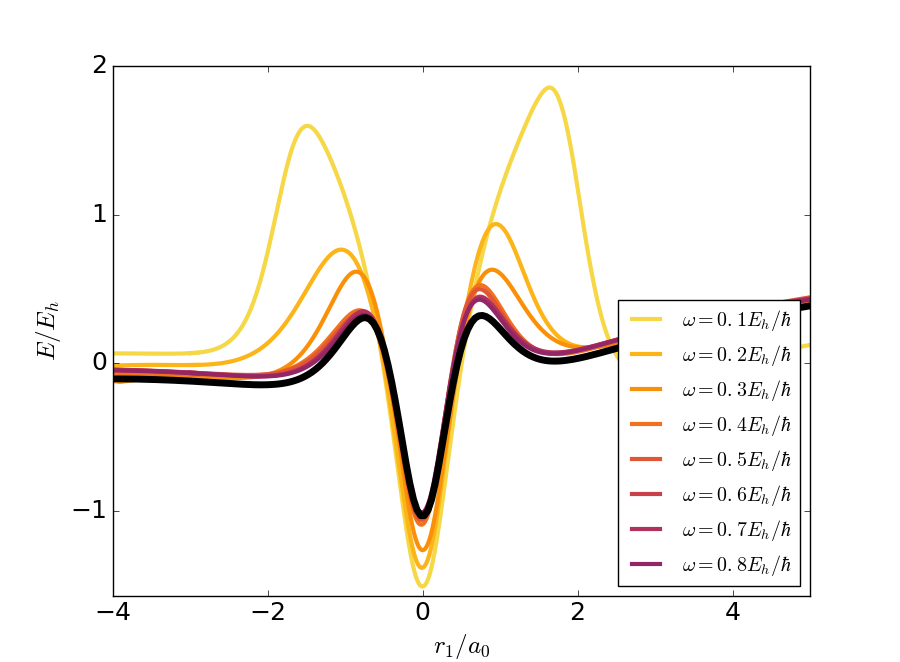 Figure 1
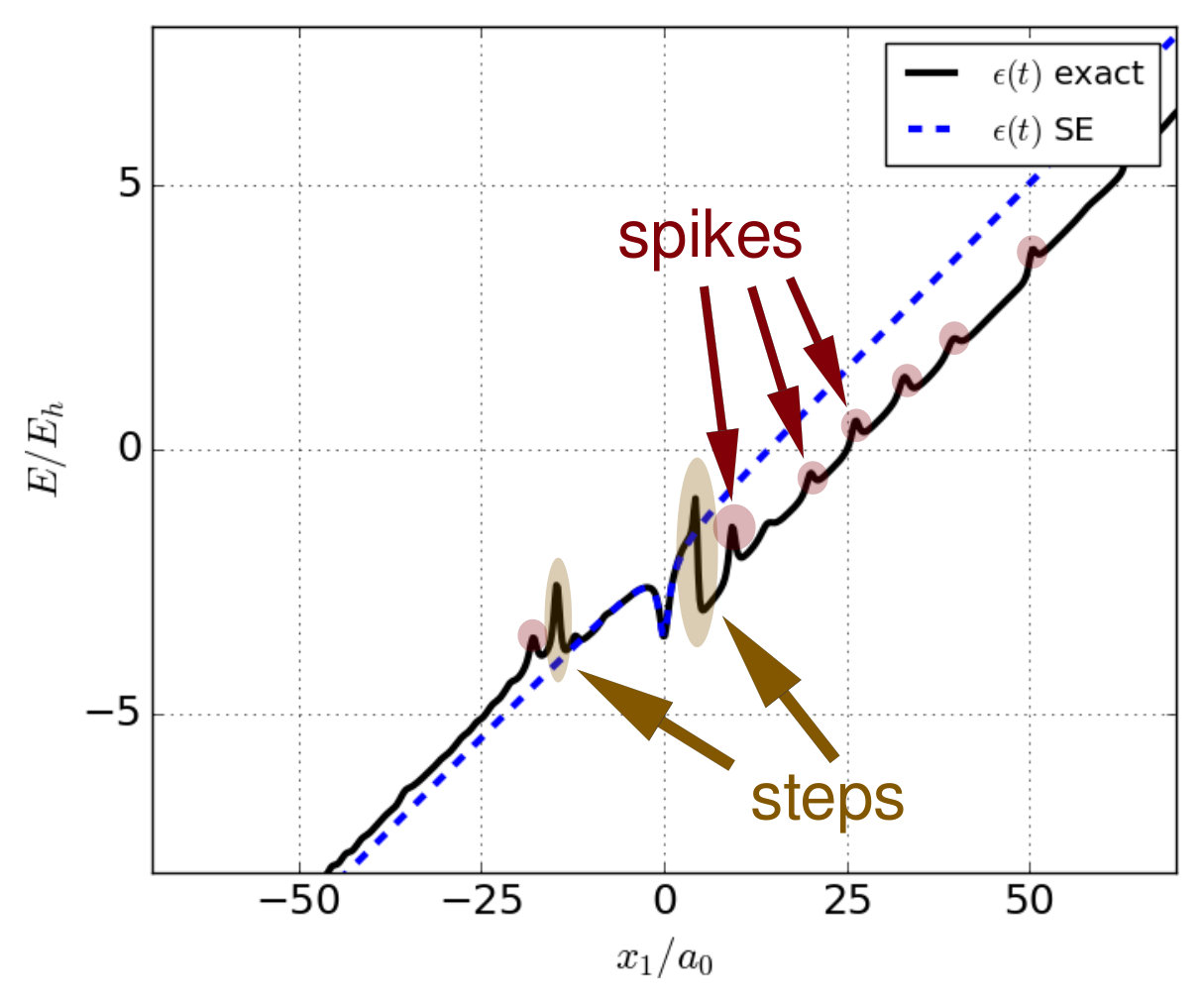 Figure 2
Peer Reviews
No public reviews on file for this paper yet. If you reviewed it on a platform where reviews are public (OpenReview, ICLR, NeurIPS, ICML), you can paste yours below so the community can read it here.
Videos
No videos yet. Explain this paper in a talk, walkthrough, or lecture? Add one.
Exact single-electron approach to the dynamics of molecules in strong laser fields
Axel Schild
Max-Planck-Institut für Mikrostrukturphysik
E.K.U. Gross
Max-Planck-Institut für Mikrostrukturphysik
Abstract
We present an exact single-electron picture that describes the correlated electron dynamics in strong laser fields. Our approach is based on the factorization of the electronic wavefunction as a product of a marginal and a conditional amplitude. The marginal amplitude, which depends only on one electronic coordinate and yields the exact one-electron density and current density, obeys a time-dependent Schrödinger equation with an effective time-dependent potential. The exact equations are used to derive an approximation that is a step towards a general and feasible ab-initio single-electron approximation for molecules. The derivation also challenges the usual interpretation of the single-active electron approximation. From the study of model systems, we find that the exact and approximate single-electron potentials for processes with negligible two-electron ionization lead to a qualitatively similar dynamics, but that the ionization barrier may be explicitly time-dependent.
Molecules in strong laser fields are a fascinating field of research. In such laser fields it becomes possible to monitor the electron dynamics in chemical reactions experimentally on its natural time scale, and in concert with the nuclear dynamics. Recent experimental studies show that parts of the electron dynamics can already be measured.Smirnova et al. (2009); Kraus et al. (2015); Wolter et al. (2016); Huppert et al. (2016)
With progress in experimental techniques comes the necessity to develop and to improve theoretical tools to analyze the experiments. An important role in this respect have single-electron pictures. The 3-step model Schafer et al. (1993); Corkum (1993) and its quantum version, the strong field approximation,Lewenstein et al. (1994) are single-electron models that describe the main mechanism which is responsible for many of the observed effects, e.g. high-harmonic generation. Based on the success of these models, a Single-Active Electron (SAE) approximation Kulander (1987) is often the basis for the development of quantum theories of strong field processes.Awasthi et al. (2008); Le et al. (2016) From such investigations, general phenomena that may occur in experiments can be deduced. However, there is no clear understanding of why the SAE works and what its limitations are, or even if it can be derived.Rohringer et al. (2006) Thus, it is highly desirable to investigate how far we can get with a single-electron model.
Typically, in the SAE approximation a time-dependent Schrödinger equation
[TABLE]
is solved for a single-electron wavefunction and observables are computed from this wavefunction.Rohringer et al. (2006); Le et al. (2016) The many-electron effects are approximated by an effective time-independent potential , while the interaction with the laser field may e.g. be described in the dipole approximation in the length gauge, as is done in (1). The crucial information for the SAE is the effective potential . While for atoms, it may be possible to guess a model potential, this is much harder for molecules.Awasthi et al. (2008); Barth et al. (2008); Abu-samha and Madsen (2010); Awasthi and Saenz (2010) However, hints that more general model potentials can describe effects that seem to be beyond the applicability of the SAE approximation exists already for a while.Watson et al. (1997); Lein and Kümmel (2005); Gordon et al. (2006)
In this article, we first present an exact single-electron description of a many-electron system in a laser field, the Exact Electron Factorization (EEF). The EEF is then used to derive an approximation, the Time-Independent Conditional Amplitude (TICA) approximation, that is formally close to the SAE approximation (1) but has a different interpretation: The SAE approximation assumes that the processes to be described are essentially single-electron processes and seems to treat all but one electron as “frozen”. Hence, it is often assumed that it cannot describe multi-electron effects.Ishikawa and Sato (2015) In contrast, the EEF and also the TICA approximation represent the dynamics of all electrons with an effective potential.
The EEF is a generalization of the Exact (Electron-Nuclear) Factorization,Abedi et al. (2010) which separates the nuclear from the electronic system of a molecular wavefunction exactly, to the case of electrons only. The idea of the EEF was already given for static systems some time agoHunter (1986); A. Buijse et al. (1989), and aspects of it are also known in the field of Density Functional Theory.Deb and Ghosh (1983); Levy et al. (1984); March (1986, 1987) With this article, we generalize the EEF to time-dependent problems and show that it is useful for developing the theory of attosecond experiments. The derivation of a TICA approximation from the EEF shows the assumptions that are made when an equation such as (1) is used to represent the electron dynamics. Also, it yields a general procedure to obtain the TICA potential for any system.
To make the ideas that follow as clear as possible, we write the general equations using a simplified notation with only two spatial coordinates, and . In an -electron system, and stand for an arbitrary partitioning of the coordinates of the electrons into two sets. The most important case for our application is the case where contains the coordinates of electron and contains the coordinates of the remaining electrons. This case is assumed below. Also, we use atomic units and we do not use explicit vector notation. The general equations with vector notation are given in the supplementary material.
We consider a non-relativistic description of a molecule in a laser field. In the dipole approximation in the length gauge, the evolution of the system is described with the time-dependent Schrödinger equation
[TABLE]
Here, is the Coulomb interaction among the electrons and of the electrons with clamped nuclei, and is the time-dependent electric field. We note that by using the reverse factorization Suzuki et al. (2014); Khosravi et al. (2015), (2) can be valid without clamping the nuclei. However, then would be time-dependent and would not be a bare Coulomb potential. The electronic wavefunction depends on spatial coordinates and spin coordinates , which are in general not separable, but may always be written as a sum of coordinate permutations of a unique spatial wavefunction , multiplied by a corresponding spin function .Shpilkin et al. (1996) Below, we work with the spatial wavefunction alone which, for our problem, has the same information content as and which has a time-evolution given by the Schrödinger equation (2), too.
Next, we make the EEF ansatz
[TABLE]
with partial normalization condition
[TABLE]
where the notation represents integration over all coordinates . It automatically follows that
[TABLE]
Given that is normalized to one and hence has the meaning of a joint probability density, i.e. it represents the probability of finding one electron at and the other electrons at given we are at time , and also acquire a special meaning: is the one-electron density or marginal density, i.e. it represents the probability of finding an electron at , given time ; is the conditional probability of finding electrons at configuration , given one electron is at and given time . Hence, we call the marginal amplitude and the conditional amplitude. We note that if the number of spin-up and spin-down electrons is not equal, there are two different factorizations. An example is the 3-electron system discussed below.
A variational derivation of the equations of motion for and yields
[TABLE]
for the marginal amplitude. This is a normal time-dependent Schrödinger equation with a vector potential
[TABLE]
and a scalar potential
[TABLE]
with average kinetic and potential energy of the other electrons
[TABLE]
the electric field interaction with a modified dipole operator
[TABLE]
a Fubini-Study term
[TABLE]
and a gauge-dependent term
[TABLE]
There is a gauge freedom in the choice of a phase , because and yield the same electronic wavefunction according to (3), and the equations of motion stay invariant up to the change , . The equation of motion for the conditional amplitude is not of interest here and can be found in the supplementary material.
The marginal amplitude is an interesting quantity. It yields the exact one-electron density, cf. (5), and it obeys a time-dependent Schrödinger equation (6). Additionally, it is straightforward to show that it also yields the exact one-electron current density. From , all observables depending on and , most notably the dipole expectation value (that yields, e.g., the high harmonic generation spectrum) and the momentum expectation value, can be obtained. Consequently, may also be called a one-electron wavefunction, and it gives an exact single-electron picture of the dynamics.
The marginal amplitude is an appealing quantity, but solving the full problem does not by itself become easier by making ansatz (3). Instead, the main problem now is to obtain the scalar and vector potentials and , which depend on the conditional amplitude . However, the single-electron Schrödinger equation (6) gives us the possibility to derive a single-electron approximation.
One way to derive a single-electron approximation of the form (1) from the exact single-electron equation (6) is to assume that the conditional amplitude is time-independent, . Together with choosing the gauge as (which may not always be possibleRequist et al. (2016)), we obtain a time-independent potential
[TABLE]
The only formal difference between this approximation, called the TICA (Time-Independent Conditional Amplitude) approximation, and the SAE equation (1) is the change of the dipole operator from to , i.e. the TICA approximation is
[TABLE]
A typical choice for is the conditional amplitude of the state at , which usually is an eigenstate of the system. Then, to compute in practice it is only necessary to know the one-electron density of this state, as at , and to solve the time-independent analogue of (14) for . The modified dipole can be obtained by computing for the initial wavefunction. While in our examples studied below the function is of minor importance, it can become important for many electrons.
A significant part of the computational effort of a TICA calculation is to obtain . can then be computed for any system, in contrast to the SAE potential , which is a priori unknown. However, it is necessary to divide by to compute both and , which may be numerically difficult. Then, to obtain the dynamics it is only necessary to solve the single-electron time-dependent Schrödinger equation (14), independent of the number of electrons in the system.
To learn more about the exact and the TICA potential, we consider one-dimensional models of the helium atom (2 electrons) and of the lithium atom (3 electrons). All solutions to the involved eigenvalue problems were obtained with help of the linear algebra routines in the SciPy package Jones et al. (01); Lehoucq et al. (1998). The time-propagation was performed with the Gonoskov-Marklund propagatorGonoskov and Marklund (2016) or a Runge-Kutta method. Details can be found in the supplementary material.
For the Helium model, we choose as initial state the spin-singlet ground state and use the parameters of Shi-Lin and Ting-Yun (2013). Our choice for is the conditional amplitude of the initial state. The dynamics is computed for a 12-cycle laser pulse with a wavelength of 580 nm and a maximum intensity of W/cm2. By comparing the dynamics and the high harmonic generation spectra, we found quantitative agreement of the TICA calculations with the exact calculations, and the effect of the modified dipole operator is almost negligible. A representative picture for the comparison of the exact single-electron potential with the TICA potential is shown in figure 1, and a movie is given in the supplementary material.
We see two important features that distinguish the exact potential from the TICA potential: There are time-dependent steps and spikes in the exact potential which are absent in the TICA potential. The steps are similar to those known from Time-Dependent Density Functional Theory Lein and Kümmel (2005); Elliott et al. (2012); Hodgson et al. (2013, 2016) and are related to those from the Exact Electron Nuclear Factorization.Abedi et al. (2013) They occur only at certain times and positions, develop and disappear rapidly, and they can only be found in the gauge-dependent part of the potential. We do not have an intuitive interpretation for the steps in the EEF, but we find that they have negligible effect on the dynamics: They are located at positions with very low electron density and the parts of the potential connected by steps are parallel. Hence, they change the momentum of some parts of , but this does not result in an important effect for the overall dynamics. The spikes also occur at positions where the one-electron density is minimal. They are a peculiar feature of the factorization ansatz: because is the one-electron density and this never becomes zero in our systems, we do not have exact nodes except if we impose them by a choice of the phase (which may lead to discontinuities in ). We found that in the model propagation, the spikes in the exact potential can be neglected for the propagation of , which is equivalent to allowing the marginal amplitude to become zero.
Next, we study the lithium model, a one-dimensional spin-doublet model system with parameters taken from Rapp and Bauer (2014), for an 8-cycle laser pulse with several laser frequencies between 0.1 (152 nm) and 1.0 (46 nm), and with a maximum intensity of W/cm2. The electronic wavefunction is given by
[TABLE]
with anti-symmetry condition for the spatial wavefunction. There are two possible factorizations, one for the spin-up one-electron density and one for the spin-down one-electron density . As we aim at describing processes that mainly involve the valence electron, which is a spin-up electron, we only consider the factorization for .
Figure 2 shows a snapshot of the exact and the TICA potential for the 3-electron model system in the laser fields, at a time where the electric field is maximal, in the spatial region close to the nucleus. Movies of the dynamics for different frequencies of the laser field are given in the supplementary material. Note that the TICA potential is independent of the laser frequency, as it is a sum of the initial exact potential and the laser interaction in dipole form, cf. (14).
The initial potential shows a deep minimum, but also a barrier to the left and to the right followed by shallow minima. This reflects the electronic structure of the problem. It also illustrates that a suitable model potential for many-electron systems is not easy to guess and an ab-inito treatment like the TICA approximation is recommended. During the evolution, time-dependent spikes and steps occur like in the 2-electron case. What is most striking, however, is the explicit time-dependence of the exact potential around the bounding region: At times where the field is strong, the potential well located around becomes deeper, and the barriers at its sides become higher. These changes become stronger with smaller frequency of the laser pulse. Interpreted in terms of the 3-step model, the effect of this additional barrier is clear: It suppresses the tunneling out of the bounding well and is an obstacle during the recombination step. In contrast, the TICA potential does not show this time-dependent barrier, which results in a similar qualitative dynamics, but different quantitative results.
Further investigations of the contributions to the exact potential show that this effect originates in the interaction of the two spin-up electrons, while the effect of the contributions of the spin-down electron to the exact potential is small. We expect the time-dependent barrier to be partly a consequence of the anti-symmetry condition of the electronic wavefunction for the two spin-up electrons, which is not met by the TICA: While the EEF is exact and preserves symmetries of the full wavefunction, it does not reflect those symmetries in the equations of motion. Consequently, approximations to the EEF lead to a symmetry breaking, which may be of minor importance, like in the 2-electron spin singlet case, but which we expect to be significant in most cases, like in the 3-electron spin doublet case. Hence, it may be worthwhile to include symmetries of the problems explicitly. Extensions like a repeated factorizationCederbaum (2015) or more symmetric factorizations need to be explored in the future.
In summary, from our investigations we learned the following: First, it is possible to obtain a single-electron approximation analogous to the usual SAE approximation, the TICA approximation, from an exact single-electron theory, the EEF. It can be applied not only for atoms or simple molecules, but also for complex molecules where the alignment of the molecule relative to the laser field matters. Additionally, the derivation from the EEF also highlights one of the less appreciated merits of some SAE calculations: They do not only describe an “active” electron and a “frozen” core, but they also describes the dynamics of electrons in the core region in an approximate way. This becomes clear if the SAE wavefunction is interpreted like the TICA wavefunction, i.e. as an approximation to the exact single-electron density and current density. Second, we found that a 2-electron spin-singlet system behaves similar to a one-electron system and that the shape of the exact potential is simple to model, at least as long as two-electron ionization is negligible. Hence it is easy to approximate, but its applicability as model for many-electron effects is limited. Third, we saw that already for the 3-electron model system an ab-initio treatment like the TICA approximation is necessary to obtain a potential which includes all relevant features. Finally, it became clear that the TICA approach is useful to compute qualitative effects, again with the restriction of negligible two-electron ionization. It does, however, in general ignore a time-dependent barrier that changes the ionization and recombination step. This barrier, in turn, challenges our view on the 3-step model and shows the need for further studies. Also, the role of the vector potential (7) and its relation to topological features of the system Requist et al. (2016) needs to be investigated in the future.
The reference list from the paper itself. Each links out to its DOI / PubMed record.
- 1Smirnova et al. (2009) O. Smirnova, Y. Mairesse, S. Patchkovskii, N. Dudovich, D. Villeneuve, P. Corkum, and M. Y. Ivanov, Nature 460 , 972 (2009) . · doi ↗
- 2Kraus et al. (2015) P. M. Kraus, B. Mignolet, D. Baykusheva, A. Rupenyan, L. Horný, E. F. Penka, G. Grassi, O. I. Tolstikhin, J. Schneider, F. Jensen, L. B. Madsen, A. D. Bandrauk, F. Remacle, and H. J. Wörner, Science 350 , 790 (2015) . · doi ↗
- 3Wolter et al. (2016) B. Wolter, M. G. Pullen, A.-T. Le, M. Baudisch, K. Doblhoff-Dier, A. Senftleben, M. Hemmer, C. D. Schröter, J. Ullrich, T. Pfeifer, R. Moshammer, S. Gräfe, O. Vendrell, C. D. Lin, and J. Biegert, Science 354 , 308 (2016) . · doi ↗
- 4Huppert et al. (2016) M. Huppert, I. Jordan, D. Baykusheva, A. von Conta, and H. J. Wörner, Phys. Rev. Lett. 117 , 093001 (2016) . · doi ↗
- 5Schafer et al. (1993) K. J. Schafer, B. Yang, L. F. Di Mauro, and K. C. Kulander, Phys. Rev. Lett. 70 , 1599 (1993) . · doi ↗
- 6Corkum (1993) P. B. Corkum, Phys. Rev. Lett. 71 , 1994 (1993) . · doi ↗
- 7Lewenstein et al. (1994) M. Lewenstein, P. Balcou, M. Y. Ivanov, A. L’Huillier, and P. B. Corkum, Phys. Rev. A 49 , 2117 (1994) . · doi ↗
- 8Kulander (1987) K. C. Kulander, Phys. Rev. A 35 , 445 (1987) . · doi ↗