Dark Matter Search in Space: Combined Analysis of Cosmic Ray Antiproton-to-Proton Flux Ratio and Positron Flux Measured by AMS-02
Jie Feng, Hong-Hao Zhang

TL;DR
This paper combines cosmic ray antiproton and positron data from AMS-02 to investigate dark matter signatures, revealing that certain annihilation channels can explain observed features depending on the Monte Carlo model used.
Contribution
It presents a combined analysis of cosmic ray spectra considering different propagation models and Monte Carlo generators, proposing specific dark matter annihilation channels.
Findings
EPOS LHC suggests dark matter annihilation into tau leptons explains data.
QGSJET-II-04m does not support a single annihilation channel explanation.
Two-channel scenarios are proposed based on different models.
Abstract
Dark matter search in space has been carried out for many years. Measurements of cosmic ray photons, charged antiparticles and neutrinos are useful tools for dark matter indirect search. The antiparticle energy spectra of cosmic rays have several exciting features such as the unexpected positron excess at energy about 10 -- 500 GeV and the remarkably flattening antiproton/proton at energy about 60--450 GeV precisely measured by the AMS-02 experiment, which can not be explained simultaneously by secondary production in interstellar medium. In this work, we report a combined analysis of cosmic ray antiproton and positron spectra arising from dark matter on the top of a secondary production in a spatial-dependent propagation model. We discuss the systematics from antiproton production cross section using the two latest Monte Carlo generators, i.e. EPOS LHC and QGSJET-II-04m, respectively.…
Click any figure to enlarge with its caption.
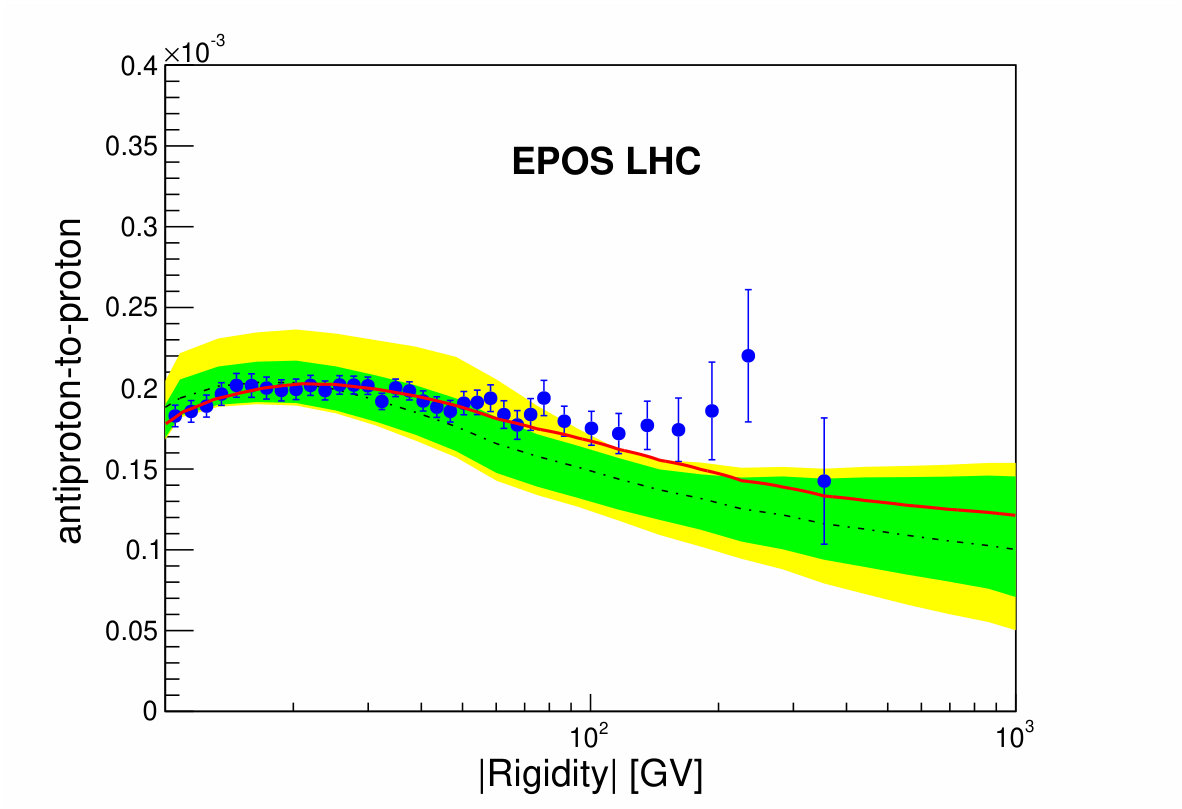 Figure 1
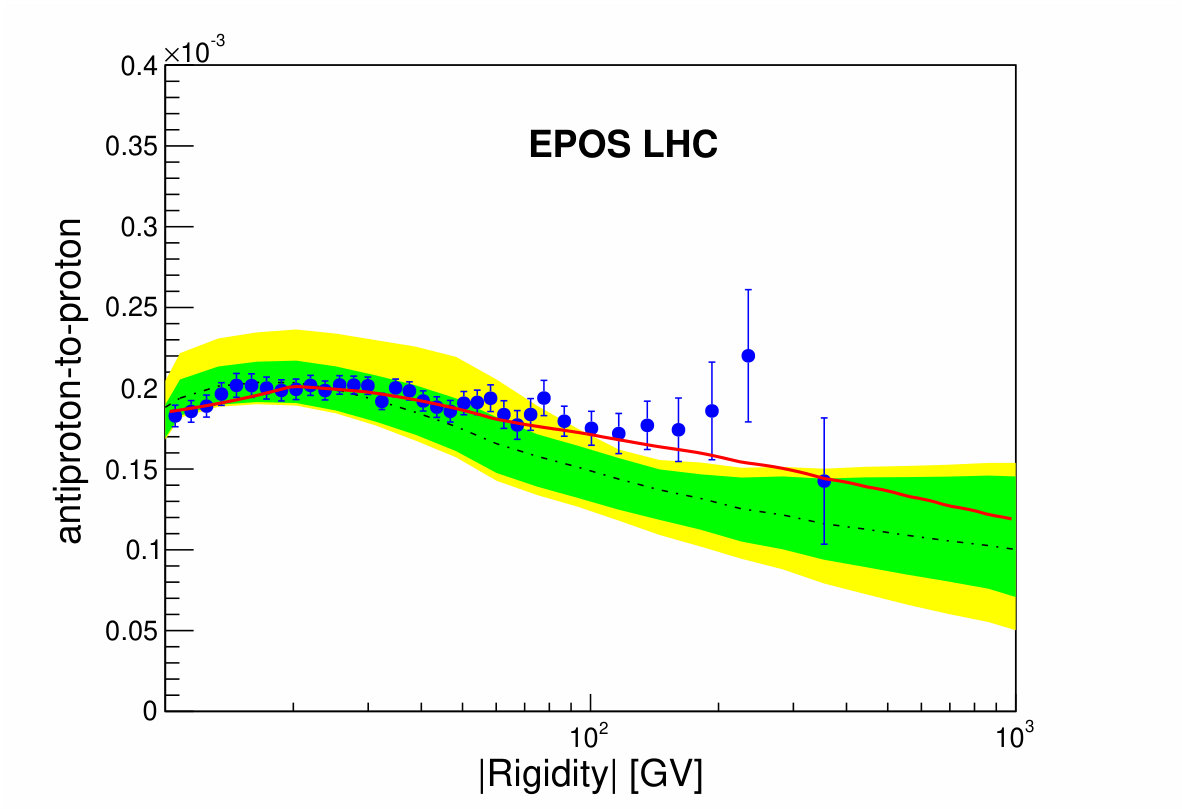 Figure 2
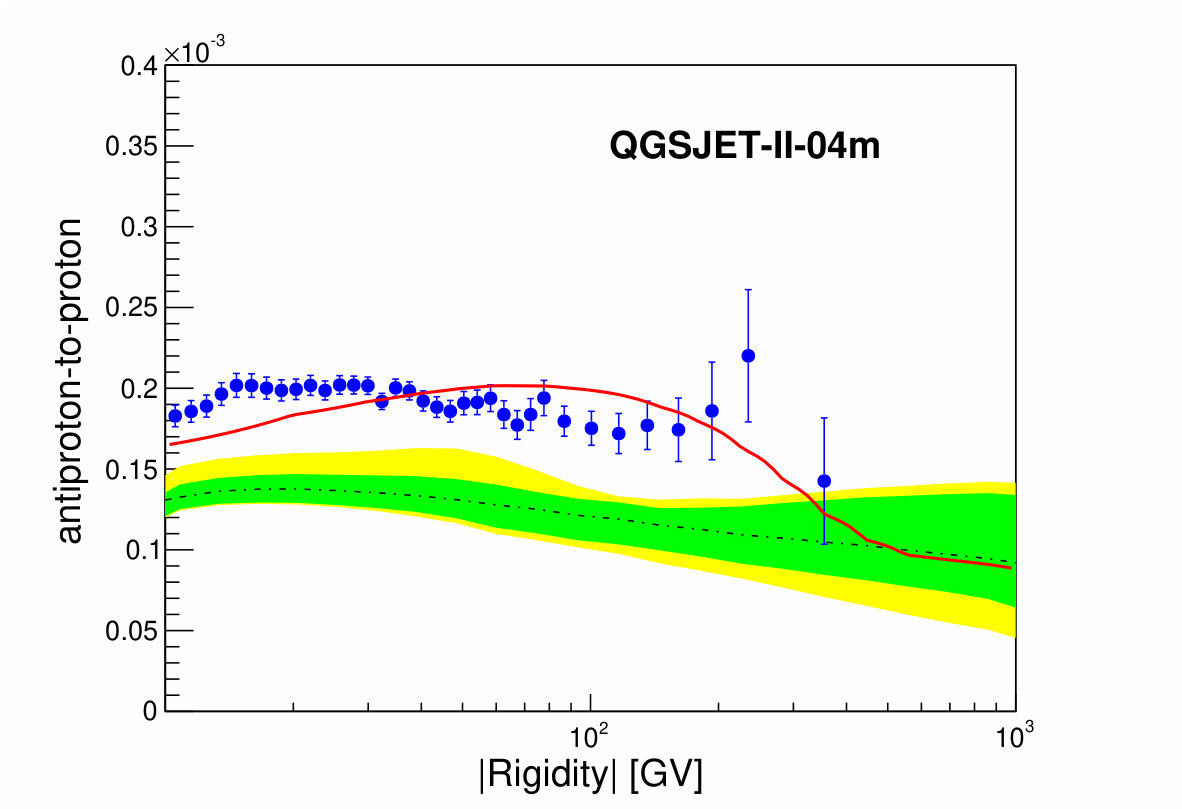 Figure 3
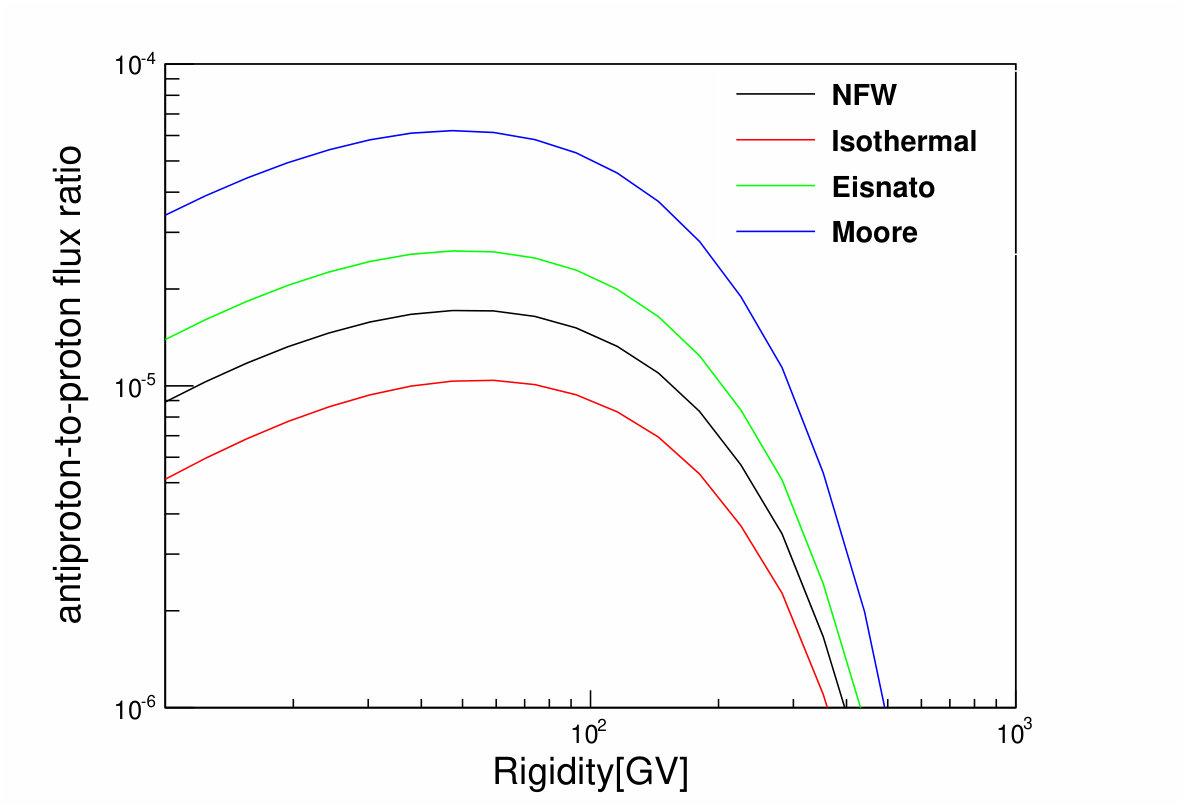 Figure 4
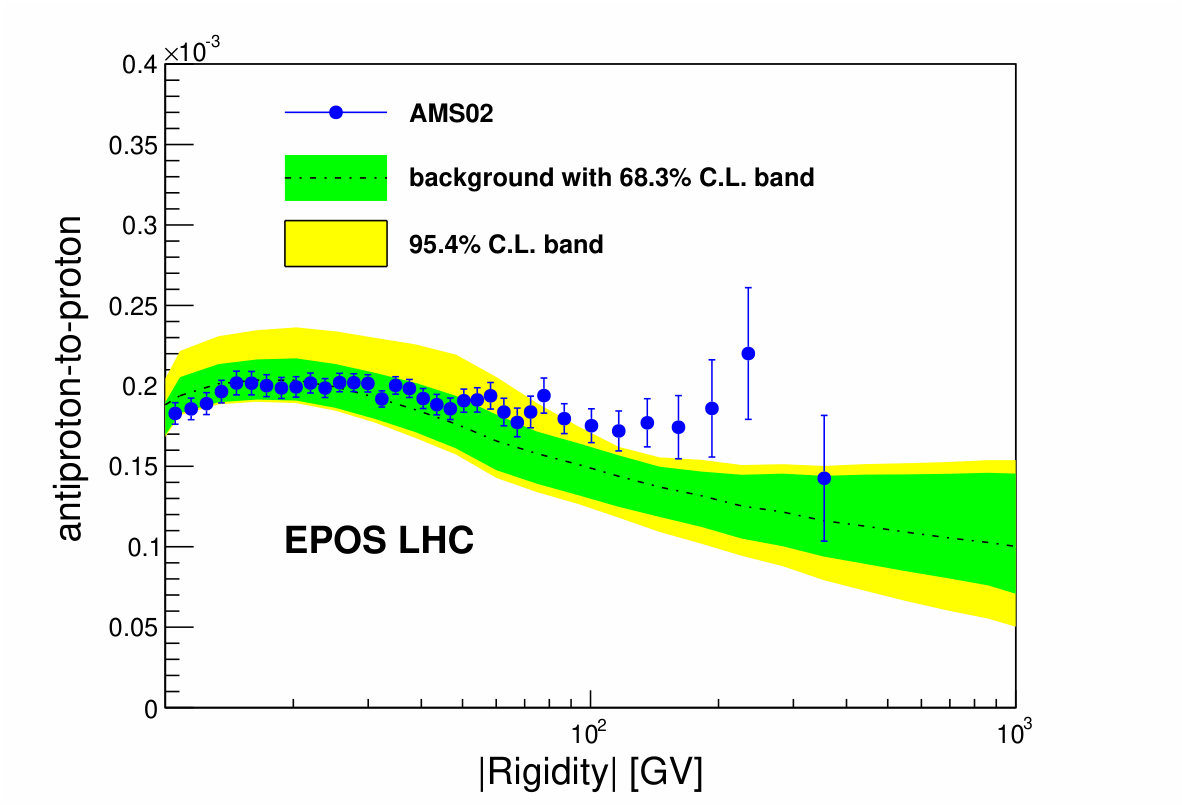 Figure 5
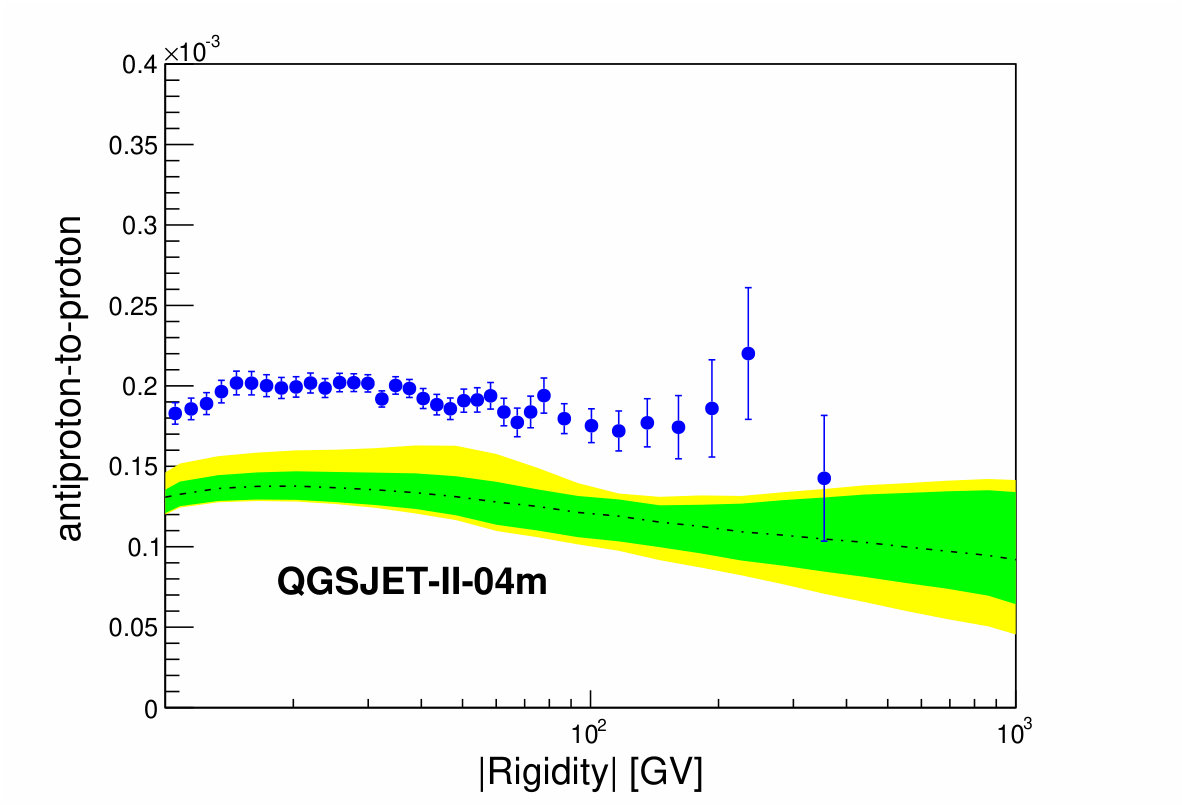 Figure 6
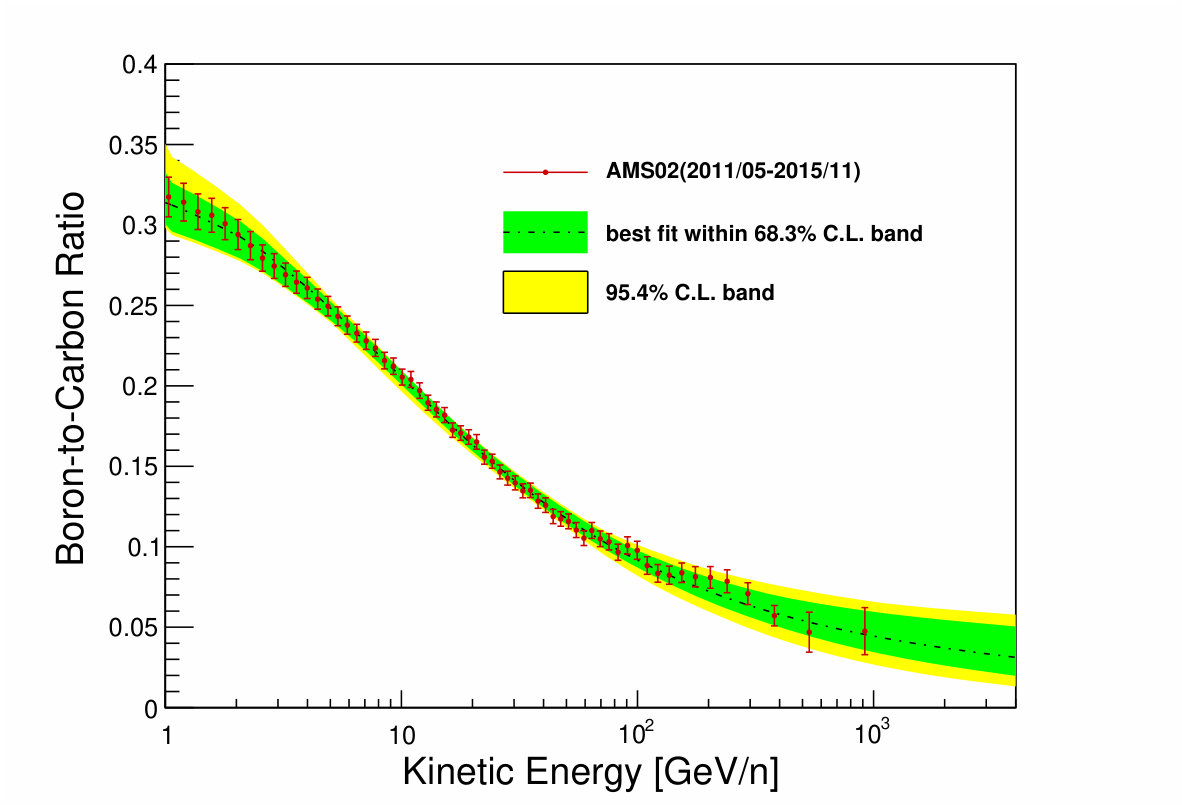 Figure 7
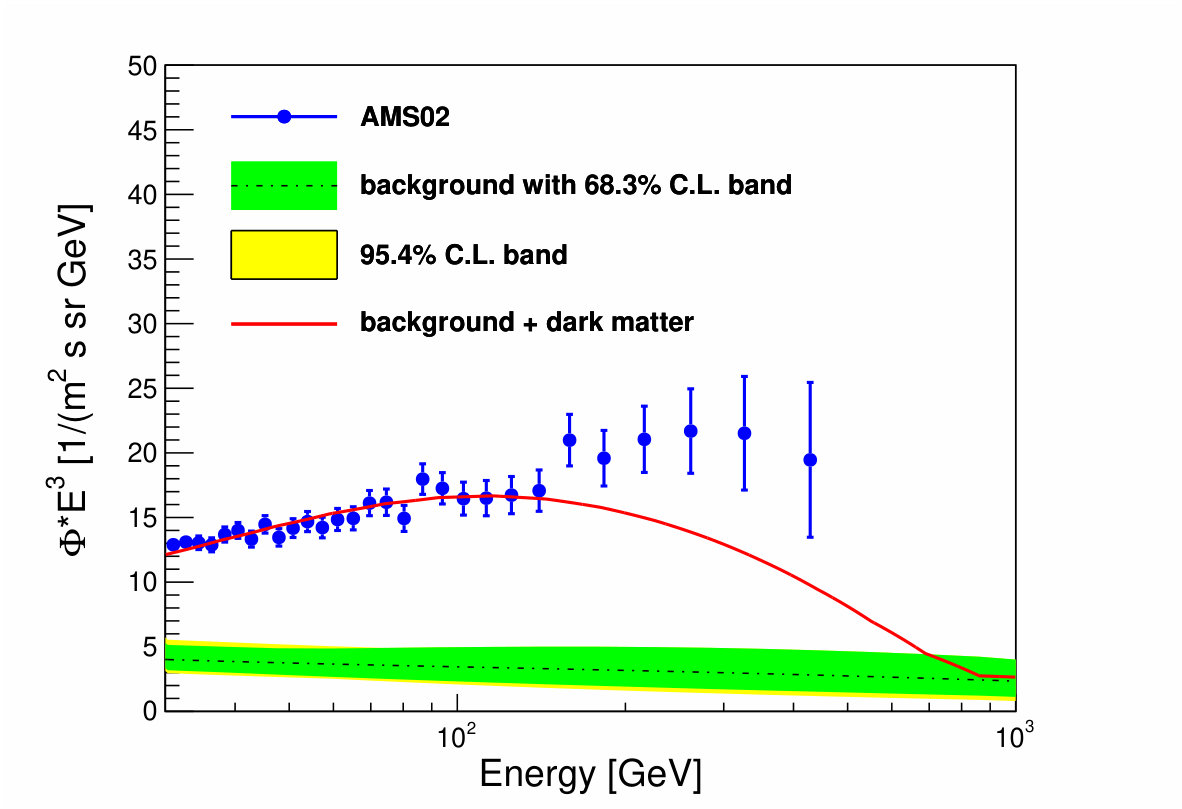 Figure 8
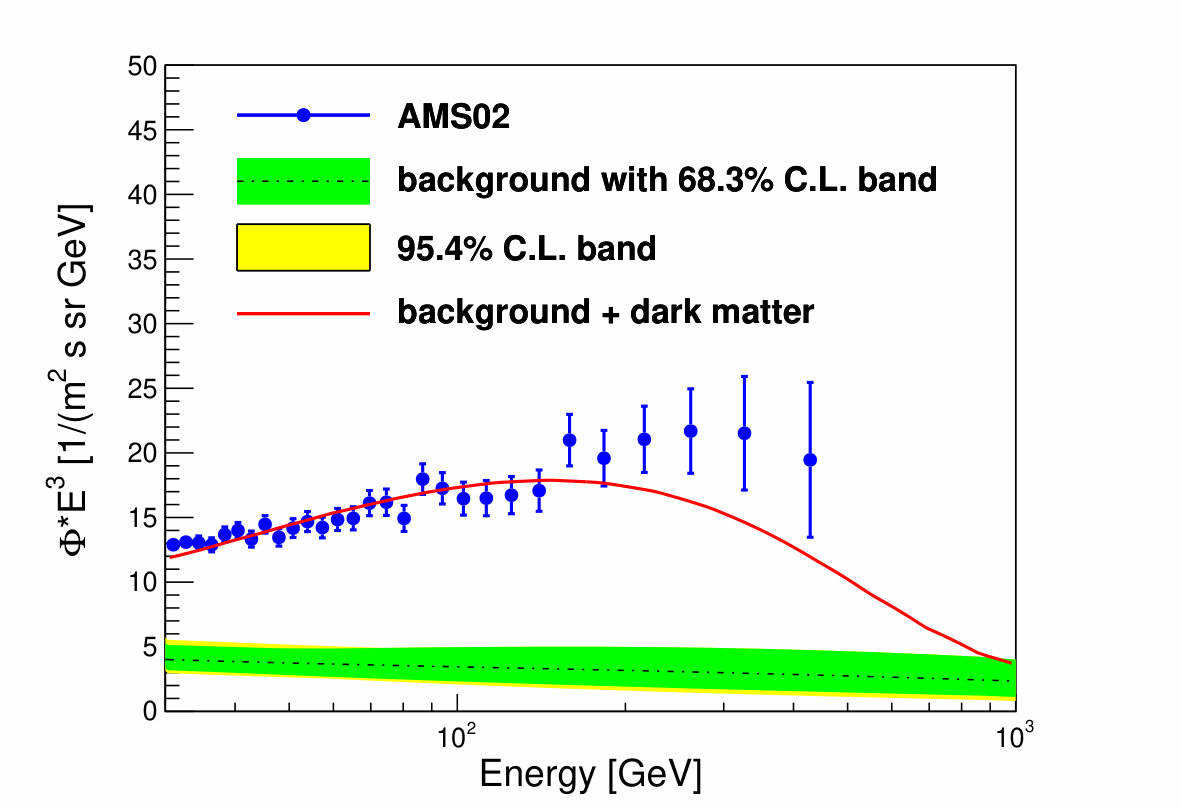 Figure 9
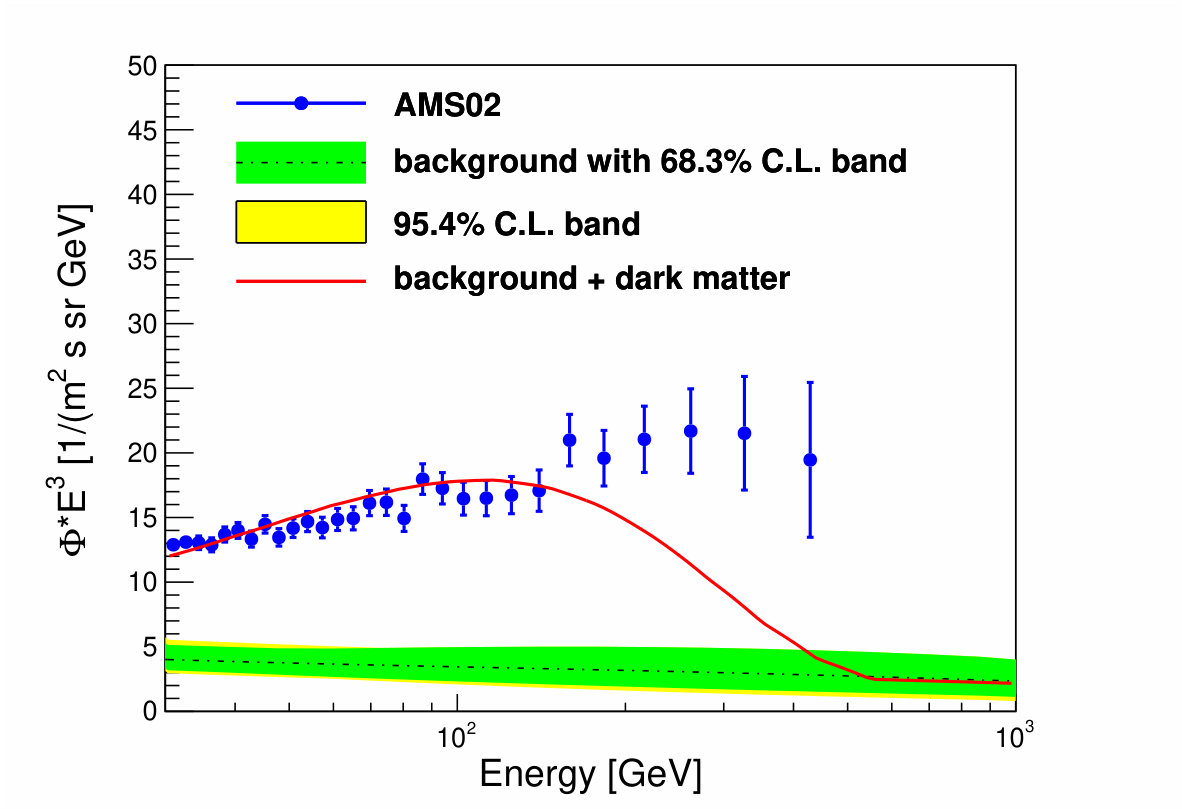 Figure 10
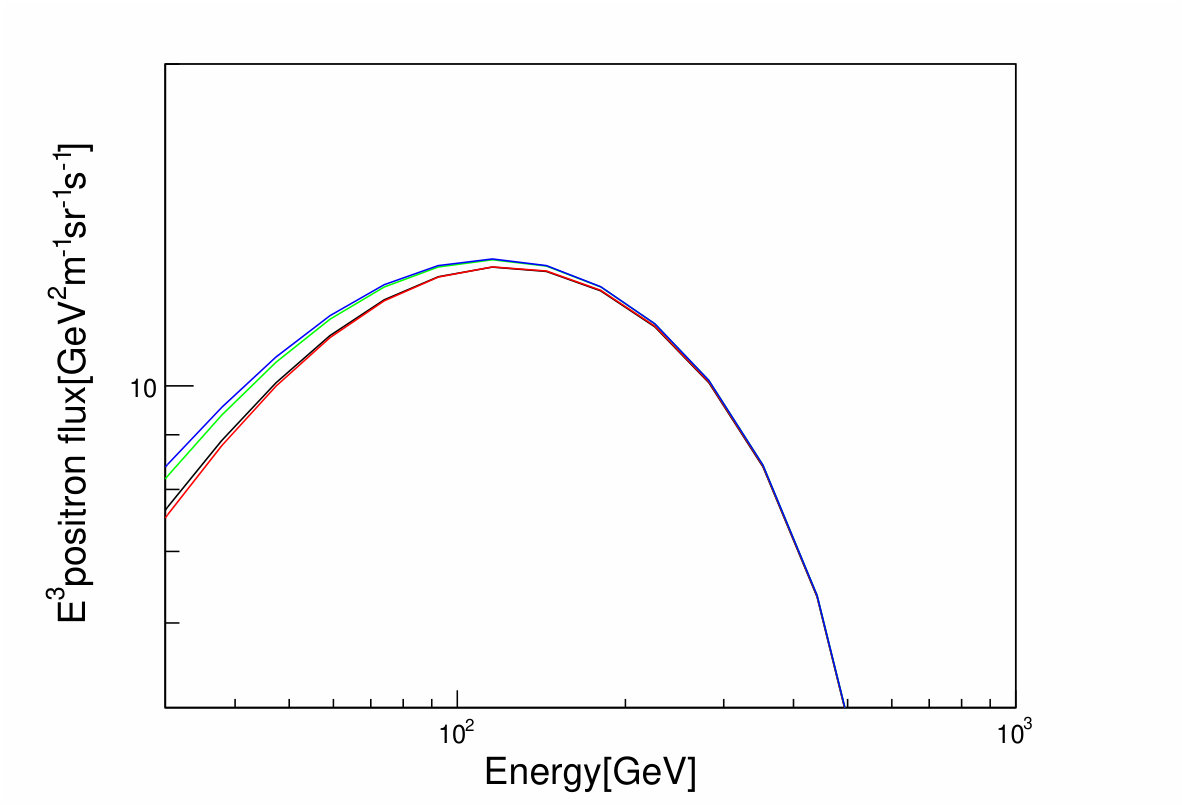 Figure 11
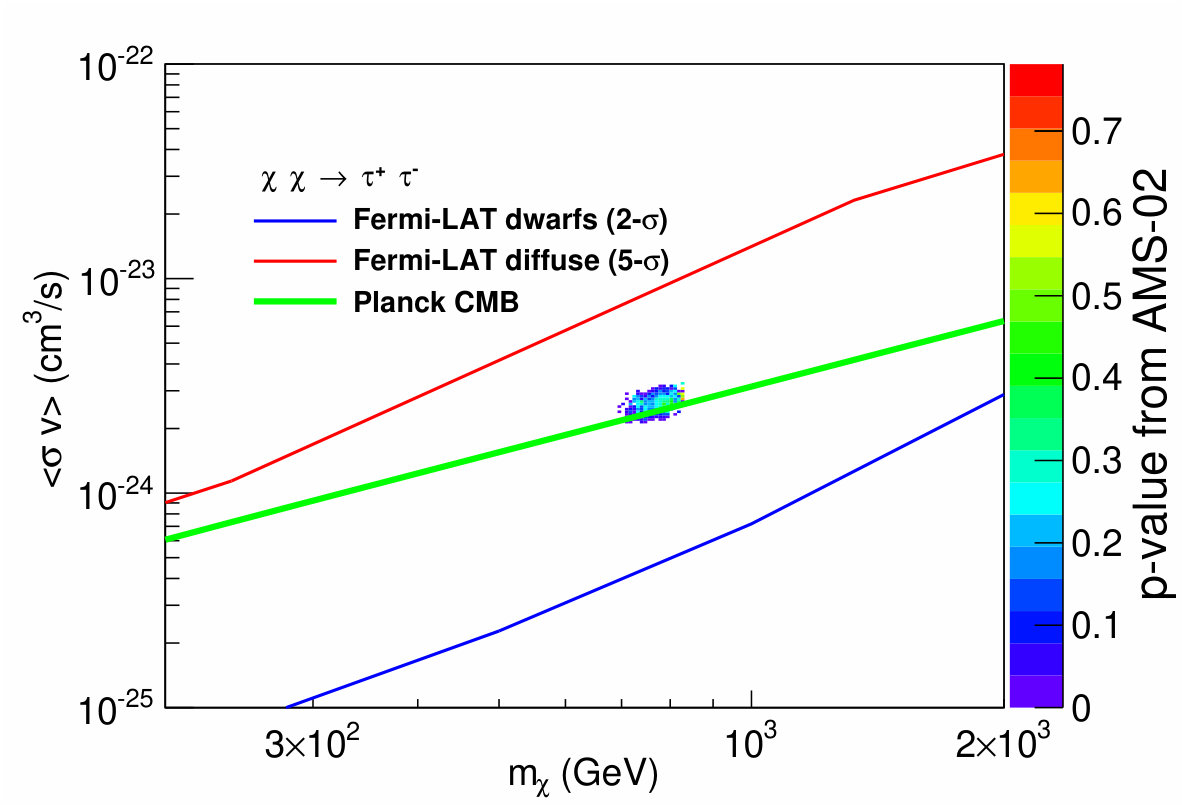 Figure 12
| parameter | unit | this work | SG |
|---|---|---|---|
| … | -4 | 0.91 | |
| kpc | 6.70 | 4.0 | |
| 1028 cm2 s-1 | 2.18 | 4.3 | |
| … | 0.19 | 0.395 | |
| … | 0.56 | … | |
| … | 0.22 | … | |
| … | 0.30 | … | |
| km s-1 | … | 28.6 | |
| km s-1 | … | 12.4 | |
| km s-1 kpc-1 | … | 10.2 | |
| GV | … | 7 | |
| GV | … | 360 | |
| … | 2.39 | 1.69 | |
| … | … | 2.44 | |
| … | … | 2.28 | |
| GV | … | 7 | |
| GV | … | 360 | |
| … | 2.29 | 1.71 | |
| … | … | 2.38 | |
| … | … | 2.21 |
| p-value | ||||||
|---|---|---|---|---|---|---|
| (GeV) | () | () | ||||
| VV2 | 164.42 | 0.9885 | ||||
| VV2 | 174.85 | 0.9593 | ||||
| VV2 | 162.43 | 0.9916 | ||||
| VV2 | 185.60 | 0.8659 | ||||
| VV2 | 149.29 | 0.9992 | ||||
| VV2 | 180.12 | 0.9192 | ||||
| VV2 | 143.65 | 0.9998 |
Peer Reviews
No public reviews on file for this paper yet. If you reviewed it on a platform where reviews are public (OpenReview, ICLR, NeurIPS, ICML), you can paste yours below so the community can read it here.
Videos
No videos yet. Explain this paper in a talk, walkthrough, or lecture? Add one.
Dark Matter Search in Space: Combined Analysis of Cosmic Ray Antiproton-to-Proton Flux Ratio and Positron Flux Measured by AMS-02
Jie Feng1,2
Hong-Hao Zhang1,
1School of Physics, Sun Yat-Sen University, Guangzhou 510275, China
2Massachusetts Institute of Technology (MIT), Cambridge, Massachusetts 02139, USA
Abstract
Dark matter search in space has been carried out for many years. Measurements of cosmic ray photons, charged antiparticles and neutrinos are useful tools for dark matter indirect search. The antiparticle energy spectra of cosmic rays have several exciting features such as the unexpected positron excess at 10 – 500 GeV and the remarkably flattening antiproton/proton at 60–450 GeV precisely measured by the AMS-02 experiment, which can not be explained simultaneously by secondary production in interstellar medium. In this work, we report a combined analysis of cosmic ray antiproton and positron spectra arising from dark matter on the top of a secondary production in a spatial-dependent propagation model. We discuss the systematic uncertainties from antiproton production cross section using the two latest Monte Carlo generators, i.e. EPOS LHC and QGSJET-II-04m, respectively. We compare their results. In the case of EPOS LHC, we find that the dark matter pair annihilating into leptons channel with 100% branching ratio and p-wave annihilation cross section assumption is the only possible one channel scenario to explain data. On the other hand, there is not a single possible channel in the case of QGSJET-II-04m. We also propose possible two-channel scenarios based on these two Monte Carlo generators.
I Introduction
After nearly one century of physics investigation, the search for dark matter is still ongoing. This search is carried out in three complementary ways: dark matter production in colliders, direct detection with underground instruments and indirect detection in cosmic rays (CRs). Dark matter annihilation or decay may produce elementary particles, including neutral particles (photons () and neutrinos) and charged ones ( positrons () and antiprotons () ). An impressive amount of dark matter information is being achieved by -ray data coming from spacebased or groundbased telescopes such as Fermi’s Large Area Telescope (Fermi-LAT) Ackermann et al. (2012, 2015) or High Energy Stereoscopic System (H.E.S.S) Abdallah et al. (2016). Besides, valuable pieces of dark matter information from neutrinos are being collected by IceCube Aartsen et al. (2016). At the same time, an increase in the accuracy of charged elementary CR particles spectra is driving us to a deeper understanding of the fundamental physics processes in the Galaxy. Thanks to the new generation detection experiments, such as the Payload for Antimatter Matter Exploration and Light-nuclei Astrophysics (PAMELA) or the Alpha Magnetic Spectrometer (AMS-02) in space, we are able to retrieve dark matter information in charged particle channels. The AMS-02 collaboration has now published the precise ratio measurement between 0.5 and 450 GeV of kinetic energy, showing that the ratio above 60 GeV experiences a remarkably flat behavior Aguilar et al. (2016a). PAMELA has also published similar results but with less statistical significance Adriani et al. (2013). Together with the resent flux data Adriani et al. (2009); Aguilar et al. (2014), which shows a surprising excess above 10 GeV, those results give us a hint of extra sources.
Unlike neutral particles that travel almost along straight lines, charged particles are difficult to be traced back to their sources due to the complex magnetic turbulence in the Galaxy. To constrain secondary production contribution, one also need to study the CR B/C elemental ratio, which have been measured by PAMELA and AMS-02 in space, or by or the Advanced Thin Ionization Calorimeter (ATIC-2) and the Cosmic Ray Energetics and Mass (CREAM) on balloon. Besides, systematics from solar modulation and antiparticle production cross section should also be studied Feng et al. (2016). Recent studies Feng et al. (2016); Boschini et al. (2017a) showed that the excess of antiprotons was not significant but that of positrons was solid given by the current understanding of systematics. Some studies were carried out to interpret the positron excess that were consistent with a smooth B/C spectrum. According to diffusive shock acceleration (DSA), the sources accelerating C-N-O are the same as those accelerating helium or protons, which are the main progenitors of antiprotons and positrons Blasi (2009); Mertsch and Sarkar (2014); Tomassetti and Donato (2015). However, a recent deuteron-to-helium ratio (d/He) measurement at 0.5-2 TeV/n by the satellite mission SOKOL Turundaevskiy and Podorozhnyi (2017) showed a rather high value, which is not expected from the predictions tuned against B/C. It stimulates a challenge to DSA Tomassetti and Feng (2017). If this deuteron-to-helium ratio measurement is correct, one should expect that the sources accelerating C-N-O are not the same as those accelerating helium or protons. The positron excess can be explained by nearby sources, which should be compatible with d/He instead of B/C. Otherwise, it seems unavoidable to introduce extra source components such as dark matter particle annihilation Cirelli and Strumia (2008); Cirelli et al. (2009); Yuan et al. (2015); Lin et al. (2015); Boudaud et al. (2015), or pair production mechanisms inside nearby pulsars Hooper et al. (2009); Profumo (2011); Delahaye et al. (2010); Linden and Profumo (2013); Yin et al. (2013); Delahaye et al. (2014); Lin et al. (2015); Boudaud et al. (2015); Feng and Zhang (2016). Observations by Fermi-LAT Abdo et al. (2011) indicated that -rays of pulsars were produced by leptons rather than hadrons, which can basically exclude the possibility that pulsars produce high energy antiprotons.
Numerous analyses have been performed to interprete precise spectrum measured by AMS-02 independent of with dark matter scenarios Giesen et al. (2015); Lin et al. (2015, 2017); Huang et al. (2016); Cui et al. (2017); Cuoco et al. (2017). There are also some combined analyses of PAMELA , which has larger uncertainties, and AMS-02 Cheng et al. (2016). In this paper, we perform a combined analysis of and in dark matter scenarios. We reduce some uncertainty from normalization by analyzing instead of spectrum because p are progenitors. For a similar reason, we avoid injection uncertainties of by analyzing instead of /(+). Our basic idea is that the cross section and the mass of dark matter annihilation estimated from data should be consistent with that from data. Besides, we notice that antiproton production cross section introduces major systematic uncertainties in spectrum Feng et al. (2016); Di Mauro et al. (2014); Winkler (2017). Following the implementation of the cross section from MC generators in Feng et al. (2016), we present our study with EPOS LHC and QGSJET-II-04m, which were tuned against the latest LHC experimental data and reproduce the production well Feng et al. (2016); Lin et al. (2017). In each case, we perform a global fit to the data with all the free parameters in the propagation and dark matter models. We quantify the agreement between model prediction and data with “p-value” method. We find that is the only possible channel, with 100% branching ratio and p-wave cross section assumption, based on the antiproton background calculated by EPOS LHC, while no channel is possible for QGSJET-II-04m. We also study the scenarios that dark matter decays into two channels, which gives a larger p-value compared to the one from channel scenarios. Comparisons with the analyses of -ray and cosmic microwave background (CMB) observations are also shown.
This paper is organized as follows. In Sec.II, we present our calculations. In Sec.II.1, we review briefly the and from astro-physical sources as the background of our analysis. In Sec.II.2, we introduce and flux produced at dark matter annihilation. In Sec.II.3, it is presented our definition of a good fit. In Sec.II.4, our consideration of solar modulation uncertainties is shown. In Sec. III, we show our results and discussion including one annihilation channel in Sec. III.1 and two annihilation channels in Sec. III.2. Finally, the conclusion is drawn in Sec. IV.
II calculations
II.1 Astro-physical background
In convectional CR propagation models, antiparticles are only produced in collisions of high-energy nuclei with interstellar medium (ISM). The fluxs of their progenitor nuclei and CR propagation process together determine the specta of antiparticles. The Galatic disk is surrounded by a halo with half-thickness . For each CR species, its propagation can be described by a two-dimensional transport equation:
[TABLE]
where is the number density as a function of energy and space coordinates, is the destruction rate in ISM, with density , at velocity and cross section . The source term includes a primary term, , and a secondary production term , from interaction of heavier –type nuclei with rate . The term describes ionization and Coulomb losses, as well as radiative cooling of CR leptons. The diffusion coefficient is taken as , where shows its normalization, is defined as the magnetic rigidity and is its normalization rigidity. expresses the scaling index.
Recent studies were done to get a set of injection and propagation parameters which could simultaneously reproduce a large set of nuclear data including proton, helium and carbon fluxes, the B/C elemental ratio, and the isotopic ratio Lin et al. (2015); G. Johannesson et al. (2016); Feng et al. (2016); Evoli et al. (2015). To assess astro-physical background of antiparticles, we adopt a spatial-dependent model of CR diffusion Tomassetti (2012, 2015). This model explains the high-energy departures from the standard universal power-law expectations in p and He spectra observed by PAMELA Adriani et al. (2011) and confirmed by AMS-02 Aguilar et al. (2015a, b), predicts a harder secondary-to-primary flux ratio later observed by AMS-02 and solves the problems on nuclei anisotropy and diffuse rays Feng et al. (2016); Guo and Yuan (2018) while the convectional models failed to do so Evoli and Yan (2014). In this scenario, the scaling index in the region of (inner halo) and when (outer halo) . The normalization is for the inner halo and for the outer. There is a connecting function of the type to ensure a smooth transition of the parameters and across the two zones Guo et al. (2015). The injection spectral indices of all the nuclei whose all equal to , while that of proton is . Based on the method presented in Ref. Feng et al. (2016), we redo the Bayesian analysis on those parameters with the latest AMS-02 B/C ratio Aguilar et al. (2016b). In Fig. 1, the B/C ratio calculations are shown in comparisons with the data. We use DRAGON package Gaggero et al. (2013), which is based on GALPROP package Strong et al. (2007), to solve the transport equation. In Table. 1, we compare the fit parameters in the spatial dependent propagation model (this work) with those in the standard GALPROP model (SG) reported in Boschini et al. (2017a). At low rigidity, the diffusion coefficient has a velocity dependent factor , where . We fix in order to reproduce proton and helium fluxes below 20 GV in this work, while it is a free parameter in Ref. Boschini et al. (2017a). This setting can avoid the complicated parameters associated to convection, reacceleration and the injection break around 7 GV. In the standard GALPROP model, the injection spectral index of protons or helium is no longer a constant and contains two breaks (i.e. and ) with different indices (i.e. , and ) before and after the breaks. We define and in order to compare them with those in Ref. Boschini et al. (2017a). , and , in Table. 1, are the Alfvn velocity, the convection wind velocity and its gradient, respectively.
Antiproton production cross section systematic is one of the main uncertainties of the astro-physical background. As has been studied in Feng et al. (2016); Kachelriess et al. (2015), two of the most advanced Monte Carlo (MC) generators EPOS LHC Pierog et al. (2015) and QGSJET-II-04m Kachelriess et al. (2015) can reproduce the recent ground experiments well. However, due to the scarcity of the anti-neutron production data, we have no way to test anti-neutron production cross sections. EPOS LHC predicts the anti-neutron/anti-proton ratio varies between 1.2 and 2.0, while QGSJET-II-04m shows it is close to 1 except near the production threshold. As is shown in Fig. 2, both model predictions with the latest AMS-02 B/C data Aguilar et al. (2016b) on the antiproton-to-proton ratio are below the experimental data measured by the same instrument Aguilar et al. (2016a). The first measurement of antiproton production cross section in p + He + X channel is recently made by LHCb experiment located at the Large Hadron Collider accelerator (LHC) at CERN Graziani (2017). Collisions of 6.5 TeV proton beams on He Nuclei at rest have been studied. Preliminary results showed that the data were between the predictions of EPOS LHC and QGSJET-II-04m. One should also note that those measurements are focused on high transverse momentum () range, which is the tail of the production. More data at low , where most of the antiprotons are produced, will be appreciated. We believe the truth should be somewhere between these two models, so we test the dark matter scenarios with the backgrounds predicted by them individually. Positron production cross section is taken from a recent parameterization Kamae et al. (2006). As you can find latter in Sec. III, positron production cross section is not a dominating component of the total uncertainties, since the excess of from the background is significant. So we do not discuss other cross section in this paper.
Pulsars are also important sources which produce secondary positrons. Previous studies showed that it is better to explain positron spectrum with pulsar models rather than with dark matter models Boudaud et al. (2015). This is ascribed to the fact that the profile of pulsar model usually has more degree of freedom than that of dark matter model. For example, it is unavoidable to introduce at least three parameters in the pulsar fit, i.e., the cutoff energy, the injection spectral index and the normalization Feng and Zhang (2016). In dark matter scenarios, however, there are only two free parameters: the mass of the dark matter and the normalization (i.e. thermally averaged annihilation cross section in the case of annihilation, where is the annihilation cross section and is the velocity, or which is the lifetime in the case of decay Giesen et al. (2015)). The -ray spectrum of a single pulsar is preferred to be explained by a leptonic model rather than hadronic one Abdo et al. (2011). The spectral index of -ray produced from pion-decay emission Ellison and Vladimirov (2008) of hadronic interactions should be harder than that through the Inverse-Compton scattering by leptons in a pulsar. Observation of RX J1713.7-3946 supports the latter one. One might easily explain the CR antiproton spectrum by dark matter and the positron by pulsar. In this way, there will be five free parameters so everything can be explained. However, this is not what we are going to do in this paper. Since the parameters of pulsars are not easy to be constrained, we do not consider contribution of them into the astro-physical background.
II.2 The fluxes of anti-matter from dark matter annihilation
The CR anti-particle fluxes produced by dark matter have been studied and collected in A Poor Particle Physicist Cookbook for Dark Matter Indirect Detection (PPPC) Cirelli et al. (2011). The authors calculated the results with PYTHIA and HERWIG Monte Carlos so they had a feeling of the uncertainties. Historically, leptons and vector bosons were treated as unpolarized. And parton showers were assumed not to emite ’s and ’s. Under these assumptions, will not be produced in leptonic channels. However, as is pointed out by Ciafaloni et al. (2011), polarizations and electroweak corrections should be considered, which will modify spectra at low energies and produce in leptonic channels due to radiation.
We consider dark matter annihilation into the following primary channels: e^{+}$$e^{-}, muons (\mu^{+}$$\mu^{-}), tauons (\tau^{+}$$\tau^{-}), light quarks (q$$\bar{q}), bottom quarks (b$$\bar{b}) and W bosons (W$$\bar{W}) in order to compare this study with the -ray observations Ackermann et al. (2015). As you can see latter in this paper, q$$\bar{q}, b$$\bar{b} and W$$\bar{W} predict too many but not enough . In order to improve the model, we also study the , and , where the annihilation first goes into a new light boson that will later decay into a pair of leptons proposed by Arkani-Hamed et al. (2009); Pospelov and Ritz (2009). Previous study by Ref.Cholis and Hooper (2014) showed that those channels can also reproduce . These so-called “4-body” channels will not produce . A recent study proposed a “3-body” channel where dark matter decays into a stable neutral particle and a pair of super symmetry fermions Cheng et al. (2016), which is also interesting but more complex. Another recent work proposed a new “4-body” channel that dark matter annihilate into light mediators that later decays into 2q$$\bar{q} Huang et al. (2016). We do not discuss this case since it produces mostly in its final state while we prefer more in this study.
We adopt the Navarro, Frenk and White (NFW) Navarro et al. (1996) profile to describe the galactic distribution of dark matter in the Milky Way, which reads:
[TABLE]
where and kpc are typical scale density and radius Cirelli et al. (2011). These values are obtained by setting the density to be at the Sun position kpc. As is shown in Fig. 3 , the dark matter density profile does not affect the observed positron spectrum near earth, which is dominated by the local contribution. It is also worth pointing out that the isothermal Bergstrom et al. (1998), Einasto Einasto (2009) and Moore Moore et al. (1999); Diemand et al. (2004) profile will change the dark matter antiproton contribution normalization by a factor of 0.5, that of 2 and that of 4 respectively in the spatial-dependent propagation model. These difference is smaller than those reported in traditional propagation models Jin et al. (2015).
After getting the fluxes of antiparticles produced by dark matter with NFW distribution, we take it as the source term in the transport equation eq. (1). The differential fluxes of antimatter at production are in the case of annihilation and in the case of decay Cirelli et al. (2011). Since the fluxes have the same energy dependence for the two cases and the energy spectra at the position of the earth would be similar, we discuss dark matter annihilation here as an example.
II.3 Formalism of the statistical test method
We adopt a frequentist statistical test in this work. Generally speaking, for discovering dark matter, we define the null hypothesis, , as the astrophysical background, which is to be tested against the alternative that includes both astrophysical background and dark matter signal. For setting dark matter limits, we define as the astrophysical background plus dark matter signal to be tested against the background-only hypothesis, . This work is in the former case. To quantify the agreement between data and the predictions of , we compute the probability, the widely used “p-value” Cowan et al. (2011),
[TABLE]
where is the for a given signal strength . is the observed one. is the distribution of for the number of degree of freedom , where is a gamma function.
II.4 Solar modulation uncertainties
Force field approximation is used to describe solar modulation. However, this approximation fails to describe charge-sign-dependent solar modulation Maccione (2013); Kappl (2016), which is recently observed by PAMELA Adriani et al. (2016) and can be quantitatively studied with high statistic AMS data. In order to take solar modulation uncertainties into account, the can be written as a function of and the dark matter mass ,
[TABLE]
where is the total uncertainty of the data point with the model uncertainty () introduced by varying the solar modulation potential from 300MV to 700MV. The prior of background parameters is obtained via the fitting to the B/C Aguilar et al. (2016b), 10BeBe Hagen et al. (1977); Buffington et al. (1978); Webber and Kish (1979); Garcia-Munoz et al. (1977, 1981); Wiedenbeck and Greiner (1980), proton Aguilar et al. (2015a), helium Aguilar et al. (2015b); Yoon et al. (2011) and carbon data Adriani et al. (2014); Ahn et al. (2009). This quantity describes the consistency of model parameters () and experimental data () with corresponding uncertainties ().
In this way, the model is more sensitive to high energy CR data rather than low energy ones. This method allows us to make use of the low energy data without introducing bias from solar modulation models.
III results and discussion
III.1 dark matter annihilation into one channel
We investigate the possibility to explain and by one annihilation channel with 100% branching ratio. We study spectrum instead of flux, since the uncertainties of and those of are cancelled. To avoid the uncertainties of the injection spectra, we study flux. To avoid solar modulation uncertainties, we use positron flux data above 30 GeV, antiproton-to-proton flux ratio above 10 GeV, and primary proton and nuclei fluxes above 10 GeV. We found that only channel gives us a p-value greater than , with a normalized chisquare and =0.9918. We get the best fit values: = GeV and =. Other channels are impossible. To give a feeling of the goodness of the fit, we plot the calculated and spectra together with the AMS-02 data in Fig. 4. On the other hand, however, there is no channel that gives us a large p-value with QGSJET-II-04m.
In Fig. 5, it is shown that this scenario survives from the constraints of Fermi-LAT diffuse measurements Ackermann et al. (2012), has an overlap with Planck CMB constrain Slatyer (2016); Ade et al. (2016), but has been excluded by -ray observations from Milky Way Dwarf Spheroidal Galaxies under the s-wave-dominated dark matter assumption Ackermann et al. (2015). A latest study by Masi and Ballardini (2016) also pointed out that dark matter scenario obtained from CRs positrons are not completely excluded by CMB observations considering the current systematic uncertainties. One should notice that there is still a possibility to accept this scenario if p-wave annihilation is not negligible, according to a recent study Zhao et al. (2016).
From this exercise, it is shown that most of the single channel scenarios can not simultaneously explain and . With respect to the astro-physical background, the excess of is a solid evidence of extra source, while that of is marginal. This requires a large to explain data, while a small to produce . For quark (e.g. q$$\bar{q} and b$$\bar{b}) or boson channels (e.g. W$$\bar{W}), it predicts not enough and too much . For leptonic channels (i.e. e^{+}$$e^{-}, \mu^{+}$$\mu^{-} and \tau^{+}$$\tau^{-}), it predicts enough but the profile of dark matter signal does not match data quite well. Thus, we introduce one more channel to get more in Sec. III.2 to improve the fit.
III.2 dark matter annihilation into two channels
Now we come to the possibility that dark matter annihilates into two channels. In Sec. III.1, it is shown that more in the annihilation will improve the fit. Setting one of the 6 channels in Sec. III.1 as the first channel, we have studied “4-body” lepton channels as the second channels, which are pure lepton channels and do not produce any . In this kind of scenarios, we will have more while keeping almost the same amount of .
Seven scenarios with a best fit p-value greater than for EPOS LHC as the antiproton production model are listed in Table. 2. The number of degree of freedom is 208. stands for the th channel. is short for the branching ratio of the th channel. Compared with the one channel scenarios, these two channel scenarios can improve the quality of the fit a lot. In Table. 2, it is shown that is the dominating channel in three scenarios with the largest p-values. For QGSJET-II-04m, no scenario gives a p-value greater than . The best scenario gives a and a p-value = 3.1 with the parameters: GeV, ** = ** for and ** = ** for .
We draw the and plots of dark matter annihilation into W$$\bar{W} and VV2\tau^{+}$$\tau^{-} channel as the “best” fit example for EPOS LHC in Fig. 6. This scenario shows the mass of dark matter is GeV and its = with a branching ratio of for and that of for . In Fig. 7, it is shown the and plots of dark matter annihilation into q$$\bar{q} and VV2\mu^{+}$$\mu^{-} channel for QGSJET-II-04m. This fit gives a low p-value, which is 3.1. We obtain that the mass of dark matter is GeV and its = with a branching ratio of for and that of for .
These two plots show that the two antiproton production models do not give consistent results for all the scenarios. As is discussed in Sec. II.1, the difference of anti-neutron production in these two MC generators is the source of the systematics of the antiproton astro-physical background. Some recent works parameterized the antiproton production cross sections with the latest ground experimental data Kappl and Winkler (2014); Winkler (2017); Di Mauro et al. (2014), which is also a good way to obtain this cross section. For antineutron production, however, they assumed an energy independent scale factor antineutron/antiproton to be a constant according to isospin symmetry, based on a preliminary experimental result published in a conference proceeding Fischer (2003). One should notice that this energy independent assumption of is not precise enough to describe antineutron production. When the antiproton energy is close to the production threshold, should be maximum in any model. goes down when the antiproton energy moves away from the threshold Feng et al. (2016). An energy dependent , however, changes the shape of the flux. More cross section measurement data from accelerators will help to reduce this kind of systematic uncertainties.
As is shown in the top plots of Fig. 6 and Fig. 7, both two MC generators predict a astrophysical background going down with energy above 60 GeV while AMS-02 data is flat. The dark matter signal makes the spectrum harder and closer to observed data. One should notice that these model predictions are based on the spatial-dependent propagation model. The standard GALPROP model shows its antiproton astro-physical background calculated with QGSJET-II-04m is compatible with AMS-02 data Boschini et al. (2017a) at high rigidity. On the other hand, flux measured by AMS-02 is significantly higher than astrophysical background. If the extra source produces the same among the and , one should expect an excess in spectrum and + spectrum. Compared to the astrophysical background, the excess in those spectra Boschini et al. (2018) is not as significant as that in pure spectrum. The dark matter profile can produce a “cut-off” like spectrum as is measured by AMS-02. The “best” fit results can match measurement up to a few hundred GeV.
IV Conclusions
An increase in the accuracy of the CR antiparticle spectra measurements is driving us closer to the answer of dark matter. Together with CR -ray Ackermann et al. (2012, 2015); Abdallah et al. (2016) and neutrino Aartsen et al. (2016) spectra, and spectra help us study astro-physical properties of the potential dark matter with GeV.
We summarize everything here. We present our study on dark matter search from CR and data above 30 GeV. For the first time, we simultaneously interpretate and spectra in the framework of AMS-02 with dark matter scenarios. We find that channel with 100% branching ratio is the best one channel scenario to reproduce CR and flux measurement, with = GeV and =, in the case of EPOS LHC. This scenario is not yet rejected by -ray observation under p-wave cross section assumption. For the antiproton background using the same MC generator, we also propose a two-channel scenario: = GeV and = . The dominating channel is with a branching ratio of , while the second channel is with a branching ratio of . In the case of QGSJET-II-04m, no scenario gives a good fit. These scenarios predict spectra harder than those in the background only scenario. They also predict a spectrum with a cut off between 100 and 2000 GeV, which is also observed by AMS-02, even though the shape does not completely match data. Since the direct observation of dark matter annihilation has not yet been reported, our results (i.e. masses, cross sections and channels) can provide useful information for the collider experiments (ATLAS and CMS) to search for weakly interacting massive particles (WIMPs) beyond the standard model.
Comparing to the pulsar scenarios Feng and Zhang (2016), we find that the s in dark matter fits are higher. This is due to the fact that pulsar models usually have more degrees of freedom. For example, the injection spectral index of a pulsar is a free parameter, which will adjust the pulsar profile to match data. On contrast, the spectral index of flux produced by dark matter is fixed by theoretical models. It is necessary to have some models to constrain the spectral index of a pulsar or to link it with the corresponding -ray spectrum. Moreover, if one tries to perform a combined fit on and spectra with quark channel dark matter and pulsar model, he has 2+3=5 free parameters and will obtain a good fit. Here we have only 3 free parameters for two channel dark matter scenario. A recent study Di Mauro et al. (2016) reported the interpretation of AMS-02 lepton paper with dark matter and pulsar scenarios. The solution purposed by the authors of Ref. Di Mauro et al. (2016) contains 3 free parameters for supernova remnants, 2 for pulsars and 2 for dark matter. A fairly good result for a dark matter annihilating in the channel was obtained in Ref. Di Mauro et al. (2016), where its cross section is relatively small and close to the thermal value. Their methods can also be adopted to obtain upper limits for the dark matter scenarios. We also investigate the impact of the antiproton background caused by cross sections. Two of the most advanced MC generators, EPOS LHC and QGSJET-II-04m, do not give consistent results. This disagreement reflects the lack of knowledge of anti-neutron production, which could be supplemented with new data of future underground experiments.
Recent time dependent / measurements by PAMELA Adriani et al. (2016) confirmed charge-sign-dependent solar modulation models Maccione (2013); Kappl (2016). The convectional force field approximation Gleeson and Axford (1968) is not precise enough for us. Recent developments of solar modulation model Bobik et al. (2012, ); Boschini et al. (2017b) considered more realistic physical processes. This model, namely HelMod, has successfully reproduced proton spectra during solar cycle 23 and 24. Another interesting study discovered that solar modulation parameters are related to the number of solar sunspots and the tilt angle of the heliospheric current sheet 8.1 months in advance Tomassetti et al. (2017). AMS-02 will publish its much more precise time-dependent , , and fluxes in the near future, which will allow us to further test HelMod and to reconstruct the fluxes out of the heliosphere.
Acknowledgments
We thank Qiang Yuan and Zhao-Huan Yu for helpful discussions. This work is supported by the National Natural Science Foundation of China (NSFC) under Grant Nos. 11375277, 11410301005, 11647606, and 11005163, the Fundamental Research Funds for the Central Universities, the Natural Science Foundation of Guangdong Province under Grant No. 2016A030313313, and the Sun Yat-Sen University Science Foundation.
The reference list from the paper itself. Each links out to its DOI / PubMed record.
- 1Ackermann et al. (2012) M. Ackermann et al. (Fermi-LAT), Astrophys. J. 761 , 91 (2012) , ar Xiv:1205.6474 [astro-ph.CO] . · doi ↗
- 2Ackermann et al. (2015) M. Ackermann et al. (Fermi-LAT), Phys. Rev. Lett. 115 , 231301 (2015) , ar Xiv:1503.02641 [astro-ph.HE] . · doi ↗
- 3Abdallah et al. (2016) H. Abdallah et al. (HESS), Phys. Rev. Lett. 117 , 111301 (2016) , ar Xiv:1607.08142 [astro-ph.HE] . · doi ↗
- 4Aartsen et al. (2016) M. G. Aartsen et al. (Ice Cube), Eur. Phys. J. C 76 , 531 (2016) , ar Xiv:1606.00209 [astro-ph.HE] . · doi ↗
- 5Aguilar et al. (2016 a) M. Aguilar et al. (AMS), Phys. Rev. Lett. 117 , 091103 (2016 a) . · doi ↗
- 6Adriani et al. (2013) O. Adriani et al. , JETP Lett. 96 , 621 (2013) , [Pisma Zh. Eksp. Teor. Fiz.96,693(2012)]. · doi ↗
- 7Adriani et al. (2009) O. Adriani et al. (PAMELA), Nature 458 , 607 (2009) , ar Xiv:0810.4995 [astro-ph] . · doi ↗
- 8Aguilar et al. (2014) M. Aguilar et al. (AMS), Phys.Rev.Lett. 113 , 121102 (2014) . · doi ↗