Uncertainty Relation Based on Skew Information with Quantum Memory
Zhihao Ma, Zhihua Chen, Shaoming Fei

TL;DR
This paper introduces a new uncertainty relation using skew information, demonstrating how quantum memory and correlations influence the bounds of uncertainty in bipartite quantum systems.
Contribution
It proposes a novel uncertainty relation based on skew information and explores its connection with quantum memory and correlations in bipartite systems.
Findings
Uncertainty bounds are tighter with quantum memory.
Quantum correlations affect the uncertainty limits.
The relation generalizes existing uncertainty principles.
Abstract
We present a new uncertainty relation by defining a measure of uncertainty based on skew information. For bipartite systems, we establish uncertainty relations with the existence of a quantum memory. A general relation between quantum correlations and tight bounds of uncertainty has been presented.
Click any figure to enlarge with its caption.
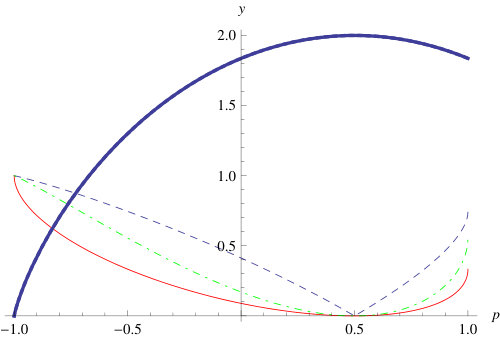 Figure 1
Peer Reviews
No public reviews on file for this paper yet. If you reviewed it on a platform where reviews are public (OpenReview, ICLR, NeurIPS, ICML), you can paste yours below so the community can read it here.
Videos
No videos yet. Explain this paper in a talk, walkthrough, or lecture? Add one.
\BeginPage
1
111*Corresponding author (email: [email protected])
Uncertainty Relations Based on Skew Information with Quantum Memory
Zhihao Ma
Zhihua Chen
Shao-Ming Fei*∗*
School of Mathematical Sciences, Shanghai Jiaotong University, Shanghai, 200240, China
Department of Applied Mathematics, Zhejiang University of Technology, Hangzhou, 310014, China
School of Mathematical Sciences, Capital Normal University, Beijing 100048, China
4 Max-Planck-Institute for Mathematics in the Sciences, 04103 Leipzig, Germany
\PACS
03.67.-a, 75.10.Pq, 03.67.Mn
Dear Editors,
Uncertainty principle is one of the most fascinating features of the quantum world. It asserts a fundamental limit on the precision with which certain pairs of physical properties of a particle, such as position and momentum, can not be simultaneously known. The uncertainty principle has attracted considerable attention since the innovation of quantum mechanics and has been investigated in terms of various types of uncertainty inequalities: as informational recourses in entropic terms, by means of majorization technique and based on sum of variances and standard deviations.
For a pair of observables and , the well-known Heisenberg-Robertson uncertainty relation [1] says that, where is the commutator and is the standard deviation of . The entropies serve as appropriate measures of the information content. It is also used to quantify the quantum uncertainty: the sum of the Shannon entropy of the probability distribution of the outcomes is no less than [2] when and are measured. The term quantifies the complementarity of the two observables and . It has been proved that the entropy uncertainty relations do imply the Heisenberg’s uncertainty relation.
Concerning bipartite systems, the authors in [3] provided a bound on the uncertainties which depends on the amount of entanglement between the measured particle and the quantum memory . The result of [3] was further improved to depend on the quantum discord between particles and in [4]. Recently the authors in[5] obtained entropic uncertainty relations for multiple measurements with quantum memory.
The quantum uncertainty relation can be also described in terms of skew information. is introduced to quantify the degree of non-commutativity of a state and an observable , which is reduced to the variance when is a pure state [6]. It can be interpreted as quantum uncertainty of in . Luo introduced another quantity in [7], , where is the anti-commutator, with the identity operator. The following inequality holds [7],
[TABLE]
can be regarded as a kind of measure for quantum uncertainty. Hence we define . Then we define the uncertainty of associated to the projective measurement as: where and are the rank one spectral projectors of two non-degenerate observables and with eigenvectors and , respectively.
Now we consider the case of bipartite state in tensor space [8]. Recall that quantum discord is a kind of quantum correlation that is different from the entanglement and has found many novel applications[9]. A bipartite state is of zero discord if and only if it is a classical-quantum correlated state (CQ state). Besides the definition of the original discord, there are some other discord-like measures sharing the same properties such that their values are zero iff the state is a CQ state. In this letter we define another discord-like measure. Let be any orthogonal basis space in Hilbert space . Let be an orthogonal basis of and the orthogonal projections on . We define the quantum correlation of as:
[TABLE]
where the minimum is taken over all the orthogonal bases in , is the reduced state of system .
From the inequality in [10] that for any bipartite state and any observable on , we have the property that . Moreover, if and only if is a CQ state by using the method in proving the theorem 1, property (1) of [11].
has a term of measurement on the subsystem , which gives an explicit physical meaning: it is the minimal difference of incompatibility of the projective measurements on the bipartite state and on the local reduced state . It quantifies the quantum correlations between the subsystems and .
Theorem Let be a quantum state on , and denote two sets of rank one projective measurements on . Then the following uncertainty relation holds:
[TABLE]
where .
Proof. By definition we have
[TABLE]
The first inequality holds since (see [12]). The second inequality is due to the Cauchy-Schwarz inequality. The final inequality holds because the optimal measurement for may not be or .
From the theorem, we obtain an uncertainty relation in the form of sum of skew information, which is in some sense similar to the result in the recent work [13]. But actually our result is quite different from that in [13], which only deals with single partite case. We treat the bipartite case with a quantum memory . Interestingly, the lower bound contains two terms, one term is the quantum correlation , the other term is which characterizes the degree of complementarity of two measurements, just as the meaning of in the entropic uncertainty relation [3]. Therefore our result can be viewed as an analogue of the bipartite entropic uncertainty relation.
As an example, we consider the 2-qubit Werner state where and . Take and as the two observables. For our theorem we have the values of the left hand side and the right hand side of (3), and , respectively. While the left hand side of the theorem in [7] is and the right hand side is 0. From the result in [4], the left hand side is , the bound is the same as the left hand side, see Fig. 1 for comparision.
In summary, we have established a new uncertainty relation based on the skew information. We studied the case of uncertainty relation with the existence of a quantum memory for the bipartite quantum system. Our result shows that quantum correlations can be used to obtain a tighter bound of uncertainty.
\Acknowledgements\bahao
Zhihao Ma and Zhihua Chen thank Davide Girolami for useful discussions. This work is supported by NSFC under numbers 11275131, 11371247, 11571313 and 11675113.
The reference list from the paper itself. Each links out to its DOI / PubMed record.
- 1[1] W. Heisenberg, Z. Phys, 43, 172 (1927).
- 2[2] H. Maassen, J. B. M. Uffink, Phys. Rev. Lett., 60, 1103 (1988).
- 3[3] M. Berta, et al, Nature Physics, 6, 659(2010).
- 4[4] A. K. Pati, A. R. Usha Devi, A. K. Rajagopal, et al, Phys. Rev. A, 86, 042105 (2012).
- 5[5] S. Liu, L.-Z. Mu, and H. Fan, Phys. Rev. A, 91 , 042133 (2015).
- 6[6] E. P. Wigner, M. M. Yanase, Proc. Natl. Acad. Sci. U.S.A., 49, 910 (1963).
- 7[7] S. Luo, Phys. Rev. A, 72,042110 (2005).
- 8[8] A. Uhlmann, Science China Physics, Mechanics and Astronomy , 59(3), 630301 (2016).