Inelastic Neutrino-Nucleus Interactions within the Spectral Function Formalism
Erica Vagnoni, Omar Benhar, and Davide Meloni

TL;DR
This paper investigates neutrino-carbon interactions across a wide energy range using a spectral function approach within the impulse approximation, providing a comprehensive analysis of different scattering processes based on a realistic nuclear ground state.
Contribution
It introduces a novel model that consistently describes quasi-elastic, resonance, and deep inelastic scattering using a realistic spectral function for the nuclear ground state.
Findings
First-time consistent modeling of all interaction types from a realistic nuclear ground state.
Quantitative comparison of quasi-elastic, resonance, and deep inelastic contributions.
Enhanced understanding of neutrino-nucleus interactions across a broad energy spectrum.
Abstract
We report the results of a study of neutrino-carbon interactions at beam energies ranging between few hundreds MeV and few tens of GeV, carried out within the framework of the impulse approximation using a realistic spectral function. The contributions of quasi elastic scattering, resonance production and deep inelastic scattering---consistently obtained, for first time, from a model based on a realistic description of the nuclear ground state---are compared and analyzed.
Click any figure to enlarge with its caption.
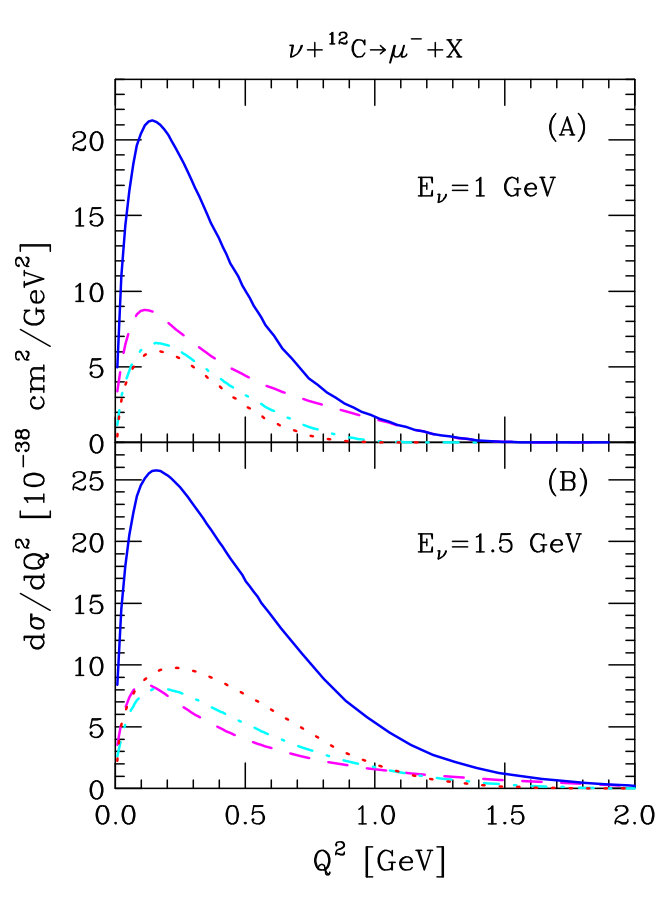 Figure 1
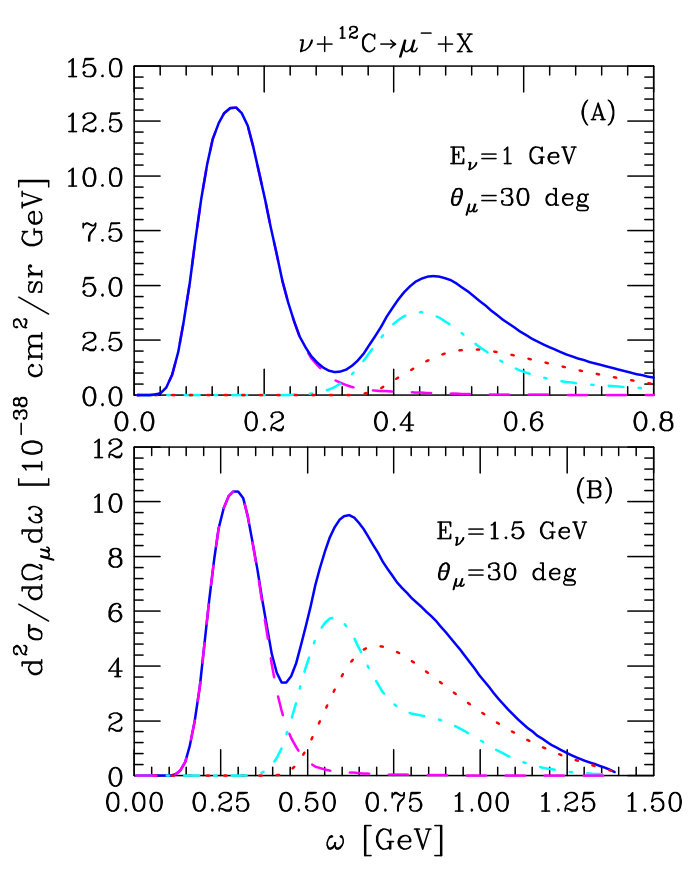 Figure 2
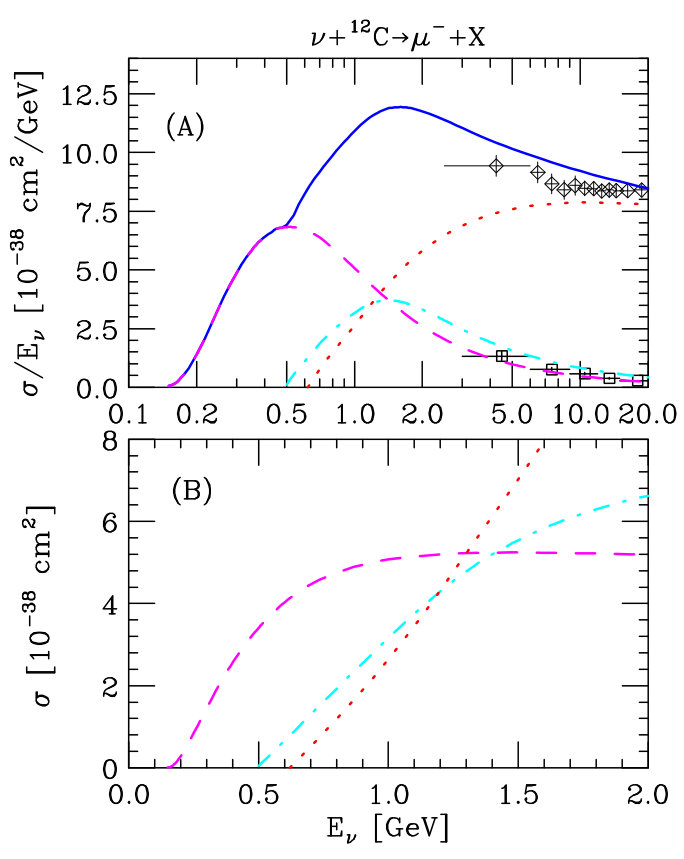 Figure 3
Peer Reviews
No public reviews on file for this paper yet. If you reviewed it on a platform where reviews are public (OpenReview, ICLR, NeurIPS, ICML), you can paste yours below so the community can read it here.
Videos
No videos yet. Explain this paper in a talk, walkthrough, or lecture? Add one.
Inelastic Neutrino-Nucleus Interactions within the Spectral Function Formalism
Erica Vagnoni
INFN and Dipartimento di Matematica e Fisica, Università Roma Tre, I-00146 Roma, Italy
Omar Benhar
INFN and Dipartimento di Fisica, “Sapienza” Università di Roma, I-00185 Roma, Italy
Center for Neutrino Physics, Virginia Tech, Blacksburg, Virginia 24061, USA
Davide Meloni
INFN and Dipartimento di Matematica e Fisica, Università Roma Tre, I-00146 Roma, Italy
Abstract
We report the results of a study of neutrino-carbon interactions at beam energies ranging between few hundreds MeV and few tens of GeV, carried out within the framework of the impulse approximation using a realistic spectral function. The contributions of quasi elastic scattering, resonance production and deep inelastic scattering—consistently obtained, for first time, from a model based on a realistic description of the nuclear ground state—are compared and analyzed.
pacs:
13.15.+g, 25.30.Pt, 24.10.Cn
Over the past decade, the broad effort aimed at improving the oversimplified description of neutrino-nucleus interactions based on the Relativistic Fermi Gas Model (RFGM), has led to the development of a number of more advanced approaches, capable of providing a fairly accurate description of part of the available data Benhar05 ; Benhar:2006nr ; GIBBU ; coletti ; PhysRevLett.98.242501 ; Martini:2010ex ; martini ; Amaro:2010sd ; PhysRevC.83.045501 ; nieves ; Gran:2013kda ; natalie ; megias . Most existing studies are restricted to the charged-current quasi-elastic (CCQE) sector, which makes the dominant contribution to the neutrino-carbon cross sections measured by the MiniBooNE Collaboration using a neutrino flux of mean energy miniboone_ccqe_2 ; AguilarArevalo:2010zc . However, the interpretation of the signals relevant to ongoing and future experiments at higher neutrino energies, such as MINERA minerva , NOA Ayres:2007tu and DUNE DUNE requires accurate predictions of the nuclear cross sections in inelastic channels. For example, at , corresponding to the peak energy of the NOA oscillated events, the total cross section is expected to receive comparable contributions from CCQE, resonance production and deep inelastic scattering (DIS) processes Ayres:2007tu .
Theoretical calculations of the neutrino-nucleus cross section involve three main elements—the target initial and final states and the nuclear weak current—whose consistent description in the broad kinematical region corresponding to neutrino energies between few hundreds MeV and few GeV poses severe difficulties. The initial state can be safely modeled within the non relativistic approximation, independent of kinematics, whereas at large momentum transfer , the same approximation cannot be used to describe either the nuclear final state, comprising at least one particle carrying momentum , or the nuclear current operator, which depends explicitly on momentum transfer.
The impulse approximation (IA)—a detailed derivation of which can be found in Refs. Benhar05 ; Benhar:2006wy —provides a conceptual framework ideally suited to circumvent the above problem. The main tenet underlying this scheme is that, at large momentum transfer, nuclear interactions reduce to the incoherent sum of elementary processes involving individual nucleons. As a consequence, nuclear and weak interaction dynamics are decoupled, and—to the extent to which the corresponding neutrino-nucleon cross section can be measured using hydrogen and deuterium targets—the formalism based on the IA can be used to describe neutrino-nucleus scattering in any channels.
In this Letter, we report the results of the first comprehensive study of the neutrino-carbon cross section—including CCQE interactions, resonance production and DIS—carried out within the IA using a realistic spectral function.
The differential cross section of the process
[TABLE]
in which a neutrino of four-momentum scatters off a carbon nucleus producing a muon of four-momentum , with the nuclear final state being undetected, can be written in the form
[TABLE]
where is the solid angle specified by the direction of the vector , is the Fermi constant and is the element of the Cabibbo-Kobayashi-Maskawa (CKM) matrix coupling and quarks.
The tensor is completely determined by lepton kinematics, whereas the nuclear response to weak interactions is described by the tensor
[TABLE]
where and denote the target ground state and the hadronic final state, carrying four momenta and , respectively, is the nuclear weak current and the sum is extended to all hadronic final states.
The formalism of IA is based on the factorization ansatz, which amounts to replacing Benhar05 ; Benhar:2006wy
[TABLE]
where is the hadronic state produced at the electromagnetic vertex with momentum , while describes the recoiling nucleus, carrying momentum .
It follows that Eq.(2) reduces to the simple and transparent form
[TABLE]
where the elementary cross section—written in terms of five structure functions —describes the interaction between the incoming neutrino and a moving bound nucleon, while the nuclear spectral function —trivially related to the imaginary part of the two-point Green’s function BFF1 ; BFF2 —yields the probability of removing a nucleon of momentum from the target ground state, leaving the residual nucleus with excitation energy .
Equation (5) clearly illustrates the potential of the formalism based on the factorization ansatz of Eq. (4). Because the spectral function is an intrinsic property of the target ground state, it can be obtained from non relativistic nuclear many-body theory, and employed to carry out calculations of the nuclear cross section in any channels, provided the corresponding -nucleon cross section in vacuum is known. The elementary cross section can be treated using the relativistic formalism without any problems, nuclear medium effects being taken into account through the replacement Benhar:2006wy
[TABLE]
where is the target mass, while and denote the energies of the hadronic state produced at the neutrino interaction vertex and of the recoiling nucleus, respectively. Equation (6) allows to account for the fact that, even though the weak interaction involves an individual nucleon, a fraction of the energy transfer in the scattering process goes into excitation energy of the spectator system.
In the CCQE channel, characterized by the absence of pions in the final state, the relevant elementary interaction process is
[TABLE]
and the nucleon structure functions—involving a -function constraining the mass of the hadronic final state to be equal to the proton mass, —can be written in terms of the nucleon vector and axial-vector form factors. The former have been accurately measured in electron-proton and electron-deuteron experiments Kelly2004 ; BBBA , while the latter is usually written in the dipole form
[TABLE]
with . The axial-vector coupling constant, , is known from neutron -decay g_A , while the value of the axial mass is determined from elastic neutrino- and antineutrino-nucleon scattering, charged pion electro-production off nucleons and muon capture on the proton bernard ; bodek2 .
The results reported in this Letter have been obtained using the state-of-the-art parametrization of the vector form factors of Ref. BBBA , and the dipole parametrization of the axial-vector form factor with .
Conceptually, the generalization to describe resonance production, driven by elementary processes such as
[TABLE]
where denotes the nucleon resonance, only requires minor changes Benhar:2006nr . In this case, the cross section involves the matrix elements of the weak current describing the nucleon-resonance transitions. As a consequence, the structure functions—which can still be written in terms of phenomenological vector and axial-vector form factors—depend on both and , the squared invariant mass of the state . In addition, the energy conserving -function is replaced by a Breit-Wigner factor, accounting for the finite width of the resonance.
Besides the prominent state, providing the largest contribution to the cross section, we have taken into account the three isospin states—, , and —comprised in the so-called second resonance region. The numerical results have been obtained using the parametrization of the structure functions described in Refs res1 ; res2 ; res3 . Within this approach, the vector form factors are constrained by electroproduction data, while the axial couplings are extracted from the measured resonance decay rates, exploiting the Partially Conserved Axial Current (PCAC) hypothesis.
From the observational point of view, Deep Inelastic Scattering (DIS) is associated with hadronic final states comprising more than one pion.
In principle, the three nucleon structure functions determining the cross section in the DIS regime—, and —may be obtained combining measured neutrino and antineutrino scattering cross sections. However, as the available structure functions have been extracted from nuclear cross sections (see, e.g., Ref. CDHS ), their use in ab initio theoretical studies, aimed at identifying nuclear effects, entails obvious conceptual difficulties.
An alternative approach, allowing to obtain the structure functions describing DIS on isolated nucleons, can be developed within the conceptual framework of the quark-parton model, exploiting the large database of accurate DIS data collected using charged lepton beams and hydrogen and deuteron targets (see, e.g., Ref. roberts ). Within this scheme, the function , where is the structure function of an isoscalar nucleon, can be simply related to the corresponding structure function extracted from electron scattering data, through111For the sake of simplicity, here, and in what follows, we will ignore the contributions of and quarks.
[TABLE]
where is the Bjorken scaling variable. In addition, the relation
[TABLE]
where and and denote the valence quark distributions, implies
[TABLE]
Using Eqs. (10)-(12) and the Callan-Gross relation roberts , linking to , one can readily obtain all the relevant weak structure functions from the existing parametrizations of the measured electromagnetic structure function and of the antiquark distributions and (see, e.g., Ref .GRV98 ). Alternatively, the quark and antiquark distributions can be also used to obtain the structure function from
[TABLE]
In this work, we have used Eqs.(10)-(13) and the parton distributions of Ref. GRV98 , which are available for GeV2. At lower values of , we have assumed the parton distributions to be the same as at .
Note that the above procedure rests on the tenet, underlying the IA scheme, that the elementary neutrino-nucleon interaction is not affected by the presence of the nuclear medium, the effects of which are accounted for with the substitution of Eq.(6). While this assumption is strongly supported by electron-nucleus scattering data in the quasi elastic channel, showing no evidence of medium modifications of the nucleon vector form factors, it has to be mentioned that analyses of neutrino DIS data are often carried out within a conceptually different approach, allowing for medium modifications of either the nucleon structure functions petti ; haider , or of the parton distributions entering their definitions kumano .
The results of calculations of the electron-nucleus cross sections have provided ample evidence that the approach based on IA and the spectral function formalism, involving no adjustable parameters, is capable to deliver a quantitative description of the double-differential electron-nucleus cross sections—measured at fixed beam energy and electron scattering angle—in both the qualsielastic and inelastic sectors electron ; LDA . Figure 1 shows the results of the extension of these analyses to the case of neutrino-carbon interactions. The calculations have been carried out using the spectral function of Ref. LDA and setting the muon emission angle to . Comparison between panels (A) and (B), corresponding to 1 and 1.5 GeV, respectively, illustrates how the relative weight of the different reaction mechanisms changes with increasing neutrino energy.
The -distributions, obtained from the double-differential cross section of Fig. 2 by integrating over , are displayed in Fig. 2. At both 1 and 1.5 GeV, the full , corresponding to the solid line, exhibits a pronounced maximum at .
Finally, integration over yields the total cross section, , whose behavior as a function of the neutrino energy is illustrated in Fig. 3. Panels (B) and (A) show and the ratio , respectively, as well as the contributions corresponding to the CCQE, resonance production, and DIS channels. It is apparent that, while at GeV CCQE interactions dominate, the inelastic cross section rapidly increases with energy. At GeV, the contributions arising from the three reaction channels turn out to be about the same.
For comparison, in panel (B) we also report, as diamonds, the -carbon total cross section measured by the NOMAD collaboration NOMAD_tot . It turns out that, while the energy-dependence of the data at GeV is well reproduced by our prediction of the DIS contribution, represented by the dotted line, the results of the full calculation, corresponding to the solid line, sizably exceed the measured cross section. In view of the fact that the CCQE cross section obtained from the NOMAD data of Ref. NOMAD_CCQE , shown by the open squares, turns out to be in close agreement with the results of our calculations, this discrepancy is likely to be ascribed to double counting between resonance production and DIS contributions, which are very hard to identify in a truly model independent fashion.
In conclusion, we have carried out a calculation based on the IA and the spectral function formalism, in which the contributions of CCQE processes, resonance production and DIS are taken into account, for the first time, in a fully consistent fashion. The present implementation of the factorization scheme does not take into account the occurrence of processes involving more than one nucleon—such as those in which the neutrino couples to nuclear Meson-Exchange-Currents (MEC)—as well as final state interactions (FSI) between the nucleon participating in the weak interaction process and the spectator particles. The inclusion of MEC contributions to the neutrino-nucleus cross section is believed to be needed to explain the flux-integrated double-differential cross section measured by the MiniBooNE collaboration martini ; nieves ; megias , while the understanding of FSI is required, e.g., to determine the nuclear transparency to the hadrons produced at the interactions vertex transparency .
Theoretical studies of the electron-carbon cross section provide convincing evidence that MEC contributions can be consistently included in the spectral function formalism, through a generalization of the factorization ansatz MEC1 ; MEC2 , while FSI corrections in the quasi elastic channel are understood at quantitative level FSI1 ; FSI2 . Note, however, that FSI do not affect the CCQE total cross section shown in Fig. 3.
The emerging picture suggests that the approach based on spectral functions strongly constrained by both inclusive and exclusive electron-nucleus scattering data, such as those derived in Ref. LDA , has the potential to describe both elastic and inelastic neutrino-nucleus interactions at the level of accuracy required to face the outstanding challenges of neutrino physics.
Acknowledgements.
The authors are grateful to Artur M. Ankowski and Camillo Mariani for countless illuminating discussions. The work of E.V. and D.M. was supported by INFN through grant WSIP. The work of O.B. was supported by INFN through grant MANYBODY.
The reference list from the paper itself. Each links out to its DOI / PubMed record.
- 1(1) O. Benhar, N. Farina, H. Nakamura, M. Sakuda, and R. Seki, Phys. Rev. D 72 , 053005 (2005).
- 2(2) O. Benhar and D. Meloni, Nucl. Phys. A 789 , 379 (2007).
- 3(3) T. Leitner, O. Buss, L. Alvarez-Ruso, and U. Mosel, Phys. Rev. C 79 , 034601 (2009).
- 4(4) J.E. Amaro, M.B. Barbaro, J.A. Caballero, and T.W. Donnelly, Phys. Rev. Lett. 98 , 242501 (2008).
- 5(5) O. Benhar, P. Coletti, and D. Meloni, Phys. Rev.Lett. 105 , 132301 (2010).
- 6(6) M. Martini, M. Ericson, G. Chanfray, and J. Marteau, Phys. Rev. C 81 , 045502 (2010).
- 7(7) M. Martini, M. Ericson, and G. Chanfray, Phys. Rev. C 84 , 055502 (2011).
- 8(8) J. E. Amaro, M.B. Barbaro, J.A. Caballero, T.W. Donnelly, and C.F. Williamson, Phys. Lett. B 696 , 151 (2011).