Magnetization in narrow ribbons: curvature effects
Yuri Gaididei, Arseni Goussev, Volodymyr P. Kravchuk, Oleksandr V., Pylypovskyi, J. M. Robbins, Denis D. Sheka, Valeriy Slastikov, and Sergiy, Vasylkevych

TL;DR
This paper investigates how curvature and torsion influence magnetization states and spin wave excitations in narrow magnetic ribbons, revealing transitions in ground states and asymmetric dispersion laws due to geometry and chirality.
Contribution
It derives a reduced one-dimensional micromagnetic model for narrow ribbons incorporating curvature and torsion effects, and analyzes specific geometries like helicoid and M"obius ribbons.
Findings
Ground state magnetization transitions depend on tangential anisotropy.
Helicoid ribbon exhibits a uniform perpendicular ground state below zero anisotropy.
M"obius ribbon shows a nonuniform ground state at positive critical anisotropy.
Abstract
A ribbon is a surface swept out by a line segment turning as it moves along a central curve. For narrow magnetic ribbons, for which the length of the line segment is much less than the length of the curve, the anisotropy induced by the magnetostatic interaction is biaxial, with hard axis normal to the ribbon and easy axis along the central curve. The micromagnetic energy of a narrow ribbon reduces to that of a one-dimensional ferromagnetic wire, but with curvature, torsion and local anisotropy modified by the rate of turning. These general results are applied to two examples, namely a helicoid ribbon, for which the central curve is a straight line, and a M\"obius ribbon, for which the central curve is a circle about which the line segment executes a twist. In both examples, for large positive tangential anisotropy, the ground state magnetization lies tangent to the central…
Click any figure to enlarge with its caption.
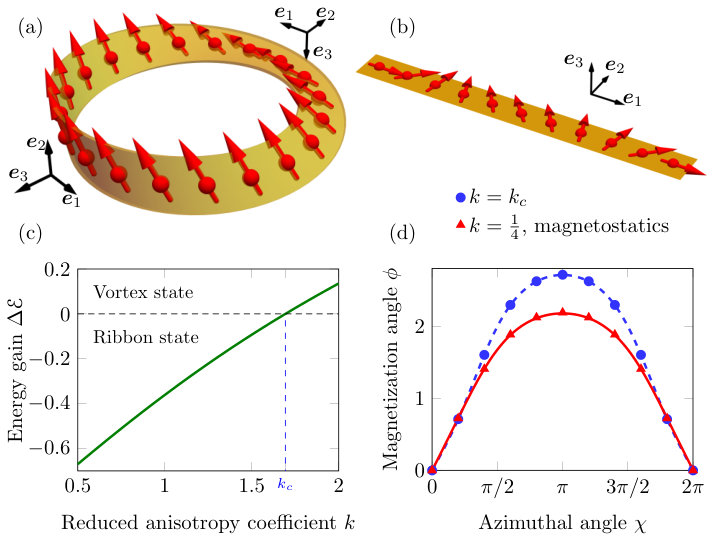 Figure 1
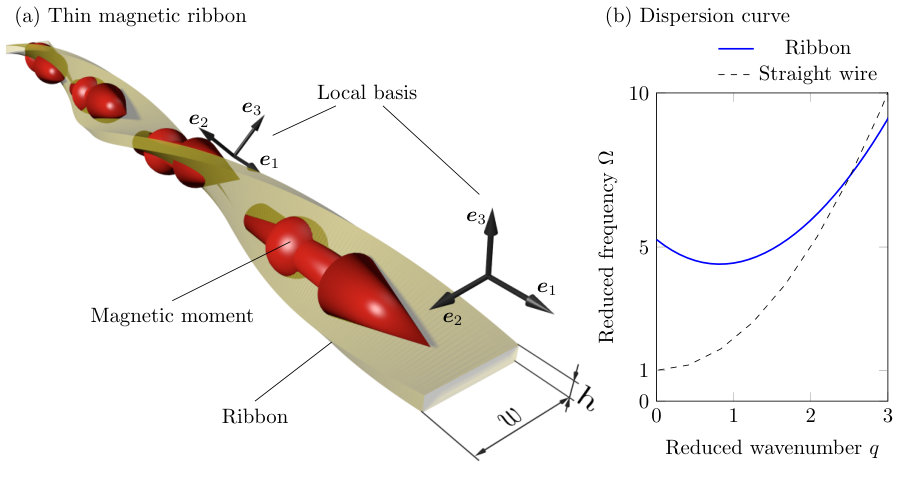 Figure 2
Peer Reviews
No public reviews on file for this paper yet. If you reviewed it on a platform where reviews are public (OpenReview, ICLR, NeurIPS, ICML), you can paste yours below so the community can read it here.
Videos
No videos yet. Explain this paper in a talk, walkthrough, or lecture? Add one.
, , , , , ,
Magnetization in narrow ribbons: curvature effects
Yuri Gaididei1, Arseni Goussev2, Volodymyr P. Kravchuk1, Oleksandr V. Pylypovskyi3, J. M. Robbins4, Denis D. Sheka3, Valeriy Slastikov4, and Sergiy Vasylkevych4
1 Bogolyubov Institute for Theoretical Physics of National Academy of Sciences of Ukraine, 03680 Kyiv, Ukraine
2 Department of Mathematics, Physics and Electrical Engineering, Northumbria University, Newcastle upon Tyne, NE1 8ST, UK
3 Taras Shevchenko National University of Kyiv, 01601 Kyiv, Ukraine
4 School of Mathematics, University of Bristol, Bristol, BS8 1TW, UK
Abstract
A ribbon is a surface swept out by a line segment turning as it moves along a central curve. For narrow magnetic ribbons, for which the length of the line segment is much less than the length of the curve, the anisotropy induced by the magnetostatic interaction is biaxial, with hard axis normal to the ribbon and easy axis along the central curve. The micromagnetic energy of a narrow ribbon reduces to that of a one-dimensional ferromagnetic wire, but with curvature, torsion and local anisotropy modified by the rate of turning. These general results are applied to two examples, namely a helicoid ribbon, for which the central curve is a straight line, and a Möbius ribbon, for which the central curve is a circle about which the line segment executes a twist. In both examples, for large positive tangential anisotropy, the ground state magnetization lies tangent to the central curve. As the tangential anisotropy is decreased, the ground state magnetization undergoes a transition, acquiring an in-surface component perpendicular to the central curve. For the helicoid ribbon, the transition occurs at vanishing anisotropy, below which the ground state is uniformly perpendicular to the central curve. The transition for the Möbius ribbon is more subtle; it occurs at a positive critical value of the anisotropy, below which the ground state is nonuniform. For the helicoid ribbon, the dispersion law for spin wave excitations about the tangential state is found to exhibit an asymmetry determined by the geometric and magnetic chiralities.
pacs:
75.70.-i, 75.75.-c, 75.10.Hk, 75.30.Et
††: J. Phys. A: Math. Gen.
Introduction
The emerging area of magnetism in curved geometries encompasses a range of fascinating geometry-induced effects in the magnetic properties of materials [1]. Theoretical investigations in this area are providing new insights into the behaviour of curved magnetic nanostructures and the control of their magnetic excitations, with applications to shapeable magnetoelectronics [2] and prospective energy-efficient data storage, among others.
In continuum models, the magnetization is represented by a three-dimensional unit-vector field . The study of curvature–induced effects in vector-field models in one- and two-dimensional geometries has a rather long history [3, 4, 5, 6]. In spite of numerous results [3, 4, 5, 6], the problem is far from being fully solved. In the majority of these studies, the vector field is taken to be tangent to the domain. In particular, a general expression for the surface energy of a tangential director field describing a nematic liquid crystal in a curvilinear shell was recently obtained [7, 8, 9, 10], with possible applications using different geometries and orientational ordering [11, 12, 13]. The assumption of a strictly tangential field was also used in a study of the role of curvature in the interaction between defects in 2D -like models, with applications to superfluids, superconductors, and liquid crystals deposited on curved surfaces [14].
Very recently a fully 3D approach was developed for thin magnetic shells and wires of arbitrary shape [15, 16]. This approach yields an energy for arbitrary curves and surfaces and for arbitrary magnetization fields under the assumption that the anisotropy greatly exceeds the dipolar interaction, so that
[TABLE]
Here is the exchange energy density and is the density of effective anisotropy interaction. We consider the model of isotropic exchange, , where with describes the cartesian components of magnetization. Therefore in cartesian coordinates, the sample geometry appears only through the anisotropy term via the spatial variation of the anisotropy axis; for example, in the case of a uniaxial curved magnet, is given by , where the unit vector determines the direction of the easy axis.
In curvilinear coordinates adapted to the sample geometry, the spatial variation of the anisotropy axes is automatically accounted for, and the anisotropy energy density assumes its usual translation-invariant form. Instead, the exchange energy acquires two additional terms, which describe contributions to due to the spatial variation of the coordinate frame [16], namely curvilinear-geometry-induced effective anisotropy and curvilinear-geometry-induced effective Dzyaloshinskii–Moriya interaction. For magnetic shells, these contributions may be expressed in terms of local curvatures [15]; for magnetic wires, in terms of curvature and torsion [16]. Below we review briefly some manifestations of these contributions, which have been reported elsewhere.
(i) Curvilinear-geometry-induced effective anisotropy. Geometry-induced anisotropy can have a significant effect on the ground-state magnetization profile, rendering it no longer strictly tangential, even in the case of strong easy-tangential anisotropy. For example, for a helical nanowire with strong anisotropy directed along the wire, the ground-state magnetization is always tilted in the local rectifying surface, with tilting angle dependent on the product of the curvature and the torsion [17, 18]. For two-dimensional geometries with nontrivial topology, a striking manifestation of geometry-induced anisotropy is shape–induced patterning. In spherical shells, a strictly in-surface magnetization is forbidden due to the hairy–ball theorem [19]. Instead, the ground-state magnetization profile has two oppositely disposed vortices [20]. Another nontrivial example is the Möbius ring. Since a Möbius ring is a nonorientable surface, its topology forces a discontinuity in any nonvanishing normal vector field. Recently we proposed that magnetic nanostructures shaped as Möbius strips possess non-volatility in their magneto-electric response due to the presence of topologically protected magnetic domain walls in materials with an out-of-plane orientation of the easy axis of magnetization [21]. In both of these examples, the link between surface topology and magnetization is a consequence of geometry–dependent anisotropy.
(ii) Curvilinear-geometry-induced effective Dzyaloshinskii–Moriya interaction. Recently, the role of curvature in domain wall pinning was elucidated [22]; a local bend in a nanowire is the source of a pinning potential for transversal domain walls. Chiral symmetry-breaking due to a geometry-induced Dzyaloshinskii–Moriya interaction strongly impacts the domain wall dynamics and allows domain wall motion under the action of different spin–torques, e.g. field–like torques [18] and anti–damping torques [23]. In the particular case of a helical nanowire, torsion can produce negative domain wall mobility [18, 23], while curvature can produce a shift in the Walker breakdown [23].
We have briefly described a theoretical framework for studying different curvilinear systems, including 1D nanowires and 2D nanoshells. In this approach we suppose that the effects of nonlocal dipole-dipole interactions can be reduced to an effective easy-surface anisotropy. In the 1D case, this reduction has been rigorously justified in the limit where the diameter of the wire is much smaller than its length [24]. Similar arguments have been provided in the 2D case for planar thin films [25] and thin shells [26] where the surface thickness is much less than the lateral size .
In the current study we consider a ribbon, which represents a curve with an infinitesimal neighbourhood of a surface along it [27]. For a narrow ribbon whose thickness is much less than its width , which in turn is much less than its length , namely , another micromagnetic limit is realized. We show that the micromagnetic energy can be reduced to the energy of a wire with modified curvature, torsion and anisotropy. We illustrate this approach with two examples, namely a narrow helicoid ribbon and a Möbius ribbon. The existence of a new nonhomogeneous ground state is predicted for the Möbius ribbon over a range of anisotropy parameter . The prediction is confirmed by full scale spin–lattice simulations. We also analyse the magnon spectrum for a narrow helicoid ribbon: unlike the magnon spectrum for a straight wire, there appears an asymmetry in the dispersion law caused by the geometric and magnetic chiralities.
The paper is organized as follows. In Section 1 we derive the micromagnetic energy for a narrow ribbon, which may be interpreted as a modification of the 1D micromagnetic energy of its central curve. We illustrate the model by two examples, a helicoid ribbon (Section 2) and a Möbius ribbon (Section 3). Concluding remarks are given in Section 4. The justification of the magnetostatic energy for ribbons and strips is presented in A. The spin-lattice simulations are detailed in B.
1 Model of narrow ribbon vs thin wire
1.1 Thin ferromagnetic wire
Here we consider a ferromagnetic wire described by a curve with fixed cross-section of area , parameterized by arc length , where is the length of the wire. It has been shown [24] that the properties of sufficiently thin ferromagnetic wires of circular (or square) cross section are described by a reduced one-dimensional energy given by a sum of exchange and local anisotropy terms,
[TABLE]
Here, denotes the unit magnetization vector, prime ′ denotes derivative with respect to , is the saturation magnetization, and is the exchange length with being the exchange constant. The local anisotropy is uniaxial, with easy axis along the tangent . The normalized anisotropy constant (or quality factor) incorporates the intrinsic crystalline anisotropy as well as a geometry-induced magnetostatic contribution,
[TABLE]
Note that the shape-induced biaxial anisotropy is caused by the asymmetry of the cross-section. In particular, for a rectangular cross-section, the anisotropy coefficients are determined by Eq. (30@@italiccorr); for elliptical cross-sections, see [24].
It is convenient to express the magnetization in terms of the Frenet-Serret frame comprised of the tangent , the normal , and the binormal . These satisfy the Frenet-Serret equations,
[TABLE]
where and are the curvature and torsion of , respectively. Letting
[TABLE]
where and are functions of (and time , if dynamics is considered), one can show [16] that the exchange and anisotropy energy densities are given by
[TABLE]
1.2 Narrow ferromagnetic ribbon
As above, let denote a three-dimensional curve parametrized by arc length. Following [27], we take a ribbon to be a two-dimensional surface swept out by a line segment centred at and perpendicular to , moving (and possibly turning) along The ribbon may parametrized as
[TABLE]
where is the width of the segment (assumed to be small enough so that has no self-intersections) and determines the orientation of the segment with respect to the normal and binormal. We construct a three-frame on the ribbon given by
[TABLE]
Here and in what follows, we use Greek letters to denote indices restricted to the ribbon surface. Using the Frenet–Serret equations (4@@italiccorr), one can show that (6@@italiccorr) constitute an orthonormal frame, with and tangent to the ribbon and normal to it. It follows that the first fundamental form (or metric), , is diagonal. The second fundamental form, , is given by . The Gauß and mean curvatures are given respectively by the determinant and trace of .
We consider a thin ferromagnetic shell about the ribbon of thickness , where
[TABLE]
The shell is comprised of points , where . We express the unit magnetization inside the shell in terms of the frame as
[TABLE]
where and are functions of the surface coordinates (and time , for dynamical problems), but are independent of the transverse coordinate . The micromagnetic energy of a thin shell reads
[TABLE]
where . The exchange energy density in (8a@@italiccorr) is given by [15, 16]
[TABLE]
where denotes a surface del operator in its curvilinear form with components , the vector is a spin connection with components , and the vector is given by ||H_{\mu\nu}||\left(\begin{array}[]{c}\cos\phi\\ \sin\phi\end{array}\right). The next term in the energy functional, , is the anisotropy energy density of the shell:
[TABLE]
where and are the tangential and normal anisotropy coefficients of the intrinsic crystalline anisotropy. The magnetostatic energy, , has, in the general case, a nonlocal form. The local form is restored in the limit of thin films [28, 29, 30] and thin shells [26, 31].
We proceed to consider the narrow-ribbon limit,
[TABLE]
Keeping leading-order terms in we obtain that the geometrical properties of ribbon are determined by
[TABLE]
In the same way, we obtain from (1.2@@italiccorr) the following:
[TABLE]
where the effective spin connection and vector are given by
[TABLE]
The last term in the energy density, , is the effective anisotropy energy density of the narrow ribbon. Using arguments similar to those in [28, 30, 26], it can be shown that
[TABLE]
Here and incorporate the intrinsic crystalline anisotropies and as well as geometry-induced magnetostatic contributions:
[TABLE]
see the justification in A. In the particular case of soft magnetic materials, where , the anisotropy is due entirely to the magnetostatic interaction. From (10d@@italiccorr), we get and .
The induced anisotropy is biaxial, with easy axis along the central curve as for a thin wire (cf (3@@italiccorr)) and hard axis normal to the surface as for a thin shell. Indeed, one can recast the narrow-ribbon energy (1.2@@italiccorr) in the form of the thin-wire energy (2@@italiccorr) with biaxial anisotropy, as follows:
[TABLE]
In (11@@italiccorr), the effective curvature and torsion are given by
[TABLE]
the angle is defined by
[TABLE]
and the effective anisotropies are given by
[TABLE]
2 Helicoid ribbon
The helicoid ribbon has a straight line, which has vanishing curvature and torsion, as its central curve. We take . The rate of turning about is constant, and we take , where the chirality is for a right-handed helicoid and for a left-handed helicoid. From (5@@italiccorr), the parametrized surface is given by
[TABLE]
The boundary curves, given by , are helices, see Fig. 1 (a). It is well known that the curvature and torsion essentially influence the spin-wave dynamics in a helix wire, acting as an effective magnetic field [17]. One can expect similar behaviour in a helicoid ribbon.
From (12@@italiccorr) and (13@@italiccorr), the effective curvature, torsion and anisotropies are given by
[TABLE]
From (11@@italiccorr), the energy density is given by
[TABLE]
Let us consider the particular case of soft magnetic materials (). Under the reasonable assumption , we see that , so that the easy-surface anisotropy dominates the energy density and acts as an in-surface constraint. Taking to accommodate this constraint, we obtain the (further) reduced energy density
[TABLE]
which depends only on the in-surface orientation . The ground states have constant, with orientation depending on the sign of the tangential-axis anisotropy . For , the ground states are
[TABLE]
where the magnetochirality determines whether the magnetisation is parallel () or antiparallel () to the helicoid axis. For , the ground states are given by
[TABLE]
where the magnetochirality determines whether the magnetisation is parallel () or antiparallel () to the normal . This behaviour is similar to that of a ferromagnetic helical wire, which was recently studied in Ref. [17].
2.1 Spin-wave spectrum in a helicoid ribbon
Let us consider spin waves in a helicoid ribbon on the tangential ground state (16@@italiccorr). We write
[TABLE]
where and with . Expanding the energy density (15@@italiccorr) to quadratic order in the and , we obtain
[TABLE]
The linearised Landau–Lifshits equations have the form of a generalized Schrödinger equation for the complex-valued function [17],
[TABLE]
where the “potentials” have the following form:
[TABLE]
We look for plane wave solutions of (17@@italiccorr) of the form
[TABLE]
where is a dimensionless wave number, is a dimensionless frequency, is an arbitrary phase, and are constant amplitudes. By substituting (19@@italiccorr) into the generalized Schrödinger equation (17@@italiccorr), we obtain
[TABLE]
see Fig. 1 (b), in which the parameters have the following values: , , , and . The dispersion relation (20@@italiccorr) for the helicoid ribbon is similar to that of a helical wire [17], but different from that of a straight wire, in that it is not reflection-symmetric in . The sign of the asymmetry is determined by the product of the helicoid chirality , which depends on the topology of the ribbon, and the magnetochirality , which depends on the topology of the magnetic structure. This asymmetry stems from the curvature-induced effective Dzyaloshinskii–Moriya interaction, which is the source of the vector potential , where . In this context, it is instructive to mention a relation between the Dzyaloshinskii–Moriya interaction and the Berry phase [32].
3 Möbius ribbon
In this section we consider a narrow Möbius ribbon. The Möbius ring was studied previously in Ref. [21]. The ground state is determined by the relationship between geometrical and magnetic parameters. The vortex configuration is favorable in the small anisotropy case, while a topologically protected domain wall is the ground state for large easy-normal anisotropy. Although the problem was studied for a wide range of parameters, the limit of a narrow ribbon was not considered previously. Below we show that the narrow Möbius ribbon exhibits a new inhomogeneous ground state, see Fig. 2 (a), (b).
The Möbius ribbon has a circle as its central curve and turns at a constant rate, making a half-twist once around the circle; it can be formed by joining the ends of a helicoid ribbon. Letting denote the radius, we use the angle instead of arc length as parameter, and set
[TABLE]
The chirality determines whether the Möbius ribbon is right- or left-handed. From (5@@italiccorr), the parametrized surface is given by
[TABLE]
Here is the azimuthal angle and is the position along the ring width. From (1.2@@italiccorr) the energy of the narrow Möbius ribbon reads , where the energy density is given by
[TABLE]
with effective anisotropies (cf (10d@@italiccorr))
[TABLE]
The effective curvature and torsion are given by (cf (12@@italiccorr))
[TABLE]
Let us consider the case of uniaxial magnetic materials, for which . Under the reasonable assumption , we have that , so that the easy-surface anisotropy dominates the energy density and acts as an in-surface constraint (as for the helicoid ribbon). Taking , we obtain the simplified energy density
[TABLE]
which depends only on the in-surface orientation . The equilibrium magnetization distribution is described by the following Euler–Lagrange equation
[TABLE]
where the antiperiodic boundary conditions compensate for the half-twist in the Möbius ribbon and ensure that the magnetisation is smooth at . The reduced anisotropy coefficient in (23@@italiccorr) reads
[TABLE]
It is easily seen that if is a solution of (23@@italiccorr), then is also a solution with the same energy. Since solutions differing by multiples of describe the same magnetisation, only corresponds to a configuration distinct from . We also note that if is a solution of (23@@italiccorr), then is also a solution with the same energy.
By inspection, and , are solutions of (23@@italiccorr); the ground states are
[TABLE]
where the magnetochirality determines whether the magnetisation is parallel or antiparallel to the circular axis. We refer to these as vortex states. Unlike the case of the helicoid ribbon, is not a solution of (23@@italiccorr). Numerically, we find two further solutions of the Euler-Lagrange equation, denoted and , which we call ribbon states. While we have not obtained analytical expressions for , good approximations can be found by assuming to be antiperiodic and odd, so that it has a Fourier-sine expansion of the form
[TABLE]
The series is rapidly converging, with the first four coefficients , , , and for , providing an approximation accurate to within 0.03% (specifically, the -norm difference between the numerically determined , as described in B, and this expansion is 0.003).
Numerical calculations indicate that the ground state of the Möbius ribbon, like the helicoid ribbon, undergoes a bifurcation as the tangential-axis anisotropy decreases. Unlike the helicoid ribbon, the bifurcation occurs for positive anisotropy given by
[TABLE]
For , the vortex state has the lowest energy, whereas for , the ribbon state has the lowest energy. The energy difference between the vortex and ribbon states,
[TABLE]
is plotted in Fig. 2(c). In some respects the ribbon state resembles an onion state in magnetic rings [33, 34, 35, 16]; in the laboratory reference frame the magnetization distribution is close to a spatially homogeneous state, see Fig. 2(a).
The in-surface magnetization angle for the ribbon state is plotted in Fig. 2(d). The plot shows good agreement between the analytic expression (25@@italiccorr) and spin–lattice SLaSi simulations (see B for details). The blue dashed line with solid circles represents the case (the critical anisotropy value). The red solid line corresponds to the solution of Eq. (23@@italiccorr) for , an effective anisotropy induced by magnetostatics. It is in a good agreement with simulations shown by red triangles where the dipole–dipole interaction is taken into account instead of easy-tangential anisotropy. The magnetization distribution for the ribbon state is shown in Fig. 2(a) (3-dimensional view) and Fig. 2(b) (an untwisted schematic of the Möbius ribbon).
Let us estimate the values of the parameters for which the ribbon state is energetically preferable. Taking into account (24@@italiccorr), we find that the ribbon state is energetically preferable provided
[TABLE]
This condition is a fortiori satisfied for the hard axial case, ie when . For soft magnetic materials the only source of anisotropy is the shape anisotropy. The ribbon state is the ground state when
[TABLE]
which imposes constraints on the geometry and material parameters.
4 Conclusion
We have studied ferromagnetic ribbons, that is magnetic materials in the shape of thin shells whose median surface is swept out by a line segment turning as it moves along a central curve. Ferromagnetic ribbons combine properties of both 1D systems, ie nanowires, and 2D systems, ie curved films and nanoshells. While the geometrical properties of a narrow ribbon are described by its central curve and the rate of turning of its transverse line segment, its magnetic properties are determined by the geometrical and magnetic properties of the ribbon surface. The micromagnetic energy of the ribbon can be reduced to the energy of a 1D system (magnetic nanowire) with effective curvature, torsion and biaxial anisotropy. While the source of effective curvature and torsion is the exchange interaction only, the biaxiality results from both exchange and magnetostatics.
We have studied two examples: (i) a narrow helicoid ribbon and ii) a narrow Möbius ribbon. The helicoid ribbon has zero effective curvature but finite torsion, which provides a paradigmatic model for studying purely torsion-induced effects. Similar to a microhelix structure [17], a geometry-induced effective Dzyaloshinskii–Moriya interaction is a source of coupling between the helicoid chirality and the magnetochirality, which essentially influences both magnetization statics and dynamics. The emergent magnetic field generated by the torsion breaks mirror symmetry, so that the properties of magnetic excitations in different spatial directions is not identical. The narrow Möbius ribbon is characterized by spatially varying effective curvature and torsion. We have predicted a new inhomogeneous ribbon state for the Möbius ribbon, which is characterized by an inhomogeneous in-surface magnetization distribution. The existence of this state has been confirmed by spin–lattice simulations.
A. G. acknowledges the support of EPSRC Grant No. EP/K024116/1.V. P. K. acknowledges the Alexander von Humboldt Foundation for the support and IFW Dresden for kind hospitality. D. D. Sh. thanks the University of Bristol, where part of this work was performed, for kind hospitality. J. M. R. and V. S. acknowledge the support of EPSRC Grant No. EP/K02390X/1.
Appendix A Magnetostatic energy of ribbons and strips
Here we justify formulae (10c@@italiccorr), (10d@@italiccorr) for the magnetostatic energy of a narrow ribbon. To this end, we calculate the magnetostatic energy of the shell of reduced width and reduced thickness in the regime
[TABLE]
and then identify the leading contributions to the energy of a ribbon in the limit of small aspect ratio
[TABLE]
For the sake of clarity, before turning our attention to the general case, we first consider a flat strip . The magnetostatic energy may be written in the form
[TABLE]
It is well known that the leading order contribution to the magnetostatic energy is coming from the interaction between the surface charges of the largest surfaces. We denote by and the pair of top and bottom surfaces of the strip (of surface area ) and by , the front and rear surfaces of the strip (of surface area ), respectively. It is straightforward to show (see e.g. [30, 24]) that
[TABLE]
where is the average of magnetization over the cross-section of area , is the surface normal, and .
We note that for an arbitrary smooth function and a constant
[TABLE]
Applying this formula and following the approach developed in [24], we can show that the main contribution to the magnetostatic energy will be coming from the term in the last integral. Therefore, we obtain
[TABLE]
By integrating over the cross-section variables, the expression (27@@italiccorr) further simplifies to
[TABLE]
Hence, the magnetostatic energy of the flat strip is
[TABLE]
Returning to the general case, we recall from (5@@italiccorr) that a ribbon may be parametrized as
[TABLE]
and consider a shell of thickness around parametrized as
[TABLE]
where are defined in (6@@italiccorr) and is small enough so that does not intersect itself. Then, introducing and , the energy of the shell up to terms of order is given by
[TABLE]
We remark that the formula (29@@italiccorr) yields the correct result both for a wire with a rectangular cross-section () and in the thin film limit (), cf. [24] and [26], respectively, however in the latter case it resolves terms beyond the leading order.
Expanding the first integral in (29@@italiccorr) in and integrating over cross-section variables, we obtain that the magnetostatic energy of the ribbon
[TABLE]
is insensitive to curvature effects, cf (28@@italiccorr). Finally, using the constrain we get the magnetostatic energy in the form (10c@@italiccorr), (10d@@italiccorr).
Appendix B Simulations
We use the in-house developed spin-lattice simulator SLaSi [36]. A chain of classical magnetic moments , , is considered. They are situated on a circle (21@@italiccorr), which defines a central axis of the narrow Möbius ribbon (22@@italiccorr), hence the periodic condition is used. The following classical Hamiltonian is used:
[TABLE]
where is the lattice constant, and are unit basis vectors (6@@italiccorr) in -th site and the coefficient is used as a switch for dipolar interactions.
To study the static magnetization distribution, we minimize the energy by solving a set of vector Landau–Lifshitz–Gilbert ordinary differential equations for sites situated on a ring of radius and using the Runge–Kutta–Fehlberg scheme (RKF45), see [37] for general description of the simulator. The equilibrium magnetization state is found starting the simulations from different initial distributions (four different random ones, uniformly magnetized states along , , and along unit vectors .
The simulations are performed using the high-performance computer clusters of the Taras Shevchenko National University of Kyiv [38] and the Bayreuth University [39].
The reference list from the paper itself. Each links out to its DOI / PubMed record.
- 1[1] Streubel R, Fischer P, Kronast F, Kravchuk V P, Sheka D D, Gaididei Y, Schmidt O G and Makarov D 2016 Journal of Physics D: Applied Physics 49 363001 URL http://stacks.iop.org/0022-3727/49/i=36/a=363001
- 2[2] Makarov D, Melzer M, Karnaushenko D and Schmidt O G 2016 Applied Physics Reviews 3 011101 URL http://dx.doi.org/10.1063/1.4938497 · doi ↗
- 3[3] Kamien R 2002 Reviews of Modern Physics 74 953–971 URL http://dx.doi.org/10.1103/Rev Mod Phys.74.953 · doi ↗
- 4[4] Nelson D, Weinberg S and Piran T 2004 Statistical Mechanics of Membranes and Surfaces (Second Edition) (Wspc) ISBN 9812387609 URL http://www.amazon.com/Statistical-Mechanics-Membranes-Surfaces-Edition/dp/9812387609%3F Subscription Id%3D 0JYN 1NVW 651KCA 56C 102%26tag%3Dtechkie-20%26link Code%3Dxm 2%26camp%3D 2025%26creative%3D 165953%26creative ASIN%3D 9812387609
- 5[5] Bowick M J and Giomi L 2009 Advances in Physics 58 449–563 URL http://www.tandfonline.com/doi/abs/10.1080/00018730903043166
- 6[6] Turner A M, Vitelli V and Nelson D R 2010 Rev. Mod. Phys. 82 1301–1348 URL http://link.aps.org/doi/10.1103/Rev Mod Phys.82.1301
- 7[7] Napoli G and Vergori L 2012 Physical Review Letters 108 207803 URL http://dx.doi.org/10.1103/Phys Rev Lett.108.207803 · doi ↗
- 8[8] Napoli G and Vergori L 2012 Physical Review E 85 061701 URL http://dx.doi.org/10.1103/Phys Rev E.85.061701 · doi ↗