Double phase transition in the triangular antiferromagnet Ba$_3$CoTa$_2$O$_9$
K. M. Ranjith, K. Brinda, U. Arjun, N. G. Hegde, and R. Nath

TL;DR
This study reports the synthesis and magnetic characterization of Ba$_3$CoTa$_2$O$_9$, revealing two successive magnetic phase transitions and a complex phase diagram indicative of rich magnetic behavior in a triangular antiferromagnet.
Contribution
The paper presents the discovery of double phase transitions and detailed magnetic phase diagram of Ba$_3$CoTa$_2$O$_9$, a new triangular lattice antiferromagnet with effective spin-1/2 Co$^{2+}$ ions.
Findings
Two successive magnetic phase transitions at 0.70 K and 0.57 K.
Field-dependent shift of transition anomalies to lower temperatures.
Disappearance of transition peaks at high fields, replaced by a broad Schottky anomaly.
Abstract
Here, we report the synthesis and magnetic properties of a new triangular lattice antiferromagnet BaCoTaO. The effective spin of Co is found to be at low temperatures due to the combined effect of crystal field and spin-orbit coupling. BaCoTaO undergoes two successive magnetic phase transitions at ~K and ~K in zero applied field, which is typical for triangular antiferromagnets with the easy-axis magnetic anisotropy. With increasing field, the transition anomalies are found to shift toward low temperatures, confirming the antiferromagnetic nature of the transitions. At higher fields, the transition peaks in the heat capacity data disappear and give way to a broad maximum, which can be ascribed to a Schottky anomaly due to the Zeeman splitting of spin levels. The phase diagram of the compound shows three…
Click any figure to enlarge with its caption.
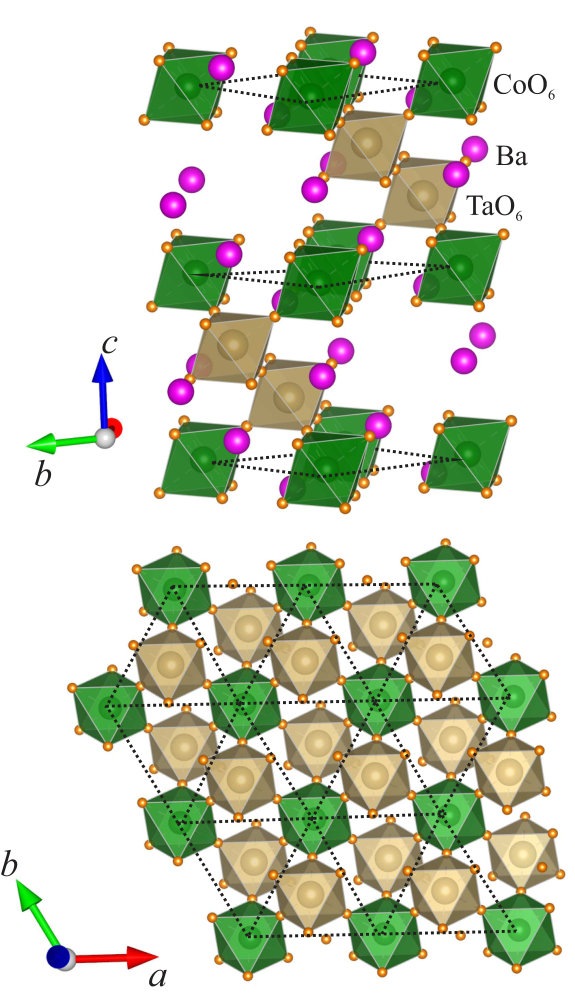 Figure 1
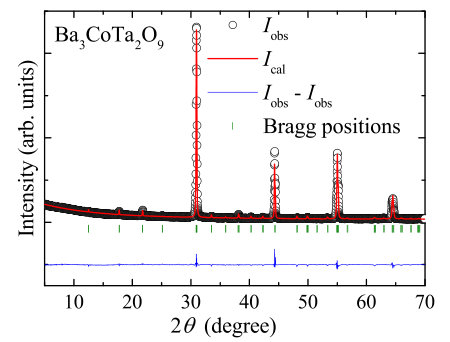 Figure 2
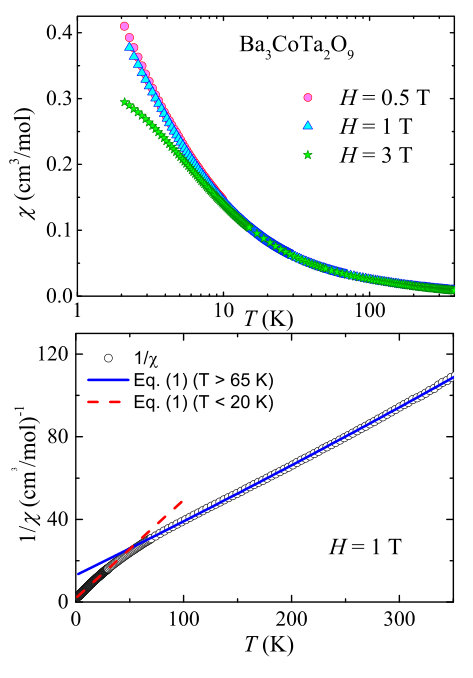 Figure 3
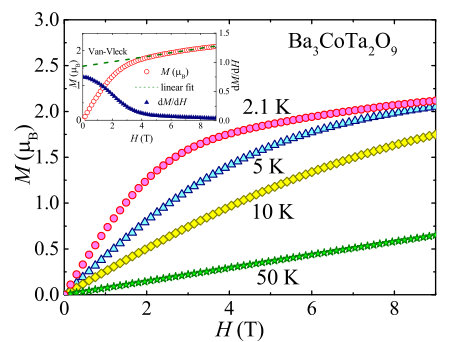 Figure 4
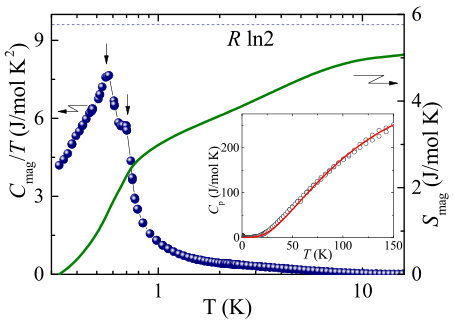 Figure 5
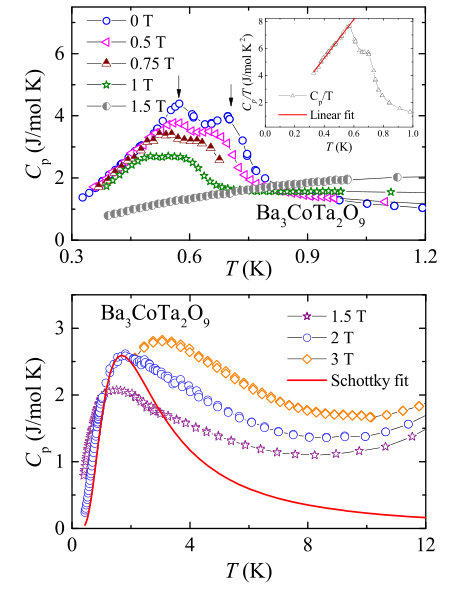 Figure 6
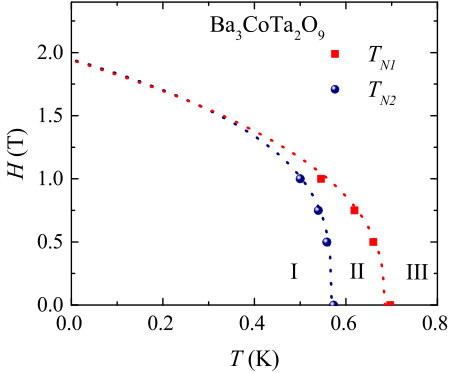 Figure 7
Peer Reviews
No public reviews on file for this paper yet. If you reviewed it on a platform where reviews are public (OpenReview, ICLR, NeurIPS, ICML), you can paste yours below so the community can read it here.
Videos
No videos yet. Explain this paper in a talk, walkthrough, or lecture? Add one.
Double phase transition in the triangular antiferromagnet Ba3CoTa2O9
K. M. Ranjith
School of Physics, Indian Institute of Science Education and Research Thiruvananthapuram-695016, India
K. Brinda
School of Physics, Indian Institute of Science Education and Research Thiruvananthapuram-695016, India
U. Arjun
School of Physics, Indian Institute of Science Education and Research Thiruvananthapuram-695016, India
N. G. Hegde
School of Physics, Indian Institute of Science Education and Research Thiruvananthapuram-695016, India
R. Nath
School of Physics, Indian Institute of Science Education and Research Thiruvananthapuram-695016, India
Abstract
Here, we report the synthesis and magnetic properties of a new triangular lattice antiferromagnet Ba3CoTa2O9. The effective spin of Co2+ is found to be at low temperatures due to the combined effect of crystal field and spin-orbit coupling. Ba3CoTa2O9 undergoes two successive magnetic phase transitions at K and K in zero applied field, which is typical for triangular antiferromagnets with the easy-axis magnetic anisotropy. With increasing field, the transition anomalies are found to shift toward low temperatures, confirming the antiferromagnetic nature of the transitions. At higher fields, the transition peaks in the heat capacity data disappear and give way to a broad maximum, which can be ascribed to a Schottky anomaly due to the Zeeman splitting of spin levels. The phase diagram of the compound shows three distinct phases. The possible nature of these phases is discussed.
pacs:
75.10.Jm, 75.30.Et, 75.30.Kz, 75.50.Ee
I Introduction
Magnetic frustration and the rich variety of phases driven by competing magnetic couplings have attracted a lot of attention in present-day condensed matter physics.Lacroix et al. (2011) Two dimensional (2D) triangular lattice antiferromagnet (TLAF) is the simplest example of a geometrically frustrated quantum system, where lattice geometry precludes simultaneous minimization of exchange interaction energy on different bonds, thus leading to a highly degenerate classical ground state.Coldea et al. (2001, 2003); Dong and Gu (2000) Quantum fluctuations, which are most pronounced in systems with reduced dimensionality and low spin values, lift the classical degeneracy and stabilize a variety of exotic phases, including quantum spin liquid (QSL),Gardner et al. (1999); Yamashita et al. (2008); Balents (2010); Yamashita et al. (2010) spin ice,Bramwell and Gingras (2001) and field-induced states manifesting themselves by plateau features in the magnetization.Misguich et al. (2001); Kodama et al. (2002) In a quasi-2D isotropic Heisenberg TLAF, the spins order antiferromagnetically in a 120*∘* structure at zero field. Under external magnetic field this 120*∘* ordered state evolves to an ‘up-up-down’ () state showing a plateau at the 1/3 of the saturation magnetization, through quantum and/or thermal fluctuations, as in the compounds Cs2CuBr4 and Ba3CoSb2O9.Ono et al. (2003); Fortune et al. (2009); Susuki et al. (2013) At very high fields, the state becomes unstable leading to canted spin states. Ground states of TLAFs are also sensitive to inter-layer coupling and exchange anisotropy which often lead to even more complex phases.Alicea et al. (2009); Coldea et al. (2003)
Recently, a family of TLAFs, BaO9 ( Co, Ni, Cu, Mn and Sb and Nb), has been studied extensively. These studies unveiled a plethora of interesting properties.Susuki et al. (2013); Zhou et al. (2012); Yokota et al. (2014); Shirata et al. (2011); Koutroulakis et al. (2015); Zhou et al. (2011); Hwang et al. (2012); Doi et al. (2004); Lee et al. (2014a, b) The compound Ba3CuSb2O9 shows features of a QSL, such as the absence of magnetic long-range ordering (LRO) down to 0.2 K despite the large Curie-Weiss temperature , and the linear temperature dependence of the heat capacity at low temperatures.Zhou et al. (2011) Owing to the octahedral crystal field and the spin-orbit coupling, the Co2+ ion in Ba3CoSb2O9 and Ba3CoNb2O9 features an effective spin at low temperatures. While Ba3CoNb2O9 shows two consecutive phase transitions, Ba3CoSb2O9 has only one transition in zero field, likely due to the easy-axis and easy-plane type anisotropies, respectively.Lee et al. (2014a); Zhou et al. (2012) Ba3CoSb2O9 is reported to display magnetization plateaus at intermediate fields below the saturation field.Susuki et al. (2013) Because of such non-trivial and exotic properties, Co2+ based TLAFs are paid a great deal of attention both experimentally and theoretically.
In this paper, we report the magnetic behavior of a new compound of this family, Ba3CoTa2O9. It crystallizes in a hexagonal structure Treiber and Kemmler-Sack (1982) with the space group . Figure 1 shows the crystal structure of Ba3CoTa2O9, which can be represented as a framework consisting of CoO6 octahedra sharing corners with dimers of TaO6 octahedra. The Co2+ ions, which occupy the site, form triangular lattices parallel to the plane (see the bottom panel of Fig. 1) and are separated by non-magnetic Ba atoms. A weak inter-layer coupling still can be envisaged via an extended Co2+-O2--Ta5+-O2--Co2+ pathway. Our magnetic measurements reveal two magnetic phase transitions at K and K with a complex phase diagram.
II Experimental details
Polycrystalline sample of Ba3CoTa2O9 was prepared by a conventional solid-state reaction technique using BaCO3 (99.999%, Aldrich), CoO (99.99%, Aldrich), and Ta2O5 (99.99%, Aldrich) as starting materials. Stoichiometric mixture of the starting materials was intimately ground, pressed into pellets, and fired at 900C for 8 hours and then at 1200C for 48 hours in air with intermediate grindings and pelletizations. Phase purity of the sample was confirmed by recording powder x-ray diffraction (XRD) pattern using the PANalytical powder diffractometer (CuKα radiation, = 1.5406 Å) at room temperature. Le-bail fit of the observed XRD pattern was performed using FULLPROF package Rodríguez-Carvajal (1993) for which the initial parameters were taken from Ref. Treiber and Kemmler-Sack, 1982.
Figure 2 shows the room temperature powder XRD pattern for Ba3CoTa2O9 along with its Le-bail fit. All the peaks in the XRD pattern could be indexed based on the space group (No. 164). The lattice parameters obtained from the Le-bail fit [ Å and Å] are comparable to the previous report [ Å and Å].Treiber and Kemmler-Sack (1982) The goodness of fit parameter was obtained to be .
Magnetization () measurements were performed as a function of temperature and applied field using vibrating sample magnetometer (VSM) attachment to the physical property measurement system (PPMS, Quantum Design). Heat capacity as a function of and was measured on a pressed pellet using the relaxation technique in a PPMS. The low temperature ( K) measurements were carried out using an additional 3He attachment.
III Results and Discussion
III.1 Magnetization
Temperature-dependent magnetic susceptibility measured at applied fields of T, 1 T, and 3 T are shown in the upper panel of Fig. 3. With decreasing , increases in a Curie-Weiss (CW) manner as expected in the paramagnetic regime. No indication of a magnetic LRO was observed down to 2 K. As shown in the lower panel of Fig. 3, varies linearly with in the high- regime and a change of slope is observed at low temperatures. In order to extract the magnetic parameters, measured at T in the high- regime was fitted by the following expression:
[TABLE]
where is the temperature-independent contribution consisting of core diamagnetism of the core electron shells () and Van-Vleck paramagnetism () of the open shells of the Co2+ ions present in the sample. The second term in Eq. (1) is the CW law with the CW temperature () and Curie constant , where is Avogadro’s number, is Boltzmann constant, is the effective magnetic moment, is the Land -factor, and is the spin quantum number.
Our CW fit in the high-temperature range ( K) yields cm3/mol, cm3K/mol, and K. From this value of , the effective moment was calculated to be /Co. This value of is close to the value of [] expected for the high-spin state () of Co2+ taking , obtained from the magnetization data (discussed later).
Since a change in slope was observed at low temperatures for , the data were fitted separately using Eq. (1) for K, which yields cm3/mol, cm3K/mol, and K. From this value of , the effective moment was calculated to be /Co, which is reminiscent of an effective state with the same (the value of would be expected). The reduction in upon cooling is indeed expected for Co2+ in the octahedral environment, because spin-orbit coupling splits the lowest orbital triplet into six Kramers doublets. When the temperature is low enough such that , magnetic behavior is determined by the lowest Kramers doublet with , where stands for the full angular momentum, as opposed to the spin angular momentum . In Co2+ compounds, K Shirata et al. (2012) and hence at low temperatures Ba3CoTa2O9 is expected to produce an effective spin-1/2 behavior. The effective spin- ground state is also reported for other TLAFs with the octahedral coordinates Co2+ sites, such as Ba3CoO9 ( = Sb, Nb) Doi et al. (2004); Lee et al. (2014a) and Co ( = Cs, Rb and = Cl, Br).Collins and Petrenko (1997)
In order to obtain further insight into the ground-state properties, we measured isotherms at different temperatures K, 5 K, 10 K, and 50 K, as shown in Fig. 4. At higher temperatures (K), varies almost linearly with , as expected for AFM materials with a large exchange coupling. For K, it develops a curvature, which is more pronounced at low temperatures. At K, the Co2+ spins saturate at T, above which increases linearly, but with a much smaller slope.
The inset of Fig. 4 shows the magnetic isotherm ( vs ) and its derivative vs at K in the left and right axes, respectively. The derivative shows a gradual change of slope with increasing field, and above T the change is almost negligible suggesting that the saturation field is close to 3 T. This small value of is comparable to that reported for Ba3CoNb2O9 Yokota et al. (2014) but much smaller than T in Ba3CoSb2O9.Susuki et al. (2013) Above , there is a slow linear increase in , usually attributed to the temperature-independent Van-Vleck paramagnetic contribution, typical for a Co2+ ion in an octahedral environment.Oguchi (1965); Lines (1963) Similar scenario is also reported for Ba3CoNb2O9 and Ba3CoSb2O9.Yokota et al. (2014); Shirata et al. (2012); Susuki et al. (2013) A linear fit of the data above gives a slope of T, which corresponds to the Van-Vleck susceptibility cm3/mol. This is in close agreement with the value cm3/mol reported for the TLAF compound Ba3CoNb2O9.Yokota et al. (2014) From the intercept of the linear fit above on the axis, the saturation magnetization was obtained as . This value of () corresponds to an average value of for , and the deviation from the free-electron -value of 2.0 is due to the spin-orbit coupling. Such a large value of is also reported for Ba3CoNb2O9 and Ba3CoSb2O9 Yokota et al. (2014); Susuki et al. (2013). The high and anisotropic -values are expected for Co2+ compounds in the octahedral environment due to the large orbital contribution.Carlin (1986) The ESR experiment on the analogous compound Ba3CoSb2O9 indeed reports the high values of (for ) and (for ).Susuki et al. (2013)
In contrast to Ba3CoNb2O9 and Ba3CoSb2O9, the anomaly in the vs curve at T is not very sharp.Yokota et al. (2014); Susuki et al. (2013) The shape of this anomaly depends on various factors such as the -tensor anisotropy. In powder samples, this anisotropy smears the anomaly out. Therefore, the fact that our vs curve does not show any sharp anomaly at is possibly indicating at an anisotropic -value.
III.2 Heat capacity
Heat capacity for magnetic insulators has two major contributions: phononic () and magnetic () parts. At high temperatures, is mainly dominated by , while at low temperatures it is mostly of magnetic origin. In order to estimate the phonon part of the heat capacity, the data at high temperature were fitted by the sum of Debye functions
[TABLE]
where are the characteristic Debye temperatures and are the integer coefficients indicating the contributions of different atoms (or group of atoms) to . Similar procedure has been adopted in various other compounds to estimate the phonon contribution.Nath et al. (2008); Ahmed et al. (2015) The inset of Fig. 5 shows data as a function of in zero applied field and the fit (solid line) by Eq. (2) with , , , and . Here, , , , and represent the number of Ba, Co, Ta, and O atoms per formula unit, respectively. The sum of equals to 15, which is the number of atoms per formula unit. Because of the large differences in the atomic masses, we used three different Debye temperatures: for Ba3+ and Ta3+, for Co2+, and for O2-. Finally, the high- fit was extrapolated down to 2 K and was estimated by subtracting from . is plotted as a function of in Fig. 5.
To cross-check the reliability of the fitting procedure, we calculated the total magnetic entropy by integrating between 2.1 K and high temperatures as
[TABLE]
The obtained is plotted on the right axis of Fig. 5. It reaches the value of J/mol K at around 16 K. This value is only slightly smaller than the expected theoretical value [] of 5.76 J/mol K for . This indeed is a strong evidence for the formation of the state at low temperatures.
The measured at different applied fields from 0 T to 1.5 T in the low temperature regime is shown in the upper panel of Fig. 6. In zero field, it exhibits two anomalies suggesting two successive magnetic transitions at K and K. Below , the data were fitted using a power law with the exponent (inset of the upper panel of Fig. 6). A quadratic temperature dependence of in the ordered state is expected for 2D lattices.Nakatsuji et al. (2005) With increasing field, the transition peaks get smeared and shift towards lower temperatures before they completely disappear at T. With increasing field, a broad feature appears at about K for T, which can be identified as the Schottky anomaly arising due to the Zeeman splitting of the energy levels at low temperatures (lower panel of Fig. 6). As the field increases, the Schottky anomaly is observed to shift towards higher temperatures. It is to be noted that, although the peak positions and their heights at the magnetic transition as well as Schottky anomaly regimes are changing with magnetic field, the value of at 16 K remains close to 5.76 J/mol K, irrespective of the magnitude of the applied field. For T, a theoretical curve was simulated using the Schottky expression,
[TABLE]
This expression represents the Schottky specific heat due to the Zeeman splitting of the state without exchange interactions between the spins. As shown in Fig. 6, the low temperature data match well with the simulated curve with , further confirming the large value of inferred from the magnetization measurements. The deviations between the simulated curve and experimental data at higher temperatures are attributed to the phonon contribution of the heat capacity.
IV Discussion
Ba3CoTa2O9 shows two successive magnetic phase transitions at low temperatures. It has been theoretically predicted that double magnetic transitions can occur in TLAFs when the magnetic anisotropy is of the easy-axis type, while a single transition is expected for easy-plane type anisotropy.Matsubara (1982); Miyashita and Kawamura (1985) In TLAFs with the easy-axis anisotropy, the 120∘ state is often preceded by a collinear state. Our zero-field measurements show two transitions that can be thus associated with the collinear state below and the 120*∘* state below . The putative easy-axis anisotropy in Ba3CoTa2O9 is similar to that reported for other TLAFs, Ba3CoNb2O9, RbMn(MoO4)3, CsMnI3, and CsNiCl3.Yokota et al. (2014); Ishii et al. (2011); Harrison et al. (1991); Ajiro et al. (1990); Clark and Moulton (1972); Kadowaki et al. (1987) The temperature range of the intermediate phase can be used to obtain ()/ that roughly quantifies the size of the easy-axis anisotropy with respect to the intra-layer exchange coupling. The narrow intermediate phase () seen in Ba3CoTa2O9 suggests that the easy-axis anisotropy is significantly smaller than the intra-layer coupling.
The phase diagram derived from the field-dependent measurements is shown in Fig. 7. It exhibits three distinct phases denoted by I, II, and III. Region III corresponds to the paramagnetic phase, while regions II and I are expected to be the collinear and 120∘ spin states, respectively, in line with the theoretical predictions and the subsequent experimental realizations in Ba3CoNb2O9 and RbMn(MoO4)3.Yokota et al. (2014); Ishii et al. (2011); Chubukov and Golosov (1991); Kawamura and Miyashita (1985)
The data points in Fig. 7 are fitted by a power law,
[TABLE]
where the critical field , , and critical exponent are the fitting parameters. The value reflects the universality class and dimensionality of the spin system. The values obtained for are consistent with the transition temperatures at zero applied field and the value of (for ) and 0.38 (for ) are close to the value of predicted by the mean-field theory for three dimensional (3D) spin systems.Nath et al. (2009)
V Conclusion
Magnetic properties of the triangular antiferromagnet Ba3CoTa2O9 were investigated. At low temperatures, it undergoes two successive AFM transitions at K and K with a narrow intermediate phase, which is due to weak easy-axis magnetic anisotropy. Co2+ adopts the state at low temperatures, whereas at higher temperatures the state is observed. The magnetization saturates already at T suggesting weak magnetic interactions in the system. The phase diagram deduced from the heat capacity measurements shows three distinct phases. The above peculiar features render Ba3CoTa2O9 a model TLAF compound for further experimental and theoretical studies.
Acknowledgements.
We thank Alexander Tsirlin for fruitful discussions.
The reference list from the paper itself. Each links out to its DOI / PubMed record.
- 1Lacroix et al. (2011) C. Lacroix, P. Mendels, and F. Mila, Introduction to Frustrated Magnetism: Materials, Experiments, Theory , Springer Series in Solid-State Sciences (Springer, Berlin, 2011), ISBN 9783642105890.
- 2Coldea et al. (2001) R. Coldea, D. A. Tennant, A. M. Tsvelik, and Z. Tylczynski, Phys. Rev. Lett. 86 , 1335 (2001).
- 3Coldea et al. (2003) R. Coldea, D. A. Tennant, and Z. Tylczynski, Phys. Rev. B 68 , 134424 (2003).
- 4Dong and Gu (2000) Z.-H. Dong and S.-W. Gu, J. Phys.: Condens. Matter 12 , 2819 (2000).
- 5Gardner et al. (1999) J. S. Gardner, S. R. Dunsiger, B. D. Gaulin, M. J. P. Gingras, J. E. Greedan, R. F. Kiefl, M. D. Lumsden, W. A. Mac Farlane, N. P. Raju, J. E. Sonier, et al., Phys. Rev. Lett. 82 , 1012 (1999).
- 6Yamashita et al. (2008) S. Yamashita, Y. Nakazawa, M. Oguni, Y. Oshima, H. Nojiri, Y. Shimizu, K. Miyagawa, and K. Kanoda, Nat. Phys. 4 , 459 (2008).
- 7Balents (2010) L. Balents, Nature(London) 464 , 199 (2010).
- 8Yamashita et al. (2010) M. Yamashita, N. Nakata, Y. Senshu, M. Nagata, H. M. Yamamoto, R. Kato, T. Shibauchi, and Y. Matsuda, Science 328 , 1246 (2010).