An ecological assessment of the pandemic threat of Zika virus
Colin J. Carlson, Eric R. Dougherty, Wayne Getz

TL;DR
This paper assesses the potential global spread of Zika virus by modeling its ecological niche and comparing it to dengue fever, suggesting it is more limited by climate and unlikely to spread as widely as its mosquito vectors.
Contribution
The paper introduces the first spatially explicit global dataset of Zika virus occurrences and models its ecological niche.
Findings
Zika virus is more constrained by precipitation and temperature seasonality than dengue fever.
Zika is unlikely to spread as widely as its mosquito vectors under current conditions.
Climate change may allow northward expansion of Zika, but not full vector range.
Abstract
The current outbreak of Zika virus poses a threat of unknown magnitude to human health1. While the range of the virus has been cataloged growing slowly over the last 50 years, the recent explosive expansion in the Americas indicates that the full potential distribution of Zika remains uncertain2-4. Moreover, most current epidemiology relies on its similarities to dengue fever, a phylogenetically closely related disease of unknown similarity in spatial range or ecological niche5,6. Here we compile the first spatially explicit global occurrence dataset from Zika viral surveillance and serological surveys, and construct ecological niche models to test basic hypotheses about its spread and potential establishment. The hypothesis that the outbreak of cases in Mexico and North America are anomalous and outside the ecological niche of the disease, and may be linked to El Nino or similar…
Genes, proteins, chemicals, diseases, species, mutations and cell lines named across the full text — each resolved to its canonical identifier and authoritative record.
Click any figure to enlarge with its caption.
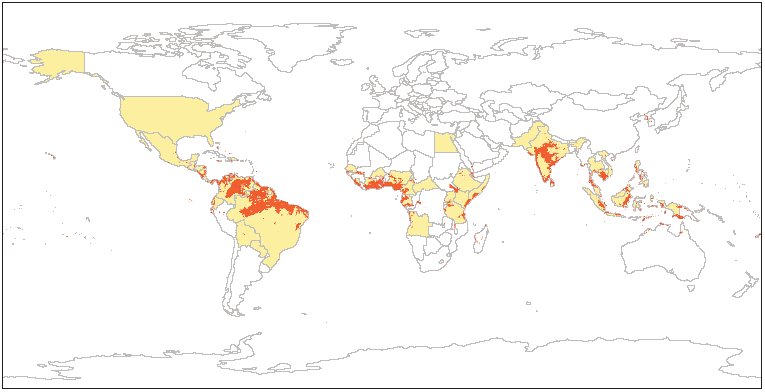 Figure 1
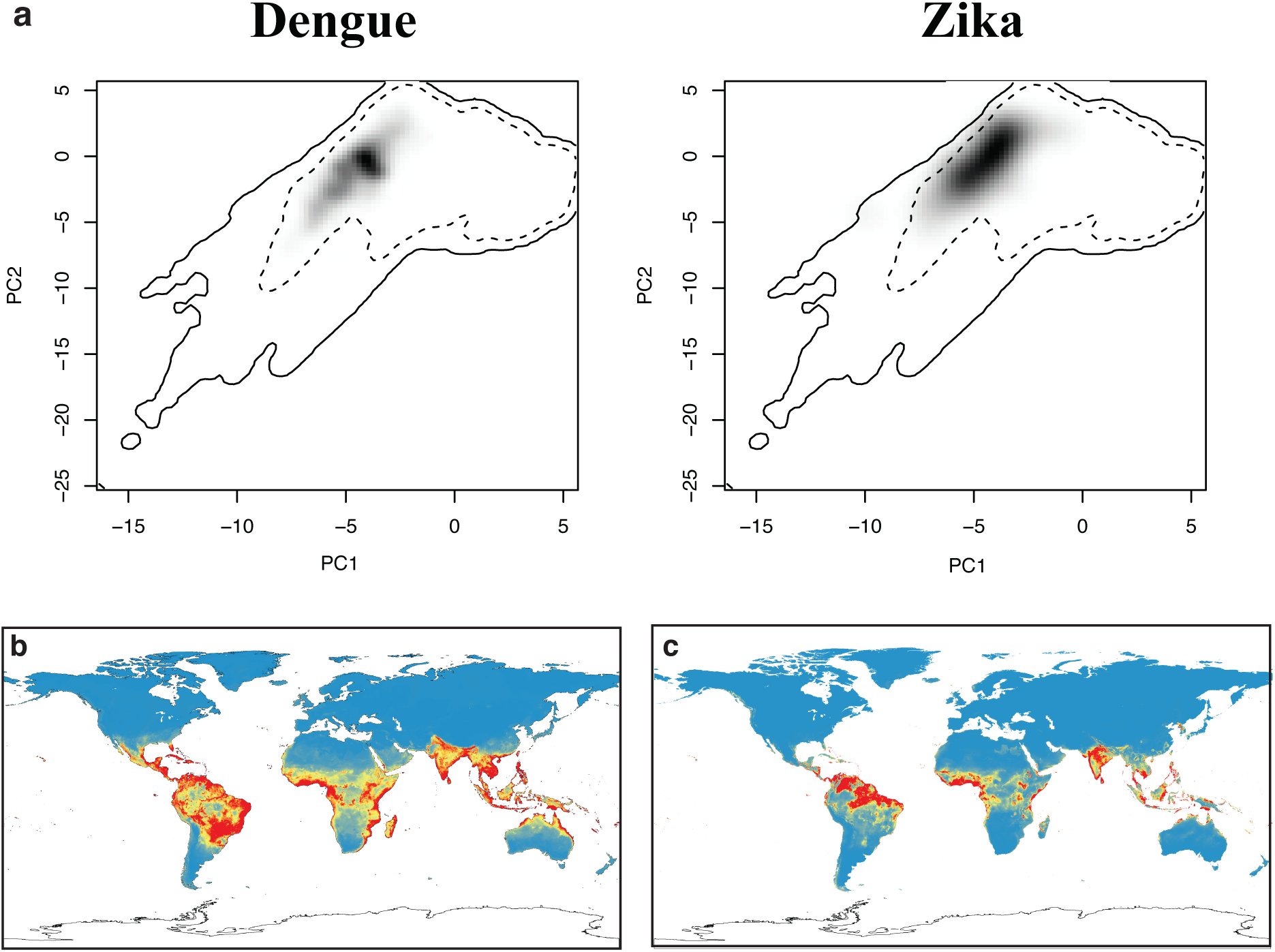 Figure 2
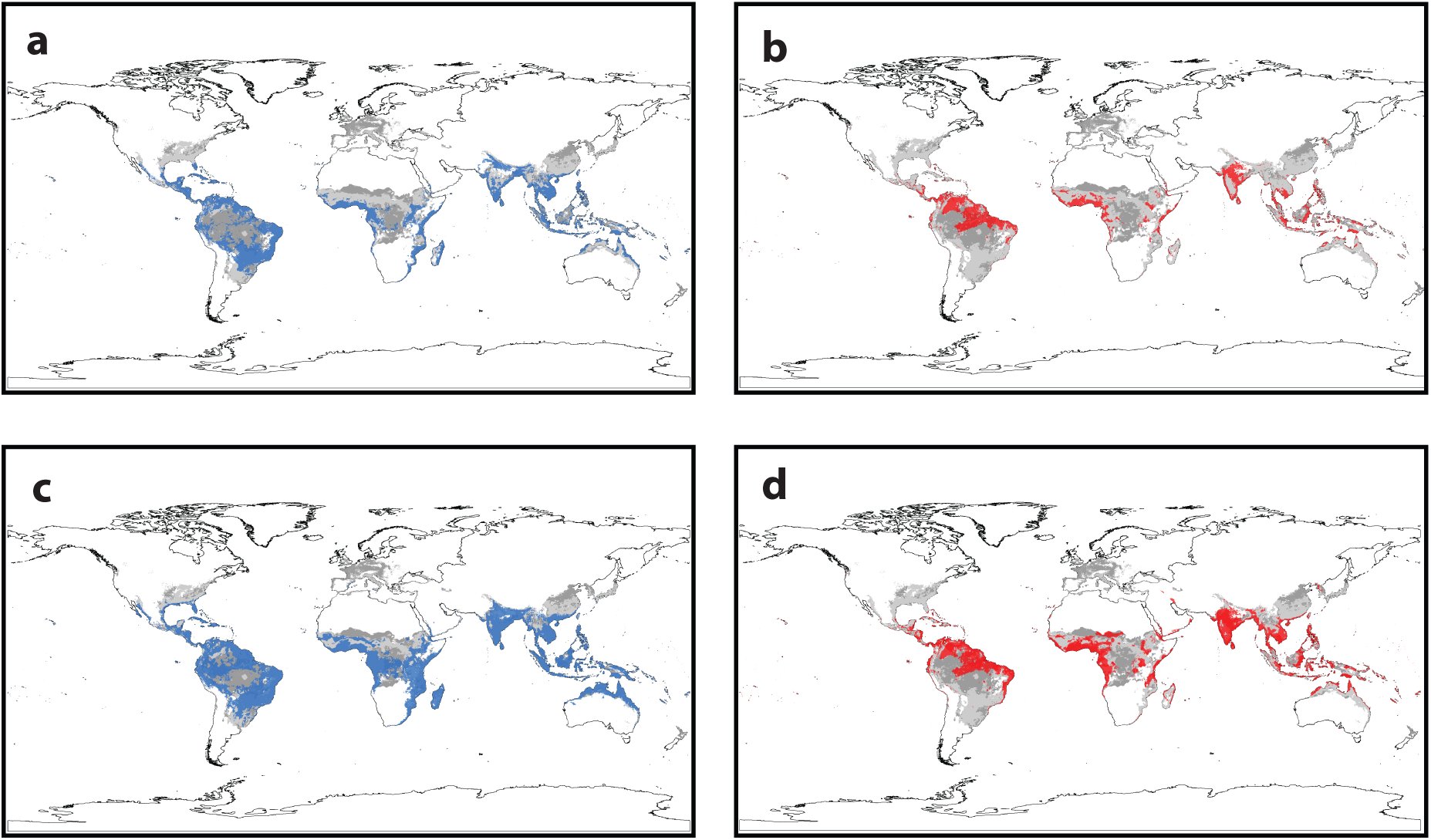 Figure 3
Peer Reviews
No public reviews on file for this paper yet. If you reviewed it on a platform where reviews are public (OpenReview, ICLR, NeurIPS, ICML), you can paste yours below so the community can read it here.
Videos
No videos yet. Explain this paper in a talk, walkthrough, or lecture? Add one.
Taxonomy
TopicsMosquito-borne diseases and control · Viral Infections and Vectors · Zoonotic diseases and public health
Main Text
Following a twenty-fold upsurge in microcephalic newborns in Brazil tentatively linked to Zika virus (ZIKV), the World Health Organization has declared an international health emergency^1^. Despite being profiled for the first time in 1947^8^, Zika remains poorly characterized at a global scale. Thus, the present pandemic expansion in the Americas poses a threat of currently unknown magnitude. Closely related to dengue fever, Zika conventionally presents as a mild infection, with 80% of cases estimated to be asymptomatic^9^. The cryptic nature of infection has resulted in sporadic documentation of the disease and rarely includes spatially explicit information beyond the regional scale^1-4^. This greatly limits the confidence with which statistical inferences can be made about the expansion of the virus. With an estimated 440,000-1,300,000 cases in Brazil in 2015^9^, and continuing emergence of new cases in Central America and, most recently, the United States, assessing the full pandemic potential of the virus is an urgent task with major ramifications for global health policy.
Current evidence portrays the global spread of ZIKV as a basic diffusion process facilitated by human and mosquito movement, a hypothesis supported by the frequency of infected traveler case studies in the Zika literature^10-13^. Tracing phylogenetic and epidemiological data has revealed the expansion of ZIKV has occurred in a stepwise process through the South Pacific, moving the disease from Southeast Asia into French Polynesia and the Philippines, and subsequently to Easter Island^1-4^. ZIKV is conjectured to have dispersed into South America as recently as three years ago from the last of those locations, and the virus is not presumed to be at a biogeographic equilibrium in the Americas. With cases in the ongoing outbreak in Colombia, El Salvador, Guatemala, Paraguay, and Venezuela, and by November of last year, as far north as Mexico, Puerto Rico, and the continental United States, the full potential distribution of the disease remains unknown. Moreover, alternative explanations for the disease’s expansion remain unconsidered; most notably, the role of climate change in Zika’s expansion is uncertain^7^.
We present three competing hypotheses that describe the path of expansion that Zika could take, based on evaluations of the ecological niche of the virus within and outside of its vectors. If the Zika niche is indistinguishable from that of its Aedes vectors (as is essentially the case for dengue fever^14^), future range expansions should match mosquito ranges. On the other hand, if Zika has a transmission niche that is constrained by climatic factors within the ranges of its mosquito vectors, its range may be much more limited—with, as we show below, possible confinement to the tropics. In this case, the expansion of Zika into North America represents one of two hypothesized processes: a steady range expansion driven by climatic shifts, or an anomalous event driven by human dispersal or extreme weather events. To test these hypotheses, we present the first spatially explicit database of Zika occurrences from the literature and an ecological niche model^15^ using that data to map the potential distribution of the virus.
Our dataset includes 64 of the known occurrences of the disease – a combination of clinical cases and seropositivity surveys in humans and mosquitoes. Of these, 60 points from outside the current outbreak are used in our model to determine the expected distribution in the Americas based on the niche in areas where the virus is established (rather than potentially transient). Spanning seven decades, these data have not previously been compiled nor explicitly geo-referenced, and emergency modeling efforts for diseases of special concern often work from limited data. Previously published sensitivity analyses unequivocally suggest that accuracy of the modeling methods we employ plateaus at or near 50 points, justifying the use of a dataset of this size^16-18^. Ensemble modeling also vastly improves the predictive power with datasets of this sort (Extended Data Fig. 1-5), and reduces the associated error. Our final model combines seven methods with a variable set chosen from bioclimatic variables and a vegetation index to minimize predictor covariance. The ensemble model performs very well (AUC = 0.993; Fig. 1), and strongly matches most occurrences including the hotspots of Brazilian microcephaly. It also predicts additional regions where Zika is as yet unrecorded, but where further inquiry may be desired (in particular, Southern Sudan and the northern coast of Australia). Our model indicates that certain occurrences, like the 1954 report from Egypt and almost all North American cases, are likely outside the stable transmission niche^19^ (i.e., persistent over time) of the virus. Moreover, we note that visual presentation of cases at the country level may make the range of the virus appear far larger than our models suggest (see Fig. 1). Projecting niche models to the year 2050 suggests that expansion of Zika’s niche outside the tropics is an unlikely scenario, independent of vector availability (Fig. 2d). However, significant westward expansion in South America and eastward expansion in Africa implies that Zika may continue to emerge in the tropics.
The global distribution of case reports of Zika virus (1947 to February 2016) broken down by country (blue shading) and an ensemble niche model built from occurrence data (red shading). Our model predicts occurrence in part of every shaded country; it is clear that displaying cases at country resolution overstates the distribution of the virus, especially in the Americas (for example, Alaska).
The ecological niche of Zika and dengue in principal component space (a). Solid and dashed lines are 100%/50% boundaries for all environmental data Despite apparent overlap in environmental niche space, the dissimilarity between the black shading in each principal component graph indicates statistically significant differences between the niches, evident in the projections of our niche models for dengue (b) and Zika (c).
Given the public health crisis posed by Zika, and the potential costs associated with underpredicting the extent of the current outbreak, we pay special attention to evaluating the sensitivity of our models to variations in our preliminary dataset. Geographical data on cases in the Americas are lacking, and the routes and drivers of transmission involved in that outbreak are uncertain, preventing cross validation of models of the current outbreak with our Old World model. But, in light evidence that African and Asian strains of the virus may be ecologically distinct, we present models trained on each continent and projected globally, as a basic sensitivity analysis (Extended Data Fig. 7). The two models cross-validate poorly; driven by both the 50% reduction in sample size and the higher degree of aggregation of Asian occurrences, the two projected distributions are severely different. But despite the major over-prediction of the Asian model and the overfitting of the African model, we emphasize that neither extreme scenario predicts any greater range in the Americas. Moreover, despite low transferability between continents, both sub-models are well matched by our aggregated model in their native range, further supporting the accuracy and predictive power of our global projection.
Recently published work by Bogoch et al.^6^ uses an ecological niche model for dengue as a proxy for the potential full distribution of ZIKV in the Americas, presenting findings in terms of potential seasonal vs. full-year transmission zones. While that approach has been effectively validated for dengue transmission in mosquitoes, using a model of one disease to represent the potential distribution of another emerging pathogen is only a placeholder, and is particularly concerning given the lack of evidence in our models that ZIKV and dengue have a similar niche breadth^20^. To evaluate the similarity of Zika and dengue, we built another niche model using the dengue occurrence database compiled by Messina et al.^21^. Comparing the two niche models reveals that the two niches are significantly different (Schoener’s D = 0.256; p < 0.02; Extended Data Fig. 6). While the two occupy a similar region of global climate space, Zika is more strictly tropical than dengue, occupying regions with higher diurnal temperature fluctuations and seasonality of precipitation (Fig. 2a). Moreover, our future projections for dengue (which strongly agree with previously published ones^22^) show an expansion out of the tropics that is not shared with Zika (Fig. 2, 3). These results call into question the applicability of dengue niche models used to project a significant future range for Zika in North America^6^.
The estimated distribution of Zika (red) and dengue (blue) based on current (a, b) and 2050 climate projections (c, d), compared against the current (light grey) and future distribution of all three mosquito vectors (a-d).
Given the ecological nonequivalence of Zika and dengue, and the occurrence of Zika cases outside our predicted suitable range for the virus, the 2016 Zika outbreak may be in ephemeral rather than stable parts of the Zika transmission niche due to anomalous climatic conditions. Specifically, El Niño Southern Oscillation (ENSO) events drive outbreaks of dengue in the Americas and in Southeast Asia^23^, and we conjecture that the 2016 ENSO event may be responsible in large part for the severity of the ZIKV outbreak in North and Central America, a hypothesis also raised by Paz et al.^7^ in response to Bogoch et al.^6^. While wind-dispersed mosquitoes carrying infections can be responsible for the introduction of diseases to new regions^24^, reported cases in the United States have all been contracted sexually or while traveling abroad to regions with endemic outbreaks, further supporting the tropical constraint hypothesis. However, the rapid expansion during the current outbreak beyond the boundaries of the stable transmission niche indicates that regions outside our modeled range may support transmission during anomalous periods of climatic flux, but will not necessarily enable naturalization of the pathogen in the future. This highlights one of the most important limitations of this work, as ecological niche models relate occurrence to climate, while disease drivers may operate at the temporal scale of weather.
While the potential for rare, weather-driven outbreaks should not be overlooked, our models imply that it is premature to expect Zika naturalization as an eventuality in North America. Without more definitive information on the basic biology of Zika, however, the confidence with which niche models can forecast pandemics is limited. In particular, we draw attention to recent evidence suggesting Zika persistence may depend on wildlife reservoirs in addition to human hosts and mosquitoes. Primates have been suggested as the primary candidate clade, because the Zika flavivirus was first isolated in a rhesus macaque in the Zika Forest in Uganda. But as rhesus macaques do not occur on the African continent, and were captive there for inoculation experiments, the primate reservoir hypothesis remains unsupported. A 2015 case of an Australian presumed to have contracted Zika from a monkey bite while traveling in Indonesia, however, indicates that primates may transmit the virus directly^12^. Additionally, antibodies against Zika have been observed in several rodent and livestock species in Pakistan^25^, as well as several large mammal species, including orangutans, zebras, and elephants^26^. The potential for any North American wildlife species to play host to Zika is, at the present time, entirely unknown, and the infection of alternate hosts could potentially support new regions of stable transmission.
From the limited data in existence, we conclude that the global threat of a specifically vector-borne Zika pandemic, though devastating, may be limited to the tropics. However, sexual transmission of Zika infections may still facilitate a significant outbreak in the United States and other previously unsuitable regions, particular under evolutionary processes that select for the most directly transmissible strains of pathogens^27^. A case of sexual transmission in Texas has been suspected in the 2016 outbreak, and two previous reports of likely sexual transmission of ZIKV originate from 2011 and 2015^3,28^, though these seem to have been overlooked in most press coverage, which has presented the case of sexual transmission in Texas as a novel facet to the disease. Even if the Zika cases in the United States represent a rare spillover outside of the mosquito-borne viral niche, sexual transmission could create a new, unbounded niche in which the virus could spread. We draw attention to the potential parallels with simian and human immunodeficiency virus (SIV/HIV), for which a sexually transmitted pandemic has overshadowed the zoonotic origin of the disease^29^. With Zika’s asymptomatic presentation and the overall confusion surrounding its basic biology and transmission modes, we caution that its potential for a sexually-transmitted global pandemic cannot be overlooked in the coming months.
Supplementary Information
Supplementary Information is linked to the online version of the paper at www.nature.com/nature.
The reference list from the paper itself. Each links out to its DOI / PubMed record.
- 1Attar, N. Zika virus circulates in new regions. Nature Rev. Microbiol. 14, 62 (2016).
- 2Musso, D., Nilles, E.J. & Cao-Lormeau, V.M. Rapid spread of emerging Zika virus in the Pacific Area. Clin. Microbiol. Infec. 20, O 595–O 596 (2014).
- 3Musso, D., Cao-Lormeau, V.M., & Gubler, D.J. Zika virus: following the path of dengue and chikungunya? Lancet 386, 243–244 (2015).
- 4Gatherer, D. Zika virus: a previously slow pandemic spreads rapidly through the Americas? J. Gen. Virol., in press.
- 5Kelser, E.A. Meet dengue’s cousin, Zika. Microbes Infect., in press
- 6Bogoch, I.I., et al. Anticipating the international spread of Zika virus from Brazil. Lancet 387, 335–336 (2016).
- 7Paz, S. & Semenza, J.C. El Niño and climate change–contributing factors in the dispersal of Zika virus in the Americas? Lancet, in press.
- 8Dick, G.W.A., Kitchen, S.F. & Haddow, A.J. Zika virus (I). Isolations and serological specificity. Trans. R. Soc. Trop. Med. Hyg. 46, 509–520 (1952).