Analysis of Two-State Folding Using Parabolic Approximation IV: Non-Arrhenius Kinetics of FBP28 WW Part-II
Robert S. Sade

TL;DR
This paper explains how protein folding rates can deviate from Arrhenius behavior by modeling folding and unfolding processes using energy wells and solvent effects.
Contribution
The paper introduces a novel model using harmonic Gibbs energy wells to explain non-Arrhenius kinetics in two-state protein folding.
Findings
Folding rate is maximized when heat from interactions balances desolvation heat.
Unfolding rate is minimized when heat to break interactions balances hydration heat.
Cold denaturation is driven by solvent effects, while heat denaturation is due to chain effects.
Abstract
A model which treats the denatured and the native conformers as being confined to harmonic Gibbs energy wells has been used to rationalize the physical basis for the non-Arrhenius behaviour of spontaneously-folding fixed two-state systems. It is shown that at constant pressure and solvent conditions: (i) the rate constant for folding will be a maximum when the heat released upon formation of net molecular interactions is exactly compensated by the heat absorbed to desolvate net polar and non-polar solvent accessible surface area (SASA), as the denatured conformers driven by thermal noise bury their SASA and diffuse on the Gibbs energy surface to reach the activated state; (ii) the rate constant for unfolding will be a minimum when the heat absorbed by the native conformers to break various net backbone and sidechain interactions is exactly compensated by the heat of hydration released…
Genes, proteins, chemicals, diseases, species, mutations and cell lines named across the full text — each resolved to its canonical identifier and authoritative record.
Click any figure to enlarge with its caption.
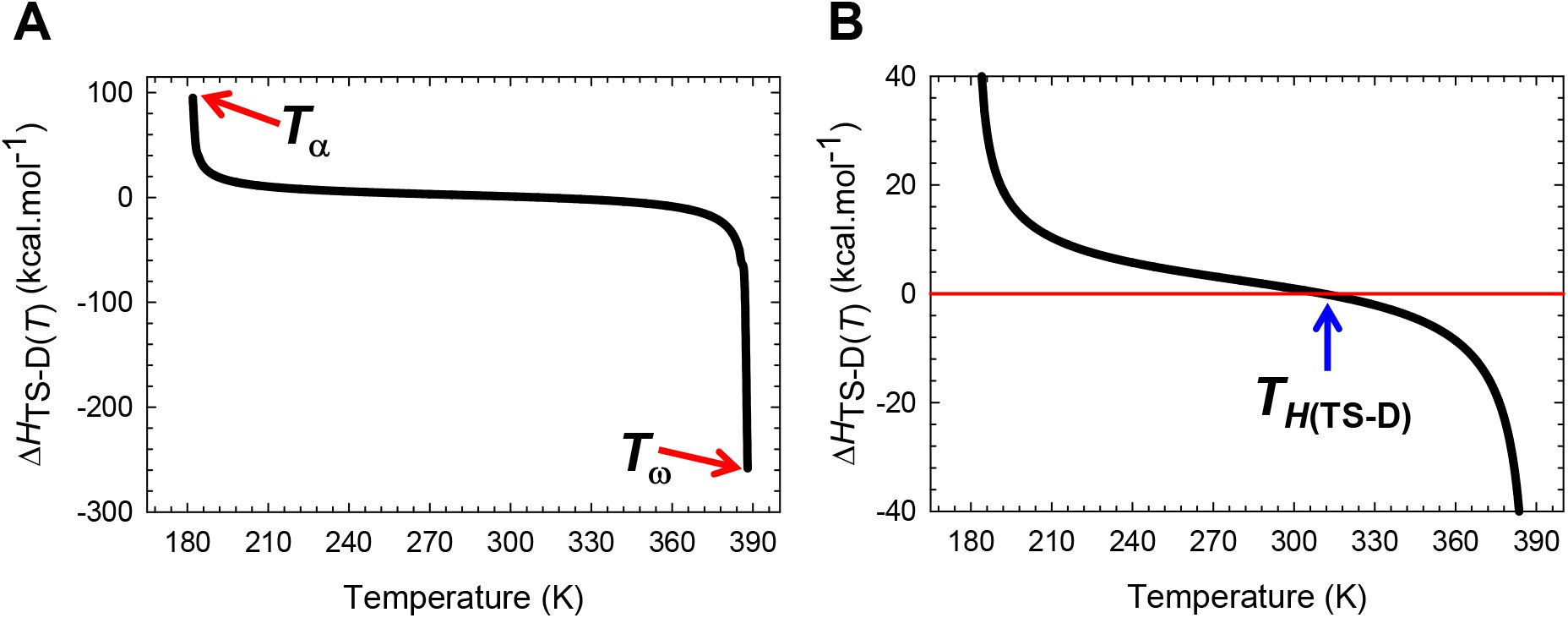 Figure 1
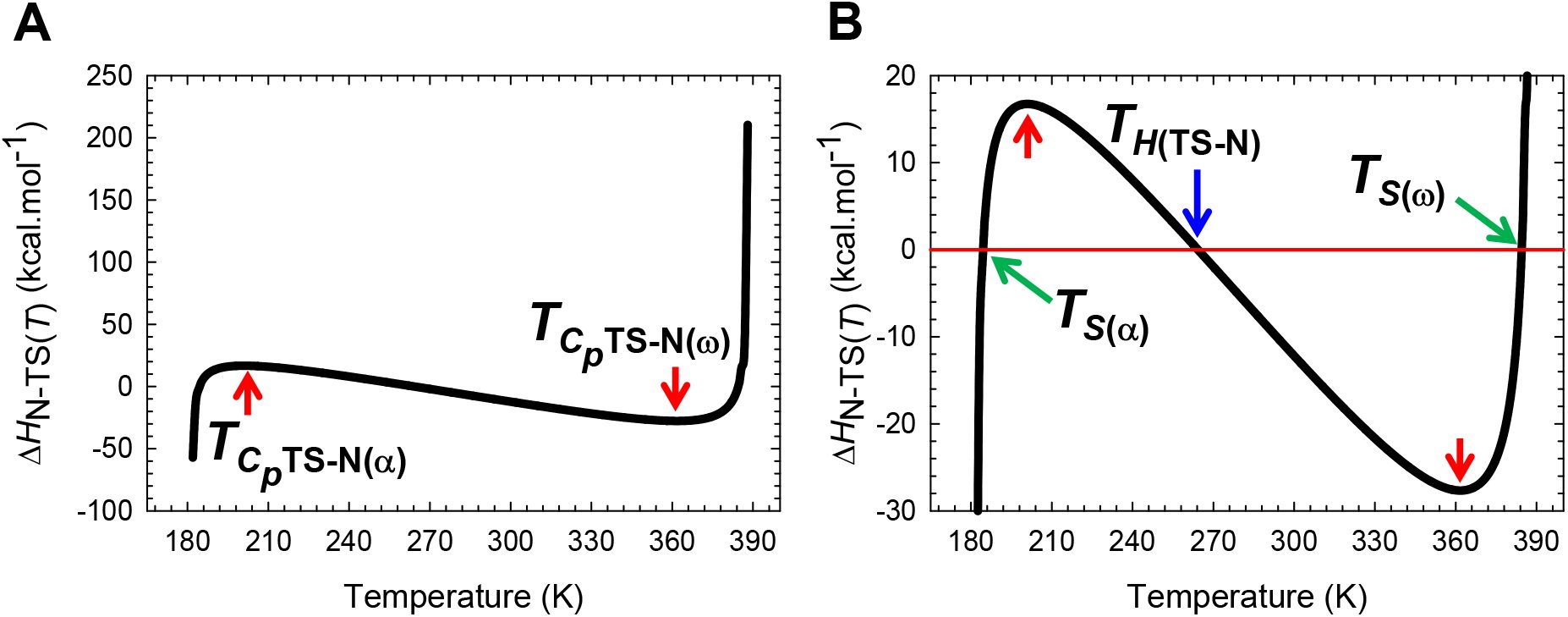 Figure 2
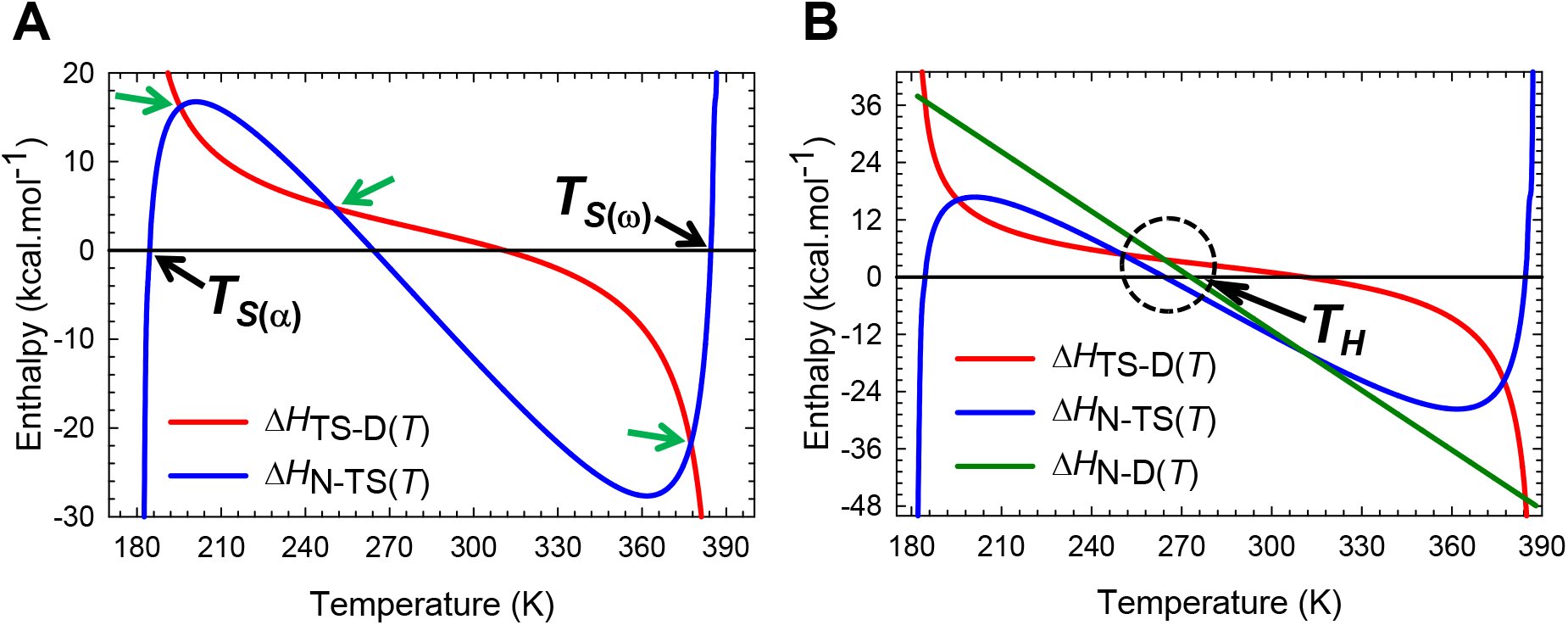 Figure 3
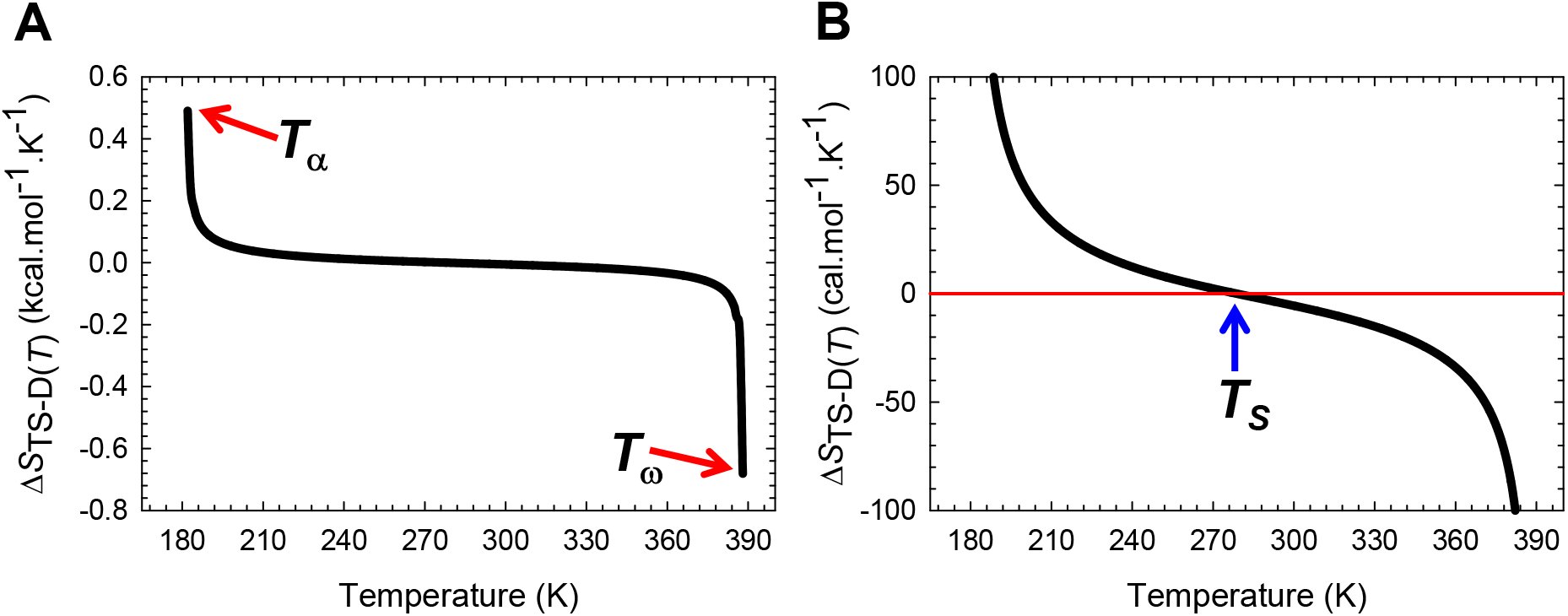 Figure 4
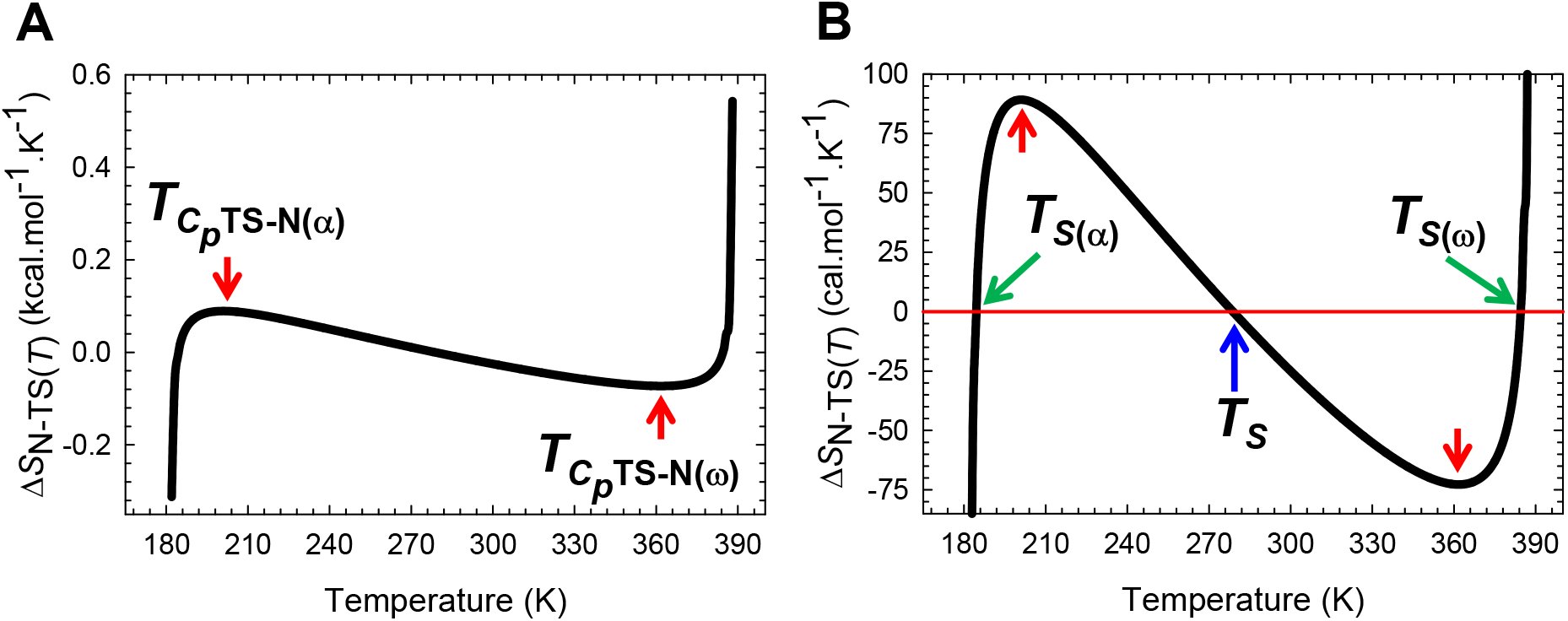 Figure 5
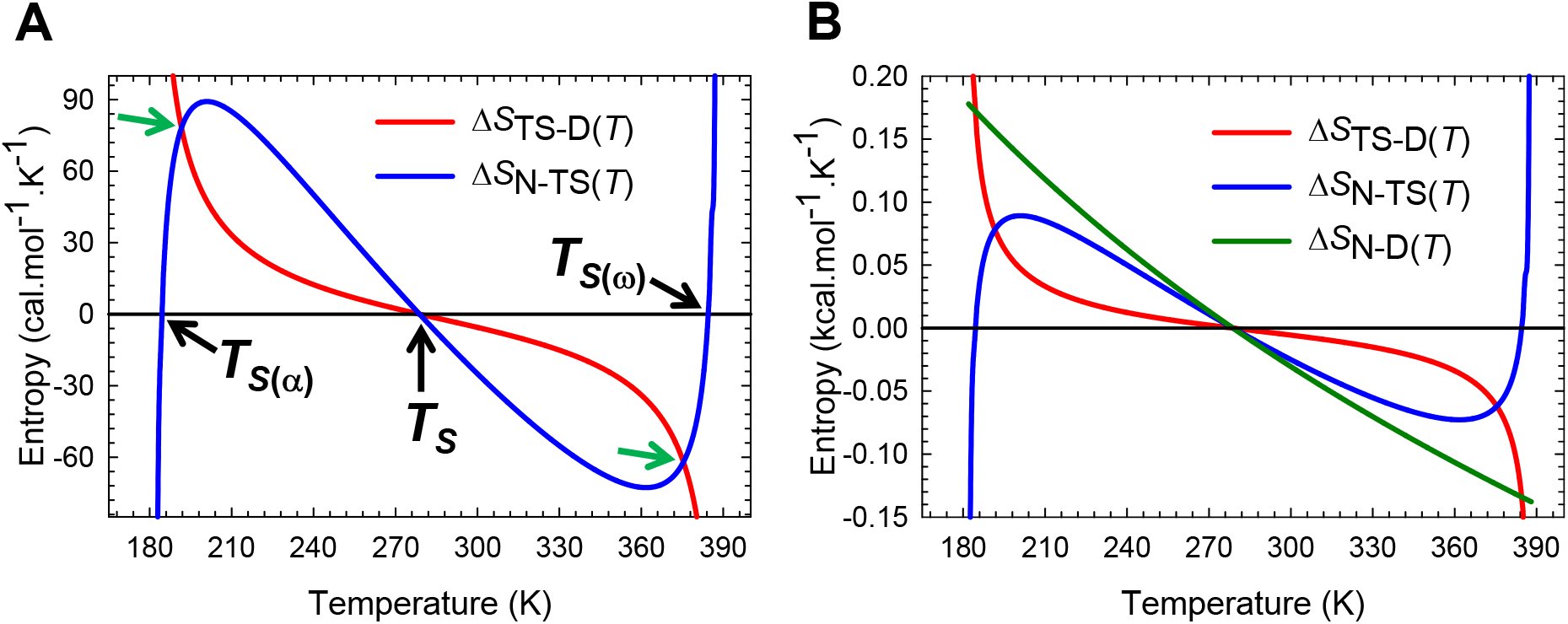 Figure 6
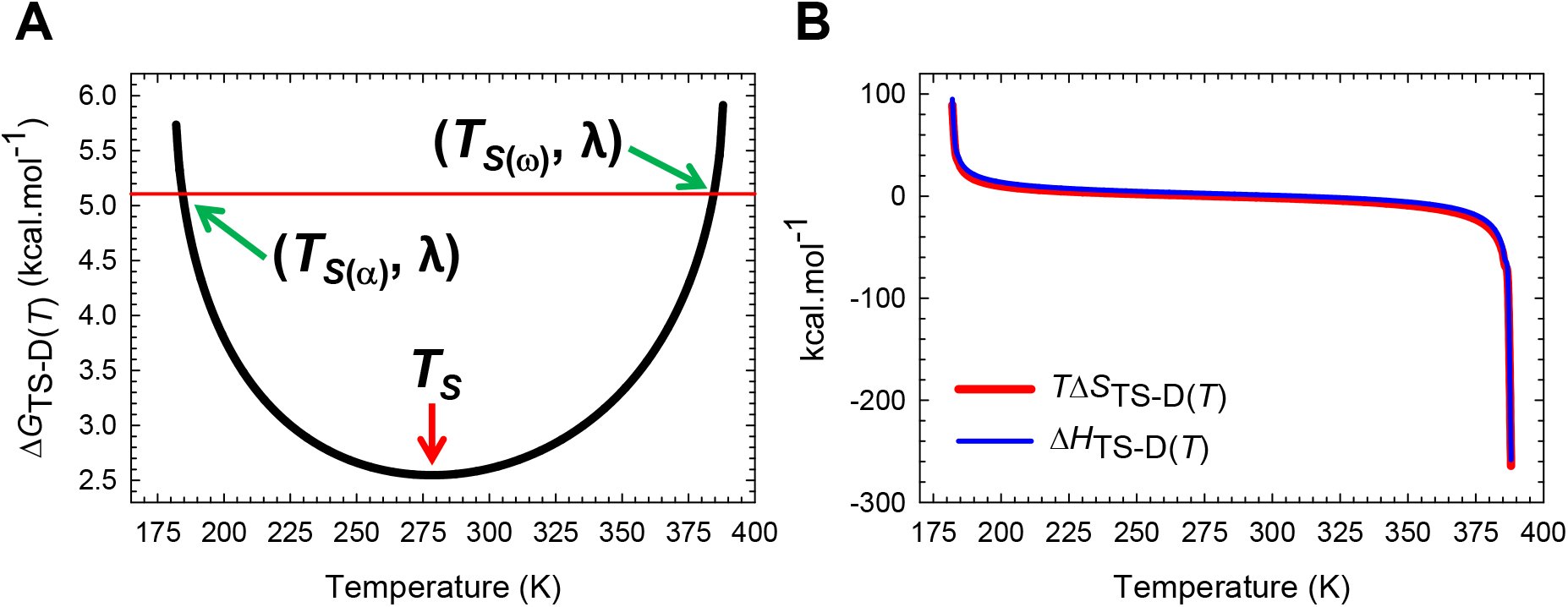 Figure 7
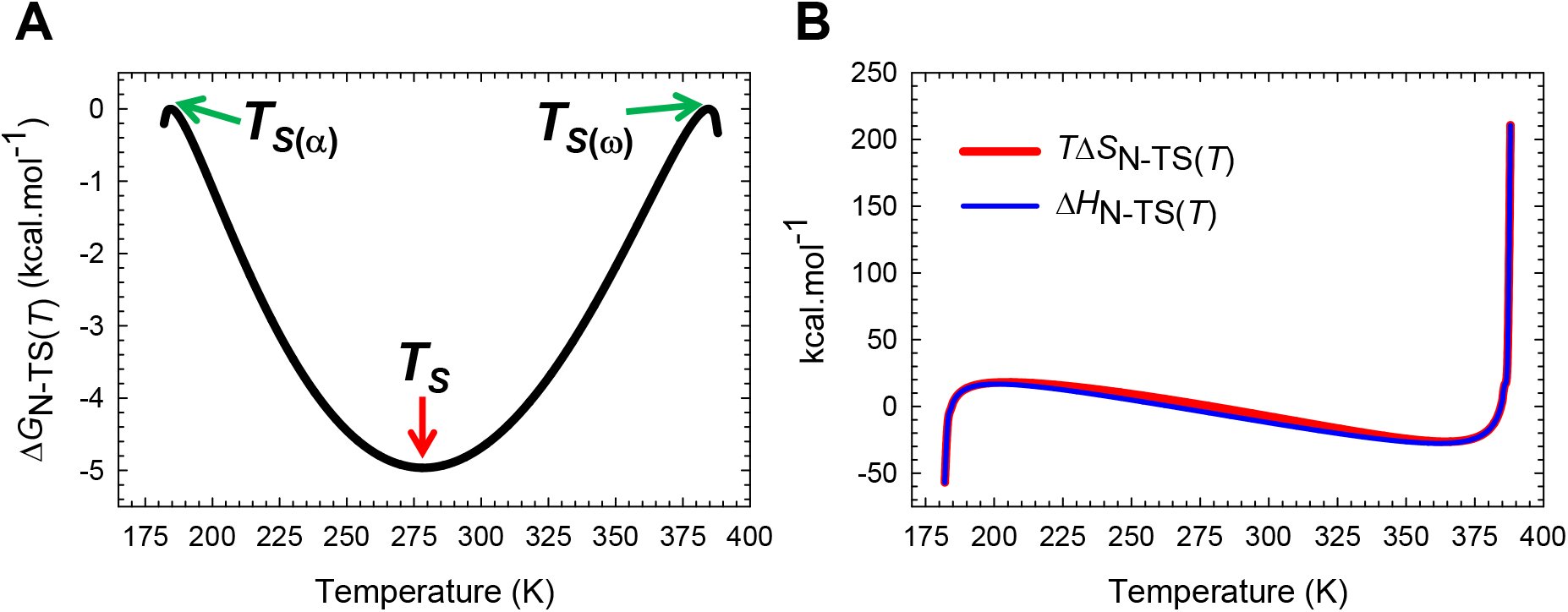 Figure 8
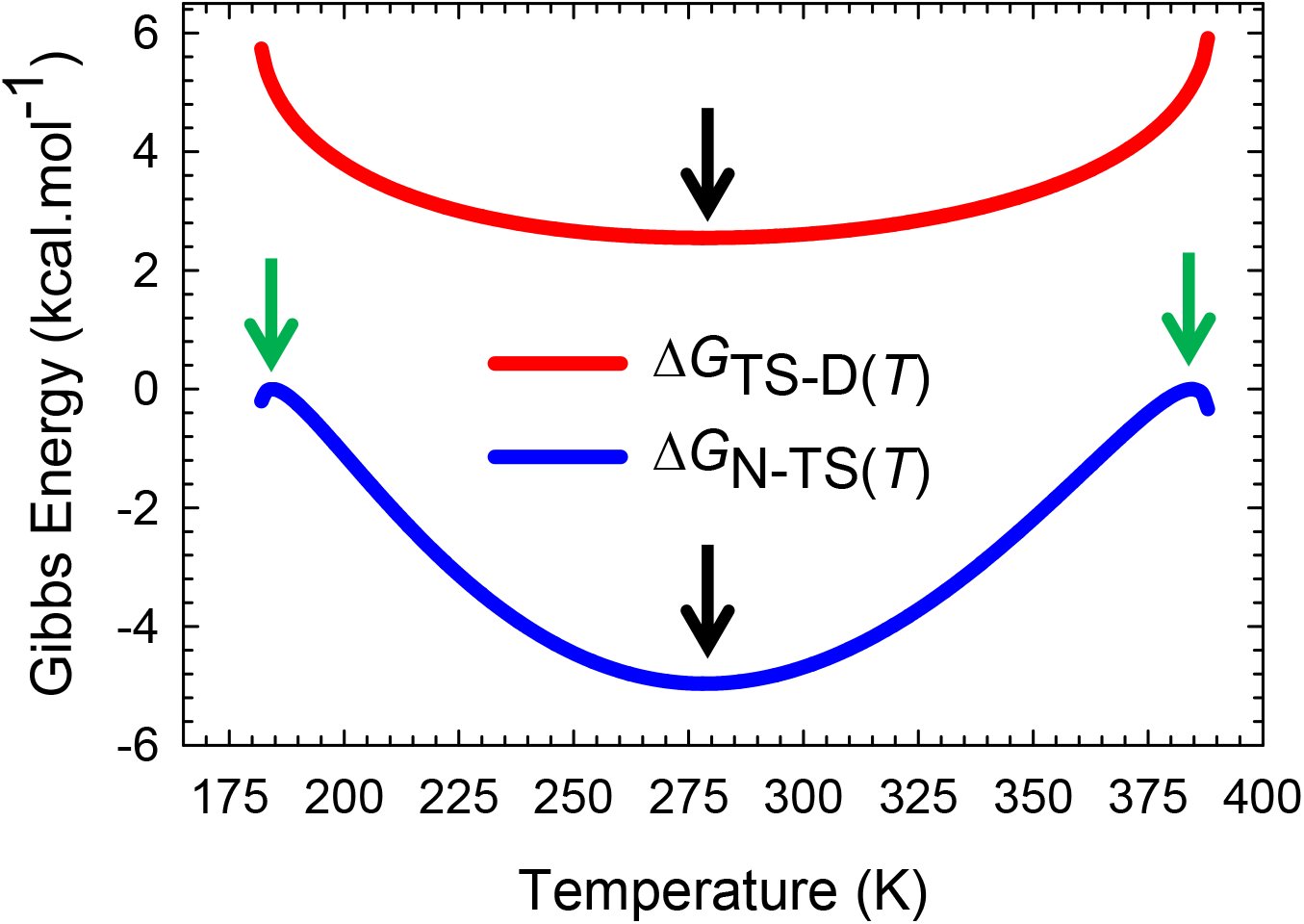 Figure 9
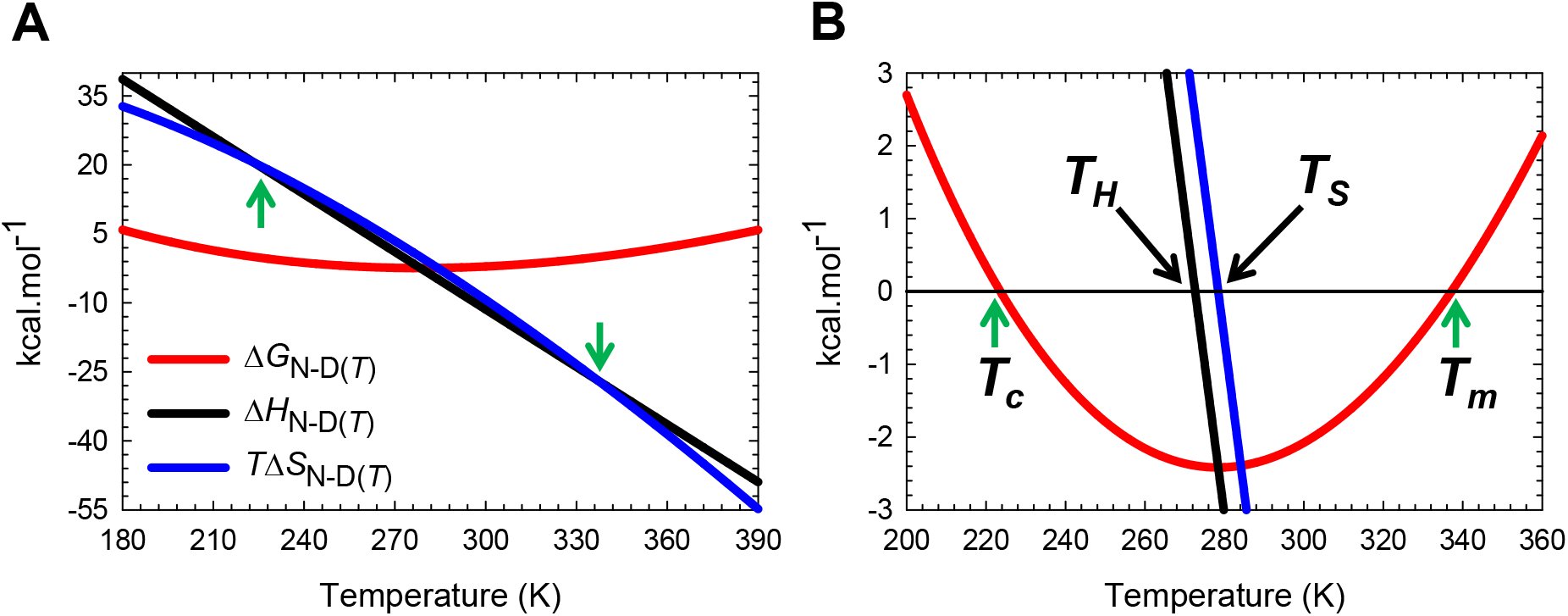 Figure 10
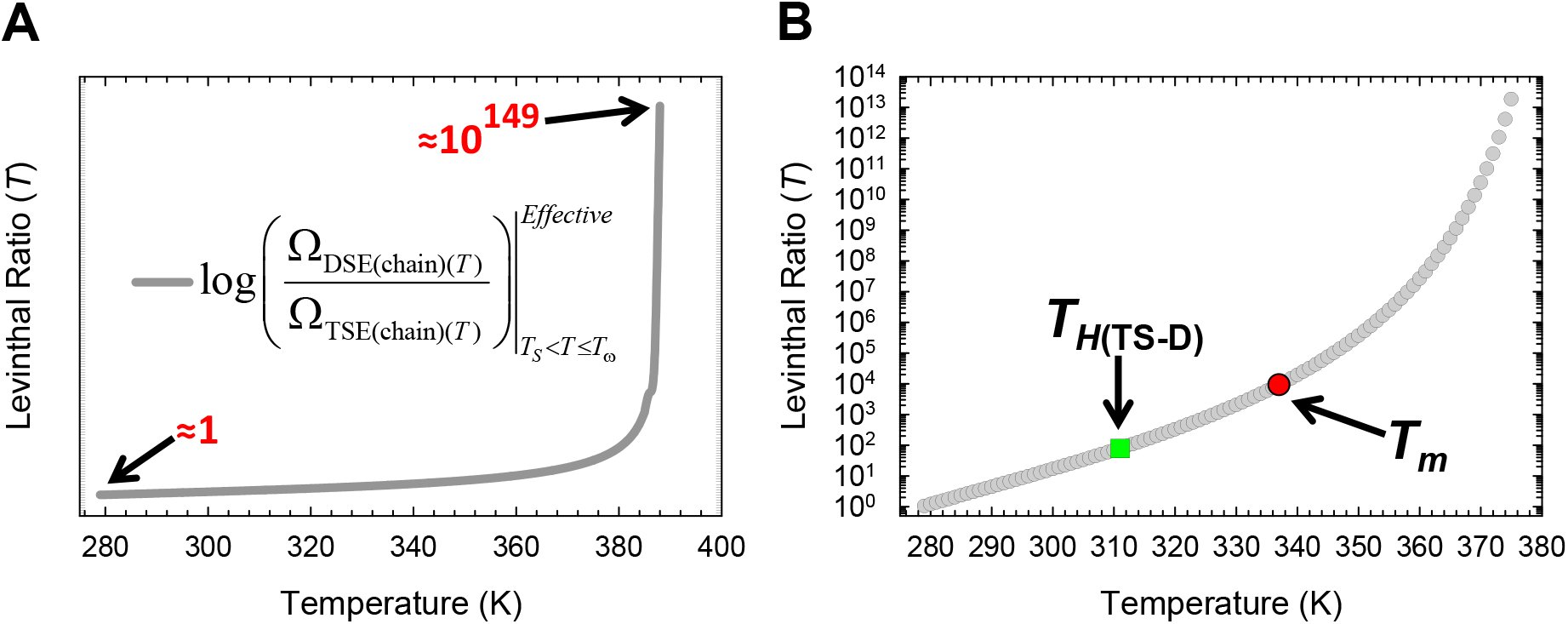 Figure 11
























































Peer Reviews
No public reviews on file for this paper yet. If you reviewed it on a platform where reviews are public (OpenReview, ICLR, NeurIPS, ICML), you can paste yours below so the community can read it here.
Videos
No videos yet. Explain this paper in a talk, walkthrough, or lecture? Add one.
Taxonomy
TopicsProtein Structure and Dynamics · Enzyme Structure and Function · Crystallography and molecular interactions
Introduction
It was shown in the preceding papers, henceforth referred to as Papers I-III that the equilibrium and kinetic behaviour of spontaneously-folding fixed two-state systems can be analysed using parabolic approximation. While the theory and assumptions, and the basic equations underlying this procedure were described in Paper-I, equations governing temperature-dependence were derived in Paper-II.^1, 2^ The framework from Papers I and II was then used to give a detailed description of the non-Arrhenius behaviour of the 37-residue FBP28 WW domain at an unprecedented temperature range and resolution (Paper-III).^3^ The purpose of this article is to give a detailed physical explanation for the non-Arrhenius behaviour of two-state systems in terms of chain and solvent effects, once again, using FBP28 WW as an example.^4^ Because this article is primarily an extension of Paper-III, those aspects that were discussed adequately in Paper-III will not be readdressed here; consequently, any critical appraisal of the conclusions drawn here must be done in conjunction with Paper-III in particular, and Papers I and II, in general.
Results and Discussion
Determinants of the enthalpies
Activation enthalpy for folding
The physical basis for the temperature-dependence of the activation enthalpy for the partial folding reaction D ⇌ [TS] may be rationalized by deconvoluting it into its formal components.
where ΔH_TS-D(T)_ is the total change in enthalpy for the activation of conformers from the DSE to the TSE at any given temperature, pressure and solvent conditions, and ΔHTS-D(res-res)(T) is purely due to the formation of net backbone and side-chain contacts en route to the TSE, i.e., relative to whatever residual structure that pre-exists in the DSE under folding conditions (includes all possible kinds of molecular interactions such as hydrophobic and van der Waals interactions, hydrogen bonding, long-range electrostatic interactions and salt-bridges etc., including the enthalpy of ionization that stems from perturbed pK_a_s of ionisable residues).^5-8^ The term ΔH_TS-D(res-solvent)(T)_ represents the activation enthalpy due to the desolvation of polar and non-polar residues (changes in the solvation shell; see Fig. 1 in Frauenfelder et al., 2009), while ΔHTS-D(solvent-solvent)(T) is purely due to the reorganization of the bulk solvent.^9, 10^
Temperature-dependence of the activation enthalpy for folding. (A) The variation in function with temperature. The slope of this curve varies with temperature, equals ΔCpTS-D(T), and is algebraically negative. (B) An appropriately scaled version of the plot on the left to illuminate the three important scenarios: (i) ΔHTS-D(T) > 0 for Tα ≤ T < TH(TS-D); (ii) ΔHTS-D(T) < 0 for TH(TS-D) < T ≤ Tω; and (iii) ΔHTS-D(T) = 0 when T = TH(TS-D). Note that kf(T) is a maximum at TH(TS-D). The values of the reference temperatures are given in Table 1.
Since water soluble globular proteins to which this entire discussion is relevant fold in ~55 M of water, to a first approximation, the contribution of the change in enthalpy due to the reorganization of bulk solvent to ΔHTS-D(T) may be ignored. The reasons are as follows: First, in most in vitro protein folding experiments the molar concentration of the protein under investigation ranges from sub-micromolar (in single molecule spectroscopy) to a few hundred micromolar (in NMR studies). Therefore, the ratio of the molar concentration of the bulk water to protein is ~10^7^ at the lower-end, and about 10^5^ at the higher-end. It is thus not too unreasonable to assume that such an incredibly small amount of solute will not be able to significantly alter the physical properties of bulk water. Second, although the properties of bulk water (density, dielectric constant, surface tension, viscosity etc.) invariably vary with temperature, particularly if the temperature range is substantial, the effects that stem from this variation will cancel out for any given temperature since we are calculating the difference between the values of the state functions of the reaction-states. That one can subtract out the contribution of bulk water is at the heart of differential scanning calorimetry: The heat absorbed or released at constant pressure by the protein+buffer cell is relative to that of the buffer cell. If the thermal behaviour of bulk water in protein+buffer cell is significantly different from the behaviour of water in the buffer cell, then the midpoint of heat denaturation, T_m_, and the equilibrium enthalpy of unfolding at T_m_ (ΔHD-N(cal)(Tm)) obtained from calorimetry will not agree with ΔHD-N(vH)(Tm) (van’t Hoff enthalpy) obtained from analysis of a sigmoidal thermal denaturation curve (obtained using spectroscopy, typically CD 217 nm for β-sheet proteins, CD 222 nm for α-helical proteins, and CD 280 nm for tertiary structure) using a two-state approximation (van’t Hoff analysis), even if the protein were a legitimate two-state folder.^11, 12^ If and only if these arguments hold, we may write
Of the two terms on the right-hand-side (RHS), the first term due to chain enthalpy is negative (exothermic) and favours, while the second term due to desolvation enthalpy is positive (endothermic) and disfavours the enthalpic activation of the denatured conformers to the TSE.^9, 13^ Inspection of Figure 1 immediately demonstrates that for Tα ≤ T < TH(TS-D), the unfavourable desolvation enthalpy dominates over favourable chain enthalpy making it enthalpically unfavourable to activate the conformers in the DSE to the TSE (ΔHTS-D(T) > 0), and for TH(TS-D) < T ≤ Tω, the favourable chain enthalpy dominates over the unfavourable desolvation enthalpy making it enthalpically favourable to activate the denatured conformers to the TSE (ΔHTS-D(T) < 0); and these two opposing enthalpies cancel each other out at TH(TS-D) such that ∂ln k_f(T)_/∂T = ΔHTS-D(T)/RT2 = 0 and kf(T) is a maximum (Figure 1-figure supplement 1). Thus, a corollary is that for a two-state folder at constant pressure and solvent conditions (for example, no change in the pH of the solvent due to the temperature-dependence of the pKa of the constituent buffer), “the Gibbs barrier to folding is purely entropie, the solubility of the TSE as compared to the DSE is the greatest, and k_f(T)_ is a maximum, when the heat released upon formation of net molecular interactions is exactly compensated by the heat absorbed to desolvate net polar and non-polar SASA, as the denatured conformers propelled by thermal energy, bury their SASA and diffuse on the Gibbs energy surface to reach the activated state” (Figure 1-figure supplement 2; see Massieu-Planck activation potentials in Paper-III).^3^
We may now take this analysis one step further by introducing the notion of residual enthalpies. It is apparent from inspection of Eq. (4) that even if we have no information on the absolute values of the terms on the RHS, if for a given temperature we find that the left-hand-side (LHS) is algebraically positive, it implies that ΔHTS-D(T) is purely due to the residual desolvation enthalpy [eqn] which by definition is the positive or endothermic remnant of the algebraic sum of the endothermic desolvation enthalpy and the exothermic chain enthalpy. Conversely, if we find that the LHS is algebraically negative at a given temperature, it implies that ΔHTS-D(T) is purely due to the residual chain enthalpy ([eqn]) which by definition is the negative or exothermic remnant of the algebraic sum of the endothermic desolvation enthalpy and the exothermic chain enthalpy (the superscripts δ^+^ or δ^-^ indicate the algebraic sign of the residual quantities). Consequently, we may conclude from inspection of Figure 1 that for Tα ≤ T < TH(TS-D), ΔHTS-D(T) is purely due to the residual desolvation enthalpy [eqn], making it enthalpically unfavourable; and for TH(TS-D) < T ≤ Tω, ΔHTS-D(T) is purely due to the residual chain enthalpy [eqn], making it enthalpically favourable to activate the denatured conformers to the TSE. Naturally, when T = TH(TS-D), the residual enthalpies become zero such that the activation of the denatured conformers to the TSE is enthalpically neutral.
Change in enthalpy for the partial folding reaction [TS] ⇌ N
Applying similar considerations as above for the second-half of the folding reaction, we may write
Of the two terms on the RHS, the first term due to chain enthalpy is negative and favourable, while the second term due to desolvation enthalpy is positive and unfavourable. Unlike the ΔHTS-D(T) function which changes its algebraic sign only once across the entire temperature range over which a two-state system is physically defined (Tα ≤ T ≤ Tω see Paper-III),^3^ the behaviour of ΔHN-TS(T) function is far more complex. Inspection of Figure 2 demonstrates that for the temperature regimes T_α_ ≤ T < T_S(α)_ and TH(TS-N) < T < TS(ω), the exothermic chain enthalpy dominates over the endothermic desolvation enthalpy. Consequently, we may conclude that the reaction [TS] ⇌ N is enthalpically favoured and is purely due to the residual chain enthalpy [eqn]. In contrast, for the temperature regimes T_S(α)_ < T < TH(TS-N) and T_S(ω)_ < T ≤ T_ω_, the endothermic desolvation enthalpy dominates over the exothermic chain enthalpy, leading to [TS] ⇌ N being enthalpically disfavoured, and is purely due to the residual desolvation enthalpy ([eqn]). At the temperatures T_S(α)_, T^H(TS-N)^, and T_S(ω)_, the residual enthalpies become zero, such that [TS] ⇌ N from the viewpoint of enthalpy is neither favoured nor disfavoured (ΔHN-TS(T) = 0).
Temperature-dependence of the change in enthalpy for the partial folding reaction [TS] ⇌ N. (A) The variation in ΔHN-TS(T) with temperature. The slope of this curve varies with temperature and equals ΔCpN-TS(T). The red pointers indicate the temperatures where ΔCpN-TS(T) (or – ΔCpTS-N(T)) is zero. (B) An appropriately scaled version of the plot on the left to illuminate the various temperature regimes. The net flux of the conformers from the TSE to the NSE is enthalpically: (i) favourable for Tα ≤ T < TS(α) and TH(TS-N) < T < TS(ω) (ΔHN-TS(T) < 0); (ii) unfavourable for TS(α) < T < TH(TS-N) and TS(ω) < T ≤ Tω (ΔHN-TS(T) > 0); and (iii) neither favourable nor unfavourable at TS(α), TH(TS-N), and TS(ω). At TS(α) and TS(ω), we have the unique scenario: ΔGN-TS(T) = ΔSN-TS(T) = ΔHN-TS(T) = 0, and ku(T) = k0. The values of the reference temperatures are given in Table 1.
Activation enthalpy for unfolding
If we reverse the reaction-direction, i.e., for the partial unfolding reaction N ⇌ [TS] (note the change in subscripts that indicate the reaction-direction), we may write
Unlike the first term on the RHS of Eq. (5), ΔHTS-N(chain^*^)(T) on the RHS of Eq. (6) is endothermic since heat is absorbed by the native conformers to break net backbone and side-chain interactions for them to be activated to the TSE. Similarly, unlike the endothermic desolvation enthalpy term on the RHS of Eq. (5), ΔHTS-N(hydration)(T) on the RHS of Eq. (6) is exothermic since heat is released upon hydration of polar and non-polar SASA as the native conformers unravel and expose net SASA to reach the TSE. Inspection of Figure 2-figure supplement 1 demonstrates that for the temperature regimes Tα ≤ T < T_S(α)_ and TH(TS-N) < T < T_S(ω)_, the endothermic ΔHTS-N(chain*)(T) term dominates over the exothermic ΔHTS-N(hydration)(T) term, such that the activation of the native conformers to the TSE is enthalpically disfavoured, and is purely due to the residual enthalpy that stems from the heat absorbed to break various net backbone and side-chain interactions not being fully compensated by the heat of hydration released due to a net increase in SASA [eqn]. In contrast, for the temperature regimes *T_S(α)* < T < TH(TS-N)_ and T_S(ω)_ < T ≤ T_ω_, we have ΔHTS-N(hydration)(T) > ΔHTS-N(chain*)(T); consequently, the activation of the native conformers to the TSE is enthalpically favoured and is purely due to the residual enthalpy of hydration ([eqn]). At T_S(α)_, T_H*(TS-N)*, and *T_S(ω), we have ΔH_TS-N(chain)(T)_ = ΔHTS-N(hydration)(T) such that the activation of the conformers from the NSE to the TSE is neither favoured nor disfavoured (ΔHTS-N(T) = 0). As explained in Paper-III in considerable detail, although ∂ln k_u(T)_/∂T = 0 ⇒ ΔH_TS-N(T)_ = 0 at T_S(α)_ T_H(TS-N), and *T_S(ω) (Figure 2-figure supplement 2), the behaviour of the system at T_S(α)_ and T_S(ω)_ is distinctly different from that at TH(TS-N).^3^ While ΔGTS-N(T) = ΔHTS-N(T) = ΔSTS-N(T) = 0, ΔGTS-D(T) = ΔGN-D(T) > 0, ΔSTS-D(T) = ΔSN-D(T) ≠0, and k_u(T)_ = k^0^ (the prefactor in the Arrhenius expression) at TS(α) and T_S(ω)_, the distinguishing features associated with T_H*(TS-N)_ is that k_u(T)_ is a minimum (k_u(T)_ << k^0^), ΔGTS-N(T) > 0, and ΔGTS-N(T) < 0 (see activation entropies and Gibbs energies later). Thus, a corollary is that for a two-state folder at constant pressure and solvent conditions, “the Gibbs barrier to unfolding is purely entropie, the molar concentration of the conformers in the TSE as compared to those in the NSE is the least, and k_u(T)_ is a minimum, when the heat absorbed by the native conformers to break various net backbone and side-chain interactions is exactly compensated by the heat of hydration released due to a net increase in SASA as the native conformers unravel and diffuse on the Gibbs energy surface to reach the TSE” (Figure 2-figure supplement 3).
Change in enthalpy for the coupled reaction D ⇌ N
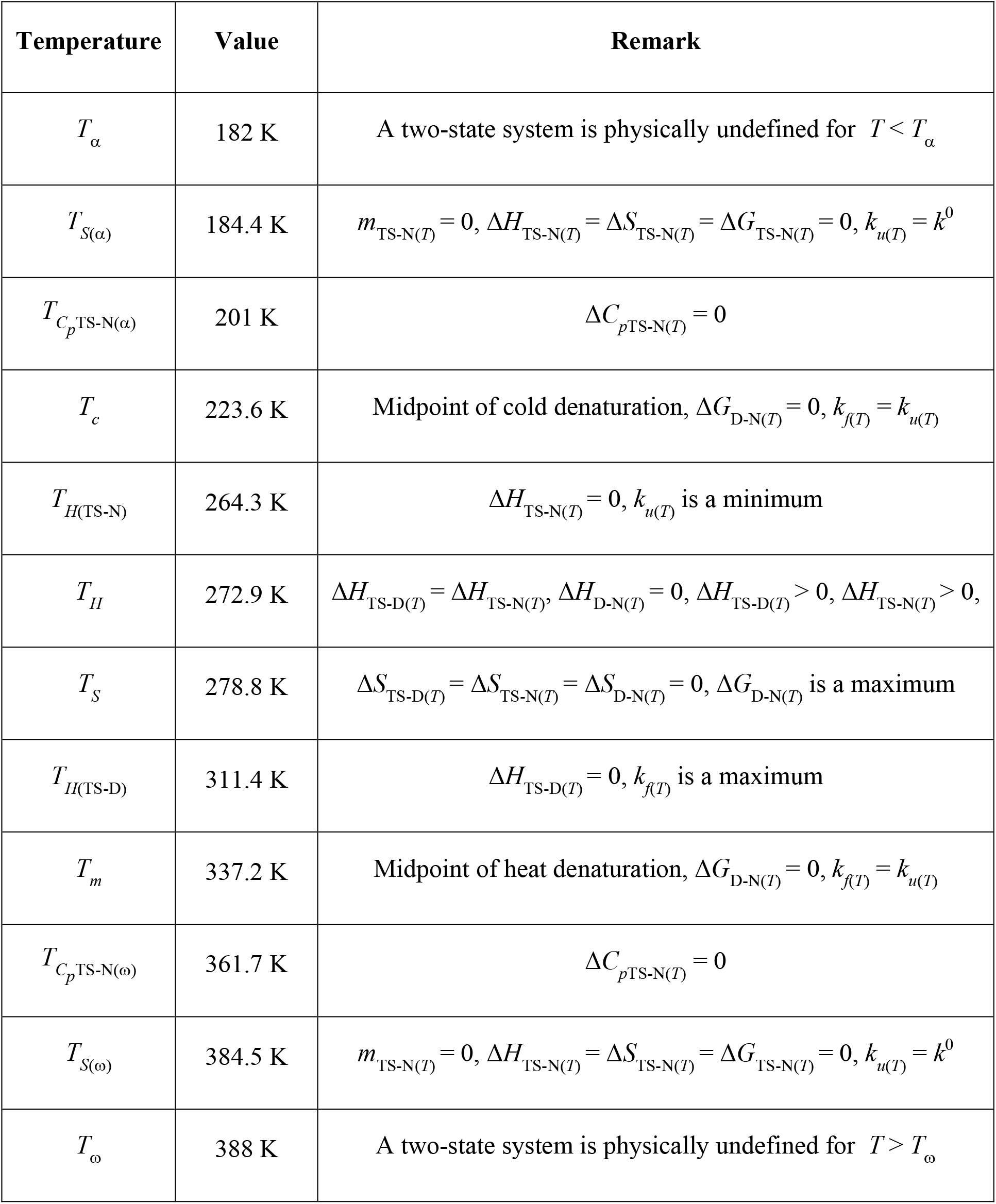
Now that the changes in enthalpies for the partial folding reactions D ⇌ [TS] and [TS] ⇌ N have been deconvoluted into their constituent chain and desolvation enthalpies across a wide temperature regime, the physical chemistry underlying the variation in ΔH_N-D(T)_ (determined independently from thermal denaturation experiments at equilibrium) may be rationalized using the relationship ΔHN-D(T) = ΔH_TS-D(T)_ + ΔH_N-TS(T)_, and by partitioning the physically definable temperature range into six temperature regimes using the reference temperatures T_α_, T_S(α)_, T_H*(TS-N)*, *T_H, T_H*(TS-D), *T_S(ω)*, and T_ω_ (see Table 1).
Table 1:: Reference temperatures
Enthalpic Regime I (Tα ≤ T < T): Inspection of Figure 3 demonstrates that while D ⇌ [TS] is enthalpically disfavoured and is purely due to the endothermic residual enthalpy of desolvation [eqn], the reaction [TS] ⇌ N is enthalpically favourable and is purely due to the exothermic residual chain enthalpy [eqn]. Because ΔHN-D(T) > 0 for T < T_H_ (green curve in Figure 3B; see Paper-III and also Becktel and Schellman, 1987),^3, 14^ we may write
An overlay of ΔHTS-D(T), ΔHN-TS(T), and ΔHN-D(T), functions. (A) An overlay of ΔHTS-D(T) and ΔHN-D(T) functions. At the temperatures where the functions intersect (green pointers, 195.5 K, 250 K, and 377.4 K), the absolute enthalpy of the TSE is exactly half the algebraic sum of the absolute enthalpies of the DSE and the NSE, i.e., HTS(T) = (HD(T) + HN(T)/2. The intersection of the blue curve with the black reference line occurs at TS(α), TH(TS-N), and TSω. The intersection of the red curve with the black reference line occurs at TH(TS-D). (B) An overlay of ΔHTS-D(T), ΔHN-TS(T), and ΔHN-D(T) functions to illuminate the relative contribution of the enthalpies of the partial folding reactions D ⇌ [TS] and [TS] ⇌ N to the change in enthalpy of folding at equilibrium. The red and the green curves intersect at TS(α), TH(TS-N), and TSα, and the blue and the green curves intersect at TH(TS-D). ΔHN-D(T) = 0 at the temperature (TH) where the green curve intersects the black reference line. The net flux of the conformers from the DSE to the NSE is enthalpically unfavourable for Tα ≤ T < TH, and favourable for TH < T ≤ Tω. The values of the reference temperatures are given in Table 1. See Figure 3-figure supplement 1 for an appropriately scaled view of the intersections occurring inside the encircled region.
As explained earlier, although we have no information on the absolute values of the terms on the RHS of Eq. (7), we can nevertheless work out from the algebraic sign of the independently determined LHS from thermal denaturation at equilibrium, which one of the terms on the RHS is dominant. Thus, the logical conclusion is that although the second-half of the folding reaction is enthalpically favoured [eqn], it is unable to fully compensate for the unfavourable desolvation enthalpy generated in the first-half of the folding reaction [eqn] such that the coupled reaction D ⇌ N is enthalpically disfavoured. When T = T_S(α)_, the second term on the RHS becomes zero, leading to [eqn] (intersection of the red and the green curves to the left of the encircled area in Figure 3B). This implies that at T_S(α)_, ΔH_N-D(T)_ is primarily due to events occurring in the first-half of the folding reaction.
Enthalpie Regime II (T_S(α)_ < T < TH(TS-N): Inspection of Figure 3 shows that for this temperature regime, both D ⇌ [TS] and [TS] ⇌ N are enthalpically disfavoured and are purely due to endothermic residual desolvation enthalpies.
Thus, the independently determined endothermic ΔH_N-D(T)_ for this regime is once again due to the enthalpic penalty of desolvation, but unlike Regime I, is determined by both the partial folding reactions. When T = TH(TS-N) the second term on the RHS of Eq. (8) becomes zero, leading to [eqn] (intersection of the red and the green curves inside the encircled area in Figure 3B). Consequently, we may conclude that at TH(TS-N), ΔHN-D(T) is purely due to the endothermic residual desolvation enthalpy incurred in the reaction D ⇌ [TS]. Further, at the two unique temperatures within this regime where ΔHTS-D(T) = ΔHN-TS(T) (intersection of the blue and the red curves, and indicated by green pointers) we have [eqn]; and in terms of the absolute enthalpies we have: HTS(T) = (HD(T) + HN(T))/2.
Enthalpic Regime III (TH(TS-N) < T < T_H_): Inspection of Figure 3-figure supplement 1 shows that the reaction D ⇌ N is endothermic and enthalpically disfavoured. What this implies is that although for this temperature regime the reaction [TS] ⇌ N is enthalpically favoured and is purely due to the exothermic residual chain enthalpy, it nevertheless does not fully compensate for the endothermic residual desolvation enthalpy incurred in the reaction D ⇌ [TS], such that the coupled reaction D ⇌ N is enthalpically disfavoured.
When T = T_H_, we have [eqn] such that ΔHN-D(T) = 0. A corollary is that for a two-state system at constant pressure and solvent conditions, the solubility of the NSE as compared to the DSE, or the equilibrium constant for folding is the greatest, and is driven purely by the difference in entropy between the NSE and the DSE when the endothermic residual desolvation penalty incurred in first-half of the folding reaction is exactly compensated by the exothermic residual chain enthalpy generated in the second-half of the folding reaction.
Enthalpie Regime IV (T_H_ < T < TH(TS-D)): Inspection of Figure 3 and Figure 3-figure supplement 1 shows that the reaction D ⇌ N is exothermic and enthalpically favourable (ΔHN-D(T) < 0). Thus, we may conclude that although the activation of the denatured conformers to the TSE is enthalpically disfavoured and is purely due to the residual endothermic desolvation enthalpy, this is more than compensated by the exothermic residual chain enthalpy generated in the second-half of the folding reaction [TS] ⇌ N, such that the coupled reaction D ⇌ N is enthalpically favoured.
When T = TH(TS-D), the first term on the RHS of Eq. (10) becomes zero since the chain and desolvation enthalpies for the reaction D ⇌ [TS] compensate each other exactly. Consequently, we have [eqn] (intersection of the blue and the green curves in Figure 3B), i.e., the exothermic and favourable ΔHN-D(T) is primarily due to events occurring in the second-half of the folding reaction.
Enthalpic Regime V (T_H(TS-D)_ < T < TS(ω): It is immediately apparent from inspection of Figure 3 that the enthalpically favourable coupled reaction D ⇌ N is a consequence of both the partial folding reactions being enthalpically favourable, and is purely due to exothermic residual chain enthalpy.
When T = T_S(ω)_, the second term on the RHS of Eq. (11) becomes zero owing to the chain and desolvation enthalpies for the reaction [TS] ⇌ N compensating each other exactly. Consequently, we have [eqn] (intersection of the red and the green curves to the right of the encircled area in Figure 3B), i.e., ΔHN-D(T) is primarily due to events occurring in the first-half of the folding reaction. Further, at the temperature where ΔHTS-D(T) = ΔHN-TS(T) (intersection of the blue and the red curves to the right of the encircled area in Figure 3B) we have [eqn] and HTS(T) = (HD(T) + HN(T))/^2^.
Enthalpie Regime VI (T_S(ω)_ < T ≤ Tω): Inspection of Figure 3 shows that for this regime, the reaction D ⇌ [TS] which is enthalpically favourable and purely due to the exothermic residual chain enthalpy, more than compensates for the endothermic residual desolvation enthalpy for the reaction [TS] ⇌ N, such that the coupled reaction D ⇌ N is enthalpically favourable.
Determinants of entropies
Activation entropy for folding
The physical basis for the temperature-dependence of the activation entropy for the partial folding reaction D ⇌ [TS] may be similarly rationalized by deconvoluting them into their formal components.
where ΔSTS-D(T) is the total change in entropy for the activation of the denatured conformers to the TSE, ΔSTS-D(res-res)(T) is the change in entropy due to a change in the backbone and the side-chain mobility, ΔSTS-D(res-solvent)(T) is the change in entropy due to reorganization of the solvent molecules in the solvation shell, and ΔSTS-D(solvent-solvent)(T) is the change in entropy of the bulk water. As discussed earlier, if to a first approximation we ignore the change in entropy due to reorganization of the bulk solvent, we may write
Because the activation of denatured conformers to the TSE involves a net decrease in backbone and side-chain mobility as compared to the DSE, the first term on the RHS due to chain entropy is negative and opposes folding. In contrast, since solvent molecules are released from the solvation shell into the bulk water as the denatured conformers bury net polar and nonpolar SASA en route to the TSE, the desolvation entropy term is positive and favours the entropic activation of the denatured conformers to the TSE. Consequently, the magnitude and algebraic sign of ΔSTS-D(T) is dependent on the intricate temperature-dependent balance between these two opposing entropies.
Inspection of Figure 4 immediately demonstrates that for T_α_ ≤ T < T_S_ the favourable entropy of the release of solvent molecules from the solvation shell dominates over the unfavourable chain entropy making it entropically favourable (ΔSTS-D(T) > 0), and for T_S_ < T ≤ T_ω_ the unfavourable chain entropy dominates over the favourable desolvation entropy making it entropically unfavourable (ΔSTS-D(T) < 0) to activate denatured conformers to the TSE. These two opposing entropies cancel each other out at T_S_ such that ∂ΔGTS-D(T)/∂T = – ΔSTS-D(T) = 0 and ΔGTS-D(T) is a minimum. A corollary is that for a two-state folder at constant pressure and solvent conditions, “ the difference in SASA between the DSE and the TSE, the position of the TSE relative to the DSE along the heat capacity and entropic RCs, as well as the Gibbs activation energy for folding are all a minimum when the loss of entropy due to decreased backbone and side-chain mobility is exactly compensated by the entropy gained from solventrelease, as the denatured conformers propelled by thermal energy bury their SASA and diffuse on the Gibbs energy surface to reach the TSE” (“The principle of least displacement”).
Temperature-dependence of the activation entropy for folding. (A) The variation in ΔSTS-D(T) function with temperature. The slope of this curve varies with temperature and equals ΔCpTS-D(T). (B) An appropriately scaled version of the figure on the left to illuminate the three temperature regimes and their implications: (i) ΔSTS-D(T) > 0 for Tα ≤ T < TS; (ii) ΔSTS-D(T) < 0 for TS < T ≤ Tω; and (iii) ΔSTS-D(T) = 0 when T = Ts. The values of the reference temperatures are given in Table 1.
We may once again take this analysis to another level by introducing the notion of residual entropies. Although we have no information on the absolute values of the terms on the RHS of Eq. (16), if we find that at any given temperature the LHS is algebraically positive, it implies that ΔS_TS-D(T)_ is purely due to the residual desolvation entropy [eqn] which by definition is the positive or favourable remnant of the algebraic sum of the positive desolvation entropy and the negative chain entropy. Conversely, if the LHS is negative at any given temperature, it implies that ΔSTS-D(T) is purely due to the residual chain entropy ([eqn]) which by definition is the negative or unfavourable remnant of the algebraic sum of the positive desolvation entropy and the negative chain entropy. Thus, we may conclude from inspection of Figure 4 that for T_α_ ≤ T < T_S_, ΔSTS-D(T) is purely due to the residual desolvation entropy [eqn] making it entropically favourable; and for T_S_ < T ≤ T_ω_, ΔSTS-D(T) is purely due to the residual chain entropy ([eqn]) making it entropically unfavourable to activate denatured conformers to the TSE. Obviously, when T = T_S_, the residual entropies become zero such that the activation of the denatured conformers to the TSE is entropically neutral.
Change in entropy for the partial folding reaction [TS] ⇌ N
Similarly, for the second-half of the folding reaction we may write
The first term on the RHS due to chain entropy is negative and unfavourable, while the second term due to desolvation entropy is positive and favourable. However, unlike the ΔSTS-D(T) function which changes its polarity only once across the physically definable temperature range, the behaviour of the ΔSN-TS(T) function with temperature is far more complex. Inspection of Figure 5 demonstrates that for T_α_ ≤ T < T_S(α)_ and T_S_ < T < T_S(ω)_ the negative and unfavourable chain entropy dominates over the positive and favourable desolvation entropy, such that the reaction [TS] ⇌ N is entropically disfavoured, and is purely due to the residual chain entropy [eqn]. In contrast, for T_S(α_ < T < T_S_ and T_S(ω)_ < T ≤ T_ω_, the positive desolvation entropy dominates over the negative chain entropy, leading to [TS] ⇌ N being entropically favoured, and is purely due to the residual desolvation entropy [eqn]. At the temperatures T_S(α)_, T_S_, and T_S(ω)_, the residual entropies become zero, such that [TS] ⇌ N is entropically neither favoured nor disfavoured, i.e., ∂ΔGN-TS(T)/ ∂T = – ΔSN-TS(T) = 0. Importantly, while at T_S(α)_ and TS(ω) we have GTS(T) = GN(T), STS(T) = SN(T) and ΔGN-TS(T) is a maximum, at T_S_ we have GTS(T) >> ^G^N(T), SD(T) = STS(T) = SN(T) with ΔGN-TS(T) being a minimum and the most negative (see Gibbs energies later). A corollary is that for a two-state folder at constant pressure and solvent conditions, “the change in Gibbs energy for the flux of the conformers from the TSE to the NSE is most favourable and purely enthalpic when the loss of backbone and side-chain conformational freedom is exactly compensated by the release of solvent from the solvation shell, as the conformers in the TSE bury their SASA to reach the NSE.” Note that the term “flux” is operationally defined as the “diffusion of the conformers from one reaction-state to the other on the Gibbs energy surface.”
The variation in ΔSN-TS(T) for the partial folding reaction [TS] ⇌ N. (A) The variation in ΔSN-TS(T) function with temperature. The slope of this curve, given by ΔCpN-TS(T)/T, varies with temperature, and is zero at TCpTS-N(α) and TCpTS-N(ω). (B) An appropriately scaled view of the plot on the left to illuminate the various temperature regimes. The flux of the conformers from the TSE to the NSE is entropically: (i) unfavourable for Tα ≤ T < TS(α) and TS < T < TS(ω) (ΔSN-TS(T) < 0); (ii) favourable for TS(α) < T < TS and TS(ω) < T ≤ Tω (ΔSN-TS(T) > 0); and (iii) neutral at TS(α), TS and TS(ω). The values of the reference temperatures are given in Table 1.
Activation entropy for unfolding
If we now reverse the reaction-direction, i.e., for the partial unfolding reaction N ⇌ [TS]we may write
Unlike the negative first term on the RHS of Eq. (17), ΔSTS-N (chain*)(T) is positive since the backbone and side-chain mobility of the conformers in the TSE is greater than that of the native conformers. In contrast, unlike the positive second term on the RHS of Eq. (17), ΔSTS-N (hydration)(T) is negative since solvent is captured on the protein surface as the native conformers expose net SASA and diffuse on the Gibbs energy surface to reach the TSE. Inspection of Figure 5-figure supplement 1 demonstrates that for T_α_ ≤ T < T_S(α)_ and T_S_ < T < T_S(ω)_, the positive and favourable ΔSTS-N (chain*)(T) term dominates over the negative and unfavourable ΔSTS-N (hydration)(T) term, such that the activation of the native conformers to the TSE is entropically favoured, and is purely due to the residual entropy that stems from the gain in the backbone and side-chain mobility not being fully compensated by the loss of entropy due to solvent capture on the protein surface [eqn]. In contrast, for T_S(α)_ < T < T_S_ and T_S(ω)_ < T ≤ T_ω_, the ΔSTS-N (hydration)(T) term dominates over the ΔSTS-N (chain*)(T) leading to the activation of the native conformers to the TSE being entropically disfavoured, and is purely due to the residual negentropy of solvent capture ([eqn]). At the temperatures T_S(α)_, T_S_, and T_S(ω)_, the residual entropies become zero, such that the activation of the native conformers to the TSE is entropically neutral, i.e., ∂ΔGTS-N(T)/∂T = = ΔSTS-N(T) = 0. Because ΔGTS-N(T) = ΔHTS-N(T) = 0 at T_S(α)_ and T_S(ω)_ unfolding is barrierless and k_u(T)_ is an absolute maximum for that particular solvent and pressure, i.e., k_u(T)_ = k^0^. Further, while the extrema of ΔGTS-N(T) are a minimum at T_S(α)_ and T_S(ω)_, it is a maximum at T_S_. Thus, for a two-state folder at constant pressure and solvent conditions, “the Gibbs barriers to unfolding, depending on the temperature, are the greatest as well as the least when the gain in entropy due to the increased backbone and side-chain mobility is exactly compensated by the loss in entropy of the solvent due to its capture on the net SASA exposed, as the native conformers unravel to reach the TSE.”
Change in entropy for the coupled reaction D ⇌ N
The deconvolution of the changes in entropies for the partial folding reactions D ⇌ [TS] and [TS] ⇌ N into their constituent chain and desolvation entropies enables the physical basis for the temperature-dependence of ΔS_N-D(T)_ (determined independently from thermal denaturation experiments at equilibrium using the relationship R[∂(T ln KN-D(T))/∂T] = ΔSN-D(T) Where KN-D(T) is the equilibrium constant for D ⇌ N) to be rationalized. This is best illuminated by partitioning the physically definable temperature range into four regimes using the reference temperatures T_α_, T_S(α)_, T_S_, T_Sω_ and T_ω_ (see Table 1).
Entropic Regime I (T_α_ ≤ T < T_S(α)_): Inspection of Figure 6 demonstrates that while D ⇌ [TS] is entropically favoured and is purely due to the residual desolvation entropy ([eqn]), the reaction [TS] ⇌ N is entropically disfavoured and is purely due to the residual chain entropy [eqn]. Because ΔSN-D(T) > 0 for T < T_S_ (green curve in Figure 6B; see also Paper-III), we may write
An overlay of ΔSTS-D(T), ΔSN-TS(T), and ΔSN-TS(T) functions. (A) An overlay of ΔSTS-D(T) and ΔSN-TS(T) functions for the partial folding reactions D ⇌ [TS] and [TS] ⇌ N, respectively. At the high and low temperatures where the functions intersect (green pointers, 191.7 K and 375.5 K), the absolute entropy of the TSE is exactly half the algebraic sum of the absolute entropies of the DSE and the NSE, i.e., S TS(T) =(SD(T) + SN(T))/2. The intersection of the blue curve with the black reference line occurs at TS(α), TS and TS(ω). The intersection of the red curve with the black reference line occurs at TS. (B) An overlay of ΔSTS-D(T), ΔSN-TS(T), and ΔSN-D(T) functions to illuminate the relative contribution of the entropies of the partial folding reactions D ⇌ [TS] and [TS] ⇌ N to the change in entropy for the coupled reaction D ⇌ N. While the red and the green curves intersect at TS(α), TS, and TS(ω), all the three curves intersect at TS ( SD(T) = STS(T) = SN(T)). The net flux of the conformers from the DSE to the NSE is entropically favourable for Tα ≤ T < TS and unfavourable for TS < T ≤ Tω. The values of the reference temperatures are given in Table 1.
Thus, although the second-half of the folding reaction is entropically unfavourable, the favourable desolvation entropy generated in the first-half more than compensates for it, such that the coupled D ⇌ N is entropically favoured. When T = T_S(α)_, the second term on the RHS becomes zero, leading to [eqn] (intersection of the red and the green curves at the extreme left in Figure 6B). This implies that at T_S(α)_, the favourable ΔSN-D(T) is primarily due to events occurring in the first-half of the folding reaction.
Entropie Regime II (T_S(α)_ < T < T_S_): Inspection of Figure 6 demonstrates that for this regime both the partial folding reactions are entropically favourable and are purely due to the residual desolvation entropies. Thus we may write
Thus, the logical conclusion is that although the decrease in backbone and sidechain mobility disfavours D ⇌ N, this is more than compensated by the release of solvent from the solvation shell, as the denatured conformers diffuse on the Gibbs energy surface to reach the NSE. Further, at the temperature where ΔSTS-D(T) = ΔSN-TS(T) (intersection of the blue and the red curves at the extreme left) we have [eqn] and STS(T) = (SD(T) + SN(T)/2. When T = T_S_, both the terms on the RHS become zero leading to the Gibbs energy of folding which is the most negative (or ΔGD-N(T) is the greatest) being purely enthalpic. A corollary is that “equilibrium stability is always the greatest, and the position of the TSE relative to the DSE along the SASA, entropic and heat capacity RCs is always the least, when the decrease in the backbone and sidechain entropy that accompanies folding is exactly compensated by the gain in entropy that stems from solvent-release” (“The principle of least displacement”).
Entropie Regime III (T_S_ < T < T_S(ω)_: Inspection of Figure 6 demonstrates that for this regime both the partial folding reactions are entropically unfavourable and are purely due to the residual chain entropy. Thus we may write
Thus, although the release of solvent favours both the partial folding reactions, this does not fully compensate for the unfavourable entropy that stems from a decrease in backbone and sidechain mobility. Consequently, the reaction D ⇌ N is entropically disfavoured and is purely due to residual chain entropy. When T = TS(ω), the second term on the RHS becomes zero, leading to [eqn] (intersection of the red and the green curves). This implies that at T_S(ω)_ the unfavourable ΔSN-D(T) is primarily due to events occurring in the first-half of the folding reaction. Further, at the temperature where ΔSTS-D(T) = ΔSN-TS(T) (intersection of the blue and the red curves at the extreme right) we once again have the relationship [eqn] and [eqn].
Entropie Regime IV (T_S(ω)_ < T ≤ Tω): Inspection of Figure 6 demonstrates that while [TS] ⇌ N is entropically favoured and is purely due to the residual desolvation entropy ([eqn]), the reaction D ⇌ [TS] entropically disfavoured and is purely to the residual chain entropy [eqn]. Because ΔSN-D(T) < 0 for T > T_S_, we may write
Thus, the logical conclusion is that although the second-half of the folding reaction is entropically favourable, it is unable to compensate for the unfavourable chain entropy generated in the first-half, such that the coupled D ⇌ N is entropically disfavoured.
Determinants of Gibbs energies
Since the changes in enthalpies and entropies have been deconvoluted into their constituent chain and solvent components, it is relatively straightforward to rationalize the physical chemistry underlying the temperature-dependence of the difference in Gibbs energies between the various reaction-states.
Gibbs activation energy for the partial folding reaction D ⇌ [TS]
This may be discussed by partitioning the physically meaningful temperature range into three distinct regimes using the reference temperatures T_α_, T_S_, T_H*(TS-D)* and *T_ω* (Figure 7 and Figure 7-figure supplement 1).
Temperature-dependence of the Gibbs activation energy for folding. (A) ΔGTS-D(T) is a minimum at TS, identical to λ = α(mD-N)2 = 5.106 kcal.mol-1 at TS(α) and TS(ω) and greater than λ for Tα ≤ T < TS(α) and TS(ω) < T ≤ Tω (λ is the Marcus reorganization energy for protein folding), and ∂ΔGTS-D(T)/∂T = –ΔSTS-d(T) = 0 at TS. (B) Despite large changes in ΔHTS-D(T) (~ 400 kcal.mol-1) ΔGTS-D(T) varies only by ~3.4 kcal.mol-1 due to compensating changes in ΔSTS-D(T). See the appropriately scaled figure supplement for description.
Regime I for ΔG_TS-D(T)_ (T ≤ T < T_S_): Because ΔG_TS-D(T)_ > 0, the logical conclusion is that although the entropic component of ΔGTS-D(T) favours the activation of the denatured conformers to the TSE and is purely due to the residual desolvation entropy ([eqn]), it does not fully compensate for the unfavourable change in enthalpy that stems purely from residual desolvation enthalpy ([eqn]). Thus, we may write
Because chain parameters do not feature in Eq. (23), we may conclude that the Gibbs activation barrier to folding for this regime is ultimately due to solvent effects. At T_S_, the chain and desolvation entropies compensate each other exactly leading to [eqn]. Consequently, we have [eqn]. Therefore, the Arrhenius expression for the rate constant for folding at T_S_ becomes (k^0^ is the temperature-invariant prefactor)
In summary, the Gibbs barrier to folding is a minimum and is purely due to the endothermic residual desolvation enthalpy, and occurs precisely at T_S_. Further, at this temperature, equilibrium stability is a maximum, and the position of the TSE relative to the DSE along the SASA, entropic, and heat capacity RCs, is a minimum.
Regime II for ΔGTS-D(T) (T_S_ < T < TH(TS-D)): In contrast to Regime I where the magnitude and algebraic sign of ΔG_TS-D(T)_ is determined by the imbalance between unfavourable and favourable terms, Regime II is characterised by the unfavourable and endothermic residual desolvation enthalpy [eqn], and the negative and unfavourable residual chain entropy [eqn], colluding to generate a barrier. Thus, we may write
Importantly, unlike Regime I, the Gibbs barrier to folding for this regime is due to both chain and solvent effects. At T = TH(TS-D) the chain and desolvation enthalpies compensate each other exactly leading to [eqn]. Therefore, the expression for at kf(T) at TH(TS-D) becomes
Because k_f(T)_ for any two-state folder at constant pressure and solvent conditions is a maximum at TH(TS-D) the unfavourable residual chain entropy term in Eq. (26) implies that the speed-limit for the folding of any two-state folder for a particular solvent and pressure ultimately boils down to conformational searching.^15^ We will come back to this when we address Levinthal’s paradox.^16^
Regime III for ΔGTS-D(T) (TH(TS-D) < T < Tω): Akin to Regime I and unlike Regime II, the magnitude and algebraic sign of ΔG_TS-D(T)_ for this regime is once again determined by the imbalance between unfavourable and favourable terms. Although the exothermic residual chain enthalpy favours the activation of the denatured conformers to the TSE ([eqn]), it does not fully compensate for the unfavourable residual chain entropy ([eqn]), such that the Gibbs barrier to folding is positive. Thus, we may write
Importantly, while Regime I is dominated by solvent effects, and Regime II by solvent and chain effects, the Gibbs barrier to folding for Regime III is ultimately due to chain effects. Further, although the relative contribution of the solvent and chain parameters to ΔGTS-D(T) within any given regime is gradual, the switch-over is abrupt and occurs precisely at T_S_ and TH(TS-D).
Change in Gibbs energy for the partial folding reaction [TS] ⇌ N
This may be discussed by partitioning the physically meaningful temperature range into five distinct regimes using the reference temperatures T_α_, T_S(α)_, TH(TS-N), T_S_, T_S(ω)_, and T_ω_ (Figure 8 and Figure 8-figure supplement 1).
Temperature-dependence of the change in Gibbs energy for the partial folding reaction [TS] ⇌ N (A) In contrast to ΔGTS-D(T) which has only one extremum, ΔGN-TS(T) is a minimum at TS and a maximum (zero) at TS(α) and TS(ω); consequently, ∂ΔGN-TS(T)/∂T = – ΔSN-TS(T) = 0 at TS(α), TS and TS(ω). The values of the reference temperatures are given in Table 1. (B) Despite large changes in ΔHN-TS(T), ΔGN-TS(T) varies only by ~5 kcal.mol-1 due to compensating changes in ΔSN-TS(T). See the appropriately scaled figure supplement for description.
Regime I for ΔGN-TS(T) (T_α_ ≤ T < T_S(α_): Because ΔGN-TS(T) < 0, we may conclude that although the reaction [TS] ⇌ N is entropically disfavoured and is purely due to the residual chain entropy [eqn], it is more than compensated by the exothermic residual chain enthalpy [eqn]. Thus, we may write
When T = T_s(α)_ both the terms on the RHS become zero; consequently, ΔGN-TS(T) = − ΔGTS-N(T) = 0 and k_u(T)_ = k^0^. Because the solvent parameters do not feature in Eq. (28), we may conclude that this regime is dominated by chain effects.
Regime II for ΔGN-TS(T) (T_S(α)_ < T < TH(TS-N): Although the reaction [TS] ⇌ N is enthalpically disfavoured and is purely due to the residual desolvation enthalpy ([eqn]), it is more than compensated by residual desolvation entropy ([eqn]), such that ΔGN-TS(T) < 0. Therefore, we may write
Since chain parameters do not feature in Eq. (29), the change in Gibbs energy for this regime is ultimately due to solvent effects. When T = TH(TS-N), the first term on the RHS becomes zero leading to [eqn]. Now, if we reVerse the reaction-direction (i.e., the partial unfolding reaction N ⇌ [TS]) We have [eqn] where [eqn] is the residual negentropy of solvent capture (see activation entropy for unfolding). Consequently, the expression for k_u(T)_ which is a minimum at TH(TS-N) becomes
Note that at this temperature the solubility of the XSE relative to the NSE is a minimum, or the Massieu-Planck activation potential for unfolding is a maximum. Further, in contrast to the maximum of k_f(T)_ being dominated by chain effects, the minimum of k_u(T)_ is ultimately due to the difference in the size of the solvent shells of the conformers in the NSE and the TSE, including their mobility within the solvent shell.
Regime III for ΔGN-TS(T)(TH(TS-N) < T < T_S_): Unlike Regimes I and II where the favourable change in Gibbs energy is due to the favourable terms more than compensating for the unfavourable terms, this regime is characterised by the favourable and exothermic residual chain enthalpy [eqn], and the favourable residual desolvation entropy ([eqn]) complementing each other, such that ΔGN-TS(T) < 0. Therefore, we may write
Because both chain and solvent parameters feature in Eq. (31), we may conclude that this regime is due to both chain and solvent effects. When T = T_S_, the second term on the RHS becomes zero leading to [eqn]. Now, if we reverse the reaction-direction (i.e., the partial unfolding reaction N ⇌ [TS]) we have [eqn] where [eqn] is the residual heat taken up by the native conformers to break various net backbone and side-chain interactions as they are activated to the TSE (see activation enthalpy for unfolding). Consequently, the expression for k_u(T)_ at T_S_ is given by
Regime IV for ΔGN-TS(T) (T_S_ < T < T_S(ω)_): Although the reaction [TS] ⇌ N is entropically disfavoured and is purely due to the residual chain entropy [eqn], this is more than compensated by the exothermic chain enthalpy [eqn], such that ΔGN-TS(T) < 0. Therefore, we may write
When T = T_S(ω)_ both the terms on the RHS become zero; consequently, ΔGN-TS(T) = − ΔGTS-N(T) = 0 and k_u(T)_ = k^0^. Because solvent parameters do not feature in Eq. (33), this regime is primarily due to chain effects.
Regime V for ΔG_N-TS(T)_ (T_S(ω)_ < T ≤ Tω: Although the reaction [TS] ⇌ N is enthalpically disfavoured and is purely due to the residual desolvation enthalpy [eqn], this is more than compensated by the favourable residual desolvation entropy ([eqn]), such that ΔGN-TS(T) < 0. Thus, We may Write
To summarize, while Regimes I and IV are dominated by chain effects, Regimes II and V are primarily due to solvent effects. In contrast, Regime III is dominated by both chain and solvent effects. Further, while the enthalpic and entropic components complement each other and favour the reaction [TS] ⇌ N in Regime III, ΔG_N-TS(T)_ for all the rest of the temperature regimes is due to the dominance of the favourable terms over the unfavourable components.
Change in Gibbs energy for the coupled reaction D ⇌ N
Now that we have detailed knowledge of how residual chain and desolvation enthalpies, and residual chain and desolvation entropies battle for dominance, or sometimes collude to determine the temperature-dependence of the magnitude and algebraic sign of the ΔGTS-D(T) and ΔGN-TS(T) functions, it is relatively straightforward to provide a physical explanation for the behaviour of two-state systems at equilibrium using ΔGN-D(T) = ΔHN-D(T) - TΔS_N-D(T)_ for the coupled reaction D ⇌ N. This may best be accomplished by partitioning the physically meaningful temperature range into seven distinct regimes using the reference temperatures T_α_, T_S(α)_, TH(TS-N), T_H_, T_S_, TH(TS-D), T_S(ω)_, and T_ω_. However before we perform a detailed deconvolution, akin to the treatment given to glycolysis in biochemistry textbooks, it is instructive to think of the reaction D ⇌ N as a business venture. Because ΔGTS-D(T) > 0 for all temperatures, we may think of the activation of the denatured conformers to the TSE as the “investment or the preparatory phase.” In contrast, since ΔGN-TS(T) < 0 except for the temperatures T_S(α)_ and T_S(ω)_ we may think of the second-half of the folding reaction as the “pay-off phase” (Figure 9). For the temperature regimes T_α_ ≤ T < T_c_ (T_c_ is the midpoint of cold dénaturation) and T_m_ < T ≤ T_ω_ (T_ω_ is the midpoint of heat dénaturation), the revenue generated in the pay-off phase does not fully compensate for the investment, and the company incurs a loss. In contrast, for T_c_ < T < T_m_, the company makes a net profit since the revenue generated in the pay-off phase more than compensates for the investment. While the net profit at T_c_ and T_m_, is zero, the same will be a maximum at T_S_ since the investment is the least and the pay-off is the greatest (Figure 10). Naturally, at T_S(α)_ and T(ω) the returns on the investment is null; consequently, the loss incurred is identical to the investment.
An overlay of ΔGTS_D(J) and ΔGN_TS(r) functions. Although both ΔGTS-D(T) and ΔGN-TS(T) are a minimum at TS (black pointers), ΔGTS-D(T) is always positive and ΔGN-TS(T) is negative except for the temperatures TS(α) and TS(ω) (green pointers). Further, ΔGTS-D(T) is identical to the Marcus reorganization energy at TS(α) and TS(ω) (see Paper-III)3
Stability curve for the folding reaction D ⇌ N (A) Temperature-dependence of ΔGND-D(T), ΔHN-D(T) and TΔSND(T). The green pointers identify the cold (Tc) and heat (Tm) denaturation temperatures. The green pointers identify Tc and Tm. The slopes of the red and black curves are given by ∂ΔGN-D(T)/∂T = -ΔSN-D(T) and ∂ΔHN-D(T)/∂T =ΔCpN-D, respectively. (B) An appropriately scaled version of plot on the left. TH is the temperature at which ΔHN-D(T) = 0, and TS is the temperature at which ΔSN-D(T) = 0. The values of the reference temperatures are given in Table 1.
Regime I for ΔGN-D(T) (T_α_ ≤ T < T_s(α)_): Because the independently determined ΔGN-D(T) > 0 for this regime, substituting Eqs. (7) and (19) in the Gibbs equation gives
Although chain parameters appear in Eq. (35), since ΔHN-D(T) and ΔSN-D(T) are both independently positive for this regime (Figures 3B and 6B), we may conclude that the unfavourable change in Gibbs energy for this regime is ultimately due to the enthalpic penalty of desolvation paid by system to activate the denatured conformers to the TSE, or in short, this regime is dominated by solvent effects. When T = T_S(α)_, both [eqn] and [eqn] become zero (or ΔG_N-TS(T)_ = 0; Figures 2, 5 and 8), leading to
The parameter λ is the Marcus reorganization energy for protein folding, and by definition is the Gibbs energy required to compress the DSE under folding conditions to a state whose SASA is identical to that of the NSE but without the stabilizing native interactions (see Paper-I).
Regime II for ΔGN-D(T) (T_S(α)_ < T < TH(TS-N)): The relevant equations for this regime are Eqs. (8) and (20). However, since the cold denaturation temperature, T_c_ at which [eqn] (Figure 10-figure supplement 1) falls between T_S(α)_ and TH(TS-N) (Table I) we may write
where [eqn] is the endothermic residual desolvation enthalpy, and [eqn] is the residual desolvation entropy for the coupled reaction D ⇌ N. Thus for T_S(α)_ < T < T_c_ we have [eqn], and the net fluX of the conformers will be from the NSE to the DSE. In contrast, for T_c_ < T < TH(TS-N) we have [eqn], and the net fluX of the conformers w111 be from the DSE to the NSE. When T = T_c_ the favourable and unfavourable terms on the RHS of Eq. (38) compensate each other exactly leading to
Consequently, the flux of the conformers from the DSE to the NSE will be identical to the flux in the reverse direction. Now, when T = TH(TS-N), we have [eqn] and k_u(T)_ is a minimum (Figure 2 and Figure 2-figure supplement 2), and Eq. (37) becomes
Thus, the reason why ΔGN-D(T) < 0 at TH(TS-N) is that although the system incurs an enthalpic penalty to desolvate the protein surface in the reaction D ⇌ [TS], this is more than compensated by the entropy of solvent-release that accompanies D ⇌ N. Because the chain parameters do not feature in Eqs. (37) - (40), we may conclude that this regime, including cold denaturation, is dominated by solvent effects.
Regime III for ΔGN-D(T)(TH(TS-N) < T < T_H_): The relevant equations for this regime are Eqs. (9) and (20). Substituting these in the Gibbs equation gives
Although the favourable and exothermic residual chain enthalpy term appears in Eq. (41), since ΔHN-D(T) and ΔSN-D(T) are both independently positive for this regime (Figures 3B and 6B), we may conclude that the favourable change in Gibbs energy for this regime is ultimately due to the favourable entropy of solvent-release, and thus is dominated by solvent effects. When T = T_H_, we have [eqn] (Figure 3) leading to
Because KN-D(T) is a maximum at T_H_, we may conclude that the solubility of the NSE as compared to the DSE is maximum, and is ultimately determined by favourable residual desolvation entropy that stems from the net decrease in the backbone and side-chain mobility being more than compensated by the entropy of net solvent-release, as the denatured conformers propelled by thermal noise bury their SASA and diffuse on the Gibbs energy surface to reach the NSE.
Regime IV for ΔGN-D(T) (TH < T < TS): Although the relevant equations for this regime are identical to those describing the behaviour of the previous regime (Eq. (41)) except for the temperature limits, the interpretation is distinctly different.
Because ΔHN-D(T) < 0 and ΔSN-D(T) > 0 for this regime (Figures 3B and 6B), we may conclude that the net flux of the conformers from the DSE to the NSE for this regime is ultimately due to the favourable entropy of solvent-release for the reaction D ⇌ N ( [eqn]) and the exothermic residual chain enthalpy for the reaction [eqn] complementing each other. In short, this regime is dominated by both chain and solvent effects. When T = T_S_, we have [eqn] (Figure 6) and Eq. (44) becomes
From Schellman’s seminal analysis we know that the stability of a two-state system is the greatest (or ΔGN-D(T) is the most negative and a minimum) and is purely enthalpic at T_S_.14 Eq. (45) tells us that the magnitude of ΔGN-D(T) at T_S_ is ultimately determined by the exothermic residual chain enthalpy generated in the second-half of the folding reaction. Because [eqn] (see Eq.(10) in Becktel and Schellman, 1987), and the difference in heat capacity between the DSE and the NSE is large and positive ΔCpD-N > 0), T_H_ and T_S_ will not differ by more than a few Kelvin (Figure 9B and Table I). Despite this small difference in temperature, we see that while the magnitude of ΔGN-D(T) is ultimately down to solvent effects at T_H_, it is primarily due to chain effects at T_S_. Further, while both the partial folding reactions take part in generating these solvent effects at T_H_, the chain effects at T_S_ are primarily due to interactions forming in the second-half of the folding reaction.
Regime V for ΔGN-D(T)(*T_S < T < T_H(TS-D)):* The relevant equations for this regime are Eqs. (10) and (21). Substituting these in the Gibbs equation gives
It is immediately apparent from inspection of the terms on the RHS that the only favourable term is the exothermic residual chain enthalpy [eqn] generated in the second-half of the folding reaction. Because ΔHN-D(T), ΔSN-D(T) and ΔGN-D(T) are all independently negative for this regime (Figures 3B, 6B and 10B), we may conclude that the energetically favoured net flux of the conformers from the DSE to the NSE is primarily due to the residual heat liberated from backbone and side-enthalpy in the second-half of the folding reaction more than compensating for all the unfavourable terms, or in short, this regime is dominated by cham effects. When T = TH(TS-D), we have [eqn] and k_f(t)_ is a maximum (Figure 1 and Figure 1-figure supplement 1), and Eq. (46) becomes
Regime VI for ΔGN-D(T) (TH(TS-D) < T < TS(ω)): The relevant equations for this regime are Eqs. (11) and (21). However, since T_m_ at which [eqn] (Figure 10-figure supplement 1) falls between TH(TS D) and T_S(ω)_ (Table I) we may write
where [eqn] is the exothermic residual chain enthalpy, and [eqn] is the unfavourable residual chain entropy for the coupled reaction D ⇌ N. Thus, for TH(TS-D) < T < T_m_ we have [eqn], and the net flux of the conformers will be from the DSE to the NSE. In contrast, for T_m_ < T < T_S(ω)_ we have [eqn] the net flux of the conformers will be from the NSE to the DSE. When T = T_m_, the favourable and unfavourable terms on the RHS of Eq. (49) compensate each other exactly leading to
Consequently, the flux of the conformers from the DSE to the NSE will be identical to the flux in the reverse direction. When T = T_S(ω)_, both [eqn] and [eqn] become zero (or ΔGN-TS(T) = 0; Figures 2, 5 and 8), leading to
Because solvent parameters do not feature in Eqs. (48) - (51), we may conclude that this regime is dominated by chain effects. Importantly, we note that while cold denaturation is driven predominantly by solvent effects, heat denaturation is primarily due to chain effects17
Regime VII for ΔGN-D(T) (TS(ω) < T ≤ T_(ω)_): The relevant equations for this regime are Eqs. (12) and (22). Substituting these in the Gibbs equation gives
Although the favourable and endothermic residual desolvation terms appear in Eq. (52), since ΔHN-D(T) and ΔSN-D(T) are both independently negative for this regime (Figures 3B and 6B), we may conclude that the unfavourable change in Gibbs energy for this regime is ultimately due to the unfavourable residual chain entropy generated in the second-half of the folding reaction, or in short, this regime is dominated by chain effects.
To summarize, we see that the magnitude and algebraic sign of ΔGN-D(T) across a wide temperature range is determined by both solvent and chain parameters: While the first three regimes are dominated by solvent effects (Tα ≤ T < T_H_), the last three regimes are dominated by chain effects (T_S_ < T ≤ T_(ω)_). In contrast, Regime IV whose temperature range (T_H_ < T < T_S_) is not more than a few Kelvin and is the most stable region, is dominated by both solvent and chain effects. Importantly, the changeover from solvent-dominated regimes to chain-and- solvent-dominated regime, followed by chain-dominated regimes is abrupt and occurs precisely at T_H_ and T_S_, respectively. Further, the temperature-dependence of the state functions of any given two-state system can be modulated by altering either the chain or solvent properties (see cis-acting and trans-acting factors in Paper-I); and the change brought forth by altering the chain parameters can, in principle, be negated by altering the solvent properties, and vice versa.
However, despite its apparent rigour, this deconvolution is far too simplistic. Since in vitro protein folding reactions are almost never carried out in water but in a buffer which sometimes also contain other additives, the shell around the protein, although predominantly water, will invariably contain other species. Consequently, the desolvation enthalpy and entropy terms can vary significantly with the solvent composition even if the primary sequence, pH, temperature and pressure are constant. This is because the enthalpic penalty incurred in removing, for example, a neutral or a charged species from the solvent-exposed surface of the denatured conformer before it can be buried en route to the NSE via the TSE may not be the same as removing water. Similarly, the entropic benefit that stems from stripping the protein surface depends on the nature of the species (for example, structuremaking kosmotropes vs structure-breaking chaotropes, see Figure 30.12 in Dill and Bromberg, 2003).^18,19^ This is precisely why changing the ionic strength, or adding cosolvents can sometimes significantly alter the rate constants and equilibrium parameters, and is the basis for Hofmeister effects (addressed elsewhere).^20-22^ Given that in vitro folding itself is so complicated despite having precise knowledge of the experimental variables, one can readily comprehend (despite knowing little) the complexity of the folding problem inside the cell.^23,24^
The coupling of partial exergonic and endergonic reactions such that the coupled total reaction is exergonic is a recurring theme in biology for driven reactions. Such coupling can occur in cis or in trans. While spontaneous reversible folding as detailed above is an example of cis-coupling, trans-coupling can occur either via free diffusion and encounter of two species, or through a common interface (protein allostery). Trans-coupling is central to signalling cascades, chaperone and chaperonin-mediated folding, and coupled binding and folding etc. A detailed discussion is beyond the scope of this article and is addressed elsewhere.
Levinthal’s paradox
Levinthal postulated in 1969 that the number of conformations accessible to even modestly-sized polypeptides in their denatured states is astronomical; consequently, he concluded that they will not be able to fold to their native states purely by a random search of all possible conformations.^16^ This particular formulation of the question which has since come to be known as the “Levinthal’s paradox” enabled the protein folding problem to be explicitly defined and led to ideas such as pathways to protein folding and the kinetic and thermodynamic control of protein folding.^25-30^ Although, there have been various attempts to address this paradox- from a monkey’s random attempts to type Hamlet’s remark “Methinks it is like a weasel,” - to the use of energy landscape funnels and mean first-passage times which essentially suggest that the key to resolving this search problem can be as simple as applying a reasonable energy bias against locally unfavourable conformations,^31-36^ we will instead ask “What is the ratio of the effective number of conformations in the DSE and the TSE if we account for the positive desolvation entropy that accompanies activation?” Now, if the total number of conformations accessible to the polypeptide in the DSE and the TSE at constant pressure and solvent conditions are denoted by and Ω_DSE(chain)(T)_ and Ω_TSE(chain)(T)_ respectively, then the molar conformational entropies of the DSE and the TSE are given by the Boltzmann expressions R ln Ω_DSE(chain)(T)_ and R ln Ω_TSE(chain)(T)_, respectively. Thus, Eq. (16) may be recast as [eqn]
The first term on the RHS due to chain entropy is negative, while the second term due to desolvation entropy is positive. Thus, for Tα ≤ T < T_s_, the positive second-term on the RHS dominates, and for T_S_ < T ≤ T_ω_ the negative first-term dominates, causing the LHS to be positive and negative, respectively; and these two opposing quantities cancel each other out at T_S_ leading to ΔSTS-D(T) = 0 (Figure 4). Because ΔSTS-D(T) < 0 for T_S_ < T ≤ Tω, and is purely due to the residual chain entropy, we may write
It is imperative to note that the ratio on the RHS of Eq. (54) and the LHS of Eq. (55) is not the ratio of total accessible conformations, but rather the ratio of effective number of accessible conformations. The temperature-dependence of the effective ratio shown in Figure 11 emphasizes a very important principle: The ratio of total number of conformations available to the polypeptide in the DSE and in the TSE can be a very large number; however, the favourable entropy of solvent-release, depending on the temperature, will partially, or significantly, or even more-than-compensate for the decrease in the backbone and the sidechain conformational freedom, such that the effective ratio is sufficiently small. This is precisely why foldable proteins are able to fold within a finite time when temperature, pressure and solvent conditions favour folding. This compensating effect of solvent entropy is certainly not limited to protein folding, and is often invoked in the explanation for anomalous increases in binding energies and strengths of hydrogen bonds, and rate accelerations in enzymatic reactions.^37,38^ As an aside, recasting Eq. (26) in terms of Eq. (55) demonstrates that when T = TH(TS-D), the ratio of effective number of accessible conformations in the DSE to those in the TSE is identical to the ratio of the protein folding prefactor and the rate constant for folding.
The ratio of effective number of accessible chain conformations in the DSE to those in the TSE. (A) Temperature-dependence of the change in the ratio of the effective number of accessible conformations in the DSE to those in the TSE calculated according to Eq. (55) and shown on a log scale (base 10). (B) An appropriately scaled version of the plot on the left. Although the effective ratio is greater than the Avogadro number for T > ~382 K, and is about 10149 when T = Tω, it is reasonably small for the temperature regime TS < TS < T < Tm. These calculations cannot be performed for T < TS since the entropy of solvent-release more than compensates for the decrease in chain entropy (Figure 4B).
Thus, from the perspective of the parabolic hypothesis, Levinthal’s paradox appears to have little basis for T_c_ < T < T_m_, where the NSE is more stable than the DSE (note that we cannot calculate the effective ratio for T < T_S_ since for this temperature regime the entropy of solvent release that accompanies folding more than compensates for the unfavourable decrease in chain entropy). Indeed, if the effective ratio were astronomically large, as is the case at T = T_ω_ (10^149^), the protein ideally will not be able to fold; and the only reason why the folding time is finite at T = T_ω_ is that it is partially compensated by the exothermic change in enthalpy (kf(T) = 0.2815 s^-1^ ⇒ τ = 1/kf(T) = 3.55s, Figures 1A and 7B). However, the criticism of the paradox cannot be levelled at Levinthal since he never stated that there exists a paradox;^16,39^ and the notion that there exist an astronomical number of conformations in the DSE is for a hypothetical case which may not be relevant to foldable proteins since their DSEs under folding conditions are never extended chains.^7,8,40,41^ In fact, Levinthal’s explanation offers a powerful insight into what might be happening in real scenarios as is evident from: “In nature, proteins apparently do not sample all of these possible configurations since they fold in a few seconds, and even postulating a minimum time from one conformation to another, the proteins would have to try on the order of 10^8^ different conformations at most before reaching their final state.”^16^ The unfortunate propagation of this paradox probably has to do with the early work on the DSEs of proteins by Tanford and co-workers, which likened them to random coils in high concentration of denaturants.^42,43^ Consequently, the “random coil” approximation for the DSEs of proteins-which essentially implies that all possible conformational states in the DSE have equal probability of being populated-became a deeply entrenched idea until the early nineties for two predominant reasons: (i) paucity of high-resolution structural data on the DSEs of proteins under folding conditions that suggested otherwise; and (ii) the relative ease of interpretation of the effect of perturbations (mutations, denaturants, co-solvents, temperature, pressure etc.) on folding equilibria, i.e., if the DSEs are assumed to be a random coils, the effect of perturbations on the energetics of the DSEs can be ignored, and conveniently be attributed to the native states whose structure is known to atomic or near-atomic resolution.^7^ Although it became increasingly apparent by the early nineties that the DSEs of proteins are not random coils,^6,44,45^ the discovery of proteins that fold in a simple two-state manner, and the introduction of two-point Bronsted analysis (Φ-value analysis) shifted the emphasis onto the TSEs of proteins.^46,47^ Since we now know that not only do the DSEs under folding conditions have a significant amount of residual structure that includes both short-range and long-range interactions, that they can be native-like, and can persist even under high concentration of denaturants, it is perhaps not too unreasonable to expect that even the total conformational space accessible to the denatured polypeptide under folding conditions may not be astronomical but restricted for the temperature-range within which the NSE is more stable than the DSE.^7,8,48-51^
In conclusion, any explanation for protein folding that focusses purely on chain entropy and underestimates the contribution of the entropy of solvent-release will not only be inadequate but will also be misleading because it will erroneously: (i) portray protein folding as a phenomenon that is far more complex and daunting than it actually is; (ii) imply through use of the term “information” that the principles that govern protein folding are fundamentally different from those that determine the chemical reactions of small molecules; (iii) imply that there is such a thing as a “folding code” that translates a 1-dimensional chain into its 3dimensional structure; and (iv) imply that the protein folding problem was solved by evolution, since in all probability simple polymers would have folded and unfolded for possibly more than a billion years before life as we know it came into being.^52^ It is precisely for this reason it is illogical to state that “proteins fold in biologically relevant timescales” because the time-scale of biology is a consequence of physical chemistry, or as Feynman put it so well, “there is nothing that living things do that cannot be understood from the point of view that they are made of atoms acting according to the laws of physics.”^53,54^
Concluding Remarks
Owing to space constraints, the physics behind the origin of extreme thermal stability has not been addressed in this article. Nevertheless, for two proteins of identical chain lengths but differing primary sequences, a decrease in ΔCpD-N will concomitantly lead to a decrease in ΔCpD-TS(T); and because ΔCpTS-D(T) is the slope of the ΔHTS-D(T) function, it essentially implies that ΔHTS-D(T) becomes relatively insensitive to temperature such that TH(TS-D) is shifted to higher temperatures. Equivalently, since the slope of ΔSTS-D(T) is also related to ΔCpTS-D(T), it implies that ΔSTS-D(T) will also be relatively insensitive to temperature such that T_S_ is shifted to higher temperatures. Because the reference temperatures are interrelated (Table 1), a shift in T_S_ and TH(TS-D) to higher temperatures implies a concomitant shift in T_m_ to higher temperatures. Although this can be achieved either by decreasing the SASA of the DSE (i.e., a more compact DSE) or increasing the SASA of the NSE (i.e., a more expanded NSE) or both, if the said two-state systems share the same native fold and similar primary sequences, increasing the SASA of the NSE would be an unlikely scenario; instead, thermal tolerance would primarily stem from changes in the SASA of the DSE. Because the SASA of the DSE is itself a function of its residual structure, all that needs to be done is increase the residual structure in the DSE. This can be achieved via introduction of hydrophobic clusters, charge clusters and ion-pairs, disulfide bonds, metal ion coordination to residues such as histidines etc. in the DSE. These effects will be addressed elsewhere.
The reference list from the paper itself. Each links out to its DOI / PubMed record.
- 1Sade, R. S. Analysis of Two-State Folding Using Parabolic Approximation I: Hypothesis. bio Rxiv, doi:10.1101/036491 (2016). · doi ↗
- 2Sade, R. S. Analysis of Two-State Folding Using Parabolic Approximation II: Temperature-Dependence. bio Rxiv, doi:10.1101/037341 (2016). · doi ↗
- 3Sade, R. S. Analysis of Two-State Folding Using Parabolic Approximation III: Non-Arrhenius Kinetics of FBP 28 WW Part-I. bio Rxiv, doi:10.1101/038331 (2016). · doi ↗
- 4Petrovich, M., Jonsson, A. L., Ferguson, N., Daggett, V. & Fersht, A. R. Φ-Analysis at the Experimental Limits: Mechanism of Beta-Hairpin Formation. J. Mol. Biol. 360, 865–881, doi:10.1016/jjmb.2006.05.050 (2006). · doi ↗
- 5Dill, K. A. Dominant Forces in Protein Folding. Biochemistry 29, 7133–7155, doi:10.1021/bi 00483 a 001 (1990). · doi ↗
- 6Dill, K. A. & Shortle, D. Denatured States of Proteins. Annu. Rev. Biochem. 60, 795825, doi:10.1146/annurev.bi.60.070191.004051 (1991). · doi ↗
- 7Shortle, D. The Expanded Denatured State: An Ensemble of Conformations Trapped in a Locally Encoded Topological Space. Adv. Protein Chem. 62, 1–23, doi:10.1016/S 0065-3233(02)62003-0 (2002). · doi ↗
- 8Bowler, B. E. Residual structure in unfolded proteins. Curr. Opin. Struct. Biol. 22, 413, doi:10.1016/j.sbi.2011.09.002 (2012). · doi ↗